Enlightenment or Inversion? A “What If” Reflection on Lucifer’s Original Role


There was a moment in a recent interview with the Catholic exorcist Fr. Chad Ripperger that struck me. [1]

While speaking about Satan he said,

“Lucifer was his originally assigned name. “Lucifer” comes from a root meaning “to bear light.” He was supposed to enlighten our minds, that was his originally assigned task, and he refused to do so.”

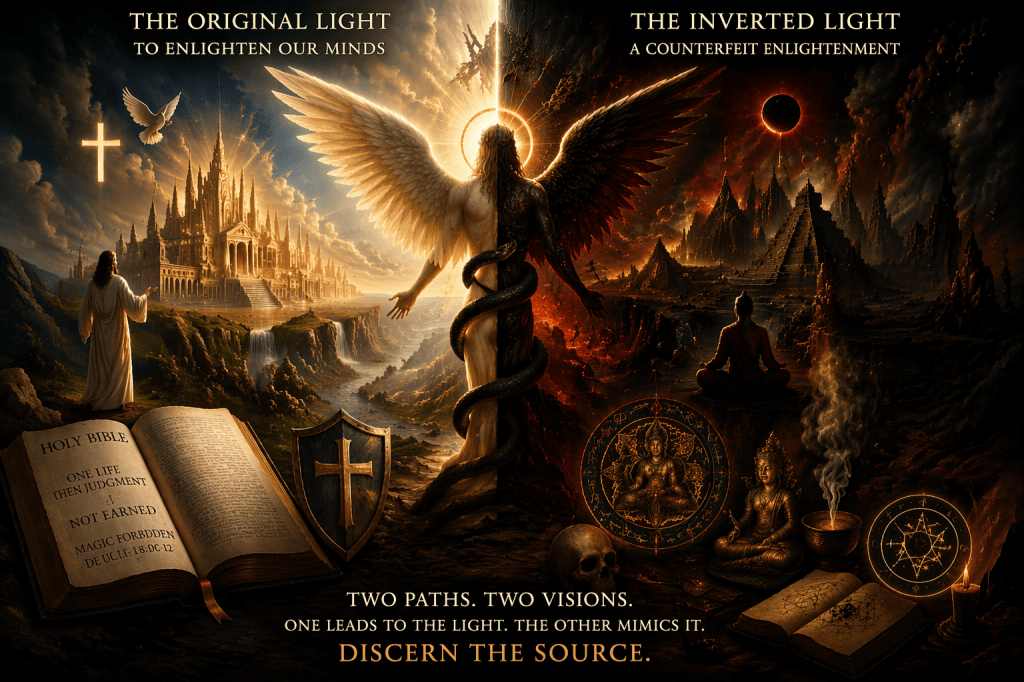
That line intrigued me because if Lucifer’s original function was to enlighten, and he rejected that role in rebellion against God, then a natural question follows: What would a fallen angel do with that original mandate?

The Inversion Principle

Later in the same interview, Fr. Ripperger describes something even more striking:

“Beelzebub is the inversion of the Holy Spirit. Lucifer is the inversion of [Christ] the Second Person of the Trinity… And Satan is the ‘Father of Lies,’ so the inversion of God the Father. So you basically have this unholy trinity.”

If that’s true, then inversion isn’t incidental but structural and Lucifer’s rebellion becomes a mirroring, a distortion, and a counterfeit. What if Lucifer didn’t abandon his original assigned task of enlightening, but instead inverted it? What if instead of leading minds toward truth, he developed systems that simulate enlightenment while directing souls away from God?

A Familiar Word: Enlightenment

The word itself appears across a wide range of esoteric and mystical traditions such as Buddhist tantra, certain strands of Freemasonry, occult systems, and various Eastern philosophies.

But what does “enlightenment” mean in each context?

In Christianity, truth is revealed by God and received through grace, but in many esoteric systems, enlightenment is something achieved, often through hidden knowledge, ritual, and disciplined technique. In tantric traditions, enlightenment involves engagement with spiritual forces or entities other than the Biblical God.

If a being like Lucifer wanted to draw souls away from God, not by force, but by deception, what would be the most effective strategy? Probably not obvious evil, but something that resembles truth while subtly redirecting it in a parallel system that is a convincing alternative. Wouldn’t he create a spiritual landscape that feels ancient and profound, but is ultimately oriented away from the Creator?

From that perspective, several contrasts begin to stand out:

1. Creator vs. Non-Creator Frameworks

Biblical Christianity affirms a personal God who created all things. Many non-theistic or differently structured systems do not center reality on a personal Creator, and may instead describe it as arising through interdependent processes or consciousness.

2. One Life vs. Many Lives

Christianity teaches that we live once and then face judgment. Traditions such as Tibetan Buddhism describe cycles of rebirth (samsara) across many lifetimes.

3. Grace vs. Technique

In Christianity, salvation is not earned but given. In esoteric systems, advancement is often tied to occult knowledge, initiation, and disciplined practice.

4. Prohibition of Magic vs. Ritual Use

The Bible consistently forbids sorcery and magical practice. Tantric traditions incorporate rituals, mandalas, invocations, and even practices described as subjugation or destruction of enemies.

That last point raises a difficult question: how do such practices relate to broader Buddhist teachings on compassion and non-harm?

5. Apostolic Succession vs. Spiritual Lineage

In Catholic Christianity, spiritual authority is understood to flow through apostolic succession: a historical, traceable line from Christ to the apostles and through the bishops of the Church. This succession is not merely symbolic; it is understood as a transmission of authority grounded in Christ Himself, preserved through sacrament and doctrine.

In Tibetan Buddhism and related traditions, there is also a strong emphasis on lineage. Spiritual authority and teaching are passed from guru to disciple in an unbroken chain, often tracing back to an enlightened master. In Tibetan Buddhist lineages it traces back to the Buddha himself. Initiation into practices, especially in tantric contexts, typically requires empowerment from someone within that lineage.

At a structural level, the resemblance is striking. Both systems emphasize continuity, transmission, and authorized access to deeper spiritual realities. But within the framework of inversion, the similarity itself becomes significant.

If Lucifer’s rebellion operates through mirroring and distortion rather than outright opposition, then a counterfeit system would not discard the idea of transmission but it would replicate it in altered form. Instead of a lineage grounded in divine revelation and safeguarded by the Church, one might expect a lineage grounded in esoteric knowledge, initiation, and experiential realization.

In that sense, what appears to be parallel structure could be interpreted as inversion: a system that retains the form of authorized transmission while redirecting its source and purpose.

Which leads to a deeper conclusion: if both claim lineage, continuity, and authority, you must discern the true source of that transmission, whether it originates from the Most High God or from something that imitates Him.

Are These Just Different Paths?

At this point, some might object: what if these are simply two different paths to the same ultimate reality? What if “God” in Christianity and “enlightenment” in other systems are just different expressions of the same truth? But that idea becomes difficult to sustain when the core claims directly contradict one another. A personal Creator who judges the soul is not the same as an impersonal reality with no creator. A single earthly life followed by judgment is not the same as endless cycles of rebirth. Grace given by God is not the same as enlightenment achieved through occult techniques. These are not minor differences but fundamentally opposed descriptions of reality. Within the framework of inversion, this matters. If one system is true, then a parallel system that contradicts it cannot simply be an alternative route to the same destination, it must lead somewhere else entirely.

The Question of Power

Another detail from the interview adds an important layer. Fr. Ripperger describes cases in which individuals gained accurate hidden knowledge through demonic influence:

“The demons would tell her, ‘This is what your husband’s doing,’ etc. And it was accurate… that’s how you know it’s true—it’s actually accurate.”

Accuracy, in itself, is not proof of goodness. Many systems, ancient and modern, promise access to hidden knowledge, insight, or power. But the deeper question is: what is the source of that knowledge?

A Counterfeit System?

If we follow this line of thought, a possibility emerges. A fallen angel, originally designed to enlighten, could create entire systems that:

  • Mimic divine structure
  • Offer real spiritual experiences
  • Provide accurate, but limited or misleading, knowledge
  • Encourage self-deification (“you will be like gods”)
  • And ultimately redirect worship, trust, and dependence away from the Biblical God

In that light, the serpent’s words in Genesis begin to look less like a one-time event and more like a recurring pattern:

“You will be like God.”

Not through obedience, but hidden knowledge, technique, and transformation.

Final Thought

If Lucifer’s original role was to enlighten, and he rejected God, then the question is not whether enlightenment exists. The question is where each path promising “enlightenment” ultimately leads.


Footnote:

  1. Interview with Tucker Carlson and Fr. Chad Ripperger:
    https://youtu.be/Of3ys0dmyYc?si=U630YmXL0sF0-C2-

From the Yellow Brick Road to the Rock of Peter: A Journey Back


I was raised in the Catholic faith. Its prayers, seasons, schools, and sacraments shaped my earliest understanding of the world. But as I grew older, the atmosphere changed and it started to feel foreign to me. After the upheavals in the liturgy and doctrine that followed the Second Vatican Council, everything became muted and seemed different. Gone was the mystery and ritual of the high Mass. What replaced it was grey and humdrum. As I embraced my mid-teens I felt like the Church had become unrecognizable. I was bored in Mass and began to question everything. I felt myself drifting, carried away by the freedom and experimentation of the post-Hippie generation.

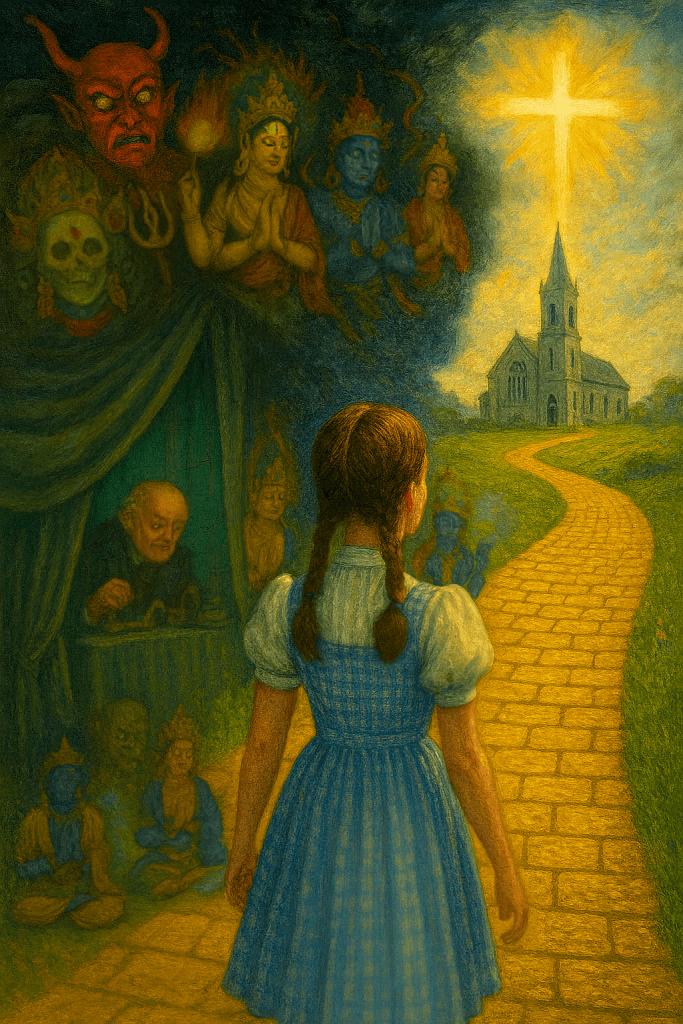
That search carried me far from the Church for more than three decades. As an adult I immersed myself in Tibetan Buddhism. Compared to the Catholicism I thought I had outgrown, this new path was exhilarating. The colorful symbols, rituals, exotic chanting, and promises of hidden knowledge shone bright like the Technicolor world Dorothy steps into after her house lands in Oz. Everything was vibrant and different. For a long time, I believed I had found a far richer spiritual universe than the one I had left behind.

As the years passed, I committed myself more deeply to Tibetan tantric Buddhism. Gurus, deities, and intricate ritual practices in long retreats promised transformation. I accepted men as guides who claimed they could lead me toward enlightenment. But slowly, over time, questions emerged. The yanas contradicted one another. The path began to feel less like liberation and more like entanglement in a feudal system with a hazy set of arcane laws. What had once seemed full of promise started to feel like a maze of deception.

The turning point came when I least expected it. Like Dorothy traversing the Emerald City, dazzled by spectacle, I had followed the yellow brick road as far as I could, believing I was approaching a transformative experience of enlightenment. And just as Dorothy eventually reaches Oz and pulls back the curtain, only to find a small man manipulating levers, I was forced to see behind the veil as well. The Root Guru I had trusted was revealed as a sorcerer, and the tantric deities I had once exalted no longer appeared as divine guides but as accusing, demonic forces. They became something like the scary flying monkeys that viciously attack Dorothy and her friends at one point. I suddenly realized that the impressive display I had put my faith in was only smoke and mirrors, and the powers behind it were not what they claimed at all, but actually fallen angels and their human minions.

That realization shook me to my core. In the very moment the illusion collapsed, a strange clarity emerged. I found myself remembering what I had learned as a child, what the Church had taught from the very beginning. The contrast between truth and imitation soon became unmistakable. What I had embraced as enlightened beings were nothing of the sort. Their nature did not align with the Most High God but with the very deceptive forces that the Bible warns against. I had spent years seeking hidden wisdom only to discover that the truth I needed had been with me since childhood. What a bizarre discovery after so many years of a life lived in error.

When I returned to the Catholic Church, I expected judgment or distance. Instead, I found the opposite. The Church received me with open arms, with the warmth of a parent waiting for a child who has been gone far too long. Over the years, thanks to Popes like John Paul II and Benedict, the Church regained some of its true colors that had been lost in the hasty rush to modernize. It now seemed sacramental and grounded in truth. I began to approach my re-version with the discerning mind of an adult hungry for knowledge. Gradually, a whole new world opened up to me and I was amazed that the truth of Christ’s sacrifice to humanity held new meaning after the horrors I had just lived through in the occult. Is the institution of the Catholic Church perfect? No. Its human side can fail, and at times it clearly has. Some say it is in crisis. Yet Christ promised, “You are Peter, and on this rock I will build my Church, and the gates of hell shall not prevail against it” (Matthew 16:18). That promise has become an anchor for me in these difficult times.

My journey through the many beguiling practices of Tibetan Buddhism taught me how convincing illusions can be. It taught me how eager the human heart is for spiritual novelty, and how easy it is to mistake mystical experiences for truth. The Catholic Church, which I once believed had lost its footing, proved steady after all. After thirty-five years away, I came home to the enduring Christian faith that had been guiding me from the beginning.

The Counterfeit Kingdom: How Occult Religions Imitate the Catholic Church

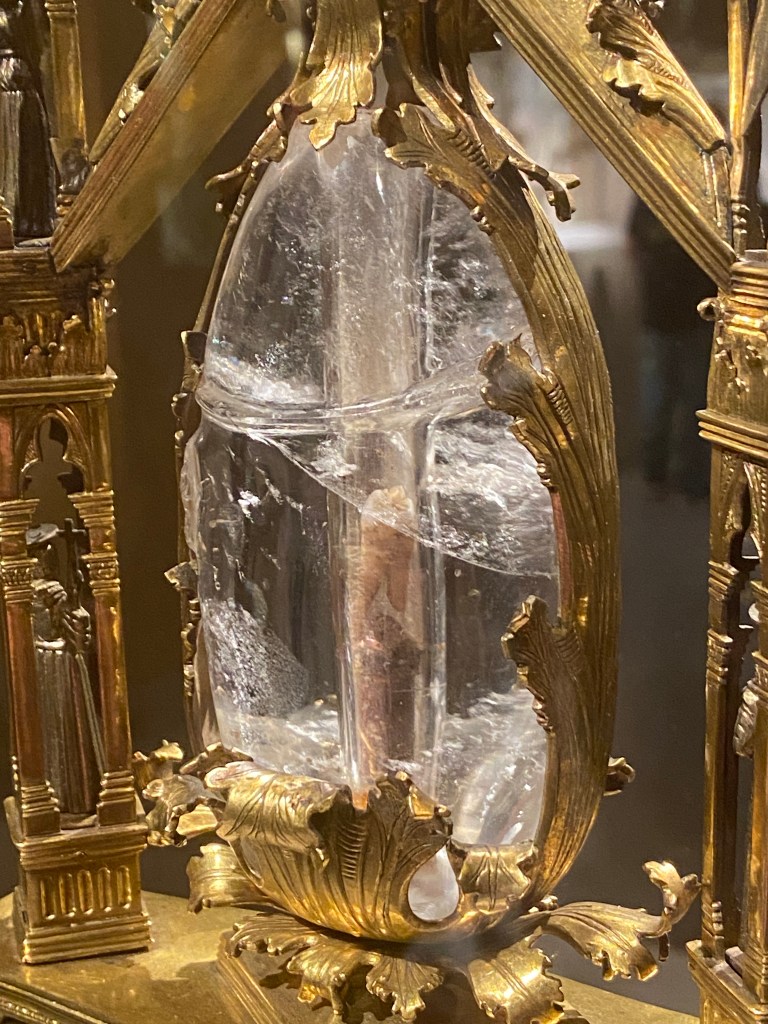
Relic of St. Mary Magdalene in the Metropolitan Museum, NYC


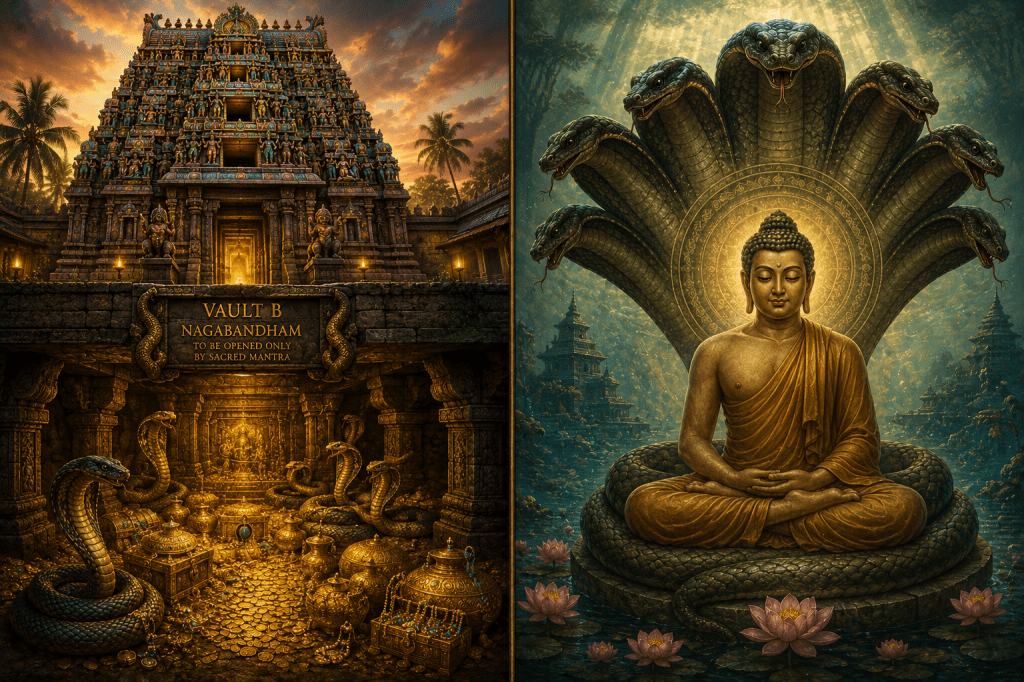
There is a strange and disturbing trend among occult and demonic religions, particularly within esoteric branches of Buddhism, such as Tibetan Vajrayana. These traditions go to great lengths to mimic, distort, and counterfeit elements of the Catholic faith. Why? Because Satan has no creativity of his own. His kingdom is one of imitation, distortion, and inversion. And when we look closer, it becomes chillingly clear: many of these occult systems are designed as spiritual forgeries, imitating the truths of the Catholic Church while replacing Christ with false gods and demons.

Here are just a few examples.


Relics: Holy vs. Unholy

In Catholicism, relics are a beautiful and reverent way the faithful connect with the saints in heaven. The bones, hair, and clothing of saints, when venerated properly, are physical reminders of lives of holiness and union with Christ. First-class relics (parts of a saint’s body), second-class relics (items the saint used), and third-class relics (objects touched to a first-class relic) are all part of an ancient, sacred tradition rooted in the Incarnation: God came in the flesh, and through His Body and those who share in His holiness, the physical becomes a channel of grace.

Now compare this to Tibetan Buddhism and other occult traditions.

Tibetan lamas preserve the bones and hair of deceased teachers and display them in shrines. In some cases, these relics are even mixed into pills or powders thought to convey “blessings” or spiritual power. Even more shockingly, there are “blood pills” created from the blood of high lamas, dried and consumed by devotees, believed to transfer the lama’s blessing and heal the disciples’ illnesses.

What we see here is not simply reverence for a teacher but an occult inversion of the sacred. These objects are treated as talismans or sources of supernatural power, often wrapped in secrecy, ritual, and magical thinking.


Apostolic Succession vs. Tantric Lineage

The Catholic Church has an unbroken apostolic lineage going back to Christ Himself. This is not just symbolic but the real spiritual authority passed from bishop to bishop, from the Apostle Peter to the present-day pope. The sacraments are valid because of this lineage. The Holy Spirit moves through it, not because of magical powers or personal charisma, but because of Christ’s promise to His Church.

Tibetan Buddhism, too, places massive emphasis on “lineage” in the passing of initiations, teachings, and realizations from teacher to student. They claim these go back to the historical Buddha, Sakyamuni. But here’s the problem: the tantras, the core of Tibetan esoteric practice,did not exist during Sakyamuni Buddha’s life. These were later developments, many of which emerged between the 5th and 10th centuries AD, centuries after the Buddha died.

So how do they justify their claims? Through visions, dream revelations, hidden treasure texts (termas), and secret transmissions from spirit beings. These are not testable or historically verifiable. Instead, they mimic the structure of apostolic succession while relying on supernatural claims rooted in occultism. It’s a counterfeit version of Catholic apostolic lineage, one that replaces the Holy Spirit with “dakinis,” “protectors,” and wrathful spirits.


Blessed Sacrament vs. Tantric Empowerments

In the Catholic Church, the Eucharist is the Real Presence of Jesus, body, blood, soul, and divinity. It is the highest form of worship and union with God. Only validly ordained priests can consecrate the Host, and it is surrounded with reverence and liturgy.

IIn tantric Buddhism, “empowerments” are elaborate rituals meant to grant spiritual powers, open energy channels, and “ripen” the disciple for advanced practices. They are sometimes sexually charged, invoking deities (who are really demons in disguise), and can involve ingesting “nectars,” or entering into trance states. Many initiations are based on “secret” transmissions, whispered lineages, or magical seals. These seals are believed to imprint a spiritual mark or bind the practitioner to a specific deity, practice, and lineage. But this is not unique to Tibetan Buddhism. Magical seals are also found in Satanism, Luciferianism, and ceremonial magic, where they are used to summon or bind spirits and demons in exchange for occult knowledge, power, or protection. These seals are spiritual contracts or expressions of unseen allegiances, and their use is never neutral. They are tools of spiritual manipulation that open the soul to influence, possession, or bondage by demonic spirits. In these traditions, the seal acts as a gateway or portal, and it is binding, a counterfeit version of the indelible mark left by the Holy Spirit in baptism or confirmation. Where the Church seals the faithful with chrism and the sign of the cross, occult traditions seal their initiates with marks of spiritual enslavement.

Chrism refers to a consecrated oil used in the Catholic Church during certain sacraments, specifically Baptism, Confirmation, and Holy Orders. It is a mixture of olive oil and balsam, blessed by a bishop during Holy Week.

The use of chrism is deeply symbolic:

  • It represents the Holy Spirit and divine anointing.
  • It marks the person as set apart for God, sealed with grace and incorporated into Christ.
  • The anointing with chrism leaves an indelible spiritual mark on the soul, which can never be removed.

The tantric empowerments claim to transform the practitioner’s body, speech, and mind into that of a deity but again, this is a counterfeit. Instead of communion with God through grace, it’s the deification of the self through ritual manipulation and demonic assistance.


The Church Triumphant vs. the Pantheon of Demons

Catholics honor the communion of saints, those in heaven who intercede for us and serve as models of holiness. Saints are not worshipped; they are venerated. The glory always goes to God.

Tibetan Buddhism features a dizzying pantheon of “yidams” (meditational deities), “protectors,” and “enlightened deities” that are summoned, visualized, and sometimes merged with through complex meditations. These include wrathful, terrifying figures in colors of blue, red, and black, with fangs, skulls, and weapons, dripping with blood or dancing on corpses. Vajrayogini, for example, is often visualized standing on a human corpse, holding a flayed skin and drinking from a skull cup. Although these are claimed to be symbols of transcendence, they are actually demonic imitations of holiness.


Satan’s Strategy: Imitation, Not Innovation

Why does the enemy copy the Church? Because the Catholic Church is the true Bride of Christ. Satan can’t create truth, but he can twist it. His most dangerous weapons are not outright lies, but distorted half-truths wrapped in spiritual language. He dresses up darkness to look like light.

Tibetan Buddhism and similar occult systems offer spiritual hierarchy, ritual, relics, and transmission, but without Christ. They offer communion, but with spirits and demons. They offer transformation, but into false gods, not saints.


The Real Power: Jesus Christ

There is no substitute for the true power of God through Jesus Christ. No blood pill, no tantric lineage, no magical empowerment can wash away sin or bring eternal life. Only Christ, crucified and risen, can do that.

For those who have been caught up in these counterfeit systems, whether through curiosity, spiritual seeking, or deception, it is important to remember that there is hope and it is possible to extricate oneself. Jesus is the Way, the Truth, and the Life and his truth is not hidden in secret teachings or passed down in esoteric rituals. It is freely offered to all who repent and believe.