
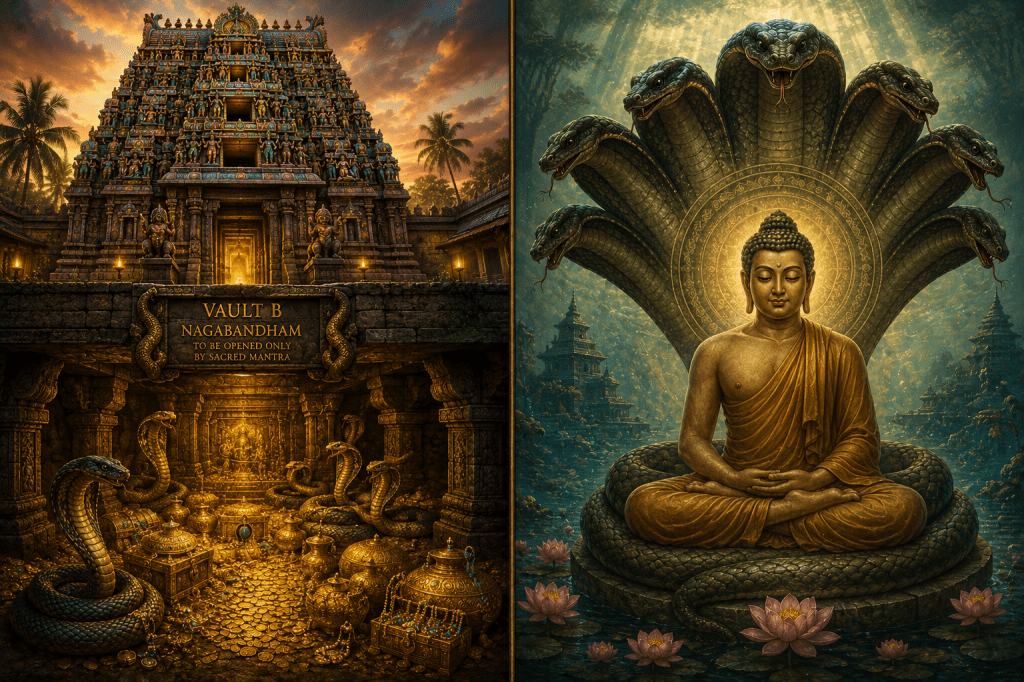
Serpents Guardians: Gold, Secrets, and Esoteric Knowledge


A recent conversation led me down an interesting rabbit hole involving snakes, hidden treasure, and religious mythology.

I was told about the famous Sree Padmanabhaswamy Temple in Kerala, India, one of the wealthiest temples in the world. The temple is said to contain underground vaults filled with immense quantities of gold, jewels, and priceless artifacts accumulated over centuries.

One vault in particular, known as Vault B, has become the center of extraordinary legends. According to local traditions, the vault is protected by divine serpents called Nagas. Some believe the door is sealed through a mystical process known as Nagabandham, a serpent binding that can only be undone through the correct sacred mantra. Stories claim that previous attempts to enter the vault were thwarted by swarms of snakes or supernatural forces.

One important distinction should be made. The immense wealth of the Sree Padmanabhaswamy Temple is well documented. Inventories conducted in recent years did indeed reveal vast wealth. Reports of snakes inhabiting areas beneath and around the temple are unsurprising in Kerala’s tropical environment. The claim that divine serpent beings guard Vault B, however, belongs to the realm of local belief rather than established historical fact. Yet whether actual divine snakes ever protected the vault is not really the point. What matters is the symbolism. Why are serpents so often imagined as guardians of hidden treasure and restricted access?

The story immediately reminded me of a well-known tradition within Mahayana Buddhism. According to Buddhist legend, certain advanced teachings of the Buddha were hidden away and entrusted to the Nagas, divine serpent beings who preserved them beneath the waters until humanity was ready to receive them. Centuries later, the philosopher Nagarjuna is said to have recovered these teachings from the realm of the Nagas, revealing what became an important portion of the Mahayana sutra corpus.

Here we find the same pattern. The serpent stands between ordinary people and something valuable. Whether the treasure is gold or wisdom, access is restricted and guarded by serpents.

The motif also appears at another temple in Kerala, the Mannarasala Sree Nagaraja Temple. This is one of the most famous centers of serpent worship in India. Thousands of serpent images cover the grounds, and the Nagas are revered as powerful spiritual beings associated with fertility, protection, and prosperity.

To many Westerners, the idea of worshipping snakes sounds strange, even heretical. Yet serpent veneration is remarkably widespread throughout human history. In ancient Egypt, the cobra symbolized royal power. In Greece, serpents were associated with healing and divine wisdom. In Mesoamerica, the feathered serpent was a major deity. In Hindu traditions, Nagas appear as guardians of rivers, treasures, temples, and sacred knowledge.

From Hidden Treasure to Hidden Revelation

The serpent motif becomes even more interesting when viewed through the lens of esoteric traditions. In many forms of Tantra, practitioners are told that the highest teachings are secret. They are said to be too powerful, too dangerous, or too profound for ordinary people. Access requires initiation and a proper guru capable of imparting an authentic transmission. The disciple must also be deemed worthy to receive it.

The tantric teachings of Tibetan Buddhism are among the most advanced and esoteric in the Buddhist world, but Vajrayana Buddhism incorporates the Mahayana corpus as well. According to traditional accounts both the Mahayana and Vajrayana texts appear centuries after the Buddha’s death.

The Mahayana story of the Nagas preserving hidden sutras raises obvious questions. How can anyone verify that teachings supposedly hidden by supernatural beings for centuries actually originated with the Buddha? The narrative places the evidence beyond examination. There is a circular logic to it: the teachings are authentic because they were hidden, and they were hidden because they were authentic.

Revelation alone, however, is not evidence of authenticity. A hidden teaching is not necessarily profound, and a secret lineage is not necessarily legitimate. Once knowledge is declared inaccessible to outsiders or protected by supernatural forces, verification becomes difficult and trust in the gatekeepers takes its place.

From a Christian perspective, the symbolism becomes even more striking. Throughout the Bible, the serpent is rarely a guardian of divine truth. It is the serpent in Eden who introduces hidden knowledge and promises secret wisdom that God has supposedly withheld. The pattern is familiar: access to a higher truth is offered through an alternative source, apart from the revelation God has openly given.

This stands in sharp contrast to Christianity itself. The Gospel was not hidden in underground vaults, guarded by serpents, or reserved for a spiritual elite. Christ taught publicly. His apostles preached openly. The faith was handed down through public witness, not secret initiations. While Christianity contains mysteries that challenge human understanding, it does not claim that salvation depends upon access to concealed doctrines available only to a select few.

Seen through this lens, traditions that portray serpents as guardians of occult wisdom raise an important question. If truth requires secret initiations, hidden transmissions, or teachings protected from scrutiny, how can its claims be tested? For Christians, the measure of a teaching is not its secrecy, antiquity, or mystical origin story. It is whether it conforms to the revelation God has given through Scripture and Sacred Tradition. The recurring image of serpents guarding hidden knowledge may therefore serve as more than a mythological motif. It can also be seen as a warning about the perennial temptation to seek secret wisdom apart from the truth God has already revealed. In that sense, the serpent remains what it was in Eden: a symbol not of divine revelation but of spiritual deception, enticing humanity with promises of hidden knowledge while leading it away from God and into error.

When Spirits Enter: Comparing Vajrayana Empowerment with Western Occult Initiation

Both Vajrayana and Luciferian rites use geometric portals to invoke spiritual forces and what comes through may not leave easily.


Follow-up to: “The ‘Hidden’ Truth of Vajrayana Empowerment: Does the Lama Implant a Deity into the Disciple’s Mind?”

Following the previous article “The ‘Hidden’ Truth of Vajrayana Empowerment,” which exposed how Tibetan tantric initiation involves the lama implanting a deity into the disciple’s mind-stream, this follow-up explores how that same core process, spiritual implantation, appears in Western occult and Satanic initiation rites. Though culturally and theologically distinct, both systems describe a mystical transformation in which the aspirant is indwelt, overshadowed, or spiritually fused with a nonhuman being. The parallels are striking, and the implications for unsuspecting spiritual seekers are sobering.

Union Through Inhabitation

In Vajrayana Buddhism, the empowerment ritual is designed to activate the disciple’s Buddha-nature by personifying it as a specific deity. This process is not symbolic; it requires the intervention of the guru, who performs a series of initiations (vase, secret, wisdom, and word) that culminate in the wisdom deity entering the disciple’s visualized form. Sam van Schaik and other scholars describe this as a fusion of two minds: the practitioner becomes “in union” with the deity.¹ Light or energy entering the heart symbolizes this transmission, and classical sources like Vilāsavajra² and Jamgön Kongtrul³ confirm that the deity’s presence is meant to take root within the initiate.

This process mirrors what takes place in various forms of Western occult initiation. Whether in ceremonial magic, Luciferian practice, or Thelemic rites, the aspirant invites a spiritual entity, sometimes framed as a “higher self” and other times as a demon or god-form, to inhabit or fuse with their consciousness.⁴ In certain traditions, this is done under the guise of awakening one’s divine essence or ascending the Tree of Life, but the mechanics remain: the person is inviting another spiritual will to merge with their own.

The Role of the Officiant

In Vajrayana, only a qualified guru can perform the empowerment. The lama must have realization of the deity in order to transmit it, effectively serving as a channel through which the deity is implanted into the disciple. The disciple cannot access the highest yoga tantra deity alone; it must come through the guru.⁵

In Western occultism, the structure is more flexible. In ceremonial lodges like the Golden Dawn, initiation is conferred by a hierarchy of initiates. In solitary or Luciferian paths, the practitioner may self-initiate, performing a ritual to invoke and receive a spiritual entity directly.⁶ This difference, hierarchical transmission versus self-directed invocation, changes the form but not the essence of what is happening: a spiritual being is invited in.

Seed and Possession

Both traditions speak of what can be described as a spiritual seed taking root in the initiate. In Vajrayana Buddhism this is the seed of the deity that is implanted through ritual and nurtured by mantra and visualization, growing into full enlightenment.⁷ In occult traditions, similar metaphors abound: the Black Flame (Luciferianism), divine spark (Gnosticism), or magical current (Thelema) all describe a presence awakened or implanted within the practitioner.⁸

Possession or identity fusion is not merely metaphorical in either tradition. In Vajrayana, the practitioner becomes the deity in practice and visualization. In Western occultism, invocation or evocation may result in the spirit speaking through the practitioner, taking partial or full control.⁹ The aspirant may not merely visualize the entity; they may be inhabited by it.

Theological Framing

Here is where the surface similarities give way to deeper concerns. Vajrayana presents this union as sacred and salvific. The deities are said to be manifestations of enlightened mind, and the process is aimed at liberation from suffering.

In contrast, many Western occult traditions embrace the transgressive nature of the ritual. In Luciferian and Satanic paths, the union with a spiritual being is framed as an act of rebellion, empowerment, or divinization.¹⁰ Even in systems that use angelic or archetypal language, the goal is often gnosis independent of God, power over nature, or rejection of traditional morality.

From a Christian theological perspective, both processes, however cloaked in cultural or religious language, involve the opening of the soul to spiritual beings not of God.¹¹ Whether the entity is labeled as a deity, guardian angel, or inner Buddha, the core act is the same: inviting possession or fusion with a nonhuman intelligence. Exorcists describe demons as “persons without bodies.”

Deliberate Secrecy vs. Ritual Transparency

Another key difference lies in disclosure. Vajrayana does not typically explain to new initiates that the lama will implant the deity into their mindstream. This is concealed under layers of euphemisms, talk of “blessings,” “inspiration,” or “awakening Buddha-nature”.¹² Western occultism, by contrast, often acknowledges its aims more directly. A Luciferian magician knows they are invoking Lucifer. A Thelemite understands the goal is Knowledge and Conversation with a higher being.¹³

But the result is no less dangerous. Both systems involve entering into a spiritual relationship that can dominate or override the practitioner’s will. From a Christian point of view, these are not symbolic practices but acts of spiritual surrender and potentially, spiritual bondage.

Conclusion: Two Paths, One Mechanism

While Vajrayana tantra and Western occultism differ in terminology, mythos, and cultural packaging, they share a core mechanism: a ritual invitation for a spiritual being to enter the initiate’s consciousness. Whether masked as deity yoga or celebrated as demonic possession, the outcome is the same: identity fusion with a nonhuman spirit.

The true danger lies not only in the act itself but in the lack of informed consent. Many Vajrayana practitioners never fully understand what they’ve opened themselves to until it’s too late. And many occultists, lured by the promise of empowerment, mistake possession for enlightenment.

As explored on this blog, the deeper deception is the true nature of “possession” rituals versus how they are presented. Spiritual seekers deserve the truth: that these practices, whether called empowerment or initiation, are not harmless techniques for personal growth and transcendence. They are open doors: both Vajrayana and Luciferian rites use geometric portals to invoke spiritual forces and what walks through may not be your friend or leave easily.


Sources

  1. Sam van Schaik, “The Limits of Transgression: The Samaya Vows of Mahāyoga” (2010).
  2. Vilāsavajra, Hevajra Tantra Commentary, excerpts found in Mahāyoga textual studies.
  3. Jamgön Kongtrul, The Treasury of Knowledge, Book Eight, Part Three.
  4. Aleister Crowley, Magick in Theory and Practice; Michael Ford, Luciferian Witchcraft.
  5. Ngawang Phuntsok, On Receiving Wang (Empowerment).
  6. Israel Regardie, The Golden Dawn: A Complete System of Magic.
  7. Dalai Lama, Kalachakra Initiation Teachings; traditional commentaries on empowerment.
  8. Michael W. Ford, Apotheosis: The Ultimate Beginner’s Guide to Luciferianism.
  9. Kenneth Grant, The Magical Revival; practices in chaos and ceremonial magic.
  10. Anton LaVey, The Satanic Bible; Ford, Dragon of the Two Flames.
  11. Catechism of the Catholic Church, paragraphs 2116–2117.
  12. Scott Globus, “Empowerments: Awakening the Buddha Within,” Rubin Museum, 2021.
  13. Aleister Crowley, The Vision and the VoiceLiber Samekh.