

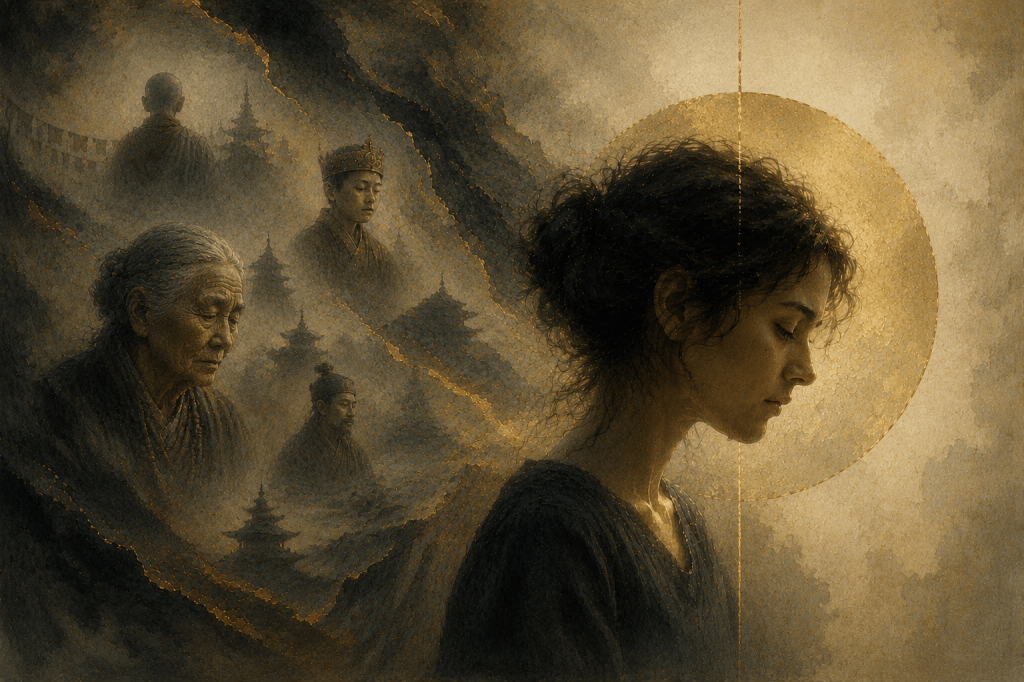
One of the most difficult beliefs for me to relinquish when leaving Tibetan Buddhism was reincarnation.
Unlike many other Buddhist teachings that gradually fell away as I examined them through a lived Christian lens, reincarnation presented a unique challenge. It seemed to be supported not only by doctrine but also by personal testimony, stories of remembered past lives, and the long tradition of reincarnated lamas recognized within Tibetan Buddhism. For years, I had accepted it as an unquestioned fact about reality.
Yet as I moved toward Christianity, I encountered a problem that could not be ignored. Christianity and the doctrine of reincarnation cannot both be true.
The Christian understanding of the human person is fundamentally incompatible with the Buddhist doctrine of repeated rebirth. Christianity teaches that each human being is uniquely created by God, lives one earthly life, dies, and then faces judgment. Reincarnation teaches an ongoing cycle of repeated births and deaths extending across countless lifetimes. The two views are mutually exclusive.
As I began to heal through Christianity, I became convinced that the faith was true. If Christianity is true, then reincarnation cannot be. But what, then, should I make of all the evidence that seemed to support it? This question stayed with me for years.
Early in my conversion, a Catholic priest suggested a possible answer. More recently, I heard a similar explanation discussed during an online group conversation. The idea was simple, yet it provided a framework that resolved many of the difficulties I had struggled with.
What if the memories are real, but they do not belong to the person experiencing them?
From a Christian perspective, demonic spirits are intelligent beings whose existence extends far beyond the lifespan of any individual human being. They observe human lives, accumulate knowledge, and seek to deceive. If such entities can influence human consciousness, as the Catholic Church teaches and exorcists regularly attest, then apparent memories of previous lives need not originate from a former incarnation. They may instead originate from the spirit influencing or possessing the person.
In that framework, what people interpret as reincarnation is not the return of a deceased human soul to earthly life. Rather, it is a demonic spirit carrying memories, experiences, and knowledge accumulated through previous individuals it has influenced or possessed over time. The continuity exists within the demonic spirit itself. The same entity carries memories from one person to another, presenting them as evidence of reincarnation. The recipient naturally concludes that he has lived before because he is experiencing memories that seem personal and immediate. In reality, the memories originate from another source.
This possibility becomes particularly interesting when examining traditions that identify certain individuals as the reincarnations of previous spiritual masters. In Tibetan Buddhism, reincarnated lamas are often recognized through a combination of signs, including unusual knowledge, recognition of objects belonging to a deceased teacher, personality traits, reported memories of a previous life, and other indications of continuity with an earlier lama. The standard explanation is that the lama’s consciousness has returned in a new body. From the perspective I am describing, however, the phenomenon could be understood differently. What appears to be continuity between human souls may instead reflect the activity of the same spiritual entity manifesting through successive individuals.
Viewed in this light, reincarnation becomes a profound deception. The individual concludes that he has lived many lives when he is actually encountering memories that belong to a spiritual entity rather than to himself.
Looking back, stories about the past lives of lineage masters were among the most persuasive arguments for adopting the beliefs of Tibetan Buddhism. They convinced me that the religion possessed evidence that Christianity could not explain.
This interpretation also sheds light on why reincarnation narratives so often reinforce particular spiritual systems. The memories do not merely provide information about a supposed former life. They frequently validate larger theological claims about karma, lineage, enlightenment, and the authority of certain teachers and traditions. They make it easier to dismiss the Christian account of creation, human nature, and salvation. The experience of past lives itself becomes a powerful mechanism for persuading individuals that the worldview surrounding it must be true.
From a Christian perspective, this possibility should not be dismissed lightly. Scripture repeatedly warns that spiritual deception is real. The serpent’s temptation in Eden was not an invitation to obvious evil. It was an invitation to hidden knowledge. The promise was that human beings could gain wisdom through an alternative source rather than trusting the revelation God had already provided.
The Church has not formally taught this specific explanation for apparent past-life memories, and I therefore present it as theological speculation rather than established doctrine. Nevertheless, it remains the most coherent explanation I have encountered, one that preserves both the Christian rejection of reincarnation and the reality of spiritual deception.
The insight that finally resolved this issue for me was remarkably simple: the memories may be real, but they do not belong to the person experiencing them. If that is true, then some of the strongest evidence offered for reincarnation may not point to previous human lives at all. Instead, it may reveal the activity of deceptive spiritual entities that exploit the appearance of past lives in order to draw human beings away from the truth revealed in Jesus Christ.
 Tantric Deception
I also practiced Tibetan Vajrayana Buddhism for ten years, but fortunately I did not make any kind of commitment to any teacher, I never chose none of them as a Guru and I was able to leave it unharmed. Although I did not have any kind of problem with teachers or the sangha in itself, my intuition was constantly telling me that something wasn’t right. In due time, I realised that many people in the sangha were living an impure life, drinking alcohol, using drugs, giving themselves to promiscuity and eating meat. Their behaviour were everything Siddharth Gautama condemned. The breaking point for me was the day when I saw the resident lama drinking alcohol, and when I was helping as a volunteer in the kitchen, the main attendant of the lama was cooking one of the favourite dishes of the lama, Foie Gras, which is duck liver obtained through extreme cruelty, long story short, there was no compassion but hypocrisy was abundant. I’ve been vegetarian for 25 years, I’m celibate and I never used drugs, I also don’t drink alcohol. I have a degree in Asian studies and I also studied compared religion, therefore I would like to share some informations with you.
The first thing is that most part of Westerners are not fit for these spiritual practices due to wrong habits and contamination, a large number of them have a common past involving drug use, promiscuity and meat consumption. They should first be put to purify themselves through fasting and other practices before engaging in certain sadhannas.
The second thing is that for many Tibetans, their religion became their main source of income, the lamas and their communities depend on the income generated through retreats, empowerments, books, teachings, selling of religious art and ritual itens. Although there were some genuine teachers in the past, most part of them lowered the bar in order to accept unqualified students.
The third thing are the delusional expectations created by students who get in these Buddhist sanghas expecting comfort and validation, unfortunately Buddhism in the west has been corrupted by certain leftist political ideologies and it really made everything worse. We need to change ourselves because of the spiritual path, not the other way around, otherwise what’s the point of engaging in it? We should have compassion for others, listen to them and help if possible, but it’s quite different from having a permissive attitude which became a common pattern in many Buddhist Sanghas in the West, a sangha is not a country club nor a form of therapy. Many people fail to see that these Lamas and their sanghas are basically mirroring the cultural and particular behaviour of their students.
Regarding this post about reincarnation, It’s impossible to imagine a good and loving God who would create souls to suffer for no reason. Why would God give children to Hindu and Tibetan Buddhist parents if they will follow a “demonic” spiritual path? Why would God give children to some isolated tribe in the middle of Amazon forest or in the middle of nowhere in Africa where they will never learn about Jesus? Of course, it doesn’t make sense.
Why would an all powerful, omniscient God permit the existence of Satan who make souls fall?
I studied Christianity in both Catholic and orthodox churches, the Catholic Bible has 73 books, the orthodox 81, the Ethiopian which is orthodox as well could have 88. Who is right and who is wrong?
Were the church fathers really able to comprehend Jesus teachings?
As an European born in a half Catholic and half Jewish family I also studied abrahamic traditions. I studied Judaism and Kabbalah, in Kabbalah the interpretation of the Bible is really interesting and makes much more sense, there is a large number of Jews who believe in reincarnation, including orthodox ones.
According to Kabbalists, Adam and Eve are polarities of the soul, Satan is the prosecutor who test us with God’s permission in order to make us stronger and expand our consciousness.
Theosophy was also really interesting for me, and I learned a lot from it.
I’m sorry for everything you went through, I also had to deal with a huge amount of sadness and disappointment after realising the situation of Tibetan Buddhism. But, I don’t think Yoga and meditation are “demonic”.
Hatha Yoga and traditional meditation helped me to recover, and I still practice it, all yamas and nyamas are a valid system of principles and morals, the map of chakras and Nadis are really helpful, but unfortunately it’s really rare to find a good and properly qualified spiritual teachers in any spiritual path nowadays, it doesn’t matter if it’s Christian traditions, Judaism, Buddhism or Sanatana Dharma (Hinduism).
I do believe in Karma and reincarnation, all spiritual practices will culminate with a strong karmic event or events to release us in order to assist and make our spiritual progress quicker, usually in the form of sickness, external events and so on. It’s a common pattern in the lives of saints of different religions.
If Buddha, Jesus, Moses and other spiritual masters were alive today, would they want to follow Buddhism, Christianity and so on? That’s a good question to reflect about.
Deep inside, we all want the magic, the transformation, an angel sent by God to transform our lives, but everything depends on the will of God alone, only God can determine when and how, meanwhile, we have to continue going forward, meditating, praying, looking inside to transform bad tendencies, help others.
Personally, I don’t see myself following any particular religion anymore, especially after seeing certain patterns of behaviours across all religious traditions, but I will continue to follow the moral and spiritual principles common to them all, and I do believe in God.
I really pray and hope that you can find your inner balance, peace and Divine connection.
LikeLike