

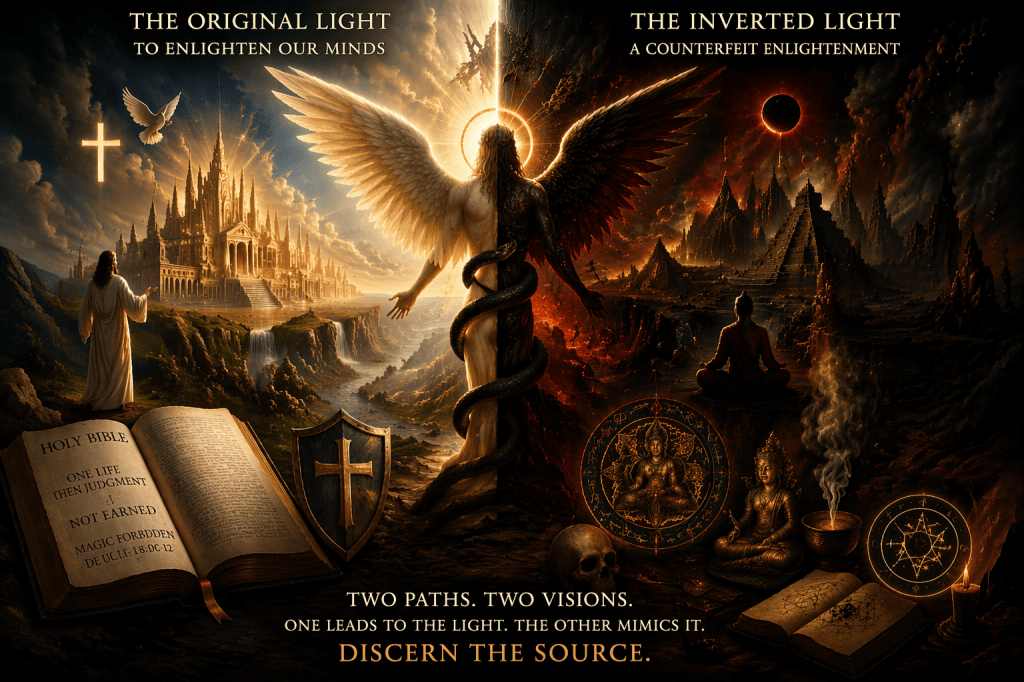
There was a moment in a recent interview with the Catholic exorcist Fr. Chad Ripperger that struck me. [1]
While speaking about Satan he said,
“Lucifer was his originally assigned name. “Lucifer” comes from a root meaning “to bear light.” He was supposed to enlighten our minds, that was his originally assigned task, and he refused to do so.”
That line intrigued me because if Lucifer’s original function was to enlighten, and he rejected that role in rebellion against God, then a natural question follows: What would a fallen angel do with that original mandate?
The Inversion Principle
Later in the same interview, Fr. Ripperger describes something even more striking:
“Beelzebub is the inversion of the Holy Spirit. Lucifer is the inversion of [Christ] the Second Person of the Trinity… And Satan is the ‘Father of Lies,’ so the inversion of God the Father. So you basically have this unholy trinity.”
If that’s true, then inversion isn’t incidental but structural and Lucifer’s rebellion becomes a mirroring, a distortion, and a counterfeit. What if Lucifer didn’t abandon his original assigned task of enlightening, but instead inverted it? What if instead of leading minds toward truth, he developed systems that simulate enlightenment while directing souls away from God?
A Familiar Word: Enlightenment
The word itself appears across a wide range of esoteric and mystical traditions such as Buddhist tantra, certain strands of Freemasonry, occult systems, and various Eastern philosophies.
But what does “enlightenment” mean in each context?
In Christianity, truth is revealed by God and received through grace, but in many esoteric systems, enlightenment is something achieved, often through hidden knowledge, ritual, and disciplined technique. In tantric traditions, enlightenment involves engagement with spiritual forces or entities other than the Biblical God.
If a being like Lucifer wanted to draw souls away from God, not by force, but by deception, what would be the most effective strategy? Probably not obvious evil, but something that resembles truth while subtly redirecting it in a parallel system that is a convincing alternative. Wouldn’t he create a spiritual landscape that feels ancient and profound, but is ultimately oriented away from the Creator?
From that perspective, several contrasts begin to stand out:
1. Creator vs. Non-Creator Frameworks
Biblical Christianity affirms a personal God who created all things. Many non-theistic or differently structured systems do not center reality on a personal Creator, and may instead describe it as arising through interdependent processes or consciousness.
2. One Life vs. Many Lives
Christianity teaches that we live once and then face judgment. Traditions such as Tibetan Buddhism describe cycles of rebirth (samsara) across many lifetimes.
3. Grace vs. Technique
In Christianity, salvation is not earned but given. In esoteric systems, advancement is often tied to occult knowledge, initiation, and disciplined practice.
4. Prohibition of Magic vs. Ritual Use
The Bible consistently forbids sorcery and magical practice. Tantric traditions incorporate rituals, mandalas, invocations, and even practices described as subjugation or destruction of enemies.
That last point raises a difficult question: how do such practices relate to broader Buddhist teachings on compassion and non-harm?
5. Apostolic Succession vs. Spiritual Lineage
In Catholic Christianity, spiritual authority is understood to flow through apostolic succession: a historical, traceable line from Christ to the apostles and through the bishops of the Church. This succession is not merely symbolic; it is understood as a transmission of authority grounded in Christ Himself, preserved through sacrament and doctrine.
In Tibetan Buddhism and related traditions, there is also a strong emphasis on lineage. Spiritual authority and teaching are passed from guru to disciple in an unbroken chain, often tracing back to an enlightened master. In Tibetan Buddhist lineages it traces back to the Buddha himself. Initiation into practices, especially in tantric contexts, typically requires empowerment from someone within that lineage.
At a structural level, the resemblance is striking. Both systems emphasize continuity, transmission, and authorized access to deeper spiritual realities. But within the framework of inversion, the similarity itself becomes significant.
If Lucifer’s rebellion operates through mirroring and distortion rather than outright opposition, then a counterfeit system would not discard the idea of transmission but it would replicate it in altered form. Instead of a lineage grounded in divine revelation and safeguarded by the Church, one might expect a lineage grounded in esoteric knowledge, initiation, and experiential realization.
In that sense, what appears to be parallel structure could be interpreted as inversion: a system that retains the form of authorized transmission while redirecting its source and purpose.
Which leads to a deeper conclusion: if both claim lineage, continuity, and authority, you must discern the true source of that transmission, whether it originates from the Most High God or from something that imitates Him.
Are These Just Different Paths?
At this point, some might object: what if these are simply two different paths to the same ultimate reality? What if “God” in Christianity and “enlightenment” in other systems are just different expressions of the same truth? But that idea becomes difficult to sustain when the core claims directly contradict one another. A personal Creator who judges the soul is not the same as an impersonal reality with no creator. A single earthly life followed by judgment is not the same as endless cycles of rebirth. Grace given by God is not the same as enlightenment achieved through occult techniques. These are not minor differences but fundamentally opposed descriptions of reality. Within the framework of inversion, this matters. If one system is true, then a parallel system that contradicts it cannot simply be an alternative route to the same destination, it must lead somewhere else entirely.
The Question of Power
Another detail from the interview adds an important layer. Fr. Ripperger describes cases in which individuals gained accurate hidden knowledge through demonic influence:
“The demons would tell her, ‘This is what your husband’s doing,’ etc. And it was accurate… that’s how you know it’s true—it’s actually accurate.”
Accuracy, in itself, is not proof of goodness. Many systems, ancient and modern, promise access to hidden knowledge, insight, or power. But the deeper question is: what is the source of that knowledge?
A Counterfeit System?
If we follow this line of thought, a possibility emerges. A fallen angel, originally designed to enlighten, could create entire systems that:
- Mimic divine structure
- Offer real spiritual experiences
- Provide accurate, but limited or misleading, knowledge
- Encourage self-deification (“you will be like gods”)
- And ultimately redirect worship, trust, and dependence away from the Biblical God
In that light, the serpent’s words in Genesis begin to look less like a one-time event and more like a recurring pattern:
“You will be like God.”
Not through obedience, but hidden knowledge, technique, and transformation.
Final Thought
If Lucifer’s original role was to enlighten, and he rejected God, then the question is not whether enlightenment exists. The question is where each path promising “enlightenment” ultimately leads.
Footnote:
- Interview with Tucker Carlson and Fr. Chad Ripperger:
https://youtu.be/Of3ys0dmyYc?si=U630YmXL0sF0-C2-

 Tantric Deception