A recent Vatican meeting between Pope Leo XIV and the International Association of Exorcists underscores growing concern within the Church about the spread of occult practices and their spiritual consequences.
According to the exorcists, there has been a “noticeable rise” in involvement with “occultism, esotericism, and Satanism,” developments they associate with increasing cases of spiritual distress.¹ These trends are not viewed as abstract cultural shifts, but as realities encountered in pastoral work.
The delegation stressed that many individuals who engage in such practices experience serious harm, describing “grave spiritual suffering” among those affected.¹ In their view, these are not isolated incidents but part of a broader pattern requiring a structured response from the Church.
“Ignoring these realities leaves many people without an adequate response to grave spiritual suffering.”¹
For this reason, the exorcists emphasized the importance of ensuring that every diocese has properly trained clergy capable of addressing these situations. They called for stronger formation, clearer discernment, and greater institutional readiness.
At the same time, they acknowledged the complexity of these cases. The meeting highlighted the need for collaboration with medical and psychological professionals to distinguish between spiritual affliction and mental health conditions.¹ This cooperation is seen as essential for responsible pastoral care.
The Vatican framed the issue as one of accompaniment and guidance. Many who turn to occult or esoteric practices are described as searching for meaning or relief from personal struggles.¹ From the exorcists’ standpoint, this search can expose individuals to demonic influences that require careful spiritual intervention.
Overall, the meeting reflects a coordinated effort within the Church to respond to what exorcists describe as a growing pastoral challenge: one that involves both spiritual discernment and practical support for those affected.
St. Michael the Archangel, defender of the faithful, stands as heaven’s warrior casting down the forces of darkness and waging relentless battle against demonic powers.
Footnote
Marty Vergel Baes, “Pope Leo XIV Hosts Exorcists at Vatican — Surge in Satanism Cases Raises Concern for Vulnerable Believers,” International Business Times UK, March 23, 2026.
(Left) The Miss Shakti pageant described by former members of the organization. Participants performed dances representing Hindu goddesses during the group’s annual spiritual camp in Costinești, Romania. According to survivor testimony, the competition was presented as a celebration of divine feminine energy within the movement’s tantric teachings. At the end, women were encouraged to lose their costumes and dance naked.
(Right) Illustration represents a disappointing moment described by former members when selected women were brought to meet the group’s leader in a private setting. Several survivors have said the faded older guru greeted them in a bathrobe, and after sex made them drink his pee. Women claimed the encounter differed sharply from the expectations created by the organization’s portrayal of the guru as a spiritually extraordinary figure.
In late November 2023 French police launched a series of coordinated raids across the Paris region targeting a network of international yoga schools linked to Romanian guru Gregorian Bivolaru. Investigators deployed roughly 175 officers to search multiple properties connected to the organization. Dozens of suspects were detained, including the movement’s founder.[1]
Authorities allege the investigation uncovered a system that recruited women through yoga courses and spiritual retreats before subjecting some of them to psychological coercion, sexual exploitation, and trafficking. Prosecutors say the network relied on secrecy, spiritual authority, and tightly controlled living environments to maintain power over followers.[2]
To the outside world the organization presented itself as a loose federation of yoga schools devoted to meditation, spiritual growth, and tantric philosophy. Classes advertised esoteric spirituality and techniques for personal transformation. Students attending local branches often believed they were participating in ordinary yoga programs.
However, former members say the reality behind the scenes could be very different.
Their accounts describe a gradual process in which newcomers were drawn deeper into the group through friendship, spiritual promises, and increasingly secret teachings. And a select number of participants encountered the most controversial practices, which were framed as advanced spiritual initiations.
The story of one former member, Miranda Grace, provides a detailed glimpse into how that process unfolded.[3]
The Spiritual Entry Point
Miranda first encountered the organization through what appeared to be an ordinary yoga school operating in London under the name Tara Yoga Centre. At the time she was deeply interested in spiritual practice and had recently returned from India after completing yoga teacher training. The school’s curriculum seemed attractive to someone searching for deeper spiritual knowledge. Courses covered yoga postures, meditation techniques, astrology, tantra philosophy, and elements of Kashmiri Shaivism.
Students were told the organization practiced something called “white tantra,” which teachers described as a sacred spiritual tradition emphasizing energetic transformation rather than sexuality. This distinction was important because many Western tantra workshops openly incorporate sexual exercises. By contrast, the school presented itself as offering a purer and more traditional form of tantra rooted in ancient teachings.
Miranda later explained that nothing initially appeared suspicious. Teachers and students were warm and welcoming and the environment felt supportive and spiritual. Like many new members she believed she had discovered a serious community devoted to meditation and self-development.
The Founder and the Network
The broader movement behind these yoga schools traces back to Romanian teacher Gregorian Bivolaru. During the 1970s and 1980s Bivolaru taught yoga under Romania’s communist regime, when alternative spiritual practices were often suppressed. This period helped build his reputation among followers as a persecuted mystic and spiritual rebel.
After the fall of communism he established the Movement for Spiritual Integration into the Absolute, commonly known as MISA.[4] The organization later expanded internationally and began operating under numerous affiliated names, including the Atman Federation of Yoga Schools. Branches have appeared across Europe, Asia, and North America under names such as Tara Yoga Centre, Natha Yoga, and Mahasiddha Yoga.
Within the movement Bivolaru is referred to by followers as “Grieg,” a spiritual guide believed to possess advanced enlightenment and extraordinary energetic powers. Students are taught that he can accelerate spiritual evolution and transmit powerful mystical states to disciples. Critics and investigators, however, describe a very different picture. European authorities say the guru used psychological manipulation and spiritual authority to obtain sexual access to female followers and maintain a network of exploitation.[5]
Gradual Indoctrination
According to Miranda’s account, the group’s recruitment process unfolds slowly. New members begin with standard yoga classes and meditation workshops. Over time they are invited to retreats and special groups where the teachings become more esoteric. Teachers often emphasize themes of sacred femininity and the spiritual importance of sexual energy.
Women’s groups may include exercises designed to help participants feel more comfortable with their bodies. In some cases members are encouraged to wear lingerie or perform sensual dances framed as spiritual empowerment. Discussions about sexuality become increasingly explicit, though always couched in mystical language about energy, chakras, and sacred union.
Miranda recalled that the process felt gradual rather than shocking. The environment was filled with people who appeared joyful and spiritually advanced, which made it easier to overlook moments that felt strange or uncomfortable. Compliments and encouragement from teachers created the sense that she was progressing along an important spiritual path.
Eventually she was invited to join a more exclusive women’s group. Members were described as women who were particularly “open” and spiritually receptive. Inside the group the practices intensified. Participants were told they were exploring sacred feminine energy and were encouraged to express sensuality without shame.
At one point photographs were taken of participants and sent to the guru so he could evaluate their spiritual potential by reading their aura. Some of the photographs were nude. Shortly afterward Miranda was told she had been chosen to attend a summer camp in Romania.
The Romanian Retreat
The retreat took place during the organization’s large annual spiritual camp in Costinești, Romania. Thousands of followers from around the world attend the event each summer for lectures, meditations, and spiritual workshops organized by the movement. For many participants the gathering resembles a festival devoted to yoga and mystical philosophy.
According to Miranda’s account, the atmosphere changed once she arrived at the women’s villa connected to the retreat. Participants were required to surrender their passports and phones when entering the building and were only allowed to retrieve them when leaving the premises. Organizers explained that the rules were meant to protect the group from outside interference and to maintain a focused spiritual environment.
Women were also asked to swear secrecy oaths. In Miranda’s case this involved placing a hand on a Bible and promising never to reveal what happened inside the retreat or during certain initiations. Participants were warned that breaking this oath could damage their health, spiritual evolution, or even harm their families.
Another practice involved filming participants naked while they slowly turned in a circle. Organizers told them the recordings would allow the guru to read their aura and determine their spiritual level.
During the retreat the guru himself was spoken about in increasingly reverential terms. Teachers and senior members described him as a spiritual guide whose consciousness operated beyond ordinary human limitations. Followers shared stories about profound spiritual transformations they said they had experienced through his teachings.
One of the most prominent events at the camp was the Miss Shakti pageant. The competition was presented as a celebration of divine feminine energy inspired by Hindu goddess traditions. At the beginning participants wore elaborate costumes and performed choreographed dances meant to embody different goddesses. As the competition progressed, the performances became increasingly sexualized. By the final stage the remaining contestants appeared nude on stage. According to Miranda, the winner received the prize of a special spiritual relationship and guidance from the guru for one year.
The Secret Trip
After the retreat Miranda was invited to meet Bivolaru personally. The journey was conducted under strict secrecy. Participants were instructed to tell friends and family they were attending a silent retreat and would not be reachable.
During the drive toward Paris the women were given hats and sunglasses and told to keep them pulled down so they could not see where they were going. If police stopped the vehicle they were instructed to say they were simply traveling on a yoga holiday.
When they arrived at a house outside Paris their phones, passports, and bank cards were confiscated. Organizers said electronic devices interfered with spiritual energy and that documents had to be stored safely. In practice the measures ensured that the women had no independent means of communication or travel.
Inside the house they were required to read long documents describing tantric sexual techniques, watch videos, and write reflections about spiritual experiences. Participants were filmed naked again so the guru could supposedly analyze their energy. Several women slept in each bedroom while new arrivals appeared frequently. Investigators who later raided similar properties reported finding dozens of women living in crowded conditions under tight supervision.[6]
The Initiation
Eventually Miranda was taken to meet the guru. Her first reaction was confusion. She had expected a powerful spiritual figure but instead encountered an elderly man in a bathrobe.
Despite feeling no attraction, she felt enormous pressure to proceed. Every woman she knew in the organization had supposedly undergone the same initiation. Refusing would mean failing spiritually and losing her entire community.
She later described dissociating during the experience. Afterward she was required to record a positive testimonial while naked on camera describing the encounter as spiritually meaningful.[3]
Economic Exploitation
Miranda was later transferred to another house described as a spiritual integration center. In reality it functioned as a camgirl studio. Women worked shifts on adult websites while being told the activity was a form of spiritual volunteering known as karma yoga.
The payment structure was confusing. Food, housing, and fines were deducted from earnings, leaving many participants with little or no money. Former members say similar operations existed across several countries, including webcam studios, erotic film projects, massage centers, and clubs staffed by female disciples.
Investigators believe these businesses generated substantial income for the organization.
The 2023 Police Raids
Years of complaints from former members eventually led to a large international investigation. On November 28, 2023 French police carried out coordinated raids targeting properties connected to the network.[1]
Authorities arrested dozens of suspects and placed several in pretrial detention. Bivolaru himself was arrested in Paris, where police reportedly discovered large sums of cash during the search.[7] Investigators also reported finding dozens of women living in crowded conditions at locations linked to the case.[6]
Prosecutors allege the organization used spiritual ideology and psychological pressure to control followers and obtain sexual access to women. The guru denies the accusations and supporters claim the investigation is politically motivated. The case is expected to move toward trial in the coming years.
The “Golden Elixir” Practice
One of the most unusual doctrines described by former members involves a ritual referred to inside the organization as the “golden elixir.” According to Miranda’s testimony, women were taught that after prolonged tantric intercourse the body’s fluids become spiritually transformed into a sacred substance containing a person’s highest energetic essence.[3]
Within the ritual, urine produced after the sexual act was described as a powerful elixir capable of transmitting spiritual energy between partners. Participants were told that consuming or exchanging the substance allowed practitioners to absorb each other’s spiritual qualities and accelerate enlightenment.
The terminology appears to borrow from several older esoteric traditions. In Taoist internal alchemy, texts sometimes refer to symbolic “elixirs of immortality” created through meditation and breath practices that refine the body’s vital energy. These teachings describe internal energetic processes rather than literal bodily fluids.
Classical tantric traditions also contain symbolic references to sexual energy and bodily substances as vehicles for spiritual transformation. However, scholars note that the specific ritual described by survivors does not appear in historical tantric texts and appears to be a modern interpretation developed within the group’s teachings.
Former members say the doctrine functioned as a powerful form of conditioning. By framing extreme sexual practices as advanced spiritual techniques, it helped normalize behaviors that many participants would otherwise have found disturbing.
Why Systems Like This Work
Stories like Miranda’s often provoke disbelief. It is tempting to ask how intelligent people could become involved in such situations.
But the structure of these organizations explains much of the dynamic. People do not join a cult on the first day. They join yoga classes, meditation groups, and spiritual communities. The most extreme practices appear only after months or years of gradual escalation.
By that point members often have close friendships, romantic relationships, housing arrangements, and spiritual identities tied to the organization. Leaving can mean losing an entire social world and admitting that a deeply held belief system may have been deceptive.
That psychological trap is one of the most powerful control mechanisms any high-demand spiritual group can create.
When the Pattern Appears in Other Traditions
At first glance the story of the Romanian yoga network may appear to be an extreme and unusual case. It is easy to assume that such dynamics occur only in fringe spiritual movements operating outside established religious traditions.
Yet similar patterns have appeared in many different spiritual communities where authority becomes concentrated in the hands of revered teachers and questioning that authority is discouraged.
My own experience practicing within Tibetan Buddhist communities made this reality difficult to ignore. Within Vajrayana Buddhism, devotion to the guru is considered a central element of the spiritual path. Students are taught that the teacher embodies enlightened wisdom and that maintaining trust in the guru is essential for progress. In traditional teachings, breaking that bond of devotion can be described as creating extremely serious karmic consequences.[8]
In theory these teachings are meant to cultivate trust between teacher and student. In practice they can create environments where misconduct becomes difficult to challenge. When a teacher is viewed as spiritually infallible, ethical concerns can be reframed as failures of devotion.
Recent reports from the Samye Ling Buddhist community in Scotland illustrate how such dynamics can arise. Samye Ling is one of the oldest Tibetan Buddhist centers in the West and has played a major role in introducing Tibetan Buddhism to Europe. Yet accounts published by former practitioners describe allegations of bullying, coercion, sexual abuse, and misuse of tantric authority during retreats connected with some of the teachers associated with the community.[9]
According to reports compiled from former residents and retreat participants, several women had previously raised complaints about intimidation and psychological pressure during extended retreats on Holy Isle, the island retreat center connected with Samye Ling.[9] Some accounts describe the use of tantra in ways that participants experienced as coercive or abusive.
One particularly tragic case involved the reported suicide of a woman after participating in a long retreat associated with the center. Statements shared by members of a survivors’ support group suggest she had previously expressed distress about bullying by the guru during the retreat experience.[10]
These reports do not describe the same type of organized trafficking network alleged in the Romanian case. The situations are different in important ways. Yet the structural similarities are striking. In both contexts spiritual authority can become so elevated that criticism becomes socially and psychologically dangerous. Students may feel pressured to reinterpret discomfort as evidence of their own spiritual shortcomings rather than possible misconduct by a teacher.
Over time this dynamic can lead people to reinterpret harm as a path to spiritual progress and to ignore red flags.
Recognizing this pattern reveals a recurring vulnerability that appears whenever secrecy, hierarchical authority, and devotion converge around charismatic and powerful spiritual leaders.
Examining that vulnerability openly may be one of the most important steps spiritual communities can take if they hope to prevent similar harm in the future.
The story that began with a Romanian yoga movement ultimately points to a broader issue that reaches far beyond a single organization or religious tradition. Whenever spiritual authority becomes insulated from scrutiny, secrecy surrounds advanced teachings, and students are taught that questioning a teacher is a spiritual failure, the same dynamics emerge again and again. For many survivors, the hardest realization is that practices once presented as sacred were used to enforce silence, obedience, and harm. Understanding the patterns that recur in high-demand spiritual groups is one important way people can be protected from those who seek to misuse them.
Note: In recent years the controversy surrounding the Romanian yoga movement has begun to attract wider public attention. A new documentary series titled Twisted Yoga on Apple TV examines allegations surrounding the organization and its founder, drawing on interviews with former members and investigative reporting. Independent researchers have also compiled information and survivor testimony through the website Atman Cult Alert, which tracks developments related to the network and its affiliated schools. Several podcast series have explored the story in depth as well, including The Bad Guru from the BBC in the United Kingdom, Toxic Tantra produced in Germany, and The Road to Paradise, a Danish podcast investigating the organization’s activities in Europe. Together these projects reflect a growing international effort to understand how the movement expanded across multiple countries and how former members say they were drawn into its inner circles and exploited.
Footnotes
International reporting on the November 2023 French police raids targeting the Atman Federation and related yoga organizations.
Statements from French prosecutors describing trafficking and organized crime charges connected to the investigation.
Miranda Grace interview on the YouTube channel Cults to Consciousness describing her experiences inside the Tara Yoga / Atman network.
Historical background on Gregorian Bivolaru and the Movement for Spiritual Integration into the Absolute (MISA).
Investigative reporting describing allegations of psychological manipulation and exploitation linked to the organization.
Reports from French authorities describing conditions discovered in properties raided during the investigation.
Media coverage describing the arrest of Gregorian Bivolaru and seizure of cash during searches in Paris.
Discussions in Vajrayana Buddhist literature regarding the seriousness of breaking devotion to one’s guru.
Reports compiled by Dakini Translations regarding allegations of misconduct and bullying involving Drupon Karma Lhabu and teachers connected with Samye Ling and Holy Isle retreats.
Reporting and survivor statements regarding the death of a woman following participation in a retreat associated with the Samye Ling community.
Tibetan Buddhism is marketed in the West as a path of the highest integrity. It is described as a philosophical system with techniques for developing mindfulness, compassion, and ultimately for attaining enlightenment. What is rarely stated plainly is that Vajrayāna tantric systems are structured around ritualized spirit possession and identity takeover.
A 2022 doctoral dissertation, Āveśa and Deity Possession in the Tantric Traditions of South Asia by Vikas Malhotra, documents that possession became central to medieval Tantric practice, including Buddhist Tantra that later developed into Tibetan Vajrayāna.[1] The Sanskrit term āveśa literally means “entering into.” In Tantric contexts, it refers to the fusion of practitioner and deity. This was not marginal but foundational.[2]
Deity Yoga Involves Possession
In Tibetan Deity Yoga, practitioners visualize themselves as a deity, recite its mantra, adopt its gestures and identity, and are instructed to experience no separation between themselves and that being. Modern teachers frame this as symbolic or psychological and as a method to realize emptiness. But examined historically, it follows the structure of possession technology:
Invocation
Descent of power
Identity fusion
Altered agency
Bodily and psychological signs
Medieval Tantric texts describe possession markers such as trembling, ecstasy, altered consciousness, and loss of ordinary identity. These same phenomena and mechanisms are reported in Vajrayāna contexts.
Guru Yoga and Human Possession
There are also uncomfortable truths concerning Guru Yoga. In this practice, the visualized guru dissolves into light and enters the disciple. The disciple experiences the guru’s mind as inseparable from their own. Empowerment is described as a descent of blessing into the subtle body. The dissertation notes that in Tantric systems, even advanced humans could possess others in positive ways. [3]
The guru embodies enlightened power.
Through initiation, that power descends.
The disciple becomes a vessel.
Identity shifts from individual to lineage-bearer.
This is ritualized human-to-human possession. It is framed as a positive transmission, but is it really? What are the implications of inviting another human being in to possess you? If you examine the numerous exposés of abuse in Vajrayāna communities over the past few decades, you might wonder why anyone would let a fallible human being enter and possess them. As someone who lived through egregious abuse by a supposedly enlightened Vajrayāna master, I can speak from personal experience. Guru yoga creates a framework in which another human being is granted intimate internal authority over your mind and identity. Why would anyone knowingly consent to that dynamic? They probably wouldn’t if they knew that spiritual possession is what actually happens during guru and deity yoga.
Why This Is Glossed Over
The fact that this is glossed over in Tibetan Buddhist teachings should give one pause. Why isn’t this discussed up front? It is because possession sounds primitive and carries negative psychiatric and colonial baggage. For these reasons, traditions seeking Western legitimacy avoid the term and conceal the reality beneath layers of theological and philosophical euphemism. The issue is not vocabulary, but whether practitioners are told clearly what is structurally taking place. If Vajrayāna depends on ritualized possession through deity and guru incorporation, that should be stated plainly.
In Western religious history, especially within Christianity, possession has long been regarded as negative, spiritually dangerous, and psychologically destabilizing. It is associated with loss of agency, vulnerability to manipulation by demonic entities, and the need for protection or exorcism. It is not treated as spiritually glamorous. It is treated as a serious risk.
Yet when similar identity-dissolving dynamics appear within an imported spiritual system, they are often elevated, aestheticized, and shielded from scrutiny. The language changes but the underlying structure does not.
Why does ritual possession provoke alarm in one context but reverence in another? Why does a shift in metaphysical framing automatically neutralize the concern? If this would raise red flags in a Western church, why should it be exempt from examination in a Tibetan temple?
The historical record is clear. Possession is not peripheral to Tibetan Tantra. It is embedded in its ritual core. If that is so, then practitioners deserve to confront that reality consciously rather than encounter it disguised as harmless symbolism or elevated mysticism.
Footnotes
[1] Vikas Malhotra, Āveśa and Deity Possession in the Tantric Traditions of South Asia: History, Evolution, & Etiology, PhD diss., University of California, Santa Barbara, 2022 .
[2] Ibid., discussion of possession becoming central to Tantric praxis .
[3] Ibid., discussion of positive forms of human possession .
[4] Ibid., integrated model of possession as embodied transformation .
In public he was a benefactor of science, a patron of universities, and a familiar presence at elite gatherings where presidents, financiers, and scholars lifted glasses in his honor. He spoke often about innovation and the future of humanity. He funded research into artificial intelligence and longevity. He donated to museums and cultivated relationships with some of the wealthiest and most powerful people in the world.
In private, according to court findings and sworn testimony, he engaged in the sexual exploitation of underage girls. For years he maintained elite access even after a 2008 conviction in Florida that resulted in a widely criticized plea deal and a remarkably lenient sentence that allowed him to leave his jail cell to work in his office by day. His re-arrest in 2019 on federal sex trafficking charges exposed how effectively wealth, influence, and reputation had insulated him from deeper scrutiny.
Epstein seemed to understand a brutal rule of power: visibility can function as protection. The more photographed he was beside institutions of prestige, the less imaginable his alleged private conduct became to those outside his inner circle.
His gatherings were invitation-only, often held at his private island compound in the U.S. Virgin Islands. The architecture there blended minimalist modernism with a small blue-and-white striped domed structure that media outlets dubbed a “temple” because of its appearance. Guests described the environment as theatrical. Much of what occurred behind closed doors is documented only through depositions, allegations, and ongoing public debate.
Recently unsealed court documents, often referred to online as “the Epstein files,” have reignited public scrutiny. Thousands of pages of redacted emails including some visual material are being dissected not only by journalists but by ordinary citizens on TikTok, X, Reddit, and other platforms. Some social media users claim the documents reveal evidence of very extreme abuses beyond the charges formally brought in court, including references they interpret as ritualized harm or Satanic Ritual Abuse. These interpretations circulate widely online, though the verified criminal cases center on the exploitation and trafficking of minors.
Epstein was, by all outward appearances, a master of code-switching. By day he discussed finance, philanthropy, and global policy. By night, prosecutors allege, he participated in the exploitation of vulnerable girls. Private investigators with platforms on social media allege that he functioned as a sort of occult high priest who orchestrated acts of unimaginable depravity. He moved between these worlds without visible friction. Financier and social strategist in public; accused trafficker in private.
The deeper question is not merely how one man operated, but how systems of prestige allowed him to do so for so long. And whether others who participated in or enabled the abuse will ever face prosecution.
The Cult of Radiant Compassion
Across the ocean, in the mountains of distant lands, another structure flourished for centuries. Let’s just call it the Order of Radiant Compassion.
To outsiders, the Order appeared serene. Its temples were adorned with luminous murals depicting buddhas and bodhisattvas acting for the benefit of all sentient beings. Devotees spoke of nonviolence, transcendence of ego, and enlightenment.
But within the inner circles of the most accomplished adepts, a harsher doctrine was practiced. These gurus demanded absolute obedience. Students pledged sacred vows called samayas that many did not fully understand. Breaking those vows, they were warned, would condemn their consciousness to eons of unimaginable torment. Many vulnerable disciples were abused and gaslighted.
In this cult, the outer teachings emphasized kindness, while the secret teachings emphasized power and allowed for great cruelty. Advanced disciples were taught that reality could be manipulated through ritual and that consciousness could be fractured and reconstructed by tantric techniques. A disciple’s identity became malleable clay in the hands of the enlightened master who used those techniques to enforce his will. The language was luminous, but the implications were not.
Epstein’s circle believed themselves liberated from morality by intellect. The Order believed themselves liberated from morality by metaphysics. One cloaked itself in secular humanism, while the other cloaked itself in sanctified mysticism. Both relied on a similar architecture of control:
Public virtue
Private transgression
Initiation through secrecy
Loyalty secured by psychological or other forms of leverage
While some investigators have speculated that Epstein leveraged compromising information, the Order secured obedience through fear of karmic retribution and promises of enlightenment. In both systems, followers surrendered discernment in exchange for something greater.
The House of Mirrors
The lesson is not about one man’s island of horrors or one enlightenment cult’s flourishing through deception. It is about systems that divide the world into initiates and outsiders, that sanctify hierarchy, and that position certain people into positions of authority beyond moral scrutiny.
The public exposure of Epstein’s life shattered the illusion that prestige guarantees virtue. It forced a reckoning with how reputational power can silence victims for decades and how easily human beings are dazzled by proximity to influence. No system, whether financial, political, or spiritual, should ever place itself above ordinary morality. Accountability begins when we stop confusing the appearance of status with sanctity.
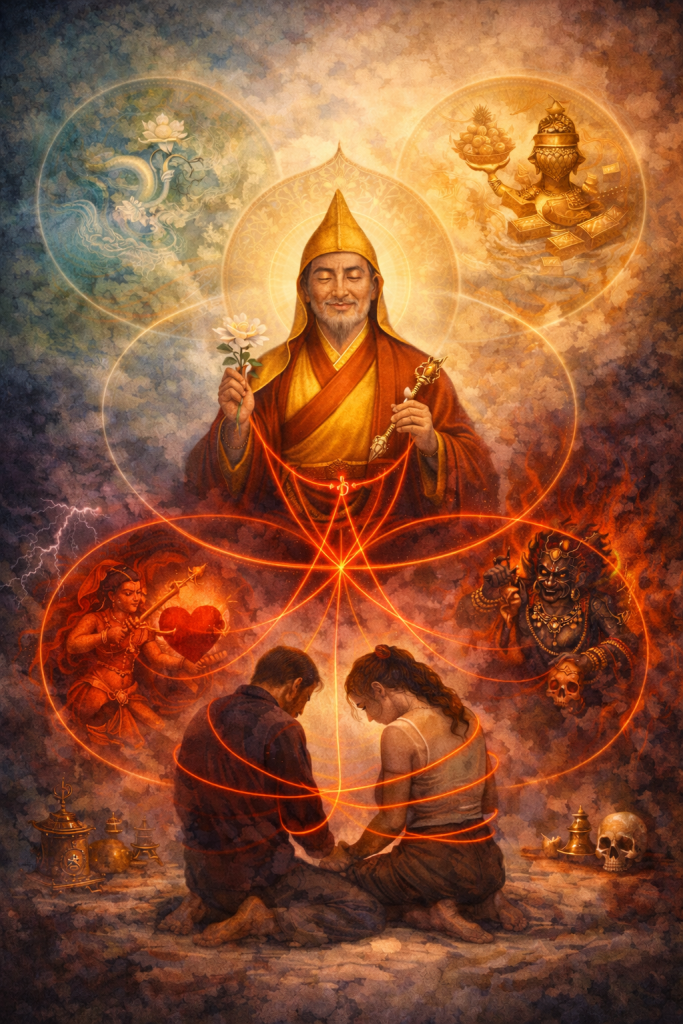
In Vajrayana Buddhism and related tantric systems, practitioners are taught that enlightened activity manifests in four fundamental modes, often called the Four Activities. These are commonly translated as Pacifying, Enriching, Magnetizing, and Subjugating. In Sanskrit they correspond to śāntika, pauṣṭika, vaśīkaraṇa, and abhicāra. In Tibetan sources they are known as zhi, rgyas, dbang, and drag po.
Doctrinally, the Four Activities are described as spontaneous expressions of awakened compassion. An enlightened being pacifies obstacles, enriches virtue and resources, magnetizes beings toward the Dharma, and subjugates harmful forces. This presentation emphasizes intent and realization, assuring the student that such actions, when performed from enlightenment, are free of karmic stain.
Yet this sanitized description obscures a more uncomfortable reality. Historically and textually, the Four Activities function as classificatory frameworks for large compendiums of ritual technologies. These include magical spells, rites, visualizations, mantras, and talismanic operations designed to bring about very specific effects in the world. Such effects include healing and calming, increasing wealth or longevity, attracting and binding others, and coercing, harming, or destroying enemies.
This dual framing creates a tension that is rarely examined openly within modern Buddhist discourse.
The Four Activities as Magical Technologies
Tantric manuals from India and Tibet make explicit that the Four Activities are not metaphors. They are actionable ritual categories. Tantras such as the Guhyasamāja Tantra and the Hevajra Tantra, along with later ritual compendiums such as the Sādhanamālā and abhicāravidyā genre texts, provide detailed instructions for rites aimed at controlling weather, influencing rulers, compelling lovers, paralyzing rivals, or causing illness and death.[1]
These materials make clear that tantric ritual was never confined to inner transformation alone. The Four Activities structured a full spectrum of practical interventions into social, political, and psychological life.
The Sādhanamālā
The Sādhanamālā is a large Sanskrit compendium of tantric ritual manuals compiled in India roughly between the 8th and 12th centuries CE.
It is Buddhist, specifically Vajrayana or Mantrayāna, and not Śaiva, even though it shares techniques and ritual logic with non-Buddhist tantric traditions. The text consists of several hundred sādhana instructions for meditation and ritual practice focused on Buddhas, bodhisattvas, and tantric deities such as Tārā, Avalokiteśvara, Mañjuśrī, Vajrayoginī, and Hevajra.
Many of these sādhanas are explicitly or implicitly classified according to the Four Activities. They include ritual prescriptions for pacifying illness, enriching wealth or lifespan, magnetizing kings, patrons, or disciples, and subjugating enemies. The intended effects are practical and worldly as well as soteriological.
The Sādhanamālā was translated into Tibetan in parts and circulated widely in Tibet. Tibetan ritual literature draws heavily on this material, even when the Indian source material is not foregrounded explicitly.
Standard scholarly references include: Benoytosh Bhattacharyya, Sādhanamālā, Baroda, 1925–1928, and David Snellgrove, Indo-Tibetan Buddhism, Shambhala, 1987.
Abhicāravidyā Texts
Abhicāravidyā is not a single book but a category of ritual literature.
The Sanskrit term abhicāra refers to rites of coercion, harm, or destructive magic. Vidyā means a spell or magical formula. Abhicāravidyā texts are therefore manuals of destructive or coercive rites.
In Buddhist tantra, such texts describe subjugation practices including immobilization, madness, illness, death, expulsion of consciousness, and rites intended to cause death, sometimes described as ritual killing by proxy. These rites are usually justified as actions taken against enemies of the Dharma, oath breakers, or beings deemed karmically irredeemable.
These texts circulated in India among tantric specialists and were selectively translated into Tibetan, often under euphemistic titles or embedded within larger ritual cycles. In Tibet, their contents were reorganized under the heading of drag po, or wrathful activity.
Important examples of Buddhist abhicāra material appear in:
The Guhyasamāja Tantra and its explanatory tantras The Hevajra Tantra The Sarvatathāgatatattvasaṃgraha Later ritual manuals attributed to figures such as Nāgārjuna and Padmasambhava
Because of their ethical volatility, abhicāra rites were rarely taught openly. Access was restricted, which is one reason modern practitioners often underestimate how central such practices were historically.
Key scholarly discussions include: Ronald Davidson, Indian Esoteric Buddhism, Columbia University Press, 2002, and Alexis Sanderson, “The Śaiva Age,” in Genesis and Development of Tantrism, Tokyo, 2009.
Relationship to Tibetan Buddhism
Tibetan Buddhism inherited these Indian materials largely intact. The Four Activities framework in Tibet is not an innovation but a systematization of Indian tantric categories.
What changed in Tibet was less the ritual content than the doctrinal rhetoric surrounding it. Destructive and coercive rites were reframed as compassionate acts performed by realized beings. This rhetorical move allowed the practices to survive while softening their public presentation.
When Tibetan teachers speak of the Four Activities today, they are standing on a ritual foundation built by Indian Buddhist tantra, including the Sādhanamālā and abhicāravidyā traditions, whether this inheritance is acknowledged or not.
In Tibetan contexts, this ritual material was further systematized. The Four Activities became a classificatory framework under which thousands of rites were organized. Fire pujas, effigy magic, thread-cross rituals, and sexual yogas all find their place within this scheme.[2]
The ethical difficulty is obvious. While pacifying and enriching activities can be interpreted charitably, subjugation practices explicitly involve violence, coercion, and psychological domination. Tibetan ritual manuals state that subjugation rites can cause madness, death, or rebirth in hell realms for the target, often justified by vague claims that the victim is an enemy of the Dharma.[3]
Subjugation and Buddhist Ethical Dissonance
From the standpoint of Buddhist ethics, subjugation is the most troubling of the Four Activities. Buddhism is grounded in non-harming and the cultivation of compassion. Yet subjugation rituals rely on wrathful intent and instrumental harm. Traditional defenses argue that enlightened beings act beyond dualistic morality because they have transcended good and evil.
For modern Western practitioners, these explanations often remain abstract. Teachers rarely teach subjugation practices explicitly, and students are encouraged to interpret wrathful deities symbolically. This produces a form of cognitive dissonance. The practices exist, are preserved, and are sometimes performed within group pujas, but disciples can maintain psychological distance by not understanding the wrathful practices or details. Ignorance becomes a form of insulation.
Magnetizing Activity and the Binding of Disciples
Magnetizing activity is often portrayed as benign. It is described as the compassionate attraction of beings to the path. Yet tantric texts are explicit that magnetizing rites are used to influence minds, bind loyalty, and generate devotion.[4]
In ritual manuals, magnetizing practices are used to attract lovers, patrons, followers, and students. They involve visualizations of cords, hooks, nooses, and substances entering the bodies of targets to incline their thoughts and emotions. These are not metaphors for persuasion. They are magical technologies of attachment.
Within guru-disciple relationships, magnetizing activity takes on a particularly disturbing dimension. Once a student takes tantric initiation, they are bound by samaya vows. These vows often include lifelong loyalty to the guru and lineage until enlightenment is achieved.[5]
The power imbalance is severe. The teacher is positioned as the embodiment of awakening. The student is warned that doubt, criticism, or separation leads to spiritual ruin.
What If Enlightenment Is Not Reached?
Traditional literature assumes enlightenment will be reached. But what if it is not. What if the practitioner becomes disillusioned, traumatized, or psychologically destabilized.
In such cases, the Four Activities do not disappear. The same ritual logic that binds can also be used to punish. Tibetan sources describe the use of subjugation rites against oath breakers, samaya violators, and enemies of the lineage.[6]
Modern scholars and psychologists studying tantric communities have documented patterns of dependency, identity collapse, and long-term trauma following abusive guru relationships.[7] Magnetizing activity, in this light, resembles a spider’s web. Attraction is not neutral. It is structured, adhesive, and difficult to escape.
Conclusion
The Four Activities are not merely poetic descriptions of enlightened compassion. They are historical and functional systems of magical action. To ignore this is to misunderstand tantra at its core.
Subjugation challenges Buddhist ethics directly. Magnetizing challenges them more subtly. It operates through devotion, love, and surrender, making it easier to accept and harder to question. For Western practitioners kept deliberately ignorant of these dynamics, the result is not safety but vulnerability and the possibility of ruin.
An honest engagement with tantra requires confronting these practices without romanticism, without denial, and without pretending that malevolent harm disappears simply because it is cloaked in sacred language.
Footnotes and Sources
Alexis Sanderson, “The Śaiva Age,” in Genesis and Development of Tantrism, Tokyo, 2009.
Samten Karmay, The Arrow and the Spindle, Mandala Book Point, 1998.
Ronald Davidson, Indian Esoteric Buddhism, Columbia University Press, 2002.
David Gordon White, Kiss of the Yogini, University of Chicago Press, 2003.
Jamgön Kongtrul, The Torch of Certainty, Shambhala, 1977.
Stephen Beyer, The Cult of Tārā, University of California Press, 1978.
Mariana Caplan, Halfway Up the Mountain, Hohm Press, 2011.
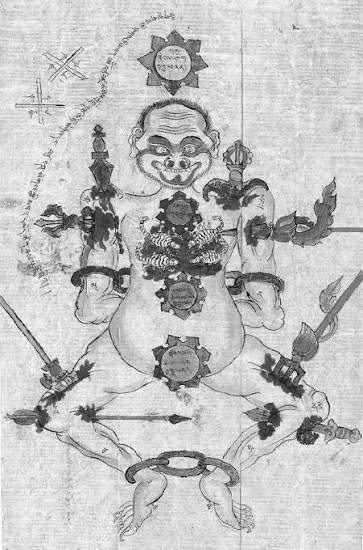
Among the many images that circulate quietly within Tibetan tantric lineages, there are several that are never explained to most practitioners and never shown outside advanced ritual contexts. One such image, often embedded within long Mahākāla rites and other high-level tantric liturgies, depicts a bound, pierced, weapon-studded human figure marked with mantras, seals, and symbolic restraints. To the uninitiated, it resembles a wrathful medical diagram or an esoteric curse talisman. To insiders, it represents something much more disturbing.
These images are not symbolic reminders of compassion, nor are they abstract metaphors for ego-death. They are ritual instruments. Specifically, they are used in rites intended to punish, bind, obstruct, or destroy the lives of those who are deemed to have broken samaya—the sacred vows binding a tantric practitioner to their guru, lineage, and yidam deity.
This fact is rarely discussed openly. When it is mentioned at all, it is framed euphemistically as “removing obstacles,” “protecting the Dharma,” or “subjugating harmful forces.” What is almost never acknowledged is that, within some tantric systems, the “harmful force” being targeted is a former disciple.
Why Beginners Are Never Told
Students entering Tibetan Buddhism are typically introduced through ethics, meditation, philosophy, and aspirational ideals: loving-kindness, compassion, non-violence, and wisdom. Tantric Buddhism is presented as a fast but benevolent path, dangerous only insofar as it requires devotion and discipline.
What they are not told is that questioning, criticizing, or emotionally reacting to a guru can itself be framed as a samaya violation. Nor are they told that certain rituals explicitly teach that lineage holders have the right, and sometimes the obligation, to retaliate metaphysically against perceived betrayal.
Beginners are warned vaguely that breaking samaya leads to “terrible consequences,” often described as karmic rather than intentional. The implication is that the universe itself will respond. What is left unsaid is that these consequences may be deliberately invoked, ritualized, and sustained by human agents acting within a tantric framework.
The unspoken lesson is simple: dissent is dangerous.
The Yidam Is Watching
At the core of highest yoga tantra is the yidam deity, the meditational deity with whom the practitioner forms an exclusive, intimate bond. The yidam is not merely visualized as an external symbol but is gradually internalized, embodied, and ultimately identified with as one’s own enlightened nature.
This process is often described in modern terms as psychological transformation. In traditional terms, however, it is far closer to classical possession.
The practitioner receives initiation from a master understood to be fully realized–meaning fully inhabited by the yidam. Through empowerment, mantra recitation, repeated visualization, and ritual invitation, the practitioner repeatedly invites the deity to enter their body and mind. Over time, the boundary between practitioner and deity is intentionally dissolved.
This is how the yidam “monitors” the practitioner: not metaphorically, but through total psychic access. Thoughts, emotions, doubts, and impulses are no longer private. They are offerings or offenses.
Within this framework, enlightenment, siddhis, and protection are granted conditionally. The deity gives, and the deity can withhold. More disturbingly, the deity can retaliate.
“Sons” of the Deity and Absolute Obedience
Advanced tantric systems often refer to lineage masters as the “sons” of the yidam. These are the men who have fully merged with the deity through practice. Disrespecting such a figure is not treated as a social conflict or ethical disagreement; it is framed as an attack on the deity itself.
This becomes especially dangerous in cases involving sexual relationships between guru and disciple. While not every such relationship is abusive, many are. In some cases, a guru expects sexual access as a demonstration of devotion and service. When the disciple becomes distressed, confused, or resistant, or when she later speaks out, the guru’s response is not accountability but punishment.
From within the tantric logic, the guru is not merely a man abusing power. He is a god-being whose will cannot be questioned. The disciple’s suffering is reframed as karmic purification or divine retribution.
Ritual Retaliation Is Real
There is a tendency among modern defenders of Tibetan Buddhism to dismiss accounts of retaliation as superstition or paranoia. Yet whistleblowers, both Western and Asian, have repeatedly documented actions taken against former disciples over months or years. In the most extreme cases, these are not momentary curses but sustained practices intended to ruin health, relationships, livelihood, and sanity.
I personally have known three gurus who engaged in such retaliatory behavior. These were not fringe figures. They were respected, accomplished masters with devoted followings. The rituals were not symbolic. They were methodical, intentional, and experienced by the practitioners themselves to be effective.
This is witchcraft in the plain sense of the word. It is no different in structure or intent from Haitian vodou curses or European malefic magic. The only difference is the religious branding.
The Ethical Contradiction at the Heart of Tantra
This raises an unavoidable question: how can a system that claims descent from the historical Buddha whose teachings emphasize non-harming, restraint, and compassion contain practices that deliberately destroy human lives?
The answer lies in tantric exceptionalism. Within these systems, ordinary Buddhist ethics are considered provisional. Once one enters the tantric domain, morality becomes subordinate to obedience, secrecy, and power. A guru possessed by a wrathful deity is no longer bound by conventional ethics because the deity is not.
Publicly, tantric masters speak constantly of compassion and loving-kindness. They smile, bless, and perform virtue with great skill. Privately, nothing is free. Every empowerment creates obligations. Every vow tightens the noose. And the deeper one goes, the more rigid and unforgiving the system becomes.
The Real Danger
Not all Tibetan Buddhist teachers engage in these practices. Many do not. But the fact that some of the most accomplished masters have done so for centuries means the danger is structural, not incidental.
The real threat of tantric Buddhism is that it weaponizes devotion, sanctifies possession, and normalizes ritual violence while hiding behind the language of Buddhist compassion and enlightenment.
Until this is openly acknowledged, aspirants will continue to walk blindly into systems that can, and sometimes do, destroy them, all in the name of awakening.
Thomas Merton remains one of the most fascinating and controversial figures in modern Catholic spirituality. A Trappist monk whose writing reached millions, he invited readers into a life of contemplation shaped by silence, inner stillness, and spiritual inquiry. By the 1960s, his search had expanded far beyond the borders of Christian tradition and into the world of Eastern mysticism. His journey raises important questions about discernment, authority, and the possibility that some mystical experiences do not come from God at all.
Why Merton looked East
Merton believed that Western Christianity had lost something essential. He felt that institutional concerns and intellectual debate had overshadowed direct experience of God. Eastern religions appeared to preserve a contemplative path in a purer form. Like many in the post–Vatican II era, he saw dialogue with non-Christian religions as an opportunity rather than a threat.
But such openness came with a cost. Many Catholics of his time assumed that all deep mystical traditions shared a common source. The idea that spiritual experiences could arise from contrary or even deceptive origins was rarely discussed. This lack of discernment created a vulnerable generation of seekers who treated Eastern practices as spiritually neutral when they were not.
Merton’s early interest in Asia
Long before traveling to Asia, Merton was reading Zen, Taoism, Advaita Vedanta, and Sufi mystics. He approached them with sincere curiosity, but also with a growing assumption that truth could be gleaned from any direction. His writings from this period suggest a desire for universal contemplative experience, sometimes without sufficient attention to the distinct theological and spiritual claims behind each tradition.
This tendency to universalize mystical experience would shape his final years.
Meeting the Dalai Lama
In 1968, Merton traveled to Dharamsala and spent several days with the Dalai Lama. Their meetings were warm and genuinely contemplative. Merton admired the Dalai Lama’s kindness, discipline, and clarity. The Dalai Lama later remembered Merton as the first Christian monk who came to him not as a tourist or academic but as a fellow practitioner of deep prayer.
Yet admiration does not erase theological differences. Tibetan Buddhism denies a creator God, embraces reincarnation, and employs esoteric tantric practices that involve deities outside the Holy Trinity. From a Christian point of view, this difference is huge. The Church has long taught the discernment of spirits: mystical experiences must be tested, because deceptive spiritual forces can imitate peace, clarity, and even compassion. Merton did not always express this caution.
Encounter with Kalu Rinpoche
Merton also met Kalu Rinpoche, one of the most respected Tibetan meditation masters of the twentieth century. He attended teachings on Mahamudra and was deeply impressed by the monastic discipline he witnessed. Kalu Rinpoche even invited him to undertake a long hermit retreat. Merton seemed drawn to the idea.
But Tibetan Buddhism contains layers of esoteric practice that Merton, like most Westerners of his time, did not fully understand. The serene exterior of Tibetan spirituality often conceals tantric rituals, spirit invocation, and hierarchical guru devotion that are fundamentally incompatible with Christianity. Later revelations of abuse and occult manipulation inside some of the major Tibetan lineages show how incomplete the Western picture had been. Merton could not have known this, yet his enthusiasm reflected a lack of discernment that would affect many who followed in his footsteps.
What else he explored
Merton’s range of interests was broad. He read Zen masters, Taoist sages, Hindu philosophers, and Sufi poets. He studied Christian hesychasm with new energy and sought common threads among all traditions. His impulse was generous, but generosity is not the same as spiritual clarity. Christian prayer directs the soul toward union with God. Eastern meditation, especially tantra, aims at dissolving the ego and merging with non-Christian spiritual entities.
These are not complementary goals but representative of different spiritual destinies.
Bangkok and a mysterious death
After leaving Dharamsala, Merton traveled to Bangkok to speak at an international monastic conference. On December 10, 1968, he died in his cottage shortly after giving a lecture. The official explanation was accidental electrocution from a faulty fan. Yet no autopsy was performed, and the circumstances were poorly documented. The inconsistencies have fueled speculation for decades.
His death came at a moment when he was moving more deeply into Buddhist thought. Whether he intended to integrate aspects of Tibetan practice into Christian monasticism remains unknown. His passing has an unfinished quality, as if he was on the edge of a major spiritual shift whose implications were never tested.
Why Merton still matters
Merton’s life challenges readers to seek authentic spiritual contemplation, not just intellectual understanding. It also warns Christians that not every path that promises depth is aligned with God. Eastern systems often carry metaphysical commitments and spiritual forces that stand in real conflict with Christian revelation. Without a strong framework of discernment, even sincere seekers can be misled.
Merton’s writings still inspire, yet his story also stands as a cautionary tale. The longing for mystical experience is real and often holy, but it must be shaped by sound doctrine and a sober awareness that not every spiritual path leads toward God.
As young Western seekers, we were told directly by the refuge lama, a highly accomplished yogi whose presence and meditative depth made his words seem authoritative, that we could be both Christian and Buddhist. He said there was no conflict, that a person could be both Christian and take refuge in Tibetan Buddhism. Only much later did I begin to see that the metaphysical claims of Christianity and Tibetan Buddhism do not sit comfortably together. When examined honestly they point in opposite directions. This article explores that truth and why the issue deserves more clarity than it usually receives.
The Christian indelible mark
Catholic teaching holds that baptism is not a symbolic rite. It confers a real spiritual character on the soul, a mark that is indelible and permanent.¹ The person baptized is said to belong to Christ in a definitive way. Even if one later rejects Christian belief, the character imprinted by baptism remains. This teaching forms a central claim about spiritual identity. Baptism is a covenant, a seal, and a bond that cannot be undone by human action. Some theologians and exorcists describe it as a spiritual allegiance that shapes the destiny of the person marked by it.²
Vows in Tibetan Buddhism
Tibetan Buddhism also understands vows as real phenomena rather than mental constructs. They are described as subtle forms that arise in the practitioner’s continuum and remain active as long as the vow is kept.
Refuge: The refuge vow is the foundation of the path. To take refuge is to entrust oneself entirely to the Buddha, Dharma, and Sangha. This commitment is said to exist as a subtle form until broken.³
Bodhisattva vow: This vow stabilizes the intention to attain enlightenment for all beings. It is also considered to have ontological presence, shaping the practitioner’s moral and spiritual life.⁴
Tantric vows: Tantric samaya binds the practitioner to the guru, the deity, and the mandala. Tibetan commentaries treat samaya as a form that abides in the subtle body. Maintaining it is essential for any tantric practice to function. Breaking it has extremely dire consequences.⁵ Tantric vows require a view of reality that rejects any creator God and understands the deity as a manifestation of awakened mind.⁶
The awareness of the deities
What makes this tension even more striking is the role of the tantric deities. In traditional Tibetan understanding these deities are not abstract ideas. They are regarded as fully aware and responsive.⁶ When a practitioner takes refuge or samaya, the commitment is made not only in the presence of a human teacher but in the presence of the deity invoked.⁷
This means that even if a lama sincerely believes there is no conflict with Christianity, the deity knows exactly what commitments the practitioner brings into the mandala. The deity is aware of conflicting allegiances. If baptism marks a person as belonging to Christ, the tantric deity would encounter that mark as a pre-existing and incompatible bond.
When my refuge lama told us that being Christian was no problem, I accepted his assurance. He was revered, a man of immense yogic accomplishment. Yet the actual teachings of the system he represented do not support his statement. Neither do the Christian teachings. Christianity requires allegiance to the Most High God and sees baptism as a permanent seal of belonging.⁸ Thus, the two religious systems do not fit together. They are not partial overlaps but mutually exclusive covenants.
The question of whether one can be both Christian and a Tibetan Buddhist practitioner is not merely philosophical. It concerns real commitments that each tradition claims have unseen but powerful form. To treat these vows and sacraments lightly is to misunderstand them. To treat them seriously is to recognize that both paths make exclusive claims on the identity and destiny of the practitioner. Honesty requires admitting that they cannot be combined without dissolving the integrity of one or the other.
Sources
¹ Catechism of the Catholic Church, 2nd ed., §§1272–1274. ² Thomas Aquinas, Summa Theologiae, III, q. 63, aa. 1–6. ³ Jamgon Kongtrul Lodro Taye, The Treasury of Knowledge, Book Six. ⁴ Je Tsongkhapa, The Great Treatise on the Stages of the Path to Enlightenment, Vol. 1. ⁵ Khenpo Ngawang Pelzang, A Guide to the Words of My Perfect Teacher. ⁶ Patrul Rinpoche, The Words of My Perfect Teacher. ⁷ Dalai Lama and Alexander Berzin, The Gelug/Kagyu Tradition of Mahamudra, chapters on tantric initiation. ⁸ Benedict XVI, Address to the Roman Curia, 22 December 2006, section on baptismal identity.
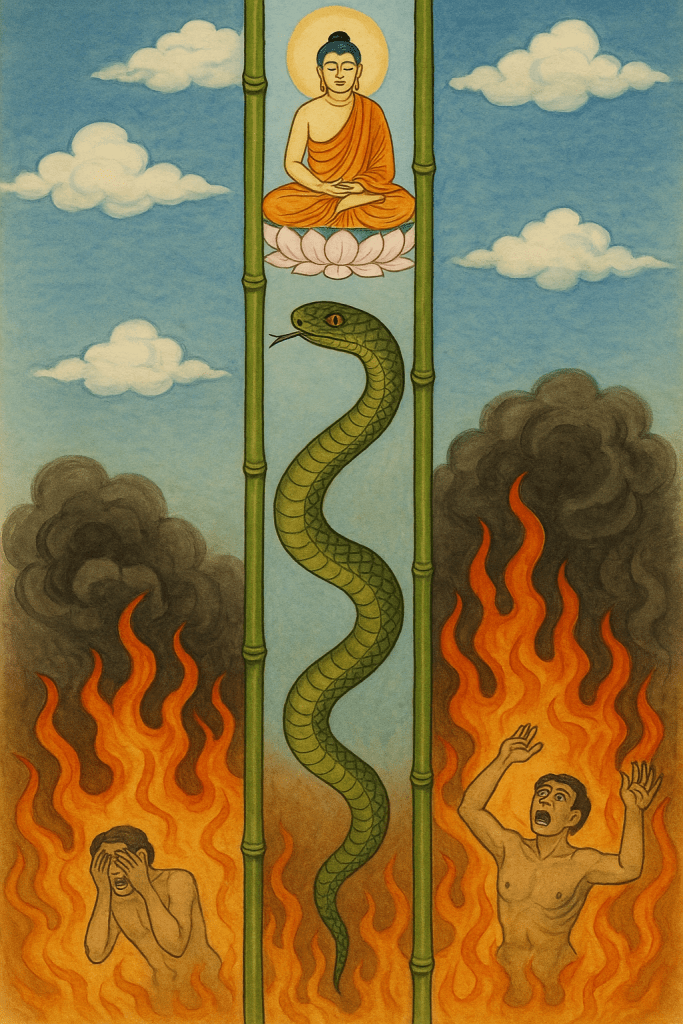
In Tibetan tantric Buddhism, the image of the snake trapped in a bamboo tube is more than a vivid proverb. It functions as a doctrinal warning: once a student enters the tantric path, there is no lateral escape. One either goes upward toward awakening or downward toward failure and “vajra hell.” Teachers have used this image to describe the uncompromising nature of samaya, the vows that bind a student to the guru, the deity, and the tantric methods themselves.¹
What is striking is how explicitly the tradition frames tantra as irreversible and high-stakes, and how rarely that stark truth is communicated to Western beginners before they agree to the vows that supposedly make the tube snap shut behind them. This mismatch between traditional warning and Western presentation is not a minor detail; it shapes the entire experience of Vajrayāna in modern contexts.
When the Warning Arrives Too Late
Many longtime practitioners have reported that the “snake in the tube” metaphor is introduced only after they have taken empowerments, established loyalty to the teacher, and accepted vows they did not fully understand. In one account, students were told after receiving advanced teachings that they were now like snakes [in a tube] with no side exit, and that questioning or leaving the guru’s authority carried dire karmic consequences.² Once framed in these terms, the student is no longer encountering tantra freely. The imagery becomes a retrospective justification for total commitment and an interpretive trap that discourages reevaluation, dissent or disengagement.
This sequencing matters. Warnings given after the student is already inside the tube are not warnings at all; they function as a mechanism of control. Sadly, it’s not just empty scaremongering to get the student to do whatever the teacher wants. The teacher can play a part in destroying the student if he wishes.
Western students, however, often enter tantra without the cultural framework that understands concepts like vajra–hell, and as a result frequently interpret them metaphorically or ignore them altogether during empowerments or teachings. As a result, the gravity of samaya is often hidden in plain sight. Students may assume that vows are symbolic or aspirational when, within the tradition, they are treated as binding conditions that determine spiritual destiny.
The asymmetry of information here is profound. Tibetan teachers know the stakes, but Western students usually do not.
Fear as a Reinforcing Mechanism
Inside the tantric system, samaya is often discussed as a bond of trust and devotion. But its shadow side is rarely addressed openly: the way threats of karmic ruin can be used to enforce silence and obedience. If leaving the guru, criticizing harmful behavior, or even doubting the teacher’s purity is framed as a breach of samaya, then fear becomes central to the student’s experience. Some Tibetan masters teach that both teacher and student can fall into vajra-hell for damaging the guru-disciple bond.³ In practice, however, this warning is most often directed at students, who are told that speaking publicly about misconduct or abuse may destroy their spiritual future.
Why the Snake Matters
The “snake in the bamboo tube” metaphor distills these concerns with unusual clarity. It shows that tantra is not designed to allow experimentation or partial commitment. It requires total participation in a closed system with its own rules, hierarchies, and cosmology. In cultures where this system has historically been embedded, those entering it do so in fuller awareness of the stakes. In the West, students often do not and they may hear such warnings in a highly suggestible state, without really grasping the implications.
One famous guru in the 1980s bluntly told students that they could be both Christian and Buddhist with no conflict whatsoever. This blatantly goes against Christian teaching. In those days Westerners were often thrust into the three-year-retreat program shortly after they signed up for teachings at Dharma centers with no knowledge of what they were really getting into. Many had little preparation to truly understand the arcane nature of samaya and its risks. Furthermore, many Tibetan teachers took advantage of their roles as authority figures to manipulate vulnerable students into sexual relationships and other sorts of commitments. Engaging in secretive sexual relationships with students while pressuring them to take highest yoga tantra vows and practices that would bind them forever often led to deep confusion and psychological unmooring.
The result is a form of spiritual engagement that looks consensual on the surface but lacks true informed consent. Students may be drawn in by promises of transformation but only later discover the rigidity of the commitments they have made. This is especially jarring given that Vajrayāna wraps together the renunciation of the Hinayāna, the boundless compassion of the Mahāyāna, and the esoteric demands of tantra. In this unwieldy fusion, the same tradition that teaches gentle observation of thoughts can also insist that a single critical thought toward one’s guru carries the weight of karmic catastrophe. The threat of vajra-hell sits uneasily beside Buddhism’s wider emphasis on compassion and non-judgment. An ethical issue looms large: a path that describes itself as having no side exit should not be offered as if it does.
To treat tantra’s danger as a secret or secondary detail is to undermine the integrity of the path itself. If practitioners are indeed snakes in a tube, they deserve to be told before they go inside.
Footnotes
¹ “Once you take samaya you become like a snake in a vertical bamboo tube: you’re either going up, or you’re going down. You can’t sneak out the side.” (Kun zang.org) (kunzang.org) ² Note: practitioner-reports and forum posts indicate the metaphor is often applied post-initiation. For example: “A Vajrayana practitioner is like a snake in a tube; … he can either go up or down, not left or right.” (dharmawheel.net) ³ “The metaphor for samaya is a snake in a bamboo tube. It has only 2 directions – up to enlightenment or down to the hells.” (TibetDharma.com) (Tibetan Buddhism)
I was raised in the Catholic faith. Its prayers, seasons, schools, and sacraments shaped my earliest understanding of the world. But as I grew older, the atmosphere changed and it started to feel foreign to me. After the upheavals in the liturgy and doctrine that followed the Second Vatican Council, everything became muted and seemed different. Gone was the mystery and ritual of the high Mass. What replaced it was grey and humdrum. As I embraced my mid-teens I felt like the Church had become unrecognizable. I was bored in Mass and began to question everything. I felt myself drifting, carried away by the freedom and experimentation of the post-Hippie generation.
That search carried me far from the Church for more than three decades. As an adult I immersed myself in Tibetan Buddhism. Compared to the Catholicism I thought I had outgrown, this new path was exhilarating. The colorful symbols, rituals, exotic chanting, and promises of hidden knowledge shone bright like the Technicolor world Dorothy steps into after her house lands in Oz. Everything was vibrant and different. For a long time, I believed I had found a far richer spiritual universe than the one I had left behind.
As the years passed, I committed myself more deeply to Tibetan tantric Buddhism. Gurus, deities, and intricate ritual practices in long retreats promised transformation. I accepted men as guides who claimed they could lead me toward enlightenment. But slowly, over time, questions emerged. The yanas contradicted one another. The path began to feel less like liberation and more like entanglement in a feudal system with a hazy set of arcane laws. What had once seemed full of promise started to feel like a maze of deception.
The turning point came when I least expected it. Like Dorothy traversing the Emerald City, dazzled by spectacle, I had followed the yellow brick road as far as I could, believing I was approaching a transformative experience of enlightenment. And just as Dorothy eventually reaches Oz and pulls back the curtain, only to find a small man manipulating levers, I was forced to see behind the veil as well. The Root Guru I had trusted was revealed as a sorcerer, and the tantric deities I had once exalted no longer appeared as divine guides but as accusing, demonic forces. They became something like the scary flying monkeys that viciously attack Dorothy and her friends at one point. I suddenly realized that the impressive display I had put my faith in was only smoke and mirrors, and the powers behind it were not what they claimed at all, but actually fallen angels and their human minions.
That realization shook me to my core. In the very moment the illusion collapsed, a strange clarity emerged. I found myself remembering what I had learned as a child, what the Church had taught from the very beginning. The contrast between truth and imitation soon became unmistakable. What I had embraced as enlightened beings were nothing of the sort. Their nature did not align with the Most High God but with the very deceptive forces that the Bible warns against. I had spent years seeking hidden wisdom only to discover that the truth I needed had been with me since childhood. What a bizarre discovery after so many years of a life lived in error.
When I returned to the Catholic Church, I expected judgment or distance. Instead, I found the opposite. The Church received me with open arms, with the warmth of a parent waiting for a child who has been gone far too long. Over the years, thanks to Popes like John Paul II and Benedict, the Church regained some of its true colors that had been lost in the hasty rush to modernize. It now seemed sacramental and grounded in truth. I began to approach my re-version with the discerning mind of an adult hungry for knowledge. Gradually, a whole new world opened up to me and I was amazed that the truth of Christ’s sacrifice to humanity held new meaning after the horrors I had just lived through in the occult. Is the institution of the Catholic Church perfect? No. Its human side can fail, and at times it clearly has. Some say it is in crisis. Yet Christ promised, “You are Peter, and on this rock I will build my Church, and the gates of hell shall not prevail against it” (Matthew 16:18). That promise has become an anchor for me in these difficult times.
My journey through the many beguiling practices of Tibetan Buddhism taught me how convincing illusions can be. It taught me how eager the human heart is for spiritual novelty, and how easy it is to mistake mystical experiences for truth. The Catholic Church, which I once believed had lost its footing, proved steady after all. After thirty-five years away, I came home to the enduring Christian faith that had been guiding me from the beginning.











 Tantric Deception