

Guru Possession in Tibetan Buddhism: Power, Devotion, and the Loss of Autonomy


What does it mean to be possessed?

In its most literal sense, possession refers to a person being overtaken by another force, such as a spirit, deity, or entity, that overrides their ordinary sense of control. This idea appears across many cultures in forms like trance, mediumship, and ritual invocation.

There is also a more subtle way to understand possession. It can describe a condition in which a person’s thoughts, emotions, loyalties, and identity become so deeply shaped by another that their independence begins to fade. The individual still appears outwardly intact, but internally their center of gravity has shifted.

After years of deep immersion in Tibetan Buddhist environments, I came to experience something that felt unmistakably like a form of possession. This is not a claim about official Tibetan Buddhist doctrine, which goes to great length to avoid that term, but a description of how the dynamics of devotion and authority unfolded in lived experience.

The Guru in Tibetan Buddhism

In Tibetan Buddhism, the role of the guru is central and highly elevated. Teachers such as Padmasambhava, Tsongkhapa, and Patrul Rinpoche all emphasize devotion to the spiritual teacher as a powerful means of transformation. The guru is described as the embodiment of awakened awareness and the source of blessings that lead the student toward realization.

In tantric practice, this relationship becomes especially intense. The student is encouraged to visualize the guru in an idealized form, merge their mind with the guru’s mind, and regard the guru as inseparable from themself. In theory, this is meant to dissolve the ego and reveal deeper awareness. In practice, it can become spiritual hijacking and inhabitation by a highly realized vajra master.

Charisma and the Aura of Power

Many Tibetan gurus possess a powerful form of charisma that is difficult to describe but easy to feel. It may appear as a kind of luminous presence that affects the emotional atmosphere around them. Students often report feelings of clarity, devotion, and euphoria in their presence.

Traditional accounts describe gurus as having extraordinary powers, sometimes referred to as siddhis. These may include heightened perception and an uncanny facility to read the minds of others as well as an ability to transmit meditative experiences into the minds of others. Stories circulate within communities about moments of insight or events that seem to confirm the guru’s special status. These magical capabilities have a strong effect. Over time, they reinforce the perception that the guru operates beyond human limits. That perception deepens one’s conviction that the guru isn’t ordinary but a godlike presence.

The Shift Toward Total Influence

At a certain point, devotion can cross into something absolute and intractable. The student’s sense of truth begins to align with the guru’s words. Emotional life becomes tied to the guru’s approval. Identity becomes shaped by the role of being a disciple. Doubt is no longer a neutral process but is seen as a failure of faith or commitment. Independence starts to disintegrate and students often become infantile, needing to discuss all their major life decisions with the guru, rather than act independently.

In my experience, this is where the language of possession begins to feel appropriate. It captures the sense that one’s inner center has been replaced by another’s influence.

Psychic and Energetic Dimensions on an Inner Level

Tantric Buddhism makes extensive use of visualization and subtle body practices. In guru yoga, students are instructed to imagine the guru sitting above their heads. The preliminary disciplines of Tibetan Buddhism (called ngondro) are designed to condition the mind and body for a major transformation. At the culmination of the practice, the guru dissolves into the practitioner, becoming inseparable from their awareness. Students are trained to dissolve their ordinary identity and merge with a more elevated form. This process is not superficial but reshapes perception at a deep level.

Over time, the boundary between self and guru can begin to dissolve. The guru’s presence may feel internal, continuous, and directive. Thoughts and emotions can be shaped in ways that are difficult to trace back to their origin. In a positive framing, this may be experienced as guidance or protection. The practitioner may hear the guru’s voice both internally and externally, offering direction, reassurance, or correction.

Within advanced tantric practice, particularly in forms associated with highest yoga tantra, this dynamic can deepen further. The guru and the yidam (meditational deity) may be experienced within the subtle body not as abstract symbols, but as vivid and intimate presences. At times, this can take on an erotic or deeply affective quality, often described in traditional language as the union of bliss and awareness.

The practitioner may experience powerful currents of energy moving through the inner network of channels and chakras. These movements can generate intense sensations of expansion, pleasure, and emotional fullness that feel complete and self-validating. From the inside, this can feel like direct spiritual guidance operating through the body itself.

At the same time, this is also a point of vulnerability. When identity and authority converge so completely, it becomes difficult to distinguish between one’s own agency and the influence of the internalized figure of the guru. In my experience, this dynamic can become a powerful mechanism for control.

Exclusivity and Control in the Outer Realm

This internal dynamic is often mirrored externally. In many communities, strong emphasis is placed on extreme loyalty to a single teacher. Seeking instruction from others may be discouraged or framed as a sign of fickleness or lack of devotion.

This creates a closed environment in which the guru becomes the primary source of meaning and authority. The student’s world gradually narrows, and alternative perspectives become harder to access, both intellectually and emotionally. Questioning the structure can feel destabilizing, not only in a social sense, but at the level of identity itself.

Hidden Dynamics

The more difficult aspects of these relationships are rarely visible in the beginning. New students often encounter warmth, insight, and a sense of belonging. Over time, as more complicated dynamics emerge, there may be increasing pressure to conform. Questioning or leaving can begin to feel impossible.

Because the relationship with the guru is embedded in sacred language, what might otherwise be recognized as manipulation or a violation of boundaries is instead interpreted as a higher teaching. This reframing makes it difficult to evaluate the situation clearly.

Deities, Power, and Obligation

Tibetan Buddhism includes many practices involving meditational and protector deities. Traditionally, these are understood as symbolic or as expressions of enlightened qualities. In lived experience, however, they can take on a more immediate spiritual and psychological presence.

Students may come to feel that the guru’s authority is supported by unseen forces. There may be a growing sense that resistance carries consequences that are not entirely understood or controlled. This adds another layer to the relationship. The influence of the guru extends beyond direct interaction and into belief, imagination, fear, and the manipulation of supernatural wrathful entities.

A Darker Interpretation

After years within this system, I began to interpret these dynamics in a more troubling way. The guru does not simply receive respect or devotion. The guru becomes the focal point of identity investment for many individuals at once. Each student focuses their attention and emotional energy on the same person. Students are encouraged to offer their body, speech, and mind to the guru, as well as time and support to the guru’s many projects. Physical offerings of money and goods are implicit. Over time, this concentration of devotion can inflate the guru’s sense of authority and power, and make criticism nearly impossible. The guru becomes someone who can do no wrong within the closed system that surrounds him. He becomes the absolute monarch of the community.

For the student, the result is often a complete erosion of autonomy. One’s sense of self becomes secondary to the structures that support the guru’s role and influence. On an esoteric level, it can feel as though one has been absorbed into another’s stream of being. Even though Tibetan Buddhist texts do not describe this as possession, this is essentially what is happening. The guru taps into powerful magic that binds the disciples and bends them to his will.

The success of the Tibetan Buddhist tantric system depends on many interconnected elements functioning correctly. If one aspect of the practice is misunderstood or misapplied, the entire process can shift and go awry. What is presented as liberation can instead become a dangerous entanglement, leading to destruction and annihilation.

In that state, the practitioner may no longer be guided, but completely overtaken and absorbed, unable to separate their mind, body, and will from the overpowering structure they have entered.
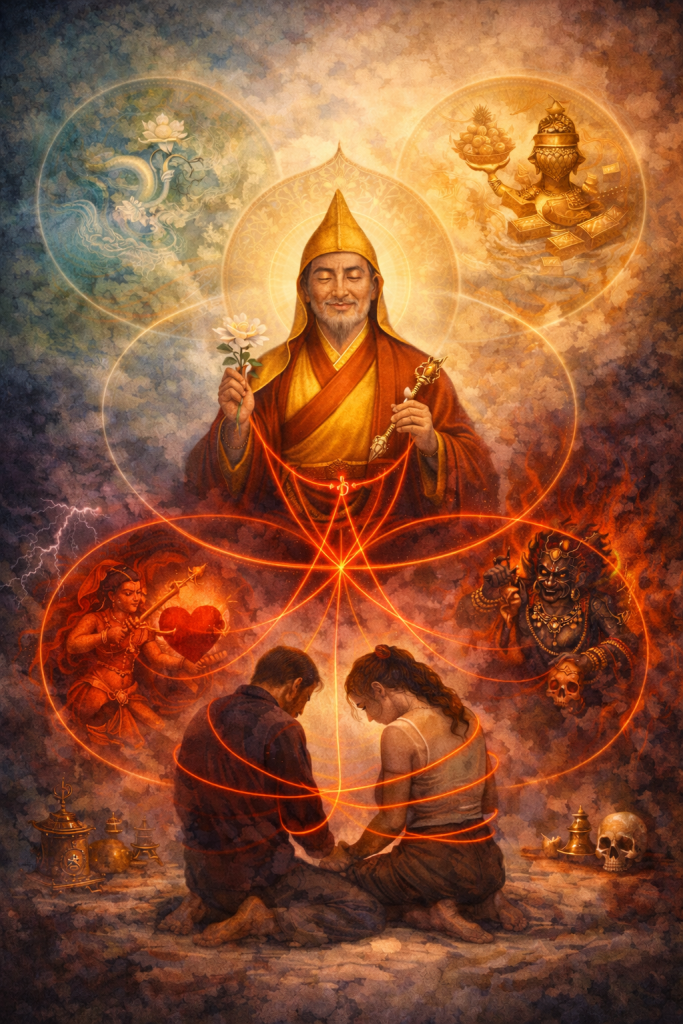

The Four Activities: How Tantra Organizes Power, Control, and Harm


In Vajrayana Buddhism and related tantric systems, practitioners are taught that enlightened activity manifests in four fundamental modes, often called the Four Activities. These are commonly translated as Pacifying, Enriching, Magnetizing, and Subjugating. In Sanskrit they correspond to śāntika, pauṣṭika, vaśīkaraṇa, and abhicāra. In Tibetan sources they are known as zhi, rgyas, dbang, and drag po.

Doctrinally, the Four Activities are described as spontaneous expressions of awakened compassion. An enlightened being pacifies obstacles, enriches virtue and resources, magnetizes beings toward the Dharma, and subjugates harmful forces. This presentation emphasizes intent and realization, assuring the student that such actions, when performed from enlightenment, are free of karmic stain.

Yet this sanitized description obscures a more uncomfortable reality. Historically and textually, the Four Activities function as classificatory frameworks for large compendiums of ritual technologies. These include magical spells, rites, visualizations, mantras, and talismanic operations designed to bring about very specific effects in the world. Such effects include healing and calming, increasing wealth or longevity, attracting and binding others, and coercing, harming, or destroying enemies.

This dual framing creates a tension that is rarely examined openly within modern Buddhist discourse.

The Four Activities as Magical Technologies

Tantric manuals from India and Tibet make explicit that the Four Activities are not metaphors. They are actionable ritual categories. Tantras such as the Guhyasamāja Tantra and the Hevajra Tantra, along with later ritual compendiums such as the Sādhanamālā and abhicāravidyā genre texts, provide detailed instructions for rites aimed at controlling weather, influencing rulers, compelling lovers, paralyzing rivals, or causing illness and death.[1]

These materials make clear that tantric ritual was never confined to inner transformation alone. The Four Activities structured a full spectrum of practical interventions into social, political, and psychological life.

The Sādhanamālā

The Sādhanamālā is a large Sanskrit compendium of tantric ritual manuals compiled in India roughly between the 8th and 12th centuries CE.

It is Buddhist, specifically Vajrayana or Mantrayāna, and not Śaiva, even though it shares techniques and ritual logic with non-Buddhist tantric traditions. The text consists of several hundred sādhana instructions for meditation and ritual practice focused on Buddhas, bodhisattvas, and tantric deities such as Tārā, Avalokiteśvara, Mañjuśrī, Vajrayoginī, and Hevajra.

Many of these sādhanas are explicitly or implicitly classified according to the Four Activities. They include ritual prescriptions for pacifying illness, enriching wealth or lifespan, magnetizing kings, patrons, or disciples, and subjugating enemies. The intended effects are practical and worldly as well as soteriological.

The Sādhanamālā was translated into Tibetan in parts and circulated widely in Tibet. Tibetan ritual literature draws heavily on this material, even when the Indian source material is not foregrounded explicitly.

Standard scholarly references include: Benoytosh Bhattacharyya, Sādhanamālā, Baroda, 1925–1928, and
David Snellgrove, Indo-Tibetan Buddhism, Shambhala, 1987.

Abhicāravidyā Texts

Abhicāravidyā is not a single book but a category of ritual literature.

The Sanskrit term abhicāra refers to rites of coercion, harm, or destructive magic. Vidyā means a spell or magical formula. Abhicāravidyā texts are therefore manuals of destructive or coercive rites.

In Buddhist tantra, such texts describe subjugation practices including immobilization, madness, illness, death, expulsion of consciousness, and rites intended to cause death, sometimes described as ritual killing by proxy. These rites are usually justified as actions taken against enemies of the Dharma, oath breakers, or beings deemed karmically irredeemable.

These texts circulated in India among tantric specialists and were selectively translated into Tibetan, often under euphemistic titles or embedded within larger ritual cycles. In Tibet, their contents were reorganized under the heading of drag po, or wrathful activity.

Important examples of Buddhist abhicāra material appear in:

The Guhyasamāja Tantra and its explanatory tantras
The Hevajra Tantra
The Sarvatathāgatatattvasaṃgraha
Later ritual manuals attributed to figures such as Nāgārjuna and Padmasambhava

Because of their ethical volatility, abhicāra rites were rarely taught openly. Access was restricted, which is one reason modern practitioners often underestimate how central such practices were historically.

Key scholarly discussions include: Ronald Davidson, Indian Esoteric Buddhism, Columbia University Press, 2002, and Alexis Sanderson, “The Śaiva Age,” in Genesis and Development of Tantrism, Tokyo, 2009.

Relationship to Tibetan Buddhism

Tibetan Buddhism inherited these Indian materials largely intact. The Four Activities framework in Tibet is not an innovation but a systematization of Indian tantric categories.

What changed in Tibet was less the ritual content than the doctrinal rhetoric surrounding it. Destructive and coercive rites were reframed as compassionate acts performed by realized beings. This rhetorical move allowed the practices to survive while softening their public presentation.

When Tibetan teachers speak of the Four Activities today, they are standing on a ritual foundation built by Indian Buddhist tantra, including the Sādhanamālā and abhicāravidyā traditions, whether this inheritance is acknowledged or not.

In Tibetan contexts, this ritual material was further systematized. The Four Activities became a classificatory framework under which thousands of rites were organized. Fire pujas, effigy magic, thread-cross rituals, and sexual yogas all find their place within this scheme.[2]

The ethical difficulty is obvious. While pacifying and enriching activities can be interpreted charitably, subjugation practices explicitly involve violence, coercion, and psychological domination. Tibetan ritual manuals state that subjugation rites can cause madness, death, or rebirth in hell realms for the target, often justified by vague claims that the victim is an enemy of the Dharma.[3]

Subjugation and Buddhist Ethical Dissonance

From the standpoint of Buddhist ethics, subjugation is the most troubling of the Four Activities. Buddhism is grounded in non-harming and the cultivation of compassion. Yet subjugation rituals rely on wrathful intent and instrumental harm. Traditional defenses argue that enlightened beings act beyond dualistic morality because they have transcended good and evil.

For modern Western practitioners, these explanations often remain abstract. Teachers rarely teach subjugation practices explicitly, and students are encouraged to interpret wrathful deities symbolically. This produces a form of cognitive dissonance. The practices exist, are preserved, and are sometimes performed within group pujas, but disciples can maintain psychological distance by not understanding the wrathful practices or details. Ignorance becomes a form of insulation.

Magnetizing Activity and the Binding of Disciples

Magnetizing activity is often portrayed as benign. It is described as the compassionate attraction of beings to the path. Yet tantric texts are explicit that magnetizing rites are used to influence minds, bind loyalty, and generate devotion.[4]

In ritual manuals, magnetizing practices are used to attract lovers, patrons, followers, and students. They involve visualizations of cords, hooks, nooses, and substances entering the bodies of targets to incline their thoughts and emotions. These are not metaphors for persuasion. They are magical technologies of attachment.

Within guru-disciple relationships, magnetizing activity takes on a particularly disturbing dimension. Once a student takes tantric initiation, they are bound by samaya vows. These vows often include lifelong loyalty to the guru and lineage until enlightenment is achieved.[5]

The power imbalance is severe. The teacher is positioned as the embodiment of awakening. The student is warned that doubt, criticism, or separation leads to spiritual ruin.

What If Enlightenment Is Not Reached?

Traditional literature assumes enlightenment will be reached. But what if it is not. What if the practitioner becomes disillusioned, traumatized, or psychologically destabilized.

In such cases, the Four Activities do not disappear. The same ritual logic that binds can also be used to punish. Tibetan sources describe the use of subjugation rites against oath breakers, samaya violators, and enemies of the lineage.[6]

Modern scholars and psychologists studying tantric communities have documented patterns of dependency, identity collapse, and long-term trauma following abusive guru relationships.[7] Magnetizing activity, in this light, resembles a spider’s web. Attraction is not neutral. It is structured, adhesive, and difficult to escape.

Conclusion

The Four Activities are not merely poetic descriptions of enlightened compassion. They are historical and functional systems of magical action. To ignore this is to misunderstand tantra at its core.

Subjugation challenges Buddhist ethics directly. Magnetizing challenges them more subtly. It operates through devotion, love, and surrender, making it easier to accept and harder to question. For Western practitioners kept deliberately ignorant of these dynamics, the result is not safety but vulnerability and the possibility of ruin.

An honest engagement with tantra requires confronting these practices without romanticism, without denial, and without pretending that malevolent harm disappears simply because it is cloaked in sacred language.

Footnotes and Sources

  1. Alexis Sanderson, “The Śaiva Age,” in Genesis and Development of Tantrism, Tokyo, 2009.
  2. Samten Karmay, The Arrow and the Spindle, Mandala Book Point, 1998.
  3. Ronald Davidson, Indian Esoteric Buddhism, Columbia University Press, 2002.
  4. David Gordon White, Kiss of the Yogini, University of Chicago Press, 2003.
  5. Jamgön Kongtrul, The Torch of Certainty, Shambhala, 1977.
  6. Stephen Beyer, The Cult of Tārā, University of California Press, 1978.
  7. Mariana Caplan, Halfway Up the Mountain, Hohm Press, 2011.

The Tragic Consequences of Romantic Relationships Between Tibetan Gurus and Their Female Disciples


In the world of Tibetan Tantra, the guru is not merely a teacher. He is regarded as a living embodiment of enlightenment, someone who, once accepted, must be obeyed as if he were the Buddha himself. Into this framework walk countless Western women, often earnest seekers of truth, healing, or transcendence. But when romance, sexuality, and devotion become intertwined, the results are rarely transformative. More often, they are tragic.

This article explores the inherent power imbalance, cultural dissonance, and psychological manipulation that underpin many intimate relationships between Tibetan tantric gurus and their female disciples.


A Different Cultural Code

In Tibetan culture, it is not uncommon for powerful men, including lamas, to have secret relationships, multiple consorts, or children outside of marriage. In many traditional communities, this behavior is normalized, even expected. Male infidelity is culturally tolerated, and truth-telling in romantic relationships is not seen as a moral imperative.

For many Western women, however, raised in societies where emotional honesty and monogamy are core values in intimate relationships, these behaviors come as a rude awakening. When a Tibetan lama engages in a romantic or sexual relationship with a Western disciple, he often does so under entirely different assumptions than she brings to the table.

The result is a tragic mismatch, not only of expectations, but of entire worldviews.

Samaya: A Weaponized Vow

At the heart of tantric Buddhism is the concept of samaya, a sacred vow of loyalty and obedience to the guru. These vows are complex, often opaque, and understood differently in Tibetan contexts than in the West. A Western woman may believe she is entering a relationship based on mutual affection or spiritual partnership, while the guru sees her as a consort, a dakini, a means to an end, whose role is to support his realization through sexual union, secrecy, and ritual submission. A less realized guru might just use women for his own sexual satisfaction without having the ability to properly engage in tantric sex for spiritual ends. This is often true nowadays.

In any case, breaking samaya is said to have dire consequences, not only spiritually, but psychologically, and physically. The risk is greatly compounded if the woman undertakes a traditional three-year-retreat and engages in the highest yoga tantra practices, including the physical yoga. The looming threat of tantric destruction can trap women in relationships that are exploitative, confusing, and coercive. Once the guru becomes the channel for the deity, any questioning of his authority can be framed as demonic and a cause for imminent karmic downfall.

Possession Disguised as Enlightenment

Tantric union is not merely symbolic. It often involves rituals where the guru is said to be “inhabited” by the deity and his voice, gaze, and touch become divinely charged. During such practices, the female disciple is encouraged to dissolve her ego, to merge into the guru-deity, and to practice dak nang or “pure view.” This process can mimic, and in some cases become, a form of spiritual possession.

What’s often missed is the psychological and energetic takeover that occurs. The guru, now deified in the disciple’s mind and practice, can dominate her thoughts, dreams, emotions, and even her bodily functions. This fusion can make it nearly impossible for her to discern spiritual guidance from emotional manipulation or sexual coercion.

Real-World Tragedies

Numerous cases, both widely reported and quietly suppressed, illustrate the dangers of intimate relationships between tantric gurus and their students. These accounts reveal recurring patterns of deception, coercion, and spiritual abuse, all cloaked in esoteric language and asymmetrical power dynamics. They are not isolated incidents but part of a systemic pattern deeply embedded in a tradition that grants unchecked spiritual authority to men who are rarely held accountable.

For those who wish to explore further, consider just a few of the many investigations and testimonies:

Buddhist Project Sunshine – Phase 3 Final Report (2018)
This comprehensive report documents allegations of abuse within the Rigpa community, providing detailed accounts and analyses.
📄 Read the PDF Report

Beyond the Temple – What Now? Blog
Formerly known as “What Now?”, this blog offers reflections and information from ex-Rigpa members about their experiences and the broader implications of abuse in spiritual communities.
Beyond the Temple – Survivors of Abuse in Tibetan Buddhism

Tricycle – “Rigpa Abuse: Former Students of Sogyal Rinpoche Share Their Stories”
An article featuring firsthand accounts from former students detailing their experiences with Sogyal Rinpoche and the Rigpa organization.
📰 Read the Article

Lion’s Roar – “Letter to Sogyal Rinpoche from Current and Ex-Rigpa Members Details Abuse Allegations”
This piece publishes a letter from Rigpa members outlining specific abuse allegations against Sogyal Rinpoche.
📄 Read the Letter

The Aftermath: Disillusionment and Healing

For many women, the breaking point comes when the promised enlightenment fails to materialize, and the emotional wounds become undeniable. Depression, anxiety, spiritual confusion, sexual trauma, and a profound crisis of faith often follow. Some leave Tibetan Buddhism altogether. Others struggle for years in silence, fearing karmic retribution or spiritual failure.

But there is also healing. More and more survivors are finding their voices, connecting with others, and re-evaluating what true spirituality looks like outside the grip of occult religions.

Conclusion: A Cautionary Tale

The guru-disciple relationship in tantric Buddhism is not a romantic ideal. It is a spiritual contract saturated with asymmetrical power, cultural blindness, and theological complexity. When this dynamic becomes sexual, the risks multiply exponentially. For Western women seeking union with the divine, the guru-lover becomes not a liberator but a captor. The elaborate practice of guru yoga further seals the deal.

This truth must be told, not to demonize individuals or traditions, but to expose the structural and spiritual dangers that thrive in secrecy. Love, in its purest form, cannot flourish where truth is sacrificed to deception and devotion is manipulated into coercion.