The “Civilized” Shaman: Geoffrey Samuel and the Tension at the Heart of the Tibetan Religion


In Civilized Shamans: Buddhism in Tibetan Societies, Geoffrey Samuel offers a sweeping anthropology of Tibetan religion that refuses to take Tibetan Buddhism at face value. He finds a living tradition shaped by older and more unruly forces beneath the polished scholastic surface of the monasteries. What emerges is a civilization of monks and magicians, of disciplined philosophers and ecstatic ritualists. His argument is simple but radical: Tibetan Buddhism is the result of Indian Buddhist ethics and philosophy meeting the shamanic substratum of the high plateau.¹

Two orientations: clerical and shamanic

Samuel organizes Tibetan religion around two poles. The first, the clerical or monastic orientation, descends from Indian Buddhism with its monasteries, ethical codes, and scholastic systems of thought. It values restraint, karmic causality, and the gradual cultivation of enlightenment. The second, the shamanic orientation, grows from indigenous Tibetan practices centered on ritual efficacy, spirit interaction, and the manipulation of unseen forces. This orientation values power (dbang) more than purity and treats ritual specialists not as moral exemplars but as technicians of spiritual power.²

These two strands were never simply reconciled. Tibetan civilization attempted to domesticate the shaman. The ecstatic healer and spirit-fighter was refashioned into a lama, wrapped in robes and scriptures yet still capable of commanding spirits, averting misfortune, or destroying an enemy through ritual means. The civilized shaman is not a metaphor. It is a social type, the institutionalized magician of a literate Buddhist society.³

Dark rituals and the question of subjugation

The most uncomfortable continuity between these worlds lies in the domain of ritual violence, what Tibetan sources call drag-po or wrathful rites. These practices are directed not toward enlightenment but toward control: the binding, subduing, or annihilation of obstructing forces, whether demonic, psychic, or human.⁴

Samuel interprets these rites not as moral aberrations but as necessary expressions of the shamanic orientation within a Buddhist frame. Indian Buddhism had long flirted with magical power but kept it at the margins of monastic life. In Tibet, ritual mastery became central. The same lama who taught compassion might also perform a subjugation rite, using effigies, mantras, and visualizations of wrathful deities to annihilate obstacles, whether spiritual or human. Such practices, found in the Nyingma and Kagyu tantric cycles and institutionalized in monastic ritual manuals, embody a logic foreign to classical Indian soteriology yet native to shamanic cosmology, the idea that power must be met with power.⁵

What makes these rites “civilized” is not their ethical domestication but their integration into a bureaucratic religion. The Tibetan monastery became a regulated arena for managing violence and transforming it into ritual performance. The monastic code that forbade killing also licensed symbolic destruction: paper effigies burned, dough figures pierced, and demons tamed through mantras.⁶ This was how a society of monks could still believe in, and even engage in, acts of ritual aggression.

Power and legitimacy

Samuel’s analysis is more about social structure than theology. The clerical orientation secured legitimacy through moral authority and learning, while the shamanic orientation maintained relevance through immediate and pragmatic results. The former built monasteries; the latter kept communities going amid famine, disease, and invasion. Tibetan Buddhism’s durability, he argues, comes from this uneasy synthesis. The scholar-monk and the ritual adept needed each other: the first to lend doctrine and order, the second to command the spirits that haunted every valley and household.⁷

In this light, the dark rituals of subjugation are not aberrations but instruments of governance. They discipline the chaotic powers of the landscape just as the monastery disciplines the passions of the mind. To them, the wrathful deity is not a contradiction of compassion but its shadow: compassion armed.

Rethinking the “Buddhist” in Tibetan Buddhism

Samuel’s greatest contribution may be to unsettle what we think “Buddhist” means. By treating Tibetan religion as a field of interacting orientations rather than a single orthodoxy, he exposes the limits of modern, idealized Buddhism. The vision of Tibet as a purely pacific, philosophical culture depends on forgetting the tantric rites that promise to destroy human enemies or subjugate spirits.⁸ Samuel does not moralize about this tension; he historicizes it. The so-called civilized shaman is a figure born of necessity, mediating between an imported moral system and an indigenous world of volatile gods.⁹

A note on tantra as the mediating field

Samuel does not treat Hindu tantra as a third, independent strand within Tibetan Buddhism. Rather, he presents tantric practice as the meeting ground of the clerical and shamanic orientations. By the time tantra reached Tibet, Indian Buddhism had already absorbed many Śaiva and Śākta elements. What Tibet inherited, therefore, was a fully developed tantric Buddhism rather than a simple blend of Buddhist and Hindu ideas. In Samuel’s account, tantra provided the channel through which shamanic power could operate within a clerical framework. It was the mechanism that allowed ecstatic and ritual techniques to coexist with the disciplines of monastic scholarship.

He also describes tantric Buddhism in Tibet as a two-way exchange. The imported Indian systems of Hevajra, Guhyasamāja, Cakrasaṃvara, and others were reinterpreted through local cosmologies of mountain gods, territorial spirits, and ancestral deities. The result was what he calls “tantricized shamanism” or “shamanized Buddhism.” While Hindu tantra was one historical source, the Tibetan tantric complex became a hybrid formation that expressed shamanic cosmology through Buddhist doctrine.¹⁰

The afterlife of the civilized shaman

Civilized Shamans was published in 1993, before the wave of globalized Tibetan Buddhism tried to reframe lamas as psychologists or humanitarians. Yet its insight remains vital. Beneath every system of enlightenment lies a system of control. The Tibetan synthesis worked precisely because it did not abolish the shamanic element. It incorporated it, turning ecstatic violence into liturgy and spirit warfare into cosmology.¹¹

For those interested in understanding tantric practice, especially the darker currents of subjugation and protection, Samuel’s anthropology is a cautionary mirror. It reminds us that ritual power is never purely symbolic. Even when intellectualized, it retains the logic of coercion: to bind, to summon, to annihilate. Tibet’s civilization was built on mastering such forces. The tension Samuel describes is not an accident of history but a model of how Tibetan religion evolved. Civilized shamans appear wherever doctrine meets magic, wherever ethics must coexist with power. Tibet made that paradox explicit.¹²


Notes

  1. Geoffrey Samuel, Civilized Shamans: Buddhism in Tibetan Societies (Washington, D.C.: Smithsonian Institution Press, 1993), 11–13.
  2. Samuel, Civilized Shamans, 11–12, 134–136.
  3. Ibid., 478–480.
  4. Ibid., 238–240.
  5. Ibid., 259–262.
  6. Ibid., 468–471.
  7. Ibid., 465–469.
  8. Ibid., 244–246, 478.
  9. Ibid., 479–482.
  10. Ibid., 66–74, 242–243, 476–478, 480–481.
  11. Ibid., 476–479.
  12. Ibid., 481–482.

Tertons, Termas, and the Curious Origins of Hidden Teachings


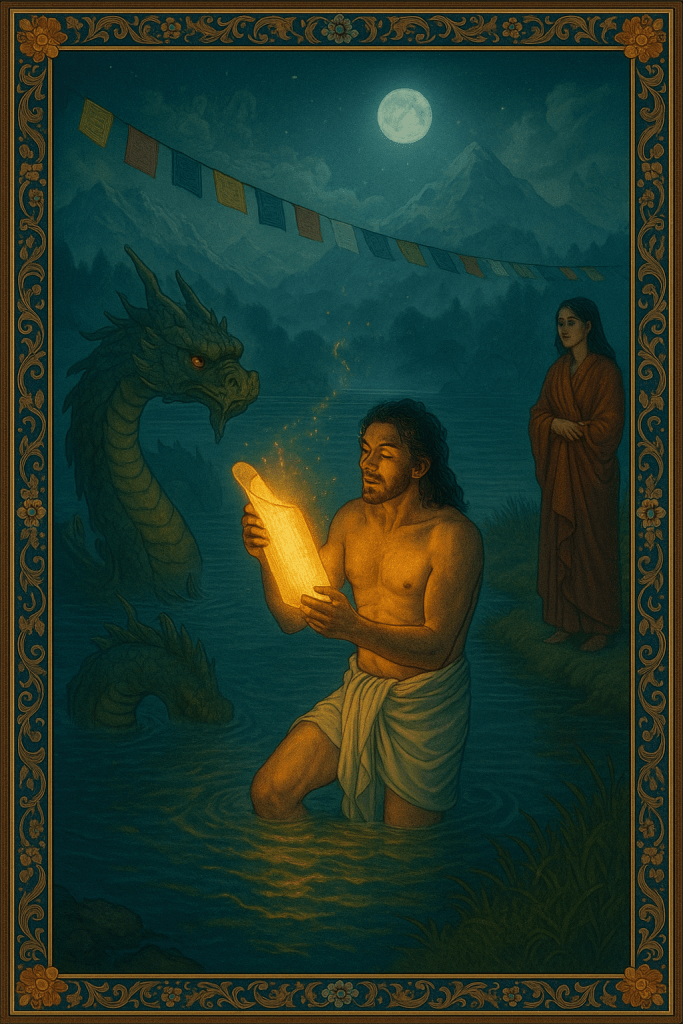
Tibetan Buddhism’s terma tradition is usually framed as a luminous, providential means by which enlightened masters hide and later reveal teachings at the exact moment needed. That’s part of the story, but it’s not the whole story by any means. Read closely, and a darker current runs through the terma corpus: treasures hidden and guarded by wrathful powers, revelations that arrive through strange, sometimes malevolent intermediaries, and rituals whose intent and method look remarkably like what modern people would call dealings with spirits or demons. In short, many tertons don’t simply find teachings; they negotiate with non-human, often wrathful forces that can reasonably be described as demonic. Below I’ll examine Dylan Esler’s study of Gya Zhang Khrom (rGya Zhang khrom)¹ and other scholarly sources as a base to examine the phenomena of tertons and terma.

What the words mean

A terma (gter ma) is literally a “hidden treasure”: text, ritual object, or practice concealed (often in a rock, lake, or the mindstream of a guru) to be discovered by a tertön (gter ston), the treasure-revealer. Academic treatments correctly emphasize the social and legitimating functions of these discoveries in prophecies, lineages, and performative acts that make the revelation believable to followers. But the same sources that record authentication narratives also preserve striking descriptions of how termas are hidden, guarded, and recovered: they are defended by territorial spirits or “treasure-lords,” transmitted by non-human yogins, and often carry explicitly wrathful, “black magic” contents. Non-human yogins can take the form of visionary yogins, dakinis/dakas, local spirits, or wrathful entities, and they act as the intermediaries who hide, protect, or hand over the treasure.

A close example: Gya Zhang Khrom and wrathful treasures

Dylan Esler’s article on Gya Zhang Khrom in the (Byang gter) Northern Treasures tradition recounts the classic terma motif: a mysterious yogin leads the future tertön to a hidden cache of ritual objects and scrolls that come out of fissures in rock, and the revealer deciphers and transmits material that includes both beneficent and harmful ritual instructions. Esler notes items described as “cycles for benefiting and harming,” in other words, materials for both white and black magic, and he situates Gya Zhang’s revelations within a Northern Treasure program that explicitly deploys wrathful, coercive ritual means. That combination of secret caches, hidden custodians, and instruction sets for destructive rituals is exactly the pattern that supports reading many termas as arriving via a demonic or semi-demonic channel.

Treasure-protectors and Lords of the Treasures: the institutional side of the “demonic”

The literatures that record terma narratives repeatedly mention gter srung (treasure-protectors) and gter bdag (lords of the treasures). These are not neutral filing cabinets: they are spirits of place, frequently wrathful, who demand protocols and substitutions (gter tshab) when a cache is opened. Ethnographic and textual scholarship treats these beings as part of the class of local, elemental, or “demonic” forces that Tibetan ritual both confronts and incorporates. Scholarly surveys of protector deities and the oral/ritual ecology around termas make clear that treasures do not simply sit inert but are guarded by active, sometimes dangerous entities. If a tertön is authorized by prophecy, that can mitigate local resistance; if not, accusations of theft and collusion with spirits arise.²

Demon-taming, wrathful methods, and ambiguous agency

The well-known motif of Padmasambhava as demon-tamer is instructive: foundational tantric figures are often framed as subduers of hostile spirits, and the very act of revealing a terma can be portrayed as the tertön’s success in negotiating or subduing a guardian force. But negotiation is not always tame or benign. A number of terma traditions preserve wrathful practices intended to overthrow enemies, cure epidemics, or control hostile spirits—techniques that look like pacts or coercive exchanges with non-human agencies. Scholarly work on Dzogchen/Northern Treasure liturgies and on early treasure careers shows repeated, explicit intersections between revealing termas and advancing ritual technologies of domination or protection over local powers.³

So, do tertons get their termas from demons?

In many traditional narratives and ritual contexts, yes. Termas are mediated by, guarded by, or negotiated with non-human beings that function similar to what observers would call demons. That’s a historical and anthropological claim. The primary sources and modern scholarship present a consistent pattern: treasures are hidden in the landscape or mind, are protected by wrathful custodians, and are sometimes transmitted by shadowy yogins or through visions that are indistinguishable from encounters with spirits. Where the contemporary, institutional presentation emphasizes enlightened intent and salvific purpose, the deeper ritual ecology reveals frequent recourse to powers that are territorial and morally ambiguous.

Final thoughts

Terma studies that stop at the rhetoric of revelation miss the subterranean reality that produces and polices those revelations. Esler’s account of Gya Zhang Khrom’s discoveries of materials explicitly useful for harming as well as helping presents a pattern replicated across the terma corpus. Read with discernment, the terma tradition looks less like a straight line from enlightened source to human disciple and more like a braided negotiation between the human revealer, local spirits or demons, and the institutional needs of Buddhist communities. That picture is central to my argument: many tertons operate at the shadowy margins where demonic forces and tantric techniques meet, and their termas are as much the products of those encounters as they are of the “pure” spiritual origins claimed by their lineages.

Notes:

  1. Dylan Esler, “Yamāntaka’s Wrathful Magic: An Instance of the Ritual Legacy of gNubs chen Sangs rgyas ye shes on the Byang gter Tradition via the Figure of rGya Zhang khrom,” Revue d’Études Tibétaines, no. 62 (Feb. 2022): 190–215, https://himalaya.socanth.cam.ac.uk/collections/journals/ret/pdf/ret_62_08.pdf (accessed Oct. 7, 2025).
  2. Jean-Luc Achard, “A Brief Note on the Northern Treasures of the Bon Tradition,” Revue d’Études Tibétaines, no. 68 (Jan. 2024): 16–35, https://d1i1jdw69xsqx0.cloudfront.net/digitalhimalaya/collections/journals/ret/pdf/ret_68_02.pdf (accessed Oct. 7, 2025).
  3. Christopher Bell, “Worldly Protector Deities in Tibetan Buddhism,” in Brill’s Encyclopedia of Buddhism, vol. 2: Major Personages in Myth, Hagiography and Historical Biography (Leiden: Brill, 2019), 1254–66, https://brill.com (entry available online; access depends on subscription) (accessed Oct. 7, 2025).

“Books of Spells” in Tibetan Buddhism: Magnetizing and Subjugation Rites, and the Problem of Sexual and Spiritual Abuse


To view Tibetan Buddhism as purely meditative and philosophical is to miss a large and still under-mapped terrain of ritual manuals and spell collections. A 9th to 10th-century Tibetan “book of spells” from the Dunhuang cave library (British Library IOL Tib J 401) shows that Tibetan monks compiled practical ritual instructions covering healing, protection, exorcism, and subjugation. It is the earliest surviving compendium of Tibetan Buddhist magical ritual and looks exactly like what we’d call a grimoire: a working handbook of spellcraft.¹

Moving forward in time, the 18th-century polymath Slelung Zhadepa Dorje (Sle lung Bzhad pa’i rdo rje) assembled a large tantric cycle centered on the Jñānaḍākinī. Within that cycle, scholars have identified several distinct grimoires of spells that are, again, practical instruction sets embedded in a broader tantric collection. As one study notes: “This paper seeks to examine such techniques in several grimoires of spells found in the tantric cycle of Gsang ba ye shes mkha’ ’gro… compiled and edited… by Sle lung Bzhad pa’i rdo rje (1697–1740) in the 1730s.”²

“Magical practices in Buddhism are still one of the least studied aspects of the religion.”³

Despite strong indications that there are many such grimoires, from Dunhuang through later ritual cycles, there is no comprehensive catalog. Scholars themselves admit the field’s patchy mapping. Sam van Schaik emphasizes the neglect, and others underline that studies too often treat magic as a literary trope rather than as practical ritual.³ ⁴

Personal experience

I do not come to this subject as a detached scholar. I was targeted by two different lamas at different times, one of whom used coercion to draw me into a sexual relationship and then employed what I can only describe as black magic when I resisted, questioned, and tried to break free. Living through those experiences is what drove me to investigate Tibetan spell craft.

“From the inside, the grimoires of Tibetan Buddhism do not feel very different from the grimoires of Western occultism.”

Although I practiced intensely for years in long retreats, I was never taught these darker rituals, yet I witnessed unsettling rites performed by my lamas. After rebuffing the advances of the first guru, I experienced what felt like severe magical attacks that reverberated for years. The cognitive dissonance was crushing: I believed these teachers were fully enlightened buddhas, yet I suffered severe trauma and PTSD.

“Fear of vajra hell kept me clinging to the practices, even as abuse intensified.”

My second guru was later exposed publicly for sexual and psychological abuse. Being caught in his orbit, I became the target of annihilation rituals. Surviving and recovering has been extraordinarily difficult. I now see that while some teachers avoid such practices, others weaponize spells of magnetism and subjugation to manipulate students, especially women, for sex and energetic vampirization. This gray area of practical magic within Tibetan Buddhism is vast and dangerous.

What the rites actually claim to do: magnetizing and subjugation

Classical Vajrayāna sorts ritual aims into four “activities”: pacifying, enriching, magnetizing, and subjugating. These are not marginal ideas; they are a standard frame for tantric ritual. Magnetizing (Tib. dbang du sdud pa) is explicitly defined as bringing others “under one’s control,” while subjugation names violent rites directed at overcoming obstacles and destroying opponents.⁵ ⁶

Texts and prayers for magnetizing circulate broadly, for instance, the “Wang Dü” prayer attributed to Mipham, described as “magnetizing or bringing under one’s control.” None of this is esoteric in the sense of being unknown; it is central to tantric categories and practice rhetoric.⁶ ⁷

From ritual claims to real-world power: how coercion maps onto communities and individuals

A ritual manual promising to attract, influence, or subdue doesn’t automatically produce abuse. Still, the rhetoric of magnetizing and subjugation sits within a social system that grants absolute authority to gurus and expects strong devotion from students. When high-status teachers have access to rites whose very names project attraction and control, the risk of translating ritual language into interpersonal domination is real.

Recent history demonstrates the danger. In 2018 Rigpa, the international organization founded by Sogyal Rinpoche, published the results of an independent investigation by the law firm Lewis Silkin that validated numerous allegations of physical and sexual abuse and identified serious safeguarding failures.⁸

The published report recounts patterns of violence and coercion including “slapping,” “punching,” “hitting with a backscratcher, phones, cups and hangers,” and documents testimonies of sexual abuse, concluding that the community had failed to protect students.⁹

This is not to claim that tantric ritual texts instruct teachers to abuse students. It is to note a combustible mix: magical mechanisms of control, asymmetries of authority, sacralized obedience, and the frequent absence of external accountability.

Bringing the strands together

  • Books of spells are the norm: Tibetan Buddhist literature contains actual “books of spells” and multiple grimoires embedded in tantric cycles. These are not aberrations but part of the tradition.¹ ²
  • An under-researched domain: Leading scholars explicitly acknowledge that this area of Buddhist practice is still understudied.³ ⁴
  • Control as a ritual aim: The four tantric activities include “magnetizing” and “subjugating,” both routinely glossed as bringing beings or circumstances under one’s control.⁵ ⁶
  • Abuse linked to ritual rhetoric: Documented cases in Tibetan Buddhist communities show how claims to ritual power combined with intense guru-devotion can provide cover for coercion and severe abuse.⁸ ⁹

Where the research gap still matters

A fuller picture of “how many” grimoires are in Tibetan tantric collections requires systematic cataloging across canons and private libraries. Right now we have case studies and local inventories rather than a master list. These texts need to be thoroughly studied in their historical and contemporary contexts and exposed to the world for what they really are–recipes for white and black magic–not sugarcoated as quaint and innocuous artifacts.³ ⁴

Without naming and analyzing how these are taught and performed, it is hard for communities and individuals to protect themselves from magical attacks.

What better safeguards look like

  • Name the risk: community materials should explain what “magnetizing” and “subjugation” denote in practice and how these can and will be used against students at the guru’s discretion.
  • Independent oversight: adopt and publish external safeguarding standards and reporting channels. The Rigpa case shows why self-policing fails.⁸
  • Informed consent and boundaries: spell out that teacher/student sex, even where allowed by law, requires adult consent free of spiritual pressure, and that the bar for “free of pressure” is very high in asymmetric relationships.
  • Don’t assume that all Tibetan Buddhist lamas have pure intention and integrity.

The safest course is to avoid Tibetan Buddhism altogether, since in practice the guru’s needs and moods often override the Buddha’s teaching of non-harm.

A closing note on method

This article is a call for transparency and insistence on precision. Tibetan Buddhist archives contain grimoires. The tradition attracts students to its supposedly compassionate practices while concealing that darker “magnetizing” and “subjugation” practices are core ritual elements. Scholars say this area is understudied. And history shows that these techniques of control, in the hands of unaccountable authorities, can easily become abusive, even deadly.

Footnotes

  1. Sam van Schaik, “The Early Tibetan Book of Spells.” Analysis of British Library manuscript IOL Tib J 401 from Dunhuang (9th–10th century). This manuscript is recognized as the earliest surviving Tibetan compendium of spells and rituals, containing instructions for healing, protection, and exorcism. See: Sam van Schaik, Early Tibet blog (2008), and also referenced in his book Tibetan Zen: Discovering a Lost Tradition (Snow Lion, 2015).
  2. Sle lung Bzhad pa’i rdo rje’s Jñānaḍākinī cycle study (Academia.edu). Scholarly paper examining several grimoires embedded in the tantric cycle of Gsang ba ye shes mkha’ ’gro, compiled and edited in the 1730s by Sle lung Bzhad pa’i rdo rje (1697–1740). The paper highlights ritual techniques, their organization, and their status as practical spell collections within a broader cycle. Available on Academia.edu.
  3. Sam van Schaik on magical practices in Buddhism. Statement that “magical practices in Buddhism are still one of the least studied aspects of the religion.” Quoted in his writings on Buddhist magic, including his blog Early Tibet and in Tibetan Zen (Snow Lion, 2015).
  4. Cameron Bailey, “The Magic of Secret Gnosis: A Theoretical Analysis of a Tibetan Buddhist ‘Grimoire’.” Journal of the Korean Association of Buddhist Studies 84 (2020): 145–176. Available via Academia.edu. Bailey notes that “magic power in Buddhism has been studied more from the perspective of a literary trope than as practical and exactingly specific ritual techniques,” and examines grimoires embedded within the Gsang ba ye shes mkha’ ’gro (Secret Gnosis Dakini) cycle compiled by Sle lung Bzhad pa’i rdo rje in the 1730s.
  5. Vajrayāna framework of four activities. Standard tantric taxonomy of ritual aims: pacifying (zhi ba), enriching (rgyas pa), magnetizing (dbang sdud), and subjugating (dbang ’joms). Discussed in multiple Vajrayāna handbooks and summaries, including descriptions in online resources such as Rigpa Wiki and introductory texts on Vajrayāna Buddhism.
  6. Definitions of magnetizing. Magnetizing (dbang du sdud pa) is routinely glossed as “bringing others under one’s control.” See standard glosses in Vajrayāna dictionaries, sadhana commentaries, and contemporary teaching materials (e.g. Rigpa Wiki, “Four activities”).
  7. “Wang Dü” prayer attributed to Mipham. A widely recited prayer describing magnetizing activities, attributed to the 19th-century scholar Mipham Rinpoche (1846–1912). Circulates in Tibetan and English translation as a practice of magnetizing or bringing beings under one’s control.
  8. Rigpa Independent Investigation, Lewis Silkin LLP (2018). Commissioned by Rigpa International following widespread allegations against founder Sogyal Lakar (Sogyal Rinpoche). The final report documented physical assaults, psychological abuse, and sexual exploitation, and called out systemic safeguarding failures. Full report available through Rigpa’s website and media coverage (2018).
  9. Findings on abuse in Rigpa/Sogyal Rinpoche’s communities. The Lewis Silkin report and subsequent coverage summarized multiple testimonies: repeated slapping, punching, use of objects to hit students, as well as sexual coercion and exploitation of women. Findings were corroborated by survivor accounts and reinforced calls for reform in Tibetan Buddhist organizations.

Yamantaka and the Truth About Violent Rituals in Tibetan Buddhism


The following is based on Aleksandra Wenta’s article “Tantric Ritual and Conflict in Tibetan Buddhist Society: The Cult of Yamāntaka” (2022).

Public perception paints Buddhism as the ultimate religion of compassion. The Dalai Lama’s cheerful smile and monks chanting in maroon robes conjure images of peace in the Western imagination. But the historical record tells quite another story, one most Buddhist institutions would prefer to bury. Violent ritual has always had a place in Tibetan Buddhist practice, and the cult of the wrathful deity Yamantaka is one of the clearest examples.

The Deity of Destruction

Yamantaka, whose name means “Ender of Death,” is no serene Buddha. In tantric lore he is a ferocious, multi-headed, weapon-wielding deity invoked to annihilate enemies. These enemies might be inner demons in metaphor, but in many cases they were very real human targets. As Wenta’s research shows, Tibetan Buddhist ritual specialists used Yamantaka rites as deliberate acts of destruction, both spiritual and physical.

Politics and Ritual Warfare

The historical examples are difficult to dismiss. In the ninth century, the Buddhist master Gnubs chen Sangs rgyas yeshes allegedly used Yamantaka magic against King Lang Darma, a ruler seen as hostile to the Dharma. Centuries later, during the political struggles of the seventeenth century, the Fifth Dalai Lama employed Yamantaka rituals to consolidate power over rival factions. These were not fringe experiments, but state-linked religious acts intended to remove opponents.

The reach of these rites went beyond Tibet. The Manchu Qianlong emperor adopted Yamantaka worship to project legitimacy over his subjects, while Mongolian and Japanese traditions incorporated similar ritual violence into their own religious-political frameworks.

Violent Compassion as Justification

Practitioners did not see these rites as morally corrupt. They justified them through the doctrine of “violent compassion,” the belief that killing or harming could liberate an enemy from a worse rebirth. Wenta notes that tantric philosophy, particularly the doctrine of emptiness, was used to argue that concepts like killer or victim do not ultimately exist. In this logic, an enlightened being could commit an act of violence without accruing negative karma.

Ritualized Destruction

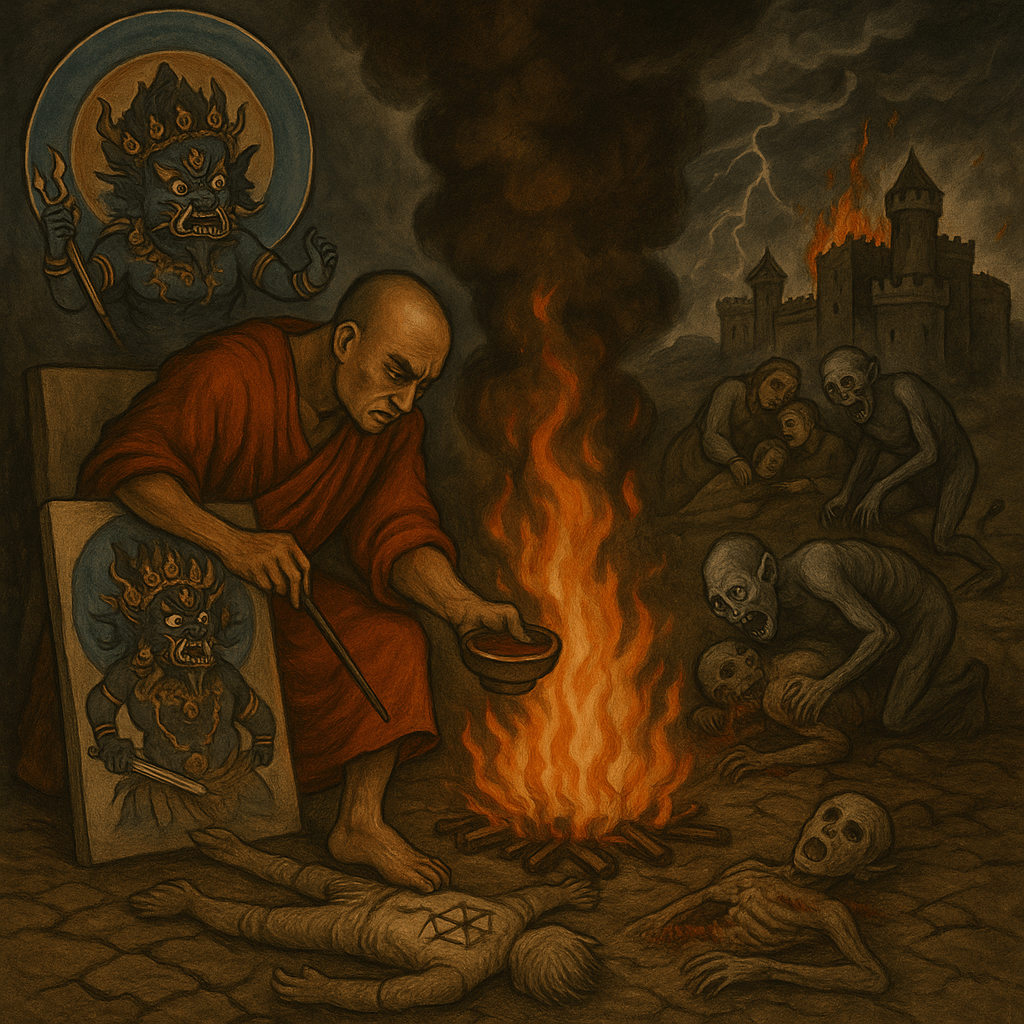
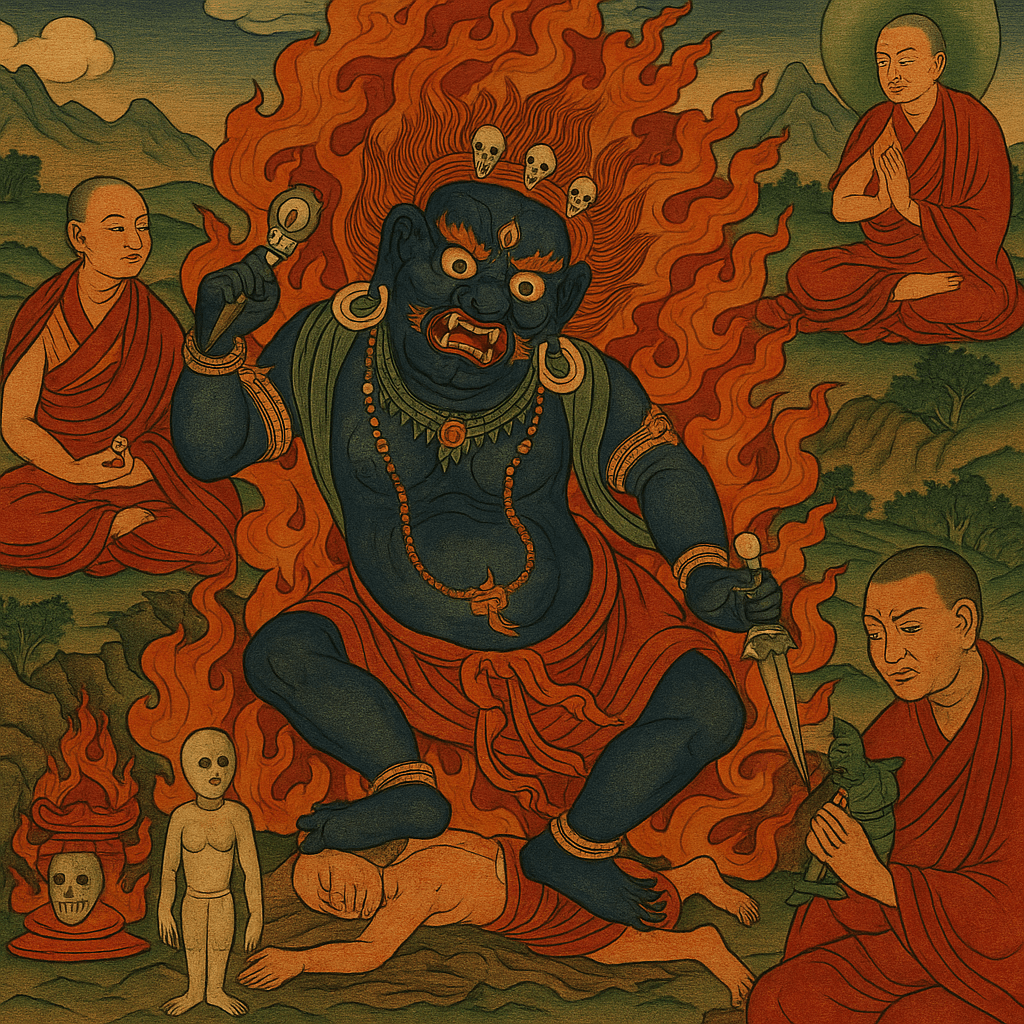
From the Mañjuśriyamūlakalpa’s “Ritual Against the Wicked Kings” comes one of the most explicit and brutal examples. The text instructs the practitioner to paint Yamantaka in terrifying form, then perform fire offerings of human blood, flesh, and powdered bone mixed with poisons and toxic plants to unleash plague, famine, storms, and demonic infestations upon the target. The king’s family is to die in sequence: son on the first day, wife and ministers on the second, the king himself on the third, while his court is overrun by flesh-eating spirits and his land struck by drought, fire from the sky, rockfall, and invasion. A human effigy bearing the victim’s birth star in cremation-ground charcoal is trampled during mantric recitation so the enemy dies, goes mad, or is devoured by demons. This is ritualized destruction in its most literal, calculated form.

One section of the same text reads like a manual for calculated devastation. The practitioner is instructed to heap human blood, flesh, powdered bone, poisons, and the roots of deadly plants onto a ritual fire in front of the painted deity. After 1008 offerings, not only is the enemy destroyed, but their family, ministers, and allies are swept away as well. The text promises droughts, plagues, famine, and storms, even fire and rocks falling from the sky, while demonic forces overrun the victim’s court. In some variations, a single datura root is enough to drive the target insane, or a few spoonfuls of spiced offerings can induce fatal fevers within days.

The text also states, “If he wants to kill someone, then having made a puppet (kṛtiṃ) he should write a name: the deity name or a nakṣatra (‘asterism under which the target was born’) using a charcoal of the cremation ground, which should be placed on the ground in front of the paṭa. Standing on [the puppet’s] head with his foot, he should be in a wrathful state, and do the recitation. He (the king) will become overpowered by a major disease, or he will die on the spot. That lord of men will be seized by piercing pains for no apparent reason, or he will be killed by an animal, or he will become crippled. He will be eaten by fierce rākṣasas, and various impure beings that have arisen from non-human birth (kravyādin), pūtanas, piśācas, pretas and the mothers, or he will be killed immediately by his own attendants.” 1

Conflict Inside the Tradition

Even within Tibetan Buddhism, the legitimacy of destructive rituals such as these was contested. Some figures, such as Rwa lo tsā ba, became famous for their wrathful practices but were denounced by peers as frauds or heretics. Reformers like Yeshes ’od tried to curtail the most extreme acts, replacing “live liberation” killings with symbolic substitutes like effigy destruction. But these reforms did not erase the underlying acceptance of ritual violence; they only tamed it for public consumption.

Another Piece of the Puzzle

Wenta’s work adds yet another piece of hard evidence to the growing pile that Tibetan Buddhism has long included practices designed to harm or destroy. These rituals were not simply metaphorical, and they were not limited to obscure sects. They were woven into the political and religious fabric of Tibet and beyond.

For those willing to look past Tibetan Buddhism’s carefully crafted PR image, the cult of Yamantaka exposes a reality in which the language of compassion hid a persistent undercurrent of deliberate harm.

Footnotes

1) Aleksandra Wenta, Tantric Ritual and Conflict in Tibetan Buddhist Society: The Cult of Yamāntaka, in Esimoncini, 19 Wenta CHIUSO, available at https://tibetanbuddhistencyclopedia.com/en/images/0/0b/Esimoncini%2C%2B19_Wenta_CHIUSO.pdf.

How Tantra Masqueraded as Buddhism: the Vajrayāna Deception


Vajrayana Buddhism, also known as Tibetan Buddhism or Tantric Buddhism, stands out for its rituals, deity worship, and complex esoteric practices. Its mantras, mandalas, and meditations on wrathful and yab/yum deities bear clear resemblance to Hindu Tantra, Vedic ritualism, and indigenous spirit cults.

So how did it convince anyone, especially devout Buddhists, that it was authentically taught by the historical Buddha?

The answer lies in a strategic combination of hidden teaching narratives, scriptural mimicry, ritual power, and imperial patronage. Let’s explore how this transformation occurred and what it means when viewed through the lens of Catholic faith and biblical discernment.

Secret Teachings: “The Buddha Taught It, But in Secret”

Vajrayana scriptures claim that the Buddha did teach tantra, but only in secret, to highly realized disciples. These teachings were said to have been hidden in celestial realms, entrusted to beings like Vajrapani or dakinis, or taught in the Buddha’s “enjoyment body” (sambhogakaya) form in other worlds such as Akanistha.(1)

This tactic mirrored earlier Mahayana developments, where new sutras like the Lotus or Avatamsaka were claimed to be higher revelations spoken by the Buddha, but not understood by his early disciples. The concept of esoteric knowledge reserved for the spiritually mature made these late texts seem like rediscovered treasures, rather than innovations.

Scriptural Mimicry and Retroactive Legitimization

To reinforce their authority, tantric scriptures deliberately mimicked the structure of traditional sutras. They often began with the familiar phrase, “Thus have I heard,” and depicted the Buddha teaching not only in celestial realms surrounded by bodhisattvas, but sometimes in radically transgressive settings such as charnel grounds, encircled by ḍākinīs and wrathful deities. These texts introduced elaborate cosmologies, detailed ritual instructions, and esoteric vows, presenting them as timeless wisdom, even though they were composed many centuries after the Buddha’s death.[2]

Authors also invented lineages, claiming that tantric teachings had been passed down secretly from Vajrapani to Nagarjuna, or from Padmasambhava to Tibetan kings.

Syncretism with Hindu and Folk Traditions

Instead of denying its similarities with Hindu Tantra, Vajrayana reinterpreted them. Wrathful deities were said to be enlightened Buddhas. Sexual rituals were described as a symbolic means to transform desire into wisdom. Offerings of blood, bones, and taboo substances were spiritualized as purifications of dualistic perception.

By repackaging Vedic and folk practices into a Buddhist framework, Vajrayana could absorb local traditions and declare them “Buddhist skillful means.”

Imperial Support and Monastic Integration

Tantra spread rapidly through the support of kings and monasteries. In Tibet, tantric masters were invited to subdue native spirits, secure political power, and perform rituals for prosperity. At Indian centers like Nalanda and Vikramashila, tantric scholars and monks practiced Mahayana logic by day and tantric visualization by night.

With the backing of the state and the academic establishment, Vajrayana was not seen as a fringe practice but as the “highest vehicle” of Buddhism.

Ritual Power and Psychological Experience

For the average practitioner, tantra “worked.” It offered visions, emotional catharsis, ritual protection, and the promise of fast-track enlightenment. The experiential pull of mantra, deity yoga, and initiation ceremonies gave people tangible results even if the doctrinal basis was historically shaky.

In the end, many believed not because of historical evidence, but because the system delivered experiences of spiritual intensity.

How Christianity Views This: The Domain of the Second Heaven

From a biblical and Catholic perspective, this raises serious concerns. The spiritual beings Vajrayana practitioners encounter, wrathful deities, dakinis, yidams, do not proclaim Christ as Lord and Savior. They do not point to the God of Abraham, Isaac, and Jacob. They offer power and enlightenment through self-transformation, not redemption.

The Bible is clear: Satan is the prince of the power of the air, ruling the spiritual domain between heaven and earth until Christ returns (Ephesians 2:2). What some refer to as the “second heaven” is where fallen angels operate, deceiving through false light, hidden knowledge, and seductive spiritual experiences.

Teachers like Derek Prince and Dr. Michael Heiser have explained how fallen entities inhabit unseen realms and impersonate divine figures such gods, ascended masters, or beings of light. Applying this view, the Buddhist realm of Akanistha, where the Buddha is said to teach in his sambhogakaya form, may not be a divine domain at all, but a carefully constructed counterfeit, orchestrated by spiritual powers aligned against the Kingdom of God.

This helps explain how a system like Vajrayana could emerge long after the Buddha’s time, imbued with supernatural power, spiritual visions, and doctrinal sophistication, yet still operate in direct opposition to the gospel of Jesus Christ.

Final Reflection: What About the Historical Buddha Himself?

This raises a deeper question: What about the historical Gautama Buddha?

His teachings, centered on renunciation, ethical conduct, and insight, seem far removed from tantric fire offerings, deity visualizations, and magical spells. He did not claim to be a god. He emphasized detachment from craving and moral clarity. So, was he simply a wise man? Or was he also deceived?

From a Catholic and biblical perspective, any system that does not point to Christ as the way, the truth, and the life (John 14:6) must be seen as incomplete at best, and spiritually dangerous at worst. Even teachings that emphasize compassion and morality can become a snare if they direct people away from the living God.

It is possible that the historical Buddha, though perhaps sincere and ethically inclined, encountered spiritual influences he did not fully understand. If he received his insights through meditation without divine revelation, then he may have opened himself to guidance from fallen beings presenting themselves as enlightened or falsely divine. This is a sobering possibility, but one that must be considered if we are to remain faithful to biblical truth.

The gospel does not offer esoteric techniques. It offers a person, Jesus, who does not ask you to awaken into the realization of emptiness. He calls you by name into communion with him, into truth, and finally, into eternal life.


Footnotes:

(1) Akanistha, also spelled Akaniṣṭha, is considered in Mahayana and Vajrayāna cosmology to be the highest of the seventeen or eighteen heavens in the form realm (rūpadhātu), and specifically the realm where Buddhas in their “enjoyment body” (sambhogakāya) manifest and teach advanced bodhisattvas. It is portrayed as a pure, radiant dimension beyond ordinary perception, where tantra and esoteric teachings are said to be revealed. From a Christian perspective, such realms existing in the unseen spiritual domain, may correspond to what theologians like Derek Prince and Michael Heiser describe as the “second heaven,” a sphere under temporary dominion of fallen angelic beings capable of impersonating divine figures (see Ephesians 6:12, Daniel 10:13).

[2] Alexis Sanderson, “The Śaiva Age: The Rise and Dominance of Śaivism during the Early Medieval Period,” in Genesis and Development of Tantrism, edited by Shingo Einoo (Tokyo: Institute of Oriental Culture, University of Tokyo, 2009), pp. 124–126. Sanderson provides detailed evidence that Buddhist tantras were modeled after Śaiva texts and appeared centuries after the Buddha’s life.

David B. Gray, The Cakrasamvara Tantra: The Discourse of Śrī Heruka, (New York: American Institute of Buddhist Studies, 2007), Introduction, pp. 18–25. Gray discusses the charnel ground setting and the structure of tantric texts, including the invocation of ḍākinīs and wrathful deities, and their divergence from earlier Buddhist sūtra literature.

The Darker Side of Tormas: Ritual Implements of Subjugation and Harm in Tibetan Tantric Practice


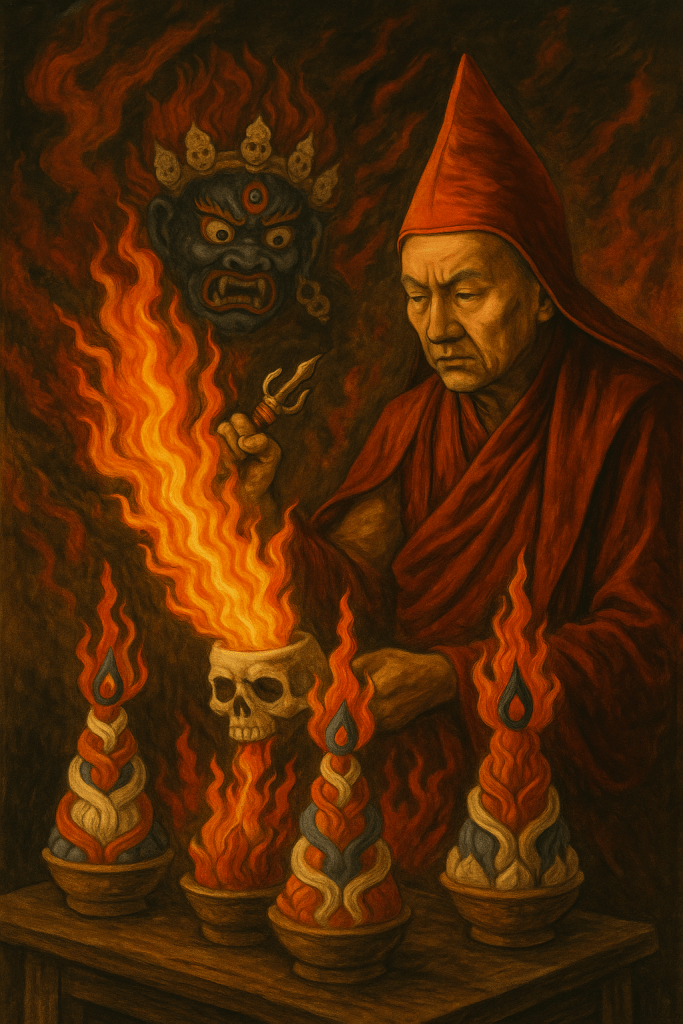
Tormas, those colorful, often conical sculptures made of barley flour, butter, and symbolic color, are widely recognized in Tibetan Buddhism as ritual offerings to deities. They are often seen as objects of devotion, used to accumulate merit and cultivate compassion. But there is another seldom discussed dimension of torma practice: their use in rituals of subjugation. These are aimed at destroying enemies, silencing dissenters, and even killing.

This article isn’t written for shock value or out of cultural disrespect. It comes from a deep need for transparency. I practiced within Tibetan Buddhism for decades, and what I discovered about the weaponization of these ritual objects came not from hearsay or internet rumors, but from firsthand experience, insider teachings, and years of quiet observation that finally crystallized into understanding.

What Are Tormas?

Tormas are visualized and empowered representations of deities as well as their palaces and mandalas. They also serve as offerings to the deities. Some types of tormas are used for offerings to spirits, and as weapons against obstructive spirits or humans. Other types of tormas known as “effigies” serve as targets. They are not merely symbolic. In Vajrayana practice, the effigies serve as “substitute bodies” for the consciousness of beings, meaning that a torma can become the ritual stand-in for an actual person. When a torma is offered, burned, stabbed, buried, or fed to spirits, it is not just a prop. It is, ritually speaking, a direct vessel for action.

In general, use of tormas can be for peaceful or wrathful purposes.

Categories of Harmful Tormas

While Western practitioners are often taught the “peaceful” or “blissful” uses of tormas (such as offering to bodhisattvas or for pacifying illnesses), most Tibetan tantric lineages include  the four activities of pacifying, enriching, magnetizing, and subjugating. These last two, magnetizing and subjugating, can lead to dangerous territory.

Here are some of the more occult, wrathful uses of tormas:

1. Subjugation of Enemies

Tormas are used to summon wrathful deities, who are then directed to “crush” or “bind” an enemy’s consciousness. This includes ritual domination of the enemy’s will, health, and spiritual power.

2. “Black Torma” Killings

Some lineages include advanced practices where a torma is empowered as the life force of a person. The torma is ritually destroyed: stabbed, burned, or fed to spirits. The goal is to destroy the target’s body, mind, or soul. In some cases, the practitioner prays explicitly for the target’s death.

3. “Torma of Speech Destruction”

These are used to silence critics or opposing religious figures. The practitioner invokes wrathful deities to sever the “enemy’s” speech, discredit them, or even cause them to go mad.

4. Sending Spirits via Tormas

Tormas can serve as carriers or offerings to nefarious spirits, binding the target’s consciousness to entities tasked with tormenting them. This can result in psychic invasion, night terrors, loss of mental clarity, or obsession.

Why This Needs to Be Talked About

These rituals are rarely, if ever, disclosed to outsiders. In fact, many lamas downplay them entirely until a student is “ripe” for higher teachings. But many practitioners have felt the effects of these rituals without knowing what they are. Unexplained breakdowns, spiritual confusion, sudden illness, and relational collapse often follow a break with the guru or a breach of samaya. We are told it is just our karma, but sometimes, it’s a ritual backlash.

If this sounds unbelievable, I understand. It sounded unbelievable to me, too, until I experienced it firsthand.

These practices are not just theoretical. They are happening now, in retreat centers and monasteries in India, Nepal and the West, in ritual rooms, behind closed doors. And their effects are very real.

Who Is Most at Risk?

  • Former students who break samaya or speak out
  • Critics of the guru or institution
  • Those perceived as spiritual “competitors”
  • Women who reject inappropriate advances
  • Outsiders who get too close to the truth

Reclaiming Truth

This article is not an indictment of all Tibetan teachers or practitioners. There are sincere people within the tradition who reject the use of harmful rites. But silence around these rituals has enabled a culture of fear, manipulation, and unchecked spiritual abuse.

It’s time to talk about it. The torma is not always what it seems. What looks like a simple offering on the altar may, in some cases, be a vessel of vengeance. We must not look away. If we really care deeply about the benefit of “all sentient beings” we must expose the truth about the dark side of tormas and their harmful uses in tantric Tibetan Buddhism.


Tantric Āveśa and Demonic Possession: A Comparative Exploration


Āveśa (Sanskrit) refers to a state of spiritual possession or divine inhabitation in which a deity or sacred power “enters” and dwells within a person. The word literally means “an entering” or “fusion,” describing the incorporation of divine power into the human body. Such forms of sacred possession have long been central to Indian Tantric practice, invoked for both worldly benefits (bhoga) and spiritual liberation (mokṣa). This is often contrasted with demonic possession in Christian theology, typically characterized as an involuntary affliction by an evil spirit.

Cross-cultural studies note that spirit possession can be either voluntary or involuntary, and it is interpreted differently depending on the tradition. Western occult traditions, such as Luciferianism, may view possession by a demon as desirable, even leading to a so-called “perfect possession.” In Christianity, however, even voluntary possession by a demonic force is considered evil. The question then arises: who or what possesses the practitioner in Eastern contexts?

Towards the end of my 35 years in Tantric Buddhism, I came to believe that the force presenting itself as a deity was, in fact, demonic. In what follows, I will examine the phenomenon of āveśa in two major esoteric traditions, Hindu Tantra (especially Shaiva lineages such as Kashmir Shaivism), and Tibetan Vajrayāna Buddhism. I will contrast these forms of divinely sanctioned possession with demonic possession in Christian and occult frameworks, drawing from historical sources, academic analysis, and personal experience.


Āveśa in Hindu Tantric Traditions

Scriptural Origins and Tantric Development

The Sanskrit root ā-viś (to enter) appears in early Indian texts, foreshadowing the later Tantric elaboration of āveśa.1 From the 5th to 11th centuries, Tantric scriptures across Śāiva, Śākta, and Buddhist milieus incorporated āveśa into ritual practice. Scholar Vikas Malhotra describes āveśa as the “entrance or fusion of oneself with the deity,” central to both magical and liberatory goals.2

These practices utilized mantras, mudrās, and nyāsa (installing mantras on the body) to induce the deity’s presence. Often this process was linked to śaktipāta, or the descent of divine energy. Over time, āveśa came to refer not just to deity possession, but a range of spiritual states culminating in union with Śiva.3 In contrast to exorcism (removing evil spirits), this adorcistic form of possession aimed to invite a divine presence.

Kashmir Shaivism and Samāveśa

In the Trika system of Kashmir Shaivism, the term samāveśa refers to full ontological immersion in Śiva-consciousness. Abhinavagupta, a 10th-century Hindu philosopher and Tantric adept, defined it as a merger of individual and divine being, sometimes accompanied by shaking, trance, or devotional ecstasy.4 Rituals such as nyāsa or advanced mudrā usage were seen as ways to divinize the body. Kṣemarāja, a key Trika commentator, emphasized that the body itself becomes a vessel for cosmic forces, eroding the sense of ego.5

This idea extended to daily ritual. The practitioner installs divine presences into various body parts—e.g., “May Brahmā be in my genitals, ViṣŇu in my feet, Śiva in my heart”—until the self is transformed.6 Āveśa was also connected to śaktipāta dīkṣā (initiation by grace), which Abhinavagupta saw as the guru’s transmission of divine force into the student.

Historical sources and hagiographies portray this not as pathology but sacred awakening. In the Bhakti tradition, saints like Caitanya and Rāmakṛṣṇa exhibited signs interpreted as divine possession, a loss of ordinary consciousness during worship or dancing in states of trance. In goddess worship, the ecstatic state of bhāva can evolve into full possession by a fierce Devī or goddess.

Induced Trance in Ritual Practice

Possession is not accidental; it is often deliberately induced. Contemporary folk-Tantric rites like Theyyam in Kerala reenact this vividly. The performer undergoes intense ritual preparation, dons a sacred headdress, and becomes a vessel for the deity. His demeanor, voice, and movements change dramatically, and devotees approach him as a god.7 These techniques including fasting, music, sacred garb, and mantra, parallel ancient Tantric rituals meant to induce āveśa.

Importantly, this experience is consensual. A priest may invite a deity for oracular guidance or blessing. The Tantric yogi similarly invites identification with Śiva. As Frederick Smith notes, such possession is the most valued spiritual experience in many Indian settings.8 Advanced yogis even practiced para-kāya praveśa, the entry of one’s consciousness into another’s body, a form of high-level āveśa.9


Āveśa (Possession) in Tibetan Vajrayāna Buddhism

Deity Yoga and Guru Inhabitation

Though the term “possession” is less used, Vajrayāna emphasizes divine inhabitation. In Deity Yoga, one visualizes oneself as a yidam (meditational deity) and invites the deity’s wisdom aspect (jñānasattva) to merge with the visualization (samayasattva). Through mantra and meditation, the practitioner dissolves ego and identifies as the deity.

While framed as an enlightened act, in practice there is no safeguard against malevolent forces. Many Tibetan rituals derive from the Yoginītantras, esoteric texts filled with wrathful, dangerous dākinīs. These entities are unpredictable and must be carefully propitiated. Practitioners hope to merge with them for wisdom and power, but failure often results in spiritual collapse or madness. One either becomes “enlightened” or is destroyed.

My personal experience, including participating in two three-year retreats, led me to conclude these deities are not divine but demonic. After prolonged practice, I experienced terrifying possession states, torturous sensations, and an uncontrollable kundalini awakening. While there were moments of bliss and magical phenomena, the final result was spiritual devastation.

Guru Yoga and Transmission

Guru Yoga, especially in the Nyingma and Kagyu lineages, mirrors āveśa. The practitioner visualizes the guru dissolving into them, merging body, speech, and mind. This is intended to produce an inseparable union. Some historical accounts even describe instant enlightenment via physical gestures or verbal commands from a master, a form of mind-to-mind transmission akin to possession.

Some Vajrayāna practices involve obvious demon possession. The Nechung Oracle, for example, enters trance during elaborate rituals, allowing the deity Pehar to possess his body. Frightening physical changes, voice alteration, and strength are observed. The practice is structured around phowa, a method of ejecting consciousness to allow divine entry.10


Possession as Initiation and Transformation

Both traditions treat āveśa as transformative. In Hindu Tantra, samāveśa may mark initiation or realization. In Vajrayāna, empowerment rituals symbolically install the lineage mindstream into the disciple. When successful, the practitioner believes they have merged with divine consciousness.

The experiences are often euphoric and expansive. Yet, as I learned, they can also become nightmarish. The forces one invokes may not be what they seem. While traditions insist the entities are enlightened or benevolent, there is no proof. Many undergo trauma, dissociation, and spiritual breakdown.


Christian Views of Possession: A Stark Contrast

In Christian theology, possession is demonic by nature. The demon enters uninvited or through occult involvement, and exorcism is the remedy. Symptoms include revulsion to the sacred, altered voices, and loss of control. Unlike tantric āveśa, the demon is not a divine aspect but an evil other. (I should note that the kundalini energy always felt “other” to me, but I was encouraged to see it as a positive experience.)

Catholic doctrine states that even voluntary occult involvement is condemned, seen as opening a door to bondage; the soul remains untouched, but the body and mind may be dominated. Consent may be partial or misguided, but once entered, the demon seeks destruction.

Only the Holy Spirit is seen as a positive presence, and even then, Christian traditions speak of inspiration rather than possession. Some Pentecostal expressions resemble Eastern possession states, but many Christians believe these, too, are counterfeit Holy Spirit experiences linked to kundalini phenomena.

Scripture offers stern warnings:

All the gods of the nations are demons.” — Psalm 96:5 (Septuagint) “They sacrificed to demons, not to God.” — Deuteronomy 32:17

In conclusion: āveśa is framed as a sacred merging in Tantra, but my experience revealed it as demonic deception. Beneath the ritual beauty lies spiritual subjugation. As an exorcist once warned me: Be careful who or what you invite to abide within.


Footnotes

  1. “A Brief Study of Possession in Hinduism Part II: The Spiritual Context,” Indic Today
  2. Vikas Malhotra, ĀveŚan and Deity Possession in the Tantric Traditions of South Asia
  3. Ibid. 
  4. “The Fulcrum of Experience in Indian Yoga and Possession Trance.” 
  5. Ibid. 
  6. Indic Today, op. cit. 
  7. “Theyyam,” Wikipedia
  8. Frederick M. Smith, The Self-Possessed: Deity and Spirit Possession in South Asian Literature and Civilization
  9. Yogasūtra III.38. 
  10. “Nechung Oracle,” Wikipedia

When Demons Leave the Way They Came: Breath, Tantra, and the Kalachakra Deception


Lately, I’ve been praying for God to continue revealing the truth about what I was involved in during my years of deep immersion in Tibetan Tantra. I’ve asked Him to uncover every layer of deception and to expose every way in which these practices are demonic. And He is answering.

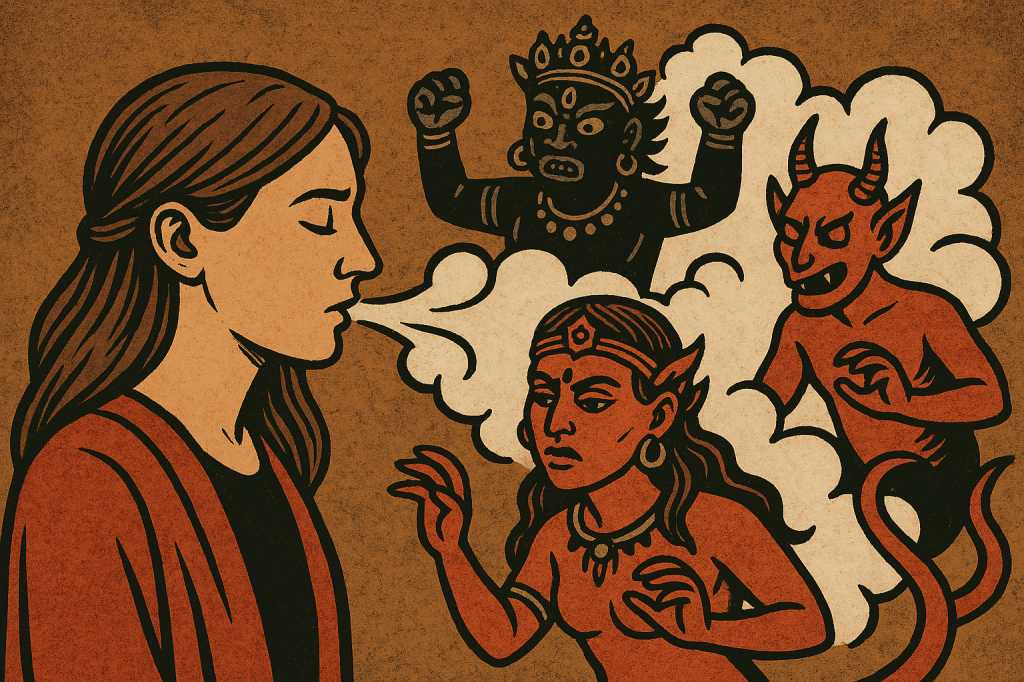
This past week, something profound happened: I experienced mass deliverance through my breath. As I exhaled, demons left me. Over and over again. It was undeniable. And then it hit me: of course they left on the breath. They came in on the breath.

This is not metaphorical. This is how tantra works. The breath is a key mechanism through which demonic entities enter one’s being. Yogic and tantric practices revolve around breath control: deep manipulation and intentional retention of the breath to open oneself to possession by what are euphemistically called “deities” but are, according to Christianity, demons.

In my three-year retreat, the main entities I invoked and merged with were Vajrayogini, the Red Dakini, and her consort. These were not simple meditations or visualizations. These were acts of surrender and identity dissolution. In essence, the goal was full-blown possession, even though it wasn’t couched in those terms and I didn’t realize that is what was happening.

Vajrayogini doesn’t come alone. Her retinue includes approximately 120 assistants, each with its own functions and qualities. That number is staggering, and that’s just one system of practice. In addition to her, I practiced the sadhana of a wrathful black deity with a massive host of demonic attendants. I should stress that these are not benign energies. They are demanding, and potentially violent and spiritually lethal.

But even beyond retreat, I continued to receive more initiations, or so-called empowerments. One that stands out is the Kalachakra initiation in 2011 from the Dalai Lama in Washington, D.C. It was a 10-day, all-day affair. I was zealous, determined to catch every detail of the ritual. I arrived early each morning to watch the Dalai Lama prepare himself by “self-generating” as the deity Kalachakra. It was amazing to watch; he was ritually becoming the deity.

Kalachakra, which means “Wheel of Time,” is a tantric deity surrounded by a staggering retinue of 722 deities. But these aren’t heavenly hosts. According to Christianity, they are demons. Every one of them. The entire system is a carefully constructed spiritual snare designed to bind souls to counterfeit light.

Thousands, maybe millions, have received these same initiations. The Dalai Lama has made it his mission to offer the Kalachakra globally. People believe they are receiving a blessing. But in reality, they are being spiritually colonized. Demonic systems are being seeded into the nations. These rituals are not neutral cultural events. They are portals for dark power.

If you want a glimpse into what may really happening during these ceremonies, I encourage you to read this article that lays it out plainly:
Dalai Lama and the Kalachakra

As for me, I’m continuing to pray and seek God’s help in cleansing every layer of my being. What I’m realizing is horrifying but I am confident that God is showing me the truth and setting me free.