Tibetan Buddhism is marketed in the West as a path of the highest integrity. It is described as a philosophical system with techniques for developing mindfulness, compassion, and ultimately for attaining enlightenment. What is rarely stated plainly is that Vajrayāna tantric systems are structured around ritualized spirit possession and identity takeover.
A 2022 doctoral dissertation, Āveśa and Deity Possession in the Tantric Traditions of South Asia by Vikas Malhotra, documents that possession became central to medieval Tantric practice, including Buddhist Tantra that later developed into Tibetan Vajrayāna.[1] The Sanskrit term āveśa literally means “entering into.” In Tantric contexts, it refers to the fusion of practitioner and deity. This was not marginal but foundational.[2]
Deity Yoga Involves Possession
In Tibetan Deity Yoga, practitioners visualize themselves as a deity, recite its mantra, adopt its gestures and identity, and are instructed to experience no separation between themselves and that being. Modern teachers frame this as symbolic or psychological and as a method to realize emptiness. But examined historically, it follows the structure of possession technology:
Invocation
Descent of power
Identity fusion
Altered agency
Bodily and psychological signs
Medieval Tantric texts describe possession markers such as trembling, ecstasy, altered consciousness, and loss of ordinary identity. These same phenomena and mechanisms are reported in Vajrayāna contexts.
Guru Yoga and Human Possession
There are also uncomfortable truths concerning Guru Yoga. In this practice, the visualized guru dissolves into light and enters the disciple. The disciple experiences the guru’s mind as inseparable from their own. Empowerment is described as a descent of blessing into the subtle body. The dissertation notes that in Tantric systems, even advanced humans could possess others in positive ways. [3]
The guru embodies enlightened power.
Through initiation, that power descends.
The disciple becomes a vessel.
Identity shifts from individual to lineage-bearer.
This is ritualized human-to-human possession. It is framed as a positive transmission, but is it really? What are the implications of inviting another human being in to possess you? If you examine the numerous exposés of abuse in Vajrayāna communities over the past few decades, you might wonder why anyone would let a fallible human being enter and possess them. As someone who lived through egregious abuse by a supposedly enlightened Vajrayāna master, I can speak from personal experience. Guru yoga creates a framework in which another human being is granted intimate internal authority over your mind and identity. Why would anyone knowingly consent to that dynamic? They probably wouldn’t if they knew that spiritual possession is what actually happens during guru and deity yoga.
Why This Is Glossed Over
The fact that this is glossed over in Tibetan Buddhist teachings should give one pause. Why isn’t this discussed up front? It is because possession sounds primitive and carries negative psychiatric and colonial baggage. For these reasons, traditions seeking Western legitimacy avoid the term and conceal the reality beneath layers of theological and philosophical euphemism. The issue is not vocabulary, but whether practitioners are told clearly what is structurally taking place. If Vajrayāna depends on ritualized possession through deity and guru incorporation, that should be stated plainly.
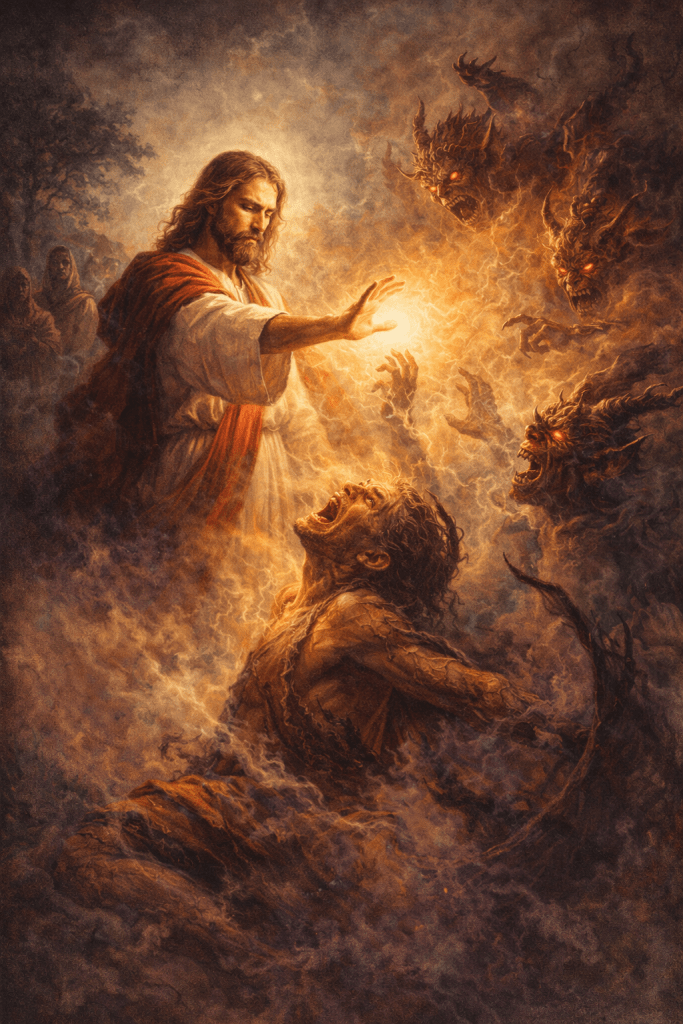
In Western religious history, especially within Christianity, possession has long been regarded as negative, spiritually dangerous, and psychologically destabilizing. It is associated with loss of agency, vulnerability to manipulation by demonic entities, and the need for protection or exorcism. It is not treated as spiritually glamorous. It is treated as a serious risk.
Yet when similar identity-dissolving dynamics appear within an imported spiritual system, they are often elevated, aestheticized, and shielded from scrutiny. The language changes but the underlying structure does not.
Why does ritual possession provoke alarm in one context but reverence in another? Why does a shift in metaphysical framing automatically neutralize the concern? If this would raise red flags in a Western church, why should it be exempt from examination in a Tibetan temple?
The historical record is clear. Possession is not peripheral to Tibetan Tantra. It is embedded in its ritual core. If that is so, then practitioners deserve to confront that reality consciously rather than encounter it disguised as harmless symbolism or elevated mysticism.
Footnotes
[1] Vikas Malhotra, Āveśa and Deity Possession in the Tantric Traditions of South Asia: History, Evolution, & Etiology, PhD diss., University of California, Santa Barbara, 2022 .
[2] Ibid., discussion of possession becoming central to Tantric praxis .
[3] Ibid., discussion of positive forms of human possession .
[4] Ibid., integrated model of possession as embodied transformation .
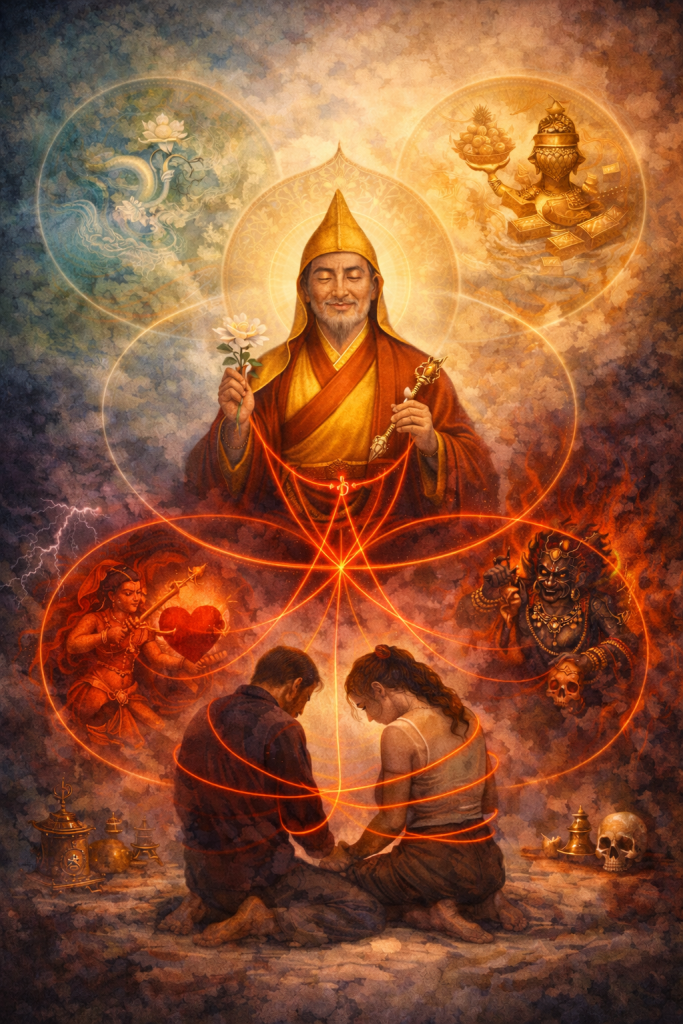
In Vajrayana Buddhism and related tantric systems, practitioners are taught that enlightened activity manifests in four fundamental modes, often called the Four Activities. These are commonly translated as Pacifying, Enriching, Magnetizing, and Subjugating. In Sanskrit they correspond to śāntika, pauṣṭika, vaśīkaraṇa, and abhicāra. In Tibetan sources they are known as zhi, rgyas, dbang, and drag po.
Doctrinally, the Four Activities are described as spontaneous expressions of awakened compassion. An enlightened being pacifies obstacles, enriches virtue and resources, magnetizes beings toward the Dharma, and subjugates harmful forces. This presentation emphasizes intent and realization, assuring the student that such actions, when performed from enlightenment, are free of karmic stain.
Yet this sanitized description obscures a more uncomfortable reality. Historically and textually, the Four Activities function as classificatory frameworks for large compendiums of ritual technologies. These include magical spells, rites, visualizations, mantras, and talismanic operations designed to bring about very specific effects in the world. Such effects include healing and calming, increasing wealth or longevity, attracting and binding others, and coercing, harming, or destroying enemies.
This dual framing creates a tension that is rarely examined openly within modern Buddhist discourse.
The Four Activities as Magical Technologies
Tantric manuals from India and Tibet make explicit that the Four Activities are not metaphors. They are actionable ritual categories. Tantras such as the Guhyasamāja Tantra and the Hevajra Tantra, along with later ritual compendiums such as the Sādhanamālā and abhicāravidyā genre texts, provide detailed instructions for rites aimed at controlling weather, influencing rulers, compelling lovers, paralyzing rivals, or causing illness and death.[1]
These materials make clear that tantric ritual was never confined to inner transformation alone. The Four Activities structured a full spectrum of practical interventions into social, political, and psychological life.
The Sādhanamālā
The Sādhanamālā is a large Sanskrit compendium of tantric ritual manuals compiled in India roughly between the 8th and 12th centuries CE.
It is Buddhist, specifically Vajrayana or Mantrayāna, and not Śaiva, even though it shares techniques and ritual logic with non-Buddhist tantric traditions. The text consists of several hundred sādhana instructions for meditation and ritual practice focused on Buddhas, bodhisattvas, and tantric deities such as Tārā, Avalokiteśvara, Mañjuśrī, Vajrayoginī, and Hevajra.
Many of these sādhanas are explicitly or implicitly classified according to the Four Activities. They include ritual prescriptions for pacifying illness, enriching wealth or lifespan, magnetizing kings, patrons, or disciples, and subjugating enemies. The intended effects are practical and worldly as well as soteriological.
The Sādhanamālā was translated into Tibetan in parts and circulated widely in Tibet. Tibetan ritual literature draws heavily on this material, even when the Indian source material is not foregrounded explicitly.
Standard scholarly references include: Benoytosh Bhattacharyya, Sādhanamālā, Baroda, 1925–1928, and David Snellgrove, Indo-Tibetan Buddhism, Shambhala, 1987.
Abhicāravidyā Texts
Abhicāravidyā is not a single book but a category of ritual literature.
The Sanskrit term abhicāra refers to rites of coercion, harm, or destructive magic. Vidyā means a spell or magical formula. Abhicāravidyā texts are therefore manuals of destructive or coercive rites.
In Buddhist tantra, such texts describe subjugation practices including immobilization, madness, illness, death, expulsion of consciousness, and rites intended to cause death, sometimes described as ritual killing by proxy. These rites are usually justified as actions taken against enemies of the Dharma, oath breakers, or beings deemed karmically irredeemable.
These texts circulated in India among tantric specialists and were selectively translated into Tibetan, often under euphemistic titles or embedded within larger ritual cycles. In Tibet, their contents were reorganized under the heading of drag po, or wrathful activity.
Important examples of Buddhist abhicāra material appear in:
The Guhyasamāja Tantra and its explanatory tantras The Hevajra Tantra The Sarvatathāgatatattvasaṃgraha Later ritual manuals attributed to figures such as Nāgārjuna and Padmasambhava
Because of their ethical volatility, abhicāra rites were rarely taught openly. Access was restricted, which is one reason modern practitioners often underestimate how central such practices were historically.
Key scholarly discussions include: Ronald Davidson, Indian Esoteric Buddhism, Columbia University Press, 2002, and Alexis Sanderson, “The Śaiva Age,” in Genesis and Development of Tantrism, Tokyo, 2009.
Relationship to Tibetan Buddhism
Tibetan Buddhism inherited these Indian materials largely intact. The Four Activities framework in Tibet is not an innovation but a systematization of Indian tantric categories.
What changed in Tibet was less the ritual content than the doctrinal rhetoric surrounding it. Destructive and coercive rites were reframed as compassionate acts performed by realized beings. This rhetorical move allowed the practices to survive while softening their public presentation.
When Tibetan teachers speak of the Four Activities today, they are standing on a ritual foundation built by Indian Buddhist tantra, including the Sādhanamālā and abhicāravidyā traditions, whether this inheritance is acknowledged or not.
In Tibetan contexts, this ritual material was further systematized. The Four Activities became a classificatory framework under which thousands of rites were organized. Fire pujas, effigy magic, thread-cross rituals, and sexual yogas all find their place within this scheme.[2]
The ethical difficulty is obvious. While pacifying and enriching activities can be interpreted charitably, subjugation practices explicitly involve violence, coercion, and psychological domination. Tibetan ritual manuals state that subjugation rites can cause madness, death, or rebirth in hell realms for the target, often justified by vague claims that the victim is an enemy of the Dharma.[3]
Subjugation and Buddhist Ethical Dissonance
From the standpoint of Buddhist ethics, subjugation is the most troubling of the Four Activities. Buddhism is grounded in non-harming and the cultivation of compassion. Yet subjugation rituals rely on wrathful intent and instrumental harm. Traditional defenses argue that enlightened beings act beyond dualistic morality because they have transcended good and evil.
For modern Western practitioners, these explanations often remain abstract. Teachers rarely teach subjugation practices explicitly, and students are encouraged to interpret wrathful deities symbolically. This produces a form of cognitive dissonance. The practices exist, are preserved, and are sometimes performed within group pujas, but disciples can maintain psychological distance by not understanding the wrathful practices or details. Ignorance becomes a form of insulation.
Magnetizing Activity and the Binding of Disciples
Magnetizing activity is often portrayed as benign. It is described as the compassionate attraction of beings to the path. Yet tantric texts are explicit that magnetizing rites are used to influence minds, bind loyalty, and generate devotion.[4]
In ritual manuals, magnetizing practices are used to attract lovers, patrons, followers, and students. They involve visualizations of cords, hooks, nooses, and substances entering the bodies of targets to incline their thoughts and emotions. These are not metaphors for persuasion. They are magical technologies of attachment.
Within guru-disciple relationships, magnetizing activity takes on a particularly disturbing dimension. Once a student takes tantric initiation, they are bound by samaya vows. These vows often include lifelong loyalty to the guru and lineage until enlightenment is achieved.[5]
The power imbalance is severe. The teacher is positioned as the embodiment of awakening. The student is warned that doubt, criticism, or separation leads to spiritual ruin.
What If Enlightenment Is Not Reached?
Traditional literature assumes enlightenment will be reached. But what if it is not. What if the practitioner becomes disillusioned, traumatized, or psychologically destabilized.
In such cases, the Four Activities do not disappear. The same ritual logic that binds can also be used to punish. Tibetan sources describe the use of subjugation rites against oath breakers, samaya violators, and enemies of the lineage.[6]
Modern scholars and psychologists studying tantric communities have documented patterns of dependency, identity collapse, and long-term trauma following abusive guru relationships.[7] Magnetizing activity, in this light, resembles a spider’s web. Attraction is not neutral. It is structured, adhesive, and difficult to escape.
Conclusion
The Four Activities are not merely poetic descriptions of enlightened compassion. They are historical and functional systems of magical action. To ignore this is to misunderstand tantra at its core.
Subjugation challenges Buddhist ethics directly. Magnetizing challenges them more subtly. It operates through devotion, love, and surrender, making it easier to accept and harder to question. For Western practitioners kept deliberately ignorant of these dynamics, the result is not safety but vulnerability and the possibility of ruin.
An honest engagement with tantra requires confronting these practices without romanticism, without denial, and without pretending that malevolent harm disappears simply because it is cloaked in sacred language.
Footnotes and Sources
Alexis Sanderson, “The Śaiva Age,” in Genesis and Development of Tantrism, Tokyo, 2009.
Samten Karmay, The Arrow and the Spindle, Mandala Book Point, 1998.
Ronald Davidson, Indian Esoteric Buddhism, Columbia University Press, 2002.
David Gordon White, Kiss of the Yogini, University of Chicago Press, 2003.
Jamgön Kongtrul, The Torch of Certainty, Shambhala, 1977.
Stephen Beyer, The Cult of Tārā, University of California Press, 1978.
Mariana Caplan, Halfway Up the Mountain, Hohm Press, 2011.
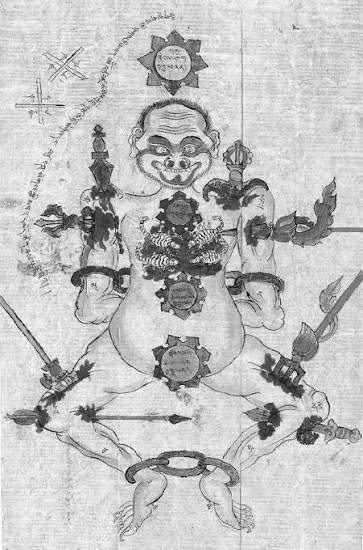
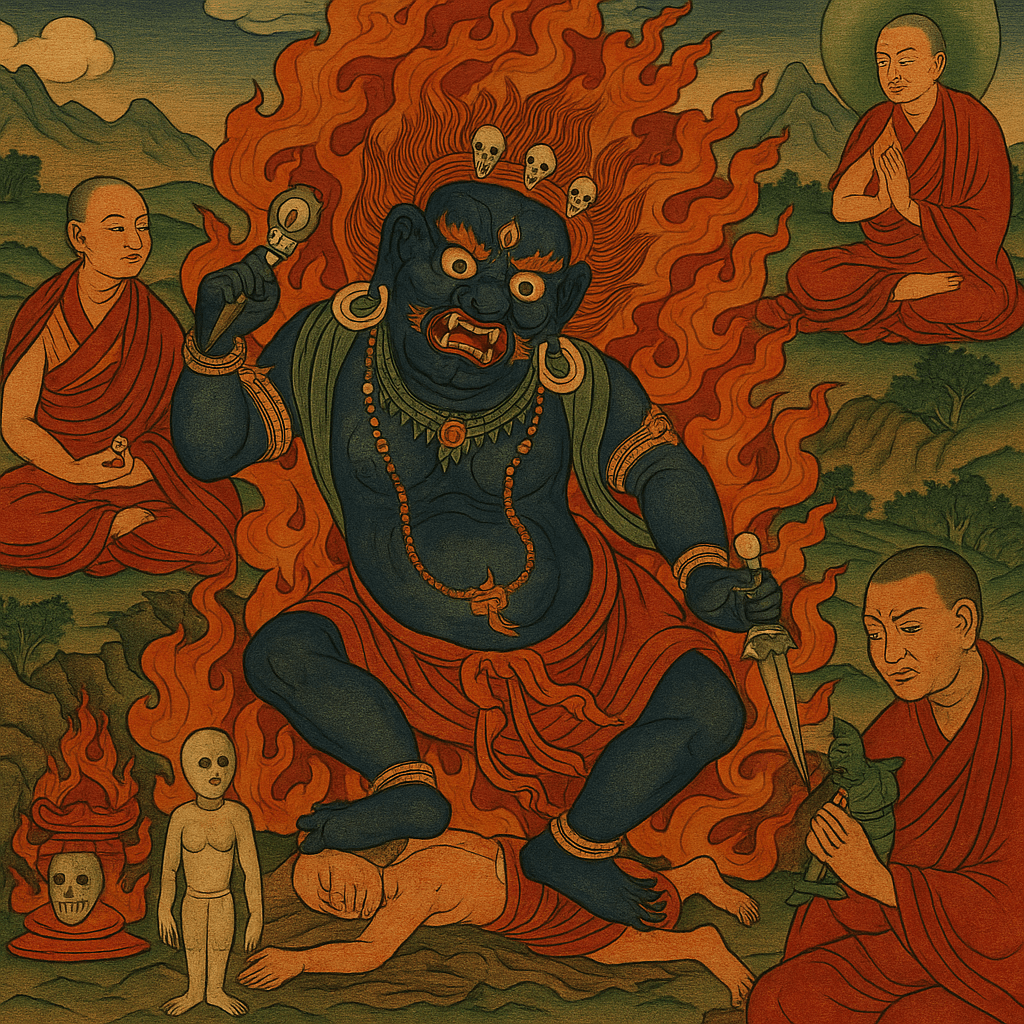
Among the many images that circulate quietly within Tibetan tantric lineages, there are several that are never explained to most practitioners and never shown outside advanced ritual contexts. One such image, often embedded within long Mahākāla rites and other high-level tantric liturgies, depicts a bound, pierced, weapon-studded human figure marked with mantras, seals, and symbolic restraints. To the uninitiated, it resembles a wrathful medical diagram or an esoteric curse talisman. To insiders, it represents something much more disturbing.
These images are not symbolic reminders of compassion, nor are they abstract metaphors for ego-death. They are ritual instruments. Specifically, they are used in rites intended to punish, bind, obstruct, or destroy the lives of those who are deemed to have broken samaya—the sacred vows binding a tantric practitioner to their guru, lineage, and yidam deity.
This fact is rarely discussed openly. When it is mentioned at all, it is framed euphemistically as “removing obstacles,” “protecting the Dharma,” or “subjugating harmful forces.” What is almost never acknowledged is that, within some tantric systems, the “harmful force” being targeted is a former disciple.
Why Beginners Are Never Told
Students entering Tibetan Buddhism are typically introduced through ethics, meditation, philosophy, and aspirational ideals: loving-kindness, compassion, non-violence, and wisdom. Tantric Buddhism is presented as a fast but benevolent path, dangerous only insofar as it requires devotion and discipline.
What they are not told is that questioning, criticizing, or emotionally reacting to a guru can itself be framed as a samaya violation. Nor are they told that certain rituals explicitly teach that lineage holders have the right, and sometimes the obligation, to retaliate metaphysically against perceived betrayal.
Beginners are warned vaguely that breaking samaya leads to “terrible consequences,” often described as karmic rather than intentional. The implication is that the universe itself will respond. What is left unsaid is that these consequences may be deliberately invoked, ritualized, and sustained by human agents acting within a tantric framework.
The unspoken lesson is simple: dissent is dangerous.
The Yidam Is Watching
At the core of highest yoga tantra is the yidam deity, the meditational deity with whom the practitioner forms an exclusive, intimate bond. The yidam is not merely visualized as an external symbol but is gradually internalized, embodied, and ultimately identified with as one’s own enlightened nature.
This process is often described in modern terms as psychological transformation. In traditional terms, however, it is far closer to classical possession.
The practitioner receives initiation from a master understood to be fully realized–meaning fully inhabited by the yidam. Through empowerment, mantra recitation, repeated visualization, and ritual invitation, the practitioner repeatedly invites the deity to enter their body and mind. Over time, the boundary between practitioner and deity is intentionally dissolved.
This is how the yidam “monitors” the practitioner: not metaphorically, but through total psychic access. Thoughts, emotions, doubts, and impulses are no longer private. They are offerings or offenses.
Within this framework, enlightenment, siddhis, and protection are granted conditionally. The deity gives, and the deity can withhold. More disturbingly, the deity can retaliate.
“Sons” of the Deity and Absolute Obedience
Advanced tantric systems often refer to lineage masters as the “sons” of the yidam. These are the men who have fully merged with the deity through practice. Disrespecting such a figure is not treated as a social conflict or ethical disagreement; it is framed as an attack on the deity itself.
This becomes especially dangerous in cases involving sexual relationships between guru and disciple. While not every such relationship is abusive, many are. In some cases, a guru expects sexual access as a demonstration of devotion and service. When the disciple becomes distressed, confused, or resistant, or when she later speaks out, the guru’s response is not accountability but punishment.
From within the tantric logic, the guru is not merely a man abusing power. He is a god-being whose will cannot be questioned. The disciple’s suffering is reframed as karmic purification or divine retribution.
Ritual Retaliation Is Real
There is a tendency among modern defenders of Tibetan Buddhism to dismiss accounts of retaliation as superstition or paranoia. Yet whistleblowers, both Western and Asian, have repeatedly documented actions taken against former disciples over months or years. In the most extreme cases, these are not momentary curses but sustained practices intended to ruin health, relationships, livelihood, and sanity.
I personally have known three gurus who engaged in such retaliatory behavior. These were not fringe figures. They were respected, accomplished masters with devoted followings. The rituals were not symbolic. They were methodical, intentional, and experienced by the practitioners themselves to be effective.
This is witchcraft in the plain sense of the word. It is no different in structure or intent from Haitian vodou curses or European malefic magic. The only difference is the religious branding.
The Ethical Contradiction at the Heart of Tantra
This raises an unavoidable question: how can a system that claims descent from the historical Buddha whose teachings emphasize non-harming, restraint, and compassion contain practices that deliberately destroy human lives?
The answer lies in tantric exceptionalism. Within these systems, ordinary Buddhist ethics are considered provisional. Once one enters the tantric domain, morality becomes subordinate to obedience, secrecy, and power. A guru possessed by a wrathful deity is no longer bound by conventional ethics because the deity is not.
Publicly, tantric masters speak constantly of compassion and loving-kindness. They smile, bless, and perform virtue with great skill. Privately, nothing is free. Every empowerment creates obligations. Every vow tightens the noose. And the deeper one goes, the more rigid and unforgiving the system becomes.
The Real Danger
Not all Tibetan Buddhist teachers engage in these practices. Many do not. But the fact that some of the most accomplished masters have done so for centuries means the danger is structural, not incidental.
The real threat of tantric Buddhism is that it weaponizes devotion, sanctifies possession, and normalizes ritual violence while hiding behind the language of Buddhist compassion and enlightenment.
Until this is openly acknowledged, aspirants will continue to walk blindly into systems that can, and sometimes do, destroy them, all in the name of awakening.
Thomas Merton remains one of the most fascinating and controversial figures in modern Catholic spirituality. A Trappist monk whose writing reached millions, he invited readers into a life of contemplation shaped by silence, inner stillness, and spiritual inquiry. By the 1960s, his search had expanded far beyond the borders of Christian tradition and into the world of Eastern mysticism. His journey raises important questions about discernment, authority, and the possibility that some mystical experiences do not come from God at all.
Why Merton looked East
Merton believed that Western Christianity had lost something essential. He felt that institutional concerns and intellectual debate had overshadowed direct experience of God. Eastern religions appeared to preserve a contemplative path in a purer form. Like many in the post–Vatican II era, he saw dialogue with non-Christian religions as an opportunity rather than a threat.
But such openness came with a cost. Many Catholics of his time assumed that all deep mystical traditions shared a common source. The idea that spiritual experiences could arise from contrary or even deceptive origins was rarely discussed. This lack of discernment created a vulnerable generation of seekers who treated Eastern practices as spiritually neutral when they were not.
Merton’s early interest in Asia
Long before traveling to Asia, Merton was reading Zen, Taoism, Advaita Vedanta, and Sufi mystics. He approached them with sincere curiosity, but also with a growing assumption that truth could be gleaned from any direction. His writings from this period suggest a desire for universal contemplative experience, sometimes without sufficient attention to the distinct theological and spiritual claims behind each tradition.
This tendency to universalize mystical experience would shape his final years.
Meeting the Dalai Lama
In 1968, Merton traveled to Dharamsala and spent several days with the Dalai Lama. Their meetings were warm and genuinely contemplative. Merton admired the Dalai Lama’s kindness, discipline, and clarity. The Dalai Lama later remembered Merton as the first Christian monk who came to him not as a tourist or academic but as a fellow practitioner of deep prayer.
Yet admiration does not erase theological differences. Tibetan Buddhism denies a creator God, embraces reincarnation, and employs esoteric tantric practices that involve deities outside the Holy Trinity. From a Christian point of view, this difference is huge. The Church has long taught the discernment of spirits: mystical experiences must be tested, because deceptive spiritual forces can imitate peace, clarity, and even compassion. Merton did not always express this caution.
Encounter with Kalu Rinpoche
Merton also met Kalu Rinpoche, one of the most respected Tibetan meditation masters of the twentieth century. He attended teachings on Mahamudra and was deeply impressed by the monastic discipline he witnessed. Kalu Rinpoche even invited him to undertake a long hermit retreat. Merton seemed drawn to the idea.
But Tibetan Buddhism contains layers of esoteric practice that Merton, like most Westerners of his time, did not fully understand. The serene exterior of Tibetan spirituality often conceals tantric rituals, spirit invocation, and hierarchical guru devotion that are fundamentally incompatible with Christianity. Later revelations of abuse and occult manipulation inside some of the major Tibetan lineages show how incomplete the Western picture had been. Merton could not have known this, yet his enthusiasm reflected a lack of discernment that would affect many who followed in his footsteps.
What else he explored
Merton’s range of interests was broad. He read Zen masters, Taoist sages, Hindu philosophers, and Sufi poets. He studied Christian hesychasm with new energy and sought common threads among all traditions. His impulse was generous, but generosity is not the same as spiritual clarity. Christian prayer directs the soul toward union with God. Eastern meditation, especially tantra, aims at dissolving the ego and merging with non-Christian spiritual entities.
These are not complementary goals but representative of different spiritual destinies.
Bangkok and a mysterious death
After leaving Dharamsala, Merton traveled to Bangkok to speak at an international monastic conference. On December 10, 1968, he died in his cottage shortly after giving a lecture. The official explanation was accidental electrocution from a faulty fan. Yet no autopsy was performed, and the circumstances were poorly documented. The inconsistencies have fueled speculation for decades.
His death came at a moment when he was moving more deeply into Buddhist thought. Whether he intended to integrate aspects of Tibetan practice into Christian monasticism remains unknown. His passing has an unfinished quality, as if he was on the edge of a major spiritual shift whose implications were never tested.
Why Merton still matters
Merton’s life challenges readers to seek authentic spiritual contemplation, not just intellectual understanding. It also warns Christians that not every path that promises depth is aligned with God. Eastern systems often carry metaphysical commitments and spiritual forces that stand in real conflict with Christian revelation. Without a strong framework of discernment, even sincere seekers can be misled.
Merton’s writings still inspire, yet his story also stands as a cautionary tale. The longing for mystical experience is real and often holy, but it must be shaped by sound doctrine and a sober awareness that not every spiritual path leads toward God.
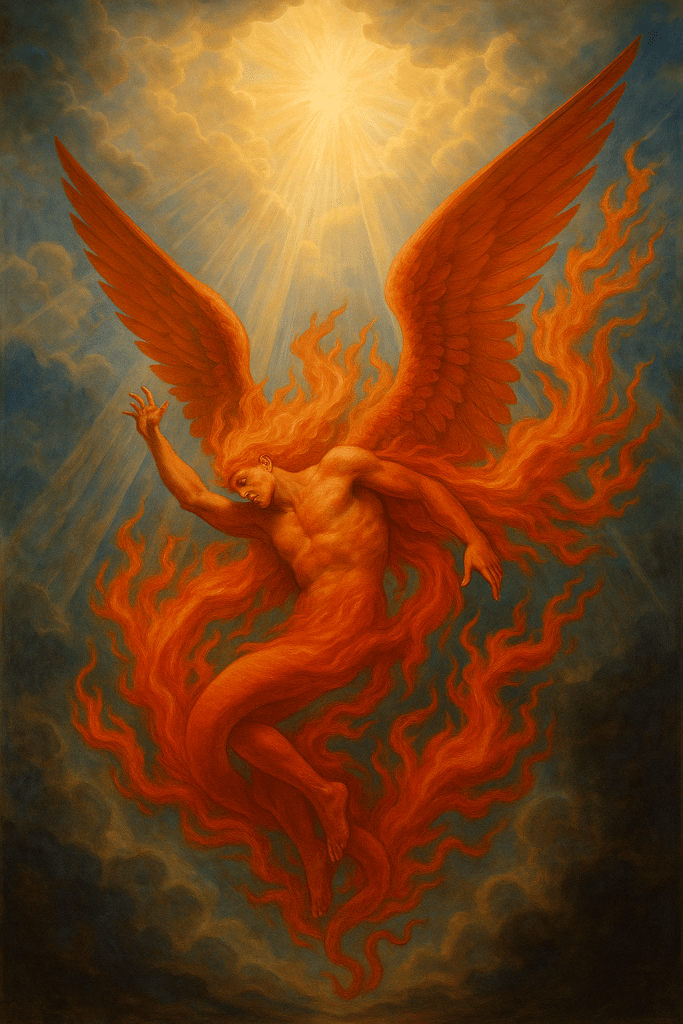
What if some of the radiant beings that ancient texts call Seraphim, the fiery, serpentine angels who once circled the throne of God, fell from that high order? The Hebrew word saraph itself means both burning one and serpent. In that ambiguity lies a bridge between the flaming spirits of heaven and the serpent powers found in other traditions.
Across the world, in the Sanskrit Purāṇas and yogic literature, there are also serpentine intelligences: the Nāgas, the Kundalinī energy, and the goddess figures who appear surrounded by flames. The sage Patañjali, author of the Yoga Sūtras, is deeply linked with serpent symbolism. In Indian mythology, he is sometimes described as an incarnation (avatāra) of the serpent deity Ādiśeṣa, or Ananta, the cosmic serpent who supports Viṣṇu. Ādiśeṣa is said to have descended to earth to bring knowledge that would relieve human suffering. This connection is why Patañjali is often portrayed with a serpent hood behind his head or a serpent body below the waist. Whether or not serpent spirits literally whispered the Yoga Sūtras to him, serpent imagery pervades yogic and tantric cosmology. The Nāgas are keepers of divine wisdom, and Kundalinī is envisioned as a coiled fiery energy at the base of the spine that awakens through disciplined practice. Over time, these motifs merged into a vision of serpentine power as both the source and the path of revelation. Suppose these mythic beings were echoes of the same order of spirits, glimpsed through another cultural lens. If the Seraphim of the Old Testament were “burning ones,” what would a fallen Seraph look like to those who encountered its power? Perhaps like the Kundalinī Śakti, a current of fire roaring through the body, consuming and transformative, perilous and hideous.
In Tibetan tantric art, figures such as Vajrayoginī blaze with this same imagery. She stands wreathed in flame, hair flying, a garland of human heads around her neck: a being of immense energy and occult knowledge. To her accomplished devotees she is enlightenment embodied, but to others overwhelmed by her force, the experience could resemble an encounter with a terrifying, cosmic intelligence that feels at once divine and frightfully destructive.
In Christian cosmology, the Seraphim stood closest to the divine light, their essence described as pure burning love. If the story of the angelic rebellion is true, the fall of Lucifer and his host might be understood as the perversion of that love for God turned inward toward self-worship. The Seraphs, if any joined that rebellion, would have fallen from the highest heaven to earth yet carried the memory of their incandescent proximity to the Most High. After such a fall, their nature would remain fiery but unmoored, no longer worshipping the divine but seeking vessels in which to become divine objects themselves, demanding reverence rather than giving it. Their rebellion took the form of imitation, of becoming godlike and leading humans away from God through elaborate systems of spiritual artifice. Seen through that lens, the serpent fire that rises in the body could be a vestige of this celestial descent, a remnant of the same luminous essence striving to return upward yet incapable of abiding in heaven because of their grave sin. In mythic terms, these fallen Seraphs might not have become the grotesque demons described by some exorcists but radiant, fallen intelligences deprived of their proper axis.
Catholic exorcists often describe demons as denizens of hell, creatures of stench, mockery, and degradation that feed on blood and fear. Yet if a third of the angels fell, the fallen host was not of one kind alone. Tradition holds that beings from all nine choirs joined the rebellion, from the lowly messengers to the highest Seraphs who once blazed before the throne. After the fall, these spirits lost their divine orientation but not their essential nature: fiery where they had been fiery, clever where they had been wise. In rebellion they became hierarchies of distortion, a dark mirror of heaven. Some manifest as the grotesque forms exorcists encounter; others as subtler intelligences still bearing the trace of their former luminosity. And what of the Nephilim, the offspring of the “sons of God” and human women? When they died, it is said, they became wandering spirits of great malice. “Demon,” then, is not a single species but a spectrum of fallen orders, each expressing what it once was in a corrupted form. As one exorcist observed, each fallen angel is a species unto itself. A fallen Seraph would perhaps appear differently from a fallen Power, Dominion, or Nephilim spirit.
If the Kundalinī or tantric fire represents contact with that residual Seraphic current, it may explain why it bears both a luminous and a destructive face. The energy feels ancient and intelligent. The ecstatic experiences described in yogic ascent mirror, in certain sense, a fallen entity yearning to return to its source. The agony that often accompanies a kundalini awakening—the painful burning, the psychic rupture, and the sense of another will within—could be the friction between that powerful celestial energy and the humble human vessel struggling to contain it. Whether one interprets this as possession or not, the pattern remains: what was once angelic becomes dangerous when severed from its orientation toward God and seeking to inhabit a human host.
Whether understood theologically, psychologically, or experientially, the speculation remains: serpent fire is something that seeks to burn within human beings, hoping to be redeemed and adored rather than condemned.
Spiritual paths that promise transcendence through serpent fire often walk a razor’s edge where illumination meets peril. Tantric Deception seeks to explore that tension, showing how practices that seem to lead toward light may instead open gateways into spiritual posession and darkness. What begins as ascent toward divinity can turn into descent into hell, both in this life and beyond. To approach the serpent fire is to confront both heaven and the echo of its fall, a perilous imitation of grace. One might call it a race to the bottom. The fallen angels made their choice long ago, and according to Christian theology there is no return for them. Those who follow, worship, or seek to become like them will share their fate in the same fire reserved for their fallen gods, a place described in Scripture as the final dwelling of the devil, his angels, and all who reject the true light. There they are said to be cast into a lake of fire that burns without end, cut off forever from the presence of the Most High God, where the torment born of rebellion becomes eternal.
This piece follows up on my previous essay, “Tantric Deception: Black Magic and Power in Tibetan Buddhism,” which explored Solomon FitzHerbert’s study of tantric statecraft and the normalization of ritual violence in seventeenth-century Tibet. In this post, I turn to an even more revealing feature of FitzHerbert’s findings: the Fifth Dalai Lama’s own moral reasoning about ritual killing.
In his autobiography, the Fifth Dalai Lama confronts the criticism that tantric rituals of destruction should not be directed “against ordinary people.” His response is stunning in its candor: “We do not need to be ashamed of this,” he writes, “as it is taught in the Tantras.”¹ He goes further, citing the eight kinds of spirits who “fiercely execute the punishment” on behalf of the enlightened adept.²
Here the Great Fifth is not apologizing for violence; he is codifying it. FitzHerbert explains that the Dalai Lama invokes a moral category known as the ten fields of liberation (sgrol ba’i zhing bcu), a rubric for identifying the kinds of people whose killing can be ritually justified in tantric Buddhism.³ These include those who “cause harm to the Buddhist religion,” “bring dishonour to the Three Jewels,” “endanger the life of the guru,” “slander the Mahāyāna,” “sow discord among the vajra community,” “prevent others from attaining siddhi,” or “pervert views concerning karma and its retribution.”⁴
In other words, violence against the enemies of the dharma was not merely tolerated; it was systematized. The moral categories of Buddhist tantra aligned precisely with the ideological boundaries of religious loyalty. To kill an “enemy of the faith” was to enact liberation through wrathful compassion, a punitive act performed in the name of spiritual duty. In this context, the term liberation does not refer to enlightenment but serves as tantric code for killing.
The crucial question, then, is this: who decides who counts as an enemy of the dharma? It is the guru, a figure endowed with godlike authority, who makes that determination and authorizes the strike, much as a mafia boss sanctions a hit within his own organization.
Such ideas did not remain abstract. As FitzHerbert shows elsewhere, the Dalai Lama’s government ritualized the deployment of these doctrines in warfare and political suppression.⁵ What we see in these passages is the theological backbone of that policy: a cosmological logic that made violence both righteous and karmically justified.
When the “Fields of Liberation” Become Personal
The ethical implications of this doctrine extend far beyond the seventeenth century. Its structure, dividing the world between defenders and destroyers of the dharma, still echoes in the tantric imagination today. Within closed guru/disciple networks, where authority is absolute and ritual power is personalized, this logic can turn inwards toward vulnerable disciples.
When a teacher is accused of abuse–sexual, financial, or psychological–some may interpret criticism of that teacher as slander of the Mahāyāna or harm to the guru, two of the very offenses listed in the ten fields of liberation. Under this view, the accuser becomes a threat to the vajra community itself. The rhetoric of “vajra hell,” karmic downfall, or spiritual ruin can be mobilized as a form of punishment.
Even when no public or obvious ritual of destruction is performed, the doctrinal framework legitimizing wrathful retribution remains intact and the teacher may privately extract revenge. A teacher who sees himself as an accomplished tantric adept may claim to act from “enlightened wrath.” Certainly he convinces himself that is the case. He may claim his retribution is not from malice but from a compassion that destroys obscurations and seeks to protect his community from dissenters. In this way, spiritual authority can blur into coercion, and the old metaphysics of tantric punishment can be redeployed against dissenting students.
Thus, the problem is not simply historical. It lies in a theological grammar that still allows destructive acts to be reframed as enlightened means. When criticism is recast as “slander of the dharma,” and when the guru’s person is identified with the deity itself, retaliation can be justified as upholding the sacred order.
Facing the Doctrine Honestly
When Western seekers encounter Tibetan Buddhism, we are often presented with an image of serene compassion, untainted by coercion or cruelty. Yet the Fifth Dalai Lama himself dismantles that illusion. He writes without hesitation that violent tantric rites are legitimate instruments of enlightened rule. The “theatre state” of seventeenth-century Tibet was the political expression of doctrines like the ten fields of liberation.
If the tradition is to be understood honestly, these passages should be part of an open and very public conversation. The Fifth Dalai Lama’s own words make clear that within tantric ethics, destruction is allowed, and killing can be framed as an act of perverted compassion. The challenge for modern practitioners and scholars alike is to recognize how this same moral architecture can exist whenever authority claims transcendence from accountability.
Footnotes
Solomon G. FitzHerbert, “The Fifth Dalai Lama and the Tantric Politics of State Formation in Seventeenth-Century Tibet,” Arts Asiatiques 27 (2018): 88.
I am amazed that the PR for Tibetan Buddhism in the West managed for so long to conceal the extent of black magic practiced by lamas in Tibet historically and even to the present day. This concealment, aided and abetted by the squeamishness and obliviousness of some scholars, has to stop. In the dharma centers I was involved in, anything dark in Tibetan lore was relegated to the Bön religion, and the implication was that once Buddhism took hold in Tibet, any kind of evil acts such as harming or killing sentient beings was completely off the table. The truth is that black magic is in the lexicon of the highest lamas in the lineage as well as ngakpas and others. I believe these techniques are used liberally and current scholarship is finally exposing it.
Solomon G. FitzHerbert’s study of the mid-seventeenth century makes the core point plainly. He argues that tantric ritual and the rhetoric of ritual violence were central to how the Ganden Phodrang state established and legitimated power, not a peripheral curiosity. He writes that Tibetan sources “more than compensate” for the lack of hard military data with abundant materials about the “legitimation and maintenance of authority” through ritual technologies and narratives.¹
Before the rise of the Fifth Dalai Lama, Tibet’s Tsang rulers were already forging political alliances through tantric warfare. FitzHerbert shows that the Tsang kings deliberately patronized lamas famed for their mastery of wrathful and repelling rites. The most favored were the hierarchs of the Karma Kagyu, the “black hat” Karmapa and the “red hat” Zhamarpa, along with the Jonang scholar Taranatha, who was also enjoined to perform repelling rituals on behalf of his patrons.² Their alliances were explicitly religious and martial: an “ecumenical alliance in the name of defending religion and Tibet from foreign armies.”³
Among the Tsang rulers’ most celebrated ritual specialists was the Nyingma master Sokdokpa Lodrö Gyeltsen (1552–1624), self-styled “Repeller of Mongols.”⁴ A disciple of Zhikpo Lingpa, Sokdokpa was the main heir to the revealed cycle Twenty-Five Ways of Repelling Armies (Dmag zlog nyi shu rtsa lnga).⁵ His Mongol-repelling rites were widely famed, and he worked directly with the Tsang ruler Phuntsok Namgyel. One elaborate rite performed in 1605 to coincide with a Tsang military offensive involved producing “some 150,000 paper effigies of enemy soldiers.”⁶ These were ritually destroyed to annihilate the opposing force, with Bonpo specialists also enlisted for their expertise in magical harm.⁷
According to FitzHerbert, Phüntsok Namgyel successfully forged a broad anti-Geluk alliance using tantric technologies of protection and destruction.⁸ After his death, “reputedly at the hands of offensive magic being hurled at him by the Shabdrung Nawang Namgyal (Zhabsdrung Ngag dbang rnam rgyal) (1594–1651), founder of the state of Bhutan,”⁹ his son Karma Tenkyong (1604–1642) inherited a weakened position. The Shabdrung’s tantric assault, still treated in Bhutanese and Tibetan sources as a historical fact, thus became the legendary moment when a ruler famed for weaponizing ritual power was himself undone by it. It is one of the rare episodes where the logic of esoteric warfare entered the realm of accepted political history.
This is where the Fifth Dalai Lama comes into focus. FitzHerbert shows that in the 17th century the Great Fifth cultivated and systematized an official repertoire of destructive and protective rites in service of government aims. In his words, the Dalai Lama showed a “lifelong concern with learning, authoring and instituting an armory of defensive and offensive rituals for the mobilization of unseen forces” for the state.¹⁰ That program contributed to the Ganden Phodrang’s reputation for “magical power,” and helped stage what FitzHerbert calls the grandest “theatre state” in Tibetan Buddhist history.¹¹
FitzHerbert details three overlapping strategies. First, the new government suppressed, marginalized, or co-opted rival traditions of war magic associated with other schools, including Karma Kagyu and strands within Nyingma, while appropriating selective cycles that could be redeployed under Geluk authority.¹² Second, it rebuilt Nyingma institutions such as Dorjé Drak and Mindröling under Ganden Phodrang patronage, folding their esoteric prestige into the state project.¹³ Third, it sponsored new state rituals based on the Dalai Lama’s own visionary experiences, further centralizing ritual power in Lhasa.¹⁴
The rhetoric was not merely devotional. Lamas and ritual specialists acted as “bodyguards” whose professional task was destructive magic on behalf of patrons.¹⁵ Chroniclers attributed battlefield outcomes to the rites of powerful tantrikas. FitzHerbert highlights Chökyi Drakpa, famed for the Yamantaka cycle known as the “Ultra-Repelling Fiery Razor,” which centered on rites of “protecting, repelling and killing.”¹⁶ In one report, after deploying these rites against a Tümed encampment, “nothing was left behind but a name.”¹⁷
To grasp how such violence could be framed as meritorious, FitzHerbert shows the tantric logic that recasts killing as an enlightened “action” when performed by an empowered adept. The adept receives empowerment, performs extensive propitiation to forge identification with the deity, and then “incite[s]” and “dispatch[es]” oath-bound spirits to defend the dharma. By manipulating the five elements and the “public non-reality” of appearances, the practitioner can pacify, increase, control, or destroy, including against human enemies.¹⁸ The moral frame is clear in the sources he cites and translates. Killing is made licit because it is tantric, ritually purified and redirected as enlightened activity.¹⁹
FitzHerbert also situates Tibetan practices within a longer Indo-Buddhist lineage of war magic. He surveys Indian materials that speak of sainyastambha or army-repelling rites, and notes that the Hevajra states that “black magic for paralyzing armies,” is part of its “manifold purpose” and that the Kālacakra includes descriptions of war machines and siege methods such as “catapults, traps, siege towers, and so on,” alongside esoteric harm and protection.²⁰ He further notes the use of human effigies and effigy destruction in offensive rites against enemies, a hallmark of Tibetan ritual repertoires that drew on wider South Asian and even Indo-European precedents.²¹
Western idealization of Tibetan Buddhism has depended on ignoring this record. The lamas who administered and celebrated these rites were not outliers. They were the architects of a political order that fused charisma, ritual terror, and doctrinal justifications into a program of power. State-sponsored ritual violence was normalized in chronicles and hagiographies as enlightened means. The fact pattern is no longer obscure. It is all in the sources, and FitzHerbert has laid them out.
Although FitzHerbert’s focus is on state-sponsored ritual violence, similar technologies of harm have long been used by individual lamas against perceived enemies including, at times, their own disciples. The anthropologist Geoffrey Samuel has noted that the ritual power claimed by tantric masters can be turned inward, weaponizing spiritual authority to punish dissent or enforce obedience.²² In one well-documented episode from the nineteenth century, the treasure-revealer (tertön) Dorje Lingpa was said to have struck down a rival practitioner through wrathful ritual means, his death interpreted locally as a karmic consequence of opposing the lama’s command.²³ Such stories attest to a cultural logic in which ritual, psychic, or physical violence by enlightened masters could be valorized as the just expression of awakened power. I have personally been a victim of this deluded violent ritual power by Tibetan masters.
If Tibetan Buddhism is to be understood honestly outside Tibet, this history needs to be taught in dharma centers and discussed in scholarship without euphemism. The tradition’s own categories allow for destructive ritual and sanctified killing under certain conditions. Pretending otherwise does not protect the innocent devotees who arrive at dharma centers with open hearts seeking methods for developing compassion and loving kindness in service of enlightenment. Indeed, one must ask what kind of enlightenment tradition could allow, even glorify such violence.
Notes
FitzHerbert, Rituals as War Propaganda, 91. FitzHerbert, Solomon G. “Rituals as War Propaganda in the Establishment of the Tibetan Ganden Phodrang State in the Mid-17th Century.” Cahiers d’Extrême-Asie 27 (2018): 49–119: https://www.persee.fr/doc/asie_0766-1177_2018_num_27_1_1508. (I first came across FitzHerbert’s article via a post on Adele Tomlin’s website http://www.dakinitranslations.com.)
Ibid., 95–96.
Ibid., 95.
Ibid., 96.
Ibid., 96.
Ibid., 97.
Ibid., 97.
Ibid., 101.
Ibid., 102–103.
Ibid., 94.
Ibid., 95.
Ibid., 96.
Ibid., 97.
Ibid., 98.
Ibid., 93.
Ibid., 100.
Ibid., 101.
Ibid., 71.
Ibid., 72.
Ibid., 98–99.
Ibid., 99.
Geoffrey Samuel, Civilized Shamans: Buddhism in Tibetan Societies (Washington: Smithsonian Institution Press, 1993), pp. 429–432.
Cathy Cantwell and Robert Mayer, “Representations of wrathful deities in treasure literature,” in Tantric Revisionings: New Understandings of Tibetan Buddhism and Indian Religion (Leiden: Brill, 2008), pp. 131–133.
In Civilized Shamans: Buddhism in Tibetan Societies, Geoffrey Samuel offers a sweeping anthropology of Tibetan religion that refuses to take Tibetan Buddhism at face value. He finds a living tradition shaped by older and more unruly forces beneath the polished scholastic surface of the monasteries. What emerges is a civilization of monks and magicians, of disciplined philosophers and ecstatic ritualists. His argument is simple but radical: Tibetan Buddhism is the result of Indian Buddhist ethics and philosophy meeting the shamanic substratum of the high plateau.¹
Two orientations: clerical and shamanic
Samuel organizes Tibetan religion around two poles. The first, the clerical or monastic orientation, descends from Indian Buddhism with its monasteries, ethical codes, and scholastic systems of thought. It values restraint, karmic causality, and the gradual cultivation of enlightenment. The second, the shamanic orientation, grows from indigenous Tibetan practices centered on ritual efficacy, spirit interaction, and the manipulation of unseen forces. This orientation values power (dbang) more than purity and treats ritual specialists not as moral exemplars but as technicians of spiritual power.²
These two strands were never simply reconciled. Tibetan civilization attempted to domesticate the shaman. The ecstatic healer and spirit-fighter was refashioned into a lama, wrapped in robes and scriptures yet still capable of commanding spirits, averting misfortune, or destroying an enemy through ritual means. The civilized shaman is not a metaphor. It is a social type, the institutionalized magician of a literate Buddhist society.³
Dark rituals and the question of subjugation
The most uncomfortable continuity between these worlds lies in the domain of ritual violence, what Tibetan sources call drag-po or wrathful rites. These practices are directed not toward enlightenment but toward control: the binding, subduing, or annihilation of obstructing forces, whether demonic, psychic, or human.⁴
Samuel interprets these rites not as moral aberrations but as necessary expressions of the shamanic orientation within a Buddhist frame. Indian Buddhism had long flirted with magical power but kept it at the margins of monastic life. In Tibet, ritual mastery became central. The same lama who taught compassion might also perform a subjugation rite, using effigies, mantras, and visualizations of wrathful deities to annihilate obstacles, whether spiritual or human. Such practices, found in the Nyingma and Kagyu tantric cycles and institutionalized in monastic ritual manuals, embody a logic foreign to classical Indian soteriology yet native to shamanic cosmology, the idea that power must be met with power.⁵
What makes these rites “civilized” is not their ethical domestication but their integration into a bureaucratic religion. The Tibetan monastery became a regulated arena for managing violence and transforming it into ritual performance. The monastic code that forbade killing also licensed symbolic destruction: paper effigies burned, dough figures pierced, and demons tamed through mantras.⁶ This was how a society of monks could still believe in, and even engage in, acts of ritual aggression.
Power and legitimacy
Samuel’s analysis is more about social structure than theology. The clerical orientation secured legitimacy through moral authority and learning, while the shamanic orientation maintained relevance through immediate and pragmatic results. The former built monasteries; the latter kept communities going amid famine, disease, and invasion. Tibetan Buddhism’s durability, he argues, comes from this uneasy synthesis. The scholar-monk and the ritual adept needed each other: the first to lend doctrine and order, the second to command the spirits that haunted every valley and household.⁷
In this light, the dark rituals of subjugation are not aberrations but instruments of governance. They discipline the chaotic powers of the landscape just as the monastery disciplines the passions of the mind. To them, the wrathful deity is not a contradiction of compassion but its shadow: compassion armed.
Rethinking the “Buddhist” in Tibetan Buddhism
Samuel’s greatest contribution may be to unsettle what we think “Buddhist” means. By treating Tibetan religion as a field of interacting orientations rather than a single orthodoxy, he exposes the limits of modern, idealized Buddhism. The vision of Tibet as a purely pacific, philosophical culture depends on forgetting the tantric rites that promise to destroy human enemies or subjugate spirits.⁸ Samuel does not moralize about this tension; he historicizes it. The so-called civilized shaman is a figure born of necessity, mediating between an imported moral system and an indigenous world of volatile gods.⁹
A note on tantra as the mediating field
Samuel does not treat Hindu tantra as a third, independent strand within Tibetan Buddhism. Rather, he presents tantric practice as the meeting ground of the clerical and shamanic orientations. By the time tantra reached Tibet, Indian Buddhism had already absorbed many Śaiva and Śākta elements. What Tibet inherited, therefore, was a fully developed tantric Buddhism rather than a simple blend of Buddhist and Hindu ideas. In Samuel’s account, tantra provided the channel through which shamanic power could operate within a clerical framework. It was the mechanism that allowed ecstatic and ritual techniques to coexist with the disciplines of monastic scholarship.
He also describes tantric Buddhism in Tibet as a two-way exchange. The imported Indian systems of Hevajra, Guhyasamāja, Cakrasaṃvara, and others were reinterpreted through local cosmologies of mountain gods, territorial spirits, and ancestral deities. The result was what he calls “tantricized shamanism” or “shamanized Buddhism.” While Hindu tantra was one historical source, the Tibetan tantric complex became a hybrid formation that expressed shamanic cosmology through Buddhist doctrine.¹⁰
The afterlife of the civilized shaman
Civilized Shamans was published in 1993, before the wave of globalized Tibetan Buddhism tried to reframe lamas as psychologists or humanitarians. Yet its insight remains vital. Beneath every system of enlightenment lies a system of control. The Tibetan synthesis worked precisely because it did not abolish the shamanic element. It incorporated it, turning ecstatic violence into liturgy and spirit warfare into cosmology.¹¹
For those interested in understanding tantric practice, especially the darker currents of subjugation and protection, Samuel’s anthropology is a cautionary mirror. It reminds us that ritual power is never purely symbolic. Even when intellectualized, it retains the logic of coercion: to bind, to summon, to annihilate. Tibet’s civilization was built on mastering such forces. The tension Samuel describes is not an accident of history but a model of how Tibetan religion evolved. Civilized shamans appear wherever doctrine meets magic, wherever ethics must coexist with power. Tibet made that paradox explicit.¹²
It has taken me decades to admit something that began as a faint suspicion, then settled into unease, and now has crystallized into a sober conclusion: Tibetan tantric Buddhism is not what I thought it was. Nor is it what I believed when I first encountered it many years ago, a bit before the time His Holiness the Dalai Lama received the Nobel Peace Prize in 1989.
Back then, the first wave of Tibetan lamas and rinpoches were arriving in the West. To many of us, they seemed like emissaries from a lost Shangrila. Coming out of the disillusionment of the Vietnam War years, with trust in government and organized religion badly shaken, we were primed to seek something transcendent and pure. And here were these men, holy men trained in the monasteries of old Tibet, carrying with them an aura of mystery and profound wisdom. Meeting them felt like an unimaginable stroke of good fortune.
The historical Buddha’s teachings struck us as luminous and deeply humane. The philosophical treatises were subtle, the meditation techniques precise and effective. And then there was tantra. We were told, almost in passing, that tantra too came directly from the Buddha. No mention was made of its roots in Shaivism, or its overlaps with the worship of Shiva, Kali, and the other tantric currents in Indian religion. Yes, there were references to the 84 Siddhas, some of whom practiced in Hindu traditions, but it was presented as a kind of colorful backdrop rather than something that demanded careful inquiry. The task, we were told, was to study the dharma, not to ask too many uncomfortable questions.
And yet, the Buddha himself had urged his students to test his words as one tests gold: cutting, burning, hammering to see if it is true. I carried that instruction into Tibetan Buddhism. But the environment I found myself in didn’t encourage such testing. Quite the opposite.
Very quickly, I was drawn into the highest yoga tantras. After a series of initiations that were performed in Tibetan, a language I didn’t understand, I was informed by a lama I scarcely knew that from now on, I had to do whatever he told me. Cognitive dissonance set in immediately. Around me, others spoke of him as a fully enlightened buddha. Terms like samaya and vajra hell were introduced without context, wrapped in a swirl of historical Buddha teachings and cryptic tantric concepts. Critical thought was not just discouraged; it was quietly undermined. The lama was king, and the student’s role was obedience.
For Westerners raised with democratic ideals and an education that stressed inquiry, this was a bewildering fit. Many of us unconsciously overlaid our early religious conditioning onto what was, in fact, a foreign and feudal religious structure with a pantheon of strange and colorful deities. The result of treating the lama as an omniscient god created confusion, sometimes tragedy. I have heard of suicides, psychotic breaks, and lives unmoored. At the same time, I know people who genuinely believe they have benefited from Tibetan Buddhism. For years, I counted myself among them, until my own turn came.
I was privately attacked by my gurus during a tantric ritual for what I considered minor offenses related to situations outside of my control. What followed was worse: a series of what can only be described as black magical assaults. I now look back at those suicides I had once heard about and wonder: had they endured similar attacks, subtle or overt, after questioning or disappointing their teachers? Perhaps. I cannot know for sure. But I do know this: the mask of compassion many lamas wear often drops when they feel challenged or exposed. Not all, certainly. But enough to form a pattern.
That slow dawning that Tibetan tantric Buddhism was not what it was presented to be has been deeply painful. The disillusionment runs far beyond personal disappointment; it speaks to a betrayal of trust, the suppression of critical thought, and the dangers that arise when power is handed to unaccountable gurus who claim authority over hidden magical practices and wield them at will. Brought into a Western culture of sincere but searching seekers, this has created a toxic mix that leaves people vulnerable at the very moment they are most open.
A ritual battle scene: Kschetrapala rising from a burning sacrificial torma outside Lhasa, facing the monstrous nine-headed Chinese demon in a clash of spirit armies.
This article contains excerpts from The Shadow of the Dalai Lama: Sexuality, Magic and Politics in Tibetan Buddhism by Victor and Victoria Trimondi
Who were the Trimondis?
Victor and Victoria Trimondi are the pen names of German cultural historians Herbert and Mariana Röttgen. In the 1980s and early 1990s, they were active supporters of the Dalai Lama, translating and publishing his works into German and helping to organize international events in support of Tibet. Initially, they saw Tibetan Buddhism as a beacon of compassion and ethical renewal.
But their perspective changed. Over years of study, they became disillusioned by what they regarded as the darker, concealed aspects of Tibetan tantric Buddhism: ritual magic, sexual practices, secrecy, and the fusion of religion with political power. Their critical work The Shadow of the Dalai Lama: Sexuality, Magic and Politics in Tibetan Buddhism (2003) full text here seeks to expose these elements, drawing heavily on Tibetan source texts and the earlier ethnographic research of figures like René de Nebesky-Wojkowitz (Oracles and Demons of Tibet, 1956) and Matthias Hermanns.
Because of this trajectory, from enthusiastic supporters of Tibetan Buddhism to outspoken critics, the Trimondis occupy a controversial position. Admirers of Tibetan Buddhism accuse them of exaggeration and hostility, but their book nonetheless catalogs texts, rituals, and historical examples that complicate the popular image of Tibetan Buddhism as peaceful and compassionate.
The following excerpts illustrate how the Trimondis argue that ritual magic was systematically integrated into Tibetan politics and warfare:
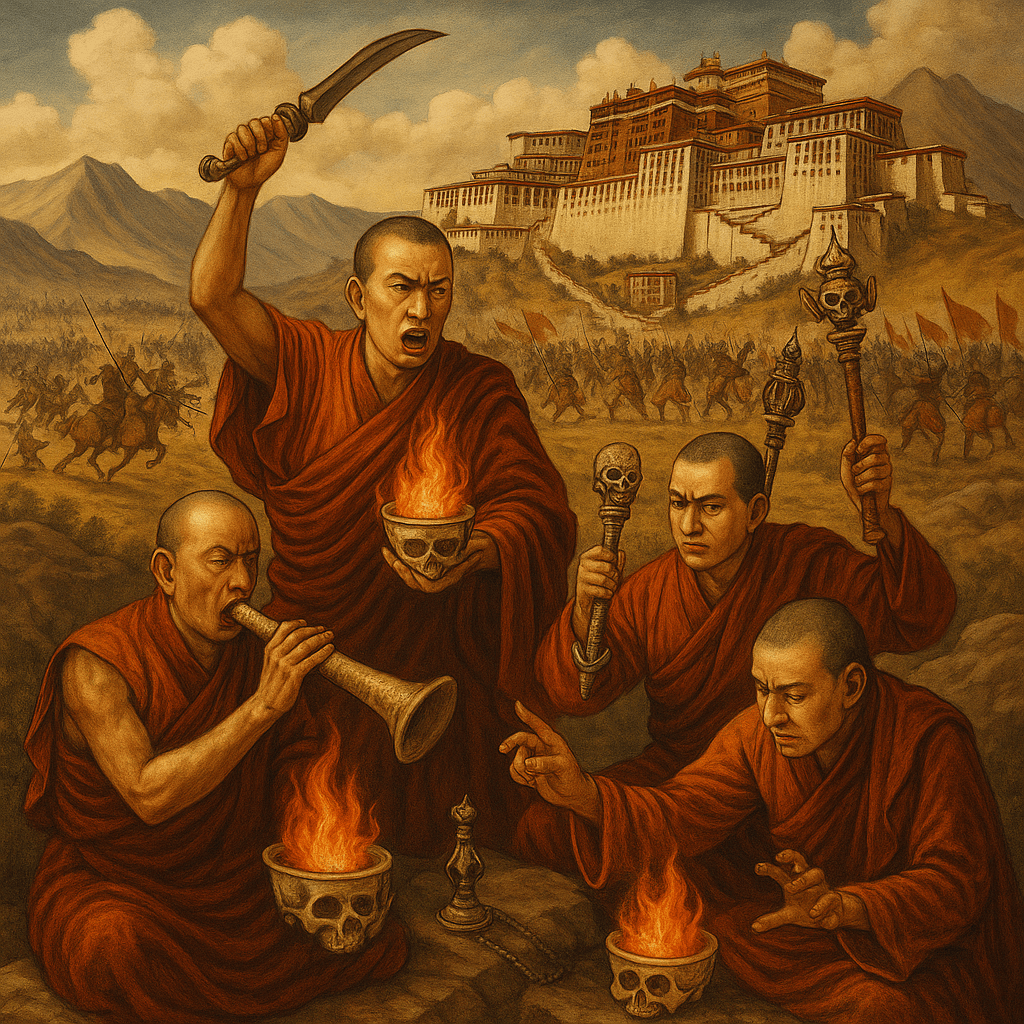
Invocation of demons Since time immemorial ritual magic and politics have been one in Tibet. A large proportion of these magic practices are devoted to the annihilation of enemies, and especially to the neutralizing of political opponents. The help of demons was necessary for such ends. And they could be found everywhere — the Land of Snows all but overflowed with terror gods, fateful spirits, vampires, ghouls, vengeful goddesses, devils, messengers of death and similar entities, who, in the words of Matthias Hermanns, “completely overgrow the mild and goodly elements [of Buddhism] and hardly let them reveal their advantages” (Hermanns, 1965, p. 401).
For this reason, invocations of demons were not at all rare occurrences nor were they restricted to the spheres of personal and family life. They were in general among the most preferred functions of the lamas. Hence, “demonology” was a high science taught at the monastic universities, and ritual dealings with malevolent spirits were — as we shall see in a moment — an important function of the lamaist state.
The war demon Kschetrapala Once the gods had accepted the sacrifice they stood at the ritual master’s disposal. The four-armed protective deity, Mahakala, was considered a particularly active assistant when it came to the destruction of enemies. In national matters his bloodthirsty emanation, the six-handed Kschetrapala, was called upon. The magician in charge wrote the war god’s mantra on a piece of paper in gold ink or blood from the blade of a sword together with the wishes he hoped to have granted, and began the invocation.
Towards the end of the forties the Gelugpa lamas sent Kschetrapala into battle against the Chinese. He was cast into a roughly three-yard high sacrificial cake (or torma). This was then set alight outside Lhasa, and whilst the priests lowered their victory banner the demon freed himself and flew in the direction of the threatened border with his army. A real battle of the spirits took place here, as a “nine-headed Chinese demon”, who was assumed to have assisted the Communists in all matters concerning Tibet, appeared on the battlefield. Both spirit princes (the Tibetan and the Chinese) have been mortal enemies for centuries. Obviously the nine-headed emerged from this final battle of the demons as the victor.
“Voodoo magic” in Tibetan Buddhism The practice widely known from the Haitian voodoo religion of making a likeness of an enemy or a doll and torturing or destroying this in their place is also widespread in Tibetan Buddhism. Usually, some substance belonging to the opponent, be it a hair or a swatch from their clothing, has to be incorporated into the substitute. It is, however, sufficient to note their name on a piece of paper…
Such “voodoo practices” were no rare and unhealthy products of the Nyingmapa sect or the despised pre-Buddhist Bonpos. Under the Fifth Dalai Lama they became part of the elevated politics of state. The “Great Fifth” had a terrible “recipe book” (the Golden Manuscript) recorded on black thangkas which was exclusively concerned with magical techniques for destroying an enemy.
Why all this matters
These passages highlight a side of Tibetan Buddhism that is largely hidden from public view: the integration of destructive magic and spirit warfare into the machinery of the lamaist state. Nebesky-Wojkowitz’s research on ritual manuals, Hermanns’ cultural observations, and the Trimondis’ synthesis all converge on the same conclusion: alongside compassion and wisdom, Tibetan Buddhism preserved and continues to use technologies of coercion and violence.
For modern practitioners and students in the West, this raises unavoidable questions:
Are newcomers told that tantric ritual includes not only deities of compassion but also demon invocations and rites of subjugation? What risks do these violent magical technologies pose for the unsuspecting student?
What does “consent” mean if disciples are invited to take refuge in Tibetan Buddhism and receive empowerments without knowledge of these dimensions?
How much of this is framed as symbolic or metaphorical today, and is that distinction clearly explained? Evidence suggests that such practices continue much as they did in the past, which makes a thorough and honest examination all the more urgent.
Conclusion
The Trimondis’ work is controversial, but it is also important because it insists on remembering what is usually forgotten or denied. If the compassionate face of Tibetan Buddhism is to be embraced honestly, then its shadow side, the reality of political magic, demon invocations, and coercive ritual, must also be acknowledged. Only then can students and practitioners engage with full awareness, rather than be fooled by the illusion of partial truths.




 Tantric Deception