

This whole emptiness thing is ultimately a red herring. It’s a smokescreen nudging us toward mediumship. The religion of the future is a religion of possession. It’s this neo-shamanic, pagan paradigm centered on emptying oneself. That’s where all this nihilism, all this narcissism, and all the psychedelic nonsense leads. It’s getting people to a place where they feel logically prepared to become comfortable with letting entities in.” (1)
Thomas Millary, Psyop Cinema
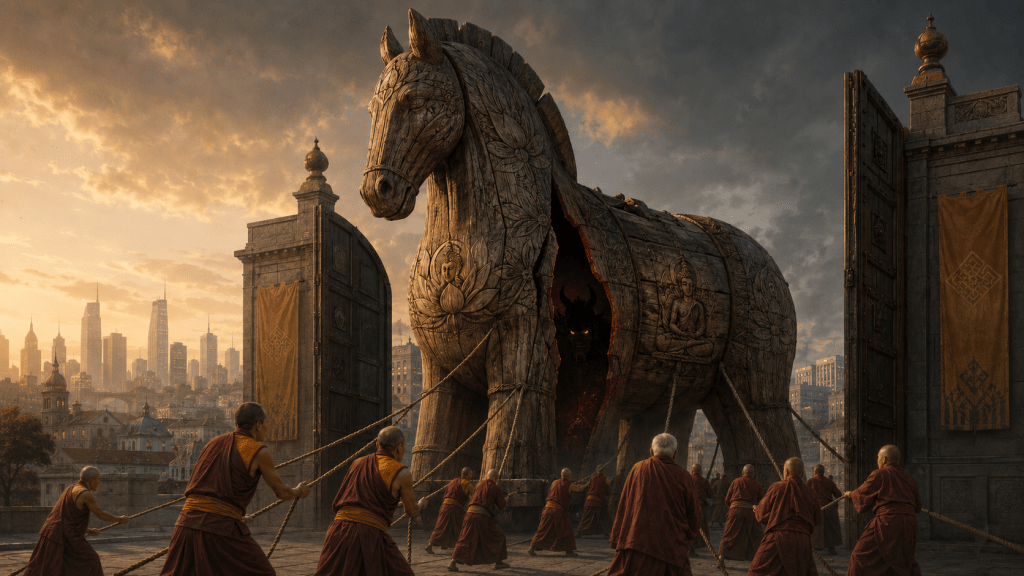
The story of Troy offers one of the clearest images of deception ever given to the West. After failing to conquer the city by force, the Greeks constructed an enormous wooden horse, concealed armed men inside it, and left it outside the walls as an apparent offering. The Trojans brought the object into their own city. What appeared peaceful, sacred, and worthy of reverence carried an invading force within it.
Strictly speaking, the horse does not appear in Homer’s Iliad, which ends before Troy falls. It belongs to the wider Trojan cycle and is recalled in Homer’s Odyssey. Yet the metaphor grows directly from the Homeric world: what cannot enter openly enters through deception and misplaced reverence.
This is how I have come to understand the spread of Tibetan Buddhism and related occult religions in the West.
They did not arrive announcing themselves as systems of spirit invocation, ritual transformation, deity possession, and total submission to unseen beings and their human minions. They entered through a much more attractive gateway, one of compassion, mindfulness, and methods for dealing with psychological disorders like anxiety. The public was shown an attractive wooden horse. Few people thought to ask what might be concealed inside it.
The outer presentation is as follows. Newcomers learn basic Buddhist ethics, calm-abiding meditation, (shamatha), and insight meditation (vipassana). They learn about compassion, non-attachment, loving-kindness, emptiness, and the Middle Way. They may be introduced to Chenrezig meditation practice. He is a white-in-color, four-armed deity who embodies compassion. The language sounds philosophical and therapeutic. It promises greater self-knowledge, freedom from destructive emotions, and a kinder relationship with the world.
What remains out of view is the destination toward which the system leads. Adjacent to the public meditation halls are advanced teachings restricted by initiation, vows, and secrecy. At some centers there are retreat buildings where selected practitioners undertake the traditional three-year retreat. The curriculum usually includes Vajrayana sadhanas, subtle-body exercises, guru yoga, deity visualization, mantra recitation, and practices in which the practitioner is taught to dissolve ordinary identity and arise as a tantric deity. Such practices are presented internally as sacred methods for attaining realization. I eventually came to see them differently: as training in demonic spirit channeling, concealed beneath theological euphemisms that make the entities and rituals sound safe and beneficent.
This distinction between the outer presentation and inner practice is the heart of the Trojan Horse metaphor. The problem is not that every person teaching awareness of the breath knows what lies at the end of the initiatory road. Many Western instructors may have encountered only the public teachings themselves. Some may sincerely believe that they are offering neutral psychological exercises. A Trojan Horse does not require every person pulling it through the gate to know what it contains.
The Magickal Childe Below, the Tibetan Buddhist Center Above
I first encountered Tibetan Buddhist practices at a center on West 19th Street in New York City. On the ground floor of the building was an infamous occult shop called The Magickal Childe. The Buddhist center was on the fifth floor.
The Magickal Childe, located at 35 West 19th Street, was one of New York’s best-known occult shops. Its shelves carried ritual implements, esoteric books, herbs, incense, candles, and magical material drawn from several occult traditions. We were warned to stay away from it because it sold hardcore Satanic literature and paraphernalia.
Upstairs, everything was different, or so it appeared. We learned about buddhas and bodhisattvas, compassion and enlightenment. We were taught practices that seemed morally elevated and spiritually clean. Whatever might have been happening in the shop below appeared to have nothing to do with the meditation and philosophy offered several floors above.
Looking back, I see the arrangement as an almost perfect symbol. The obvious occultism was downstairs, where it could be recognized by its black candles, grimoires, and sinister reputation. The respectable spiritual system was upstairs, wrapped in the language of wisdom and compassion. We assumed that the difference in appearance proved a difference in kind.
What we could not see was the possibility that we, too, were being prepared for spirit channeling, though perhaps involving a different class of demons from those summoned through the grimoires and ritual objects sold downstairs. The preparation was slower, more sophisticated, and protected by an elaborate philosophical structure. What appeared to be a path away from Satanic superstition eventually lead toward identification with beings presented as tantric deities, protectors, dakinis, or enlightened manifestations.
The overt occultist seeks an entity. The tantric initiate is taught to visualize one, invoke it, invite its presence, identify with it, and allow it to displace one’s ordinary sense of self. The vocabulary differs, but from a Christian perspective, the spiritual danger does not.
The Empty Man and the Two Faces of Initiation
The film The Empty Man helped me see this pattern more clearly. I found much of the film difficult to sit through, although it has its moments. More rewarding was the discussion of the film by Thomas Millary, his Psyop Cinema co-host Brett Carollo, and Jay Dyer. Millary is a scholar of religion, philosophy, and theology whose conversion to Orthodox Christianity changed his understanding of his earlier interests in paranormal phenomena, mysticism, occultism, psychedelia, and popular culture. His work now examines the spiritual and psychological messages concealed in film.
One sequence in The Empty Man particularly stayed with me. At the Pontifex Institute, ordinary people receive abstract teachings about meditation, identity, and emptiness. In the bowels of the building, secluded initiates participate in a collective ritual centered upon transmitting or incarnating an inhuman entity. The respectable institute and the occult rite are parts of one system. The public teaching creates the intellectual and psychological container necessary for the hidden operation.
That juxtaposition reminded me immediately of the Tibetan Buddhist centers where I lived and studied. The newcomers learn that the self lacks inherent existence and that all phenomena are empty. These teachings initially seem like a superior form of philosophy combined with methods for calming the mind.
Nearby, but largely invisible to the newcomer, are initiates undertaking practices that bear little resemblance to a secular mindfulness class. They make vows with non-human entities whose natures may not have been well understood by the initiates when they first entered.
In The Empty Man, the institute needs an empty vessel. The film’s horror depends on the possibility that a human personality can be weakened, reconstructed, or displaced so that something else can speak and act through it.
That is why Millary’s warning about emptiness deserves serious attention. Emptiness can be presented as an abstract philosophical claim about dependent origination and the absence of inherent existence. It can also function psychologically as a program of self-erasure. When combined with submission to a guru, repetitive ritual, sensory isolation, visualization, breath manipulation, and invocation, the practical question becomes unavoidable: What is expected to occupy the space once the person has been trained to empty himself?
The “Gift” Brought Through the Gates
The people of Troy were not conquered because they lacked intelligence. They were conquered because they misidentified a weapon as a gift.
The Western fascination with Buddhism has been shaped by a similar misidentification. What came from the East was frequently treated as a superior philosophy rather than a religion containing pagan gods and evil spirits, rituals, initiations, demonic hierarchies, indelible vows, and dangerous esoteric practices. Western converts were encouraged to contrast Buddhist rationality with supposedly primitive Christian beliefs about a Creator God, heaven and hell, and the outdated concepts of good and evil.
That contrast made the deception easier. A culture that scoffs at the concept of demons will not recognize an demonic invocation when it is renamed a visualization. A person who would refuse to summon a spirit may agree to “generate” himself as a deity. Someone who would recoil from possession may accept ego dissolution, guru devotion, and the surrender of ordinary identity when those things are presented as advanced methods of awakening.
By the time the nature of the inner system becomes visible, the practitioner may have invested years of diligent work, surrendered moral judgment to a teacher, accepted secrecy vows, and learned to interpret fear or resistance as evidence of spiritual inferiority. The horse is already inside the walls.
The question is therefore much larger than whether meditation can make people feel calmer and more peaceful. It often can. We must judge a religious system by its full initiatory structure, not merely by the introductory practices shown to the public. We must ask where the path ultimately leads, what type of beings are invoked, what vows are demanded, what spiritual realities are concealed, and why the deeper teachings require forms of secrecy that prevent newcomers from giving true informed consent.
The occult did not need to batter down the gates of the post-Christian West. The gates were opened from within. The invitation came disguised as compassion, therapeutic meditation, and freedom from the limiting constraints of the self. The horse was welcomed as a gift but the real question is: what demons had been allowed inside.
(1) Thomas Millary, quoted and lightly edited for clarity: “Luciferian Pop Culture: Empty Man, La Femme Nikita & Hardware – PsyOP Cinema + Jay Dyer” discussion with Brett Carollo and Jay Dyer, YouTube video, accessed July 27, 2026, @1:56:48: https://youtu.be/u7CMHjtskXw?si=W86oMv0jDizk_FWP.
 Tantric Deception