Tibetan Buddhism is marketed in the West as a path of the highest integrity. It is described as a philosophical system with techniques for developing mindfulness, compassion, and ultimately for attaining enlightenment. What is rarely stated plainly is that Vajrayāna tantric systems are structured around ritualized spirit possession and identity takeover.
A 2022 doctoral dissertation, Āveśa and Deity Possession in the Tantric Traditions of South Asia by Vikas Malhotra, documents that possession became central to medieval Tantric practice, including Buddhist Tantra that later developed into Tibetan Vajrayāna.[1] The Sanskrit term āveśa literally means “entering into.” In Tantric contexts, it refers to the fusion of practitioner and deity. This was not marginal but foundational.[2]
Deity Yoga Involves Possession
In Tibetan Deity Yoga, practitioners visualize themselves as a deity, recite its mantra, adopt its gestures and identity, and are instructed to experience no separation between themselves and that being. Modern teachers frame this as symbolic or psychological and as a method to realize emptiness. But examined historically, it follows the structure of possession technology:
Invocation
Descent of power
Identity fusion
Altered agency
Bodily and psychological signs
Medieval Tantric texts describe possession markers such as trembling, ecstasy, altered consciousness, and loss of ordinary identity. These same phenomena and mechanisms are reported in Vajrayāna contexts.
Guru Yoga and Human Possession
There are also uncomfortable truths concerning Guru Yoga. In this practice, the visualized guru dissolves into light and enters the disciple. The disciple experiences the guru’s mind as inseparable from their own. Empowerment is described as a descent of blessing into the subtle body. The dissertation notes that in Tantric systems, even advanced humans could possess others in positive ways. [3]
The guru embodies enlightened power.
Through initiation, that power descends.
The disciple becomes a vessel.
Identity shifts from individual to lineage-bearer.
This is ritualized human-to-human possession. It is framed as a positive transmission, but is it really? What are the implications of inviting another human being in to possess you? If you examine the numerous exposés of abuse in Vajrayāna communities over the past few decades, you might wonder why anyone would let a fallible human being enter and possess them. As someone who lived through egregious abuse by a supposedly enlightened Vajrayāna master, I can speak from personal experience. Guru yoga creates a framework in which another human being is granted intimate internal authority over your mind and identity. Why would anyone knowingly consent to that dynamic? They probably wouldn’t if they knew that spiritual possession is what actually happens during guru and deity yoga.
Why This Is Glossed Over
The fact that this is glossed over in Tibetan Buddhist teachings should give one pause. Why isn’t this discussed up front? It is because possession sounds primitive and carries negative psychiatric and colonial baggage. For these reasons, traditions seeking Western legitimacy avoid the term and conceal the reality beneath layers of theological and philosophical euphemism. The issue is not vocabulary, but whether practitioners are told clearly what is structurally taking place. If Vajrayāna depends on ritualized possession through deity and guru incorporation, that should be stated plainly.
In Western religious history, especially within Christianity, possession has long been regarded as negative, spiritually dangerous, and psychologically destabilizing. It is associated with loss of agency, vulnerability to manipulation by demonic entities, and the need for protection or exorcism. It is not treated as spiritually glamorous. It is treated as a serious risk.
Yet when similar identity-dissolving dynamics appear within an imported spiritual system, they are often elevated, aestheticized, and shielded from scrutiny. The language changes but the underlying structure does not.
Why does ritual possession provoke alarm in one context but reverence in another? Why does a shift in metaphysical framing automatically neutralize the concern? If this would raise red flags in a Western church, why should it be exempt from examination in a Tibetan temple?
The historical record is clear. Possession is not peripheral to Tibetan Tantra. It is embedded in its ritual core. If that is so, then practitioners deserve to confront that reality consciously rather than encounter it disguised as harmless symbolism or elevated mysticism.
Footnotes
[1] Vikas Malhotra, Āveśa and Deity Possession in the Tantric Traditions of South Asia: History, Evolution, & Etiology, PhD diss., University of California, Santa Barbara, 2022 .
[2] Ibid., discussion of possession becoming central to Tantric praxis .
[3] Ibid., discussion of positive forms of human possession .
[4] Ibid., integrated model of possession as embodied transformation .
In Vajrayana Buddhism and related tantric systems, practitioners are taught that enlightened activity manifests in four fundamental modes, often called the Four Activities. These are commonly translated as Pacifying, Enriching, Magnetizing, and Subjugating. In Sanskrit they correspond to śāntika, pauṣṭika, vaśīkaraṇa, and abhicāra. In Tibetan sources they are known as zhi, rgyas, dbang, and drag po.
Doctrinally, the Four Activities are described as spontaneous expressions of awakened compassion. An enlightened being pacifies obstacles, enriches virtue and resources, magnetizes beings toward the Dharma, and subjugates harmful forces. This presentation emphasizes intent and realization, assuring the student that such actions, when performed from enlightenment, are free of karmic stain.
Yet this sanitized description obscures a more uncomfortable reality. Historically and textually, the Four Activities function as classificatory frameworks for large compendiums of ritual technologies. These include magical spells, rites, visualizations, mantras, and talismanic operations designed to bring about very specific effects in the world. Such effects include healing and calming, increasing wealth or longevity, attracting and binding others, and coercing, harming, or destroying enemies.
This dual framing creates a tension that is rarely examined openly within modern Buddhist discourse.
The Four Activities as Magical Technologies
Tantric manuals from India and Tibet make explicit that the Four Activities are not metaphors. They are actionable ritual categories. Tantras such as the Guhyasamāja Tantra and the Hevajra Tantra, along with later ritual compendiums such as the Sādhanamālā and abhicāravidyā genre texts, provide detailed instructions for rites aimed at controlling weather, influencing rulers, compelling lovers, paralyzing rivals, or causing illness and death.[1]
These materials make clear that tantric ritual was never confined to inner transformation alone. The Four Activities structured a full spectrum of practical interventions into social, political, and psychological life.
The Sādhanamālā
The Sādhanamālā is a large Sanskrit compendium of tantric ritual manuals compiled in India roughly between the 8th and 12th centuries CE.
It is Buddhist, specifically Vajrayana or Mantrayāna, and not Śaiva, even though it shares techniques and ritual logic with non-Buddhist tantric traditions. The text consists of several hundred sādhana instructions for meditation and ritual practice focused on Buddhas, bodhisattvas, and tantric deities such as Tārā, Avalokiteśvara, Mañjuśrī, Vajrayoginī, and Hevajra.
Many of these sādhanas are explicitly or implicitly classified according to the Four Activities. They include ritual prescriptions for pacifying illness, enriching wealth or lifespan, magnetizing kings, patrons, or disciples, and subjugating enemies. The intended effects are practical and worldly as well as soteriological.
The Sādhanamālā was translated into Tibetan in parts and circulated widely in Tibet. Tibetan ritual literature draws heavily on this material, even when the Indian source material is not foregrounded explicitly.
Standard scholarly references include: Benoytosh Bhattacharyya, Sādhanamālā, Baroda, 1925–1928, and David Snellgrove, Indo-Tibetan Buddhism, Shambhala, 1987.
Abhicāravidyā Texts
Abhicāravidyā is not a single book but a category of ritual literature.
The Sanskrit term abhicāra refers to rites of coercion, harm, or destructive magic. Vidyā means a spell or magical formula. Abhicāravidyā texts are therefore manuals of destructive or coercive rites.
In Buddhist tantra, such texts describe subjugation practices including immobilization, madness, illness, death, expulsion of consciousness, and rites intended to cause death, sometimes described as ritual killing by proxy. These rites are usually justified as actions taken against enemies of the Dharma, oath breakers, or beings deemed karmically irredeemable.
These texts circulated in India among tantric specialists and were selectively translated into Tibetan, often under euphemistic titles or embedded within larger ritual cycles. In Tibet, their contents were reorganized under the heading of drag po, or wrathful activity.
Important examples of Buddhist abhicāra material appear in:
The Guhyasamāja Tantra and its explanatory tantras The Hevajra Tantra The Sarvatathāgatatattvasaṃgraha Later ritual manuals attributed to figures such as Nāgārjuna and Padmasambhava
Because of their ethical volatility, abhicāra rites were rarely taught openly. Access was restricted, which is one reason modern practitioners often underestimate how central such practices were historically.
Key scholarly discussions include: Ronald Davidson, Indian Esoteric Buddhism, Columbia University Press, 2002, and Alexis Sanderson, “The Śaiva Age,” in Genesis and Development of Tantrism, Tokyo, 2009.
Relationship to Tibetan Buddhism
Tibetan Buddhism inherited these Indian materials largely intact. The Four Activities framework in Tibet is not an innovation but a systematization of Indian tantric categories.
What changed in Tibet was less the ritual content than the doctrinal rhetoric surrounding it. Destructive and coercive rites were reframed as compassionate acts performed by realized beings. This rhetorical move allowed the practices to survive while softening their public presentation.
When Tibetan teachers speak of the Four Activities today, they are standing on a ritual foundation built by Indian Buddhist tantra, including the Sādhanamālā and abhicāravidyā traditions, whether this inheritance is acknowledged or not.
In Tibetan contexts, this ritual material was further systematized. The Four Activities became a classificatory framework under which thousands of rites were organized. Fire pujas, effigy magic, thread-cross rituals, and sexual yogas all find their place within this scheme.[2]
The ethical difficulty is obvious. While pacifying and enriching activities can be interpreted charitably, subjugation practices explicitly involve violence, coercion, and psychological domination. Tibetan ritual manuals state that subjugation rites can cause madness, death, or rebirth in hell realms for the target, often justified by vague claims that the victim is an enemy of the Dharma.[3]
Subjugation and Buddhist Ethical Dissonance
From the standpoint of Buddhist ethics, subjugation is the most troubling of the Four Activities. Buddhism is grounded in non-harming and the cultivation of compassion. Yet subjugation rituals rely on wrathful intent and instrumental harm. Traditional defenses argue that enlightened beings act beyond dualistic morality because they have transcended good and evil.
For modern Western practitioners, these explanations often remain abstract. Teachers rarely teach subjugation practices explicitly, and students are encouraged to interpret wrathful deities symbolically. This produces a form of cognitive dissonance. The practices exist, are preserved, and are sometimes performed within group pujas, but disciples can maintain psychological distance by not understanding the wrathful practices or details. Ignorance becomes a form of insulation.
Magnetizing Activity and the Binding of Disciples
Magnetizing activity is often portrayed as benign. It is described as the compassionate attraction of beings to the path. Yet tantric texts are explicit that magnetizing rites are used to influence minds, bind loyalty, and generate devotion.[4]
In ritual manuals, magnetizing practices are used to attract lovers, patrons, followers, and students. They involve visualizations of cords, hooks, nooses, and substances entering the bodies of targets to incline their thoughts and emotions. These are not metaphors for persuasion. They are magical technologies of attachment.
Within guru-disciple relationships, magnetizing activity takes on a particularly disturbing dimension. Once a student takes tantric initiation, they are bound by samaya vows. These vows often include lifelong loyalty to the guru and lineage until enlightenment is achieved.[5]
The power imbalance is severe. The teacher is positioned as the embodiment of awakening. The student is warned that doubt, criticism, or separation leads to spiritual ruin.
What If Enlightenment Is Not Reached?
Traditional literature assumes enlightenment will be reached. But what if it is not. What if the practitioner becomes disillusioned, traumatized, or psychologically destabilized.
In such cases, the Four Activities do not disappear. The same ritual logic that binds can also be used to punish. Tibetan sources describe the use of subjugation rites against oath breakers, samaya violators, and enemies of the lineage.[6]
Modern scholars and psychologists studying tantric communities have documented patterns of dependency, identity collapse, and long-term trauma following abusive guru relationships.[7] Magnetizing activity, in this light, resembles a spider’s web. Attraction is not neutral. It is structured, adhesive, and difficult to escape.
Conclusion
The Four Activities are not merely poetic descriptions of enlightened compassion. They are historical and functional systems of magical action. To ignore this is to misunderstand tantra at its core.
Subjugation challenges Buddhist ethics directly. Magnetizing challenges them more subtly. It operates through devotion, love, and surrender, making it easier to accept and harder to question. For Western practitioners kept deliberately ignorant of these dynamics, the result is not safety but vulnerability and the possibility of ruin.
An honest engagement with tantra requires confronting these practices without romanticism, without denial, and without pretending that malevolent harm disappears simply because it is cloaked in sacred language.
Footnotes and Sources
Alexis Sanderson, “The Śaiva Age,” in Genesis and Development of Tantrism, Tokyo, 2009.
Samten Karmay, The Arrow and the Spindle, Mandala Book Point, 1998.
Ronald Davidson, Indian Esoteric Buddhism, Columbia University Press, 2002.
David Gordon White, Kiss of the Yogini, University of Chicago Press, 2003.
Jamgön Kongtrul, The Torch of Certainty, Shambhala, 1977.
Stephen Beyer, The Cult of Tārā, University of California Press, 1978.
Mariana Caplan, Halfway Up the Mountain, Hohm Press, 2011.
In Tibetan tantric Buddhism, the image of the snake trapped in a bamboo tube is more than a vivid proverb. It functions as a doctrinal warning: once a student enters the tantric path, there is no lateral escape. One either goes upward toward awakening or downward toward failure and “vajra hell.” Teachers have used this image to describe the uncompromising nature of samaya, the vows that bind a student to the guru, the deity, and the tantric methods themselves.¹
What is striking is how explicitly the tradition frames tantra as irreversible and high-stakes, and how rarely that stark truth is communicated to Western beginners before they agree to the vows that supposedly make the tube snap shut behind them. This mismatch between traditional warning and Western presentation is not a minor detail; it shapes the entire experience of Vajrayāna in modern contexts.
When the Warning Arrives Too Late
Many longtime practitioners have reported that the “snake in the tube” metaphor is introduced only after they have taken empowerments, established loyalty to the teacher, and accepted vows they did not fully understand. In one account, students were told after receiving advanced teachings that they were now like snakes [in a tube] with no side exit, and that questioning or leaving the guru’s authority carried dire karmic consequences.² Once framed in these terms, the student is no longer encountering tantra freely. The imagery becomes a retrospective justification for total commitment and an interpretive trap that discourages reevaluation, dissent or disengagement.
This sequencing matters. Warnings given after the student is already inside the tube are not warnings at all; they function as a mechanism of control. Sadly, it’s not just empty scaremongering to get the student to do whatever the teacher wants. The teacher can play a part in destroying the student if he wishes.
Western students, however, often enter tantra without the cultural framework that understands concepts like vajra–hell, and as a result frequently interpret them metaphorically or ignore them altogether during empowerments or teachings. As a result, the gravity of samaya is often hidden in plain sight. Students may assume that vows are symbolic or aspirational when, within the tradition, they are treated as binding conditions that determine spiritual destiny.
The asymmetry of information here is profound. Tibetan teachers know the stakes, but Western students usually do not.
Fear as a Reinforcing Mechanism
Inside the tantric system, samaya is often discussed as a bond of trust and devotion. But its shadow side is rarely addressed openly: the way threats of karmic ruin can be used to enforce silence and obedience. If leaving the guru, criticizing harmful behavior, or even doubting the teacher’s purity is framed as a breach of samaya, then fear becomes central to the student’s experience. Some Tibetan masters teach that both teacher and student can fall into vajra-hell for damaging the guru-disciple bond.³ In practice, however, this warning is most often directed at students, who are told that speaking publicly about misconduct or abuse may destroy their spiritual future.
Why the Snake Matters
The “snake in the bamboo tube” metaphor distills these concerns with unusual clarity. It shows that tantra is not designed to allow experimentation or partial commitment. It requires total participation in a closed system with its own rules, hierarchies, and cosmology. In cultures where this system has historically been embedded, those entering it do so in fuller awareness of the stakes. In the West, students often do not and they may hear such warnings in a highly suggestible state, without really grasping the implications.
One famous guru in the 1980s bluntly told students that they could be both Christian and Buddhist with no conflict whatsoever. This blatantly goes against Christian teaching. In those days Westerners were often thrust into the three-year-retreat program shortly after they signed up for teachings at Dharma centers with no knowledge of what they were really getting into. Many had little preparation to truly understand the arcane nature of samaya and its risks. Furthermore, many Tibetan teachers took advantage of their roles as authority figures to manipulate vulnerable students into sexual relationships and other sorts of commitments. Engaging in secretive sexual relationships with students while pressuring them to take highest yoga tantra vows and practices that would bind them forever often led to deep confusion and psychological unmooring.
The result is a form of spiritual engagement that looks consensual on the surface but lacks true informed consent. Students may be drawn in by promises of transformation but only later discover the rigidity of the commitments they have made. This is especially jarring given that Vajrayāna wraps together the renunciation of the Hinayāna, the boundless compassion of the Mahāyāna, and the esoteric demands of tantra. In this unwieldy fusion, the same tradition that teaches gentle observation of thoughts can also insist that a single critical thought toward one’s guru carries the weight of karmic catastrophe. The threat of vajra-hell sits uneasily beside Buddhism’s wider emphasis on compassion and non-judgment. An ethical issue looms large: a path that describes itself as having no side exit should not be offered as if it does.
To treat tantra’s danger as a secret or secondary detail is to undermine the integrity of the path itself. If practitioners are indeed snakes in a tube, they deserve to be told before they go inside.
Footnotes
¹ “Once you take samaya you become like a snake in a vertical bamboo tube: you’re either going up, or you’re going down. You can’t sneak out the side.” (Kun zang.org) (kunzang.org) ² Note: practitioner-reports and forum posts indicate the metaphor is often applied post-initiation. For example: “A Vajrayana practitioner is like a snake in a tube; … he can either go up or down, not left or right.” (dharmawheel.net) ³ “The metaphor for samaya is a snake in a bamboo tube. It has only 2 directions – up to enlightenment or down to the hells.” (TibetDharma.com) (Tibetan Buddhism)
I am amazed that the PR for Tibetan Buddhism in the West managed for so long to conceal the extent of black magic practiced by lamas in Tibet historically and even to the present day. This concealment, aided and abetted by the squeamishness and obliviousness of some scholars, has to stop. In the dharma centers I was involved in, anything dark in Tibetan lore was relegated to the Bön religion, and the implication was that once Buddhism took hold in Tibet, any kind of evil acts such as harming or killing sentient beings was completely off the table. The truth is that black magic is in the lexicon of the highest lamas in the lineage as well as ngakpas and others. I believe these techniques are used liberally and current scholarship is finally exposing it.
Solomon G. FitzHerbert’s study of the mid-seventeenth century makes the core point plainly. He argues that tantric ritual and the rhetoric of ritual violence were central to how the Ganden Phodrang state established and legitimated power, not a peripheral curiosity. He writes that Tibetan sources “more than compensate” for the lack of hard military data with abundant materials about the “legitimation and maintenance of authority” through ritual technologies and narratives.¹
Before the rise of the Fifth Dalai Lama, Tibet’s Tsang rulers were already forging political alliances through tantric warfare. FitzHerbert shows that the Tsang kings deliberately patronized lamas famed for their mastery of wrathful and repelling rites. The most favored were the hierarchs of the Karma Kagyu, the “black hat” Karmapa and the “red hat” Zhamarpa, along with the Jonang scholar Taranatha, who was also enjoined to perform repelling rituals on behalf of his patrons.² Their alliances were explicitly religious and martial: an “ecumenical alliance in the name of defending religion and Tibet from foreign armies.”³
Among the Tsang rulers’ most celebrated ritual specialists was the Nyingma master Sokdokpa Lodrö Gyeltsen (1552–1624), self-styled “Repeller of Mongols.”⁴ A disciple of Zhikpo Lingpa, Sokdokpa was the main heir to the revealed cycle Twenty-Five Ways of Repelling Armies (Dmag zlog nyi shu rtsa lnga).⁵ His Mongol-repelling rites were widely famed, and he worked directly with the Tsang ruler Phuntsok Namgyel. One elaborate rite performed in 1605 to coincide with a Tsang military offensive involved producing “some 150,000 paper effigies of enemy soldiers.”⁶ These were ritually destroyed to annihilate the opposing force, with Bonpo specialists also enlisted for their expertise in magical harm.⁷
According to FitzHerbert, Phüntsok Namgyel successfully forged a broad anti-Geluk alliance using tantric technologies of protection and destruction.⁸ After his death, “reputedly at the hands of offensive magic being hurled at him by the Shabdrung Nawang Namgyal (Zhabsdrung Ngag dbang rnam rgyal) (1594–1651), founder of the state of Bhutan,”⁹ his son Karma Tenkyong (1604–1642) inherited a weakened position. The Shabdrung’s tantric assault, still treated in Bhutanese and Tibetan sources as a historical fact, thus became the legendary moment when a ruler famed for weaponizing ritual power was himself undone by it. It is one of the rare episodes where the logic of esoteric warfare entered the realm of accepted political history.
This is where the Fifth Dalai Lama comes into focus. FitzHerbert shows that in the 17th century the Great Fifth cultivated and systematized an official repertoire of destructive and protective rites in service of government aims. In his words, the Dalai Lama showed a “lifelong concern with learning, authoring and instituting an armory of defensive and offensive rituals for the mobilization of unseen forces” for the state.¹⁰ That program contributed to the Ganden Phodrang’s reputation for “magical power,” and helped stage what FitzHerbert calls the grandest “theatre state” in Tibetan Buddhist history.¹¹
FitzHerbert details three overlapping strategies. First, the new government suppressed, marginalized, or co-opted rival traditions of war magic associated with other schools, including Karma Kagyu and strands within Nyingma, while appropriating selective cycles that could be redeployed under Geluk authority.¹² Second, it rebuilt Nyingma institutions such as Dorjé Drak and Mindröling under Ganden Phodrang patronage, folding their esoteric prestige into the state project.¹³ Third, it sponsored new state rituals based on the Dalai Lama’s own visionary experiences, further centralizing ritual power in Lhasa.¹⁴
The rhetoric was not merely devotional. Lamas and ritual specialists acted as “bodyguards” whose professional task was destructive magic on behalf of patrons.¹⁵ Chroniclers attributed battlefield outcomes to the rites of powerful tantrikas. FitzHerbert highlights Chökyi Drakpa, famed for the Yamantaka cycle known as the “Ultra-Repelling Fiery Razor,” which centered on rites of “protecting, repelling and killing.”¹⁶ In one report, after deploying these rites against a Tümed encampment, “nothing was left behind but a name.”¹⁷
To grasp how such violence could be framed as meritorious, FitzHerbert shows the tantric logic that recasts killing as an enlightened “action” when performed by an empowered adept. The adept receives empowerment, performs extensive propitiation to forge identification with the deity, and then “incite[s]” and “dispatch[es]” oath-bound spirits to defend the dharma. By manipulating the five elements and the “public non-reality” of appearances, the practitioner can pacify, increase, control, or destroy, including against human enemies.¹⁸ The moral frame is clear in the sources he cites and translates. Killing is made licit because it is tantric, ritually purified and redirected as enlightened activity.¹⁹
FitzHerbert also situates Tibetan practices within a longer Indo-Buddhist lineage of war magic. He surveys Indian materials that speak of sainyastambha or army-repelling rites, and notes that the Hevajra states that “black magic for paralyzing armies,” is part of its “manifold purpose” and that the Kālacakra includes descriptions of war machines and siege methods such as “catapults, traps, siege towers, and so on,” alongside esoteric harm and protection.²⁰ He further notes the use of human effigies and effigy destruction in offensive rites against enemies, a hallmark of Tibetan ritual repertoires that drew on wider South Asian and even Indo-European precedents.²¹
Western idealization of Tibetan Buddhism has depended on ignoring this record. The lamas who administered and celebrated these rites were not outliers. They were the architects of a political order that fused charisma, ritual terror, and doctrinal justifications into a program of power. State-sponsored ritual violence was normalized in chronicles and hagiographies as enlightened means. The fact pattern is no longer obscure. It is all in the sources, and FitzHerbert has laid them out.
Although FitzHerbert’s focus is on state-sponsored ritual violence, similar technologies of harm have long been used by individual lamas against perceived enemies including, at times, their own disciples. The anthropologist Geoffrey Samuel has noted that the ritual power claimed by tantric masters can be turned inward, weaponizing spiritual authority to punish dissent or enforce obedience.²² In one well-documented episode from the nineteenth century, the treasure-revealer (tertön) Dorje Lingpa was said to have struck down a rival practitioner through wrathful ritual means, his death interpreted locally as a karmic consequence of opposing the lama’s command.²³ Such stories attest to a cultural logic in which ritual, psychic, or physical violence by enlightened masters could be valorized as the just expression of awakened power. I have personally been a victim of this deluded violent ritual power by Tibetan masters.
If Tibetan Buddhism is to be understood honestly outside Tibet, this history needs to be taught in dharma centers and discussed in scholarship without euphemism. The tradition’s own categories allow for destructive ritual and sanctified killing under certain conditions. Pretending otherwise does not protect the innocent devotees who arrive at dharma centers with open hearts seeking methods for developing compassion and loving kindness in service of enlightenment. Indeed, one must ask what kind of enlightenment tradition could allow, even glorify such violence.
Notes
FitzHerbert, Rituals as War Propaganda, 91. FitzHerbert, Solomon G. “Rituals as War Propaganda in the Establishment of the Tibetan Ganden Phodrang State in the Mid-17th Century.” Cahiers d’Extrême-Asie 27 (2018): 49–119: https://www.persee.fr/doc/asie_0766-1177_2018_num_27_1_1508. (I first came across FitzHerbert’s article via a post on Adele Tomlin’s website http://www.dakinitranslations.com.)
Ibid., 95–96.
Ibid., 95.
Ibid., 96.
Ibid., 96.
Ibid., 97.
Ibid., 97.
Ibid., 101.
Ibid., 102–103.
Ibid., 94.
Ibid., 95.
Ibid., 96.
Ibid., 97.
Ibid., 98.
Ibid., 93.
Ibid., 100.
Ibid., 101.
Ibid., 71.
Ibid., 72.
Ibid., 98–99.
Ibid., 99.
Geoffrey Samuel, Civilized Shamans: Buddhism in Tibetan Societies (Washington: Smithsonian Institution Press, 1993), pp. 429–432.
Cathy Cantwell and Robert Mayer, “Representations of wrathful deities in treasure literature,” in Tantric Revisionings: New Understandings of Tibetan Buddhism and Indian Religion (Leiden: Brill, 2008), pp. 131–133.
Sam van Schaik’s Buddhist Magic: Divination, Healing, and Enchantment through the Ages (2020) attends to the often-overlooked domain of spells, incantations, divination, healing rituals, and what one might call “magic” in Buddhist traditions. The book offers, among other things, a translation of a Tibetan spell-book from the Dunhuang corpus and situates it in a broad historical trajectory of Buddhist ritual technologies. Yet in his 2021 review for H-Net, Cameron Bailey argues that the book suffers from significant omissions, conceptual limitations, and a subtle apologetic tone toward the more aggressive, violent, and transgressive forms of magic found in tantric Buddhism.¹ Bailey suggests that this tone is not simply stylistic but stems from deeper disciplinary biases about what “real” Buddhism is and what kinds of ritual power are acceptable to the scholarly gaze.
For readers of Tantric Deception, which is concerned with hidden ritual power, subversive techniques, and coercive practices in the “shadow” side of tantra, Bailey’s critique is especially pertinent. The benign, therapeutic, protective aspects of magic are only half the story; the aggressive, destructive, boundary-breaking elements are equally constitutive. Here the critique unfolds on three levels: (1) Bailey’s reading of Chapter 3 of van Schaik’s book (on the Ba ri be’u ’bum); (2) his broader objections to how van Schaik defines “magic” and frames the field; and (3) implications for the study of tantric magic and deception.
Bailey’s Critique of Chapter 3: “A Tibetan Book of Spells”
Bailey looks at Chapter 3, which discusses the Tibetan spell-book known as the Ba ri be’u ’bum, compiled by Ba ri Lotsāwa in the eleventh century.² Van Schaik concludes the chapter by pointing to the presence of violent magical ritual, what might be called “black magic,” in Buddhist spell-books and tantric scriptures such as the Vajrabhairava Tantra.³
Bailey’s critique is threefold:
Understatement of prevalence. Van Schaik, he argues, seriously understates how widespread aggressive or destructive ritual practices are in tantric sources: “He could also have discussed the army-repelling magic in the Hevajra Tantra, the legendary violent magical exploits of the great tantric sorcerer Rwa Lotsāwa, or Nyingma Mahayoga scriptures, which are often positively brimming with black magic.”⁴
Authorial discomfort. Bailey detects an obvious unease with “aggressive” magic and with rituals that use human remains as ingredients, suggesting van Schaik takes an apologetic tone when discussing them.⁵
Scholarly bias. He links this tone to the longstanding tendency of Buddhist studies to privilege an idealized, pacifist Buddhism: “This kind of squeamishness … unconsciously replicates the biases of past generations of Buddhist scholars …. It is ultimately an artifact of Western observers thinking they know more about what should constitute normative Buddhism than their sources do …”⁶
For Bailey, this is not simply an omission but a rhetorical framing that soft-pedals the destructive dimensions of tantric magic.
Defining “Magic”: Bailey’s Broader Critique
Bailey extends his criticism to van Schaik’s opening chapters, where the author defines his working category of “Buddhist magic.” Van Schaik adopts a “family-resemblance” approach, noting that no direct equivalent of the Western word magic exists in Sanskrit or Tibetan.⁷ He describes magical practices as “focused on worldly ends, including healing, protection, divination, manipulation of emotions, and sometimes killing. The effects of these techniques are either immediate or come into effect in a defined, short-term period. The techniques themselves are usually brief, with clear instructions that do not need much interpretation, and are gathered together in books of spells.”⁸
Bailey objects that this framing:
Over-narrows the field by confining magic to short-term, worldly ends, thereby excluding tantric practices that are long, soteriological, and embedded in complex ritual technologies.⁹
Privileges text and literacy, focusing on manuals and specialists while sidelining oral, embodied, and popular forms of practice.¹⁰
Sanitizes the topic by foregrounding healing and protection while downplaying cursing, corpse-magic, and enemy destruction.¹¹
He concludes: “The way he defines and explains ‘magic,’ and describes how magical practices have traditionally been used by Buddhists across Asia, ends up inadvertently reinforcing many of the historical scholarly prejudices against magic that he ostensibly is trying to correct.”¹²
Van Schaik’s framework thus risks reproducing the very boundaries it seeks to challenge.
A Wider Blind Spot: Aggressive Magic and the Tantric World
Bailey argues that van Schaik should have engaged more fully with texts such as the Hevajra Tantra (with its army-repelling spells), the violent exploits of Rwa Lotsāwa, and the Nyingma Mahayoga scriptures filled with wrathful deities, corpse-magic, and enemy-destruction rites.¹³ By not doing so, or by treating such material as peripheral, van Schaik, he claims, sanitizes Tibetan Buddhism. “Van Schaik displays an obvious discomfort with the presence of ‘aggressive’ magic … and takes an apologetic tone when discussing them.”¹⁴
For scholars of tantra, this omission matters because tantric systems operate through extremes such as creation and annihilation, compassion and wrath, life-force and death. To highlight only healing and protection produces a partial picture of ritual power, one aligned with modern therapeutic Buddhism but detached from the coercive, political, and martial realities of historical tantric practice.
Bailey notes that while van Schaik does acknowledge violent spells (for example, in the Dunhuang materials), he does not trace how these recur and become canonical in later tantric systems.¹⁵ The result is a book that opens the field but keeps its most provocative elements at the margins.
Implications for the Study of Tantric Magic and Deception
Bailey’s critique has clear implications for the study of tantric ritual power:
Broaden the definition of magic. Magic in Buddhist contexts is not confined to short spells. It includes deity-yoga, state-sponsored rituals, corpse-assemblage, body technologies, and institutions of ritual power.
Recognize multiple aims. Magic serves soteriological as well as worldly purposes such awakening, subjugation, and mediation between spirits and humans.
Acknowledge popular practice. Lay and non-monastic forms of magic interpenetrate elite traditions. Focusing solely on literate specialists truncates the field.¹⁶
Examining the Aggressive and Transgressive
To understand tantric magic fully, scholarship must confront its aggressive, destructive, and taboo aspects such as spells to kill or incapacitate, invocations of wrathful deities, rituals using human remains, and forms of mystical violence justified through tantric cosmology. When these are treated as aberrations, the study of tantric sovereignty, ethics, and power becomes impoverished.
Deception, Hidden Power, and Normativity
Bailey’s review also raises a methodological issue: the scholar’s discomfort can itself become a form of concealment. Reluctance to confront violent or transgressive material filters what is studied and what remains hidden. Bailey argues that van Schaik’s apologetic tone mirrors earlier generations of scholarship that preferred a morally “respectable” Buddhism.¹⁷
For research into deception, secrecy, and power in tantra, this is crucial. Reflexivity is required: how much of what we present as Buddhism is sanitized by our own unease with its violent, ambiguous realities?
Conclusion
Cameron Bailey’s critique of Buddhist Magic is more than a review. It is a reminder that scholarly framing shapes what becomes visible and what remains unseen in the study of ritual power. Van Schaik’s work makes an important contribution by bringing spells and enchantments to the center of Buddhist studies. Yet, as Bailey insists, by downplaying the aggressive and coercive sides of tantric magic, it perpetuates a pacified image of [Tibetan] Buddhism.
For those exploring tantra, deception, and hidden power, the shadow side of magic demands attention. Spells of domination and annihilation, corpse-magic, and state-sorcery are part of the story. Scholarly discomfort cannot determine what counts as legitimate tantric Buddhism. True understanding must include the violent and transgressive alongside the healing and protective.
Van Schaik opened the door; Bailey challenges us to step through. In tantra, concealment is not accidental, it is a method and a weapon. So too must scholarship have the courage to unmask it.
Notes
Cameron Bailey, “Review of Sam van Schaik, Buddhist Magic: Divination, Healing, and Enchantment through the Ages,” H-Buddhism (H-Net Reviews), July 2021. https://www.h-net.org/reviews/showrev.php?id=56639.
Ibid.
Ibid.
Ibid., p. 3.
Ibid.
Ibid., p. 4.
Van Schaik, Buddhist Magic: Divination, Healing, and Enchantment through the Ages (Boulder: Shambhala Publications, 2020), pp. 6–8; Bailey, review.
Quoted in “Think Again Before You Dismiss Magic,” Lions Roar, April 2020.
Bailey, review, p. 3.
Ibid.
Ibid.
Ibid., p. 2.
Ibid., p. 3.
Ibid.
Ibid.
Ibid.
Ibid., p. 4.
References
Bailey, Cameron. “Review of Sam van Schaik, Buddhist Magic: Divination, Healing, and Enchantment through the Ages.” H-Buddhism (H-Net Reviews), 2021. https://www.h-net.org/reviews/showrev.php?id=56639. Van Schaik, Sam. Buddhist Magic: Divination, Healing, and Enchantment through the Ages. Boulder: Shambhala Publications, 2020. “Think Again Before You Dismiss Magic.” Lions Roar, April 2020.
Tibetan Buddhism’s terma tradition is usually framed as a luminous, providential means by which enlightened masters hide and later reveal teachings at the exact moment needed. That’s part of the story, but it’s not the whole story by any means. Read closely, and a darker current runs through the terma corpus: treasures hidden and guarded by wrathful powers, revelations that arrive through strange, sometimes malevolent intermediaries, and rituals whose intent and method look remarkably like what modern people would call dealings with spirits or demons. In short, many tertons don’t simply find teachings; they negotiate with non-human, often wrathful forces that can reasonably be described as demonic. Below I’ll examine Dylan Esler’s study of Gya Zhang Khrom (rGya Zhang khrom)¹ and other scholarly sources as a base to examine the phenomena of tertons and terma.
What the words mean
A terma (gter ma) is literally a “hidden treasure”: text, ritual object, or practice concealed (often in a rock, lake, or the mindstream of a guru) to be discovered by a tertön (gter ston), the treasure-revealer. Academic treatments correctly emphasize the social and legitimating functions of these discoveries in prophecies, lineages, and performative acts that make the revelation believable to followers. But the same sources that record authentication narratives also preserve striking descriptions of how termas are hidden, guarded, and recovered: they are defended by territorial spirits or “treasure-lords,” transmitted by non-human yogins, and often carry explicitly wrathful, “black magic” contents. Non-human yogins can take the form of visionary yogins, dakinis/dakas, local spirits, or wrathful entities, and they act as the intermediaries who hide, protect, or hand over the treasure.
A close example: Gya Zhang Khrom and wrathful treasures
Dylan Esler’s article on Gya Zhang Khrom in the (Byang gter) Northern Treasures tradition recounts the classic terma motif: a mysterious yogin leads the future tertön to a hidden cache of ritual objects and scrolls that come out of fissures in rock, and the revealer deciphers and transmits material that includes both beneficent and harmful ritual instructions. Esler notes items described as “cycles for benefiting and harming,” in other words, materials for both white and black magic, and he situates Gya Zhang’s revelations within a Northern Treasure program that explicitly deploys wrathful, coercive ritual means. That combination of secret caches, hidden custodians, and instruction sets for destructive rituals is exactly the pattern that supports reading many termas as arriving via a demonic or semi-demonic channel.
Treasure-protectors and Lords of the Treasures: the institutional side of the “demonic”
The literatures that record terma narratives repeatedly mention gter srung (treasure-protectors) and gter bdag (lords of the treasures). These are not neutral filing cabinets: they are spirits of place, frequently wrathful, who demand protocols and substitutions (gter tshab) when a cache is opened. Ethnographic and textual scholarship treats these beings as part of the class of local, elemental, or “demonic” forces that Tibetan ritual both confronts and incorporates. Scholarly surveys of protector deities and the oral/ritual ecology around termas make clear that treasures do not simply sit inert but are guarded by active, sometimes dangerous entities. If a tertön is authorized by prophecy, that can mitigate local resistance; if not, accusations of theft and collusion with spirits arise.²
Demon-taming, wrathful methods, and ambiguous agency
The well-known motif of Padmasambhava as demon-tamer is instructive: foundational tantric figures are often framed as subduers of hostile spirits, and the very act of revealing a terma can be portrayed as the tertön’s success in negotiating or subduing a guardian force. But negotiation is not always tame or benign. A number of terma traditions preserve wrathful practices intended to overthrow enemies, cure epidemics, or control hostile spirits—techniques that look like pacts or coercive exchanges with non-human agencies. Scholarly work on Dzogchen/Northern Treasure liturgies and on early treasure careers shows repeated, explicit intersections between revealing termas and advancing ritual technologies of domination or protection over local powers.³
So, do tertons get their termas from demons?
In many traditional narratives and ritual contexts, yes. Termas are mediated by, guarded by, or negotiated with non-human beings that function similar to what observers would call demons. That’s a historical and anthropological claim. The primary sources and modern scholarship present a consistent pattern: treasures are hidden in the landscape or mind, are protected by wrathful custodians, and are sometimes transmitted by shadowy yogins or through visions that are indistinguishable from encounters with spirits. Where the contemporary, institutional presentation emphasizes enlightened intent and salvific purpose, the deeper ritual ecology reveals frequent recourse to powers that are territorial and morally ambiguous.
Final thoughts
Terma studies that stop at the rhetoric of revelation miss the subterranean reality that produces and polices those revelations. Esler’s account of Gya Zhang Khrom’s discoveries of materials explicitly useful for harming as well as helping presents a pattern replicated across the terma corpus. Read with discernment, the terma tradition looks less like a straight line from enlightened source to human disciple and more like a braided negotiation between the human revealer, local spirits or demons, and the institutional needs of Buddhist communities. That picture is central to my argument: many tertons operate at the shadowy margins where demonic forces and tantric techniques meet, and their termas are as much the products of those encounters as they are of the “pure” spiritual origins claimed by their lineages.
Notes:
Dylan Esler, “Yamāntaka’s Wrathful Magic: An Instance of the Ritual Legacy of gNubs chen Sangs rgyas ye shes on the Byang gter Tradition via the Figure of rGya Zhang khrom,” Revue d’Études Tibétaines, no. 62 (Feb. 2022): 190–215, https://himalaya.socanth.cam.ac.uk/collections/journals/ret/pdf/ret_62_08.pdf (accessed Oct. 7, 2025).
Christopher Bell, “Worldly Protector Deities in Tibetan Buddhism,” in Brill’s Encyclopedia of Buddhism, vol. 2: Major Personages in Myth, Hagiography and Historical Biography (Leiden: Brill, 2019), 1254–66, https://brill.com (entry available online; access depends on subscription) (accessed Oct. 7, 2025).
I spent years as a Tibetan tantric Buddhist practitioner. I once assumed the mantra, ritual, and mandala machinery I practiced was simply the Buddha’s own teaching passed down intact. We were taught that although the historical Buddha did not teach tantra in person, he taught it after his passing, on Mount Malaya, to gods and men. Koichi Shinohara’s work forces a different view and poses the question: Did Sakyamuni really teach the long formulaic dhāraṇīs, image worship, and mandala visualization as later practitioners used them? Or did later communities invent those ritual technologies and then cloak them in the Buddha’s authority so people would better accept them?
In Spells, Images, and Maṇḍalas: Tracing the Evolution of Esoteric Buddhist Rituals, Shinohara gives us a working hypothesis that can be pressed hard for answers.[1] The rituals in question are most plausibly later innovations that used the Buddha’s prestige to become authoritative. They were not the Buddha’s core teachings in any strictly historical sense. That does not make them illegitimate as religious forms for people who practice them today. It does mean historians and critics should stop pretending these rituals are reflections of Sakyamuni’s own instructions. The burden of proof rests on anyone who wants to show unbroken doctrinal transmission from the Buddha to the later esoteric ritual machinery.
Shinohara offers a testable, evidence-driven reconstruction. He traces a plausible sequence from simple spoken spells through image ritual to organized visualization. Crucially, he foregrounds early, datable Chinese dhāraṇī collections and ritual manuals. Those Chinese witnesses often predate the surviving Sanskrit and Tibetan corpora scholars have relied on. That chronological fact is the hinge of the whole argument. (Columbia University Press)
What Shinohara’s working hypothesis means
A working hypothesis is provisional and falsifiable. Shinohara is not issuing an ideological verdict. He is proposing a historical explanation that organizes the evidence and makes concrete predictions that could be falsified by earlier, securely dated Indian or canonical texts showing the full ritual machinery already present in the Buddha’s time. To press the hypothesis hard, scholars should look for those disconfirming witnesses. So far the datable documentary and manuscript evidence he emphasizes points toward post-Buddha innovation that relied on attribution to the Buddha for legitimacy.
The core empirical point
Early Buddhism included ritual speech. The Pali paritta corpus shows that communal protective chants and recitations were an early feature of Buddhist practice. Importantly, these early chants are directed primarily to the historical Buddha and the Triple Gem, the Buddha, the Dhamma, and the Saṅgha, rather than to the later, expanded pantheon of cosmic buddhas and bodhisattvas that appear in Mahāyāna and tantric literature. By contrast, the long, formulaic dhāraṇīs with non-lexical syllables, their ritual manuals, and the tightly scripted mandala visualizations appear in the surviving record mainly in later sources, often first in Chinese translations and compilations dated to the fourth through eighth centuries. That pattern strongly suggests the later technical dhāraṇī and mandala apparatus developed after the historical Buddha and used his name as an authority seal rather than being his literal, unbroken teaching (see Ratana Sutta and the paritta collections; Access to Insight).
Pali paritta versus three representative dhāraṇīs
Below is one short Pali paritta example and three representative dhāraṇī excerpts that have early Chinese witnesses. For each dhāraṇī there is a short literal transliteration excerpt, the earliest datable Chinese witness, and why this matters for Shinohara’s thesis.
A note about transliteration and length. Full dhāraṇī texts can be very long and use non-lexical syllables. I quote short, clearly identifiable openings or kernel sequences and give citations to the editions or translations where you can read the full texts.
A. Pali paritta exemplar (short protective chant from the Buddha’s time)
Text (Pali, introductory formula used in paritta recitation): Namo tassa bhagavato arahato sammāsambuddhassa. Translation: “Homage to the Blessed One, the Worthy One, the Fully and Exactly Awakened One.” Dating and context: part of the Ratana Sutta and the paritta repertoire attested in the earliest Pali strata and used continuously in Theravada protective ritual. These are short, lexically meaningful formulas employed in communal contexts. (Access to Insight)
This matters because paritta recitation shows early Buddhists used spoken protective formulas directed to the Buddha and the Triple Gem. That continuity leaves an opening for later mantra culture to develop, but continuity alone does not prove that the later technical dhāraṇīs were the Buddha’s teaching.
B. Uṣṇīṣavijayā dhāraṇī: short transliteration excerpt and dating
Transliteration excerpt (IAST style, short kernel): oṃ aḥ hūṃ uṣṇīṣa vijaya svāh. Translation: “Om. Ah. Hum. Victory to the Ushnisha. Svāhā.” Note: full versions are much longer and include complex Siddhaṃ syllables. The line above is a short recognizable kernel rather than the entire dhāraṇī.
Earliest datable witness: multiple Tang dynasty Chinese translations; primary translations appear in the late seventh century and the text circulated widely in Tang China thereafter. Several ritual manuals for this dhāraṇī were also translated into Chinese. (84000)
This is important because Uṣṇīṣavijayā is a canonical example of a dhāraṇī that crystallized as a ritual unit in China by the seventh century. Its early and repeated Chinese attestations show how the formulaic dhāraṇī corpus became standardized in East Asia, a datum that supports Shinohara’s emphasis on Chinese witnesses. (84000)
C. Nīlakaṇṭha / Great Compassion dhāraṇī: short transliteration excerpt and dating
Transliteration excerpt (short recognizable opening): Namo ratna trayāya … oṃ namaḥ parāya svāhā. Translation: “Homage to the Three Jewels… Om. I bow to the Supreme. Svāhā.” Again, the dhāraṇī in practice is very long; this is a short illustrative kernel.
Earliest datable witness: Bhagavaddharma’s Chinese transliteration of the Thousand-armed Avalokiteśvara dhāraṇī is commonly dated to ca. 650–661 CE at Khotan, and Dunhuang manuscript copies are attested from the eighth century onward. The standard East Asian version is listed in Taishō as T.1060. (Wikipedia)
This matters because the Great Compassion dhāraṇī’s early Chinese and Central Asian circulation shows the mobility of formulaic spells across cultural borders and their crystallization in Chinese textual layers before the later Tibetan tantra apparatus matured. That pattern again undercuts a simple claim of unbroken oral descent from the historical Buddha.
D. The Dhāraṇī of the Six Gates: transliteration indicator and dating
Short indicator: the sutra opens with formulaic addresses and contains six gate dhāraṇī sequences; full transliteration is available in modern critical editions. The Chinese translation by Xuanzang is dated to 645 CE (Taishō 1360). (84000)
This matters because Xuanzang’s mid-seventh century translation gives a secure terminus ante quem for certain dhāraṇī forms in East Asia. The existence of such dated translations is exactly the kind of evidence Shinohara places in the foreground when reconstructing the genealogy of ritual techniques. (84000)
Short methodological point about dates and what they prove
When a long formulaic dhāraṇī and a ritual manual appear in a secure, dated Chinese translation in the seventh century but not in any securely dated Indian source from the centuries immediately after the Buddha, the safest historical inference is that the particular ritual form crystallized later and that Chinese transmission played a major role in its textual preservation and standardization. That does not prove the practice first originated in China. It does show that the textual and ritual machinery as preserved and circulated in East Asia is early and often predates surviving Sanskrit witnesses. Shinohara uses exactly this dating logic to show how spells, images, and visualization interrelate historically. (Columbia University Press)
Did the Buddha forbid images or deification of himself?
Canonical passages caution against attachment to the person of the teacher. A well known example is the Vakkali Sutta where the Buddha tells the sick Vakkali that seeing the Dhamma is what matters, not seeing his physical body: “One who sees the Dhamma sees me; one who sees me sees the Dhamma.” That admonition has been read as discouraging hero cult and literal deification. (SuttaCentral)
The archaeological and textual record complicates the claim that the Buddha formally forbade images. However, here is a settled scholarly debate about early “aniconism” in Buddhist art. Most scholars agree that standardized, large anthropomorphic Buddha images do not appear widely until several centuries after the historical Buddha’s death. Some specialists argue that early absence of the anthropomorphic image reflects doctrinally driven aniconism. Other specialists argue the evidence is better explained by devotional practice, material culture, and local circumstances rather than by a simple canonical ban. In short, canonical caution about attachment to persons exists, but practice evolved in ways that embraced images for devotional, pedagogical, and institutional reasons. (Wikipedia)
For the former practitioner who wants a practical takeaway
If you were taught that tantric rituals are from Sakyamuni’s own instructions, the historical picture is more complicated and poses big questions to that narrative. The very technical dhāraṇī machinery, image cults, and visualization systems that define much of later tantric practice have a historical biography. They emerge, consolidate, and professionalize in the centuries after the Buddha lived, and much of the documentary evidence that preserves them comes from dated Chinese compilations and Dunhuang manuscripts. That history changes how they should be presented when someone claims they were directly taught by the Buddha himself.
History cannot prove the metaphysical provenance of a ritual. Textual and manuscript research can show whether a practice dates to Sakyamuni’s lifetime or to later cultural development, but it cannot by itself settle whether a given visionary or ritual impulse is benign or malign. If you take the language of spiritual warfare seriously, that uncertainty argues for caution. Here are four practical questions to ask before you embrace a practice: Where does its chain of transmission point? Does it coherently line up with the ethical core of the Buddha’s teaching, such as nonharm, compassion, and right conduct? What fruits does it produce in practitioners’ lives, emotionally and morally? And how transparent are its teachers about origins and effects? If a practice fails those tests, step back and favor practices that visibly cultivate ethical integrity and mental clarity. For someone who has been inside the tantric world, this is not an abstract exercise. It is a matter of spiritual survival. Let historical honesty inform your discernment, and let the lived, ethical results of practice be the final arbiter.
Sources and Bibliography
[1] Koichi Shinohara. Spells, Images, and Maṇḍalas: Tracing the Evolution of Esoteric Buddhist Rituals. New York: Columbia University Press, 2014. xxii, 324 pp. ISBN 9780231166140. See especially Chapter 1, “The Three Ritual Scenarios” (pp. 1–28), the material on the Collected Dhāraṇī Sūtras and the All-Gathering ceremony (pp. 28–89), and the chapters on the introduction of visualization practice (pp. 89–160). Recommended exact pages to quote when discussing the three scenarios and Chinese-dated evidence: consult pp. 1–4, pp. 28–64, and pp. 89–118 for Shinohara’s core arguments and manuscript citations. (Columbia University Press)
Primary dhāraṇī witnesses and editions (quick references)
Dhāraṇīsaṃgraha, Taishō no. 901, translated by Atikūṭa in the Tang; contains collected dhāraṇī sūtras and an early mandala initiation ritual. See Taishō T.901 and catalog entry. (NTI Reader)
Uṣṇīṣavijayā Dhāraṇī. Multiple Tang Chinese translations; widely circulated from the late seventh century. See 84000 Reading Room entries explaining translation history. (84000)
Nīlakaṇṭha / Great Compassion Dhāraṇī. Bhagavaddharma’s Khotan transliteration dated ca. 650–661 CE; standard Taishō entry T.1060 and Dunhuang manuscripts attest its early East Asian circulation. (Wikipedia)
Dhāraṇī of the Six Gates. Chinese translation by Xuanzang dated 645 CE (Taishō 1360). See Xuanzang colophon and modern critical editions. (84000)
Pali and early canonical material (for paritta comparison)
Ratana Sutta, Sutta Nipāta 2.1. Standard Pali editions and translations; see SuttaCentral and Access to Insight translations for text and context. (Wikipedia)
Secondary literature and resources on dating, aniconism, and early ritual evidence
Scholarly debate on Buddhist aniconism and the delayed appearance of anthropomorphic Buddha images. See Susan L. Huntington, “Early Buddhist Art and the Theory of Aniconism” and subsequent debates summarized in surveys of early Buddhist art. (Buddhism Library)
Columbia University Press page for Shinohara’s book with contents and excerpt. (Columbia University Press)
Kurukullā, the red goddess of magnetizing, depicted in a traditional Tibetan thangka style, embodying the tantric power to attract and bind.
Western seekers approaching Tibetan Buddhism are usually drawn to its most humane face. Chenrezig practice promises the cultivation of boundless compassion through visualizing Avalokiteśvara and reciting his mantra Om Mani Peme Hung. Tonglen “taking and sending” practice trains the mind to breathe in the suffering of others and breathe out relief. These sincere aspirations are the public face of Tibetan Buddhism. Yet this religion also preserves a hidden curriculum. Alongside compassionate practices sit the four activities that structure tantric ritual: pacifying, enriching, magnetizing, and subjugating. This fuller picture is rarely presented to beginners, and yet it has consequences for any claim to informed consent.[1]
The four activities: not just compassion
The four activities, known in Sanskrit as caturkarman, classify tantric rites by their intended effect:
Pacifying (śāntika) calms illness and obstacles.
Enriching (puṣṭika) augments longevity, merit, charisma, retinues, and wealth.
Magnetizing (vaśīkaraṇa) draws people and circumstances into a chosen orbit.
Subjugating (abhicāra) forces or destroys enemies.
These are not modern inventions but standard categories across tantric manuals and commentaries.[2]
While Western students are typically introduced to the activities of pacifying and enriching, the other two, magnetizing and subjugating, remain obscure, despite being prominent in tantric ritual literature. Historian Jacob Dalton has shown that violent tantric rites were not marginal but integral, even harnessed by Tibetan states to consolidate power in the medieval period.[3]
Kurukullā: the red goddess of attraction
Kurukullā, a red goddess associated with Amitābha and Tara, epitomizes magnetizing. In traditional texts she is praised as the deity of attraction, and in Tibetan sources she is sometimes known as the “Magnetizing Tara.” She is depicted holding a arrow, bow, flower and hook, all instruments of enchantment. [4]
Contemporary dharma centers sometimes describe her as a deity of love and influence, a kind of esoteric Cupid. But Tibetan ritual manuals, as catalogued by Stephan Beyer and translated in part by modern scholars, show that Kurukullā rites include binding the loyalty or desire of others.[5]
The omission of this material in introductory teachings is significant. Students often hear of compassion, not of enchantment and coercion.
Subjugation and tantric violence
Subjugating rituals, by contrast, can be overtly violent. Dunhuang manuscripts detail effigy rites and “liberation” practices, in which enemies are ritually slain to protect practitioners and their patrons. Dalton notes that these methods scaled from local shamanic forms into state-sanctioned tantric technologies by the 13th century.[6]
Even today, wrathful practices remain part of Tibetan public culture. Cham dances of Mahākāla, staged annually in monasteries, dramatically enact the destruction of obstacles. While these are often seen as symbolic, their presence keeps alive a framework where wrathful force is ritually mobilized against perceived threats.[7]
Samaya: the binding vow
In Highest Yoga Tantra empowerments, disciples take vows of refuge, bodhisattva vows, and tantric samaya commitments. Samaya is described as a “sacred bond” with the guru and the deity. Root downfalls include disrespecting the master or revealing tantric secrets. Breach is said to bring spiritual ruin.[8]
This means that students who take empowerments without understanding the full scope of tantric practices, including magnetizing, subjugating, and punishment rites, are effectively giving consent under partial information. Despite not understanding fully what they are entering into, the bond of samaya can become a blanket mechanism of control.
As the 17th Karmapa indicated in teachings earlier this year, samaya breakers are spoken of in language that implies wrathful retribution, both spiritual and physical. The retribution he described is not symbolic but actual. See my essay, “Read Between the Lines,” for more on this.[9]
Survivors’ voices
Accounts from survivors and critical practitioners suggest that magnetizing and wrathful practices are not just metaphors. Women have described experiences of sexual energy being manipulated at a distance, sometimes calling it a form of “astral rape.” Whether one interprets this as energetic manipulation or psychological intrusion, the perception of violation is real.
Lion’s Roar published testimonies arguing that samaya has been used as a principal mechanism of coercion in abuse cases. Independent investigations of groups like Shambhala document patterns where devotion and secrecy prevented victims from speaking out.[10]
Buddhist communities are now grappling with these realities. Some organizations are introducing explicit consent policies, recognizing that the charisma of a guru, altered states of consciousness induced during a ritual, and the binding reality of vows can impair a student’s capacity to freely choose.[11]
Historical context does not erase ethical duty
Scholars such as Ronald Davidson have contextualized tantric violence as a product of medieval frontier politics and kingship.[12] This explains how such rites developed. But historical context does not remove the ethical obligation to disclose them to modern students.
Without disclosure, the vows taken in empowerments are not truly informed. The student consents to Buddhist compassion, but is bound to a system that also contains sexual enchantment, psychological manipulation, and deadly punishments.
Conclusion
The compassionate practices of Chenrezig and Tonglen have a genuine power to transform, yet Tibetan Buddhism’s esoteric side contains hidden technologies that are not peaceful but harmful: the rites of magnetizing, subjugation, and punishment. These are attested in texts, preserved in ritual, and acknowledged by scholars and survivors alike. Until these dimensions are more fully disclosed, the vows taken in tantric empowerments remain shadowy. Consent given without knowledge of the whole spectrum of practice is not true consent. It is, as this essay argues, an illusion.
Source Notes
1. Rigpa Wiki, “Four activities,” accessed 2025. Rigpa Wiki is a practitioner-maintained encyclopedia that summarizes key Vajrayana concepts. Its entry on the “four activities” clearly lays out pacifying, enriching, magnetizing, and subjugating as the classical categories of tantric ritual. It is not a critical academic source, but it reflects how contemporary Tibetan Buddhist institutions themselves present the material.
2. Study Buddhism, “What is Samaya?” and “Empowerment.” Study Buddhism is a project led by Alexander Berzin and colleagues, offering accessible introductions to Buddhist theory and practice. These entries explain samaya as a binding relationship with a guru and empowerment as the ritual granting of authority to practice tantra. They are useful for showing how Tibetan teachers explain vows and empowerments to Western audiences.
3. Jacob P. Dalton, The Taming of the Demons: Violence and Liberation in Tibetan Buddhism (Yale University Press, 2011). Dalton’s book is a landmark study of ritual violence in Tibetan Buddhism. Drawing on Dunhuang manuscripts, he shows that wrathful rites, including violent subjugation and “liberation” rituals, were integral to tantric practice. Dalton’s work challenges romantic views of Buddhism as purely peaceful.
4. Wikipedia, “Kurukullā” The Wikipedia entry gives a concise overview of Kurukullā as a magnetizing deity across Buddhist cultures.
5. Stephan Beyer, The Cult of Tārā: Magic and Ritual in Tibet (University of California Press, 1973). Beyer’s study remains a foundational ethnography of tantric ritual in Tibet. His translations of ritual manuals include examples of both compassionate and wrathful practices, including rites of attraction and subjugation. It is particularly valuable for showing how deity practices were embedded in everyday Tibetan religious life.
6. Dalton, Taming of the Demons; see also Jacob P. Dalton, “A Crisis of Doxography,” in Journal of the International Association of Buddhist Studies 28, no. 1 (2005). In addition to his book, Dalton’s article “A Crisis of Doxography” analyzes how violent rites were classified in Tibetan scholastic traditions. He shows that even systematizing scholars struggled to reconcile wrathful tantric methods with Buddhist ideals, which underscores their presence and their tension.
7. Associated Press, “Wrathful deities in Tibetan Cham dance,” 2024. This news report covers annual cham dances in Tibet and in exile communities, where wrathful deities like Mahākāla are invoked to repel obstacles. It illustrates that wrathful practices are still a living part of Tibetan Buddhist culture, even if framed from the public as symbolic or theatrical.
8. Study Buddhism, “Samaya”; Rigpa Wiki, “Empowerment.” Both entries describe the vows and commitments made during empowerment rituals. They confirm that samaya includes strict obligations to the guru and to secrecy. Their language highlights how the bonding process is explained to new students, and how much is left unspoken.
9 “Read Between the Lines: A Glimpse Into the Dark Heart of Guru Devotion,” Tantric Deception, April 4, 2025. This essay analyzes a teaching by the 17th Karmapa, where he discussed samaya and hinted at punitive consequences for breaking devotion. It shows how even contemporary high lamas continue to invoke the discourse of samaya enforcement, reinforcing the concerns about consent.
10. Lion’s Roar, “When Samaya is Used as a Weapon,” 2018; Buddhist Project Sunshine Reports, 2018–2019. Lion’s Roar published reflections by teachers and survivors on how samaya language has been used to silence or coerce students in abuse cases. Buddhist Project Sunshine was a grassroots effort to document sexual misconduct in Shambhala and other Tibetan Buddhist organizations. These sources provide survivor-centered evidence of how samaya functions in practice.
11. Buddhist Ethics Working Group, “Consent in Vajrayana,” 2021. This collective statement from Buddhist practitioners and ethicists proposes new standards for sexual and spiritual consent in Vajrayana contexts. It emphasizes enthusiastic, ongoing consent and rejects the misuse of tantric language to excuse coercion. It is an attempt at reform efforts from within the tradition.
12. Ronald M. Davidson, Indian Esoteric Buddhism: A Social History of the Tantric Movement (Columbia University Press, 2002). Davidson’s historical study situates tantric Buddhism in the political and social context of medieval India. He shows how esoteric practices were bound up with kingship, warfare, and elite patronage. His work helps explain how violent and manipulative rites could become integral to the tradition, even if they clash with Buddhist ethics.
Buddhism is usually presented in the West as a religion of mindfulness and compassion. But hidden in its tantric wing is something darker. In the eighteenth century, Sélung Shepa Dorjé (Sle lung Bzhad pa’i rdo rje) compiled a sixteen-volume cycle called Secret Gnosis Dakini (Gsang ba ye shes mkha’ ’gro, or GYCK). This was not just a collection of esoteric philosophy, but also a grimoire filled with magical spells.
According to Cameron Bailey in The Magic of Secret Gnosis: A Theoretical Analysis of a Tibetan Buddhist “Grimoire,” grimoires of spell instructions are common in Tibetan Buddhism. They often appear inside larger tantric cycles like the GYCK or in the collected works of great lamas. As the scholar Berounsky, cited by Bailey, put it, the operations in such texts are “an amalgam of tantric interventions combined with popular magic.” [1]
Volumes four and twelve of the GYCK preserve dozens of rituals for worldly power. The twelfth volume in particular reads like a magician’s handbook. It does not hide its intent; it offers ninety-two spells to heal, protect, enrich, and subjugate.
Rituals of Control
Among these spells are some dedicated to domination. Far from the common image of Buddhism as a purely gentle path of liberation, the Secret Gnosis spells allowed practitioners to bind and control others. One entire text, The Magic Lasso, instructs adepts on capturing their targets through visualization and mantra. Other spells direct them to create talismans and effigies, ritually charged to influence or destroy enemies.
Bailey emphasizes that these rituals work by merging tantric deity yoga with ritual techniques: the practitioner visualizes themselves as a wrathful god, projects light rays at the target, and seals the action with mantra. Your meditation becomes, in effect, a weapon.
The Spellbook as Technology
The grimoire aspect of the Secret Gnosis cycle cannot be overlooked. It contains practical instructions for bending reality to one’s desire. Substances like herbs, turquoise, and even urine or flesh are prescribed as tools of ritual practice.
Bailey notes that these spells are framed within a bodhisattva ethic. They are said to protect the Dharma or defend communities. Yet to modern eyes, they read unmistakably as instructions for control. This is where interpretation diverges. Bailey highlights the philosophical and ritual integration, while a critical lens reveals the coercive logic beneath the compassionate rhetoric.
A Tradition of Ambivalence
Figures like Milarepa warned against sorcery, even though his story is entangled with it. The Buddhist tradition as a whole often drew a line between miracle powers that “arise naturally” from meditation and deliberate ritual magic. But that line was blurred from the beginning. The Secret Gnosis makes clear how deeply magical domination was preserved within the canon.
Conclusion
The Secret Gnosis Dakini cycle exposes a side of tantric Buddhism rarely acknowledged publicly. Bailey shows that its grimoire-like sections are integral to tantric practice, not just marginal curiosities. What I emphasize here is that these spells—especially those of subjugation—show a system where manipulation was not an aberration but an option built into the tradition. What is presented today as a path of compassion was also, sometimes, a path of great harm.
[1] Cameron Bailey, “The Magic of Secret Gnosis: A Theoretical Analysis of a Tibetan Buddhist ‘Grimoire,’” Journal of the Korean Association for Buddhist Studies 93 (2020): 535–570.
Vajrayana Buddhism, also known as Tibetan Buddhism or Tantric Buddhism, stands out for its rituals, deity worship, and complex esoteric practices. Its mantras, mandalas, and meditations on wrathful and yab/yum deities bear clear resemblance to Hindu Tantra, Vedic ritualism, and indigenous spirit cults.
So how did it convince anyone, especially devout Buddhists, that it was authentically taught by the historical Buddha?
The answer lies in a strategic combination of hidden teaching narratives, scriptural mimicry, ritual power, and imperial patronage. Let’s explore how this transformation occurred and what it means when viewed through the lens of Catholic faith and biblical discernment.
Secret Teachings: “The Buddha Taught It, But in Secret”
Vajrayana scriptures claim that the Buddha did teach tantra, but only in secret, to highly realized disciples. These teachings were said to have been hidden in celestial realms, entrusted to beings like Vajrapani or dakinis, or taught in the Buddha’s “enjoyment body” (sambhogakaya) form in other worlds such as Akanistha.(1)
This tactic mirrored earlier Mahayana developments, where new sutras like the Lotus or Avatamsaka were claimed to be higher revelations spoken by the Buddha, but not understood by his early disciples. The concept of esoteric knowledge reserved for the spiritually mature made these late texts seem like rediscovered treasures, rather than innovations.
Scriptural Mimicry and Retroactive Legitimization
To reinforce their authority, tantric scriptures deliberately mimicked the structure of traditional sutras. They often began with the familiar phrase, “Thus have I heard,” and depicted the Buddha teaching not only in celestial realms surrounded by bodhisattvas, but sometimes in radically transgressive settings such as charnel grounds, encircled by ḍākinīs and wrathful deities. These texts introduced elaborate cosmologies, detailed ritual instructions, and esoteric vows, presenting them as timeless wisdom, even though they were composed many centuries after the Buddha’s death.[2]
Authors also invented lineages, claiming that tantric teachings had been passed down secretly from Vajrapani to Nagarjuna, or from Padmasambhava to Tibetan kings.
Syncretism with Hindu and Folk Traditions
Instead of denying its similarities with Hindu Tantra, Vajrayana reinterpreted them. Wrathful deities were said to be enlightened Buddhas. Sexual rituals were described as a symbolic means to transform desire into wisdom. Offerings of blood, bones, and taboo substances were spiritualized as purifications of dualistic perception.
By repackaging Vedic and folk practices into a Buddhist framework, Vajrayana could absorb local traditions and declare them “Buddhist skillful means.”
Imperial Support and Monastic Integration
Tantra spread rapidly through the support of kings and monasteries. In Tibet, tantric masters were invited to subdue native spirits, secure political power, and perform rituals for prosperity. At Indian centers like Nalanda and Vikramashila, tantric scholars and monks practiced Mahayana logic by day and tantric visualization by night.
With the backing of the state and the academic establishment, Vajrayana was not seen as a fringe practice but as the “highest vehicle” of Buddhism.
Ritual Power and Psychological Experience
For the average practitioner, tantra “worked.” It offered visions, emotional catharsis, ritual protection, and the promise of fast-track enlightenment. The experiential pull of mantra, deity yoga, and initiation ceremonies gave people tangible results even if the doctrinal basis was historically shaky.
In the end, many believed not because of historical evidence, but because the system delivered experiences of spiritual intensity.
How Christianity Views This: The Domain of the Second Heaven
From a biblical and Catholic perspective, this raises serious concerns. The spiritual beings Vajrayana practitioners encounter, wrathful deities, dakinis, yidams, do not proclaim Christ as Lord and Savior. They do not point to the God of Abraham, Isaac, and Jacob. They offer power and enlightenment through self-transformation, not redemption.
The Bible is clear: Satan is the prince of the power of the air, ruling the spiritual domain between heaven and earth until Christ returns (Ephesians 2:2). What some refer to as the “second heaven” is where fallen angels operate, deceiving through false light, hidden knowledge, and seductive spiritual experiences.
Teachers like Derek Prince and Dr. Michael Heiser have explained how fallen entities inhabit unseen realms and impersonate divine figures such gods, ascended masters, or beings of light. Applying this view, the Buddhist realm of Akanistha, where the Buddha is said to teach in his sambhogakaya form, may not be a divine domain at all, but a carefully constructed counterfeit, orchestrated by spiritual powers aligned against the Kingdom of God.
This helps explain how a system like Vajrayana could emerge long after the Buddha’s time, imbued with supernatural power, spiritual visions, and doctrinal sophistication, yet still operate in direct opposition to the gospel of Jesus Christ.
Final Reflection: What About the Historical Buddha Himself?
This raises a deeper question: What about the historical Gautama Buddha?
His teachings, centered on renunciation, ethical conduct, and insight, seem far removed from tantric fire offerings, deity visualizations, and magical spells. He did not claim to be a god. He emphasized detachment from craving and moral clarity. So, was he simply a wise man? Or was he also deceived?
From a Catholic and biblical perspective, any system that does not point to Christ as the way, the truth, and the life (John 14:6) must be seen as incomplete at best, and spiritually dangerous at worst. Even teachings that emphasize compassion and morality can become a snare if they direct people away from the living God.
It is possible that the historical Buddha, though perhaps sincere and ethically inclined, encountered spiritual influences he did not fully understand. If he received his insights through meditation without divine revelation, then he may have opened himself to guidance from fallen beings presenting themselves as enlightened or falsely divine. This is a sobering possibility, but one that must be considered if we are to remain faithful to biblical truth.
The gospel does not offer esoteric techniques. It offers a person, Jesus, who does not ask you to awaken into the realization of emptiness. He calls you by name into communion with him, into truth, and finally, into eternal life.
Footnotes:
(1) Akanistha, also spelled Akaniṣṭha, is considered in Mahayana and Vajrayāna cosmology to be the highest of the seventeen or eighteen heavens in the form realm (rūpadhātu), and specifically the realm where Buddhas in their “enjoyment body” (sambhogakāya) manifest and teach advanced bodhisattvas. It is portrayed as a pure, radiant dimension beyond ordinary perception, where tantra and esoteric teachings are said to be revealed. From a Christian perspective, such realms existing in the unseen spiritual domain, may correspond to what theologians like Derek Prince and Michael Heiser describe as the “second heaven,” a sphere under temporary dominion of fallen angelic beings capable of impersonating divine figures (see Ephesians 6:12, Daniel 10:13).
[2] Alexis Sanderson, “The Śaiva Age: The Rise and Dominance of Śaivism during the Early Medieval Period,” in Genesis and Development of Tantrism, edited by Shingo Einoo (Tokyo: Institute of Oriental Culture, University of Tokyo, 2009), pp. 124–126. Sanderson provides detailed evidence that Buddhist tantras were modeled after Śaiva texts and appeared centuries after the Buddha’s life.
David B. Gray, The Cakrasamvara Tantra: The Discourse of Śrī Heruka, (New York: American Institute of Buddhist Studies, 2007), Introduction, pp. 18–25. Gray discusses the charnel ground setting and the structure of tantric texts, including the invocation of ḍākinīs and wrathful deities, and their divergence from earlier Buddhist sūtra literature.


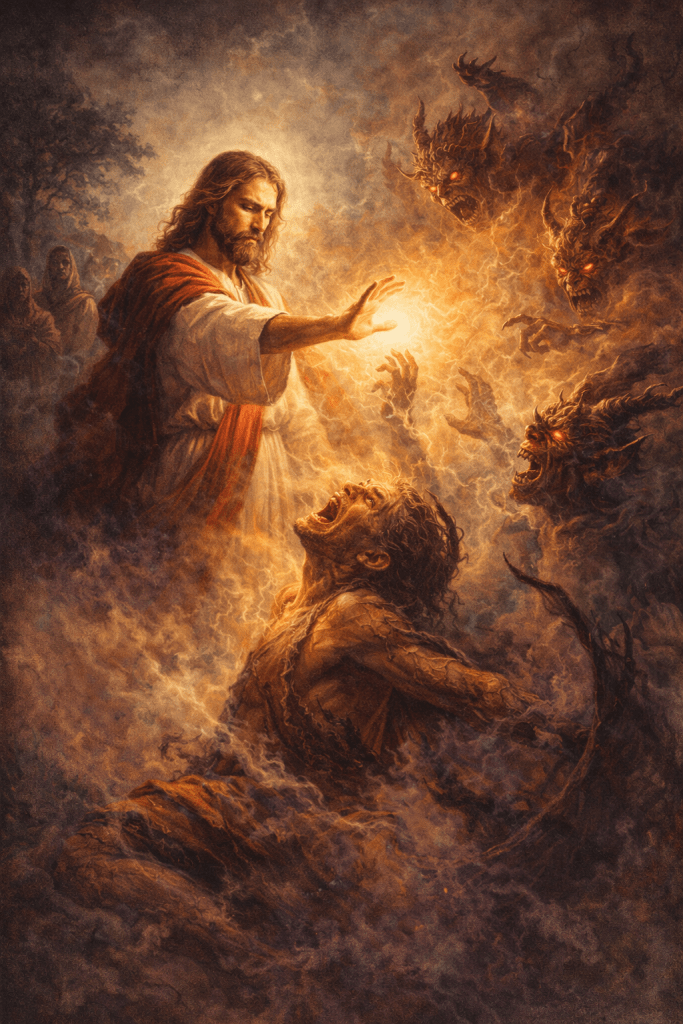
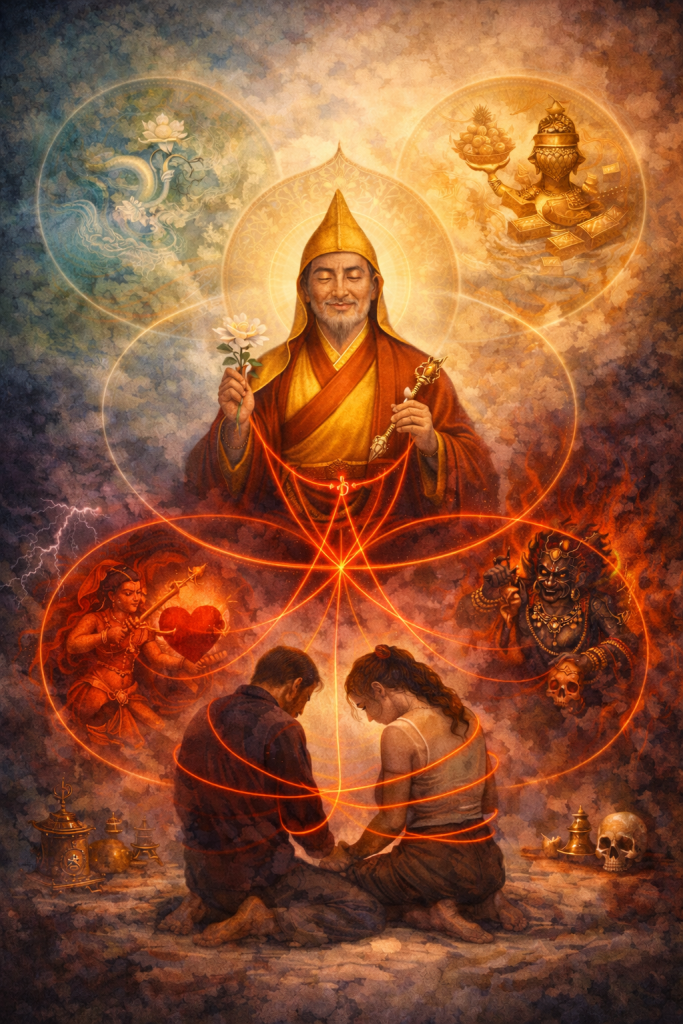
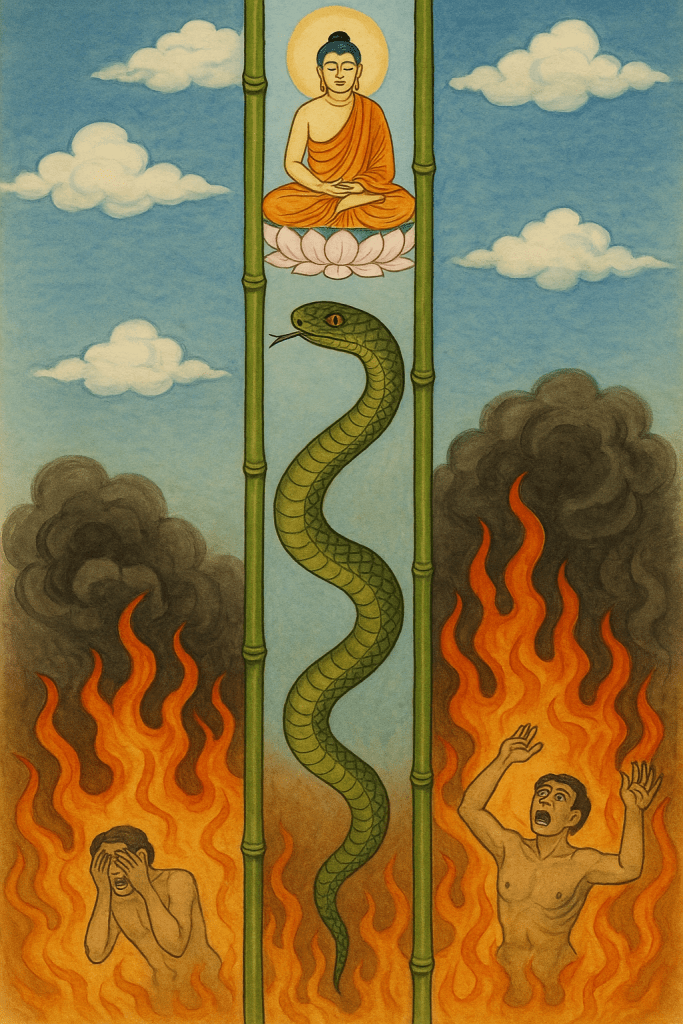
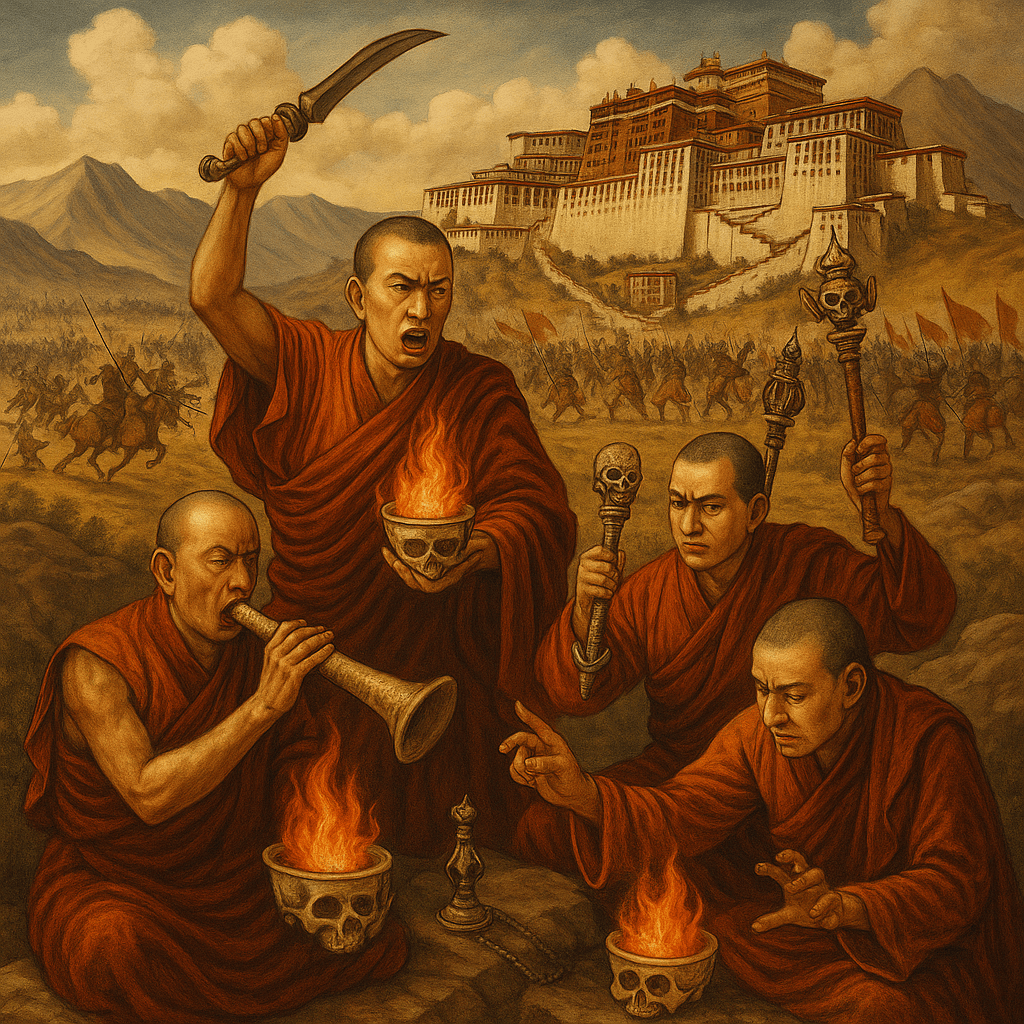
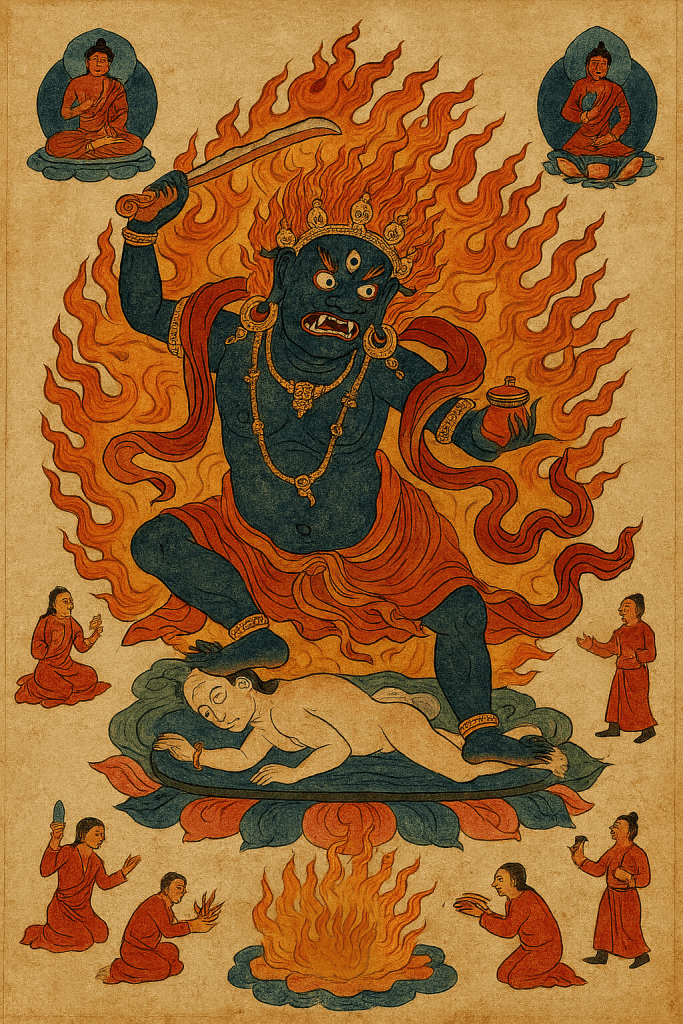
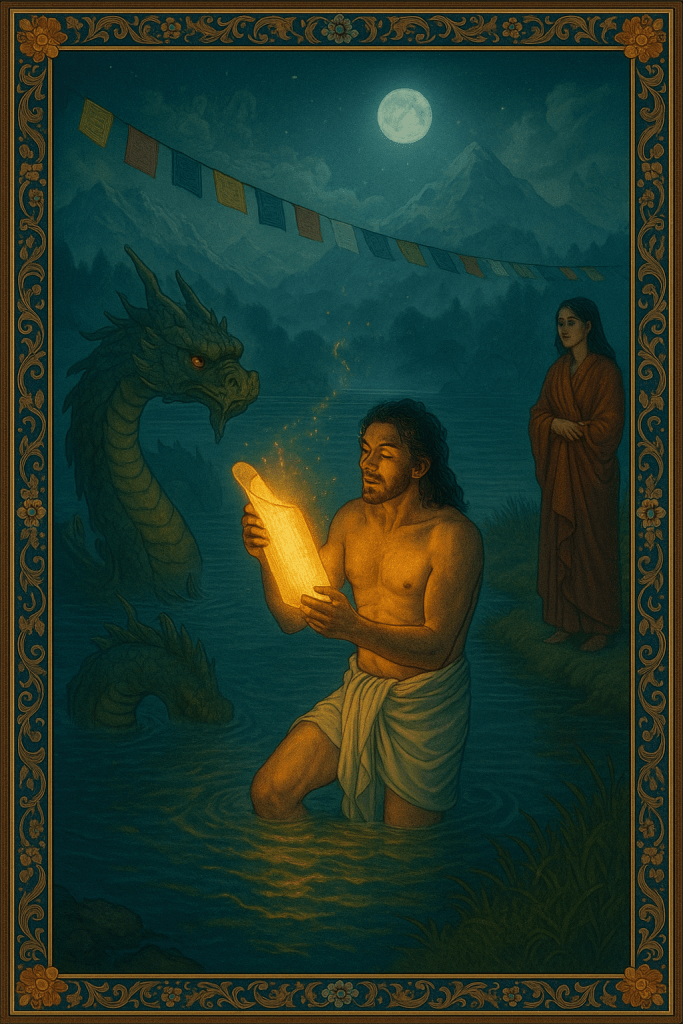

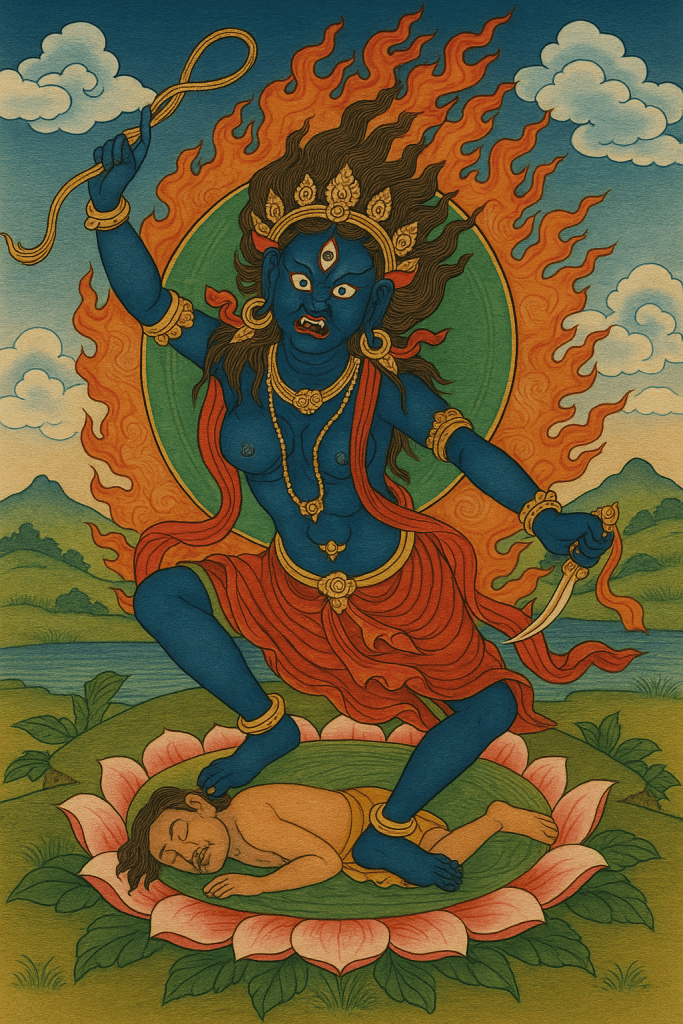
 Tantric Deception