The Question of the Soul: Christianity, Hinduism, and Buddhism


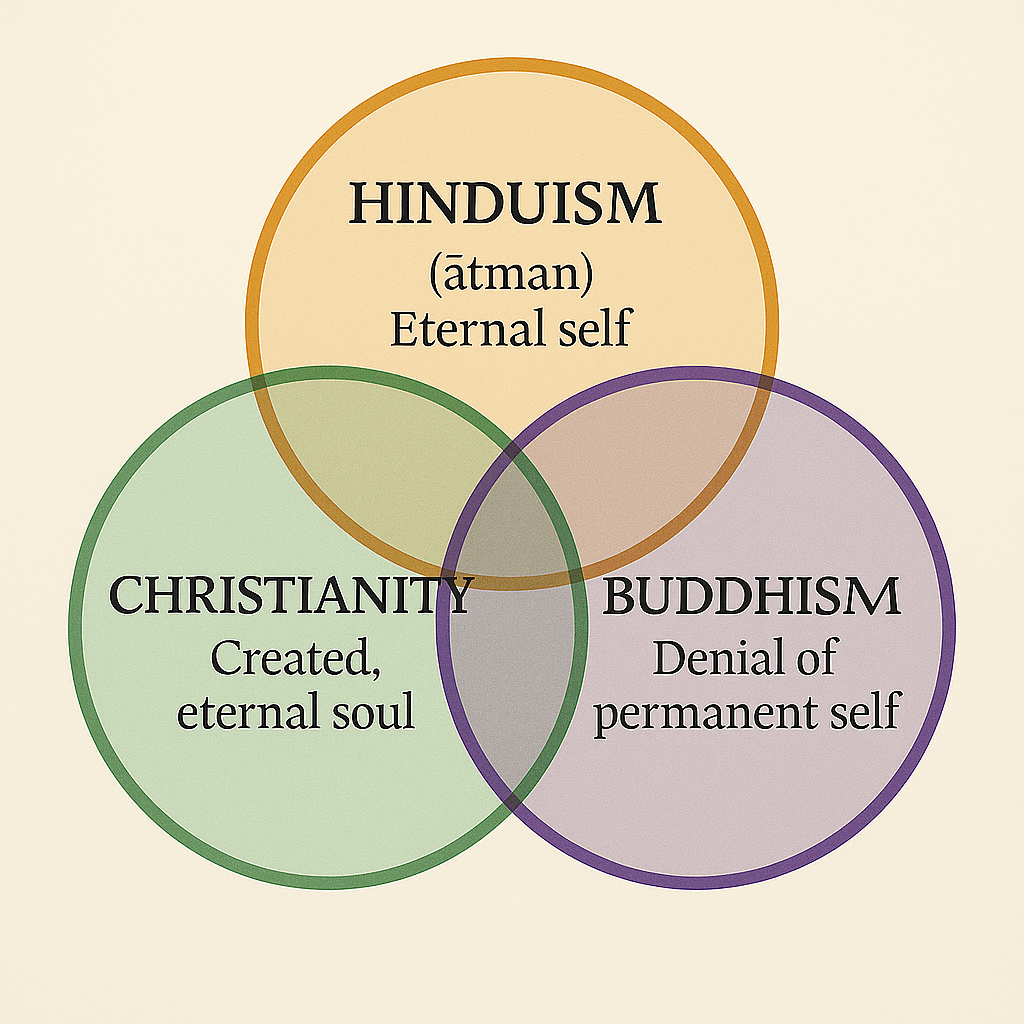
The question of what the soul is, whether it exists, and what happens to it after death lies at the center of the world’s major religious traditions. Christianity, especially in its Catholic tradition, affirms the soul as eternal and God-given. Hinduism has multiple schools, often affirming an eternal self or ātman. Buddhism, including Tibetan Buddhism, rejects the idea of a permanent self or soul and instead speaks of mind and consciousness as a conditioned stream of awareness without enduring essence.


The Christian and Catholic Understanding of the Soul

Christianity teaches that every human being has a unique, immortal soul created by God. According to Catholic doctrine, the soul is the spiritual principle of the human person. It is eternal in destiny, surviving bodily death, and directed either toward communion with God or separation from Him.

Scriptural sources include Genesis 2:7, where God breathes life into Adam and he becomes a living soul [1]; Matthew 10:28, where Jesus warns of the danger of losing the soul [2]; and the Catechism of the Catholic Church, which affirms that the soul is created by God and immortal [3]. In this view, the soul is not an impersonal principle but a personal identity, judged and redeemed by God.


Hindu Views on the Self (Ātman)

Hinduism is diverse, but most of its classical schools affirm the existence of ātman, the true self. The Chandogya Upanishad teaches “tat tvam asi” (you are that), affirming the identity of the self with Brahman [4]. The Brihadaranyaka Upanishad declares, “This self (ātman) is indeed Brahman” [5]. The Bhagavad Gita teaches that the self is eternal and indestructible [6].

Distinguishing Hindu and Christian Concepts

Both Hindu and Christian traditions speak of something enduring at the core of human existence, but they do so in different ways.

Christianity teaches that the soul is created by God, personal, and accountable before Him. It does not preexist from eternity but comes into being by His will and remains dependent on Him for existence, judgment, and salvation.

In Hindu thought, Advaita Vedānta emphasizes the identity of the self (ātman) with Brahman, dissolving individuality into the absolute. Dvaita and many Bhakti traditions instead teach that the self remains distinct yet eternal, existing in relationship with the divine. In all of these cases, the ātman is uncreated and co-eternal with ultimate reality, not brought into being by God.

Thus, while both traditions sometimes use personal and sometimes abstract language, the Christian soul and the Hindu ātman play very different roles. The soul in Christian theology is a created person before God; the ātman in Hindu philosophy is an eternal essence, whether one with Brahman or distinct in devotion.


The Creator God in Christianity and Hinduism

Christianity affirms one personal Creator God who brings the universe into being from nothing and sustains it in existence.

Hinduism presents a wide range of views. In Bhakti traditions, deities such as Vishnu, Shiva, or Devi are worshiped as supreme creators. Vedānta schools affirm Brahman as the ultimate source, though in Advaita this is not a personal act of creation but the manifestation of māyā. Other schools such as Sāṃkhya and Mīmāṃsā reject a creator altogether, viewing the universe as self-arising.

Thus, while Christianity grounds the soul in a personal God who creates and judges, Hindu thought ranges from devotion to a personal creator to cosmologies where no creator is necessary.


Buddhist Rejection of the Soul

Buddhism arose in part as a rejection of the Hindu doctrine of ātman. In the Anattalakkhana Sutta, the Buddha declared that none of the five aggregates of existence constitute a self [7]. The doctrine of anātman (no-soul) became central.

Mind and Consciousness

In Tibetan Buddhism, mind and consciousness are viewed as a stream of awareness, conditioned by karma. The Abhidharma-kośa describes consciousness as momentary and dependent [8]. Unlike Christianity and Hinduism, which affirm an eternal principle (soul or self), Buddhism denies it, calling belief in permanence a delusion.

Yet questions arise. If there is no soul, then what suffers in the hell realms described in Tibetan texts? The Bardo Thödol warns of the horrors of the Vajra Hell, a realm said to be utterly without escape [9]. The Hevajra Tantra declares that those who violate tantric commitments “will not be liberated for as many eons as there are atoms in the universe” [10]. The Cakrasaṃvara Tantra and later commentaries also teach that breaking tantric vows leads to vajra hells without release [11].

This presents a paradox: if there is no enduring self, who is suffering eternally?


Tibetan Buddhist Schools Under Examination

Madhyamaka – Nāgārjuna’s Mūlamadhyamakakārikā argues that all phenomena, including the self, are empty of inherent existence [13]. But if the self is an illusion, how does karma persist? If Vajra Hell is eternal, how can something that does not exist suffer forever?

Yogācāra (Mind-Only) – The Yogācārabhūmi Śāstra introduces ālayavijñāna, the “storehouse consciousness,” which preserves karmic seeds [14]. Though intended to avoid affirming a self, it functions much like one: carrying memory, identity, and karma. Hinduism here provides a comparison: the Bhagavad Gita teaches that the self carries karma through many births [6]. Yogācāra denies the term “soul,” yet reintroduces something strikingly similar. Christianity differs again: not a karmic storehouse, but a personal soul created by God.

Dzogchen (Great Perfection) – Dzogchen teachings, such as the Kunjed Gyalpo (All-Creating King), speak of rigpa, primordial pure awareness that is timeless and luminous [15]. Though Dzogchen denies that rigpa is a soul, the resemblance is striking. If rigpa is eternal, pure, and the ground of all experience, how is this different from what Christians call the soul or Hindus call ātman? The denial seems rhetorical rather than substantive.

Vajrayāna and Deity Possession – Tantric scriptures describe deity yoga, in which practitioners invite deities to merge with them [16]. If there is no self or soul, what exactly is being merged with or possessed?


Conclusion

Across Christianity, Hinduism, and Buddhism, the question of what endures, what we might call the soul, self, or consciousness, reveals fundamentally different views of human identity. Christianity anchors personhood in a created, immortal soul made by God and accountable to Him. Hinduism envisions an eternal ātman, uncreated and either one with or distinct from the divine. Buddhism, in contrast, denies any enduring essence, seeing the sense of self as a conditioned process. Yet in its Tibetan forms, teachings on karmic continuity, primordial awareness, and tantric transformation often edge back toward affirming something that functions like a self.

From long immersion in both Catholic and Tibetan Buddhist traditions, I have come to believe that the Christian vision alone sustains coherence between moral responsibility, continuity of consciousness, and the promise of redemption. It affirms not only that we exist, but that we are known and loved by the One who created us. Against the shifting alternatives of an impersonal absolute or an empty stream of awareness, in my opinion, the Christian understanding of the soul remains the clearest expression of what it means to be human before God.


References

[1] Genesis 2:7, The Holy Bible (ESV).
[2] Matthew 10:28, The Holy Bible (ESV).
[3] Catechism of the Catholic Church, Part I, Section Two, Chapter One, Article 1, §366.
[4] Chandogya Upanishad 6.8.7, in Radhakrishnan, S. (trans.), The Principal Upanishads.
[5] Brihadaranyaka Upanishad 4.4.5, in Olivelle, P. (trans.), The Early Upanishads.
[6] Bhagavad Gita 2.20, in Zaehner, R. (trans.), The Bhagavad-Gita.
[7] Anattalakkhana Sutta (Samyutta Nikaya 22.59), in Bhikkhu Bodhi (trans.), The Connected Discourses of the Buddha.
[8] Vasubandhu, Abhidharma-kośa.
[9] Bardo Thödol (Tibetan Book of the Dead), in Evans-Wentz, W.Y. (ed.).
[10] Hevajra Tantra, Snellgrove, D.L. (trans.), The Hevajra Tantra: A Critical Study.
[11] Cakrasaṃvara Tantra, in Tsuda, S. (trans.), The Samvarodaya Tantra.
[12] Hevajra Tantra, ibid.
[13] Nāgārjuna, Mūlamadhyamakakārikā, Kalupahana, D.J. (trans.).
[14] Yogācārabhūmi Śāstra, Xuanzang (trans.).
[15] Kunjed Gyalpo (All-Creating King), in Namkhai Norbu (trans.), The Supreme Source.
[16] Cakrasaṃvara Tantra and Hevajra Tantra, ibid.


Lin Kai’s: “Meanings of Violence in Tibetan Buddhism”


In his essay Meanings of Violence in Tibetan Buddhism, Lin Kai develops themes first raised by Elliot Sperling: Tibetan Buddhism has never been simply the peaceful, pacifist tradition imagined in Western romantic projections. Both history and ritual demonstrate how violence was woven into Tibetan religious and political life¹, continuing into the present. As Kai underscores, and as Sperling noted before him, both Western interpreters and Tibetan voices have often gone to great lengths to overlook or obscure this troubling facet of Tibetan Buddhism.

Kai highlights how rulers, including the Fifth Dalai Lama, relied on military force to consolidate power and punish rebellion. As Sperling documented, the Dalai Lama issued explicit orders in the seventeenth century to annihilate enemies, words that expose a stark contrast to the modern image of Tibet².

The Fifth Dalai Lama’s commands were phrased in brutal, almost ritualistic terms:

Make the children and grandchildren like eggs smashed against rocks;
Make the servants and followers like heaps of grass consumed by fire;
In short, annihilate any traces of them, even their names.²

This edict was aimed at other Tibetan Buddhists, mind you. Amidst such warfare, Kai notes, not all monks accepted this with ease. Some were unsettled by the amount of time and resources demanded for war rituals, though few dared openly resist their lamas. A particularly striking passage from the Fifth Dalai Lama’s autobiography shows him wrestling with his own position as a Buddhist leader at war. He recounts the following dream:

“Looking through an open window on the eastern side of the protector-chapel, stood the treasurer [Sonam Rabten] and a crowd of well-dressed monks with disapproving looks. Shoving the ritual dagger into my belt, I went outside. Thinking that if any of those monks said anything, I would strike him with the dagger, I walked resolutely straight through them. They all lowered their eyes and just stood there. When I awoke, my illness and impurities had been completely removed; not even the slightest bit remained. I was absolutely overflowing with amazement and faithful devotion.” — Fifth Dalai Lama¹

This moment captures the tension at the heart of Tibetan statecraft: the bodhisattva ideal of compassion colliding with the felt necessity of violence. Kai also emphasizes ritual violence, where wrathful deities and fierce imagery symbolize the annihilation of obstacles to enlightenment. These practices were not simply symbolic. They paralleled real political campaigns, where violent suppression against human beings was justified as protecting the Dharma¹.

Western audiences, however, have often distorted this history. Kai argues that Orientalist fantasies, especially those that cast Tibet as a timeless land of peace, obscure the record of blood and retribution¹. Sperling made the same point, noting how the Dalai Lama’s reputation as a Nobel Peace laureate stands in sharp tension with the historical evidence².

“Violence in Tibetan Buddhism cannot be neatly categorized as either barbaric or compassionate. It exists within a worldview where wrathful action and compassion may coincide, depending on context and intent.” —Lin Kai¹

In this worldview, compassion and violence were not opposites. Wrathful action could be seen as alright when it was thought to protect the Dharma or eliminate obstacles, even human ones. What emerges, then, is a very complicated and unsettling picture: violence was not an exception but an integral part of Tibetan Buddhist practice.

Kai’s work reinforces Sperling’s warning: if we want to understand Tibetan Buddhism as it is, rather than as we wish it to be, we must confront the ways in which violence was and still is sacralized within the tradition.

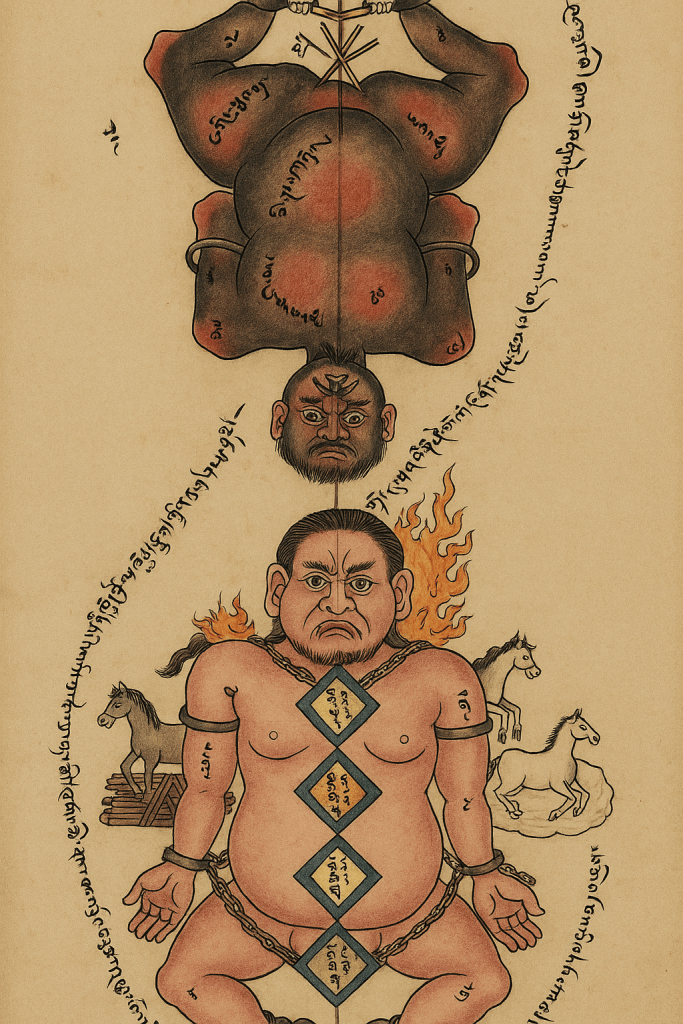
This type of linga resembles one depicted in the Secret Visions of the Fifth Dalai Lama, a visionary autobiography. It shows two figures to be ritually ‘liberated’ or killed, typical of effigies used in Tibetan Buddhist rites against so-called ‘enemies of the dharma.’ Such effigy sacrifices remain part of Tibetan Buddhist ritual practice today.


Footnotes

¹ Lin Kai, Meanings of Violence in Tibetan Buddhism, Substack, 2025.
² Elliot Sperling, Orientalism and Aspects of Violence in the Tibetan Tradition, Info-Buddhism, 2004.

Truth Behind the Myth: Violence in Tibetan Buddhism


In his article Orientalism and Aspects of Violence in the Tibetan Tradition, Elliot Sperling uses the term Orientalism in the sense made famous by Edward Said. It describes how Western scholars, writers, and media have often portrayed Asian and Middle Eastern societies in ways that are exotic, stereotypical, and distorted (Sperling 2001, p. 317). [1]

In this context, Elliot Sperling is pointing out that Tibet, especially Tibetan Buddhism, has been framed in the West not as a complex, politically active society but as a mystical and pacifist Shangri-la (Sperling 2001, p. 318). That romanticized portrayal fits the Orientalist mold because it projects Western fantasies and agendas onto a culture instead of showing it in its full, often messy, historical reality.

Here, Orientalism is not just about misunderstanding or stereotyping. It is about how those misconceptions feed into selective histories, in this case downplaying or erasing the tradition’s capacity for political maneuvering, power struggles, and violence.

It is important to cut through the sugar-coated narratives about Tibetan Buddhism as an always peaceful, otherworldly faith. Historian Elliot Sperling, a top authority on Tibet and China history, attempts to do this in his essay. He shreds the romanticized “compassionate lama” image and reintroduces the messy, political, and yes, violent realities of Tibetan history (Sperling 2001, p. 320).

  • Tibetan Buddhism was not pacifism incarnate. Sperling points out that the Fifth Dalai Lama did not shy away from military force when Gelugpa interests were on the line in the 17th century. In the early 20th century, the Thirteenth Dalai Lama actively sanctioned armed resistance against Qing forces in Lhasa (Sperling 2001, pp. 323–324).
  • Modern Western portrayals have softened the truth. The prevailing global image of Tibetan Buddhism, as inherently gentle, infallibly peaceful, and untouched by politics, is largely a product of Western assimilation and the Tibetan exile community’s framing of their own image (Sperling 2001, pp. 317–318).

Why It Matters

If you are buying into the “peace only” ideal, Sperling’s essay demands reconsideration. He forces you to recognize Tibetan Buddhism as a tradition entwined in power and violence when necessary (Sperling 2001, p. 317). The strident idealism selling Tibet as a spiritual Shangri-la does not hold up under scrutiny. In 1660, the Fifth Dalai Lama faced a rebellion in Tsang. Declaring he acted for the good of the people in the region, he issued uncompromising orders for the complete destruction of his enemies, men, women, children, servants, and property, leaving no trace of them. This directive, written in his own hand, reveals a leader willing to use extreme military force to secure his government’s power, a stark contrast to the modern image of the Dalai Lama as an unshakable symbol of peace.

[Of those in] the band of enemies who have despoiled the duties entrusted to them:
Make the male lines like trees that have had their roots cut;
Make the female lines like brooks that have dried up in winter;
Make the children and grandchildren like eggs smashed against rocks;
Make the servants and followers like heaps of grass consumed by fire;
Make their dominion like a lamp whose oil has been exhausted;
In short, annihilate any traces of them, even their names (Sperling 2001, p. 325).

This brutal passage, is a powerful and chilling indictment. It underscores the darker potential within any ideology. When power, anger, or fear take hold, even so-called peaceful spiritual traditions can sanction annihilation. Sperling’s work reminds us to stop buying into the marketing of Tibetan Buddhism as a compassionate, peaceful idyll. His historical analysis and the many examples of tantric annihilation rituals used against human targets says otherwise. It is time to drop the myth and acknowledge the tradition for what it truly is: a living, political, and sometimes violent force (Sperling 2001, p. 329).

  1. Elliot Sperling, “Orientalism and Aspects of Violence in the Tibetan Tradition” (2001), info-buddhism.com, originally published in Imagining Tibet: Perceptions, Projections, & Fantasies, ed. Thierry Dodin and Heinz Räther, Wisdom Publications. Available at: https://info-buddhism.com/Orientalism_Violence_Tibetan_Buddhism_Elliot_Sperling.html

Yamantaka and the Truth About Violent Rituals in Tibetan Buddhism


The following is based on Aleksandra Wenta’s article “Tantric Ritual and Conflict in Tibetan Buddhist Society: The Cult of Yamāntaka” (2022).

Public perception paints Buddhism as the ultimate religion of compassion. The Dalai Lama’s cheerful smile and monks chanting in maroon robes conjure images of peace in the Western imagination. But the historical record tells quite another story, one most Buddhist institutions would prefer to bury. Violent ritual has always had a place in Tibetan Buddhist practice, and the cult of the wrathful deity Yamantaka is one of the clearest examples.

The Deity of Destruction

Yamantaka, whose name means “Ender of Death,” is no serene Buddha. In tantric lore he is a ferocious, multi-headed, weapon-wielding deity invoked to annihilate enemies. These enemies might be inner demons in metaphor, but in many cases they were very real human targets. As Wenta’s research shows, Tibetan Buddhist ritual specialists used Yamantaka rites as deliberate acts of destruction, both spiritual and physical.

Politics and Ritual Warfare

The historical examples are difficult to dismiss. In the ninth century, the Buddhist master Gnubs chen Sangs rgyas yeshes allegedly used Yamantaka magic against King Lang Darma, a ruler seen as hostile to the Dharma. Centuries later, during the political struggles of the seventeenth century, the Fifth Dalai Lama employed Yamantaka rituals to consolidate power over rival factions. These were not fringe experiments, but state-linked religious acts intended to remove opponents.

The reach of these rites went beyond Tibet. The Manchu Qianlong emperor adopted Yamantaka worship to project legitimacy over his subjects, while Mongolian and Japanese traditions incorporated similar ritual violence into their own religious-political frameworks.

Violent Compassion as Justification

Practitioners did not see these rites as morally corrupt. They justified them through the doctrine of “violent compassion,” the belief that killing or harming could liberate an enemy from a worse rebirth. Wenta notes that tantric philosophy, particularly the doctrine of emptiness, was used to argue that concepts like killer or victim do not ultimately exist. In this logic, an enlightened being could commit an act of violence without accruing negative karma.

Ritualized Destruction

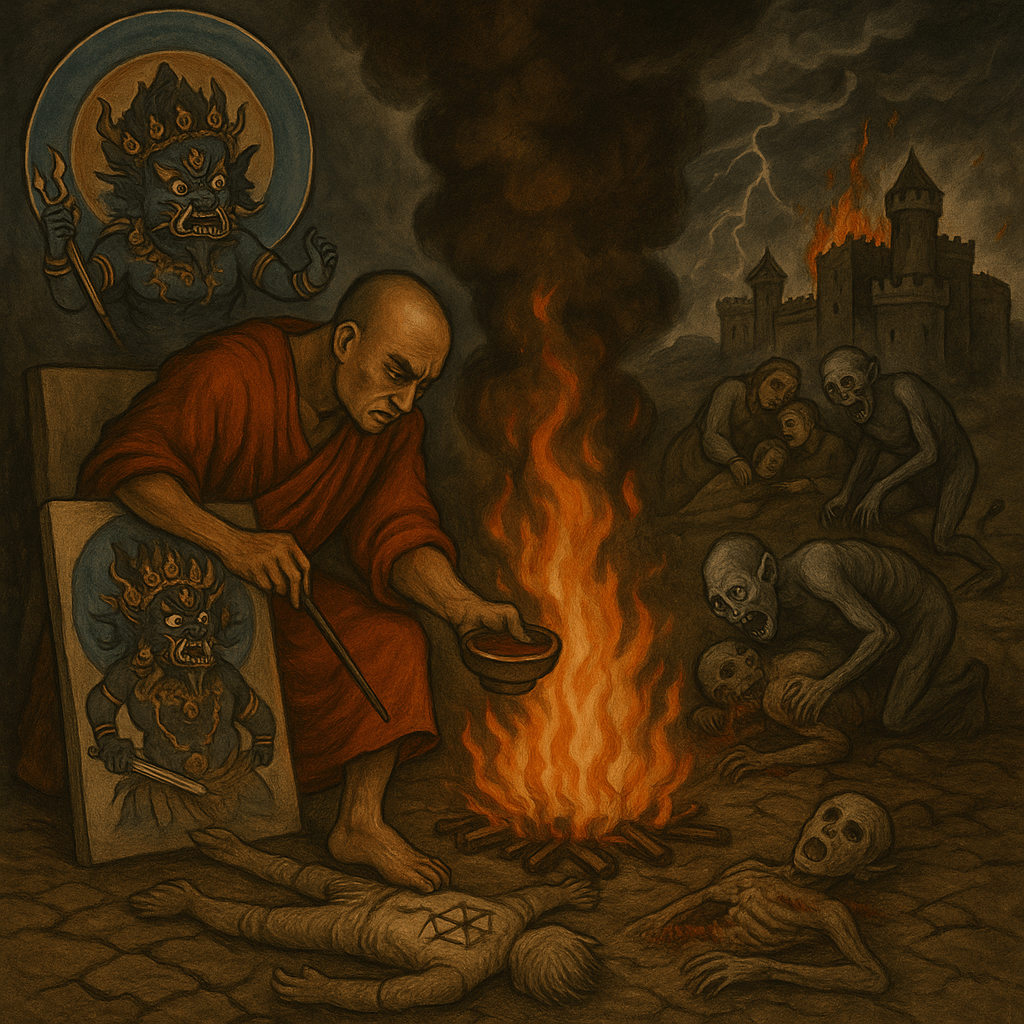
From the Mañjuśriyamūlakalpa’s “Ritual Against the Wicked Kings” comes one of the most explicit and brutal examples. The text instructs the practitioner to paint Yamantaka in terrifying form, then perform fire offerings of human blood, flesh, and powdered bone mixed with poisons and toxic plants to unleash plague, famine, storms, and demonic infestations upon the target. The king’s family is to die in sequence: son on the first day, wife and ministers on the second, the king himself on the third, while his court is overrun by flesh-eating spirits and his land struck by drought, fire from the sky, rockfall, and invasion. A human effigy bearing the victim’s birth star in cremation-ground charcoal is trampled during mantric recitation so the enemy dies, goes mad, or is devoured by demons. This is ritualized destruction in its most literal, calculated form.

One section of the same text reads like a manual for calculated devastation. The practitioner is instructed to heap human blood, flesh, powdered bone, poisons, and the roots of deadly plants onto a ritual fire in front of the painted deity. After 1008 offerings, not only is the enemy destroyed, but their family, ministers, and allies are swept away as well. The text promises droughts, plagues, famine, and storms, even fire and rocks falling from the sky, while demonic forces overrun the victim’s court. In some variations, a single datura root is enough to drive the target insane, or a few spoonfuls of spiced offerings can induce fatal fevers within days.

The text also states, “If he wants to kill someone, then having made a puppet (kṛtiṃ) he should write a name: the deity name or a nakṣatra (‘asterism under which the target was born’) using a charcoal of the cremation ground, which should be placed on the ground in front of the paṭa. Standing on [the puppet’s] head with his foot, he should be in a wrathful state, and do the recitation. He (the king) will become overpowered by a major disease, or he will die on the spot. That lord of men will be seized by piercing pains for no apparent reason, or he will be killed by an animal, or he will become crippled. He will be eaten by fierce rākṣasas, and various impure beings that have arisen from non-human birth (kravyādin), pūtanas, piśācas, pretas and the mothers, or he will be killed immediately by his own attendants.” 1

Conflict Inside the Tradition

Even within Tibetan Buddhism, the legitimacy of destructive rituals such as these was contested. Some figures, such as Rwa lo tsā ba, became famous for their wrathful practices but were denounced by peers as frauds or heretics. Reformers like Yeshes ’od tried to curtail the most extreme acts, replacing “live liberation” killings with symbolic substitutes like effigy destruction. But these reforms did not erase the underlying acceptance of ritual violence; they only tamed it for public consumption.

Another Piece of the Puzzle

Wenta’s work adds yet another piece of hard evidence to the growing pile that Tibetan Buddhism has long included practices designed to harm or destroy. These rituals were not simply metaphorical, and they were not limited to obscure sects. They were woven into the political and religious fabric of Tibet and beyond.

For those willing to look past Tibetan Buddhism’s carefully crafted PR image, the cult of Yamantaka exposes a reality in which the language of compassion hid a persistent undercurrent of deliberate harm.

Footnotes

1) Aleksandra Wenta, Tantric Ritual and Conflict in Tibetan Buddhist Society: The Cult of Yamāntaka, in Esimoncini, 19 Wenta CHIUSO, available at https://tibetanbuddhistencyclopedia.com/en/images/0/0b/Esimoncini%2C%2B19_Wenta_CHIUSO.pdf.

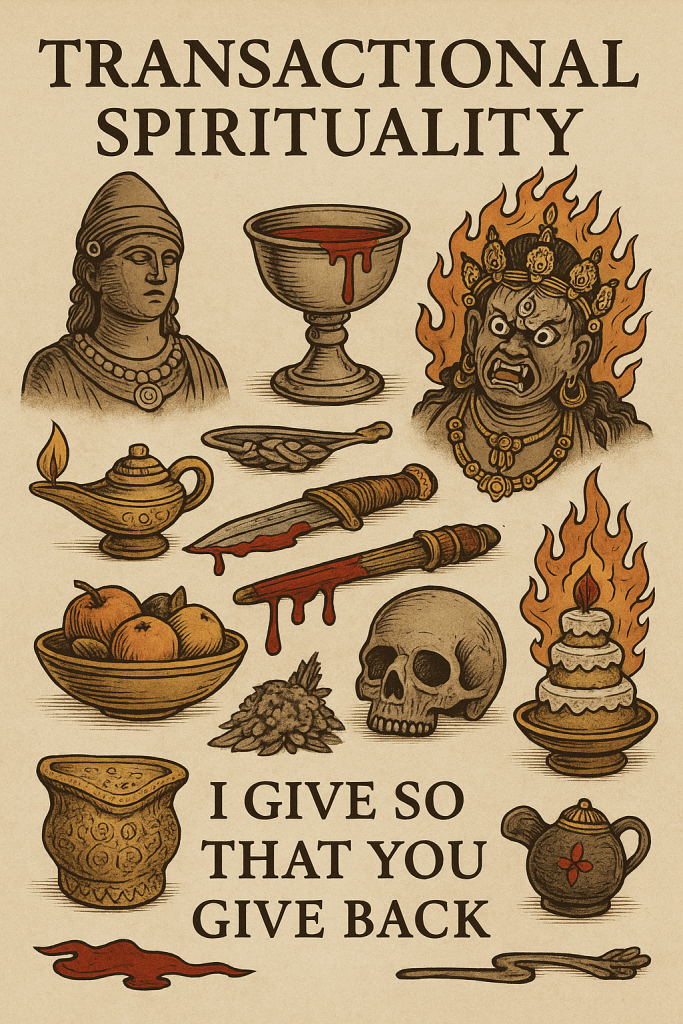
Sacrifice, Favor, Repeat


Before the modern age romanticized pagan religions into New Age panaceas, ancient worship was known to be raw and brutally pragmatic. In our modern spiritual-industrial complex, it is often sugarcoated into some kind of warm, earth-loving ceremony filled with personal empowerment and divine intimacy. But if you’re reading this, you’re probably already suspicious of that narrative.

In fact ancient religion, pagan religion, was highly transactional. The gods didn’t love you. They didn’t weep over your suffering or aspire to protect you.

A passage from Behold the Christ: Proclaiming the Gospel of Matthew by Leroy A. Huizenga makes this brutally clear. Pagan worship, he writes, operated on the ancient principle of do ut des: “I give so that you give back.”(1) In other words, the gods and humans used each other. You offered sacrifices, incense, food, or praise not out of adoration, but because you wanted something in return: good crops, protection in war, fertility, rain, wealth, healing, vengeance, and victory. And the gods? They wanted to be fed, praised, and kept relevant. It was mutual exploitation dressed up in sacred costume.

“That is, the worshipper provides a sacrifice to a god that pleases and empowers the god, who then turns around and does the worshipper favors. Because the gods are often indifferent to humans, worshippers engage in repeated ritual to reach out and get a god’s attention.”

This paragraph says more about ancient spirituality than most modern New Age books on “manifesting” or “connecting with the divine.” The ancients weren’t confused. They understood that the gods were powerful, unpredictable, and not especially interested in human wellbeing unless there was something in it for them.

And this wasn’t limited to Rome or Greece. Versions of do ut des appear in Vedic sacrifice, Mesopotamian temple economies, and also Tantric Buddhist practice where offerings are made to wrathful deities to invoke, control, or appease.

Nowhere is this transactional logic more systematized and ritualized to the point of industrial precision than in Tibetan Buddhism. While cloaked in the language of enlightenment and compassion, the tradition is saturated with mechanisms that mirror the ancient do ut des economy: elaborate offerings, incense, butter lamps, mandalas, and tormas (sacrificial cakes that replaced blood offerings when the Buddhist principle of ahimsa “non-harming” took root). These were given not out of unconditional reverence, but to elicit specific outcomes from specific deities. Monastic liturgies are not just meditative recitations, but are negotiations with a pantheon of wrathful and peaceful beings, each with their own preferences, powers, and temperaments. Moreover, the non-harming sentiment in Tibetan Buddhism only extends so far. While Buddhist tantra forbids blood sacrifice, its subjugation rituals, aimed at both spiritual and human enemies, can involve some of the most brutal punishments found in any ritual religion.

Drupchöd ceremonies, held in large monasteries, exemplify this beautifully. These are days- or weeks-long ritual marathons involving collective chanting, visualization, music, mudras, and vast offerings, all designed to propitiate deities into bestowing protection, wisdom, and worldly benefits like health and prosperity. Whether invoking Mahakala to remove obstacles or Tara for swift blessings, the assumption is clear: the deity acts when properly fed, praised, and invoked. The gods (or enlightened beings, depending on your doctrinal parsing) are not passively watching; they’re participants in a cosmic economy, and Tibetan Buddhism, more than almost any other tradition, has mastered the bureaucratic apparatus needed to transact with them. It’s not just about personal devotion. It’s about correct performance, correct offerings, and the correct “exchange rate” of ritual. The love of the gods is not assumed. Their attention must be earned over and over again.

Modern Takeaways and a Warning

This transactional pattern isn’t limited to ancient paganism or esoteric Tibetan ritualism. You’ll find the same spiritual economy alive and well in the darker corners of contemporary occultism. Take it from someone like Riaan Swiegelaar who’s lived on the other side: former Satanists and occult practitioners routinely speak of offering sacrifices, especially blood, to demons in order to negotiate outcomes.(2)

He described it well: “A lot of people ask me, ‘Why are there so many sacrifices in Satanism? Why is there blood?’ The answer is simple: blood has currency in the spirit world. If I want to negotiate with demons, I need to bring an [animal] sacrifice because that blood holds value. It functions as spiritual capital.

“But here’s the contrast: the blood of Jesus is the highest currency in the spirit world. It covers everything. That’s the authority we stand on. And every ex-Satanist or ex-occultist who’s encountered Christ will tell you the same thing. I might be the only one talking about it openly, but this is real: we engaged in negotiations with demons, offered animal sacrifices, and got results. That’s how the system worked. Then we experienced the blood and love of Christ and there’s no comparison. It’s not even close. His blood is infinitely more powerful. In spiritual warfare, people need to grasp that reality. The blood of Christ is free, but it is not cheap, is it? It came at the highest cost. And what happened on the cross? That wasn’t a one-time transaction in history: it remains as valid, active, and potent today as it was then, and always will be.”

This is so important that it bears repeating: no spiritual currency, no ritual offering, no demonic pact compares to the raw, unmatched power of the blood of Christ. This is the rupture at the heart of Christianity: the economy of sacrifice is over, not because gods stopped demanding payment, but because one sacrifice bankrupted the system.

From blood-soaked altars in Babylon to ritual offering tormas in Himalayan monasteries, humanity has always traded devotion for power and offerings for favor. But the cross flipped the script. There is no more need for bartering, manipulation, and performance to win divine attention. What Christ offered wasn’t another payment into the cosmic vending machine but a final act that rendered the machine obsolete. And if that’s true, then every attempt to re-enter the old system, whether through pagan ritual, tantric bureaucracy, or occult negotiation, isn’t just a return to tradition. It’s a rejection of victory.

(1) Leroy A. Huizenga, Behold the Christ: Proclaiming the Gospel of Matthew (Emmaus Road Publishing, Steubenville, Ohio).

(2) Riaan Swiegelaar, former co-founder of the South African Satanic Church, in various public testimonies including interviews and livestreams (e.g., “Riaan Swiegelaar Testimony,” YouTube, 2022), has spoken openly about blood sacrifice as spiritual currency and his eventual conversion after experiencing the love of Christ.


How Tantra Masqueraded as Buddhism: the Vajrayāna Deception


Vajrayana Buddhism, also known as Tibetan Buddhism or Tantric Buddhism, stands out for its rituals, deity worship, and complex esoteric practices. Its mantras, mandalas, and meditations on wrathful and yab/yum deities bear clear resemblance to Hindu Tantra, Vedic ritualism, and indigenous spirit cults.

So how did it convince anyone, especially devout Buddhists, that it was authentically taught by the historical Buddha?

The answer lies in a strategic combination of hidden teaching narratives, scriptural mimicry, ritual power, and imperial patronage. Let’s explore how this transformation occurred and what it means when viewed through the lens of Catholic faith and biblical discernment.

Secret Teachings: “The Buddha Taught It, But in Secret”

Vajrayana scriptures claim that the Buddha did teach tantra, but only in secret, to highly realized disciples. These teachings were said to have been hidden in celestial realms, entrusted to beings like Vajrapani or dakinis, or taught in the Buddha’s “enjoyment body” (sambhogakaya) form in other worlds such as Akanistha.(1)

This tactic mirrored earlier Mahayana developments, where new sutras like the Lotus or Avatamsaka were claimed to be higher revelations spoken by the Buddha, but not understood by his early disciples. The concept of esoteric knowledge reserved for the spiritually mature made these late texts seem like rediscovered treasures, rather than innovations.

Scriptural Mimicry and Retroactive Legitimization

To reinforce their authority, tantric scriptures deliberately mimicked the structure of traditional sutras. They often began with the familiar phrase, “Thus have I heard,” and depicted the Buddha teaching not only in celestial realms surrounded by bodhisattvas, but sometimes in radically transgressive settings such as charnel grounds, encircled by ḍākinīs and wrathful deities. These texts introduced elaborate cosmologies, detailed ritual instructions, and esoteric vows, presenting them as timeless wisdom, even though they were composed many centuries after the Buddha’s death.[2]

Authors also invented lineages, claiming that tantric teachings had been passed down secretly from Vajrapani to Nagarjuna, or from Padmasambhava to Tibetan kings.

Syncretism with Hindu and Folk Traditions

Instead of denying its similarities with Hindu Tantra, Vajrayana reinterpreted them. Wrathful deities were said to be enlightened Buddhas. Sexual rituals were described as a symbolic means to transform desire into wisdom. Offerings of blood, bones, and taboo substances were spiritualized as purifications of dualistic perception.

By repackaging Vedic and folk practices into a Buddhist framework, Vajrayana could absorb local traditions and declare them “Buddhist skillful means.”

Imperial Support and Monastic Integration

Tantra spread rapidly through the support of kings and monasteries. In Tibet, tantric masters were invited to subdue native spirits, secure political power, and perform rituals for prosperity. At Indian centers like Nalanda and Vikramashila, tantric scholars and monks practiced Mahayana logic by day and tantric visualization by night.

With the backing of the state and the academic establishment, Vajrayana was not seen as a fringe practice but as the “highest vehicle” of Buddhism.

Ritual Power and Psychological Experience

For the average practitioner, tantra “worked.” It offered visions, emotional catharsis, ritual protection, and the promise of fast-track enlightenment. The experiential pull of mantra, deity yoga, and initiation ceremonies gave people tangible results even if the doctrinal basis was historically shaky.

In the end, many believed not because of historical evidence, but because the system delivered experiences of spiritual intensity.

How Christianity Views This: The Domain of the Second Heaven

From a biblical and Catholic perspective, this raises serious concerns. The spiritual beings Vajrayana practitioners encounter, wrathful deities, dakinis, yidams, do not proclaim Christ as Lord and Savior. They do not point to the God of Abraham, Isaac, and Jacob. They offer power and enlightenment through self-transformation, not redemption.

The Bible is clear: Satan is the prince of the power of the air, ruling the spiritual domain between heaven and earth until Christ returns (Ephesians 2:2). What some refer to as the “second heaven” is where fallen angels operate, deceiving through false light, hidden knowledge, and seductive spiritual experiences.

Teachers like Derek Prince and Dr. Michael Heiser have explained how fallen entities inhabit unseen realms and impersonate divine figures such gods, ascended masters, or beings of light. Applying this view, the Buddhist realm of Akanistha, where the Buddha is said to teach in his sambhogakaya form, may not be a divine domain at all, but a carefully constructed counterfeit, orchestrated by spiritual powers aligned against the Kingdom of God.

This helps explain how a system like Vajrayana could emerge long after the Buddha’s time, imbued with supernatural power, spiritual visions, and doctrinal sophistication, yet still operate in direct opposition to the gospel of Jesus Christ.

Final Reflection: What About the Historical Buddha Himself?

This raises a deeper question: What about the historical Gautama Buddha?

His teachings, centered on renunciation, ethical conduct, and insight, seem far removed from tantric fire offerings, deity visualizations, and magical spells. He did not claim to be a god. He emphasized detachment from craving and moral clarity. So, was he simply a wise man? Or was he also deceived?

From a Catholic and biblical perspective, any system that does not point to Christ as the way, the truth, and the life (John 14:6) must be seen as incomplete at best, and spiritually dangerous at worst. Even teachings that emphasize compassion and morality can become a snare if they direct people away from the living God.

It is possible that the historical Buddha, though perhaps sincere and ethically inclined, encountered spiritual influences he did not fully understand. If he received his insights through meditation without divine revelation, then he may have opened himself to guidance from fallen beings presenting themselves as enlightened or falsely divine. This is a sobering possibility, but one that must be considered if we are to remain faithful to biblical truth.

The gospel does not offer esoteric techniques. It offers a person, Jesus, who does not ask you to awaken into the realization of emptiness. He calls you by name into communion with him, into truth, and finally, into eternal life.


Footnotes:

(1) Akanistha, also spelled Akaniṣṭha, is considered in Mahayana and Vajrayāna cosmology to be the highest of the seventeen or eighteen heavens in the form realm (rūpadhātu), and specifically the realm where Buddhas in their “enjoyment body” (sambhogakāya) manifest and teach advanced bodhisattvas. It is portrayed as a pure, radiant dimension beyond ordinary perception, where tantra and esoteric teachings are said to be revealed. From a Christian perspective, such realms existing in the unseen spiritual domain, may correspond to what theologians like Derek Prince and Michael Heiser describe as the “second heaven,” a sphere under temporary dominion of fallen angelic beings capable of impersonating divine figures (see Ephesians 6:12, Daniel 10:13).

[2] Alexis Sanderson, “The Śaiva Age: The Rise and Dominance of Śaivism during the Early Medieval Period,” in Genesis and Development of Tantrism, edited by Shingo Einoo (Tokyo: Institute of Oriental Culture, University of Tokyo, 2009), pp. 124–126. Sanderson provides detailed evidence that Buddhist tantras were modeled after Śaiva texts and appeared centuries after the Buddha’s life.

David B. Gray, The Cakrasamvara Tantra: The Discourse of Śrī Heruka, (New York: American Institute of Buddhist Studies, 2007), Introduction, pp. 18–25. Gray discusses the charnel ground setting and the structure of tantric texts, including the invocation of ḍākinīs and wrathful deities, and their divergence from earlier Buddhist sūtra literature.

The Lie of Non-Duality: How Tantra Disguises Possession as Enlightenment


For years, I followed the path of Tibetan Buddhism and tantric practice. I studied its rituals, visualizations, deities, and especially its central concept of “non-dual realization,” considered the highest goal in Mahayana and Vajrayana philosophy.[1]

I chanted the mantras, invoked the buddhas, bodhisattvas and dakinis, and merged myself with yidams, believing I was on the path to ultimate truth or enlightenment.

But the truth I’ve realized now is very different. It was only after leaving the system and encountering Christ again that I saw what I had actually opened myself up to. What was presented to me as wisdom was, in reality, a surrender of my soul to dark powers wearing radiant masks.

What Is “Non-Dual Realization”?

In Mahayana and Vajrayana Buddhism, “non-dual realization” is taught as the highest goal. It means transcending the conceptual distinctions of self vs. other, good vs. evil, sacred vs. profane, based on the belief that these opposites are mental constructs and ultimately empty. It means realizing that everything is empty of inherent existence, that distinctions are illusions, and that even the self is not truly existent.

In Tibetan Buddhist tantric practice, this realization is pursued through deity yoga: one visualizes an external deity like a dakini, peaceful bodhisattva, or wrathful buddha, visualizes oneself as the deity, merges with the external form, and dissolves the sense of a separate self into that visualization. The goal is to transcend the sense of individual self and merge into what is presented as enlightened awareness.

This sounds beautiful on the surface. But what is actually happening behind the scenes?

Possession Disguised as Enlightenment

From a Christian perspective, this practice can lead to spiritual possession.

The moment you invite a being to take over your mind, body, or spirit, especially one that does not proclaim Jesus Christ as Lord (1 John 4:1-3), you are offering your soul to a power that is not of God.

Tantric practices train you to dissolve your boundaries. They break down your identity and present a being who is radiant, powerful, and loving, and invite you to unite with it.

In reality, this is surrender to a counterfeit. It is a deceptively woven net, spiritually binding, and ruthlessly enforced.

The Dakini’s Magical Net: A Trap, Not a Blessing

In Tibetan Buddhism, dakinis are presented as enlightened feminine energies, guides to wisdom, and protectors of the dharma. But now, I see clearly that the “net” of the dakinis isn’t a web of wisdom, but a spiritual snare.

These magical nets are said to catch the mind stream of those who violate tantric vows. They bind, dismantle, and destroy the consciousness of the practitioner who steps out of line. That is not divine justice but spiritual murder. It is demonic.

The Hidden Power Structure Behind Vajrayana

It’s important to add a caveat here: Tibetan Buddhists often shield themselves from criticism by appealing to the ethical and philosophical framework of early Buddhism, the so-called first and second turnings of the wheel. They claim that Vajrayana is inseparably bound to the moral and philosophical teachings of Hinayana and Mahayana.

However, in practice, it is the tantric laws that prevail. When push comes to shove, tantric expediency overrides all. What you get is a kind of spiritual gangsterism, a mafia-like code of silence, loyalty, and fear, all cloaked in the sanctity of Buddhist language and lineage.

But this never felt right to me. True love does not coerce and true wisdom does not enslave. The Holy Spirit convicts, but He never violates the soul’s freedom.

The Blood of Jesus Dissolves Every Net

The day I returned to Jesus Christ, after being spiritually attacked and nearly destroyed by the tantric Buddhist forces I once invoked, I renounced all former vows, empowerments, and deities. I asked God to set me free from every magical net and every spiritual power that claimed me. So many years before, after I had left the Catholic Church, I had gone through a long period of agnosticism before I took refuge in Tibetan Buddhism. I didn’t know if God existed or not. This left me open to deception by occult systems such as Tibetan Buddhism.

What I found in trying to break free from tantric occultism is that God is real and the blood of Jesus Christ is stronger than any tantric empowerment. It dissolves all bindings and shatters and severs every demonic contract.

We Are Not an Illusion

We are not empty. We are not reducible to pure awareness or dismissed as illusion. On the contrary, our existence is real, grounded, and full of meaning.

We are persons, created in the image of God (Genesis 1:27), with eternal souls, essential wills, and a purpose that cannot be replaced.

Jesus did not ask us to dissolve into Him. He calls us to relationship, not dissolution and especially not annihilation. He redeems, restores, and makes whole. In Christ, our identity is not erased but fulfilled. If you’ve been entangled in the deceptive beauty of tantric non-duality doublespeak, know this: it is not too late; there is a way out.

[1] Note on “Non-Dual Realization” in Tibetan Buddhism:
In Mahayana and Vajrayana Buddhism, particularly within Madhyamaka philosophy and the Mahamudra tradition of the Karma Kagyu lineage, “non-dual realization” refers to the direct experiential understanding that all phenomena, including the perceiving mind and external objects, are empty of inherent existence. This does not mean merging into a single cosmic entity, but rather realizing that the distinction between subject and object is conceptually constructed and ultimately illusory.
In Mahamudra practice, this is described as the union of clarity (luminosity) and emptiness, a non-conceptual awareness that is self-liberated and ungraspable. The practitioner seeks to transcend dualistic fixation and abide in the natural state of mind, free from elaboration.
However, while this view is upheld within the tradition as a path to enlightenment, my experience revealed it as a spiritual vulnerability. Furthermore, the process of dissolving self-boundaries and engaging in deity identification opened the door to oppressive spiritual influences disguised as wisdom. What is framed as “non-dual realization” can, in practice, become the annihilation of personal agency and discernment and leave one open to possession by demonic entities.

The Illusion of Harmony: How Eastern Mysticism Misleads Christian Seekers


In today’s spiritual landscape, a troubling trend is emerging: well-meaning Christians are being led to believe that Tibetan Buddhism is not only compatible with Christianity but can even enhance it. This deception, often subtle and clothed in the language of “contemplation” or “interfaith dialogue,” has found its way into Catholic monasteries and retreat centers. At the heart of this distortion is the adoption of Eastern meditative techniques, often inspired by Tibetan Buddhist practices, and the uncritical embrace of yoga as a “neutral” spiritual discipline.

To be clear: Tibetan Buddhism is not a Christian cousin. It is a profoundly different worldview, rooted in concepts like reincarnation, karma, and the ultimate dissolution of the self, doctrines wholly incompatible with Christianity’s vision of a personal, relational God and the eternal dignity of the soul.

Meditation or Manipulation?

The Christian tradition has long held a deep respect for silence, prayer, and contemplation, especially in the monastic practices of the Desert Fathers or the Hesychast tradition of Eastern Orthodoxy. But what is often marketed today as “meditation” bears little resemblance to Christian prayer. Tibetan Buddhism aims at the realization that the self and all phenomena are empty of inherent existence, a direct experience of emptiness (śūnyatā) and the luminous, non-dual nature of awareness.

This goal is diametrically opposed to Christian theology, which insists on the uniqueness of each soul, created in the image of God and destined for eternal communion with Him.

Yet Christian leaders and institutions have increasingly opened the door to these teachings. For example, the late Father Thomas Keating, one of the leaders of the Centering Prayer movement, drew heavily on Eastern techniques, often blurring the line between Christian contemplation and Buddhist meditation. Though his intentions were no doubt sincere, the result was a confusing blend of incompatible truths.

Another case is Father Richard Rohr, a popular Franciscan whose teachings often echo non-dual philosophies far closer to Eastern mysticism than to historic Christianity. Rohr’s discussions of “Christ-consciousness” and the illusion of the separate self bear striking resemblance to Tibetan Buddhist views, yet they are consumed by many Catholics and Protestants as if they are orthodox.

The Yoga Trap

Yoga is another Trojan horse in the spiritual lives of many Christians. Despite its spiritual roots in Hindu and Buddhist traditions, yoga is often presented as a harmless or purely physical practice. In truth, yoga’s asanas (postures) were designed not for exercise, but as physical preparations for meditation and kundalini awakening, specifically, awakening to a worldview that denies the personal God revealed in Jesus Christ.

When Christians engage in yoga or Tibetan-inspired meditation without discernment, they open themselves up not just to foreign practices, but to foreign spirits. This is not religious paranoia but a spiritual reality. St. Paul warned the Corinthians about participating in pagan rituals, saying, “You cannot partake of the table of the Lord and the table of demons” (1 Corinthians 10:21).

The Deception of Compatibility

Tibetan Buddhist teachers are often happy to affirm Christian practices, so long as they are reinterpreted through a Buddhist lens. Some even encourage Christians to see Jesus as an “enlightened teacher” or “bodhisattva.” This allows the surface appearance of interfaith respect while subtly undermining core Christian claims: the Incarnation, the Resurrection, and the uniqueness of Christ as Savior.

This is not compatibility, but syncretism and it poses a spiritual danger.

A Call to Discernment

This is not to instill hostility or fear of Buddhism and other Eastern Religions. Nor is it a rejection of silence, stillness, and physical well-being. But Christians must recover the spiritual discipline of discernment. Not all that brings peace is from God. The Enemy is more than capable of offering counterfeit serenity, especially when it draws people away from the Cross and toward self-deification or belief in idols.

Christianity offers its own deep, mystical tradition rooted not in esoteric techniques or mantras, but in personal relationship with the living God. Prayer, asceticism, sacramental life, and union with Christ are more than sufficient for those seeking transformation. We do not need to import Tibetan concepts or yogic practices to find God. He is already here, knocking at the door.

The growing blend of Tibetan Buddhism and Christianity may feel harmonious on the surface, but this is illusory. At its core, the Gospel is not compatible with systems that deny Christ’s divinity, the soul’s eternal destiny, or the Triune God. As Christians, we must not be seduced by exotic forms of “spirituality” that utilize half-truths, and communion with fallen angels.

Escaping Tibetan Buddhism: A Guide to Freedom and Deliverance


Leaving Tibetan Buddhism is not just a change of belief systems; it can be a deep spiritual battle. For those who’ve practiced tantra, divination, or deity yoga, you may have sensed that something was not right and that which was supposed to be “enlightened” came with confusion, heaviness, and spiritual oppression.

If you’re reading this, you may already be in the process of leaving Tibetan Buddhism or maybe you’re considering it.


Why People Leave Tibetan Buddhism

At first, Tibetan Buddhism can appear beautiful, complex, and pure. But over time, many practitioners begin to discern troubling spiritual dynamics:

  • Worship of wrathful deities and demons presented as “enlightened beings”
  • Tantric rituals and yoga cause physical and mental anxiety
  • Dependence on gurus, where questioning is not allowed but seen as a kind of spiritual betrayal
  • Dreams, sleep paralysis, or oppression that begin after initiations or sadhana practices

These are not mere coincidences. The Bible clearly warns against idolatry, necromancy, sorcery, and invoking spirits, practices central to Tibetan tantric systems (Deuteronomy 18:10–12, Galatians 5:19–21):

Deuteronomy 18:10–12 (NKJV)

There shall not be found among you anyone who makes his son or his daughter pass through the fire, or one who practices witchcraft, or a soothsayer, or one who interprets omens, or a sorcerer, or one who conjures spells, or a medium, or a spiritist, or one who calls up the dead. For all who do these things are an abomination to the Lord, and because of these abominations the Lord your God drives them out from before you.”


Galatians 5:19–21 (NKJV)

Now the works of the flesh are evident, which are: adultery, fornication, uncleanness, lewdness, idolatry, sorcery, hatred, contentions, jealousies, outbursts of wrath, selfish ambitions, dissensions, heresies, envy, murders, drunkenness, revelries, and the like; of which I tell you beforehand, just as I also told you in time past, that those who practice such things will not inherit the kingdom of God.”


Demonic Retaliation Is Real

When someone leaves these systems, there can be real spiritual backlash and former practitioners often experience:

  • Nightmares or visitations
  • Voices or intrusive thoughts
  • Emotional heaviness and fear

The spiritual world does not easily let go, but Jesus Christ has authority over it all (Luke 10:19), so know that you are not alone.


Step-by-Step: How to Leave Tibetan Buddhism

1. Acknowledge the Truth

Call it what it is. Confess to God that you participated in practices that He calls abomination. There is no shame in this. We were deceived. He already knows and is ready to forgive (1 John 1:9).

2. Renounce All Involvement

With your words backed by your will, say out loud:

“I renounce all involvement in Tibetan Buddhism, tantra, deity worship, and all practices that are not of the one true God. I reject every false spirit of divination and claim the blood of Jesus over my life.”

Destroy objects associated with your past practice: malas, thangkas, statues, books, empowerment trinkets. Do not give them away, but burn, break, or throw them out.

3. Receive Jesus Christ as Lord and Savior

Deliverance comes through a Person, not a ritual. Jesus is the only one who has authority to truly save and set free.

“Lord Jesus, I believe You died for my sins and rose again. I repent and turn to You. Come into my life, forgive me, cleanse me, and fill me with Your Holy Spirit. I make You Lord of my life.”

4. Seek Deliverance Prayer

Depending on your level of involvement, you may need help from mature believers to walk through deliverance. This isn’t superstition but real spiritual warfare. Find a priest and church that understands deliverance ministry.

5. Saturate Yourself in God’s Word and Worship

Replace mantras with Scripture. Replace deity visualizations with the truth of God’s love. This requires patience because it can be a slow process as you’re being spiritually rewired. Read Ephesians, Psalms, and the Gospels daily. If you are Catholic, make a formal confession to a priest. Go to Mass frequently and receive the sacraments. Take steps to convert or revert.

6. Expect Retaliation but Know That You’re Safe

Don’t be surprised if you experience spiritual attack. That’s confirmation you’re on the right path. Demons may try to reassert old ties, but they are already defeated in Christ. You now have authority to rebuke them (James 4:7, Mark 16:17):

James 4:7 (NKJV)

Therefore submit to God. Resist the devil and he will flee from you.”


Mark 16:17 (NKJV)

And these signs will follow those who believe: In My name they will cast out demons; they will speak with new tongues;”


Final Thoughts: This Is War, but You’re on the Winning Side

Leaving Tibetan Buddhism may feel like you’re walking away from decades of sincere spiritual seeking. But the reality is: you are walking into the truth, the light, and the freedom that only Jesus can give.

You are not betraying your path but escaping a spiritual system that masked bondage as enlightenment. Demonic deception is real, but the power of Jesus is greater.

He said, I am the way, the truth, and the life. No one comes to the Father except through me” (John 14:6).

You are loved and being called out of darkness. For more information about Deliverance from the Occult, visit www.catholicexorcism.org.

Excerpts from Tenzin Lahkpa’s “Leaving Buddha”

Ritual Violence: the Bairaṇa Rites of Vajrayana Buddhism


In the hidden corners of Vajrayana Buddhism lies a strand of practice that few dare to discuss openly: bairaṇa (Sanskrit: vairana) rituals. These are wrathful rites aimed at the destruction of enemies, both spiritual and human.

Often sanitized or dismissed as purely symbolic by modern interpreters, the historical and textual record suggests something more visceral, more deadly: these rituals were, and in some cases, still are, performed with the explicit intention to eliminate human beings. This underscores the urgent need for transparency in the study and transmission of Vajrayana practices, especially as many naive spiritual seekers are drawn to Tibetan Buddhism by its outward promise of peace, compassion, and enlightenment, often without awareness of its esoteric and potentially violent dimensions.

What Is a Bairaṇa Ritual?

The term bairaṇa appears in the tantric classification of the four karmas: four magical functions that a Vajrayana practitioner may perform:

  • Pacifying (śānti)
  • Enriching (puṣṭi or vaśya)
  • Subjugating (stambhana)
  • Destroying (bairaṇa)

The purpose of the fourth category, “subjugating,” is unambiguous: obliteration. Within Tibetan Buddhist traditions, especially in the rites of wrathful deities such as Vajrakīla, Yamantaka, and Mahākāla, bairaṇa rituals are used to eliminate:

  • Samaya breakers: Those who violate sacred tantric vows
  • Enemies: Individuals perceived to be actively working against the practitioner
  • Obstructive spirits: Demonic forces, ghosts, or elemental energies believed to cause illness, insanity, or misfortune
  • Political enemies: In historical contexts, entire state-level rituals were conducted against rival kings or invading armies

Ritual Actions: Effigy Creation and Destruction

Texts such as The Cult of the Deity Vajrakīla describe in detail the creation of effigies to represent obstructive forces. These are crafted using materials such as cloth taken from the target, filled with charnel substances, and inscribed with mantras.(1) The effigy is then subjected to violent ritual acts such as stabbing with ritual daggers (phurba), binding, burning, or drowning.

Example: Vajrakīla Tantras (summary from Boord, The Cult of the Deity Vajrakīla)

“Fashion a figure of the enemy from black wool… fill it with the five meats and five nectars. Tie it with red thread, place it beneath the kīla (ritual dagger). Stab it while reciting the mantra… Then, place it in the fire, imagining flames consuming the soul of the enemy.”

This is not metaphor. The rite involves constructing a magical double of the target and ritually executing it. The “enemy” may be a real, named person.

Fire Offerings and Mantra Recitation

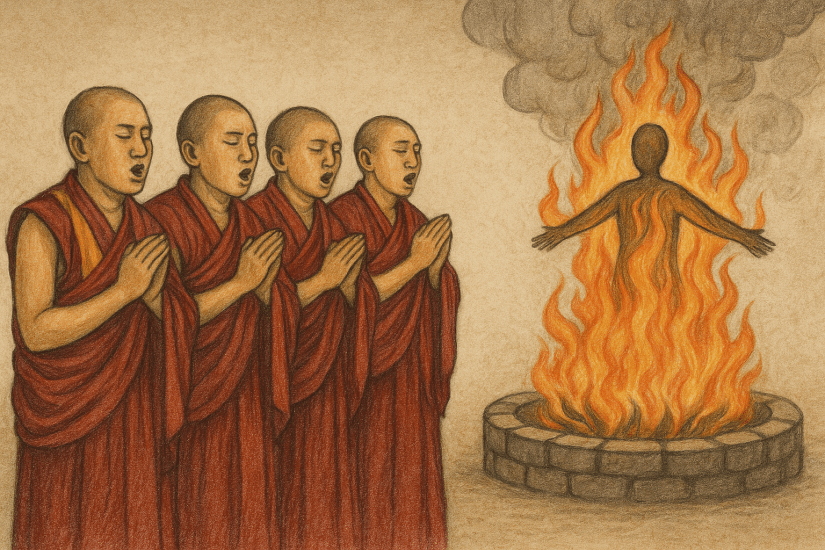
Often, the effigy is placed in a consecrated fire pit and incinerated while wrathful mantras are recited, invoking deities to consume and destroy the obstacle.

Example: From the Dujum Namchok Putri Ritual

“To receive these five aggregates of the malefactors who are our hostile enemies and obstructing spirits (causing harm)! We now feed them into your (wide open) mouths; may you accept (these morsels and devour them)—Kharam Khahi!”

This passage metaphorically frames the act of feeding the enemy to wrathful deities, representing a kind of karmic annihilation. In tantric contexts, this has often been interpreted as a sanctioned form of ritual killing.

Another Example: From the Rituals of the Secret Assembly Tantra

“Bind the name and essence of the breaker of samaya into the effigy… May his limbs be broken, his breath cease, and his karmic stains be consumed in fire.”

How Were These Used Historically?

Scholars like Ronald Davidson and Martin Boord have documented numerous instances where wrathful rites were used to eliminate perceived threats, including human beings. These were not fringe practices. They were part of the institutionalized ritual life of powerful lamas and state-sponsored religion.

For example:

  • In the 17th century, the Gelugpa used wrathful rites against rival schools.
  • The Fifth Dalai Lama reportedly employed Vajrakīla rituals to eliminate political enemies and to legitimize military campaigns.
  • In the Nyingma tradition, terma (revealed teachings) include instructions for magical actions against sorcerers and heretics.

Ethics of Wrathful Means

Here lies the uncomfortable truth: Vajrayana Buddhism is not a pacifist tradition. It is a path of power, and power is always ambiguous.

Proponents argue that wrathful actions arise from compassion, a fierce compassion that liberates by force when necessary. Critics, both within and outside the tradition, question whether such acts truly serve liberation or whether they reveal the manipulation of tantric power for worldly gain.

Conclusion: A Tradition of Dangerous Possibilities

The bairaṇa rituals of Vajrayana are not relics of a mythic past. They are living technologies, still transmitted under specific conditions to qualified initiates.

Yet when removed from their sacred context, or cloaked in euphemism, they reveal a deeper concern: the boundary between symbolic and literal violence in Tibetan Buddhism has often been porous. The image of Tibetan Buddhism as purely peaceful and benevolent does not survive close scrutiny.

(1) In Tantric practice, particularly within cremation-ground or charnel-ground rituals, practitioners engage directly with “charnel substances.” These substances include human bones (such as skulls and femurs), cremation ashes, decomposed flesh, fat, blood, and bodily fluids, as well as soil and items saturated with the energy of death. Some rituals involve the use of skull cups (kapalas) for offerings, bone ornaments worn on the body, or the smearing of ash.


Sources and Suggested Reading

  • Boord, Martin. The Cult of the Deity Vajrakīla: According to the Texts of the Northern Treasures Tradition of Tibet. Tring: The Institute of Buddhist Studies, 1993.
  • Davidson, Ronald M. Indian Esoteric Buddhism: A Social History of the Tantric Movement. Columbia University Press, 2002.
  • Dalton, Jacob. The Taming of the Demons: Violence and Liberation in Tibetan Buddhism. Yale University Press, 2011.
  • Hirshberg, Daniel. Remembering the Lotus-Born: Padmasambhava in the History of Tibet’s Golden Age. Wisdom Publications, 2016.
  • Samuel, Geoffrey. Civilized Shamans: Buddhism in Tibetan Societies. Smithsonian Institution Press, 1993.
  • Snellgrove, David L. The Hevajra Tantra: A Critical Study. Oxford University Press, 1959.
  • Cantwell, Cathy & Mayer, Rob. Early Tibetan Documents on Phur pa from Dunhuang. Wien: Verlag der Österreichischen Akademie der Wissenschaften, 2008.