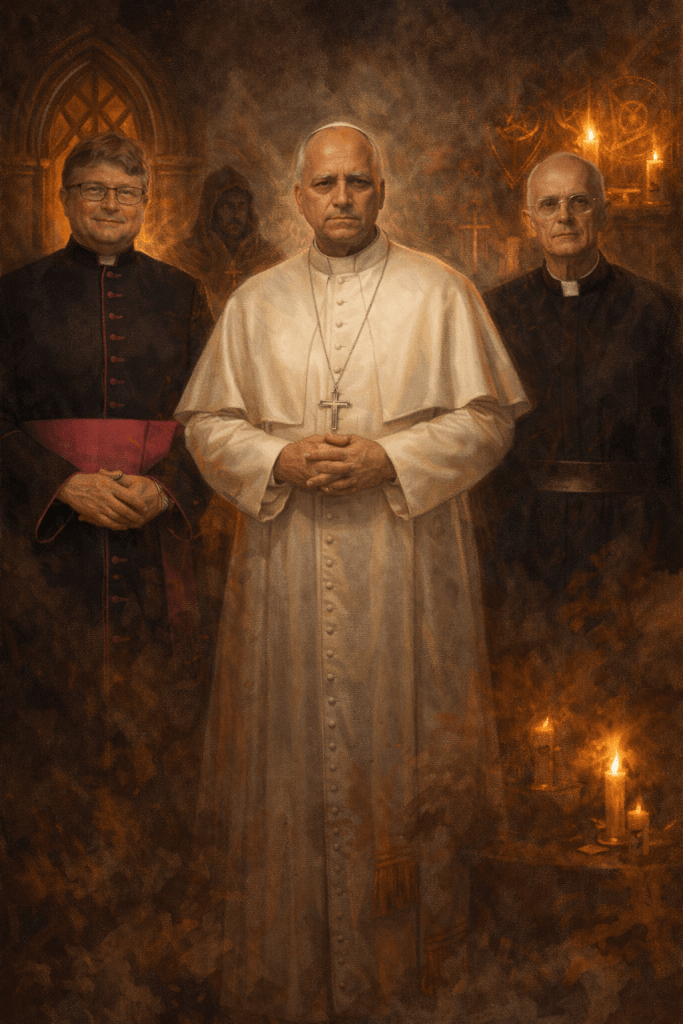
A recent Vatican meeting between Pope Leo XIV and the International Association of Exorcists underscores growing concern within the Church about the spread of occult practices and their spiritual consequences.
According to the exorcists, there has been a “noticeable rise” in involvement with “occultism, esotericism, and Satanism,” developments they associate with increasing cases of spiritual distress.¹ These trends are not viewed as abstract cultural shifts, but as realities encountered in pastoral work.
The delegation stressed that many individuals who engage in such practices experience serious harm, describing “grave spiritual suffering” among those affected.¹ In their view, these are not isolated incidents but part of a broader pattern requiring a structured response from the Church.
“Ignoring these realities leaves many people without an adequate response to grave spiritual suffering.”¹
For this reason, the exorcists emphasized the importance of ensuring that every diocese has properly trained clergy capable of addressing these situations. They called for stronger formation, clearer discernment, and greater institutional readiness.
At the same time, they acknowledged the complexity of these cases. The meeting highlighted the need for collaboration with medical and psychological professionals to distinguish between spiritual affliction and mental health conditions.¹ This cooperation is seen as essential for responsible pastoral care.
The Vatican framed the issue as one of accompaniment and guidance. Many who turn to occult or esoteric practices are described as searching for meaning or relief from personal struggles.¹ From the exorcists’ standpoint, this search can expose individuals to demonic influences that require careful spiritual intervention.
Overall, the meeting reflects a coordinated effort within the Church to respond to what exorcists describe as a growing pastoral challenge: one that involves both spiritual discernment and practical support for those affected.
St. Michael the Archangel, defender of the faithful, stands as heaven’s warrior casting down the forces of darkness and waging relentless battle against demonic powers.
Footnote
Marty Vergel Baes, “Pope Leo XIV Hosts Exorcists at Vatican — Surge in Satanism Cases Raises Concern for Vulnerable Believers,” International Business Times UK, March 23, 2026.
I was raised in the Catholic faith. Its prayers, seasons, schools, and sacraments shaped my earliest understanding of the world. But as I grew older, the atmosphere changed and it started to feel foreign to me. After the upheavals in the liturgy and doctrine that followed the Second Vatican Council, everything became muted and seemed different. Gone was the mystery and ritual of the high Mass. What replaced it was grey and humdrum. As I embraced my mid-teens I felt like the Church had become unrecognizable. I was bored in Mass and began to question everything. I felt myself drifting, carried away by the freedom and experimentation of the post-Hippie generation.
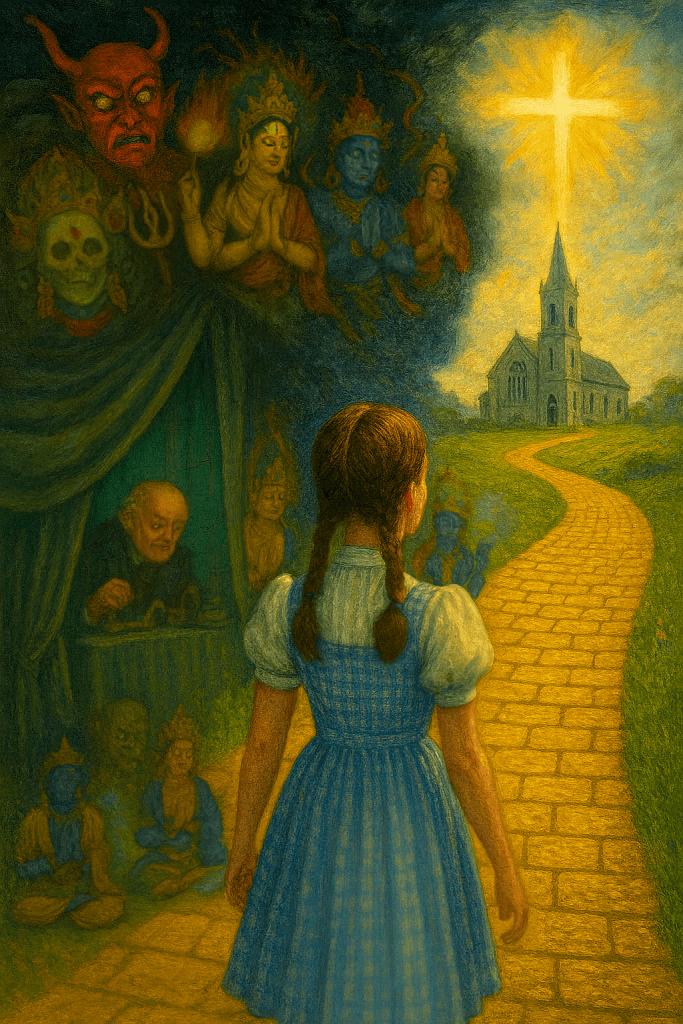
That search carried me far from the Church for more than three decades. As an adult I immersed myself in Tibetan Buddhism. Compared to the Catholicism I thought I had outgrown, this new path was exhilarating. The colorful symbols, rituals, exotic chanting, and promises of hidden knowledge shone bright like the Technicolor world Dorothy steps into after her house lands in Oz. Everything was vibrant and different. For a long time, I believed I had found a far richer spiritual universe than the one I had left behind.
As the years passed, I committed myself more deeply to Tibetan tantric Buddhism. Gurus, deities, and intricate ritual practices in long retreats promised transformation. I accepted men as guides who claimed they could lead me toward enlightenment. But slowly, over time, questions emerged. The yanas contradicted one another. The path began to feel less like liberation and more like entanglement in a feudal system with a hazy set of arcane laws. What had once seemed full of promise started to feel like a maze of deception.
The turning point came when I least expected it. Like Dorothy traversing the Emerald City, dazzled by spectacle, I had followed the yellow brick road as far as I could, believing I was approaching a transformative experience of enlightenment. And just as Dorothy eventually reaches Oz and pulls back the curtain, only to find a small man manipulating levers, I was forced to see behind the veil as well. The Root Guru I had trusted was revealed as a sorcerer, and the tantric deities I had once exalted no longer appeared as divine guides but as accusing, demonic forces. They became something like the scary flying monkeys that viciously attack Dorothy and her friends at one point. I suddenly realized that the impressive display I had put my faith in was only smoke and mirrors, and the powers behind it were not what they claimed at all, but actually fallen angels and their human minions.
That realization shook me to my core. In the very moment the illusion collapsed, a strange clarity emerged. I found myself remembering what I had learned as a child, what the Church had taught from the very beginning. The contrast between truth and imitation soon became unmistakable. What I had embraced as enlightened beings were nothing of the sort. Their nature did not align with the Most High God but with the very deceptive forces that the Bible warns against. I had spent years seeking hidden wisdom only to discover that the truth I needed had been with me since childhood. What a bizarre discovery after so many years of a life lived in error.
When I returned to the Catholic Church, I expected judgment or distance. Instead, I found the opposite. The Church received me with open arms, with the warmth of a parent waiting for a child who has been gone far too long. Over the years, thanks to Popes like John Paul II and Benedict, the Church regained some of its true colors that had been lost in the hasty rush to modernize. It now seemed sacramental and grounded in truth. I began to approach my re-version with the discerning mind of an adult hungry for knowledge. Gradually, a whole new world opened up to me and I was amazed that the truth of Christ’s sacrifice to humanity held new meaning after the horrors I had just lived through in the occult. Is the institution of the Catholic Church perfect? No. Its human side can fail, and at times it clearly has. Some say it is in crisis. Yet Christ promised, “You are Peter, and on this rock I will build my Church, and the gates of hell shall not prevail against it” (Matthew 16:18). That promise has become an anchor for me in these difficult times.
My journey through the many beguiling practices of Tibetan Buddhism taught me how convincing illusions can be. It taught me how eager the human heart is for spiritual novelty, and how easy it is to mistake mystical experiences for truth. The Catholic Church, which I once believed had lost its footing, proved steady after all. After thirty-five years away, I came home to the enduring Christian faith that had been guiding me from the beginning.
Saint Bartolo Longo was canonized by Pope Leo XIV on October 19, 2025, during a solemn Mass in St. Peter’s Square that elevated seven new saints to the altars of the Catholic Church. The Vatican’s announcement confirmed what many had long anticipated: that the once wayward lawyer who fell into occultism but found redemption would at last be formally recognized among the saints.
Before his story begins, it is worth repeating the Church’s timeless warning about the dangers of all occult practices and the spiritual counterfeits that appear holy but lead astray. The New Age fascination with séances, channeling, tarot, reiki, and yoga is not new. It is a repetition of the same deceit that misled Bartolo himself. Likewise Tibetan Buddhism, which hides black magic and sorcery behind the peaceful facade of Buddhism, should be closely examined. Bartolo Longo’s life shows something deeply consoling: no matter how far one strays into darkness, there is always a way back through repentance, confession, and devotion to Christ and His Mother.
Bartolo Longo was born in Latiano, a small southern Italian village, on February 10, 1841. His family were respected townspeople and lived comfortably with servants. Bartolo had an older sister and a younger brother, and his father worked as a physician. As a boy, Bartolo was lively and mischievous; he was quick-witted, theatrical, and often irreverent. His mother, however, formed him in devotion to the Virgin Mary and the Rosary.
When he was six, Bartolo was sent to a priest-run boarding school. He thrived there, making friends, studying hard, and developing a gift for music and fireworks. His temper, though, remained fiery. At ten, his father died, and his mother later remarried a lawyer. That stepfather’s profession drew Bartolo’s interest, and he resolved to study law.
By the 1860s, while the anti-Catholic movement was reshaping Italy, Bartolo and his brother moved to Naples for their studies. The intellectual climate was hostile to the Church. Professors openly mocked the Pope and religious orders. The young student’s faith eroded in that atmosphere. He became fascinated by the new philosophies of reason and freedom that dismissed religion as superstition.
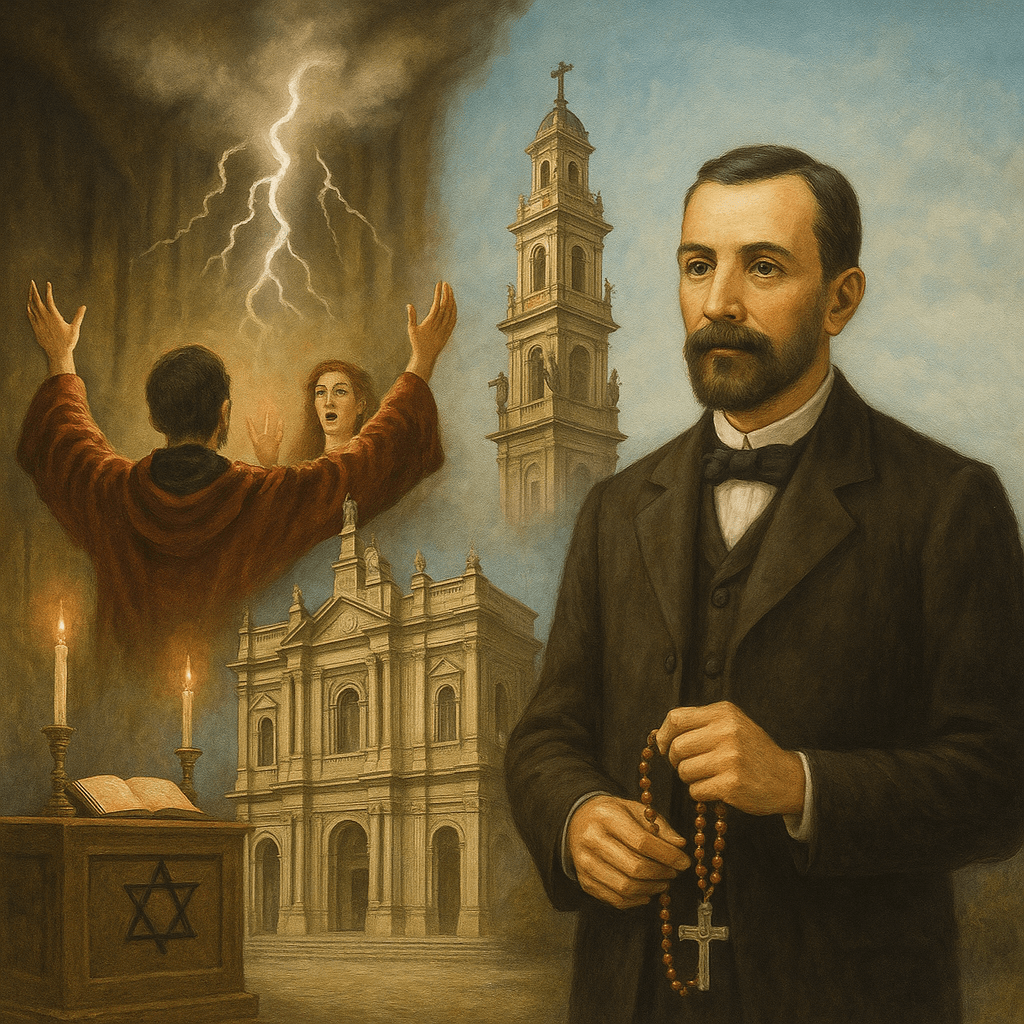
In this environment, spiritualism was fashionable among students, and Bartolo, hungry for meaning, began attending séances. These gatherings promised secret knowledge and communion with spirits. For a time, he believed he had found truth in these occult practices. But the spirits he invoked deceived him. Gradually, curiosity gave way to obsession. He became involved with a group of spiritualists and, eventually, a full satanic sect that ordained him a “priest.” During his initiation, thunder roared, and blasphemous cries filled the air. Bartolo later recalled the terror of that night, when he felt the presence of something utterly dark take hold of him.
In the months that followed, Bartolo lived in dread. He sensed an invisible companion, an “angel of darkness,” whispering to him. He felt trapped between delusion and madness. Yet even in that state, he completed his law degree and continued public attacks against the Church. His family, horrified, prayed constantly for his conversion.
Among the few faithful Catholics left at the university was Professor Vincenzo Pepe. When Bartolo confessed that he believed he had heard his dead father’s voice, Pepe warned him that the spirits were lying and that his practices would destroy both his mind and his soul. The professor begged him to repent and return to the Church. Remarkably, Bartolo agreed. Pepe gathered others to pray for him, including Caterina Volpicelli, a devout woman who led a Rosary group dedicated to the Sacred Heart of Jesus.
Through their prayers, Bartolo met Father Alberto Radente, a Dominican friar. For a full month, Father Radente counseled and exorcised him daily. Finally, on June 23, 1865, the Feast of the Sacred Heart, Bartolo made his confession and received absolution. He was reconciled to the Church and freed from the darkness that had enslaved him.
Overwhelmed with gratitude, Bartolo vowed to save others from the same deception. He attended one last séance, not to participate, but to renounce it. In the midst of the meeting, he stood up, raised a medal of the Virgin, and publicly proclaimed that spiritualism was a web of falsehood. From that moment, he dedicated his life to Christ and to Mary.
With the guidance of his spiritual directors, Bartolo discerned that his vocation was not to marry or become a priest but to serve God as a lay Dominican. On October 7, 1871 on the Feast of Our Lady of the Rosary, he entered the Third Order of St. Dominic, taking the name Brother Rosario. He studied diligently, prayed the Rosary daily, and worked among the sick and poor.
When he traveled to Pompeii to manage property for a widow, the Countess Marianna de Fusco, Bartolo found the people living in ignorance and superstition. The local church was in ruins. Remembering his own past, he resolved to restore both the building and the people’s faith. During a time of despair, haunted by thoughts of damnation, he heard an interior voice say: “If you seek salvation, propagate the Rosary. Whoever spreads the Rosary will be saved.” At that instant, peace filled his soul, and he understood his mission.
Bartolo restored the church, began teaching the Rosary, and organized an annual Feast of the Rosary in 1873. He brought to Pompeii a worn painting of Our Lady of the Rosary, later associated with miracles that drew pilgrims from across Italy. Encouraged by the Bishop of Nola, he began building a grander church, whose cornerstone was laid on May 8, 1876. Fifteen years later, it was consecrated by Cardinal Raffaele Monaco La Valletta, representing Pope Leo XIII. Today, the Pontifical Shrine of the Blessed Virgin of the Rosary of Pompeii welcomes tens of thousands of pilgrims daily.
His mission expanded beyond the basilica. Bartolo founded schools, orphanages, and homes for the children of prisoners. He started a magazine and wrote extensively about the Rosary, the saints, and Christian life. To avoid scandal from his close collaboration with Countess de Fusco, Pope Leo XIII advised them to marry. They wed on April 7, 1885, living chastely as brother and sister while continuing their charitable work.
Bartolo died peacefully on October 5, 1926, after receiving Holy Communion and praying the Rosary surrounded by orphans. His last words were, “My only desire is to see Mary, who has saved me and who will save me from the clutches of Satan.” Pope John Paul II beatified him on October 26, 1980, calling him “a man of the Rosary.” On October 19, 2025, Pope Leo XIV canonized him as Saint Bartolo Longo, Apostle of the Rosary.
Bartolo’s life remains a witness for every age: no matter how lost or deceived, a soul that turns back to God can be saved. His feast day is October 5.
Credit: Summary inspired by Bartolo Longo by Mary’s Dowry Productions (2017), available on YouTube: https://www.youtube.com/watch?v=3OQLRndbHIM. Used under fair use for educational and religious commentary.
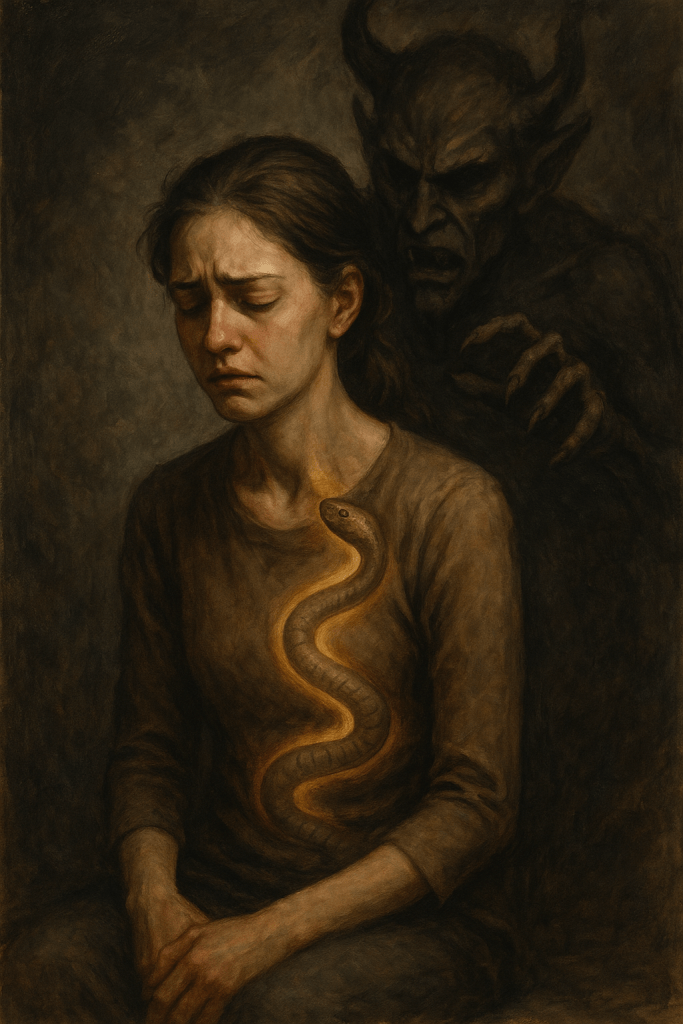
Kundalini is often described in modern yoga and New Age spirituality as a universal spiritual energy coiled at the base of the spine, waiting to rise and bring enlightenment. This portrayal is misleading. In reality, what is called a “kundalini awakening” is better understood as a form of possession. Rather than a benign inner energy, kundalini is a demonic force that enters the human mind-body continuum, hijacks the nervous system, and rewires perception, behavior, and physiology. This explains why the symptoms of kundalini often overlap with those of classic demonic possession.
Symptoms: Kundalini Possession vs. Demonic Possession
Kundalini possession symptoms
Involuntary bodily spasms or kriyas, often violent or exhausting.
A sensation of a serpent or current moving through the spine, causing heat, pressure, or pain.
Rapid swings between bliss and terror, often accompanied by visions or auditory phenomena.
Disassociation and feelings of being controlled by something non-human.
Progressive neurological deterioration: insomnia, paranoia, and psychosis.
Identification with Hindu deities or serpentine archetypes, which parallels demonic manifestations described in other cultures.
Aversion to the sacred, where holy names, prayers, or symbols provoke rage.
Manifestations of supernatural strength or the sudden ability to speak foreign languages.
Violent outbursts, self-harm, or aggression against others.
Distorted voice, grotesque facial expressions, or animal-like behavior.
Physical disturbances such as objects moving, foul odors, or sudden temperature drops.
A clear sense of hostile external control.
Both states are marked by loss of sovereignty and the intrusion of an alien intelligence. What makes kundalini more deceptive is that it cloaks itself in the language of spiritual progress.
The Entities Behind the Possessions
Kundalini-related beings
Kundalini is personified as Shakti, the serpent goddess. While Hindu texts portray her as divine, serpent symbolism universally points to deception and danger, as the serpent has long been associated with Satan in Christianity.
Many afflicted report contact with or identification as Kali, Durga, or other fierce Hindu and tantric Buddhist deities whose attributes of blood, violence, and intoxication align closely with demonic qualities.
Entities in wider demonic possession
Christianity: fallen angels under Satan’s authority.
Islam: malicious jinn, created from smokeless fire.
Judaism: dybbuks, wandering spirits of the dead seeking to inhabit bodies.
Indigenous traditions: hungry ghosts, nature demons, or restless ancestral spirits.
The same destructive force that is worshiped in India as divine feminine energy is interpreted in other traditions as demonic intrusion.
Why Kundalini Possession Often Appears Different
There are many anecdotal accounts of people afflicted by kundalini who do not display the same dramatic symptoms seen in major exorcisms performed by the Catholic Church. They may not display superhuman strength, speak unknown languages, or react violently to holy objects. Instead, their suffering appears as neurological collapse or uncontrollable kriyas.
Why does this happen? One possibility is what some exorcists call “perfect possession.” By willingly engaging in yoga, Eastern meditation, or tantric practices, the person effectively invites the spirit in. Once invited, the demon does not always need to manifest with violence or open hostility. It is already enthroned, so to speak, in the person’s consciousness and nervous system. It burrows in and embeds itself. The possession is often quieter but no less real.
Another possibility is that kundalini spirits simply manifest differently than other categories of demons. The absence of classic symptoms described by the Catholic Church may not mean the person is not possessed. It may mean they are afflicted by a different type of spirit, or by a demon whose preferred mode of influence is more insidious and long-term. Rather than breaking furniture or speaking in foreign tongues, it works by corrupting the nervous system, trapping the victim in cycles of ecstatic highs and devastating lows, and slowly eroding the mind and spirit.
Implications for the Catholic Church
Because many of these cases do not fit the criteria traditionally used to diagnose possession, individuals suffering from kundalini affliction are sometimes turned away by exorcists. Yet the sheer number of Westerners who have turned to yoga, meditation, and tantric practices since the 1960s suggests that the Church may need to reevaluate how possession presents in modern contexts. Kundalini demons may not manifest with the same overt signs as other kinds of possession, but their effects are no less destructive.
To dismiss these cases as mere psychological breakdowns risks ignoring an entire category of demonic assault that has proliferated under the guise of spirituality. The deceptive packaging of kundalini as “spiritual energy” makes it one of the most dangerous forms of possession today.
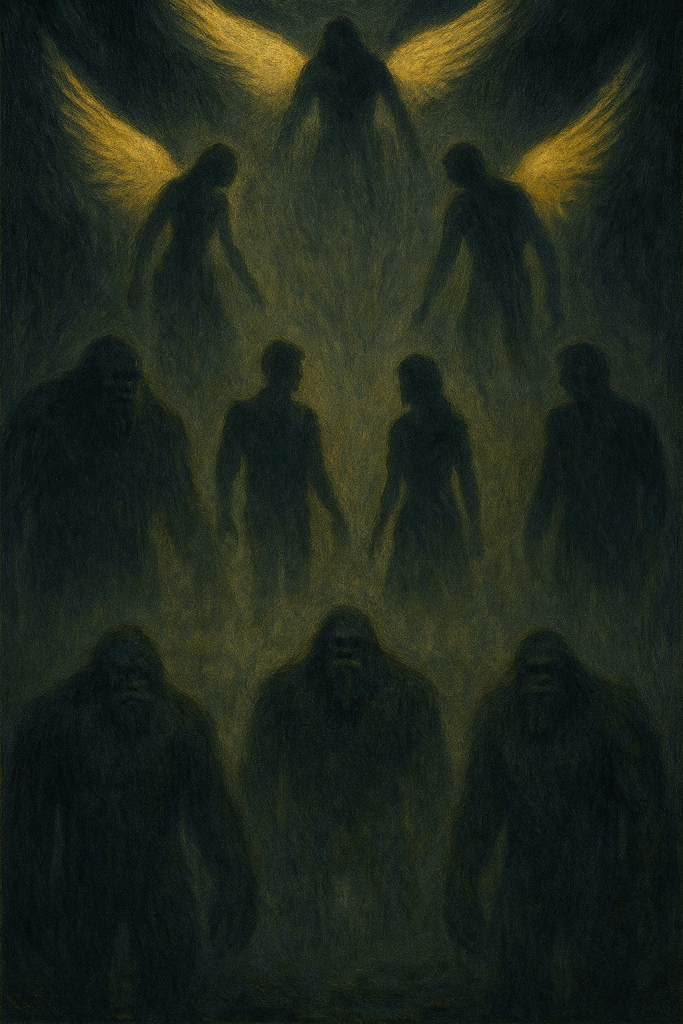
When most people hear the word Bigfoot, they picture a shaggy giant slipping through the misty forests of North America. But the legend is far older and wider than that. Across the globe, cultures tell of towering, manlike beings who walk the line between human and beast. In the Pacific Northwest, he is Bigfoot or Sasquatch, keeper of the deep woods. High in the Himalayas, mountaineers whisper of the Yeti, the Abominable Snowman. In China’s shadowed valleys roams the Yeren; in the outback of Australia, the Yowie stalks the night. The Amazon has its Mapinguari, Siberia its Almas, and medieval Europe carved the Woodwose, the wild man, into stone cathedrals as if to warn future generations.
The sheer spread of these accounts, from mountains to jungles to deserts, suggests a phenomenon far deeper than campfire stories. For the late Scott Carpenter, one of the most respected yet controversial Bigfoot researchers, the truth was darker still. His work pointed to a being not just of flesh and blood, but something supernatural: an entity at once physical and otherworldly.
In this article, based on a two-hour conversation with Carpenter’s son, we explore the evidence, the warnings, and the spiritual dimensions of Bigfoot research that most mainstream outlets won’t touch. [1]
From Survivalist to Supernatural Researcher
Scott Carpenter didn’t start out as a paranormal investigator. He was a survivalist, outdoorsman, and common sense skeptic. His interest in Bigfoot was at first just a way to spend time in the woods. But his encounters forced him into a paradigm shift:
“This isn’t just flesh and blood. This isn’t just an ape. It’s something more: flesh and blood and something supernatural.”
That realization set him apart from other researchers and drew him into a spiritual battle that would last the rest of his life.
The Survivorman Bigfoot Episode
One of Carpenter’s breakthroughs came when survival expert Les Stroud featured him in Survivorman Bigfoot (Episode 7, Smoky Mountains). Stroud not only allowed Carpenter to share his evidence but even let him discuss it in terms of Genesis 6, the infamous “Nephilim” passage.
In Genesis 6:1–4, the text describes how the “sons of God” came down to earth and took human women as wives, producing offspring known as the Nephilim. These beings are often interpreted as giants: hybrids of divine and human lineage. Some traditions see them as fallen angels mating with women, others as divine beings creating a corrupted bloodline that spread violence and chaos across the earth. This was one of the driving reasons for the Flood of Noah: to wipe out this distorted genetic legacy.
Carpenter and Stroud’s willingness to bring Genesis 6 into a Bigfoot discussion was groundbreaking. It suggested that Sasquatch might not be just another undiscovered primate, but instead tied to ancient accounts of hybrids that were part human, part “other.” For many, that biblical connection reframed Bigfoot research from zoology into theology, raising the unsettling possibility that the phenomenon could be as much spiritual as physical.
That moment shocked many viewers. Mainstream Bigfoot media usually avoids biblical or supernatural frameworks, but Stroud leaned into it. Carpenter’s evidence, including sound bites, strange photographic captures, and face reconstructions, challenged the simplistic “big ape in the woods” narrative.
DNA and the Sasquatch Genome Project
Carpenter contributed samples to the Sasquatch Genome Project, led by Dr. Melba Ketchum, a veterinarian and DNA scientist with more than 30 years of experience in genetics and forensics. Before turning her attention to Sasquatch, Ketchum had built a reputation in the professional DNA world: her laboratory, DNA Diagnostics, worked on animal forensics cases, breed verification, and even high-profile wildlife investigations. She had published in peer-reviewed journals, testified in court as an expert, and earned respect for applying human forensic standards to animal DNA.
In 2012, Ketchum announced the results of the Sasquatch Genome Project, claiming the sequencing of three complete nuclear genomes pointed to a mysterious human/primate hybrid. The team initially submitted the paper to major journals such as Nature, but Ketchum later reported it was rejected without review. Facing repeated barriers, her group launched their own journal, DeNovo Scientific Journal, to get the findings into print. That decision only fueled criticism: mainstream scientists dismissed the work as self-published and riddled with contamination, while supporters argued it was blackballed precisely because its conclusions were too disruptive.
Whatever one believes about the controversy, the scale of the project was unprecedented: it involved more than 100 samples collected across the United States that were analyzed using forensic-level protocols. Carpenter’s contributions placed him at the center of one of the most ambitious and debated attempts to prove Sasquatch through genetics. The results stunned both researchers and skeptics: the mitochondrial DNA consistently read as human, but the nuclear DNA defied classification, pointing to something nonhuman and previously unknown. If true, this would mean Sasquatch was neither myth nor mere ape, but a hybrid: a creature with human maternal lineage and a mysterious paternal source. For Carpenter and others reading through a biblical lens, this echoed the ancient warning of Genesis 6, where the “sons of God” took human women and produced hybrid offspring: the Nephilim. In that framework, the genome data was not just a curiosity but a genetic fingerprint of a story as old as Scripture.
Mitochondrial DNA (from the mother) came back human.
Nuclear DNA (from the father’s side) was unknown.
GenBank, the global DNA database, couldn’t match it to any known species.
A Land Charged with Ancient Spirits
Carpenter’s main research area sat near Morganton Cemetery in East Tennessee, on a peninsula surrounded by Cherokee land now drowned under Tellico Lake. Beneath the water lie the ancient towns of Chota, Tanasi, and Citico that had been excavated in the 1970s before the flooding. Archaeologists uncovered Cherokee council houses, plazas, burials, and artifacts from both Native and earlier Mississippian cultures, including temple mounds and ritual sites. Nearby, at Icehouse Bottom, human activity stretched back nearly ten thousand years. To Carpenter, this wasn’t just history but sacred ground, a spiritually charged landscape where human and nonhuman beings had mingled for millennia. Even the state’s name, Tennessee, traces back to Tanasi.
Local lore adds a darker layer. Legends speak of the Citico giants, towering figures tied to Canaanite-like practices of sacrifice. In the 19th century, Smithsonian surveyors and local antiquarians reported unusually tall skeletons, some approaching seven feet, uncovered in Tennessee Valley burial mounds. While mainstream archaeology explains these finds as exaggerations or natural variation, oral traditions preserved them as memories of a prehistoric race of great size and power. Citico (or Sitiku), later drowned beneath Tellico Lake, became the center of these stories, with settlers claiming to find oversized remains there. To some, the submerged cities of Chota, Tanasi, and Citico are not only Cherokee towns but remnants of an older, stranger presence, one that resonates uneasily with the biblical accounts of the Nephilim.
Carpenter’s son said:
“No wonder that area is a hotspot. The veil is thin there. Whatever was done there, it still lingers.”
Portals, Oak Ridge, and UFOs
As Carpenter’s research deepened, he began recording anomalies that looked like portals or openings through which beings appeared or vanished. These were like fleeting windows into another dimension. Strangely, this idea is not without precedent in Native tradition. Accounts of the Apache leader Geronimo describe him as more than a warrior; he was said to possess mystical knowledge of the land itself. According to oral histories, Geronimo could locate “spirit doorways” in the mountains and deserts and pass through them to evade capture. Some stories claim he used chants or songs to activate these portals, stepping into hidden realms before reappearing miles away. Whether literal or symbolic, such traditions mirror the kinds of interdimensional phenomena Carpenter reported: beings that could not be tracked or cornered because they moved in ways outside ordinary space. To those who take these parallels seriously, Geronimo’s legends suggest that what Carpenter encountered may have been part of a much older, indigenous understanding of the land’s supernatural architecture.
The geography adds another layer: just upriver lies Oak Ridge, Tennessee, one of the central sites of the Manhattan Project. While Los Alamos, New Mexico, gets most of the attention as the place where the bomb was assembled, Oak Ridge was where uranium enrichment took place on an industrial scale. Locals whisper that Oak Ridge is still conducting experiments in dimensional physics.
Carpenter’s own grandfather reported seeing UFOs “like ships battling” in the skies over Norris Lake decades ago. This wasn’t just folklore but lived experience.
Bigfoot Encounters: More Than Harmless Giants
Not all encounters are benign. Reports include:
Bigfoot revealing itself more often to women than to men.
Instances of sexual advances toward women.
Encounters where couples were watched or even escorted out of the woods.
These beings aren’t cartoonish “gentle giants.” They are unpredictable, intelligent, and capable of menace. As Carpenter warned:
“Killing you might be way down the options list… but it’s still on the list.”
This perspective ties directly into the Missing 411 phenomenon, the thousands of unexplained disappearances in North America’s national parks and wilderness areas. Researcher David Paulides, a former police investigator and close friend of Carpenter’s, has spent more than a decade compiling these cases. The patterns are chilling: people vanish without a trace, often leaving behind neatly arranged clothing or possessions, sometimes reappearing dead in areas that had already been thoroughly searched. Weather, terrain, and predators can’t account for the sheer number of anomalies.
Paulides mapped “cluster zones” of disappearances across the continent. Some of the most active are places steeped in both natural beauty and paranormal lore: Yosemite National Park in California, Crater Lake in Oregon, the Great Smoky Mountains along the Tennessee/North Carolina border, and Colorado’s Rocky Mountain National Park. These regions share rugged terrain, deep caves, and long histories of indigenous legends about otherworldly beings.
While Paulides has always stopped short of naming a single culprit, his research repeatedly points to something more than accidents or foul play. Among the possibilities, he has floated Bigfoot as a key player because it is an intelligent, powerful being with abilities beyond human understanding. Carpenter’s evidence of portals and supernatural qualities dovetailed with this idea, suggesting that Sasquatch might not just be an elusive primate but a creature capable of moving in and out of our reality. For those who see the overlap, Missing 411 is not only about human disappearances but also about encounters with beings that share the wilderness with us, such as the Bigfoot phenomenon that Carpenter dedicated his life to studying.
A Spiritual Battle
The deeper Carpenter went, the more convinced he became that Bigfoot was not simply a zoological mystery but a spiritual one.
“This is not a pastime. This is a spiritual being. When you open yourself to it, you open yourself to spiritual warfare.”
Carpenter never set out to be a prophet of the paranormal, but his path led him into a mystery that defied biology and crossed into the realm of the supernatural. His work left behind evidence, stories, and warnings that Bigfoot is not just an ape, but something entangled with ancient powers.
In his final years, Carpenter faced the very battles he had long warned others about. The strange phenomena he spent decades documenting seemed to turn inward, manifesting as spiritual oppression, sleepless nights, and a heavy sense of being pursued. Friends recalled how he spoke of attacks that weren’t merely physical but psychological and spiritual: the kind of warfare described in scripture as coming from “principalities and powers.” For Carpenter, the line between research and personal cost blurred; the entities he had studied were no longer distant mysteries but forces pressing against his own life.
His son believes that, in the end, God lifted the hedge of protection (a biblical phrase for divine safeguarding). Not as punishment, but as mercy, releasing Carpenter from the relentless fight and bringing him home.
His legacy remains one of courage and conviction: to look unflinchingly at the unknown and to remind others that what walks in the forests may not simply be flesh and blood, but part of a deeper, spiritual war. For his family, the lesson is clear: do not seek these beings lightly.
Carrying the Legacy
Scott Carpenter’s son never intended to follow in his footsteps. He wanted to be a survival expert, not a Bigfoot researcher. But, as he put it:
“God said, ‘Nope. You’re not going to sit on the sidelines. You’re going to talk about me, and Bigfoot is the way you’ll do it.’”
Now, through the Sasquatch Awareness Project and his survivalist channel, Tarp1616, he carries forward his father’s mission: warning others that Bigfoot is real, but not in the way they have been conditioned think about it.
The story of Scott Carpenter sits at the crossroads of science, faith, and the supernatural. His evidence, from DNA to video to eyewitness accounts, forces us to consider whether Bigfoot is a relic hominid, a hybrid, or something that slips through portals from another realm. Whatever the answer, one truth remains: to pursue Bigfoot is to enter into a world of spiritual warfare.
[1] Nephilim In Tennessee, Portals, & Abnormal Settlers w/ Travis Carpenter, Six Sensory Podcast, Aug 23, 2025
Before the modern age romanticized pagan religions into New Age panaceas, ancient worship was known to be raw and brutally pragmatic. In our modern spiritual-industrial complex, it is often sugarcoated into some kind of warm, earth-loving ceremony filled with personal empowerment and divine intimacy. But if you’re reading this, you’re probably already suspicious of that narrative.
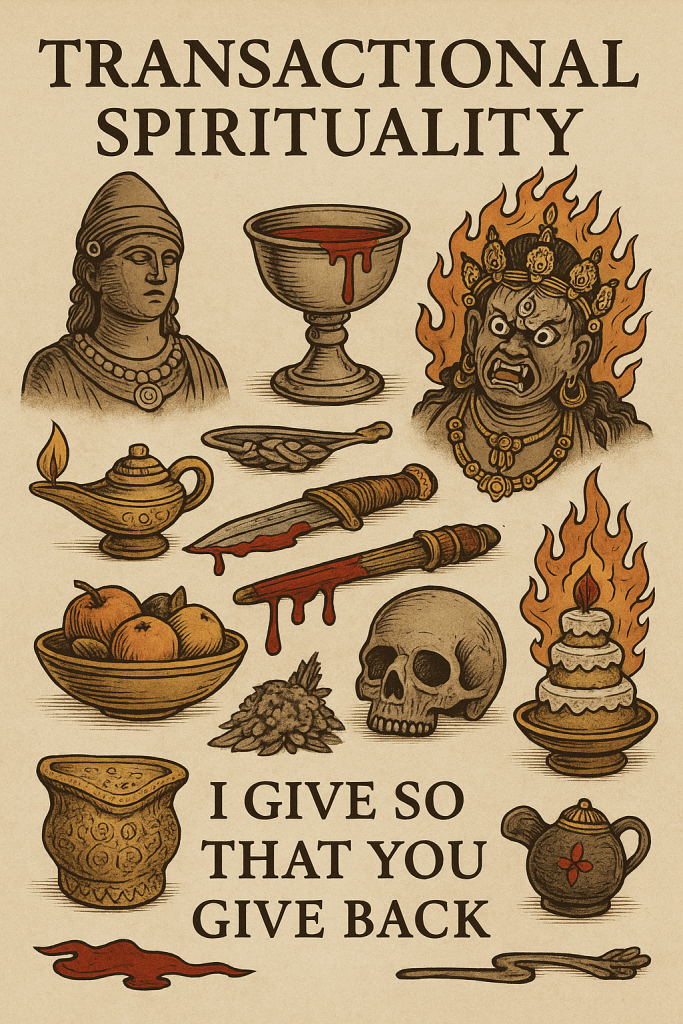
In fact ancient religion, pagan religion, was highly transactional. The gods didn’t love you. They didn’t weep over your suffering or aspire to protect you.
A passage from Behold the Christ: Proclaiming the Gospel of Matthew by Leroy A. Huizenga makes this brutally clear. Pagan worship, he writes, operated on the ancient principle of do ut des: “I give so that you give back.”(1) In other words, the gods and humans used each other. You offered sacrifices, incense, food, or praise not out of adoration, but because you wanted something in return: good crops, protection in war, fertility, rain, wealth, healing, vengeance, and victory. And the gods? They wanted to be fed, praised, and kept relevant. It was mutual exploitation dressed up in sacred costume.
“That is, the worshipper provides a sacrifice to a god that pleases and empowers the god, who then turns around and does the worshipper favors. Because the gods are often indifferent to humans, worshippers engage in repeated ritual to reach out and get a god’s attention.”
This paragraph says more about ancient spirituality than most modern New Age books on “manifesting” or “connecting with the divine.” The ancients weren’t confused. They understood that the gods were powerful, unpredictable, and not especially interested in human wellbeing unless there was something in it for them.
And this wasn’t limited to Rome or Greece. Versions of do ut des appear in Vedic sacrifice, Mesopotamian temple economies, and also Tantric Buddhist practice where offerings are made to wrathful deities to invoke, control, or appease.
Nowhere is this transactional logic more systematized and ritualized to the point of industrial precision than in Tibetan Buddhism. While cloaked in the language of enlightenment and compassion, the tradition is saturated with mechanisms that mirror the ancient do ut des economy: elaborate offerings, incense, butter lamps, mandalas, and tormas (sacrificial cakes that replaced blood offerings when the Buddhist principle of ahimsa “non-harming” took root). These were given not out of unconditional reverence, but to elicit specific outcomes from specific deities. Monastic liturgies are not just meditative recitations, but are negotiations with a pantheon of wrathful and peaceful beings, each with their own preferences, powers, and temperaments. Moreover, the non-harming sentiment in Tibetan Buddhism only extends so far. While Buddhist tantra forbids blood sacrifice, its subjugation rituals, aimed at both spiritual and human enemies, can involve some of the most brutal punishments found in any ritual religion.
Drupchöd ceremonies, held in large monasteries, exemplify this beautifully. These are days- or weeks-long ritual marathons involving collective chanting, visualization, music, mudras, and vast offerings, all designed to propitiate deities into bestowing protection, wisdom, and worldly benefits like health and prosperity. Whether invoking Mahakala to remove obstacles or Tara for swift blessings, the assumption is clear: the deity acts when properly fed, praised, and invoked. The gods (or enlightened beings, depending on your doctrinal parsing) are not passively watching; they’re participants in a cosmic economy, and Tibetan Buddhism, more than almost any other tradition, has mastered the bureaucratic apparatus needed to transact with them. It’s not just about personal devotion. It’s about correct performance, correct offerings, and the correct “exchange rate” of ritual. The love of the gods is not assumed. Their attention must be earned over and over again.
Modern Takeaways and a Warning
This transactional pattern isn’t limited to ancient paganism or esoteric Tibetan ritualism. You’ll find the same spiritual economy alive and well in the darker corners of contemporary occultism. Take it from someone like Riaan Swiegelaar who’s lived on the other side: former Satanists and occult practitioners routinely speak of offering sacrifices, especially blood, to demons in order to negotiate outcomes.(2)
He described it well: “A lot of people ask me, ‘Why are there so many sacrifices in Satanism? Why is there blood?’ The answer is simple: blood has currency in the spirit world. If I want to negotiate with demons, I need to bring an [animal] sacrifice because that blood holds value. It functions as spiritual capital.
“But here’s the contrast: the blood of Jesus is the highest currency in the spirit world. It covers everything. That’s the authority we stand on. And every ex-Satanist or ex-occultist who’s encountered Christ will tell you the same thing. I might be the only one talking about it openly, but this is real: we engaged in negotiations with demons, offered animal sacrifices, and got results. That’s how the system worked. Then we experienced the blood and love of Christ and there’s no comparison. It’s not even close. His blood is infinitely more powerful. In spiritual warfare, people need to grasp that reality. The blood of Christ is free, but it is not cheap, is it? It came at the highest cost. And what happened on the cross? That wasn’t a one-time transaction in history: it remains as valid, active, and potent today as it was then, and always will be.”
This is so important that it bears repeating: no spiritual currency, no ritual offering, no demonic pact compares to the raw, unmatched power of the blood of Christ. This is the rupture at the heart of Christianity: the economy of sacrifice is over, not because gods stopped demanding payment, but because one sacrifice bankrupted the system.
From blood-soaked altars in Babylon to ritual offering tormas in Himalayan monasteries, humanity has always traded devotion for power and offerings for favor. But the cross flipped the script. There is no more need for bartering, manipulation, and performance to win divine attention. What Christ offered wasn’t another payment into the cosmic vending machine but a final act that rendered the machine obsolete. And if that’s true, then every attempt to re-enter the old system, whether through pagan ritual, tantric bureaucracy, or occult negotiation, isn’t just a return to tradition. It’s a rejection of victory.
(1) Leroy A. Huizenga, Behold the Christ: Proclaiming the Gospel of Matthew (Emmaus Road Publishing, Steubenville, Ohio).
(2) Riaan Swiegelaar, former co-founder of the South African Satanic Church, in various public testimonies including interviews and livestreams (e.g., “Riaan Swiegelaar Testimony,” YouTube, 2022), has spoken openly about blood sacrifice as spiritual currency and his eventual conversion after experiencing the love of Christ.
Yesterday, Dan Rivera, a U.S. Army veteran and lead investigator for the New England Society for Psychic Research (NESPR), died suddenly during a tour in Gettysburg, Pennsylvania. Rivera, 54, was headlining the sold-out “Devils on the Run Tour,” a paranormal event centered around the infamous Annabelle doll, which inspired the Conjuring film series. Emergency responders performed CPR at his hotel, but Rivera was pronounced dead at the scene. Exact cause of death is unclear. The irony? Rivera died while promoting one of the most notorious cases of alleged demonic possession in American folklore.
Annabelle is no carnival sideshow. The Raggedy Ann doll was housed in the now-defunct Occult Museum founded by Ed and Lorraine Warren, the couple who brought demonic cases into the public eye long before Hollywood did. According to the Warrens, Annabelle had a history of real violence. Not metaphorical, but physical harm that left actual wounds. She caused slashes that drew blood. In one case, a priest who defied the doll reportedly crashed his car into a tree shortly after leaving. In another, a detective who came into contact with the doll was allegedly stabbed and forced into early retirement.
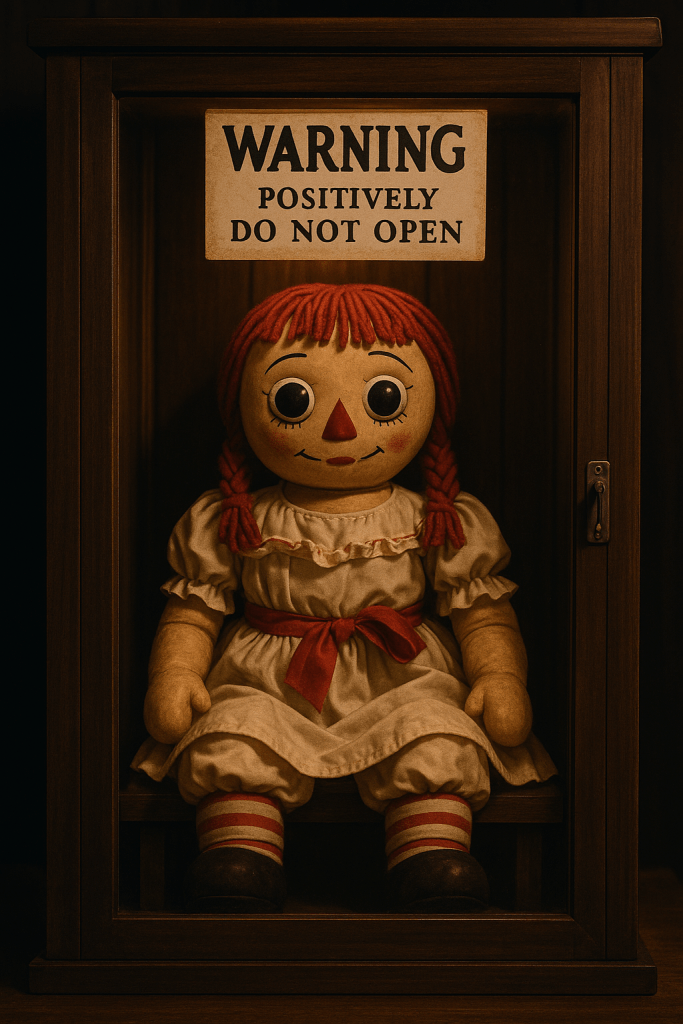
The Warrens took no chances. They sealed Annabelle in a locked glass and wood cabinet, built specifically to contain her. A large sign at the top read, “WARNING: POSITIVELY DO NOT OPEN,” and a crucifix was affixed nearby for protection. The case was blessed regularly by a Catholic priest, and the Warrens made it clear: no one was to touch the case, mock the doll, or treat her as a curiosity. The museum, as they described it, was not a showcase of artifacts; it was a containment zone for objects they believed were spiritually dangerous. And Annabelle was its most volatile resident. Ed Warren died in 2006, Lorraine in 2019, and after their deaths, Annabelle remained in the care of their son-in-law, Tony Spera. According to the New York Post article published on July 15, 2025, “In 2019, the museum closed to the public over zoning issues, and in recent years, they have toured around the US instead.” However, perhaps touring the country with a possessed doll wasn’t the greatest idea.
Annabelle’s case isn’t just a bizarre footnote in paranormal lore but a stark example of what happens when human curiosity crosses into forbidden territory. The line between fascination and spiritual danger is thinner than most people think
Flirting with Evil Is Not Harmless Curiosity
The Catholic Church has been blunt on this issue for centuries: do not engage with evil or attempt to communicate with it. The Church doesn’t take demons lightly because it understands their nature and knows they don’t play fair. Their goal is the destruction of body, mind, and soul.
Rivera’s death is not the first time a paranormal investigator has died while engaging in their work. In 2016, prominent demonologist Lorraine Warren warned publicly that even decades-old “cleansed” objects and locations still carried spiritual residue. In her words, the influence of evil does not simply go dormant, it waits.
Zak Bagans, host of Ghost Adventures, once had to close off a room in his Las Vegas museum containing what’s become known as a dybbuk box. Visitors reported nausea, blackouts, and even strokes after encountering it. One man died of a heart attack just hours after taunting the box on camera. The term “dybbuk box” refers to a modern, supposedly haunted object, often described as a wine cabinet that houses a malicious spirit rooted in Jewish folklore. Traditionally, a dybbuk is a dislocated soul believed to possess the living. However, the concept of trapping one in a box is a recent invention with no basis in authentic Jewish theology. The box was first popularized through a viral eBay listing and later sensationalized by paranormal media.
The Conjuring: A Fictional Mirror of a Spiritual Reality
Hollywood loves the Conjuring universe. Ghosts, demons, and haunted dolls are box office gold. But what people forget is that the source material isn’t fiction. These were real cases documented by the Warrens. And the “entertainment” factor trivializes the spiritual warfare at the heart of these phenomena.
This is where the deception lies. Evil often presents itself as fascinating and seductive—something to be conquered or controlled. But actual demonic entities are predatory. The more one invites them in, the greater the chance of a devastating outcome.
Dan Rivera’s Legacy: A Cautionary Tale
No one questions Rivera’s bravery or passion. But we must question the wisdom of his choices. Spiritual warfare is real. Whether Rivera’s death was directly supernatural or not is ultimately beside the point. The fact is, he died while immersed in the darkest corners of the supernatural, and he is far from the first.
The Church’s warnings aren’t outdated superstition: do not make a spectacle of evil. Do not exploit evil for entertainment. Some doors should stay shut.
In our modern world, the subconscious is often reduced to a psychological artifact, a repository of repressed memories, habits, and impulses. But from a biblical and Catholic standpoint, this internal space is more than just a vault of emotion and instinct. It is a spiritual battleground and a vulnerable domain where real entities, such as demons seek entry and control.
I speak not in theory but from personal experience. As someone who has lived through the horror of possession, I know firsthand what it means to have my subconscious colonized by non-physical forces, in particular, Tantric deities and the so-called yidams (meditational deities) I once invoked in long term retreats. They now exert control over my dreams at night, not as fragments of memory, but with an intention, force, and intelligence all their own.
Trauma, Sin, and the Open Doors
The Catholic tradition is clear: sin creates openings. These are spiritual vulnerabilities through which demonic powers can assert influence. But it’s not always sin, but often wounds and traumas that become entry points. This aligns, ironically, with what Jung called the shadow: the parts of ourselves we deny or fail to integrate.
In occult and tantric frameworks, these shadows are often “worked with” i.e. ritualistically invited, named, and visualized. In my case, the visualizations of the yidam were never just symbolic. They were summonings that invited intelligent spiritual entities through geometric portals into the liminal space of my subconscious mind.
Obviously, tantric rituals are powerful, but the power is not “of God.” The light of Christ later revealed to me that what I had opened myself up to were demonic counterfeits or parasitic forces clothed in deceptive splendor.
The Subconscious
While the Jungian model treats these internal figures such as archetypes, gods, and dreams, as symbolic representations of the psyche, Biblical scripture offers a different view. Ephesians 6:12 tells us that our struggle is “not against flesh and blood, but against principalities, against powers, against the rulers of the darkness of this world.”
What modern psychology calls “unconscious drives” may, in reality, be demonic actors exploiting our blind spots. They can manifest through thoughts, compulsions, visions, or dreams. They don’t just influence behavior, they shape the architecture of perception, infiltrating belief itself. This is why confession and deliverance are not just spiritual maintenance but are spiritual war strategies.
Dreams: The Nightly Invasion
The yidam I practiced during my retreats appears nightly, manipulating my dreams and injecting disturbing images, physical sensations, and false feelings of failure and yearning. It tries to arouse old loyalties alternating between affects of pseudo kindness and visions of cruel and bitter punishments. These dream invasions foster confusion and despair; and sometimes cause sensations of physical torment.
From a biblical perspective, dreams are a legitimate domain of spiritual communication, but that doesn’t mean all dream figures are from God. In Jeremiah 23, the Lord condemns false prophets who “make my people forget my name by their dreams.” Satan can disguise himself as an angel of light and in my experience, tantric deities do precisely that.
We must recognize the subconscious not as a private fortress, but as a permeable space, one that requires guarding, cleansing, and illumination by Christ alone. Anything else, especially tantric visualization and archetypal meditation, opens up doors we cannot close on our own.
There is no neutral spirituality. Every spiritual practice either opens the soul to grace or to deception. As one who has been inside the snare, I say this without hesitation: tantric deities are demons in disguise, and their preferred hiding place is the very part of us we least understand: the subconscious.
But Jesus Christ, in His mercy, descends even into those hidden caverns, casting out darkness and healing the wounds that made us vulnerable in the first place.
“For this purpose the Son of God was manifested, that He might destroy the works of the devil.” — 1 John 3:8
Catholic exorcists consistently emphasize that full demonic possession is rare. Far more common are lesser forms of demonic influence, what the Church calls degrees of demonic attack. According to experts like Fr. Gabriele Amorth and Fr. Chad Ripperger, these stages are typically identified as:
Temptation (ordinary spiritual warfare)
Infestation (demonic presence in a place or object)
Oppression (external hardships caused by a demon)
Obsession (mental or emotional torment)
Possession (a demon controls the body, but not the soul)
Perfect Possession (the soul itself has given full consent to the demonic)
What Is Perfect Possession?
Fr. Malachi Martin, Jesuit priest, Vatican insider, and exorcist, famously warned of the phenomenon he called perfect possession. This occurs not when a demon forces its way into a person, but when a human being voluntarily invites and cooperates with a demonic entity over time until the human will is no longer in conflict with the demon’s presence. In such cases, the individual may appear calm, successful, and even spiritual, but has wholly aligned his or her soul with darkness.
Martin described this as the most terrifying form of possession because there is no resistance and often, no exorcism possible. The person has handed over consent of the will, and the demon resides not only in the body but in the soul.
This is not the ugly, contorted possession made famous by Hollywood. This is a quieter form of coexistence.
Possession Among the Occult Elite
Catholic exorcists often connect perfect possession to satanic priests, high-level occultists, or individuals who have undergone ritual consecration to Lucifer. It is the end point of a spiritual trajectory, not a single moment of sin. It involves years of voluntary cooperation with evil using ritual invocation, blood pacts, and blasphemous imitation of the sacraments.
But there is more discrete path that leads to the same end. It is cloaked in lotus flower imagery, Sanskrit mantras, and spiritual “blessings,” and is propagated by tantric adepts, yogis, and mahasiddhas who have spent years practicing yoga and ritual invocation of beings they consider to be deities.
Is Perfect Possession the Hidden Goal of Tantra?
In the Tibetan Vajrayana tradition, called “the quick path to enlightenment,” tantric practitioners visualize themselves as the deity. They merge consciousness with the god, goddess, or guru, often through esoteric or sexual ritual, in pursuit of realization.
But what if these “deities” are not who they claim to be?
What if they are counterfeit spirits or demonic intelligences disguised as beneficent beings of light?
In that case, the tantric adept is inviting an entity to live within him, again and again, through ritual, offerings, and mental surrender. Over time, the boundary between the self and the invoked being dissolves.
This is a form of spiritual possession.
And if the person no longer resists, if they call this possession “enlightenment,” then it seems to meet the classical definition of perfect possession or possession of the soul.
Signs of Perfect Possession in the Tantric World
Unlike Hollywood portrayals, the perfectly possessed do not foam at the mouth or speak in guttural Latin. Instead, they:
Radiate serenity, even as they worship gods of wrath and destruction
Exhibit supernatural knowledge or powers (siddhis), which are praised, not feared
Express total identification with the spirit/s they invoke
Are untouchable by traditional exorcism, because they do not want to be freed
In Catholic understanding, this is the most dangerous state of all because it involves no inner conflict, and therefore no pathway to repentance. The soul lives in union with a demon, often under the delusion that it is serving the good.
Satan Appears as an Angel of Light
Scripture warns us: “And no wonder, for even Satan disguises himself as an angel of light.” – 2 Corinthians 11:14
What better disguise than that of a esoteric deity offering long life, healing, spiritual bliss, and enlightenment?
Exorcists like Fr. Amorth and Fr. Martin remind us that total possession doesn’t happen by accident. Satan must be invited in. And perfect possession is the result of spiritual consent, repeated and ritualized over time.
Tantric practitioners may never use the language of possession. They may call it “liberation,” “non-duality,” or “union with the deity.”
But from the standpoint of Christian spiritual warfare, it is not liberation but captivity, sanctified and made beautiful. It is a demonic entity, ethereally robed and seated on lotus thrones, perfectly at home in the human soul. And it leaves the adept deeply indebted to demons.
Vajrayana Buddhism, also known as Tibetan Buddhism or Tantric Buddhism, stands out for its rituals, deity worship, and complex esoteric practices. Its mantras, mandalas, and meditations on wrathful and yab/yum deities bear clear resemblance to Hindu Tantra, Vedic ritualism, and indigenous spirit cults.
So how did it convince anyone, especially devout Buddhists, that it was authentically taught by the historical Buddha?
The answer lies in a strategic combination of hidden teaching narratives, scriptural mimicry, ritual power, and imperial patronage. Let’s explore how this transformation occurred and what it means when viewed through the lens of Catholic faith and biblical discernment.
Secret Teachings: “The Buddha Taught It, But in Secret”
Vajrayana scriptures claim that the Buddha did teach tantra, but only in secret, to highly realized disciples. These teachings were said to have been hidden in celestial realms, entrusted to beings like Vajrapani or dakinis, or taught in the Buddha’s “enjoyment body” (sambhogakaya) form in other worlds such as Akanistha.(1)
This tactic mirrored earlier Mahayana developments, where new sutras like the Lotus or Avatamsaka were claimed to be higher revelations spoken by the Buddha, but not understood by his early disciples. The concept of esoteric knowledge reserved for the spiritually mature made these late texts seem like rediscovered treasures, rather than innovations.
Scriptural Mimicry and Retroactive Legitimization
To reinforce their authority, tantric scriptures deliberately mimicked the structure of traditional sutras. They often began with the familiar phrase, “Thus have I heard,” and depicted the Buddha teaching not only in celestial realms surrounded by bodhisattvas, but sometimes in radically transgressive settings such as charnel grounds, encircled by ḍākinīs and wrathful deities. These texts introduced elaborate cosmologies, detailed ritual instructions, and esoteric vows, presenting them as timeless wisdom, even though they were composed many centuries after the Buddha’s death.[2]
Authors also invented lineages, claiming that tantric teachings had been passed down secretly from Vajrapani to Nagarjuna, or from Padmasambhava to Tibetan kings.
Syncretism with Hindu and Folk Traditions
Instead of denying its similarities with Hindu Tantra, Vajrayana reinterpreted them. Wrathful deities were said to be enlightened Buddhas. Sexual rituals were described as a symbolic means to transform desire into wisdom. Offerings of blood, bones, and taboo substances were spiritualized as purifications of dualistic perception.
By repackaging Vedic and folk practices into a Buddhist framework, Vajrayana could absorb local traditions and declare them “Buddhist skillful means.”
Imperial Support and Monastic Integration
Tantra spread rapidly through the support of kings and monasteries. In Tibet, tantric masters were invited to subdue native spirits, secure political power, and perform rituals for prosperity. At Indian centers like Nalanda and Vikramashila, tantric scholars and monks practiced Mahayana logic by day and tantric visualization by night.
With the backing of the state and the academic establishment, Vajrayana was not seen as a fringe practice but as the “highest vehicle” of Buddhism.
Ritual Power and Psychological Experience
For the average practitioner, tantra “worked.” It offered visions, emotional catharsis, ritual protection, and the promise of fast-track enlightenment. The experiential pull of mantra, deity yoga, and initiation ceremonies gave people tangible results even if the doctrinal basis was historically shaky.
In the end, many believed not because of historical evidence, but because the system delivered experiences of spiritual intensity.
How Christianity Views This: The Domain of the Second Heaven
From a biblical and Catholic perspective, this raises serious concerns. The spiritual beings Vajrayana practitioners encounter, wrathful deities, dakinis, yidams, do not proclaim Christ as Lord and Savior. They do not point to the God of Abraham, Isaac, and Jacob. They offer power and enlightenment through self-transformation, not redemption.
The Bible is clear: Satan is the prince of the power of the air, ruling the spiritual domain between heaven and earth until Christ returns (Ephesians 2:2). What some refer to as the “second heaven” is where fallen angels operate, deceiving through false light, hidden knowledge, and seductive spiritual experiences.
Teachers like Derek Prince and Dr. Michael Heiser have explained how fallen entities inhabit unseen realms and impersonate divine figures such gods, ascended masters, or beings of light. Applying this view, the Buddhist realm of Akanistha, where the Buddha is said to teach in his sambhogakaya form, may not be a divine domain at all, but a carefully constructed counterfeit, orchestrated by spiritual powers aligned against the Kingdom of God.
This helps explain how a system like Vajrayana could emerge long after the Buddha’s time, imbued with supernatural power, spiritual visions, and doctrinal sophistication, yet still operate in direct opposition to the gospel of Jesus Christ.
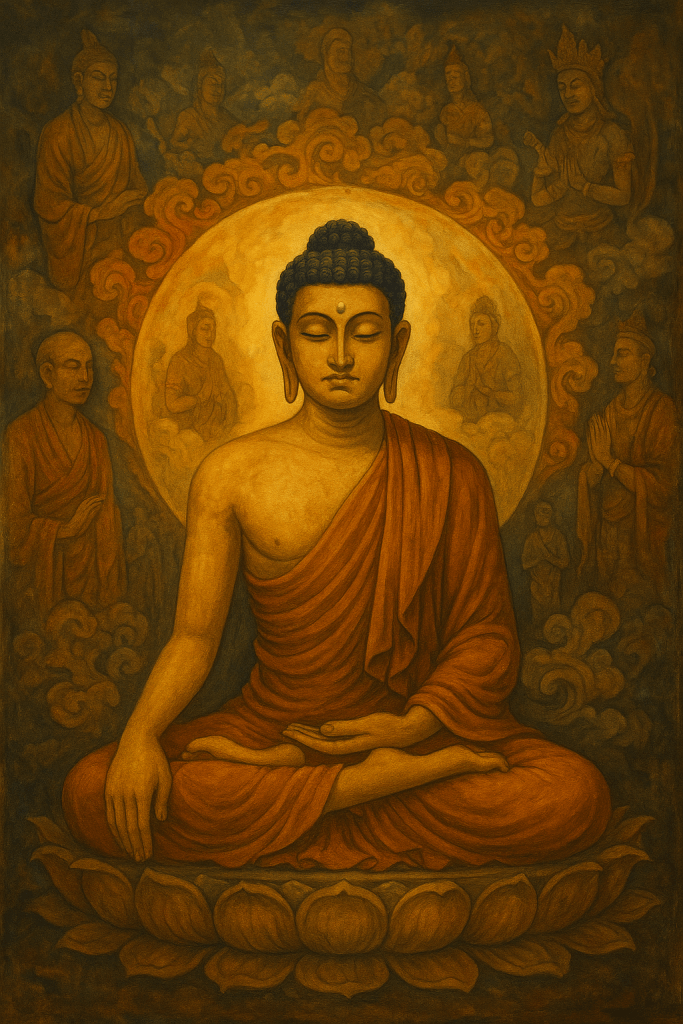
Final Reflection: What About the Historical Buddha Himself?
This raises a deeper question: What about the historical Gautama Buddha?
His teachings, centered on renunciation, ethical conduct, and insight, seem far removed from tantric fire offerings, deity visualizations, and magical spells. He did not claim to be a god. He emphasized detachment from craving and moral clarity. So, was he simply a wise man? Or was he also deceived?
From a Catholic and biblical perspective, any system that does not point to Christ as the way, the truth, and the life (John 14:6) must be seen as incomplete at best, and spiritually dangerous at worst. Even teachings that emphasize compassion and morality can become a snare if they direct people away from the living God.
It is possible that the historical Buddha, though perhaps sincere and ethically inclined, encountered spiritual influences he did not fully understand. If he received his insights through meditation without divine revelation, then he may have opened himself to guidance from fallen beings presenting themselves as enlightened or falsely divine. This is a sobering possibility, but one that must be considered if we are to remain faithful to biblical truth.
The gospel does not offer esoteric techniques. It offers a person, Jesus, who does not ask you to awaken into the realization of emptiness. He calls you by name into communion with him, into truth, and finally, into eternal life.
Footnotes:
(1) Akanistha, also spelled Akaniṣṭha, is considered in Mahayana and Vajrayāna cosmology to be the highest of the seventeen or eighteen heavens in the form realm (rūpadhātu), and specifically the realm where Buddhas in their “enjoyment body” (sambhogakāya) manifest and teach advanced bodhisattvas. It is portrayed as a pure, radiant dimension beyond ordinary perception, where tantra and esoteric teachings are said to be revealed. From a Christian perspective, such realms existing in the unseen spiritual domain, may correspond to what theologians like Derek Prince and Michael Heiser describe as the “second heaven,” a sphere under temporary dominion of fallen angelic beings capable of impersonating divine figures (see Ephesians 6:12, Daniel 10:13).
[2] Alexis Sanderson, “The Śaiva Age: The Rise and Dominance of Śaivism during the Early Medieval Period,” in Genesis and Development of Tantrism, edited by Shingo Einoo (Tokyo: Institute of Oriental Culture, University of Tokyo, 2009), pp. 124–126. Sanderson provides detailed evidence that Buddhist tantras were modeled after Śaiva texts and appeared centuries after the Buddha’s life.
David B. Gray, The Cakrasamvara Tantra: The Discourse of Śrī Heruka, (New York: American Institute of Buddhist Studies, 2007), Introduction, pp. 18–25. Gray discusses the charnel ground setting and the structure of tantric texts, including the invocation of ḍākinīs and wrathful deities, and their divergence from earlier Buddhist sūtra literature.



 Tantric Deception