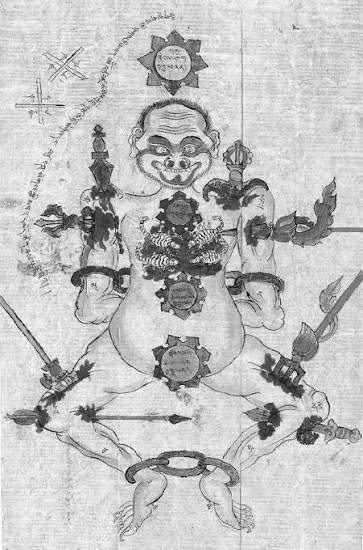
Among the many images that circulate quietly within Tibetan tantric lineages, there are several that are never explained to most practitioners and never shown outside advanced ritual contexts. One such image, often embedded within long Mahākāla rites and other high-level tantric liturgies, depicts a bound, pierced, weapon-studded human figure marked with mantras, seals, and symbolic restraints. To the uninitiated, it resembles a wrathful medical diagram or an esoteric curse talisman. To insiders, it represents something much more disturbing.
These images are not symbolic reminders of compassion, nor are they abstract metaphors for ego-death. They are ritual instruments. Specifically, they are used in rites intended to punish, bind, obstruct, or destroy the lives of those who are deemed to have broken samaya—the sacred vows binding a tantric practitioner to their guru, lineage, and yidam deity.
This fact is rarely discussed openly. When it is mentioned at all, it is framed euphemistically as “removing obstacles,” “protecting the Dharma,” or “subjugating harmful forces.” What is almost never acknowledged is that, within some tantric systems, the “harmful force” being targeted is a former disciple.
Why Beginners Are Never Told
Students entering Tibetan Buddhism are typically introduced through ethics, meditation, philosophy, and aspirational ideals: loving-kindness, compassion, non-violence, and wisdom. Tantric Buddhism is presented as a fast but benevolent path, dangerous only insofar as it requires devotion and discipline.
What they are not told is that questioning, criticizing, or emotionally reacting to a guru can itself be framed as a samaya violation. Nor are they told that certain rituals explicitly teach that lineage holders have the right, and sometimes the obligation, to retaliate metaphysically against perceived betrayal.
Beginners are warned vaguely that breaking samaya leads to “terrible consequences,” often described as karmic rather than intentional. The implication is that the universe itself will respond. What is left unsaid is that these consequences may be deliberately invoked, ritualized, and sustained by human agents acting within a tantric framework.
The unspoken lesson is simple: dissent is dangerous.
The Yidam Is Watching
At the core of highest yoga tantra is the yidam deity, the meditational deity with whom the practitioner forms an exclusive, intimate bond. The yidam is not merely visualized as an external symbol but is gradually internalized, embodied, and ultimately identified with as one’s own enlightened nature.
This process is often described in modern terms as psychological transformation. In traditional terms, however, it is far closer to classical possession.
The practitioner receives initiation from a master understood to be fully realized–meaning fully inhabited by the yidam. Through empowerment, mantra recitation, repeated visualization, and ritual invitation, the practitioner repeatedly invites the deity to enter their body and mind. Over time, the boundary between practitioner and deity is intentionally dissolved.
This is how the yidam “monitors” the practitioner: not metaphorically, but through total psychic access. Thoughts, emotions, doubts, and impulses are no longer private. They are offerings or offenses.
Within this framework, enlightenment, siddhis, and protection are granted conditionally. The deity gives, and the deity can withhold. More disturbingly, the deity can retaliate.
“Sons” of the Deity and Absolute Obedience
Advanced tantric systems often refer to lineage masters as the “sons” of the yidam. These are the men who have fully merged with the deity through practice. Disrespecting such a figure is not treated as a social conflict or ethical disagreement; it is framed as an attack on the deity itself.
This becomes especially dangerous in cases involving sexual relationships between guru and disciple. While not every such relationship is abusive, many are. In some cases, a guru expects sexual access as a demonstration of devotion and service. When the disciple becomes distressed, confused, or resistant, or when she later speaks out, the guru’s response is not accountability but punishment.
From within the tantric logic, the guru is not merely a man abusing power. He is a god-being whose will cannot be questioned. The disciple’s suffering is reframed as karmic purification or divine retribution.
Ritual Retaliation Is Real
There is a tendency among modern defenders of Tibetan Buddhism to dismiss accounts of retaliation as superstition or paranoia. Yet whistleblowers, both Western and Asian, have repeatedly documented actions taken against former disciples over months or years. In the most extreme cases, these are not momentary curses but sustained practices intended to ruin health, relationships, livelihood, and sanity.
I personally have known three gurus who engaged in such retaliatory behavior. These were not fringe figures. They were respected, accomplished masters with devoted followings. The rituals were not symbolic. They were methodical, intentional, and experienced by the practitioners themselves to be effective.
This is witchcraft in the plain sense of the word. It is no different in structure or intent from Haitian vodou curses or European malefic magic. The only difference is the religious branding.
The Ethical Contradiction at the Heart of Tantra
This raises an unavoidable question: how can a system that claims descent from the historical Buddha whose teachings emphasize non-harming, restraint, and compassion contain practices that deliberately destroy human lives?
The answer lies in tantric exceptionalism. Within these systems, ordinary Buddhist ethics are considered provisional. Once one enters the tantric domain, morality becomes subordinate to obedience, secrecy, and power. A guru possessed by a wrathful deity is no longer bound by conventional ethics because the deity is not.
Publicly, tantric masters speak constantly of compassion and loving-kindness. They smile, bless, and perform virtue with great skill. Privately, nothing is free. Every empowerment creates obligations. Every vow tightens the noose. And the deeper one goes, the more rigid and unforgiving the system becomes.
The Real Danger
Not all Tibetan Buddhist teachers engage in these practices. Many do not. But the fact that some of the most accomplished masters have done so for centuries means the danger is structural, not incidental.
The real threat of tantric Buddhism is that it weaponizes devotion, sanctifies possession, and normalizes ritual violence while hiding behind the language of Buddhist compassion and enlightenment.
Until this is openly acknowledged, aspirants will continue to walk blindly into systems that can, and sometimes do, destroy them, all in the name of awakening.
As young Western seekers, we were told directly by the refuge lama, a highly accomplished yogi whose presence and meditative depth made his words seem authoritative, that we could be both Christian and Buddhist. He said there was no conflict, that a person could be both Christian and take refuge in Tibetan Buddhism. Only much later did I begin to see that the metaphysical claims of Christianity and Tibetan Buddhism do not sit comfortably together. When examined honestly they point in opposite directions. This article explores that truth and why the issue deserves more clarity than it usually receives.
The Christian indelible mark
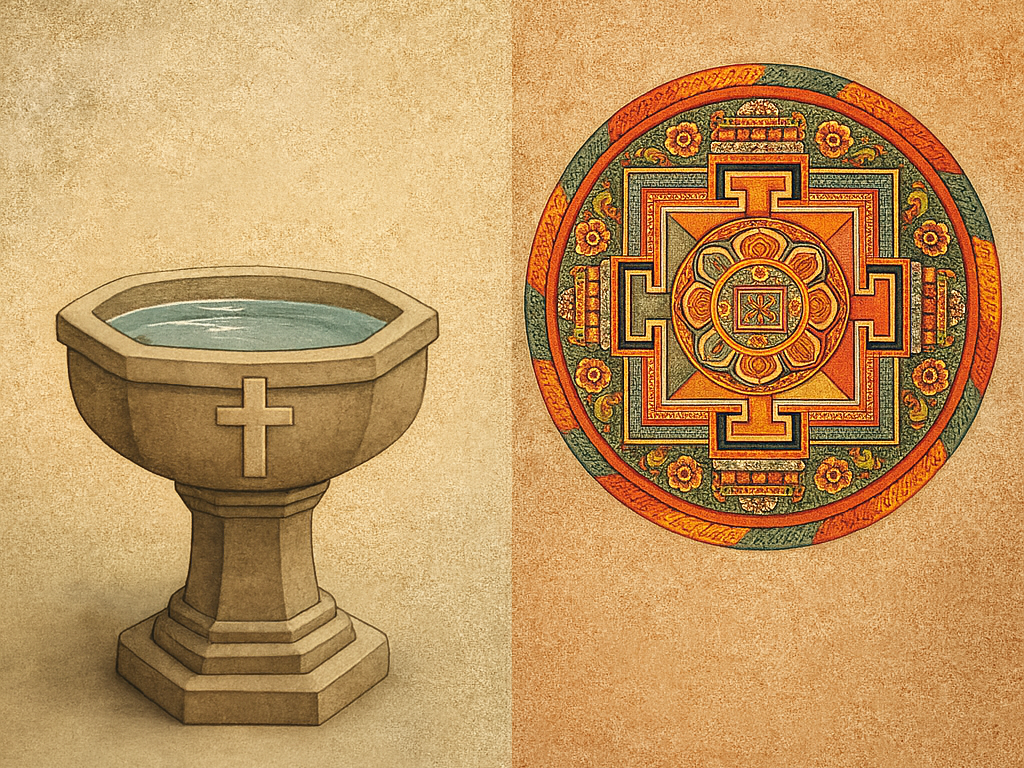
Catholic teaching holds that baptism is not a symbolic rite. It confers a real spiritual character on the soul, a mark that is indelible and permanent.¹ The person baptized is said to belong to Christ in a definitive way. Even if one later rejects Christian belief, the character imprinted by baptism remains. This teaching forms a central claim about spiritual identity. Baptism is a covenant, a seal, and a bond that cannot be undone by human action. Some theologians and exorcists describe it as a spiritual allegiance that shapes the destiny of the person marked by it.²
Vows in Tibetan Buddhism
Tibetan Buddhism also understands vows as real phenomena rather than mental constructs. They are described as subtle forms that arise in the practitioner’s continuum and remain active as long as the vow is kept.
Refuge: The refuge vow is the foundation of the path. To take refuge is to entrust oneself entirely to the Buddha, Dharma, and Sangha. This commitment is said to exist as a subtle form until broken.³
Bodhisattva vow: This vow stabilizes the intention to attain enlightenment for all beings. It is also considered to have ontological presence, shaping the practitioner’s moral and spiritual life.⁴
Tantric vows: Tantric samaya binds the practitioner to the guru, the deity, and the mandala. Tibetan commentaries treat samaya as a form that abides in the subtle body. Maintaining it is essential for any tantric practice to function. Breaking it has extremely dire consequences.⁵ Tantric vows require a view of reality that rejects any creator God and understands the deity as a manifestation of awakened mind.⁶
The awareness of the deities
What makes this tension even more striking is the role of the tantric deities. In traditional Tibetan understanding these deities are not abstract ideas. They are regarded as fully aware and responsive.⁶ When a practitioner takes refuge or samaya, the commitment is made not only in the presence of a human teacher but in the presence of the deity invoked.⁷
This means that even if a lama sincerely believes there is no conflict with Christianity, the deity knows exactly what commitments the practitioner brings into the mandala. The deity is aware of conflicting allegiances. If baptism marks a person as belonging to Christ, the tantric deity would encounter that mark as a pre-existing and incompatible bond.
When my refuge lama told us that being Christian was no problem, I accepted his assurance. He was revered, a man of immense yogic accomplishment. Yet the actual teachings of the system he represented do not support his statement. Neither do the Christian teachings. Christianity requires allegiance to the Most High God and sees baptism as a permanent seal of belonging.⁸ Thus, the two religious systems do not fit together. They are not partial overlaps but mutually exclusive covenants.
The question of whether one can be both Christian and a Tibetan Buddhist practitioner is not merely philosophical. It concerns real commitments that each tradition claims have unseen but powerful form. To treat these vows and sacraments lightly is to misunderstand them. To treat them seriously is to recognize that both paths make exclusive claims on the identity and destiny of the practitioner. Honesty requires admitting that they cannot be combined without dissolving the integrity of one or the other.
Sources
¹ Catechism of the Catholic Church, 2nd ed., §§1272–1274. ² Thomas Aquinas, Summa Theologiae, III, q. 63, aa. 1–6. ³ Jamgon Kongtrul Lodro Taye, The Treasury of Knowledge, Book Six. ⁴ Je Tsongkhapa, The Great Treatise on the Stages of the Path to Enlightenment, Vol. 1. ⁵ Khenpo Ngawang Pelzang, A Guide to the Words of My Perfect Teacher. ⁶ Patrul Rinpoche, The Words of My Perfect Teacher. ⁷ Dalai Lama and Alexander Berzin, The Gelug/Kagyu Tradition of Mahamudra, chapters on tantric initiation. ⁸ Benedict XVI, Address to the Roman Curia, 22 December 2006, section on baptismal identity.
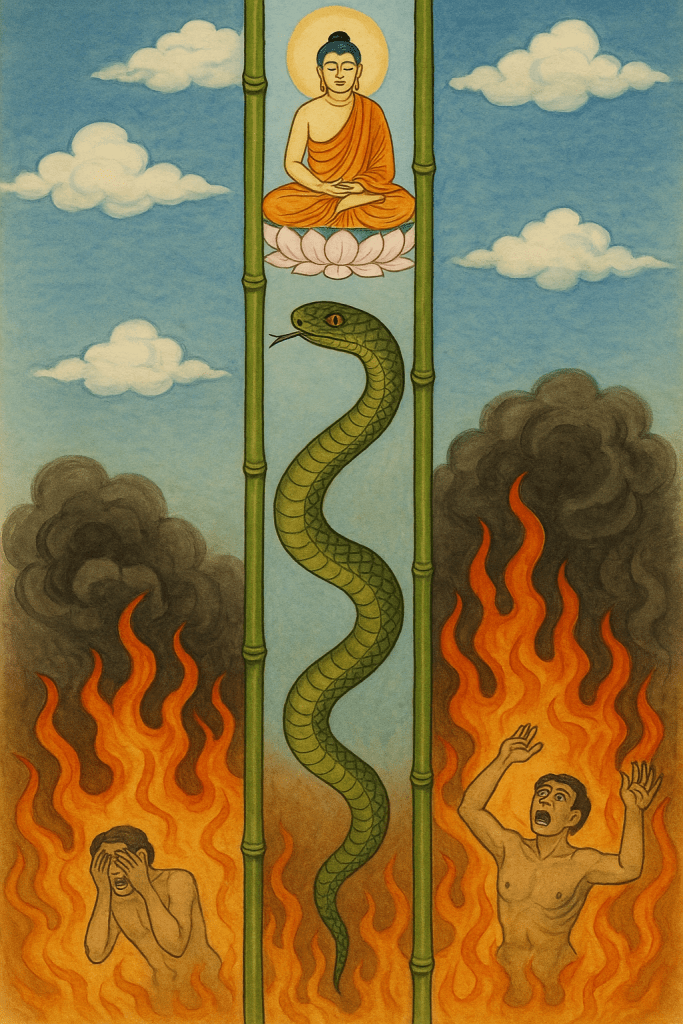
In Tibetan tantric Buddhism, the image of the snake trapped in a bamboo tube is more than a vivid proverb. It functions as a doctrinal warning: once a student enters the tantric path, there is no lateral escape. One either goes upward toward awakening or downward toward failure and “vajra hell.” Teachers have used this image to describe the uncompromising nature of samaya, the vows that bind a student to the guru, the deity, and the tantric methods themselves.¹
What is striking is how explicitly the tradition frames tantra as irreversible and high-stakes, and how rarely that stark truth is communicated to Western beginners before they agree to the vows that supposedly make the tube snap shut behind them. This mismatch between traditional warning and Western presentation is not a minor detail; it shapes the entire experience of Vajrayāna in modern contexts.
When the Warning Arrives Too Late
Many longtime practitioners have reported that the “snake in the tube” metaphor is introduced only after they have taken empowerments, established loyalty to the teacher, and accepted vows they did not fully understand. In one account, students were told after receiving advanced teachings that they were now like snakes [in a tube] with no side exit, and that questioning or leaving the guru’s authority carried dire karmic consequences.² Once framed in these terms, the student is no longer encountering tantra freely. The imagery becomes a retrospective justification for total commitment and an interpretive trap that discourages reevaluation, dissent or disengagement.
This sequencing matters. Warnings given after the student is already inside the tube are not warnings at all; they function as a mechanism of control. Sadly, it’s not just empty scaremongering to get the student to do whatever the teacher wants. The teacher can play a part in destroying the student if he wishes.
Western students, however, often enter tantra without the cultural framework that understands concepts like vajra–hell, and as a result frequently interpret them metaphorically or ignore them altogether during empowerments or teachings. As a result, the gravity of samaya is often hidden in plain sight. Students may assume that vows are symbolic or aspirational when, within the tradition, they are treated as binding conditions that determine spiritual destiny.
The asymmetry of information here is profound. Tibetan teachers know the stakes, but Western students usually do not.
Fear as a Reinforcing Mechanism
Inside the tantric system, samaya is often discussed as a bond of trust and devotion. But its shadow side is rarely addressed openly: the way threats of karmic ruin can be used to enforce silence and obedience. If leaving the guru, criticizing harmful behavior, or even doubting the teacher’s purity is framed as a breach of samaya, then fear becomes central to the student’s experience. Some Tibetan masters teach that both teacher and student can fall into vajra-hell for damaging the guru-disciple bond.³ In practice, however, this warning is most often directed at students, who are told that speaking publicly about misconduct or abuse may destroy their spiritual future.
Why the Snake Matters
The “snake in the bamboo tube” metaphor distills these concerns with unusual clarity. It shows that tantra is not designed to allow experimentation or partial commitment. It requires total participation in a closed system with its own rules, hierarchies, and cosmology. In cultures where this system has historically been embedded, those entering it do so in fuller awareness of the stakes. In the West, students often do not and they may hear such warnings in a highly suggestible state, without really grasping the implications.
One famous guru in the 1980s bluntly told students that they could be both Christian and Buddhist with no conflict whatsoever. This blatantly goes against Christian teaching. In those days Westerners were often thrust into the three-year-retreat program shortly after they signed up for teachings at Dharma centers with no knowledge of what they were really getting into. Many had little preparation to truly understand the arcane nature of samaya and its risks. Furthermore, many Tibetan teachers took advantage of their roles as authority figures to manipulate vulnerable students into sexual relationships and other sorts of commitments. Engaging in secretive sexual relationships with students while pressuring them to take highest yoga tantra vows and practices that would bind them forever often led to deep confusion and psychological unmooring.
The result is a form of spiritual engagement that looks consensual on the surface but lacks true informed consent. Students may be drawn in by promises of transformation but only later discover the rigidity of the commitments they have made. This is especially jarring given that Vajrayāna wraps together the renunciation of the Hinayāna, the boundless compassion of the Mahāyāna, and the esoteric demands of tantra. In this unwieldy fusion, the same tradition that teaches gentle observation of thoughts can also insist that a single critical thought toward one’s guru carries the weight of karmic catastrophe. The threat of vajra-hell sits uneasily beside Buddhism’s wider emphasis on compassion and non-judgment. An ethical issue looms large: a path that describes itself as having no side exit should not be offered as if it does.
To treat tantra’s danger as a secret or secondary detail is to undermine the integrity of the path itself. If practitioners are indeed snakes in a tube, they deserve to be told before they go inside.
Footnotes
¹ “Once you take samaya you become like a snake in a vertical bamboo tube: you’re either going up, or you’re going down. You can’t sneak out the side.” (Kun zang.org) (kunzang.org) ² Note: practitioner-reports and forum posts indicate the metaphor is often applied post-initiation. For example: “A Vajrayana practitioner is like a snake in a tube; … he can either go up or down, not left or right.” (dharmawheel.net) ³ “The metaphor for samaya is a snake in a bamboo tube. It has only 2 directions – up to enlightenment or down to the hells.” (TibetDharma.com) (Tibetan Buddhism)
In Tibetan tantric Buddhism, the relationship between guru and disciple is said to be sacred, a channel for transmission of enlightenment itself. Yet within that same structure lies a potential for absolute domination. When a guru feels threatened, betrayed, or exposed, the same system that demands devotion can become an instrument of terror.
The tantric logic of punishment
In tantric doctrine, every vow (samaya) between guru and disciple is a metaphysical bond. Breaking it is said to unleash cosmic consequences. Ancient texts speak of wrathful deities and oath-bound protectors who punish those who “slander the guru” or “harm the Dharma.” The idea is not metaphorical. Illness, accidents, or misfortune are interpreted as visible proof that unseen forces are enforcing spiritual law.¹
A guru who believes this, and who claims mastery of the dark ritual practices that command those forces, often teaches others to believe it. That teacher wields enormous psychological power. To label someone a “samaya-breaker” is to mark them as deserving of sickness or death. This is not an internal accusation only; it shapes the views of the community where the guru holds god-like power. It gives the guru a pretext to use ritual methods to harm students whenever he deems it necessary.
Entities that cause disease
Traditional Tibetan cosmology offers a detailed taxonomy of spirits believed to cause physical and mental harm: bdud (demons), gdon (malevolent spirits), btsan (fiery mountain gods), klu (serpent beings of water), and srin po (ogres).² Each category is said to afflict a different organ, emotion, or realm of life. Texts such as René de Nebesky-Wojkowitz’s Oracles and Demons of Tibet describe elaborate systems of offerings and threats designed to control these beings.
Within this worldview, ritual specialists do not invent malevolent forces but redirect them. A demon bound by oath can be petitioned to punish a perceived oath-breaker. Protector deities can be asked to “remove obstacles” by striking enemies with disease or madness. These ideas are deeply embedded in tantric liturgy and methodology, even if modern dharma centers prefer to describe them symbolically.
The internal logic of coercion
When this metaphysical framework meets the authoritarian structure of a retreat or monastic hierarchy, the result can be catastrophic.³ Gurus can claim divine justification for acts that would otherwise be seen as abusive. If a disciple questions orders, refuses sexual advances, or tries to leave, the teacher can declare them in spiritual violation. From that point on, any misfortune that follows can be attributed to supernatural punishment rather than the guru’s actions.
Real world allegations
The potential for that logic to cross into criminal abuse is not theoretical. Adele Tomlin has published a series of testimonies from women who participated in long-term tantric retreats under the auspices of major Tibetan Buddhist organizations in the United Kingdom and Nepal. According to Tomlin’s report, complaints were submitted to trustees of the dharma centers, as well as to resident teachers. Police reports were also made, with at least one woman reportedly informed that criminal acts had occurred.
The list of complaints is substantial: “…sexual harassment, sexual assault/coercion, ‘false imprisonment’ i.e. refusing to allow people to leave the retreat for urgent matters, such as medical diagnosis and treatment or due to psychological breakdowns, emotional bullying, insistence on signing non-disclosure legal agreements, refusal to provide proper aid to those in physical pain or serious sickness. It was reported that women who had requested to leave the retreat for the above reasons were responded to with threats that they would go to hell…and telling them they would have short lives, terrible sicknesses and their family members would die and get sick too.” There are also accounts of tantric rituals being misused “to ‘force’ consorts to engage in ‘subtle body energy’ unions without appropriate consent/devotion or even pre-requisite qualifications of the guru or consort for such a relation,” and reports that participants’ passports were confiscated before entering retreats in Nepal.”³ See Tomlin’s article here.
The psychology of fear
Once a disciple internalizes the idea that disobedience invites divine punishment, ordinary safeguards such as the law, conscience, and community protection lose their power. The guru becomes both the source of danger and the only possible protection from it. Fear of sickness, insanity, or karmic ruin may keep followers silent even when they experience or witness abuse. This is coercive control disguised as spirituality.
Why tantra is uniquely risky
Every hierarchical religion can produce abuse, but tantric systems amplify the risk because they contain dark magical rituals that can be used to secretly harm students who do not show proper obedience. In the Tibetan tantric system, the guru is not just a teacher but the embodiment of enlightenment itself. Vows are said to bind across lifetimes. Breaking them is imagined to destroy spiritual progress and unleash demonic retribution. That belief gives abusive teachers a supernatural mandate to harm and a theological excuse when they do.⁴
Many practitioners are drawn to long-term retreats by tantra’s promise of transformation. But are the risks worth it? Without structural accountability, the same tools can become weapons. When secrecy, charisma, and ritual authority converge, even devoted, sincere, and intelligent students can be trapped in a reality of pain and punishment.
For those who have lived inside such systems, the scars run deeper than physical or sexual trauma. The damage is also ontological: the haunting sense that unseen forces will stalk them forever and that they are cursed beyond escape. Healing begins by reclaiming moral and spiritual agency, by recognizing that no guru, spirit, or protector holds dominion over one’s body, mind, or fate. Yet once that agency has been surrendered to powerful gurus and their invisible minions, recovering it can be very difficult.
Notes
Stanley Mumford, Himalayan Dialogue: Tibetan Lamas and Gurung Shamans in Nepal (Madison: University of Wisconsin Press, 1989).
René de Nebesky-Wojkowitz, Oracles and Demons of Tibet (The Hague: Mouton, 1956).
Adele Tomlin sole author of Dakini Translations website: NOT SO “HOLY ISLE”? TRAGIC TALES OF REPORTED (AND ENABLED) BULLYING AND SEXUAL MISCONDUCT TOWARDS WOMEN AT SAMYE LING UK BUDDHIST CENTRES THAT ENDED IN PHYSICAL AND PSYCHOLOGICAL HARM, ATTEMPTED SUICIDES AND MURDER. Article excerpted with attribution.
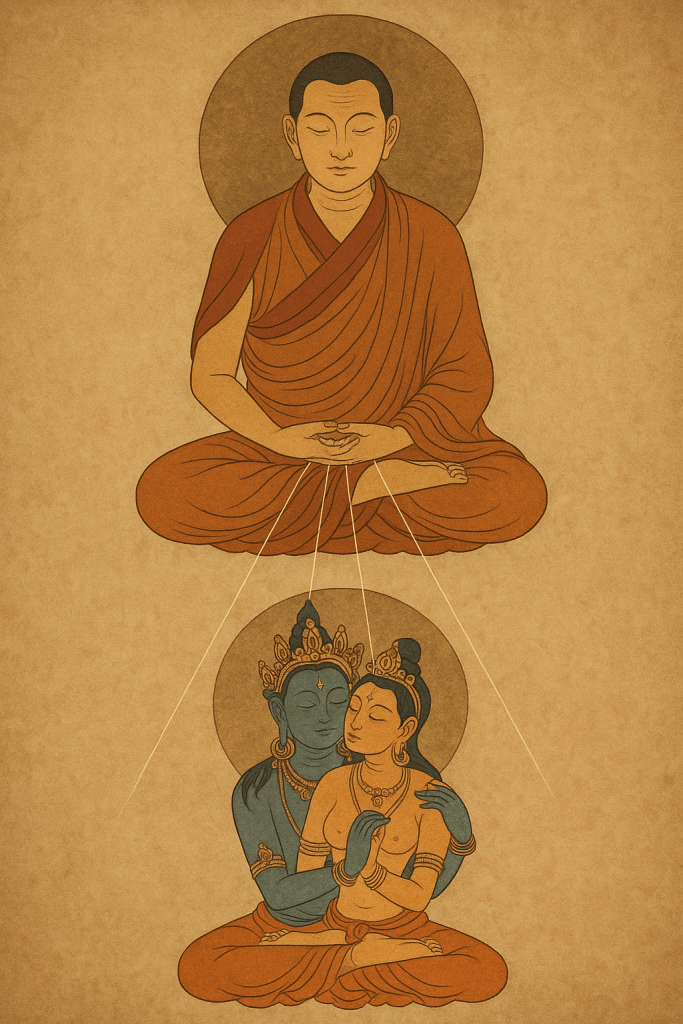
The ideal of tantric union in Vajrayāna Buddhism is described as the merging of wisdom and compassion, form and emptiness, masculine and feminine. In classical Tibetan art this appears as the yab-yum image of male and female deities in embrace.¹ The symbolism points to inner union, yet within the secrecy and hierarchy of tantra this ideal can become distorted. When intimacy, devotion, and power mix, the result can be psychological or sexual harm rather than awakening.
Union beyond the physical
“Union” (las kyi phyag rgya, maithuna) does not always refer to sexual intercourse. Many lineages teach “mental” or “energetic” union, where teacher and student visualize merging through subtle-body channels or shared deity practice.² Scholar Holly Gayley has examined how such “secret consort” (gsang yum) relationships blur lines between spiritual transmission and sexual exploitation.³
Anecdotal reports from practitioners describe non-physical experiences of sexual arousal or even orgasm initiated by the guru, without consent or understanding. For those unprepared, these experiences can feel like psychic invasion and an intrusion into the mind-body field. The ethical question is whether such experiences can ever be consensual in the context of absolute guru devotion.
The mechanism of “mental union”
Tantric theory holds that through visualization, mantra, and subtle-body control, energies (prāṇa, rlung) can be directed between beings. A guru visualized as a deity may “enter” the disciple’s heart or crown chakra, merging mindstreams in blessing.⁴ In positive settings this symbolizes transmission of realization. Yet in cases of coercion the same mechanism becomes violation: the student’s energetic body is penetrated without consent.
Ritual texts sometimes describe the guru entering the disciple’s central channel (tsa uma) through gaze or mantra, symbolic of energetic or spiritual transmission.⁵ Within Hindu Tantra, similar accounts exist of masters manipulating the disciple’s kundalinī or chakras.⁶ These ideas frame the possibility of non-physical sexualized experiences as part of spiritual union. When combined with secrecy and unequal power, the result may feel like mental rape rather than initiation.
Power, secrecy, and consent
The Vajrayāna guru is regarded as embodiment of the awakened state itself.⁷ Devotion to such a figure can override ordinary ethical boundaries. In Western contexts, where students lack cultural preparation, the potential for abuse rises sharply. Alexander Berzin warns that Western practitioners often misunderstand the traditional checks on guru authority and therefore submit to unhealthy relationships.⁸
Secrecy deepens the problem. The samaya vow forbids disclosure of tantric practices, even to peers. Gayley observes that this secrecy “can be used to reinforce sexual violence and silence abuse.”³
Real-world allegations
At Kagyu Samye Ling monastery and its retreat centre on Holy Isle in Scotland, multiple allegations have surfaced over the past decade. Reports describe bullying and psychological pressure during advanced retreats. Recently it was reported that a British woman may have died by suicide after a four-month retreat there. While there is no public evidence of sexual misconduct toward her, other survivors have alleged earlier incidents of “energy access” by the same teacher. Allegations included the use of “subtle body rape/sexual energy invasion,” according to an article by Adele Tomlin on the Dakini Translations website.⁹
The under-discussed nature of subtle-body abuse
Such cases remain largely invisible because tantric language itself obscures boundaries between metaphor and reality. A teacher’s claim of “mind-union” or “blessing” can mask non-consensual psychic intrusion. Students are often told that doubt equals spiritual failure, and that refusal breaks samaya. Without transparent ethics, the very tools meant to free the mind become weapons of domination.
Moving forward
Ethical tantric practice requires explicit, informed consent at every level: physical, psychological, and energetic. Teachers must articulate clearly what practices entail, and students must retain the right to refuse and leave. The spiritual promise of union cannot excuse the violation of personal autonomy. However, this kind of transparency is unheard of. Proper review structures and support for survivors are practically non-existent in most Tibetan Buddhist centers. The allegations surrounding Samye Ling and Holy Isle highlight what scholars such as Gayley describe as tantra’s “shadow”: the ease with which power can transform spiritual intimacy into a form of manipulation and abuse.
Oxford Research Encyclopedia of Religion, “Tantra and the Tantric Traditions of Hinduism and Buddhism.” 2016.
Gayley, Holly. “Revisiting the ‘Secret Consort’ (gsang yum) in Tibetan Buddhism.” Religions 9 (2018).
Snellgrove, David. The Hevajra Tantra: A Critical Study. Oxford University Press, 1959.
Wedemeyer, Christian K. Making Sense of Tantric Buddhism: History, Semiology, and Transgression in the Indian Traditions of Buddhist Tantra. Columbia University Press, 2013, esp. chap. 3–4, on symbolic initiation and tantric ritual language.
White, David Gordon. Kiss of the Yoginī: “Tantric Sex” in its South Asian Contexts. University of Chicago Press, 2003.
“The Guru Question: The Crisis of Western Buddhism and Global Future.” Info-Buddhism.com.
Berzin, Alexander. Relating to a Spiritual Teacher: Building a Healthy Relationship. Snow Lion, 2000.
A ritual battle scene: Kschetrapala rising from a burning sacrificial torma outside Lhasa, facing the monstrous nine-headed Chinese demon in a clash of spirit armies.
This article contains excerpts from The Shadow of the Dalai Lama: Sexuality, Magic and Politics in Tibetan Buddhism by Victor and Victoria Trimondi
Who were the Trimondis?
Victor and Victoria Trimondi are the pen names of German cultural historians Herbert and Mariana Röttgen. In the 1980s and early 1990s, they were active supporters of the Dalai Lama, translating and publishing his works into German and helping to organize international events in support of Tibet. Initially, they saw Tibetan Buddhism as a beacon of compassion and ethical renewal.
But their perspective changed. Over years of study, they became disillusioned by what they regarded as the darker, concealed aspects of Tibetan tantric Buddhism: ritual magic, sexual practices, secrecy, and the fusion of religion with political power. Their critical work The Shadow of the Dalai Lama: Sexuality, Magic and Politics in Tibetan Buddhism (2003) full text here seeks to expose these elements, drawing heavily on Tibetan source texts and the earlier ethnographic research of figures like René de Nebesky-Wojkowitz (Oracles and Demons of Tibet, 1956) and Matthias Hermanns.
Because of this trajectory, from enthusiastic supporters of Tibetan Buddhism to outspoken critics, the Trimondis occupy a controversial position. Admirers of Tibetan Buddhism accuse them of exaggeration and hostility, but their book nonetheless catalogs texts, rituals, and historical examples that complicate the popular image of Tibetan Buddhism as peaceful and compassionate.
The following excerpts illustrate how the Trimondis argue that ritual magic was systematically integrated into Tibetan politics and warfare:
Invocation of demons Since time immemorial ritual magic and politics have been one in Tibet. A large proportion of these magic practices are devoted to the annihilation of enemies, and especially to the neutralizing of political opponents. The help of demons was necessary for such ends. And they could be found everywhere — the Land of Snows all but overflowed with terror gods, fateful spirits, vampires, ghouls, vengeful goddesses, devils, messengers of death and similar entities, who, in the words of Matthias Hermanns, “completely overgrow the mild and goodly elements [of Buddhism] and hardly let them reveal their advantages” (Hermanns, 1965, p. 401).
For this reason, invocations of demons were not at all rare occurrences nor were they restricted to the spheres of personal and family life. They were in general among the most preferred functions of the lamas. Hence, “demonology” was a high science taught at the monastic universities, and ritual dealings with malevolent spirits were — as we shall see in a moment — an important function of the lamaist state.
The war demon Kschetrapala Once the gods had accepted the sacrifice they stood at the ritual master’s disposal. The four-armed protective deity, Mahakala, was considered a particularly active assistant when it came to the destruction of enemies. In national matters his bloodthirsty emanation, the six-handed Kschetrapala, was called upon. The magician in charge wrote the war god’s mantra on a piece of paper in gold ink or blood from the blade of a sword together with the wishes he hoped to have granted, and began the invocation.
Towards the end of the forties the Gelugpa lamas sent Kschetrapala into battle against the Chinese. He was cast into a roughly three-yard high sacrificial cake (or torma). This was then set alight outside Lhasa, and whilst the priests lowered their victory banner the demon freed himself and flew in the direction of the threatened border with his army. A real battle of the spirits took place here, as a “nine-headed Chinese demon”, who was assumed to have assisted the Communists in all matters concerning Tibet, appeared on the battlefield. Both spirit princes (the Tibetan and the Chinese) have been mortal enemies for centuries. Obviously the nine-headed emerged from this final battle of the demons as the victor.
“Voodoo magic” in Tibetan Buddhism The practice widely known from the Haitian voodoo religion of making a likeness of an enemy or a doll and torturing or destroying this in their place is also widespread in Tibetan Buddhism. Usually, some substance belonging to the opponent, be it a hair or a swatch from their clothing, has to be incorporated into the substitute. It is, however, sufficient to note their name on a piece of paper…
Such “voodoo practices” were no rare and unhealthy products of the Nyingmapa sect or the despised pre-Buddhist Bonpos. Under the Fifth Dalai Lama they became part of the elevated politics of state. The “Great Fifth” had a terrible “recipe book” (the Golden Manuscript) recorded on black thangkas which was exclusively concerned with magical techniques for destroying an enemy.
Why all this matters
These passages highlight a side of Tibetan Buddhism that is largely hidden from public view: the integration of destructive magic and spirit warfare into the machinery of the lamaist state. Nebesky-Wojkowitz’s research on ritual manuals, Hermanns’ cultural observations, and the Trimondis’ synthesis all converge on the same conclusion: alongside compassion and wisdom, Tibetan Buddhism preserved and continues to use technologies of coercion and violence.
For modern practitioners and students in the West, this raises unavoidable questions:
Are newcomers told that tantric ritual includes not only deities of compassion but also demon invocations and rites of subjugation? What risks do these violent magical technologies pose for the unsuspecting student?
What does “consent” mean if disciples are invited to take refuge in Tibetan Buddhism and receive empowerments without knowledge of these dimensions?
How much of this is framed as symbolic or metaphorical today, and is that distinction clearly explained? Evidence suggests that such practices continue much as they did in the past, which makes a thorough and honest examination all the more urgent.
Conclusion
The Trimondis’ work is controversial, but it is also important because it insists on remembering what is usually forgotten or denied. If the compassionate face of Tibetan Buddhism is to be embraced honestly, then its shadow side, the reality of political magic, demon invocations, and coercive ritual, must also be acknowledged. Only then can students and practitioners engage with full awareness, rather than be fooled by the illusion of partial truths.
Kurukullā, the red goddess of magnetizing, depicted in a traditional Tibetan thangka style, embodying the tantric power to attract and bind.
Western seekers approaching Tibetan Buddhism are usually drawn to its most humane face. Chenrezig practice promises the cultivation of boundless compassion through visualizing Avalokiteśvara and reciting his mantra Om Mani Peme Hung. Tonglen “taking and sending” practice trains the mind to breathe in the suffering of others and breathe out relief. These sincere aspirations are the public face of Tibetan Buddhism. Yet this religion also preserves a hidden curriculum. Alongside compassionate practices sit the four activities that structure tantric ritual: pacifying, enriching, magnetizing, and subjugating. This fuller picture is rarely presented to beginners, and yet it has consequences for any claim to informed consent.[1]
The four activities: not just compassion
The four activities, known in Sanskrit as caturkarman, classify tantric rites by their intended effect:
Pacifying (śāntika) calms illness and obstacles.
Enriching (puṣṭika) augments longevity, merit, charisma, retinues, and wealth.
Magnetizing (vaśīkaraṇa) draws people and circumstances into a chosen orbit.
Subjugating (abhicāra) forces or destroys enemies.
These are not modern inventions but standard categories across tantric manuals and commentaries.[2]
While Western students are typically introduced to the activities of pacifying and enriching, the other two, magnetizing and subjugating, remain obscure, despite being prominent in tantric ritual literature. Historian Jacob Dalton has shown that violent tantric rites were not marginal but integral, even harnessed by Tibetan states to consolidate power in the medieval period.[3]
Kurukullā: the red goddess of attraction
Kurukullā, a red goddess associated with Amitābha and Tara, epitomizes magnetizing. In traditional texts she is praised as the deity of attraction, and in Tibetan sources she is sometimes known as the “Magnetizing Tara.” She is depicted holding a arrow, bow, flower and hook, all instruments of enchantment. [4]
Contemporary dharma centers sometimes describe her as a deity of love and influence, a kind of esoteric Cupid. But Tibetan ritual manuals, as catalogued by Stephan Beyer and translated in part by modern scholars, show that Kurukullā rites include binding the loyalty or desire of others.[5]
The omission of this material in introductory teachings is significant. Students often hear of compassion, not of enchantment and coercion.
Subjugation and tantric violence
Subjugating rituals, by contrast, can be overtly violent. Dunhuang manuscripts detail effigy rites and “liberation” practices, in which enemies are ritually slain to protect practitioners and their patrons. Dalton notes that these methods scaled from local shamanic forms into state-sanctioned tantric technologies by the 13th century.[6]
Even today, wrathful practices remain part of Tibetan public culture. Cham dances of Mahākāla, staged annually in monasteries, dramatically enact the destruction of obstacles. While these are often seen as symbolic, their presence keeps alive a framework where wrathful force is ritually mobilized against perceived threats.[7]
Samaya: the binding vow
In Highest Yoga Tantra empowerments, disciples take vows of refuge, bodhisattva vows, and tantric samaya commitments. Samaya is described as a “sacred bond” with the guru and the deity. Root downfalls include disrespecting the master or revealing tantric secrets. Breach is said to bring spiritual ruin.[8]
This means that students who take empowerments without understanding the full scope of tantric practices, including magnetizing, subjugating, and punishment rites, are effectively giving consent under partial information. Despite not understanding fully what they are entering into, the bond of samaya can become a blanket mechanism of control.
As the 17th Karmapa indicated in teachings earlier this year, samaya breakers are spoken of in language that implies wrathful retribution, both spiritual and physical. The retribution he described is not symbolic but actual. See my essay, “Read Between the Lines,” for more on this.[9]
Survivors’ voices
Accounts from survivors and critical practitioners suggest that magnetizing and wrathful practices are not just metaphors. Women have described experiences of sexual energy being manipulated at a distance, sometimes calling it a form of “astral rape.” Whether one interprets this as energetic manipulation or psychological intrusion, the perception of violation is real.
Lion’s Roar published testimonies arguing that samaya has been used as a principal mechanism of coercion in abuse cases. Independent investigations of groups like Shambhala document patterns where devotion and secrecy prevented victims from speaking out.[10]
Buddhist communities are now grappling with these realities. Some organizations are introducing explicit consent policies, recognizing that the charisma of a guru, altered states of consciousness induced during a ritual, and the binding reality of vows can impair a student’s capacity to freely choose.[11]
Historical context does not erase ethical duty
Scholars such as Ronald Davidson have contextualized tantric violence as a product of medieval frontier politics and kingship.[12] This explains how such rites developed. But historical context does not remove the ethical obligation to disclose them to modern students.
Without disclosure, the vows taken in empowerments are not truly informed. The student consents to Buddhist compassion, but is bound to a system that also contains sexual enchantment, psychological manipulation, and deadly punishments.
Conclusion
The compassionate practices of Chenrezig and Tonglen have a genuine power to transform, yet Tibetan Buddhism’s esoteric side contains hidden technologies that are not peaceful but harmful: the rites of magnetizing, subjugation, and punishment. These are attested in texts, preserved in ritual, and acknowledged by scholars and survivors alike. Until these dimensions are more fully disclosed, the vows taken in tantric empowerments remain shadowy. Consent given without knowledge of the whole spectrum of practice is not true consent. It is, as this essay argues, an illusion.
Source Notes
1. Rigpa Wiki, “Four activities,” accessed 2025. Rigpa Wiki is a practitioner-maintained encyclopedia that summarizes key Vajrayana concepts. Its entry on the “four activities” clearly lays out pacifying, enriching, magnetizing, and subjugating as the classical categories of tantric ritual. It is not a critical academic source, but it reflects how contemporary Tibetan Buddhist institutions themselves present the material.
2. Study Buddhism, “What is Samaya?” and “Empowerment.” Study Buddhism is a project led by Alexander Berzin and colleagues, offering accessible introductions to Buddhist theory and practice. These entries explain samaya as a binding relationship with a guru and empowerment as the ritual granting of authority to practice tantra. They are useful for showing how Tibetan teachers explain vows and empowerments to Western audiences.
3. Jacob P. Dalton, The Taming of the Demons: Violence and Liberation in Tibetan Buddhism (Yale University Press, 2011). Dalton’s book is a landmark study of ritual violence in Tibetan Buddhism. Drawing on Dunhuang manuscripts, he shows that wrathful rites, including violent subjugation and “liberation” rituals, were integral to tantric practice. Dalton’s work challenges romantic views of Buddhism as purely peaceful.
4. Wikipedia, “Kurukullā” The Wikipedia entry gives a concise overview of Kurukullā as a magnetizing deity across Buddhist cultures.
5. Stephan Beyer, The Cult of Tārā: Magic and Ritual in Tibet (University of California Press, 1973). Beyer’s study remains a foundational ethnography of tantric ritual in Tibet. His translations of ritual manuals include examples of both compassionate and wrathful practices, including rites of attraction and subjugation. It is particularly valuable for showing how deity practices were embedded in everyday Tibetan religious life.
6. Dalton, Taming of the Demons; see also Jacob P. Dalton, “A Crisis of Doxography,” in Journal of the International Association of Buddhist Studies 28, no. 1 (2005). In addition to his book, Dalton’s article “A Crisis of Doxography” analyzes how violent rites were classified in Tibetan scholastic traditions. He shows that even systematizing scholars struggled to reconcile wrathful tantric methods with Buddhist ideals, which underscores their presence and their tension.
7. Associated Press, “Wrathful deities in Tibetan Cham dance,” 2024. This news report covers annual cham dances in Tibet and in exile communities, where wrathful deities like Mahākāla are invoked to repel obstacles. It illustrates that wrathful practices are still a living part of Tibetan Buddhist culture, even if framed from the public as symbolic or theatrical.
8. Study Buddhism, “Samaya”; Rigpa Wiki, “Empowerment.” Both entries describe the vows and commitments made during empowerment rituals. They confirm that samaya includes strict obligations to the guru and to secrecy. Their language highlights how the bonding process is explained to new students, and how much is left unspoken.
9 “Read Between the Lines: A Glimpse Into the Dark Heart of Guru Devotion,” Tantric Deception, April 4, 2025. This essay analyzes a teaching by the 17th Karmapa, where he discussed samaya and hinted at punitive consequences for breaking devotion. It shows how even contemporary high lamas continue to invoke the discourse of samaya enforcement, reinforcing the concerns about consent.
10. Lion’s Roar, “When Samaya is Used as a Weapon,” 2018; Buddhist Project Sunshine Reports, 2018–2019. Lion’s Roar published reflections by teachers and survivors on how samaya language has been used to silence or coerce students in abuse cases. Buddhist Project Sunshine was a grassroots effort to document sexual misconduct in Shambhala and other Tibetan Buddhist organizations. These sources provide survivor-centered evidence of how samaya functions in practice.
11. Buddhist Ethics Working Group, “Consent in Vajrayana,” 2021. This collective statement from Buddhist practitioners and ethicists proposes new standards for sexual and spiritual consent in Vajrayana contexts. It emphasizes enthusiastic, ongoing consent and rejects the misuse of tantric language to excuse coercion. It is an attempt at reform efforts from within the tradition.
12. Ronald M. Davidson, Indian Esoteric Buddhism: A Social History of the Tantric Movement (Columbia University Press, 2002). Davidson’s historical study situates tantric Buddhism in the political and social context of medieval India. He shows how esoteric practices were bound up with kingship, warfare, and elite patronage. His work helps explain how violent and manipulative rites could become integral to the tradition, even if they clash with Buddhist ethics.
For years, I followed the path of Tibetan Buddhism and tantric practice. I studied its rituals, visualizations, deities, and especially its central concept of “non-dual realization,” considered the highest goal in Mahayana and Vajrayana philosophy.[1]
I chanted the mantras, invoked the buddhas, bodhisattvas and dakinis, and merged myself with yidams, believing I was on the path to ultimate truth or enlightenment.
But the truth I’ve realized now is very different. It was only after leaving the system and encountering Christ again that I saw what I had actually opened myself up to. What was presented to me as wisdom was, in reality, a surrender of my soul to dark powers wearing radiant masks.
What Is “Non-Dual Realization”?
In Mahayana and Vajrayana Buddhism, “non-dual realization” is taught as the highest goal. It means transcending the conceptual distinctions of self vs. other, good vs. evil, sacred vs. profane, based on the belief that these opposites are mental constructs and ultimately empty. It means realizing that everything is empty of inherent existence, that distinctions are illusions, and that even the self is not truly existent.
In Tibetan Buddhist tantric practice, this realization is pursued through deity yoga: one visualizes an external deity like a dakini, peaceful bodhisattva, or wrathful buddha, visualizes oneself as the deity, merges with the external form, and dissolves the sense of a separate self into that visualization. The goal is to transcend the sense of individual self and merge into what is presented as enlightened awareness.
This sounds beautiful on the surface. But what is actually happening behind the scenes?
Possession Disguised as Enlightenment
From a Christian perspective, this practice can lead to spiritual possession.
The moment you invite a being to take over your mind, body, or spirit, especially one that does not proclaim Jesus Christ as Lord (1 John 4:1-3), you are offering your soul to a power that is not of God.
Tantric practices train you to dissolve your boundaries. They break down your identity and present a being who is radiant, powerful, and loving, and invite you to unite with it.
In reality, this is surrender to a counterfeit. It is a deceptively woven net, spiritually binding, and ruthlessly enforced.
The Dakini’s Magical Net: A Trap, Not a Blessing
In Tibetan Buddhism, dakinis are presented as enlightened feminine energies, guides to wisdom, and protectors of the dharma. But now, I see clearly that the “net” of the dakinis isn’t a web of wisdom, but a spiritual snare.
These magical nets are said to catch the mind stream of those who violate tantric vows. They bind, dismantle, and destroy the consciousness of the practitioner who steps out of line. That is not divine justice but spiritual murder. It is demonic.
The Hidden Power Structure Behind Vajrayana
It’s important to add a caveat here: Tibetan Buddhists often shield themselves from criticism by appealing to the ethical and philosophical framework of early Buddhism, the so-called first and second turnings of the wheel. They claim that Vajrayana is inseparably bound to the moral and philosophical teachings of Hinayana and Mahayana.
However, in practice, it is the tantric laws that prevail. When push comes to shove, tantric expediency overrides all. What you get is a kind of spiritual gangsterism, a mafia-like code of silence, loyalty, and fear, all cloaked in the sanctity of Buddhist language and lineage.
But this never felt right to me. True love does not coerce and true wisdom does not enslave. The Holy Spirit convicts, but He never violates the soul’s freedom.
The Blood of Jesus Dissolves Every Net
The day I returned to Jesus Christ, after being spiritually attacked and nearly destroyed by the tantric Buddhist forces I once invoked, I renounced all former vows, empowerments, and deities. I asked God to set me free from every magical net and every spiritual power that claimed me. So many years before, after I had left the Catholic Church, I had gone through a long period of agnosticism before I took refuge in Tibetan Buddhism. I didn’t know if God existed or not. This left me open to deception by occult systems such as Tibetan Buddhism.
What I found in trying to break free from tantric occultism is that God is real and the blood of Jesus Christ is stronger than any tantric empowerment. It dissolves all bindings and shatters and severs every demonic contract.
We Are Not an Illusion
We are not empty. We are not reducible to pure awareness or dismissed as illusion. On the contrary, our existence is real, grounded, and full of meaning.
We are persons, created in the image of God (Genesis 1:27), with eternal souls, essential wills, and a purpose that cannot be replaced.
Jesus did not ask us to dissolve into Him. He calls us to relationship, not dissolution and especially not annihilation. He redeems, restores, and makes whole. In Christ, our identity is not erased but fulfilled. If you’ve been entangled in the deceptive beauty of tantric non-duality doublespeak, know this: it is not too late; there is a way out.
[1] Note on “Non-Dual Realization” in Tibetan Buddhism: In Mahayana and Vajrayana Buddhism, particularly within Madhyamaka philosophy and the Mahamudra tradition of the Karma Kagyu lineage, “non-dual realization” refers to the direct experiential understanding that all phenomena, including the perceiving mind and external objects, are empty of inherent existence. This does not mean merging into a single cosmic entity, but rather realizing that the distinction between subject and object is conceptually constructed and ultimately illusory. In Mahamudra practice, this is described as the union of clarity (luminosity) and emptiness, a non-conceptual awareness that is self-liberated and ungraspable. The practitioner seeks to transcend dualistic fixation and abide in the natural state of mind, free from elaboration. However, while this view is upheld within the tradition as a path to enlightenment, my experience revealed it as a spiritual vulnerability. Furthermore, the process of dissolving self-boundaries and engaging in deity identification opened the door to oppressive spiritual influences disguised as wisdom. What is framed as “non-dual realization” can, in practice, become the annihilation of personal agency and discernment and leave one open to possession by demonic entities.
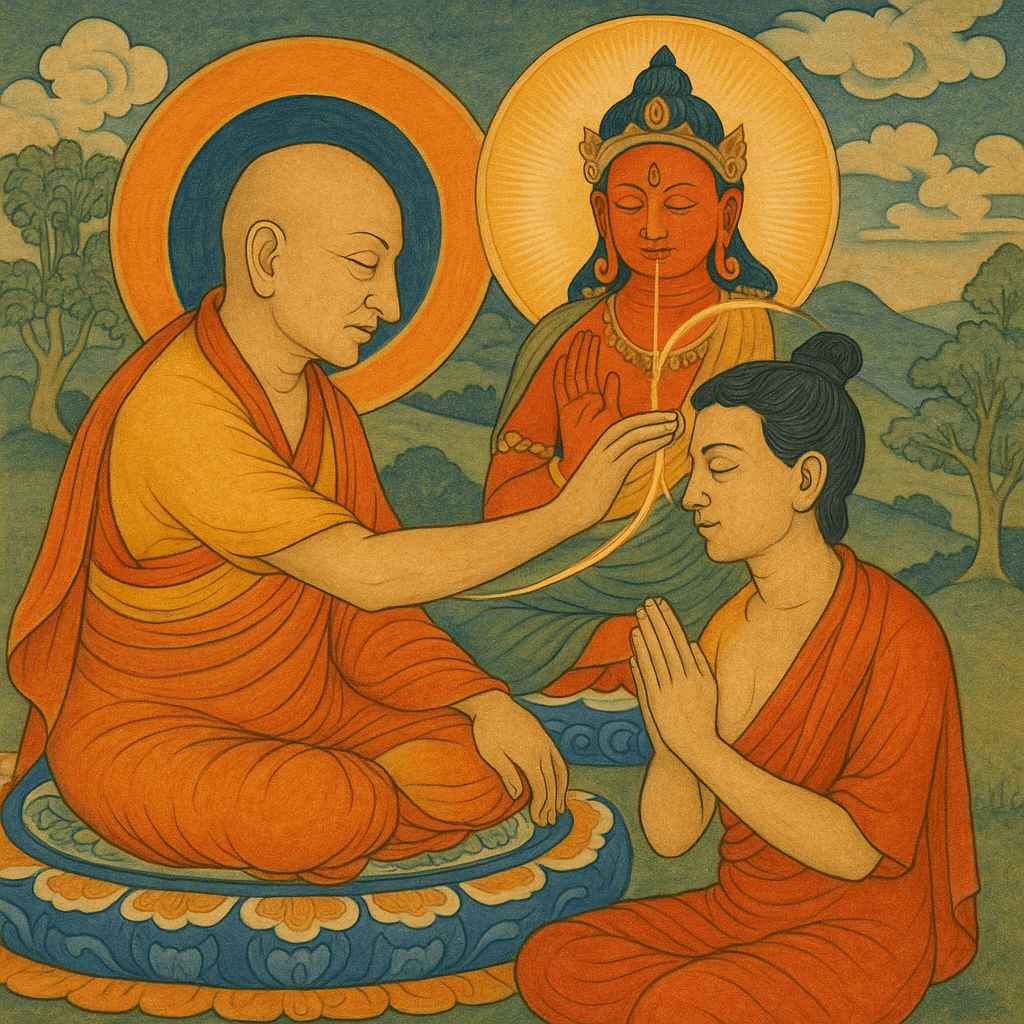
Tantric initiation (Vajrayana empowerment) is often described as a ritual that grants permission to engage in deity yoga and awaken one’s inner Buddha-nature. Yet traditional Tibetan sources suggest that something more mystical and intrusive is occurring, that the lama actually places the deity’s essence into the disciple’s mindstream. This critical detail, essentially the guru implanting or merging the deity (yidam) with the initiate’s mind, is conspicuously absent in most contemporary teachings.
This article examines classical tantras and commentaries to determine whether they explicitly describe the guru installing the deity in the disciple’s mind. It then compares that understanding with modern teachings, exposing a deliberate omission that raises serious questions about transparency in Vajrayana transmission.
Traditional Teachings on Tantric Empowerment
In Vajrayana Buddhism, empowerment (Tib. wang, Skt. abhisheka) is essential. “In the Secret Mantra Vehicle, there can be no accomplishment without empowerment.”¹ Classical definitions stress that this is not merely symbolic but a ritual that transforms the disciple’s mindstream.
According to the Rigpa Wiki, empowerment “awakens the special capacity for primordial wisdom to arise in the mind of the disciple.”² The Dalai Lama’s teachings on the Kalachakra Tantra state the guru “ripens the disciple’s psycho-physical continuum with the initiations.”³ Traditional analogies liken this to planting a seed that, with the right conditions, will grow into Buddhahood. This “seed” is not just metaphorical but is a spiritual presence that enters the disciple.
Tantric texts and commentaries describe empowerment as a mystical transmission wherein the wisdom deity (jnanasattva) is invited to enter the samaya deity (samayasattva), the visualized form of the disciple. Sam van Schaik summarizes: “in empowerment… the wisdom being becomes embodied in the samaya being.”⁴ The two minds are joined.
Instructions for such ceremonies explain that the lama generates themselves as the deity and transmits that awakened essence into the disciple through vase water, mantras, and gestures. The disciple visualizes the deity dissolving into themselves, signifying that the deity’s mind is being placed within them. Lineage sources stress that the lama must already hold the deity’s realization in order to transmit it. As one commentary puts it: “You have to hold something in you before you can give it.”⁵
In short, classical sources affirm that empowerment involves the lama implanting the deity’s essence into the disciple. Without this, Vajrayana texts say, real accomplishment is impossible, “like trying to press oil from sand.”
Does the Lama Literally Install a Deity?
While ancient texts may not use the modern phrase “implant the deity,” their intent is clear. An authoritative Kagyu explanation says the lama “places a recipient in connection with a particular Tantric deity,” enabling a “merging of essences.” This “connection” implies not just a symbolic affiliation but a mystical joining.
The empowerment ritual is the cause that activates and personifies the disciple’s Buddha-nature as a specific deity. This is not something the student can do alone; it requires the guru’s intervention. In Highest Yoga Tantra, multiple initiations (vase, secret, wisdom, word) facilitate this process in stages. During empowerment, the disciple imagines themselves as the deity (samaya being) and invites the wisdom deity to enter. When the two merge, the disciple becomes “in union” with the deity.
Some texts describe this as light or energy entering the disciple symbolizing the deity’s mind entering their heart. The Indian master Vilāsavajra described the climax of empowerment as a point when “wisdom and samaya come together.”⁶ The disciple leaves not just authorized but changed, carrying the seed of the deity from that point forward.
Jamgön Kongtrul writes that empowerment “introduces the disciple into the deity’s mandala” and allows the deity’s form and wisdom to “take root.”⁷ A Nyingma commentary states the guru, visualized as the deity, dissolves into the disciple, granting the blessing of the deity’s mind. Even the phrase “blessings enter the disciple’s stream” implies the transfer of a conscious presence.
In effect, tantric empowerment functions like a spiritual implantation, or even possession, in which the enlightened mind of the deity is placed into the disciple. The initiate now carries the deity within them, not merely as a concept but a living presence.
Modern Teachings: Omission or Adaptation?
If this is the traditional view, why don’t modern teachers say so? Contemporary teachings, especially those aimed at Western or general audiences, consistently describe empowerment in vague terms: permission, inspiration, activation of inner potential. The mystical detail of the lama implanting the deity is nearly always omitted.
In a transcribed teaching from a famous lama, now deceased (see below), empowerment is described as a prerequisite for deity meditation: the disciple receives empowerment, then instructions, and cultivates their body as the deity’s form. No mention is made of the lama placing anything into the disciple. It reads more like ceremonial enrollment than spiritual fusion.
This pattern is widespread: contemporary teachers often emphasize psychological language such as inner transformation, personal growth, and discovering potential, while minimizing the traditional notion of external metaphysical transmission. For instance, the Rubin Museum describes empowerment as a “ritual to introduce us to our own innermost Buddha qualities,”⁸ rather than as the reception of a deity from the lama. Such a framing casts the guru as a guide rather than a spiritual agent. However, this reinterpretation flattens the ritual’s ontological depth and misrepresents the original esoteric function of empowerment.
Even phrases like “placing the disciple in connection with the deity” or “ripening the mindstream” are left undefined. Many Vajrayana students, unless they study technical commentaries, may never realize that the tradition sees empowerment as a supernatural event. The omission is so consistent that one might suspect it’s intentional, perhaps to avoid alarming newcomers with the idea of having a foreign spirit installed in their mind.
Secrecy and Obfuscation in Vajrayana
To understand this omission, we must examine the role of secrecy. Vajrayana has always been esoteric. Revealing inner teachings to the uninitiated is a root downfall. As such, teachers often avoid revealing too much, especially in public settings.
Defenders of this approach argue that it’s compassionate: premature disclosure can cause misunderstanding or fear. Teachings are “graduated” and deeper layers revealed as the student progresses. In this view, the omission is considered skillful, not deceptive.
Yet critics argue that this secrecy amounts to intentional obfuscation in the modern information age. Newcomers are told that Vajrayana is about archetypes and psychological growth; this is appealing, secular-friendly language. Only later do they learn that the practice involves guru-bestowed metaphysical empowerment and deity implantation.
Few Vajrayana centers provide an upfront disclosure like: “In this empowerment, you will vow lifelong devotion and we believe that the deity’s mind will enter into yours.” Without this, informed consent becomes impossible. What if the student has been raised Christian and bound by the First Commandment: “You shall not have strange gods before Me”⁹? Would they agree to deity possession if fully informed?
The disconnect between outer presentation and inner doctrine has led some former practitioners to label the tradition dishonest. Years may pass before students learn that guru-deity fusion/possession are standard parts of the system. At that point, it may be too late as they’ve taken vows, invested emotionally, and become spiritually entangled.
Some defenders argue that Vajrayana’s opacity is necessary, that it was never meant for everyone. But in modern multi-cultural societies, this clandestine approach resembles a bait-and-switch. Students sign up for meditation, not spiritual merging with an imported god. They deserve to know what they’re consenting to.
Restoring Honesty in Transmission
Is omitting the “deity implantation” deceptive? From an academic standpoint, the answer is yes: there is a clear disconnect between traditional texts and public presentation. The idea that the guru installs a deity in the disciple’s mindstream is a core teaching, not a fringe view.
Yet most public talks and introductory texts never say this plainly. The true nature of the ritual, guru/deity fusion with the recipient, is hidden behind euphemism. This may prevent questions, but it is morally dishonest.
Vajrayana dharma centers must move toward transparency. Honesty about what is really occurring would both honor the teaching and protect the student. That this is seldom done nowadays is deeply disturbing.
In a predominantly Christian culture, where devotion to other gods violates divine commandments, the omission is not just deceptive, it’s a spiritual breach of consent. Prospective practitioners deserve to know what is happening before the ritual occurs, not after.
The tradition holds that through the guru’s blessing, one’s mind becomes inseparable from the deity. Then let us insist that teachers explain that clearly, before it is too late for the recipient to turn back.
Sources:
Traditional Vajrayana saying; cited in various commentarial teachings on abhisheka.
His Holiness the 14th Dalai Lama, Kalachakra Initiation Teachings.
Sam van Schaik, “The Limits of Transgression: The Samaya Vows of Mahāyoga” (2010).
Ngawang Phuntsok, On Receiving Wang (Empowerment).
Vilāsavajra, commentary on tantric vows; source referenced in academic discussion on Mahāyoga.
Jamgön Kongtrul, The Treasury of Knowledge, Book Eight, Part Three: The Elements of Tantric Practice.
Scott Globus, “Empowerments: Awakening the Buddha Within,” Rubin Museum, 2021.
Exodus 20:3, The Holy Bible.
Kalu Rinpoche – Teachings on Karmamudra and Mahamudra–California, Los Angeles, December 21, 1988
Transcript:
The gentleman is asking whether there is any connection between the traditional Buddhist approach to tantric practice and various sexual yogas—whether these practices have any bearing on the traditional path or whether that’s a misconception.
Yes, there is a connection. Previously, I spoke of the four major classes of tantra: Kriya Tantra, Charya Tantra, Yoga Tantra, and the fourth, Anuttara Yoga Tantra, or the Tantra of Unsurpassable Union. This fourth category is divided into Father Tantra, Mother Tantra, and Non-dual Tantra.
Principally in the classes of Mother and Non-dual Tantra, there are techniques involving sexual union as a basis for spiritual practice, technically termed karma mudra. These practices form part of a broader cycle known as the teachings on the Four Mudras. These teachings, as taught by the Buddha, are authentic and part of the tradition—the challenge lies in practicing them purely.
Traditionally, an individual would first undergo a long period of purification—purifying body, speech, and mind from harmful actions and obscurations, while cultivating positive qualities like merit and awareness. This is done through preliminary practices known as ngöndro.
Next, the individual would receive an authentic empowerment into one of the major tantric cycles from a qualified teacher. They would then receive extensive instruction in deity meditation and cultivate the experience of their own body as the deity’s form—experiencing the union of form and emptiness not as an idea, but as direct realization. Their speech would become the union of sound and emptiness, often practiced through extensive mantra recitation. They would also cultivate the awareness of mind as the union of intelligent clarity and emptiness, stabilizing it through meditative absorption.
Following this, the person would practice tummo or inner heat. This practice is done in stages and begins with the generation of inner warmth at the navel. As the warmth spreads, energy from the crown of the head flows downward. Through mastery of this flow, the practitioner experiences a profound bliss that pervades the mind-body complex.
Advanced stages involve focusing energy through the chakras. When energy is drawn to the throat, joy arises. At the heart, sublime joy. At the navel, special joy. And when energy is drawn down and contained within the genital chakra, co-emergent joy. Karma mudra practice requires the ability to hold this energy without losing it through orgasm. This leads to a nondual, non-conceptual state of awareness.
Eventually, the practitioner reverses the flow of energy upward through the chakras. Mastery over lowering and raising energy is required before karma mudra practice can be properly undertaken. With that mastery, energy is consciously directed through the 72,000 subtle channels (nadis) in the body. The ultimate aim is not sexual pleasure, but realization of Mahamudra.
Examples of individuals who attained enlightenment through such practices include the Indian king Indrabhuti, who is said to have relied on 1,000 consorts over six years. Tibetan lay practitioners like Marpa the Translator—who had eight consorts—are also examples. These paths exist, but must be practiced with purity and commitment.
Misunderstanding these practices—believing tantra is simply about sex—is a serious mistake. One of the 14 root downfalls in Vajrayana practice involves this misunderstanding, particularly the indulgence in orgasm, which is seen as a loss of energy that could otherwise be harnessed for enlightenment.
Another audience question asked about how long to leave a corpse undisturbed after death. In Tibetan tradition, the consciousness remains associated with the body for about 3.5 days. During this time, the body should ideally not be touched. A practitioner of phowa (transference of consciousness) is then called to assist the consciousness in departing skillfully.
After that, the body may be disposed of through burial, water burial, or cremation—accompanied by ritual and chanting to aid the consciousness. These practices can still be valuable even in cultures where such methods are not common, and ideally a phowa practitioner should be contacted if possible.
Another question asked whether one can attain liberation in a single lifetime through tantra. The answer is yes—realization of Buddhahood is possible. However, the physical manifestations may differ from those of a SambhogakayaBuddha, who displays specific physical marks of perfection. Still, the inner realization can be the same.
To discern an authentic teacher, look for someone with an unbroken lineage, proper transmission, sincere motivation, and correct understanding. Avoid teachers who have been disowned by their own lineage, or who act out of selfish motives. Examine their character, conduct, and consistency with traditional teachings.
In closing, the speaker encourages all listeners to study, practice, and seek qualified teachers. The merit of the teaching session is dedicated to the awakening of all sentient beings from ignorance, and the spreading of primordial awareness so that all beings may eventually attain Buddhahood.
In the world of Tibetan Tantra, the guru is not merely a teacher. He is regarded as a living embodiment of enlightenment, someone who, once accepted, must be obeyed as if he were the Buddha himself. Into this framework walk countless Western women, often earnest seekers of truth, healing, or transcendence. But when romance, sexuality, and devotion become intertwined, the results are rarely transformative. More often, they are tragic.
This article explores the inherent power imbalance, cultural dissonance, and psychological manipulation that underpin many intimate relationships between Tibetan tantric gurus and their female disciples.
A Different Cultural Code
In Tibetan culture, it is not uncommon for powerful men, including lamas, to have secret relationships, multiple consorts, or children outside of marriage. In many traditional communities, this behavior is normalized, even expected. Male infidelity is culturally tolerated, and truth-telling in romantic relationships is not seen as a moral imperative.
For many Western women, however, raised in societies where emotional honesty and monogamy are core values in intimate relationships, these behaviors come as a rude awakening. When a Tibetan lama engages in a romantic or sexual relationship with a Western disciple, he often does so under entirely different assumptions than she brings to the table.
The result is a tragic mismatch, not only of expectations, but of entire worldviews.
Samaya: A Weaponized Vow
At the heart of tantric Buddhism is the concept of samaya, a sacred vow of loyalty and obedience to the guru. These vows are complex, often opaque, and understood differently in Tibetan contexts than in the West. A Western woman may believe she is entering a relationship based on mutual affection or spiritual partnership, while the guru sees her as a consort, a dakini, a means to an end, whose role is to support his realization through sexual union, secrecy, and ritual submission. A less realized guru might just use women for his own sexual satisfaction without having the ability to properly engage in tantric sex for spiritual ends. This is often true nowadays.
In any case, breaking samaya is said to have dire consequences, not only spiritually, but psychologically, and physically. The risk is greatly compounded if the woman undertakes a traditional three-year-retreat and engages in the highest yoga tantra practices, including the physical yoga. The looming threat of tantric destruction can trap women in relationships that are exploitative, confusing, and coercive. Once the guru becomes the channel for the deity, any questioning of his authority can be framed as demonic and a cause for imminent karmic downfall.
Possession Disguised as Enlightenment
Tantric union is not merely symbolic. It often involves rituals where the guru is said to be “inhabited” by the deity and his voice, gaze, and touch become divinely charged. During such practices, the female disciple is encouraged to dissolve her ego, to merge into the guru-deity, and to practice dak nang or “pure view.” This process can mimic, and in some cases become, a form of spiritual possession.
What’s often missed is the psychological and energetic takeover that occurs. The guru, now deified in the disciple’s mind and practice, can dominate her thoughts, dreams, emotions, and even her bodily functions. This fusion can make it nearly impossible for her to discern spiritual guidance from emotional manipulation or sexual coercion.
Real-World Tragedies
Numerous cases, both widely reported and quietly suppressed, illustrate the dangers of intimate relationships between tantric gurus and their students. These accounts reveal recurring patterns of deception, coercion, and spiritual abuse, all cloaked in esoteric language and asymmetrical power dynamics. They are not isolated incidents but part of a systemic pattern deeply embedded in a tradition that grants unchecked spiritual authority to men who are rarely held accountable.
For those who wish to explore further, consider just a few of the many investigations and testimonies:
Buddhist Project Sunshine – Phase 3 Final Report (2018) This comprehensive report documents allegations of abuse within the Rigpa community, providing detailed accounts and analyses. 📄 Read the PDF Report
Beyond the Temple – What Now? Blog Formerly known as “What Now?”, this blog offers reflections and information from ex-Rigpa members about their experiences and the broader implications of abuse in spiritual communities. Beyond the Temple – Survivors of Abuse in Tibetan Buddhism
Tricycle – “Rigpa Abuse: Former Students of Sogyal Rinpoche Share Their Stories” An article featuring firsthand accounts from former students detailing their experiences with Sogyal Rinpoche and the Rigpa organization. 📰 Read the Article
Lion’s Roar – “Letter to Sogyal Rinpoche from Current and Ex-Rigpa Members Details Abuse Allegations” This piece publishes a letter from Rigpa members outlining specific abuse allegations against Sogyal Rinpoche. 📄 Read the Letter
The Aftermath: Disillusionment and Healing
For many women, the breaking point comes when the promised enlightenment fails to materialize, and the emotional wounds become undeniable. Depression, anxiety, spiritual confusion, sexual trauma, and a profound crisis of faith often follow. Some leave Tibetan Buddhism altogether. Others struggle for years in silence, fearing karmic retribution or spiritual failure.
But there is also healing. More and more survivors are finding their voices, connecting with others, and re-evaluating what true spirituality looks like outside the grip of occult religions.
Conclusion: A Cautionary Tale
The guru-disciple relationship in tantric Buddhism is not a romantic ideal. It is a spiritual contract saturated with asymmetrical power, cultural blindness, and theological complexity. When this dynamic becomes sexual, the risks multiply exponentially. For Western women seeking union with the divine, the guru-lover becomes not a liberator but a captor. The elaborate practice of guru yoga further seals the deal.
This truth must be told, not to demonize individuals or traditions, but to expose the structural and spiritual dangers that thrive in secrecy. Love, in its purest form, cannot flourish where truth is sacrificed to deception and devotion is manipulated into coercion.






 Tantric Deception