

The Structure of Tantric Abuse


In Tibetan tantric Buddhism, the relationship between guru and disciple is said to be sacred, a channel for transmission of enlightenment itself. Yet within that same structure lies a potential for absolute domination. When a guru feels threatened, betrayed, or exposed, the same system that demands devotion can become an instrument of terror.

The tantric logic of punishment

In tantric doctrine, every vow (samaya) between guru and disciple is a metaphysical bond. Breaking it is said to unleash cosmic consequences. Ancient texts speak of wrathful deities and oath-bound protectors who punish those who “slander the guru” or “harm the Dharma.” The idea is not metaphorical. Illness, accidents, or misfortune are interpreted as visible proof that unseen forces are enforcing spiritual law.¹

A guru who believes this, and who claims mastery of the dark ritual practices that command those forces, often teaches others to believe it. That teacher wields enormous psychological power. To label someone a “samaya-breaker” is to mark them as deserving of sickness or death. This is not an internal accusation only; it shapes the views of the community where the guru holds god-like power. It gives the guru a pretext to use ritual methods to harm students whenever he deems it necessary.

Entities that cause disease

Traditional Tibetan cosmology offers a detailed taxonomy of spirits believed to cause physical and mental harm: bdud (demons), gdon (malevolent spirits), btsan (fiery mountain gods), klu (serpent beings of water), and srin po (ogres).² Each category is said to afflict a different organ, emotion, or realm of life. Texts such as René de Nebesky-Wojkowitz’s Oracles and Demons of Tibet describe elaborate systems of offerings and threats designed to control these beings.

Within this worldview, ritual specialists do not invent malevolent forces but redirect them. A demon bound by oath can be petitioned to punish a perceived oath-breaker. Protector deities can be asked to “remove obstacles” by striking enemies with disease or madness. These ideas are deeply embedded in tantric liturgy and methodology, even if modern dharma centers prefer to describe them symbolically.

The internal logic of coercion

When this metaphysical framework meets the authoritarian structure of a retreat or monastic hierarchy, the result can be catastrophic.³ Gurus can claim divine justification for acts that would otherwise be seen as abusive. If a disciple questions orders, refuses sexual advances, or tries to leave, the teacher can declare them in spiritual violation. From that point on, any misfortune that follows can be attributed to supernatural punishment rather than the guru’s actions.

Real world allegations

The potential for that logic to cross into criminal abuse is not theoretical. Scholar and translator Adele Tomlin has published a series of testimonies from women who participated in long-term tantric retreats under the auspices of major Tibetan Buddhist organizations in the United Kingdom and Nepal. According to Tomlin’s report, complaints were submitted to trustees of the dharma centers, as well as to resident teachers. Police reports were also made, with at least one woman reportedly informed that criminal acts had occurred.

The list of complaints is substantial: “…sexual harassment, sexual assault/coercion, ‘false imprisonment’ i.e. refusing to allow people to leave the retreat for urgent matters, such as medical diagnosis and treatment or due to psychological breakdowns, emotional bullying, insistence on signing non-disclosure legal agreements, refusal to provide proper aid to those in physical pain or serious sickness. It was reported that women who had requested to leave the retreat for the above reasons were responded to with threats that they would go to hell…and telling them they would have short lives, terrible sicknesses and their family members would die and get sick too.” There are also accounts of tantric rituals being misused “to ‘force’ consorts to engage in ‘subtle body energy’ unions without appropriate consent/devotion or even pre-requisite qualifications of the guru or consort for such a relation,” and reports that participants’ passports were confiscated before entering retreats in Nepal.”³ See Tomlin’s article here.

The psychology of fear

Once a disciple internalizes the idea that disobedience invites divine punishment, ordinary safeguards such as the law, conscience, and community protection lose their power. The guru becomes both the source of danger and the only possible protection from it. Fear of sickness, insanity, or karmic ruin may keep followers silent even when they experience or witness abuse. This is coercive control disguised as spirituality.

Why tantra is uniquely risky

Every hierarchical religion can produce abuse, but tantric systems amplify the risk because they contain dark magical rituals that can be used to secretly harm students who do not show proper obedience. In the Tibetan tantric system, the guru is not just a teacher but the embodiment of enlightenment itself. Vows are said to bind across lifetimes. Breaking them is imagined to destroy spiritual progress and unleash demonic retribution. That belief gives abusive teachers a supernatural mandate to harm and a theological excuse when they do.⁴

Many practitioners are drawn to long-term retreats by tantra’s promise of transformation. But are the risks worth it? Without structural accountability, the same tools can become weapons. When secrecy, charisma, and ritual authority converge, even devoted, sincere, and intelligent students can be trapped in a reality of pain and punishment.

For those who have lived inside such systems, the scars run deeper than physical or sexual trauma. The damage is also ontological: the haunting sense that unseen forces will stalk them forever and that they are cursed beyond escape. Healing begins by reclaiming moral and spiritual agency, by recognizing that no guru, spirit, or protector holds dominion over one’s body, mind, or fate. Yet once that agency has been surrendered to powerful gurus and their invisible minions, recovering it can be very difficult.

Notes

  1. Stanley Mumford, Himalayan Dialogue: Tibetan Lamas and Gurung Shamans in Nepal (Madison: University of Wisconsin Press, 1989).
  2. René de Nebesky-Wojkowitz, Oracles and Demons of Tibet (The Hague: Mouton, 1956).
  3. Adele Tomlin sole author of Dakini Translations website: NOT SO “HOLY ISLE”? TRAGIC TALES OF REPORTED (AND ENABLED) BULLYING AND SEXUAL MISCONDUCT TOWARDS WOMEN AT SAMYE LING UK BUDDHIST CENTRES THAT ENDED IN PHYSICAL AND PSYCHOLOGICAL HARM, ATTEMPTED SUICIDES AND MURDER. Article excerpted with attribution.
  4. Geoffrey Samuel, Civilized Shamans: Buddhism in Tibetan Societies (Washington: Smithsonian Institution Press, 1993).

Tertons, Termas, and the Curious Origins of Hidden Teachings


Tibetan Buddhism’s terma tradition is usually framed as a luminous, providential means by which enlightened masters hide and later reveal teachings at the exact moment needed. That’s part of the story, but it’s not the whole story by any means. Read closely, and a darker current runs through the terma corpus: treasures hidden and guarded by wrathful powers, revelations that arrive through strange, sometimes malevolent intermediaries, and rituals whose intent and method look remarkably like what modern people would call dealings with spirits or demons. In short, many tertons don’t simply find teachings; they negotiate with non-human, often wrathful forces that can reasonably be described as demonic. Below I’ll examine Dylan Esler’s study of Gya Zhang Khrom (rGya Zhang khrom)¹ and other scholarly sources as a base to examine the phenomena of tertons and terma.

What the words mean

A terma (gter ma) is literally a “hidden treasure”: text, ritual object, or practice concealed (often in a rock, lake, or the mindstream of a guru) to be discovered by a tertön (gter ston), the treasure-revealer. Academic treatments correctly emphasize the social and legitimating functions of these discoveries in prophecies, lineages, and performative acts that make the revelation believable to followers. But the same sources that record authentication narratives also preserve striking descriptions of how termas are hidden, guarded, and recovered: they are defended by territorial spirits or “treasure-lords,” transmitted by non-human yogins, and often carry explicitly wrathful, “black magic” contents. Non-human yogins can take the form of visionary yogins, dakinis/dakas, local spirits, or wrathful entities, and they act as the intermediaries who hide, protect, or hand over the treasure.

A close example: Gya Zhang Khrom and wrathful treasures

Dylan Esler’s article on Gya Zhang Khrom in the (Byang gter) Northern Treasures tradition recounts the classic terma motif: a mysterious yogin leads the future tertön to a hidden cache of ritual objects and scrolls that come out of fissures in rock, and the revealer deciphers and transmits material that includes both beneficent and harmful ritual instructions. Esler notes items described as “cycles for benefiting and harming,” in other words, materials for both white and black magic, and he situates Gya Zhang’s revelations within a Northern Treasure program that explicitly deploys wrathful, coercive ritual means. That combination of secret caches, hidden custodians, and instruction sets for destructive rituals is exactly the pattern that supports reading many termas as arriving via a demonic or semi-demonic channel.

Treasure-protectors and Lords of the Treasures: the institutional side of the “demonic”

The literatures that record terma narratives repeatedly mention gter srung (treasure-protectors) and gter bdag (lords of the treasures). These are not neutral filing cabinets: they are spirits of place, frequently wrathful, who demand protocols and substitutions (gter tshab) when a cache is opened. Ethnographic and textual scholarship treats these beings as part of the class of local, elemental, or “demonic” forces that Tibetan ritual both confronts and incorporates. Scholarly surveys of protector deities and the oral/ritual ecology around termas make clear that treasures do not simply sit inert but are guarded by active, sometimes dangerous entities. If a tertön is authorized by prophecy, that can mitigate local resistance; if not, accusations of theft and collusion with spirits arise.²

Demon-taming, wrathful methods, and ambiguous agency

The well-known motif of Padmasambhava as demon-tamer is instructive: foundational tantric figures are often framed as subduers of hostile spirits, and the very act of revealing a terma can be portrayed as the tertön’s success in negotiating or subduing a guardian force. But negotiation is not always tame or benign. A number of terma traditions preserve wrathful practices intended to overthrow enemies, cure epidemics, or control hostile spirits—techniques that look like pacts or coercive exchanges with non-human agencies. Scholarly work on Dzogchen/Northern Treasure liturgies and on early treasure careers shows repeated, explicit intersections between revealing termas and advancing ritual technologies of domination or protection over local powers.³

So, do tertons get their termas from demons?

In many traditional narratives and ritual contexts, yes. Termas are mediated by, guarded by, or negotiated with non-human beings that function similar to what observers would call demons. That’s a historical and anthropological claim. The primary sources and modern scholarship present a consistent pattern: treasures are hidden in the landscape or mind, are protected by wrathful custodians, and are sometimes transmitted by shadowy yogins or through visions that are indistinguishable from encounters with spirits. Where the contemporary, institutional presentation emphasizes enlightened intent and salvific purpose, the deeper ritual ecology reveals frequent recourse to powers that are territorial and morally ambiguous.

Final thoughts

Terma studies that stop at the rhetoric of revelation miss the subterranean reality that produces and polices those revelations. Esler’s account of Gya Zhang Khrom’s discoveries of materials explicitly useful for harming as well as helping presents a pattern replicated across the terma corpus. Read with discernment, the terma tradition looks less like a straight line from enlightened source to human disciple and more like a braided negotiation between the human revealer, local spirits or demons, and the institutional needs of Buddhist communities. That picture is central to my argument: many tertons operate at the shadowy margins where demonic forces and tantric techniques meet, and their termas are as much the products of those encounters as they are of the “pure” spiritual origins claimed by their lineages.

Notes:

  1. Dylan Esler, “Yamāntaka’s Wrathful Magic: An Instance of the Ritual Legacy of gNubs chen Sangs rgyas ye shes on the Byang gter Tradition via the Figure of rGya Zhang khrom,” Revue d’Études Tibétaines, no. 62 (Feb. 2022): 190–215, https://himalaya.socanth.cam.ac.uk/collections/journals/ret/pdf/ret_62_08.pdf (accessed Oct. 7, 2025).
  2. Jean-Luc Achard, “A Brief Note on the Northern Treasures of the Bon Tradition,” Revue d’Études Tibétaines, no. 68 (Jan. 2024): 16–35, https://d1i1jdw69xsqx0.cloudfront.net/digitalhimalaya/collections/journals/ret/pdf/ret_68_02.pdf (accessed Oct. 7, 2025).
  3. Christopher Bell, “Worldly Protector Deities in Tibetan Buddhism,” in Brill’s Encyclopedia of Buddhism, vol. 2: Major Personages in Myth, Hagiography and Historical Biography (Leiden: Brill, 2019), 1254–66, https://brill.com (entry available online; access depends on subscription) (accessed Oct. 7, 2025).

Wrathful Rituals and “Black Magic” in Tibetan Guru-Disciple Relationships

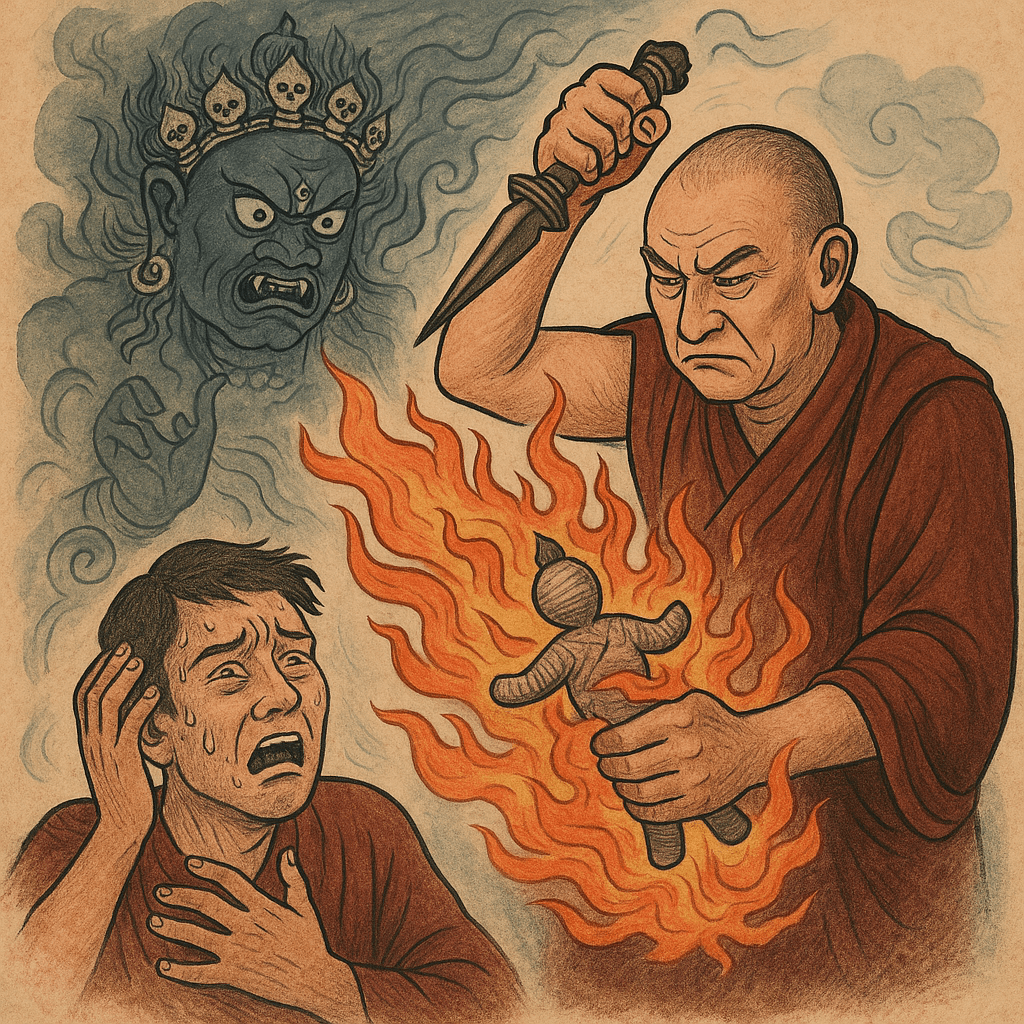
It is not far fetched to assert that it is the lama himself bringing about the karmic retribution on the student through black magic rituals using effigies and curses.


The Tibetan Buddhist tradition, especially its Vajrayana (tantric) aspect, contains teachings on wrathful rituals and even sorcery-like practices. These practices have occasionally been used (or misused) by gurus to punish or frighten disciples who violate guru devotion or samaya (sacred vows). Both classical texts and modern accounts document such phenomena:

  • Scriptural Warnings of Dire Consequences: Tantric scriptures and commentaries explicitly warn of terrible karmic punishment if a disciple betrays or criticizes their guru. For example, the Kalachakra Tantra says that even a moment of anger toward one’s guru destroys vast amounts of merit and causes rebirth in hell for eons (The Disadvantages of Incorrect Devotion to a Guru | Lama Yeshe Wisdom Archive).

  • Another text states that simply failing to properly honor a guru after receiving teachings can result in “rebirth for one hundred lifetimes as a dog” and then rebirth as a low-caste person or even a scorpion lamayeshe.com. In short, breaking samaya is portrayed as spiritually catastrophic, leading to suffering in this life and the next. These warnings, while couched as impersonal karmic law, create a climate in which gurus are held almost above criticism.

  • Oath-Breakers and Protector Deities: Tantric cosmology includes Dharmapāla (Dharma protectors) bound by oath to protect Buddhist teachings and teachers. Those who break their sacred vows or harm their guru are sometimes called “samaya-breakers” or oath-breakers. Historical texts indicate that oath-breakers were targeted by wrathful rituals. A striking example comes from a 13th-century Tibetan master at Kublai Khan’s court, Ga Anyen Dampa. In a decree mixing politics and magic, Dampa forbade harming his followers through curses or demons, but warned that if anyone disobeyed him, he would “unleash the fierce punishment of the Dharma Protectors” so that their heads would split into a hundred pieces (War Magic: Tibetan Sorcery | Rubin Museum). In other words, the guru swore to call upon wrathful deities to brutally destroy anyone who violated his command. Such records (in this case preserved as a protective charm) show that invoking black magic and protective deities as punishment for disobedience was not unheard of.

  • Effigies and “Black Magic” in Tantric Practice: Tibetan lamas developed elaborate ritual technologies to deal with enemies or detractors. Human effigies and dough figures (torma) are traditional ritual implements used to represent a target in magical rites. According to scholars, a “wide array of images, such as human effigies…or ritual dough-offering sculptures, were employed to…subdue or destroy one’s enemies” (War Magic: Tibetan Sorcery | Rubin Museum). In wrathful rites (such as the gTor dabs or torma-throwing ritual), the lama empowers an effigy with mantras and offers it to wrathful spirits or deities, directing the ensuing harm toward the intended victim. War Magic was even used at state levels, for instance, 12th-century Lama Zhang, a militant yogi, sent cursed tormas and spells against his foes and had protector goddesses like Shri Devi “assist” in battle (War Magic: Tibetan Sorcery | Rubin Museum). These historical uses of violent sorcery, while aimed at external enemies, set a background against which a guru might also target an “enemy” disciple who they feel has betrayed them.

  • Historical Case – The “Cursed Boots” Plot: In 1900, an incident in Lhasa suggests the reality of such magical punishments. The 13th Dalai Lama survived an assassination attempt involving black magic: a certain gifted pair of boots, which caused illness to the wearer, upon close inspection had “a harmful mantra hidden in the sole.” (Treasury of Lives: The Case of the Dalai Lama’s Cursed Boots – Tricycle: The Buddhist Review) The inquiry revealed that the boots were prepared as a curse by a lama famous for sorcery, acting on behalf of a former regent. That sorcerer (Lama Nyaktrul) confessed he was recruited to enchant the boots “as a means to sap the vitality of the Dalai Lama and cause his eventual death” (Treasury of Lives: The Case of the Dalai Lama’s Cursed Boots – Tricycle: The Buddhist Review). The plotters, including the ex-regent, were arrested, confirming this was not mere superstition but a documented attempt to use ritual magic to punish or eliminate a high lama. While this is a political case, it shows that Tibetan lamas did employ curses (mantras on effigies or objects) to secretly harm human targets. It’s a short step to imagine a vindictive guru doing similar things to a personal disciple who is seen as a traitor.

  • Even when literal demons aren’t invoked, the threat of supernatural harm is a powerful tool. Some Vajrayana insiders have noted that gurus sometimes wield samaya as a weapon of fear, warning that if a student breaks their devotion, it will hinder the guru’s life or send the student to Vajra Hell. This can psychologically terrorize students into silence and obedience.

  • Samaya and Guru Devotion as a Control Mechanism: The reverence for gurus in Tibetan Buddhism, while spiritually meaningful in that system, can be abused. Devoted students are taught to see the guru as embodying all Buddhas (The Disadvantages of Incorrect Devotion to a Guru | Lama Yeshe Wisdom Archive), and therefore criticizing the guru is equivalent to criticizing the Buddha himself. This makes any challenge tantamount to sacrilege. Teachers who demand absolute loyalty may invoke wrathful consequences to enforce it. In the lore, breaking samaya not only brings karmic punishment but may incite the guru’s protector spirits to take revenge. For instance, many guardian deities are oath-bound to “strike down those who break their vows” to the guru or teachings. A protector like Dorje Shugden, controversially, is believed by his devotees to punish monks who “betray” their lineage, an idea which has led to real-world fear and schisms ( Go On, Break Your Samaya | Tsem Rinpoche). Thus, within the context of guru devotion, the line between religious oath and curse can blur: a disciple who disobeys is told they invite not only bad karma but possibly violent divine retribution.

  • To go one step further, it is not far fetched to assert that it is the lama himself bringing about the karmic retribution on the student through black magic rituals using effigies and curses. These practices are particularly potent because the disciple would have opened themselves up to being possessed by the guru’s yidams and protectors through the empowerments and teachings they received from the guru. In addition, the guru is able to enter the mind and body of the disciple magically. See Tantric Astral Projection, the Guru’s Power to Liberate or Condemn. So basically, the potential enemy is already camped within the body/mind/spirit of the victim, waiting to strike should there be any samaya breakage. Although the tantric methods contain practices to repair broken samaya, the student/victim is not always aware that he has offended the guru and been condemned as an “unripe vessel” until it is too late.

In summary, credible sources, from canonical texts to academic studies and personal testimonies, support the claim that some Tibetan Buddhist gurus have used wrathful magic to punish dissenters. Traditional scriptures describe horrific fates for disciples who violate samaya, and Tibetan histories recount lamas employing curses, effigies, and protective deities to destroy enemies and “oath-breakers.” These examples, past and present, illustrate how the immense power ascribed to Vajrayana masters can morph into a tool of coercion, a “dark side” of guru devotion that Buddhist scholars and leaders are increasingly acknowledging. The evidence is admittedly esoteric, but it paints a consistent picture: under the pretext of protecting the Dharma or upholding sacred vows, some gurus have indeed used wrathful magic, rituals, or effigies to inflict harm on those who oppose or disobey them.

Sources: