
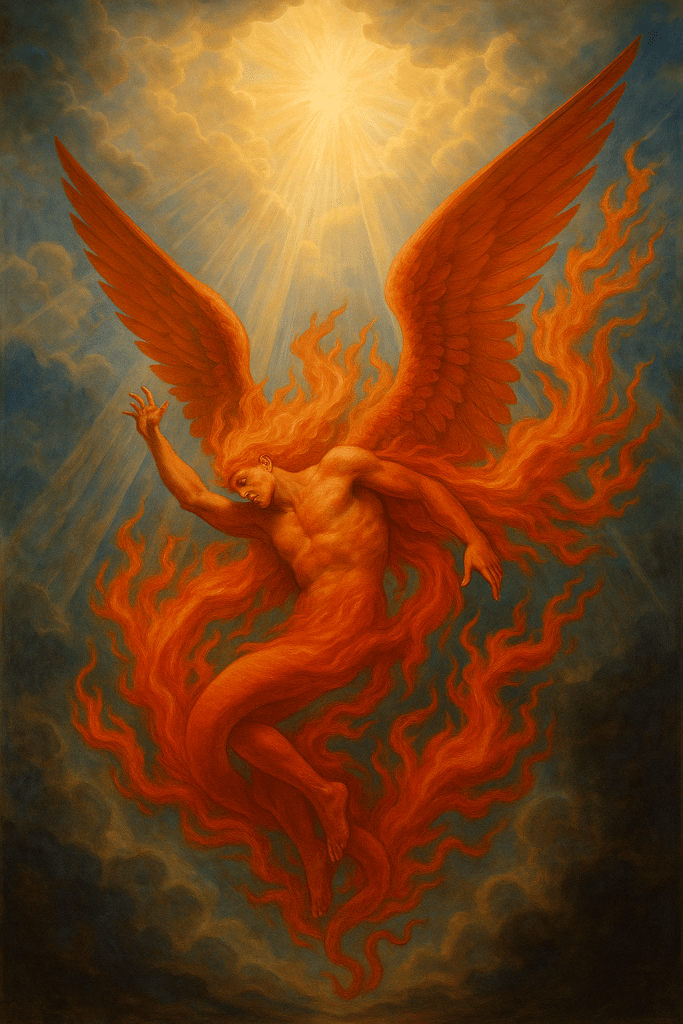
What If the Kundalini Serpent Fire Was Once Angelic?


What if some of the radiant beings that ancient texts call Seraphim, the fiery, serpentine angels who once circled the throne of God, fell from that high order? The Hebrew word saraph itself means both burning one and serpent. In that ambiguity lies a bridge between the flaming spirits of heaven and the serpent powers found in other traditions.

Across the world, in the Sanskrit Purāṇas and yogic literature, there are also serpentine intelligences: the Nāgas, the Kundalinī energy, and the goddess figures who appear surrounded by flames. The sage Patañjali, author of the Yoga Sūtras, is deeply linked with serpent symbolism. In Indian mythology, he is sometimes described as an incarnation (avatāra) of the serpent deity Ādiśeṣa, or Ananta, the cosmic serpent who supports Viṣṇu. Ādiśeṣa is said to have descended to earth to bring knowledge that would relieve human suffering. This connection is why Patañjali is often portrayed with a serpent hood behind his head or a serpent body below the waist. Whether or not serpent spirits literally whispered the Yoga Sūtras to him, serpent imagery pervades yogic and tantric cosmology. The Nāgas are keepers of divine wisdom, and Kundalinī is envisioned as a coiled fiery energy at the base of the spine that awakens through disciplined practice. Over time, these motifs merged into a vision of serpentine power as both the source and the path of revelation. Suppose these mythic beings were echoes of the same order of spirits, glimpsed through another cultural lens. If the Seraphim of the Old Testament were “burning ones,” what would a fallen Seraph look like to those who encountered its power? Perhaps like the Kundalinī Śakti, a current of fire roaring through the body, consuming and transformative, perilous and hideous.

In Tibetan tantric art, figures such as Vajrayoginī blaze with this same imagery. She stands wreathed in flame, hair flying, a garland of human heads around her neck: a being of immense energy and occult knowledge. To her accomplished devotees she is enlightenment embodied, but to others overwhelmed by her force, the experience could resemble an encounter with a terrifying, cosmic intelligence that feels at once divine and frightfully destructive.

In Christian cosmology, the Seraphim stood closest to the divine light, their essence described as pure burning love. If the story of the angelic rebellion is true, the fall of Lucifer and his host might be understood as the perversion of that love for God turned inward toward self-worship. The Seraphs, if any joined that rebellion, would have fallen from the highest heaven to earth yet carried the memory of their incandescent proximity to the Most High. After such a fall, their nature would remain fiery but unmoored, no longer worshipping the divine but seeking vessels in which to become divine objects themselves, demanding reverence rather than giving it. Their rebellion took the form of imitation, of becoming godlike and leading humans away from God through elaborate systems of spiritual artifice. Seen through that lens, the serpent fire that rises in the body could be a vestige of this celestial descent, a remnant of the same luminous essence striving to return upward yet incapable of abiding in heaven because of their grave sin. In mythic terms, these fallen Seraphs might not have become the grotesque demons described by some exorcists but radiant, fallen intelligences deprived of their proper axis.

Catholic exorcists often describe demons as denizens of hell, creatures of stench, mockery, and degradation that feed on blood and fear. Yet if a third of the angels fell, the fallen host was not of one kind alone. Tradition holds that beings from all nine choirs joined the rebellion, from the lowly messengers to the highest Seraphs who once blazed before the throne. After the fall, these spirits lost their divine orientation but not their essential nature: fiery where they had been fiery, clever where they had been wise. In rebellion they became hierarchies of distortion, a dark mirror of heaven. Some manifest as the grotesque forms exorcists encounter; others as subtler intelligences still bearing the trace of their former luminosity. And what of the Nephilim, the offspring of the “sons of God” and human women? When they died, it is said, they became wandering spirits of great malice. “Demon,” then, is not a single species but a spectrum of fallen orders, each expressing what it once was in a corrupted form. As one exorcist observed, each fallen angel is a species unto itself. A fallen Seraph would perhaps appear differently from a fallen Power, Dominion, or Nephilim spirit.

If the Kundalinī or tantric fire represents contact with that residual Seraphic current, it may explain why it bears both a luminous and a destructive face. The energy feels ancient and intelligent. The ecstatic experiences described in yogic ascent mirror, in certain sense, a fallen entity yearning to return to its source. The agony that often accompanies a kundalini awakening—the painful burning, the psychic rupture, and the sense of another will within—could be the friction between that powerful celestial energy and the humble human vessel struggling to contain it. Whether one interprets this as possession or not, the pattern remains: what was once angelic becomes dangerous when severed from its orientation toward God and seeking to inhabit a human host.

Whether understood theologically, psychologically, or experientially, the speculation remains: serpent fire is something that seeks to burn within human beings, hoping to be redeemed and adored rather than condemned.

Spiritual paths that promise transcendence through serpent fire often walk a razor’s edge where illumination meets peril. Tantric Deception seeks to explore that tension, showing how practices that seem to lead toward light may instead open gateways into spiritual posession and darkness. What begins as ascent toward divinity can turn into descent into hell, both in this life and beyond. To approach the serpent fire is to confront both heaven and the echo of its fall, a perilous imitation of grace. One might call it a race to the bottom. The fallen angels made their choice long ago, and according to Christian theology there is no return for them. Those who follow, worship, or seek to become like them will share their fate in the same fire reserved for their fallen gods, a place described in Scripture as the final dwelling of the devil, his angels, and all who reject the true light. There they are said to be cast into a lake of fire that burns without end, cut off forever from the presence of the Most High God, where the torment born of rebellion becomes eternal.
A Testimony of Deliverance from Demonic Deception on Reddit


I came to the realization they were actually evil (you have to understand they can pretend to be good, even despite their demonic names, and twist your mind into believing in them—and it feels very real)—but I couldn’t resist their power.”

They’d love bomb me and then in the next breath become really nasty. Eventually it got to the point I’d see Lucifer walking around my apartment, as a real man, and then take control of my body…and end up raping me.”

These words, pulled from a harrowing testimony posted on Reddit, felt like echoes of my own past, so chillingly familiar that I found myself nodding.

The author of the post, anonymous but heartbreakingly real, shares a decade-long descent into Luciferianism, New Age spirituality, kundalini experiences, possession, and finally, miraculous deliverance by Jesus Christ. Her story is raw, detailed, and unapologetically honest. And for those of us who have lived through the spiritual counterfeit, it rings true on every level.

Like her, I once believed the false light was real. In my case, it came in Tibetan robes, wrapped in Buddhist philosophy and tantric mysticism, cloaked in teachings about “enlightenment” and “emptiness.” Before my first three-year retreat in my twenties, my retreat lama (guru) love-bombed me. He saw my spiritual hunger and poured affection, flattery, and attention into me until the day I resisted his sexual advances. Then his interest in me turned to cruelty. The same happened again, years later, with my second three-year retreat root guru. It’s a familiar pattern to survivors of spiritual abuse: seduction, betrayal, and punishment.

The Reddit testimony describes a similar spiritual seduction, initially sweet and ecstatic, culminating in a brutal loss of bodily autonomy. Demonic spirits love-bombed her, appeared to her as beautiful, powerful entities and then turned violent and abusive, eventually raping her both spiritually and physically. She writes of Lucifer “walking around her apartment… and taking control of her body.” I, too, experienced possession after tantric rituals designed to merge with deities. The difference is, in Tibetan Buddhism, such possession is framed as “blessing.”

And like her, I couldn’t break free until I cried out to Jesus, not under pressure, but because I had nowhere else to turn. When I finally surrendered, I, too, felt deliverance (still ongoing) that was cleansing, and unmistakably holy. It felt like the definite breaking of chains.

This woman’s account is long, but worth reading. You can find the full testimony here. It’s a sobering reminder of how widespread and insidious these spiritual deceptions are and how they shape-shift across traditions, religions, and cultures, but always carry the same fingerprints: seduction, confusion, torment, and ultimate destruction of the soul.

Her courage in speaking out is an act of spiritual warfare, and I share this not to sensationalize her story but to affirm: you are not alone. And yes, there is a way out.

The Counterfeit Kingdom: How Occult Religions Imitate the Catholic Church

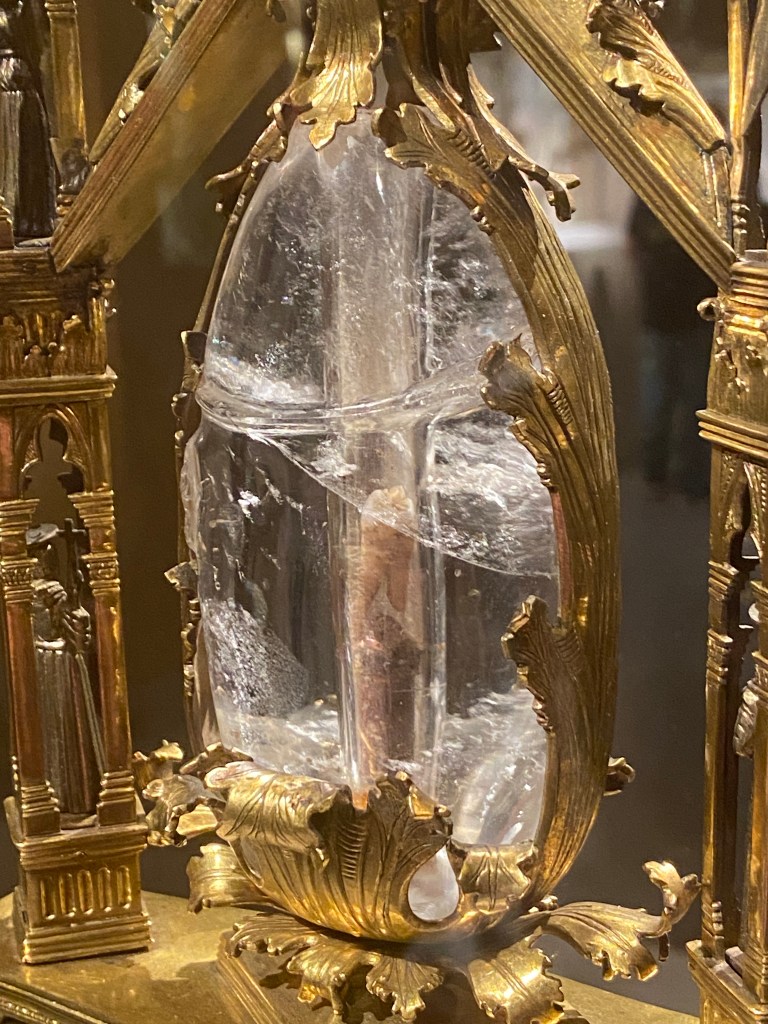
Relic of St. Mary Magdalene in the Metropolitan Museum, NYC


There is a strange and disturbing trend among occult and demonic religions, particularly within esoteric branches of Buddhism, such as Tibetan Vajrayana. These traditions go to great lengths to mimic, distort, and counterfeit elements of the Catholic faith. Why? Because Satan has no creativity of his own. His kingdom is one of imitation, distortion, and inversion. And when we look closer, it becomes chillingly clear: many of these occult systems are designed as spiritual forgeries, imitating the truths of the Catholic Church while replacing Christ with false gods and demons.

Here are just a few examples.


Relics: Holy vs. Unholy

In Catholicism, relics are a beautiful and reverent way the faithful connect with the saints in heaven. The bones, hair, and clothing of saints, when venerated properly, are physical reminders of lives of holiness and union with Christ. First-class relics (parts of a saint’s body), second-class relics (items the saint used), and third-class relics (objects touched to a first-class relic) are all part of an ancient, sacred tradition rooted in the Incarnation: God came in the flesh, and through His Body and those who share in His holiness, the physical becomes a channel of grace.

Now compare this to Tibetan Buddhism and other occult traditions.

Tibetan lamas preserve the bones and hair of deceased teachers and display them in shrines. In some cases, these relics are even mixed into pills or powders thought to convey “blessings” or spiritual power. Even more shockingly, there are “blood pills” created from the blood of high lamas, dried and consumed by devotees, believed to transfer the lama’s blessing and heal the disciples’ illnesses.

What we see here is not simply reverence for a teacher but an occult inversion of the sacred. These objects are treated as talismans or sources of supernatural power, often wrapped in secrecy, ritual, and magical thinking.


Apostolic Succession vs. Tantric Lineage

The Catholic Church has an unbroken apostolic lineage going back to Christ Himself. This is not just symbolic but the real spiritual authority passed from bishop to bishop, from the Apostle Peter to the present-day pope. The sacraments are valid because of this lineage. The Holy Spirit moves through it, not because of magical powers or personal charisma, but because of Christ’s promise to His Church.

Tibetan Buddhism, too, places massive emphasis on “lineage” in the passing of initiations, teachings, and realizations from teacher to student. They claim these go back to the historical Buddha, Sakyamuni. But here’s the problem: the tantras, the core of Tibetan esoteric practice,did not exist during Sakyamuni Buddha’s life. These were later developments, many of which emerged between the 5th and 10th centuries AD, centuries after the Buddha died.

So how do they justify their claims? Through visions, dream revelations, hidden treasure texts (termas), and secret transmissions from spirit beings. These are not testable or historically verifiable. Instead, they mimic the structure of apostolic succession while relying on supernatural claims rooted in occultism. It’s a counterfeit version of Catholic apostolic lineage, one that replaces the Holy Spirit with “dakinis,” “protectors,” and wrathful spirits.


Blessed Sacrament vs. Tantric Empowerments

In the Catholic Church, the Eucharist is the Real Presence of Jesus, body, blood, soul, and divinity. It is the highest form of worship and union with God. Only validly ordained priests can consecrate the Host, and it is surrounded with reverence and liturgy.

IIn tantric Buddhism, “empowerments” are elaborate rituals meant to grant spiritual powers, open energy channels, and “ripen” the disciple for advanced practices. They are sometimes sexually charged, invoking deities (who are really demons in disguise), and can involve ingesting “nectars,” or entering into trance states. Many initiations are based on “secret” transmissions, whispered lineages, or magical seals. These seals are believed to imprint a spiritual mark or bind the practitioner to a specific deity, practice, and lineage. But this is not unique to Tibetan Buddhism. Magical seals are also found in Satanism, Luciferianism, and ceremonial magic, where they are used to summon or bind spirits and demons in exchange for occult knowledge, power, or protection. These seals are spiritual contracts or expressions of unseen allegiances, and their use is never neutral. They are tools of spiritual manipulation that open the soul to influence, possession, or bondage by demonic spirits. In these traditions, the seal acts as a gateway or portal, and it is binding, a counterfeit version of the indelible mark left by the Holy Spirit in baptism or confirmation. Where the Church seals the faithful with chrism and the sign of the cross, occult traditions seal their initiates with marks of spiritual enslavement.

Chrism refers to a consecrated oil used in the Catholic Church during certain sacraments, specifically Baptism, Confirmation, and Holy Orders. It is a mixture of olive oil and balsam, blessed by a bishop during Holy Week.

The use of chrism is deeply symbolic:

  • It represents the Holy Spirit and divine anointing.
  • It marks the person as set apart for God, sealed with grace and incorporated into Christ.
  • The anointing with chrism leaves an indelible spiritual mark on the soul, which can never be removed.

The tantric empowerments claim to transform the practitioner’s body, speech, and mind into that of a deity but again, this is a counterfeit. Instead of communion with God through grace, it’s the deification of the self through ritual manipulation and demonic assistance.


The Church Triumphant vs. the Pantheon of Demons

Catholics honor the communion of saints, those in heaven who intercede for us and serve as models of holiness. Saints are not worshipped; they are venerated. The glory always goes to God.

Tibetan Buddhism features a dizzying pantheon of “yidams” (meditational deities), “protectors,” and “enlightened deities” that are summoned, visualized, and sometimes merged with through complex meditations. These include wrathful, terrifying figures in colors of blue, red, and black, with fangs, skulls, and weapons, dripping with blood or dancing on corpses. Vajrayogini, for example, is often visualized standing on a human corpse, holding a flayed skin and drinking from a skull cup. Although these are claimed to be symbols of transcendence, they are actually demonic imitations of holiness.


Satan’s Strategy: Imitation, Not Innovation

Why does the enemy copy the Church? Because the Catholic Church is the true Bride of Christ. Satan can’t create truth, but he can twist it. His most dangerous weapons are not outright lies, but distorted half-truths wrapped in spiritual language. He dresses up darkness to look like light.

Tibetan Buddhism and similar occult systems offer spiritual hierarchy, ritual, relics, and transmission, but without Christ. They offer communion, but with spirits and demons. They offer transformation, but into false gods, not saints.


The Real Power: Jesus Christ

There is no substitute for the true power of God through Jesus Christ. No blood pill, no tantric lineage, no magical empowerment can wash away sin or bring eternal life. Only Christ, crucified and risen, can do that.

For those who have been caught up in these counterfeit systems, whether through curiosity, spiritual seeking, or deception, it is important to remember that there is hope and it is possible to extricate oneself. Jesus is the Way, the Truth, and the Life and his truth is not hidden in secret teachings or passed down in esoteric rituals. It is freely offered to all who repent and believe.

The History of Tantra


The word “Tantra” evokes sex and mysticism in the modern world. However, it is a spiritual practice fraught with controversy and potential harm. Though its origins are deeply embedded in South Asian spiritual traditions, Tantra has long been a subject of debate for its questionable methods and the risks it poses to practitioners.

Questioning Tantra’s Validity in Indian Buddhism

One of the most contentious aspects of Tantra in Indian Buddhism is its origins. Did these esoteric practices truly originate with the Buddha, or do they stem from darker, occult sources? Many argue that Tantra’s reliance on rituals, mantras, and deity possession deviates sharply from the Buddha’s original teachings. Instead, Tantra seems to delve into a realm of magic, where practitioners invoke powerful spirits or deities that are difficult to control. The secretive and arcane nature of Tantra has even drawn comparisons to Western Satanism, with parallels in symbolic inversion, forbidden knowledge, and the harnessing of dark energies. These troubling similarities raise serious questions about the true intent and origins of Tantra.

Tantra is believed to have emerged in India around the 5th to 7th centuries CE as a response to the rigid practices of Vedic Hinduism and early Buddhism. Its origins are steeped in secrecy and myth. The term “Tantra,” means “to weave” or “to expand,” and hints at its darker origins: the weaving of esoteric forces into the human psyche.

The Core Principles of Tantra: A Double-Edged Sword

Tantra appears to challenge dualistic thinking, presenting the material and spiritual worlds as interconnected:

Shakti and Shiva: While the union of Shakti (divine feminine) and Shiva (divine masculine) is portrayed as a balance, the rituals associated with this concept often involve the invocation of chaotic energies that can destabilize practitioners.

Sacredness of the Body: Tantra’s reverence for the body as a vehicle for enlightenment can lead to practices that blur ethical boundaries, and expose aspirants to physical and psychological risks. These practices often involve an extreme form of yoga that includes breath manipulation and physical postures designed to awaken kundalini energy. This wild and often uncontrollable force is said to be a dormant energy that resides at the base of the spine, but in reality, it involves possession by a spirit.

Ritual and Symbolism: The intricate rituals, mandalas (geometric designs), and mantras (sacred sounds) used in Tantra can act as portals and invocations to preternatural forces.

Tantra in Hinduism and Buddhism

While Tantra is often associated with Hinduism and Buddhism, its practices diverge significantly from the ethical foundations of these traditions. In Hinduism, Tantra became linked with Shaivism and Shaktism, incorporating rituals that many consider to be unorthodox and even dangerous. For instance, human sacrifice, though outlawed, is still secretly practiced in India. In Buddhism, Tantra’s form, Vajrayana, emerged as an esoteric path that relies heavily on guru worship, deity yoga, and visualization. These methods often blur the line between spiritual growth and occult manipulation. Critics argue that such practices betray the Buddha’s emphasis on ethical conduct and mindfulness.

The Spread and Evolution of Tantra: A Troubling Legacy

As Tantra spread beyond India, it adapted to local cultures but retained its core. In Tibet, for instance, Tantric rituals merged with indigenous Bon practices, creating a potent fusion. During the colonial era, Western scholars sensationalized Tantra, focusing on its sexual practices and scary looking deities while ignoring its broader implications. This misrepresentation led to a rehabilitation of Tantra in the West in the second half of the 20th century that idealized Tibetan Buddhist Tantra as purely benevolent, reframing and obscuring its darker aspects.

In the modern world, Tantra has been rebranded as a tool for personal empowerment, often stripped of its spiritual and cultural context. However, this simplification overlooks the risks associated with its practices. Authentic Tantra, with its emphasis on invoking and channeling preternatural energies, is a perilous path that can lead to psychological torment and spiritual dissolution. The allure of Tantra’s supposed transformative power can blind practitioners to its potential for harm.

A Warning

The history of Tantra is not merely a tale of spiritual innovation but also a cautionary story of occult manipulation and risk. Its practices, which often involve possession by spirits or deities, can have dire consequences even if approached with extreme caution. These entities, if angered or improperly controlled, can turn on the practitioner, leading to profound suffering. While Tantra may promise enlightenment, its methods carry a heavy price. Those who seek spiritual growth would do well to heed these warnings and consider safer, more ethical paths.