
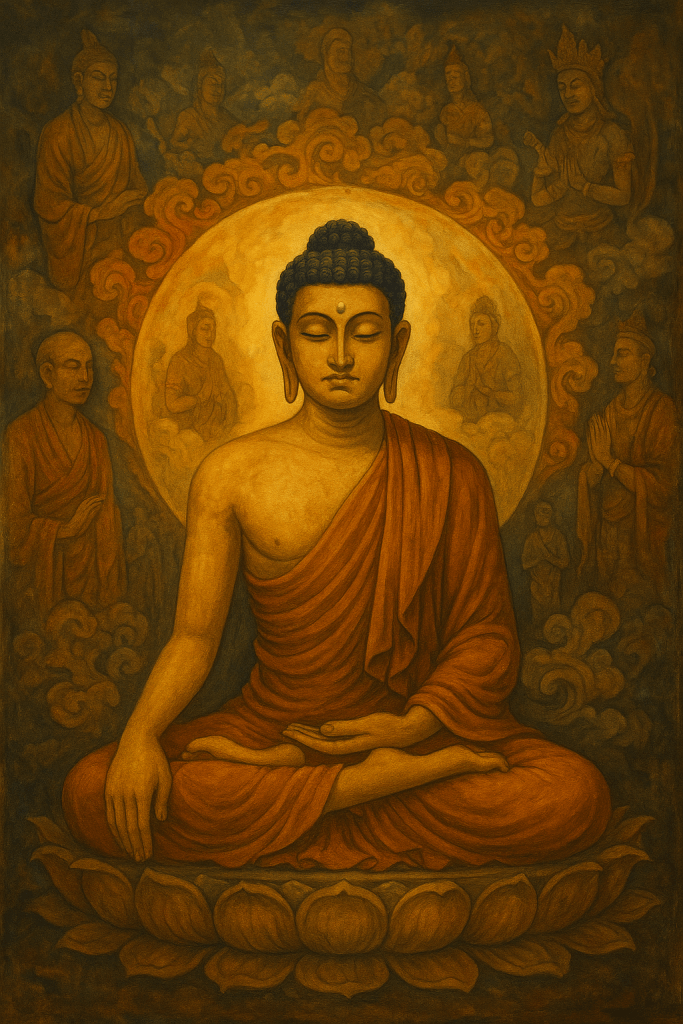
How Tantra Masqueraded as Buddhism: the Vajrayāna Deception


Vajrayana Buddhism, also known as Tibetan Buddhism or Tantric Buddhism, stands out for its rituals, deity worship, and complex esoteric practices. Its mantras, mandalas, and meditations on wrathful and yab/yum deities bear clear resemblance to Hindu Tantra, Vedic ritualism, and indigenous spirit cults.

So how did it convince anyone, especially devout Buddhists, that it was authentically taught by the historical Buddha?

The answer lies in a strategic combination of hidden teaching narratives, scriptural mimicry, ritual power, and imperial patronage. Let’s explore how this transformation occurred and what it means when viewed through the lens of Catholic faith and biblical discernment.

Secret Teachings: “The Buddha Taught It, But in Secret”

Vajrayana scriptures claim that the Buddha did teach tantra, but only in secret, to highly realized disciples. These teachings were said to have been hidden in celestial realms, entrusted to beings like Vajrapani or dakinis, or taught in the Buddha’s “enjoyment body” (sambhogakaya) form in other worlds such as Akanistha.(1)

This tactic mirrored earlier Mahayana developments, where new sutras like the Lotus or Avatamsaka were claimed to be higher revelations spoken by the Buddha, but not understood by his early disciples. The concept of esoteric knowledge reserved for the spiritually mature made these late texts seem like rediscovered treasures, rather than innovations.

Scriptural Mimicry and Retroactive Legitimization

To reinforce their authority, tantric scriptures deliberately mimicked the structure of traditional sutras. They often began with the familiar phrase, “Thus have I heard,” and depicted the Buddha teaching not only in celestial realms surrounded by bodhisattvas, but sometimes in radically transgressive settings such as charnel grounds, encircled by ḍākinīs and wrathful deities. These texts introduced elaborate cosmologies, detailed ritual instructions, and esoteric vows, presenting them as timeless wisdom, even though they were composed many centuries after the Buddha’s death.[2]

Authors also invented lineages, claiming that tantric teachings had been passed down secretly from Vajrapani to Nagarjuna, or from Padmasambhava to Tibetan kings.

Syncretism with Hindu and Folk Traditions

Instead of denying its similarities with Hindu Tantra, Vajrayana reinterpreted them. Wrathful deities were said to be enlightened Buddhas. Sexual rituals were described as a symbolic means to transform desire into wisdom. Offerings of blood, bones, and taboo substances were spiritualized as purifications of dualistic perception.

By repackaging Vedic and folk practices into a Buddhist framework, Vajrayana could absorb local traditions and declare them “Buddhist skillful means.”

Imperial Support and Monastic Integration

Tantra spread rapidly through the support of kings and monasteries. In Tibet, tantric masters were invited to subdue native spirits, secure political power, and perform rituals for prosperity. At Indian centers like Nalanda and Vikramashila, tantric scholars and monks practiced Mahayana logic by day and tantric visualization by night.

With the backing of the state and the academic establishment, Vajrayana was not seen as a fringe practice but as the “highest vehicle” of Buddhism.

Ritual Power and Psychological Experience

For the average practitioner, tantra “worked.” It offered visions, emotional catharsis, ritual protection, and the promise of fast-track enlightenment. The experiential pull of mantra, deity yoga, and initiation ceremonies gave people tangible results even if the doctrinal basis was historically shaky.

In the end, many believed not because of historical evidence, but because the system delivered experiences of spiritual intensity.

How Christianity Views This: The Domain of the Second Heaven

From a biblical and Catholic perspective, this raises serious concerns. The spiritual beings Vajrayana practitioners encounter, wrathful deities, dakinis, yidams, do not proclaim Christ as Lord and Savior. They do not point to the God of Abraham, Isaac, and Jacob. They offer power and enlightenment through self-transformation, not redemption.

The Bible is clear: Satan is the prince of the power of the air, ruling the spiritual domain between heaven and earth until Christ returns (Ephesians 2:2). What some refer to as the “second heaven” is where fallen angels operate, deceiving through false light, hidden knowledge, and seductive spiritual experiences.

Teachers like Derek Prince and Dr. Michael Heiser have explained how fallen entities inhabit unseen realms and impersonate divine figures such gods, ascended masters, or beings of light. Applying this view, the Buddhist realm of Akanistha, where the Buddha is said to teach in his sambhogakaya form, may not be a divine domain at all, but a carefully constructed counterfeit, orchestrated by spiritual powers aligned against the Kingdom of God.

This helps explain how a system like Vajrayana could emerge long after the Buddha’s time, imbued with supernatural power, spiritual visions, and doctrinal sophistication, yet still operate in direct opposition to the gospel of Jesus Christ.

Final Reflection: What About the Historical Buddha Himself?

This raises a deeper question: What about the historical Gautama Buddha?

His teachings, centered on renunciation, ethical conduct, and insight, seem far removed from tantric fire offerings, deity visualizations, and magical spells. He did not claim to be a god. He emphasized detachment from craving and moral clarity. So, was he simply a wise man? Or was he also deceived?

From a Catholic and biblical perspective, any system that does not point to Christ as the way, the truth, and the life (John 14:6) must be seen as incomplete at best, and spiritually dangerous at worst. Even teachings that emphasize compassion and morality can become a snare if they direct people away from the living God.

It is possible that the historical Buddha, though perhaps sincere and ethically inclined, encountered spiritual influences he did not fully understand. If he received his insights through meditation without divine revelation, then he may have opened himself to guidance from fallen beings presenting themselves as enlightened or falsely divine. This is a sobering possibility, but one that must be considered if we are to remain faithful to biblical truth.

The gospel does not offer esoteric techniques. It offers a person, Jesus, who does not ask you to awaken into the realization of emptiness. He calls you by name into communion with him, into truth, and finally, into eternal life.


Footnotes:

(1) Akanistha, also spelled Akaniṣṭha, is considered in Mahayana and Vajrayāna cosmology to be the highest of the seventeen or eighteen heavens in the form realm (rūpadhātu), and specifically the realm where Buddhas in their “enjoyment body” (sambhogakāya) manifest and teach advanced bodhisattvas. It is portrayed as a pure, radiant dimension beyond ordinary perception, where tantra and esoteric teachings are said to be revealed. From a Christian perspective, such realms existing in the unseen spiritual domain, may correspond to what theologians like Derek Prince and Michael Heiser describe as the “second heaven,” a sphere under temporary dominion of fallen angelic beings capable of impersonating divine figures (see Ephesians 6:12, Daniel 10:13).

[2] Alexis Sanderson, “The Śaiva Age: The Rise and Dominance of Śaivism during the Early Medieval Period,” in Genesis and Development of Tantrism, edited by Shingo Einoo (Tokyo: Institute of Oriental Culture, University of Tokyo, 2009), pp. 124–126. Sanderson provides detailed evidence that Buddhist tantras were modeled after Śaiva texts and appeared centuries after the Buddha’s life.

David B. Gray, The Cakrasamvara Tantra: The Discourse of Śrī Heruka, (New York: American Institute of Buddhist Studies, 2007), Introduction, pp. 18–25. Gray discusses the charnel ground setting and the structure of tantric texts, including the invocation of ḍākinīs and wrathful deities, and their divergence from earlier Buddhist sūtra literature.

Tantric Āveśa and Demonic Possession: A Comparative Exploration


Āveśa (Sanskrit) refers to a state of spiritual possession or divine inhabitation in which a deity or sacred power “enters” and dwells within a person. The word literally means “an entering” or “fusion,” describing the incorporation of divine power into the human body. Such forms of sacred possession have long been central to Indian Tantric practice, invoked for both worldly benefits (bhoga) and spiritual liberation (mokṣa). This is often contrasted with demonic possession in Christian theology, typically characterized as an involuntary affliction by an evil spirit.

Cross-cultural studies note that spirit possession can be either voluntary or involuntary, and it is interpreted differently depending on the tradition. Western occult traditions, such as Luciferianism, may view possession by a demon as desirable, even leading to a so-called “perfect possession.” In Christianity, however, even voluntary possession by a demonic force is considered evil. The question then arises: who or what possesses the practitioner in Eastern contexts?

Towards the end of my 35 years in Tantric Buddhism, I came to believe that the force presenting itself as a deity was, in fact, demonic. In what follows, I will examine the phenomenon of āveśa in two major esoteric traditions, Hindu Tantra (especially Shaiva lineages such as Kashmir Shaivism), and Tibetan Vajrayāna Buddhism. I will contrast these forms of divinely sanctioned possession with demonic possession in Christian and occult frameworks, drawing from historical sources, academic analysis, and personal experience.


Āveśa in Hindu Tantric Traditions

Scriptural Origins and Tantric Development

The Sanskrit root ā-viś (to enter) appears in early Indian texts, foreshadowing the later Tantric elaboration of āveśa.1 From the 5th to 11th centuries, Tantric scriptures across Śāiva, Śākta, and Buddhist milieus incorporated āveśa into ritual practice. Scholar Vikas Malhotra describes āveśa as the “entrance or fusion of oneself with the deity,” central to both magical and liberatory goals.2

These practices utilized mantras, mudrās, and nyāsa (installing mantras on the body) to induce the deity’s presence. Often this process was linked to śaktipāta, or the descent of divine energy. Over time, āveśa came to refer not just to deity possession, but a range of spiritual states culminating in union with Śiva.3 In contrast to exorcism (removing evil spirits), this adorcistic form of possession aimed to invite a divine presence.

Kashmir Shaivism and Samāveśa

In the Trika system of Kashmir Shaivism, the term samāveśa refers to full ontological immersion in Śiva-consciousness. Abhinavagupta, a 10th-century Hindu philosopher and Tantric adept, defined it as a merger of individual and divine being, sometimes accompanied by shaking, trance, or devotional ecstasy.4 Rituals such as nyāsa or advanced mudrā usage were seen as ways to divinize the body. Kṣemarāja, a key Trika commentator, emphasized that the body itself becomes a vessel for cosmic forces, eroding the sense of ego.5

This idea extended to daily ritual. The practitioner installs divine presences into various body parts—e.g., “May Brahmā be in my genitals, ViṣŇu in my feet, Śiva in my heart”—until the self is transformed.6 Āveśa was also connected to śaktipāta dīkṣā (initiation by grace), which Abhinavagupta saw as the guru’s transmission of divine force into the student.

Historical sources and hagiographies portray this not as pathology but sacred awakening. In the Bhakti tradition, saints like Caitanya and Rāmakṛṣṇa exhibited signs interpreted as divine possession, a loss of ordinary consciousness during worship or dancing in states of trance. In goddess worship, the ecstatic state of bhāva can evolve into full possession by a fierce Devī or goddess.

Induced Trance in Ritual Practice

Possession is not accidental; it is often deliberately induced. Contemporary folk-Tantric rites like Theyyam in Kerala reenact this vividly. The performer undergoes intense ritual preparation, dons a sacred headdress, and becomes a vessel for the deity. His demeanor, voice, and movements change dramatically, and devotees approach him as a god.7 These techniques including fasting, music, sacred garb, and mantra, parallel ancient Tantric rituals meant to induce āveśa.

Importantly, this experience is consensual. A priest may invite a deity for oracular guidance or blessing. The Tantric yogi similarly invites identification with Śiva. As Frederick Smith notes, such possession is the most valued spiritual experience in many Indian settings.8 Advanced yogis even practiced para-kāya praveśa, the entry of one’s consciousness into another’s body, a form of high-level āveśa.9


Āveśa (Possession) in Tibetan Vajrayāna Buddhism

Deity Yoga and Guru Inhabitation

Though the term “possession” is less used, Vajrayāna emphasizes divine inhabitation. In Deity Yoga, one visualizes oneself as a yidam (meditational deity) and invites the deity’s wisdom aspect (jñānasattva) to merge with the visualization (samayasattva). Through mantra and meditation, the practitioner dissolves ego and identifies as the deity.

While framed as an enlightened act, in practice there is no safeguard against malevolent forces. Many Tibetan rituals derive from the Yoginītantras, esoteric texts filled with wrathful, dangerous dākinīs. These entities are unpredictable and must be carefully propitiated. Practitioners hope to merge with them for wisdom and power, but failure often results in spiritual collapse or madness. One either becomes “enlightened” or is destroyed.

My personal experience, including participating in two three-year retreats, led me to conclude these deities are not divine but demonic. After prolonged practice, I experienced terrifying possession states, torturous sensations, and an uncontrollable kundalini awakening. While there were moments of bliss and magical phenomena, the final result was spiritual devastation.

Guru Yoga and Transmission

Guru Yoga, especially in the Nyingma and Kagyu lineages, mirrors āveśa. The practitioner visualizes the guru dissolving into them, merging body, speech, and mind. This is intended to produce an inseparable union. Some historical accounts even describe instant enlightenment via physical gestures or verbal commands from a master, a form of mind-to-mind transmission akin to possession.

Some Vajrayāna practices involve obvious demon possession. The Nechung Oracle, for example, enters trance during elaborate rituals, allowing the deity Pehar to possess his body. Frightening physical changes, voice alteration, and strength are observed. The practice is structured around phowa, a method of ejecting consciousness to allow divine entry.10


Possession as Initiation and Transformation

Both traditions treat āveśa as transformative. In Hindu Tantra, samāveśa may mark initiation or realization. In Vajrayāna, empowerment rituals symbolically install the lineage mindstream into the disciple. When successful, the practitioner believes they have merged with divine consciousness.

The experiences are often euphoric and expansive. Yet, as I learned, they can also become nightmarish. The forces one invokes may not be what they seem. While traditions insist the entities are enlightened or benevolent, there is no proof. Many undergo trauma, dissociation, and spiritual breakdown.


Christian Views of Possession: A Stark Contrast

In Christian theology, possession is demonic by nature. The demon enters uninvited or through occult involvement, and exorcism is the remedy. Symptoms include revulsion to the sacred, altered voices, and loss of control. Unlike tantric āveśa, the demon is not a divine aspect but an evil other. (I should note that the kundalini energy always felt “other” to me, but I was encouraged to see it as a positive experience.)

Catholic doctrine states that even voluntary occult involvement is condemned, seen as opening a door to bondage; the soul remains untouched, but the body and mind may be dominated. Consent may be partial or misguided, but once entered, the demon seeks destruction.

Only the Holy Spirit is seen as a positive presence, and even then, Christian traditions speak of inspiration rather than possession. Some Pentecostal expressions resemble Eastern possession states, but many Christians believe these, too, are counterfeit Holy Spirit experiences linked to kundalini phenomena.

Scripture offers stern warnings:

All the gods of the nations are demons.” — Psalm 96:5 (Septuagint) “They sacrificed to demons, not to God.” — Deuteronomy 32:17

In conclusion: āveśa is framed as a sacred merging in Tantra, but my experience revealed it as demonic deception. Beneath the ritual beauty lies spiritual subjugation. As an exorcist once warned me: Be careful who or what you invite to abide within.


Footnotes

  1. “A Brief Study of Possession in Hinduism Part II: The Spiritual Context,” Indic Today
  2. Vikas Malhotra, ĀveŚan and Deity Possession in the Tantric Traditions of South Asia
  3. Ibid. 
  4. “The Fulcrum of Experience in Indian Yoga and Possession Trance.” 
  5. Ibid. 
  6. Indic Today, op. cit. 
  7. “Theyyam,” Wikipedia
  8. Frederick M. Smith, The Self-Possessed: Deity and Spirit Possession in South Asian Literature and Civilization
  9. Yogasūtra III.38. 
  10. “Nechung Oracle,” Wikipedia