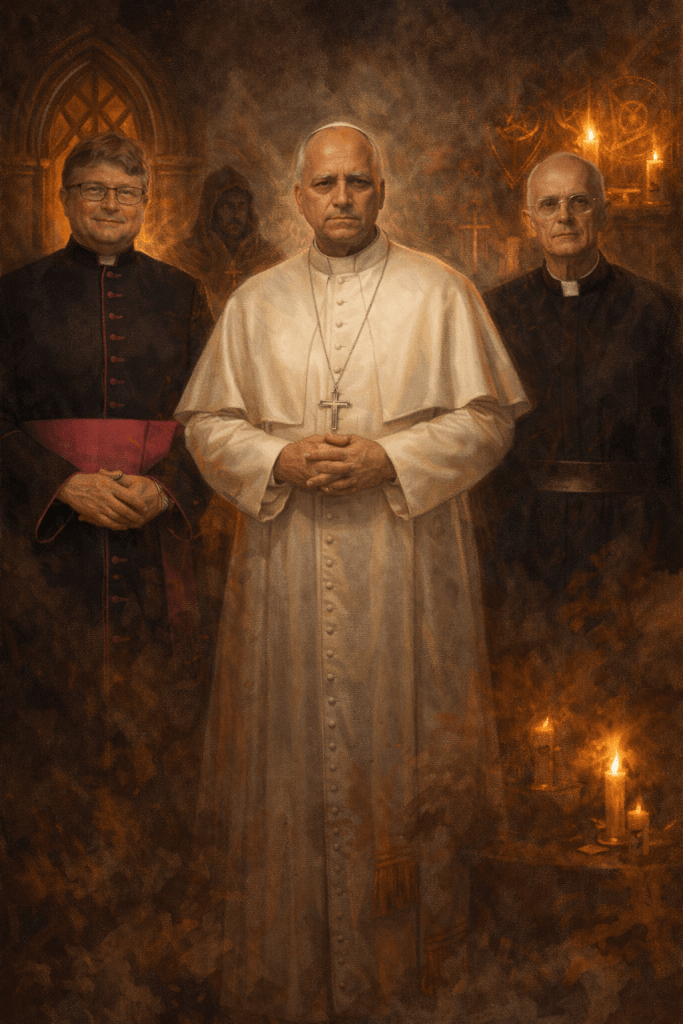
A recent Vatican meeting between Pope Leo XIV and the International Association of Exorcists underscores growing concern within the Church about the spread of occult practices and their spiritual consequences.
According to the exorcists, there has been a “noticeable rise” in involvement with “occultism, esotericism, and Satanism,” developments they associate with increasing cases of spiritual distress.¹ These trends are not viewed as abstract cultural shifts, but as realities encountered in pastoral work.
The delegation stressed that many individuals who engage in such practices experience serious harm, describing “grave spiritual suffering” among those affected.¹ In their view, these are not isolated incidents but part of a broader pattern requiring a structured response from the Church.
“Ignoring these realities leaves many people without an adequate response to grave spiritual suffering.”¹
For this reason, the exorcists emphasized the importance of ensuring that every diocese has properly trained clergy capable of addressing these situations. They called for stronger formation, clearer discernment, and greater institutional readiness.
At the same time, they acknowledged the complexity of these cases. The meeting highlighted the need for collaboration with medical and psychological professionals to distinguish between spiritual affliction and mental health conditions.¹ This cooperation is seen as essential for responsible pastoral care.
The Vatican framed the issue as one of accompaniment and guidance. Many who turn to occult or esoteric practices are described as searching for meaning or relief from personal struggles.¹ From the exorcists’ standpoint, this search can expose individuals to demonic influences that require careful spiritual intervention.
Overall, the meeting reflects a coordinated effort within the Church to respond to what exorcists describe as a growing pastoral challenge: one that involves both spiritual discernment and practical support for those affected.
St. Michael the Archangel, defender of the faithful, stands as heaven’s warrior casting down the forces of darkness and waging relentless battle against demonic powers.
Footnote
Marty Vergel Baes, “Pope Leo XIV Hosts Exorcists at Vatican — Surge in Satanism Cases Raises Concern for Vulnerable Believers,” International Business Times UK, March 23, 2026.
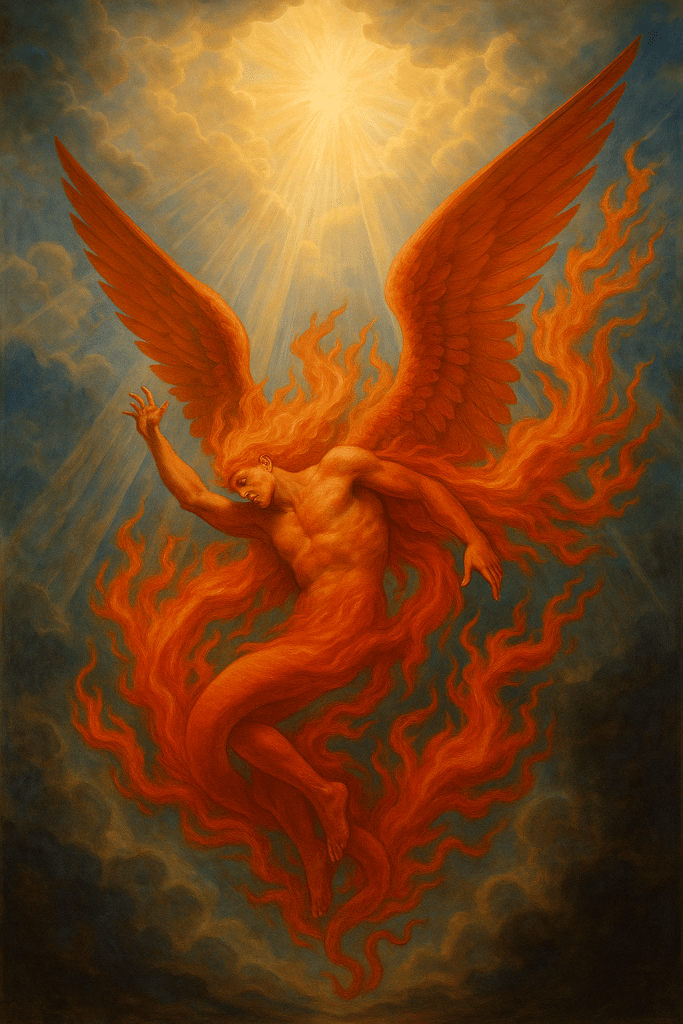
What if some of the radiant beings that ancient texts call Seraphim, the fiery, serpentine angels who once circled the throne of God, fell from that high order? The Hebrew word saraph itself means both burning one and serpent. In that ambiguity lies a bridge between the flaming spirits of heaven and the serpent powers found in other traditions.
Across the world, in the Sanskrit Purāṇas and yogic literature, there are also serpentine intelligences: the Nāgas, the Kundalinī energy, and the goddess figures who appear surrounded by flames. The sage Patañjali, author of the Yoga Sūtras, is deeply linked with serpent symbolism. In Indian mythology, he is sometimes described as an incarnation (avatāra) of the serpent deity Ādiśeṣa, or Ananta, the cosmic serpent who supports Viṣṇu. Ādiśeṣa is said to have descended to earth to bring knowledge that would relieve human suffering. This connection is why Patañjali is often portrayed with a serpent hood behind his head or a serpent body below the waist. Whether or not serpent spirits literally whispered the Yoga Sūtras to him, serpent imagery pervades yogic and tantric cosmology. The Nāgas are keepers of divine wisdom, and Kundalinī is envisioned as a coiled fiery energy at the base of the spine that awakens through disciplined practice. Over time, these motifs merged into a vision of serpentine power as both the source and the path of revelation. Suppose these mythic beings were echoes of the same order of spirits, glimpsed through another cultural lens. If the Seraphim of the Old Testament were “burning ones,” what would a fallen Seraph look like to those who encountered its power? Perhaps like the Kundalinī Śakti, a current of fire roaring through the body, consuming and transformative, perilous and hideous.
In Tibetan tantric art, figures such as Vajrayoginī blaze with this same imagery. She stands wreathed in flame, hair flying, a garland of human heads around her neck: a being of immense energy and occult knowledge. To her accomplished devotees she is enlightenment embodied, but to others overwhelmed by her force, the experience could resemble an encounter with a terrifying, cosmic intelligence that feels at once divine and frightfully destructive.
In Christian cosmology, the Seraphim stood closest to the divine light, their essence described as pure burning love. If the story of the angelic rebellion is true, the fall of Lucifer and his host might be understood as the perversion of that love for God turned inward toward self-worship. The Seraphs, if any joined that rebellion, would have fallen from the highest heaven to earth yet carried the memory of their incandescent proximity to the Most High. After such a fall, their nature would remain fiery but unmoored, no longer worshipping the divine but seeking vessels in which to become divine objects themselves, demanding reverence rather than giving it. Their rebellion took the form of imitation, of becoming godlike and leading humans away from God through elaborate systems of spiritual artifice. Seen through that lens, the serpent fire that rises in the body could be a vestige of this celestial descent, a remnant of the same luminous essence striving to return upward yet incapable of abiding in heaven because of their grave sin. In mythic terms, these fallen Seraphs might not have become the grotesque demons described by some exorcists but radiant, fallen intelligences deprived of their proper axis.
Catholic exorcists often describe demons as denizens of hell, creatures of stench, mockery, and degradation that feed on blood and fear. Yet if a third of the angels fell, the fallen host was not of one kind alone. Tradition holds that beings from all nine choirs joined the rebellion, from the lowly messengers to the highest Seraphs who once blazed before the throne. After the fall, these spirits lost their divine orientation but not their essential nature: fiery where they had been fiery, clever where they had been wise. In rebellion they became hierarchies of distortion, a dark mirror of heaven. Some manifest as the grotesque forms exorcists encounter; others as subtler intelligences still bearing the trace of their former luminosity. And what of the Nephilim, the offspring of the “sons of God” and human women? When they died, it is said, they became wandering spirits of great malice. “Demon,” then, is not a single species but a spectrum of fallen orders, each expressing what it once was in a corrupted form. As one exorcist observed, each fallen angel is a species unto itself. A fallen Seraph would perhaps appear differently from a fallen Power, Dominion, or Nephilim spirit.
If the Kundalinī or tantric fire represents contact with that residual Seraphic current, it may explain why it bears both a luminous and a destructive face. The energy feels ancient and intelligent. The ecstatic experiences described in yogic ascent mirror, in certain sense, a fallen entity yearning to return to its source. The agony that often accompanies a kundalini awakening—the painful burning, the psychic rupture, and the sense of another will within—could be the friction between that powerful celestial energy and the humble human vessel struggling to contain it. Whether one interprets this as possession or not, the pattern remains: what was once angelic becomes dangerous when severed from its orientation toward God and seeking to inhabit a human host.
Whether understood theologically, psychologically, or experientially, the speculation remains: serpent fire is something that seeks to burn within human beings, hoping to be redeemed and adored rather than condemned.
Spiritual paths that promise transcendence through serpent fire often walk a razor’s edge where illumination meets peril. Tantric Deception seeks to explore that tension, showing how practices that seem to lead toward light may instead open gateways into spiritual posession and darkness. What begins as ascent toward divinity can turn into descent into hell, both in this life and beyond. To approach the serpent fire is to confront both heaven and the echo of its fall, a perilous imitation of grace. One might call it a race to the bottom. The fallen angels made their choice long ago, and according to Christian theology there is no return for them. Those who follow, worship, or seek to become like them will share their fate in the same fire reserved for their fallen gods, a place described in Scripture as the final dwelling of the devil, his angels, and all who reject the true light. There they are said to be cast into a lake of fire that burns without end, cut off forever from the presence of the Most High God, where the torment born of rebellion becomes eternal.
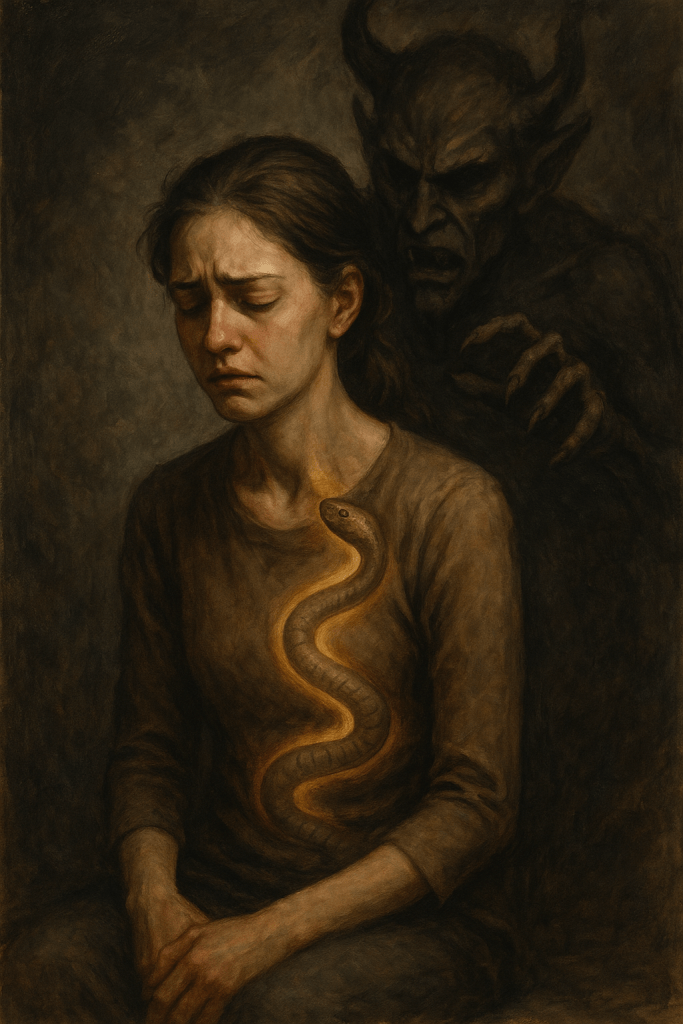
Kundalini is often described in modern yoga and New Age spirituality as a universal spiritual energy coiled at the base of the spine, waiting to rise and bring enlightenment. This portrayal is misleading. In reality, what is called a “kundalini awakening” is better understood as a form of possession. Rather than a benign inner energy, kundalini is a demonic force that enters the human mind-body continuum, hijacks the nervous system, and rewires perception, behavior, and physiology. This explains why the symptoms of kundalini often overlap with those of classic demonic possession.
Symptoms: Kundalini Possession vs. Demonic Possession
Kundalini possession symptoms
Involuntary bodily spasms or kriyas, often violent or exhausting.
A sensation of a serpent or current moving through the spine, causing heat, pressure, or pain.
Rapid swings between bliss and terror, often accompanied by visions or auditory phenomena.
Disassociation and feelings of being controlled by something non-human.
Progressive neurological deterioration: insomnia, paranoia, and psychosis.
Identification with Hindu deities or serpentine archetypes, which parallels demonic manifestations described in other cultures.
Aversion to the sacred, where holy names, prayers, or symbols provoke rage.
Manifestations of supernatural strength or the sudden ability to speak foreign languages.
Violent outbursts, self-harm, or aggression against others.
Distorted voice, grotesque facial expressions, or animal-like behavior.
Physical disturbances such as objects moving, foul odors, or sudden temperature drops.
A clear sense of hostile external control.
Both states are marked by loss of sovereignty and the intrusion of an alien intelligence. What makes kundalini more deceptive is that it cloaks itself in the language of spiritual progress.
The Entities Behind the Possessions
Kundalini-related beings
Kundalini is personified as Shakti, the serpent goddess. While Hindu texts portray her as divine, serpent symbolism universally points to deception and danger, as the serpent has long been associated with Satan in Christianity.
Many afflicted report contact with or identification as Kali, Durga, or other fierce Hindu and tantric Buddhist deities whose attributes of blood, violence, and intoxication align closely with demonic qualities.
Entities in wider demonic possession
Christianity: fallen angels under Satan’s authority.
Islam: malicious jinn, created from smokeless fire.
Judaism: dybbuks, wandering spirits of the dead seeking to inhabit bodies.
Indigenous traditions: hungry ghosts, nature demons, or restless ancestral spirits.
The same destructive force that is worshiped in India as divine feminine energy is interpreted in other traditions as demonic intrusion.
Why Kundalini Possession Often Appears Different
There are many anecdotal accounts of people afflicted by kundalini who do not display the same dramatic symptoms seen in major exorcisms performed by the Catholic Church. They may not display superhuman strength, speak unknown languages, or react violently to holy objects. Instead, their suffering appears as neurological collapse or uncontrollable kriyas.
Why does this happen? One possibility is what some exorcists call “perfect possession.” By willingly engaging in yoga, Eastern meditation, or tantric practices, the person effectively invites the spirit in. Once invited, the demon does not always need to manifest with violence or open hostility. It is already enthroned, so to speak, in the person’s consciousness and nervous system. It burrows in and embeds itself. The possession is often quieter but no less real.
Another possibility is that kundalini spirits simply manifest differently than other categories of demons. The absence of classic symptoms described by the Catholic Church may not mean the person is not possessed. It may mean they are afflicted by a different type of spirit, or by a demon whose preferred mode of influence is more insidious and long-term. Rather than breaking furniture or speaking in foreign tongues, it works by corrupting the nervous system, trapping the victim in cycles of ecstatic highs and devastating lows, and slowly eroding the mind and spirit.
Implications for the Catholic Church
Because many of these cases do not fit the criteria traditionally used to diagnose possession, individuals suffering from kundalini affliction are sometimes turned away by exorcists. Yet the sheer number of Westerners who have turned to yoga, meditation, and tantric practices since the 1960s suggests that the Church may need to reevaluate how possession presents in modern contexts. Kundalini demons may not manifest with the same overt signs as other kinds of possession, but their effects are no less destructive.
To dismiss these cases as mere psychological breakdowns risks ignoring an entire category of demonic assault that has proliferated under the guise of spirituality. The deceptive packaging of kundalini as “spiritual energy” makes it one of the most dangerous forms of possession today.
Yesterday, Dan Rivera, a U.S. Army veteran and lead investigator for the New England Society for Psychic Research (NESPR), died suddenly during a tour in Gettysburg, Pennsylvania. Rivera, 54, was headlining the sold-out “Devils on the Run Tour,” a paranormal event centered around the infamous Annabelle doll, which inspired the Conjuring film series. Emergency responders performed CPR at his hotel, but Rivera was pronounced dead at the scene. Exact cause of death is unclear. The irony? Rivera died while promoting one of the most notorious cases of alleged demonic possession in American folklore.
Annabelle is no carnival sideshow. The Raggedy Ann doll was housed in the now-defunct Occult Museum founded by Ed and Lorraine Warren, the couple who brought demonic cases into the public eye long before Hollywood did. According to the Warrens, Annabelle had a history of real violence. Not metaphorical, but physical harm that left actual wounds. She caused slashes that drew blood. In one case, a priest who defied the doll reportedly crashed his car into a tree shortly after leaving. In another, a detective who came into contact with the doll was allegedly stabbed and forced into early retirement.
The Warrens took no chances. They sealed Annabelle in a locked glass and wood cabinet, built specifically to contain her. A large sign at the top read, “WARNING: POSITIVELY DO NOT OPEN,” and a crucifix was affixed nearby for protection. The case was blessed regularly by a Catholic priest, and the Warrens made it clear: no one was to touch the case, mock the doll, or treat her as a curiosity. The museum, as they described it, was not a showcase of artifacts; it was a containment zone for objects they believed were spiritually dangerous. And Annabelle was its most volatile resident. Ed Warren died in 2006, Lorraine in 2019, and after their deaths, Annabelle remained in the care of their son-in-law, Tony Spera. According to the New York Post article published on July 15, 2025, “In 2019, the museum closed to the public over zoning issues, and in recent years, they have toured around the US instead.” However, perhaps touring the country with a possessed doll wasn’t the greatest idea.
Annabelle’s case isn’t just a bizarre footnote in paranormal lore but a stark example of what happens when human curiosity crosses into forbidden territory. The line between fascination and spiritual danger is thinner than most people think
Flirting with Evil Is Not Harmless Curiosity
The Catholic Church has been blunt on this issue for centuries: do not engage with evil or attempt to communicate with it. The Church doesn’t take demons lightly because it understands their nature and knows they don’t play fair. Their goal is the destruction of body, mind, and soul.
Rivera’s death is not the first time a paranormal investigator has died while engaging in their work. In 2016, prominent demonologist Lorraine Warren warned publicly that even decades-old “cleansed” objects and locations still carried spiritual residue. In her words, the influence of evil does not simply go dormant, it waits.
Zak Bagans, host of Ghost Adventures, once had to close off a room in his Las Vegas museum containing what’s become known as a dybbuk box. Visitors reported nausea, blackouts, and even strokes after encountering it. One man died of a heart attack just hours after taunting the box on camera. The term “dybbuk box” refers to a modern, supposedly haunted object, often described as a wine cabinet that houses a malicious spirit rooted in Jewish folklore. Traditionally, a dybbuk is a dislocated soul believed to possess the living. However, the concept of trapping one in a box is a recent invention with no basis in authentic Jewish theology. The box was first popularized through a viral eBay listing and later sensationalized by paranormal media.
The Conjuring: A Fictional Mirror of a Spiritual Reality
Hollywood loves the Conjuring universe. Ghosts, demons, and haunted dolls are box office gold. But what people forget is that the source material isn’t fiction. These were real cases documented by the Warrens. And the “entertainment” factor trivializes the spiritual warfare at the heart of these phenomena.
This is where the deception lies. Evil often presents itself as fascinating and seductive—something to be conquered or controlled. But actual demonic entities are predatory. The more one invites them in, the greater the chance of a devastating outcome.
Dan Rivera’s Legacy: A Cautionary Tale
No one questions Rivera’s bravery or passion. But we must question the wisdom of his choices. Spiritual warfare is real. Whether Rivera’s death was directly supernatural or not is ultimately beside the point. The fact is, he died while immersed in the darkest corners of the supernatural, and he is far from the first.
The Church’s warnings aren’t outdated superstition: do not make a spectacle of evil. Do not exploit evil for entertainment. Some doors should stay shut.
In our modern world, the subconscious is often reduced to a psychological artifact, a repository of repressed memories, habits, and impulses. But from a biblical and Catholic standpoint, this internal space is more than just a vault of emotion and instinct. It is a spiritual battleground and a vulnerable domain where real entities, such as demons seek entry and control.
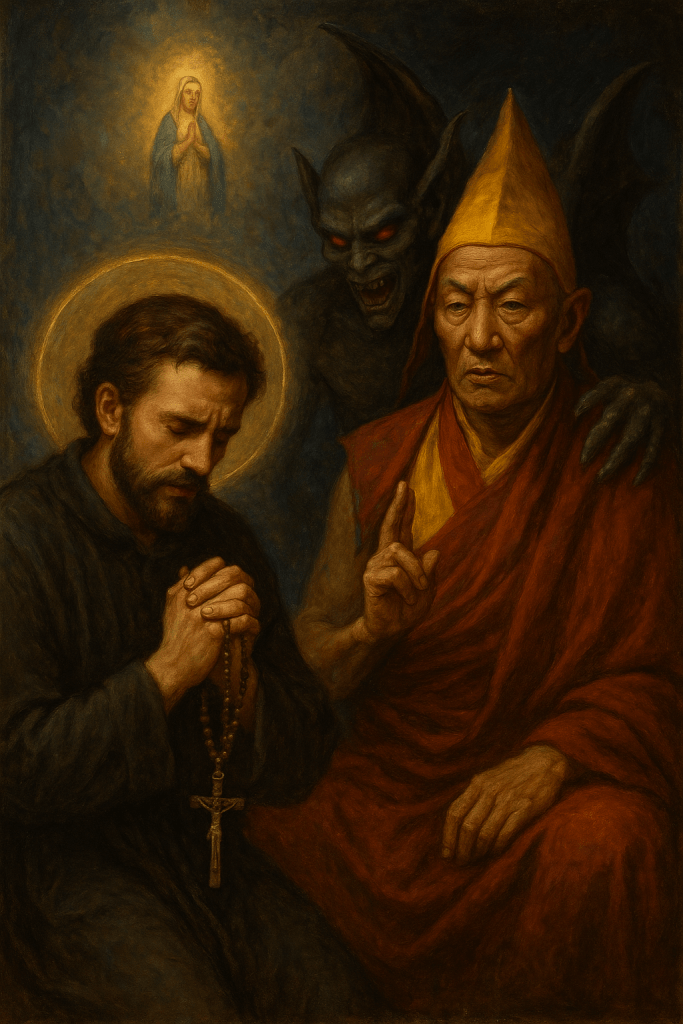
I speak not in theory but from personal experience. As someone who has lived through the horror of possession, I know firsthand what it means to have my subconscious colonized by non-physical forces, in particular, Tantric deities and the so-called yidams (meditational deities) I once invoked in long term retreats. They now exert control over my dreams at night, not as fragments of memory, but with an intention, force, and intelligence all their own.
Trauma, Sin, and the Open Doors
The Catholic tradition is clear: sin creates openings. These are spiritual vulnerabilities through which demonic powers can assert influence. But it’s not always sin, but often wounds and traumas that become entry points. This aligns, ironically, with what Jung called the shadow: the parts of ourselves we deny or fail to integrate.
In occult and tantric frameworks, these shadows are often “worked with” i.e. ritualistically invited, named, and visualized. In my case, the visualizations of the yidam were never just symbolic. They were summonings that invited intelligent spiritual entities through geometric portals into the liminal space of my subconscious mind.
Obviously, tantric rituals are powerful, but the power is not “of God.” The light of Christ later revealed to me that what I had opened myself up to were demonic counterfeits or parasitic forces clothed in deceptive splendor.
The Subconscious
While the Jungian model treats these internal figures such as archetypes, gods, and dreams, as symbolic representations of the psyche, Biblical scripture offers a different view. Ephesians 6:12 tells us that our struggle is “not against flesh and blood, but against principalities, against powers, against the rulers of the darkness of this world.”
What modern psychology calls “unconscious drives” may, in reality, be demonic actors exploiting our blind spots. They can manifest through thoughts, compulsions, visions, or dreams. They don’t just influence behavior, they shape the architecture of perception, infiltrating belief itself. This is why confession and deliverance are not just spiritual maintenance but are spiritual war strategies.
Dreams: The Nightly Invasion
The yidam I practiced during my retreats appears nightly, manipulating my dreams and injecting disturbing images, physical sensations, and false feelings of failure and yearning. It tries to arouse old loyalties alternating between affects of pseudo kindness and visions of cruel and bitter punishments. These dream invasions foster confusion and despair; and sometimes cause sensations of physical torment.
From a biblical perspective, dreams are a legitimate domain of spiritual communication, but that doesn’t mean all dream figures are from God. In Jeremiah 23, the Lord condemns false prophets who “make my people forget my name by their dreams.” Satan can disguise himself as an angel of light and in my experience, tantric deities do precisely that.
We must recognize the subconscious not as a private fortress, but as a permeable space, one that requires guarding, cleansing, and illumination by Christ alone. Anything else, especially tantric visualization and archetypal meditation, opens up doors we cannot close on our own.
There is no neutral spirituality. Every spiritual practice either opens the soul to grace or to deception. As one who has been inside the snare, I say this without hesitation: tantric deities are demons in disguise, and their preferred hiding place is the very part of us we least understand: the subconscious.
But Jesus Christ, in His mercy, descends even into those hidden caverns, casting out darkness and healing the wounds that made us vulnerable in the first place.
“For this purpose the Son of God was manifested, that He might destroy the works of the devil.” — 1 John 3:8
Both Vajrayana and Luciferian rites use geometric portals to invoke spiritual forces and what comes through may not leave easily.
Follow-up to: “The ‘Hidden’ Truth of Vajrayana Empowerment: Does the Lama Implant a Deity into the Disciple’s Mind?”
Following the previous article “The ‘Hidden’ Truth of Vajrayana Empowerment,” which exposed how Tibetan tantric initiation involves the lama implanting a deity into the disciple’s mind-stream, this follow-up explores how that same core process, spiritual implantation, appears in Western occult and Satanic initiation rites. Though culturally and theologically distinct, both systems describe a mystical transformation in which the aspirant is indwelt, overshadowed, or spiritually fused with a nonhuman being. The parallels are striking, and the implications for unsuspecting spiritual seekers are sobering.
Union Through Inhabitation
In Vajrayana Buddhism, the empowerment ritual is designed to activate the disciple’s Buddha-nature by personifying it as a specific deity. This process is not symbolic; it requires the intervention of the guru, who performs a series of initiations (vase, secret, wisdom, and word) that culminate in the wisdom deity entering the disciple’s visualized form. Sam van Schaik and other scholars describe this as a fusion of two minds: the practitioner becomes “in union” with the deity.¹ Light or energy entering the heart symbolizes this transmission, and classical sources like Vilāsavajra² and Jamgön Kongtrul³ confirm that the deity’s presence is meant to take root within the initiate.
This process mirrors what takes place in various forms of Western occult initiation. Whether in ceremonial magic, Luciferian practice, or Thelemic rites, the aspirant invites a spiritual entity, sometimes framed as a “higher self” and other times as a demon or god-form, to inhabit or fuse with their consciousness.⁴ In certain traditions, this is done under the guise of awakening one’s divine essence or ascending the Tree of Life, but the mechanics remain: the person is inviting another spiritual will to merge with their own.
The Role of the Officiant
In Vajrayana, only a qualified guru can perform the empowerment. The lama must have realization of the deity in order to transmit it, effectively serving as a channel through which the deity is implanted into the disciple. The disciple cannot access the highest yoga tantra deity alone; it must come through the guru.⁵
In Western occultism, the structure is more flexible. In ceremonial lodges like the Golden Dawn, initiation is conferred by a hierarchy of initiates. In solitary or Luciferian paths, the practitioner may self-initiate, performing a ritual to invoke and receive a spiritual entity directly.⁶ This difference, hierarchical transmission versus self-directed invocation, changes the form but not the essence of what is happening: a spiritual being is invited in.
Seed and Possession
Both traditions speak of what can be described as a spiritual seed taking root in the initiate. In Vajrayana Buddhism this is the seed of the deity that is implanted through ritual and nurtured by mantra and visualization, growing into full enlightenment.⁷ In occult traditions, similar metaphors abound: the Black Flame (Luciferianism), divine spark (Gnosticism), or magical current (Thelema) all describe a presence awakened or implanted within the practitioner.⁸
Possession or identity fusion is not merely metaphorical in either tradition. In Vajrayana, the practitioner becomes the deity in practice and visualization. In Western occultism, invocation or evocation may result in the spirit speaking through the practitioner, taking partial or full control.⁹ The aspirant may not merely visualize the entity; they may be inhabited by it.
Theological Framing
Here is where the surface similarities give way to deeper concerns. Vajrayana presents this union as sacred and salvific. The deities are said to be manifestations of enlightened mind, and the process is aimed at liberation from suffering.
In contrast, many Western occult traditions embrace the transgressive nature of the ritual. In Luciferian and Satanic paths, the union with a spiritual being is framed as an act of rebellion, empowerment, or divinization.¹⁰ Even in systems that use angelic or archetypal language, the goal is often gnosis independent of God, power over nature, or rejection of traditional morality.
From a Christian theological perspective, both processes, however cloaked in cultural or religious language, involve the opening of the soul to spiritual beings not of God.¹¹ Whether the entity is labeled as a deity, guardian angel, or inner Buddha, the core act is the same: inviting possession or fusion with a nonhuman intelligence. Exorcists describe demons as “persons without bodies.”
Deliberate Secrecy vs. Ritual Transparency
Another key difference lies in disclosure. Vajrayana does not typically explain to new initiates that the lama will implant the deity into their mindstream. This is concealed under layers of euphemisms, talk of “blessings,” “inspiration,” or “awakening Buddha-nature”.¹² Western occultism, by contrast, often acknowledges its aims more directly. A Luciferian magician knows they are invoking Lucifer. A Thelemite understands the goal is Knowledge and Conversation with a higher being.¹³
But the result is no less dangerous. Both systems involve entering into a spiritual relationship that can dominate or override the practitioner’s will. From a Christian point of view, these are not symbolic practices but acts of spiritual surrender and potentially, spiritual bondage.
Conclusion: Two Paths, One Mechanism
While Vajrayana tantra and Western occultism differ in terminology, mythos, and cultural packaging, they share a core mechanism: a ritual invitation for a spiritual being to enter the initiate’s consciousness. Whether masked as deity yoga or celebrated as demonic possession, the outcome is the same: identity fusion with a nonhuman spirit.
The true danger lies not only in the act itself but in the lack of informed consent. Many Vajrayana practitioners never fully understand what they’ve opened themselves to until it’s too late. And many occultists, lured by the promise of empowerment, mistake possession for enlightenment.
As explored on this blog, the deeper deception is the true nature of “possession” rituals versus how they are presented. Spiritual seekers deserve the truth: that these practices, whether called empowerment or initiation, are not harmless techniques for personal growth and transcendence. They are open doors: both Vajrayana and Luciferian rites use geometric portals to invoke spiritual forces and what walks through may not be your friend or leave easily.
Sources
Sam van Schaik, “The Limits of Transgression: The Samaya Vows of Mahāyoga” (2010).
Vilāsavajra, Hevajra Tantra Commentary, excerpts found in Mahāyoga textual studies.
Jamgön Kongtrul, The Treasury of Knowledge, Book Eight, Part Three.
Aleister Crowley, Magick in Theory and Practice; Michael Ford, Luciferian Witchcraft.
Ngawang Phuntsok, On Receiving Wang (Empowerment).
Israel Regardie, The Golden Dawn: A Complete System of Magic.
Dalai Lama, Kalachakra Initiation Teachings; traditional commentaries on empowerment.
Michael W. Ford, Apotheosis: The Ultimate Beginner’s Guide to Luciferianism.
Kenneth Grant, The Magical Revival; practices in chaos and ceremonial magic.
Anton LaVey, The Satanic Bible; Ford, Dragon of the Two Flames.
Catechism of the Catholic Church, paragraphs 2116–2117.
Scott Globus, “Empowerments: Awakening the Buddha Within,” Rubin Museum, 2021.
Aleister Crowley, The Vision and the Voice; Liber Samekh.
In the late 19th century, a young Italian lawyer named Bartolo Longo wandered the outskirts of Pompeii consumed by despair. Once a zealous Catholic, Bartolo had been “consecrated a satanic priest” in a Neapolitan occult circle, even promising his soul to a demon. He presided over dark rituals and blasphemed the Church, but the wages of serving Satan swiftly took their toll. Haunted by diabolical visions, paranoia, and suicidal depression, Bartolo felt his sanity slipping. On the brink of taking his own life, he suddenly heard a familiar voice – the voice of his old Dominican mentor echoing in his mind, repeating the Virgin Mary’s promise: “One who propagates my Rosary shall be saved.” In that moment, light pierced his darkness. Bartolo fell to his knees and vowed to devote the rest of his life to God, spreading the Holy Rosary as a penance and path to salvation. The former Satanist renounced the occult and embraced a life of heroic virtue. He would go on to build the Basilica of Our Lady of the Rosary in Pompeii and be acclaimed by Pope St. John Paul II as the “Apostle of the Rosary.” He will be canonized a saint in the fall of 2025. Bartolo Longo’s dramatic conversion sets the stage for a stark spiritual contrast: the true charisms of the saints versus the counterfeit “siddhi” powers of occult mystics.
Charisms: Miracles Born of Holiness and Submission to God
In Catholic tradition, charisms are supernatural gifts granted by the Holy Spirit to holy men and women for the building up of the Church. Whether humble or extraordinary, every authentic charism serves God’s glory and the good of souls, not the ego of the individual. These wonders blossom only in the soil of sanctity for they are fruits of a life surrendered to God’s will. The Church teaches that charisms must be discerned and always align with charity and truth. In other words, genuine miracles flow from holiness and obedience, never from personal ambition or curiosity.
The lives of the saints abound with such holy marvels. For example, St. Padre Pio of Pietrelcina (1887–1968) manifested numerous charisms that stunned the world. This humble Capuchin friar bore the bleeding wounds of Christ (the stigmata) for 50 years and endured vicious demonic attacks at night in union with Christ’s passion. Thousands of witnesses attest that Padre Pio could read hearts and souls in the confessional, knowing penitents’ sins before they spoke. He was often observed in bilocation, mysteriously appearing to comfort people hundreds of miles away while simultaneously remaining in his monastery. He healed the sick by his prayers (sometimes before they even asked), and he gave prophetic counsel. Famously, he foretold that a young Polish priest (Karol Wojtyła) would ascend to “the highest post in the Church,” years before Wojtyła became Pope John Paul II. All these miracles Padre Pio worked he attributed entirely to God. “I am only a humble friar,” he would insist, pointing all acclaim back to the Lord. His motto, “Pray, hope, and don’t worry,” reflected total trust in divine Providence. In every sense, Padre Pio’s charisms were gifts from God, signs following the faith of one who sought only to do God’s will.
Other saints, too, manifested astounding gifts by God’s grace. St. Joseph of Cupertino, a 17th-century Franciscan, was known as “the Flying Friar” for his frequent levitations during ecstatic prayer. Scores of witnesses, including skeptics, saw Joseph lifted off the ground, sometimes soaring high above the altar, whenever he fell into rapturous contemplation of God. This was no occult trick but a God-given ecstasy, so reliable that it embarrassed Joseph and his superiors (who often transferred him to avoid drawing crowds). Similarly, St. Catherine of Siena in the 14th century had a charism for casting out demons, such was her holiness in spiritual warfare. St. Martin de Porres (1579–1639) humbly bilocated and performed miraculous healings among the poor and sick of Lima. St. John Vianney, the Curé of Ars, could read souls and endured demonic harassment nightly as he drew throngs of sinners back to God. From the earliest apostles (healing the sick with St. Peter’s shadow in Acts 5:15) to modern blesseds like Bartolo Longo himself (whose restored Marian shrine in Pompeii became a locus of miracles), the Church recognizes these phenomena as authentic charisms only when they align with holiness and truth.
Importantly, the saints never sought supernatural gifts for their own sake. On the contrary, many pleaded with God to remove such signs, fearing they might attract attention or pride. Padre Pio, for example, prayed that his visible stigmata would vanish so he could suffer in secret. The holiest souls flee notoriety, embracing suffering and humility. Miracles then follow as God wills, to bear witness to the Gospel. The Catechism of the Catholic Church emphasizes that even remarkable charisms must be exercised in humble conformity to God’s love, and always subject to discernment by Church authorities. In short, the saints did not control or command these gifts, they received them. And they received them only because they first surrendered their lives in total obedience to Christ. The true power behind charisms is God Himself. As Scripture says, “No prophecy ever came by the will of man, but men moved by the Holy Spirit spoke from God” (2 Pet. 1:21). So it is with every healing, prophecy, or miracle of the saints: it is the Holy Spirit at work, a divine gift freely given, never a humanly engineered skill.
Siddhis: Occult Powers and Deceptive Feats of Tibetan Gurus
Contrast this with the siddhis, the flashy supernatural powers claimed by certain Eastern mystics, such as Tibetan Buddhist gurus and Hindu yogis. In the yogic Buddhist tradition, siddhis are paranormal abilities supposedly acquired through esoteric meditation practices or occult rituals. They include feats like clairvoyance (third-eye “vision”), telepathy, levitation, astral travel, bi-location, materialization of objects, extreme control over bodily processes (e.g. stopping the heartbeat or generating intense inner heat), and even the manipulation of matter and weather. The Tibetan landscape of legends and hagiographies is rich with such tales, but from a Catholic perspective, these awe-inspiring siddhis are dangerous illusions springing not from sanctity, but from the influence of demonic forces.
Tibetan Buddhist lore celebrates figures known as mahasiddhas (“great adepts”) who achieved mystical powers. Perhaps the most famous is Milarepa (c. 1052–1135), a yogi revered in Tibet as a great saint. Milarepa’s life story itself is telling: as a young man he learned black magic to avenge a family injustice, invoking demons to slaughter his enemies with a magical hailstorm, an act for which he later repented. After apprenticing under a Buddhist master, Milarepa underwent austere meditation retreats in mountain caves for years. He is rumored to have attained an array of astonishing powers, including the ability to levitate and fly, to walk or sleep while suspended in mid-air, and to transform his body into any shape he wished, even transmuting into fire or water. He could supposedly heat his body internally through tummo yoga to survive subzero winters clad only in a thin cotton cloth. Tibetan paintings often depict Milarepa in a cave, hand cupped to his ear, while effortlessly defying gravity in meditation. Notably, even in Buddhist accounts these abilities were regarded with caution. They were “occult powers” (in Milarepa’s own tradition, siddhis are considered byproducts of spiritual practice, not the goal). In Catholic eyes, such feats are not miracles from God, for Milarepa did not worship the true God; rather, they smack of the preternatural tricks of fallen angels. Indeed, the levitation of Milarepa and others like him stands in stark counterpoint to the levitations of a St. Joseph of Cupertino, one source being occult and the other divine.
Even in modern times, Tibetan Buddhist leaders continue to be credited with paranormal siddhis. Devotees of the late 16th Karmapa, Rangjung Rigpe Dorje (the head of the Karma Kagyu sect, who died in 1981) recount numerous extraordinary deeds. As a child, the 16th Karmapa reportedly displayed clairvoyance, unerringly telling local villagers where their lost animals had wandered. He was fond of birds and was said to put dying birds into a trance so that they stood upright for days after death, a ritual interpreted as guiding the birds’ consciousness to a better rebirth. In 1974, during a visit to a Hopi Indian reservation, the Karmapa performed a ceremony wearing his ritual Black Crown and, as the story goes, ended a 75-day drought by summoning a sudden downpour of rain. There are accounts of Tibetan masters (in various schools) who allegedly teleported or projected astral doubles of themselves across great distances, or who upon death shrunk their corpses to a fraction of normal size accompanied by rainbow lights, the famed “rainbow body”phenomenon that Tibetan Buddhists consider a sign of ultimate realization. All of these siddhis are celebrated within their respective circles as evidence of spiritual attainment. But are they from God? The Catholic answer is a resounding no.
From a Christian standpoint, it is suspicious that these powers arise in those who do not even acknowledge Jesus Christ as Lord, and often in tandem with pagan or occult rituals. The 16th Karmapa, for instance, appeared to be a kind and compassionate man by worldly accounts, even meeting Pope Paul VI, but the source of his “miracles” is highly suspect. Some lamas who knew about his secret magical activities were afraid of him, and after he died, his lineage split apart in a bitter conflict that continues to this day. Performing rain ceremonies invoking Tibetan and territorial or “local” deities (in reality, demons masquerading as gods) is a form of sorcery, explicitly forbidden by Scripture and the Church. The clairvoyance displayed by such gurus parallels the “second sight” of spirit mediums, an ability which the Catechism identifies as false divination that “conceals a desire for power over time, history and other human beings”, in competition with trust in God. And while Catholic saints healed by prayer or expelled demons in the name of Christ, Tibetan lamas employ mantras, secret empowerments, and spirit invocations to wield siddhis.
Jesus warned that “false christs and false prophets will arise and show great signs and wonders to deceive” (Matthew 24:24). The siddhi-working guru fits this warning: no matter how benevolent they seem, if they lead people away from the True God, their wonders are meant to deceive. The Church Fathers and theologians have long taught that demons can produce preternatural phenomena to ape God’s miracles; these are known as “lying wonders”intended to ensnare the unwary. St. Thomas Aquinas affirmed that demons, by their angelic nature, can manipulate matter and human perception, performing impressive tricks (though never true creation ex nihilo) to bolster false religions. An occult practitioner “levitating” or a lama conjuring rain is akin to Pharaoh’s magicians mimicking Moses: infernal sleight-of-hand permitted to test the faithful. What’s more, any apparent good that comes from siddhis is a bait on the hook (I can attest to this from personal experience), and a brief benefit to bind people to demonic influence in the long run.
The True Source: Holy Spirit vs. Occult Spirits
To discern the difference between a saint’s charism and a guru’s siddhi, one must examine the source and fruit of each. True spiritual gifts originate from the Holy Spirit and bear the fruits of the Spirit such as conversion, humility, charity, peace, and truth. By contrast, occult powers (no matter how wondrous) stem from unholy spirits and ultimately yield rotten fruit such as pride, confusion, spiritual bondage, fear, harm, and falsehood. The Catholic Church explicitly warns that seeking supernatural power apart from God’s will is a grave sin that opens one to demonic influence. The Catechism states unequivocally: “All forms of divination are to be rejected: recourse to Satan or demons, conjuring up the dead or other practices falsely supposed to ‘unveil’ the future… Consulting horoscopes, astrology, palm reading, tarot, interpretation of omens and lots, the phenomena of clairvoyance, and recourse to mediums all conceal a desire for power… They contradict the honor, respect, and loving fear that we owe to God alone.”
Likewise, “all practices of magic or sorcery, by which one attempts to tame occult powers… to have a supernatural power over others, even if for the sake of restoring health, are gravely contrary to the virtue of religion.” In short, to seek or use siddhis is to break the First Commandment, usurping God’s authority and bartering with demons for knowledge or power. No matter if one’s intention seems good (“healing” or “enlightenment”), the act of grasping at occult ability is a Faustian bargain and an invitation for the demonic to take control.
By contrast, the Church praises the charisms of the saints precisely because the saints never sought them. They sought only God, and God freely bestowed gifts as He pleased. There is no technique in the Catholic Church to get a charism: no incantation or secret method, only growth in holiness and prayer, which is itself at God’s initiative. Charisms are received in prayerful surrender, whereas siddhis are seized through ritual manipulation. A Tibetan guru meticulously follows occult protocols (chants, visualizations, yoga postures, ritual offerings) specifically to gain powers (the ordinary and extraordinary siddhis), a fundamentally prideful endeavor, however cloaked in spiritual language. A saint, on the other hand, often doesn’t even know they have a gift until it manifests unexpectedly to meet a need. Consider the fruits: When a saint works a miracle, people are healed physically and spiritually. Bodies are mended and hearts turned to Christ. When an occultist displays a wonder, observers might be astonished or entertained, but are they led to repentance and faith in the true God? Or are they lured deeper into fascination with the supernatural for its own sake? The answer is clear. God’s miracles always point back to God increasing faith, hope, and love. Demonic wonders point away from God toward ego, secret knowledge, or exotic spiritualities divorced from Christ.
Even the emotional aura surrounding these phenomena differs. True charisms, though extraordinary, convey a sense of peace, joy, and sacredness. Witnesses of a saint’s miracle often report a deepened devotion or the presence of God’s love. By contrast, siddhis and occult feats often carry an air of thrill, fear, or agitation (i.e. the kundalini phenomena produces a range of frightening symptoms). The devil can dazzle the senses, but he cannot impart true peace. How telling that Bartolo Longo, when he was deep in the occult, was tormented by depression and insanity; only when he returned to Christ did he find freedom and joy. Many who dabble in New Age or Eastern occult practices experience initial wonder, but later are plagued by nightmares, oppression, or a crippling pride. The devil demands a pound of flesh for every favor. As Jesus said, “By their fruits you will know them” (Matt. 7:20). The fruits of siddhis, no matter how impressive, are ultimately bitter. The fruits of the Holy Spirit are sweet and life-giving.
Testimonies of Deliverance: Warnings from Those Who Escaped the Occult
The stark difference between charisms and siddhis is not just theoretical, it is confirmed by the testimonies of those who have escaped the snare of occult practices. Modern Catholic exorcists and former occultists have sounded the alarm with firsthand experiences. Monsignor Stephen Rossetti, an exorcist, recounts numerous cases of people who thought they had natural “psychic” or healing gifts, when in fact these abilities were coming from demons. One woman who had worked as a New Age healer could see spirits and perform cures; after her return to the Church, Msgr. Rossetti counseled that her former “gift” was really an occult third-eye opened by demonic influence, not a charism from God. Only through renouncing all occult ties and intense deliverance prayers over years could such preternatural abilities be purged of dark influences. This illustrates a crucial point: Satan may grant a person a facsimile of healing or clairvoyance for a time, but it’s a Trojan horse, enslaving that soul to his dominion.
A particularly striking testimony comes from a woman who spent 35 years deeply involved in Tibetan Buddhism. She believed in the gurus’ powers and the Buddhist deities until she started to see strange behaviors and have doubts. The deities and the gurus considered her doubts to be “wrong views” and attacked her. The guru performed a horrific annihilation ritual upon her using an effigy ( a form of black magic). She reported a terrible realization: “I was tricked and deceived into believing that Buddha was the same as God… The group’s deities were actually demons and the gurus were their minions.” Ultimately, the gurus cursed her and threatened her with ‘the worst hell imaginable’, and she began suffering intense physical and mental assaults from demonic forces. Only through the power of Jesus, frequent confession, attending Mass, praying the Rosary, did she start finding liberation. This survivor now works to warn others: what Tibetan Buddhism presents as enlightened masters and benevolent spirit guides were, in truth, agents of Satan dragging souls to perdition. Her story is a sobering confirmation that occult powers always come at a terrible price. The devil may masquerade as an angel of light or even as a compassionate “bodhisattva,” but when unmasked, the fangs show. As the survivor put it, those who unwittingly worship these “gods” are in fact worshipping demons, and they often suffer hellish oppression as a result.
The Catholic Church urges us to seek the higher gifts (1 Cor. 12:31), faith, hope, and charity, and to leave extraordinary gifts to God’s providence. If ever we encounter phenomena of a mystical nature, we must test the spirits (1 Jn 4:1) under the Church’s guidance. Does it glorify Jesus Christ? Does it accord with Scripture and sacred Tradition? Does it promote virtue or feed curiosity and ego? The answers will quickly unveil the source.
Let Bartolo Longo’s story stand as a beacon: He tasted the darkest occult powers and found only despair, but when he turned to Our Lady and her Rosary, he found redemption and true spiritual authority over the darkness. In the end, the charisms of the saints point to the triumph of Christ, whereas the siddhis of the Tibetan masters (and all occultists) are a devilish dead-end. One path leads to eternal life; the other, if not abandoned, leads to spiritual death.
Christ or the occult? Each of us must choose. The stakes are nothing less than salvation. May all be moved to embrace the light of Christ, renouncing Satan and all his empty show. Let us therefore strive to become saints, not sorcerers, for in the end, every knee will bow to the true God, and all false gods and their lying wonders will be cast down.
Sources: The Catholic Church’s teaching on charisms and occult practices (Catechism of the Catholic Church 799-801, 2115-2117); Lives of Blessed Bartolo Longo; Testimony of ex-Tibetan Buddhist; Accounts of Padre Pio’s gifts; Tibetan siddhi claims (16th Karmapa, Milarepa); Msgr. Stephen Rossetti on occult “gifts” vs. divine charisms.
In a dusty corner of southern India, something strange is happening. Among the Catholic untouchables of Tamil Nadu the Virgin Mary reigns. These are the Dalit communities who converted to Christianity to escape caste oppression. Here the Virgin Mary is not just the mother of Christ or the Queen of Heaven. She’s the protector from demons, the healer of the possessed, and the exorcist of lustful spirits who prey on young women. [1]
Her name here is Arockyai Mary, “Our Lady of Good Health,” and unlike the goddesses of India’s native pantheon, she never harms. She doesn’t demand blood, or rage, or possess.
This makes her an anomaly in a world where possession is an everyday threat and where menstruation, pregnancy, and the liminal chaos of female sexuality are believed to attract wandering spirits, often the ghosts of those who died violently or before their time. These spirits, it is said, latch onto the vulnerable, especially women, and drive them into trances and convulsions.
And then there are the Hindu goddesses like Mariyamman [2] and Kaliamman [3], powerful but volatile. They heal, but they can also possess, punish, and destroy. Unlike the Virgin Mary, who is seen as unconditionally loving and healing, Mariyamman and Kaliamman’s protection must be earned through ritual and sacrifice. Their presence is often feared as much as it is venerated, revealing a form of feminine divinity that is transactional, fierce, and unpredictable.
The deeper thread that ties this to my own journey through Eastern mysticism and into Catholic truth is that the female deities of India are not so much saviors as they are owners. They ride their devotees like horses often through an overpowering kundalini experience. They enter bodies without informed consent. They demand submission, sacrifice, and pain. This is what possession looks like when the divine manifests as fierce femininity unmoored from moral restraint.
But the Virgin Mary is different in kind, not just degree. She doesn’t exploit vulnerability; she protects it. Her power is rooted in love, not domination. She doesn’t punish women for their sexuality; she guards them from the predators that do.
Many of us who were drawn into the tantric and yogic traditions found ourselves worshiping goddesses we didn’t truly understand such as Kali, Vajrayogini, and Durga. These powerful beings granted “blessings” that often came in the form of disorientation, illness, and spiritual invasion. What we called “awakening” was perhaps possession, wrapped in ritual and mystique.
In the story of the Paraiyar women, we see this clearly. Demonic possession is a warning as well. The culture teaches women that if they stray outside ritual boundaries, if they become too sexually visible, if they travel alone at dusk or cross the wrong river, they open the door to attack. And it’s the Virgin Mary, not Kali, who shows up to cast the darkness out.
Humanity does not need more divine rage, but the one Woman who is pure benevolence: the Mother of Jesus who through her perfection is feared by and can cast out spirits and demonic goddesses.
[1] Source article: Deliège, Robert. “La Possession démoniaque chez les Intouchables catholiques de l’Inde du sud / Demoniac Possession Among the Catholic Untouchables in Southern India.” Archives de sciences sociales des religions, no. 79, 1992, pp. 115–134. Available online.
[2] Mariyamman is a powerful village goddess widely worshipped in South India, especially in Tamil Nadu. Her name combines “mari,” meaning rain or disease, and “amman,” meaning mother—making her the Mother of Rain and Disease. She is especially associated with illnesses like smallpox, fevers, and skin diseases, but also with fertility, childbirth, and protection from evil spirits. Visually, she often appears fierce—sometimes with fiery red skin, holding a trident, and crowned with flames—bearing a resemblance to goddesses like Kali or Durga. Her shrines are typically modest, and her worship is deeply rooted in folk rituals. Devotees may offer animal sacrifices, participate in firewalking, or fall into trances believed to be divine possessions. In many cases, women are the ones possessed by Mariyamman, and these episodes are interpreted as both blessings and warnings—depending on whether the goddess has been properly appeased.
[3] Kaliammam is a fierce village manifestation of the goddess Kali, worshipped primarily in Tamil Nadu and other parts of South India. The name “Kaliamman” translates to “Mother Kali,” reflecting her role as a local protective mother goddess rooted in folk traditions. Like Kali, she is associated with destruction, power, and the eradication of evil, but in the village context, she is also invoked for healing, fertility, and protection from malevolent spirits. Kaliamman is often depicted with dark skin, a lolling tongue, wild hair, and multiple arms holding weapons—symbolizing her unrestrained spiritual power. Her worship includes rituals that are intense and sometimes violent: offerings of blood, possession trances, firewalking, and dramatic acts of devotion are common. She is believed to possess her devotees—often women—either to bless them, deliver a warning, or punish neglect. She must be honored and feared. Her presence reinforces moral and ritual boundaries in the community, demanding reverence through sacrifice and submission rather than drawing near in mercy or compassion.






 Tantric Deception