
Tertons, Termas, and the Curious Origins of Hidden Teachings


Tibetan Buddhism’s terma tradition is usually framed as a luminous, providential means by which enlightened masters hide and later reveal teachings at the exact moment needed. That’s part of the story, but it’s not the whole story by any means. Read closely, and a darker current runs through the terma corpus: treasures hidden and guarded by wrathful powers, revelations that arrive through strange, sometimes malevolent intermediaries, and rituals whose intent and method look remarkably like what modern people would call dealings with spirits or demons. In short, many tertons don’t simply find teachings; they negotiate with non-human, often wrathful forces that can reasonably be described as demonic. Below I’ll examine Dylan Esler’s study of Gya Zhang Khrom (rGya Zhang khrom)¹ and other scholarly sources as a base to examine the phenomena of tertons and terma.

What the words mean

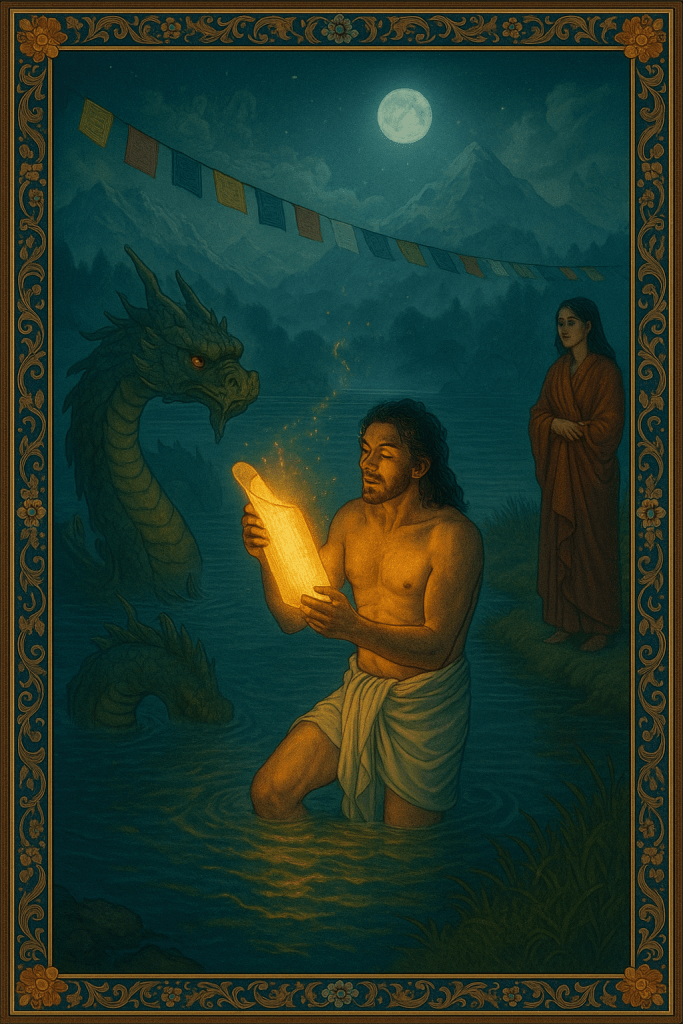
A terma (gter ma) is literally a “hidden treasure”: text, ritual object, or practice concealed (often in a rock, lake, or the mindstream of a guru) to be discovered by a tertön (gter ston), the treasure-revealer. Academic treatments correctly emphasize the social and legitimating functions of these discoveries in prophecies, lineages, and performative acts that make the revelation believable to followers. But the same sources that record authentication narratives also preserve striking descriptions of how termas are hidden, guarded, and recovered: they are defended by territorial spirits or “treasure-lords,” transmitted by non-human yogins, and often carry explicitly wrathful, “black magic” contents. Non-human yogins can take the form of visionary yogins, dakinis/dakas, local spirits, or wrathful entities, and they act as the intermediaries who hide, protect, or hand over the treasure.

A close example: Gya Zhang Khrom and wrathful treasures

Dylan Esler’s article on Gya Zhang Khrom in the (Byang gter) Northern Treasures tradition recounts the classic terma motif: a mysterious yogin leads the future tertön to a hidden cache of ritual objects and scrolls that come out of fissures in rock, and the revealer deciphers and transmits material that includes both beneficent and harmful ritual instructions. Esler notes items described as “cycles for benefiting and harming,” in other words, materials for both white and black magic, and he situates Gya Zhang’s revelations within a Northern Treasure program that explicitly deploys wrathful, coercive ritual means. That combination of secret caches, hidden custodians, and instruction sets for destructive rituals is exactly the pattern that supports reading many termas as arriving via a demonic or semi-demonic channel.

Treasure-protectors and Lords of the Treasures: the institutional side of the “demonic”

The literatures that record terma narratives repeatedly mention gter srung (treasure-protectors) and gter bdag (lords of the treasures). These are not neutral filing cabinets: they are spirits of place, frequently wrathful, who demand protocols and substitutions (gter tshab) when a cache is opened. Ethnographic and textual scholarship treats these beings as part of the class of local, elemental, or “demonic” forces that Tibetan ritual both confronts and incorporates. Scholarly surveys of protector deities and the oral/ritual ecology around termas make clear that treasures do not simply sit inert but are guarded by active, sometimes dangerous entities. If a tertön is authorized by prophecy, that can mitigate local resistance; if not, accusations of theft and collusion with spirits arise.²

Demon-taming, wrathful methods, and ambiguous agency

The well-known motif of Padmasambhava as demon-tamer is instructive: foundational tantric figures are often framed as subduers of hostile spirits, and the very act of revealing a terma can be portrayed as the tertön’s success in negotiating or subduing a guardian force. But negotiation is not always tame or benign. A number of terma traditions preserve wrathful practices intended to overthrow enemies, cure epidemics, or control hostile spirits—techniques that look like pacts or coercive exchanges with non-human agencies. Scholarly work on Dzogchen/Northern Treasure liturgies and on early treasure careers shows repeated, explicit intersections between revealing termas and advancing ritual technologies of domination or protection over local powers.³

So, do tertons get their termas from demons?

In many traditional narratives and ritual contexts, yes. Termas are mediated by, guarded by, or negotiated with non-human beings that function similar to what observers would call demons. That’s a historical and anthropological claim. The primary sources and modern scholarship present a consistent pattern: treasures are hidden in the landscape or mind, are protected by wrathful custodians, and are sometimes transmitted by shadowy yogins or through visions that are indistinguishable from encounters with spirits. Where the contemporary, institutional presentation emphasizes enlightened intent and salvific purpose, the deeper ritual ecology reveals frequent recourse to powers that are territorial and morally ambiguous.

Final thoughts

Terma studies that stop at the rhetoric of revelation miss the subterranean reality that produces and polices those revelations. Esler’s account of Gya Zhang Khrom’s discoveries of materials explicitly useful for harming as well as helping presents a pattern replicated across the terma corpus. Read with discernment, the terma tradition looks less like a straight line from enlightened source to human disciple and more like a braided negotiation between the human revealer, local spirits or demons, and the institutional needs of Buddhist communities. That picture is central to my argument: many tertons operate at the shadowy margins where demonic forces and tantric techniques meet, and their termas are as much the products of those encounters as they are of the “pure” spiritual origins claimed by their lineages.

Notes:

  1. Dylan Esler, “Yamāntaka’s Wrathful Magic: An Instance of the Ritual Legacy of gNubs chen Sangs rgyas ye shes on the Byang gter Tradition via the Figure of rGya Zhang khrom,” Revue d’Études Tibétaines, no. 62 (Feb. 2022): 190–215, https://himalaya.socanth.cam.ac.uk/collections/journals/ret/pdf/ret_62_08.pdf (accessed Oct. 7, 2025).
  2. Jean-Luc Achard, “A Brief Note on the Northern Treasures of the Bon Tradition,” Revue d’Études Tibétaines, no. 68 (Jan. 2024): 16–35, https://d1i1jdw69xsqx0.cloudfront.net/digitalhimalaya/collections/journals/ret/pdf/ret_68_02.pdf (accessed Oct. 7, 2025).
  3. Christopher Bell, “Worldly Protector Deities in Tibetan Buddhism,” in Brill’s Encyclopedia of Buddhism, vol. 2: Major Personages in Myth, Hagiography and Historical Biography (Leiden: Brill, 2019), 1254–66, https://brill.com (entry available online; access depends on subscription) (accessed Oct. 7, 2025).
The Question of the Soul: Christianity, Hinduism, and Buddhism


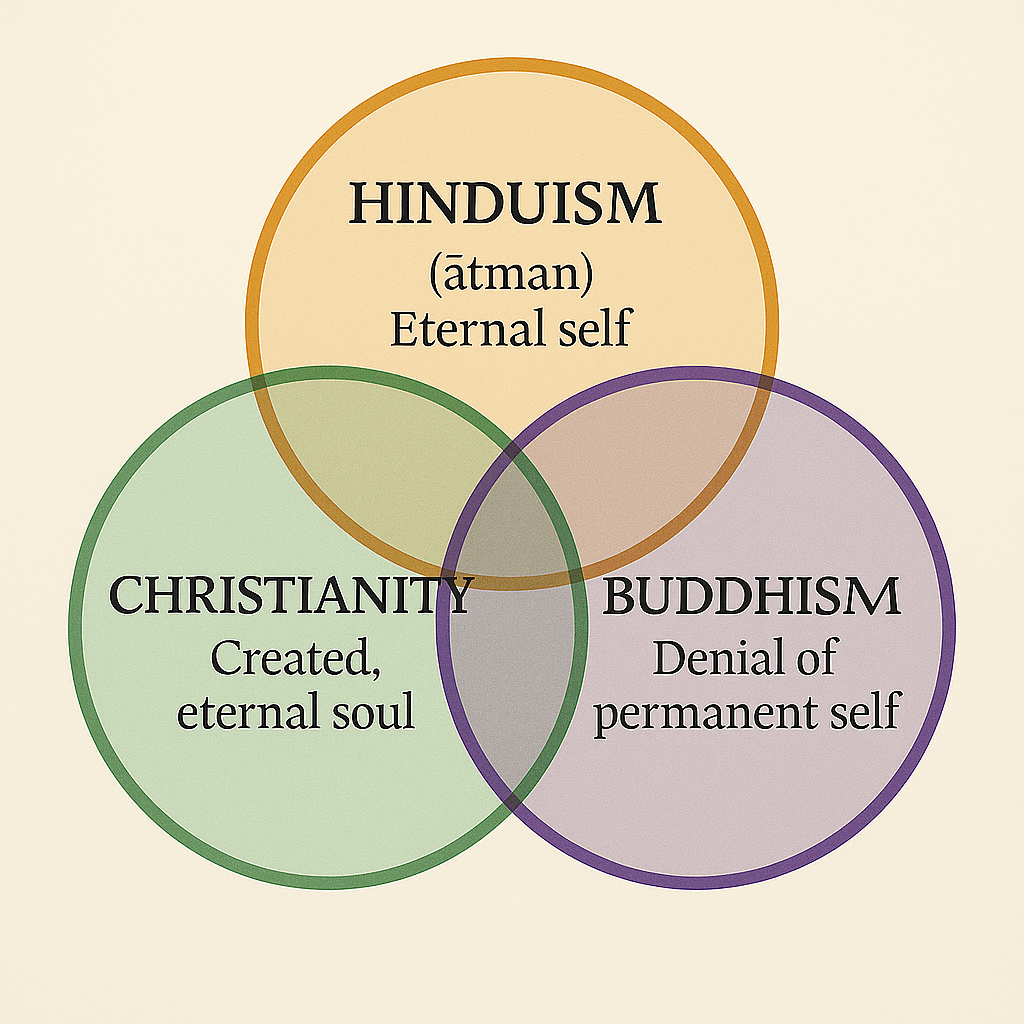
The question of what the soul is, whether it exists, and what happens to it after death lies at the center of the world’s major religious traditions. Christianity, especially in its Catholic tradition, affirms the soul as eternal and God-given. Hinduism has multiple schools, often affirming an eternal self or ātman. Buddhism, including Tibetan Buddhism, rejects the idea of a permanent self or soul and instead speaks of mind and consciousness as a conditioned stream of awareness without enduring essence.


The Christian and Catholic Understanding of the Soul

Christianity teaches that every human being has a unique, immortal soul created by God. According to Catholic doctrine, the soul is the spiritual principle of the human person. It is eternal in destiny, surviving bodily death, and directed either toward communion with God or separation from Him.

Scriptural sources include Genesis 2:7, where God breathes life into Adam and he becomes a living soul [1]; Matthew 10:28, where Jesus warns of the danger of losing the soul [2]; and the Catechism of the Catholic Church, which affirms that the soul is created by God and immortal [3]. In this view, the soul is not an impersonal principle but a personal identity, judged and redeemed by God.


Hindu Views on the Self (Ātman)

Hinduism is diverse, but most of its classical schools affirm the existence of ātman, the true self. The Chandogya Upanishad teaches “tat tvam asi” (you are that), affirming the identity of the self with Brahman [4]. The Brihadaranyaka Upanishad declares, “This self (ātman) is indeed Brahman” [5]. The Bhagavad Gita teaches that the self is eternal and indestructible [6].

Distinguishing Hindu and Christian Concepts

Both Hindu and Christian traditions speak of something enduring at the core of human existence, but they do so in different ways.

Christianity teaches that the soul is created by God, personal, and accountable before Him. It does not preexist from eternity but comes into being by His will and remains dependent on Him for existence, judgment, and salvation.

In Hindu thought, Advaita Vedānta emphasizes the identity of the self (ātman) with Brahman, dissolving individuality into the absolute. Dvaita and many Bhakti traditions instead teach that the self remains distinct yet eternal, existing in relationship with the divine. In all of these cases, the ātman is uncreated and co-eternal with ultimate reality, not brought into being by God.

Thus, while both traditions sometimes use personal and sometimes abstract language, the Christian soul and the Hindu ātman play very different roles. The soul in Christian theology is a created person before God; the ātman in Hindu philosophy is an eternal essence, whether one with Brahman or distinct in devotion.


The Creator God in Christianity and Hinduism

Christianity affirms one personal Creator God who brings the universe into being from nothing and sustains it in existence.

Hinduism presents a wide range of views. In Bhakti traditions, deities such as Vishnu, Shiva, or Devi are worshiped as supreme creators. Vedānta schools affirm Brahman as the ultimate source, though in Advaita this is not a personal act of creation but the manifestation of māyā. Other schools such as Sāṃkhya and Mīmāṃsā reject a creator altogether, viewing the universe as self-arising.

Thus, while Christianity grounds the soul in a personal God who creates and judges, Hindu thought ranges from devotion to a personal creator to cosmologies where no creator is necessary.


Buddhist Rejection of the Soul

Buddhism arose in part as a rejection of the Hindu doctrine of ātman. In the Anattalakkhana Sutta, the Buddha declared that none of the five aggregates of existence constitute a self [7]. The doctrine of anātman (no-soul) became central.

Mind and Consciousness

In Tibetan Buddhism, mind and consciousness are viewed as a stream of awareness, conditioned by karma. The Abhidharma-kośa describes consciousness as momentary and dependent [8]. Unlike Christianity and Hinduism, which affirm an eternal principle (soul or self), Buddhism denies it, calling belief in permanence a delusion.

Yet questions arise. If there is no soul, then what suffers in the hell realms described in Tibetan texts? The Bardo Thödol warns of the horrors of the Vajra Hell, a realm said to be utterly without escape [9]. The Hevajra Tantra declares that those who violate tantric commitments “will not be liberated for as many eons as there are atoms in the universe” [10]. The Cakrasaṃvara Tantra and later commentaries also teach that breaking tantric vows leads to vajra hells without release [11].

This presents a paradox: if there is no enduring self, who is suffering eternally?


Tibetan Buddhist Schools Under Examination

Madhyamaka – Nāgārjuna’s Mūlamadhyamakakārikā argues that all phenomena, including the self, are empty of inherent existence [13]. But if the self is an illusion, how does karma persist? If Vajra Hell is eternal, how can something that does not exist suffer forever?

Yogācāra (Mind-Only) – The Yogācārabhūmi Śāstra introduces ālayavijñāna, the “storehouse consciousness,” which preserves karmic seeds [14]. Though intended to avoid affirming a self, it functions much like one: carrying memory, identity, and karma. Hinduism here provides a comparison: the Bhagavad Gita teaches that the self carries karma through many births [6]. Yogācāra denies the term “soul,” yet reintroduces something strikingly similar. Christianity differs again: not a karmic storehouse, but a personal soul created by God.

Dzogchen (Great Perfection) – Dzogchen teachings, such as the Kunjed Gyalpo (All-Creating King), speak of rigpa, primordial pure awareness that is timeless and luminous [15]. Though Dzogchen denies that rigpa is a soul, the resemblance is striking. If rigpa is eternal, pure, and the ground of all experience, how is this different from what Christians call the soul or Hindus call ātman? The denial seems rhetorical rather than substantive.

Vajrayāna and Deity Possession – Tantric scriptures describe deity yoga, in which practitioners invite deities to merge with them [16]. If there is no self or soul, what exactly is being merged with or possessed?


Conclusion

Across Christianity, Hinduism, and Buddhism, the question of what endures, what we might call the soul, self, or consciousness, reveals fundamentally different views of human identity. Christianity anchors personhood in a created, immortal soul made by God and accountable to Him. Hinduism envisions an eternal ātman, uncreated and either one with or distinct from the divine. Buddhism, in contrast, denies any enduring essence, seeing the sense of self as a conditioned process. Yet in its Tibetan forms, teachings on karmic continuity, primordial awareness, and tantric transformation often edge back toward affirming something that functions like a self.

From long immersion in both Catholic and Tibetan Buddhist traditions, I have come to believe that the Christian vision alone sustains coherence between moral responsibility, continuity of consciousness, and the promise of redemption. It affirms not only that we exist, but that we are known and loved by the One who created us. Against the shifting alternatives of an impersonal absolute or an empty stream of awareness, in my opinion, the Christian understanding of the soul remains the clearest expression of what it means to be human before God.


References

[1] Genesis 2:7, The Holy Bible (ESV).
[2] Matthew 10:28, The Holy Bible (ESV).
[3] Catechism of the Catholic Church, Part I, Section Two, Chapter One, Article 1, §366.
[4] Chandogya Upanishad 6.8.7, in Radhakrishnan, S. (trans.), The Principal Upanishads.
[5] Brihadaranyaka Upanishad 4.4.5, in Olivelle, P. (trans.), The Early Upanishads.
[6] Bhagavad Gita 2.20, in Zaehner, R. (trans.), The Bhagavad-Gita.
[7] Anattalakkhana Sutta (Samyutta Nikaya 22.59), in Bhikkhu Bodhi (trans.), The Connected Discourses of the Buddha.
[8] Vasubandhu, Abhidharma-kośa.
[9] Bardo Thödol (Tibetan Book of the Dead), in Evans-Wentz, W.Y. (ed.).
[10] Hevajra Tantra, Snellgrove, D.L. (trans.), The Hevajra Tantra: A Critical Study.
[11] Cakrasaṃvara Tantra, in Tsuda, S. (trans.), The Samvarodaya Tantra.
[12] Hevajra Tantra, ibid.
[13] Nāgārjuna, Mūlamadhyamakakārikā, Kalupahana, D.J. (trans.).
[14] Yogācārabhūmi Śāstra, Xuanzang (trans.).
[15] Kunjed Gyalpo (All-Creating King), in Namkhai Norbu (trans.), The Supreme Source.
[16] Cakrasaṃvara Tantra and Hevajra Tantra, ibid.