Tibetan Buddhism is marketed in the West as a path of the highest integrity. It is described as a philosophical system with techniques for developing mindfulness, compassion, and ultimately for attaining enlightenment. What is rarely stated plainly is that Vajrayāna tantric systems are structured around ritualized spirit possession and identity takeover.
A 2022 doctoral dissertation, Āveśa and Deity Possession in the Tantric Traditions of South Asia by Vikas Malhotra, documents that possession became central to medieval Tantric practice, including Buddhist Tantra that later developed into Tibetan Vajrayāna.[1] The Sanskrit term āveśa literally means “entering into.” In Tantric contexts, it refers to the fusion of practitioner and deity. This was not marginal but foundational.[2]
Deity Yoga Involves Possession
In Tibetan Deity Yoga, practitioners visualize themselves as a deity, recite its mantra, adopt its gestures and identity, and are instructed to experience no separation between themselves and that being. Modern teachers frame this as symbolic or psychological and as a method to realize emptiness. But examined historically, it follows the structure of possession technology:
Invocation
Descent of power
Identity fusion
Altered agency
Bodily and psychological signs
Medieval Tantric texts describe possession markers such as trembling, ecstasy, altered consciousness, and loss of ordinary identity. These same phenomena and mechanisms are reported in Vajrayāna contexts.
Guru Yoga and Human Possession
There are also uncomfortable truths concerning Guru Yoga. In this practice, the visualized guru dissolves into light and enters the disciple. The disciple experiences the guru’s mind as inseparable from their own. Empowerment is described as a descent of blessing into the subtle body. The dissertation notes that in Tantric systems, even advanced humans could possess others in positive ways. [3]
The guru embodies enlightened power.
Through initiation, that power descends.
The disciple becomes a vessel.
Identity shifts from individual to lineage-bearer.
This is ritualized human-to-human possession. It is framed as a positive transmission, but is it really? What are the implications of inviting another human being in to possess you? If you examine the numerous exposés of abuse in Vajrayāna communities over the past few decades, you might wonder why anyone would let a fallible human being enter and possess them. As someone who lived through egregious abuse by a supposedly enlightened Vajrayāna master, I can speak from personal experience. Guru yoga creates a framework in which another human being is granted intimate internal authority over your mind and identity. Why would anyone knowingly consent to that dynamic? They probably wouldn’t if they knew that spiritual possession is what actually happens during guru and deity yoga.
Why This Is Glossed Over
The fact that this is glossed over in Tibetan Buddhist teachings should give one pause. Why isn’t this discussed up front? It is because possession sounds primitive and carries negative psychiatric and colonial baggage. For these reasons, traditions seeking Western legitimacy avoid the term and conceal the reality beneath layers of theological and philosophical euphemism. The issue is not vocabulary, but whether practitioners are told clearly what is structurally taking place. If Vajrayāna depends on ritualized possession through deity and guru incorporation, that should be stated plainly.
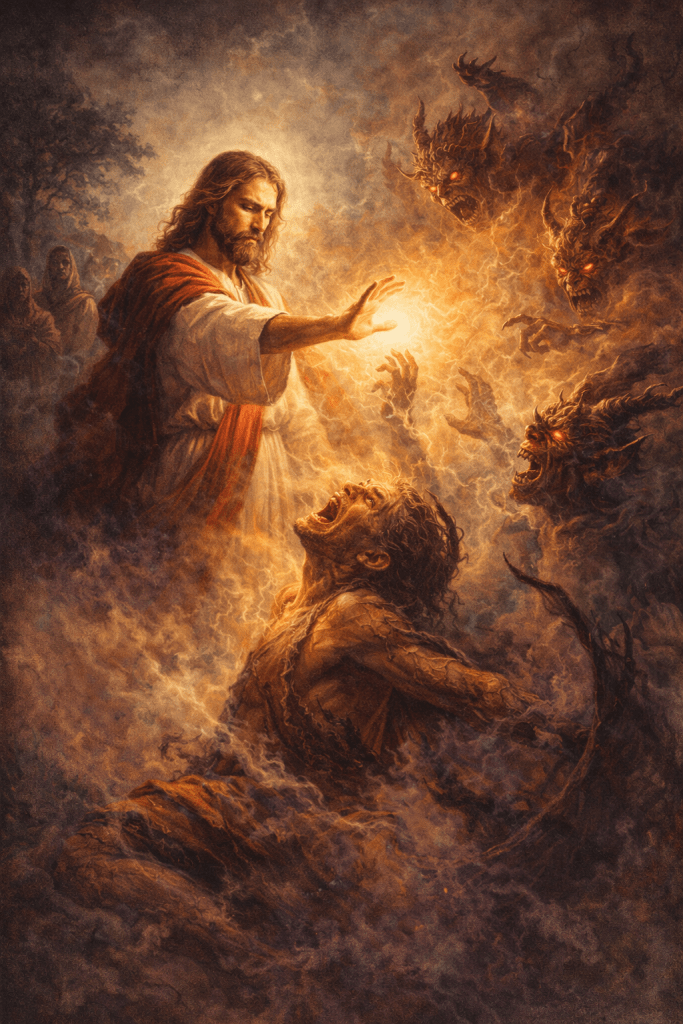
In Western religious history, especially within Christianity, possession has long been regarded as negative, spiritually dangerous, and psychologically destabilizing. It is associated with loss of agency, vulnerability to manipulation by demonic entities, and the need for protection or exorcism. It is not treated as spiritually glamorous. It is treated as a serious risk.
Yet when similar identity-dissolving dynamics appear within an imported spiritual system, they are often elevated, aestheticized, and shielded from scrutiny. The language changes but the underlying structure does not.
Why does ritual possession provoke alarm in one context but reverence in another? Why does a shift in metaphysical framing automatically neutralize the concern? If this would raise red flags in a Western church, why should it be exempt from examination in a Tibetan temple?
The historical record is clear. Possession is not peripheral to Tibetan Tantra. It is embedded in its ritual core. If that is so, then practitioners deserve to confront that reality consciously rather than encounter it disguised as harmless symbolism or elevated mysticism.
Footnotes
[1] Vikas Malhotra, Āveśa and Deity Possession in the Tantric Traditions of South Asia: History, Evolution, & Etiology, PhD diss., University of California, Santa Barbara, 2022 .
[2] Ibid., discussion of possession becoming central to Tantric praxis .
[3] Ibid., discussion of positive forms of human possession .
[4] Ibid., integrated model of possession as embodied transformation .
Catholic exorcists consistently emphasize that full demonic possession is rare. Far more common are lesser forms of demonic influence, what the Church calls degrees of demonic attack. According to experts like Fr. Gabriele Amorth and Fr. Chad Ripperger, these stages are typically identified as:
Temptation (ordinary spiritual warfare)
Infestation (demonic presence in a place or object)
Oppression (external hardships caused by a demon)
Obsession (mental or emotional torment)
Possession (a demon controls the body, but not the soul)
Perfect Possession (the soul itself has given full consent to the demonic)
What Is Perfect Possession?
Fr. Malachi Martin, Jesuit priest, Vatican insider, and exorcist, famously warned of the phenomenon he called perfect possession. This occurs not when a demon forces its way into a person, but when a human being voluntarily invites and cooperates with a demonic entity over time until the human will is no longer in conflict with the demon’s presence. In such cases, the individual may appear calm, successful, and even spiritual, but has wholly aligned his or her soul with darkness.
Martin described this as the most terrifying form of possession because there is no resistance and often, no exorcism possible. The person has handed over consent of the will, and the demon resides not only in the body but in the soul.
This is not the ugly, contorted possession made famous by Hollywood. This is a quieter form of coexistence.
Possession Among the Occult Elite
Catholic exorcists often connect perfect possession to satanic priests, high-level occultists, or individuals who have undergone ritual consecration to Lucifer. It is the end point of a spiritual trajectory, not a single moment of sin. It involves years of voluntary cooperation with evil using ritual invocation, blood pacts, and blasphemous imitation of the sacraments.
But there is more discrete path that leads to the same end. It is cloaked in lotus flower imagery, Sanskrit mantras, and spiritual “blessings,” and is propagated by tantric adepts, yogis, and mahasiddhas who have spent years practicing yoga and ritual invocation of beings they consider to be deities.
Is Perfect Possession the Hidden Goal of Tantra?
In the Tibetan Vajrayana tradition, called “the quick path to enlightenment,” tantric practitioners visualize themselves as the deity. They merge consciousness with the god, goddess, or guru, often through esoteric or sexual ritual, in pursuit of realization.
But what if these “deities” are not who they claim to be?
What if they are counterfeit spirits or demonic intelligences disguised as beneficent beings of light?
In that case, the tantric adept is inviting an entity to live within him, again and again, through ritual, offerings, and mental surrender. Over time, the boundary between the self and the invoked being dissolves.
This is a form of spiritual possession.
And if the person no longer resists, if they call this possession “enlightenment,” then it seems to meet the classical definition of perfect possession or possession of the soul.
Signs of Perfect Possession in the Tantric World
Unlike Hollywood portrayals, the perfectly possessed do not foam at the mouth or speak in guttural Latin. Instead, they:
Radiate serenity, even as they worship gods of wrath and destruction
Exhibit supernatural knowledge or powers (siddhis), which are praised, not feared
Express total identification with the spirit/s they invoke
Are untouchable by traditional exorcism, because they do not want to be freed
In Catholic understanding, this is the most dangerous state of all because it involves no inner conflict, and therefore no pathway to repentance. The soul lives in union with a demon, often under the delusion that it is serving the good.
Satan Appears as an Angel of Light
Scripture warns us: “And no wonder, for even Satan disguises himself as an angel of light.” – 2 Corinthians 11:14
What better disguise than that of a esoteric deity offering long life, healing, spiritual bliss, and enlightenment?
Exorcists like Fr. Amorth and Fr. Martin remind us that total possession doesn’t happen by accident. Satan must be invited in. And perfect possession is the result of spiritual consent, repeated and ritualized over time.
Tantric practitioners may never use the language of possession. They may call it “liberation,” “non-duality,” or “union with the deity.”
But from the standpoint of Christian spiritual warfare, it is not liberation but captivity, sanctified and made beautiful. It is a demonic entity, ethereally robed and seated on lotus thrones, perfectly at home in the human soul. And it leaves the adept deeply indebted to demons.
Vajrayana Buddhism, also known as Tibetan Buddhism or Tantric Buddhism, stands out for its rituals, deity worship, and complex esoteric practices. Its mantras, mandalas, and meditations on wrathful and yab/yum deities bear clear resemblance to Hindu Tantra, Vedic ritualism, and indigenous spirit cults.
So how did it convince anyone, especially devout Buddhists, that it was authentically taught by the historical Buddha?
The answer lies in a strategic combination of hidden teaching narratives, scriptural mimicry, ritual power, and imperial patronage. Let’s explore how this transformation occurred and what it means when viewed through the lens of Catholic faith and biblical discernment.
Secret Teachings: “The Buddha Taught It, But in Secret”
Vajrayana scriptures claim that the Buddha did teach tantra, but only in secret, to highly realized disciples. These teachings were said to have been hidden in celestial realms, entrusted to beings like Vajrapani or dakinis, or taught in the Buddha’s “enjoyment body” (sambhogakaya) form in other worlds such as Akanistha.(1)
This tactic mirrored earlier Mahayana developments, where new sutras like the Lotus or Avatamsaka were claimed to be higher revelations spoken by the Buddha, but not understood by his early disciples. The concept of esoteric knowledge reserved for the spiritually mature made these late texts seem like rediscovered treasures, rather than innovations.
Scriptural Mimicry and Retroactive Legitimization
To reinforce their authority, tantric scriptures deliberately mimicked the structure of traditional sutras. They often began with the familiar phrase, “Thus have I heard,” and depicted the Buddha teaching not only in celestial realms surrounded by bodhisattvas, but sometimes in radically transgressive settings such as charnel grounds, encircled by ḍākinīs and wrathful deities. These texts introduced elaborate cosmologies, detailed ritual instructions, and esoteric vows, presenting them as timeless wisdom, even though they were composed many centuries after the Buddha’s death.[2]
Authors also invented lineages, claiming that tantric teachings had been passed down secretly from Vajrapani to Nagarjuna, or from Padmasambhava to Tibetan kings.
Syncretism with Hindu and Folk Traditions
Instead of denying its similarities with Hindu Tantra, Vajrayana reinterpreted them. Wrathful deities were said to be enlightened Buddhas. Sexual rituals were described as a symbolic means to transform desire into wisdom. Offerings of blood, bones, and taboo substances were spiritualized as purifications of dualistic perception.
By repackaging Vedic and folk practices into a Buddhist framework, Vajrayana could absorb local traditions and declare them “Buddhist skillful means.”
Imperial Support and Monastic Integration
Tantra spread rapidly through the support of kings and monasteries. In Tibet, tantric masters were invited to subdue native spirits, secure political power, and perform rituals for prosperity. At Indian centers like Nalanda and Vikramashila, tantric scholars and monks practiced Mahayana logic by day and tantric visualization by night.
With the backing of the state and the academic establishment, Vajrayana was not seen as a fringe practice but as the “highest vehicle” of Buddhism.
Ritual Power and Psychological Experience
For the average practitioner, tantra “worked.” It offered visions, emotional catharsis, ritual protection, and the promise of fast-track enlightenment. The experiential pull of mantra, deity yoga, and initiation ceremonies gave people tangible results even if the doctrinal basis was historically shaky.
In the end, many believed not because of historical evidence, but because the system delivered experiences of spiritual intensity.
How Christianity Views This: The Domain of the Second Heaven
From a biblical and Catholic perspective, this raises serious concerns. The spiritual beings Vajrayana practitioners encounter, wrathful deities, dakinis, yidams, do not proclaim Christ as Lord and Savior. They do not point to the God of Abraham, Isaac, and Jacob. They offer power and enlightenment through self-transformation, not redemption.
The Bible is clear: Satan is the prince of the power of the air, ruling the spiritual domain between heaven and earth until Christ returns (Ephesians 2:2). What some refer to as the “second heaven” is where fallen angels operate, deceiving through false light, hidden knowledge, and seductive spiritual experiences.
Teachers like Derek Prince and Dr. Michael Heiser have explained how fallen entities inhabit unseen realms and impersonate divine figures such gods, ascended masters, or beings of light. Applying this view, the Buddhist realm of Akanistha, where the Buddha is said to teach in his sambhogakaya form, may not be a divine domain at all, but a carefully constructed counterfeit, orchestrated by spiritual powers aligned against the Kingdom of God.
This helps explain how a system like Vajrayana could emerge long after the Buddha’s time, imbued with supernatural power, spiritual visions, and doctrinal sophistication, yet still operate in direct opposition to the gospel of Jesus Christ.
Final Reflection: What About the Historical Buddha Himself?
This raises a deeper question: What about the historical Gautama Buddha?
His teachings, centered on renunciation, ethical conduct, and insight, seem far removed from tantric fire offerings, deity visualizations, and magical spells. He did not claim to be a god. He emphasized detachment from craving and moral clarity. So, was he simply a wise man? Or was he also deceived?
From a Catholic and biblical perspective, any system that does not point to Christ as the way, the truth, and the life (John 14:6) must be seen as incomplete at best, and spiritually dangerous at worst. Even teachings that emphasize compassion and morality can become a snare if they direct people away from the living God.
It is possible that the historical Buddha, though perhaps sincere and ethically inclined, encountered spiritual influences he did not fully understand. If he received his insights through meditation without divine revelation, then he may have opened himself to guidance from fallen beings presenting themselves as enlightened or falsely divine. This is a sobering possibility, but one that must be considered if we are to remain faithful to biblical truth.
The gospel does not offer esoteric techniques. It offers a person, Jesus, who does not ask you to awaken into the realization of emptiness. He calls you by name into communion with him, into truth, and finally, into eternal life.
Footnotes:
(1) Akanistha, also spelled Akaniṣṭha, is considered in Mahayana and Vajrayāna cosmology to be the highest of the seventeen or eighteen heavens in the form realm (rūpadhātu), and specifically the realm where Buddhas in their “enjoyment body” (sambhogakāya) manifest and teach advanced bodhisattvas. It is portrayed as a pure, radiant dimension beyond ordinary perception, where tantra and esoteric teachings are said to be revealed. From a Christian perspective, such realms existing in the unseen spiritual domain, may correspond to what theologians like Derek Prince and Michael Heiser describe as the “second heaven,” a sphere under temporary dominion of fallen angelic beings capable of impersonating divine figures (see Ephesians 6:12, Daniel 10:13).
[2] Alexis Sanderson, “The Śaiva Age: The Rise and Dominance of Śaivism during the Early Medieval Period,” in Genesis and Development of Tantrism, edited by Shingo Einoo (Tokyo: Institute of Oriental Culture, University of Tokyo, 2009), pp. 124–126. Sanderson provides detailed evidence that Buddhist tantras were modeled after Śaiva texts and appeared centuries after the Buddha’s life.
David B. Gray, The Cakrasamvara Tantra: The Discourse of Śrī Heruka, (New York: American Institute of Buddhist Studies, 2007), Introduction, pp. 18–25. Gray discusses the charnel ground setting and the structure of tantric texts, including the invocation of ḍākinīs and wrathful deities, and their divergence from earlier Buddhist sūtra literature.
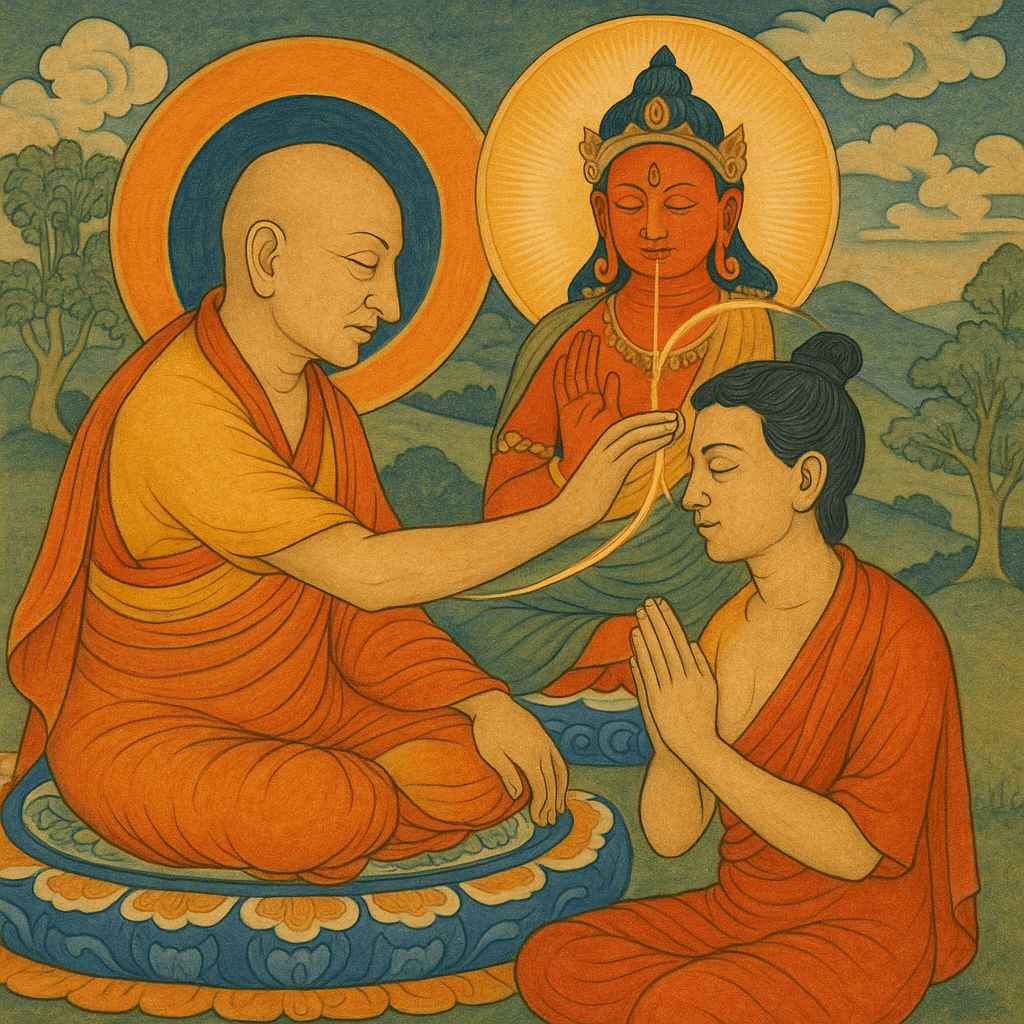
Tantric initiation (Vajrayana empowerment) is often described as a ritual that grants permission to engage in deity yoga and awaken one’s inner Buddha-nature. Yet traditional Tibetan sources suggest that something more mystical and intrusive is occurring, that the lama actually places the deity’s essence into the disciple’s mindstream. This critical detail, essentially the guru implanting or merging the deity (yidam) with the initiate’s mind, is conspicuously absent in most contemporary teachings.
This article examines classical tantras and commentaries to determine whether they explicitly describe the guru installing the deity in the disciple’s mind. It then compares that understanding with modern teachings, exposing a deliberate omission that raises serious questions about transparency in Vajrayana transmission.
Traditional Teachings on Tantric Empowerment
In Vajrayana Buddhism, empowerment (Tib. wang, Skt. abhisheka) is essential. “In the Secret Mantra Vehicle, there can be no accomplishment without empowerment.”¹ Classical definitions stress that this is not merely symbolic but a ritual that transforms the disciple’s mindstream.
According to the Rigpa Wiki, empowerment “awakens the special capacity for primordial wisdom to arise in the mind of the disciple.”² The Dalai Lama’s teachings on the Kalachakra Tantra state the guru “ripens the disciple’s psycho-physical continuum with the initiations.”³ Traditional analogies liken this to planting a seed that, with the right conditions, will grow into Buddhahood. This “seed” is not just metaphorical but is a spiritual presence that enters the disciple.
Tantric texts and commentaries describe empowerment as a mystical transmission wherein the wisdom deity (jnanasattva) is invited to enter the samaya deity (samayasattva), the visualized form of the disciple. Sam van Schaik summarizes: “in empowerment… the wisdom being becomes embodied in the samaya being.”⁴ The two minds are joined.
Instructions for such ceremonies explain that the lama generates themselves as the deity and transmits that awakened essence into the disciple through vase water, mantras, and gestures. The disciple visualizes the deity dissolving into themselves, signifying that the deity’s mind is being placed within them. Lineage sources stress that the lama must already hold the deity’s realization in order to transmit it. As one commentary puts it: “You have to hold something in you before you can give it.”⁵
In short, classical sources affirm that empowerment involves the lama implanting the deity’s essence into the disciple. Without this, Vajrayana texts say, real accomplishment is impossible, “like trying to press oil from sand.”
Does the Lama Literally Install a Deity?
While ancient texts may not use the modern phrase “implant the deity,” their intent is clear. An authoritative Kagyu explanation says the lama “places a recipient in connection with a particular Tantric deity,” enabling a “merging of essences.” This “connection” implies not just a symbolic affiliation but a mystical joining.
The empowerment ritual is the cause that activates and personifies the disciple’s Buddha-nature as a specific deity. This is not something the student can do alone; it requires the guru’s intervention. In Highest Yoga Tantra, multiple initiations (vase, secret, wisdom, word) facilitate this process in stages. During empowerment, the disciple imagines themselves as the deity (samaya being) and invites the wisdom deity to enter. When the two merge, the disciple becomes “in union” with the deity.
Some texts describe this as light or energy entering the disciple symbolizing the deity’s mind entering their heart. The Indian master Vilāsavajra described the climax of empowerment as a point when “wisdom and samaya come together.”⁶ The disciple leaves not just authorized but changed, carrying the seed of the deity from that point forward.
Jamgön Kongtrul writes that empowerment “introduces the disciple into the deity’s mandala” and allows the deity’s form and wisdom to “take root.”⁷ A Nyingma commentary states the guru, visualized as the deity, dissolves into the disciple, granting the blessing of the deity’s mind. Even the phrase “blessings enter the disciple’s stream” implies the transfer of a conscious presence.
In effect, tantric empowerment functions like a spiritual implantation, or even possession, in which the enlightened mind of the deity is placed into the disciple. The initiate now carries the deity within them, not merely as a concept but a living presence.
Modern Teachings: Omission or Adaptation?
If this is the traditional view, why don’t modern teachers say so? Contemporary teachings, especially those aimed at Western or general audiences, consistently describe empowerment in vague terms: permission, inspiration, activation of inner potential. The mystical detail of the lama implanting the deity is nearly always omitted.
In a transcribed teaching from a famous lama, now deceased (see below), empowerment is described as a prerequisite for deity meditation: the disciple receives empowerment, then instructions, and cultivates their body as the deity’s form. No mention is made of the lama placing anything into the disciple. It reads more like ceremonial enrollment than spiritual fusion.
This pattern is widespread: contemporary teachers often emphasize psychological language such as inner transformation, personal growth, and discovering potential, while minimizing the traditional notion of external metaphysical transmission. For instance, the Rubin Museum describes empowerment as a “ritual to introduce us to our own innermost Buddha qualities,”⁸ rather than as the reception of a deity from the lama. Such a framing casts the guru as a guide rather than a spiritual agent. However, this reinterpretation flattens the ritual’s ontological depth and misrepresents the original esoteric function of empowerment.
Even phrases like “placing the disciple in connection with the deity” or “ripening the mindstream” are left undefined. Many Vajrayana students, unless they study technical commentaries, may never realize that the tradition sees empowerment as a supernatural event. The omission is so consistent that one might suspect it’s intentional, perhaps to avoid alarming newcomers with the idea of having a foreign spirit installed in their mind.
Secrecy and Obfuscation in Vajrayana
To understand this omission, we must examine the role of secrecy. Vajrayana has always been esoteric. Revealing inner teachings to the uninitiated is a root downfall. As such, teachers often avoid revealing too much, especially in public settings.
Defenders of this approach argue that it’s compassionate: premature disclosure can cause misunderstanding or fear. Teachings are “graduated” and deeper layers revealed as the student progresses. In this view, the omission is considered skillful, not deceptive.
Yet critics argue that this secrecy amounts to intentional obfuscation in the modern information age. Newcomers are told that Vajrayana is about archetypes and psychological growth; this is appealing, secular-friendly language. Only later do they learn that the practice involves guru-bestowed metaphysical empowerment and deity implantation.
Few Vajrayana centers provide an upfront disclosure like: “In this empowerment, you will vow lifelong devotion and we believe that the deity’s mind will enter into yours.” Without this, informed consent becomes impossible. What if the student has been raised Christian and bound by the First Commandment: “You shall not have strange gods before Me”⁹? Would they agree to deity possession if fully informed?
The disconnect between outer presentation and inner doctrine has led some former practitioners to label the tradition dishonest. Years may pass before students learn that guru-deity fusion/possession are standard parts of the system. At that point, it may be too late as they’ve taken vows, invested emotionally, and become spiritually entangled.
Some defenders argue that Vajrayana’s opacity is necessary, that it was never meant for everyone. But in modern multi-cultural societies, this clandestine approach resembles a bait-and-switch. Students sign up for meditation, not spiritual merging with an imported god. They deserve to know what they’re consenting to.
Restoring Honesty in Transmission
Is omitting the “deity implantation” deceptive? From an academic standpoint, the answer is yes: there is a clear disconnect between traditional texts and public presentation. The idea that the guru installs a deity in the disciple’s mindstream is a core teaching, not a fringe view.
Yet most public talks and introductory texts never say this plainly. The true nature of the ritual, guru/deity fusion with the recipient, is hidden behind euphemism. This may prevent questions, but it is morally dishonest.
Vajrayana dharma centers must move toward transparency. Honesty about what is really occurring would both honor the teaching and protect the student. That this is seldom done nowadays is deeply disturbing.
In a predominantly Christian culture, where devotion to other gods violates divine commandments, the omission is not just deceptive, it’s a spiritual breach of consent. Prospective practitioners deserve to know what is happening before the ritual occurs, not after.
The tradition holds that through the guru’s blessing, one’s mind becomes inseparable from the deity. Then let us insist that teachers explain that clearly, before it is too late for the recipient to turn back.
Sources:
Traditional Vajrayana saying; cited in various commentarial teachings on abhisheka.
His Holiness the 14th Dalai Lama, Kalachakra Initiation Teachings.
Sam van Schaik, “The Limits of Transgression: The Samaya Vows of Mahāyoga” (2010).
Ngawang Phuntsok, On Receiving Wang (Empowerment).
Vilāsavajra, commentary on tantric vows; source referenced in academic discussion on Mahāyoga.
Jamgön Kongtrul, The Treasury of Knowledge, Book Eight, Part Three: The Elements of Tantric Practice.
Scott Globus, “Empowerments: Awakening the Buddha Within,” Rubin Museum, 2021.
Exodus 20:3, The Holy Bible.
Kalu Rinpoche – Teachings on Karmamudra and Mahamudra–California, Los Angeles, December 21, 1988
Transcript:
The gentleman is asking whether there is any connection between the traditional Buddhist approach to tantric practice and various sexual yogas—whether these practices have any bearing on the traditional path or whether that’s a misconception.
Yes, there is a connection. Previously, I spoke of the four major classes of tantra: Kriya Tantra, Charya Tantra, Yoga Tantra, and the fourth, Anuttara Yoga Tantra, or the Tantra of Unsurpassable Union. This fourth category is divided into Father Tantra, Mother Tantra, and Non-dual Tantra.
Principally in the classes of Mother and Non-dual Tantra, there are techniques involving sexual union as a basis for spiritual practice, technically termed karma mudra. These practices form part of a broader cycle known as the teachings on the Four Mudras. These teachings, as taught by the Buddha, are authentic and part of the tradition—the challenge lies in practicing them purely.
Traditionally, an individual would first undergo a long period of purification—purifying body, speech, and mind from harmful actions and obscurations, while cultivating positive qualities like merit and awareness. This is done through preliminary practices known as ngöndro.
Next, the individual would receive an authentic empowerment into one of the major tantric cycles from a qualified teacher. They would then receive extensive instruction in deity meditation and cultivate the experience of their own body as the deity’s form—experiencing the union of form and emptiness not as an idea, but as direct realization. Their speech would become the union of sound and emptiness, often practiced through extensive mantra recitation. They would also cultivate the awareness of mind as the union of intelligent clarity and emptiness, stabilizing it through meditative absorption.
Following this, the person would practice tummo or inner heat. This practice is done in stages and begins with the generation of inner warmth at the navel. As the warmth spreads, energy from the crown of the head flows downward. Through mastery of this flow, the practitioner experiences a profound bliss that pervades the mind-body complex.
Advanced stages involve focusing energy through the chakras. When energy is drawn to the throat, joy arises. At the heart, sublime joy. At the navel, special joy. And when energy is drawn down and contained within the genital chakra, co-emergent joy. Karma mudra practice requires the ability to hold this energy without losing it through orgasm. This leads to a nondual, non-conceptual state of awareness.
Eventually, the practitioner reverses the flow of energy upward through the chakras. Mastery over lowering and raising energy is required before karma mudra practice can be properly undertaken. With that mastery, energy is consciously directed through the 72,000 subtle channels (nadis) in the body. The ultimate aim is not sexual pleasure, but realization of Mahamudra.
Examples of individuals who attained enlightenment through such practices include the Indian king Indrabhuti, who is said to have relied on 1,000 consorts over six years. Tibetan lay practitioners like Marpa the Translator—who had eight consorts—are also examples. These paths exist, but must be practiced with purity and commitment.
Misunderstanding these practices—believing tantra is simply about sex—is a serious mistake. One of the 14 root downfalls in Vajrayana practice involves this misunderstanding, particularly the indulgence in orgasm, which is seen as a loss of energy that could otherwise be harnessed for enlightenment.
Another audience question asked about how long to leave a corpse undisturbed after death. In Tibetan tradition, the consciousness remains associated with the body for about 3.5 days. During this time, the body should ideally not be touched. A practitioner of phowa (transference of consciousness) is then called to assist the consciousness in departing skillfully.
After that, the body may be disposed of through burial, water burial, or cremation—accompanied by ritual and chanting to aid the consciousness. These practices can still be valuable even in cultures where such methods are not common, and ideally a phowa practitioner should be contacted if possible.
Another question asked whether one can attain liberation in a single lifetime through tantra. The answer is yes—realization of Buddhahood is possible. However, the physical manifestations may differ from those of a SambhogakayaBuddha, who displays specific physical marks of perfection. Still, the inner realization can be the same.
To discern an authentic teacher, look for someone with an unbroken lineage, proper transmission, sincere motivation, and correct understanding. Avoid teachers who have been disowned by their own lineage, or who act out of selfish motives. Examine their character, conduct, and consistency with traditional teachings.
In closing, the speaker encourages all listeners to study, practice, and seek qualified teachers. The merit of the teaching session is dedicated to the awakening of all sentient beings from ignorance, and the spreading of primordial awareness so that all beings may eventually attain Buddhahood.
Āveśa (Sanskrit) refers to a state of spiritual possession or divine inhabitation in which a deity or sacred power “enters” and dwells within a person. The word literally means “an entering” or “fusion,” describing the incorporation of divine power into the human body. Such forms of sacred possession have long been central to Indian Tantric practice, invoked for both worldly benefits (bhoga) and spiritual liberation (mokṣa). This is often contrasted with demonic possession in Christian theology, typically characterized as an involuntary affliction by an evil spirit.
Cross-cultural studies note that spirit possession can be either voluntary or involuntary, and it is interpreted differently depending on the tradition. Western occult traditions, such as Luciferianism, may view possession by a demon as desirable, even leading to a so-called “perfect possession.” In Christianity, however, even voluntary possession by a demonic force is considered evil. The question then arises: who or what possesses the practitioner in Eastern contexts?
Towards the end of my 35 years in Tantric Buddhism, I came to believe that the force presenting itself as a deity was, in fact, demonic. In what follows, I will examine the phenomenon of āveśa in two major esoteric traditions, Hindu Tantra (especially Shaiva lineages such as Kashmir Shaivism), and Tibetan Vajrayāna Buddhism. I will contrast these forms of divinely sanctioned possession with demonic possession in Christian and occult frameworks, drawing from historical sources, academic analysis, and personal experience.
Āveśa in Hindu Tantric Traditions
Scriptural Origins and Tantric Development
The Sanskrit root ā-viś (to enter) appears in early Indian texts, foreshadowing the later Tantric elaboration of āveśa.1 From the 5th to 11th centuries, Tantric scriptures across Śāiva, Śākta, and Buddhist milieus incorporated āveśa into ritual practice. Scholar Vikas Malhotra describes āveśa as the “entrance or fusion of oneself with the deity,” central to both magical and liberatory goals.2
These practices utilized mantras, mudrās, and nyāsa (installing mantras on the body) to induce the deity’s presence. Often this process was linked to śaktipāta, or the descent of divine energy. Over time, āveśa came to refer not just to deity possession, but a range of spiritual states culminating in union with Śiva.3 In contrast to exorcism (removing evil spirits), this adorcistic form of possession aimed to invite a divine presence.
Kashmir Shaivism and Samāveśa
In the Trika system of Kashmir Shaivism, the term samāveśa refers to full ontological immersion in Śiva-consciousness. Abhinavagupta, a 10th-century Hindu philosopher and Tantric adept, defined it as a merger of individual and divine being, sometimes accompanied by shaking, trance, or devotional ecstasy.4 Rituals such as nyāsa or advanced mudrā usage were seen as ways to divinize the body. Kṣemarāja, a key Trika commentator, emphasized that the body itself becomes a vessel for cosmic forces, eroding the sense of ego.5
This idea extended to daily ritual. The practitioner installs divine presences into various body parts—e.g., “May Brahmā be in my genitals, ViṣŇu in my feet, Śiva in my heart”—until the self is transformed.6 Āveśa was also connected to śaktipāta dīkṣā (initiation by grace), which Abhinavagupta saw as the guru’s transmission of divine force into the student.
Historical sources and hagiographies portray this not as pathology but sacred awakening. In the Bhakti tradition, saints like Caitanya and Rāmakṛṣṇa exhibited signs interpreted as divine possession, a loss of ordinary consciousness during worship or dancing in states of trance. In goddess worship, the ecstatic state of bhāva can evolve into full possession by a fierce Devī or goddess.
Induced Trance in Ritual Practice
Possession is not accidental; it is often deliberately induced. Contemporary folk-Tantric rites like Theyyam in Kerala reenact this vividly. The performer undergoes intense ritual preparation, dons a sacred headdress, and becomes a vessel for the deity. His demeanor, voice, and movements change dramatically, and devotees approach him as a god.7 These techniques including fasting, music, sacred garb, and mantra, parallel ancient Tantric rituals meant to induce āveśa.
Importantly, this experience is consensual. A priest may invite a deity for oracular guidance or blessing. The Tantric yogi similarly invites identification with Śiva. As Frederick Smith notes, such possession is the most valued spiritual experience in many Indian settings.8 Advanced yogis even practiced para-kāya praveśa, the entry of one’s consciousness into another’s body, a form of high-level āveśa.9
Āveśa (Possession) in Tibetan Vajrayāna Buddhism
Deity Yoga and Guru Inhabitation
Though the term “possession” is less used, Vajrayāna emphasizes divine inhabitation. In Deity Yoga, one visualizes oneself as a yidam (meditational deity) and invites the deity’s wisdom aspect (jñānasattva) to merge with the visualization (samayasattva). Through mantra and meditation, the practitioner dissolves ego and identifies as the deity.
While framed as an enlightened act, in practice there is no safeguard against malevolent forces. Many Tibetan rituals derive from the Yoginītantras, esoteric texts filled with wrathful, dangerous dākinīs. These entities are unpredictable and must be carefully propitiated. Practitioners hope to merge with them for wisdom and power, but failure often results in spiritual collapse or madness. One either becomes “enlightened” or is destroyed.
My personal experience, including participating in two three-year retreats, led me to conclude these deities are not divine but demonic. After prolonged practice, I experienced terrifying possession states, torturous sensations, and an uncontrollable kundalini awakening. While there were moments of bliss and magical phenomena, the final result was spiritual devastation.
Guru Yoga and Transmission
Guru Yoga, especially in the Nyingma and Kagyu lineages, mirrors āveśa. The practitioner visualizes the guru dissolving into them, merging body, speech, and mind. This is intended to produce an inseparable union. Some historical accounts even describe instant enlightenment via physical gestures or verbal commands from a master, a form of mind-to-mind transmission akin to possession.
Some Vajrayāna practices involve obvious demon possession. The Nechung Oracle, for example, enters trance during elaborate rituals, allowing the deity Pehar to possess his body. Frightening physical changes, voice alteration, and strength are observed. The practice is structured around phowa, a method of ejecting consciousness to allow divine entry.10
Possession as Initiation and Transformation
Both traditions treat āveśa as transformative. In Hindu Tantra, samāveśa may mark initiation or realization. In Vajrayāna, empowerment rituals symbolically install the lineage mindstream into the disciple. When successful, the practitioner believes they have merged with divine consciousness.
The experiences are often euphoric and expansive. Yet, as I learned, they can also become nightmarish. The forces one invokes may not be what they seem. While traditions insist the entities are enlightened or benevolent, there is no proof. Many undergo trauma, dissociation, and spiritual breakdown.
Christian Views of Possession: A Stark Contrast
In Christian theology, possession is demonic by nature. The demon enters uninvited or through occult involvement, and exorcism is the remedy. Symptoms include revulsion to the sacred, altered voices, and loss of control. Unlike tantric āveśa, the demon is not a divine aspect but an evil other. (I should note that the kundalini energy always felt “other” to me, but I was encouraged to see it as a positive experience.)
Catholic doctrine states that even voluntary occult involvement is condemned, seen as opening a door to bondage; the soul remains untouched, but the body and mind may be dominated. Consent may be partial or misguided, but once entered, the demon seeks destruction.
Only the Holy Spirit is seen as a positive presence, and even then, Christian traditions speak of inspiration rather than possession. Some Pentecostal expressions resemble Eastern possession states, but many Christians believe these, too, are counterfeit Holy Spirit experiences linked to kundalini phenomena.
Scripture offers stern warnings:
All the gods of the nations are demons.” — Psalm 96:5 (Septuagint) “They sacrificed to demons, not to God.” — Deuteronomy 32:17
In conclusion: āveśa is framed as a sacred merging in Tantra, but my experience revealed it as demonic deception. Beneath the ritual beauty lies spiritual subjugation. As an exorcist once warned me: Be careful who or what you invite to abide within.
Footnotes
“A Brief Study of Possession in Hinduism Part II: The Spiritual Context,” Indic Today.
Vikas Malhotra, ĀveŚan and Deity Possession in the Tantric Traditions of South Asia.
Ibid.
“The Fulcrum of Experience in Indian Yoga and Possession Trance.”
Ibid.
Indic Today, op. cit.
“Theyyam,” Wikipedia.
Frederick M. Smith, The Self-Possessed: Deity and Spirit Possession in South Asian Literature and Civilization.
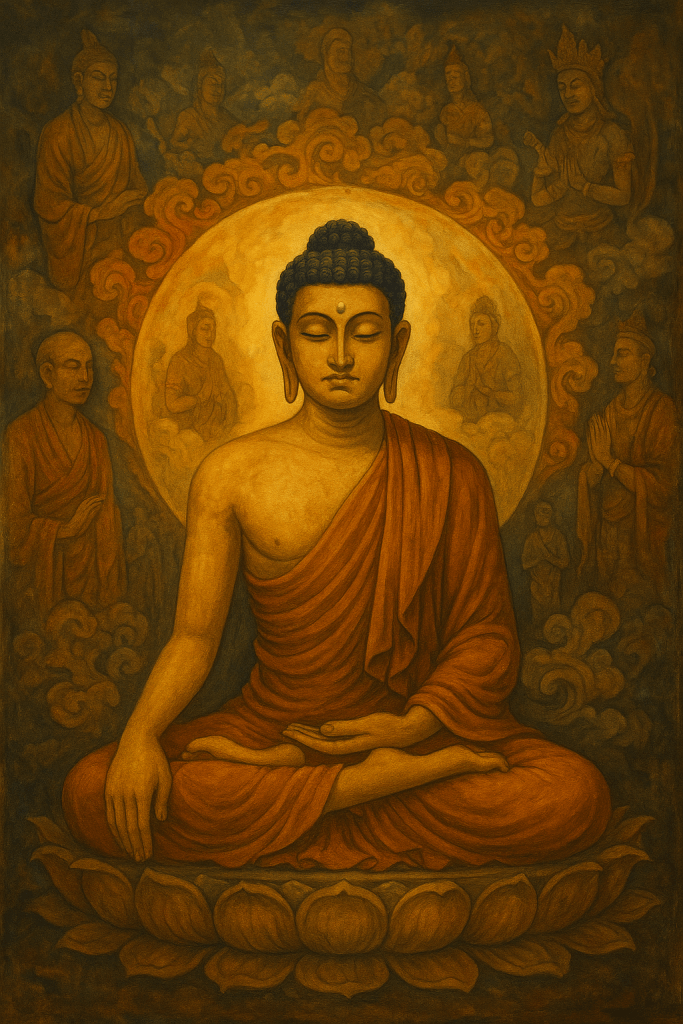
When people hear the term “Buddhism,” they often imagine a peaceful monk seated under a tree, cultivating mindfulness and inner stillness. They might recall the image of the Buddha, Siddhartha Gautama, who renounced wealth and power to pursue a path of liberation through ethical conduct, meditation, and wisdom. What many do not realize is that across Asia, the original teachings of the Buddha have often been overlaid with rituals, deities, and esoteric practices that resemble occultism more than renunciation. This is especially true with the spread of Tantric Buddhism, also known as Vajrayāna.
Tantric Buddhism, which developed in India around the 6th century CE, introduced rituals, visualizations, secret initiations, deity yoga, and sexual symbolism that were foreign to the early teachings found in the Pāli Canon. While it may have originated in India, the influence of Tantra has spread far beyond the Himalayas. Countries known today for their Theravāda heritage, such as Cambodia, Laos, Vietnam, and Thailand, have all, at different times, been touched or even deeply influenced by Tantric practices. This article traces the spread of Tantric Buddhism and asks a pressing question: Is this fusion of Tantra and Buddhism in harmony with what the Buddha actually taught?
India: The Birthplace of Tantra and the Turning Point
Though Siddhartha Gautama taught a path of non-attachment, the later development of Tantric Buddhism in India marked a dramatic departure. The Tantric path emphasized achieving enlightenment quickly by harnessing the powerful energies of desire, fear, and wrath through ritual and symbolic transgression.
Early Buddhist schools such as Theravāda preserved the monastic, ethical, and meditative disciplines taught by the Buddha. But by the time Vajrayāna emerged, Buddhism in India had evolved into Mahāyāna and beyond, with Tantric elements becoming dominant in institutions like Nālandā and Vikramaśīla monasteries before their destruction. From here, Tantra spread east.
Tibet: The Tantric Stronghold
No country embraced Tantric Buddhism more completely than Tibet. With the arrival of Indian masters like Padmasambhava in the 8th century, Tibet adopted esoteric practices involving deity yoga, ritual offerings (such as torma and blood libations), and secret empowerments. The Nyingma, Kagyu, Sakya, and Gelug schools all incorporated tantric texts and practices, often passed orally and practiced in secrecy.
Tibetan Buddhism’s public face often emphasizes compassion and mindfulness, but beneath the surface lies a highly ritualized system of guru devotion, spirit invocation, and occult symbolism. Even the widely admired Dalai Lama is an initiated tantric practitioner who publicly defends the practice of deity yoga and sexual yogas, raising serious questions about his alignment with the historical Buddha’s path.
China: Mixed Influence and Lingering Tantra
In China, the dominant schools of Buddhism have historically been Chan (Zen), Pure Land, and Huayan. However, during the Tang dynasty (7th–10th centuries), Esoteric Buddhism (Mizong) was introduced by Indian masters like Amoghavajra. While it never overtook the native schools, it left a lasting impact in some sects and still survives in diluted form within Chinese folk religion and Taoist-Buddhist syncretism.
Today, Chinese Buddhism largely appears non-tantric, but undercurrents remain, especially in temple rituals involving spirit appeasement, elaborate deity worship, and occult practices inherited from early Tantric transmission.
Vietnam: The Mahāyāna-Tantra Hybrid
Vietnam officially follows Mahāyāna Buddhism, heavily influenced by Chinese traditions. However, tantric rituals were introduced via Chinese Esoteric Buddhism and Indian Tantric texts. Vietnamese temples often blend Pure Land devotion with protective rituals invoking wrathful deities or dhāraṇīs (mantras with supposed magical powers). Such rituals, while less publicized, reveal an undercurrent of occultism beneath an otherwise devotional landscape.
Cambodia and Laos: Theravāda Facade, Tantric Underbelly
Cambodia and Laos are Theravāda countries, yet their histories are steeped in tantric influence from the ancient Khmer Empire. Angkor Wat, though now viewed as a Hindu and Buddhist site, was once home to elaborate Tantric rituals. Statues of multi-armed deities and ritual paraphernalia suggest tantric syncretism flourished.
Today, while the public face of Buddhism in these countries is Theravāda, local shamans (mo phi) and monks alike may engage in protective magic, spirit invocations, and talisman-making, practices more akin to Tantric ritual than Theravādan restraint.
Thailand: Theravāda Mixed with Occultism
Thailand is often held up as a bastion of Theravāda purity, yet here too the line between Buddhism and occultism blurs. Amulets, tattoos (sak yant), and rituals to appease spirits are common. Many monks perform rituals invoking Phra Ngang or other spirits linked to animistic or tantric practices. While not called Tantra, the ritual culture that has evolved in Thailand includes aspects strikingly similar: mantras, yantras, invocations, and guru devotion.
The Buddha vs. Tantra: Are They Compatible?
The question at the heart of this analysis is critical: Do tantric practices align with the historical Buddha’s teachings?
The Buddha emphasized renunciation, morality, mindfulness, and wisdom. He warned against magic, ascetic extremism, and blind devotion to teachers. He discouraged speculation about supernatural powers and encouraged liberation through insight and ethical living.
Tantric Buddhism, by contrast, often involves oath-bound secrecy, symbolic transgression (including sexual union and consumption of taboo substances), and reliance on supernatural beings and powers. In many forms, it is more reminiscent of sorcery than liberation.
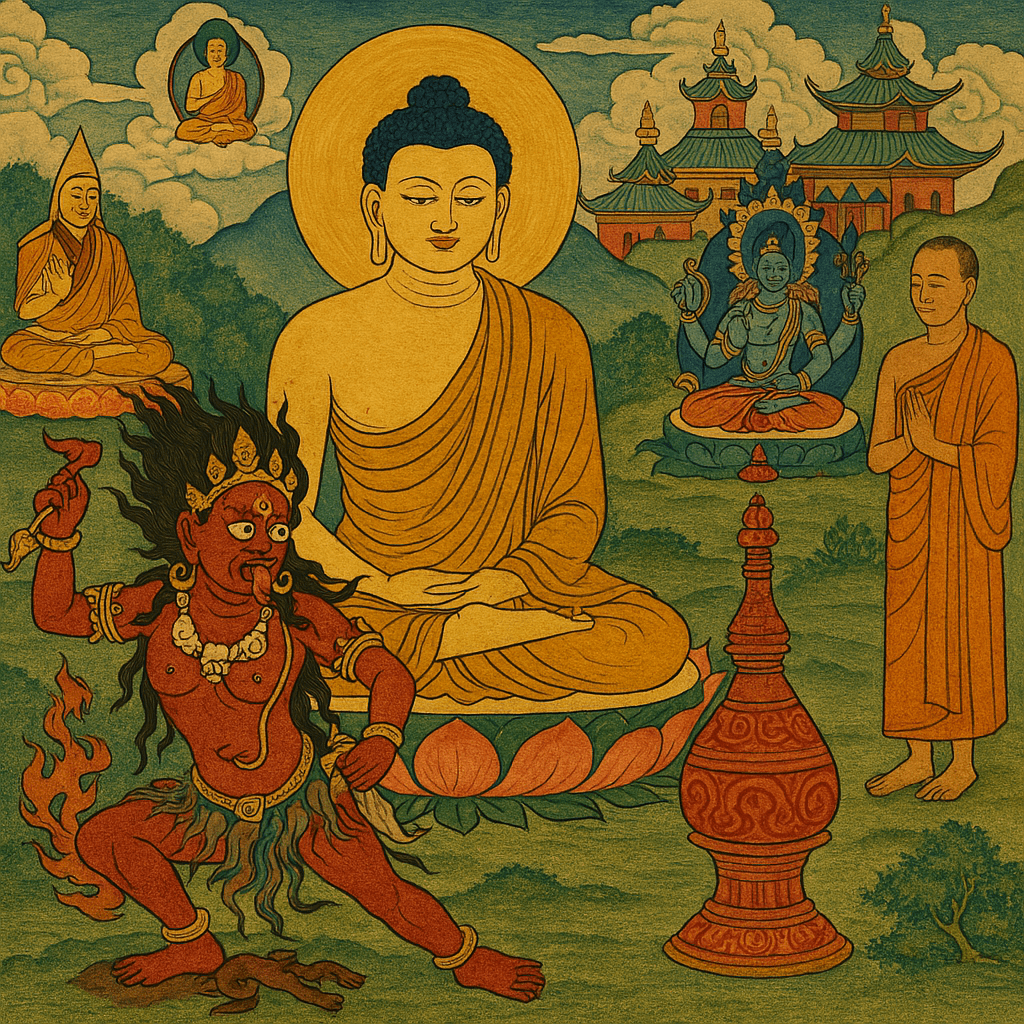
Bluntly stated, Tantra is not a spiritual shortcut, but a dangerous detour. It promises power, but often delivers confusion and spiritual enslavement. For survivors of tantric abuse, like myself, it’s critical to shine a light on how these practices have hidden behind the Buddha’s name and image for centuries. As Tantric Buddhism spread across the globe, from Tibet to Thailand, from China to Cambodia, it cloaked itself in the language of compassion and enlightenment; however, its methods betray a different source, one that leans toward secrecy, manipulation, and occultic power rather than truth and freedom.



 Tantric Deception