

Tibetan Tantra: A Snake in a Bamboo Tube


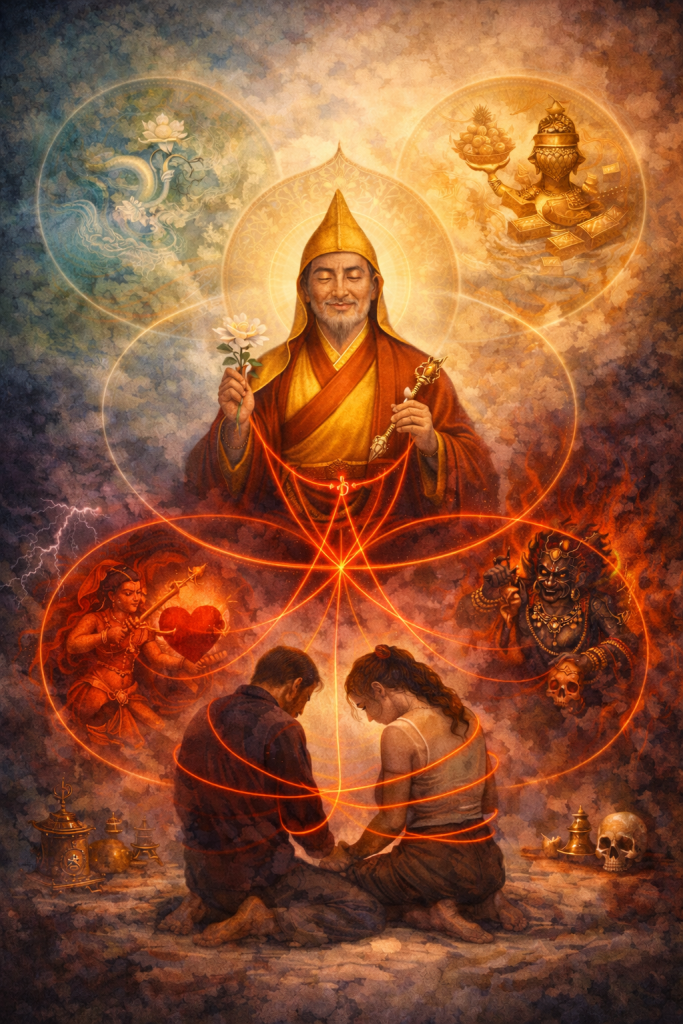
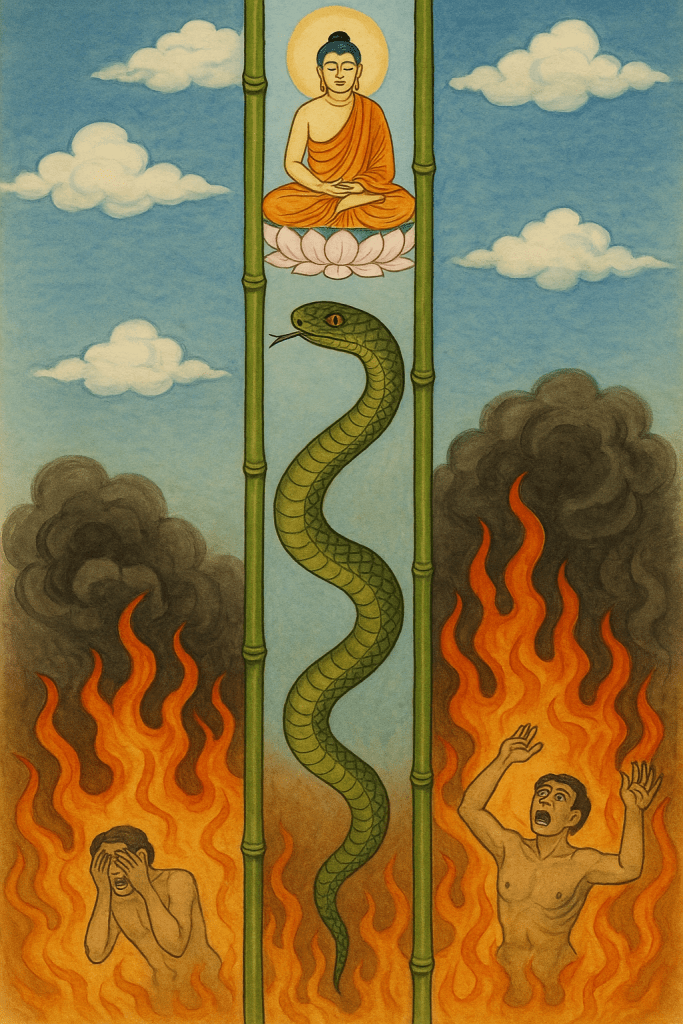
In Tibetan tantric Buddhism, the image of the snake trapped in a bamboo tube is more than a vivid proverb. It functions as a doctrinal warning: once a student enters the tantric path, there is no lateral escape. One either goes upward toward awakening or downward toward failure and “vajra hell.” Teachers have used this image to describe the uncompromising nature of samaya, the vows that bind a student to the guru, the deity, and the tantric methods themselves.¹

What is striking is how explicitly the tradition frames tantra as irreversible and high-stakes, and how rarely that stark truth is communicated to Western beginners before they agree to the vows that supposedly make the tube snap shut behind them. This mismatch between traditional warning and Western presentation is not a minor detail; it shapes the entire experience of Vajrayāna in modern contexts.

When the Warning Arrives Too Late

Many longtime practitioners have reported that the “snake in the tube” metaphor is introduced only after they have taken empowerments, established loyalty to the teacher, and accepted vows they did not fully understand. In one account, students were told after receiving advanced teachings that they were now like snakes [in a tube] with no side exit, and that questioning or leaving the guru’s authority carried dire karmic consequences.² Once framed in these terms, the student is no longer encountering tantra freely. The imagery becomes a retrospective justification for total commitment and an interpretive trap that discourages reevaluation, dissent or disengagement.

This sequencing matters. Warnings given after the student is already inside the tube are not warnings at all; they function as a mechanism of control. Sadly, it’s not just empty scaremongering to get the student to do whatever the teacher wants. The teacher can play a part in destroying the student if he wishes.

Western students, however, often enter tantra without the cultural framework that understands concepts like vajra–hell, and as a result frequently interpret them metaphorically or ignore them altogether during empowerments or teachings. As a result, the gravity of samaya is often hidden in plain sight. Students may assume that vows are symbolic or aspirational when, within the tradition, they are treated as binding conditions that determine spiritual destiny.

The asymmetry of information here is profound. Tibetan teachers know the stakes, but Western students usually do not.

Fear as a Reinforcing Mechanism

Inside the tantric system, samaya is often discussed as a bond of trust and devotion. But its shadow side is rarely addressed openly: the way threats of karmic ruin can be used to enforce silence and obedience. If leaving the guru, criticizing harmful behavior, or even doubting the teacher’s purity is framed as a breach of samaya, then fear becomes central to the student’s experience. Some Tibetan masters teach that both teacher and student can fall into vajra-hell for damaging the guru-disciple bond.³ In practice, however, this warning is most often directed at students, who are told that speaking publicly about misconduct or abuse may destroy their spiritual future.

Why the Snake Matters

The “snake in the bamboo tube” metaphor distills these concerns with unusual clarity. It shows that tantra is not designed to allow experimentation or partial commitment. It requires total participation in a closed system with its own rules, hierarchies, and cosmology. In cultures where this system has historically been embedded, those entering it do so in fuller awareness of the stakes. In the West, students often do not and they may hear such warnings in a highly suggestible state, without really grasping the implications.

One famous guru in the 1980s bluntly told students that they could be both Christian and Buddhist with no conflict whatsoever. This blatantly goes against Christian teaching. In those days Westerners were often thrust into the three-year-retreat program shortly after they signed up for teachings at Dharma centers with no knowledge of what they were really getting into. Many had little preparation to truly understand the arcane nature of samaya and its risks. Furthermore, many Tibetan teachers took advantage of their roles as authority figures to manipulate vulnerable students into sexual relationships and other sorts of commitments. Engaging in secretive sexual relationships with students while pressuring them to take highest yoga tantra vows and practices that would bind them forever often led to deep confusion and psychological unmooring.

The result is a form of spiritual engagement that looks consensual on the surface but lacks true informed consent. Students may be drawn in by promises of transformation but only later discover the rigidity of the commitments they have made. This is especially jarring given that Vajrayāna wraps together the renunciation of the Hinayāna, the boundless compassion of the Mahāyāna, and the esoteric demands of tantra. In this unwieldy fusion, the same tradition that teaches gentle observation of thoughts can also insist that a single critical thought toward one’s guru carries the weight of karmic catastrophe. The threat of vajra-hell sits uneasily beside Buddhism’s wider emphasis on compassion and non-judgment. An ethical issue looms large: a path that describes itself as having no side exit should not be offered as if it does.

To treat tantra’s danger as a secret or secondary detail is to undermine the integrity of the path itself. If practitioners are indeed snakes in a tube, they deserve to be told before they go inside.


Footnotes

¹ “Once you take samaya you become like a snake in a vertical bamboo tube: you’re either going up, or you’re going down. You can’t sneak out the side.” (Kun zang.org) (kunzang.org)
² Note: practitioner-reports and forum posts indicate the metaphor is often applied post-initiation. For example: “A Vajrayana practitioner is like a snake in a tube; … he can either go up or down, not left or right.” (dharmawheel.net)
³ “The metaphor for samaya is a snake in a bamboo tube. It has only 2 directions – up to enlightenment or down to the hells.” (TibetDharma.com) (Tibetan Buddhism)

The Structure of Tantric Abuse


In Tibetan tantric Buddhism, the relationship between guru and disciple is said to be sacred, a channel for transmission of enlightenment itself. Yet within that same structure lies a potential for absolute domination. When a guru feels threatened, betrayed, or exposed, the same system that demands devotion can become an instrument of terror.

The tantric logic of punishment

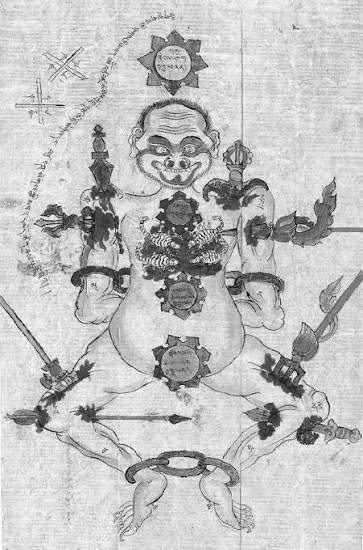
In tantric doctrine, every vow (samaya) between guru and disciple is a metaphysical bond. Breaking it is said to unleash cosmic consequences. Ancient texts speak of wrathful deities and oath-bound protectors who punish those who “slander the guru” or “harm the Dharma.” The idea is not metaphorical. Illness, accidents, or misfortune are interpreted as visible proof that unseen forces are enforcing spiritual law.¹

A guru who believes this, and who claims mastery of the dark ritual practices that command those forces, often teaches others to believe it. That teacher wields enormous psychological power. To label someone a “samaya-breaker” is to mark them as deserving of sickness or death. This is not an internal accusation only; it shapes the views of the community where the guru holds god-like power. It gives the guru a pretext to use ritual methods to harm students whenever he deems it necessary.

Entities that cause disease

Traditional Tibetan cosmology offers a detailed taxonomy of spirits believed to cause physical and mental harm: bdud (demons), gdon (malevolent spirits), btsan (fiery mountain gods), klu (serpent beings of water), and srin po (ogres).² Each category is said to afflict a different organ, emotion, or realm of life. Texts such as René de Nebesky-Wojkowitz’s Oracles and Demons of Tibet describe elaborate systems of offerings and threats designed to control these beings.

Within this worldview, ritual specialists do not invent malevolent forces but redirect them. A demon bound by oath can be petitioned to punish a perceived oath-breaker. Protector deities can be asked to “remove obstacles” by striking enemies with disease or madness. These ideas are deeply embedded in tantric liturgy and methodology, even if modern dharma centers prefer to describe them symbolically.

The internal logic of coercion

When this metaphysical framework meets the authoritarian structure of a retreat or monastic hierarchy, the result can be catastrophic.³ Gurus can claim divine justification for acts that would otherwise be seen as abusive. If a disciple questions orders, refuses sexual advances, or tries to leave, the teacher can declare them in spiritual violation. From that point on, any misfortune that follows can be attributed to supernatural punishment rather than the guru’s actions.

Real world allegations

The potential for that logic to cross into criminal abuse is not theoretical. Scholar and translator Adele Tomlin has published a series of testimonies from women who participated in long-term tantric retreats under the auspices of major Tibetan Buddhist organizations in the United Kingdom and Nepal. According to Tomlin’s report, complaints were submitted to trustees of the dharma centers, as well as to resident teachers. Police reports were also made, with at least one woman reportedly informed that criminal acts had occurred.

The list of complaints is substantial: “…sexual harassment, sexual assault/coercion, ‘false imprisonment’ i.e. refusing to allow people to leave the retreat for urgent matters, such as medical diagnosis and treatment or due to psychological breakdowns, emotional bullying, insistence on signing non-disclosure legal agreements, refusal to provide proper aid to those in physical pain or serious sickness. It was reported that women who had requested to leave the retreat for the above reasons were responded to with threats that they would go to hell…and telling them they would have short lives, terrible sicknesses and their family members would die and get sick too.” There are also accounts of tantric rituals being misused “to ‘force’ consorts to engage in ‘subtle body energy’ unions without appropriate consent/devotion or even pre-requisite qualifications of the guru or consort for such a relation,” and reports that participants’ passports were confiscated before entering retreats in Nepal.”³ See Tomlin’s article here.

The psychology of fear

Once a disciple internalizes the idea that disobedience invites divine punishment, ordinary safeguards such as the law, conscience, and community protection lose their power. The guru becomes both the source of danger and the only possible protection from it. Fear of sickness, insanity, or karmic ruin may keep followers silent even when they experience or witness abuse. This is coercive control disguised as spirituality.

Why tantra is uniquely risky

Every hierarchical religion can produce abuse, but tantric systems amplify the risk because they contain dark magical rituals that can be used to secretly harm students who do not show proper obedience. In the Tibetan tantric system, the guru is not just a teacher but the embodiment of enlightenment itself. Vows are said to bind across lifetimes. Breaking them is imagined to destroy spiritual progress and unleash demonic retribution. That belief gives abusive teachers a supernatural mandate to harm and a theological excuse when they do.⁴

Many practitioners are drawn to long-term retreats by tantra’s promise of transformation. But are the risks worth it? Without structural accountability, the same tools can become weapons. When secrecy, charisma, and ritual authority converge, even devoted, sincere, and intelligent students can be trapped in a reality of pain and punishment.

For those who have lived inside such systems, the scars run deeper than physical or sexual trauma. The damage is also ontological: the haunting sense that unseen forces will stalk them forever and that they are cursed beyond escape. Healing begins by reclaiming moral and spiritual agency, by recognizing that no guru, spirit, or protector holds dominion over one’s body, mind, or fate. Yet once that agency has been surrendered to powerful gurus and their invisible minions, recovering it can be very difficult.

Notes

  1. Stanley Mumford, Himalayan Dialogue: Tibetan Lamas and Gurung Shamans in Nepal (Madison: University of Wisconsin Press, 1989).
  2. René de Nebesky-Wojkowitz, Oracles and Demons of Tibet (The Hague: Mouton, 1956).
  3. Adele Tomlin sole author of Dakini Translations website: NOT SO “HOLY ISLE”? TRAGIC TALES OF REPORTED (AND ENABLED) BULLYING AND SEXUAL MISCONDUCT TOWARDS WOMEN AT SAMYE LING UK BUDDHIST CENTRES THAT ENDED IN PHYSICAL AND PSYCHOLOGICAL HARM, ATTEMPTED SUICIDES AND MURDER. Article excerpted with attribution.
  4. Geoffrey Samuel, Civilized Shamans: Buddhism in Tibetan Societies (Washington: Smithsonian Institution Press, 1993).

The Slow Dawning: Rethinking Tibetan Tantric Buddhism


It has taken me decades to admit something that began as a faint suspicion, then settled into unease, and now has crystallized into a sober conclusion: Tibetan tantric Buddhism is not what I thought it was. Nor is it what I believed when I first encountered it many years ago, a bit before the time His Holiness the Dalai Lama received the Nobel Peace Prize in 1989.

Back then, the first wave of Tibetan lamas and rinpoches were arriving in the West. To many of us, they seemed like emissaries from a lost Shangrila. Coming out of the disillusionment of the Vietnam War years, with trust in government and organized religion badly shaken, we were primed to seek something transcendent and pure. And here were these men, holy men trained in the monasteries of old Tibet, carrying with them an aura of mystery and profound wisdom. Meeting them felt like an unimaginable stroke of good fortune.

The historical Buddha’s teachings struck us as luminous and deeply humane. The philosophical treatises were subtle, the meditation techniques precise and effective. And then there was tantra. We were told, almost in passing, that tantra too came directly from the Buddha. No mention was made of its roots in Shaivism, or its overlaps with the worship of Shiva, Kali, and the other tantric currents in Indian religion. Yes, there were references to the 84 Siddhas, some of whom practiced in Hindu traditions, but it was presented as a kind of colorful backdrop rather than something that demanded careful inquiry. The task, we were told, was to study the dharma, not to ask too many uncomfortable questions.

And yet, the Buddha himself had urged his students to test his words as one tests gold: cutting, burning, hammering to see if it is true. I carried that instruction into Tibetan Buddhism. But the environment I found myself in didn’t encourage such testing. Quite the opposite.

Very quickly, I was drawn into the highest yoga tantras. After a series of initiations that were performed in Tibetan, a language I didn’t understand, I was informed by a lama I scarcely knew that from now on, I had to do whatever he told me. Cognitive dissonance set in immediately. Around me, others spoke of him as a fully enlightened buddha. Terms like samaya and vajra hell were introduced without context, wrapped in a swirl of historical Buddha teachings and cryptic tantric concepts. Critical thought was not just discouraged; it was quietly undermined. The lama was king, and the student’s role was obedience.

For Westerners raised with democratic ideals and an education that stressed inquiry, this was a bewildering fit. Many of us unconsciously overlaid our early religious conditioning onto what was, in fact, a foreign and feudal religious structure with a pantheon of strange and colorful deities. The result of treating the lama as an omniscient god created confusion, sometimes tragedy. I have heard of suicides, psychotic breaks, and lives unmoored. At the same time, I know people who genuinely believe they have benefited from Tibetan Buddhism. For years, I counted myself among them, until my own turn came.

I was privately attacked by my gurus during a tantric ritual for what I considered minor offenses related to situations outside of my control. What followed was worse: a series of what can only be described as black magical assaults. I now look back at those suicides I had once heard about and wonder: had they endured similar attacks, subtle or overt, after questioning or disappointing their teachers? Perhaps. I cannot know for sure. But I do know this: the mask of compassion many lamas wear often drops when they feel challenged or exposed. Not all, certainly. But enough to form a pattern.

That slow dawning that Tibetan tantric Buddhism was not what it was presented to be has been deeply painful. The disillusionment runs far beyond personal disappointment; it speaks to a betrayal of trust, the suppression of critical thought, and the dangers that arise when power is handed to unaccountable gurus who claim authority over hidden magical practices and wield them at will. Brought into a Western culture of sincere but searching seekers, this has created a toxic mix that leaves people vulnerable at the very moment they are most open.

“Books of Spells” in Tibetan Buddhism: Magnetizing and Subjugation Rites, and the Problem of Sexual and Spiritual Abuse


To view Tibetan Buddhism as purely meditative and philosophical is to miss a large and still under-mapped terrain of ritual manuals and spell collections. A 9th to 10th-century Tibetan “book of spells” from the Dunhuang cave library (British Library IOL Tib J 401) shows that Tibetan monks compiled practical ritual instructions covering healing, protection, exorcism, and subjugation. It is the earliest surviving compendium of Tibetan Buddhist magical ritual and looks exactly like what we’d call a grimoire: a working handbook of spellcraft.¹

Moving forward in time, the 18th-century polymath Slelung Zhadepa Dorje (Sle lung Bzhad pa’i rdo rje) assembled a large tantric cycle centered on the Jñānaḍākinī. Within that cycle, scholars have identified several distinct grimoires of spells that are, again, practical instruction sets embedded in a broader tantric collection. As one study notes: “This paper seeks to examine such techniques in several grimoires of spells found in the tantric cycle of Gsang ba ye shes mkha’ ’gro… compiled and edited… by Sle lung Bzhad pa’i rdo rje (1697–1740) in the 1730s.”²

“Magical practices in Buddhism are still one of the least studied aspects of the religion.”³

Despite strong indications that there are many such grimoires, from Dunhuang through later ritual cycles, there is no comprehensive catalog. Scholars themselves admit the field’s patchy mapping. Sam van Schaik emphasizes the neglect, and others underline that studies too often treat magic as a literary trope rather than as practical ritual.³ ⁴

Personal experience

I do not come to this subject as a detached scholar. I was targeted by two different lamas at different times, one of whom used coercion to draw me into a sexual relationship and then employed what I can only describe as black magic when I resisted, questioned, and tried to break free. Living through those experiences is what drove me to investigate Tibetan spell craft.

“From the inside, the grimoires of Tibetan Buddhism do not feel very different from the grimoires of Western occultism.”

Although I practiced intensely for years in long retreats, I was never taught these darker rituals, yet I witnessed unsettling rites performed by my lamas. After rebuffing the advances of the first guru, I experienced what felt like severe magical attacks that reverberated for years. The cognitive dissonance was crushing: I believed these teachers were fully enlightened buddhas, yet I suffered severe trauma and PTSD.

“Fear of vajra hell kept me clinging to the practices, even as abuse intensified.”

My second guru was later exposed publicly for sexual and psychological abuse. Being caught in his orbit, I became the target of annihilation rituals. Surviving and recovering has been extraordinarily difficult. I now see that while some teachers avoid such practices, others weaponize spells of magnetism and subjugation to manipulate students, especially women, for sex and energetic vampirization. This gray area of practical magic within Tibetan Buddhism is vast and dangerous.

What the rites actually claim to do: magnetizing and subjugation

Classical Vajrayāna sorts ritual aims into four “activities”: pacifying, enriching, magnetizing, and subjugating. These are not marginal ideas; they are a standard frame for tantric ritual. Magnetizing (Tib. dbang du sdud pa) is explicitly defined as bringing others “under one’s control,” while subjugation names violent rites directed at overcoming obstacles and destroying opponents.⁵ ⁶

Texts and prayers for magnetizing circulate broadly, for instance, the “Wang Dü” prayer attributed to Mipham, described as “magnetizing or bringing under one’s control.” None of this is esoteric in the sense of being unknown; it is central to tantric categories and practice rhetoric.⁶ ⁷

From ritual claims to real-world power: how coercion maps onto communities and individuals

A ritual manual promising to attract, influence, or subdue doesn’t automatically produce abuse. Still, the rhetoric of magnetizing and subjugation sits within a social system that grants absolute authority to gurus and expects strong devotion from students. When high-status teachers have access to rites whose very names project attraction and control, the risk of translating ritual language into interpersonal domination is real.

Recent history demonstrates the danger. In 2018 Rigpa, the international organization founded by Sogyal Rinpoche, published the results of an independent investigation by the law firm Lewis Silkin that validated numerous allegations of physical and sexual abuse and identified serious safeguarding failures.⁸

The published report recounts patterns of violence and coercion including “slapping,” “punching,” “hitting with a backscratcher, phones, cups and hangers,” and documents testimonies of sexual abuse, concluding that the community had failed to protect students.⁹

This is not to claim that tantric ritual texts instruct teachers to abuse students. It is to note a combustible mix: magical mechanisms of control, asymmetries of authority, sacralized obedience, and the frequent absence of external accountability.

Bringing the strands together

  • Books of spells are the norm: Tibetan Buddhist literature contains actual “books of spells” and multiple grimoires embedded in tantric cycles. These are not aberrations but part of the tradition.¹ ²
  • An under-researched domain: Leading scholars explicitly acknowledge that this area of Buddhist practice is still understudied.³ ⁴
  • Control as a ritual aim: The four tantric activities include “magnetizing” and “subjugating,” both routinely glossed as bringing beings or circumstances under one’s control.⁵ ⁶
  • Abuse linked to ritual rhetoric: Documented cases in Tibetan Buddhist communities show how claims to ritual power combined with intense guru-devotion can provide cover for coercion and severe abuse.⁸ ⁹

Where the research gap still matters

A fuller picture of “how many” grimoires are in Tibetan tantric collections requires systematic cataloging across canons and private libraries. Right now we have case studies and local inventories rather than a master list. These texts need to be thoroughly studied in their historical and contemporary contexts and exposed to the world for what they really are–recipes for white and black magic–not sugarcoated as quaint and innocuous artifacts.³ ⁴

Without naming and analyzing how these are taught and performed, it is hard for communities and individuals to protect themselves from magical attacks.

What better safeguards look like

  • Name the risk: community materials should explain what “magnetizing” and “subjugation” denote in practice and how these can and will be used against students at the guru’s discretion.
  • Independent oversight: adopt and publish external safeguarding standards and reporting channels. The Rigpa case shows why self-policing fails.⁸
  • Informed consent and boundaries: spell out that teacher/student sex, even where allowed by law, requires adult consent free of spiritual pressure, and that the bar for “free of pressure” is very high in asymmetric relationships.
  • Don’t assume that all Tibetan Buddhist lamas have pure intention and integrity.

The safest course is to avoid Tibetan Buddhism altogether, since in practice the guru’s needs and moods often override the Buddha’s teaching of non-harm.

A closing note on method

This article is a call for transparency and insistence on precision. Tibetan Buddhist archives contain grimoires. The tradition attracts students to its supposedly compassionate practices while concealing that darker “magnetizing” and “subjugation” practices are core ritual elements. Scholars say this area is understudied. And history shows that these techniques of control, in the hands of unaccountable authorities, can easily become abusive, even deadly.

Footnotes

  1. Sam van Schaik, “The Early Tibetan Book of Spells.” Analysis of British Library manuscript IOL Tib J 401 from Dunhuang (9th–10th century). This manuscript is recognized as the earliest surviving Tibetan compendium of spells and rituals, containing instructions for healing, protection, and exorcism. See: Sam van Schaik, Early Tibet blog (2008), and also referenced in his book Tibetan Zen: Discovering a Lost Tradition (Snow Lion, 2015).
  2. Sle lung Bzhad pa’i rdo rje’s Jñānaḍākinī cycle study (Academia.edu). Scholarly paper examining several grimoires embedded in the tantric cycle of Gsang ba ye shes mkha’ ’gro, compiled and edited in the 1730s by Sle lung Bzhad pa’i rdo rje (1697–1740). The paper highlights ritual techniques, their organization, and their status as practical spell collections within a broader cycle. Available on Academia.edu.
  3. Sam van Schaik on magical practices in Buddhism. Statement that “magical practices in Buddhism are still one of the least studied aspects of the religion.” Quoted in his writings on Buddhist magic, including his blog Early Tibet and in Tibetan Zen (Snow Lion, 2015).
  4. Cameron Bailey, “The Magic of Secret Gnosis: A Theoretical Analysis of a Tibetan Buddhist ‘Grimoire’.” Journal of the Korean Association of Buddhist Studies 84 (2020): 145–176. Available via Academia.edu. Bailey notes that “magic power in Buddhism has been studied more from the perspective of a literary trope than as practical and exactingly specific ritual techniques,” and examines grimoires embedded within the Gsang ba ye shes mkha’ ’gro (Secret Gnosis Dakini) cycle compiled by Sle lung Bzhad pa’i rdo rje in the 1730s.
  5. Vajrayāna framework of four activities. Standard tantric taxonomy of ritual aims: pacifying (zhi ba), enriching (rgyas pa), magnetizing (dbang sdud), and subjugating (dbang ’joms). Discussed in multiple Vajrayāna handbooks and summaries, including descriptions in online resources such as Rigpa Wiki and introductory texts on Vajrayāna Buddhism.
  6. Definitions of magnetizing. Magnetizing (dbang du sdud pa) is routinely glossed as “bringing others under one’s control.” See standard glosses in Vajrayāna dictionaries, sadhana commentaries, and contemporary teaching materials (e.g. Rigpa Wiki, “Four activities”).
  7. “Wang Dü” prayer attributed to Mipham. A widely recited prayer describing magnetizing activities, attributed to the 19th-century scholar Mipham Rinpoche (1846–1912). Circulates in Tibetan and English translation as a practice of magnetizing or bringing beings under one’s control.
  8. Rigpa Independent Investigation, Lewis Silkin LLP (2018). Commissioned by Rigpa International following widespread allegations against founder Sogyal Lakar (Sogyal Rinpoche). The final report documented physical assaults, psychological abuse, and sexual exploitation, and called out systemic safeguarding failures. Full report available through Rigpa’s website and media coverage (2018).
  9. Findings on abuse in Rigpa/Sogyal Rinpoche’s communities. The Lewis Silkin report and subsequent coverage summarized multiple testimonies: repeated slapping, punching, use of objects to hit students, as well as sexual coercion and exploitation of women. Findings were corroborated by survivor accounts and reinforced calls for reform in Tibetan Buddhist organizations.

When Devotion Becomes a Cage: Abuse in the Guru–Disciple Relationship


Based on Mary Garden’s article “The Potential for Abuse in the Guru-Disciple Relationship,” Cult Recovery 101

“No amount of evidence, nor the quality of it, will serve to un-convince the true believer. Their belief is something they not only want, they need it.” –James Randi

For decades, the Western imagination has romanticized the guru-disciple relationship: the wise, enlightened master guiding the humble seeker toward liberation. Yet beneath the rosy image lies a power dynamic that can turn toxic, even violent. Mary Garden’s searing account strips away the mystique, showing how devotion can be exploited to serve the ego, desires, and domination of the so-called spiritual elite.

A Pattern Hidden in Plain Sight

The dynamics Garden describes are not confined to Hindu ashrams or Indian gurus. They echo almost perfectly the same mechanisms of control found in certain strains of tantric practices within Tibetan Buddhism. These are systems where teachers are often elevated to godlike status and obedience is framed as the fast track to enlightenment. In both cases, devotion becomes a weapon that protects the guru from scrutiny, while binding the disciple to them even in the face of blatant harm.

Surrender Without Safeguards

Garden recalls her own journey in the 1970s, moving between ashrams in search of enlightenment. She describes the intoxicating joy of initiation, the chants, the sense of belonging, and the ecstatic highs that felt like spiritual transformation. But once she became a guru’s favored consort, the darkness emerged. The same man who preached divine wisdom alternated between seduction and brutal rage, even physically assaulting others in her presence. At one point she became pregnant by him and he blamed her for it and forced her to have an abortion.

The culture of total surrender made resistance almost unthinkable. Cruelty was reframed as a test of faith, abuse as a blessing, and every whim of the guru as cosmic law. The environment rewarded silence and punished doubt. Those who questioned were shamed, isolated, or cast out.

How Control Works

Her experience, echoed in countless other testimonies, reveals the common mechanics of spiritual exploitation:

  • Deification of the teacher silences doubt and criticism
  • Induced dependency through mystical highs and identity fusion
  • Rationalized harm presented as discipline or “divine play”
  • Social entrapment that makes leaving a spiritual, financial, and emotional crisis

The Cost of Leaving

Breaking free meant dismantling not only her faith in the guru, but also her connection to the community, the esoteric practices, and the sense of higher purpose she had built her life around. Even after witnessing violence firsthand, many of her peers remained loyal, their belief immune to any evidence of harm.

Lessons for the Seeker

Garden’s testimony is not a blanket condemnation of spiritual practice. It is a warning: any system that demands unquestioning obedience to a single human being, no matter how radiant their smile or lofty their words, contains the seed of abuse. Without discernment and the freedom to question, devotion can slide into bondage.

In her closing words, Garden writes, “The guru-disciple relationship is probably the most authoritarian of all in its demands for surrender and obedience. Hence it can be the most destructive. Far from achieving the enlightenment and freedom that many of us ‘wannabe’ spiritual pioneers of the 1970s sought and were promised, we experienced mental imprisonment and confusion. We were seduced by yogis and swamis telling us what we wanted to hear: that we were special and that they were God incarnate. Our need was our downfall. And if we escaped, we often carried lingering doubts: Was it just me? Did I fail? Did I give up too soon?”

Source: Mary Garden, The Potential for Abuse in the Guru-Disciple Relationship, Cult Recovery 101. Read the original article here.

The Tragic Consequences of Romantic Relationships Between Tibetan Gurus and Their Female Disciples


In the world of Tibetan Tantra, the guru is not merely a teacher. He is regarded as a living embodiment of enlightenment, someone who, once accepted, must be obeyed as if he were the Buddha himself. Into this framework walk countless Western women, often earnest seekers of truth, healing, or transcendence. But when romance, sexuality, and devotion become intertwined, the results are rarely transformative. More often, they are tragic.

This article explores the inherent power imbalance, cultural dissonance, and psychological manipulation that underpin many intimate relationships between Tibetan tantric gurus and their female disciples.


A Different Cultural Code

In Tibetan culture, it is not uncommon for powerful men, including lamas, to have secret relationships, multiple consorts, or children outside of marriage. In many traditional communities, this behavior is normalized, even expected. Male infidelity is culturally tolerated, and truth-telling in romantic relationships is not seen as a moral imperative.

For many Western women, however, raised in societies where emotional honesty and monogamy are core values in intimate relationships, these behaviors come as a rude awakening. When a Tibetan lama engages in a romantic or sexual relationship with a Western disciple, he often does so under entirely different assumptions than she brings to the table.

The result is a tragic mismatch, not only of expectations, but of entire worldviews.

Samaya: A Weaponized Vow

At the heart of tantric Buddhism is the concept of samaya, a sacred vow of loyalty and obedience to the guru. These vows are complex, often opaque, and understood differently in Tibetan contexts than in the West. A Western woman may believe she is entering a relationship based on mutual affection or spiritual partnership, while the guru sees her as a consort, a dakini, a means to an end, whose role is to support his realization through sexual union, secrecy, and ritual submission. A less realized guru might just use women for his own sexual satisfaction without having the ability to properly engage in tantric sex for spiritual ends. This is often true nowadays.

In any case, breaking samaya is said to have dire consequences, not only spiritually, but psychologically, and physically. The risk is greatly compounded if the woman undertakes a traditional three-year-retreat and engages in the highest yoga tantra practices, including the physical yoga. The looming threat of tantric destruction can trap women in relationships that are exploitative, confusing, and coercive. Once the guru becomes the channel for the deity, any questioning of his authority can be framed as demonic and a cause for imminent karmic downfall.

Possession Disguised as Enlightenment

Tantric union is not merely symbolic. It often involves rituals where the guru is said to be “inhabited” by the deity and his voice, gaze, and touch become divinely charged. During such practices, the female disciple is encouraged to dissolve her ego, to merge into the guru-deity, and to practice dak nang or “pure view.” This process can mimic, and in some cases become, a form of spiritual possession.

What’s often missed is the psychological and energetic takeover that occurs. The guru, now deified in the disciple’s mind and practice, can dominate her thoughts, dreams, emotions, and even her bodily functions. This fusion can make it nearly impossible for her to discern spiritual guidance from emotional manipulation or sexual coercion.

Real-World Tragedies

Numerous cases, both widely reported and quietly suppressed, illustrate the dangers of intimate relationships between tantric gurus and their students. These accounts reveal recurring patterns of deception, coercion, and spiritual abuse, all cloaked in esoteric language and asymmetrical power dynamics. They are not isolated incidents but part of a systemic pattern deeply embedded in a tradition that grants unchecked spiritual authority to men who are rarely held accountable.

For those who wish to explore further, consider just a few of the many investigations and testimonies:

Buddhist Project Sunshine – Phase 3 Final Report (2018)
This comprehensive report documents allegations of abuse within the Rigpa community, providing detailed accounts and analyses.
📄 Read the PDF Report

Beyond the Temple – What Now? Blog
Formerly known as “What Now?”, this blog offers reflections and information from ex-Rigpa members about their experiences and the broader implications of abuse in spiritual communities.
Beyond the Temple – Survivors of Abuse in Tibetan Buddhism

Tricycle – “Rigpa Abuse: Former Students of Sogyal Rinpoche Share Their Stories”
An article featuring firsthand accounts from former students detailing their experiences with Sogyal Rinpoche and the Rigpa organization.
📰 Read the Article

Lion’s Roar – “Letter to Sogyal Rinpoche from Current and Ex-Rigpa Members Details Abuse Allegations”
This piece publishes a letter from Rigpa members outlining specific abuse allegations against Sogyal Rinpoche.
📄 Read the Letter

The Aftermath: Disillusionment and Healing

For many women, the breaking point comes when the promised enlightenment fails to materialize, and the emotional wounds become undeniable. Depression, anxiety, spiritual confusion, sexual trauma, and a profound crisis of faith often follow. Some leave Tibetan Buddhism altogether. Others struggle for years in silence, fearing karmic retribution or spiritual failure.

But there is also healing. More and more survivors are finding their voices, connecting with others, and re-evaluating what true spirituality looks like outside the grip of occult religions.

Conclusion: A Cautionary Tale

The guru-disciple relationship in tantric Buddhism is not a romantic ideal. It is a spiritual contract saturated with asymmetrical power, cultural blindness, and theological complexity. When this dynamic becomes sexual, the risks multiply exponentially. For Western women seeking union with the divine, the guru-lover becomes not a liberator but a captor. The elaborate practice of guru yoga further seals the deal.

This truth must be told, not to demonize individuals or traditions, but to expose the structural and spiritual dangers that thrive in secrecy. Love, in its purest form, cannot flourish where truth is sacrificed to deception and devotion is manipulated into coercion.


The Mirror and the Light: Spiritual Execution in Tibetan Feudalism


In Hilary Mantel’s The Mirror and the Light, Thomas Cromwell rises from blacksmith’s son to the right hand of King Henry VIII. He becomes the monarch’s “mirror and light,” reflecting and executing his will. But the same proximity that elevates him also destroys him. When Cromwell fails to deliver a pleasing queen, he is arrested, disgraced, and executed, his closeness to power proving fatal.

Tibetan tantric Buddhism operates on a hauntingly similar logic. In this tradition, the guru is king, and the disciple, like a courtier, is raised or destroyed at the guru’s whim. Far from being egalitarian or purely spiritual, Tibetan Buddhism, especially in its institutional forms, retains a deeply feudal structure, complete with titles, inheritance, land ownership, and enforced hierarchy.¹

Tibetan Buddhism as a Feudal System

For centuries, Tibetan Buddhism was not just a religion but the ruling system of the nation. The Dalai Lama was both spiritual sovereign and temporal king. Monasteries controlled vast tracts of land, collected taxes, and held legal authority over villages.² Senior lamas, often reincarnated tulkus, inherited wealth and power from their predecessors, a system akin to aristocracy by divine right. Large institutions like Drepung, Sera, and Tashi Lhunpo amassed political influence and wealth, with monasteries owning up to two-thirds of arable land in pre-1950s Tibet.³

The tulku system (identifying reincarnated masters) consolidated this feudalism. Wealth and authority passed to a chosen child, often from a high-status family, and the child was installed into a network of patronage, where senior monks managed the estate until the tulku matured. Ordinary monks and villagers remained economically dependent on these institutions, often working the land in exchange for spiritual services and blessings.⁴ According to historian Melvyn Goldstein, Tibetan society was “essentially a form of monastic feudalism.”⁵

The Guru as King: Absolute Power

In the Vajrayāna path, the guru is not merely a teacher: he is treated as the Buddha himself. Vajrayāna texts warn against questioning the guru, no matter how erratic or abusive his behavior.⁶ Students are bound by samaya (tantric vows), which demand total obedience, silence, and loyalty. In this relationship, the disciple becomes like Cromwell: a mirror for the guru’s will, performing rituals, making offerings, and receiving favor or punishment.

This closeness creates the illusion of intimacy, even love. Many disciples report feeling spiritually chosen or singled out by the guru. But this intimacy masks a darker truth: it is conditional and instrumental. When the disciple fails to satisfy the guru, by asking questions, expressing trauma, or failing to uphold impossible vows, they are cast out. Not just socially, but cosmically.⁷

Falling Out of Favor: Spiritual Annihilation

When a disciple displeases a guru in these feudal tantric systems, the consequences are severe. Historically, punishments ranged from beatings and public shaming to exile from the monastic estate.⁸ In modern times, exile takes subtler forms: ostracism, reputation assassination, spiritual gaslighting, and the threat of karmic damnation. Survivors of abuse report being told they were “possessed by demons,” “breaking their samaya,” or “falling into the lower realms” simply for speaking out.⁹

Just like Henry VIII’s wives or ministers, the disciple who falls out of favor is ritually erased. Their years of devotion are forgotten; their insights mocked. The same master who called them “special” now identifies them as a threat to the dharma. The disciple’s proximity to power becomes their undoing.

When the Light Burns

The title The Mirror and the Light is tragically fitting for both Thomas Cromwell and the countless disciples who believed that closeness to the guru meant safety. In Tibetan tantric Buddhism’s feudal framework, it often means the opposite. Disciples serve as tools of the guru’s charisma, devotion, and control. When they no longer reflect his will, they are discarded and spiritually “executed” without ceremony.

Just as Cromwell’s brilliance could not save him, neither can sincerity or devotion save a disciple in a rigged, feudal system.


Footnotes

  1. Geoffrey Samuel, Civilized Shamans: Buddhism in Tibetan Societies (Smithsonian Institution Press, 1993), pp. 22–29.
  2. Melvyn C. Goldstein, A History of Modern Tibet, Volume 1: The Demise of the Lamaist State (University of California Press, 1989), pp. 80–95.
  3. Matthew T. Kapstein, The Tibetans (Wiley-Blackwell, 2006), pp. 142–148.
  4. Toni Huber and Stuart Blackburn, Origins of the Tulku System in The Social History of Tibetan Institutions (Brill, 2002).
  5. Goldstein, History of Modern Tibet, p. 90.
  6. Alex Wayman, The Role of the Guru in Vajrayana, in Tibetan Buddhism: Reason and Revelation, ed. S. Lopez (SUNY Press, 1997).
  7. Miranda Adams, Samaya and Silence: Enforcing Obedience in Vajrayana Communities, unpublished thesis, 2020.
  8. Janet Gyatso, Being Human in a Buddhist World (Columbia University Press, 2015), ch. 3.
  9. Annabella Pitkin, “Broken Samaya and the Threat of Hell: Devotion, Dissent, and Control in Contemporary Tibetan Buddhism,” Journal of Global Buddhism, Vol. 22 (2021).

The Cultish Nature of Tibetan Buddhism


When I began my journey into Tibetan Buddhism, I was swiftly enveloped in its rituals and traditions. Without much explanation, I was handed monastic robes, instructed to shave my head, and urged to take lifelong vows. This rapid immersion into a structured and demanding system left me questioning the true nature of the practice. Was this a genuine spiritual path, or was I being drawn into a cult masquerading as a path to enlightenment?

The Allure of Tibetan Buddhism

Tibetan Buddhism often presents itself as a path of loving-kindness, compassion, and profound meditative insight. Its teachings emphasize peace, mindfulness, and the cultivation of wisdom. On the surface, these ideals are appealing and resonate with many.

However, lurking beneath this serene exterior is a complex structure of vows, rituals, and hierarchical relationships that can be overwhelming and oppressive.

The Samaya Vows: Protective or Deadly?

Central to Vajrayana Buddhism are the samaya vows, which are commitments taken by practitioners during tantric initiations. They establish a sacred bond between the guru and the disciple, outlining the conduct required to uphold that bond.

These vows can create a sense of obligation and fear. Breaking samaya is believed to lead to severe karmic consequences, placing immense pressure on individuals to adhere strictly to obedience no matter what the guru does.

Hidden Subjugation and Control

The hierarchical nature of Tibetan Buddhist communities can lead to overt forms of mind control and manipulation. The reverence for the guru borders on unquestioning subservience, with the guru’s authority rarely being challenged. This dynamic can foster an environment where questioning is discouraged, and followers are compelled to conform to the guru’s demands and the group’s expectations.

Moreover, the concept of “crazy wisdom” is sometimes used to justify behavior that would otherwise be deemed inappropriate or abusive. This philosophy, associated with figures like Chögyam Trungpa, suggests that unconventional or even disruptive actions by a guru are acceptable if they lead to spiritual awakening. Such justifications can blur ethical boundaries to the extent that students are ripe for abuse.

The Dark Side of Tibetan Buddhism

Instances of widespread misconduct within Tibetan Buddhist communities have been reported, raising concerns about the integrity of these institutions. The case of Sogyal Rinpoche, the founder of the Rigpa organization, is one example where allegations of sexual abuse and severe authoritarian control surfaced, leading to significant controversy and criticism. After eight students leaked a letter on the internet exposing his crimes, a highly-regarded Khenpo associated with the group gave a talk denouncing those eight students, angrily declaring that they would all go to vajra hell. Even though many Westerner disciples of Tibetan Buddhism don’t believe in vajra hell, I can assure you from first hand experience that it’s very real. You can read more about it here.

These incidents highlight the potential for exploitation within systems that place immense power in the hands of a single individual or a small group of leaders. The lack of accountability and transparency in many Tibetan Buddhist organizations can create an environment ripe for cultish abuse.

Conclusion: A Call for Critical Reflection

While Tibetan Buddhism appears to offer profound teachings and practices, it is essential to approach these traditions with a critical eye. The allure of compassion and peace should not overshadow the lack of ethical conduct, transparency, and respect for individual autonomy that often hides beneath the surface.