
Why a Baptized Christian Cannot Also Hold Tantric Vows


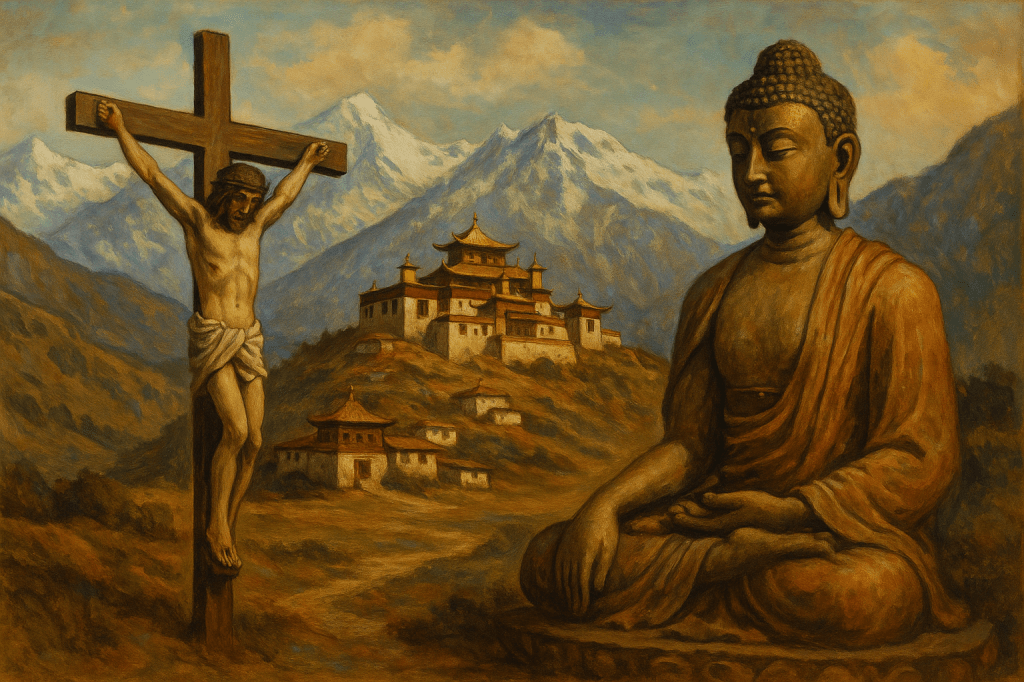
As young Western seekers, we were told directly by the refuge lama, a highly accomplished yogi whose presence and meditative depth made his words seem authoritative, that we could be both Christian and Buddhist. He said there was no conflict, that a person could be both Christian and take refuge in Tibetan Buddhism. Only much later did I begin to see that the metaphysical claims of Christianity and Tibetan Buddhism do not sit comfortably together. When examined honestly they point in opposite directions. This article explores that truth and why the issue deserves more clarity than it usually receives.

The Christian indelible mark

Catholic teaching holds that baptism is not a symbolic rite. It confers a real spiritual character on the soul, a mark that is indelible and permanent.¹ The person baptized is said to belong to Christ in a definitive way. Even if one later rejects Christian belief, the character imprinted by baptism remains. This teaching forms a central claim about spiritual identity. Baptism is a covenant, a seal, and a bond that cannot be undone by human action. Some theologians and exorcists describe it as a spiritual allegiance that shapes the destiny of the person marked by it.²

Vows in Tibetan Buddhism

Tibetan Buddhism also understands vows as real phenomena rather than mental constructs. They are described as subtle forms that arise in the practitioner’s continuum and remain active as long as the vow is kept.

Refuge: The refuge vow is the foundation of the path. To take refuge is to entrust oneself entirely to the Buddha, Dharma, and Sangha. This commitment is said to exist as a subtle form until broken.³

Bodhisattva vow: This vow stabilizes the intention to attain enlightenment for all beings. It is also considered to have ontological presence, shaping the practitioner’s moral and spiritual life.⁴

Tantric vows: Tantric samaya binds the practitioner to the guru, the deity, and the mandala. Tibetan commentaries treat samaya as a form that abides in the subtle body. Maintaining it is essential for any tantric practice to function. Breaking it has extremely dire consequences.⁵ Tantric vows require a view of reality that rejects any creator God and understands the deity as a manifestation of awakened mind.⁶

The awareness of the deities

What makes this tension even more striking is the role of the tantric deities. In traditional Tibetan understanding these deities are not abstract ideas. They are regarded as fully aware and responsive.⁶ When a practitioner takes refuge or samaya, the commitment is made not only in the presence of a human teacher but in the presence of the deity invoked.⁷

This means that even if a lama sincerely believes there is no conflict with Christianity, the deity knows exactly what commitments the practitioner brings into the mandala. The deity is aware of conflicting allegiances. If baptism marks a person as belonging to Christ, the tantric deity would encounter that mark as a pre-existing and incompatible bond.

When my refuge lama told us that being Christian was no problem, I accepted his assurance. He was revered, a man of immense yogic accomplishment. Yet the actual teachings of the system he represented do not support his statement. Neither do the Christian teachings. Christianity requires allegiance to the Most High God and sees baptism as a permanent seal of belonging.⁸ Thus, the two religious systems do not fit together. They are not partial overlaps but mutually exclusive covenants.

The question of whether one can be both Christian and a Tibetan Buddhist practitioner is not merely philosophical. It concerns real commitments that each tradition claims have unseen but powerful form. To treat these vows and sacraments lightly is to misunderstand them. To treat them seriously is to recognize that both paths make exclusive claims on the identity and destiny of the practitioner. Honesty requires admitting that they cannot be combined without dissolving the integrity of one or the other.


Sources

¹ Catechism of the Catholic Church, 2nd ed., §§1272–1274.
² Thomas Aquinas, Summa Theologiae, III, q. 63, aa. 1–6.
³ Jamgon Kongtrul Lodro Taye, The Treasury of Knowledge, Book Six.
⁴ Je Tsongkhapa, The Great Treatise on the Stages of the Path to Enlightenment, Vol. 1.
⁵ Khenpo Ngawang Pelzang, A Guide to the Words of My Perfect Teacher.
⁶ Patrul Rinpoche, The Words of My Perfect Teacher.
⁷ Dalai Lama and Alexander Berzin, The Gelug/Kagyu Tradition of Mahamudra, chapters on tantric initiation.
⁸ Benedict XVI, Address to the Roman Curia, 22 December 2006, section on baptismal identity.
Christianity in Tibet: The Legacy of Jesuit Priest Ippolito Desideri


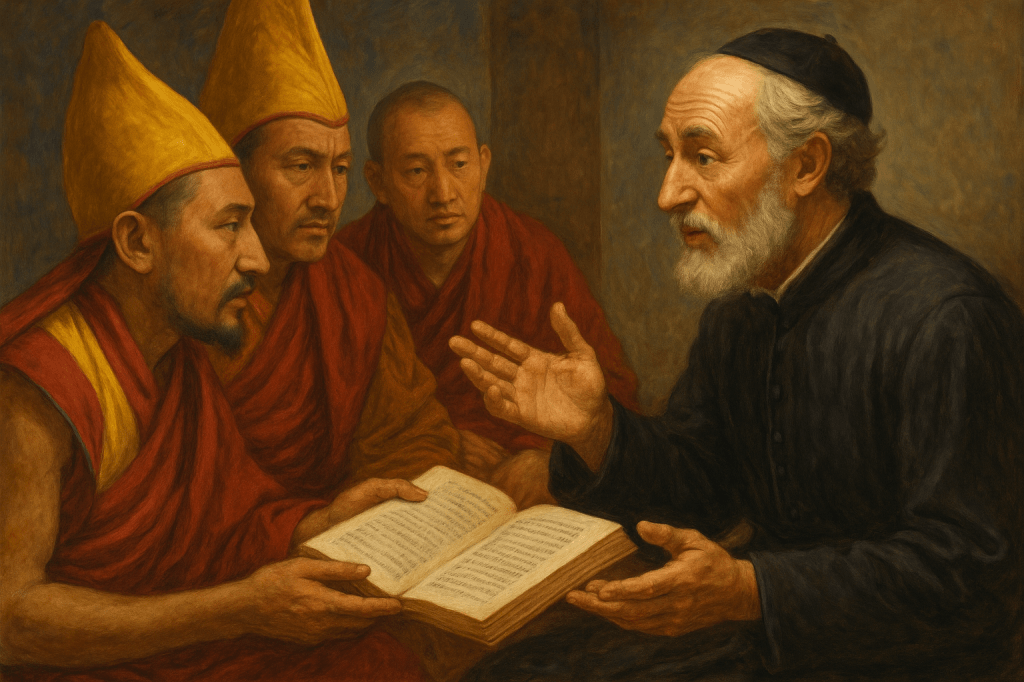
For centuries, Tibet has been a land that captures the imagination of the West: a high, remote world where spiritual and philosophical traditions intertwine with the stark beauty of the Himalayas. Among the earliest Westerners to truly engage with Tibetan thought was Ippolito Desideri, a Jesuit priest from Tuscany whose intellect, linguistic mastery, and deep curiosity made him one of the most remarkable missionaries of the early modern era. His work in the early 18th century stands as the first sustained encounter between Christianity and Tibetan Buddhism, marked not by confrontation but by a rare spirit of dialogue.

Early life and mission

Born in Pistoia in 1684, Desideri joined the Society of Jesus and quickly established himself as a scholar and teacher. His ambition was missionary work, and in 1712 he left Europe for India under the Jesuit Province of Goa. After years of difficult travel through Delhi, Kashmir, and Ladakh, he entered Lhasa on March 18, 1716. The Mongol ruler Lhasang Khan granted him permission to reside and study, marking the beginning of one of the most extraordinary intellectual encounters in religious history.¹

Tibet and the Capuchin dispute

Unknown to Desideri at the time, the Vatican’s Congregation for the Propagation of the Faith had already granted the Capuchin order exclusive rights over the Tibetan mission in 1703. This bureaucratic decision set the stage for a long jurisdictional dispute that would eventually cut short his work. In 1718, Propaganda Fide reaffirmed its assignment to the Capuchins and ordered the Jesuits to withdraw. After years of correspondence and litigation in Rome, a final decree in 1732 confirmed the Capuchins’ claim to Tibet.²

Immersion in Tibetan learning

In Lhasa, Desideri did what few missionaries before or since have attempted: he learned Tibetan thoroughly, studied Buddhist philosophy at Sera Monastery, and debated with monks in their own scholastic format. When the Dzungar invasion disrupted the capital in late 1717, he moved to Dakpo, where he continued to write and teach until his departure in 1721.³

Desideri’s approach was remarkable for its intellectual humility and rigor. He sought not to denounce Buddhism from ignorance but to understand it from within. By studying logic, metaphysics, and the Abhidharma, he entered into dialogue with the most sophisticated thinkers of his day in Tibet.

The Tibetan writings

Between 1718 and 1721 Desideri composed several original works in Tibetan. These writings, preserved in manuscripts now held in Rome and elsewhere, represent the earliest sustained Christian philosophical literature written in the Tibetan language.

  1. Tho rangs (“The Dawn”). An introductory dialogue presenting Christianity as the light that dispels ignorance and prepares the reader for deeper argumentation.⁴
  2. Lo snying po (“Essence of the Doctrine”). A concise catechism that sets out the essentials of Christian theology in the format of a Tibetan scholastic summary.⁵
  3. ’Byun k’uns (“Origin of Living Beings and of All Things”). A detailed critique of Buddhist cosmology and rebirth, arguing for a First Cause and a created order.⁶
  4. Nes legs (“The Supreme Good and Final End”). A philosophical exploration of the highest good, contrasting Christian teleology with Buddhist conceptions of nirvana.⁷

These works reveal a unique attempt to translate Thomistic metaphysics into the conceptual world of Tibetan Buddhism. Desideri employed debate forms familiar to the Geluk school and structured his reasoning through syllogisms recognizable to monastic scholars.⁸

His arguments against rebirth and emptiness

Desideri’s philosophical engagement centered on two main critiques of Buddhist doctrine: the cycle of rebirth and the concept of emptiness.

He argued that the karmic theory of rebirth fails to explain the origin of the first sentient beings, since it presupposes an infinite regress of prior lives without an initial cause. The moral and causal order of the universe, he wrote, points instead to an intelligent Creator who is both the origin and sustainer of being.⁹

Regarding emptiness (śūnyatā), Desideri contended that the very notion of dependent origination implies the existence of something independent. If everything is contingent and conditioned, reason demands an unconditioned ground. For Desideri, that ground is God, the necessary and self-subsistent cause of all things.¹⁰ He thus turned Tibetan logic toward a Christian conclusion, using the same tools his interlocutors used to defend their own tradition.

Conflict with the Capuchins and departure

While Desideri’s intellectual project flourished, his position within the Catholic hierarchy collapsed. The Capuchins, already active in Lhasa, viewed the Jesuits as intruders and appealed to Rome. After Propaganda Fide confirmed their authority, Desideri was ordered to leave Tibet in 1721. He made his way through India and returned to Europe in 1728, where he spent years defending the Jesuits’ case before ultimately submitting to the Vatican’s ruling.¹¹

The great narrative: Notizie istoriche del Tibet

Back in Rome, Desideri composed Notizie istoriche del Tibet (“Historical Notices of Tibet”), an extraordinary blend of ethnography, travel narrative, and theological reflection. In it, he described Tibetan geography, society, and religion with unprecedented detail and sympathy. Modern readers can access this work in the English translation Mission to Tibet by Michael Sweet and Leonard Zwilling, as well as in Donald Lopez and Thupten Jinpa’s Dispelling the Darkness.¹²

Legacy

Desideri died in 1733, only a year after the final Vatican ruling. His Tibetan manuscripts remained largely unknown until rediscovered in the 19th century. Today, he is recognized not only as a pioneering missionary but as a scholar who took the intellectual and spiritual life of Tibet seriously. His work stands as an early model of interreligious understanding, where dialogue was pursued through reason, language, and genuine respect.

Modern scholars such as Trent Pomplun, Donald Lopez, Thupten Jinpa, and Guido Stucco have shown that Desideri’s project anticipated later comparative philosophy by centuries. His writings remain a testimony to a unique moment when a European Jesuit and Tibetan monks met across the boundaries of faith to ask the same ultimate questions about being, purpose, and salvation.¹³


Footnotes

  1. Wikipedia, “Ippolito Desideri.”
  2. Michael J. Sweet, “Desperately Seeking Capuchins,” Archivum Historicum Societatis Iesu.
  3. Donald S. Lopez Jr. and Thupten Jinpa, Dispelling the Darkness: A Jesuit’s Quest for the Soul of Tibet.
  4. Guido Stucco, When Thomas Aquinas Met Nāgārjuna (includes translation of The Dawn).
  5. Elaine M. Robson, “A Christian Catechism in Tibetan,” University of Bristol thesis.
  6. Guido Stucco, When Thomas Aquinas Met Nāgārjuna (translation of The Origin of Living Beings).
  7. Opere tibetane di Ippolito Desideri, S.J., vol. IV (Toscano, ed.).
  8. Trent Pomplun, Jesuit on the Roof of the World: Ippolito Desideri’s Encounter with Tibetan Buddhism.
  9. Guido Stucco, When Thomas Aquinas Met Nāgārjuna, commentary section.
  10. Lopez and Jinpa, Dispelling the Darkness, analysis of Desideri’s argument on emptiness.
  11. Sweet, “Desperately Seeking Capuchins.”
  12. Ippolito Desideri, Mission to Tibet: The Extraordinary Eighteenth-Century Account, trans. Sweet, ed. Zwilling.
  13. Pomplun, Jesuit on the Roof of the World.

A Brief History of Christianity in Tibet


Early Traces: The Nestorians and the Eighth Century

The history of Christianity in Tibet stretches back far earlier than most assume. The earliest Christian presence likely came from the Nestorian Church of the East, which had spread along Silk Road routes from Mesopotamia into China by the 7th century. Evidence from the Xi’an Stele of 781 CE shows that Nestorian missionaries were active under the Tang Dynasty, and given Tibet’s close relations with Tang China, it is plausible that Christian communities emerged within the Tibetan cultural sphere during the 8th century.1 However, these early Christian enclaves left no sustained legacy; Tibet’s conversion to Buddhism under Trisong Detsen soon dominated its spiritual landscape.

Jesuits in Guge: Antonio de Andrade and the Lost Kingdom

The next major encounter between Christianity and Tibet came through the Jesuit missions of the 17th century. In 1624, the Portuguese Jesuit Antonio de Andrade became the first known European to enter Tibet. He reached Tsaparang, the capital of the Guge Kingdom in western Tibet, where he was warmly received by King Tri Tashi Dakpa (also called Chadakpo). The king even laid the cornerstone for Tibet’s first church, completed in 1626.2

De Andrade’s arrival, however, sparked tensions. His success in converting local nobles alienated the powerful Buddhist clergy. A political conflict between the king and his brother, who was aligned with Buddhist monastics, led to the downfall of the Guge mission. Around 1630, the king was overthrown with assistance from the Ladakhi ruler Sengge Namgyal, who viewed Guge’s alliance with Catholic missionaries as a provocation.3 The Jesuits were expelled or killed, and Guge itself disappeared from the political map soon thereafter.

The Jesuits in Lhasa: Ippolito Desideri and the Capuchin Controversy

After Guge’s fall, the next great missionary endeavor came with Ippolito Desideri, an Italian Jesuit who reached Lhasa in 1716. Desideri immersed himself in Tibetan culture, mastered the language, and composed treatises comparing Christian and Buddhist metaphysics. His conciliatory approach, attempting dialogue rather than confrontation, won him both local sympathy and later admiration among scholars.4

Desideri’s work, however, was undone not by Tibetans but by Church politics in Rome. The Vatican’s Congregation for the Propagation of the Faith (Propaganda Fide) restructured Asian missions and in 1703 assigned Tibet to the Capuchins, a Franciscan order. The Jesuits were ordered to withdraw, leading to Desideri’s forced departure in 1721. The decision reflected not only internal rivalry but also a Vatican preference for an order more controllable and less inclined toward syncretic engagement.5

Suppression and Exile: The 18th and 19th Centuries

After the Jesuits’ departure, Capuchin missionaries continued their work until the 1740s. A crisis erupted in 1742, when a Tibetan convert refused to bow before the Dalai Lama, an act perceived as defiance against both religion and state. The government expelled the missionaries and banned Christianity in Central Tibet, a policy enforced by 1760.6

Despite this, individual attempts persisted. In the 19th century, the British missionary Annie Royle Taylor undertook a daring journey toward Lhasa in 1892, becoming the first Western woman to reach central Tibet, though she was ultimately turned back by Tibetan guards.7 Her journey epitomized the enduring fascination and futility of Christian outreach in a land long closed to foreigners.

Elsewhere, especially in eastern Tibet (Kham), anti-Christian sentiment often flared into violence. During the 1905 Batang Uprising, missionaries and Tibetan converts were targeted and killed. Among those martyred were André Soulié (1858–1905) and Jean-Théodore Monbeig-Andrieu (1875–1914), who are commemorated in Catholic hagiographies as victims of faith-driven hostility.8

The Vatican’s Strategic Shift: Why the Jesuits Were Replaced

The Vatican’s decision to replace the Jesuits with Capuchins was rooted in both theological and geopolitical concerns. The Chinese Rites Controversy (late 17th–early 18th centuries), in which Jesuits were accused of tolerating Confucian and local religious practices, had eroded papal trust. The Propaganda Fide viewed Jesuit accommodationism, especially Desideri’s open dialogue with Buddhist philosophy, as dangerous relativism. Capuchins, by contrast, were stricter and less likely to blur doctrinal lines. As historian Donald Lach notes, “the Capuchins represented the centralizing impulse of the Counter-Reformation, where obedience outweighed intellectual innovation.”9

Christianity and Modern Tibet: A Restricted Faith

Under Chinese administration since the 1950s, Tibet’s relationship with Christianity has remained tightly controlled. The People’s Republic of China recognizes only state-sanctioned religious institutions, and Catholic practice in the Tibet Autonomous Region exists only under the auspices of the Chinese Catholic Patriotic Association, which does not recognize Vatican authority. The Holy See’s cautious diplomacy, especially during Pope Francis’s efforts to reestablish relations with Beijing, has led to a de facto acceptance of limited Catholic presence, primarily among Han Chinese residents in Lhasa rather than ethnic Tibetans.10

The Vatican continues to regard Tibet as part of its mission territory, but evangelization remains almost nonexistent. Tibetan Buddhism remains dominant, and Christian symbols such as crosses, churches, even icons are scarce across the plateau.

Legacy

From the Nestorian wanderers to Jesuit polymaths and Franciscan ascetics, Christianity’s story in Tibet is one of ambition, misunderstanding, and endurance. While never a major presence, its traces linger in forgotten ruins in Tsaparang, in Desideri’s Tibetan manuscripts preserved in Rome, and in the historical memory of dialogue between two of the world’s most mystical spiritual traditions.

Footnotes

  1. Samuel H. Moffett, A History of Christianity in Asia, Vol. I: Beginnings to 1500 (Maryknoll: Orbis Books, 1992), 291–295.
  2. Antonio de Andrade, Novo Descobrimento do Gram Cathayo ou dos Reinos de Tibet (Lisbon, 1626); Timo Schmitz, An Overview of Tibetan History (2025), 91–92.
  3. Le Calloc’h, J. (1991). “Antonio de Andrade and the Mission in Western Tibet.” Archivum Historicum Societatis Iesu, 60: 57–60.
  4. Ippolito Desideri, Notizie Istoriche del Tibet (Rome, 1727); Hattaway, Paul. Tibet: The Roof of the World (2021), 41.
  5. Peter Clarke, The Jesuits in Asia (Cambridge University Press, 1993), 204–207.
  6. Schmitz, Timo An Overview of Tibetan History, 91–92; Hattaway, 2021: 41–44.
  7. Hattaway, 2021: 68–71.
  8. Servin, Michael. “Christian Martyrs of Tibet.” Journal of Asian Church History 11 (2010): 23–39.
  9. Donald F. Lach, Asia in the Making of Europe, Vol. III (University of Chicago Press, 1977), 225–228.
  10. Holy See Press Office, “Relations between the Vatican and China,” L’Osservatore Romano, 2020.

The Question of the Soul: Christianity, Hinduism, and Buddhism


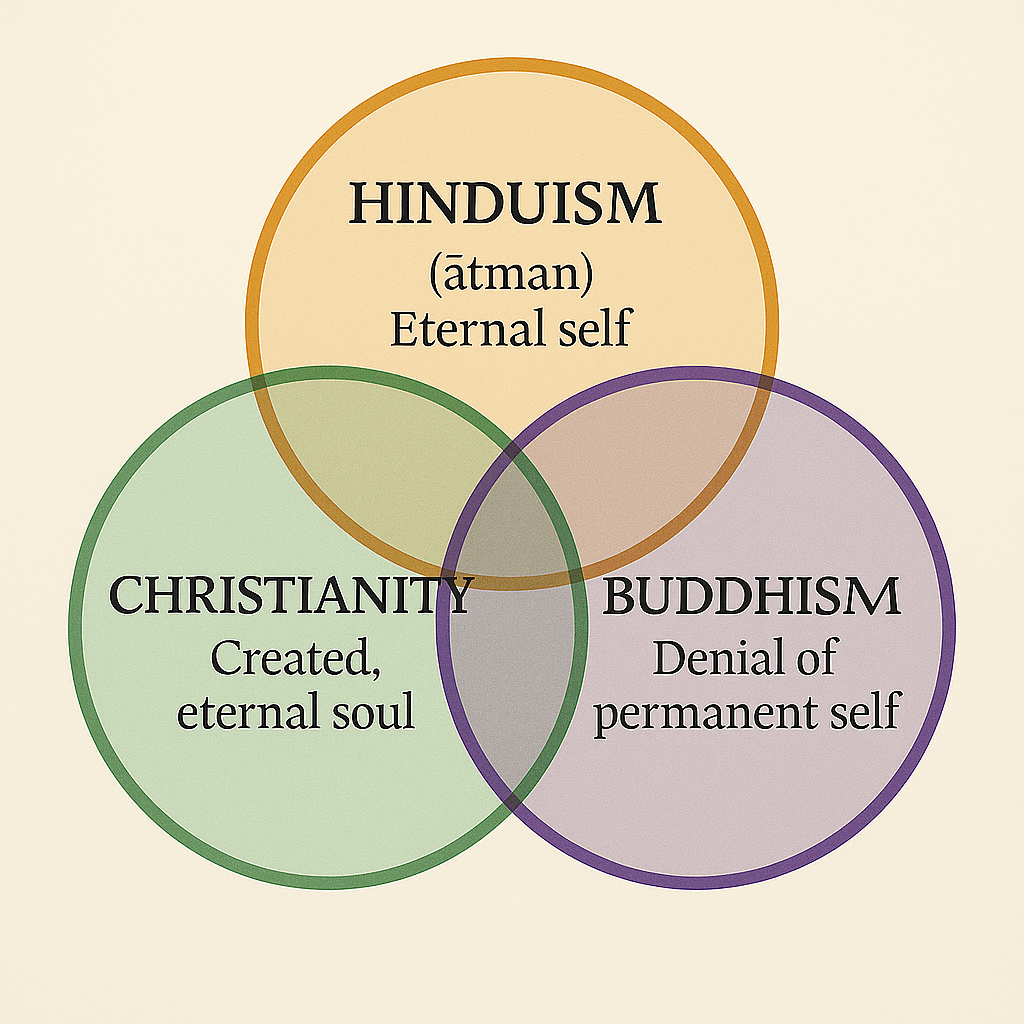
The question of what the soul is, whether it exists, and what happens to it after death lies at the center of the world’s major religious traditions. Christianity, especially in its Catholic tradition, affirms the soul as eternal and God-given. Hinduism has multiple schools, often affirming an eternal self or ātman. Buddhism, including Tibetan Buddhism, rejects the idea of a permanent self or soul and instead speaks of mind and consciousness as a conditioned stream of awareness without enduring essence.


The Christian and Catholic Understanding of the Soul

Christianity teaches that every human being has a unique, immortal soul created by God. According to Catholic doctrine, the soul is the spiritual principle of the human person. It is eternal in destiny, surviving bodily death, and directed either toward communion with God or separation from Him.

Scriptural sources include Genesis 2:7, where God breathes life into Adam and he becomes a living soul [1]; Matthew 10:28, where Jesus warns of the danger of losing the soul [2]; and the Catechism of the Catholic Church, which affirms that the soul is created by God and immortal [3]. In this view, the soul is not an impersonal principle but a personal identity, judged and redeemed by God.


Hindu Views on the Self (Ātman)

Hinduism is diverse, but most of its classical schools affirm the existence of ātman, the true self. The Chandogya Upanishad teaches “tat tvam asi” (you are that), affirming the identity of the self with Brahman [4]. The Brihadaranyaka Upanishad declares, “This self (ātman) is indeed Brahman” [5]. The Bhagavad Gita teaches that the self is eternal and indestructible [6].

Distinguishing Hindu and Christian Concepts

Both Hindu and Christian traditions speak of something enduring at the core of human existence, but they do so in different ways.

Christianity teaches that the soul is created by God, personal, and accountable before Him. It does not preexist from eternity but comes into being by His will and remains dependent on Him for existence, judgment, and salvation.

In Hindu thought, Advaita Vedānta emphasizes the identity of the self (ātman) with Brahman, dissolving individuality into the absolute. Dvaita and many Bhakti traditions instead teach that the self remains distinct yet eternal, existing in relationship with the divine. In all of these cases, the ātman is uncreated and co-eternal with ultimate reality, not brought into being by God.

Thus, while both traditions sometimes use personal and sometimes abstract language, the Christian soul and the Hindu ātman play very different roles. The soul in Christian theology is a created person before God; the ātman in Hindu philosophy is an eternal essence, whether one with Brahman or distinct in devotion.


The Creator God in Christianity and Hinduism

Christianity affirms one personal Creator God who brings the universe into being from nothing and sustains it in existence.

Hinduism presents a wide range of views. In Bhakti traditions, deities such as Vishnu, Shiva, or Devi are worshiped as supreme creators. Vedānta schools affirm Brahman as the ultimate source, though in Advaita this is not a personal act of creation but the manifestation of māyā. Other schools such as Sāṃkhya and Mīmāṃsā reject a creator altogether, viewing the universe as self-arising.

Thus, while Christianity grounds the soul in a personal God who creates and judges, Hindu thought ranges from devotion to a personal creator to cosmologies where no creator is necessary.


Buddhist Rejection of the Soul

Buddhism arose in part as a rejection of the Hindu doctrine of ātman. In the Anattalakkhana Sutta, the Buddha declared that none of the five aggregates of existence constitute a self [7]. The doctrine of anātman (no-soul) became central.

Mind and Consciousness

In Tibetan Buddhism, mind and consciousness are viewed as a stream of awareness, conditioned by karma. The Abhidharma-kośa describes consciousness as momentary and dependent [8]. Unlike Christianity and Hinduism, which affirm an eternal principle (soul or self), Buddhism denies it, calling belief in permanence a delusion.

Yet questions arise. If there is no soul, then what suffers in the hell realms described in Tibetan texts? The Bardo Thödol warns of the horrors of the Vajra Hell, a realm said to be utterly without escape [9]. The Hevajra Tantra declares that those who violate tantric commitments “will not be liberated for as many eons as there are atoms in the universe” [10]. The Cakrasaṃvara Tantra and later commentaries also teach that breaking tantric vows leads to vajra hells without release [11].

This presents a paradox: if there is no enduring self, who is suffering eternally?


Tibetan Buddhist Schools Under Examination

Madhyamaka – Nāgārjuna’s Mūlamadhyamakakārikā argues that all phenomena, including the self, are empty of inherent existence [13]. But if the self is an illusion, how does karma persist? If Vajra Hell is eternal, how can something that does not exist suffer forever?

Yogācāra (Mind-Only) – The Yogācārabhūmi Śāstra introduces ālayavijñāna, the “storehouse consciousness,” which preserves karmic seeds [14]. Though intended to avoid affirming a self, it functions much like one: carrying memory, identity, and karma. Hinduism here provides a comparison: the Bhagavad Gita teaches that the self carries karma through many births [6]. Yogācāra denies the term “soul,” yet reintroduces something strikingly similar. Christianity differs again: not a karmic storehouse, but a personal soul created by God.

Dzogchen (Great Perfection) – Dzogchen teachings, such as the Kunjed Gyalpo (All-Creating King), speak of rigpa, primordial pure awareness that is timeless and luminous [15]. Though Dzogchen denies that rigpa is a soul, the resemblance is striking. If rigpa is eternal, pure, and the ground of all experience, how is this different from what Christians call the soul or Hindus call ātman? The denial seems rhetorical rather than substantive.

Vajrayāna and Deity Possession – Tantric scriptures describe deity yoga, in which practitioners invite deities to merge with them [16]. If there is no self or soul, what exactly is being merged with or possessed?


Conclusion

Across Christianity, Hinduism, and Buddhism, the question of what endures, what we might call the soul, self, or consciousness, reveals fundamentally different views of human identity. Christianity anchors personhood in a created, immortal soul made by God and accountable to Him. Hinduism envisions an eternal ātman, uncreated and either one with or distinct from the divine. Buddhism, in contrast, denies any enduring essence, seeing the sense of self as a conditioned process. Yet in its Tibetan forms, teachings on karmic continuity, primordial awareness, and tantric transformation often edge back toward affirming something that functions like a self.

From long immersion in both Catholic and Tibetan Buddhist traditions, I have come to believe that the Christian vision alone sustains coherence between moral responsibility, continuity of consciousness, and the promise of redemption. It affirms not only that we exist, but that we are known and loved by the One who created us. Against the shifting alternatives of an impersonal absolute or an empty stream of awareness, in my opinion, the Christian understanding of the soul remains the clearest expression of what it means to be human before God.


References

[1] Genesis 2:7, The Holy Bible (ESV).
[2] Matthew 10:28, The Holy Bible (ESV).
[3] Catechism of the Catholic Church, Part I, Section Two, Chapter One, Article 1, §366.
[4] Chandogya Upanishad 6.8.7, in Radhakrishnan, S. (trans.), The Principal Upanishads.
[5] Brihadaranyaka Upanishad 4.4.5, in Olivelle, P. (trans.), The Early Upanishads.
[6] Bhagavad Gita 2.20, in Zaehner, R. (trans.), The Bhagavad-Gita.
[7] Anattalakkhana Sutta (Samyutta Nikaya 22.59), in Bhikkhu Bodhi (trans.), The Connected Discourses of the Buddha.
[8] Vasubandhu, Abhidharma-kośa.
[9] Bardo Thödol (Tibetan Book of the Dead), in Evans-Wentz, W.Y. (ed.).
[10] Hevajra Tantra, Snellgrove, D.L. (trans.), The Hevajra Tantra: A Critical Study.
[11] Cakrasaṃvara Tantra, in Tsuda, S. (trans.), The Samvarodaya Tantra.
[12] Hevajra Tantra, ibid.
[13] Nāgārjuna, Mūlamadhyamakakārikā, Kalupahana, D.J. (trans.).
[14] Yogācārabhūmi Śāstra, Xuanzang (trans.).
[15] Kunjed Gyalpo (All-Creating King), in Namkhai Norbu (trans.), The Supreme Source.
[16] Cakrasaṃvara Tantra and Hevajra Tantra, ibid.


The Illusion of Harmony: How Eastern Mysticism Misleads Christian Seekers


In today’s spiritual landscape, a troubling trend is emerging: well-meaning Christians are being led to believe that Tibetan Buddhism is not only compatible with Christianity but can even enhance it. This deception, often subtle and clothed in the language of “contemplation” or “interfaith dialogue,” has found its way into Catholic monasteries and retreat centers. At the heart of this distortion is the adoption of Eastern meditative techniques, often inspired by Tibetan Buddhist practices, and the uncritical embrace of yoga as a “neutral” spiritual discipline.

To be clear: Tibetan Buddhism is not a Christian cousin. It is a profoundly different worldview, rooted in concepts like reincarnation, karma, and the ultimate dissolution of the self, doctrines wholly incompatible with Christianity’s vision of a personal, relational God and the eternal dignity of the soul.

Meditation or Manipulation?

The Christian tradition has long held a deep respect for silence, prayer, and contemplation, especially in the monastic practices of the Desert Fathers or the Hesychast tradition of Eastern Orthodoxy. But what is often marketed today as “meditation” bears little resemblance to Christian prayer. Tibetan Buddhism aims at the realization that the self and all phenomena are empty of inherent existence, a direct experience of emptiness (śūnyatā) and the luminous, non-dual nature of awareness.

This goal is diametrically opposed to Christian theology, which insists on the uniqueness of each soul, created in the image of God and destined for eternal communion with Him.

Yet Christian leaders and institutions have increasingly opened the door to these teachings. For example, the late Father Thomas Keating, one of the leaders of the Centering Prayer movement, drew heavily on Eastern techniques, often blurring the line between Christian contemplation and Buddhist meditation. Though his intentions were no doubt sincere, the result was a confusing blend of incompatible truths.

Another case is Father Richard Rohr, a popular Franciscan whose teachings often echo non-dual philosophies far closer to Eastern mysticism than to historic Christianity. Rohr’s discussions of “Christ-consciousness” and the illusion of the separate self bear striking resemblance to Tibetan Buddhist views, yet they are consumed by many Catholics and Protestants as if they are orthodox.

The Yoga Trap

Yoga is another Trojan horse in the spiritual lives of many Christians. Despite its spiritual roots in Hindu and Buddhist traditions, yoga is often presented as a harmless or purely physical practice. In truth, yoga’s asanas (postures) were designed not for exercise, but as physical preparations for meditation and kundalini awakening, specifically, awakening to a worldview that denies the personal God revealed in Jesus Christ.

When Christians engage in yoga or Tibetan-inspired meditation without discernment, they open themselves up not just to foreign practices, but to foreign spirits. This is not religious paranoia but a spiritual reality. St. Paul warned the Corinthians about participating in pagan rituals, saying, “You cannot partake of the table of the Lord and the table of demons” (1 Corinthians 10:21).

The Deception of Compatibility

Tibetan Buddhist teachers are often happy to affirm Christian practices, so long as they are reinterpreted through a Buddhist lens. Some even encourage Christians to see Jesus as an “enlightened teacher” or “bodhisattva.” This allows the surface appearance of interfaith respect while subtly undermining core Christian claims: the Incarnation, the Resurrection, and the uniqueness of Christ as Savior.

This is not compatibility, but syncretism and it poses a spiritual danger.

A Call to Discernment

This is not to instill hostility or fear of Buddhism and other Eastern Religions. Nor is it a rejection of silence, stillness, and physical well-being. But Christians must recover the spiritual discipline of discernment. Not all that brings peace is from God. The Enemy is more than capable of offering counterfeit serenity, especially when it draws people away from the Cross and toward self-deification or belief in idols.

Christianity offers its own deep, mystical tradition rooted not in esoteric techniques or mantras, but in personal relationship with the living God. Prayer, asceticism, sacramental life, and union with Christ are more than sufficient for those seeking transformation. We do not need to import Tibetan concepts or yogic practices to find God. He is already here, knocking at the door.

The growing blend of Tibetan Buddhism and Christianity may feel harmonious on the surface, but this is illusory. At its core, the Gospel is not compatible with systems that deny Christ’s divinity, the soul’s eternal destiny, or the Triune God. As Christians, we must not be seduced by exotic forms of “spirituality” that utilize half-truths, and communion with fallen angels.

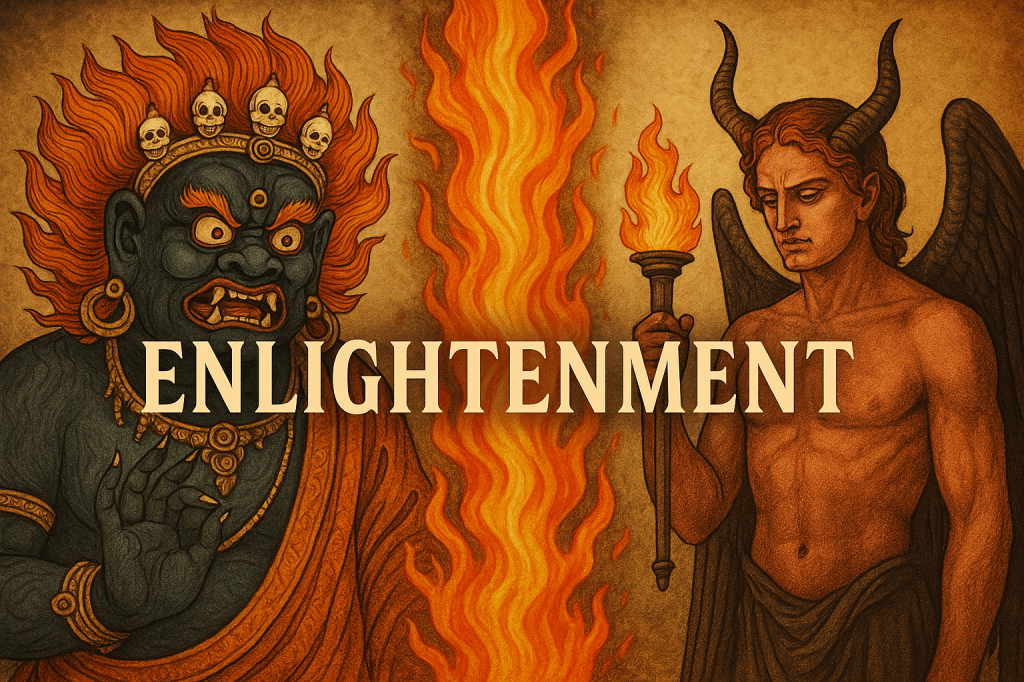
Enlightenment as a Smokescreen: How Luciferianism and Tibetan Buddhism Mirror Each Other

When I was a devoted Tibetan Buddhist, the word enlightenment held sacred weight. It meant the complete awakening of compassion and wisdom, the state of a Buddha who sees through illusion and dedicates themselves to freeing all sentient beings from the sufferings of samsara. I trusted in that vision, because I believed I was following a noble tradition.

But even then, something always felt a little off. I had a quiet discomfort I kept pushing aside.

The problem was this: the term enlightenment wasn’t exclusive to Buddhism. I saw the same word used in the occult, in Theosophy, Freemasonry, and even Luciferianism, often in ways that glorified rebellion and the pursuit of hidden knowledge. Why were systems as wildly different as Tibetan Buddhism and Luciferian occultism both invoking “enlightenment” and “awakening” as their ultimate goal? Why did the same term span both the sacred and the profane?

Tibetan Buddhism: Enlightenment as Compassionate Wisdom

In Tibetan Buddhism, enlightenment is the realization of emptiness, the transcendence of ego, and the birth of boundless compassion. The ideal of the bodhisattva is someone who delays their own final nirvana in order to help all other beings reach liberation. This enlightenment isn’t just something a guru gifts you; it’s a hard-won transformation of your own mind.

Vajrayana Buddhism, the tantric branch of Tibetan Buddhism, adds layers of secrecy and initiation. There are empowerments, mantras, visualizations, and guru devotion practices. It uses powerful symbols such as vajras, weapons, fire, and wrathful deities that on the surface could resemble occult ritual. This made me uneasy. Was this actually an Eastern form of the same hidden path to power that Western esoteric groups followed?

I reassured myself that Vajrayana was different. It used “occult” methods, maybe, but only to realize true compassion and emptiness. Still, the similarity in tone and terminology between tantric rituals and occult rites always bothered me.

Now, after 35 years of hard work, study, devotion, and ultimately betrayal at the hands of tantric Buddhist gurus and deities, I’ve come to a grim realization: the enlightenment I was seeking wasn’t what I thought it was. It is merely an occult system dressed in Buddhist robes. The deeper I went, the clearer it became that Tibetan Buddhism and Luciferianism are two sides of the same coin. They may use different language, imagery, and rituals, but they are architecturally and spiritually similar and they both serve darkness, not light.

The word that they share, enlightenment, is the bait they use to ensnare seekers.

Luciferianism and Tibetan Buddhism: Two Faces of the Same Enlightenment Agenda

In Luciferianism, enlightenment is about becoming your own god. Lucifer is framed not as evil, but as the “light-bringer,” the one who defies divine authority to bestow forbidden knowledge. Enlightenment here is rebellion, self-deification, and esoteric power.

Helena Blavatsky, the founder of Theosophy, which heavily influenced modern occultism, named her journal Lucifer and described the figure as a misunderstood bringer of divine wisdom¹. In The Secret Doctrine, she refers to Lucifer as the “spirit of intellectual enlightenment”² and equates him with the higher mind of humanity. Freemasonry, Theosophy, and modern occultism all share the core motif: moving from darkness to light, and from ignorance to gnosis, through secret initiation.³

This kind of “light” is occult and exclusive. The “enlightened ones” in these systems are initiates who’ve been brought into deeper mysteries. The light is not for everyone; it’s reserved for those chosen by the system who are able to serve its agenda.

What shocked me, and what I ignored for years, is that tantric Buddhism functions much the same way. It promises special teachings, revealed only to the initiated. It trains students to see their guru as a living Buddha, above criticism or doubt, and presents his questionable actions as “skillful means,” while bypassing basic moral accountability. There is a similar secretive, hierarchical structure although this one is surrounded by colorful thangkas and Sanskrit mantras.

The deeper I went, the more I saw that my devotion was being weaponized against me. Tantric gurus used “crazy wisdom” to justify harm, and “samaya vows” to silence dissent. It wasn’t really compassion, but a spiritual aristocracy, no different from the occult orders I once thought Buddhism stood apart from. The beatific vision of enlightenment for the benefit of all sentient beings was merely the bait. The hook was the hidden power of dark forces.

Now I see clearly that the word enlightenment, both in Tibetan Buddhism and Luciferianism, functions as a kind of smokescreen. It sounds noble, luminous, and superior. But in both systems, it serves those in power and creates a class of “enlightened ones” who are above reproach, who serve gods and buddhas from unseen realms that are not what they appear to be.

“Enlightened Ones” as Agents of the Lie

It’s not just that the term enlightenment is misused. It’s that those who claim it, whether in Tibetan Buddhism or Luciferianism, are agents of a system that serves a being or beings pretending to be of the light.

These “enlightened ones” often behave the same way, regardless of tradition: they demand loyalty, obedience, and silence. They wield charisma and secrecy as tools. And when challenged, they invoke mystical authority and retaliation.

In both systems, the “light” is a mask and those who follow it are bound to something posing as divine. Whether it’s called Buddha, a Bodhisattva, an Ascended Master, or Lucifer, the same current runs underneath: it is a demonic force clothed in the language of transcendence.

Christianity and the True Nature of Light

Unlike Tibetan Buddhism and occultism, Christianity doesn’t use enlightenment as a central goal. It speaks instead of salvationgrace, and being born again through the Holy Spirit. The light of Christ is not esoteric knowledge reserved for an initiated elite but is open, relational, and grounded in love and repentance. Christ’s light is not something attained through ritual or secrecy; it is something revealed publicly and offered to all.

As Jesus says in the Gospel of John: *“I have spoken openly to the world. I have always taught in synagogues and in the temple, where all Jews come together. I have said nothing in secret.”⁵ This sharply contrasts with occult traditions, including tantric Buddhism, where knowledge is concealed, layered in initiations, and distributed only to those deemed “ready.” In my own experience, this secrecy became a mask for control. I was told not to question or doubt. I had to sacrifice my own inner wisdom and clarity.

But the light of Christ does not require silence or blind devotion. The Holy Spirit is not a power to be manipulated, but a divine presence who convicts, comforts, and guides with truth. In my experience, that is the only light that does not deceive.

Every other version I followed, no matter how radiant it appeared, eventually demanded that I suppress my discernment, abandon my conscience, and serve a system of secrecy cloaked in mystical language.

A Word to the Seekers

To anyone still in these systems, or brushing up against them through yoga, New Age teachings, or tantric practices: be careful with “light” that demands you stop using discernment. Be cautious of teachers who ask for your silence or your soul. Be wary of the spiritual forces behind the promised enlightenment.

I say this not as an outsider, but as someone who gave my life to this path. I practiced the rituals, prostrated to the gurus, and offered my heart in devotion. And when the mask came off, I saw what was truly being served, and it wasn’t holy. It was something else entirely.


Footnotes and Sources

  1. Blavatsky, H. P., Lucifer, Vol. 1. Theosophical Society, 1887.
  2. Blavatsky, H. P., The Secret Doctrine, Vol. 2. Theosophical Publishing House, 1888.
  3. Pike, Albert. Morals and Dogma of the Ancient and Accepted Scottish Rite of Freemasonry. Southern Jurisdiction, 1871.
  4. Mackey, Albert G. The Symbolism of Freemasonry. Masonic Publishing, 1882.
  5. The Holy Bible, English Standard Version, John 18:20.
  6. Crowley, Aleister. The Book of the Law. 1904.
  7. Bailey, Alice A. Initiation, Human and Solar. Lucis Publishing Company, 1922.
  8. Dapsance, Marion. “Behind the Smiling Façade: Abuse in Tibetan Buddhism.” Le Nouvel Observateur, 2018. Translated and discussed in Tricycle: The Buddhist Review.
  9. Sawerthal, Anna. “Sogyal Rinpoche’s Abuse and the Breakdown of Secrecy in Buddhism.” Tricycle, 2018.
  10. Peljor, Tenzin. “Tibetan Buddhism and Abuse: Why Critical Thinking is Essential.” Interview in Spiegel Online, 2019.

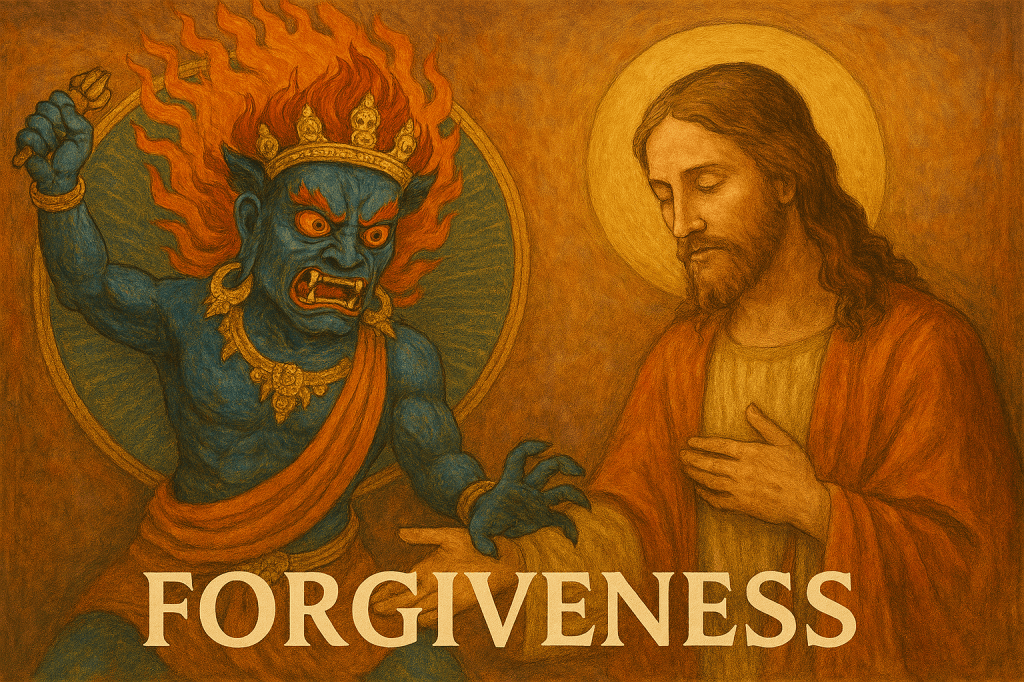
Forgiveness in Christianity vs Wrath in Tantric Tibetan Buddhism


In Tantric Tibetan Buddhism, forgiveness is not traditionally emphasized as it is in Christianity. Tibetan Buddhism places greater emphasis on karma, the universal law of cause and effect. According to this view, actions inherently produce outcomes, and there is little scope for simply “forgiving” or releasing someone from the karmic consequences of their deeds. Instead, purification practices are prescribed to cleanse one’s negative karma. If they are not done effectively, retribution is a given.

Ken McLeod, a prominent Western teacher and translator of Tibetan Buddhism, highlights this point clearly in an article titled, “Forgiveness is not Buddhist.” He writes, “In Tibetan Buddhism, forgiveness isn’t really addressed in the same way as it is in Christianity. Instead, there’s an emphasis on purification and insight into the nature of mind and action.” [1]

Practitioners engage in rituals and meditation practices, such as Vajrasattva purification practices, visualizing negative karma being cleansed. However, these rituals differ fundamentally from the Christian idea of interpersonal forgiveness. They are personal acts of purification rather than relational acts of forgiving or seeking forgiveness from another person or deity.

Although the emphasis in Tibetan Buddhism is allegedly on compassion (karuna), a larger concept of retribution is often at work behind the scenes. Compassion in Buddhism is the profound desire to alleviate suffering universally, extending even to one’s perceived enemies. Tantra, paradoxically, emphasizes karmic retribution that allows the guru to “payback” perceived slights and disrespect secretly using black magic techniques or “rituals of subjugation.”

Personal Account: The Dark Side of the Teachings

My own experience underscores the stark absence of forgiveness in Tantric Tibetan Buddhism. During a tantric ritual of annihilation, I desperately begged forgiveness from the guru for any perceived wrongdoing, hoping for mercy or compassion. I honestly did not know what I was being punished for. The guru, however, demonstrated not even the slightest bit of forgiveness or mercy. This painful event highlighted for me the profound differences between the compassionate forgiveness taught by Jesus Christ and the severe, impersonal karmic logic of Tantric Tibetan Buddhism.

Forgiveness in Christianity

In Christianity, forgiveness occupies a central and explicit place. It involves both human interpersonal forgiveness and divine forgiveness through the mercy and grace of God. Christianity explicitly encourages believers to forgive one another as God has forgiven them through Christ’s sacrifice on the cross.

Forgiveness in Christianity is relational, deeply rooted in repentance, reconciliation, and restoration of relationships with God and with others. It implies a personal release from the debt of sin through God’s grace, rather than the impersonal balancing of karmic scales.

Jesus teaches explicitly on forgiveness, such as in the Lord’s Prayer (“Forgive us our trespasses, as we forgive those who trespass against us”), emphasizing the interconnectedness of receiving and giving forgiveness. Forgiveness is portrayed not merely as a spiritual virtue but as a fundamental practice essential to spiritual health and salvation itself.

Western Practitioners and Misplaced Assumptions

Many Western practitioners of Tibetan Buddhism unconsciously overlay their Judeo-Christian cultural and moral values onto the tantric Buddhist teachings, often at their own detriment. They assume the presence of forgiveness and personal mercy that simply do not exist in the traditional tantric framework. This mistaken belief can lead practitioners to misunderstand or misinterpret the intentions and actions of teachers, making them vulnerable to exploitation and emotional and physical harm. Ultimately, recognizing these fundamental differences can lead to safety, and protection from mistaken spiritual paths. For more about the guru’s ability to engage in karmic retribution see here, here, and here.

[1] Ken McLeod, “Forgiveness is Not Buddhist,” Unfettered Mindhttps://unfetteredmind.org/forgiveness-is-not-buddhist/ (accessed April 9, 2025).

A Testimony of Deliverance from Demonic Deception on Reddit


I came to the realization they were actually evil (you have to understand they can pretend to be good, even despite their demonic names, and twist your mind into believing in them—and it feels very real)—but I couldn’t resist their power.”

They’d love bomb me and then in the next breath become really nasty. Eventually it got to the point I’d see Lucifer walking around my apartment, as a real man, and then take control of my body…and end up raping me.”

These words, pulled from a harrowing testimony posted on Reddit, felt like echoes of my own past, so chillingly familiar that I found myself nodding.

The author of the post, anonymous but heartbreakingly real, shares a decade-long descent into Luciferianism, New Age spirituality, kundalini experiences, possession, and finally, miraculous deliverance by Jesus Christ. Her story is raw, detailed, and unapologetically honest. And for those of us who have lived through the spiritual counterfeit, it rings true on every level.

Like her, I once believed the false light was real. In my case, it came in Tibetan robes, wrapped in Buddhist philosophy and tantric mysticism, cloaked in teachings about “enlightenment” and “emptiness.” Before my first three-year retreat in my twenties, my retreat lama (guru) love-bombed me. He saw my spiritual hunger and poured affection, flattery, and attention into me until the day I resisted his sexual advances. Then his interest in me turned to cruelty. The same happened again, years later, with my second three-year retreat root guru. It’s a familiar pattern to survivors of spiritual abuse: seduction, betrayal, and punishment.

The Reddit testimony describes a similar spiritual seduction, initially sweet and ecstatic, culminating in a brutal loss of bodily autonomy. Demonic spirits love-bombed her, appeared to her as beautiful, powerful entities and then turned violent and abusive, eventually raping her both spiritually and physically. She writes of Lucifer “walking around her apartment… and taking control of her body.” I, too, experienced possession after tantric rituals designed to merge with deities. The difference is, in Tibetan Buddhism, such possession is framed as “blessing.”

And like her, I couldn’t break free until I cried out to Jesus, not under pressure, but because I had nowhere else to turn. When I finally surrendered, I, too, felt deliverance (still ongoing) that was cleansing, and unmistakably holy. It felt like the definite breaking of chains.

This woman’s account is long, but worth reading. You can find the full testimony here. It’s a sobering reminder of how widespread and insidious these spiritual deceptions are and how they shape-shift across traditions, religions, and cultures, but always carry the same fingerprints: seduction, confusion, torment, and ultimate destruction of the soul.

Her courage in speaking out is an act of spiritual warfare, and I share this not to sensationalize her story but to affirm: you are not alone. And yes, there is a way out.

The Attraction of Magic in Western Culture: A Biblical Perspective


Magic has long held a powerful allure in Western culture, woven into childhood stories, entertainment, and even everyday practices. From the entrancing fairy tales of Europe to modern pop culture phenomena like Harry Potter, the fascination with the mystical and supernatural has deeply shaped our collective imagination. Yet, while magic appears enchanting and harmless, Scripture warns us of its true nature and the dangers it poses to our souls.

The Allure of Magic in Childhood and Popular Culture

From an early age, children are introduced to magical themes through classic fairy tales and princess stories. Cinderella has a fairy godmother who transforms her fate with a wave of a wand. Sleeping Beauty and Snow White showcase witches casting spells, while Beauty and the Beast features an enchantress who curses a prince. These tales, though seemingly innocent, normalize the idea that magic is often a force for good.

Modern fantasy literature and films have reinforced this fascination with the supernatural. Harry Potter popularized wizardry and spellcasting, portraying them as exciting and even virtuous. Meanwhile, Ouija boards are marketed as mere games, despite their real connections to spirit communication. The 1973 horror film The Exorcist, based on a true story, illustrates the dangers of such practices. In reality, a young boy became possessed after playing with a Ouija board with his aunt. Though the film dramatized certain elements, the actual events were even more chilling. Additionally, fortune telling, astrology, tarot cards, and horoscopes have become widely accepted as harmless entertainment, masking the serious spiritual risks they pose.

These magical themes desensitize people, especially children, to the reality of occult practices. What begins as entertainment can lead to deeper interest and eventual participation in practices that God expressly forbids.

Biblical Warnings Against Magic and the Occult

The Bible is clear in its condemnation of witchcraft, sorcery, and all forms of divination. These practices are not neutral or harmless but rather open doors to demonic influences. God commands His people to stay away from such things:

  • Witchcraft is forbidden – “Thou shalt not suffer a witch to live.” (Exodus 22:18)
  • Divination is detestable – “There shall not be found among you anyone who… uses divination, practices witchcraft, or interprets omens.” (Deuteronomy 18:10-12)
  • Necromancy is condemned – “Do not turn to mediums or seek out spiritists, for you will be defiled by them.” (Leviticus 19:31)
  • Magic and sorcery are tied to judgment – “But the cowardly, unbelieving, abominable, murderers, sexually immoral, sorcerers, idolaters, and all liars shall have their part in the lake which burns with fire and brimstone.” (Revelation 21:8)

The story of King Saul consulting the witch of Endor (1 Samuel 28:6-7) illustrates the grave consequences of seeking guidance outside of God’s will. Similarly, Acts 19:19 records how new believers burned their books of magic as a sign of their repentance.

The Hidden Dangers of the Occult

Many who delve into magic, Wicca, and New Age practices do so out of curiosity or a desire for control over their lives. However, these practices deceive people into thinking they are gaining wisdom and power when, in reality, they are exposing themselves to spiritual bondage.

The devil masquerades as an angel of light (2 Corinthians 11:14), making magic appear appealing and even beneficial. Yet, as Zechariah 10:2 warns, “The idols speak deceit and diviners see visions that lie.” Engaging in these practices can lead to oppression, deception, and separation from the only true God.

Engaging in witchcraft, even so-called “white magic” spells, places one in deep spiritual debt to demonic forces. Many practitioners believe that white magic is harmless or even benevolent, but Scripture makes no distinction, all forms of witchcraft come from the same dark source. When someone casts a spell, invokes spirits, or seeks supernatural aid outside of God, they are entering into an agreement with demonic entities, whether they realize it or not. Demons do not offer power or knowledge freely; they always demand something in return. At first, their influence may seem subtle and provide results. This can increase fascination with magic, or offer a false sense of control. However, over time, this influence grows, leading the practitioner further into spiritual deception and dependence. This can quickly evolve into obsession, addiction, and ultimately, spiritual enslavement. Isaiah 8:19 warns, “When they say to you, ‘Consult the mediums and the spiritists who whisper and mutter,’ should not a people consult their God? Should they consult the dead on behalf of the living?” Seeking power outside of God’s will always comes at a cost. Those who engage in witchcraft often find themselves plagued with spiritual attacks, demonic oppression or possession, and an increasing inability to break free from their involvement.

Acts 16:16 tells of a slave girl who practiced divination and brought her owners great profit. However, when Paul cast out the spirit that enabled her fortune-telling, she immediately lost her powers, revealing that her abilities had come from demonic oppression, not personal skill. This account underscores the reality that magical practices are not self-generated, but are granted by spirits who expect repayment.

Guarding Ourselves and Our Children

As Christians, we must be vigilant in protecting ourselves and our families from the influence of the occult. Here are some practical ways to guard against the infiltration of magic in our lives:

  1. Teach children biblical truth – Instill in them a love for God’s Word so they can discern between good and evil. (Proverbs 22:6)
  2. Remove occult influences – Get rid of books, movies, games, and objects that promote witchcraft or supernatural themes contrary to Scripture. (Acts 19:19)
  3. Pray for discernment – Ask the Holy Spirit for wisdom in recognizing hidden occult influences. (James 1:5)
  4. Encourage a love for Christ, not magic – Rather than looking for excitement in the supernatural, teach children to find joy in a relationship with Jesus Christ.

Magic is deeply embedded in Western culture, from childhood fairy tales to modern entertainment. While it may seem harmless and fun, the Bible warns us that magic and the occult are gateways to spiritual deception. As believers, we must remain vigilant, guarding our hearts and homes against practices that draw us away from God. Instead, let us cling to the truth of Scripture, teaching our children to trust in the Lord and reject the false allure of magic.

“Have nothing to do with the fruitless deeds of darkness, but rather expose them.” (Ephesians 5:11)

Ancient Grimoires, Pagan Rituals, and the Biblical Warning


Throughout history, humans have sought ways to control nature, heal diseases, and influence their surroundings through ritualistic means. In some traditions, these practices were written down in books of spells, known as grimoires, that provided detailed instructions for supernatural interventions. While such texts may appear as cultural artifacts, the Bible warns against engaging in these kinds of rituals, associating them with the pagan practices of idol worship and demon invocation.

One such example is a Tibetan grimoire from the 9th or 10th century, which includes a ritual using a frog effigy to cure diseases attributed to nagas or serpent-like water spirits believed to control rain and fertility. The ritual involves crafting a frog from barley flour, applying a special ointment to the affected area, and performing visualizations to drive out the ailment. The effigy is then placed near a spring with incense offerings to complete the healing process.¹

A modern parallel to this practice can be found in Nepal, where villagers perform a rain-making ceremony. This ritual, blending Tibetan and Hindu elements, involves crafting wax frog effigies filled with mystical inscriptions and black dog excrement. One effigy is submerged in a sacred spring, while the other is burned at a crossroads to compel serpent-spirits and sky deities to release rain.¹ These practices, rooted in ancient beliefs, illustrate a continued reliance on rituals to manipulate nature.

The Tibetan Grimoire: A Book of Spells and Ritual Power

The Tibetan grimoire in question provides a fascinating glimpse into the ritualistic practices of Buddhist monks from the early medieval period. Inscribed on stitched-together leaves of paper, this spellbook belonged to Bhikṣu Prajñāprabhā, a Buddhist monk whose name appears on its cover.²

Its contents include a wide variety of spells and rituals, such as:

  • Prophecies and Divination – Techniques for foreseeing future events.
  • Demon Subjugation – Methods to bind and control malevolent spirits.
  • Conflict Resolution – Spells to pacify enemies and restore friendships.
  • Wild Animal Control – Incantations to protect against dangerous beasts.
  • Resource Generation – Spells to locate hidden treasures or create valuable objects.
  • Healing Practices – Rituals for curing illnesses, including severe ailments and mental disturbances.
  • Control Over Natural Phenomena – Invocations to summon springs or alter water flow.

One particularly complex ritual in the grimoire is a fire puja (homa), intended to cure insanity. This ceremony involves offering specific items into a ritual fire while reciting sacred formulas.² Such practices reflect a deep intertwining of spiritual and practical concerns, with Buddhist monks acting as intermediaries between the divine and human realms.

The Biblical Warning: Pagan Rituals and the Israelites’ Downfall

These rituals and grimoires bear striking resemblance to the pagan practices that God repeatedly warned the Israelites against. The Old Testament contains clear instructions to avoid divination, sorcery, and calling upon spirits. In Deuteronomy 18:10-12, God explicitly forbids these activities, declaring them an abomination.

Despite these warnings, the Israelites often fell into syncretism, combining their worship of God with the rituals of the surrounding nations. Their participation in idol worship, sacrifices to false gods, and magical rites ultimately led to their downfall. The Babylonian exile was one of the greatest consequences of their disobedience, demonstrating the dangers of engaging in forbidden spiritual practices.

Does the New Testament Forbid These Practices?

The New Testament continues to condemn such rituals. Galatians 5:19-21 lists sorcery among the “acts of the flesh,” warning that those who engage in it will not inherit the Kingdom of God. Acts 19:19 recounts how new believers in Ephesus publicly burned their books of magic, signifying their rejection of occultism in favor of Christ.

The Bible consistently teaches that attempts to control nature or the spirit world through mystical means, whether through Tibetan grimoires, pagan idol worship, or modern occult practices, are not merely neutral cultural traditions but spiritual dangers that lead people away from God.

What Can Modern Christians Learn?

The lesson from both the Old and New Testaments is clear: Christians must reject practices that seek power through forbidden spiritual means. Even if these rituals appear harmless or are framed as “folk traditions,” they ultimately fall into the category of divination and magic condemned by Scripture. The Israelites’ downfall serves as a warning that straying from God’s commandments leads to spiritual ruin.

As modern Christians navigate a world filled with fascination for ancient practices, new age mysticism, and spiritual rituals such as those found in Tibetan Buddhism, they must remain vigilant. The Bible offers the only true path to spiritual salvation through reliance on God alone.


Footnotes:

¹ Sam van Schaik, “Two Frogs a Thousand Years Apart,” Early Tibet, September 23, 2011. https://earlytibet.com/2011/09/23/two-frogs-a-thousand-years-apart/.

² Sam van Schaik, “A Tibetan Book of Spells,” Early Tibet, February 19, 2009. https://earlytibet.com/2009/02/19/a-tibetan-book-of-spells/.