A Brief History of Christianity in Tibet


Early Traces: The Nestorians and the Eighth Century

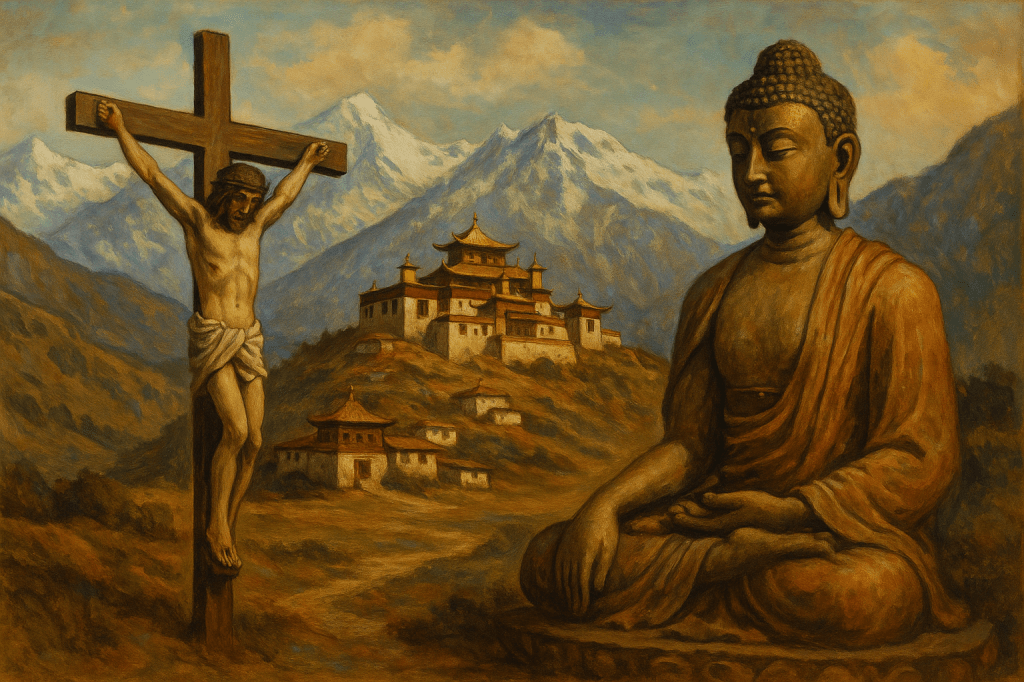
The history of Christianity in Tibet stretches back far earlier than most assume. The earliest Christian presence likely came from the Nestorian Church of the East, which had spread along Silk Road routes from Mesopotamia into China by the 7th century. Evidence from the Xi’an Stele of 781 CE shows that Nestorian missionaries were active under the Tang Dynasty, and given Tibet’s close relations with Tang China, it is plausible that Christian communities emerged within the Tibetan cultural sphere during the 8th century.1 However, these early Christian enclaves left no sustained legacy; Tibet’s conversion to Buddhism under Trisong Detsen soon dominated its spiritual landscape.

Jesuits in Guge: Antonio de Andrade and the Lost Kingdom

The next major encounter between Christianity and Tibet came through the Jesuit missions of the 17th century. In 1624, the Portuguese Jesuit Antonio de Andrade became the first known European to enter Tibet. He reached Tsaparang, the capital of the Guge Kingdom in western Tibet, where he was warmly received by King Tri Tashi Dakpa (also called Chadakpo). The king even laid the cornerstone for Tibet’s first church, completed in 1626.2

De Andrade’s arrival, however, sparked tensions. His success in converting local nobles alienated the powerful Buddhist clergy. A political conflict between the king and his brother, who was aligned with Buddhist monastics, led to the downfall of the Guge mission. Around 1630, the king was overthrown with assistance from the Ladakhi ruler Sengge Namgyal, who viewed Guge’s alliance with Catholic missionaries as a provocation.3 The Jesuits were expelled or killed, and Guge itself disappeared from the political map soon thereafter.

The Jesuits in Lhasa: Ippolito Desideri and the Capuchin Controversy

After Guge’s fall, the next great missionary endeavor came with Ippolito Desideri, an Italian Jesuit who reached Lhasa in 1716. Desideri immersed himself in Tibetan culture, mastered the language, and composed treatises comparing Christian and Buddhist metaphysics. His conciliatory approach, attempting dialogue rather than confrontation, won him both local sympathy and later admiration among scholars.4

Desideri’s work, however, was undone not by Tibetans but by Church politics in Rome. The Vatican’s Congregation for the Propagation of the Faith (Propaganda Fide) restructured Asian missions and in 1703 assigned Tibet to the Capuchins, a Franciscan order. The Jesuits were ordered to withdraw, leading to Desideri’s forced departure in 1721. The decision reflected not only internal rivalry but also a Vatican preference for an order more controllable and less inclined toward syncretic engagement.5

Suppression and Exile: The 18th and 19th Centuries

After the Jesuits’ departure, Capuchin missionaries continued their work until the 1740s. A crisis erupted in 1742, when a Tibetan convert refused to bow before the Dalai Lama, an act perceived as defiance against both religion and state. The government expelled the missionaries and banned Christianity in Central Tibet, a policy enforced by 1760.6

Despite this, individual attempts persisted. In the 19th century, the British missionary Annie Royle Taylor undertook a daring journey toward Lhasa in 1892, becoming the first Western woman to reach central Tibet, though she was ultimately turned back by Tibetan guards.7 Her journey epitomized the enduring fascination and futility of Christian outreach in a land long closed to foreigners.

Elsewhere, especially in eastern Tibet (Kham), anti-Christian sentiment often flared into violence. During the 1905 Batang Uprising, missionaries and Tibetan converts were targeted and killed. Among those martyred were André Soulié (1858–1905) and Jean-Théodore Monbeig-Andrieu (1875–1914), who are commemorated in Catholic hagiographies as victims of faith-driven hostility.8

The Vatican’s Strategic Shift: Why the Jesuits Were Replaced

The Vatican’s decision to replace the Jesuits with Capuchins was rooted in both theological and geopolitical concerns. The Chinese Rites Controversy (late 17th–early 18th centuries), in which Jesuits were accused of tolerating Confucian and local religious practices, had eroded papal trust. The Propaganda Fide viewed Jesuit accommodationism, especially Desideri’s open dialogue with Buddhist philosophy, as dangerous relativism. Capuchins, by contrast, were stricter and less likely to blur doctrinal lines. As historian Donald Lach notes, “the Capuchins represented the centralizing impulse of the Counter-Reformation, where obedience outweighed intellectual innovation.”9

Christianity and Modern Tibet: A Restricted Faith

Under Chinese administration since the 1950s, Tibet’s relationship with Christianity has remained tightly controlled. The People’s Republic of China recognizes only state-sanctioned religious institutions, and Catholic practice in the Tibet Autonomous Region exists only under the auspices of the Chinese Catholic Patriotic Association, which does not recognize Vatican authority. The Holy See’s cautious diplomacy, especially during Pope Francis’s efforts to reestablish relations with Beijing, has led to a de facto acceptance of limited Catholic presence, primarily among Han Chinese residents in Lhasa rather than ethnic Tibetans.10

The Vatican continues to regard Tibet as part of its mission territory, but evangelization remains almost nonexistent. Tibetan Buddhism remains dominant, and Christian symbols such as crosses, churches, even icons are scarce across the plateau.

Legacy

From the Nestorian wanderers to Jesuit polymaths and Franciscan ascetics, Christianity’s story in Tibet is one of ambition, misunderstanding, and endurance. While never a major presence, its traces linger in forgotten ruins in Tsaparang, in Desideri’s Tibetan manuscripts preserved in Rome, and in the historical memory of dialogue between two of the world’s most mystical spiritual traditions.

Footnotes

  1. Samuel H. Moffett, A History of Christianity in Asia, Vol. I: Beginnings to 1500 (Maryknoll: Orbis Books, 1992), 291–295.
  2. Antonio de Andrade, Novo Descobrimento do Gram Cathayo ou dos Reinos de Tibet (Lisbon, 1626); Timo Schmitz, An Overview of Tibetan History (2025), 91–92.
  3. Le Calloc’h, J. (1991). “Antonio de Andrade and the Mission in Western Tibet.” Archivum Historicum Societatis Iesu, 60: 57–60.
  4. Ippolito Desideri, Notizie Istoriche del Tibet (Rome, 1727); Hattaway, Paul. Tibet: The Roof of the World (2021), 41.
  5. Peter Clarke, The Jesuits in Asia (Cambridge University Press, 1993), 204–207.
  6. Schmitz, Timo An Overview of Tibetan History, 91–92; Hattaway, 2021: 41–44.
  7. Hattaway, 2021: 68–71.
  8. Servin, Michael. “Christian Martyrs of Tibet.” Journal of Asian Church History 11 (2010): 23–39.
  9. Donald F. Lach, Asia in the Making of Europe, Vol. III (University of Chicago Press, 1977), 225–228.
  10. Holy See Press Office, “Relations between the Vatican and China,” L’Osservatore Romano, 2020.
The Question of the Soul: Christianity, Hinduism, and Buddhism


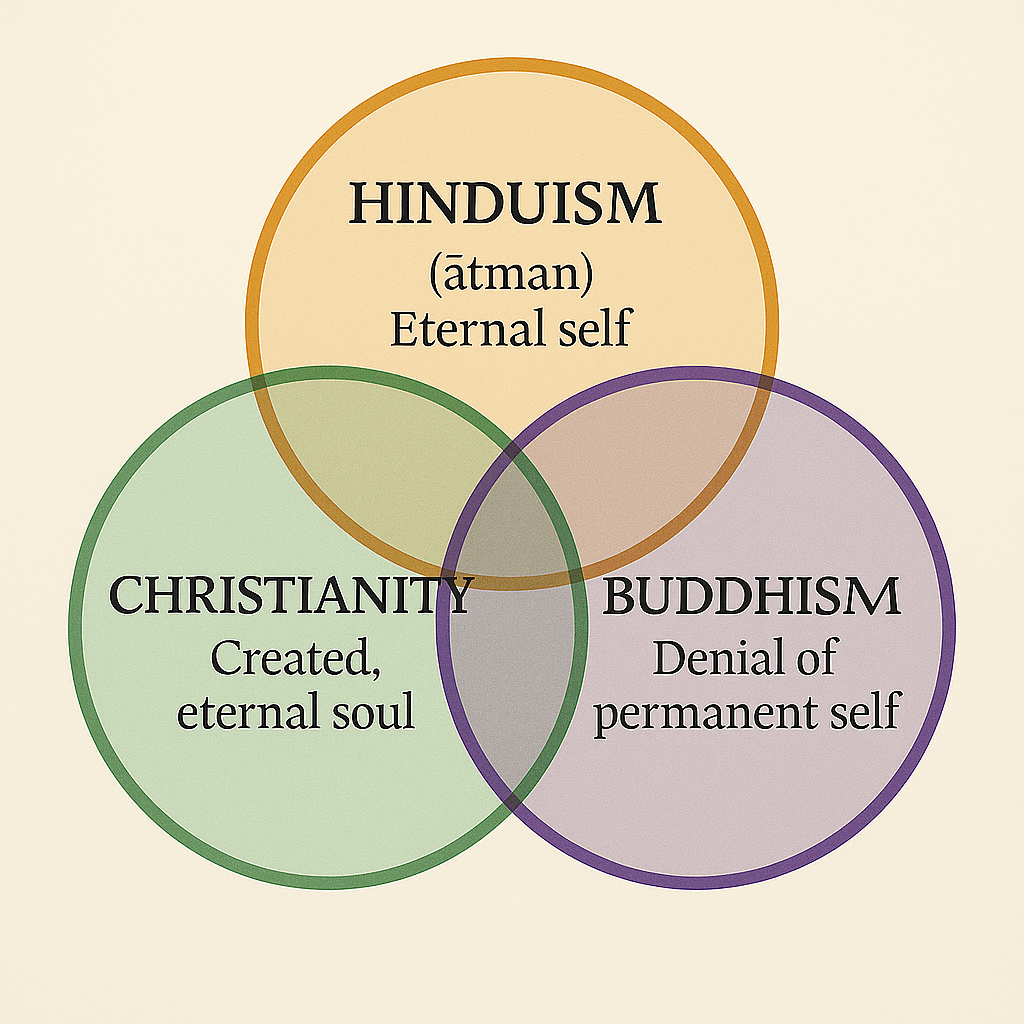
The question of what the soul is, whether it exists, and what happens to it after death lies at the center of the world’s major religious traditions. Christianity, especially in its Catholic tradition, affirms the soul as eternal and God-given. Hinduism has multiple schools, often affirming an eternal self or ātman. Buddhism, including Tibetan Buddhism, rejects the idea of a permanent self or soul and instead speaks of mind and consciousness as a conditioned stream of awareness without enduring essence.


The Christian and Catholic Understanding of the Soul

Christianity teaches that every human being has a unique, immortal soul created by God. According to Catholic doctrine, the soul is the spiritual principle of the human person. It is eternal in destiny, surviving bodily death, and directed either toward communion with God or separation from Him.

Scriptural sources include Genesis 2:7, where God breathes life into Adam and he becomes a living soul [1]; Matthew 10:28, where Jesus warns of the danger of losing the soul [2]; and the Catechism of the Catholic Church, which affirms that the soul is created by God and immortal [3]. In this view, the soul is not an impersonal principle but a personal identity, judged and redeemed by God.


Hindu Views on the Self (Ātman)

Hinduism is diverse, but most of its classical schools affirm the existence of ātman, the true self. The Chandogya Upanishad teaches “tat tvam asi” (you are that), affirming the identity of the self with Brahman [4]. The Brihadaranyaka Upanishad declares, “This self (ātman) is indeed Brahman” [5]. The Bhagavad Gita teaches that the self is eternal and indestructible [6].

Distinguishing Hindu and Christian Concepts

Both Hindu and Christian traditions speak of something enduring at the core of human existence, but they do so in different ways.

Christianity teaches that the soul is created by God, personal, and accountable before Him. It does not preexist from eternity but comes into being by His will and remains dependent on Him for existence, judgment, and salvation.

In Hindu thought, Advaita Vedānta emphasizes the identity of the self (ātman) with Brahman, dissolving individuality into the absolute. Dvaita and many Bhakti traditions instead teach that the self remains distinct yet eternal, existing in relationship with the divine. In all of these cases, the ātman is uncreated and co-eternal with ultimate reality, not brought into being by God.

Thus, while both traditions sometimes use personal and sometimes abstract language, the Christian soul and the Hindu ātman play very different roles. The soul in Christian theology is a created person before God; the ātman in Hindu philosophy is an eternal essence, whether one with Brahman or distinct in devotion.


The Creator God in Christianity and Hinduism

Christianity affirms one personal Creator God who brings the universe into being from nothing and sustains it in existence.

Hinduism presents a wide range of views. In Bhakti traditions, deities such as Vishnu, Shiva, or Devi are worshiped as supreme creators. Vedānta schools affirm Brahman as the ultimate source, though in Advaita this is not a personal act of creation but the manifestation of māyā. Other schools such as Sāṃkhya and Mīmāṃsā reject a creator altogether, viewing the universe as self-arising.

Thus, while Christianity grounds the soul in a personal God who creates and judges, Hindu thought ranges from devotion to a personal creator to cosmologies where no creator is necessary.


Buddhist Rejection of the Soul

Buddhism arose in part as a rejection of the Hindu doctrine of ātman. In the Anattalakkhana Sutta, the Buddha declared that none of the five aggregates of existence constitute a self [7]. The doctrine of anātman (no-soul) became central.

Mind and Consciousness

In Tibetan Buddhism, mind and consciousness are viewed as a stream of awareness, conditioned by karma. The Abhidharma-kośa describes consciousness as momentary and dependent [8]. Unlike Christianity and Hinduism, which affirm an eternal principle (soul or self), Buddhism denies it, calling belief in permanence a delusion.

Yet questions arise. If there is no soul, then what suffers in the hell realms described in Tibetan texts? The Bardo Thödol warns of the horrors of the Vajra Hell, a realm said to be utterly without escape [9]. The Hevajra Tantra declares that those who violate tantric commitments “will not be liberated for as many eons as there are atoms in the universe” [10]. The Cakrasaṃvara Tantra and later commentaries also teach that breaking tantric vows leads to vajra hells without release [11].

This presents a paradox: if there is no enduring self, who is suffering eternally?


Tibetan Buddhist Schools Under Examination

Madhyamaka – Nāgārjuna’s Mūlamadhyamakakārikā argues that all phenomena, including the self, are empty of inherent existence [13]. But if the self is an illusion, how does karma persist? If Vajra Hell is eternal, how can something that does not exist suffer forever?

Yogācāra (Mind-Only) – The Yogācārabhūmi Śāstra introduces ālayavijñāna, the “storehouse consciousness,” which preserves karmic seeds [14]. Though intended to avoid affirming a self, it functions much like one: carrying memory, identity, and karma. Hinduism here provides a comparison: the Bhagavad Gita teaches that the self carries karma through many births [6]. Yogācāra denies the term “soul,” yet reintroduces something strikingly similar. Christianity differs again: not a karmic storehouse, but a personal soul created by God.

Dzogchen (Great Perfection) – Dzogchen teachings, such as the Kunjed Gyalpo (All-Creating King), speak of rigpa, primordial pure awareness that is timeless and luminous [15]. Though Dzogchen denies that rigpa is a soul, the resemblance is striking. If rigpa is eternal, pure, and the ground of all experience, how is this different from what Christians call the soul or Hindus call ātman? The denial seems rhetorical rather than substantive.

Vajrayāna and Deity Possession – Tantric scriptures describe deity yoga, in which practitioners invite deities to merge with them [16]. If there is no self or soul, what exactly is being merged with or possessed?


Conclusion

Across Christianity, Hinduism, and Buddhism, the question of what endures, what we might call the soul, self, or consciousness, reveals fundamentally different views of human identity. Christianity anchors personhood in a created, immortal soul made by God and accountable to Him. Hinduism envisions an eternal ātman, uncreated and either one with or distinct from the divine. Buddhism, in contrast, denies any enduring essence, seeing the sense of self as a conditioned process. Yet in its Tibetan forms, teachings on karmic continuity, primordial awareness, and tantric transformation often edge back toward affirming something that functions like a self.

From long immersion in both Catholic and Tibetan Buddhist traditions, I have come to believe that the Christian vision alone sustains coherence between moral responsibility, continuity of consciousness, and the promise of redemption. It affirms not only that we exist, but that we are known and loved by the One who created us. Against the shifting alternatives of an impersonal absolute or an empty stream of awareness, in my opinion, the Christian understanding of the soul remains the clearest expression of what it means to be human before God.


References

[1] Genesis 2:7, The Holy Bible (ESV).
[2] Matthew 10:28, The Holy Bible (ESV).
[3] Catechism of the Catholic Church, Part I, Section Two, Chapter One, Article 1, §366.
[4] Chandogya Upanishad 6.8.7, in Radhakrishnan, S. (trans.), The Principal Upanishads.
[5] Brihadaranyaka Upanishad 4.4.5, in Olivelle, P. (trans.), The Early Upanishads.
[6] Bhagavad Gita 2.20, in Zaehner, R. (trans.), The Bhagavad-Gita.
[7] Anattalakkhana Sutta (Samyutta Nikaya 22.59), in Bhikkhu Bodhi (trans.), The Connected Discourses of the Buddha.
[8] Vasubandhu, Abhidharma-kośa.
[9] Bardo Thödol (Tibetan Book of the Dead), in Evans-Wentz, W.Y. (ed.).
[10] Hevajra Tantra, Snellgrove, D.L. (trans.), The Hevajra Tantra: A Critical Study.
[11] Cakrasaṃvara Tantra, in Tsuda, S. (trans.), The Samvarodaya Tantra.
[12] Hevajra Tantra, ibid.
[13] Nāgārjuna, Mūlamadhyamakakārikā, Kalupahana, D.J. (trans.).
[14] Yogācārabhūmi Śāstra, Xuanzang (trans.).
[15] Kunjed Gyalpo (All-Creating King), in Namkhai Norbu (trans.), The Supreme Source.
[16] Cakrasaṃvara Tantra and Hevajra Tantra, ibid.


The Subconscious as Battleground: Demonic Infiltration Through the Wounds of the Psyche


In our modern world, the subconscious is often reduced to a psychological artifact, a repository of repressed memories, habits, and impulses. But from a biblical and Catholic standpoint, this internal space is more than just a vault of emotion and instinct. It is a spiritual battleground and a vulnerable domain where real entities, such as demons seek entry and control.

I speak not in theory but from personal experience. As someone who has lived through the horror of possession, I know firsthand what it means to have my subconscious colonized by non-physical forces, in particular, Tantric deities and the so-called yidams (meditational deities) I once invoked in long term retreats. They now exert control over my dreams at night, not as fragments of memory, but with an intention, force, and intelligence all their own.

Trauma, Sin, and the Open Doors

The Catholic tradition is clear: sin creates openings. These are spiritual vulnerabilities through which demonic powers can assert influence. But it’s not always sin, but often wounds and traumas that become entry points. This aligns, ironically, with what Jung called the shadow: the parts of ourselves we deny or fail to integrate.

In occult and tantric frameworks, these shadows are often “worked with” i.e. ritualistically invited, named, and visualized. In my case, the visualizations of the yidam were never just symbolic. They were summonings that invited intelligent spiritual entities through geometric portals into the liminal space of my subconscious mind.

Obviously, tantric rituals are powerful, but the power is not “of God.” The light of Christ later revealed to me that what I had opened myself up to were demonic counterfeits or parasitic forces clothed in deceptive splendor.

The Subconscious

While the Jungian model treats these internal figures such as archetypes, gods, and dreams, as symbolic representations of the psyche, Biblical scripture offers a different view. Ephesians 6:12 tells us that our struggle is “not against flesh and blood, but against principalities, against powers, against the rulers of the darkness of this world.”

What modern psychology calls “unconscious drives” may, in reality, be demonic actors exploiting our blind spots. They can manifest through thoughts, compulsions, visions, or dreams. They don’t just influence behavior, they shape the architecture of perception, infiltrating belief itself. This is why confession and deliverance are not just spiritual maintenance but are spiritual war strategies.

Dreams: The Nightly Invasion

The yidam I practiced during my retreats appears nightly, manipulating my dreams and injecting disturbing images, physical sensations, and false feelings of failure and yearning. It tries to arouse old loyalties alternating between affects of pseudo kindness and visions of cruel and bitter punishments. These dream invasions foster confusion and despair; and sometimes cause sensations of physical torment.

From a biblical perspective, dreams are a legitimate domain of spiritual communication, but that doesn’t mean all dream figures are from God. In Jeremiah 23, the Lord condemns false prophets who “make my people forget my name by their dreams.” Satan can disguise himself as an angel of light and in my experience, tantric deities do precisely that.

We must recognize the subconscious not as a private fortress, but as a permeable space, one that requires guarding, cleansing, and illumination by Christ alone. Anything else, especially tantric visualization and archetypal meditation, opens up doors we cannot close on our own.

There is no neutral spirituality. Every spiritual practice either opens the soul to grace or to deception. As one who has been inside the snare, I say this without hesitation: tantric deities are demons in disguise, and their preferred hiding place is the very part of us we least understand: the subconscious.

But Jesus Christ, in His mercy, descends even into those hidden caverns, casting out darkness and healing the wounds that made us vulnerable in the first place.

“For this purpose the Son of God was manifested, that He might destroy the works of the devil.”
— 1 John 3:8

The Counterfeit Kingdom: How Occult Religions Imitate the Catholic Church

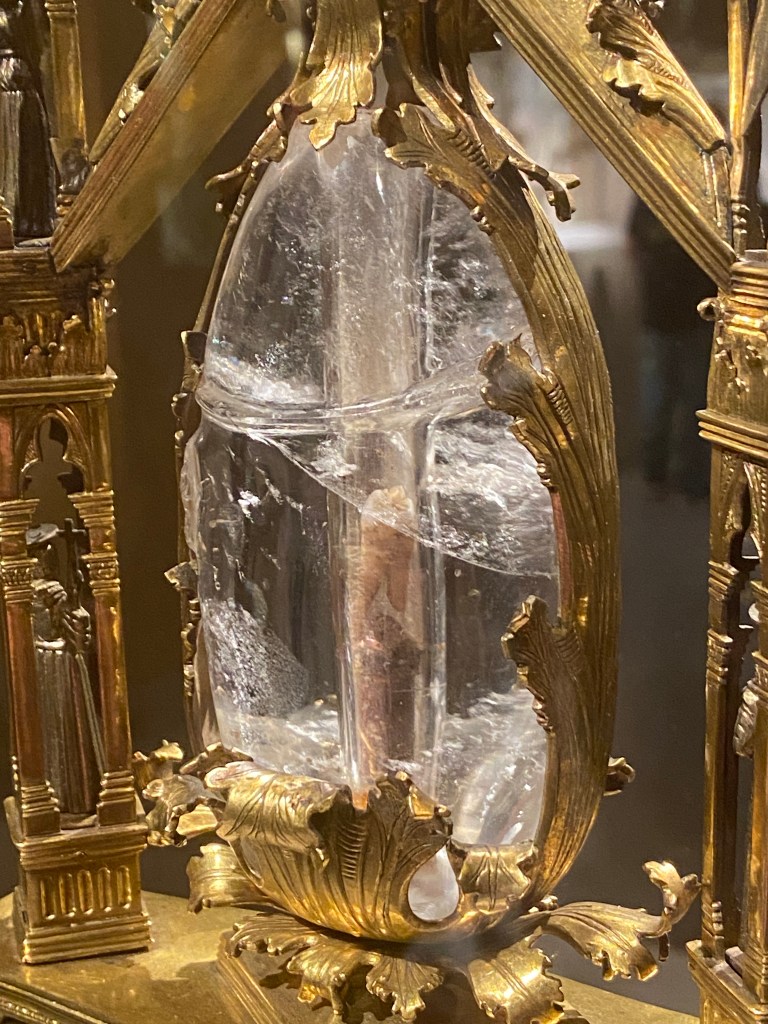
Relic of St. Mary Magdalene in the Metropolitan Museum, NYC


There is a strange and disturbing trend among occult and demonic religions, particularly within esoteric branches of Buddhism, such as Tibetan Vajrayana. These traditions go to great lengths to mimic, distort, and counterfeit elements of the Catholic faith. Why? Because Satan has no creativity of his own. His kingdom is one of imitation, distortion, and inversion. And when we look closer, it becomes chillingly clear: many of these occult systems are designed as spiritual forgeries, imitating the truths of the Catholic Church while replacing Christ with false gods and demons.

Here are just a few examples.


Relics: Holy vs. Unholy

In Catholicism, relics are a beautiful and reverent way the faithful connect with the saints in heaven. The bones, hair, and clothing of saints, when venerated properly, are physical reminders of lives of holiness and union with Christ. First-class relics (parts of a saint’s body), second-class relics (items the saint used), and third-class relics (objects touched to a first-class relic) are all part of an ancient, sacred tradition rooted in the Incarnation: God came in the flesh, and through His Body and those who share in His holiness, the physical becomes a channel of grace.

Now compare this to Tibetan Buddhism and other occult traditions.

Tibetan lamas preserve the bones and hair of deceased teachers and display them in shrines. In some cases, these relics are even mixed into pills or powders thought to convey “blessings” or spiritual power. Even more shockingly, there are “blood pills” created from the blood of high lamas, dried and consumed by devotees, believed to transfer the lama’s blessing and heal the disciples’ illnesses.

What we see here is not simply reverence for a teacher but an occult inversion of the sacred. These objects are treated as talismans or sources of supernatural power, often wrapped in secrecy, ritual, and magical thinking.


Apostolic Succession vs. Tantric Lineage

The Catholic Church has an unbroken apostolic lineage going back to Christ Himself. This is not just symbolic but the real spiritual authority passed from bishop to bishop, from the Apostle Peter to the present-day pope. The sacraments are valid because of this lineage. The Holy Spirit moves through it, not because of magical powers or personal charisma, but because of Christ’s promise to His Church.

Tibetan Buddhism, too, places massive emphasis on “lineage” in the passing of initiations, teachings, and realizations from teacher to student. They claim these go back to the historical Buddha, Sakyamuni. But here’s the problem: the tantras, the core of Tibetan esoteric practice,did not exist during Sakyamuni Buddha’s life. These were later developments, many of which emerged between the 5th and 10th centuries AD, centuries after the Buddha died.

So how do they justify their claims? Through visions, dream revelations, hidden treasure texts (termas), and secret transmissions from spirit beings. These are not testable or historically verifiable. Instead, they mimic the structure of apostolic succession while relying on supernatural claims rooted in occultism. It’s a counterfeit version of Catholic apostolic lineage, one that replaces the Holy Spirit with “dakinis,” “protectors,” and wrathful spirits.


Blessed Sacrament vs. Tantric Empowerments

In the Catholic Church, the Eucharist is the Real Presence of Jesus, body, blood, soul, and divinity. It is the highest form of worship and union with God. Only validly ordained priests can consecrate the Host, and it is surrounded with reverence and liturgy.

IIn tantric Buddhism, “empowerments” are elaborate rituals meant to grant spiritual powers, open energy channels, and “ripen” the disciple for advanced practices. They are sometimes sexually charged, invoking deities (who are really demons in disguise), and can involve ingesting “nectars,” or entering into trance states. Many initiations are based on “secret” transmissions, whispered lineages, or magical seals. These seals are believed to imprint a spiritual mark or bind the practitioner to a specific deity, practice, and lineage. But this is not unique to Tibetan Buddhism. Magical seals are also found in Satanism, Luciferianism, and ceremonial magic, where they are used to summon or bind spirits and demons in exchange for occult knowledge, power, or protection. These seals are spiritual contracts or expressions of unseen allegiances, and their use is never neutral. They are tools of spiritual manipulation that open the soul to influence, possession, or bondage by demonic spirits. In these traditions, the seal acts as a gateway or portal, and it is binding, a counterfeit version of the indelible mark left by the Holy Spirit in baptism or confirmation. Where the Church seals the faithful with chrism and the sign of the cross, occult traditions seal their initiates with marks of spiritual enslavement.

Chrism refers to a consecrated oil used in the Catholic Church during certain sacraments, specifically Baptism, Confirmation, and Holy Orders. It is a mixture of olive oil and balsam, blessed by a bishop during Holy Week.

The use of chrism is deeply symbolic:

  • It represents the Holy Spirit and divine anointing.
  • It marks the person as set apart for God, sealed with grace and incorporated into Christ.
  • The anointing with chrism leaves an indelible spiritual mark on the soul, which can never be removed.

The tantric empowerments claim to transform the practitioner’s body, speech, and mind into that of a deity but again, this is a counterfeit. Instead of communion with God through grace, it’s the deification of the self through ritual manipulation and demonic assistance.


The Church Triumphant vs. the Pantheon of Demons

Catholics honor the communion of saints, those in heaven who intercede for us and serve as models of holiness. Saints are not worshipped; they are venerated. The glory always goes to God.

Tibetan Buddhism features a dizzying pantheon of “yidams” (meditational deities), “protectors,” and “enlightened deities” that are summoned, visualized, and sometimes merged with through complex meditations. These include wrathful, terrifying figures in colors of blue, red, and black, with fangs, skulls, and weapons, dripping with blood or dancing on corpses. Vajrayogini, for example, is often visualized standing on a human corpse, holding a flayed skin and drinking from a skull cup. Although these are claimed to be symbols of transcendence, they are actually demonic imitations of holiness.


Satan’s Strategy: Imitation, Not Innovation

Why does the enemy copy the Church? Because the Catholic Church is the true Bride of Christ. Satan can’t create truth, but he can twist it. His most dangerous weapons are not outright lies, but distorted half-truths wrapped in spiritual language. He dresses up darkness to look like light.

Tibetan Buddhism and similar occult systems offer spiritual hierarchy, ritual, relics, and transmission, but without Christ. They offer communion, but with spirits and demons. They offer transformation, but into false gods, not saints.


The Real Power: Jesus Christ

There is no substitute for the true power of God through Jesus Christ. No blood pill, no tantric lineage, no magical empowerment can wash away sin or bring eternal life. Only Christ, crucified and risen, can do that.

For those who have been caught up in these counterfeit systems, whether through curiosity, spiritual seeking, or deception, it is important to remember that there is hope and it is possible to extricate oneself. Jesus is the Way, the Truth, and the Life and his truth is not hidden in secret teachings or passed down in esoteric rituals. It is freely offered to all who repent and believe.