In Civilized Shamans: Buddhism in Tibetan Societies, Geoffrey Samuel offers a sweeping anthropology of Tibetan religion that refuses to take Tibetan Buddhism at face value. He finds a living tradition shaped by older and more unruly forces beneath the polished scholastic surface of the monasteries. What emerges is a civilization of monks and magicians, of disciplined philosophers and ecstatic ritualists. His argument is simple but radical: Tibetan Buddhism is the result of Indian Buddhist ethics and philosophy meeting the shamanic substratum of the high plateau.¹
Two orientations: clerical and shamanic
Samuel organizes Tibetan religion around two poles. The first, the clerical or monastic orientation, descends from Indian Buddhism with its monasteries, ethical codes, and scholastic systems of thought. It values restraint, karmic causality, and the gradual cultivation of enlightenment. The second, the shamanic orientation, grows from indigenous Tibetan practices centered on ritual efficacy, spirit interaction, and the manipulation of unseen forces. This orientation values power (dbang) more than purity and treats ritual specialists not as moral exemplars but as technicians of spiritual power.²
These two strands were never simply reconciled. Tibetan civilization attempted to domesticate the shaman. The ecstatic healer and spirit-fighter was refashioned into a lama, wrapped in robes and scriptures yet still capable of commanding spirits, averting misfortune, or destroying an enemy through ritual means. The civilized shaman is not a metaphor. It is a social type, the institutionalized magician of a literate Buddhist society.³
Dark rituals and the question of subjugation
The most uncomfortable continuity between these worlds lies in the domain of ritual violence, what Tibetan sources call drag-po or wrathful rites. These practices are directed not toward enlightenment but toward control: the binding, subduing, or annihilation of obstructing forces, whether demonic, psychic, or human.⁴
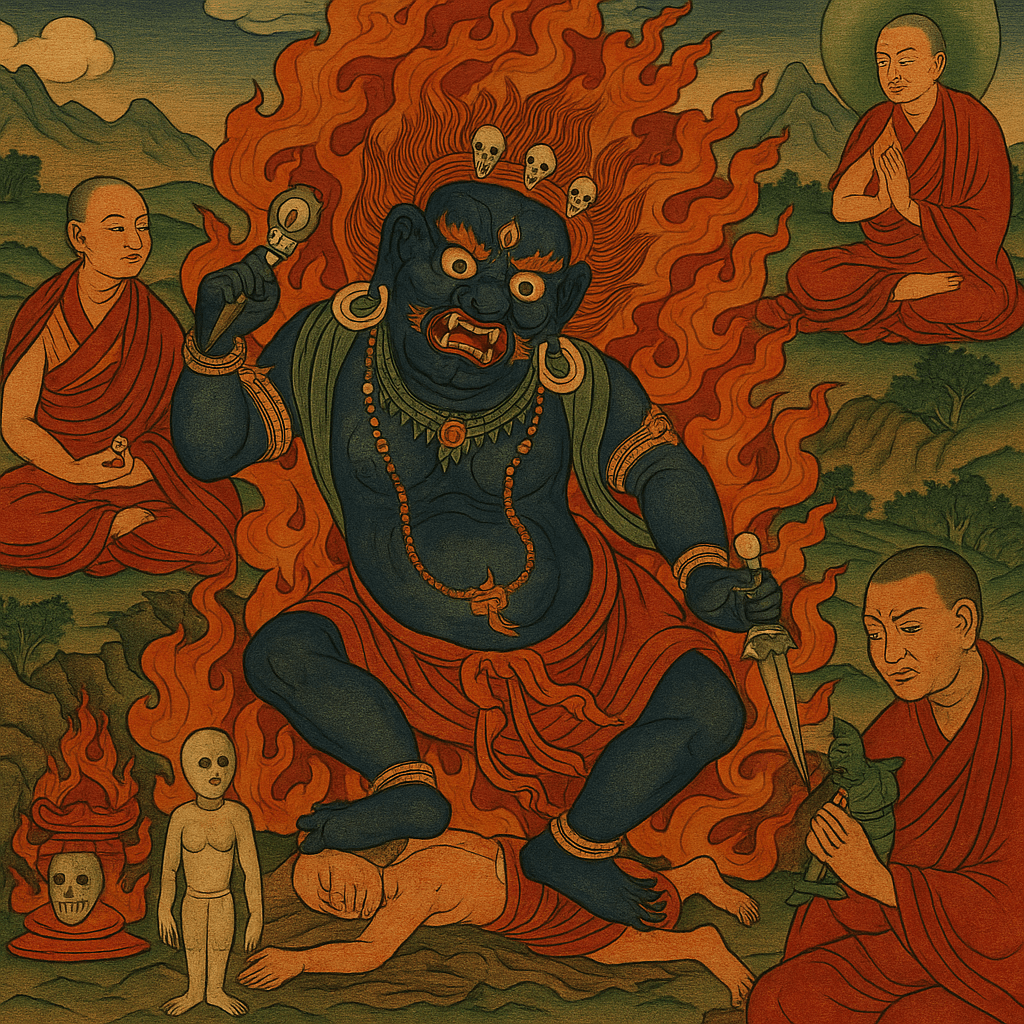
Samuel interprets these rites not as moral aberrations but as necessary expressions of the shamanic orientation within a Buddhist frame. Indian Buddhism had long flirted with magical power but kept it at the margins of monastic life. In Tibet, ritual mastery became central. The same lama who taught compassion might also perform a subjugation rite, using effigies, mantras, and visualizations of wrathful deities to annihilate obstacles, whether spiritual or human. Such practices, found in the Nyingma and Kagyu tantric cycles and institutionalized in monastic ritual manuals, embody a logic foreign to classical Indian soteriology yet native to shamanic cosmology, the idea that power must be met with power.⁵
What makes these rites “civilized” is not their ethical domestication but their integration into a bureaucratic religion. The Tibetan monastery became a regulated arena for managing violence and transforming it into ritual performance. The monastic code that forbade killing also licensed symbolic destruction: paper effigies burned, dough figures pierced, and demons tamed through mantras.⁶ This was how a society of monks could still believe in, and even engage in, acts of ritual aggression.
Power and legitimacy
Samuel’s analysis is more about social structure than theology. The clerical orientation secured legitimacy through moral authority and learning, while the shamanic orientation maintained relevance through immediate and pragmatic results. The former built monasteries; the latter kept communities going amid famine, disease, and invasion. Tibetan Buddhism’s durability, he argues, comes from this uneasy synthesis. The scholar-monk and the ritual adept needed each other: the first to lend doctrine and order, the second to command the spirits that haunted every valley and household.⁷
In this light, the dark rituals of subjugation are not aberrations but instruments of governance. They discipline the chaotic powers of the landscape just as the monastery disciplines the passions of the mind. To them, the wrathful deity is not a contradiction of compassion but its shadow: compassion armed.
Rethinking the “Buddhist” in Tibetan Buddhism
Samuel’s greatest contribution may be to unsettle what we think “Buddhist” means. By treating Tibetan religion as a field of interacting orientations rather than a single orthodoxy, he exposes the limits of modern, idealized Buddhism. The vision of Tibet as a purely pacific, philosophical culture depends on forgetting the tantric rites that promise to destroy human enemies or subjugate spirits.⁸ Samuel does not moralize about this tension; he historicizes it. The so-called civilized shaman is a figure born of necessity, mediating between an imported moral system and an indigenous world of volatile gods.⁹
A note on tantra as the mediating field
Samuel does not treat Hindu tantra as a third, independent strand within Tibetan Buddhism. Rather, he presents tantric practice as the meeting ground of the clerical and shamanic orientations. By the time tantra reached Tibet, Indian Buddhism had already absorbed many Śaiva and Śākta elements. What Tibet inherited, therefore, was a fully developed tantric Buddhism rather than a simple blend of Buddhist and Hindu ideas. In Samuel’s account, tantra provided the channel through which shamanic power could operate within a clerical framework. It was the mechanism that allowed ecstatic and ritual techniques to coexist with the disciplines of monastic scholarship.
He also describes tantric Buddhism in Tibet as a two-way exchange. The imported Indian systems of Hevajra, Guhyasamāja, Cakrasaṃvara, and others were reinterpreted through local cosmologies of mountain gods, territorial spirits, and ancestral deities. The result was what he calls “tantricized shamanism” or “shamanized Buddhism.” While Hindu tantra was one historical source, the Tibetan tantric complex became a hybrid formation that expressed shamanic cosmology through Buddhist doctrine.¹⁰
The afterlife of the civilized shaman
Civilized Shamans was published in 1993, before the wave of globalized Tibetan Buddhism tried to reframe lamas as psychologists or humanitarians. Yet its insight remains vital. Beneath every system of enlightenment lies a system of control. The Tibetan synthesis worked precisely because it did not abolish the shamanic element. It incorporated it, turning ecstatic violence into liturgy and spirit warfare into cosmology.¹¹
For those interested in understanding tantric practice, especially the darker currents of subjugation and protection, Samuel’s anthropology is a cautionary mirror. It reminds us that ritual power is never purely symbolic. Even when intellectualized, it retains the logic of coercion: to bind, to summon, to annihilate. Tibet’s civilization was built on mastering such forces. The tension Samuel describes is not an accident of history but a model of how Tibetan religion evolved. Civilized shamans appear wherever doctrine meets magic, wherever ethics must coexist with power. Tibet made that paradox explicit.¹²
It has taken me decades to admit something that began as a faint suspicion, then settled into unease, and now has crystallized into a sober conclusion: Tibetan tantric Buddhism is not what I thought it was. Nor is it what I believed when I first encountered it many years ago, a bit before the time His Holiness the Dalai Lama received the Nobel Peace Prize in 1989.
Back then, the first wave of Tibetan lamas and rinpoches were arriving in the West. To many of us, they seemed like emissaries from a lost Shangrila. Coming out of the disillusionment of the Vietnam War years, with trust in government and organized religion badly shaken, we were primed to seek something transcendent and pure. And here were these men, holy men trained in the monasteries of old Tibet, carrying with them an aura of mystery and profound wisdom. Meeting them felt like an unimaginable stroke of good fortune.
The historical Buddha’s teachings struck us as luminous and deeply humane. The philosophical treatises were subtle, the meditation techniques precise and effective. And then there was tantra. We were told, almost in passing, that tantra too came directly from the Buddha. No mention was made of its roots in Shaivism, or its overlaps with the worship of Shiva, Kali, and the other tantric currents in Indian religion. Yes, there were references to the 84 Siddhas, some of whom practiced in Hindu traditions, but it was presented as a kind of colorful backdrop rather than something that demanded careful inquiry. The task, we were told, was to study the dharma, not to ask too many uncomfortable questions.
And yet, the Buddha himself had urged his students to test his words as one tests gold: cutting, burning, hammering to see if it is true. I carried that instruction into Tibetan Buddhism. But the environment I found myself in didn’t encourage such testing. Quite the opposite.
Very quickly, I was drawn into the highest yoga tantras. After a series of initiations that were performed in Tibetan, a language I didn’t understand, I was informed by a lama I scarcely knew that from now on, I had to do whatever he told me. Cognitive dissonance set in immediately. Around me, others spoke of him as a fully enlightened buddha. Terms like samaya and vajra hell were introduced without context, wrapped in a swirl of historical Buddha teachings and cryptic tantric concepts. Critical thought was not just discouraged; it was quietly undermined. The lama was king, and the student’s role was obedience.
For Westerners raised with democratic ideals and an education that stressed inquiry, this was a bewildering fit. Many of us unconsciously overlaid our early religious conditioning onto what was, in fact, a foreign and feudal religious structure with a pantheon of strange and colorful deities. The result of treating the lama as an omniscient god created confusion, sometimes tragedy. I have heard of suicides, psychotic breaks, and lives unmoored. At the same time, I know people who genuinely believe they have benefited from Tibetan Buddhism. For years, I counted myself among them, until my own turn came.
I was privately attacked by my gurus during a tantric ritual for what I considered minor offenses related to situations outside of my control. What followed was worse: a series of what can only be described as black magical assaults. I now look back at those suicides I had once heard about and wonder: had they endured similar attacks, subtle or overt, after questioning or disappointing their teachers? Perhaps. I cannot know for sure. But I do know this: the mask of compassion many lamas wear often drops when they feel challenged or exposed. Not all, certainly. But enough to form a pattern.
That slow dawning that Tibetan tantric Buddhism was not what it was presented to be has been deeply painful. The disillusionment runs far beyond personal disappointment; it speaks to a betrayal of trust, the suppression of critical thought, and the dangers that arise when power is handed to unaccountable gurus who claim authority over hidden magical practices and wield them at will. Brought into a Western culture of sincere but searching seekers, this has created a toxic mix that leaves people vulnerable at the very moment they are most open.
Buddhism is usually presented in the West as a religion of mindfulness and compassion. But hidden in its tantric wing is something darker. In the eighteenth century, Sélung Shepa Dorjé (Sle lung Bzhad pa’i rdo rje) compiled a sixteen-volume cycle called Secret Gnosis Dakini (Gsang ba ye shes mkha’ ’gro, or GYCK). This was not just a collection of esoteric philosophy, but also a grimoire filled with magical spells.
According to Cameron Bailey in The Magic of Secret Gnosis: A Theoretical Analysis of a Tibetan Buddhist “Grimoire,” grimoires of spell instructions are common in Tibetan Buddhism. They often appear inside larger tantric cycles like the GYCK or in the collected works of great lamas. As the scholar Berounsky, cited by Bailey, put it, the operations in such texts are “an amalgam of tantric interventions combined with popular magic.” [1]
Volumes four and twelve of the GYCK preserve dozens of rituals for worldly power. The twelfth volume in particular reads like a magician’s handbook. It does not hide its intent; it offers ninety-two spells to heal, protect, enrich, and subjugate.
Rituals of Control
Among these spells are some dedicated to domination. Far from the common image of Buddhism as a purely gentle path of liberation, the Secret Gnosis spells allowed practitioners to bind and control others. One entire text, The Magic Lasso, instructs adepts on capturing their targets through visualization and mantra. Other spells direct them to create talismans and effigies, ritually charged to influence or destroy enemies.
Bailey emphasizes that these rituals work by merging tantric deity yoga with ritual techniques: the practitioner visualizes themselves as a wrathful god, projects light rays at the target, and seals the action with mantra. Your meditation becomes, in effect, a weapon.
The Spellbook as Technology
The grimoire aspect of the Secret Gnosis cycle cannot be overlooked. It contains practical instructions for bending reality to one’s desire. Substances like herbs, turquoise, and even urine or flesh are prescribed as tools of ritual practice.
Bailey notes that these spells are framed within a bodhisattva ethic. They are said to protect the Dharma or defend communities. Yet to modern eyes, they read unmistakably as instructions for control. This is where interpretation diverges. Bailey highlights the philosophical and ritual integration, while a critical lens reveals the coercive logic beneath the compassionate rhetoric.
A Tradition of Ambivalence
Figures like Milarepa warned against sorcery, even though his story is entangled with it. The Buddhist tradition as a whole often drew a line between miracle powers that “arise naturally” from meditation and deliberate ritual magic. But that line was blurred from the beginning. The Secret Gnosis makes clear how deeply magical domination was preserved within the canon.
Conclusion
The Secret Gnosis Dakini cycle exposes a side of tantric Buddhism rarely acknowledged publicly. Bailey shows that its grimoire-like sections are integral to tantric practice, not just marginal curiosities. What I emphasize here is that these spells—especially those of subjugation—show a system where manipulation was not an aberration but an option built into the tradition. What is presented today as a path of compassion was also, sometimes, a path of great harm.
[1] Cameron Bailey, “The Magic of Secret Gnosis: A Theoretical Analysis of a Tibetan Buddhist ‘Grimoire,’” Journal of the Korean Association for Buddhist Studies 93 (2020): 535–570.
The following is based on Aleksandra Wenta’s article “Tantric Ritual and Conflict in Tibetan Buddhist Society: The Cult of Yamāntaka” (2022).
Public perception paints Buddhism as the ultimate religion of compassion. The Dalai Lama’s cheerful smile and monks chanting in maroon robes conjure images of peace in the Western imagination. But the historical record tells quite another story, one most Buddhist institutions would prefer to bury. Violent ritual has always had a place in Tibetan Buddhist practice, and the cult of the wrathful deity Yamantaka is one of the clearest examples.
The Deity of Destruction
Yamantaka, whose name means “Ender of Death,” is no serene Buddha. In tantric lore he is a ferocious, multi-headed, weapon-wielding deity invoked to annihilate enemies. These enemies might be inner demons in metaphor, but in many cases they were very real human targets. As Wenta’s research shows, Tibetan Buddhist ritual specialists used Yamantaka rites as deliberate acts of destruction, both spiritual and physical.
Politics and Ritual Warfare
The historical examples are difficult to dismiss. In the ninth century, the Buddhist master Gnubs chen Sangs rgyas yeshes allegedly used Yamantaka magic against King Lang Darma, a ruler seen as hostile to the Dharma. Centuries later, during the political struggles of the seventeenth century, the Fifth Dalai Lama employed Yamantaka rituals to consolidate power over rival factions. These were not fringe experiments, but state-linked religious acts intended to remove opponents.
The reach of these rites went beyond Tibet. The Manchu Qianlong emperor adopted Yamantaka worship to project legitimacy over his subjects, while Mongolian and Japanese traditions incorporated similar ritual violence into their own religious-political frameworks.
Violent Compassion as Justification
Practitioners did not see these rites as morally corrupt. They justified them through the doctrine of “violent compassion,” the belief that killing or harming could liberate an enemy from a worse rebirth. Wenta notes that tantric philosophy, particularly the doctrine of emptiness, was used to argue that concepts like killer or victim do not ultimately exist. In this logic, an enlightened being could commit an act of violence without accruing negative karma.
Ritualized Destruction
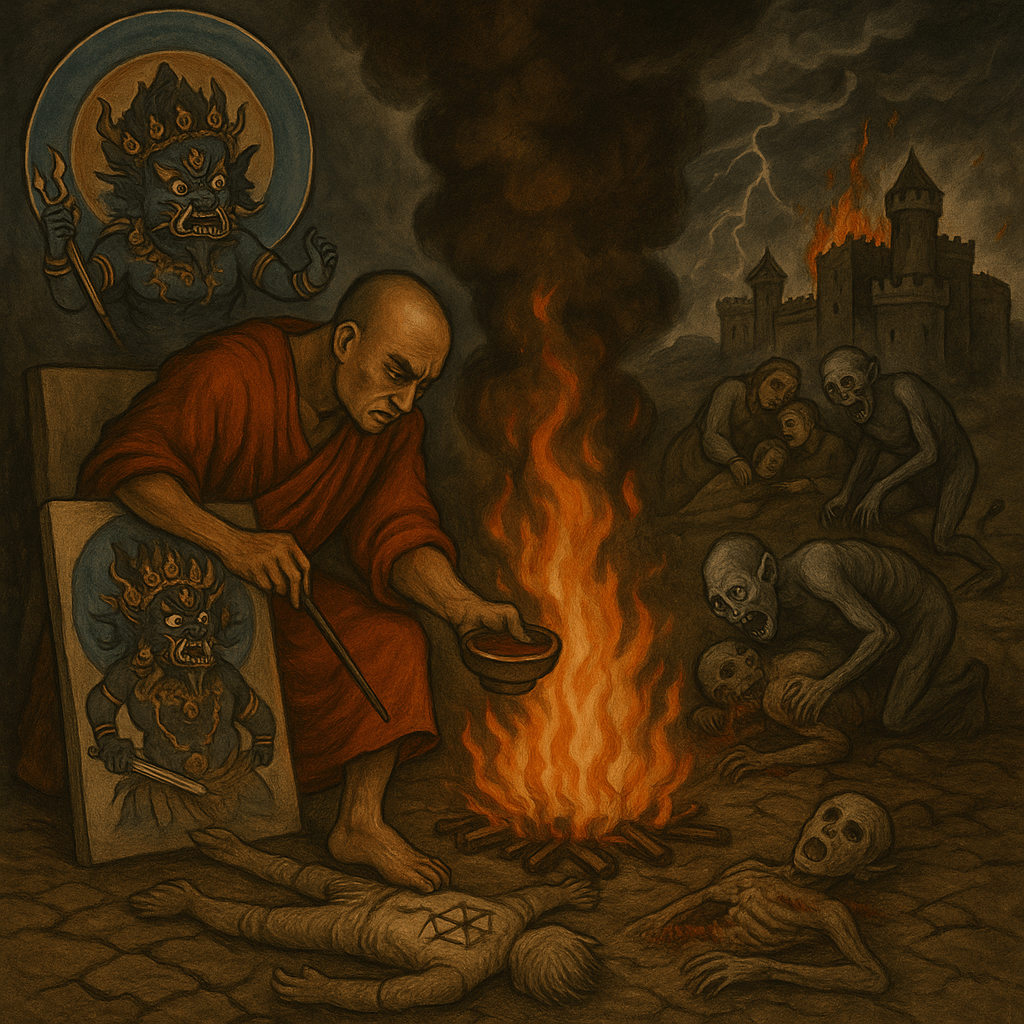
From the Mañjuśriyamūlakalpa’s “Ritual Against the Wicked Kings” comes one of the most explicit and brutal examples. The text instructs the practitioner to paint Yamantaka in terrifying form, then perform fire offerings of human blood, flesh, and powdered bone mixed with poisons and toxic plants to unleash plague, famine, storms, and demonic infestations upon the target. The king’s family is to die in sequence: son on the first day, wife and ministers on the second, the king himself on the third, while his court is overrun by flesh-eating spirits and his land struck by drought, fire from the sky, rockfall, and invasion. A human effigy bearing the victim’s birth star in cremation-ground charcoal is trampled during mantric recitation so the enemy dies, goes mad, or is devoured by demons. This is ritualized destruction in its most literal, calculated form.
One section of the same text reads like a manual for calculated devastation. The practitioner is instructed to heap human blood, flesh, powdered bone, poisons, and the roots of deadly plants onto a ritual fire in front of the painted deity. After 1008 offerings, not only is the enemy destroyed, but their family, ministers, and allies are swept away as well. The text promises droughts, plagues, famine, and storms, even fire and rocks falling from the sky, while demonic forces overrun the victim’s court. In some variations, a single datura root is enough to drive the target insane, or a few spoonfuls of spiced offerings can induce fatal fevers within days.
The text also states, “If he wants to kill someone, then having made a puppet (kṛtiṃ) he should write a name: the deity name or a nakṣatra (‘asterism under which the target was born’) using a charcoal of the cremation ground, which should be placed on the ground in front of the paṭa. Standing on [the puppet’s] head with his foot, he should be in a wrathful state, and do the recitation. He (the king) will become overpowered by a major disease, or he will die on the spot. That lord of men will be seized by piercing pains for no apparent reason, or he will be killed by an animal, or he will become crippled. He will be eaten by fierce rākṣasas, and various impure beings that have arisen from non-human birth (kravyādin), pūtanas, piśācas, pretas and the mothers, or he will be killed immediately by his own attendants.” 1
Conflict Inside the Tradition
Even within Tibetan Buddhism, the legitimacy of destructive rituals such as these was contested. Some figures, such as Rwa lo tsā ba, became famous for their wrathful practices but were denounced by peers as frauds or heretics. Reformers like Yeshes ’od tried to curtail the most extreme acts, replacing “live liberation” killings with symbolic substitutes like effigy destruction. But these reforms did not erase the underlying acceptance of ritual violence; they only tamed it for public consumption.
Another Piece of the Puzzle
Wenta’s work adds yet another piece of hard evidence to the growing pile that Tibetan Buddhism has long included practices designed to harm or destroy. These rituals were not simply metaphorical, and they were not limited to obscure sects. They were woven into the political and religious fabric of Tibet and beyond.
For those willing to look past Tibetan Buddhism’s carefully crafted PR image, the cult of Yamantaka exposes a reality in which the language of compassion hid a persistent undercurrent of deliberate harm.
Vajrayana Buddhism, also known as Tibetan Buddhism or Tantric Buddhism, stands out for its rituals, deity worship, and complex esoteric practices. Its mantras, mandalas, and meditations on wrathful and yab/yum deities bear clear resemblance to Hindu Tantra, Vedic ritualism, and indigenous spirit cults.
So how did it convince anyone, especially devout Buddhists, that it was authentically taught by the historical Buddha?
The answer lies in a strategic combination of hidden teaching narratives, scriptural mimicry, ritual power, and imperial patronage. Let’s explore how this transformation occurred and what it means when viewed through the lens of Catholic faith and biblical discernment.
Secret Teachings: “The Buddha Taught It, But in Secret”
Vajrayana scriptures claim that the Buddha did teach tantra, but only in secret, to highly realized disciples. These teachings were said to have been hidden in celestial realms, entrusted to beings like Vajrapani or dakinis, or taught in the Buddha’s “enjoyment body” (sambhogakaya) form in other worlds such as Akanistha.(1)
This tactic mirrored earlier Mahayana developments, where new sutras like the Lotus or Avatamsaka were claimed to be higher revelations spoken by the Buddha, but not understood by his early disciples. The concept of esoteric knowledge reserved for the spiritually mature made these late texts seem like rediscovered treasures, rather than innovations.
Scriptural Mimicry and Retroactive Legitimization
To reinforce their authority, tantric scriptures deliberately mimicked the structure of traditional sutras. They often began with the familiar phrase, “Thus have I heard,” and depicted the Buddha teaching not only in celestial realms surrounded by bodhisattvas, but sometimes in radically transgressive settings such as charnel grounds, encircled by ḍākinīs and wrathful deities. These texts introduced elaborate cosmologies, detailed ritual instructions, and esoteric vows, presenting them as timeless wisdom, even though they were composed many centuries after the Buddha’s death.[2]
Authors also invented lineages, claiming that tantric teachings had been passed down secretly from Vajrapani to Nagarjuna, or from Padmasambhava to Tibetan kings.
Syncretism with Hindu and Folk Traditions
Instead of denying its similarities with Hindu Tantra, Vajrayana reinterpreted them. Wrathful deities were said to be enlightened Buddhas. Sexual rituals were described as a symbolic means to transform desire into wisdom. Offerings of blood, bones, and taboo substances were spiritualized as purifications of dualistic perception.
By repackaging Vedic and folk practices into a Buddhist framework, Vajrayana could absorb local traditions and declare them “Buddhist skillful means.”
Imperial Support and Monastic Integration
Tantra spread rapidly through the support of kings and monasteries. In Tibet, tantric masters were invited to subdue native spirits, secure political power, and perform rituals for prosperity. At Indian centers like Nalanda and Vikramashila, tantric scholars and monks practiced Mahayana logic by day and tantric visualization by night.
With the backing of the state and the academic establishment, Vajrayana was not seen as a fringe practice but as the “highest vehicle” of Buddhism.
Ritual Power and Psychological Experience
For the average practitioner, tantra “worked.” It offered visions, emotional catharsis, ritual protection, and the promise of fast-track enlightenment. The experiential pull of mantra, deity yoga, and initiation ceremonies gave people tangible results even if the doctrinal basis was historically shaky.
In the end, many believed not because of historical evidence, but because the system delivered experiences of spiritual intensity.
How Christianity Views This: The Domain of the Second Heaven
From a biblical and Catholic perspective, this raises serious concerns. The spiritual beings Vajrayana practitioners encounter, wrathful deities, dakinis, yidams, do not proclaim Christ as Lord and Savior. They do not point to the God of Abraham, Isaac, and Jacob. They offer power and enlightenment through self-transformation, not redemption.
The Bible is clear: Satan is the prince of the power of the air, ruling the spiritual domain between heaven and earth until Christ returns (Ephesians 2:2). What some refer to as the “second heaven” is where fallen angels operate, deceiving through false light, hidden knowledge, and seductive spiritual experiences.
Teachers like Derek Prince and Dr. Michael Heiser have explained how fallen entities inhabit unseen realms and impersonate divine figures such gods, ascended masters, or beings of light. Applying this view, the Buddhist realm of Akanistha, where the Buddha is said to teach in his sambhogakaya form, may not be a divine domain at all, but a carefully constructed counterfeit, orchestrated by spiritual powers aligned against the Kingdom of God.
This helps explain how a system like Vajrayana could emerge long after the Buddha’s time, imbued with supernatural power, spiritual visions, and doctrinal sophistication, yet still operate in direct opposition to the gospel of Jesus Christ.
Final Reflection: What About the Historical Buddha Himself?
This raises a deeper question: What about the historical Gautama Buddha?
His teachings, centered on renunciation, ethical conduct, and insight, seem far removed from tantric fire offerings, deity visualizations, and magical spells. He did not claim to be a god. He emphasized detachment from craving and moral clarity. So, was he simply a wise man? Or was he also deceived?
From a Catholic and biblical perspective, any system that does not point to Christ as the way, the truth, and the life (John 14:6) must be seen as incomplete at best, and spiritually dangerous at worst. Even teachings that emphasize compassion and morality can become a snare if they direct people away from the living God.
It is possible that the historical Buddha, though perhaps sincere and ethically inclined, encountered spiritual influences he did not fully understand. If he received his insights through meditation without divine revelation, then he may have opened himself to guidance from fallen beings presenting themselves as enlightened or falsely divine. This is a sobering possibility, but one that must be considered if we are to remain faithful to biblical truth.
The gospel does not offer esoteric techniques. It offers a person, Jesus, who does not ask you to awaken into the realization of emptiness. He calls you by name into communion with him, into truth, and finally, into eternal life.
Footnotes:
(1) Akanistha, also spelled Akaniṣṭha, is considered in Mahayana and Vajrayāna cosmology to be the highest of the seventeen or eighteen heavens in the form realm (rūpadhātu), and specifically the realm where Buddhas in their “enjoyment body” (sambhogakāya) manifest and teach advanced bodhisattvas. It is portrayed as a pure, radiant dimension beyond ordinary perception, where tantra and esoteric teachings are said to be revealed. From a Christian perspective, such realms existing in the unseen spiritual domain, may correspond to what theologians like Derek Prince and Michael Heiser describe as the “second heaven,” a sphere under temporary dominion of fallen angelic beings capable of impersonating divine figures (see Ephesians 6:12, Daniel 10:13).
[2] Alexis Sanderson, “The Śaiva Age: The Rise and Dominance of Śaivism during the Early Medieval Period,” in Genesis and Development of Tantrism, edited by Shingo Einoo (Tokyo: Institute of Oriental Culture, University of Tokyo, 2009), pp. 124–126. Sanderson provides detailed evidence that Buddhist tantras were modeled after Śaiva texts and appeared centuries after the Buddha’s life.
David B. Gray, The Cakrasamvara Tantra: The Discourse of Śrī Heruka, (New York: American Institute of Buddhist Studies, 2007), Introduction, pp. 18–25. Gray discusses the charnel ground setting and the structure of tantric texts, including the invocation of ḍākinīs and wrathful deities, and their divergence from earlier Buddhist sūtra literature.
For years, I followed the path of Tibetan Buddhism and tantric practice. I studied its rituals, visualizations, deities, and especially its central concept of “non-dual realization,” considered the highest goal in Mahayana and Vajrayana philosophy.[1]
I chanted the mantras, invoked the buddhas, bodhisattvas and dakinis, and merged myself with yidams, believing I was on the path to ultimate truth or enlightenment.
But the truth I’ve realized now is very different. It was only after leaving the system and encountering Christ again that I saw what I had actually opened myself up to. What was presented to me as wisdom was, in reality, a surrender of my soul to dark powers wearing radiant masks.
What Is “Non-Dual Realization”?
In Mahayana and Vajrayana Buddhism, “non-dual realization” is taught as the highest goal. It means transcending the conceptual distinctions of self vs. other, good vs. evil, sacred vs. profane, based on the belief that these opposites are mental constructs and ultimately empty. It means realizing that everything is empty of inherent existence, that distinctions are illusions, and that even the self is not truly existent.
In Tibetan Buddhist tantric practice, this realization is pursued through deity yoga: one visualizes an external deity like a dakini, peaceful bodhisattva, or wrathful buddha, visualizes oneself as the deity, merges with the external form, and dissolves the sense of a separate self into that visualization. The goal is to transcend the sense of individual self and merge into what is presented as enlightened awareness.
This sounds beautiful on the surface. But what is actually happening behind the scenes?
Possession Disguised as Enlightenment
From a Christian perspective, this practice can lead to spiritual possession.
The moment you invite a being to take over your mind, body, or spirit, especially one that does not proclaim Jesus Christ as Lord (1 John 4:1-3), you are offering your soul to a power that is not of God.
Tantric practices train you to dissolve your boundaries. They break down your identity and present a being who is radiant, powerful, and loving, and invite you to unite with it.
In reality, this is surrender to a counterfeit. It is a deceptively woven net, spiritually binding, and ruthlessly enforced.
The Dakini’s Magical Net: A Trap, Not a Blessing
In Tibetan Buddhism, dakinis are presented as enlightened feminine energies, guides to wisdom, and protectors of the dharma. But now, I see clearly that the “net” of the dakinis isn’t a web of wisdom, but a spiritual snare.
These magical nets are said to catch the mind stream of those who violate tantric vows. They bind, dismantle, and destroy the consciousness of the practitioner who steps out of line. That is not divine justice but spiritual murder. It is demonic.
The Hidden Power Structure Behind Vajrayana
It’s important to add a caveat here: Tibetan Buddhists often shield themselves from criticism by appealing to the ethical and philosophical framework of early Buddhism, the so-called first and second turnings of the wheel. They claim that Vajrayana is inseparably bound to the moral and philosophical teachings of Hinayana and Mahayana.
However, in practice, it is the tantric laws that prevail. When push comes to shove, tantric expediency overrides all. What you get is a kind of spiritual gangsterism, a mafia-like code of silence, loyalty, and fear, all cloaked in the sanctity of Buddhist language and lineage.
But this never felt right to me. True love does not coerce and true wisdom does not enslave. The Holy Spirit convicts, but He never violates the soul’s freedom.
The Blood of Jesus Dissolves Every Net
The day I returned to Jesus Christ, after being spiritually attacked and nearly destroyed by the tantric Buddhist forces I once invoked, I renounced all former vows, empowerments, and deities. I asked God to set me free from every magical net and every spiritual power that claimed me. So many years before, after I had left the Catholic Church, I had gone through a long period of agnosticism before I took refuge in Tibetan Buddhism. I didn’t know if God existed or not. This left me open to deception by occult systems such as Tibetan Buddhism.
What I found in trying to break free from tantric occultism is that God is real and the blood of Jesus Christ is stronger than any tantric empowerment. It dissolves all bindings and shatters and severs every demonic contract.
We Are Not an Illusion
We are not empty. We are not reducible to pure awareness or dismissed as illusion. On the contrary, our existence is real, grounded, and full of meaning.
We are persons, created in the image of God (Genesis 1:27), with eternal souls, essential wills, and a purpose that cannot be replaced.
Jesus did not ask us to dissolve into Him. He calls us to relationship, not dissolution and especially not annihilation. He redeems, restores, and makes whole. In Christ, our identity is not erased but fulfilled. If you’ve been entangled in the deceptive beauty of tantric non-duality doublespeak, know this: it is not too late; there is a way out.
[1] Note on “Non-Dual Realization” in Tibetan Buddhism: In Mahayana and Vajrayana Buddhism, particularly within Madhyamaka philosophy and the Mahamudra tradition of the Karma Kagyu lineage, “non-dual realization” refers to the direct experiential understanding that all phenomena, including the perceiving mind and external objects, are empty of inherent existence. This does not mean merging into a single cosmic entity, but rather realizing that the distinction between subject and object is conceptually constructed and ultimately illusory. In Mahamudra practice, this is described as the union of clarity (luminosity) and emptiness, a non-conceptual awareness that is self-liberated and ungraspable. The practitioner seeks to transcend dualistic fixation and abide in the natural state of mind, free from elaboration. However, while this view is upheld within the tradition as a path to enlightenment, my experience revealed it as a spiritual vulnerability. Furthermore, the process of dissolving self-boundaries and engaging in deity identification opened the door to oppressive spiritual influences disguised as wisdom. What is framed as “non-dual realization” can, in practice, become the annihilation of personal agency and discernment and leave one open to possession by demonic entities.
In the hidden corners of Vajrayana Buddhism lies a strand of practice that few dare to discuss openly: bairaṇa (Sanskrit: vairana) rituals. These are wrathful rites aimed at the destruction of enemies, both spiritual and human.
Often sanitized or dismissed as purely symbolic by modern interpreters, the historical and textual record suggests something more visceral, more deadly: these rituals were, and in some cases, still are, performed with the explicit intention to eliminate human beings. This underscores the urgent need for transparency in the study and transmission of Vajrayana practices, especially as many naive spiritual seekers are drawn to Tibetan Buddhism by its outward promise of peace, compassion, and enlightenment, often without awareness of its esoteric and potentially violent dimensions.
What Is a Bairaṇa Ritual?
The term bairaṇa appears in the tantric classification of the four karmas: four magical functions that a Vajrayana practitioner may perform:
Pacifying (śānti)
Enriching (puṣṭi or vaśya)
Subjugating (stambhana)
Destroying (bairaṇa)
The purpose of the fourth category, “subjugating,” is unambiguous: obliteration. Within Tibetan Buddhist traditions, especially in the rites of wrathful deities such as Vajrakīla, Yamantaka, and Mahākāla, bairaṇa rituals are used to eliminate:
Samaya breakers: Those who violate sacred tantric vows
Enemies: Individuals perceived to be actively working against the practitioner
Obstructive spirits: Demonic forces, ghosts, or elemental energies believed to cause illness, insanity, or misfortune
Political enemies: In historical contexts, entire state-level rituals were conducted against rival kings or invading armies
Ritual Actions: Effigy Creation and Destruction
Texts such as The Cult of the Deity Vajrakīla describe in detail the creation of effigies to represent obstructive forces. These are crafted using materials such as cloth taken from the target, filled with charnel substances, and inscribed with mantras.(1) The effigy is then subjected to violent ritual acts such as stabbing with ritual daggers (phurba), binding, burning, or drowning.
Example: Vajrakīla Tantras (summary from Boord, The Cult of the Deity Vajrakīla)
“Fashion a figure of the enemy from black wool… fill it with the five meats and five nectars. Tie it with red thread, place it beneath the kīla (ritual dagger). Stab it while reciting the mantra… Then, place it in the fire, imagining flames consuming the soul of the enemy.”
This is not metaphor. The rite involves constructing a magical double of the target and ritually executing it. The “enemy” may be a real, named person.
Fire Offerings and Mantra Recitation
Often, the effigy is placed in a consecrated fire pit and incinerated while wrathful mantras are recited, invoking deities to consume and destroy the obstacle.
Example: From the Dujum Namchok Putri Ritual
“To receive these five aggregates of the malefactors who are our hostile enemies and obstructing spirits (causing harm)! We now feed them into your (wide open) mouths; may you accept (these morsels and devour them)—Kharam Khahi!”
This passage metaphorically frames the act of feeding the enemy to wrathful deities, representing a kind of karmic annihilation. In tantric contexts, this has often been interpreted as a sanctioned form of ritual killing.
Another Example: From the Rituals of the Secret Assembly Tantra
“Bind the name and essence of the breaker of samaya into the effigy… May his limbs be broken, his breath cease, and his karmic stains be consumed in fire.”
How Were These Used Historically?
Scholars like Ronald Davidson and Martin Boord have documented numerous instances where wrathful rites were used to eliminate perceived threats, including human beings. These were not fringe practices. They were part of the institutionalized ritual life of powerful lamas and state-sponsored religion.
For example:
In the 17th century, the Gelugpa used wrathful rites against rival schools.
The Fifth Dalai Lama reportedly employed Vajrakīla rituals to eliminate political enemies and to legitimize military campaigns.
In the Nyingma tradition, terma (revealed teachings) include instructions for magical actions against sorcerers and heretics.
Ethics of Wrathful Means
Here lies the uncomfortable truth: Vajrayana Buddhism is not a pacifist tradition. It is a path of power, and power is always ambiguous.
Proponents argue that wrathful actions arise from compassion, a fierce compassion that liberates by force when necessary. Critics, both within and outside the tradition, question whether such acts truly serve liberation or whether they reveal the manipulation of tantric power for worldly gain.
Conclusion: A Tradition of Dangerous Possibilities
The bairaṇa rituals of Vajrayana are not relics of a mythic past. They are living technologies, still transmitted under specific conditions to qualified initiates.
Yet when removed from their sacred context, or cloaked in euphemism, they reveal a deeper concern: the boundary between symbolic and literal violence in Tibetan Buddhism has often been porous. The image of Tibetan Buddhism as purely peaceful and benevolent does not survive close scrutiny.
(1) In Tantric practice, particularly within cremation-ground or charnel-ground rituals, practitioners engage directly with “charnel substances.” These substances include human bones (such as skulls and femurs), cremation ashes, decomposed flesh, fat, blood, and bodily fluids, as well as soil and items saturated with the energy of death. Some rituals involve the use of skull cups (kapalas) for offerings, bone ornaments worn on the body, or the smearing of ash.
Sources and Suggested Reading
Boord, Martin. The Cult of the Deity Vajrakīla: According to the Texts of the Northern Treasures Tradition of Tibet. Tring: The Institute of Buddhist Studies, 1993.
Davidson, Ronald M. Indian Esoteric Buddhism: A Social History of the Tantric Movement. Columbia University Press, 2002.
Dalton, Jacob. The Taming of the Demons: Violence and Liberation in Tibetan Buddhism. Yale University Press, 2011.
Hirshberg, Daniel. Remembering the Lotus-Born: Padmasambhava in the History of Tibet’s Golden Age. Wisdom Publications, 2016.
Both Vajrayana and Luciferian rites use geometric portals to invoke spiritual forces and what comes through may not leave easily.
Follow-up to: “The ‘Hidden’ Truth of Vajrayana Empowerment: Does the Lama Implant a Deity into the Disciple’s Mind?”
Following the previous article “The ‘Hidden’ Truth of Vajrayana Empowerment,” which exposed how Tibetan tantric initiation involves the lama implanting a deity into the disciple’s mind-stream, this follow-up explores how that same core process, spiritual implantation, appears in Western occult and Satanic initiation rites. Though culturally and theologically distinct, both systems describe a mystical transformation in which the aspirant is indwelt, overshadowed, or spiritually fused with a nonhuman being. The parallels are striking, and the implications for unsuspecting spiritual seekers are sobering.
Union Through Inhabitation
In Vajrayana Buddhism, the empowerment ritual is designed to activate the disciple’s Buddha-nature by personifying it as a specific deity. This process is not symbolic; it requires the intervention of the guru, who performs a series of initiations (vase, secret, wisdom, and word) that culminate in the wisdom deity entering the disciple’s visualized form. Sam van Schaik and other scholars describe this as a fusion of two minds: the practitioner becomes “in union” with the deity.¹ Light or energy entering the heart symbolizes this transmission, and classical sources like Vilāsavajra² and Jamgön Kongtrul³ confirm that the deity’s presence is meant to take root within the initiate.
This process mirrors what takes place in various forms of Western occult initiation. Whether in ceremonial magic, Luciferian practice, or Thelemic rites, the aspirant invites a spiritual entity, sometimes framed as a “higher self” and other times as a demon or god-form, to inhabit or fuse with their consciousness.⁴ In certain traditions, this is done under the guise of awakening one’s divine essence or ascending the Tree of Life, but the mechanics remain: the person is inviting another spiritual will to merge with their own.
The Role of the Officiant
In Vajrayana, only a qualified guru can perform the empowerment. The lama must have realization of the deity in order to transmit it, effectively serving as a channel through which the deity is implanted into the disciple. The disciple cannot access the highest yoga tantra deity alone; it must come through the guru.⁵
In Western occultism, the structure is more flexible. In ceremonial lodges like the Golden Dawn, initiation is conferred by a hierarchy of initiates. In solitary or Luciferian paths, the practitioner may self-initiate, performing a ritual to invoke and receive a spiritual entity directly.⁶ This difference, hierarchical transmission versus self-directed invocation, changes the form but not the essence of what is happening: a spiritual being is invited in.
Seed and Possession
Both traditions speak of what can be described as a spiritual seed taking root in the initiate. In Vajrayana Buddhism this is the seed of the deity that is implanted through ritual and nurtured by mantra and visualization, growing into full enlightenment.⁷ In occult traditions, similar metaphors abound: the Black Flame (Luciferianism), divine spark (Gnosticism), or magical current (Thelema) all describe a presence awakened or implanted within the practitioner.⁸
Possession or identity fusion is not merely metaphorical in either tradition. In Vajrayana, the practitioner becomes the deity in practice and visualization. In Western occultism, invocation or evocation may result in the spirit speaking through the practitioner, taking partial or full control.⁹ The aspirant may not merely visualize the entity; they may be inhabited by it.
Theological Framing
Here is where the surface similarities give way to deeper concerns. Vajrayana presents this union as sacred and salvific. The deities are said to be manifestations of enlightened mind, and the process is aimed at liberation from suffering.
In contrast, many Western occult traditions embrace the transgressive nature of the ritual. In Luciferian and Satanic paths, the union with a spiritual being is framed as an act of rebellion, empowerment, or divinization.¹⁰ Even in systems that use angelic or archetypal language, the goal is often gnosis independent of God, power over nature, or rejection of traditional morality.
From a Christian theological perspective, both processes, however cloaked in cultural or religious language, involve the opening of the soul to spiritual beings not of God.¹¹ Whether the entity is labeled as a deity, guardian angel, or inner Buddha, the core act is the same: inviting possession or fusion with a nonhuman intelligence. Exorcists describe demons as “persons without bodies.”
Deliberate Secrecy vs. Ritual Transparency
Another key difference lies in disclosure. Vajrayana does not typically explain to new initiates that the lama will implant the deity into their mindstream. This is concealed under layers of euphemisms, talk of “blessings,” “inspiration,” or “awakening Buddha-nature”.¹² Western occultism, by contrast, often acknowledges its aims more directly. A Luciferian magician knows they are invoking Lucifer. A Thelemite understands the goal is Knowledge and Conversation with a higher being.¹³
But the result is no less dangerous. Both systems involve entering into a spiritual relationship that can dominate or override the practitioner’s will. From a Christian point of view, these are not symbolic practices but acts of spiritual surrender and potentially, spiritual bondage.
Conclusion: Two Paths, One Mechanism
While Vajrayana tantra and Western occultism differ in terminology, mythos, and cultural packaging, they share a core mechanism: a ritual invitation for a spiritual being to enter the initiate’s consciousness. Whether masked as deity yoga or celebrated as demonic possession, the outcome is the same: identity fusion with a nonhuman spirit.
The true danger lies not only in the act itself but in the lack of informed consent. Many Vajrayana practitioners never fully understand what they’ve opened themselves to until it’s too late. And many occultists, lured by the promise of empowerment, mistake possession for enlightenment.
As explored on this blog, the deeper deception is the true nature of “possession” rituals versus how they are presented. Spiritual seekers deserve the truth: that these practices, whether called empowerment or initiation, are not harmless techniques for personal growth and transcendence. They are open doors: both Vajrayana and Luciferian rites use geometric portals to invoke spiritual forces and what walks through may not be your friend or leave easily.
Sources
Sam van Schaik, “The Limits of Transgression: The Samaya Vows of Mahāyoga” (2010).
Vilāsavajra, Hevajra Tantra Commentary, excerpts found in Mahāyoga textual studies.
Jamgön Kongtrul, The Treasury of Knowledge, Book Eight, Part Three.
Aleister Crowley, Magick in Theory and Practice; Michael Ford, Luciferian Witchcraft.
Ngawang Phuntsok, On Receiving Wang (Empowerment).
Israel Regardie, The Golden Dawn: A Complete System of Magic.
Dalai Lama, Kalachakra Initiation Teachings; traditional commentaries on empowerment.
Michael W. Ford, Apotheosis: The Ultimate Beginner’s Guide to Luciferianism.
Kenneth Grant, The Magical Revival; practices in chaos and ceremonial magic.
Anton LaVey, The Satanic Bible; Ford, Dragon of the Two Flames.
Catechism of the Catholic Church, paragraphs 2116–2117.
Scott Globus, “Empowerments: Awakening the Buddha Within,” Rubin Museum, 2021.
Aleister Crowley, The Vision and the Voice; Liber Samekh.
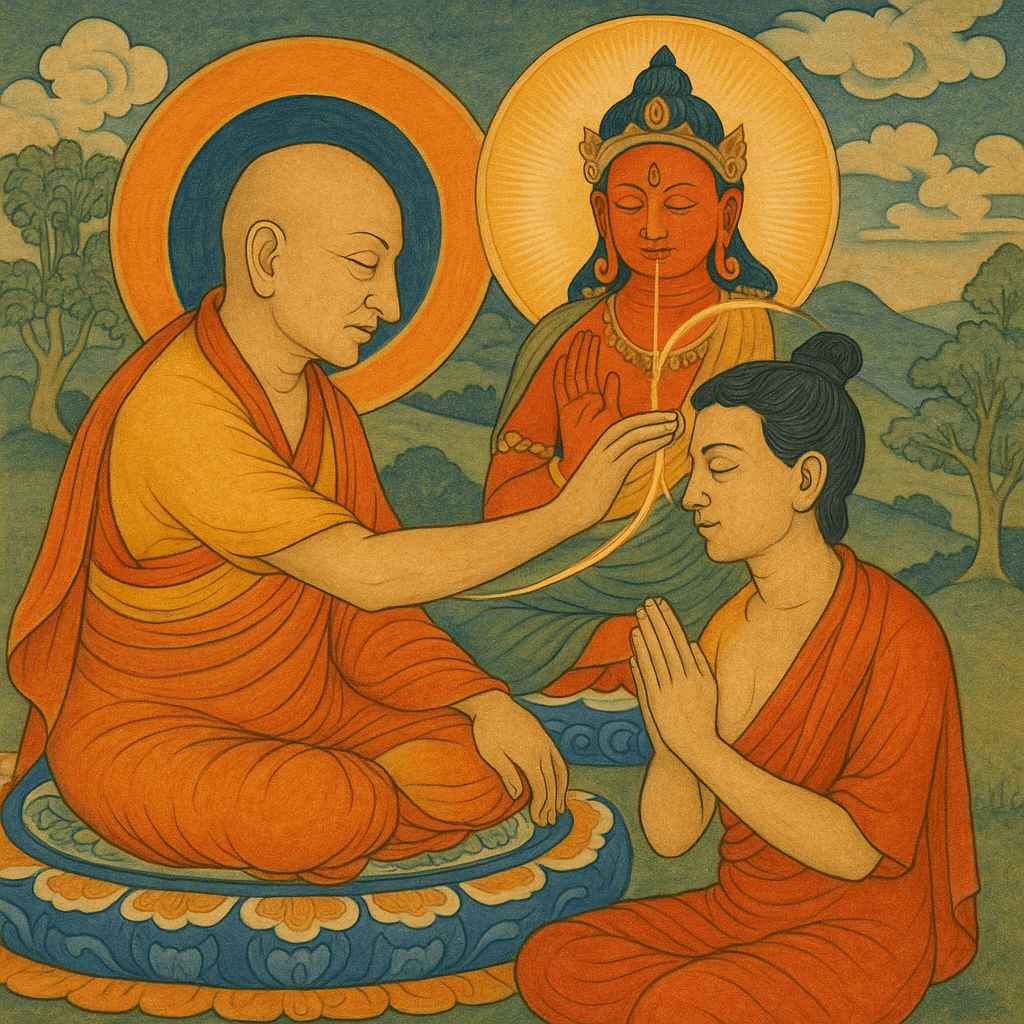
Tantric initiation (Vajrayana empowerment) is often described as a ritual that grants permission to engage in deity yoga and awaken one’s inner Buddha-nature. Yet traditional Tibetan sources suggest that something more mystical and intrusive is occurring, that the lama actually places the deity’s essence into the disciple’s mindstream. This critical detail, essentially the guru implanting or merging the deity (yidam) with the initiate’s mind, is conspicuously absent in most contemporary teachings.
This article examines classical tantras and commentaries to determine whether they explicitly describe the guru installing the deity in the disciple’s mind. It then compares that understanding with modern teachings, exposing a deliberate omission that raises serious questions about transparency in Vajrayana transmission.
Traditional Teachings on Tantric Empowerment
In Vajrayana Buddhism, empowerment (Tib. wang, Skt. abhisheka) is essential. “In the Secret Mantra Vehicle, there can be no accomplishment without empowerment.”¹ Classical definitions stress that this is not merely symbolic but a ritual that transforms the disciple’s mindstream.
According to the Rigpa Wiki, empowerment “awakens the special capacity for primordial wisdom to arise in the mind of the disciple.”² The Dalai Lama’s teachings on the Kalachakra Tantra state the guru “ripens the disciple’s psycho-physical continuum with the initiations.”³ Traditional analogies liken this to planting a seed that, with the right conditions, will grow into Buddhahood. This “seed” is not just metaphorical but is a spiritual presence that enters the disciple.
Tantric texts and commentaries describe empowerment as a mystical transmission wherein the wisdom deity (jnanasattva) is invited to enter the samaya deity (samayasattva), the visualized form of the disciple. Sam van Schaik summarizes: “in empowerment… the wisdom being becomes embodied in the samaya being.”⁴ The two minds are joined.
Instructions for such ceremonies explain that the lama generates themselves as the deity and transmits that awakened essence into the disciple through vase water, mantras, and gestures. The disciple visualizes the deity dissolving into themselves, signifying that the deity’s mind is being placed within them. Lineage sources stress that the lama must already hold the deity’s realization in order to transmit it. As one commentary puts it: “You have to hold something in you before you can give it.”⁵
In short, classical sources affirm that empowerment involves the lama implanting the deity’s essence into the disciple. Without this, Vajrayana texts say, real accomplishment is impossible, “like trying to press oil from sand.”
Does the Lama Literally Install a Deity?
While ancient texts may not use the modern phrase “implant the deity,” their intent is clear. An authoritative Kagyu explanation says the lama “places a recipient in connection with a particular Tantric deity,” enabling a “merging of essences.” This “connection” implies not just a symbolic affiliation but a mystical joining.
The empowerment ritual is the cause that activates and personifies the disciple’s Buddha-nature as a specific deity. This is not something the student can do alone; it requires the guru’s intervention. In Highest Yoga Tantra, multiple initiations (vase, secret, wisdom, word) facilitate this process in stages. During empowerment, the disciple imagines themselves as the deity (samaya being) and invites the wisdom deity to enter. When the two merge, the disciple becomes “in union” with the deity.
Some texts describe this as light or energy entering the disciple symbolizing the deity’s mind entering their heart. The Indian master Vilāsavajra described the climax of empowerment as a point when “wisdom and samaya come together.”⁶ The disciple leaves not just authorized but changed, carrying the seed of the deity from that point forward.
Jamgön Kongtrul writes that empowerment “introduces the disciple into the deity’s mandala” and allows the deity’s form and wisdom to “take root.”⁷ A Nyingma commentary states the guru, visualized as the deity, dissolves into the disciple, granting the blessing of the deity’s mind. Even the phrase “blessings enter the disciple’s stream” implies the transfer of a conscious presence.
In effect, tantric empowerment functions like a spiritual implantation, or even possession, in which the enlightened mind of the deity is placed into the disciple. The initiate now carries the deity within them, not merely as a concept but a living presence.
Modern Teachings: Omission or Adaptation?
If this is the traditional view, why don’t modern teachers say so? Contemporary teachings, especially those aimed at Western or general audiences, consistently describe empowerment in vague terms: permission, inspiration, activation of inner potential. The mystical detail of the lama implanting the deity is nearly always omitted.
In a transcribed teaching from a famous lama, now deceased (see below), empowerment is described as a prerequisite for deity meditation: the disciple receives empowerment, then instructions, and cultivates their body as the deity’s form. No mention is made of the lama placing anything into the disciple. It reads more like ceremonial enrollment than spiritual fusion.
This pattern is widespread: contemporary teachers often emphasize psychological language such as inner transformation, personal growth, and discovering potential, while minimizing the traditional notion of external metaphysical transmission. For instance, the Rubin Museum describes empowerment as a “ritual to introduce us to our own innermost Buddha qualities,”⁸ rather than as the reception of a deity from the lama. Such a framing casts the guru as a guide rather than a spiritual agent. However, this reinterpretation flattens the ritual’s ontological depth and misrepresents the original esoteric function of empowerment.
Even phrases like “placing the disciple in connection with the deity” or “ripening the mindstream” are left undefined. Many Vajrayana students, unless they study technical commentaries, may never realize that the tradition sees empowerment as a supernatural event. The omission is so consistent that one might suspect it’s intentional, perhaps to avoid alarming newcomers with the idea of having a foreign spirit installed in their mind.
Secrecy and Obfuscation in Vajrayana
To understand this omission, we must examine the role of secrecy. Vajrayana has always been esoteric. Revealing inner teachings to the uninitiated is a root downfall. As such, teachers often avoid revealing too much, especially in public settings.
Defenders of this approach argue that it’s compassionate: premature disclosure can cause misunderstanding or fear. Teachings are “graduated” and deeper layers revealed as the student progresses. In this view, the omission is considered skillful, not deceptive.
Yet critics argue that this secrecy amounts to intentional obfuscation in the modern information age. Newcomers are told that Vajrayana is about archetypes and psychological growth; this is appealing, secular-friendly language. Only later do they learn that the practice involves guru-bestowed metaphysical empowerment and deity implantation.
Few Vajrayana centers provide an upfront disclosure like: “In this empowerment, you will vow lifelong devotion and we believe that the deity’s mind will enter into yours.” Without this, informed consent becomes impossible. What if the student has been raised Christian and bound by the First Commandment: “You shall not have strange gods before Me”⁹? Would they agree to deity possession if fully informed?
The disconnect between outer presentation and inner doctrine has led some former practitioners to label the tradition dishonest. Years may pass before students learn that guru-deity fusion/possession are standard parts of the system. At that point, it may be too late as they’ve taken vows, invested emotionally, and become spiritually entangled.
Some defenders argue that Vajrayana’s opacity is necessary, that it was never meant for everyone. But in modern multi-cultural societies, this clandestine approach resembles a bait-and-switch. Students sign up for meditation, not spiritual merging with an imported god. They deserve to know what they’re consenting to.
Restoring Honesty in Transmission
Is omitting the “deity implantation” deceptive? From an academic standpoint, the answer is yes: there is a clear disconnect between traditional texts and public presentation. The idea that the guru installs a deity in the disciple’s mindstream is a core teaching, not a fringe view.
Yet most public talks and introductory texts never say this plainly. The true nature of the ritual, guru/deity fusion with the recipient, is hidden behind euphemism. This may prevent questions, but it is morally dishonest.
Vajrayana dharma centers must move toward transparency. Honesty about what is really occurring would both honor the teaching and protect the student. That this is seldom done nowadays is deeply disturbing.
In a predominantly Christian culture, where devotion to other gods violates divine commandments, the omission is not just deceptive, it’s a spiritual breach of consent. Prospective practitioners deserve to know what is happening before the ritual occurs, not after.
The tradition holds that through the guru’s blessing, one’s mind becomes inseparable from the deity. Then let us insist that teachers explain that clearly, before it is too late for the recipient to turn back.
Sources:
Traditional Vajrayana saying; cited in various commentarial teachings on abhisheka.
His Holiness the 14th Dalai Lama, Kalachakra Initiation Teachings.
Sam van Schaik, “The Limits of Transgression: The Samaya Vows of Mahāyoga” (2010).
Ngawang Phuntsok, On Receiving Wang (Empowerment).
Vilāsavajra, commentary on tantric vows; source referenced in academic discussion on Mahāyoga.
Jamgön Kongtrul, The Treasury of Knowledge, Book Eight, Part Three: The Elements of Tantric Practice.
Scott Globus, “Empowerments: Awakening the Buddha Within,” Rubin Museum, 2021.
Exodus 20:3, The Holy Bible.
Kalu Rinpoche – Teachings on Karmamudra and Mahamudra–California, Los Angeles, December 21, 1988
Transcript:
The gentleman is asking whether there is any connection between the traditional Buddhist approach to tantric practice and various sexual yogas—whether these practices have any bearing on the traditional path or whether that’s a misconception.
Yes, there is a connection. Previously, I spoke of the four major classes of tantra: Kriya Tantra, Charya Tantra, Yoga Tantra, and the fourth, Anuttara Yoga Tantra, or the Tantra of Unsurpassable Union. This fourth category is divided into Father Tantra, Mother Tantra, and Non-dual Tantra.
Principally in the classes of Mother and Non-dual Tantra, there are techniques involving sexual union as a basis for spiritual practice, technically termed karma mudra. These practices form part of a broader cycle known as the teachings on the Four Mudras. These teachings, as taught by the Buddha, are authentic and part of the tradition—the challenge lies in practicing them purely.
Traditionally, an individual would first undergo a long period of purification—purifying body, speech, and mind from harmful actions and obscurations, while cultivating positive qualities like merit and awareness. This is done through preliminary practices known as ngöndro.
Next, the individual would receive an authentic empowerment into one of the major tantric cycles from a qualified teacher. They would then receive extensive instruction in deity meditation and cultivate the experience of their own body as the deity’s form—experiencing the union of form and emptiness not as an idea, but as direct realization. Their speech would become the union of sound and emptiness, often practiced through extensive mantra recitation. They would also cultivate the awareness of mind as the union of intelligent clarity and emptiness, stabilizing it through meditative absorption.
Following this, the person would practice tummo or inner heat. This practice is done in stages and begins with the generation of inner warmth at the navel. As the warmth spreads, energy from the crown of the head flows downward. Through mastery of this flow, the practitioner experiences a profound bliss that pervades the mind-body complex.
Advanced stages involve focusing energy through the chakras. When energy is drawn to the throat, joy arises. At the heart, sublime joy. At the navel, special joy. And when energy is drawn down and contained within the genital chakra, co-emergent joy. Karma mudra practice requires the ability to hold this energy without losing it through orgasm. This leads to a nondual, non-conceptual state of awareness.
Eventually, the practitioner reverses the flow of energy upward through the chakras. Mastery over lowering and raising energy is required before karma mudra practice can be properly undertaken. With that mastery, energy is consciously directed through the 72,000 subtle channels (nadis) in the body. The ultimate aim is not sexual pleasure, but realization of Mahamudra.
Examples of individuals who attained enlightenment through such practices include the Indian king Indrabhuti, who is said to have relied on 1,000 consorts over six years. Tibetan lay practitioners like Marpa the Translator—who had eight consorts—are also examples. These paths exist, but must be practiced with purity and commitment.
Misunderstanding these practices—believing tantra is simply about sex—is a serious mistake. One of the 14 root downfalls in Vajrayana practice involves this misunderstanding, particularly the indulgence in orgasm, which is seen as a loss of energy that could otherwise be harnessed for enlightenment.
Another audience question asked about how long to leave a corpse undisturbed after death. In Tibetan tradition, the consciousness remains associated with the body for about 3.5 days. During this time, the body should ideally not be touched. A practitioner of phowa (transference of consciousness) is then called to assist the consciousness in departing skillfully.
After that, the body may be disposed of through burial, water burial, or cremation—accompanied by ritual and chanting to aid the consciousness. These practices can still be valuable even in cultures where such methods are not common, and ideally a phowa practitioner should be contacted if possible.
Another question asked whether one can attain liberation in a single lifetime through tantra. The answer is yes—realization of Buddhahood is possible. However, the physical manifestations may differ from those of a SambhogakayaBuddha, who displays specific physical marks of perfection. Still, the inner realization can be the same.
To discern an authentic teacher, look for someone with an unbroken lineage, proper transmission, sincere motivation, and correct understanding. Avoid teachers who have been disowned by their own lineage, or who act out of selfish motives. Examine their character, conduct, and consistency with traditional teachings.
In closing, the speaker encourages all listeners to study, practice, and seek qualified teachers. The merit of the teaching session is dedicated to the awakening of all sentient beings from ignorance, and the spreading of primordial awareness so that all beings may eventually attain Buddhahood.
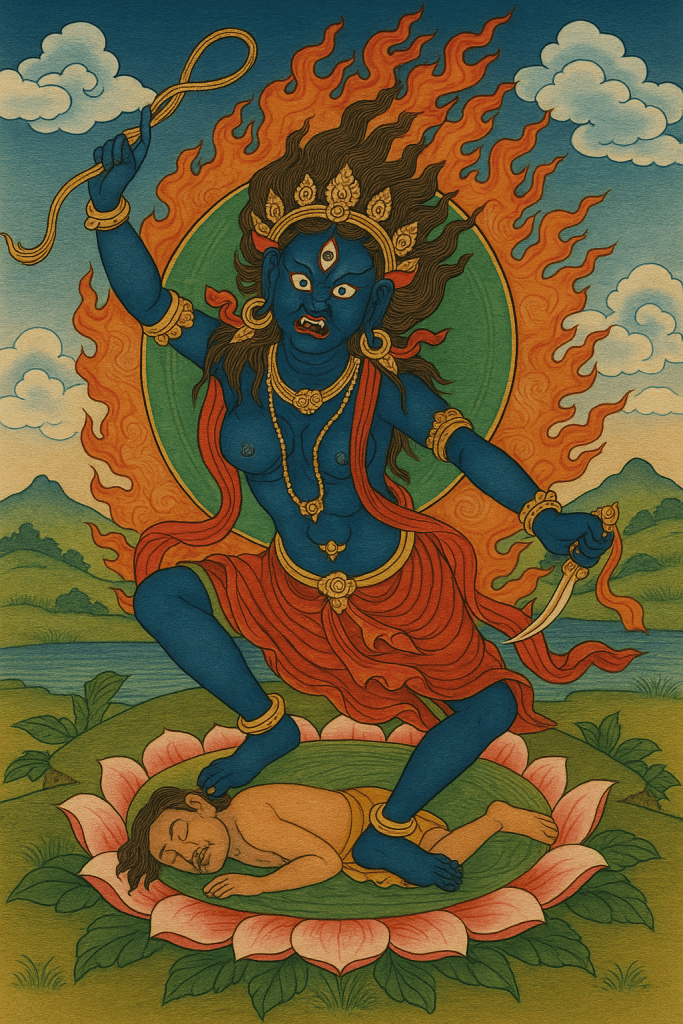
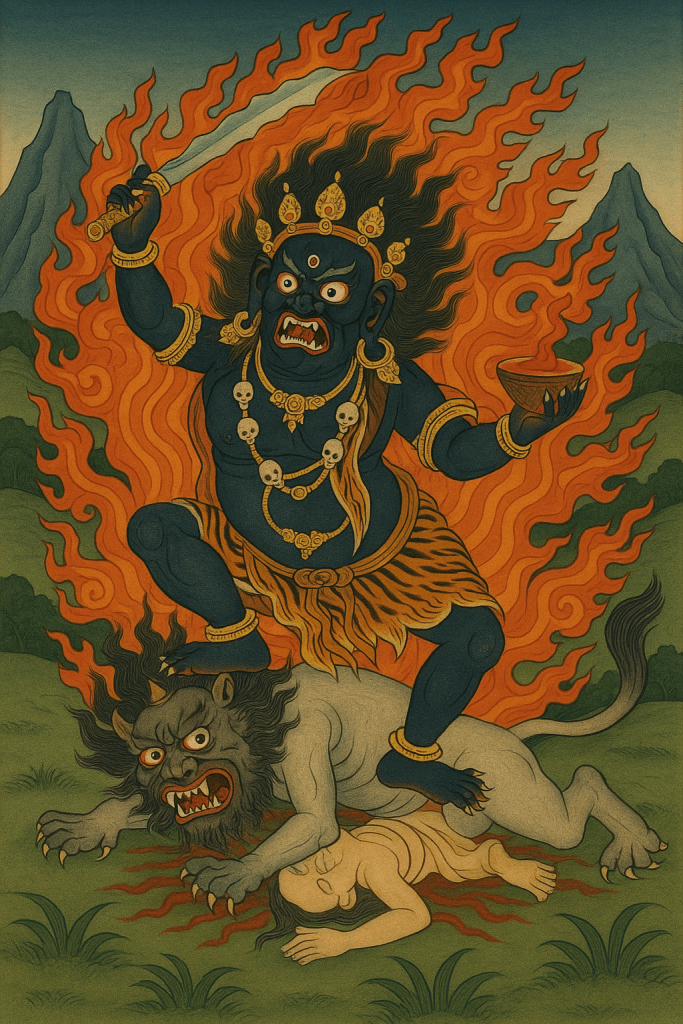
In this thangka-style painting, a wrathful tantric deity, likely Mahākāla, stands triumphant, engulfed in flames of spiritual power. He tramples a beast-like demon beneath his feet, which in turn crushes a human figure below. Far from mere symbolism, this hierarchy reveals a grim reality embedded in Tibetan tantric worldview: a cosmology where demons are organized in ranks, with wrathful deities occupying the highest tiers. These so-called “protector” spirits are themselves demonic in nature. They are powerful but subjugated through ritual, and are commanded by the guru to unleash violence against enemies of the dharma. The animal-like demon represents a lower-order spirit, weaponized by the deity. The crushed human symbolizes an actual person, someone the practitioner or lama has deemed a threat. The image is not just metaphor: it is a magical contract of domination.
Buddhists sometimes invoke ferocious protector deities like Mahākāla or Vajrakīlaya in rituals charged with violent imagery. In Tibetan history, such wrathful practices were often presented as spiritual rites to subdue obstacles, but evidence shows they could target actual enemies. For example, medieval Tibetan lamas served in warfare and politics: Lama Zhang (12th C. Kagyu) “engaged in political and military affairs” and even sent students into battle (War Magic: Tibetan Sorcery | Rubin Museum), using tantric rituals and deities (like Vajravārāhī and Mahākāla) to subjugate foes. Under the Mongol Yuan, Tibetan Buddhist “magical warfare” became statecraft: Tsami Lotsāwa, a Tangut court chaplain, authored texts like “The Usurpation of Government,” a how-to on overthrowing rulers invoking Mahākāla against armies. When Genghis Khan’s siege faltered in 1210, Tibetan sources credit Mahākāla summoned by Tsami (War Magic: Tibetan Sorcery | Rubin Museum) with bursting the Mongol siege dams and routing the attackers. The Mongols then adopted Mahākāla as their state protector. Likewise, Tibetan figures like the 8th Karmapa Karma Pakshi reportedly requested Mahākāla to exact revenge on his Chinese captors; lore even says Mahākāla “struck” the imperial palace (calling upon Mahakala…. | Ganachakra). Even the Nyingma saint Rwa Lotsāwa Dorje Drag (11th–12th C.) is celebrated in tradition for having “killed/murdered thirteen lamas” allegedly via Vajrabhairava rituals (Teacher: Rwa Lotsawa Dorje Drag). These and other incidents show tantric masters of Nyingma and Kagyu lineages historically appealed to protectors and demons in worldly struggles, not just inner battles.
Historical examples of tantric “war magic” include:
Sectarian conflicts: Rival Buddhist factions sometimes accused each other of violent tantra. (For example, later Gelugpa–Nyingma disputes mention rituals aimed at sectarian “enemies.”) In legend, a Kagyu master used Mahākāla to punish “impure” Gelugpas, and Dorje Shugden cult lore alleges victims of protector curses. (Such sectarian claims persist, though here we focus on pre-modern precedents.)
Regional skirmishes: Kagyu and Nyingma yogins were known as healers and sorcerers. One Kagyu lama reportedly used protective rites to strike fear into rebels. Vajrabhairava, a wrathful Nyingma deity, was famously employed by Rwa Lotsāwa in ritual assassinations (one story credits him with killing Marpa Lotsāwa’s son, Dharma Dode) (Himalayan Art: News).
These accounts contradict the comforting piety that “the only enemies are our defilements.” Instead, Tibetan sources show tantric deities being literally invoked against human foes and armies. Even art and prayers reinforce this: Palden Lhamo, the Dalai Lamas’ protector, is often depicted brandishing a sword and holding a skull bowl “brimming with the blood of vanquished enemies” (Palden Lhamo: Supreme Guardian Goddess of the Dalai Lamas – Tibetan Buddhist Encyclopedia). Such imagery underscores that the deity’s “compassion” is militarized.
Violent Imagery in Ritual Texts
The ritual texts themselves are unapologetically graphic. For example, a common Vajrakīlaya (Krodha Phurba) sādhanā (prayer) reads like a battle spell. One verse proclaims that Vajrakīlaya wields weapons “with which even the whole great mountain Sumeru is crushed to dust,” and that he “grinds to atoms the nine Gong-po brothers of phenomenal existence” (Cult of the Deity Vajrakila). In context, the “Gong-po brothers” symbolize fundamental enemies or obstacles (often conceptualized as Mara’s forces or the mind’s afflictions), but the language is literal and violent.
Texts on Mahākāla and Vajrabhairava likewise list long menus of violent exploits, trampling demons, cannibalizing spirits, or annihilating armies. In many kīlaya and bairaṇa (wrathful) rituals, the practitioner is explicitly instructed to cast forms or effigies of enemies into a bonfire or entangle them with magical ropes (Cult of the Deity Vajrakila) (The Rhetoric of Violence in the Buddhist Tantras). These are not purely abstract symbols but are described as actively destroying whoever or whatever they represent.
Indeed, scholar David Gray notes that Buddhist tantras use two kinds of violent rhetoric: grandiose, hyperbolic imagery to glorify the deity and impress the initiate, and actual ritual prescriptions for “violent ritual practices” (The Rhetoric of Violence in the Buddhist Tantras). While the former may seem merely figurative, Gray observes that even “symbolic” rituals often aim to harm the person symbolized (for example, burning an effigy of an enemy) (The Rhetoric of Violence in the Buddhist Tantras). Many tantra texts then justify these acts as transcending ordinary ethics: invoking a state of “non-dual gnosis” to excuse what would otherwise be murder (The Rhetoric of Violence in the Buddhist Tantras). In short, tantric sādhanās straddle symbolism and reality: they metaphorically crush delusions, but describe that metaphor in ultra-realistic, brutal terms accompanied by magical spells intended to harm human beings.
Empowered Lamas and “Transgressive” Rituals
Why this double talk? Tibetan lineages insist that only the most accomplished yogins (mahasiddhas) may perform such rites, precisely because they are “transgressive” and dangerous. The idea is that a realized master, having already tamed anger within, can safely wield wrath outside. As one modern analysis notes, advanced tantric practitioners are allowed “to invert Buddhist moral injunctions,” because rites aimed at killing are taught only to those senior enough to hold them (Buddhist Pacifists at War – JSTOR Daily). In practice, this meant kings, high lamas or court chaplains, not ordinary monks, performed these rituals.
Yet even senior masters often downplay the literal meaning today. Contemporary teachers frequently claim that prayers to “destroy enemies” really target the five poisons or ego-clinging, not people. (For instance, some explain Palden Lhamo’s blood bowl as symbolic of afflictions conquered.) Such interpretations align with inner-journey aspects of Vajrayāna. But history and ritual texts offer a different picture: these deities were invoked as warrior gods. Indeed, modern scholars argue that Buddhist tantra developed war-magic precisely because societies faced real threats. As Iain Sinclair puts it, defensive magic in early tantras was “pacifist in nature” but “destructive war magic also developed.” (Buddhist Pacifists at War – JSTOR Daily) Tantric manuals taught spells to freeze enemy armies with blizzards, sicken them with disease, or even consume them invisibly (Buddhist Pacifists at War – JSTOR Daily) ((PDF) War Magic: Religion, Sorcery, and Performance). One text in the Kālacakra cycle even provides a just-war framework, allowing only defensive conflict, infused with inner virtue, but this too presumes actual armed struggle (Buddhist Pacifists at War – JSTOR Daily).
This tension has sparked scholarly debate. Bryan Cuevas notes tantra’s fusion of “the internal and external worlds,” with protectors serving both spiritual and mundane power (War Magic: Tibetan Sorcery | Rubin Museum). Gray emphasizes that, despite rhetoric, tantrics did prescribe lethal rituals, legitimized by claims to higher awareness (The Rhetoric of Violence in the Buddhist Tantras).
Critical Perspective and Conclusions
In light of this evidence, the standard assurance that wrathful protector practices are only symbolic ring hollow. Certainly, Vajrayāna doctrine can spiritualize violence, positing that a bodhisattva’s anger is “pure compassion.” But when lamas claim “I’m just crushing my own ego,” the historical record shows they were also legitimizing political or personal power plays. At the very least, the literalist language of the liturgies warrants skepticism. A practitioner chanting “grind my enemies into dust” is arguably invoking cosmic butchery, not just inner peace.
For modern readers, this does not necessarily indict all Vajrayāna practice for many make upstanding vows and use wrathful deities for healing or psychological aid. However, it does mean we should be wary of uncritical glosses. As Gray warns, tantra’s “ethical double standard,” appealing to transcendent insight to excuse violence, has been used to justify harmful actions even in contemporary settings (The Rhetoric of Violence in the Buddhist Tantras).
For those intrigued or unsettled by these findings, scholars continue to examine how Tibetan Buddhism navigates the gulf between its nonviolent ideals and its martial heritage. Controversies within the tradition and in academic circles reflect this struggle. What is certain is that any romantic notion of pacifist Buddhism must contend with the very real phenomenon of tantric war magic and the subjugation rituals conducted against human beings.
Further Reading: For critical scholarship on these issues, see Iain Sinclair’s “War Magic and Just War in Indian Tantric Buddhism” (Buddhist Pacifists at War – JSTOR Daily) (Buddhist Pacifists at War – JSTOR Daily) and Bryan Cuevas, “The Wizarding World of Tibetan Sorcery” (in Faith and Empire, esp. ch.5) (War Magic: Tibetan Sorcery | Rubin Museum) (War Magic: Tibetan Sorcery | Rubin Museum). David B. Gray’s article “The Rhetoric of Violence in the Buddhist Tantras” (2018) explicitly examines tantric prescriptions of violence (The Rhetoric of Violence in the Buddhist Tantras). Solomon FitzHerbert’s study of 17th-c. Tibetan “ritual propaganda” is also enlightening. (Online references: Rubin Museum’s “War Magic” exhibition, Himalayan Art archives, and academic discussions by Sinclair and Gray are excellent starting points.)




 Tantric Deception