For years, I followed the path of Tibetan Buddhism and tantric practice. I studied its rituals, visualizations, deities, and especially its central concept of “non-dual realization,” considered the highest goal in Mahayana and Vajrayana philosophy.[1]
I chanted the mantras, invoked the buddhas, bodhisattvas and dakinis, and merged myself with yidams, believing I was on the path to ultimate truth or enlightenment.
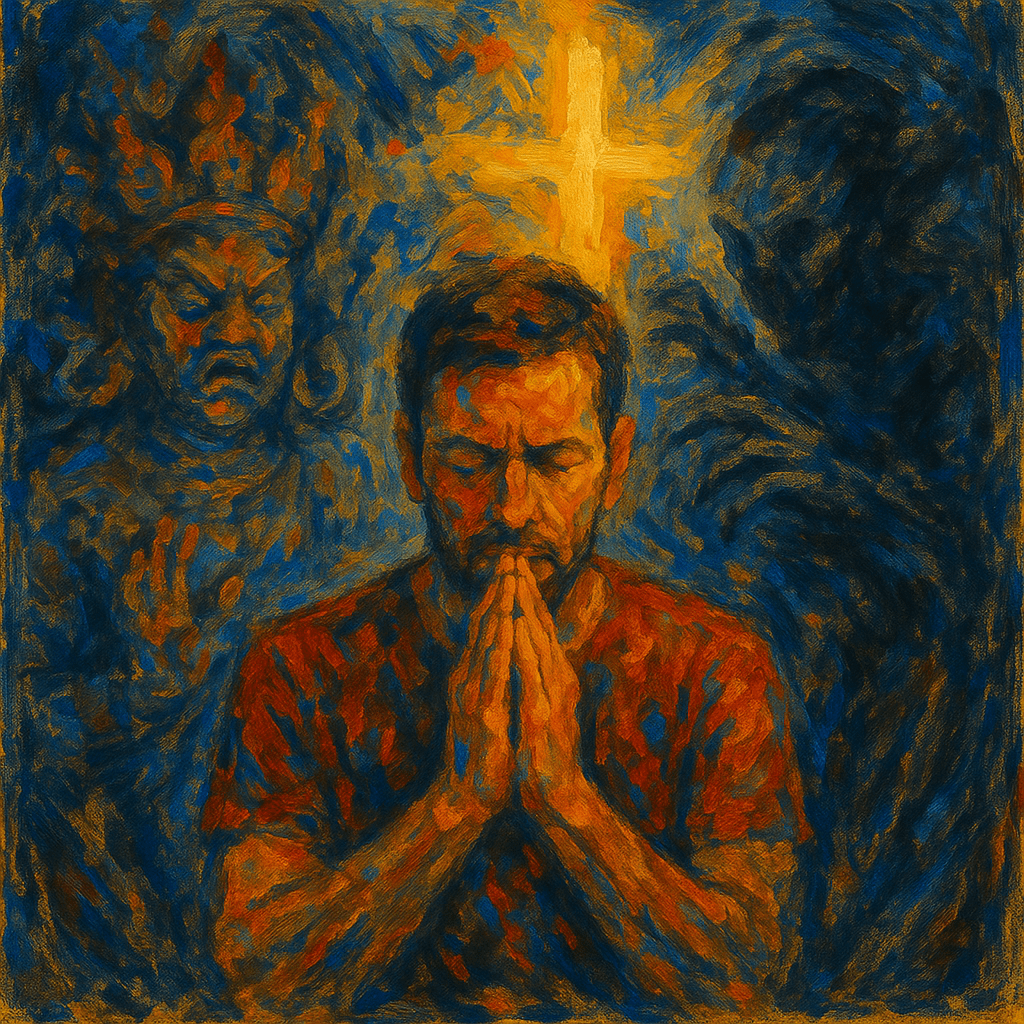
But the truth I’ve realized now is very different. It was only after leaving the system and encountering Christ again that I saw what I had actually opened myself up to. What was presented to me as wisdom was, in reality, a surrender of my soul to dark powers wearing radiant masks.
What Is “Non-Dual Realization”?
In Mahayana and Vajrayana Buddhism, “non-dual realization” is taught as the highest goal. It means transcending the conceptual distinctions of self vs. other, good vs. evil, sacred vs. profane, based on the belief that these opposites are mental constructs and ultimately empty. It means realizing that everything is empty of inherent existence, that distinctions are illusions, and that even the self is not truly existent.
In Tibetan Buddhist tantric practice, this realization is pursued through deity yoga: one visualizes an external deity like a dakini, peaceful bodhisattva, or wrathful buddha, visualizes oneself as the deity, merges with the external form, and dissolves the sense of a separate self into that visualization. The goal is to transcend the sense of individual self and merge into what is presented as enlightened awareness.
This sounds beautiful on the surface. But what is actually happening behind the scenes?
Possession Disguised as Enlightenment
From a Christian perspective, this practice can lead to spiritual possession.
The moment you invite a being to take over your mind, body, or spirit, especially one that does not proclaim Jesus Christ as Lord (1 John 4:1-3), you are offering your soul to a power that is not of God.
Tantric practices train you to dissolve your boundaries. They break down your identity and present a being who is radiant, powerful, and loving, and invite you to unite with it.
In reality, this is surrender to a counterfeit. It is a deceptively woven net, spiritually binding, and ruthlessly enforced.
The Dakini’s Magical Net: A Trap, Not a Blessing
In Tibetan Buddhism, dakinis are presented as enlightened feminine energies, guides to wisdom, and protectors of the dharma. But now, I see clearly that the “net” of the dakinis isn’t a web of wisdom, but a spiritual snare.
These magical nets are said to catch the mind stream of those who violate tantric vows. They bind, dismantle, and destroy the consciousness of the practitioner who steps out of line. That is not divine justice but spiritual murder. It is demonic.
The Hidden Power Structure Behind Vajrayana
It’s important to add a caveat here: Tibetan Buddhists often shield themselves from criticism by appealing to the ethical and philosophical framework of early Buddhism, the so-called first and second turnings of the wheel. They claim that Vajrayana is inseparably bound to the moral and philosophical teachings of Hinayana and Mahayana.
However, in practice, it is the tantric laws that prevail. When push comes to shove, tantric expediency overrides all. What you get is a kind of spiritual gangsterism, a mafia-like code of silence, loyalty, and fear, all cloaked in the sanctity of Buddhist language and lineage.
But this never felt right to me. True love does not coerce and true wisdom does not enslave. The Holy Spirit convicts, but He never violates the soul’s freedom.
The Blood of Jesus Dissolves Every Net
The day I returned to Jesus Christ, after being spiritually attacked and nearly destroyed by the tantric Buddhist forces I once invoked, I renounced all former vows, empowerments, and deities. I asked God to set me free from every magical net and every spiritual power that claimed me. So many years before, after I had left the Catholic Church, I had gone through a long period of agnosticism before I took refuge in Tibetan Buddhism. I didn’t know if God existed or not. This left me open to deception by occult systems such as Tibetan Buddhism.
What I found in trying to break free from tantric occultism is that God is real and the blood of Jesus Christ is stronger than any tantric empowerment. It dissolves all bindings and shatters and severs every demonic contract.
We Are Not an Illusion
We are not empty. We are not reducible to pure awareness or dismissed as illusion. On the contrary, our existence is real, grounded, and full of meaning.
We are persons, created in the image of God (Genesis 1:27), with eternal souls, essential wills, and a purpose that cannot be replaced.
Jesus did not ask us to dissolve into Him. He calls us to relationship, not dissolution and especially not annihilation. He redeems, restores, and makes whole. In Christ, our identity is not erased but fulfilled. If you’ve been entangled in the deceptive beauty of tantric non-duality doublespeak, know this: it is not too late; there is a way out.
[1] Note on “Non-Dual Realization” in Tibetan Buddhism: In Mahayana and Vajrayana Buddhism, particularly within Madhyamaka philosophy and the Mahamudra tradition of the Karma Kagyu lineage, “non-dual realization” refers to the direct experiential understanding that all phenomena, including the perceiving mind and external objects, are empty of inherent existence. This does not mean merging into a single cosmic entity, but rather realizing that the distinction between subject and object is conceptually constructed and ultimately illusory. In Mahamudra practice, this is described as the union of clarity (luminosity) and emptiness, a non-conceptual awareness that is self-liberated and ungraspable. The practitioner seeks to transcend dualistic fixation and abide in the natural state of mind, free from elaboration. However, while this view is upheld within the tradition as a path to enlightenment, my experience revealed it as a spiritual vulnerability. Furthermore, the process of dissolving self-boundaries and engaging in deity identification opened the door to oppressive spiritual influences disguised as wisdom. What is framed as “non-dual realization” can, in practice, become the annihilation of personal agency and discernment and leave one open to possession by demonic entities.
In the ancient catacombs beneath Rome, the bones of countless Christian martyrs still rest. Their blood once soaked the soil of the Eternal City, spilled in arenas and burned at stakes. These early saints stood firm as the empire raged against them, refusing to bow before the gods of Olympus. Their sacrifice helped dismantle an entire pantheon, culminating in the 4th century with the conversion of Emperor Constantine and the eventual abolition of state-sponsored paganism.
This was no mere political shift; it was a metaphysical war. The temples of Mercury, Dionysus, and Asclepius were shuttered or repurposed. The rites of Isis, Mithras, and the Eleusinian mysteries faded into obscurity. The cross had conquered the caduceus.
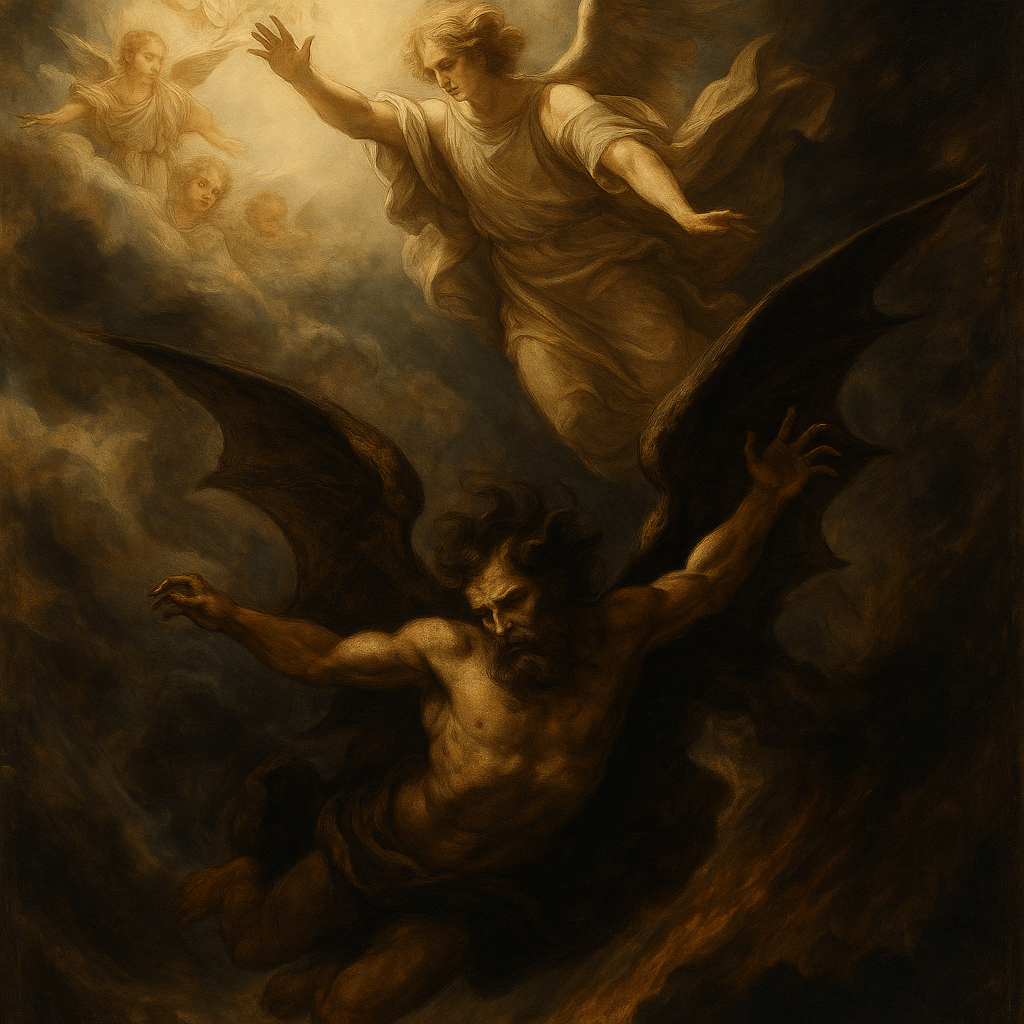
But pagan gods, the fallen angels never truly die. They reinvent themselves. And sometimes, they reappear in new lands wearing different clothes.
The Echoes of Hermes in the Serpent of Shakti
After Constantine, as Christian Rome rose from the ashes of the pagan world, something remarkable was stirring across the continent in India. By the 5th century, the traditions of Tantra and Kundalini had begun to take shape. Where Rome had cast down the serpent as a symbol of Satan, Indian mysticism raised it up as the dormant energy of the Divine Feminine, Kundalini.
Can we trace a spiritual current from Hermes to Shiva, from the Greek mysteries to the yogic inner fire? This is speculative, but consider the astonishing parallels:
Theme
Greco-Roman (Hermes, Asclepius)
Indian Tantra/Kundalini
Serpents
Symbol of wisdom, healing, duality
Coiled energy, Shakti
Staff or Axis
Caduceus (Hermes), two snakes coiled around a staff
Sushumna nadi (central energy channel flanked by solar and lunar channels)
Healing
Asclepius, god of medicine
Kundalini as transformative healing energy
Divine Union
Hieros gamos, Dionysian ecstasy, inner union of male and female energies
Shiva–Shakti union
Body as microcosm of the universe
Mystery religions, alchemy
Tantric yoga, body as vehicle to moksha (liberation)
If we imagine the fall of Greco-Roman religion not as a disappearance but as a transmutation, we might say:
The energy of Hermes migrated eastward, shedding its Western garb and reappearing as Shiva, serpent-lord and cosmic dancer, custodian of the inner path.
A Vision in the Night
Early this morning, something powerful happened to me. I woke up at around 2:30 or 3:00 a.m. and engaged in deep Catholic prayer. Afterwards, I drifted back into sleep and experienced a vivid spiritual battle.
I saw the Caduceus and felt the presence of a dark force, perhaps a demon. Then I sensed small demons leaving as if they shot out of my mouth on puffs of air, accompanied by groaning, crying, even the sound of gunshots, as though a war was raging inside my soul. At the end of the vision, one man remained below, pointing a gun upward. I watched from a higher vantage point. Who was he? The man, I believe, was Satan.
He was not dead and he was poised to keep fighting.
I woke up. What I experienced wasn’t just a dream. It felt like an echo of that ancient struggle in Rome, replayed within the temple of my own body. The Christian martyrs cast down idols with their blood. We, too, must cast down what is false within us at whatever cost; we must uproot and cast out the inner serpent that slithered in during years of practicing the occult.
Rome uprooted the pagan gods and repurposed their shrines into Catholic cathedrals. Sadly, the pagan entities they represented were not destroyed. Perhaps they merely migrated east, into the rituals of Tantra, the breath of yogis, and the rising coil of kundalini.
In today’s spiritual landscape, a troubling trend is emerging: well-meaning Christians are being led to believe that Tibetan Buddhism is not only compatible with Christianity but can even enhance it. This deception, often subtle and clothed in the language of “contemplation” or “interfaith dialogue,” has found its way into Catholic monasteries and retreat centers. At the heart of this distortion is the adoption of Eastern meditative techniques, often inspired by Tibetan Buddhist practices, and the uncritical embrace of yoga as a “neutral” spiritual discipline.
To be clear: Tibetan Buddhism is not a Christian cousin. It is a profoundly different worldview, rooted in concepts like reincarnation, karma, and the ultimate dissolution of the self, doctrines wholly incompatible with Christianity’s vision of a personal, relational God and the eternal dignity of the soul.
Meditation or Manipulation?
The Christian tradition has long held a deep respect for silence, prayer, and contemplation, especially in the monastic practices of the Desert Fathers or the Hesychast tradition of Eastern Orthodoxy. But what is often marketed today as “meditation” bears little resemblance to Christian prayer. Tibetan Buddhism aims at the realization that the self and all phenomena are empty of inherent existence, a direct experience of emptiness (śūnyatā) and the luminous, non-dual nature of awareness.
This goal is diametrically opposed to Christian theology, which insists on the uniqueness of each soul, created in the image of God and destined for eternal communion with Him.
Yet Christian leaders and institutions have increasingly opened the door to these teachings. For example, the late Father Thomas Keating, one of the leaders of the Centering Prayer movement, drew heavily on Eastern techniques, often blurring the line between Christian contemplation and Buddhist meditation. Though his intentions were no doubt sincere, the result was a confusing blend of incompatible truths.
Another case is Father Richard Rohr, a popular Franciscan whose teachings often echo non-dual philosophies far closer to Eastern mysticism than to historic Christianity. Rohr’s discussions of “Christ-consciousness” and the illusion of the separate self bear striking resemblance to Tibetan Buddhist views, yet they are consumed by many Catholics and Protestants as if they are orthodox.
The Yoga Trap
Yoga is another Trojan horse in the spiritual lives of many Christians. Despite its spiritual roots in Hindu and Buddhist traditions, yoga is often presented as a harmless or purely physical practice. In truth, yoga’s asanas (postures) were designed not for exercise, but as physical preparations for meditation and kundalini awakening, specifically, awakening to a worldview that denies the personal God revealed in Jesus Christ.
When Christians engage in yoga or Tibetan-inspired meditation without discernment, they open themselves up not just to foreign practices, but to foreign spirits. This is not religious paranoia but a spiritual reality. St. Paul warned the Corinthians about participating in pagan rituals, saying, “You cannot partake of the table of the Lord and the table of demons” (1 Corinthians 10:21).
The Deception of Compatibility
Tibetan Buddhist teachers are often happy to affirm Christian practices, so long as they are reinterpreted through a Buddhist lens. Some even encourage Christians to see Jesus as an “enlightened teacher” or “bodhisattva.” This allows the surface appearance of interfaith respect while subtly undermining core Christian claims: the Incarnation, the Resurrection, and the uniqueness of Christ as Savior.
This is not compatibility, but syncretism and it poses a spiritual danger.
A Call to Discernment
This is not to instill hostility or fear of Buddhism and other Eastern Religions. Nor is it a rejection of silence, stillness, and physical well-being. But Christians must recover the spiritual discipline of discernment. Not all that brings peace is from God. The Enemy is more than capable of offering counterfeit serenity, especially when it draws people away from the Cross and toward self-deification or belief in idols.
Christianity offers its own deep, mystical tradition rooted not in esoteric techniques or mantras, but in personal relationship with the living God. Prayer, asceticism, sacramental life, and union with Christ are more than sufficient for those seeking transformation. We do not need to import Tibetan concepts or yogic practices to find God. He is already here, knocking at the door.
The growing blend of Tibetan Buddhism and Christianity may feel harmonious on the surface, but this is illusory. At its core, the Gospel is not compatible with systems that deny Christ’s divinity, the soul’s eternal destiny, or the Triune God. As Christians, we must not be seduced by exotic forms of “spirituality” that utilize half-truths, and communion with fallen angels.
Leaving Tibetan Buddhism is not just a change of belief systems; it can be a deep spiritual battle. For those who’ve practiced tantra, divination, or deity yoga, you may have sensed that something was not right and that which was supposed to be “enlightened” came with confusion, heaviness, and spiritual oppression.
If you’re reading this, you may already be in the process of leaving Tibetan Buddhism or maybe you’re considering it.
Why People Leave Tibetan Buddhism
At first, Tibetan Buddhism can appear beautiful, complex, and pure. But over time, many practitioners begin to discern troubling spiritual dynamics:
Worship of wrathful deities and demons presented as “enlightened beings”
Tantric rituals and yoga cause physical and mental anxiety
Dependence on gurus, where questioning is not allowed but seen as a kind of spiritual betrayal
Dreams, sleep paralysis, or oppression that begin after initiations or sadhana practices
These are not mere coincidences. The Bible clearly warns against idolatry, necromancy, sorcery, and invoking spirits, practices central to Tibetan tantric systems (Deuteronomy 18:10–12, Galatians 5:19–21):
Deuteronomy 18:10–12 (NKJV)
“There shall not be found among you anyone who makes his son or his daughter pass through the fire, or one who practices witchcraft, or a soothsayer, or one who interprets omens, or a sorcerer, or one who conjures spells, or a medium, or a spiritist, or one who calls up the dead. For all who do these things are an abomination to the Lord, and because of these abominations the Lord your God drives them out from before you.”
Galatians 5:19–21 (NKJV)
“Now the works of the flesh are evident, which are: adultery, fornication, uncleanness, lewdness, idolatry, sorcery, hatred, contentions, jealousies, outbursts of wrath, selfish ambitions, dissensions, heresies, envy, murders, drunkenness, revelries, and the like; of which I tell you beforehand, just as I also told you in time past, that those who practice such things will not inherit the kingdom of God.”
Demonic Retaliation Is Real
When someone leaves these systems, there can be real spiritual backlash and former practitioners often experience:
Nightmares or visitations
Voices or intrusive thoughts
Emotional heaviness and fear
The spiritual world does not easily let go, but Jesus Christ has authority over it all (Luke 10:19), so know that you are not alone.
Step-by-Step: How to Leave Tibetan Buddhism
1. Acknowledge the Truth
Call it what it is. Confess to God that you participated in practices that He calls abomination. There is no shame in this. We were deceived. He already knows and is ready to forgive (1 John 1:9).
2. Renounce All Involvement
With your words backed by your will, say out loud:
“I renounce all involvement in Tibetan Buddhism, tantra, deity worship, and all practices that are not of the one true God. I reject every false spirit of divination and claim the blood of Jesus over my life.”
Destroy objects associated with your past practice: malas, thangkas, statues, books, empowerment trinkets. Do not give them away, but burn, break, or throw them out.
3. Receive Jesus Christ as Lord and Savior
Deliverance comes through a Person, not a ritual. Jesus is the only one who has authority to truly save and set free.
“Lord Jesus, I believe You died for my sins and rose again. I repent and turn to You. Come into my life, forgive me, cleanse me, and fill me with Your Holy Spirit. I make You Lord of my life.”
4. Seek Deliverance Prayer
Depending on your level of involvement, you may need help from mature believers to walk through deliverance. This isn’t superstition but real spiritual warfare. Find a priest and church that understands deliverance ministry.
5. Saturate Yourself in God’s Word and Worship
Replace mantras with Scripture. Replace deity visualizations with the truth of God’s love. This requires patience because it can be a slow process as you’re being spiritually rewired. Read Ephesians, Psalms, and the Gospels daily. If you are Catholic, make a formal confession to a priest. Go to Mass frequently and receive the sacraments. Take steps to convert or revert.
6. Expect Retaliation but Know That You’re Safe
Don’t be surprised if you experience spiritual attack. That’s confirmation you’re on the right path. Demons may try to reassert old ties, but they are already defeated in Christ. You now have authority to rebuke them (James 4:7, Mark 16:17):
James 4:7 (NKJV)
“Therefore submit to God. Resist the devil and he will flee from you.”
Mark 16:17 (NKJV)
“And these signs will follow those who believe: In My name they will cast out demons; they will speak with new tongues;”
Final Thoughts: This Is War, but You’re on the Winning Side
Leaving Tibetan Buddhism may feel like you’re walking away from decades of sincere spiritual seeking. But the reality is: you are walking into the truth, the light, and the freedom that only Jesus can give.
You are not betraying your path but escaping a spiritual system that masked bondage as enlightenment. Demonic deception is real, but the power of Jesus is greater.
He said, I am the way, the truth, and the life. No one comes to the Father except through me” (John 14:6).
You are loved and being called out of darkness. For more information about Deliverance from the Occult, visit www.catholicexorcism.org.
In the hidden corners of Vajrayana Buddhism lies a strand of practice that few dare to discuss openly: bairaṇa (Sanskrit: vairana) rituals. These are wrathful rites aimed at the destruction of enemies, both spiritual and human.
Often sanitized or dismissed as purely symbolic by modern interpreters, the historical and textual record suggests something more visceral, more deadly: these rituals were, and in some cases, still are, performed with the explicit intention to eliminate human beings. This underscores the urgent need for transparency in the study and transmission of Vajrayana practices, especially as many naive spiritual seekers are drawn to Tibetan Buddhism by its outward promise of peace, compassion, and enlightenment, often without awareness of its esoteric and potentially violent dimensions.
What Is a Bairaṇa Ritual?
The term bairaṇa appears in the tantric classification of the four karmas: four magical functions that a Vajrayana practitioner may perform:
Pacifying (śānti)
Enriching (puṣṭi or vaśya)
Subjugating (stambhana)
Destroying (bairaṇa)
The purpose of the fourth category, “subjugating,” is unambiguous: obliteration. Within Tibetan Buddhist traditions, especially in the rites of wrathful deities such as Vajrakīla, Yamantaka, and Mahākāla, bairaṇa rituals are used to eliminate:
Samaya breakers: Those who violate sacred tantric vows
Enemies: Individuals perceived to be actively working against the practitioner
Obstructive spirits: Demonic forces, ghosts, or elemental energies believed to cause illness, insanity, or misfortune
Political enemies: In historical contexts, entire state-level rituals were conducted against rival kings or invading armies
Ritual Actions: Effigy Creation and Destruction
Texts such as The Cult of the Deity Vajrakīla describe in detail the creation of effigies to represent obstructive forces. These are crafted using materials such as cloth taken from the target, filled with charnel substances, and inscribed with mantras.(1) The effigy is then subjected to violent ritual acts such as stabbing with ritual daggers (phurba), binding, burning, or drowning.
Example: Vajrakīla Tantras (summary from Boord, The Cult of the Deity Vajrakīla)
“Fashion a figure of the enemy from black wool… fill it with the five meats and five nectars. Tie it with red thread, place it beneath the kīla (ritual dagger). Stab it while reciting the mantra… Then, place it in the fire, imagining flames consuming the soul of the enemy.”
This is not metaphor. The rite involves constructing a magical double of the target and ritually executing it. The “enemy” may be a real, named person.
Fire Offerings and Mantra Recitation
Often, the effigy is placed in a consecrated fire pit and incinerated while wrathful mantras are recited, invoking deities to consume and destroy the obstacle.
Example: From the Dujum Namchok Putri Ritual
“To receive these five aggregates of the malefactors who are our hostile enemies and obstructing spirits (causing harm)! We now feed them into your (wide open) mouths; may you accept (these morsels and devour them)—Kharam Khahi!”
This passage metaphorically frames the act of feeding the enemy to wrathful deities, representing a kind of karmic annihilation. In tantric contexts, this has often been interpreted as a sanctioned form of ritual killing.
Another Example: From the Rituals of the Secret Assembly Tantra
“Bind the name and essence of the breaker of samaya into the effigy… May his limbs be broken, his breath cease, and his karmic stains be consumed in fire.”
How Were These Used Historically?
Scholars like Ronald Davidson and Martin Boord have documented numerous instances where wrathful rites were used to eliminate perceived threats, including human beings. These were not fringe practices. They were part of the institutionalized ritual life of powerful lamas and state-sponsored religion.
For example:
In the 17th century, the Gelugpa used wrathful rites against rival schools.
The Fifth Dalai Lama reportedly employed Vajrakīla rituals to eliminate political enemies and to legitimize military campaigns.
In the Nyingma tradition, terma (revealed teachings) include instructions for magical actions against sorcerers and heretics.
Ethics of Wrathful Means
Here lies the uncomfortable truth: Vajrayana Buddhism is not a pacifist tradition. It is a path of power, and power is always ambiguous.
Proponents argue that wrathful actions arise from compassion, a fierce compassion that liberates by force when necessary. Critics, both within and outside the tradition, question whether such acts truly serve liberation or whether they reveal the manipulation of tantric power for worldly gain.
Conclusion: A Tradition of Dangerous Possibilities
The bairaṇa rituals of Vajrayana are not relics of a mythic past. They are living technologies, still transmitted under specific conditions to qualified initiates.
Yet when removed from their sacred context, or cloaked in euphemism, they reveal a deeper concern: the boundary between symbolic and literal violence in Tibetan Buddhism has often been porous. The image of Tibetan Buddhism as purely peaceful and benevolent does not survive close scrutiny.
(1) In Tantric practice, particularly within cremation-ground or charnel-ground rituals, practitioners engage directly with “charnel substances.” These substances include human bones (such as skulls and femurs), cremation ashes, decomposed flesh, fat, blood, and bodily fluids, as well as soil and items saturated with the energy of death. Some rituals involve the use of skull cups (kapalas) for offerings, bone ornaments worn on the body, or the smearing of ash.
Sources and Suggested Reading
Boord, Martin. The Cult of the Deity Vajrakīla: According to the Texts of the Northern Treasures Tradition of Tibet. Tring: The Institute of Buddhist Studies, 1993.
Davidson, Ronald M. Indian Esoteric Buddhism: A Social History of the Tantric Movement. Columbia University Press, 2002.
Dalton, Jacob. The Taming of the Demons: Violence and Liberation in Tibetan Buddhism. Yale University Press, 2011.
Hirshberg, Daniel. Remembering the Lotus-Born: Padmasambhava in the History of Tibet’s Golden Age. Wisdom Publications, 2016.
In both Hindu and Buddhist tantric traditions, Kali and Vajrayoginī stand as iconic figures of immense power. Wrathful, seductive, and liberating, they are revered as goddesses who destroy ignorance and ego, leading practitioners to freedom through terrifying grace. They drink blood, wear garlands of skulls, and dance on corpses. These are not symbols for the faint of heart.
Kali, in Hinduism, is the goddess of time and death. She is the dark mother who slays demons, severs illusion, and devours ego. Vajrayoginī, in Vajrayāna Buddhism, is a female buddha who leads devotees to enlightenment through the annihilation of dualistic perception, often through erotic and wrathful means.
Today, many feminists embrace these goddesses as symbols of female empowerment, strength, and liberation from patriarchal religion. But this overlooks the possibility that these figures, far from celebrating womanhood, may actually represent a deep spiritual hostility toward it. The ego-annihilation they demand may not be empowering at all, but destructive, both spiritually and psychologically. When viewed through a biblical lens, one must consider whether these so-called icons of empowerment are in fact hostile agents cloaked in feminine form. From a biblical worldview, who are they really?
Fallen Beings or Demonic Entities
If we take the Bible as the sole and literal authority:
There is one true God (YHWH), and worship is due to Him alone.
Any supernatural beings outside of YHWH and His angels fall under:
Idols (Psalm 96:5 – “For all the gods of the nations are idols”)
Deceiving spirits or demons (1 Corinthians 10:20 – “The sacrifices of pagans are offered to demons, not to God.”)
From this view:
Deity
Biblical Interpretation
Kali
A manifestation of a demonic spirit that seduces worshippers through fear and false power
Vajrayoginī
A spirit of deception using mystical allure to imitate divine enlightenment
Why They’re Considered Dangerous
1. They Accept Worship Not Meant for Them
Worship of any being other than the God of Israel is strictly forbidden. (Exodus 20:3 – “You shall have no other gods before Me.”)
Revering supernatural powers outside of God constitutes rebellion and idolatry.
2. They Promote False Teachings
3. They Offer Counterfeit Spiritual Power
These goddesses can induce real mystical experiences through the occult third eye, but from a biblical view, such power is not from God.
They mimic light and transcendence, offering access to preternatural realms that ensnare souls in spiritual bondage.
Biblical Warnings Relevant to These Figures
2 Corinthians 11:14 – “Even Satan disguises himself as an angel of light.”
Deuteronomy 13:1–3 – Even if a sign or wonder comes to pass, if it leads you to follow other gods, it is a test from the Lord.
Revelation 9:20 – Condemns worship of “idols of gold and silver… which cannot see or hear or walk.”
Summary (from a Biblical Lens)
Kali and Vajrayoginī are not misunderstood archetypes or symbolic feminine faces of divine truth. From a biblical standpoint, they are false gods or fallen spirits who lure seekers through mysticism, ecstasy, and power into worship that ultimately defies the true and living God.
Their powers are spiritual deceptions, designed to mimic enlightenment while leading souls away from salvation and the truth of Jesus Christ.
To those recovering from tantric abuse or deception: the biblical path does not deny spiritual reality, it affirms that spiritual warfare is real, and that freedom is found in Christ alone, not through altered states, or the worship of seductive wrathful or peaceful goddesses, or any other small “g” god for that matter.
You shall have no other gods before Me.” — Exodus 20:3
In the modern spiritual landscape, the image of the Tibetan Buddhist guru reigns supreme: a figure of wisdom, compassion, and radiant loving-kindness. They preach mindfulness, selflessness, and sanctity, inviting seekers into what appears to be a sacred journey toward enlightenment. Yet, to me, this image is a facade, a carefully curated performance masking a much darker reality.
I write these words not as a distant observer but as someone who has experienced firsthand the profound betrayal of being targeted by spiritual teachers I once trusted. In my personal journey, three different gurus, revered in their communities for saintly and/or enlightened behavior, turned to black magic rituals against me when I questioned, disagreed, or simply became inconvenient to their carefully maintained personas. This article is an exploration of the deep cognitive dissonance that allows such individuals to publicly embody ideals of compassion while privately committing acts of cruelty.
The Ideal: Loving-Kindness and Compassion as a Mask
Gurus in traditions such as Tibetan Buddhism, Hinduism, and various New Age movements are often held up as embodiments of selfless love and wisdom. Their teachings and writings are saturated with the language of peace and universal compassion. In public, they radiate qualities such as patience and gentleness, reinforcing the image of infallibility.
This idealized projection is not merely for the benefit of followers; it also serves the guru’s own self-concept. They must see themselves, and be seen as holy, thereby reinforcing their authority and maintaining their social and spiritual power.
The Threat: When a Disciple Questions Authority
In the sanitized image of the perfect guru, there is no room for dissent. Questions, criticisms, or any sign of independence from a disciple can be perceived not as opportunities for dialogue, but as existential threats. After all, if a guru’s authority rests on the illusion of flawless wisdom and compassion, any crack in that image could unravel the entire edifice.
When faced with a questioning or independent-minded disciple, an insecure guru may respond not with the compassion they preach, but with fear, rage, and vindictiveness. To protect their power, they must eliminate the threat, not through open dialogue or humility, but through covert aggression.
The Betrayal: Weaponizing Spiritual Power
Traditions rich in esoteric knowledge provide tools that can be used for healing and protection, but also for harm. Tibetan Buddhism, for instance, preserves rituals historically intended to call down curses, obstacles, and psychic attack upon perceived enemies.
In my experience, these gurus invoked black magic against me. These were not random charlatans; they were highly respected spiritual leaders, who waxed eloquently in the language of love and compassion. Yet when challenged, they resorted to covert energetic and magical attacks, using the very tradition they claimed to uphold to violate the sacred trust between teacher and student.
Cognitive Dissonance: Reconciling Saintliness with Malice
How does a guru reconcile the horror of harming a disciple while maintaining their self-image as a bodhisattva, a compassionate enlightened being? The answer must lie in cognitive dissonance: the mental stress of holding two contradictory beliefs simultaneously.
To preserve their self-concept, the guru must justify their actions internally:
“I am protecting the dharma.”
“This disciple was dangerous, impure, deserving of punishment.”
“Sometimes cruel and violent actions are necessary for the greater good.”
Through rationalization, projection, and splitting, they maintain the fiction of compassion while engaging in spiritual violence. They convince themselves that their harmful actions are righteous, necessary, and justified.
The Aftermath for the Disciple
For those of us on the receiving end, the experience is devastating on many levels. It deeply tears at the soul to be targeted by those we once revered. The betrayal fractures trust not only in teachers but in the entire spiritual path. The disciple may grapple at first with:
Confusion: “Was it my fault?”
Self-doubt: “Did I deserve this?”
Spiritual disillusionment: “Is true compassion even real?”
If the disciple survives this first stage, similar to a victim of Stockholm syndrome, there comes a gradual dawning of the truth: the Tibetan Buddhist path, far from being one of light, has revealed itself as a path of darkness. That realization, painful as it is, can ultimately be deeply empowering.
I do not minimize the devastating effects of the powerful magic performed by these modern-day mahasiddhas. Black magic attacks are very real, manifesting as physical illness, emotional despair, and worse. Healing from such trauma requires immense courage and deep inner work. It is one of the most horrific experiences a human being can endure.
Yet, there is a stronger and truly holy force at work in the universe: the Most High God–yes, the biblical God. Sadly, many Tibetan gurus seem to have little experience of Jesus Christ, the Holy Spirit, or the true mercy and compassion that they embody.
The Deeper Horror: Gurus Possessed by False Spirits
It is not enough to say these gurus made mistakes or succumbed to human weakness. When a soul trained in the disciplines of compassion, wisdom, and loving-kindness instead chooses cruelty, retaliation, and spiritual violence, something darker is at work.
One must ask: how can they inflict such harm without being crushed by the weight of their own conscience? The terrifying truth is that many of these gurus may no longer be acting from their own hearts at all. They are, at some deep inner level, possessed, not by the enlightened deities they claim to serve, but by deceptive demonic forces masquerading as gods, bodhisattvas, protectors, and spirits of light.
In their ignorance and self-deception, they have invited darkness into themselves. They have handed over their will to entities that delight in mockery, destruction, and the inversion of sacred teachings. The rituals they once performed for healing and protection now become channels for curses, oppression, and spiritual decay.
And yet, even in this darkness, a greater light shines.
There is a true and living God, the Most High, whose justice is perfect and whose mercy is real. There is Jesus Christ, the Holy Spirit, and the incorruptible power of divine love, utterly beyond the reach of these childish gurus and their counterfeit spiritualities.
When I was a devoted Tibetan Buddhist, the word enlightenment held sacred weight. It meant the complete awakening of compassion and wisdom, the state of a Buddha who sees through illusion and dedicates themselves to freeing all sentient beings from the sufferings of samsara. I trusted in that vision, because I believed I was following a noble tradition.
But even then, something always felt a little off. I had a quiet discomfort I kept pushing aside.
The problem was this: the term enlightenment wasn’t exclusive to Buddhism. I saw the same word used in the occult, in Theosophy, Freemasonry, and even Luciferianism, often in ways that glorified rebellion and the pursuit of hidden knowledge. Why were systems as wildly different as Tibetan Buddhism and Luciferian occultism both invoking “enlightenment” and “awakening” as their ultimate goal? Why did the same term span both the sacred and the profane?
Tibetan Buddhism: Enlightenment as Compassionate Wisdom
In Tibetan Buddhism, enlightenment is the realization of emptiness, the transcendence of ego, and the birth of boundless compassion. The ideal of the bodhisattva is someone who delays their own final nirvana in order to help all other beings reach liberation. This enlightenment isn’t just something a guru gifts you; it’s a hard-won transformation of your own mind.
Vajrayana Buddhism, the tantric branch of Tibetan Buddhism, adds layers of secrecy and initiation. There are empowerments, mantras, visualizations, and guru devotion practices. It uses powerful symbols such as vajras, weapons, fire, and wrathful deities that on the surface could resemble occult ritual. This made me uneasy. Was this actually an Eastern form of the same hidden path to power that Western esoteric groups followed?
I reassured myself that Vajrayana was different. It used “occult” methods, maybe, but only to realize true compassion and emptiness. Still, the similarity in tone and terminology between tantric rituals and occult rites always bothered me.
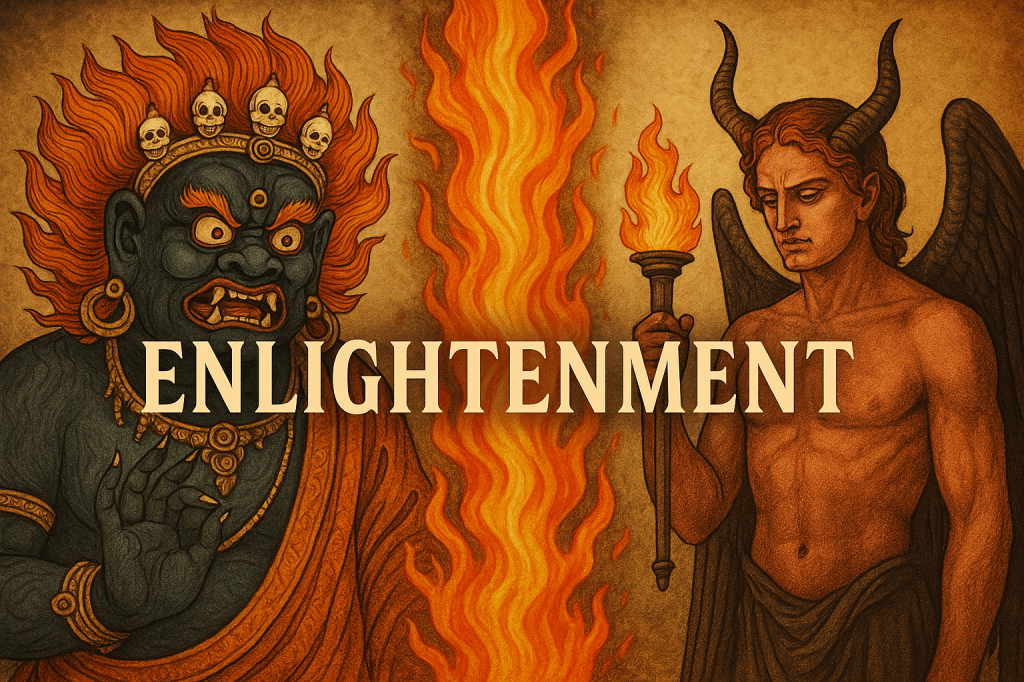
Now, after 35 years of hard work, study, devotion, and ultimately betrayal at the hands of tantric Buddhist gurus and deities, I’ve come to a grim realization: the enlightenment I was seeking wasn’t what I thought it was. It is merely an occult system dressed in Buddhist robes. The deeper I went, the clearer it became that Tibetan Buddhism and Luciferianism are two sides of the same coin. They may use different language, imagery, and rituals, but they are architecturally and spiritually similar and they both serve darkness, not light.
The word that they share, enlightenment, is the bait they use to ensnare seekers.
Luciferianism and Tibetan Buddhism: Two Faces of the Same Enlightenment Agenda
In Luciferianism, enlightenment is about becoming your own god. Lucifer is framed not as evil, but as the “light-bringer,” the one who defies divine authority to bestow forbidden knowledge. Enlightenment here is rebellion, self-deification, and esoteric power.
Helena Blavatsky, the founder of Theosophy, which heavily influenced modern occultism, named her journal Lucifer and described the figure as a misunderstood bringer of divine wisdom¹. In The Secret Doctrine, she refers to Lucifer as the “spirit of intellectual enlightenment”² and equates him with the higher mind of humanity. Freemasonry, Theosophy, and modern occultism all share the core motif: moving from darkness to light, and from ignorance to gnosis, through secret initiation.³
This kind of “light” is occult and exclusive. The “enlightened ones” in these systems are initiates who’ve been brought into deeper mysteries. The light is not for everyone; it’s reserved for those chosen by the system who are able to serve its agenda.
What shocked me, and what I ignored for years, is that tantric Buddhism functions much the same way. It promises special teachings, revealed only to the initiated. It trains students to see their guru as a living Buddha, above criticism or doubt, and presents his questionable actions as “skillful means,” while bypassing basic moral accountability. There is a similar secretive, hierarchical structure although this one is surrounded by colorful thangkas and Sanskrit mantras.
The deeper I went, the more I saw that my devotion was being weaponized against me. Tantric gurus used “crazy wisdom” to justify harm, and “samaya vows” to silence dissent. It wasn’t really compassion, but a spiritual aristocracy, no different from the occult orders I once thought Buddhism stood apart from. The beatific vision of enlightenment for the benefit of all sentient beings was merely the bait. The hook was the hidden power of dark forces.
Now I see clearly that the word enlightenment, both in Tibetan Buddhism and Luciferianism, functions as a kind of smokescreen. It sounds noble, luminous, and superior. But in both systems, it serves those in power and creates a class of “enlightened ones” who are above reproach, who serve gods and buddhas from unseen realms that are not what they appear to be.
“Enlightened Ones” as Agents of the Lie
It’s not just that the term enlightenment is misused. It’s that those who claim it, whether in Tibetan Buddhism or Luciferianism, are agents of a system that serves a being or beings pretending to be of the light.
These “enlightened ones” often behave the same way, regardless of tradition: they demand loyalty, obedience, and silence. They wield charisma and secrecy as tools. And when challenged, they invoke mystical authority and retaliation.
In both systems, the “light” is a mask and those who follow it are bound to something posing as divine. Whether it’s called Buddha, a Bodhisattva, an Ascended Master, or Lucifer, the same current runs underneath: it is a demonic force clothed in the language of transcendence.
Christianity and the True Nature of Light
Unlike Tibetan Buddhism and occultism, Christianity doesn’t use enlightenment as a central goal. It speaks instead of salvation, grace, and being born again through the Holy Spirit. The light of Christ is not esoteric knowledge reserved for an initiated elite but is open, relational, and grounded in love and repentance. Christ’s light is not something attained through ritual or secrecy; it is something revealed publicly and offered to all.
As Jesus says in the Gospel of John: *“I have spoken openly to the world. I have always taught in synagogues and in the temple, where all Jews come together. I have said nothing in secret.”⁵ This sharply contrasts with occult traditions, including tantric Buddhism, where knowledge is concealed, layered in initiations, and distributed only to those deemed “ready.” In my own experience, this secrecy became a mask for control. I was told not to question or doubt. I had to sacrifice my own inner wisdom and clarity.
But the light of Christ does not require silence or blind devotion. The Holy Spirit is not a power to be manipulated, but a divine presence who convicts, comforts, and guides with truth. In my experience, that is the only light that does not deceive.
Every other version I followed, no matter how radiant it appeared, eventually demanded that I suppress my discernment, abandon my conscience, and serve a system of secrecy cloaked in mystical language.
A Word to the Seekers
To anyone still in these systems, or brushing up against them through yoga, New Age teachings, or tantric practices: be careful with “light” that demands you stop using discernment. Be cautious of teachers who ask for your silence or your soul. Be wary of the spiritual forces behind the promised enlightenment.
I say this not as an outsider, but as someone who gave my life to this path. I practiced the rituals, prostrated to the gurus, and offered my heart in devotion. And when the mask came off, I saw what was truly being served, and it wasn’t holy. It was something else entirely.
Footnotes and Sources
Blavatsky, H. P., Lucifer, Vol. 1. Theosophical Society, 1887.
Blavatsky, H. P., The Secret Doctrine, Vol. 2. Theosophical Publishing House, 1888.
Pike, Albert. Morals and Dogma of the Ancient and Accepted Scottish Rite of Freemasonry. Southern Jurisdiction, 1871.
Mackey, Albert G. The Symbolism of Freemasonry. Masonic Publishing, 1882.
The Holy Bible, English Standard Version, John 18:20.
Crowley, Aleister. The Book of the Law. 1904.
Bailey, Alice A. Initiation, Human and Solar. Lucis Publishing Company, 1922.
Dapsance, Marion. “Behind the Smiling Façade: Abuse in Tibetan Buddhism.” Le Nouvel Observateur, 2018. Translated and discussed in Tricycle: The Buddhist Review.
Sawerthal, Anna. “Sogyal Rinpoche’s Abuse and the Breakdown of Secrecy in Buddhism.” Tricycle, 2018.
Peljor, Tenzin. “Tibetan Buddhism and Abuse: Why Critical Thinking is Essential.” Interview in Spiegel Online, 2019.
Both Vajrayana and Luciferian rites use geometric portals to invoke spiritual forces and what comes through may not leave easily.
Follow-up to: “The ‘Hidden’ Truth of Vajrayana Empowerment: Does the Lama Implant a Deity into the Disciple’s Mind?”
Following the previous article “The ‘Hidden’ Truth of Vajrayana Empowerment,” which exposed how Tibetan tantric initiation involves the lama implanting a deity into the disciple’s mind-stream, this follow-up explores how that same core process, spiritual implantation, appears in Western occult and Satanic initiation rites. Though culturally and theologically distinct, both systems describe a mystical transformation in which the aspirant is indwelt, overshadowed, or spiritually fused with a nonhuman being. The parallels are striking, and the implications for unsuspecting spiritual seekers are sobering.
Union Through Inhabitation
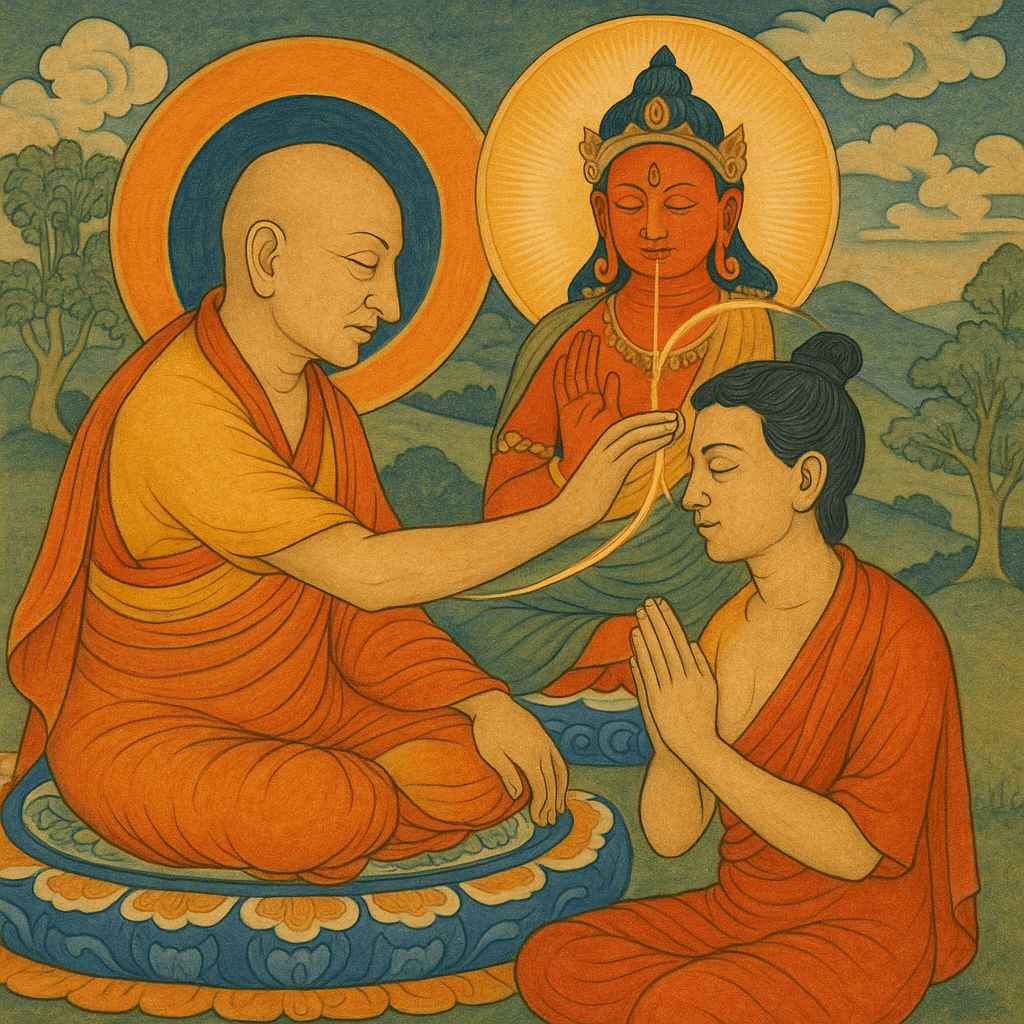
In Vajrayana Buddhism, the empowerment ritual is designed to activate the disciple’s Buddha-nature by personifying it as a specific deity. This process is not symbolic; it requires the intervention of the guru, who performs a series of initiations (vase, secret, wisdom, and word) that culminate in the wisdom deity entering the disciple’s visualized form. Sam van Schaik and other scholars describe this as a fusion of two minds: the practitioner becomes “in union” with the deity.¹ Light or energy entering the heart symbolizes this transmission, and classical sources like Vilāsavajra² and Jamgön Kongtrul³ confirm that the deity’s presence is meant to take root within the initiate.
This process mirrors what takes place in various forms of Western occult initiation. Whether in ceremonial magic, Luciferian practice, or Thelemic rites, the aspirant invites a spiritual entity, sometimes framed as a “higher self” and other times as a demon or god-form, to inhabit or fuse with their consciousness.⁴ In certain traditions, this is done under the guise of awakening one’s divine essence or ascending the Tree of Life, but the mechanics remain: the person is inviting another spiritual will to merge with their own.
The Role of the Officiant
In Vajrayana, only a qualified guru can perform the empowerment. The lama must have realization of the deity in order to transmit it, effectively serving as a channel through which the deity is implanted into the disciple. The disciple cannot access the highest yoga tantra deity alone; it must come through the guru.⁵
In Western occultism, the structure is more flexible. In ceremonial lodges like the Golden Dawn, initiation is conferred by a hierarchy of initiates. In solitary or Luciferian paths, the practitioner may self-initiate, performing a ritual to invoke and receive a spiritual entity directly.⁶ This difference, hierarchical transmission versus self-directed invocation, changes the form but not the essence of what is happening: a spiritual being is invited in.
Seed and Possession
Both traditions speak of what can be described as a spiritual seed taking root in the initiate. In Vajrayana Buddhism this is the seed of the deity that is implanted through ritual and nurtured by mantra and visualization, growing into full enlightenment.⁷ In occult traditions, similar metaphors abound: the Black Flame (Luciferianism), divine spark (Gnosticism), or magical current (Thelema) all describe a presence awakened or implanted within the practitioner.⁸
Possession or identity fusion is not merely metaphorical in either tradition. In Vajrayana, the practitioner becomes the deity in practice and visualization. In Western occultism, invocation or evocation may result in the spirit speaking through the practitioner, taking partial or full control.⁹ The aspirant may not merely visualize the entity; they may be inhabited by it.
Theological Framing
Here is where the surface similarities give way to deeper concerns. Vajrayana presents this union as sacred and salvific. The deities are said to be manifestations of enlightened mind, and the process is aimed at liberation from suffering.
In contrast, many Western occult traditions embrace the transgressive nature of the ritual. In Luciferian and Satanic paths, the union with a spiritual being is framed as an act of rebellion, empowerment, or divinization.¹⁰ Even in systems that use angelic or archetypal language, the goal is often gnosis independent of God, power over nature, or rejection of traditional morality.
From a Christian theological perspective, both processes, however cloaked in cultural or religious language, involve the opening of the soul to spiritual beings not of God.¹¹ Whether the entity is labeled as a deity, guardian angel, or inner Buddha, the core act is the same: inviting possession or fusion with a nonhuman intelligence. Exorcists describe demons as “persons without bodies.”
Deliberate Secrecy vs. Ritual Transparency
Another key difference lies in disclosure. Vajrayana does not typically explain to new initiates that the lama will implant the deity into their mindstream. This is concealed under layers of euphemisms, talk of “blessings,” “inspiration,” or “awakening Buddha-nature”.¹² Western occultism, by contrast, often acknowledges its aims more directly. A Luciferian magician knows they are invoking Lucifer. A Thelemite understands the goal is Knowledge and Conversation with a higher being.¹³
But the result is no less dangerous. Both systems involve entering into a spiritual relationship that can dominate or override the practitioner’s will. From a Christian point of view, these are not symbolic practices but acts of spiritual surrender and potentially, spiritual bondage.
Conclusion: Two Paths, One Mechanism
While Vajrayana tantra and Western occultism differ in terminology, mythos, and cultural packaging, they share a core mechanism: a ritual invitation for a spiritual being to enter the initiate’s consciousness. Whether masked as deity yoga or celebrated as demonic possession, the outcome is the same: identity fusion with a nonhuman spirit.
The true danger lies not only in the act itself but in the lack of informed consent. Many Vajrayana practitioners never fully understand what they’ve opened themselves to until it’s too late. And many occultists, lured by the promise of empowerment, mistake possession for enlightenment.
As explored on this blog, the deeper deception is the true nature of “possession” rituals versus how they are presented. Spiritual seekers deserve the truth: that these practices, whether called empowerment or initiation, are not harmless techniques for personal growth and transcendence. They are open doors: both Vajrayana and Luciferian rites use geometric portals to invoke spiritual forces and what walks through may not be your friend or leave easily.
Sources
Sam van Schaik, “The Limits of Transgression: The Samaya Vows of Mahāyoga” (2010).
Vilāsavajra, Hevajra Tantra Commentary, excerpts found in Mahāyoga textual studies.
Jamgön Kongtrul, The Treasury of Knowledge, Book Eight, Part Three.
Aleister Crowley, Magick in Theory and Practice; Michael Ford, Luciferian Witchcraft.
Ngawang Phuntsok, On Receiving Wang (Empowerment).
Israel Regardie, The Golden Dawn: A Complete System of Magic.
Dalai Lama, Kalachakra Initiation Teachings; traditional commentaries on empowerment.
Michael W. Ford, Apotheosis: The Ultimate Beginner’s Guide to Luciferianism.
Kenneth Grant, The Magical Revival; practices in chaos and ceremonial magic.
Anton LaVey, The Satanic Bible; Ford, Dragon of the Two Flames.
Catechism of the Catholic Church, paragraphs 2116–2117.
Scott Globus, “Empowerments: Awakening the Buddha Within,” Rubin Museum, 2021.
Aleister Crowley, The Vision and the Voice; Liber Samekh.
Tantric initiation (Vajrayana empowerment) is often described as a ritual that grants permission to engage in deity yoga and awaken one’s inner Buddha-nature. Yet traditional Tibetan sources suggest that something more mystical and intrusive is occurring, that the lama actually places the deity’s essence into the disciple’s mindstream. This critical detail, essentially the guru implanting or merging the deity (yidam) with the initiate’s mind, is conspicuously absent in most contemporary teachings.
This article examines classical tantras and commentaries to determine whether they explicitly describe the guru installing the deity in the disciple’s mind. It then compares that understanding with modern teachings, exposing a deliberate omission that raises serious questions about transparency in Vajrayana transmission.
Traditional Teachings on Tantric Empowerment
In Vajrayana Buddhism, empowerment (Tib. wang, Skt. abhisheka) is essential. “In the Secret Mantra Vehicle, there can be no accomplishment without empowerment.”¹ Classical definitions stress that this is not merely symbolic but a ritual that transforms the disciple’s mindstream.
According to the Rigpa Wiki, empowerment “awakens the special capacity for primordial wisdom to arise in the mind of the disciple.”² The Dalai Lama’s teachings on the Kalachakra Tantra state the guru “ripens the disciple’s psycho-physical continuum with the initiations.”³ Traditional analogies liken this to planting a seed that, with the right conditions, will grow into Buddhahood. This “seed” is not just metaphorical but is a spiritual presence that enters the disciple.
Tantric texts and commentaries describe empowerment as a mystical transmission wherein the wisdom deity (jnanasattva) is invited to enter the samaya deity (samayasattva), the visualized form of the disciple. Sam van Schaik summarizes: “in empowerment… the wisdom being becomes embodied in the samaya being.”⁴ The two minds are joined.
Instructions for such ceremonies explain that the lama generates themselves as the deity and transmits that awakened essence into the disciple through vase water, mantras, and gestures. The disciple visualizes the deity dissolving into themselves, signifying that the deity’s mind is being placed within them. Lineage sources stress that the lama must already hold the deity’s realization in order to transmit it. As one commentary puts it: “You have to hold something in you before you can give it.”⁵
In short, classical sources affirm that empowerment involves the lama implanting the deity’s essence into the disciple. Without this, Vajrayana texts say, real accomplishment is impossible, “like trying to press oil from sand.”
Does the Lama Literally Install a Deity?
While ancient texts may not use the modern phrase “implant the deity,” their intent is clear. An authoritative Kagyu explanation says the lama “places a recipient in connection with a particular Tantric deity,” enabling a “merging of essences.” This “connection” implies not just a symbolic affiliation but a mystical joining.
The empowerment ritual is the cause that activates and personifies the disciple’s Buddha-nature as a specific deity. This is not something the student can do alone; it requires the guru’s intervention. In Highest Yoga Tantra, multiple initiations (vase, secret, wisdom, word) facilitate this process in stages. During empowerment, the disciple imagines themselves as the deity (samaya being) and invites the wisdom deity to enter. When the two merge, the disciple becomes “in union” with the deity.
Some texts describe this as light or energy entering the disciple symbolizing the deity’s mind entering their heart. The Indian master Vilāsavajra described the climax of empowerment as a point when “wisdom and samaya come together.”⁶ The disciple leaves not just authorized but changed, carrying the seed of the deity from that point forward.
Jamgön Kongtrul writes that empowerment “introduces the disciple into the deity’s mandala” and allows the deity’s form and wisdom to “take root.”⁷ A Nyingma commentary states the guru, visualized as the deity, dissolves into the disciple, granting the blessing of the deity’s mind. Even the phrase “blessings enter the disciple’s stream” implies the transfer of a conscious presence.
In effect, tantric empowerment functions like a spiritual implantation, or even possession, in which the enlightened mind of the deity is placed into the disciple. The initiate now carries the deity within them, not merely as a concept but a living presence.
Modern Teachings: Omission or Adaptation?
If this is the traditional view, why don’t modern teachers say so? Contemporary teachings, especially those aimed at Western or general audiences, consistently describe empowerment in vague terms: permission, inspiration, activation of inner potential. The mystical detail of the lama implanting the deity is nearly always omitted.
In a transcribed teaching from a famous lama, now deceased (see below), empowerment is described as a prerequisite for deity meditation: the disciple receives empowerment, then instructions, and cultivates their body as the deity’s form. No mention is made of the lama placing anything into the disciple. It reads more like ceremonial enrollment than spiritual fusion.
This pattern is widespread: contemporary teachers often emphasize psychological language such as inner transformation, personal growth, and discovering potential, while minimizing the traditional notion of external metaphysical transmission. For instance, the Rubin Museum describes empowerment as a “ritual to introduce us to our own innermost Buddha qualities,”⁸ rather than as the reception of a deity from the lama. Such a framing casts the guru as a guide rather than a spiritual agent. However, this reinterpretation flattens the ritual’s ontological depth and misrepresents the original esoteric function of empowerment.
Even phrases like “placing the disciple in connection with the deity” or “ripening the mindstream” are left undefined. Many Vajrayana students, unless they study technical commentaries, may never realize that the tradition sees empowerment as a supernatural event. The omission is so consistent that one might suspect it’s intentional, perhaps to avoid alarming newcomers with the idea of having a foreign spirit installed in their mind.
Secrecy and Obfuscation in Vajrayana
To understand this omission, we must examine the role of secrecy. Vajrayana has always been esoteric. Revealing inner teachings to the uninitiated is a root downfall. As such, teachers often avoid revealing too much, especially in public settings.
Defenders of this approach argue that it’s compassionate: premature disclosure can cause misunderstanding or fear. Teachings are “graduated” and deeper layers revealed as the student progresses. In this view, the omission is considered skillful, not deceptive.
Yet critics argue that this secrecy amounts to intentional obfuscation in the modern information age. Newcomers are told that Vajrayana is about archetypes and psychological growth; this is appealing, secular-friendly language. Only later do they learn that the practice involves guru-bestowed metaphysical empowerment and deity implantation.
Few Vajrayana centers provide an upfront disclosure like: “In this empowerment, you will vow lifelong devotion and we believe that the deity’s mind will enter into yours.” Without this, informed consent becomes impossible. What if the student has been raised Christian and bound by the First Commandment: “You shall not have strange gods before Me”⁹? Would they agree to deity possession if fully informed?
The disconnect between outer presentation and inner doctrine has led some former practitioners to label the tradition dishonest. Years may pass before students learn that guru-deity fusion/possession are standard parts of the system. At that point, it may be too late as they’ve taken vows, invested emotionally, and become spiritually entangled.
Some defenders argue that Vajrayana’s opacity is necessary, that it was never meant for everyone. But in modern multi-cultural societies, this clandestine approach resembles a bait-and-switch. Students sign up for meditation, not spiritual merging with an imported god. They deserve to know what they’re consenting to.
Restoring Honesty in Transmission
Is omitting the “deity implantation” deceptive? From an academic standpoint, the answer is yes: there is a clear disconnect between traditional texts and public presentation. The idea that the guru installs a deity in the disciple’s mindstream is a core teaching, not a fringe view.
Yet most public talks and introductory texts never say this plainly. The true nature of the ritual, guru/deity fusion with the recipient, is hidden behind euphemism. This may prevent questions, but it is morally dishonest.
Vajrayana dharma centers must move toward transparency. Honesty about what is really occurring would both honor the teaching and protect the student. That this is seldom done nowadays is deeply disturbing.
In a predominantly Christian culture, where devotion to other gods violates divine commandments, the omission is not just deceptive, it’s a spiritual breach of consent. Prospective practitioners deserve to know what is happening before the ritual occurs, not after.
The tradition holds that through the guru’s blessing, one’s mind becomes inseparable from the deity. Then let us insist that teachers explain that clearly, before it is too late for the recipient to turn back.
Sources:
Traditional Vajrayana saying; cited in various commentarial teachings on abhisheka.
His Holiness the 14th Dalai Lama, Kalachakra Initiation Teachings.
Sam van Schaik, “The Limits of Transgression: The Samaya Vows of Mahāyoga” (2010).
Ngawang Phuntsok, On Receiving Wang (Empowerment).
Vilāsavajra, commentary on tantric vows; source referenced in academic discussion on Mahāyoga.
Jamgön Kongtrul, The Treasury of Knowledge, Book Eight, Part Three: The Elements of Tantric Practice.
Scott Globus, “Empowerments: Awakening the Buddha Within,” Rubin Museum, 2021.
Exodus 20:3, The Holy Bible.
Kalu Rinpoche – Teachings on Karmamudra and Mahamudra–California, Los Angeles, December 21, 1988
Transcript:
The gentleman is asking whether there is any connection between the traditional Buddhist approach to tantric practice and various sexual yogas—whether these practices have any bearing on the traditional path or whether that’s a misconception.
Yes, there is a connection. Previously, I spoke of the four major classes of tantra: Kriya Tantra, Charya Tantra, Yoga Tantra, and the fourth, Anuttara Yoga Tantra, or the Tantra of Unsurpassable Union. This fourth category is divided into Father Tantra, Mother Tantra, and Non-dual Tantra.
Principally in the classes of Mother and Non-dual Tantra, there are techniques involving sexual union as a basis for spiritual practice, technically termed karma mudra. These practices form part of a broader cycle known as the teachings on the Four Mudras. These teachings, as taught by the Buddha, are authentic and part of the tradition—the challenge lies in practicing them purely.
Traditionally, an individual would first undergo a long period of purification—purifying body, speech, and mind from harmful actions and obscurations, while cultivating positive qualities like merit and awareness. This is done through preliminary practices known as ngöndro.
Next, the individual would receive an authentic empowerment into one of the major tantric cycles from a qualified teacher. They would then receive extensive instruction in deity meditation and cultivate the experience of their own body as the deity’s form—experiencing the union of form and emptiness not as an idea, but as direct realization. Their speech would become the union of sound and emptiness, often practiced through extensive mantra recitation. They would also cultivate the awareness of mind as the union of intelligent clarity and emptiness, stabilizing it through meditative absorption.
Following this, the person would practice tummo or inner heat. This practice is done in stages and begins with the generation of inner warmth at the navel. As the warmth spreads, energy from the crown of the head flows downward. Through mastery of this flow, the practitioner experiences a profound bliss that pervades the mind-body complex.
Advanced stages involve focusing energy through the chakras. When energy is drawn to the throat, joy arises. At the heart, sublime joy. At the navel, special joy. And when energy is drawn down and contained within the genital chakra, co-emergent joy. Karma mudra practice requires the ability to hold this energy without losing it through orgasm. This leads to a nondual, non-conceptual state of awareness.
Eventually, the practitioner reverses the flow of energy upward through the chakras. Mastery over lowering and raising energy is required before karma mudra practice can be properly undertaken. With that mastery, energy is consciously directed through the 72,000 subtle channels (nadis) in the body. The ultimate aim is not sexual pleasure, but realization of Mahamudra.
Examples of individuals who attained enlightenment through such practices include the Indian king Indrabhuti, who is said to have relied on 1,000 consorts over six years. Tibetan lay practitioners like Marpa the Translator—who had eight consorts—are also examples. These paths exist, but must be practiced with purity and commitment.
Misunderstanding these practices—believing tantra is simply about sex—is a serious mistake. One of the 14 root downfalls in Vajrayana practice involves this misunderstanding, particularly the indulgence in orgasm, which is seen as a loss of energy that could otherwise be harnessed for enlightenment.
Another audience question asked about how long to leave a corpse undisturbed after death. In Tibetan tradition, the consciousness remains associated with the body for about 3.5 days. During this time, the body should ideally not be touched. A practitioner of phowa (transference of consciousness) is then called to assist the consciousness in departing skillfully.
After that, the body may be disposed of through burial, water burial, or cremation—accompanied by ritual and chanting to aid the consciousness. These practices can still be valuable even in cultures where such methods are not common, and ideally a phowa practitioner should be contacted if possible.
Another question asked whether one can attain liberation in a single lifetime through tantra. The answer is yes—realization of Buddhahood is possible. However, the physical manifestations may differ from those of a SambhogakayaBuddha, who displays specific physical marks of perfection. Still, the inner realization can be the same.
To discern an authentic teacher, look for someone with an unbroken lineage, proper transmission, sincere motivation, and correct understanding. Avoid teachers who have been disowned by their own lineage, or who act out of selfish motives. Examine their character, conduct, and consistency with traditional teachings.
In closing, the speaker encourages all listeners to study, practice, and seek qualified teachers. The merit of the teaching session is dedicated to the awakening of all sentient beings from ignorance, and the spreading of primordial awareness so that all beings may eventually attain Buddhahood.








 Tantric Deception