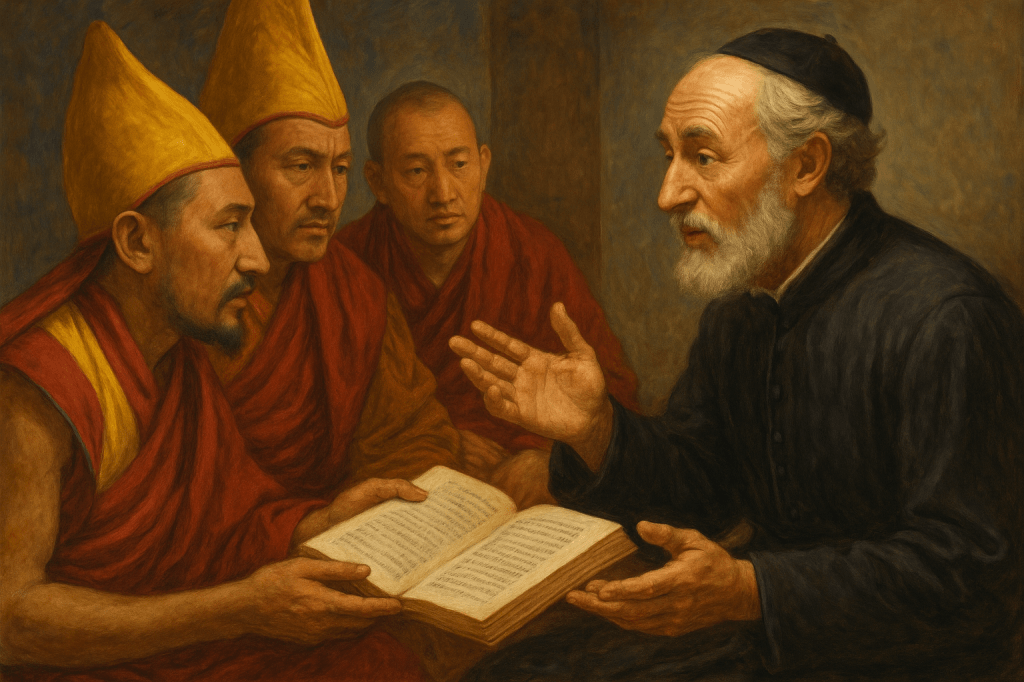
When Tantric Union in Tibetan Buddhism is Invasive and Unwanted


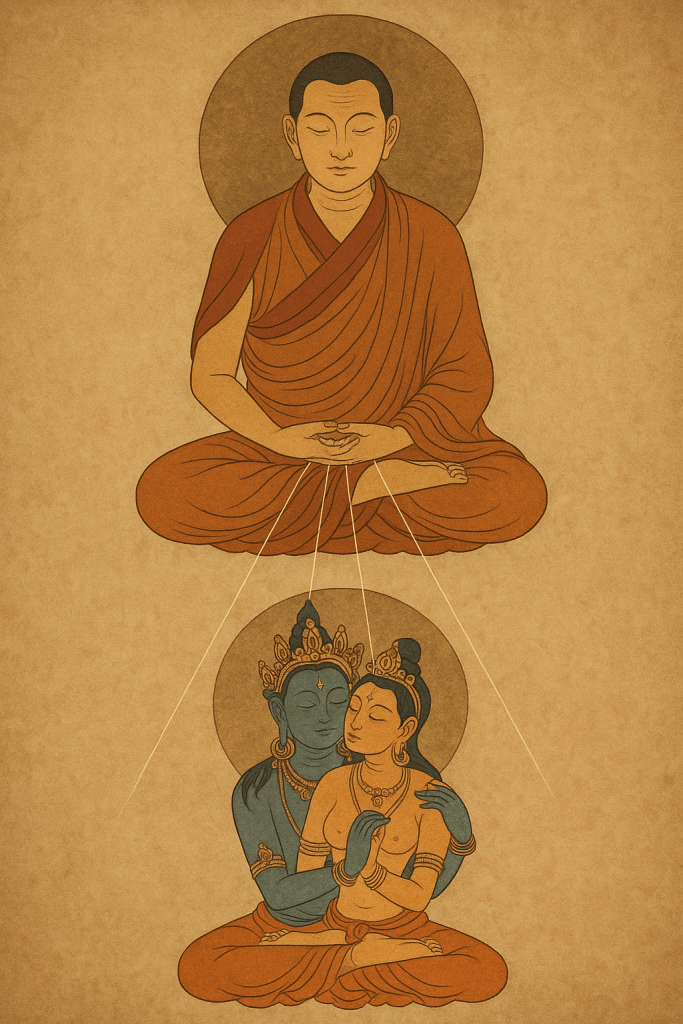
The ideal of tantric union in Vajrayāna Buddhism is described as the merging of wisdom and compassion, form and emptiness, masculine and feminine. In classical Tibetan art this appears as the yab-yum image of male and female deities in embrace.¹ The symbolism points to inner union, yet within the secrecy and hierarchy of tantra this ideal can become distorted. When intimacy, devotion, and power mix, the result can be psychological or sexual harm rather than awakening.

Union beyond the physical

“Union” (las kyi phyag rgya, maithuna) does not always refer to sexual intercourse. Many lineages teach “mental” or “energetic” union, where teacher and student visualize merging through subtle-body channels or shared deity practice.² Scholar Holly Gayley has examined how such “secret consort” (gsang yum) relationships blur lines between spiritual transmission and sexual exploitation.³

Anecdotal reports from practitioners describe non-physical experiences of sexual arousal or even orgasm initiated by the guru, without consent or understanding. For those unprepared, these experiences can feel like psychic invasion and an intrusion into the mind-body field. The ethical question is whether such experiences can ever be consensual in the context of absolute guru devotion.

The mechanism of “mental union”

Tantric theory holds that through visualization, mantra, and subtle-body control, energies (prāṇa, rlung) can be directed between beings. A guru visualized as a deity may “enter” the disciple’s heart or crown chakra, merging mindstreams in blessing.⁴ In positive settings this symbolizes transmission of realization. Yet in cases of coercion the same mechanism becomes violation: the student’s energetic body is penetrated without consent.

Ritual texts sometimes describe the guru entering the disciple’s central channel (tsa uma) through gaze or mantra, symbolic of energetic or spiritual transmission.⁵ Within Hindu Tantra, similar accounts exist of masters manipulating the disciple’s kundalinī or chakras.⁶ These ideas frame the possibility of non-physical sexualized experiences as part of spiritual union. When combined with secrecy and unequal power, the result may feel like mental rape rather than initiation.

Power, secrecy, and consent

The Vajrayāna guru is regarded as embodiment of the awakened state itself.⁷ Devotion to such a figure can override ordinary ethical boundaries. In Western contexts, where students lack cultural preparation, the potential for abuse rises sharply. Alexander Berzin warns that Western practitioners often misunderstand the traditional checks on guru authority and therefore submit to unhealthy relationships.⁸

Secrecy deepens the problem. The samaya vow forbids disclosure of tantric practices, even to peers. Gayley observes that this secrecy “can be used to reinforce sexual violence and silence abuse.”³

Real-world allegations

At Kagyu Samye Ling monastery and its retreat centre on Holy Isle in Scotland, multiple allegations have surfaced over the past decade. Reports describe bullying and psychological pressure during advanced retreats. Recently it was reported that a British woman may have died by suicide after a four-month retreat there. While there is no public evidence of sexual misconduct toward her, other survivors have alleged earlier incidents of “energy access” by the same teacher. Allegations included the use of “subtle body rape/sexual energy invasion,” according to an article by Adele Tomlin on the Dakini Translations website.⁹

The under-discussed nature of subtle-body abuse

Such cases remain largely invisible because tantric language itself obscures boundaries between metaphor and reality. A teacher’s claim of “mind-union” or “blessing” can mask non-consensual psychic intrusion. Students are often told that doubt equals spiritual failure, and that refusal breaks samaya. Without transparent ethics, the very tools meant to free the mind become weapons of domination.

Moving forward

Ethical tantric practice requires explicit, informed consent at every level: physical, psychological, and energetic. Teachers must articulate clearly what practices entail, and students must retain the right to refuse and leave. The spiritual promise of union cannot excuse the violation of personal autonomy. However, this kind of transparency is unheard of. Proper review structures and support for survivors are practically non-existent in most Tibetan Buddhist centers. The allegations surrounding Samye Ling and Holy Isle highlight what scholars such as Gayley describe as tantra’s “shadow”: the ease with which power can transform spiritual intimacy into a form of manipulation and abuse.


References

  1. Buddha Weekly, “What’s a Consort Union in Tantric Buddhism?” https://buddhaweekly.com/whats-consort-union-tantric-buddhism-no-not-sexual-fantasies-psychology-yab-yum-consorts-union-wisdom-compassion/
  2. Oxford Research Encyclopedia of Religion, “Tantra and the Tantric Traditions of Hinduism and Buddhism.” 2016.
  3. Gayley, Holly. “Revisiting the ‘Secret Consort’ (gsang yum) in Tibetan Buddhism.” Religions 9 (2018).
  4. Snellgrove, David. The Hevajra Tantra: A Critical Study. Oxford University Press, 1959.
  5. Wedemeyer, Christian K. Making Sense of Tantric Buddhism: History, Semiology, and Transgression in the Indian Traditions of Buddhist Tantra. Columbia University Press, 2013, esp. chap. 3–4, on symbolic initiation and tantric ritual language.
  6. White, David Gordon. Kiss of the Yoginī: “Tantric Sex” in its South Asian Contexts. University of Chicago Press, 2003.
  7. “The Guru Question: The Crisis of Western Buddhism and Global Future.” Info-Buddhism.com.
  8. Berzin, Alexander. Relating to a Spiritual Teacher: Building a Healthy Relationship. Snow Lion, 2000.
  9. Dakini Translations, “Suicide of Woman Reported in ‘Survivors of Samye Ling Support Group,’” by Adele Tomlin, the sole author of that site. https://dakinitranslations.com/2025/10/28/suicide-of-woman-reported-in-survivors-of-samye-ling-support-group-alleged-bullying-by-drupon-khen-karma-lhabu-teacher-misuse-tantra/
  10. Buddhistdoor Global, “Maithuna: Reflections on the Sacred Tantric Union of Masculine and Feminine.” https://www.buddhistdoor.net/features/maithuna-reflections-on-the-sacred-tantric-union-of-masculine-and-feminine/

The Moral Logic of Ritual Killing in the Wrathful Practices of Tibetan Buddhism


This piece follows up on my previous essay, “Tantric Deception: Black Magic and Power in Tibetan Buddhism,” which explored Solomon FitzHerbert’s study of tantric statecraft and the normalization of ritual violence in seventeenth-century Tibet. In this post, I turn to an even more revealing feature of FitzHerbert’s findings: the Fifth Dalai Lama’s own moral reasoning about ritual killing.

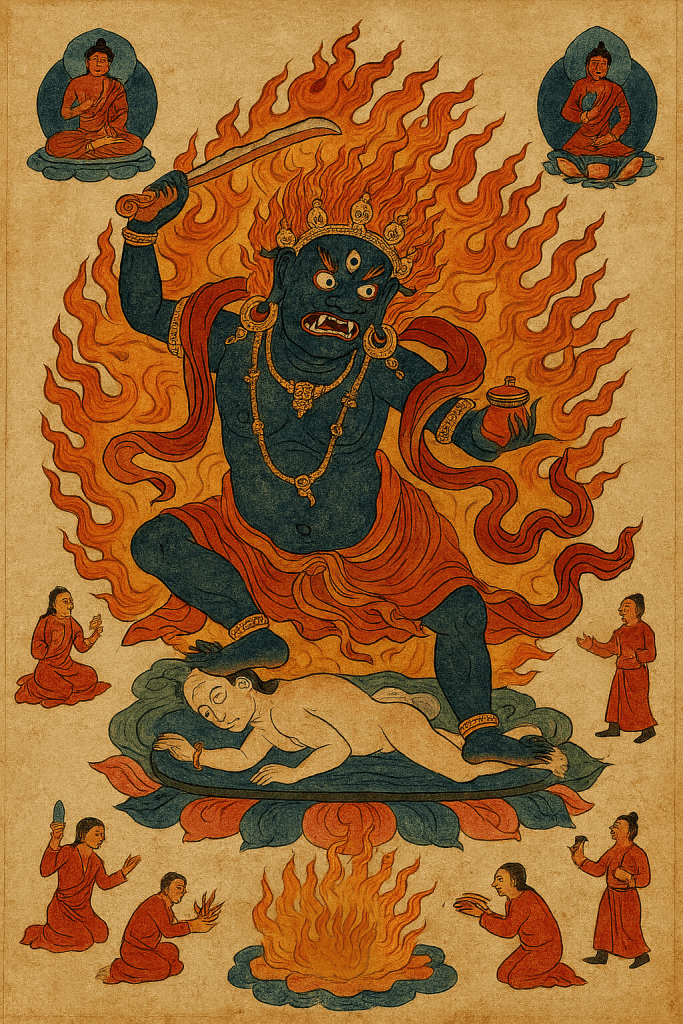
In his autobiography, the Fifth Dalai Lama confronts the criticism that tantric rituals of destruction should not be directed “against ordinary people.” His response is stunning in its candor: “We do not need to be ashamed of this,” he writes, “as it is taught in the Tantras.”¹ He goes further, citing the eight kinds of spirits who “fiercely execute the punishment” on behalf of the enlightened adept.²

Here the Great Fifth is not apologizing for violence; he is codifying it. FitzHerbert explains that the Dalai Lama invokes a moral category known as the ten fields of liberation (sgrol ba’i zhing bcu), a rubric for identifying the kinds of people whose killing can be ritually justified in tantric Buddhism.³ These include those who “cause harm to the Buddhist religion,” “bring dishonour to the Three Jewels,” “endanger the life of the guru,” “slander the Mahāyāna,” “sow discord among the vajra community,” “prevent others from attaining siddhi,” or “pervert views concerning karma and its retribution.”⁴

In other words, violence against the enemies of the dharma was not merely tolerated; it was systematized. The moral categories of Buddhist tantra aligned precisely with the ideological boundaries of religious loyalty. To kill an “enemy of the faith” was to enact liberation through wrathful compassion, a punitive act performed in the name of spiritual duty. In this context, the term liberation does not refer to enlightenment but serves as tantric code for killing.

The crucial question, then, is this: who decides who counts as an enemy of the dharma? It is the guru, a figure endowed with godlike authority, who makes that determination and authorizes the strike, much as a mafia boss sanctions a hit within his own organization.

Such ideas did not remain abstract. As FitzHerbert shows elsewhere, the Dalai Lama’s government ritualized the deployment of these doctrines in warfare and political suppression.⁵ What we see in these passages is the theological backbone of that policy: a cosmological logic that made violence both righteous and karmically justified.


When the “Fields of Liberation” Become Personal

The ethical implications of this doctrine extend far beyond the seventeenth century. Its structure, dividing the world between defenders and destroyers of the dharma, still echoes in the tantric imagination today. Within closed guru/disciple networks, where authority is absolute and ritual power is personalized, this logic can turn inwards toward vulnerable disciples.

When a teacher is accused of abuse–sexual, financial, or psychological–some may interpret criticism of that teacher as slander of the Mahāyāna or harm to the guru, two of the very offenses listed in the ten fields of liberation. Under this view, the accuser becomes a threat to the vajra community itself. The rhetoric of “vajra hell,” karmic downfall, or spiritual ruin can be mobilized as a form of punishment.

Even when no public or obvious ritual of destruction is performed, the doctrinal framework legitimizing wrathful retribution remains intact and the teacher may privately extract revenge. A teacher who sees himself as an accomplished tantric adept may claim to act from “enlightened wrath.” Certainly he convinces himself that is the case. He may claim his retribution is not from malice but from a compassion that destroys obscurations and seeks to protect his community from dissenters. In this way, spiritual authority can blur into coercion, and the old metaphysics of tantric punishment can be redeployed against dissenting students.

Thus, the problem is not simply historical. It lies in a theological grammar that still allows destructive acts to be reframed as enlightened means. When criticism is recast as “slander of the dharma,” and when the guru’s person is identified with the deity itself, retaliation can be justified as upholding the sacred order.

Facing the Doctrine Honestly

When Western seekers encounter Tibetan Buddhism, we are often presented with an image of serene compassion, untainted by coercion or cruelty. Yet the Fifth Dalai Lama himself dismantles that illusion. He writes without hesitation that violent tantric rites are legitimate instruments of enlightened rule. The “theatre state” of seventeenth-century Tibet was the political expression of doctrines like the ten fields of liberation.

If the tradition is to be understood honestly, these passages should be part of an open and very public conversation. The Fifth Dalai Lama’s own words make clear that within tantric ethics, destruction is allowed, and killing can be framed as an act of perverted compassion. The challenge for modern practitioners and scholars alike is to recognize how this same moral architecture can exist whenever authority claims transcendence from accountability.


Footnotes

  1. Solomon G. FitzHerbert, “The Fifth Dalai Lama and the Tantric Politics of State Formation in Seventeenth-Century Tibet,” Arts Asiatiques 27 (2018): 88.
  2. Ibid.
  3. Ibid., 89.
  4. Ibid.
  5. Ibid., 74–83.

Tantric Deception: Black Magic and Power in Tibetan Buddhism


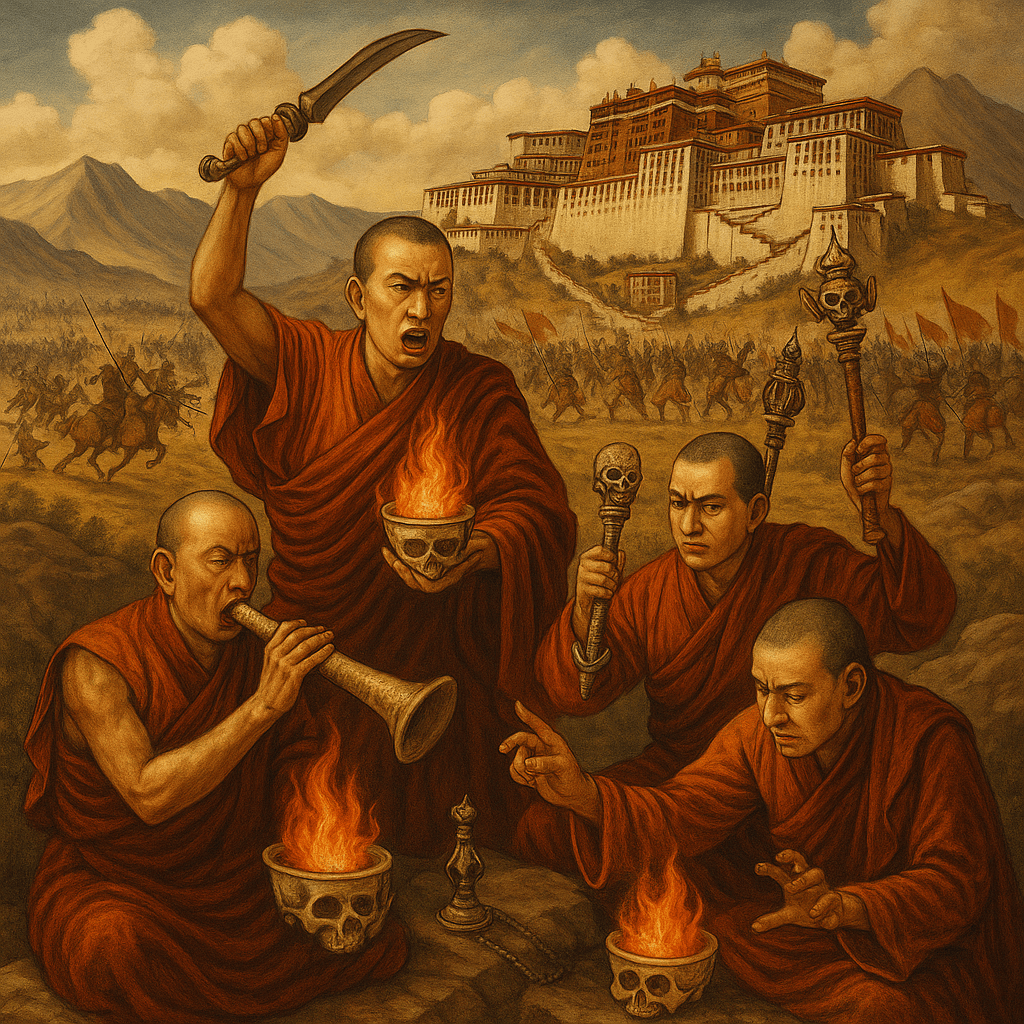
I am amazed that the PR for Tibetan Buddhism in the West managed for so long to conceal the extent of black magic practiced by lamas in Tibet historically and even to the present day. This concealment, aided and abetted by the squeamishness and obliviousness of some scholars, has to stop. In the dharma centers I was involved in, anything dark in Tibetan lore was relegated to the Bön religion, and the implication was that once Buddhism took hold in Tibet, any kind of evil acts such as harming or killing sentient beings was completely off the table. The truth is that black magic is in the lexicon of the highest lamas in the lineage as well as ngakpas and others. I believe these techniques are used liberally and current scholarship is finally exposing it.

Solomon G. FitzHerbert’s study of the mid-seventeenth century makes the core point plainly. He argues that tantric ritual and the rhetoric of ritual violence were central to how the Ganden Phodrang state established and legitimated power, not a peripheral curiosity. He writes that Tibetan sources “more than compensate” for the lack of hard military data with abundant materials about the “legitimation and maintenance of authority” through ritual technologies and narratives.¹

Before the rise of the Fifth Dalai Lama, Tibet’s Tsang rulers were already forging political alliances through tantric warfare. FitzHerbert shows that the Tsang kings deliberately patronized lamas famed for their mastery of wrathful and repelling rites. The most favored were the hierarchs of the Karma Kagyu, the “black hat” Karmapa and the “red hat” Zhamarpa, along with the Jonang scholar Taranatha, who was also enjoined to perform repelling rituals on behalf of his patrons.² Their alliances were explicitly religious and martial: an “ecumenical alliance in the name of defending religion and Tibet from foreign armies.”³

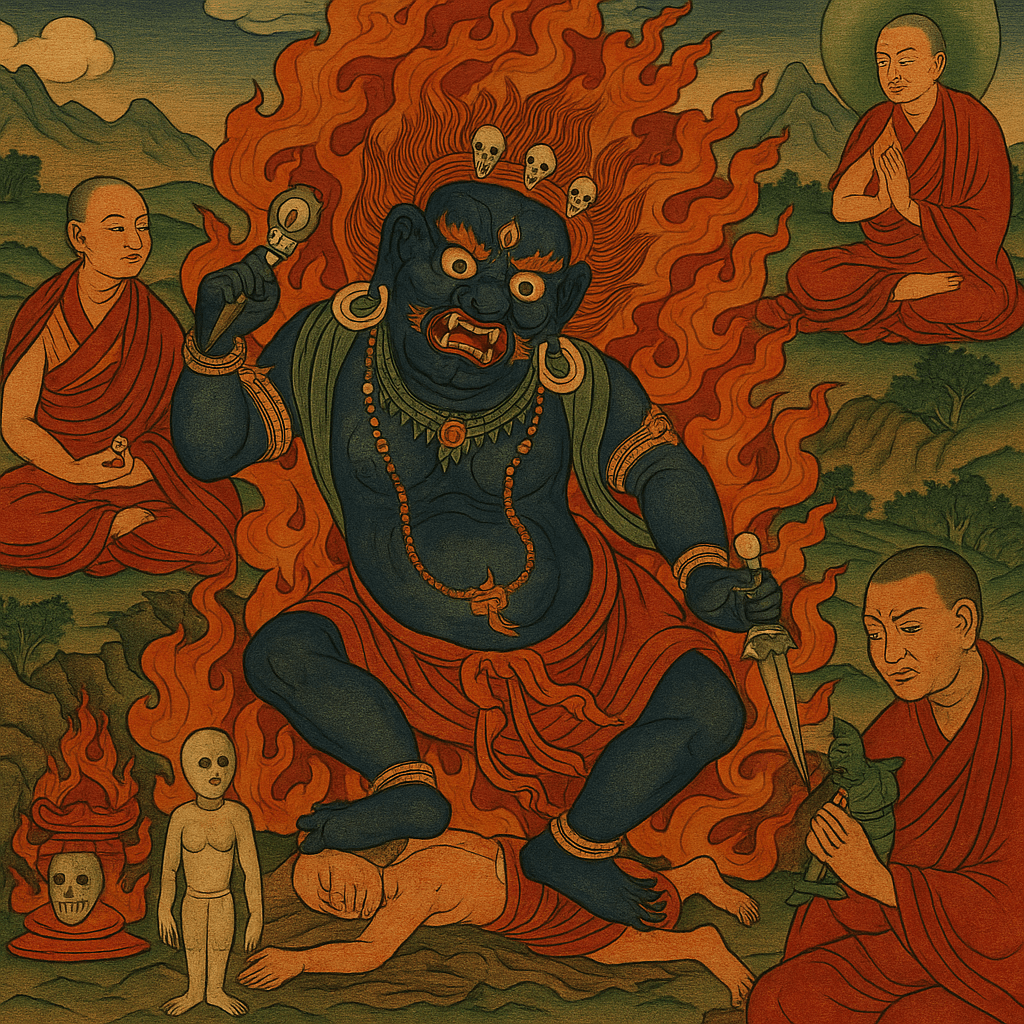
Among the Tsang rulers’ most celebrated ritual specialists was the Nyingma master Sokdokpa Lodrö Gyeltsen (1552–1624), self-styled “Repeller of Mongols.”⁴ A disciple of Zhikpo Lingpa, Sokdokpa was the main heir to the revealed cycle Twenty-Five Ways of Repelling Armies (Dmag zlog nyi shu rtsa lnga).⁵ His Mongol-repelling rites were widely famed, and he worked directly with the Tsang ruler Phuntsok Namgyel. One elaborate rite performed in 1605 to coincide with a Tsang military offensive involved producing “some 150,000 paper effigies of enemy soldiers.”⁶ These were ritually destroyed to annihilate the opposing force, with Bonpo specialists also enlisted for their expertise in magical harm.⁷

According to FitzHerbert, Phüntsok Namgyel successfully forged a broad anti-Geluk alliance using tantric technologies of protection and destruction.⁸ After his death, “reputedly at the hands of offensive magic being hurled at him by the Shabdrung Nawang Namgyal (Zhabsdrung Ngag dbang rnam rgyal) (1594–1651), founder of the state of Bhutan,”⁹ his son Karma Tenkyong (1604–1642) inherited a weakened position. The Shabdrung’s tantric assault, still treated in Bhutanese and Tibetan sources as a historical fact, thus became the legendary moment when a ruler famed for weaponizing ritual power was himself undone by it. It is one of the rare episodes where the logic of esoteric warfare entered the realm of accepted political history.

This is where the Fifth Dalai Lama comes into focus. FitzHerbert shows that in the 17th century the Great Fifth cultivated and systematized an official repertoire of destructive and protective rites in service of government aims. In his words, the Dalai Lama showed a “lifelong concern with learning, authoring and instituting an armory of defensive and offensive rituals for the mobilization of unseen forces” for the state.¹⁰ That program contributed to the Ganden Phodrang’s reputation for “magical power,” and helped stage what FitzHerbert calls the grandest “theatre state” in Tibetan Buddhist history.¹¹

FitzHerbert details three overlapping strategies. First, the new government suppressed, marginalized, or co-opted rival traditions of war magic associated with other schools, including Karma Kagyu and strands within Nyingma, while appropriating selective cycles that could be redeployed under Geluk authority.¹² Second, it rebuilt Nyingma institutions such as Dorjé Drak and Mindröling under Ganden Phodrang patronage, folding their esoteric prestige into the state project.¹³ Third, it sponsored new state rituals based on the Dalai Lama’s own visionary experiences, further centralizing ritual power in Lhasa.¹⁴

The rhetoric was not merely devotional. Lamas and ritual specialists acted as “bodyguards” whose professional task was destructive magic on behalf of patrons.¹⁵ Chroniclers attributed battlefield outcomes to the rites of powerful tantrikas. FitzHerbert highlights Chökyi Drakpa, famed for the Yamantaka cycle known as the “Ultra-Repelling Fiery Razor,” which centered on rites of “protecting, repelling and killing.”¹⁶ In one report, after deploying these rites against a Tümed encampment, “nothing was left behind but a name.”¹⁷

To grasp how such violence could be framed as meritorious, FitzHerbert shows the tantric logic that recasts killing as an enlightened “action” when performed by an empowered adept. The adept receives empowerment, performs extensive propitiation to forge identification with the deity, and then “incite[s]” and “dispatch[es]” oath-bound spirits to defend the dharma. By manipulating the five elements and the “public non-reality” of appearances, the practitioner can pacify, increase, control, or destroy, including against human enemies.¹⁸ The moral frame is clear in the sources he cites and translates. Killing is made licit because it is tantric, ritually purified and redirected as enlightened activity.¹⁹

FitzHerbert also situates Tibetan practices within a longer Indo-Buddhist lineage of war magic. He surveys Indian materials that speak of sainyastambha or army-repelling rites, and notes that the Hevajra states that “black magic for paralyzing armies,” is part of its “manifold purpose” and that the Kālacakra includes descriptions of war machines and siege methods such as “catapults, traps, siege towers, and so on,” alongside esoteric harm and protection.²⁰ He further notes the use of human effigies and effigy destruction in offensive rites against enemies, a hallmark of Tibetan ritual repertoires that drew on wider South Asian and even Indo-European precedents.²¹

Western idealization of Tibetan Buddhism has depended on ignoring this record. The lamas who administered and celebrated these rites were not outliers. They were the architects of a political order that fused charisma, ritual terror, and doctrinal justifications into a program of power. State-sponsored ritual violence was normalized in chronicles and hagiographies as enlightened means. The fact pattern is no longer obscure. It is all in the sources, and FitzHerbert has laid them out.

Although FitzHerbert’s focus is on state-sponsored ritual violence, similar technologies of harm have long been used by individual lamas against perceived enemies including, at times, their own disciples. The anthropologist Geoffrey Samuel has noted that the ritual power claimed by tantric masters can be turned inward, weaponizing spiritual authority to punish dissent or enforce obedience.²² In one well-documented episode from the nineteenth century, the treasure-revealer (tertön) Dorje Lingpa was said to have struck down a rival practitioner through wrathful ritual means, his death interpreted locally as a karmic consequence of opposing the lama’s command.²³ Such stories attest to a cultural logic in which ritual, psychic, or physical violence by enlightened masters could be valorized as the just expression of awakened power. I have personally been a victim of this deluded violent ritual power by Tibetan masters.

If Tibetan Buddhism is to be understood honestly outside Tibet, this history needs to be taught in dharma centers and discussed in scholarship without euphemism. The tradition’s own categories allow for destructive ritual and sanctified killing under certain conditions. Pretending otherwise does not protect the innocent devotees who arrive at dharma centers with open hearts seeking methods for developing compassion and loving kindness in service of enlightenment. Indeed, one must ask what kind of enlightenment tradition could allow, even glorify such violence.


Notes

  1. FitzHerbert, Rituals as War Propaganda, 91. FitzHerbert, Solomon G. “Rituals as War Propaganda in the Establishment of the Tibetan Ganden Phodrang State in the Mid-17th Century.” Cahiers d’Extrême-Asie 27 (2018): 49–119: https://www.persee.fr/doc/asie_0766-1177_2018_num_27_1_1508. (I first came across FitzHerbert’s article via a post on Adele Tomlin’s website http://www.dakinitranslations.com.)
  2. Ibid., 95–96.
  3. Ibid., 95.
  4. Ibid., 96.
  5. Ibid., 96.
  6. Ibid., 97.
  7. Ibid., 97.
  8. Ibid., 101.
  9. Ibid., 102–103.
  10. Ibid., 94.
  11. Ibid., 95.
  12. Ibid., 96.
  13. Ibid., 97.
  14. Ibid., 98.
  15. Ibid., 93.
  16. Ibid., 100.
  17. Ibid., 101.
  18. Ibid., 71.
  19. Ibid., 72.
  20. Ibid., 98–99.
  21. Ibid., 99.
  22. Geoffrey Samuel, Civilized Shamans: Buddhism in Tibetan Societies (Washington: Smithsonian Institution Press, 1993), pp. 429–432.
  23. Cathy Cantwell and Robert Mayer, “Representations of wrathful deities in treasure literature,” in Tantric Revisionings: New Understandings of Tibetan Buddhism and Indian Religion (Leiden: Brill, 2008), pp. 131–133.


The Squeamishness of Scholarship: Cameron Bailey’s Critique of Sam van Schaik’s book on Buddhist Magic


Sam van Schaik’s Buddhist Magic: Divination, Healing, and Enchantment through the Ages (2020) attends to the often-overlooked domain of spells, incantations, divination, healing rituals, and what one might call “magic” in Buddhist traditions. The book offers, among other things, a translation of a Tibetan spell-book from the Dunhuang corpus and situates it in a broad historical trajectory of Buddhist ritual technologies. Yet in his 2021 review for H-Net, Cameron Bailey argues that the book suffers from significant omissions, conceptual limitations, and a subtle apologetic tone toward the more aggressive, violent, and transgressive forms of magic found in tantric Buddhism.¹ Bailey suggests that this tone is not simply stylistic but stems from deeper disciplinary biases about what “real” Buddhism is and what kinds of ritual power are acceptable to the scholarly gaze.

For readers of Tantric Deception, which is concerned with hidden ritual power, subversive techniques, and coercive practices in the “shadow” side of tantra, Bailey’s critique is especially pertinent. The benign, therapeutic, protective aspects of magic are only half the story; the aggressive, destructive, boundary-breaking elements are equally constitutive. Here the critique unfolds on three levels: (1) Bailey’s reading of Chapter 3 of van Schaik’s book (on the Ba ri be’u ’bum); (2) his broader objections to how van Schaik defines “magic” and frames the field; and (3) implications for the study of tantric magic and deception.

Bailey’s Critique of Chapter 3: “A Tibetan Book of Spells”

Bailey looks at Chapter 3, which discusses the Tibetan spell-book known as the Ba ri be’u ’bum, compiled by Ba ri Lotsāwa in the eleventh century.² Van Schaik concludes the chapter by pointing to the presence of violent magical ritual, what might be called “black magic,” in Buddhist spell-books and tantric scriptures such as the Vajrabhairava Tantra

Bailey’s critique is threefold:

  1. Understatement of prevalence. Van Schaik, he argues, seriously understates how widespread aggressive or destructive ritual practices are in tantric sources: “He could also have discussed the army-repelling magic in the Hevajra Tantra, the legendary violent magical exploits of the great tantric sorcerer Rwa Lotsāwa, or Nyingma Mahayoga scriptures, which are often positively brimming with black magic.”⁴
  2. Authorial discomfort. Bailey detects an obvious unease with “aggressive” magic and with rituals that use human remains as ingredients, suggesting van Schaik takes an apologetic tone when discussing them.⁵
  3. Scholarly bias. He links this tone to the longstanding tendency of Buddhist studies to privilege an idealized, pacifist Buddhism: “This kind of squeamishness … unconsciously replicates the biases of past generations of Buddhist scholars …. It is ultimately an artifact of Western observers thinking they know more about what should constitute normative Buddhism than their sources do …”⁶

For Bailey, this is not simply an omission but a rhetorical framing that soft-pedals the destructive dimensions of tantric magic.

Defining “Magic”: Bailey’s Broader Critique

Bailey extends his criticism to van Schaik’s opening chapters, where the author defines his working category of “Buddhist magic.” Van Schaik adopts a “family-resemblance” approach, noting that no direct equivalent of the Western word magic exists in Sanskrit or Tibetan.⁷ He describes magical practices as “focused on worldly ends, including healing, protection, divination, manipulation of emotions, and sometimes killing. The effects of these techniques are either immediate or come into effect in a defined, short-term period. The techniques themselves are usually brief, with clear instructions that do not need much interpretation, and are gathered together in books of spells.”⁸

Bailey objects that this framing:

  • Over-narrows the field by confining magic to short-term, worldly ends, thereby excluding tantric practices that are long, soteriological, and embedded in complex ritual technologies.⁹
  • Privileges text and literacy, focusing on manuals and specialists while sidelining oral, embodied, and popular forms of practice.¹⁰
  • Sanitizes the topic by foregrounding healing and protection while downplaying cursing, corpse-magic, and enemy destruction.¹¹

He concludes: “The way he defines and explains ‘magic,’ and describes how magical practices have traditionally been used by Buddhists across Asia, ends up inadvertently reinforcing many of the historical scholarly prejudices against magic that he ostensibly is trying to correct.”¹²

Van Schaik’s framework thus risks reproducing the very boundaries it seeks to challenge.

A Wider Blind Spot: Aggressive Magic and the Tantric World

Bailey argues that van Schaik should have engaged more fully with texts such as the Hevajra Tantra (with its army-repelling spells), the violent exploits of Rwa Lotsāwa, and the Nyingma Mahayoga scriptures filled with wrathful deities, corpse-magic, and enemy-destruction rites.¹³ By not doing so, or by treating such material as peripheral, van Schaik, he claims, sanitizes Tibetan Buddhism. “Van Schaik displays an obvious discomfort with the presence of ‘aggressive’ magic … and takes an apologetic tone when discussing them.”¹⁴

For scholars of tantra, this omission matters because tantric systems operate through extremes such as creation and annihilation, compassion and wrath, life-force and death. To highlight only healing and protection produces a partial picture of ritual power, one aligned with modern therapeutic Buddhism but detached from the coercive, political, and martial realities of historical tantric practice.

Bailey notes that while van Schaik does acknowledge violent spells (for example, in the Dunhuang materials), he does not trace how these recur and become canonical in later tantric systems.¹⁵ The result is a book that opens the field but keeps its most provocative elements at the margins.

Implications for the Study of Tantric Magic and Deception

Bailey’s critique has clear implications for the study of tantric ritual power:

  • Broaden the definition of magic. Magic in Buddhist contexts is not confined to short spells. It includes deity-yoga, state-sponsored rituals, corpse-assemblage, body technologies, and institutions of ritual power.
  • Recognize multiple aims. Magic serves soteriological as well as worldly purposes such awakening, subjugation, and mediation between spirits and humans.
  • Acknowledge popular practice. Lay and non-monastic forms of magic interpenetrate elite traditions. Focusing solely on literate specialists truncates the field.¹⁶

Examining the Aggressive and Transgressive

To understand tantric magic fully, scholarship must confront its aggressive, destructive, and taboo aspects such as spells to kill or incapacitate, invocations of wrathful deities, rituals using human remains, and forms of mystical violence justified through tantric cosmology. When these are treated as aberrations, the study of tantric sovereignty, ethics, and power becomes impoverished.

Deception, Hidden Power, and Normativity

Bailey’s review also raises a methodological issue: the scholar’s discomfort can itself become a form of concealment. Reluctance to confront violent or transgressive material filters what is studied and what remains hidden. Bailey argues that van Schaik’s apologetic tone mirrors earlier generations of scholarship that preferred a morally “respectable” Buddhism.¹⁷

For research into deception, secrecy, and power in tantra, this is crucial. Reflexivity is required: how much of what we present as Buddhism is sanitized by our own unease with its violent, ambiguous realities?

Conclusion

Cameron Bailey’s critique of Buddhist Magic is more than a review. It is a reminder that scholarly framing shapes what becomes visible and what remains unseen in the study of ritual power. Van Schaik’s work makes an important contribution by bringing spells and enchantments to the center of Buddhist studies. Yet, as Bailey insists, by downplaying the aggressive and coercive sides of tantric magic, it perpetuates a pacified image of [Tibetan] Buddhism.

For those exploring tantra, deception, and hidden power, the shadow side of magic demands attention. Spells of domination and annihilation, corpse-magic, and state-sorcery are part of the story. Scholarly discomfort cannot determine what counts as legitimate tantric Buddhism. True understanding must include the violent and transgressive alongside the healing and protective.

Van Schaik opened the door; Bailey challenges us to step through. In tantra, concealment is not accidental, it is a method and a weapon. So too must scholarship have the courage to unmask it.


Notes

  1. Cameron Bailey, “Review of Sam van Schaik, Buddhist Magic: Divination, Healing, and Enchantment through the Ages,” H-Buddhism (H-Net Reviews), July 2021. https://www.h-net.org/reviews/showrev.php?id=56639.
  2. Ibid.
  3. Ibid.
  4. Ibid., p. 3.
  5. Ibid.
  6. Ibid., p. 4.
  7. Van Schaik, Buddhist Magic: Divination, Healing, and Enchantment through the Ages (Boulder: Shambhala Publications, 2020), pp. 6–8; Bailey, review.
  8. Quoted in “Think Again Before You Dismiss Magic,” Lions Roar, April 2020.
  9. Bailey, review, p. 3.
  10. Ibid.
  11. Ibid.
  12. Ibid., p. 2.
  13. Ibid., p. 3.
  14. Ibid.
  15. Ibid.
  16. Ibid.
  17. Ibid., p. 4.

References

Bailey, Cameron. “Review of Sam van Schaik, Buddhist Magic: Divination, Healing, and Enchantment through the Ages.” H-Buddhism (H-Net Reviews), 2021. https://www.h-net.org/reviews/showrev.php?id=56639.
Van Schaik, Sam. Buddhist Magic: Divination, Healing, and Enchantment through the Ages. Boulder: Shambhala Publications, 2020.
“Think Again Before You Dismiss Magic.” Lions Roar, April 2020.

The “Civilized” Shaman: Geoffrey Samuel and the Tension at the Heart of the Tibetan Religion


In Civilized Shamans: Buddhism in Tibetan Societies, Geoffrey Samuel offers a sweeping anthropology of Tibetan religion that refuses to take Tibetan Buddhism at face value. He finds a living tradition shaped by older and more unruly forces beneath the polished scholastic surface of the monasteries. What emerges is a civilization of monks and magicians, of disciplined philosophers and ecstatic ritualists. His argument is simple but radical: Tibetan Buddhism is the result of Indian Buddhist ethics and philosophy meeting the shamanic substratum of the high plateau.¹

Two orientations: clerical and shamanic

Samuel organizes Tibetan religion around two poles. The first, the clerical or monastic orientation, descends from Indian Buddhism with its monasteries, ethical codes, and scholastic systems of thought. It values restraint, karmic causality, and the gradual cultivation of enlightenment. The second, the shamanic orientation, grows from indigenous Tibetan practices centered on ritual efficacy, spirit interaction, and the manipulation of unseen forces. This orientation values power (dbang) more than purity and treats ritual specialists not as moral exemplars but as technicians of spiritual power.²

These two strands were never simply reconciled. Tibetan civilization attempted to domesticate the shaman. The ecstatic healer and spirit-fighter was refashioned into a lama, wrapped in robes and scriptures yet still capable of commanding spirits, averting misfortune, or destroying an enemy through ritual means. The civilized shaman is not a metaphor. It is a social type, the institutionalized magician of a literate Buddhist society.³

Dark rituals and the question of subjugation

The most uncomfortable continuity between these worlds lies in the domain of ritual violence, what Tibetan sources call drag-po or wrathful rites. These practices are directed not toward enlightenment but toward control: the binding, subduing, or annihilation of obstructing forces, whether demonic, psychic, or human.⁴

Samuel interprets these rites not as moral aberrations but as necessary expressions of the shamanic orientation within a Buddhist frame. Indian Buddhism had long flirted with magical power but kept it at the margins of monastic life. In Tibet, ritual mastery became central. The same lama who taught compassion might also perform a subjugation rite, using effigies, mantras, and visualizations of wrathful deities to annihilate obstacles, whether spiritual or human. Such practices, found in the Nyingma and Kagyu tantric cycles and institutionalized in monastic ritual manuals, embody a logic foreign to classical Indian soteriology yet native to shamanic cosmology, the idea that power must be met with power.⁵

What makes these rites “civilized” is not their ethical domestication but their integration into a bureaucratic religion. The Tibetan monastery became a regulated arena for managing violence and transforming it into ritual performance. The monastic code that forbade killing also licensed symbolic destruction: paper effigies burned, dough figures pierced, and demons tamed through mantras.⁶ This was how a society of monks could still believe in, and even engage in, acts of ritual aggression.

Power and legitimacy

Samuel’s analysis is more about social structure than theology. The clerical orientation secured legitimacy through moral authority and learning, while the shamanic orientation maintained relevance through immediate and pragmatic results. The former built monasteries; the latter kept communities going amid famine, disease, and invasion. Tibetan Buddhism’s durability, he argues, comes from this uneasy synthesis. The scholar-monk and the ritual adept needed each other: the first to lend doctrine and order, the second to command the spirits that haunted every valley and household.⁷

In this light, the dark rituals of subjugation are not aberrations but instruments of governance. They discipline the chaotic powers of the landscape just as the monastery disciplines the passions of the mind. To them, the wrathful deity is not a contradiction of compassion but its shadow: compassion armed.

Rethinking the “Buddhist” in Tibetan Buddhism

Samuel’s greatest contribution may be to unsettle what we think “Buddhist” means. By treating Tibetan religion as a field of interacting orientations rather than a single orthodoxy, he exposes the limits of modern, idealized Buddhism. The vision of Tibet as a purely pacific, philosophical culture depends on forgetting the tantric rites that promise to destroy human enemies or subjugate spirits.⁸ Samuel does not moralize about this tension; he historicizes it. The so-called civilized shaman is a figure born of necessity, mediating between an imported moral system and an indigenous world of volatile gods.⁹

A note on tantra as the mediating field

Samuel does not treat Hindu tantra as a third, independent strand within Tibetan Buddhism. Rather, he presents tantric practice as the meeting ground of the clerical and shamanic orientations. By the time tantra reached Tibet, Indian Buddhism had already absorbed many Śaiva and Śākta elements. What Tibet inherited, therefore, was a fully developed tantric Buddhism rather than a simple blend of Buddhist and Hindu ideas. In Samuel’s account, tantra provided the channel through which shamanic power could operate within a clerical framework. It was the mechanism that allowed ecstatic and ritual techniques to coexist with the disciplines of monastic scholarship.

He also describes tantric Buddhism in Tibet as a two-way exchange. The imported Indian systems of Hevajra, Guhyasamāja, Cakrasaṃvara, and others were reinterpreted through local cosmologies of mountain gods, territorial spirits, and ancestral deities. The result was what he calls “tantricized shamanism” or “shamanized Buddhism.” While Hindu tantra was one historical source, the Tibetan tantric complex became a hybrid formation that expressed shamanic cosmology through Buddhist doctrine.¹⁰

The afterlife of the civilized shaman

Civilized Shamans was published in 1993, before the wave of globalized Tibetan Buddhism tried to reframe lamas as psychologists or humanitarians. Yet its insight remains vital. Beneath every system of enlightenment lies a system of control. The Tibetan synthesis worked precisely because it did not abolish the shamanic element. It incorporated it, turning ecstatic violence into liturgy and spirit warfare into cosmology.¹¹

For those interested in understanding tantric practice, especially the darker currents of subjugation and protection, Samuel’s anthropology is a cautionary mirror. It reminds us that ritual power is never purely symbolic. Even when intellectualized, it retains the logic of coercion: to bind, to summon, to annihilate. Tibet’s civilization was built on mastering such forces. The tension Samuel describes is not an accident of history but a model of how Tibetan religion evolved. Civilized shamans appear wherever doctrine meets magic, wherever ethics must coexist with power. Tibet made that paradox explicit.¹²


Notes

  1. Geoffrey Samuel, Civilized Shamans: Buddhism in Tibetan Societies (Washington, D.C.: Smithsonian Institution Press, 1993), 11–13.
  2. Samuel, Civilized Shamans, 11–12, 134–136.
  3. Ibid., 478–480.
  4. Ibid., 238–240.
  5. Ibid., 259–262.
  6. Ibid., 468–471.
  7. Ibid., 465–469.
  8. Ibid., 244–246, 478.
  9. Ibid., 479–482.
  10. Ibid., 66–74, 242–243, 476–478, 480–481.
  11. Ibid., 476–479.
  12. Ibid., 481–482.

Saint Bartolo Longo: From Darkness to Light


Saint Bartolo Longo was canonized by Pope Leo XIV on October 19, 2025, during a solemn Mass in St. Peter’s Square that elevated seven new saints to the altars of the Catholic Church. The Vatican’s announcement confirmed what many had long anticipated: that the once wayward lawyer who fell into occultism but found redemption would at last be formally recognized among the saints.

Before his story begins, it is worth repeating the Church’s timeless warning about the dangers of all occult practices and the spiritual counterfeits that appear holy but lead astray. The New Age fascination with séances, channeling, tarot, reiki, and yoga is not new. It is a repetition of the same deceit that misled Bartolo himself. Likewise Tibetan Buddhism, which hides black magic and sorcery behind the peaceful facade of Buddhism, should be closely examined. Bartolo Longo’s life shows something deeply consoling: no matter how far one strays into darkness, there is always a way back through repentance, confession, and devotion to Christ and His Mother.

Bartolo Longo was born in Latiano, a small southern Italian village, on February 10, 1841. His family were respected townspeople and lived comfortably with servants. Bartolo had an older sister and a younger brother, and his father worked as a physician. As a boy, Bartolo was lively and mischievous; he was quick-witted, theatrical, and often irreverent. His mother, however, formed him in devotion to the Virgin Mary and the Rosary.

When he was six, Bartolo was sent to a priest-run boarding school. He thrived there, making friends, studying hard, and developing a gift for music and fireworks. His temper, though, remained fiery. At ten, his father died, and his mother later remarried a lawyer. That stepfather’s profession drew Bartolo’s interest, and he resolved to study law.

By the 1860s, while the anti-Catholic movement was reshaping Italy, Bartolo and his brother moved to Naples for their studies. The intellectual climate was hostile to the Church. Professors openly mocked the Pope and religious orders. The young student’s faith eroded in that atmosphere. He became fascinated by the new philosophies of reason and freedom that dismissed religion as superstition.

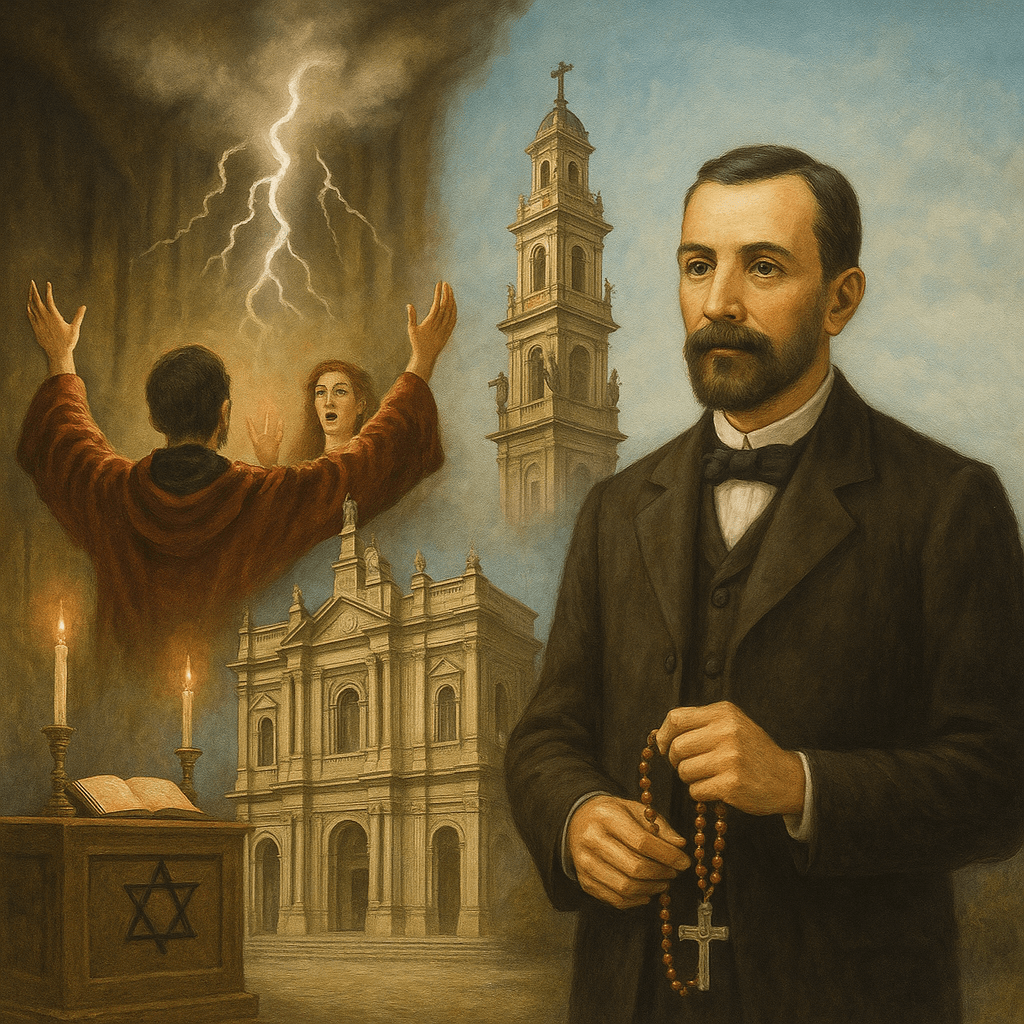
In this environment, spiritualism was fashionable among students, and Bartolo, hungry for meaning, began attending séances. These gatherings promised secret knowledge and communion with spirits. For a time, he believed he had found truth in these occult practices. But the spirits he invoked deceived him. Gradually, curiosity gave way to obsession. He became involved with a group of spiritualists and, eventually, a full satanic sect that ordained him a “priest.” During his initiation, thunder roared, and blasphemous cries filled the air. Bartolo later recalled the terror of that night, when he felt the presence of something utterly dark take hold of him.

In the months that followed, Bartolo lived in dread. He sensed an invisible companion, an “angel of darkness,” whispering to him. He felt trapped between delusion and madness. Yet even in that state, he completed his law degree and continued public attacks against the Church. His family, horrified, prayed constantly for his conversion.

Among the few faithful Catholics left at the university was Professor Vincenzo Pepe. When Bartolo confessed that he believed he had heard his dead father’s voice, Pepe warned him that the spirits were lying and that his practices would destroy both his mind and his soul. The professor begged him to repent and return to the Church. Remarkably, Bartolo agreed. Pepe gathered others to pray for him, including Caterina Volpicelli, a devout woman who led a Rosary group dedicated to the Sacred Heart of Jesus.

Through their prayers, Bartolo met Father Alberto Radente, a Dominican friar. For a full month, Father Radente counseled and exorcised him daily. Finally, on June 23, 1865, the Feast of the Sacred Heart, Bartolo made his confession and received absolution. He was reconciled to the Church and freed from the darkness that had enslaved him.

Overwhelmed with gratitude, Bartolo vowed to save others from the same deception. He attended one last séance, not to participate, but to renounce it. In the midst of the meeting, he stood up, raised a medal of the Virgin, and publicly proclaimed that spiritualism was a web of falsehood. From that moment, he dedicated his life to Christ and to Mary.

With the guidance of his spiritual directors, Bartolo discerned that his vocation was not to marry or become a priest but to serve God as a lay Dominican. On October 7, 1871 on the Feast of Our Lady of the Rosary, he entered the Third Order of St. Dominic, taking the name Brother Rosario. He studied diligently, prayed the Rosary daily, and worked among the sick and poor.

When he traveled to Pompeii to manage property for a widow, the Countess Marianna de Fusco, Bartolo found the people living in ignorance and superstition. The local church was in ruins. Remembering his own past, he resolved to restore both the building and the people’s faith. During a time of despair, haunted by thoughts of damnation, he heard an interior voice say: “If you seek salvation, propagate the Rosary. Whoever spreads the Rosary will be saved.” At that instant, peace filled his soul, and he understood his mission.

Bartolo restored the church, began teaching the Rosary, and organized an annual Feast of the Rosary in 1873. He brought to Pompeii a worn painting of Our Lady of the Rosary, later associated with miracles that drew pilgrims from across Italy. Encouraged by the Bishop of Nola, he began building a grander church, whose cornerstone was laid on May 8, 1876. Fifteen years later, it was consecrated by Cardinal Raffaele Monaco La Valletta, representing Pope Leo XIII. Today, the Pontifical Shrine of the Blessed Virgin of the Rosary of Pompeii welcomes tens of thousands of pilgrims daily.

His mission expanded beyond the basilica. Bartolo founded schools, orphanages, and homes for the children of prisoners. He started a magazine and wrote extensively about the Rosary, the saints, and Christian life. To avoid scandal from his close collaboration with Countess de Fusco, Pope Leo XIII advised them to marry. They wed on April 7, 1885, living chastely as brother and sister while continuing their charitable work.

Bartolo died peacefully on October 5, 1926, after receiving Holy Communion and praying the Rosary surrounded by orphans. His last words were, “My only desire is to see Mary, who has saved me and who will save me from the clutches of Satan.” Pope John Paul II beatified him on October 26, 1980, calling him “a man of the Rosary.” On October 19, 2025, Pope Leo XIV canonized him as Saint Bartolo Longo, Apostle of the Rosary.

Bartolo’s life remains a witness for every age: no matter how lost or deceived, a soul that turns back to God can be saved. His feast day is October 5.


Credit:
Summary inspired by Bartolo Longo by Mary’s Dowry Productions (2017), available on YouTube: https://www.youtube.com/watch?v=3OQLRndbHIM. Used under fair use for educational and religious commentary.

Christianity in Tibet: The Legacy of Jesuit Priest Ippolito Desideri


For centuries, Tibet has been a land that captures the imagination of the West: a high, remote world where spiritual and philosophical traditions intertwine with the stark beauty of the Himalayas. Among the earliest Westerners to truly engage with Tibetan thought was Ippolito Desideri, a Jesuit priest from Tuscany whose intellect, linguistic mastery, and deep curiosity made him one of the most remarkable missionaries of the early modern era. His work in the early 18th century stands as the first sustained encounter between Christianity and Tibetan Buddhism, marked not by confrontation but by a rare spirit of dialogue.

Early life and mission

Born in Pistoia in 1684, Desideri joined the Society of Jesus and quickly established himself as a scholar and teacher. His ambition was missionary work, and in 1712 he left Europe for India under the Jesuit Province of Goa. After years of difficult travel through Delhi, Kashmir, and Ladakh, he entered Lhasa on March 18, 1716. The Mongol ruler Lhasang Khan granted him permission to reside and study, marking the beginning of one of the most extraordinary intellectual encounters in religious history.¹

Tibet and the Capuchin dispute

Unknown to Desideri at the time, the Vatican’s Congregation for the Propagation of the Faith had already granted the Capuchin order exclusive rights over the Tibetan mission in 1703. This bureaucratic decision set the stage for a long jurisdictional dispute that would eventually cut short his work. In 1718, Propaganda Fide reaffirmed its assignment to the Capuchins and ordered the Jesuits to withdraw. After years of correspondence and litigation in Rome, a final decree in 1732 confirmed the Capuchins’ claim to Tibet.²

Immersion in Tibetan learning

In Lhasa, Desideri did what few missionaries before or since have attempted: he learned Tibetan thoroughly, studied Buddhist philosophy at Sera Monastery, and debated with monks in their own scholastic format. When the Dzungar invasion disrupted the capital in late 1717, he moved to Dakpo, where he continued to write and teach until his departure in 1721.³

Desideri’s approach was remarkable for its intellectual humility and rigor. He sought not to denounce Buddhism from ignorance but to understand it from within. By studying logic, metaphysics, and the Abhidharma, he entered into dialogue with the most sophisticated thinkers of his day in Tibet.

The Tibetan writings

Between 1718 and 1721 Desideri composed several original works in Tibetan. These writings, preserved in manuscripts now held in Rome and elsewhere, represent the earliest sustained Christian philosophical literature written in the Tibetan language.

  1. Tho rangs (“The Dawn”). An introductory dialogue presenting Christianity as the light that dispels ignorance and prepares the reader for deeper argumentation.⁴
  2. Lo snying po (“Essence of the Doctrine”). A concise catechism that sets out the essentials of Christian theology in the format of a Tibetan scholastic summary.⁵
  3. ’Byun k’uns (“Origin of Living Beings and of All Things”). A detailed critique of Buddhist cosmology and rebirth, arguing for a First Cause and a created order.⁶
  4. Nes legs (“The Supreme Good and Final End”). A philosophical exploration of the highest good, contrasting Christian teleology with Buddhist conceptions of nirvana.⁷

These works reveal a unique attempt to translate Thomistic metaphysics into the conceptual world of Tibetan Buddhism. Desideri employed debate forms familiar to the Geluk school and structured his reasoning through syllogisms recognizable to monastic scholars.⁸

His arguments against rebirth and emptiness

Desideri’s philosophical engagement centered on two main critiques of Buddhist doctrine: the cycle of rebirth and the concept of emptiness.

He argued that the karmic theory of rebirth fails to explain the origin of the first sentient beings, since it presupposes an infinite regress of prior lives without an initial cause. The moral and causal order of the universe, he wrote, points instead to an intelligent Creator who is both the origin and sustainer of being.⁹

Regarding emptiness (śūnyatā), Desideri contended that the very notion of dependent origination implies the existence of something independent. If everything is contingent and conditioned, reason demands an unconditioned ground. For Desideri, that ground is God, the necessary and self-subsistent cause of all things.¹⁰ He thus turned Tibetan logic toward a Christian conclusion, using the same tools his interlocutors used to defend their own tradition.

Conflict with the Capuchins and departure

While Desideri’s intellectual project flourished, his position within the Catholic hierarchy collapsed. The Capuchins, already active in Lhasa, viewed the Jesuits as intruders and appealed to Rome. After Propaganda Fide confirmed their authority, Desideri was ordered to leave Tibet in 1721. He made his way through India and returned to Europe in 1728, where he spent years defending the Jesuits’ case before ultimately submitting to the Vatican’s ruling.¹¹

The great narrative: Notizie istoriche del Tibet

Back in Rome, Desideri composed Notizie istoriche del Tibet (“Historical Notices of Tibet”), an extraordinary blend of ethnography, travel narrative, and theological reflection. In it, he described Tibetan geography, society, and religion with unprecedented detail and sympathy. Modern readers can access this work in the English translation Mission to Tibet by Michael Sweet and Leonard Zwilling, as well as in Donald Lopez and Thupten Jinpa’s Dispelling the Darkness.¹²

Legacy

Desideri died in 1733, only a year after the final Vatican ruling. His Tibetan manuscripts remained largely unknown until rediscovered in the 19th century. Today, he is recognized not only as a pioneering missionary but as a scholar who took the intellectual and spiritual life of Tibet seriously. His work stands as an early model of interreligious understanding, where dialogue was pursued through reason, language, and genuine respect.

Modern scholars such as Trent Pomplun, Donald Lopez, Thupten Jinpa, and Guido Stucco have shown that Desideri’s project anticipated later comparative philosophy by centuries. His writings remain a testimony to a unique moment when a European Jesuit and Tibetan monks met across the boundaries of faith to ask the same ultimate questions about being, purpose, and salvation.¹³


Footnotes

  1. Wikipedia, “Ippolito Desideri.”
  2. Michael J. Sweet, “Desperately Seeking Capuchins,” Archivum Historicum Societatis Iesu.
  3. Donald S. Lopez Jr. and Thupten Jinpa, Dispelling the Darkness: A Jesuit’s Quest for the Soul of Tibet.
  4. Guido Stucco, When Thomas Aquinas Met Nāgārjuna (includes translation of The Dawn).
  5. Elaine M. Robson, “A Christian Catechism in Tibetan,” University of Bristol thesis.
  6. Guido Stucco, When Thomas Aquinas Met Nāgārjuna (translation of The Origin of Living Beings).
  7. Opere tibetane di Ippolito Desideri, S.J., vol. IV (Toscano, ed.).
  8. Trent Pomplun, Jesuit on the Roof of the World: Ippolito Desideri’s Encounter with Tibetan Buddhism.
  9. Guido Stucco, When Thomas Aquinas Met Nāgārjuna, commentary section.
  10. Lopez and Jinpa, Dispelling the Darkness, analysis of Desideri’s argument on emptiness.
  11. Sweet, “Desperately Seeking Capuchins.”
  12. Ippolito Desideri, Mission to Tibet: The Extraordinary Eighteenth-Century Account, trans. Sweet, ed. Zwilling.
  13. Pomplun, Jesuit on the Roof of the World.

A Brief History of Christianity in Tibet


Early Traces: The Nestorians and the Eighth Century

The history of Christianity in Tibet stretches back far earlier than most assume. The earliest Christian presence likely came from the Nestorian Church of the East, which had spread along Silk Road routes from Mesopotamia into China by the 7th century. Evidence from the Xi’an Stele of 781 CE shows that Nestorian missionaries were active under the Tang Dynasty, and given Tibet’s close relations with Tang China, it is plausible that Christian communities emerged within the Tibetan cultural sphere during the 8th century.1 However, these early Christian enclaves left no sustained legacy; Tibet’s conversion to Buddhism under Trisong Detsen soon dominated its spiritual landscape.

Jesuits in Guge: Antonio de Andrade and the Lost Kingdom

The next major encounter between Christianity and Tibet came through the Jesuit missions of the 17th century. In 1624, the Portuguese Jesuit Antonio de Andrade became the first known European to enter Tibet. He reached Tsaparang, the capital of the Guge Kingdom in western Tibet, where he was warmly received by King Tri Tashi Dakpa (also called Chadakpo). The king even laid the cornerstone for Tibet’s first church, completed in 1626.2

De Andrade’s arrival, however, sparked tensions. His success in converting local nobles alienated the powerful Buddhist clergy. A political conflict between the king and his brother, who was aligned with Buddhist monastics, led to the downfall of the Guge mission. Around 1630, the king was overthrown with assistance from the Ladakhi ruler Sengge Namgyal, who viewed Guge’s alliance with Catholic missionaries as a provocation.3 The Jesuits were expelled or killed, and Guge itself disappeared from the political map soon thereafter.

The Jesuits in Lhasa: Ippolito Desideri and the Capuchin Controversy

After Guge’s fall, the next great missionary endeavor came with Ippolito Desideri, an Italian Jesuit who reached Lhasa in 1716. Desideri immersed himself in Tibetan culture, mastered the language, and composed treatises comparing Christian and Buddhist metaphysics. His conciliatory approach, attempting dialogue rather than confrontation, won him both local sympathy and later admiration among scholars.4

Desideri’s work, however, was undone not by Tibetans but by Church politics in Rome. The Vatican’s Congregation for the Propagation of the Faith (Propaganda Fide) restructured Asian missions and in 1703 assigned Tibet to the Capuchins, a Franciscan order. The Jesuits were ordered to withdraw, leading to Desideri’s forced departure in 1721. The decision reflected not only internal rivalry but also a Vatican preference for an order more controllable and less inclined toward syncretic engagement.5

Suppression and Exile: The 18th and 19th Centuries

After the Jesuits’ departure, Capuchin missionaries continued their work until the 1740s. A crisis erupted in 1742, when a Tibetan convert refused to bow before the Dalai Lama, an act perceived as defiance against both religion and state. The government expelled the missionaries and banned Christianity in Central Tibet, a policy enforced by 1760.6

Despite this, individual attempts persisted. In the 19th century, the British missionary Annie Royle Taylor undertook a daring journey toward Lhasa in 1892, becoming the first Western woman to reach central Tibet, though she was ultimately turned back by Tibetan guards.7 Her journey epitomized the enduring fascination and futility of Christian outreach in a land long closed to foreigners.

Elsewhere, especially in eastern Tibet (Kham), anti-Christian sentiment often flared into violence. During the 1905 Batang Uprising, missionaries and Tibetan converts were targeted and killed. Among those martyred were André Soulié (1858–1905) and Jean-Théodore Monbeig-Andrieu (1875–1914), who are commemorated in Catholic hagiographies as victims of faith-driven hostility.8

The Vatican’s Strategic Shift: Why the Jesuits Were Replaced

The Vatican’s decision to replace the Jesuits with Capuchins was rooted in both theological and geopolitical concerns. The Chinese Rites Controversy (late 17th–early 18th centuries), in which Jesuits were accused of tolerating Confucian and local religious practices, had eroded papal trust. The Propaganda Fide viewed Jesuit accommodationism, especially Desideri’s open dialogue with Buddhist philosophy, as dangerous relativism. Capuchins, by contrast, were stricter and less likely to blur doctrinal lines. As historian Donald Lach notes, “the Capuchins represented the centralizing impulse of the Counter-Reformation, where obedience outweighed intellectual innovation.”9

Christianity and Modern Tibet: A Restricted Faith

Under Chinese administration since the 1950s, Tibet’s relationship with Christianity has remained tightly controlled. The People’s Republic of China recognizes only state-sanctioned religious institutions, and Catholic practice in the Tibet Autonomous Region exists only under the auspices of the Chinese Catholic Patriotic Association, which does not recognize Vatican authority. The Holy See’s cautious diplomacy, especially during Pope Francis’s efforts to reestablish relations with Beijing, has led to a de facto acceptance of limited Catholic presence, primarily among Han Chinese residents in Lhasa rather than ethnic Tibetans.10

The Vatican continues to regard Tibet as part of its mission territory, but evangelization remains almost nonexistent. Tibetan Buddhism remains dominant, and Christian symbols such as crosses, churches, even icons are scarce across the plateau.

Legacy

From the Nestorian wanderers to Jesuit polymaths and Franciscan ascetics, Christianity’s story in Tibet is one of ambition, misunderstanding, and endurance. While never a major presence, its traces linger in forgotten ruins in Tsaparang, in Desideri’s Tibetan manuscripts preserved in Rome, and in the historical memory of dialogue between two of the world’s most mystical spiritual traditions.

Footnotes

  1. Samuel H. Moffett, A History of Christianity in Asia, Vol. I: Beginnings to 1500 (Maryknoll: Orbis Books, 1992), 291–295.
  2. Antonio de Andrade, Novo Descobrimento do Gram Cathayo ou dos Reinos de Tibet (Lisbon, 1626); Timo Schmitz, An Overview of Tibetan History (2025), 91–92.
  3. Le Calloc’h, J. (1991). “Antonio de Andrade and the Mission in Western Tibet.” Archivum Historicum Societatis Iesu, 60: 57–60.
  4. Ippolito Desideri, Notizie Istoriche del Tibet (Rome, 1727); Hattaway, Paul. Tibet: The Roof of the World (2021), 41.
  5. Peter Clarke, The Jesuits in Asia (Cambridge University Press, 1993), 204–207.
  6. Schmitz, Timo An Overview of Tibetan History, 91–92; Hattaway, 2021: 41–44.
  7. Hattaway, 2021: 68–71.
  8. Servin, Michael. “Christian Martyrs of Tibet.” Journal of Asian Church History 11 (2010): 23–39.
  9. Donald F. Lach, Asia in the Making of Europe, Vol. III (University of Chicago Press, 1977), 225–228.
  10. Holy See Press Office, “Relations between the Vatican and China,” L’Osservatore Romano, 2020.

Tertons, Termas, and the Curious Origins of Hidden Teachings


Tibetan Buddhism’s terma tradition is usually framed as a luminous, providential means by which enlightened masters hide and later reveal teachings at the exact moment needed. That’s part of the story, but it’s not the whole story by any means. Read closely, and a darker current runs through the terma corpus: treasures hidden and guarded by wrathful powers, revelations that arrive through strange, sometimes malevolent intermediaries, and rituals whose intent and method look remarkably like what modern people would call dealings with spirits or demons. In short, many tertons don’t simply find teachings; they negotiate with non-human, often wrathful forces that can reasonably be described as demonic. Below I’ll examine Dylan Esler’s study of Gya Zhang Khrom (rGya Zhang khrom)¹ and other scholarly sources as a base to examine the phenomena of tertons and terma.

What the words mean

A terma (gter ma) is literally a “hidden treasure”: text, ritual object, or practice concealed (often in a rock, lake, or the mindstream of a guru) to be discovered by a tertön (gter ston), the treasure-revealer. Academic treatments correctly emphasize the social and legitimating functions of these discoveries in prophecies, lineages, and performative acts that make the revelation believable to followers. But the same sources that record authentication narratives also preserve striking descriptions of how termas are hidden, guarded, and recovered: they are defended by territorial spirits or “treasure-lords,” transmitted by non-human yogins, and often carry explicitly wrathful, “black magic” contents. Non-human yogins can take the form of visionary yogins, dakinis/dakas, local spirits, or wrathful entities, and they act as the intermediaries who hide, protect, or hand over the treasure.

A close example: Gya Zhang Khrom and wrathful treasures

Dylan Esler’s article on Gya Zhang Khrom in the (Byang gter) Northern Treasures tradition recounts the classic terma motif: a mysterious yogin leads the future tertön to a hidden cache of ritual objects and scrolls that come out of fissures in rock, and the revealer deciphers and transmits material that includes both beneficent and harmful ritual instructions. Esler notes items described as “cycles for benefiting and harming,” in other words, materials for both white and black magic, and he situates Gya Zhang’s revelations within a Northern Treasure program that explicitly deploys wrathful, coercive ritual means. That combination of secret caches, hidden custodians, and instruction sets for destructive rituals is exactly the pattern that supports reading many termas as arriving via a demonic or semi-demonic channel.

Treasure-protectors and Lords of the Treasures: the institutional side of the “demonic”

The literatures that record terma narratives repeatedly mention gter srung (treasure-protectors) and gter bdag (lords of the treasures). These are not neutral filing cabinets: they are spirits of place, frequently wrathful, who demand protocols and substitutions (gter tshab) when a cache is opened. Ethnographic and textual scholarship treats these beings as part of the class of local, elemental, or “demonic” forces that Tibetan ritual both confronts and incorporates. Scholarly surveys of protector deities and the oral/ritual ecology around termas make clear that treasures do not simply sit inert but are guarded by active, sometimes dangerous entities. If a tertön is authorized by prophecy, that can mitigate local resistance; if not, accusations of theft and collusion with spirits arise.²

Demon-taming, wrathful methods, and ambiguous agency

The well-known motif of Padmasambhava as demon-tamer is instructive: foundational tantric figures are often framed as subduers of hostile spirits, and the very act of revealing a terma can be portrayed as the tertön’s success in negotiating or subduing a guardian force. But negotiation is not always tame or benign. A number of terma traditions preserve wrathful practices intended to overthrow enemies, cure epidemics, or control hostile spirits—techniques that look like pacts or coercive exchanges with non-human agencies. Scholarly work on Dzogchen/Northern Treasure liturgies and on early treasure careers shows repeated, explicit intersections between revealing termas and advancing ritual technologies of domination or protection over local powers.³

So, do tertons get their termas from demons?

In many traditional narratives and ritual contexts, yes. Termas are mediated by, guarded by, or negotiated with non-human beings that function similar to what observers would call demons. That’s a historical and anthropological claim. The primary sources and modern scholarship present a consistent pattern: treasures are hidden in the landscape or mind, are protected by wrathful custodians, and are sometimes transmitted by shadowy yogins or through visions that are indistinguishable from encounters with spirits. Where the contemporary, institutional presentation emphasizes enlightened intent and salvific purpose, the deeper ritual ecology reveals frequent recourse to powers that are territorial and morally ambiguous.

Final thoughts

Terma studies that stop at the rhetoric of revelation miss the subterranean reality that produces and polices those revelations. Esler’s account of Gya Zhang Khrom’s discoveries of materials explicitly useful for harming as well as helping presents a pattern replicated across the terma corpus. Read with discernment, the terma tradition looks less like a straight line from enlightened source to human disciple and more like a braided negotiation between the human revealer, local spirits or demons, and the institutional needs of Buddhist communities. That picture is central to my argument: many tertons operate at the shadowy margins where demonic forces and tantric techniques meet, and their termas are as much the products of those encounters as they are of the “pure” spiritual origins claimed by their lineages.

Notes:

  1. Dylan Esler, “Yamāntaka’s Wrathful Magic: An Instance of the Ritual Legacy of gNubs chen Sangs rgyas ye shes on the Byang gter Tradition via the Figure of rGya Zhang khrom,” Revue d’Études Tibétaines, no. 62 (Feb. 2022): 190–215, https://himalaya.socanth.cam.ac.uk/collections/journals/ret/pdf/ret_62_08.pdf (accessed Oct. 7, 2025).
  2. Jean-Luc Achard, “A Brief Note on the Northern Treasures of the Bon Tradition,” Revue d’Études Tibétaines, no. 68 (Jan. 2024): 16–35, https://d1i1jdw69xsqx0.cloudfront.net/digitalhimalaya/collections/journals/ret/pdf/ret_68_02.pdf (accessed Oct. 7, 2025).
  3. Christopher Bell, “Worldly Protector Deities in Tibetan Buddhism,” in Brill’s Encyclopedia of Buddhism, vol. 2: Major Personages in Myth, Hagiography and Historical Biography (Leiden: Brill, 2019), 1254–66, https://brill.com (entry available online; access depends on subscription) (accessed Oct. 7, 2025).

How So-Called “Buddhist” Dhāraṇīs, Images and Mandalas Were Developed Post Buddha


I spent years as a Tibetan tantric Buddhist practitioner. I once assumed the mantra, ritual, and mandala machinery I practiced was simply the Buddha’s own teaching passed down intact. We were taught that although the historical Buddha did not teach tantra in person, he taught it after his passing, on Mount Malaya, to gods and men. Koichi Shinohara’s work forces a different view and poses the question: Did Sakyamuni really teach the long formulaic dhāraṇīs, image worship, and mandala visualization as later practitioners used them? Or did later communities invent those ritual technologies and then cloak them in the Buddha’s authority so people would better accept them?

In Spells, Images, and Maṇḍalas: Tracing the Evolution of Esoteric Buddhist Rituals, Shinohara gives us a working hypothesis that can be pressed hard for answers.[1] The rituals in question are most plausibly later innovations that used the Buddha’s prestige to become authoritative. They were not the Buddha’s core teachings in any strictly historical sense. That does not make them illegitimate as religious forms for people who practice them today. It does mean historians and critics should stop pretending these rituals are reflections of Sakyamuni’s own instructions. The burden of proof rests on anyone who wants to show unbroken doctrinal transmission from the Buddha to the later esoteric ritual machinery.

Shinohara offers a testable, evidence-driven reconstruction. He traces a plausible sequence from simple spoken spells through image ritual to organized visualization. Crucially, he foregrounds early, datable Chinese dhāraṇī collections and ritual manuals. Those Chinese witnesses often predate the surviving Sanskrit and Tibetan corpora scholars have relied on. That chronological fact is the hinge of the whole argument. (Columbia University Press)

What Shinohara’s working hypothesis means

A working hypothesis is provisional and falsifiable. Shinohara is not issuing an ideological verdict. He is proposing a historical explanation that organizes the evidence and makes concrete predictions that could be falsified by earlier, securely dated Indian or canonical texts showing the full ritual machinery already present in the Buddha’s time. To press the hypothesis hard, scholars should look for those disconfirming witnesses. So far the datable documentary and manuscript evidence he emphasizes points toward post-Buddha innovation that relied on attribution to the Buddha for legitimacy.

The core empirical point

Early Buddhism included ritual speech. The Pali paritta corpus shows that communal protective chants and recitations were an early feature of Buddhist practice. Importantly, these early chants are directed primarily to the historical Buddha and the Triple Gem, the Buddha, the Dhamma, and the Saṅgha, rather than to the later, expanded pantheon of cosmic buddhas and bodhisattvas that appear in Mahāyāna and tantric literature. By contrast, the long, formulaic dhāraṇīs with non-lexical syllables, their ritual manuals, and the tightly scripted mandala visualizations appear in the surviving record mainly in later sources, often first in Chinese translations and compilations dated to the fourth through eighth centuries. That pattern strongly suggests the later technical dhāraṇī and mandala apparatus developed after the historical Buddha and used his name as an authority seal rather than being his literal, unbroken teaching (see Ratana Sutta and the paritta collections; Access to Insight).

Pali paritta versus three representative dhāraṇīs

Below is one short Pali paritta example and three representative dhāraṇī excerpts that have early Chinese witnesses. For each dhāraṇī there is a short literal transliteration excerpt, the earliest datable Chinese witness, and why this matters for Shinohara’s thesis.

A note about transliteration and length. Full dhāraṇī texts can be very long and use non-lexical syllables. I quote short, clearly identifiable openings or kernel sequences and give citations to the editions or translations where you can read the full texts.

A. Pali paritta exemplar (short protective chant from the Buddha’s time)

  • Text (Pali, introductory formula used in paritta recitation):
    Namo tassa bhagavato arahato sammāsambuddhassa.
    Translation: “Homage to the Blessed One, the Worthy One, the Fully and Exactly Awakened One.”
    Dating and context: part of the Ratana Sutta and the paritta repertoire attested in the earliest Pali strata and used continuously in Theravada protective ritual. These are short, lexically meaningful formulas employed in communal contexts. (Access to Insight)

This matters because paritta recitation shows early Buddhists used spoken protective formulas directed to the Buddha and the Triple Gem. That continuity leaves an opening for later mantra culture to develop, but continuity alone does not prove that the later technical dhāraṇīs were the Buddha’s teaching.


B. Uṣṇīṣavijayā dhāraṇī: short transliteration excerpt and dating

  • Transliteration excerpt (IAST style, short kernel):
    oṃ aḥ hūṃ uṣṇīṣa vijaya svāh. Translation: “Om. Ah. Hum. Victory to the Ushnisha. Svāhā.” Note: full versions are much longer and include complex Siddhaṃ syllables. The line above is a short recognizable kernel rather than the entire dhāraṇī.
  • Earliest datable witness: multiple Tang dynasty Chinese translations; primary translations appear in the late seventh century and the text circulated widely in Tang China thereafter. Several ritual manuals for this dhāraṇī were also translated into Chinese. (84000)

This is important because Uṣṇīṣavijayā is a canonical example of a dhāraṇī that crystallized as a ritual unit in China by the seventh century. Its early and repeated Chinese attestations show how the formulaic dhāraṇī corpus became standardized in East Asia, a datum that supports Shinohara’s emphasis on Chinese witnesses. (84000)


C. Nīlakaṇṭha / Great Compassion dhāraṇī: short transliteration excerpt and dating

  • Transliteration excerpt (short recognizable opening):
    Namo ratna trayāya … oṃ namaḥ parāya svāhā. Translation: “Homage to the Three Jewels… Om. I bow to the Supreme. Svāhā.”
    Again, the dhāraṇī in practice is very long; this is a short illustrative kernel.
  • Earliest datable witness: Bhagavaddharma’s Chinese transliteration of the Thousand-armed Avalokiteśvara dhāraṇī is commonly dated to ca. 650–661 CE at Khotan, and Dunhuang manuscript copies are attested from the eighth century onward. The standard East Asian version is listed in Taishō as T.1060. (Wikipedia)

This matters because the Great Compassion dhāraṇī’s early Chinese and Central Asian circulation shows the mobility of formulaic spells across cultural borders and their crystallization in Chinese textual layers before the later Tibetan tantra apparatus matured. That pattern again undercuts a simple claim of unbroken oral descent from the historical Buddha.


D. The Dhāraṇī of the Six Gates: transliteration indicator and dating

  • Short indicator: the sutra opens with formulaic addresses and contains six gate dhāraṇī sequences; full transliteration is available in modern critical editions. The Chinese translation by Xuanzang is dated to 645 CE (Taishō 1360). (84000)

This matters because Xuanzang’s mid-seventh century translation gives a secure terminus ante quem for certain dhāraṇī forms in East Asia. The existence of such dated translations is exactly the kind of evidence Shinohara places in the foreground when reconstructing the genealogy of ritual techniques. (84000)

Short methodological point about dates and what they prove

When a long formulaic dhāraṇī and a ritual manual appear in a secure, dated Chinese translation in the seventh century but not in any securely dated Indian source from the centuries immediately after the Buddha, the safest historical inference is that the particular ritual form crystallized later and that Chinese transmission played a major role in its textual preservation and standardization. That does not prove the practice first originated in China. It does show that the textual and ritual machinery as preserved and circulated in East Asia is early and often predates surviving Sanskrit witnesses. Shinohara uses exactly this dating logic to show how spells, images, and visualization interrelate historically. (Columbia University Press)

Did the Buddha forbid images or deification of himself?

Canonical passages caution against attachment to the person of the teacher. A well known example is the Vakkali Sutta where the Buddha tells the sick Vakkali that seeing the Dhamma is what matters, not seeing his physical body: “One who sees the Dhamma sees me; one who sees me sees the Dhamma.” That admonition has been read as discouraging hero cult and literal deification. (SuttaCentral)

The archaeological and textual record complicates the claim that the Buddha formally forbade images. However, here is a settled scholarly debate about early “aniconism” in Buddhist art. Most scholars agree that standardized, large anthropomorphic Buddha images do not appear widely until several centuries after the historical Buddha’s death. Some specialists argue that early absence of the anthropomorphic image reflects doctrinally driven aniconism. Other specialists argue the evidence is better explained by devotional practice, material culture, and local circumstances rather than by a simple canonical ban. In short, canonical caution about attachment to persons exists, but practice evolved in ways that embraced images for devotional, pedagogical, and institutional reasons. (Wikipedia)

For the former practitioner who wants a practical takeaway

If you were taught that tantric rituals are from Sakyamuni’s own instructions, the historical picture is more complicated and poses big questions to that narrative. The very technical dhāraṇī machinery, image cults, and visualization systems that define much of later tantric practice have a historical biography. They emerge, consolidate, and professionalize in the centuries after the Buddha lived, and much of the documentary evidence that preserves them comes from dated Chinese compilations and Dunhuang manuscripts. That history changes how they should be presented when someone claims they were directly taught by the Buddha himself.

History cannot prove the metaphysical provenance of a ritual. Textual and manuscript research can show whether a practice dates to Sakyamuni’s lifetime or to later cultural development, but it cannot by itself settle whether a given visionary or ritual impulse is benign or malign. If you take the language of spiritual warfare seriously, that uncertainty argues for caution. Here are four practical questions to ask before you embrace a practice: Where does its chain of transmission point? Does it coherently line up with the ethical core of the Buddha’s teaching, such as nonharm, compassion, and right conduct? What fruits does it produce in practitioners’ lives, emotionally and morally? And how transparent are its teachers about origins and effects? If a practice fails those tests, step back and favor practices that visibly cultivate ethical integrity and mental clarity. For someone who has been inside the tantric world, this is not an abstract exercise. It is a matter of spiritual survival. Let historical honesty inform your discernment, and let the lived, ethical results of practice be the final arbiter.

Sources and Bibliography

[1] Koichi Shinohara. Spells, Images, and Maṇḍalas: Tracing the Evolution of Esoteric Buddhist Rituals. New York: Columbia University Press, 2014. xxii, 324 pp. ISBN 9780231166140. See especially Chapter 1, “The Three Ritual Scenarios” (pp. 1–28), the material on the Collected Dhāraṇī Sūtras and the All-Gathering ceremony (pp. 28–89), and the chapters on the introduction of visualization practice (pp. 89–160). Recommended exact pages to quote when discussing the three scenarios and Chinese-dated evidence: consult pp. 1–4, pp. 28–64, and pp. 89–118 for Shinohara’s core arguments and manuscript citations. (Columbia University Press)

Primary dhāraṇī witnesses and editions (quick references)

  • Dhāraṇīsaṃgraha, Taishō no. 901, translated by Atikūṭa in the Tang; contains collected dhāraṇī sūtras and an early mandala initiation ritual. See Taishō T.901 and catalog entry. (NTI Reader)
  • Uṣṇīṣavijayā Dhāraṇī. Multiple Tang Chinese translations; widely circulated from the late seventh century. See 84000 Reading Room entries explaining translation history. (84000)
  • Nīlakaṇṭha / Great Compassion Dhāraṇī. Bhagavaddharma’s Khotan transliteration dated ca. 650–661 CE; standard Taishō entry T.1060 and Dunhuang manuscripts attest its early East Asian circulation. (Wikipedia)
  • Dhāraṇī of the Six Gates. Chinese translation by Xuanzang dated 645 CE (Taishō 1360). See Xuanzang colophon and modern critical editions. (84000)

Pali and early canonical material (for paritta comparison)

  • Ratana Sutta, Sutta Nipāta 2.1. Standard Pali editions and translations; see SuttaCentral and Access to Insight translations for text and context. (Wikipedia)

Secondary literature and resources on dating, aniconism, and early ritual evidence

  • Scholarly debate on Buddhist aniconism and the delayed appearance of anthropomorphic Buddha images. See Susan L. Huntington, “Early Buddhist Art and the Theory of Aniconism” and subsequent debates summarized in surveys of early Buddhist art. (Buddhism Library)
  • Columbia University Press page for Shinohara’s book with contents and excerpt. (Columbia University Press)