
An Encounter with Kali


The descent into Bengal began with a vision. As our plane banked low over the hazy sprawl of Calcutta, I sat in meditation, quietly preparing for a long journey north to Sikkim for a series of tantric empowerments. Then, quite suddenly, a naked dakini appeared before me, dancing and beckoning. She seemed to be greeting me to Calcutta. I knew, or thought I knew, that it was Kali.

We stayed in a modest Baptist guesthouse chosen for its safety and low price, a short walk from Mother Teresa’s compound. It was late October, and the air was warm and humid. Calcutta felt a bit down on her heels, yet intellectual and dignified. My companions, all Tibetan Buddhist practitioners, decided to visit Mother Teresa’s place to pay homage. I hung back. They were sincere in their devotion to that famous nun, but something in me pulled in another direction. Although I had been raised Catholic, I felt a faint aversion to anything connected with the Catholic Church. I regarded the religion as problematic. Still, seeing how genuinely excited my friends were, I encouraged them to go.

The next day I hired a taxi and arranged for us to cross the city to the Dakshineswar Kali Temple, the same temple where Ramakrishna had worshipped and experienced his visions of the Divine Mother and became enlightened. “We really must make the effort to see it,” I told the others, although I wasn’t sure why. The journey took nearly an hour through dusty streets and chaotic traffic. I had read that Kali was the patron goddess of Bengal, and that Dakshineswar was one of her most important shrines. The closer we came, the stronger the pull felt.

At the temple, a long line of Indian devotees wound through the courtyard, each waiting to glimpse the goddess and receive her blessing. We appeared to be the only Westerners there. I knew very little about the history of the temple at that point. All I knew was that I had always been intrigued by Ramakrishna among all the Hindu mystics and had always wanted to visit his temple and pay my respects.

The Temple and Its History

The Dakshineswar Kali Temple was founded in the mid-nineteenth century by Rani Rashmoni, a wealthy zamindar who, according to legend, dreamt that the goddess Kali commanded her to build a temple on the banks of the Hooghly River rather than journey by boat to Varanasi¹. Rashmoni had been preparing for the pilgrimage for months and had spent a small fortune, but on the night before her departure, Kali appeared in a dream and told her she need not travel at all. Instead, the goddess instructed her to raise a temple and enshrine an image that Kali herself would inhabit, blessing all who came to worship. The temple was completed in 1855 and the complex stands on land said to resemble a tortoise, a form considered especially auspicious in Shakta-Tantra cosmology².

Architecturally, the main temple is built in the navaratna (nine-spired) style typical of Bengal, raised on a high platform overlooking the river³. Surrounding the sanctum are twelve identical Shiva shrines aligned along the Hooghly’s edge, a small Radha-Krishna temple, and bathing ghats for pilgrims⁴.

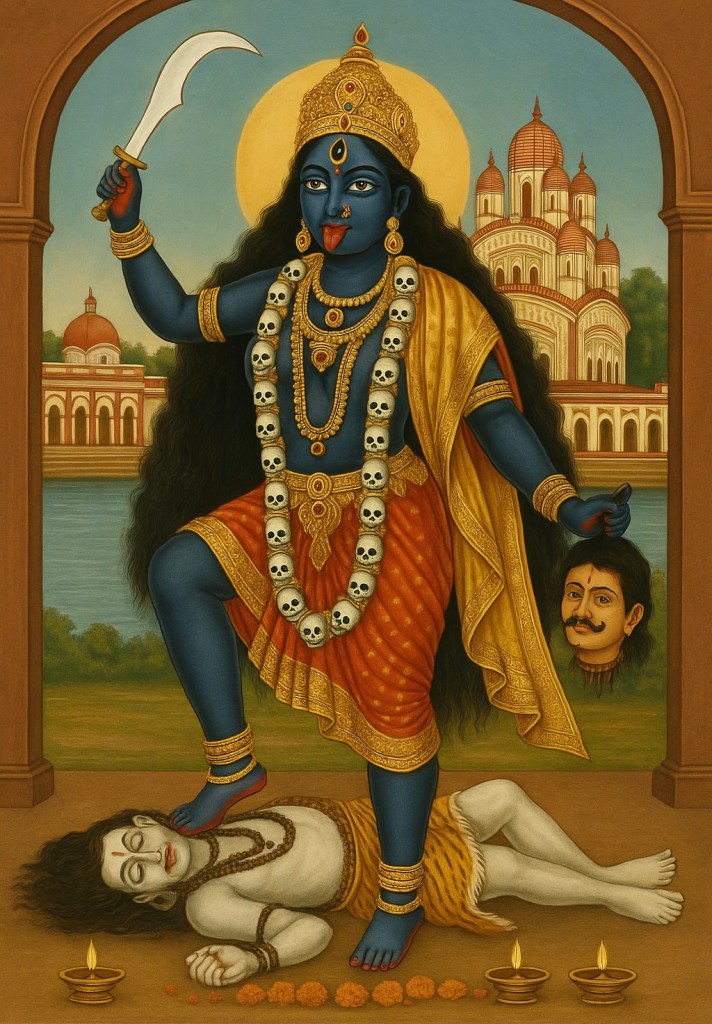
Inside the sanctum resides Bhavatarini, a fierce aspect of Kali known as “Saviour of the Universe,” depicted with one foot on Shiva’s chest⁵. The mystic Ramakrishna served as the temple’s priest and carried out years of intense spiritual practice within its grounds, transforming the site into one of India’s holiest centers of Shakti worship⁶. The atmosphere there is thick with incense, bells, flowers, and the hum of thousands of mantras. Once inside the gate you feel the city’s chaos fall away.

As we stood in line, something unexpected happened. An Indian guard suddenly appeared, motioned to me and a Buddhist friend, and beckoned us forward. Without explanation, we were led past the waiting crowd directly to the inner sanctum. The goddess stood before us, draped in red and gold, eyes alive in the flicker of ghee lamps. When I received prasad, it tasted sweet and delicious, and I felt a surge of a deep, penetrating love. It was so overwhelming that I began to cry.

As a Tibetan Buddhist, I had always regarded Hindu deities as somehow inferior and secondary to the Tibetan ones who were the representations of the ultimate truth. My practice had centered on Vajrayogini and Chakrasamvara, not on Kali. Yet there, when the experience of divine love engulfed me in the Dakshineswar temple, I felt an unmistakable recognition.

Years later, after surviving the catastrophic unraveling of my own tantric path due to the betrayal by male Buddhist teachers, the exposure of their sexual abuses, and the psychic annihilation that followed, I began to study the origins of tantra in earnest. Through the research of Alexis Sanderson and others, I learned what my experience at Dakshineswar had already shown me: that the yoginī tantras of Tibetan Buddhism arose from the same crucible of medieval Hindu Śaiva and Śākta practice⁷. Vajrayoginī, the red goddess of my own initiations, was in essence a Buddhized form of Kali. The goddess in both traditions can give blessings and boons, but she can become, in an instant, a terrifying and destructive demon with her own set of intentions and cosmic laws.

That insight came at great cost. The deeper I studied, the more clearly I saw that tantra, in both Hindu and Buddhist forms, was inseparable from forces of domination, secrecy, and power. The same ecstatic current that once inspired devotion also lurked behind manipulation and abuse. In the West, these darker currents were long dismissed or hidden, until the many scandals of 2017 tore the veil away.

My visit to Kali’s temple remains a paradox. In that moment I felt only grace: the raw, overwhelming presence of the divine feminine. But in hindsight, I experienced Kali as both mother and destroyer, blessing and devourer. She welcomed me to Calcutta with open arms, but in time, in her Buddhist form as Vajrayogini, she stripped me of everything I held dear in order to completely destroy my body, mind, and soul. By the grace of the highest divinity, the eternal Christian God, I survived and am still alive to tell the tale.


Notes

  1. Dakshineswar Kali Temple, Wikipedia, last modified 2025.
  2. Ibid.
  3. Ibid.
  4. Ibid.; see also Dakshineswar Kali Temple official site, Places in Dakshineshwar (dakshineswarkalitemple.org).
  5. Dakshineswar Kali Temple, Britannica.
  6. Ibid.; Ramakrishna’s association documented in Swami Nikhilananda, The Gospel of Sri Ramakrishna (New York: Ramakrishna-Vivekananda Center, 1942).
  7. Alexis Sanderson, “The Śaiva Age: The Rise and Dominance of Śaivism during the Early Medieval Period,” in Genesis and Development of Tantrism, ed. Shingo Einoo (Tokyo: Institute of Oriental Culture, University of Tokyo, 2009), 41–350.

What If the Kundalini Serpent Fire Was Once Angelic?


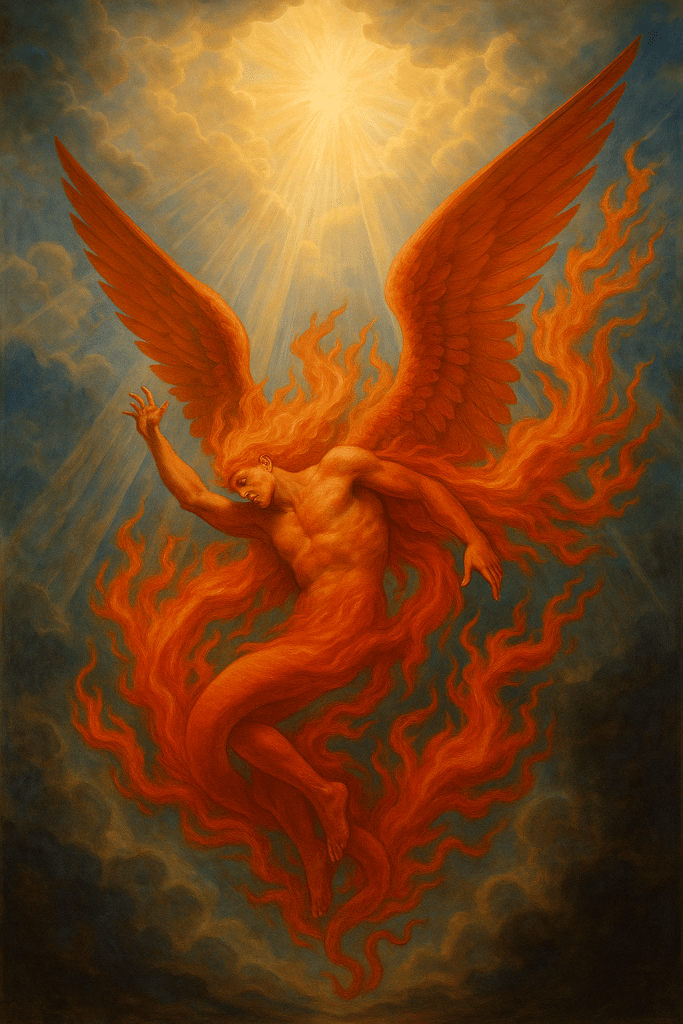
What if some of the radiant beings that ancient texts call Seraphim, the fiery, serpentine angels who once circled the throne of God, fell from that high order? The Hebrew word saraph itself means both burning one and serpent. In that ambiguity lies a bridge between the flaming spirits of heaven and the serpent powers found in other traditions.

Across the world, in the Sanskrit Purāṇas and yogic literature, there are also serpentine intelligences: the Nāgas, the Kundalinī energy, and the goddess figures who appear surrounded by flames. The sage Patañjali, author of the Yoga Sūtras, is deeply linked with serpent symbolism. In Indian mythology, he is sometimes described as an incarnation (avatāra) of the serpent deity Ādiśeṣa, or Ananta, the cosmic serpent who supports Viṣṇu. Ādiśeṣa is said to have descended to earth to bring knowledge that would relieve human suffering. This connection is why Patañjali is often portrayed with a serpent hood behind his head or a serpent body below the waist. Whether or not serpent spirits literally whispered the Yoga Sūtras to him, serpent imagery pervades yogic and tantric cosmology. The Nāgas are keepers of divine wisdom, and Kundalinī is envisioned as a coiled fiery energy at the base of the spine that awakens through disciplined practice. Over time, these motifs merged into a vision of serpentine power as both the source and the path of revelation. Suppose these mythic beings were echoes of the same order of spirits, glimpsed through another cultural lens. If the Seraphim of the Old Testament were “burning ones,” what would a fallen Seraph look like to those who encountered its power? Perhaps like the Kundalinī Śakti, a current of fire roaring through the body, consuming and transformative, perilous and hideous.

In Tibetan tantric art, figures such as Vajrayoginī blaze with this same imagery. She stands wreathed in flame, hair flying, a garland of human heads around her neck: a being of immense energy and occult knowledge. To her accomplished devotees she is enlightenment embodied, but to others overwhelmed by her force, the experience could resemble an encounter with a terrifying, cosmic intelligence that feels at once divine and frightfully destructive.

In Christian cosmology, the Seraphim stood closest to the divine light, their essence described as pure burning love. If the story of the angelic rebellion is true, the fall of Lucifer and his host might be understood as the perversion of that love for God turned inward toward self-worship. The Seraphs, if any joined that rebellion, would have fallen from the highest heaven to earth yet carried the memory of their incandescent proximity to the Most High. After such a fall, their nature would remain fiery but unmoored, no longer worshipping the divine but seeking vessels in which to become divine objects themselves, demanding reverence rather than giving it. Their rebellion took the form of imitation, of becoming godlike and leading humans away from God through elaborate systems of spiritual artifice. Seen through that lens, the serpent fire that rises in the body could be a vestige of this celestial descent, a remnant of the same luminous essence striving to return upward yet incapable of abiding in heaven because of their grave sin. In mythic terms, these fallen Seraphs might not have become the grotesque demons described by some exorcists but radiant, fallen intelligences deprived of their proper axis.

Catholic exorcists often describe demons as denizens of hell, creatures of stench, mockery, and degradation that feed on blood and fear. Yet if a third of the angels fell, the fallen host was not of one kind alone. Tradition holds that beings from all nine choirs joined the rebellion, from the lowly messengers to the highest Seraphs who once blazed before the throne. After the fall, these spirits lost their divine orientation but not their essential nature: fiery where they had been fiery, clever where they had been wise. In rebellion they became hierarchies of distortion, a dark mirror of heaven. Some manifest as the grotesque forms exorcists encounter; others as subtler intelligences still bearing the trace of their former luminosity. And what of the Nephilim, the offspring of the “sons of God” and human women? When they died, it is said, they became wandering spirits of great malice. “Demon,” then, is not a single species but a spectrum of fallen orders, each expressing what it once was in a corrupted form. As one exorcist observed, each fallen angel is a species unto itself. A fallen Seraph would perhaps appear differently from a fallen Power, Dominion, or Nephilim spirit.

If the Kundalinī or tantric fire represents contact with that residual Seraphic current, it may explain why it bears both a luminous and a destructive face. The energy feels ancient and intelligent. The ecstatic experiences described in yogic ascent mirror, in certain sense, a fallen entity yearning to return to its source. The agony that often accompanies a kundalini awakening—the painful burning, the psychic rupture, and the sense of another will within—could be the friction between that powerful celestial energy and the humble human vessel struggling to contain it. Whether one interprets this as possession or not, the pattern remains: what was once angelic becomes dangerous when severed from its orientation toward God and seeking to inhabit a human host.

Whether understood theologically, psychologically, or experientially, the speculation remains: serpent fire is something that seeks to burn within human beings, hoping to be redeemed and adored rather than condemned.

Spiritual paths that promise transcendence through serpent fire often walk a razor’s edge where illumination meets peril. Tantric Deception seeks to explore that tension, showing how practices that seem to lead toward light may instead open gateways into spiritual posession and darkness. What begins as ascent toward divinity can turn into descent into hell, both in this life and beyond. To approach the serpent fire is to confront both heaven and the echo of its fall, a perilous imitation of grace. One might call it a race to the bottom. The fallen angels made their choice long ago, and according to Christian theology there is no return for them. Those who follow, worship, or seek to become like them will share their fate in the same fire reserved for their fallen gods, a place described in Scripture as the final dwelling of the devil, his angels, and all who reject the true light. There they are said to be cast into a lake of fire that burns without end, cut off forever from the presence of the Most High God, where the torment born of rebellion becomes eternal.

When Tantric Union in Tibetan Buddhism is Invasive and Unwanted


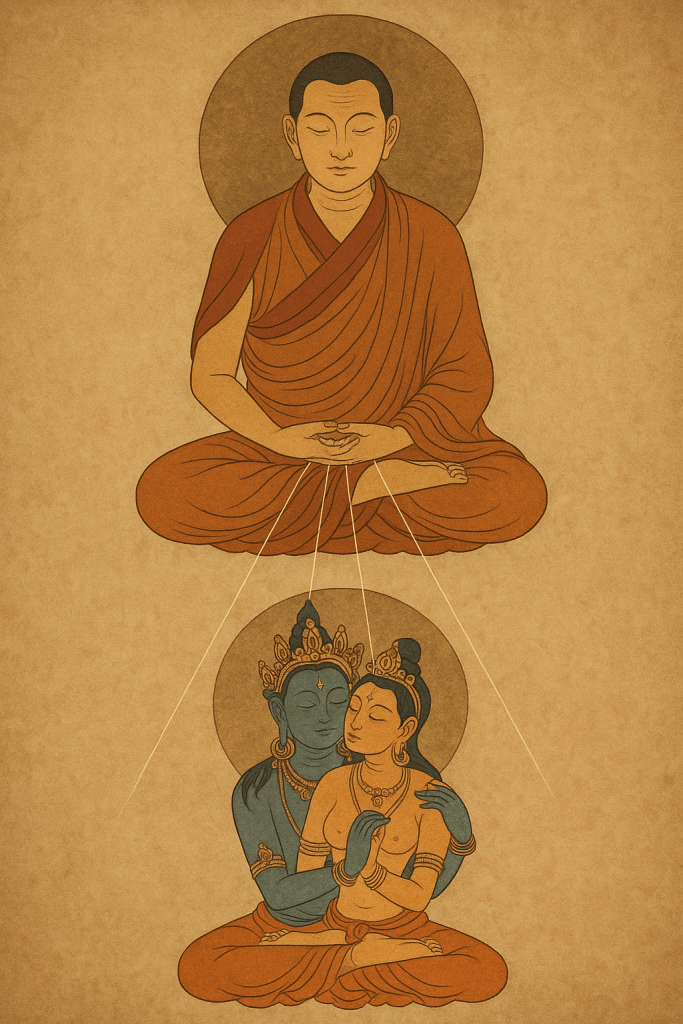
The ideal of tantric union in Vajrayāna Buddhism is described as the merging of wisdom and compassion, form and emptiness, masculine and feminine. In classical Tibetan art this appears as the yab-yum image of male and female deities in embrace.¹ The symbolism points to inner union, yet within the secrecy and hierarchy of tantra this ideal can become distorted. When intimacy, devotion, and power mix, the result can be psychological or sexual harm rather than awakening.

Union beyond the physical

“Union” (las kyi phyag rgya, maithuna) does not always refer to sexual intercourse. Many lineages teach “mental” or “energetic” union, where teacher and student visualize merging through subtle-body channels or shared deity practice.² Scholar Holly Gayley has examined how such “secret consort” (gsang yum) relationships blur lines between spiritual transmission and sexual exploitation.³

Anecdotal reports from practitioners describe non-physical experiences of sexual arousal or even orgasm initiated by the guru, without consent or understanding. For those unprepared, these experiences can feel like psychic invasion and an intrusion into the mind-body field. The ethical question is whether such experiences can ever be consensual in the context of absolute guru devotion.

The mechanism of “mental union”

Tantric theory holds that through visualization, mantra, and subtle-body control, energies (prāṇa, rlung) can be directed between beings. A guru visualized as a deity may “enter” the disciple’s heart or crown chakra, merging mindstreams in blessing.⁴ In positive settings this symbolizes transmission of realization. Yet in cases of coercion the same mechanism becomes violation: the student’s energetic body is penetrated without consent.

Ritual texts sometimes describe the guru entering the disciple’s central channel (tsa uma) through gaze or mantra, symbolic of energetic or spiritual transmission.⁵ Within Hindu Tantra, similar accounts exist of masters manipulating the disciple’s kundalinī or chakras.⁶ These ideas frame the possibility of non-physical sexualized experiences as part of spiritual union. When combined with secrecy and unequal power, the result may feel like mental rape rather than initiation.

Power, secrecy, and consent

The Vajrayāna guru is regarded as embodiment of the awakened state itself.⁷ Devotion to such a figure can override ordinary ethical boundaries. In Western contexts, where students lack cultural preparation, the potential for abuse rises sharply. Alexander Berzin warns that Western practitioners often misunderstand the traditional checks on guru authority and therefore submit to unhealthy relationships.⁸

Secrecy deepens the problem. The samaya vow forbids disclosure of tantric practices, even to peers. Gayley observes that this secrecy “can be used to reinforce sexual violence and silence abuse.”³

Real-world allegations

At Kagyu Samye Ling monastery and its retreat centre on Holy Isle in Scotland, multiple allegations have surfaced over the past decade. Reports describe bullying and psychological pressure during advanced retreats led by Drupon Khen Karma Lhabu. Recently it was reported that a British woman may have died by suicide after a four-month retreat with him; while there is no public evidence of sexual misconduct toward her, other survivors have alleged earlier incidents of “energy access” by the same teacher. Allegations included the use of “subtle body rape/sexual energy invasion,” according to an article by Adele Tomlin on the Dakini Translations website.⁹

The under-discussed nature of subtle-body abuse

Such cases remain largely invisible because tantric language itself obscures boundaries between metaphor and reality. A teacher’s claim of “mind-union” or “blessing” can mask non-consensual psychic intrusion. Students are often told that doubt equals spiritual failure, and that refusal breaks samaya. Without transparent ethics, the very tools meant to free the mind become weapons of domination.

Moving forward

Ethical tantric practice requires explicit, informed consent at every level: physical, psychological, and energetic. Teachers must articulate clearly what practices entail, and students must retain the right to refuse and leave. The spiritual promise of union cannot excuse the violation of personal autonomy. However, this kind of transparency is unheard of. Proper review structures and support for survivors are practically non-existent in most Tibetan Buddhist centers. The allegations surrounding Samye Ling and Holy Isle highlight what scholars such as Gayley describe as tantra’s “shadow”: the ease with which power can transform spiritual intimacy into a form of manipulation and abuse.


References

  1. Buddha Weekly, “What’s a Consort Union in Tantric Buddhism?” https://buddhaweekly.com/whats-consort-union-tantric-buddhism-no-not-sexual-fantasies-psychology-yab-yum-consorts-union-wisdom-compassion/
  2. Oxford Research Encyclopedia of Religion, “Tantra and the Tantric Traditions of Hinduism and Buddhism.” 2016.
  3. Gayley, Holly. “Revisiting the ‘Secret Consort’ (gsang yum) in Tibetan Buddhism.” Religions 9 (2018).
  4. Snellgrove, David. The Hevajra Tantra: A Critical Study. Oxford University Press, 1959.
  5. Wedemeyer, Christian K. Making Sense of Tantric Buddhism: History, Semiology, and Transgression in the Indian Traditions of Buddhist Tantra. Columbia University Press, 2013, esp. chap. 3–4, on symbolic initiation and tantric ritual language.
  6. White, David Gordon. Kiss of the Yoginī: “Tantric Sex” in its South Asian Contexts. University of Chicago Press, 2003.
  7. “The Guru Question: The Crisis of Western Buddhism and Global Future.” Info-Buddhism.com.
  8. Berzin, Alexander. Relating to a Spiritual Teacher: Building a Healthy Relationship. Snow Lion, 2000.
  9. Dakini Translations, “Suicide of Woman Reported in ‘Survivors of Samye Ling Support Group,’” by Adele Tomlin, the sole author of that site. https://dakinitranslations.com/2025/10/28/suicide-of-woman-reported-in-survivors-of-samye-ling-support-group-alleged-bullying-by-drupon-khen-karma-lhabu-teacher-misuse-tantra/
  10. Buddhistdoor Global, “Maithuna: Reflections on the Sacred Tantric Union of Masculine and Feminine.” https://www.buddhistdoor.net/features/maithuna-reflections-on-the-sacred-tantric-union-of-masculine-and-feminine/