Tibetan Tantra: A Snake in a Bamboo Tube


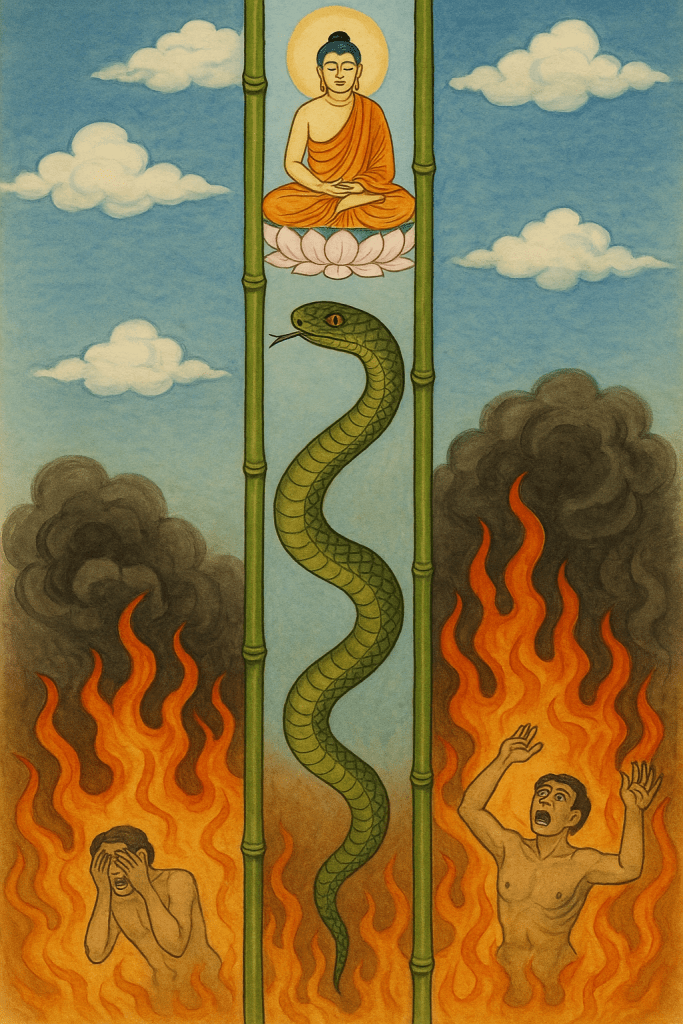
In Tibetan tantric Buddhism, the image of the snake trapped in a bamboo tube is more than a vivid proverb. It functions as a doctrinal warning: once a student enters the tantric path, there is no lateral escape. One either goes upward toward awakening or downward toward failure and “vajra hell.” Teachers have used this image to describe the uncompromising nature of samaya, the vows that bind a student to the guru, the deity, and the tantric methods themselves.¹

What is striking is how explicitly the tradition frames tantra as irreversible and high-stakes, and how rarely that stark truth is communicated to Western beginners before they agree to the vows that supposedly make the tube snap shut behind them. This mismatch between traditional warning and Western presentation is not a minor detail; it shapes the entire experience of Vajrayāna in modern contexts.

When the Warning Arrives Too Late

Many longtime practitioners have reported that the “snake in the tube” metaphor is introduced only after they have taken empowerments, established loyalty to the teacher, and accepted vows they did not fully understand. In one account, students were told after receiving advanced teachings that they were now like snakes [in a tube] with no side exit, and that questioning or leaving the guru’s authority carried dire karmic consequences.² Once framed in these terms, the student is no longer encountering tantra freely. The imagery becomes a retrospective justification for total commitment and an interpretive trap that discourages reevaluation, dissent or disengagement.

This sequencing matters. Warnings given after the student is already inside the tube are not warnings at all; they function as a mechanism of control. Sadly, it’s not just empty scaremongering to get the student to do whatever the teacher wants. The teacher can play a part in destroying the student if he wishes.

Western students, however, often enter tantra without the cultural framework that understands concepts like vajra–hell, and as a result frequently interpret them metaphorically or ignore them altogether during empowerments or teachings. As a result, the gravity of samaya is often hidden in plain sight. Students may assume that vows are symbolic or aspirational when, within the tradition, they are treated as binding conditions that determine spiritual destiny.

The asymmetry of information here is profound. Tibetan teachers know the stakes, but Western students usually do not.

Fear as a Reinforcing Mechanism

Inside the tantric system, samaya is often discussed as a bond of trust and devotion. But its shadow side is rarely addressed openly: the way threats of karmic ruin can be used to enforce silence and obedience. If leaving the guru, criticizing harmful behavior, or even doubting the teacher’s purity is framed as a breach of samaya, then fear becomes central to the student’s experience. Some Tibetan masters teach that both teacher and student can fall into vajra-hell for damaging the guru-disciple bond.³ In practice, however, this warning is most often directed at students, who are told that speaking publicly about misconduct or abuse may destroy their spiritual future.

Why the Snake Matters

The “snake in the bamboo tube” metaphor distills these concerns with unusual clarity. It shows that tantra is not designed to allow experimentation or partial commitment. It requires total participation in a closed system with its own rules, hierarchies, and cosmology. In cultures where this system has historically been embedded, those entering it do so in fuller awareness of the stakes. In the West, students often do not and they may hear such warnings in a highly suggestible state, without really grasping the implications.

One famous guru in the 1980s bluntly told students that they could be both Christian and Buddhist with no conflict whatsoever. This blatantly goes against Christian teaching. In those days Westerners were often thrust into the three-year-retreat program shortly after they signed up for teachings at Dharma centers with no knowledge of what they were really getting into. Many had little preparation to truly understand the arcane nature of samaya and its risks. Furthermore, many Tibetan teachers took advantage of their roles as authority figures to manipulate vulnerable students into sexual relationships and other sorts of commitments. Engaging in secretive sexual relationships with students while pressuring them to take highest yoga tantra vows and practices that would bind them forever often led to deep confusion and psychological unmooring.

The result is a form of spiritual engagement that looks consensual on the surface but lacks true informed consent. Students may be drawn in by promises of transformation but only later discover the rigidity of the commitments they have made. This is especially jarring given that Vajrayāna wraps together the renunciation of the Hinayāna, the boundless compassion of the Mahāyāna, and the esoteric demands of tantra. In this unwieldy fusion, the same tradition that teaches gentle observation of thoughts can also insist that a single critical thought toward one’s guru carries the weight of karmic catastrophe. The threat of vajra-hell sits uneasily beside Buddhism’s wider emphasis on compassion and non-judgment. An ethical issue looms large: a path that describes itself as having no side exit should not be offered as if it does.

To treat tantra’s danger as a secret or secondary detail is to undermine the integrity of the path itself. If practitioners are indeed snakes in a tube, they deserve to be told before they go inside.


Footnotes

¹ “Once you take samaya you become like a snake in a vertical bamboo tube: you’re either going up, or you’re going down. You can’t sneak out the side.” (Kun zang.org) (kunzang.org)
² Note: practitioner-reports and forum posts indicate the metaphor is often applied post-initiation. For example: “A Vajrayana practitioner is like a snake in a tube; … he can either go up or down, not left or right.” (dharmawheel.net)
³ “The metaphor for samaya is a snake in a bamboo tube. It has only 2 directions – up to enlightenment or down to the hells.” (TibetDharma.com) (Tibetan Buddhism)

The Question of the Soul: Christianity, Hinduism, and Buddhism


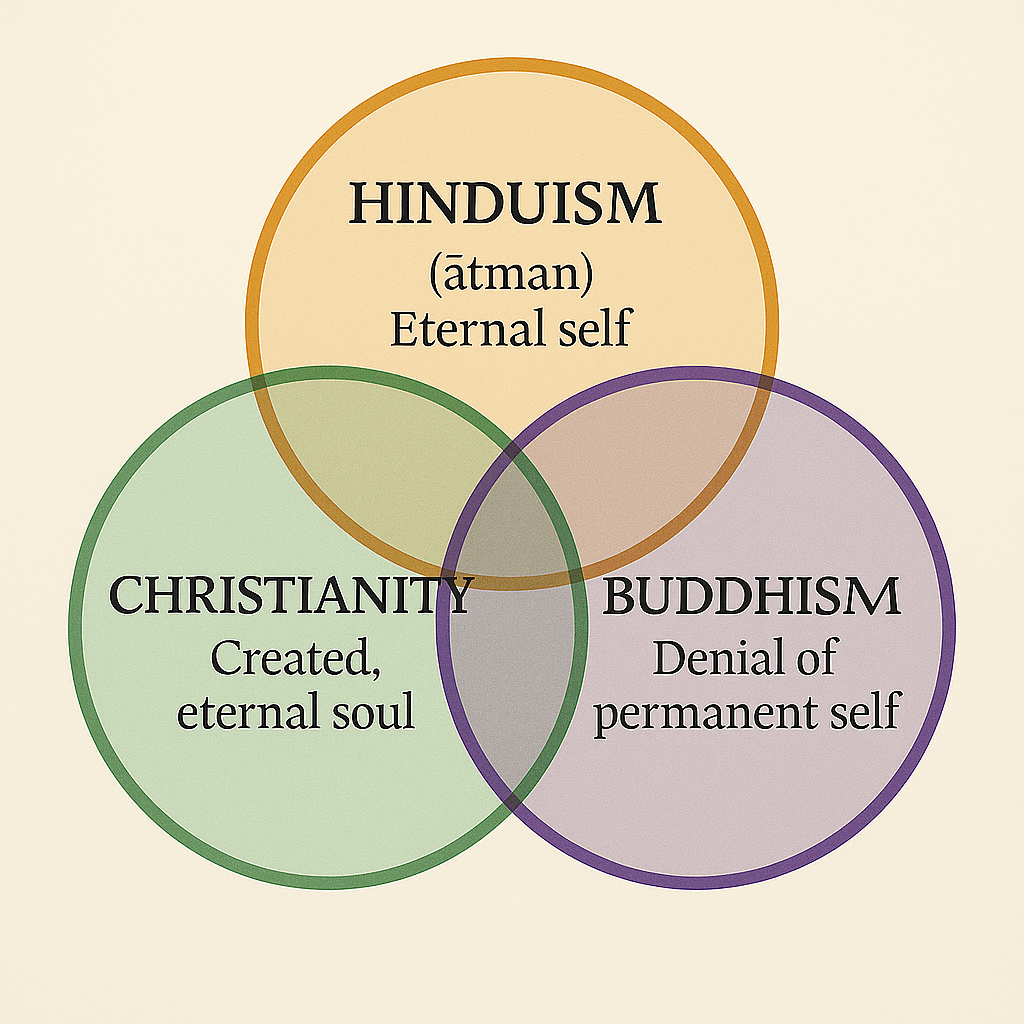
The question of what the soul is, whether it exists, and what happens to it after death lies at the center of the world’s major religious traditions. Christianity, especially in its Catholic tradition, affirms the soul as eternal and God-given. Hinduism has multiple schools, often affirming an eternal self or ātman. Buddhism, including Tibetan Buddhism, rejects the idea of a permanent self or soul and instead speaks of mind and consciousness as a conditioned stream of awareness without enduring essence.


The Christian and Catholic Understanding of the Soul

Christianity teaches that every human being has a unique, immortal soul created by God. According to Catholic doctrine, the soul is the spiritual principle of the human person. It is eternal in destiny, surviving bodily death, and directed either toward communion with God or separation from Him.

Scriptural sources include Genesis 2:7, where God breathes life into Adam and he becomes a living soul [1]; Matthew 10:28, where Jesus warns of the danger of losing the soul [2]; and the Catechism of the Catholic Church, which affirms that the soul is created by God and immortal [3]. In this view, the soul is not an impersonal principle but a personal identity, judged and redeemed by God.


Hindu Views on the Self (Ātman)

Hinduism is diverse, but most of its classical schools affirm the existence of ātman, the true self. The Chandogya Upanishad teaches “tat tvam asi” (you are that), affirming the identity of the self with Brahman [4]. The Brihadaranyaka Upanishad declares, “This self (ātman) is indeed Brahman” [5]. The Bhagavad Gita teaches that the self is eternal and indestructible [6].

Distinguishing Hindu and Christian Concepts

Both Hindu and Christian traditions speak of something enduring at the core of human existence, but they do so in different ways.

Christianity teaches that the soul is created by God, personal, and accountable before Him. It does not preexist from eternity but comes into being by His will and remains dependent on Him for existence, judgment, and salvation.

In Hindu thought, Advaita Vedānta emphasizes the identity of the self (ātman) with Brahman, dissolving individuality into the absolute. Dvaita and many Bhakti traditions instead teach that the self remains distinct yet eternal, existing in relationship with the divine. In all of these cases, the ātman is uncreated and co-eternal with ultimate reality, not brought into being by God.

Thus, while both traditions sometimes use personal and sometimes abstract language, the Christian soul and the Hindu ātman play very different roles. The soul in Christian theology is a created person before God; the ātman in Hindu philosophy is an eternal essence, whether one with Brahman or distinct in devotion.


The Creator God in Christianity and Hinduism

Christianity affirms one personal Creator God who brings the universe into being from nothing and sustains it in existence.

Hinduism presents a wide range of views. In Bhakti traditions, deities such as Vishnu, Shiva, or Devi are worshiped as supreme creators. Vedānta schools affirm Brahman as the ultimate source, though in Advaita this is not a personal act of creation but the manifestation of māyā. Other schools such as Sāṃkhya and Mīmāṃsā reject a creator altogether, viewing the universe as self-arising.

Thus, while Christianity grounds the soul in a personal God who creates and judges, Hindu thought ranges from devotion to a personal creator to cosmologies where no creator is necessary.


Buddhist Rejection of the Soul

Buddhism arose in part as a rejection of the Hindu doctrine of ātman. In the Anattalakkhana Sutta, the Buddha declared that none of the five aggregates of existence constitute a self [7]. The doctrine of anātman (no-soul) became central.

Mind and Consciousness

In Tibetan Buddhism, mind and consciousness are viewed as a stream of awareness, conditioned by karma. The Abhidharma-kośa describes consciousness as momentary and dependent [8]. Unlike Christianity and Hinduism, which affirm an eternal principle (soul or self), Buddhism denies it, calling belief in permanence a delusion.

Yet questions arise. If there is no soul, then what suffers in the hell realms described in Tibetan texts? The Bardo Thödol warns of the horrors of the Vajra Hell, a realm said to be utterly without escape [9]. The Hevajra Tantra declares that those who violate tantric commitments “will not be liberated for as many eons as there are atoms in the universe” [10]. The Cakrasaṃvara Tantra and later commentaries also teach that breaking tantric vows leads to vajra hells without release [11].

This presents a paradox: if there is no enduring self, who is suffering eternally?


Tibetan Buddhist Schools Under Examination

Madhyamaka – Nāgārjuna’s Mūlamadhyamakakārikā argues that all phenomena, including the self, are empty of inherent existence [13]. But if the self is an illusion, how does karma persist? If Vajra Hell is eternal, how can something that does not exist suffer forever?

Yogācāra (Mind-Only) – The Yogācārabhūmi Śāstra introduces ālayavijñāna, the “storehouse consciousness,” which preserves karmic seeds [14]. Though intended to avoid affirming a self, it functions much like one: carrying memory, identity, and karma. Hinduism here provides a comparison: the Bhagavad Gita teaches that the self carries karma through many births [6]. Yogācāra denies the term “soul,” yet reintroduces something strikingly similar. Christianity differs again: not a karmic storehouse, but a personal soul created by God.

Dzogchen (Great Perfection) – Dzogchen teachings, such as the Kunjed Gyalpo (All-Creating King), speak of rigpa, primordial pure awareness that is timeless and luminous [15]. Though Dzogchen denies that rigpa is a soul, the resemblance is striking. If rigpa is eternal, pure, and the ground of all experience, how is this different from what Christians call the soul or Hindus call ātman? The denial seems rhetorical rather than substantive.

Vajrayāna and Deity Possession – Tantric scriptures describe deity yoga, in which practitioners invite deities to merge with them [16]. If there is no self or soul, what exactly is being merged with or possessed?


Conclusion

Across Christianity, Hinduism, and Buddhism, the question of what endures, what we might call the soul, self, or consciousness, reveals fundamentally different views of human identity. Christianity anchors personhood in a created, immortal soul made by God and accountable to Him. Hinduism envisions an eternal ātman, uncreated and either one with or distinct from the divine. Buddhism, in contrast, denies any enduring essence, seeing the sense of self as a conditioned process. Yet in its Tibetan forms, teachings on karmic continuity, primordial awareness, and tantric transformation often edge back toward affirming something that functions like a self.

From long immersion in both Catholic and Tibetan Buddhist traditions, I have come to believe that the Christian vision alone sustains coherence between moral responsibility, continuity of consciousness, and the promise of redemption. It affirms not only that we exist, but that we are known and loved by the One who created us. Against the shifting alternatives of an impersonal absolute or an empty stream of awareness, in my opinion, the Christian understanding of the soul remains the clearest expression of what it means to be human before God.


References

[1] Genesis 2:7, The Holy Bible (ESV).
[2] Matthew 10:28, The Holy Bible (ESV).
[3] Catechism of the Catholic Church, Part I, Section Two, Chapter One, Article 1, §366.
[4] Chandogya Upanishad 6.8.7, in Radhakrishnan, S. (trans.), The Principal Upanishads.
[5] Brihadaranyaka Upanishad 4.4.5, in Olivelle, P. (trans.), The Early Upanishads.
[6] Bhagavad Gita 2.20, in Zaehner, R. (trans.), The Bhagavad-Gita.
[7] Anattalakkhana Sutta (Samyutta Nikaya 22.59), in Bhikkhu Bodhi (trans.), The Connected Discourses of the Buddha.
[8] Vasubandhu, Abhidharma-kośa.
[9] Bardo Thödol (Tibetan Book of the Dead), in Evans-Wentz, W.Y. (ed.).
[10] Hevajra Tantra, Snellgrove, D.L. (trans.), The Hevajra Tantra: A Critical Study.
[11] Cakrasaṃvara Tantra, in Tsuda, S. (trans.), The Samvarodaya Tantra.
[12] Hevajra Tantra, ibid.
[13] Nāgārjuna, Mūlamadhyamakakārikā, Kalupahana, D.J. (trans.).
[14] Yogācārabhūmi Śāstra, Xuanzang (trans.).
[15] Kunjed Gyalpo (All-Creating King), in Namkhai Norbu (trans.), The Supreme Source.
[16] Cakrasaṃvara Tantra and Hevajra Tantra, ibid.


Jesus Let Me Walk Away; the Gurus Did Not


When I was fifteen, I walked away from the Catholic Church.

There was no drama, no spiritual backlash, no eerie sense of guilt or dread. I simply left. I had questions, and I didn’t know the answers. Like so many teenagers raised in religion, I drifted toward freedom, or what I thought was freedom. But I never stopped believing in Jesus Christ. I always knew He was real.

Still, for eight years, I lived outside the Church. No demons haunted me. No spiritual “agents” came after me. No dark force tried to pull me back or punish me. I was free to explore.

Then, at twenty-three, I was introduced to Tibetan Buddhism by a friend. Spiritual curiosity quickly became commitment. The teachings were deep, the rituals profound, and the promises huge. My belief in Jesus wasn’t challenged outright; instead, the gurus cleverly and swiftly recast Him as a “bodhisattva,” one of many enlightened beings in a cosmic buffet of spiritual options. I was told He was admirable, but not unique. Just another wise, and probably enlightened teacher.

I didn’t realize then how that subtle shift had planted the seeds of spiritual confusion. Over time, the practices became more demanding and more secretive. Eventually questions weren’t welcomed. When I began to notice darker occult elements woven into the heart of the practice, I had troubling doubts. The tantric path spoke of vajra hell, an eternal punishment for those who questioned or broke samaya (spiritual vows to the guru). And not just for betrayal or disobedience, but even for internal doubts.

And when I had them, everything changed.

I was tossed out. Not just socially or emotionally, but spiritually. I was attacked, not just by my former gurus, but by unseen forces. It was violent and supernatural. The very same tradition that had claimed to offer peace and enlightenment unleashed something very dark the moment I started to turn away from the guru.

This wasn’t like walking away from the Catholic Church. It was completely different. I experienced a spiritual assault of such magnitude that no one could believe me. And it begged the question: What kind of spiritual path tortures you for eternity for having doubts?

A demonic path does.The historical Buddha taught to question everything, but tantra did not allow it.

Tibetan Buddhism may parade as a tradition of compassion and peace, but my experience showed otherwise. If it were truly of the Light, it wouldn’t need to threaten vajra hell or unleash invisible tormentors on those who simply ask blunt and honest questions. It wouldn’t need to cloak the guru in infallibility while turning a blind eye to his abuse. And it certainly wouldn’t need to demonically retaliate against a soul simply for having doubts and trauma. The difference between the two paths couldn’t be clearer. When I left the Church, there was silence. When I left Tibetan Buddhism, there was war.


Wrathful Rituals and “Black Magic” in Tibetan Guru-Disciple Relationships

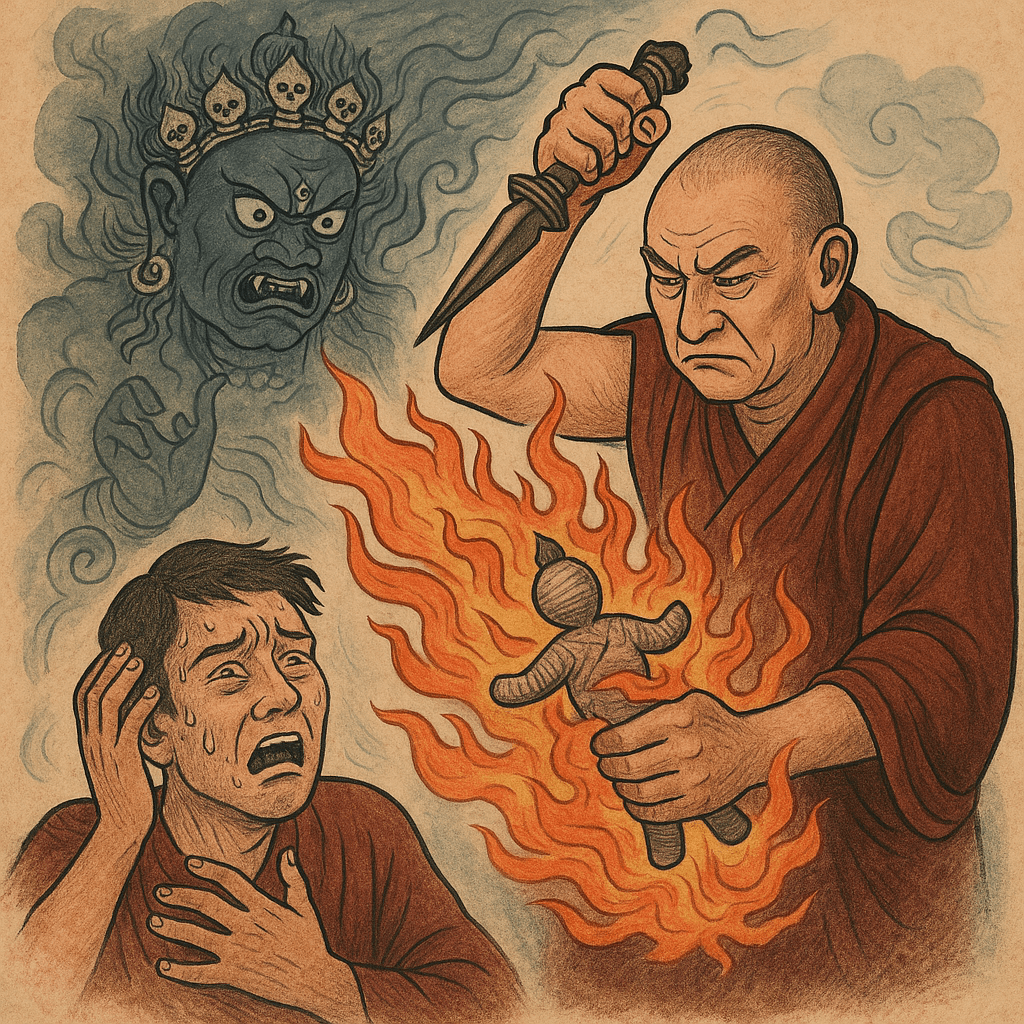
It is not far fetched to assert that it is the lama himself bringing about the karmic retribution on the student through black magic rituals using effigies and curses.


The Tibetan Buddhist tradition, especially its Vajrayana (tantric) aspect, contains teachings on wrathful rituals and even sorcery-like practices. These practices have occasionally been used (or misused) by gurus to punish or frighten disciples who violate guru devotion or samaya (sacred vows). Both classical texts and modern accounts document such phenomena:

  • Scriptural Warnings of Dire Consequences: Tantric scriptures and commentaries explicitly warn of terrible karmic punishment if a disciple betrays or criticizes their guru. For example, the Kalachakra Tantra says that even a moment of anger toward one’s guru destroys vast amounts of merit and causes rebirth in hell for eons (The Disadvantages of Incorrect Devotion to a Guru | Lama Yeshe Wisdom Archive).

  • Another text states that simply failing to properly honor a guru after receiving teachings can result in “rebirth for one hundred lifetimes as a dog” and then rebirth as a low-caste person or even a scorpion lamayeshe.com. In short, breaking samaya is portrayed as spiritually catastrophic, leading to suffering in this life and the next. These warnings, while couched as impersonal karmic law, create a climate in which gurus are held almost above criticism.

  • Oath-Breakers and Protector Deities: Tantric cosmology includes Dharmapāla (Dharma protectors) bound by oath to protect Buddhist teachings and teachers. Those who break their sacred vows or harm their guru are sometimes called “samaya-breakers” or oath-breakers. Historical texts indicate that oath-breakers were targeted by wrathful rituals. A striking example comes from a 13th-century Tibetan master at Kublai Khan’s court, Ga Anyen Dampa. In a decree mixing politics and magic, Dampa forbade harming his followers through curses or demons, but warned that if anyone disobeyed him, he would “unleash the fierce punishment of the Dharma Protectors” so that their heads would split into a hundred pieces (War Magic: Tibetan Sorcery | Rubin Museum). In other words, the guru swore to call upon wrathful deities to brutally destroy anyone who violated his command. Such records (in this case preserved as a protective charm) show that invoking black magic and protective deities as punishment for disobedience was not unheard of.

  • Effigies and “Black Magic” in Tantric Practice: Tibetan lamas developed elaborate ritual technologies to deal with enemies or detractors. Human effigies and dough figures (torma) are traditional ritual implements used to represent a target in magical rites. According to scholars, a “wide array of images, such as human effigies…or ritual dough-offering sculptures, were employed to…subdue or destroy one’s enemies” (War Magic: Tibetan Sorcery | Rubin Museum). In wrathful rites (such as the gTor dabs or torma-throwing ritual), the lama empowers an effigy with mantras and offers it to wrathful spirits or deities, directing the ensuing harm toward the intended victim. War Magic was even used at state levels, for instance, 12th-century Lama Zhang, a militant yogi, sent cursed tormas and spells against his foes and had protector goddesses like Shri Devi “assist” in battle (War Magic: Tibetan Sorcery | Rubin Museum). These historical uses of violent sorcery, while aimed at external enemies, set a background against which a guru might also target an “enemy” disciple who they feel has betrayed them.

  • Historical Case – The “Cursed Boots” Plot: In 1900, an incident in Lhasa suggests the reality of such magical punishments. The 13th Dalai Lama survived an assassination attempt involving black magic: a certain gifted pair of boots, which caused illness to the wearer, upon close inspection had “a harmful mantra hidden in the sole.” (Treasury of Lives: The Case of the Dalai Lama’s Cursed Boots – Tricycle: The Buddhist Review) The inquiry revealed that the boots were prepared as a curse by a lama famous for sorcery, acting on behalf of a former regent. That sorcerer (Lama Nyaktrul) confessed he was recruited to enchant the boots “as a means to sap the vitality of the Dalai Lama and cause his eventual death” (Treasury of Lives: The Case of the Dalai Lama’s Cursed Boots – Tricycle: The Buddhist Review). The plotters, including the ex-regent, were arrested, confirming this was not mere superstition but a documented attempt to use ritual magic to punish or eliminate a high lama. While this is a political case, it shows that Tibetan lamas did employ curses (mantras on effigies or objects) to secretly harm human targets. It’s a short step to imagine a vindictive guru doing similar things to a personal disciple who is seen as a traitor.

  • Even when literal demons aren’t invoked, the threat of supernatural harm is a powerful tool. Some Vajrayana insiders have noted that gurus sometimes wield samaya as a weapon of fear, warning that if a student breaks their devotion, it will hinder the guru’s life or send the student to Vajra Hell. This can psychologically terrorize students into silence and obedience.

  • Samaya and Guru Devotion as a Control Mechanism: The reverence for gurus in Tibetan Buddhism, while spiritually meaningful in that system, can be abused. Devoted students are taught to see the guru as embodying all Buddhas (The Disadvantages of Incorrect Devotion to a Guru | Lama Yeshe Wisdom Archive), and therefore criticizing the guru is equivalent to criticizing the Buddha himself. This makes any challenge tantamount to sacrilege. Teachers who demand absolute loyalty may invoke wrathful consequences to enforce it. In the lore, breaking samaya not only brings karmic punishment but may incite the guru’s protector spirits to take revenge. For instance, many guardian deities are oath-bound to “strike down those who break their vows” to the guru or teachings. A protector like Dorje Shugden, controversially, is believed by his devotees to punish monks who “betray” their lineage, an idea which has led to real-world fear and schisms ( Go On, Break Your Samaya | Tsem Rinpoche). Thus, within the context of guru devotion, the line between religious oath and curse can blur: a disciple who disobeys is told they invite not only bad karma but possibly violent divine retribution.

  • To go one step further, it is not far fetched to assert that it is the lama himself bringing about the karmic retribution on the student through black magic rituals using effigies and curses. These practices are particularly potent because the disciple would have opened themselves up to being possessed by the guru’s yidams and protectors through the empowerments and teachings they received from the guru. In addition, the guru is able to enter the mind and body of the disciple magically. See Tantric Astral Projection, the Guru’s Power to Liberate or Condemn. So basically, the potential enemy is already camped within the body/mind/spirit of the victim, waiting to strike should there be any samaya breakage. Although the tantric methods contain practices to repair broken samaya, the student/victim is not always aware that he has offended the guru and been condemned as an “unripe vessel” until it is too late.

In summary, credible sources, from canonical texts to academic studies and personal testimonies, support the claim that some Tibetan Buddhist gurus have used wrathful magic to punish dissenters. Traditional scriptures describe horrific fates for disciples who violate samaya, and Tibetan histories recount lamas employing curses, effigies, and protective deities to destroy enemies and “oath-breakers.” These examples, past and present, illustrate how the immense power ascribed to Vajrayana masters can morph into a tool of coercion, a “dark side” of guru devotion that Buddhist scholars and leaders are increasingly acknowledging. The evidence is admittedly esoteric, but it paints a consistent picture: under the pretext of protecting the Dharma or upholding sacred vows, some gurus have indeed used wrathful magic, rituals, or effigies to inflict harm on those who oppose or disobey them.

Sources: