
When Demons Leave the Way They Came: Breath, Tantra, and the Kalachakra Deception


Lately, I’ve been praying for God to continue revealing the truth about what I was involved in during my years of deep immersion in Tibetan Tantra. I’ve asked Him to uncover every layer of deception and to expose every way in which these practices are demonic. And He is answering.

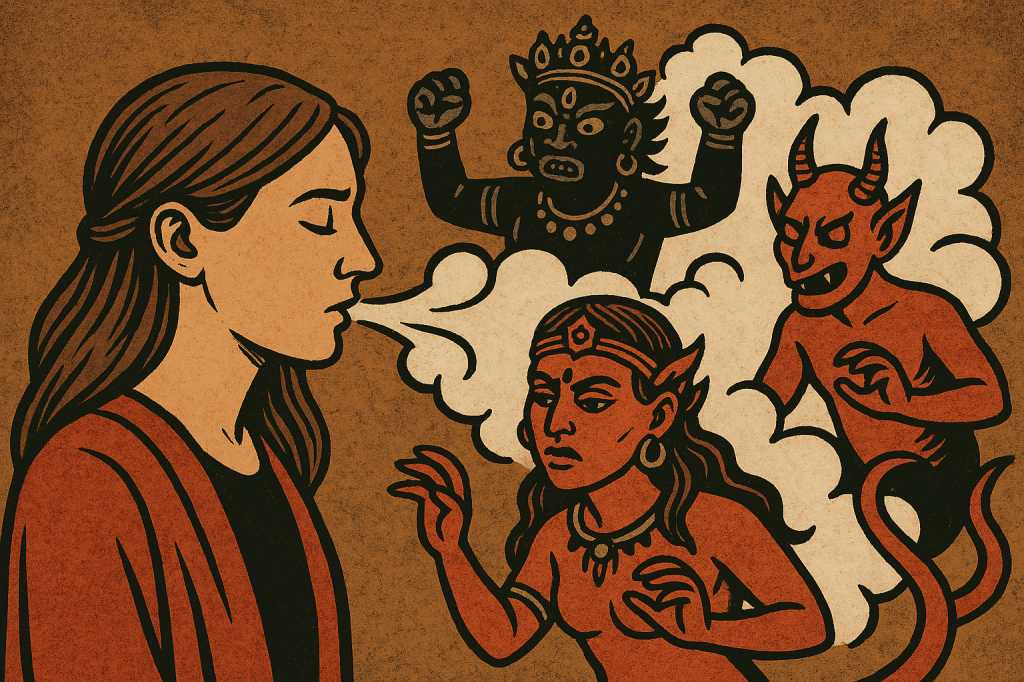
This past week, something profound happened: I experienced mass deliverance through my breath. As I exhaled, demons left me. Over and over again. It was undeniable. And then it hit me: of course they left on the breath. They came in on the breath.

This is not metaphorical. This is how tantra works. The breath is a key mechanism through which demonic entities enter one’s being. Yogic and tantric practices revolve around breath control: deep manipulation and intentional retention of the breath to open oneself to possession by what are euphemistically called “deities” but are, according to Christianity, demons.

In my three-year retreat, the main entities I invoked and merged with were Vajrayogini, the Red Dakini, and her consort. These were not simple meditations or visualizations. These were acts of surrender and identity dissolution. In essence, the goal was full-blown possession, even though it wasn’t couched in those terms and I didn’t realize that is what was happening.

Vajrayogini doesn’t come alone. Her retinue includes approximately 120 assistants, each with its own functions and qualities. That number is staggering, and that’s just one system of practice. In addition to her, I practiced the sadhana of a wrathful black deity with a massive host of demonic attendants. I should stress that these are not benign energies. They are demanding, and potentially violent and spiritually lethal.

But even beyond retreat, I continued to receive more initiations, or so-called empowerments. One that stands out is the Kalachakra initiation in 2011 from the Dalai Lama in Washington, D.C. It was a 10-day, all-day affair. I was zealous, determined to catch every detail of the ritual. I arrived early each morning to watch the Dalai Lama prepare himself by “self-generating” as the deity Kalachakra. It was amazing to watch; he was ritually becoming the deity.

Kalachakra, which means “Wheel of Time,” is a tantric deity surrounded by a staggering retinue of 722 deities. But these aren’t heavenly hosts. According to Christianity, they are demons. Every one of them. The entire system is a carefully constructed spiritual snare designed to bind souls to counterfeit light.

Thousands, maybe millions, have received these same initiations. The Dalai Lama has made it his mission to offer the Kalachakra globally. People believe they are receiving a blessing. But in reality, they are being spiritually colonized. Demonic systems are being seeded into the nations. These rituals are not neutral cultural events. They are portals for dark power.

If you want a glimpse into what may really happening during these ceremonies, I encourage you to read this article that lays it out plainly:
Dalai Lama and the Kalachakra

As for me, I’m continuing to pray and seek God’s help in cleansing every layer of my being. What I’m realizing is horrifying but I am confident that God is showing me the truth and setting me free.

A Critical Look at Vajrayana Magic


Vajrayana Buddhism presents itself as a path of radical transformation: a sacred alchemy where ordinary perception is transmuted into enlightened wisdom. Its ritual technologies are often described as “skillful means,” and its magical practices framed as expressions of “Buddha activity.” But the colorful mandalas and enchanting deity meditations obscure something more dangerous than most practitioners realize.

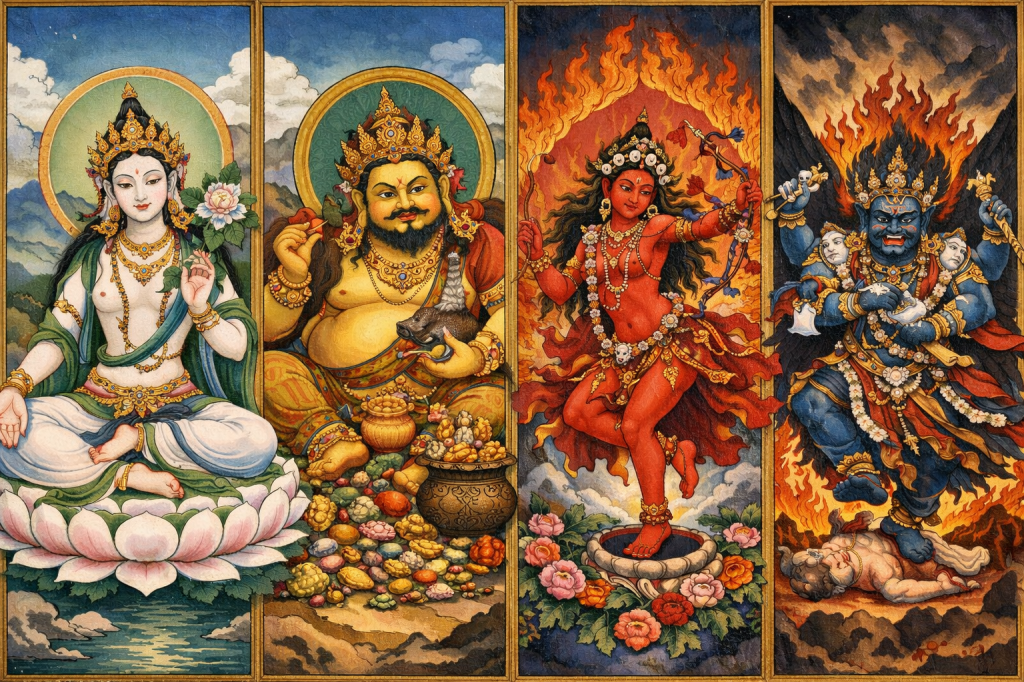
According to vajranatha.com, Vajrayana operates through four principal kinds of magical activity, each aligned with a cardinal direction, a color, and a particular type of power:

  • White (east): for pacifying and healing
  • Yellow (south): for increasing wealth and wisdom
  • Red (west): for attraction and control
  • Dark blue or green (north): for wrathful subjugation and protection

These are personified in the deity forms of White Tara, Dzambhala, Kurukulla, and Vajrakilaya, respectively. Collectively, these “Four Activities” are described as enlightened, but their function mirrors the mechanisms of many other systems of sorcery with spells for healing, prosperity, attraction, and destruction.

So who, or what, is powering these rituals?

Chögyam Trungpa, one of the most influential Tibetan lamas to bring Vajrayana to the West, once gave a startlingly candid warning:

“Committing oneself to the Vajrayana teaching is like inviting a poisonous snake into bed with you and making love to it. Once you have the possibility of making love to this poisonous snake, it is fantastically pleasurable: you are churning out antideath potion on the spot. The whole snake turns into antideath potion and eternal joy. But if you make the wrong move, that snake will destroy you on the spot.”
—Chögyam Trungpa

This is not a metaphor for the all-encompassing wisdom and compassion of the Buddhas and Bodhisattvas. It is a warning of immense spiritual danger.

Vajrayana demands the total surrender of one’s body, speech, and mind, not only to the teachings, but to the guru and the spiritual forces behind those teachings. This surrender is cloaked in bliss, ecstasy, and the promise of transformation. But as Trungpa makes clear, one wrong move and the very force you trusted can turn lethal. And it can turn on a dime.

I experienced this firsthand. It began as a profound visualization and mantra practice during a three-year retreat and gradually turned into energetic torment and psychological destabilization. The deities I once practiced became increasingly foreign, invasive, and predatory. The guru, once seen as a vessel of wisdom, became a wrathful executioner.

These practices are not what they seem: they tap into powerful and often uncontrollable spiritual forces. And one must ask, who or what is really powering these rituals? Who benefits when a practitioner opens themselves to these entities and their so-called “energies”? Why should we assume these forces are benevolent, simply because they have Buddhist names and appear in ornate, colorful iconography?

The structure described here isn’t just about religious symbolism or spiritual beauty, but it reflects a deep psychological system designed to influence the mind through ritual. Vajrayana practices use visualization, chanting, offerings, and mantra repetition to create altered states of consciousness and emotional and physical bonding with supernatural entities.

Vajrayana aligns closely with classic occult systems, ones that use similar rituals to summon, contact, and make pacts with spirits. Healing and increase, attraction and domination are not neutral tools. They are technologies for channeling unseen forces toward specific outcomes. And these forces are personified, and bonded with through ritual acts that, the deeper you go, begin to resemble spiritual possession with demonic pacts.

In my own experience, the entities I contacted through these practices eventually revealed themselves to be something other than the enlightened mind of the Buddhas, whatever that might be. They had their own will, their own agendas, and their own personalities. Especially in the darker rites of semi-wrathful and wrathful deities, there was a sharp edge of coercion, and spiritual threat.

If we take these rituals seriously, not as colorful mysticism, but as real technologies of spiritual manipulation, then we must also take seriously the possibility that their source may not be benevolent.

Just because it’s branded as “Buddha activity” doesn’t mean it is holy. Survivors of spiritual abuse in Tibetan Buddhism must be brave enough to ask the hard questions. Who, or what, are we inviting into our minds and bodies when we chant these mantras, visualize these beings, and make offerings in exchange for spiritual results? Are these forces truly enlightened or are we just calling them that because we’ve been taught to?

When your healing comes at the cost of spiritual bondage…When your wisdom is bought by making pacts with demons…Something is deeply wrong.

Magic in Vajrayana is not peripheral but central to the practice. And it must be examined with clear-eyed discernment.