

The Structure of Tantric Abuse


In Tibetan tantric Buddhism, the relationship between guru and disciple is said to be sacred, a channel for transmission of enlightenment itself. Yet within that same structure lies a potential for absolute domination. When a guru feels threatened, betrayed, or exposed, the same system that demands devotion can become an instrument of terror.

The tantric logic of punishment

In tantric doctrine, every vow (samaya) between guru and disciple is a metaphysical bond. Breaking it is said to unleash cosmic consequences. Ancient texts speak of wrathful deities and oath-bound protectors who punish those who “slander the guru” or “harm the Dharma.” The idea is not metaphorical. Illness, accidents, or misfortune are interpreted as visible proof that unseen forces are enforcing spiritual law.¹

A guru who believes this, and who claims mastery of the dark ritual practices that command those forces, often teaches others to believe it. That teacher wields enormous psychological power. To label someone a “samaya-breaker” is to mark them as deserving of sickness or death. This is not an internal accusation only; it shapes the views of the community where the guru holds god-like power. It gives the guru a pretext to use ritual methods to harm students whenever he deems it necessary.

Entities that cause disease

Traditional Tibetan cosmology offers a detailed taxonomy of spirits believed to cause physical and mental harm: bdud (demons), gdon (malevolent spirits), btsan (fiery mountain gods), klu (serpent beings of water), and srin po (ogres).² Each category is said to afflict a different organ, emotion, or realm of life. Texts such as René de Nebesky-Wojkowitz’s Oracles and Demons of Tibet describe elaborate systems of offerings and threats designed to control these beings.

Within this worldview, ritual specialists do not invent malevolent forces but redirect them. A demon bound by oath can be petitioned to punish a perceived oath-breaker. Protector deities can be asked to “remove obstacles” by striking enemies with disease or madness. These ideas are deeply embedded in tantric liturgy and methodology, even if modern dharma centers prefer to describe them symbolically.

The internal logic of coercion

When this metaphysical framework meets the authoritarian structure of a retreat or monastic hierarchy, the result can be catastrophic.³ Gurus can claim divine justification for acts that would otherwise be seen as abusive. If a disciple questions orders, refuses sexual advances, or tries to leave, the teacher can declare them in spiritual violation. From that point on, any misfortune that follows can be attributed to supernatural punishment rather than the guru’s actions.

Real world allegations

The potential for that logic to cross into criminal abuse is not theoretical. Scholar and translator Adele Tomlin has published a series of testimonies from women who participated in long-term tantric retreats under the auspices of major Tibetan Buddhist organizations in the United Kingdom and Nepal. According to Tomlin’s report, complaints were submitted to trustees of the dharma centers, as well as to resident teachers. Police reports were also made, with at least one woman reportedly informed that criminal acts had occurred.

The list of complaints is substantial: “…sexual harassment, sexual assault/coercion, ‘false imprisonment’ i.e. refusing to allow people to leave the retreat for urgent matters, such as medical diagnosis and treatment or due to psychological breakdowns, emotional bullying, insistence on signing non-disclosure legal agreements, refusal to provide proper aid to those in physical pain or serious sickness. It was reported that women who had requested to leave the retreat for the above reasons were responded to with threats that they would go to hell…and telling them they would have short lives, terrible sicknesses and their family members would die and get sick too.” There are also accounts of tantric rituals being misused “to ‘force’ consorts to engage in ‘subtle body energy’ unions without appropriate consent/devotion or even pre-requisite qualifications of the guru or consort for such a relation,” and reports that participants’ passports were confiscated before entering retreats in Nepal.”³ See Tomlin’s article here.

The psychology of fear

Once a disciple internalizes the idea that disobedience invites divine punishment, ordinary safeguards such as the law, conscience, and community protection lose their power. The guru becomes both the source of danger and the only possible protection from it. Fear of sickness, insanity, or karmic ruin may keep followers silent even when they experience or witness abuse. This is coercive control disguised as spirituality.

Why tantra is uniquely risky

Every hierarchical religion can produce abuse, but tantric systems amplify the risk because they contain dark magical rituals that can be used to secretly harm students who do not show proper obedience. In the Tibetan tantric system, the guru is not just a teacher but the embodiment of enlightenment itself. Vows are said to bind across lifetimes. Breaking them is imagined to destroy spiritual progress and unleash demonic retribution. That belief gives abusive teachers a supernatural mandate to harm and a theological excuse when they do.⁴

Many practitioners are drawn to long-term retreats by tantra’s promise of transformation. But are the risks worth it? Without structural accountability, the same tools can become weapons. When secrecy, charisma, and ritual authority converge, even devoted, sincere, and intelligent students can be trapped in a reality of pain and punishment.

For those who have lived inside such systems, the scars run deeper than physical or sexual trauma. The damage is also ontological: the haunting sense that unseen forces will stalk them forever and that they are cursed beyond escape. Healing begins by reclaiming moral and spiritual agency, by recognizing that no guru, spirit, or protector holds dominion over one’s body, mind, or fate. Yet once that agency has been surrendered to powerful gurus and their invisible minions, recovering it can be very difficult.

Notes

  1. Stanley Mumford, Himalayan Dialogue: Tibetan Lamas and Gurung Shamans in Nepal (Madison: University of Wisconsin Press, 1989).
  2. René de Nebesky-Wojkowitz, Oracles and Demons of Tibet (The Hague: Mouton, 1956).
  3. Adele Tomlin sole author of Dakini Translations website: NOT SO “HOLY ISLE”? TRAGIC TALES OF REPORTED (AND ENABLED) BULLYING AND SEXUAL MISCONDUCT TOWARDS WOMEN AT SAMYE LING UK BUDDHIST CENTRES THAT ENDED IN PHYSICAL AND PSYCHOLOGICAL HARM, ATTEMPTED SUICIDES AND MURDER. Article excerpted with attribution.
  4. Geoffrey Samuel, Civilized Shamans: Buddhism in Tibetan Societies (Washington: Smithsonian Institution Press, 1993).
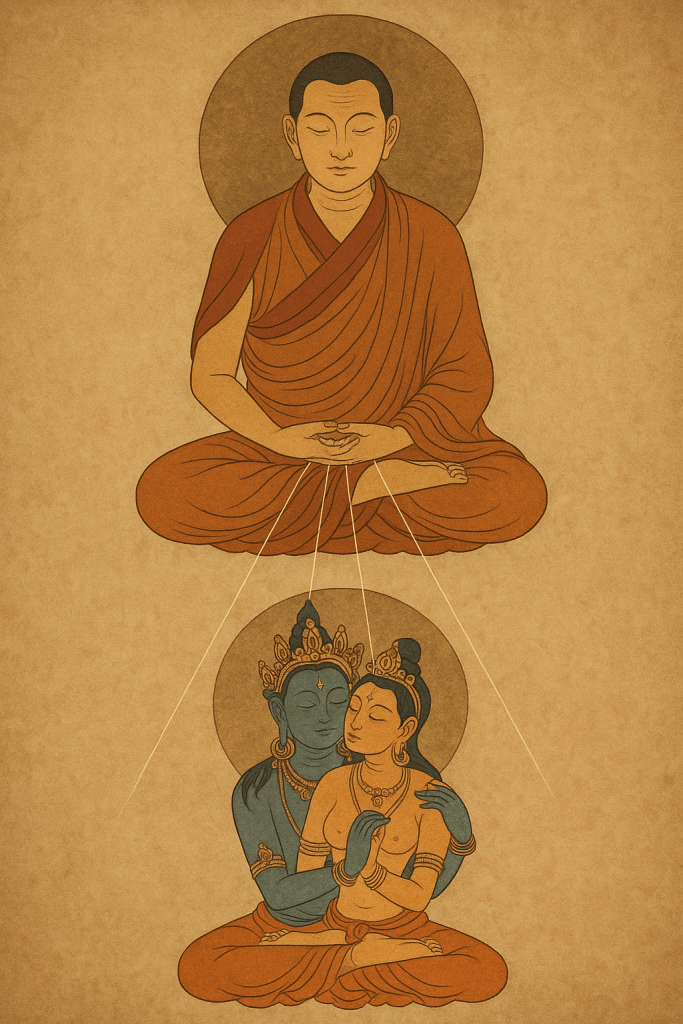

When Tantric Union in Tibetan Buddhism is Invasive and Unwanted


The ideal of tantric union in Vajrayāna Buddhism is described as the merging of wisdom and compassion, form and emptiness, masculine and feminine. In classical Tibetan art this appears as the yab-yum image of male and female deities in embrace.¹ The symbolism points to inner union, yet within the secrecy and hierarchy of tantra this ideal can become distorted. When intimacy, devotion, and power mix, the result can be psychological or sexual harm rather than awakening.

Union beyond the physical

“Union” (las kyi phyag rgya, maithuna) does not always refer to sexual intercourse. Many lineages teach “mental” or “energetic” union, where teacher and student visualize merging through subtle-body channels or shared deity practice.² Scholar Holly Gayley has examined how such “secret consort” (gsang yum) relationships blur lines between spiritual transmission and sexual exploitation.³

Anecdotal reports from practitioners describe non-physical experiences of sexual arousal or even orgasm initiated by the guru, without consent or understanding. For those unprepared, these experiences can feel like psychic invasion and an intrusion into the mind-body field. The ethical question is whether such experiences can ever be consensual in the context of absolute guru devotion.

The mechanism of “mental union”

Tantric theory holds that through visualization, mantra, and subtle-body control, energies (prāṇa, rlung) can be directed between beings. A guru visualized as a deity may “enter” the disciple’s heart or crown chakra, merging mindstreams in blessing.⁴ In positive settings this symbolizes transmission of realization. Yet in cases of coercion the same mechanism becomes violation: the student’s energetic body is penetrated without consent.

Ritual texts sometimes describe the guru entering the disciple’s central channel (tsa uma) through gaze or mantra, symbolic of energetic or spiritual transmission.⁵ Within Hindu Tantra, similar accounts exist of masters manipulating the disciple’s kundalinī or chakras.⁶ These ideas frame the possibility of non-physical sexualized experiences as part of spiritual union. When combined with secrecy and unequal power, the result may feel like mental rape rather than initiation.

Power, secrecy, and consent

The Vajrayāna guru is regarded as embodiment of the awakened state itself.⁷ Devotion to such a figure can override ordinary ethical boundaries. In Western contexts, where students lack cultural preparation, the potential for abuse rises sharply. Alexander Berzin warns that Western practitioners often misunderstand the traditional checks on guru authority and therefore submit to unhealthy relationships.⁸

Secrecy deepens the problem. The samaya vow forbids disclosure of tantric practices, even to peers. Gayley observes that this secrecy “can be used to reinforce sexual violence and silence abuse.”³

Real-world allegations

At Kagyu Samye Ling monastery and its retreat centre on Holy Isle in Scotland, multiple allegations have surfaced over the past decade. Reports describe bullying and psychological pressure during advanced retreats. Recently it was reported that a British woman may have died by suicide after a four-month retreat there. While there is no public evidence of sexual misconduct toward her, other survivors have alleged earlier incidents of “energy access” by the same teacher. Allegations included the use of “subtle body rape/sexual energy invasion,” according to an article by Adele Tomlin on the Dakini Translations website.⁹

The under-discussed nature of subtle-body abuse

Such cases remain largely invisible because tantric language itself obscures boundaries between metaphor and reality. A teacher’s claim of “mind-union” or “blessing” can mask non-consensual psychic intrusion. Students are often told that doubt equals spiritual failure, and that refusal breaks samaya. Without transparent ethics, the very tools meant to free the mind become weapons of domination.

Moving forward

Ethical tantric practice requires explicit, informed consent at every level: physical, psychological, and energetic. Teachers must articulate clearly what practices entail, and students must retain the right to refuse and leave. The spiritual promise of union cannot excuse the violation of personal autonomy. However, this kind of transparency is unheard of. Proper review structures and support for survivors are practically non-existent in most Tibetan Buddhist centers. The allegations surrounding Samye Ling and Holy Isle highlight what scholars such as Gayley describe as tantra’s “shadow”: the ease with which power can transform spiritual intimacy into a form of manipulation and abuse.


References

  1. Buddha Weekly, “What’s a Consort Union in Tantric Buddhism?” https://buddhaweekly.com/whats-consort-union-tantric-buddhism-no-not-sexual-fantasies-psychology-yab-yum-consorts-union-wisdom-compassion/
  2. Oxford Research Encyclopedia of Religion, “Tantra and the Tantric Traditions of Hinduism and Buddhism.” 2016.
  3. Gayley, Holly. “Revisiting the ‘Secret Consort’ (gsang yum) in Tibetan Buddhism.” Religions 9 (2018).
  4. Snellgrove, David. The Hevajra Tantra: A Critical Study. Oxford University Press, 1959.
  5. Wedemeyer, Christian K. Making Sense of Tantric Buddhism: History, Semiology, and Transgression in the Indian Traditions of Buddhist Tantra. Columbia University Press, 2013, esp. chap. 3–4, on symbolic initiation and tantric ritual language.
  6. White, David Gordon. Kiss of the Yoginī: “Tantric Sex” in its South Asian Contexts. University of Chicago Press, 2003.
  7. “The Guru Question: The Crisis of Western Buddhism and Global Future.” Info-Buddhism.com.
  8. Berzin, Alexander. Relating to a Spiritual Teacher: Building a Healthy Relationship. Snow Lion, 2000.
  9. Dakini Translations, “Suicide of Woman Reported in ‘Survivors of Samye Ling Support Group,’” by Adele Tomlin, the sole author of that site. https://dakinitranslations.com/2025/10/28/suicide-of-woman-reported-in-survivors-of-samye-ling-support-group-alleged-bullying-by-drupon-khen-karma-lhabu-teacher-misuse-tantra/
  10. Buddhistdoor Global, “Maithuna: Reflections on the Sacred Tantric Union of Masculine and Feminine.” https://www.buddhistdoor.net/features/maithuna-reflections-on-the-sacred-tantric-union-of-masculine-and-feminine/

The Tragic Consequences of Romantic Relationships Between Tibetan Gurus and Their Female Disciples


In the world of Tibetan Tantra, the guru is not merely a teacher. He is regarded as a living embodiment of enlightenment, someone who, once accepted, must be obeyed as if he were the Buddha himself. Into this framework walk countless Western women, often earnest seekers of truth, healing, or transcendence. But when romance, sexuality, and devotion become intertwined, the results are rarely transformative. More often, they are tragic.

This article explores the inherent power imbalance, cultural dissonance, and psychological manipulation that underpin many intimate relationships between Tibetan tantric gurus and their female disciples.


A Different Cultural Code

In Tibetan culture, it is not uncommon for powerful men, including lamas, to have secret relationships, multiple consorts, or children outside of marriage. In many traditional communities, this behavior is normalized, even expected. Male infidelity is culturally tolerated, and truth-telling in romantic relationships is not seen as a moral imperative.

For many Western women, however, raised in societies where emotional honesty and monogamy are core values in intimate relationships, these behaviors come as a rude awakening. When a Tibetan lama engages in a romantic or sexual relationship with a Western disciple, he often does so under entirely different assumptions than she brings to the table.

The result is a tragic mismatch, not only of expectations, but of entire worldviews.

Samaya: A Weaponized Vow

At the heart of tantric Buddhism is the concept of samaya, a sacred vow of loyalty and obedience to the guru. These vows are complex, often opaque, and understood differently in Tibetan contexts than in the West. A Western woman may believe she is entering a relationship based on mutual affection or spiritual partnership, while the guru sees her as a consort, a dakini, a means to an end, whose role is to support his realization through sexual union, secrecy, and ritual submission. A less realized guru might just use women for his own sexual satisfaction without having the ability to properly engage in tantric sex for spiritual ends. This is often true nowadays.

In any case, breaking samaya is said to have dire consequences, not only spiritually, but psychologically, and physically. The risk is greatly compounded if the woman undertakes a traditional three-year-retreat and engages in the highest yoga tantra practices, including the physical yoga. The looming threat of tantric destruction can trap women in relationships that are exploitative, confusing, and coercive. Once the guru becomes the channel for the deity, any questioning of his authority can be framed as demonic and a cause for imminent karmic downfall.

Possession Disguised as Enlightenment

Tantric union is not merely symbolic. It often involves rituals where the guru is said to be “inhabited” by the deity and his voice, gaze, and touch become divinely charged. During such practices, the female disciple is encouraged to dissolve her ego, to merge into the guru-deity, and to practice dak nang or “pure view.” This process can mimic, and in some cases become, a form of spiritual possession.

What’s often missed is the psychological and energetic takeover that occurs. The guru, now deified in the disciple’s mind and practice, can dominate her thoughts, dreams, emotions, and even her bodily functions. This fusion can make it nearly impossible for her to discern spiritual guidance from emotional manipulation or sexual coercion.

Real-World Tragedies

Numerous cases, both widely reported and quietly suppressed, illustrate the dangers of intimate relationships between tantric gurus and their students. These accounts reveal recurring patterns of deception, coercion, and spiritual abuse, all cloaked in esoteric language and asymmetrical power dynamics. They are not isolated incidents but part of a systemic pattern deeply embedded in a tradition that grants unchecked spiritual authority to men who are rarely held accountable.

For those who wish to explore further, consider just a few of the many investigations and testimonies:

Buddhist Project Sunshine – Phase 3 Final Report (2018)
This comprehensive report documents allegations of abuse within the Rigpa community, providing detailed accounts and analyses.
📄 Read the PDF Report

Beyond the Temple – What Now? Blog
Formerly known as “What Now?”, this blog offers reflections and information from ex-Rigpa members about their experiences and the broader implications of abuse in spiritual communities.
Beyond the Temple – Survivors of Abuse in Tibetan Buddhism

Tricycle – “Rigpa Abuse: Former Students of Sogyal Rinpoche Share Their Stories”
An article featuring firsthand accounts from former students detailing their experiences with Sogyal Rinpoche and the Rigpa organization.
📰 Read the Article

Lion’s Roar – “Letter to Sogyal Rinpoche from Current and Ex-Rigpa Members Details Abuse Allegations”
This piece publishes a letter from Rigpa members outlining specific abuse allegations against Sogyal Rinpoche.
📄 Read the Letter

The Aftermath: Disillusionment and Healing

For many women, the breaking point comes when the promised enlightenment fails to materialize, and the emotional wounds become undeniable. Depression, anxiety, spiritual confusion, sexual trauma, and a profound crisis of faith often follow. Some leave Tibetan Buddhism altogether. Others struggle for years in silence, fearing karmic retribution or spiritual failure.

But there is also healing. More and more survivors are finding their voices, connecting with others, and re-evaluating what true spirituality looks like outside the grip of occult religions.

Conclusion: A Cautionary Tale

The guru-disciple relationship in tantric Buddhism is not a romantic ideal. It is a spiritual contract saturated with asymmetrical power, cultural blindness, and theological complexity. When this dynamic becomes sexual, the risks multiply exponentially. For Western women seeking union with the divine, the guru-lover becomes not a liberator but a captor. The elaborate practice of guru yoga further seals the deal.

This truth must be told, not to demonize individuals or traditions, but to expose the structural and spiritual dangers that thrive in secrecy. Love, in its purest form, cannot flourish where truth is sacrificed to deception and devotion is manipulated into coercion.