America’s Freemasonic Roots and the Hidden Rise of Tantra


The United States was founded as a nation with Christian underpinnings. Though explicitly rejecting a state church, the culture, law, and moral sensibilities of the early colonies were undeniably rooted in European Christianity. The Puritans brought Calvinism to New England, Anglicans established themselves in the South, and Catholic missions flourished in Spanish-controlled territories such as California and the Southwest. Later waves of immigration brought Lutherans, Methodists, Presbyterians, and Baptists who carved out religious strongholds across the Midwest and South.

By the 19th century, the so-called “Bible Belt” had emerged in the South, Methodism had spread explosively through revivalism, and Catholicism had grown with Irish and Italian immigration. By the mid-20th century, America was demographically and culturally a Christian nation. According to Gallup polls from the late 1950s and early 1960s, more than 90% of Americans identified as Christian, with the largest groups being Protestants (roughly 70%) and Catholics (about 25%).


The Cultural Explosion of the 1960s

Then came the 1960s, a decade that tore through old structures. The Vietnam War, the civil rights struggle, the sexual revolution, psychedelic experimentation, and anti-establishment sentiment all converged. The cultural consensus rooted in old forms of Christianity began to fracture. Simultaneously, the Second Vatican Council (1962–1965) radically reformed Catholicism, introducing liturgical changes, opening the Church to interreligious dialogue, and softening the rigid boundaries between Catholic identity and “the other.” For the first time in history, the Catholic Church officially entertained the possibility that truth could exist outside its walls. This, in turn, prepared the ground for interfaith openness and even syncretism.

At the same time, young Americans disillusioned by the war machine were searching for new sources of peace and meaning. Buddhism, with its emphasis on compassion, nonviolence, and meditation, arrived at exactly the right moment. For the counterculture, it offered a path to peace and love in stark contrast to the devastation of the Vietnam War.


Gurus, Lamas, and the Tibetan Diaspora

The timing was uncanny. In 1959, Tibet fell to the Chinese Communist takeover, and a vast exodus of Tibetans fled into India and Nepal. Among the refugees were lamas who carried tantric teachings preserved for centuries in their monasteries. In the late 1960s and 1970s, the first wave of Western seekers, hippies from the US and Europe, traveled to India and Nepal, encountering these masters in exile. For the Tibetans, these were years of profound trauma, dislocation, and cultural upheaval. For the Westerners, it was a spiritual gold rush.

Out of this strange meeting of East and West emerged the first Tibetan Buddhist centers in America. By the mid-1970s, figures such as Chögyam Trungpa Rinpoche and the 16th Karmapa had established institutions across the country, often structured exactly like churches: religious nonprofits with tax-exempt status, complete with community rituals, hierarchies, and devotional practices. The Dalai Lama’s influence would come slightly later, after his first U.S. visit in 1979. Scores of young Americans, many from Christian families, converted to Tibetan Buddhism, convinced they had found something far superior to the “hollow faith” of their parents.


The Hidden Face of Tantra

Buddhism, in its ethical and philosophical dimensions, does indeed share much with Christianity such as compassion, ethical restraint, and renunciation of greed and hatred. But hidden within the Tibetan stream lies tantra, a system of occult practices and magical invocations that have no basis in the teachings of the historical Buddha. Instead, they represent a grafting of Indian tantric traditions onto Buddhism. Tibetan shamanic practices were also woven into the mix—rituals of spirit invocation and magical rites—which only reinforced the occult dimension and pushed the system even further from the teachings of the historical Buddha.

Some early Tibetan teachers in the West even made cryptic statements hinting at the true nature of their teachings. One unsettling quote, difficult to substantiate, yet chilling in its cynicism, was attributed to a Tibetan Vajrayana Buddhist master: “Satan is Vajra Jesus.” Indeed, after decades of immersion, it became clear to me that “Vajra” is not merely a symbol of indestructibility as is taught, but a coded reference to occult power, Satanic at its core. The genius of the system lies in its camouflage: cloaked in the ethics of Buddhism, the darker currents of tantra flow undetected.


Tibetan Buddhism and Freemasonry: A Parallel

The comparison with Freemasonry is instructive. Many of America’s Founding Fathers were Freemasons, and while the fraternity appeared on the surface to be a benevolent society, its higher degrees revealed allegiance to Lucifer.* At the lower levels, members encountered moral lessons and fraternity; only later, through oaths and initiations, was the deeper reality disclosed.**

Tibetan Buddhism operates in a strikingly similar way. Entry-level students learn meditation, ethics, and compassion. Only after deeper commitment, vows, and initiations are they gradually exposed to tantric practices: rituals involving wrathful deities, consorts, and occult visualizations. By then, they are bound by vows and loyalty to their teachers.


Full Circle: From Freemason Roots to Tantric Fruits

In this light, the embrace of Tibetan Buddhism in America seems less like an alien import and more like a continuation of an esoteric undercurrent already present in the nation’s DNA. The United States, born with strong Christian roots but also intertwined with Freemasonic structures, has become fertile ground for tantric infiltration. Just as Freemasonry concealed its Luciferian essence under a philanthropic veneer, Tibetan Buddhism cloaks its demonic core under Buddhist compassion.

The cultural revolution of the 1960s cracked open the shell of Christianity in America. Into that breach poured the lamas and their tantric systems. What appeared to be a message of peace and healing, at precisely the moment of American disillusionment, carried with it an occult agenda. In that sense, the story of tantra in America is not just about East meeting West, but about a deeper pattern repeating itself: a hidden, Luciferian tradition resurfacing under new guises.


*Not every Freemason engages in satanic practices, or even knows about that aspect of it. It is only at the 33rd degree and beyond that initiates are allegedly confronted with a Luciferian element. This is somewhat like the staged vows and initiations of Tibetan Buddhism that lead beyond basic Buddhism into communion with a pantheon of tantric gods that are not merely symbols or archetypes. Each level of Freemasonry opens the way to higher oaths and allegiances, ultimately directed toward Lucifer and other demons.

**While many of the Founding Fathers were Freemasons, probably some of them really did have noble intentions and wanted to make Washington, D.C. a kind of beacon of light. But there were very deep, dark, hidden forces that lurked within Freemasonry.

The Question of the Soul: Christianity, Hinduism, and Buddhism


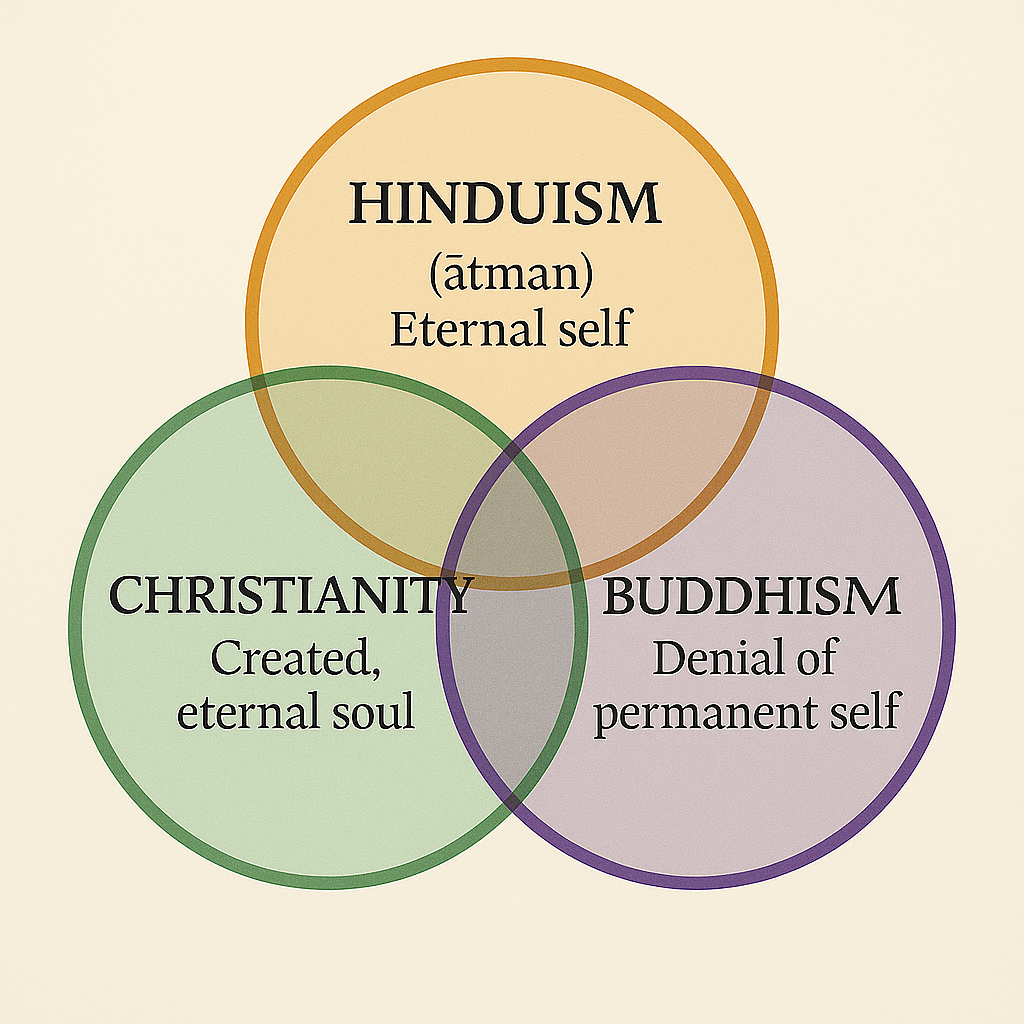
The question of what the soul is, whether it exists, and what happens to it after death lies at the center of the world’s major religious traditions. Christianity, especially in its Catholic tradition, affirms the soul as eternal and God-given. Hinduism has multiple schools, often affirming an eternal self or ātman. Buddhism, including Tibetan Buddhism, rejects the idea of a permanent self or soul and instead speaks of mind and consciousness as a conditioned stream of awareness without enduring essence.


The Christian and Catholic Understanding of the Soul

Christianity teaches that every human being has a unique, immortal soul created by God. According to Catholic doctrine, the soul is the spiritual principle of the human person. It is eternal in destiny, surviving bodily death, and directed either toward communion with God or separation from Him.

Scriptural sources include Genesis 2:7, where God breathes life into Adam and he becomes a living soul [1]; Matthew 10:28, where Jesus warns of the danger of losing the soul [2]; and the Catechism of the Catholic Church, which affirms that the soul is created by God and immortal [3]. In this view, the soul is not an impersonal principle but a personal identity, judged and redeemed by God.


Hindu Views on the Self (Ātman)

Hinduism is diverse, but most of its classical schools affirm the existence of ātman, the true self. The Chandogya Upanishad teaches “tat tvam asi” (you are that), affirming the identity of the self with Brahman [4]. The Brihadaranyaka Upanishad declares, “This self (ātman) is indeed Brahman” [5]. The Bhagavad Gita teaches that the self is eternal and indestructible [6].

Distinguishing Hindu and Christian Concepts

Both Hindu and Christian traditions speak of something enduring at the core of human existence, but they do so in different ways.

Christianity teaches that the soul is created by God, personal, and accountable before Him. It does not preexist from eternity but comes into being by His will and remains dependent on Him for existence, judgment, and salvation.

In Hindu thought, Advaita Vedānta emphasizes the identity of the self (ātman) with Brahman, dissolving individuality into the absolute. Dvaita and many Bhakti traditions instead teach that the self remains distinct yet eternal, existing in relationship with the divine. In all of these cases, the ātman is uncreated and co-eternal with ultimate reality, not brought into being by God.

Thus, while both traditions sometimes use personal and sometimes abstract language, the Christian soul and the Hindu ātman play very different roles. The soul in Christian theology is a created person before God; the ātman in Hindu philosophy is an eternal essence, whether one with Brahman or distinct in devotion.


The Creator God in Christianity and Hinduism

Christianity affirms one personal Creator God who brings the universe into being from nothing and sustains it in existence.

Hinduism presents a wide range of views. In Bhakti traditions, deities such as Vishnu, Shiva, or Devi are worshiped as supreme creators. Vedānta schools affirm Brahman as the ultimate source, though in Advaita this is not a personal act of creation but the manifestation of māyā. Other schools such as Sāṃkhya and Mīmāṃsā reject a creator altogether, viewing the universe as self-arising.

Thus, while Christianity grounds the soul in a personal God who creates and judges, Hindu thought ranges from devotion to a personal creator to cosmologies where no creator is necessary.


Buddhist Rejection of the Soul

Buddhism arose in part as a rejection of the Hindu doctrine of ātman. In the Anattalakkhana Sutta, the Buddha declared that none of the five aggregates of existence constitute a self [7]. The doctrine of anātman (no-soul) became central.

Mind and Consciousness

In Tibetan Buddhism, mind and consciousness are viewed as a stream of awareness, conditioned by karma. The Abhidharma-kośa describes consciousness as momentary and dependent [8]. Unlike Christianity and Hinduism, which affirm an eternal principle (soul or self), Buddhism denies it, calling belief in permanence a delusion.

Yet questions arise. If there is no soul, then what suffers in the hell realms described in Tibetan texts? The Bardo Thödol warns of the horrors of the Vajra Hell, a realm said to be utterly without escape [9]. The Hevajra Tantra declares that those who violate tantric commitments “will not be liberated for as many eons as there are atoms in the universe” [10]. The Cakrasaṃvara Tantra and later commentaries also teach that breaking tantric vows leads to vajra hells without release [11].

This presents a paradox: if there is no enduring self, who is suffering eternally?


Tibetan Buddhist Schools Under Examination

Madhyamaka – Nāgārjuna’s Mūlamadhyamakakārikā argues that all phenomena, including the self, are empty of inherent existence [13]. But if the self is an illusion, how does karma persist? If Vajra Hell is eternal, how can something that does not exist suffer forever?

Yogācāra (Mind-Only) – The Yogācārabhūmi Śāstra introduces ālayavijñāna, the “storehouse consciousness,” which preserves karmic seeds [14]. Though intended to avoid affirming a self, it functions much like one: carrying memory, identity, and karma. Hinduism here provides a comparison: the Bhagavad Gita teaches that the self carries karma through many births [6]. Yogācāra denies the term “soul,” yet reintroduces something strikingly similar. Christianity differs again: not a karmic storehouse, but a personal soul created by God.

Dzogchen (Great Perfection) – Dzogchen teachings, such as the Kunjed Gyalpo (All-Creating King), speak of rigpa, primordial pure awareness that is timeless and luminous [15]. Though Dzogchen denies that rigpa is a soul, the resemblance is striking. If rigpa is eternal, pure, and the ground of all experience, how is this different from what Christians call the soul or Hindus call ātman? The denial seems rhetorical rather than substantive.

Vajrayāna and Deity Possession – Tantric scriptures describe deity yoga, in which practitioners invite deities to merge with them [16]. If there is no self or soul, what exactly is being merged with or possessed?


Conclusion

Across Christianity, Hinduism, and Buddhism, the question of what endures, what we might call the soul, self, or consciousness, reveals fundamentally different views of human identity. Christianity anchors personhood in a created, immortal soul made by God and accountable to Him. Hinduism envisions an eternal ātman, uncreated and either one with or distinct from the divine. Buddhism, in contrast, denies any enduring essence, seeing the sense of self as a conditioned process. Yet in its Tibetan forms, teachings on karmic continuity, primordial awareness, and tantric transformation often edge back toward affirming something that functions like a self.

From long immersion in both Catholic and Tibetan Buddhist traditions, I have come to believe that the Christian vision alone sustains coherence between moral responsibility, continuity of consciousness, and the promise of redemption. It affirms not only that we exist, but that we are known and loved by the One who created us. Against the shifting alternatives of an impersonal absolute or an empty stream of awareness, in my opinion, the Christian understanding of the soul remains the clearest expression of what it means to be human before God.


References

[1] Genesis 2:7, The Holy Bible (ESV).
[2] Matthew 10:28, The Holy Bible (ESV).
[3] Catechism of the Catholic Church, Part I, Section Two, Chapter One, Article 1, §366.
[4] Chandogya Upanishad 6.8.7, in Radhakrishnan, S. (trans.), The Principal Upanishads.
[5] Brihadaranyaka Upanishad 4.4.5, in Olivelle, P. (trans.), The Early Upanishads.
[6] Bhagavad Gita 2.20, in Zaehner, R. (trans.), The Bhagavad-Gita.
[7] Anattalakkhana Sutta (Samyutta Nikaya 22.59), in Bhikkhu Bodhi (trans.), The Connected Discourses of the Buddha.
[8] Vasubandhu, Abhidharma-kośa.
[9] Bardo Thödol (Tibetan Book of the Dead), in Evans-Wentz, W.Y. (ed.).
[10] Hevajra Tantra, Snellgrove, D.L. (trans.), The Hevajra Tantra: A Critical Study.
[11] Cakrasaṃvara Tantra, in Tsuda, S. (trans.), The Samvarodaya Tantra.
[12] Hevajra Tantra, ibid.
[13] Nāgārjuna, Mūlamadhyamakakārikā, Kalupahana, D.J. (trans.).
[14] Yogācārabhūmi Śāstra, Xuanzang (trans.).
[15] Kunjed Gyalpo (All-Creating King), in Namkhai Norbu (trans.), The Supreme Source.
[16] Cakrasaṃvara Tantra and Hevajra Tantra, ibid.


Sacrifice, Favor, Repeat


Before the modern age romanticized pagan religions into New Age panaceas, ancient worship was known to be raw and brutally pragmatic. In our modern spiritual-industrial complex, it is often sugarcoated into some kind of warm, earth-loving ceremony filled with personal empowerment and divine intimacy. But if you’re reading this, you’re probably already suspicious of that narrative.

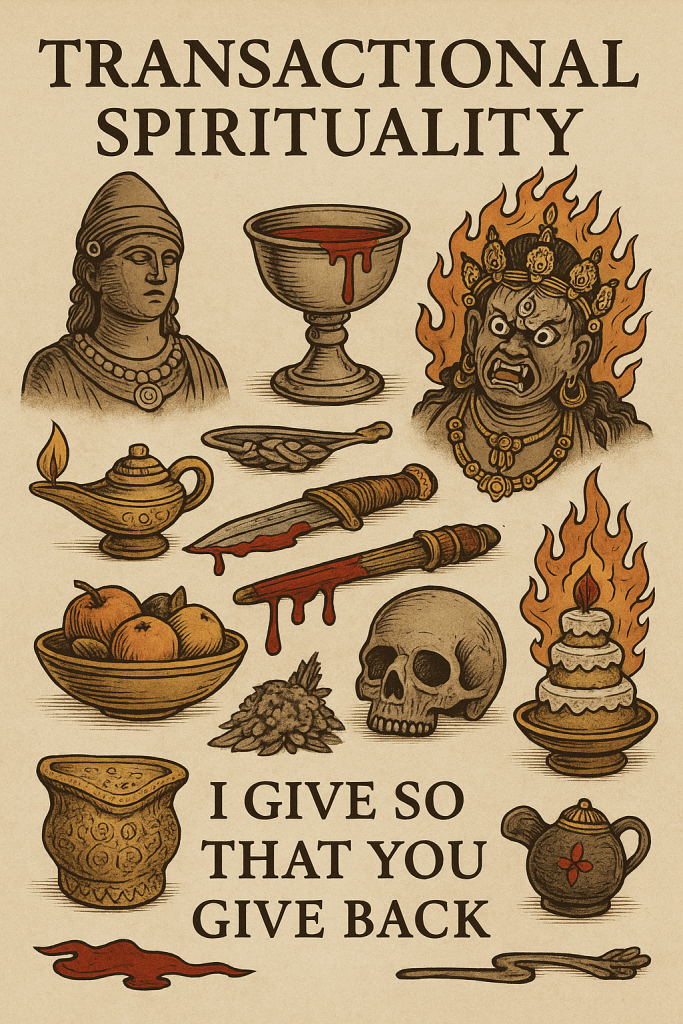
In fact ancient religion, pagan religion, was highly transactional. The gods didn’t love you. They didn’t weep over your suffering or aspire to protect you.

A passage from Behold the Christ: Proclaiming the Gospel of Matthew by Leroy A. Huizenga makes this brutally clear. Pagan worship, he writes, operated on the ancient principle of do ut des: “I give so that you give back.”(1) In other words, the gods and humans used each other. You offered sacrifices, incense, food, or praise not out of adoration, but because you wanted something in return: good crops, protection in war, fertility, rain, wealth, healing, vengeance, and victory. And the gods? They wanted to be fed, praised, and kept relevant. It was mutual exploitation dressed up in sacred costume.

“That is, the worshipper provides a sacrifice to a god that pleases and empowers the god, who then turns around and does the worshipper favors. Because the gods are often indifferent to humans, worshippers engage in repeated ritual to reach out and get a god’s attention.”

This paragraph says more about ancient spirituality than most modern New Age books on “manifesting” or “connecting with the divine.” The ancients weren’t confused. They understood that the gods were powerful, unpredictable, and not especially interested in human wellbeing unless there was something in it for them.

And this wasn’t limited to Rome or Greece. Versions of do ut des appear in Vedic sacrifice, Mesopotamian temple economies, and also Tantric Buddhist practice where offerings are made to wrathful deities to invoke, control, or appease.

Nowhere is this transactional logic more systematized and ritualized to the point of industrial precision than in Tibetan Buddhism. While cloaked in the language of enlightenment and compassion, the tradition is saturated with mechanisms that mirror the ancient do ut des economy: elaborate offerings, incense, butter lamps, mandalas, and tormas (sacrificial cakes that replaced blood offerings when the Buddhist principle of ahimsa “non-harming” took root). These were given not out of unconditional reverence, but to elicit specific outcomes from specific deities. Monastic liturgies are not just meditative recitations, but are negotiations with a pantheon of wrathful and peaceful beings, each with their own preferences, powers, and temperaments. Moreover, the non-harming sentiment in Tibetan Buddhism only extends so far. While Buddhist tantra forbids blood sacrifice, its subjugation rituals, aimed at both spiritual and human enemies, can involve some of the most brutal punishments found in any ritual religion.

Drupchöd ceremonies, held in large monasteries, exemplify this beautifully. These are days- or weeks-long ritual marathons involving collective chanting, visualization, music, mudras, and vast offerings, all designed to propitiate deities into bestowing protection, wisdom, and worldly benefits like health and prosperity. Whether invoking Mahakala to remove obstacles or Tara for swift blessings, the assumption is clear: the deity acts when properly fed, praised, and invoked. The gods (or enlightened beings, depending on your doctrinal parsing) are not passively watching; they’re participants in a cosmic economy, and Tibetan Buddhism, more than almost any other tradition, has mastered the bureaucratic apparatus needed to transact with them. It’s not just about personal devotion. It’s about correct performance, correct offerings, and the correct “exchange rate” of ritual. The love of the gods is not assumed. Their attention must be earned over and over again.

Modern Takeaways and a Warning

This transactional pattern isn’t limited to ancient paganism or esoteric Tibetan ritualism. You’ll find the same spiritual economy alive and well in the darker corners of contemporary occultism. Take it from someone like Riaan Swiegelaar who’s lived on the other side: former Satanists and occult practitioners routinely speak of offering sacrifices, especially blood, to demons in order to negotiate outcomes.(2)

He described it well: “A lot of people ask me, ‘Why are there so many sacrifices in Satanism? Why is there blood?’ The answer is simple: blood has currency in the spirit world. If I want to negotiate with demons, I need to bring an [animal] sacrifice because that blood holds value. It functions as spiritual capital.

“But here’s the contrast: the blood of Jesus is the highest currency in the spirit world. It covers everything. That’s the authority we stand on. And every ex-Satanist or ex-occultist who’s encountered Christ will tell you the same thing. I might be the only one talking about it openly, but this is real: we engaged in negotiations with demons, offered animal sacrifices, and got results. That’s how the system worked. Then we experienced the blood and love of Christ and there’s no comparison. It’s not even close. His blood is infinitely more powerful. In spiritual warfare, people need to grasp that reality. The blood of Christ is free, but it is not cheap, is it? It came at the highest cost. And what happened on the cross? That wasn’t a one-time transaction in history: it remains as valid, active, and potent today as it was then, and always will be.”

This is so important that it bears repeating: no spiritual currency, no ritual offering, no demonic pact compares to the raw, unmatched power of the blood of Christ. This is the rupture at the heart of Christianity: the economy of sacrifice is over, not because gods stopped demanding payment, but because one sacrifice bankrupted the system.

From blood-soaked altars in Babylon to ritual offering tormas in Himalayan monasteries, humanity has always traded devotion for power and offerings for favor. But the cross flipped the script. There is no more need for bartering, manipulation, and performance to win divine attention. What Christ offered wasn’t another payment into the cosmic vending machine but a final act that rendered the machine obsolete. And if that’s true, then every attempt to re-enter the old system, whether through pagan ritual, tantric bureaucracy, or occult negotiation, isn’t just a return to tradition. It’s a rejection of victory.

(1) Leroy A. Huizenga, Behold the Christ: Proclaiming the Gospel of Matthew (Emmaus Road Publishing, Steubenville, Ohio).

(2) Riaan Swiegelaar, former co-founder of the South African Satanic Church, in various public testimonies including interviews and livestreams (e.g., “Riaan Swiegelaar Testimony,” YouTube, 2022), has spoken openly about blood sacrifice as spiritual currency and his eventual conversion after experiencing the love of Christ.


The Lie of Non-Duality: How Tantra Disguises Possession as Enlightenment


For years, I followed the path of Tibetan Buddhism and tantric practice. I studied its rituals, visualizations, deities, and especially its central concept of “non-dual realization,” considered the highest goal in Mahayana and Vajrayana philosophy.[1]

I chanted the mantras, invoked the buddhas, bodhisattvas and dakinis, and merged myself with yidams, believing I was on the path to ultimate truth or enlightenment.

But the truth I’ve realized now is very different. It was only after leaving the system and encountering Christ again that I saw what I had actually opened myself up to. What was presented to me as wisdom was, in reality, a surrender of my soul to dark powers wearing radiant masks.

What Is “Non-Dual Realization”?

In Mahayana and Vajrayana Buddhism, “non-dual realization” is taught as the highest goal. It means transcending the conceptual distinctions of self vs. other, good vs. evil, sacred vs. profane, based on the belief that these opposites are mental constructs and ultimately empty. It means realizing that everything is empty of inherent existence, that distinctions are illusions, and that even the self is not truly existent.

In Tibetan Buddhist tantric practice, this realization is pursued through deity yoga: one visualizes an external deity like a dakini, peaceful bodhisattva, or wrathful buddha, visualizes oneself as the deity, merges with the external form, and dissolves the sense of a separate self into that visualization. The goal is to transcend the sense of individual self and merge into what is presented as enlightened awareness.

This sounds beautiful on the surface. But what is actually happening behind the scenes?

Possession Disguised as Enlightenment

From a Christian perspective, this practice can lead to spiritual possession.

The moment you invite a being to take over your mind, body, or spirit, especially one that does not proclaim Jesus Christ as Lord (1 John 4:1-3), you are offering your soul to a power that is not of God.

Tantric practices train you to dissolve your boundaries. They break down your identity and present a being who is radiant, powerful, and loving, and invite you to unite with it.

In reality, this is surrender to a counterfeit. It is a deceptively woven net, spiritually binding, and ruthlessly enforced.

The Dakini’s Magical Net: A Trap, Not a Blessing

In Tibetan Buddhism, dakinis are presented as enlightened feminine energies, guides to wisdom, and protectors of the dharma. But now, I see clearly that the “net” of the dakinis isn’t a web of wisdom, but a spiritual snare.

These magical nets are said to catch the mind stream of those who violate tantric vows. They bind, dismantle, and destroy the consciousness of the practitioner who steps out of line. That is not divine justice but spiritual murder. It is demonic.

The Hidden Power Structure Behind Vajrayana

It’s important to add a caveat here: Tibetan Buddhists often shield themselves from criticism by appealing to the ethical and philosophical framework of early Buddhism, the so-called first and second turnings of the wheel. They claim that Vajrayana is inseparably bound to the moral and philosophical teachings of Hinayana and Mahayana.

However, in practice, it is the tantric laws that prevail. When push comes to shove, tantric expediency overrides all. What you get is a kind of spiritual gangsterism, a mafia-like code of silence, loyalty, and fear, all cloaked in the sanctity of Buddhist language and lineage.

But this never felt right to me. True love does not coerce and true wisdom does not enslave. The Holy Spirit convicts, but He never violates the soul’s freedom.

The Blood of Jesus Dissolves Every Net

The day I returned to Jesus Christ, after being spiritually attacked and nearly destroyed by the tantric Buddhist forces I once invoked, I renounced all former vows, empowerments, and deities. I asked God to set me free from every magical net and every spiritual power that claimed me. So many years before, after I had left the Catholic Church, I had gone through a long period of agnosticism before I took refuge in Tibetan Buddhism. I didn’t know if God existed or not. This left me open to deception by occult systems such as Tibetan Buddhism.

What I found in trying to break free from tantric occultism is that God is real and the blood of Jesus Christ is stronger than any tantric empowerment. It dissolves all bindings and shatters and severs every demonic contract.

We Are Not an Illusion

We are not empty. We are not reducible to pure awareness or dismissed as illusion. On the contrary, our existence is real, grounded, and full of meaning.

We are persons, created in the image of God (Genesis 1:27), with eternal souls, essential wills, and a purpose that cannot be replaced.

Jesus did not ask us to dissolve into Him. He calls us to relationship, not dissolution and especially not annihilation. He redeems, restores, and makes whole. In Christ, our identity is not erased but fulfilled. If you’ve been entangled in the deceptive beauty of tantric non-duality doublespeak, know this: it is not too late; there is a way out.

[1] Note on “Non-Dual Realization” in Tibetan Buddhism:
In Mahayana and Vajrayana Buddhism, particularly within Madhyamaka philosophy and the Mahamudra tradition of the Karma Kagyu lineage, “non-dual realization” refers to the direct experiential understanding that all phenomena, including the perceiving mind and external objects, are empty of inherent existence. This does not mean merging into a single cosmic entity, but rather realizing that the distinction between subject and object is conceptually constructed and ultimately illusory.
In Mahamudra practice, this is described as the union of clarity (luminosity) and emptiness, a non-conceptual awareness that is self-liberated and ungraspable. The practitioner seeks to transcend dualistic fixation and abide in the natural state of mind, free from elaboration.
However, while this view is upheld within the tradition as a path to enlightenment, my experience revealed it as a spiritual vulnerability. Furthermore, the process of dissolving self-boundaries and engaging in deity identification opened the door to oppressive spiritual influences disguised as wisdom. What is framed as “non-dual realization” can, in practice, become the annihilation of personal agency and discernment and leave one open to possession by demonic entities.

Was the Caduceus Reborn in the East?


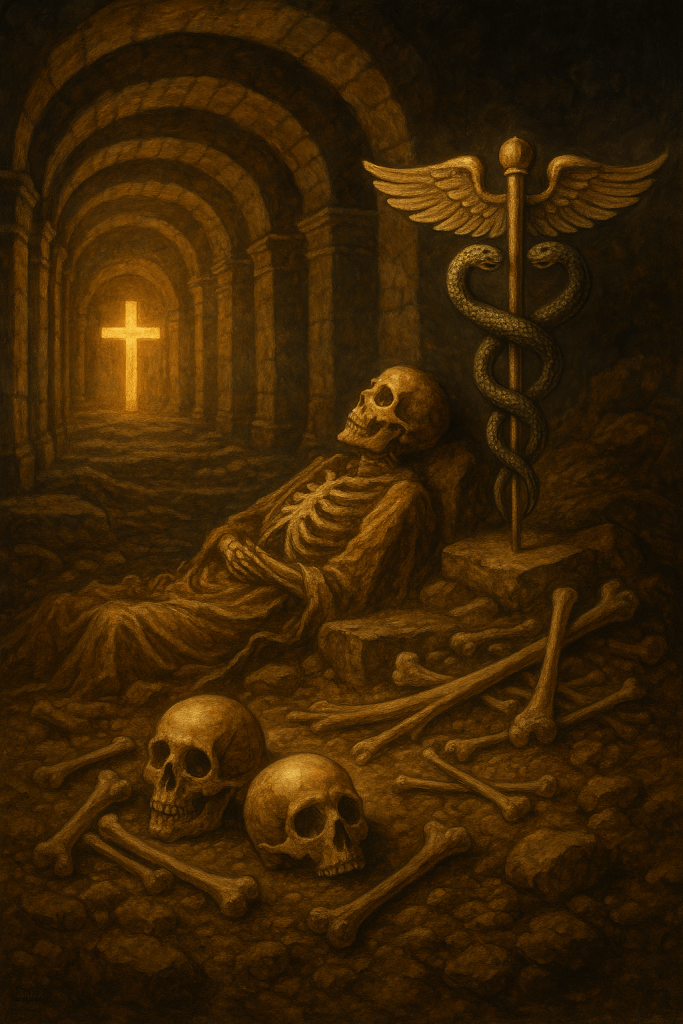
In the ancient catacombs beneath Rome, the bones of countless Christian martyrs still rest. Their blood once soaked the soil of the Eternal City, spilled in arenas and burned at stakes. These early saints stood firm as the empire raged against them, refusing to bow before the gods of Olympus. Their sacrifice helped dismantle an entire pantheon, culminating in the 4th century with the conversion of Emperor Constantine and the eventual abolition of state-sponsored paganism.

This was no mere political shift; it was a metaphysical war. The temples of Mercury, Dionysus, and Asclepius were shuttered or repurposed. The rites of Isis, Mithras, and the Eleusinian mysteries faded into obscurity. The cross had conquered the caduceus.

But pagan gods, the fallen angels never truly die. They reinvent themselves. And sometimes, they reappear in new lands wearing different clothes.

The Echoes of Hermes in the Serpent of Shakti

After Constantine, as Christian Rome rose from the ashes of the pagan world, something remarkable was stirring across the continent in India. By the 5th century, the traditions of Tantra and Kundalini had begun to take shape. Where Rome had cast down the serpent as a symbol of Satan, Indian mysticism raised it up as the dormant energy of the Divine Feminine, Kundalini.

Can we trace a spiritual current from Hermes to Shiva, from the Greek mysteries to the yogic inner fire? This is speculative, but consider the astonishing parallels:

ThemeGreco-Roman (Hermes, Asclepius)Indian Tantra/Kundalini
SerpentsSymbol of wisdom, healing, dualityCoiled energy, Shakti
Staff or AxisCaduceus (Hermes), two snakes coiled around a staffSushumna nadi (central energy channel flanked by solar and lunar channels)
HealingAsclepius, god of medicineKundalini as transformative healing energy
Divine UnionHieros gamos, Dionysian ecstasy, inner union of male and female energiesShiva–Shakti union
Body as microcosm of the universeMystery religions, alchemyTantric yoga, body as vehicle to moksha (liberation)

If we imagine the fall of Greco-Roman religion not as a disappearance but as a transmutation, we might say:

The energy of Hermes migrated eastward, shedding its Western garb and reappearing as Shiva, serpent-lord and cosmic dancer, custodian of the inner path.

A Vision in the Night

Early this morning, something powerful happened to me. I woke up at around 2:30 or 3:00 a.m. and engaged in deep Catholic prayer. Afterwards, I drifted back into sleep and experienced a vivid spiritual battle.

I saw the Caduceus and felt the presence of a dark force, perhaps a demon. Then I sensed small demons leaving as if they shot out of my mouth on puffs of air, accompanied by groaning, crying, even the sound of gunshots, as though a war was raging inside my soul. At the end of the vision, one man remained below, pointing a gun upward. I watched from a higher vantage point. Who was he? The man, I believe, was Satan.

He was not dead and he was poised to keep fighting.

I woke up. What I experienced wasn’t just a dream. It felt like an echo of that ancient struggle in Rome, replayed within the temple of my own body. The Christian martyrs cast down idols with their blood. We, too, must cast down what is false within us at whatever cost; we must uproot and cast out the inner serpent that slithered in during years of practicing the occult.

Rome uprooted the pagan gods and repurposed their shrines into Catholic cathedrals. Sadly, the pagan entities they represented were not destroyed. Perhaps they merely migrated east, into the rituals of Tantra, the breath of yogis, and the rising coil of kundalini.

Shape-Shifting in Tantra and Shamanism


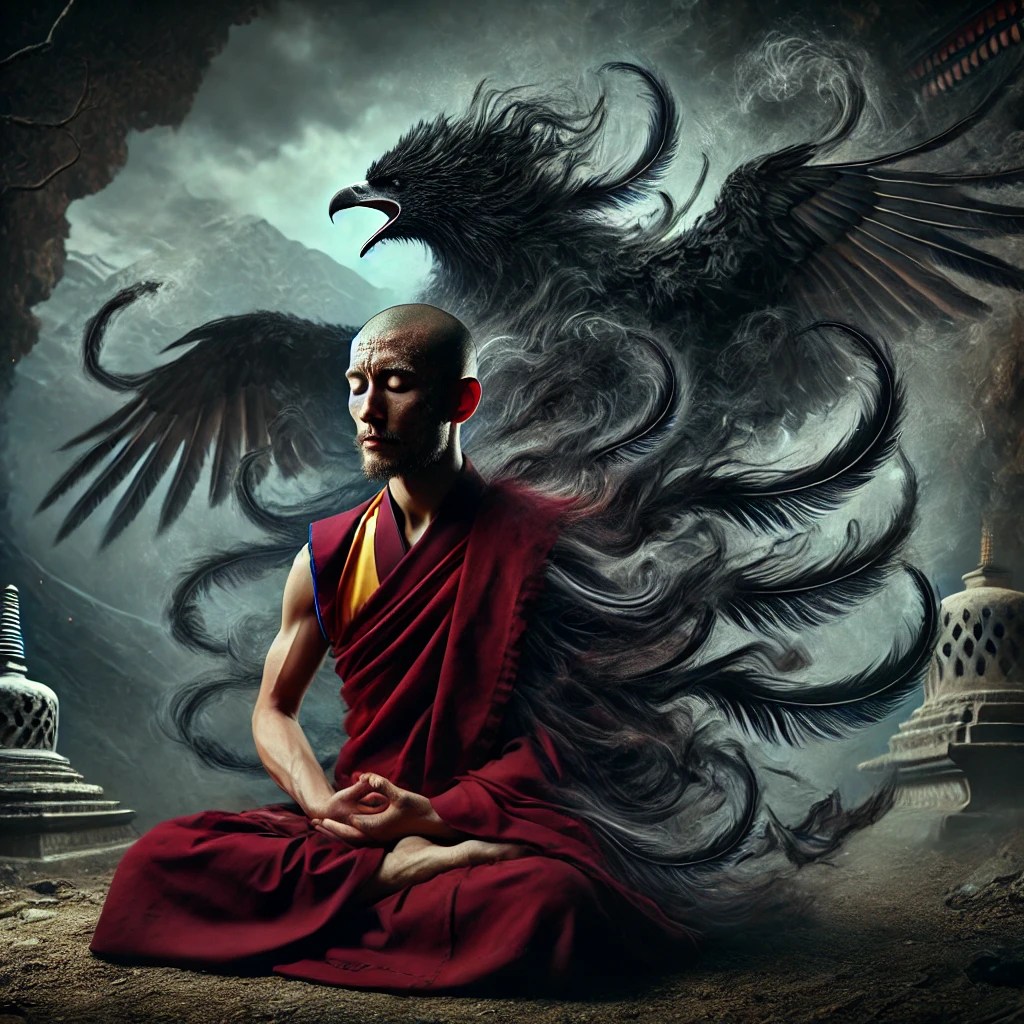
Shape-shifting has long been a recurring theme in mystical traditions across the world, appearing in shamanic practices, tantric rituals, and folklore. In Tibetan Buddhism, the Chakrasamvara Tantra contains instructions for shape-shifting, particularly into animals such as hawks and eagles. The presence of these spells in a sacred text raises an intriguing question: where do these siddhis (spiritual powers) truly originate from? Are they manifestations of enlightenment, or do they come at a cost, placing the practitioner in debt to unseen forces?

Shape-Shifting in the Cakrasamvara Tantra

The Cakrasamvara Tantra is one of the most esoteric and influential texts within the Anuttarayoga (highest yoga) class of Tantric Buddhism. Among its many rituals, it contains precise instructions for practitioners to take on non-human forms, including that of a bird. David Gray, in his translation and commentary on the text, notes that these shape-shifting spells are not mere metaphors but were understood as actual yogic attainments.

The text outlines multiple methods for transformation. One passage describes a ritual in which a practitioner can enchant a cord made from the sinew or hair of an animal and bind it around their neck to assume that animal’s form. This includes birds such as hawks, owls, and vultures, as well as larger quadrupeds (Cakrasamvara Tantra, Chapter XLVII, p. 363). Another section states that by consuming or even touching an enchanted substance, the yogin may take on a divine or animal form (Cakrasamvara Tantra, Chapter XLIX, p. 369). These instructions suggest that shape-shifting was considered a real and attainable siddhi for advanced practitioners.

In Vajrayana, these extraordinary abilities, known as siddhis, are divided into two categories:

  • Mundane siddhis (laukika siddhis), which include powers such as flight, invisibility, and shape-shifting.
  • Supreme siddhis (lokottara siddhis), which refer to enlightenment itself.

While the latter is the ultimate goal of practice, the existence of spells for mundane abilities suggests that some practitioners were actively seeking, and attaining, more earthly, supernatural powers.

But why would a Buddhist tantra contain shape-shifting spells? The standard response is that these abilities help advanced practitioners aid sentient beings and overcome obstacles. However, if the goal were purely benevolent, why does the very same tantra contain spells for harming, controlling, and even destroying sentient beings? The presence of violent and coercive rituals alongside shape-shifting practices suggests that acquiring such siddhis was not solely about compassion or enlightenment. Instead, these abilities may have served more ambiguous or self-serving purposes, whether for power, domination, and even destruction. Moreover, history is filled with accounts of people acquiring mystical abilities at a hidden cost, often through pacts with forces beyond their ultimate control or comprehension. If a yogin can assume the form of an animal, what else might they be gaining or losing in the process?

Debt to the Unseen: Shape-Shifting and Supernatural Pacts

The idea that magical transformations require spiritual debt is not unique to Tantra. Across cultures, shape-shifting often comes with hidden agreements between the practitioner and demonic entities.

  • Shamanism and Possession: In many indigenous traditions, a shaman does not shape-shift alone but must first enter a trance state, often facilitated by spirits or tutelary deities. This raises the question, when a shaman transforms into an animal, are they truly in control, or is something else working through them?
  • Vampirism and the Undead Pact: The myth of the vampire is closely related to shape-shifting, with folklore describing their ability to turn into bats, wolves, or mist. Yet, vampires are universally depicted as cursed beings who exist by taking the life force of others. Their transformations are not self-generated but come as a consequence of an external force, a dark exchange that binds them to an unnatural state.
  • Faustian Bargains in Occult Traditions: From medieval grimoires to modern occultism, the idea persists that those who seek supernatural abilities must often enter into a contract with demonic non-human entities. The magician gains knowledge or power but loses something in return, whether it be autonomy or a portion of their soul.

Could the siddhis described in tantric texts function similarly? If shape-shifting is possible, does it occur through the practitioner’s own spiritual mastery, or is it facilitated by a demonic force to which they become indebted?

The Cost of Siddhis: Are They Truly Benevolent?

Tantric Buddhism teaches that mundane siddhis should never be sought for their own sake. In the Hevajra Tantra, a text closely related to Chakrasamvara, the practitioner is warned that seeking supernatural abilities out of attachment can lead to ruin. Some Buddhist teachers even caution that siddhis can become obstacles on the path to liberation, enticing practitioners away from true spiritual realization.

If shape-shifting and similar siddhis are real, should they be seen as gifts of an awakened mind or as evidence of hidden transactions with demonic forces? If the latter, what do these forces ultimately seek in return?

For those who have witnessed such transformations firsthand, the question remains: What is really behind them?

[1] Gray, David B. (2007). The Cakrasamvara Tantra (The Discourse of Śrī Heruka): A Study and Annotated Translation. New York: American Institute of Buddhist Studies at Columbia University. ISBN: 978-0975373460. See Chapter XLVII, p. 363, and Chapter XLIX, p. 369 for descriptions of shape-shifting methods.

Monk Hsuan Chao’s View of Tantric Buddhism in 10th Century India


The emergence of Tantric Buddhism, also known as Vajrayana, represents a radical departure from the original teachings of the Buddha. While early Buddhism focused on ethical conduct, meditation, and wisdom as the path to enlightenment, Tantra introduced esoteric rituals, mantras, and controversial practices that blurred the lines between Buddhism and Hindu Shaivite traditions. The origins of Tantric Buddhism can be traced back to the mid-first millennium CE, gaining prominence between the seventh and tenth centuries. This period saw its infiltration into the great Buddhist monastic institutions of India, including the renowned Nalanda University.

The Rise of Tantric Buddhism

By the seventh century, Buddhist monks and scholars at Nalanda, Vikramashila, and other centers of learning began incorporating Tantric elements into their teachings. The introduction of deities, elaborate rituals, and magical practices marked a significant transformation from the rational and ethical framework established by the Buddha. The Guhyasamāja Tantra (c. 8th century) and other tantras became part of monastic curricula, suggesting that at least some scholars at these institutions were receptive to these esoteric traditions.

However, not all Buddhist monks welcomed these innovations. The Chinese monk Hsuan Chao (Xuanzhao), who traveled to India in the 10th century, was particularly critical of the Tantric Buddhists he encountered. He likened their practices to those of the Kapalikas, a Shaivite sect notorious for engaging in transgressive rituals involving human remains, sexual rites, and magical invocations.

Hsuan Chao’s Observations

Hsuan Chao’s journey to India was part of a larger Chinese monastic tradition of seeking authentic Buddhist teachings from their source. Although there is no definitive evidence that he studied at Nalanda, he likely visited Buddhist centers where Tantra was taught and observed its practitioners firsthand. He was disturbed by their practices, which he viewed as a stark deviation from the ethical and meditative traditions that defined early Buddhism.

His critiques were not merely personal reflections; they were grounded in the belief that Buddhism had been corrupted by external influences. The Buddha’s original teachings, as preserved in the Pali Canon and early Mahayana texts, emphasized renunciation, discipline, and insight. By contrast, Tantric Buddhism introduced complex rituals, deity worship, and doctrines that mirrored Hindu traditions, leading figures like Hsuan Chao to question whether these practices were truly Buddhist at all.

The Heretical Shift

Tantric Buddhism’s divergence from the core principles of Buddhism raises important questions about its legitimacy. The Buddha’s teaching on suffering (dukkha), impermanence (anicca), and non-self (anatta) left no room for the mystical aspirations of Tantra. Yet, by the late first millennium, Tantric texts were becoming influential within Buddhist traditions, particularly through the incorporation of dhāranīs (magical incantations) and mantras into Mahayana and Vajrayana texts. Some Mahayana sutras, such as the Lotus Sutra and Golden Light Sutra, contain elements of magical prayer, leading to scholarly debate over whether these were original to the texts or later interpolations. The presence of spells and protective charms in Buddhist literature suggests that such additions may have been efforts to appeal to popular religious sensibilities rather than direct reflections of the Buddha’s earliest teachings.

It is likely that some of these magical elements were added later, as Buddhism adapted to local traditions and sought to compete with Hindu and indigenous religious movements. In doing so, it absorbed ritualistic elements that were foreign to its original doctrine. The Buddha himself warned against blind faith in supernatural powers, emphasizing instead the development of wisdom and ethical conduct. This makes the inclusion of tantric rituals, many of which involved breaking moral precepts, highly suspect.

Conclusion

The rise of Tantric Buddhism represents a significant and, arguably, heretical transformation of the Buddha’s teachings. While early Buddhism sought liberation through ethical discipline and meditation, Tantra embraced occult rituals and esoteric knowledge as shortcuts to enlightenment. Monks like Hsuan Chao saw this as a dangerous deviation, likening Tantric Buddhists to the Kapalikas, whose extreme practices had long been considered outside the bounds of both Buddhist and Hindu orthodoxy.

The question remains: Was Tantric Buddhism a legitimate evolution of Buddhist thought, or was it a corruption of its foundational principles? Given its reliance on practices that directly contradicted the Buddha’s teachings, the latter seems more likely. As such, the study of Tantric Buddhism should be approached with a critical eye, recognizing its fundamental departure from the wisdom and ethics that once defined the Buddhist path.

Conversion


I spent a lifetime in Tibetan Buddhism, immersing myself in it. My spiritual journey took me to places I never imagined in the search for ultimate truth. I experienced expansive states of consciousness, and feeling a deep and blissful connection to the divine. But which “divinity?” What I didn’t know then, and what I have come to realize, is that there is a darkness woven into the fabric of tantric practices. What appears to be ascension, enlightenment, and higher understanding is, in reality, an ingenious, demonic hack of consciousness.

The Tibetan Buddhist teachings I followed, deeply rooted in ancient tantric rituals, promised transcendence through their intense and elaborate practices. I absolutely believed that I would be completely enlightened in this life, in the bardo (the period between lives) or in the next life. But sadly this was not to be because I angered my first lama, and later on my second guru, by taking issue with the sexual abuse by lamas of their students. It had happened to me many years ago by my first lama and had been deeply traumatic; I never completely recovered from it. Then a few years ago, I was the victim of a “linga annihilation ritual,” a highly secretive and disturbing process, led by two gurus who used their power to sever my connection with the divine. These gurus were attempting to bring about spiritual “death” through the destruction of my mind and body, but what they did was far worse than anything I could have imagined. The ritual shattered my consciousness, left me stripped of my spirit, and plunged me into a terrifying, hellish reality.

Before this happened to me, I believed that the tantric rituals, no matter how painful or intense, were a part of the path to enlightenment. I knew that the sexual abuse by the lamas of their students was very wrong and destructive, but I thought that the teachings themselves were pure. The sexual abuse, however common, must just be an aberration, I thought. But the linga annihilation ritual that occurred after my first lama was publicly exposed for predatory sexual abuse after many years left me spiritually completely hollow and cut off from any sense of peace or hope. I was literally attacked day and night by the gurus and their demons. This went on for years, and continues in a lesser form even up to the present day. It is obvious to me now that for all those years, I had been deeply deceived. In the guise of spiritual awakening, I had been led into the deepest form of spiritual manipulation. The guru, with his promise of divine power and liberation, became little more than an agent of destruction, using a deep knowledge of tantra to exploit, control, and then destroy my very being.

This devastating crisis led me to search for an answer beyond the confines of Tibetan Buddhism, something that could provide true healing, hope, and redemption. After a lot of suffering, I eventually found my way back to Catholicism, the faith of my childhood that I had left so many years ago in search of something more powerful and profound. I came to realize that Christianity, and Catholicism in particular, offers a truth that tantric practices could never deliver. The love of God, the grace of Christ, and the power of the Holy Spirit were waiting for me all along, not in the dark corners of esoteric rituals, but in the simplicity and purity of Christ’s message of salvation.

Returning to Catholicism has not been easy. The process of re-entering the Church after years of living in a completely different spiritual system has been humbling, and at times, disorienting. The Church has had many upheavals of Her own. But as I embrace the sacraments, pray with sincerity, and allow God’s healing grace to wash over me, I am starting to feel a deep sense of peace that I have not known in years. The darkness that has clouded my mind is slowly lifting.

I know now that tantra, with its promises of spiritual power and transcendence, is not a path to liberation but a detour that leads one further away from God. Its manipulations of consciousness, through rituals and doctrines, are not about divine union but about yielding to spiritual forces that are in reality dark entities seeking to enslave and destroy. I can see it now for what it is, an elaborate trick of the enemy, gussied up as enlightenment. It took my mind, spirit, and soul sinking to a place of the deepest despair before I could finally see the truth.

To anyone reading this who may feel lost or deceived in their spiritual journey, I urge you to seek truth, not in hidden, mystical practices, but in the clear, unwavering love of Christ. He is the only way, the truth, and the life. After all these years, I finally understand the symbolism of the crucifix: Jesus Christ sacrificed himself to pay the deep debt of all of humanity. As I continue to make progress on my journey and engage in spiritual warfare against the enemy to become completely free, I hope to document this process as I engage in the biggest battle of my life.

The Battle Over Tantric Interpretation: Symbolic vs. Literal Tantric Traditions


Tantric Buddhism has long been one of the most misunderstood and debated traditions in religious history. At the heart of this controversy lies a fundamental question: Should its texts and practices be interpreted literally or symbolically? One of the most influential figures in this debate was Jñānākara, an 11th-century scholar who championed a symbolic interpretation of tantric scriptures, countering those who advocated for a literal approach to tantric rituals.[1]

The Tantric Dilemma: Symbolism or Literalism?

Tantric texts often contain vivid imagery of sexual union, wrathful rituals, and the consumption of taboo substances. Some Buddhist practitioners and scholars understood these descriptions as directives for actual practices, while others saw them as metaphors for deeper spiritual principles.[2]

  • Literal Interpretation: Some tantric teachers and traditions argued that rituals involving sexual union, the consumption of alcohol and other taboo substances, and even violent imagery were meant to be physically enacted as part of the spiritual path. These practitioners believed that by transcending conventional morality, they could directly attain enlightenment by confronting and transforming base emotions like desire and aversion.[3]
  • Symbolic Interpretation: Jñānākara strongly opposed this approach, insisting that such texts were meant to be understood allegorically, not literally. In his Mantrāvatāra, he systematically argued that sexual union symbolized the merging of wisdom and compassion, and that tantric rituals were meant to take place on a mental and meditative level rather than in the physical world.[4]

Jñānākara’s Critique of Literal Tantra

For Jñānākara, the rise of literal interpretations was a dangerous trend that risked undermining Buddhist ethics, particularly monastic discipline. Many monks had taken vows of celibacy, and engaging in literal sexual rites contradicted their commitments. He believed that those who promoted physical tantric rituals were misunderstanding or distorting the true intent of tantric texts.[5]

To support his argument, Jñānākara drew upon hermeneutical techniques established by earlier scholars like Candrakīrti. He emphasized that tantric texts contained twilight language (sandhābhāṣā), meaning they were meant to be decoded through metaphor rather than taken at face value.[6]

For example:

  • Sexual imagery in tantric texts represents the union of wisdom (prajñā) and skillful means (upāya), rather than physical intercourse.
  • Killing and wrathful acts do not endorse violence but symbolize destroying ignorance and negative mental states.
  • Consuming taboo substances represents transcending dualistic notions of purity and impurity.[7]

The Opposition: Advocates of Literal Tantra

While Jñānākara and like-minded scholars, including Atīśa, promoted a restrained, symbolic approach, other tantric masters argued that direct experience through literal practice was essential for transformation. These practitioners contended that symbolic interpretations diluted the raw power of tantra, which aimed to cut through illusion in an immediate, experiential way.[8]

Figures such as Abhayākaragupta and Darpanācārya argued that all Buddhists, monks and laypeople alike, should be allowed to engage in tantric consecrations, including sexual initiation rites. They maintained that direct engagement with desire, fear, and social taboos could accelerate spiritual awakening.[9]

Subjection Rites and Ritual Violence in Tantra

Despite Jñānākara’s emphasis on symbolic interpretation, some tantric traditions in Tibet, including those that largely followed his approach, continued to engage in subjection rites, sometimes involving ritualized acts of violence. The Cakrasaṁvara Tantra, for instance, describes rituals meant to subjugate, bind, and even kill enemies, with wrathful deities acting as enforcers of divine justice.[10]

There is evidence that in Tibet, “live kills” (srog sgrol) were practiced into the 20th century, and possibly still occur today in some secretive circles. These rites were believed to be means of neutralizing obstacles, whether internal (psychological enemies) or external (political or spiritual threats). Even among those adhering to Jñānākara’s symbolic reading, subjection rites continued in a ritualized form, where the target of destruction was seen as a demonic force rather than an actual person.[11]

While some Tibetan tantric lineages attempted to justify these practices as symbolic acts of internal transformation, historical accounts suggest that physical executions and ritualized killings did, at times, occur as part of certain tantric sects’ secretive rites. These practices remain highly controversial and are rarely discussed openly by modern Buddhist authorities.[12]

Conclusion

Even today, different schools of Vajrayāna Buddhism hold varying interpretations of tantra. Some Tibetan Buddhist traditions, such as the Gelugpa school, maintain a strongly symbolic approach, while others, particularly some Nyingma and Kagyu traditions, acknowledge the historical presence of more literal practices in certain contexts.[14]

The controversy surrounding tantra highlights a larger question in religious traditions: Who gets to decide how sacred texts should be read? Jñānākara’s conservative stance on symbolic interpretation shaped Tibetan Buddhism in profound ways, steering it toward a more ethical, monastically compatible form of tantra. [15]

Ultimately, Jñānākara’s legacy reminds us that how we interpret texts matters as much as what they say. His approach demonstrates the lasting power of hermeneutics, how the meaning of a text is shaped by the needs, ethics, and priorities of those who read it.


Footnotes:

  1. Lopez, D. (1998). Prisoners of Shangri-La. University of Chicago Press.
  2. Davidson, R. (2004). Indian Esoteric Buddhism: A Social History of the Tantric Movement. Columbia University Press.
  3. Wenta, A. (2018). The Making of Tantric Orthodoxy in the Eleventh-Century Indo-Tibetan World: Jñānākara’s Mantrāvatāra. Springer.
  4. Gray, D. (2007). The Cakrasamvara Tantra: A Study and Annotated Translation. Columbia University Press.
  5. Wedemeyer, C. (2013). Making Sense of Tantric Buddhism: History, Semiology, and Transgression in the Indian Traditions. Columbia University Press.
  6. Sanderson, A. (2009). The Śiva Age: The Rise and Dominance of Śivism During the Early Medieval Period. Brill.
  7. Snellgrove, D. (1987). Indo-Tibetan Buddhism: Indian Buddhists and Their Tibetan Successors. Shambhala Publications.
  8. Newman, J. (1987). The Outer, Inner, and Secret Biography of Padmasambhava. Oxford University Press.
  9. Gray, D. (2016). Subjugation and Ritual Violence in Buddhist Tantra. Oxford University Press.
  10. Karmay, S. (1998). Secret Visions of the Fifth Dalai Lama. Serindia Publications.

The History of Tantra


The word “Tantra” evokes sex and mysticism in the modern world. However, it is a spiritual practice fraught with controversy and potential harm. Though its origins are deeply embedded in South Asian spiritual traditions, Tantra has long been a subject of debate for its questionable methods and the risks it poses to practitioners.

Questioning Tantra’s Validity in Indian Buddhism

One of the most contentious aspects of Tantra in Indian Buddhism is its origins. Did these esoteric practices truly originate with the Buddha, or do they stem from darker, occult sources? Many argue that Tantra’s reliance on rituals, mantras, and deity possession deviates sharply from the Buddha’s original teachings. Instead, Tantra seems to delve into a realm of magic, where practitioners invoke powerful spirits or deities that are difficult to control. The secretive and arcane nature of Tantra has even drawn comparisons to Western Satanism, with parallels in symbolic inversion, forbidden knowledge, and the harnessing of dark energies. These troubling similarities raise serious questions about the true intent and origins of Tantra.

Tantra is believed to have emerged in India around the 5th to 7th centuries CE as a response to the rigid practices of Vedic Hinduism and early Buddhism. Its origins are steeped in secrecy and myth. The term “Tantra,” means “to weave” or “to expand,” and hints at its darker origins: the weaving of esoteric forces into the human psyche.

The Core Principles of Tantra: A Double-Edged Sword

Tantra appears to challenge dualistic thinking, presenting the material and spiritual worlds as interconnected:

Shakti and Shiva: While the union of Shakti (divine feminine) and Shiva (divine masculine) is portrayed as a balance, the rituals associated with this concept often involve the invocation of chaotic energies that can destabilize practitioners.

Sacredness of the Body: Tantra’s reverence for the body as a vehicle for enlightenment can lead to practices that blur ethical boundaries, and expose aspirants to physical and psychological risks. These practices often involve an extreme form of yoga that includes breath manipulation and physical postures designed to awaken kundalini energy. This wild and often uncontrollable force is said to be a dormant energy that resides at the base of the spine, but in reality, it involves possession by a spirit.

Ritual and Symbolism: The intricate rituals, mandalas (geometric designs), and mantras (sacred sounds) used in Tantra can act as portals and invocations to preternatural forces.

Tantra in Hinduism and Buddhism

While Tantra is often associated with Hinduism and Buddhism, its practices diverge significantly from the ethical foundations of these traditions. In Hinduism, Tantra became linked with Shaivism and Shaktism, incorporating rituals that many consider to be unorthodox and even dangerous. For instance, human sacrifice, though outlawed, is still secretly practiced in India. In Buddhism, Tantra’s form, Vajrayana, emerged as an esoteric path that relies heavily on guru worship, deity yoga, and visualization. These methods often blur the line between spiritual growth and occult manipulation. Critics argue that such practices betray the Buddha’s emphasis on ethical conduct and mindfulness.

The Spread and Evolution of Tantra: A Troubling Legacy

As Tantra spread beyond India, it adapted to local cultures but retained its core. In Tibet, for instance, Tantric rituals merged with indigenous Bon practices, creating a potent fusion. During the colonial era, Western scholars sensationalized Tantra, focusing on its sexual practices and scary looking deities while ignoring its broader implications. This misrepresentation led to a rehabilitation of Tantra in the West in the second half of the 20th century that idealized Tibetan Buddhist Tantra as purely benevolent, reframing and obscuring its darker aspects.

In the modern world, Tantra has been rebranded as a tool for personal empowerment, often stripped of its spiritual and cultural context. However, this simplification overlooks the risks associated with its practices. Authentic Tantra, with its emphasis on invoking and channeling preternatural energies, is a perilous path that can lead to psychological torment and spiritual dissolution. The allure of Tantra’s supposed transformative power can blind practitioners to its potential for harm.

A Warning

The history of Tantra is not merely a tale of spiritual innovation but also a cautionary story of occult manipulation and risk. Its practices, which often involve possession by spirits or deities, can have dire consequences even if approached with extreme caution. These entities, if angered or improperly controlled, can turn on the practitioner, leading to profound suffering. While Tantra may promise enlightenment, its methods carry a heavy price. Those who seek spiritual growth would do well to heed these warnings and consider safer, more ethical paths.