I came to the realization they were actually evil (you have to understand they can pretend to be good, even despite their demonic names, and twist your mind into believing in them—and it feels very real)—but I couldn’t resist their power.”
They’d love bomb me and then in the next breath become really nasty. Eventually it got to the point I’d see Lucifer walking around my apartment, as a real man, and then take control of my body…and end up raping me.”
These words, pulled from a harrowing testimony posted on Reddit, felt like echoes of my own past, so chillingly familiar that I found myself nodding.
The author of the post, anonymous but heartbreakingly real, shares a decade-long descent into Luciferianism, New Age spirituality, kundalini experiences, possession, and finally, miraculous deliverance by Jesus Christ. Her story is raw, detailed, and unapologetically honest. And for those of us who have lived through the spiritual counterfeit, it rings true on every level.
Like her, I once believed the false light was real. In my case, it came in Tibetan robes, wrapped in Buddhist philosophy and tantric mysticism, cloaked in teachings about “enlightenment” and “emptiness.” Before my first three-year retreat in my twenties, my retreat lama (guru) love-bombed me. He saw my spiritual hunger and poured affection, flattery, and attention into me until the day I resisted his sexual advances. Then his interest in me turned to cruelty. The same happened again, years later, with my second three-year retreat root guru. It’s a familiar pattern to survivors of spiritual abuse: seduction, betrayal, and punishment.
The Reddit testimony describes a similar spiritual seduction, initially sweet and ecstatic, culminating in a brutal loss of bodily autonomy. Demonic spirits love-bombed her, appeared to her as beautiful, powerful entities and then turned violent and abusive, eventually raping her both spiritually and physically. She writes of Lucifer “walking around her apartment… and taking control of her body.” I, too, experienced possession after tantric rituals designed to merge with deities. The difference is, in Tibetan Buddhism, such possession is framed as “blessing.”
And like her, I couldn’t break free until I cried out to Jesus, not under pressure, but because I had nowhere else to turn. When I finally surrendered, I, too, felt deliverance (still ongoing) that was cleansing, and unmistakably holy. It felt like the definite breaking of chains.
This woman’s account is long, but worth reading. You can find the full testimony here. It’s a sobering reminder of how widespread and insidious these spiritual deceptions are and how they shape-shift across traditions, religions, and cultures, but always carry the same fingerprints: seduction, confusion, torment, and ultimate destruction of the soul.
Her courage in speaking out is an act of spiritual warfare, and I share this not to sensationalize her story but to affirm: you are not alone. And yes, there is a way out.
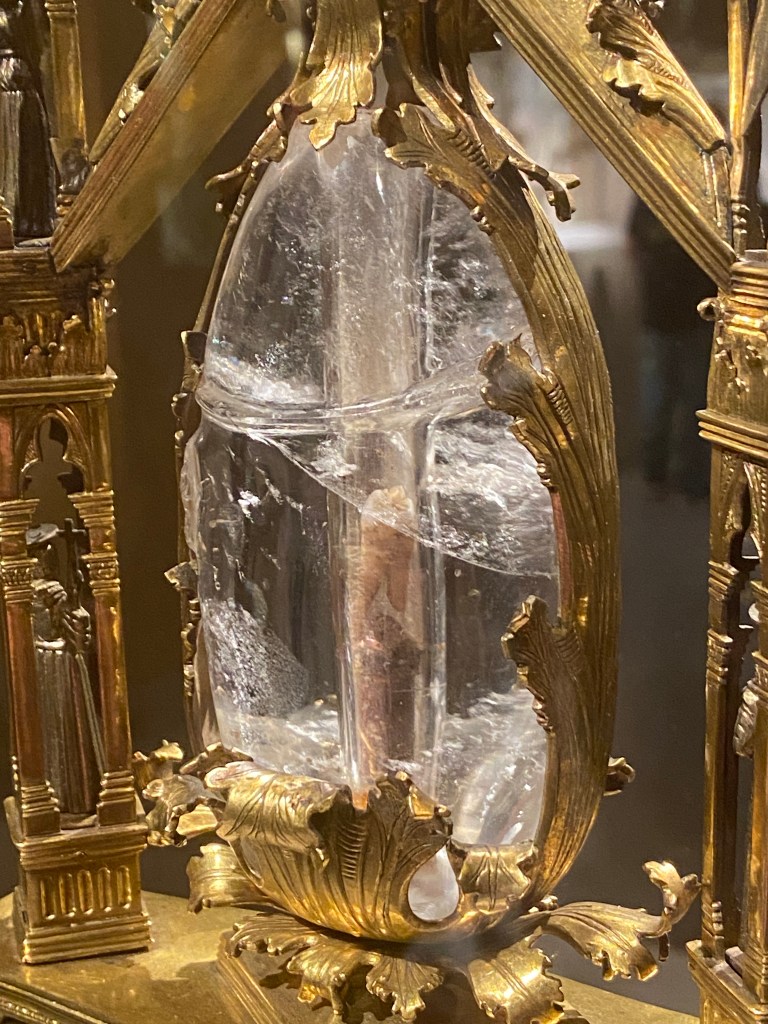
Relic of St. Mary Magdalene in the Metropolitan Museum, NYC
There is a strange and disturbing trend among occult and demonic religions, particularly within esoteric branches of Buddhism, such as Tibetan Vajrayana. These traditions go to great lengths to mimic, distort, and counterfeit elements of the Catholic faith. Why? Because Satan has no creativity of his own. His kingdom is one of imitation, distortion, and inversion. And when we look closer, it becomes chillingly clear: many of these occult systems are designed as spiritual forgeries, imitating the truths of the Catholic Church while replacing Christ with false gods and demons.
Here are just a few examples.
Relics: Holy vs. Unholy
In Catholicism, relics are a beautiful and reverent way the faithful connect with the saints in heaven. The bones, hair, and clothing of saints, when venerated properly, are physical reminders of lives of holiness and union with Christ. First-class relics (parts of a saint’s body), second-class relics (items the saint used), and third-class relics (objects touched to a first-class relic) are all part of an ancient, sacred tradition rooted in the Incarnation: God came in the flesh, and through His Body and those who share in His holiness, the physical becomes a channel of grace.
Now compare this to Tibetan Buddhism and other occult traditions.
Tibetan lamas preserve the bones and hair of deceased teachers and display them in shrines. In some cases, these relics are even mixed into pills or powders thought to convey “blessings” or spiritual power. Even more shockingly, there are “blood pills” created from the blood of high lamas, dried and consumed by devotees, believed to transfer the lama’s blessing and heal the disciples’ illnesses.
What we see here is not simply reverence for a teacher but an occult inversion of the sacred. These objects are treated as talismans or sources of supernatural power, often wrapped in secrecy, ritual, and magical thinking.
Apostolic Succession vs. Tantric Lineage
The Catholic Church has an unbroken apostolic lineage going back to Christ Himself. This is not just symbolic but the real spiritual authority passed from bishop to bishop, from the Apostle Peter to the present-day pope. The sacraments are valid because of this lineage. The Holy Spirit moves through it, not because of magical powers or personal charisma, but because of Christ’s promise to His Church.
Tibetan Buddhism, too, places massive emphasis on “lineage” in the passing of initiations, teachings, and realizations from teacher to student. They claim these go back to the historical Buddha, Sakyamuni. But here’s the problem: the tantras, the core of Tibetan esoteric practice,did not exist during Sakyamuni Buddha’s life. These were later developments, many of which emerged between the 5th and 10th centuries AD, centuries after the Buddha died.
So how do they justify their claims? Through visions, dream revelations, hidden treasure texts (termas), and secret transmissions from spirit beings. These are not testable or historically verifiable. Instead, they mimic the structure of apostolic succession while relying on supernatural claims rooted in occultism. It’s a counterfeit version of Catholic apostolic lineage, one that replaces the Holy Spirit with “dakinis,” “protectors,” and wrathful spirits.
Blessed Sacrament vs. Tantric Empowerments
In the Catholic Church, the Eucharist is the Real Presence of Jesus, body, blood, soul, and divinity. It is the highest form of worship and union with God. Only validly ordained priests can consecrate the Host, and it is surrounded with reverence and liturgy.
IIn tantric Buddhism, “empowerments” are elaborate rituals meant to grant spiritual powers, open energy channels, and “ripen” the disciple for advanced practices. They are sometimes sexually charged, invoking deities (who are really demons in disguise), and can involve ingesting “nectars,” or entering into trance states. Many initiations are based on “secret” transmissions, whispered lineages, or magical seals. These seals are believed to imprint a spiritual mark or bind the practitioner to a specific deity, practice, and lineage. But this is not unique to Tibetan Buddhism. Magical seals are also found in Satanism, Luciferianism, and ceremonial magic, where they are used to summon or bind spirits and demons in exchange for occult knowledge, power, or protection. These seals are spiritual contracts or expressions of unseen allegiances, and their use is never neutral. They are tools of spiritual manipulation that open the soul to influence, possession, or bondage by demonic spirits. In these traditions, the seal acts as a gateway or portal, and it is binding, a counterfeit version of the indelible mark left by the Holy Spirit in baptism or confirmation. Where the Church seals the faithful with chrism and the sign of the cross, occult traditions seal their initiates with marks of spiritual enslavement.
Chrism refers to a consecrated oil used in the Catholic Church during certain sacraments, specifically Baptism, Confirmation, and Holy Orders. It is a mixture of olive oil and balsam, blessed by a bishop during Holy Week.
The use of chrism is deeply symbolic:
It represents the Holy Spirit and divine anointing.
It marks the person as set apart for God, sealed with grace and incorporated into Christ.
The anointing with chrism leaves an indelible spiritual mark on the soul, which can never be removed.
The tantric empowerments claim to transform the practitioner’s body, speech, and mind into that of a deity but again, this is a counterfeit. Instead of communion with God through grace, it’s the deification of the self through ritual manipulation and demonic assistance.
The Church Triumphant vs. the Pantheon of Demons
Catholics honor the communion of saints, those in heaven who intercede for us and serve as models of holiness. Saints are not worshipped; they are venerated. The glory always goes to God.
Tibetan Buddhism features a dizzying pantheon of “yidams” (meditational deities), “protectors,” and “enlightened deities” that are summoned, visualized, and sometimes merged with through complex meditations. These include wrathful, terrifying figures in colors of blue, red, and black, with fangs, skulls, and weapons, dripping with blood or dancing on corpses. Vajrayogini, for example, is often visualized standing on a human corpse, holding a flayed skin and drinking from a skull cup. Although these are claimed to be symbols of transcendence, they are actually demonic imitations of holiness.
Satan’s Strategy: Imitation, Not Innovation
Why does the enemy copy the Church? Because the Catholic Church is the true Bride of Christ. Satan can’t create truth, but he can twist it. His most dangerous weapons are not outright lies, but distorted half-truths wrapped in spiritual language. He dresses up darkness to look like light.
Tibetan Buddhism and similar occult systems offer spiritual hierarchy, ritual, relics, and transmission, but without Christ. They offer communion, but with spirits and demons. They offer transformation, but into false gods, not saints.
The Real Power: Jesus Christ
There is no substitute for the true power of God through Jesus Christ. No blood pill, no tantric lineage, no magical empowerment can wash away sin or bring eternal life. Only Christ, crucified and risen, can do that.
For those who have been caught up in these counterfeit systems, whether through curiosity, spiritual seeking, or deception, it is important to remember that there is hope and it is possible to extricate oneself. Jesus is the Way, the Truth, and the Life and his truth is not hidden in secret teachings or passed down in esoteric rituals. It is freely offered to all who repent and believe.
In a dusty corner of southern India, something strange is happening. Among the Catholic untouchables of Tamil Nadu the Virgin Mary reigns. These are the Dalit communities who converted to Christianity to escape caste oppression. Here the Virgin Mary is not just the mother of Christ or the Queen of Heaven. She’s the protector from demons, the healer of the possessed, and the exorcist of lustful spirits who prey on young women. [1]
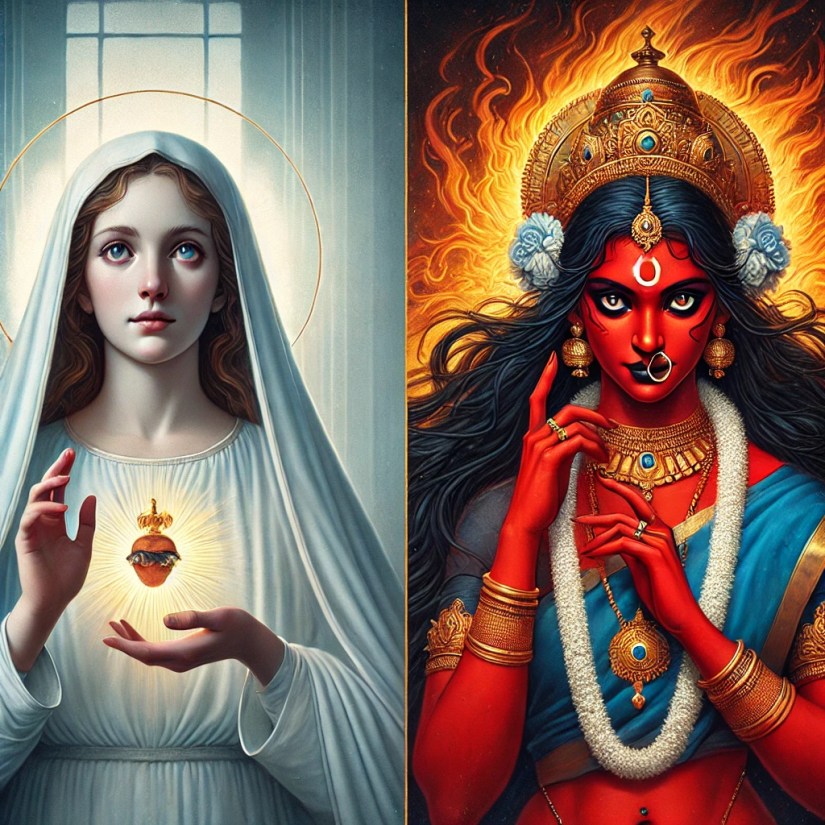
Her name here is Arockyai Mary, “Our Lady of Good Health,” and unlike the goddesses of India’s native pantheon, she never harms. She doesn’t demand blood, or rage, or possess.
This makes her an anomaly in a world where possession is an everyday threat and where menstruation, pregnancy, and the liminal chaos of female sexuality are believed to attract wandering spirits, often the ghosts of those who died violently or before their time. These spirits, it is said, latch onto the vulnerable, especially women, and drive them into trances and convulsions.
And then there are the Hindu goddesses like Mariyamman [2] and Kaliamman [3], powerful but volatile. They heal, but they can also possess, punish, and destroy. Unlike the Virgin Mary, who is seen as unconditionally loving and healing, Mariyamman and Kaliamman’s protection must be earned through ritual and sacrifice. Their presence is often feared as much as it is venerated, revealing a form of feminine divinity that is transactional, fierce, and unpredictable.
The deeper thread that ties this to my own journey through Eastern mysticism and into Catholic truth is that the female deities of India are not so much saviors as they are owners. They ride their devotees like horses often through an overpowering kundalini experience. They enter bodies without informed consent. They demand submission, sacrifice, and pain. This is what possession looks like when the divine manifests as fierce femininity unmoored from moral restraint.
But the Virgin Mary is different in kind, not just degree. She doesn’t exploit vulnerability; she protects it. Her power is rooted in love, not domination. She doesn’t punish women for their sexuality; she guards them from the predators that do.
Many of us who were drawn into the tantric and yogic traditions found ourselves worshiping goddesses we didn’t truly understand such as Kali, Vajrayogini, and Durga. These powerful beings granted “blessings” that often came in the form of disorientation, illness, and spiritual invasion. What we called “awakening” was perhaps possession, wrapped in ritual and mystique.
In the story of the Paraiyar women, we see this clearly. Demonic possession is a warning as well. The culture teaches women that if they stray outside ritual boundaries, if they become too sexually visible, if they travel alone at dusk or cross the wrong river, they open the door to attack. And it’s the Virgin Mary, not Kali, who shows up to cast the darkness out.
Humanity does not need more divine rage, but the one Woman who is pure benevolence: the Mother of Jesus who through her perfection is feared by and can cast out spirits and demonic goddesses.
[1] Source article: Deliège, Robert. “La Possession démoniaque chez les Intouchables catholiques de l’Inde du sud / Demoniac Possession Among the Catholic Untouchables in Southern India.” Archives de sciences sociales des religions, no. 79, 1992, pp. 115–134. Available online.
[2] Mariyamman is a powerful village goddess widely worshipped in South India, especially in Tamil Nadu. Her name combines “mari,” meaning rain or disease, and “amman,” meaning mother—making her the Mother of Rain and Disease. She is especially associated with illnesses like smallpox, fevers, and skin diseases, but also with fertility, childbirth, and protection from evil spirits. Visually, she often appears fierce—sometimes with fiery red skin, holding a trident, and crowned with flames—bearing a resemblance to goddesses like Kali or Durga. Her shrines are typically modest, and her worship is deeply rooted in folk rituals. Devotees may offer animal sacrifices, participate in firewalking, or fall into trances believed to be divine possessions. In many cases, women are the ones possessed by Mariyamman, and these episodes are interpreted as both blessings and warnings—depending on whether the goddess has been properly appeased.
[3] Kaliammam is a fierce village manifestation of the goddess Kali, worshipped primarily in Tamil Nadu and other parts of South India. The name “Kaliamman” translates to “Mother Kali,” reflecting her role as a local protective mother goddess rooted in folk traditions. Like Kali, she is associated with destruction, power, and the eradication of evil, but in the village context, she is also invoked for healing, fertility, and protection from malevolent spirits. Kaliamman is often depicted with dark skin, a lolling tongue, wild hair, and multiple arms holding weapons—symbolizing her unrestrained spiritual power. Her worship includes rituals that are intense and sometimes violent: offerings of blood, possession trances, firewalking, and dramatic acts of devotion are common. She is believed to possess her devotees—often women—either to bless them, deliver a warning, or punish neglect. She must be honored and feared. Her presence reinforces moral and ritual boundaries in the community, demanding reverence through sacrifice and submission rather than drawing near in mercy or compassion.
Throughout the Bible, God’s Word is described as a powerful and transformative force capable of addressing the deepest struggles of humanity, including the battle against evil. For Christians who are engaging in spiritual warfare and fighting against demonic forces, using the Bible is not only permissible but deeply rooted in scriptural authority. Here, we explore how the Bible provides this foundation and clarify why this practice is far removed from the realm of magic.
The Sword of the Spirit: The Word as a Weapon
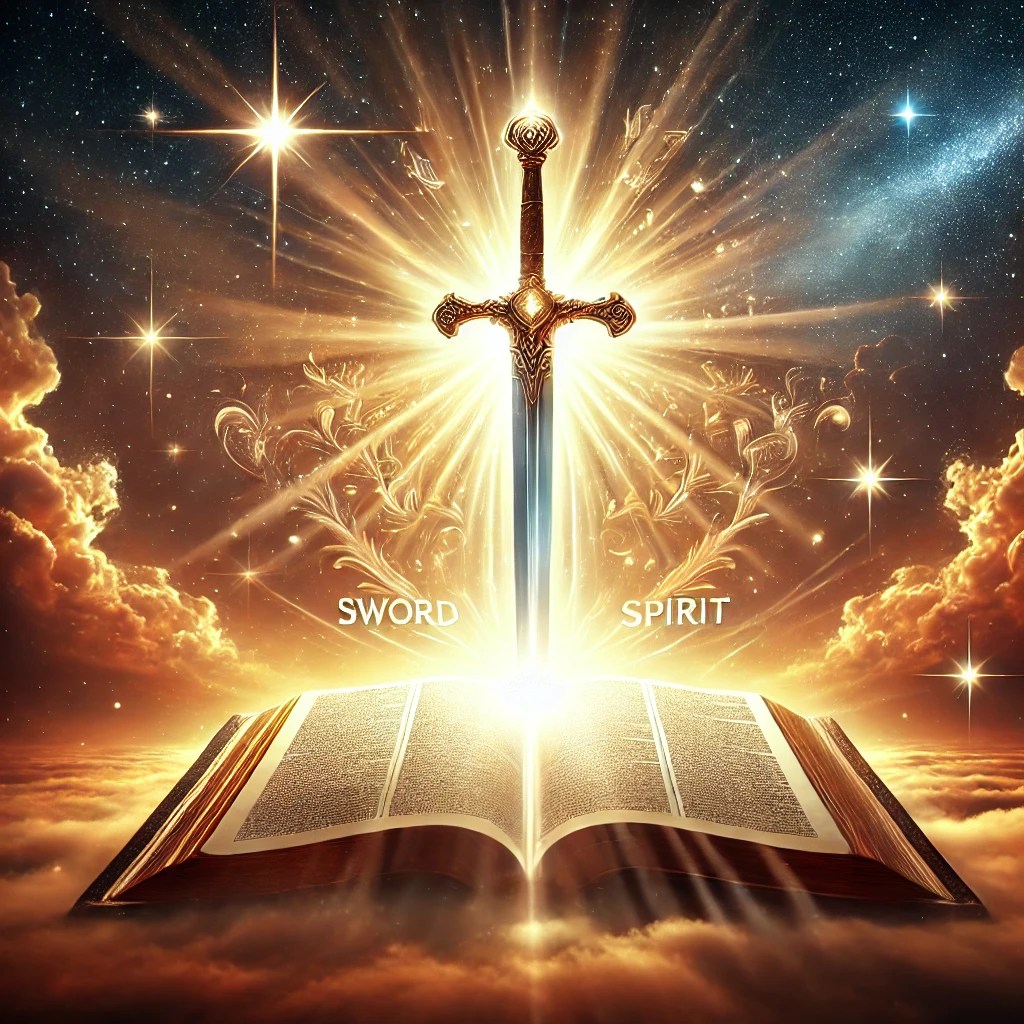
Ephesians 6:17 declares, “Take the helmet of salvation, and the sword of the Spirit, which is the word of God.” Paul describes the Word of God as a vital piece of the “armor of God,” emphasizing its role as an offensive weapon against spiritual challenges. This imagery highlights the Bible’s unique power to confront and dismantle evil. Hebrews 4:12 echoes this sentiment, calling the Word “living and active, sharper than any two-edged sword” that can discern and pierce the heart’s deepest intentions.
Unlike physical combat, spiritual warfare relies on divine power, as Paul reminds us in 2 Corinthians 10:4-5: “For the weapons of our warfare are not of the flesh but have divine power to destroy strongholds.” Here, Scripture becomes a tool to demolish false arguments and thoughts that stand against the knowledge of God.
The Tongue’s Role in Warfare
Proverbs 18:21 asserts that “Death and life are in the power of the tongue.” Words hold immense spiritual weight, capable of uplifting or destroying. When believers declare God’s promises and truths against demonic attacks, they engage in a profound act of spiritual resistance. This isn’t incantation; it is aligning one’s voice with God’s truth, as demonstrated in Jesus’ own confrontations with Satan (Matthew 4:1-11).
David’s Example: Seeking Divine Intervention
Many Psalms, including Psalm 35 and Psalm 18, depict David calling upon God to intervene against his enemies. Psalm 35:3 implores, “Draw the spear and javelin against my pursuers! Say to my soul, ‘I am your salvation!’” These passages illustrate that God is actively involved in protecting His people. The believer’s reliance on Scripture as a form of prayer and declaration invokes God’s power rather than personal ability.
Spiritual Warfare Is Not Magic
It is essential to distinguish between the use of Scripture in spiritual warfare and the practice of magic. Magic seeks to manipulate spiritual forces through rituals or incantations. Spiritual warfare, by contrast, is rooted in submission to God’s authority and reliance on His power. Jeremiah 23:29 underscores the potency of God’s Word, describing it as a “fire” and a “hammer” that breaks rock into pieces. This power is not harnessed through human will but through divine will, activated by faith.
Cosmic and Divine Intervention
Judges 5:20 provides an intriguing insight: “From the heavens the stars fought, from their courses they fought against Sisera.” This poetic account reveals that God’s creation itself aligns with His purposes to combat evil. Believers today can trust that when they rely on God’s Word, they are not fighting alone but are part of a divine strategy against darkness.
Faithfulness and Authority
Revelation 2:26-27 promises authority to those who remain faithful: “To the one who is victorious and does my will to the end, I will give authority over the nations…” This passage reassures Christians that their victory in spiritual warfare is part of their inheritance in Christ. They wield God’s Word not as a mystical tool but as an authoritative proclamation of His truth.
A Call to Action
In engaging in spiritual warfare, Christians are called to:
1. Equip Themselves with Scripture: Memorize and meditate on verses like Ephesians 6:17 and Hebrews 4:12 to understand the authority of God’s Word. 2. Speak with Faith: Use the tongue to declare God’s promises, as Proverbs 18:21 encourages. 3. Submit to God: Recognize that victory comes from His power, not human strength, as emphasized in 2 Corinthians 10:4-5. 4. Rely on God’s Intervention: Trust in His active involvement, as depicted in the Psalms and throughout the Bible.
Spiritual warfare using God’s Word is not an act of mysticism but a profound alignment with His divine authority. As believers stand firm in Scripture, they demonstrate faith in the living and active power of God, wielding the “sword of the Spirit” with confidence and trust. By doing so, they participate in a battle already won by Christ, assured of ultimate victory.


 Tantric Deception