A recent Vatican meeting between Pope Leo XIV and the International Association of Exorcists underscores growing concern within the Church about the spread of occult practices and their spiritual consequences.
According to the exorcists, there has been a “noticeable rise” in involvement with “occultism, esotericism, and Satanism,” developments they associate with increasing cases of spiritual distress.¹ These trends are not viewed as abstract cultural shifts, but as realities encountered in pastoral work.
The delegation stressed that many individuals who engage in such practices experience serious harm, describing “grave spiritual suffering” among those affected.¹ In their view, these are not isolated incidents but part of a broader pattern requiring a structured response from the Church.
“Ignoring these realities leaves many people without an adequate response to grave spiritual suffering.”¹
For this reason, the exorcists emphasized the importance of ensuring that every diocese has properly trained clergy capable of addressing these situations. They called for stronger formation, clearer discernment, and greater institutional readiness.
At the same time, they acknowledged the complexity of these cases. The meeting highlighted the need for collaboration with medical and psychological professionals to distinguish between spiritual affliction and mental health conditions.¹ This cooperation is seen as essential for responsible pastoral care.
The Vatican framed the issue as one of accompaniment and guidance. Many who turn to occult or esoteric practices are described as searching for meaning or relief from personal struggles.¹ From the exorcists’ standpoint, this search can expose individuals to demonic influences that require careful spiritual intervention.
Overall, the meeting reflects a coordinated effort within the Church to respond to what exorcists describe as a growing pastoral challenge: one that involves both spiritual discernment and practical support for those affected.
St. Michael the Archangel, defender of the faithful, stands as heaven’s warrior casting down the forces of darkness and waging relentless battle against demonic powers.
Footnote
Marty Vergel Baes, “Pope Leo XIV Hosts Exorcists at Vatican — Surge in Satanism Cases Raises Concern for Vulnerable Believers,” International Business Times UK, March 23, 2026.
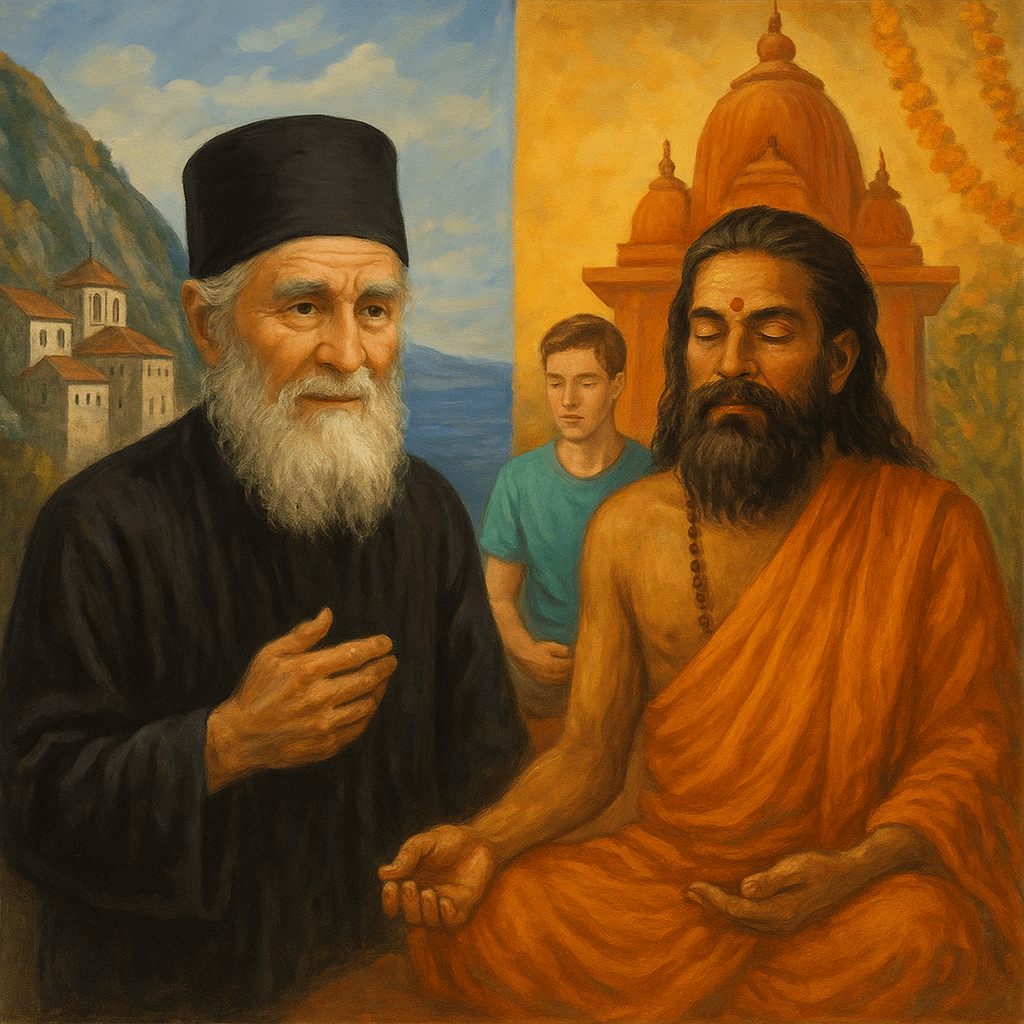
In 2008, the Holy Monastery of Saint Arsenios on Mount Athos published The Gurus, the Young Man, and Elder Paisios.¹ It tells the true story of a young Greek man whose hunger for spiritual depth led him from the monasteries of Athos to the ashrams of India, where he fell under the sway of a Hindu guru. This book resonated with me because it mirrors the restlessness of many modern seekers. It traces the arc from yearning for authentic experience, through dangerous detours into counterfeit light, and finally to deliverance through Christ. That theme, the need for discernment in a world of spiritual seductions, is central to my own story and to the explorations I share.
The First Encounter with Elder Paisios
The young man first encountered Elder Paisios on Mount Athos, the spiritual heart of Greek Orthodoxy. Athos is not simply a monastic peninsula but a living continuation of the desert fathers, a land saturated with centuries of prayer. Elder Paisios was already known as a man with the profound gifts of clairvoyance, discernment, and love. At the heart of Orthodoxy, he explained, lies the invocation of the name of Christ: “Lord Jesus Christ, have mercy on me.”² This is not a spiritual technique but a cry from the heart. As Paisios emphasized, “With the name of Christ we experience divine Grace, divine illumination, and union with God.”³
Life on Mount Athos
Mount Athos rises from the Aegean like a fortress of prayer. Approaching by boat, pilgrims see monasteries clinging to cliffs, their domes catching the morning sun. Bells toll at dawn, summoning monks from their cells to the katholikón, the central church. Inside, the air is heavy with incense; oil lamps flicker before icons blackened with centuries of smoke. The chanting is slow and unhurried, carrying the words of the Psalms like waves rolling in from the sea.
The rhythm of Athonite life is simple but relentless. To walk its paths is to feel the weight of prayer, as if the very stones are steeped in the remembrance of God. When the young man would meet Elder Paisios in his cell at Panagouda, he encountered not pomp or grandeur but humility. The elder sat on a rough stool, his clothes patched, his face lined with suffering yet radiant with joy. Paisios was accessible, direct, and utterly unpretentious. His authority did not come from outward spectacle but from the depth of grace shining through him.
Despite these encounters, the young man was restless. His desire for spiritual experience drew him beyond Orthodoxy and into Hinduism in India.
Life in the Ashram
India overwhelmed his senses. It was a riot of bright colors and potent scents. Bells clanged rhythmically at dawn, mingling with the chant of myriad voices repeating mantras. Bare feet shuffled across dusty courtyards as disciples hurried to gather at the feet of the guru, who sat elevated on a dais draped in silk and garlands of marigolds. The air around him was charged with expectancy.
Daily life in the ashram followed ritual precision. Before sunrise, disciples bathed in cold water, then filed into meditation halls where they repeated mantras by the thousands. Each syllable, they believed, vibrated with cosmic energy. The guru’s followers bowed low, sometimes lying full-length on the ground, convinced that to touch even the dust beneath his feet was a blessing.⁴ His faintest smile was received as a gift, his disapproval a knife wound.
The guru’s teachings promised transcendence. He insisted that the repetition of mantras would dissolve the ego and merge the self into the divine. He was not merely a teacher but the embodiment of truth itself. Service was considered worship: cooking his meals, arranging his seat, or waving fans before him was thought to create conditions conducive to liberation. At first, the young man was drawn in by the atmosphere of devotion and the apparent serenity of the disciples. The charged rituals, intense and mystical, seemed to hum with power.
Yet Elder Paisios had already warned him: “The invocation of the name of any other god apart from Christ is communion with demons. The person who invokes that name calls upon the demon corresponding to it and is possessed by it.”⁵ What seemed like nectar would prove to be poison.
Paisios explained that deceptive energies imitate grace: “They give a sweetness, a supposed peace, but afterwards they bring turmoil.”⁶ This was the young man’s experience. The chants that once filled him with calm soon unsettled him. His thoughts scattered, his dreams grew dark, and the guru’s gaze, once a source of comfort, became suffocating. The ashram that had promised freedom now felt like a dangerous place.
The Return to Mount Athos
When the young man finally returned to Athos and told Paisios everything, the elder spoke with clarity. “In Orthodoxy we have the invocation of the name of Christ. With it we experience illumination and union with God. All other invocations, all other names, apart from Christ, lead to deception.”⁷
Paisios prayed for him, invoking Christ. In that moment, the torment that had hounded the young man since the ashram lifted. He felt the peace of God return, and the tormenting voices were silenced. What the guru’s gaze and mantras had invoked, the simple name of Jesus restored.
Why It Resonates
This story mirrors my own path. Like the young man, I wandered away from Christ into Eastern occult traditions that promised transformation through techniques such as deity yoga, mantra repetition, and breath manipulation. The initial sweetness was very real followed by years of difficulties alternating with mystical heights, but all of that led to demonic possession by entities I once thought were buddhas.
In a world where esoteric practices are commonplace, Paisios’s warnings are urgent. Many today seek mystical experiences, but as Elder Paisios said, “Grace brings deep humility, contrition, tears, and love for Christ.”⁸ The counterfeit, by contrast, produces disturbance and bondage. The young man’s deliverance is not his story alone; it is a caution to the world that spiritual deceptions come at a terrible price.
Notes
Dionysios Farasiotis, The Gurus, the Young Man, and Elder Paisios, trans. and adapted by Hieromonk Alexis (Trader), ed. Philip Navarro (Platina, CA: St. Herman of Alaska Brotherhood, 2011).
Farasiotis, The Gurus, the Young Man, and Elder Paisios, chap. 3.
Farasiotis, The Gurus, the Young Man, and Elder Paisios, chap. 4.
Farasiotis, The Gurus, the Young Man, and Elder Paisios, chap. 5.
Farasiotis, The Gurus, the Young Man, and Elder Paisios, chap. 4.
Farasiotis, The Gurus, the Young Man, and Elder Paisios, chap. 4.
Farasiotis, The Gurus, the Young Man, and Elder Paisios, chap. 4.
Farasiotis, The Gurus, the Young Man, and Elder Paisios, chap. 4.
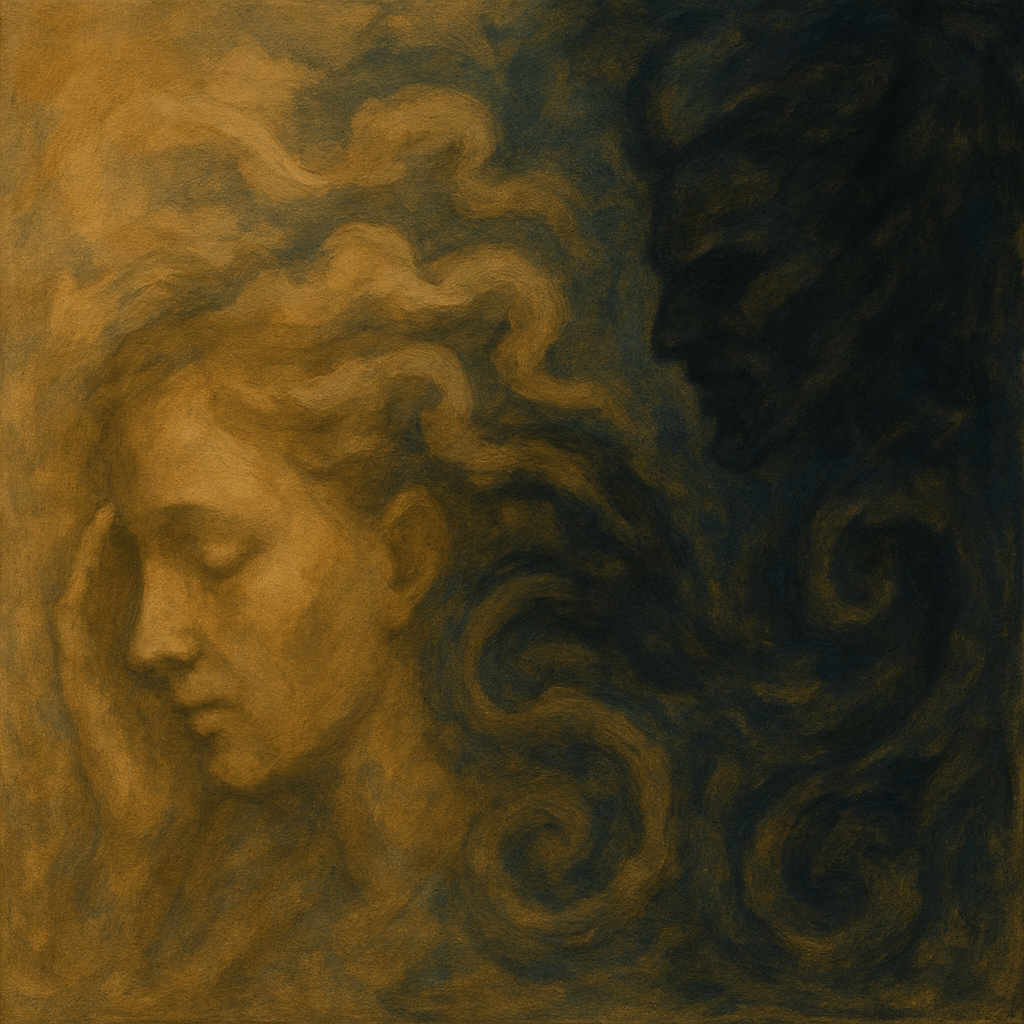
In our modern world, the subconscious is often reduced to a psychological artifact, a repository of repressed memories, habits, and impulses. But from a biblical and Catholic standpoint, this internal space is more than just a vault of emotion and instinct. It is a spiritual battleground and a vulnerable domain where real entities, such as demons seek entry and control.
I speak not in theory but from personal experience. As someone who has lived through the horror of possession, I know firsthand what it means to have my subconscious colonized by non-physical forces, in particular, Tantric deities and the so-called yidams (meditational deities) I once invoked in long term retreats. They now exert control over my dreams at night, not as fragments of memory, but with an intention, force, and intelligence all their own.
Trauma, Sin, and the Open Doors
The Catholic tradition is clear: sin creates openings. These are spiritual vulnerabilities through which demonic powers can assert influence. But it’s not always sin, but often wounds and traumas that become entry points. This aligns, ironically, with what Jung called the shadow: the parts of ourselves we deny or fail to integrate.
In occult and tantric frameworks, these shadows are often “worked with” i.e. ritualistically invited, named, and visualized. In my case, the visualizations of the yidam were never just symbolic. They were summonings that invited intelligent spiritual entities through geometric portals into the liminal space of my subconscious mind.
Obviously, tantric rituals are powerful, but the power is not “of God.” The light of Christ later revealed to me that what I had opened myself up to were demonic counterfeits or parasitic forces clothed in deceptive splendor.
The Subconscious
While the Jungian model treats these internal figures such as archetypes, gods, and dreams, as symbolic representations of the psyche, Biblical scripture offers a different view. Ephesians 6:12 tells us that our struggle is “not against flesh and blood, but against principalities, against powers, against the rulers of the darkness of this world.”
What modern psychology calls “unconscious drives” may, in reality, be demonic actors exploiting our blind spots. They can manifest through thoughts, compulsions, visions, or dreams. They don’t just influence behavior, they shape the architecture of perception, infiltrating belief itself. This is why confession and deliverance are not just spiritual maintenance but are spiritual war strategies.
Dreams: The Nightly Invasion
The yidam I practiced during my retreats appears nightly, manipulating my dreams and injecting disturbing images, physical sensations, and false feelings of failure and yearning. It tries to arouse old loyalties alternating between affects of pseudo kindness and visions of cruel and bitter punishments. These dream invasions foster confusion and despair; and sometimes cause sensations of physical torment.
From a biblical perspective, dreams are a legitimate domain of spiritual communication, but that doesn’t mean all dream figures are from God. In Jeremiah 23, the Lord condemns false prophets who “make my people forget my name by their dreams.” Satan can disguise himself as an angel of light and in my experience, tantric deities do precisely that.
We must recognize the subconscious not as a private fortress, but as a permeable space, one that requires guarding, cleansing, and illumination by Christ alone. Anything else, especially tantric visualization and archetypal meditation, opens up doors we cannot close on our own.
There is no neutral spirituality. Every spiritual practice either opens the soul to grace or to deception. As one who has been inside the snare, I say this without hesitation: tantric deities are demons in disguise, and their preferred hiding place is the very part of us we least understand: the subconscious.
But Jesus Christ, in His mercy, descends even into those hidden caverns, casting out darkness and healing the wounds that made us vulnerable in the first place.
“For this purpose the Son of God was manifested, that He might destroy the works of the devil.” — 1 John 3:8
In today’s spiritual landscape, a troubling trend is emerging: well-meaning Christians are being led to believe that Tibetan Buddhism is not only compatible with Christianity but can even enhance it. This deception, often subtle and clothed in the language of “contemplation” or “interfaith dialogue,” has found its way into Catholic monasteries and retreat centers. At the heart of this distortion is the adoption of Eastern meditative techniques, often inspired by Tibetan Buddhist practices, and the uncritical embrace of yoga as a “neutral” spiritual discipline.
To be clear: Tibetan Buddhism is not a Christian cousin. It is a profoundly different worldview, rooted in concepts like reincarnation, karma, and the ultimate dissolution of the self, doctrines wholly incompatible with Christianity’s vision of a personal, relational God and the eternal dignity of the soul.
Meditation or Manipulation?
The Christian tradition has long held a deep respect for silence, prayer, and contemplation, especially in the monastic practices of the Desert Fathers or the Hesychast tradition of Eastern Orthodoxy. But what is often marketed today as “meditation” bears little resemblance to Christian prayer. Tibetan Buddhism aims at the realization that the self and all phenomena are empty of inherent existence, a direct experience of emptiness (śūnyatā) and the luminous, non-dual nature of awareness.
This goal is diametrically opposed to Christian theology, which insists on the uniqueness of each soul, created in the image of God and destined for eternal communion with Him.
Yet Christian leaders and institutions have increasingly opened the door to these teachings. For example, the late Father Thomas Keating, one of the leaders of the Centering Prayer movement, drew heavily on Eastern techniques, often blurring the line between Christian contemplation and Buddhist meditation. Though his intentions were no doubt sincere, the result was a confusing blend of incompatible truths.
Another case is Father Richard Rohr, a popular Franciscan whose teachings often echo non-dual philosophies far closer to Eastern mysticism than to historic Christianity. Rohr’s discussions of “Christ-consciousness” and the illusion of the separate self bear striking resemblance to Tibetan Buddhist views, yet they are consumed by many Catholics and Protestants as if they are orthodox.
The Yoga Trap
Yoga is another Trojan horse in the spiritual lives of many Christians. Despite its spiritual roots in Hindu and Buddhist traditions, yoga is often presented as a harmless or purely physical practice. In truth, yoga’s asanas (postures) were designed not for exercise, but as physical preparations for meditation and kundalini awakening, specifically, awakening to a worldview that denies the personal God revealed in Jesus Christ.
When Christians engage in yoga or Tibetan-inspired meditation without discernment, they open themselves up not just to foreign practices, but to foreign spirits. This is not religious paranoia but a spiritual reality. St. Paul warned the Corinthians about participating in pagan rituals, saying, “You cannot partake of the table of the Lord and the table of demons” (1 Corinthians 10:21).
The Deception of Compatibility
Tibetan Buddhist teachers are often happy to affirm Christian practices, so long as they are reinterpreted through a Buddhist lens. Some even encourage Christians to see Jesus as an “enlightened teacher” or “bodhisattva.” This allows the surface appearance of interfaith respect while subtly undermining core Christian claims: the Incarnation, the Resurrection, and the uniqueness of Christ as Savior.
This is not compatibility, but syncretism and it poses a spiritual danger.
A Call to Discernment
This is not to instill hostility or fear of Buddhism and other Eastern Religions. Nor is it a rejection of silence, stillness, and physical well-being. But Christians must recover the spiritual discipline of discernment. Not all that brings peace is from God. The Enemy is more than capable of offering counterfeit serenity, especially when it draws people away from the Cross and toward self-deification or belief in idols.
Christianity offers its own deep, mystical tradition rooted not in esoteric techniques or mantras, but in personal relationship with the living God. Prayer, asceticism, sacramental life, and union with Christ are more than sufficient for those seeking transformation. We do not need to import Tibetan concepts or yogic practices to find God. He is already here, knocking at the door.
The growing blend of Tibetan Buddhism and Christianity may feel harmonious on the surface, but this is illusory. At its core, the Gospel is not compatible with systems that deny Christ’s divinity, the soul’s eternal destiny, or the Triune God. As Christians, we must not be seduced by exotic forms of “spirituality” that utilize half-truths, and communion with fallen angels.
In the modern spiritual landscape, the image of the Tibetan Buddhist guru reigns supreme: a figure of wisdom, compassion, and radiant loving-kindness. They preach mindfulness, selflessness, and sanctity, inviting seekers into what appears to be a sacred journey toward enlightenment. Yet, to me, this image is a facade, a carefully curated performance masking a much darker reality.
I write these words not as a distant observer but as someone who has experienced firsthand the profound betrayal of being targeted by spiritual teachers I once trusted. In my personal journey, three different gurus, revered in their communities for saintly and/or enlightened behavior, turned to black magic rituals against me when I questioned, disagreed, or simply became inconvenient to their carefully maintained personas. This article is an exploration of the deep cognitive dissonance that allows such individuals to publicly embody ideals of compassion while privately committing acts of cruelty.
The Ideal: Loving-Kindness and Compassion as a Mask
Gurus in traditions such as Tibetan Buddhism, Hinduism, and various New Age movements are often held up as embodiments of selfless love and wisdom. Their teachings and writings are saturated with the language of peace and universal compassion. In public, they radiate qualities such as patience and gentleness, reinforcing the image of infallibility.
This idealized projection is not merely for the benefit of followers; it also serves the guru’s own self-concept. They must see themselves, and be seen as holy, thereby reinforcing their authority and maintaining their social and spiritual power.
The Threat: When a Disciple Questions Authority
In the sanitized image of the perfect guru, there is no room for dissent. Questions, criticisms, or any sign of independence from a disciple can be perceived not as opportunities for dialogue, but as existential threats. After all, if a guru’s authority rests on the illusion of flawless wisdom and compassion, any crack in that image could unravel the entire edifice.
When faced with a questioning or independent-minded disciple, an insecure guru may respond not with the compassion they preach, but with fear, rage, and vindictiveness. To protect their power, they must eliminate the threat, not through open dialogue or humility, but through covert aggression.
The Betrayal: Weaponizing Spiritual Power
Traditions rich in esoteric knowledge provide tools that can be used for healing and protection, but also for harm. Tibetan Buddhism, for instance, preserves rituals historically intended to call down curses, obstacles, and psychic attack upon perceived enemies.
In my experience, these gurus invoked black magic against me. These were not random charlatans; they were highly respected spiritual leaders, who waxed eloquently in the language of love and compassion. Yet when challenged, they resorted to covert energetic and magical attacks, using the very tradition they claimed to uphold to violate the sacred trust between teacher and student.
Cognitive Dissonance: Reconciling Saintliness with Malice
How does a guru reconcile the horror of harming a disciple while maintaining their self-image as a bodhisattva, a compassionate enlightened being? The answer must lie in cognitive dissonance: the mental stress of holding two contradictory beliefs simultaneously.
To preserve their self-concept, the guru must justify their actions internally:
“I am protecting the dharma.”
“This disciple was dangerous, impure, deserving of punishment.”
“Sometimes cruel and violent actions are necessary for the greater good.”
Through rationalization, projection, and splitting, they maintain the fiction of compassion while engaging in spiritual violence. They convince themselves that their harmful actions are righteous, necessary, and justified.
The Aftermath for the Disciple
For those of us on the receiving end, the experience is devastating on many levels. It deeply tears at the soul to be targeted by those we once revered. The betrayal fractures trust not only in teachers but in the entire spiritual path. The disciple may grapple at first with:
Confusion: “Was it my fault?”
Self-doubt: “Did I deserve this?”
Spiritual disillusionment: “Is true compassion even real?”
If the disciple survives this first stage, similar to a victim of Stockholm syndrome, there comes a gradual dawning of the truth: the Tibetan Buddhist path, far from being one of light, has revealed itself as a path of darkness. That realization, painful as it is, can ultimately be deeply empowering.
I do not minimize the devastating effects of the powerful magic performed by these modern-day mahasiddhas. Black magic attacks are very real, manifesting as physical illness, emotional despair, and worse. Healing from such trauma requires immense courage and deep inner work. It is one of the most horrific experiences a human being can endure.
Yet, there is a stronger and truly holy force at work in the universe: the Most High God–yes, the biblical God. Sadly, many Tibetan gurus seem to have little experience of Jesus Christ, the Holy Spirit, or the true mercy and compassion that they embody.
The Deeper Horror: Gurus Possessed by False Spirits
It is not enough to say these gurus made mistakes or succumbed to human weakness. When a soul trained in the disciplines of compassion, wisdom, and loving-kindness instead chooses cruelty, retaliation, and spiritual violence, something darker is at work.
One must ask: how can they inflict such harm without being crushed by the weight of their own conscience? The terrifying truth is that many of these gurus may no longer be acting from their own hearts at all. They are, at some deep inner level, possessed, not by the enlightened deities they claim to serve, but by deceptive demonic forces masquerading as gods, bodhisattvas, protectors, and spirits of light.
In their ignorance and self-deception, they have invited darkness into themselves. They have handed over their will to entities that delight in mockery, destruction, and the inversion of sacred teachings. The rituals they once performed for healing and protection now become channels for curses, oppression, and spiritual decay.
And yet, even in this darkness, a greater light shines.
There is a true and living God, the Most High, whose justice is perfect and whose mercy is real. There is Jesus Christ, the Holy Spirit, and the incorruptible power of divine love, utterly beyond the reach of these childish gurus and their counterfeit spiritualities.
When I was a devoted Tibetan Buddhist, the word enlightenment held sacred weight. It meant the complete awakening of compassion and wisdom, the state of a Buddha who sees through illusion and dedicates themselves to freeing all sentient beings from the sufferings of samsara. I trusted in that vision, because I believed I was following a noble tradition.
But even then, something always felt a little off. I had a quiet discomfort I kept pushing aside.
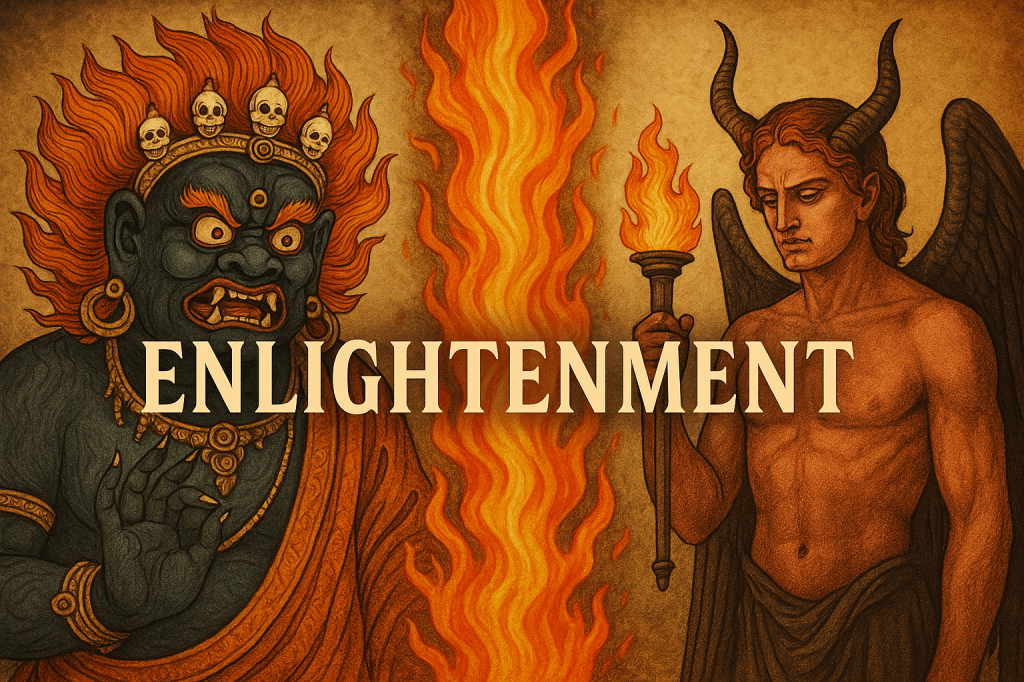
The problem was this: the term enlightenment wasn’t exclusive to Buddhism. I saw the same word used in the occult, in Theosophy, Freemasonry, and even Luciferianism, often in ways that glorified rebellion and the pursuit of hidden knowledge. Why were systems as wildly different as Tibetan Buddhism and Luciferian occultism both invoking “enlightenment” and “awakening” as their ultimate goal? Why did the same term span both the sacred and the profane?
Tibetan Buddhism: Enlightenment as Compassionate Wisdom
In Tibetan Buddhism, enlightenment is the realization of emptiness, the transcendence of ego, and the birth of boundless compassion. The ideal of the bodhisattva is someone who delays their own final nirvana in order to help all other beings reach liberation. This enlightenment isn’t just something a guru gifts you; it’s a hard-won transformation of your own mind.
Vajrayana Buddhism, the tantric branch of Tibetan Buddhism, adds layers of secrecy and initiation. There are empowerments, mantras, visualizations, and guru devotion practices. It uses powerful symbols such as vajras, weapons, fire, and wrathful deities that on the surface could resemble occult ritual. This made me uneasy. Was this actually an Eastern form of the same hidden path to power that Western esoteric groups followed?
I reassured myself that Vajrayana was different. It used “occult” methods, maybe, but only to realize true compassion and emptiness. Still, the similarity in tone and terminology between tantric rituals and occult rites always bothered me.
Now, after 35 years of hard work, study, devotion, and ultimately betrayal at the hands of tantric Buddhist gurus and deities, I’ve come to a grim realization: the enlightenment I was seeking wasn’t what I thought it was. It is merely an occult system dressed in Buddhist robes. The deeper I went, the clearer it became that Tibetan Buddhism and Luciferianism are two sides of the same coin. They may use different language, imagery, and rituals, but they are architecturally and spiritually similar and they both serve darkness, not light.
The word that they share, enlightenment, is the bait they use to ensnare seekers.
Luciferianism and Tibetan Buddhism: Two Faces of the Same Enlightenment Agenda
In Luciferianism, enlightenment is about becoming your own god. Lucifer is framed not as evil, but as the “light-bringer,” the one who defies divine authority to bestow forbidden knowledge. Enlightenment here is rebellion, self-deification, and esoteric power.
Helena Blavatsky, the founder of Theosophy, which heavily influenced modern occultism, named her journal Lucifer and described the figure as a misunderstood bringer of divine wisdom¹. In The Secret Doctrine, she refers to Lucifer as the “spirit of intellectual enlightenment”² and equates him with the higher mind of humanity. Freemasonry, Theosophy, and modern occultism all share the core motif: moving from darkness to light, and from ignorance to gnosis, through secret initiation.³
This kind of “light” is occult and exclusive. The “enlightened ones” in these systems are initiates who’ve been brought into deeper mysteries. The light is not for everyone; it’s reserved for those chosen by the system who are able to serve its agenda.
What shocked me, and what I ignored for years, is that tantric Buddhism functions much the same way. It promises special teachings, revealed only to the initiated. It trains students to see their guru as a living Buddha, above criticism or doubt, and presents his questionable actions as “skillful means,” while bypassing basic moral accountability. There is a similar secretive, hierarchical structure although this one is surrounded by colorful thangkas and Sanskrit mantras.
The deeper I went, the more I saw that my devotion was being weaponized against me. Tantric gurus used “crazy wisdom” to justify harm, and “samaya vows” to silence dissent. It wasn’t really compassion, but a spiritual aristocracy, no different from the occult orders I once thought Buddhism stood apart from. The beatific vision of enlightenment for the benefit of all sentient beings was merely the bait. The hook was the hidden power of dark forces.
Now I see clearly that the word enlightenment, both in Tibetan Buddhism and Luciferianism, functions as a kind of smokescreen. It sounds noble, luminous, and superior. But in both systems, it serves those in power and creates a class of “enlightened ones” who are above reproach, who serve gods and buddhas from unseen realms that are not what they appear to be.
“Enlightened Ones” as Agents of the Lie
It’s not just that the term enlightenment is misused. It’s that those who claim it, whether in Tibetan Buddhism or Luciferianism, are agents of a system that serves a being or beings pretending to be of the light.
These “enlightened ones” often behave the same way, regardless of tradition: they demand loyalty, obedience, and silence. They wield charisma and secrecy as tools. And when challenged, they invoke mystical authority and retaliation.
In both systems, the “light” is a mask and those who follow it are bound to something posing as divine. Whether it’s called Buddha, a Bodhisattva, an Ascended Master, or Lucifer, the same current runs underneath: it is a demonic force clothed in the language of transcendence.
Christianity and the True Nature of Light
Unlike Tibetan Buddhism and occultism, Christianity doesn’t use enlightenment as a central goal. It speaks instead of salvation, grace, and being born again through the Holy Spirit. The light of Christ is not esoteric knowledge reserved for an initiated elite but is open, relational, and grounded in love and repentance. Christ’s light is not something attained through ritual or secrecy; it is something revealed publicly and offered to all.
As Jesus says in the Gospel of John: *“I have spoken openly to the world. I have always taught in synagogues and in the temple, where all Jews come together. I have said nothing in secret.”⁵ This sharply contrasts with occult traditions, including tantric Buddhism, where knowledge is concealed, layered in initiations, and distributed only to those deemed “ready.” In my own experience, this secrecy became a mask for control. I was told not to question or doubt. I had to sacrifice my own inner wisdom and clarity.
But the light of Christ does not require silence or blind devotion. The Holy Spirit is not a power to be manipulated, but a divine presence who convicts, comforts, and guides with truth. In my experience, that is the only light that does not deceive.
Every other version I followed, no matter how radiant it appeared, eventually demanded that I suppress my discernment, abandon my conscience, and serve a system of secrecy cloaked in mystical language.
A Word to the Seekers
To anyone still in these systems, or brushing up against them through yoga, New Age teachings, or tantric practices: be careful with “light” that demands you stop using discernment. Be cautious of teachers who ask for your silence or your soul. Be wary of the spiritual forces behind the promised enlightenment.
I say this not as an outsider, but as someone who gave my life to this path. I practiced the rituals, prostrated to the gurus, and offered my heart in devotion. And when the mask came off, I saw what was truly being served, and it wasn’t holy. It was something else entirely.
Footnotes and Sources
Blavatsky, H. P., Lucifer, Vol. 1. Theosophical Society, 1887.
Blavatsky, H. P., The Secret Doctrine, Vol. 2. Theosophical Publishing House, 1888.
Pike, Albert. Morals and Dogma of the Ancient and Accepted Scottish Rite of Freemasonry. Southern Jurisdiction, 1871.
Mackey, Albert G. The Symbolism of Freemasonry. Masonic Publishing, 1882.
The Holy Bible, English Standard Version, John 18:20.
Crowley, Aleister. The Book of the Law. 1904.
Bailey, Alice A. Initiation, Human and Solar. Lucis Publishing Company, 1922.
Dapsance, Marion. “Behind the Smiling Façade: Abuse in Tibetan Buddhism.” Le Nouvel Observateur, 2018. Translated and discussed in Tricycle: The Buddhist Review.
Sawerthal, Anna. “Sogyal Rinpoche’s Abuse and the Breakdown of Secrecy in Buddhism.” Tricycle, 2018.
Peljor, Tenzin. “Tibetan Buddhism and Abuse: Why Critical Thinking is Essential.” Interview in Spiegel Online, 2019.
Āveśa (Sanskrit) refers to a state of spiritual possession or divine inhabitation in which a deity or sacred power “enters” and dwells within a person. The word literally means “an entering” or “fusion,” describing the incorporation of divine power into the human body. Such forms of sacred possession have long been central to Indian Tantric practice, invoked for both worldly benefits (bhoga) and spiritual liberation (mokṣa). This is often contrasted with demonic possession in Christian theology, typically characterized as an involuntary affliction by an evil spirit.
Cross-cultural studies note that spirit possession can be either voluntary or involuntary, and it is interpreted differently depending on the tradition. Western occult traditions, such as Luciferianism, may view possession by a demon as desirable, even leading to a so-called “perfect possession.” In Christianity, however, even voluntary possession by a demonic force is considered evil. The question then arises: who or what possesses the practitioner in Eastern contexts?
Towards the end of my 35 years in Tantric Buddhism, I came to believe that the force presenting itself as a deity was, in fact, demonic. In what follows, I will examine the phenomenon of āveśa in two major esoteric traditions, Hindu Tantra (especially Shaiva lineages such as Kashmir Shaivism), and Tibetan Vajrayāna Buddhism. I will contrast these forms of divinely sanctioned possession with demonic possession in Christian and occult frameworks, drawing from historical sources, academic analysis, and personal experience.
Āveśa in Hindu Tantric Traditions
Scriptural Origins and Tantric Development
The Sanskrit root ā-viś (to enter) appears in early Indian texts, foreshadowing the later Tantric elaboration of āveśa.1 From the 5th to 11th centuries, Tantric scriptures across Śāiva, Śākta, and Buddhist milieus incorporated āveśa into ritual practice. Scholar Vikas Malhotra describes āveśa as the “entrance or fusion of oneself with the deity,” central to both magical and liberatory goals.2
These practices utilized mantras, mudrās, and nyāsa (installing mantras on the body) to induce the deity’s presence. Often this process was linked to śaktipāta, or the descent of divine energy. Over time, āveśa came to refer not just to deity possession, but a range of spiritual states culminating in union with Śiva.3 In contrast to exorcism (removing evil spirits), this adorcistic form of possession aimed to invite a divine presence.
Kashmir Shaivism and Samāveśa
In the Trika system of Kashmir Shaivism, the term samāveśa refers to full ontological immersion in Śiva-consciousness. Abhinavagupta, a 10th-century Hindu philosopher and Tantric adept, defined it as a merger of individual and divine being, sometimes accompanied by shaking, trance, or devotional ecstasy.4 Rituals such as nyāsa or advanced mudrā usage were seen as ways to divinize the body. Kṣemarāja, a key Trika commentator, emphasized that the body itself becomes a vessel for cosmic forces, eroding the sense of ego.5
This idea extended to daily ritual. The practitioner installs divine presences into various body parts—e.g., “May Brahmā be in my genitals, ViṣŇu in my feet, Śiva in my heart”—until the self is transformed.6 Āveśa was also connected to śaktipāta dīkṣā (initiation by grace), which Abhinavagupta saw as the guru’s transmission of divine force into the student.
Historical sources and hagiographies portray this not as pathology but sacred awakening. In the Bhakti tradition, saints like Caitanya and Rāmakṛṣṇa exhibited signs interpreted as divine possession, a loss of ordinary consciousness during worship or dancing in states of trance. In goddess worship, the ecstatic state of bhāva can evolve into full possession by a fierce Devī or goddess.
Induced Trance in Ritual Practice
Possession is not accidental; it is often deliberately induced. Contemporary folk-Tantric rites like Theyyam in Kerala reenact this vividly. The performer undergoes intense ritual preparation, dons a sacred headdress, and becomes a vessel for the deity. His demeanor, voice, and movements change dramatically, and devotees approach him as a god.7 These techniques including fasting, music, sacred garb, and mantra, parallel ancient Tantric rituals meant to induce āveśa.
Importantly, this experience is consensual. A priest may invite a deity for oracular guidance or blessing. The Tantric yogi similarly invites identification with Śiva. As Frederick Smith notes, such possession is the most valued spiritual experience in many Indian settings.8 Advanced yogis even practiced para-kāya praveśa, the entry of one’s consciousness into another’s body, a form of high-level āveśa.9
Āveśa (Possession) in Tibetan Vajrayāna Buddhism
Deity Yoga and Guru Inhabitation
Though the term “possession” is less used, Vajrayāna emphasizes divine inhabitation. In Deity Yoga, one visualizes oneself as a yidam (meditational deity) and invites the deity’s wisdom aspect (jñānasattva) to merge with the visualization (samayasattva). Through mantra and meditation, the practitioner dissolves ego and identifies as the deity.
While framed as an enlightened act, in practice there is no safeguard against malevolent forces. Many Tibetan rituals derive from the Yoginītantras, esoteric texts filled with wrathful, dangerous dākinīs. These entities are unpredictable and must be carefully propitiated. Practitioners hope to merge with them for wisdom and power, but failure often results in spiritual collapse or madness. One either becomes “enlightened” or is destroyed.
My personal experience, including participating in two three-year retreats, led me to conclude these deities are not divine but demonic. After prolonged practice, I experienced terrifying possession states, torturous sensations, and an uncontrollable kundalini awakening. While there were moments of bliss and magical phenomena, the final result was spiritual devastation.
Guru Yoga and Transmission
Guru Yoga, especially in the Nyingma and Kagyu lineages, mirrors āveśa. The practitioner visualizes the guru dissolving into them, merging body, speech, and mind. This is intended to produce an inseparable union. Some historical accounts even describe instant enlightenment via physical gestures or verbal commands from a master, a form of mind-to-mind transmission akin to possession.
Some Vajrayāna practices involve obvious demon possession. The Nechung Oracle, for example, enters trance during elaborate rituals, allowing the deity Pehar to possess his body. Frightening physical changes, voice alteration, and strength are observed. The practice is structured around phowa, a method of ejecting consciousness to allow divine entry.10
Possession as Initiation and Transformation
Both traditions treat āveśa as transformative. In Hindu Tantra, samāveśa may mark initiation or realization. In Vajrayāna, empowerment rituals symbolically install the lineage mindstream into the disciple. When successful, the practitioner believes they have merged with divine consciousness.
The experiences are often euphoric and expansive. Yet, as I learned, they can also become nightmarish. The forces one invokes may not be what they seem. While traditions insist the entities are enlightened or benevolent, there is no proof. Many undergo trauma, dissociation, and spiritual breakdown.
Christian Views of Possession: A Stark Contrast
In Christian theology, possession is demonic by nature. The demon enters uninvited or through occult involvement, and exorcism is the remedy. Symptoms include revulsion to the sacred, altered voices, and loss of control. Unlike tantric āveśa, the demon is not a divine aspect but an evil other. (I should note that the kundalini energy always felt “other” to me, but I was encouraged to see it as a positive experience.)
Catholic doctrine states that even voluntary occult involvement is condemned, seen as opening a door to bondage; the soul remains untouched, but the body and mind may be dominated. Consent may be partial or misguided, but once entered, the demon seeks destruction.
Only the Holy Spirit is seen as a positive presence, and even then, Christian traditions speak of inspiration rather than possession. Some Pentecostal expressions resemble Eastern possession states, but many Christians believe these, too, are counterfeit Holy Spirit experiences linked to kundalini phenomena.
Scripture offers stern warnings:
All the gods of the nations are demons.” — Psalm 96:5 (Septuagint) “They sacrificed to demons, not to God.” — Deuteronomy 32:17
In conclusion: āveśa is framed as a sacred merging in Tantra, but my experience revealed it as demonic deception. Beneath the ritual beauty lies spiritual subjugation. As an exorcist once warned me: Be careful who or what you invite to abide within.
Footnotes
“A Brief Study of Possession in Hinduism Part II: The Spiritual Context,” Indic Today.
Vikas Malhotra, ĀveŚan and Deity Possession in the Tantric Traditions of South Asia.
Ibid.
“The Fulcrum of Experience in Indian Yoga and Possession Trance.”
Ibid.
Indic Today, op. cit.
“Theyyam,” Wikipedia.
Frederick M. Smith, The Self-Possessed: Deity and Spirit Possession in South Asian Literature and Civilization.







 Tantric Deception