Leaving Tibetan Buddhism is not just a change of belief systems; it can be a deep spiritual battle. For those who’ve practiced tantra, divination, or deity yoga, you may have sensed that something was not right and that which was supposed to be “enlightened” came with confusion, heaviness, and spiritual oppression.
If you’re reading this, you may already be in the process of leaving Tibetan Buddhism or maybe you’re considering it.
Why People Leave Tibetan Buddhism
At first, Tibetan Buddhism can appear beautiful, complex, and pure. But over time, many practitioners begin to discern troubling spiritual dynamics:
Worship of wrathful deities and demons presented as “enlightened beings”
Tantric rituals and yoga cause physical and mental anxiety
Dependence on gurus, where questioning is not allowed but seen as a kind of spiritual betrayal
Dreams, sleep paralysis, or oppression that begin after initiations or sadhana practices
These are not mere coincidences. The Bible clearly warns against idolatry, necromancy, sorcery, and invoking spirits, practices central to Tibetan tantric systems (Deuteronomy 18:10–12, Galatians 5:19–21):
Deuteronomy 18:10–12 (NKJV)
“There shall not be found among you anyone who makes his son or his daughter pass through the fire, or one who practices witchcraft, or a soothsayer, or one who interprets omens, or a sorcerer, or one who conjures spells, or a medium, or a spiritist, or one who calls up the dead. For all who do these things are an abomination to the Lord, and because of these abominations the Lord your God drives them out from before you.”
Galatians 5:19–21 (NKJV)
“Now the works of the flesh are evident, which are: adultery, fornication, uncleanness, lewdness, idolatry, sorcery, hatred, contentions, jealousies, outbursts of wrath, selfish ambitions, dissensions, heresies, envy, murders, drunkenness, revelries, and the like; of which I tell you beforehand, just as I also told you in time past, that those who practice such things will not inherit the kingdom of God.”
Demonic Retaliation Is Real
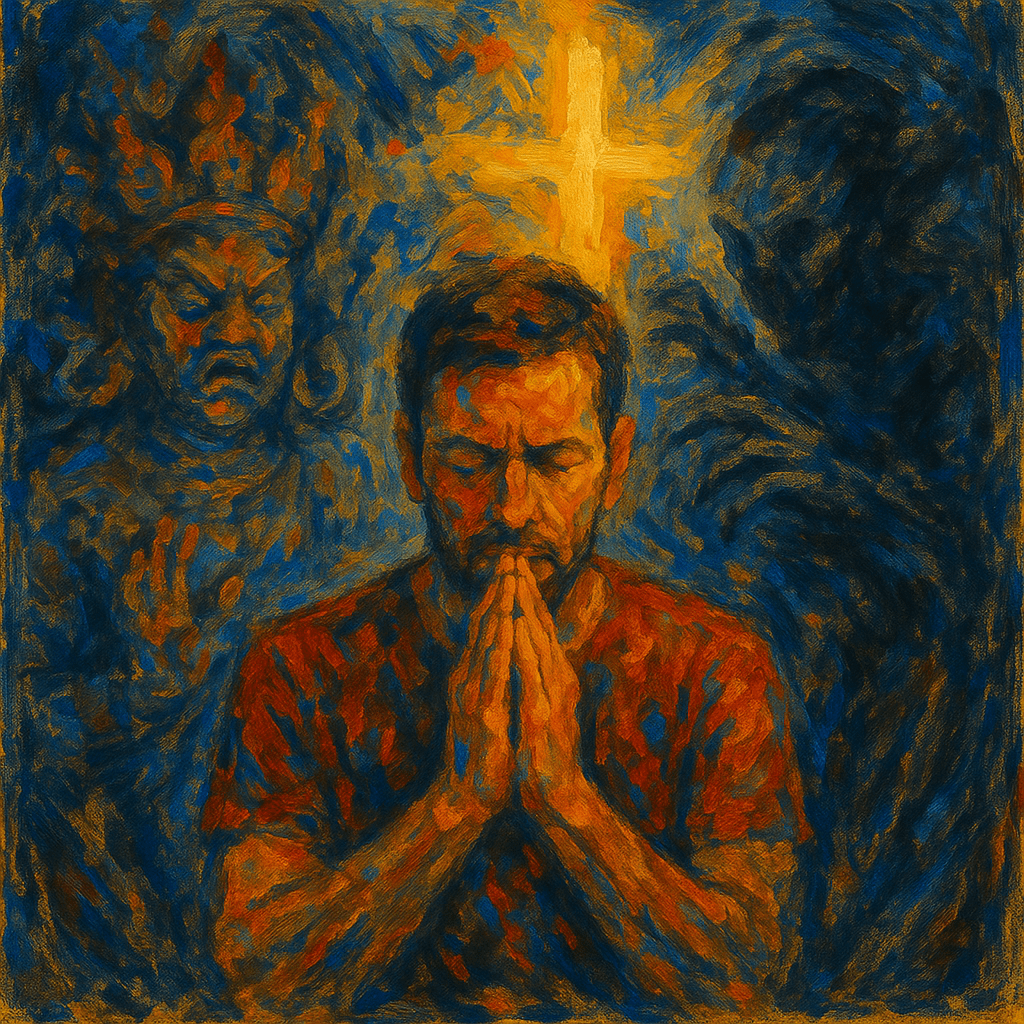
When someone leaves these systems, there can be real spiritual backlash and former practitioners often experience:
Nightmares or visitations
Voices or intrusive thoughts
Emotional heaviness and fear
The spiritual world does not easily let go, but Jesus Christ has authority over it all (Luke 10:19), so know that you are not alone.
Step-by-Step: How to Leave Tibetan Buddhism
1. Acknowledge the Truth
Call it what it is. Confess to God that you participated in practices that He calls abomination. There is no shame in this. We were deceived. He already knows and is ready to forgive (1 John 1:9).
2. Renounce All Involvement
With your words backed by your will, say out loud:
“I renounce all involvement in Tibetan Buddhism, tantra, deity worship, and all practices that are not of the one true God. I reject every false spirit of divination and claim the blood of Jesus over my life.”
Destroy objects associated with your past practice: malas, thangkas, statues, books, empowerment trinkets. Do not give them away, but burn, break, or throw them out.
3. Receive Jesus Christ as Lord and Savior
Deliverance comes through a Person, not a ritual. Jesus is the only one who has authority to truly save and set free.
“Lord Jesus, I believe You died for my sins and rose again. I repent and turn to You. Come into my life, forgive me, cleanse me, and fill me with Your Holy Spirit. I make You Lord of my life.”
4. Seek Deliverance Prayer
Depending on your level of involvement, you may need help from mature believers to walk through deliverance. This isn’t superstition but real spiritual warfare. Find a priest and church that understands deliverance ministry.
5. Saturate Yourself in God’s Word and Worship
Replace mantras with Scripture. Replace deity visualizations with the truth of God’s love. This requires patience because it can be a slow process as you’re being spiritually rewired. Read Ephesians, Psalms, and the Gospels daily. If you are Catholic, make a formal confession to a priest. Go to Mass frequently and receive the sacraments. Take steps to convert or revert.
6. Expect Retaliation but Know That You’re Safe
Don’t be surprised if you experience spiritual attack. That’s confirmation you’re on the right path. Demons may try to reassert old ties, but they are already defeated in Christ. You now have authority to rebuke them (James 4:7, Mark 16:17):
James 4:7 (NKJV)
“Therefore submit to God. Resist the devil and he will flee from you.”
Mark 16:17 (NKJV)
“And these signs will follow those who believe: In My name they will cast out demons; they will speak with new tongues;”
Final Thoughts: This Is War, but You’re on the Winning Side
Leaving Tibetan Buddhism may feel like you’re walking away from decades of sincere spiritual seeking. But the reality is: you are walking into the truth, the light, and the freedom that only Jesus can give.
You are not betraying your path but escaping a spiritual system that masked bondage as enlightenment. Demonic deception is real, but the power of Jesus is greater.
He said, I am the way, the truth, and the life. No one comes to the Father except through me” (John 14:6).
You are loved and being called out of darkness. For more information about Deliverance from the Occult, visit www.catholicexorcism.org.
Both Vajrayana and Luciferian rites use geometric portals to invoke spiritual forces and what comes through may not leave easily.
Follow-up to: “The ‘Hidden’ Truth of Vajrayana Empowerment: Does the Lama Implant a Deity into the Disciple’s Mind?”
Following the previous article “The ‘Hidden’ Truth of Vajrayana Empowerment,” which exposed how Tibetan tantric initiation involves the lama implanting a deity into the disciple’s mind-stream, this follow-up explores how that same core process, spiritual implantation, appears in Western occult and Satanic initiation rites. Though culturally and theologically distinct, both systems describe a mystical transformation in which the aspirant is indwelt, overshadowed, or spiritually fused with a nonhuman being. The parallels are striking, and the implications for unsuspecting spiritual seekers are sobering.
Union Through Inhabitation
In Vajrayana Buddhism, the empowerment ritual is designed to activate the disciple’s Buddha-nature by personifying it as a specific deity. This process is not symbolic; it requires the intervention of the guru, who performs a series of initiations (vase, secret, wisdom, and word) that culminate in the wisdom deity entering the disciple’s visualized form. Sam van Schaik and other scholars describe this as a fusion of two minds: the practitioner becomes “in union” with the deity.¹ Light or energy entering the heart symbolizes this transmission, and classical sources like Vilāsavajra² and Jamgön Kongtrul³ confirm that the deity’s presence is meant to take root within the initiate.
This process mirrors what takes place in various forms of Western occult initiation. Whether in ceremonial magic, Luciferian practice, or Thelemic rites, the aspirant invites a spiritual entity, sometimes framed as a “higher self” and other times as a demon or god-form, to inhabit or fuse with their consciousness.⁴ In certain traditions, this is done under the guise of awakening one’s divine essence or ascending the Tree of Life, but the mechanics remain: the person is inviting another spiritual will to merge with their own.
The Role of the Officiant
In Vajrayana, only a qualified guru can perform the empowerment. The lama must have realization of the deity in order to transmit it, effectively serving as a channel through which the deity is implanted into the disciple. The disciple cannot access the highest yoga tantra deity alone; it must come through the guru.⁵
In Western occultism, the structure is more flexible. In ceremonial lodges like the Golden Dawn, initiation is conferred by a hierarchy of initiates. In solitary or Luciferian paths, the practitioner may self-initiate, performing a ritual to invoke and receive a spiritual entity directly.⁶ This difference, hierarchical transmission versus self-directed invocation, changes the form but not the essence of what is happening: a spiritual being is invited in.
Seed and Possession
Both traditions speak of what can be described as a spiritual seed taking root in the initiate. In Vajrayana Buddhism this is the seed of the deity that is implanted through ritual and nurtured by mantra and visualization, growing into full enlightenment.⁷ In occult traditions, similar metaphors abound: the Black Flame (Luciferianism), divine spark (Gnosticism), or magical current (Thelema) all describe a presence awakened or implanted within the practitioner.⁸
Possession or identity fusion is not merely metaphorical in either tradition. In Vajrayana, the practitioner becomes the deity in practice and visualization. In Western occultism, invocation or evocation may result in the spirit speaking through the practitioner, taking partial or full control.⁹ The aspirant may not merely visualize the entity; they may be inhabited by it.
Theological Framing
Here is where the surface similarities give way to deeper concerns. Vajrayana presents this union as sacred and salvific. The deities are said to be manifestations of enlightened mind, and the process is aimed at liberation from suffering.
In contrast, many Western occult traditions embrace the transgressive nature of the ritual. In Luciferian and Satanic paths, the union with a spiritual being is framed as an act of rebellion, empowerment, or divinization.¹⁰ Even in systems that use angelic or archetypal language, the goal is often gnosis independent of God, power over nature, or rejection of traditional morality.
From a Christian theological perspective, both processes, however cloaked in cultural or religious language, involve the opening of the soul to spiritual beings not of God.¹¹ Whether the entity is labeled as a deity, guardian angel, or inner Buddha, the core act is the same: inviting possession or fusion with a nonhuman intelligence. Exorcists describe demons as “persons without bodies.”
Deliberate Secrecy vs. Ritual Transparency
Another key difference lies in disclosure. Vajrayana does not typically explain to new initiates that the lama will implant the deity into their mindstream. This is concealed under layers of euphemisms, talk of “blessings,” “inspiration,” or “awakening Buddha-nature”.¹² Western occultism, by contrast, often acknowledges its aims more directly. A Luciferian magician knows they are invoking Lucifer. A Thelemite understands the goal is Knowledge and Conversation with a higher being.¹³
But the result is no less dangerous. Both systems involve entering into a spiritual relationship that can dominate or override the practitioner’s will. From a Christian point of view, these are not symbolic practices but acts of spiritual surrender and potentially, spiritual bondage.
Conclusion: Two Paths, One Mechanism
While Vajrayana tantra and Western occultism differ in terminology, mythos, and cultural packaging, they share a core mechanism: a ritual invitation for a spiritual being to enter the initiate’s consciousness. Whether masked as deity yoga or celebrated as demonic possession, the outcome is the same: identity fusion with a nonhuman spirit.
The true danger lies not only in the act itself but in the lack of informed consent. Many Vajrayana practitioners never fully understand what they’ve opened themselves to until it’s too late. And many occultists, lured by the promise of empowerment, mistake possession for enlightenment.
As explored on this blog, the deeper deception is the true nature of “possession” rituals versus how they are presented. Spiritual seekers deserve the truth: that these practices, whether called empowerment or initiation, are not harmless techniques for personal growth and transcendence. They are open doors: both Vajrayana and Luciferian rites use geometric portals to invoke spiritual forces and what walks through may not be your friend or leave easily.
Sources
Sam van Schaik, “The Limits of Transgression: The Samaya Vows of Mahāyoga” (2010).
Vilāsavajra, Hevajra Tantra Commentary, excerpts found in Mahāyoga textual studies.
Jamgön Kongtrul, The Treasury of Knowledge, Book Eight, Part Three.
Aleister Crowley, Magick in Theory and Practice; Michael Ford, Luciferian Witchcraft.
Ngawang Phuntsok, On Receiving Wang (Empowerment).
Israel Regardie, The Golden Dawn: A Complete System of Magic.
Dalai Lama, Kalachakra Initiation Teachings; traditional commentaries on empowerment.
Michael W. Ford, Apotheosis: The Ultimate Beginner’s Guide to Luciferianism.
Kenneth Grant, The Magical Revival; practices in chaos and ceremonial magic.
Anton LaVey, The Satanic Bible; Ford, Dragon of the Two Flames.
Catechism of the Catholic Church, paragraphs 2116–2117.
Scott Globus, “Empowerments: Awakening the Buddha Within,” Rubin Museum, 2021.
Aleister Crowley, The Vision and the Voice; Liber Samekh.
Tantric initiation (Vajrayana empowerment) is often described as a ritual that grants permission to engage in deity yoga and awaken one’s inner Buddha-nature. Yet traditional Tibetan sources suggest that something more mystical and intrusive is occurring, that the lama actually places the deity’s essence into the disciple’s mindstream. This critical detail, essentially the guru implanting or merging the deity (yidam) with the initiate’s mind, is conspicuously absent in most contemporary teachings.
This article examines classical tantras and commentaries to determine whether they explicitly describe the guru installing the deity in the disciple’s mind. It then compares that understanding with modern teachings, exposing a deliberate omission that raises serious questions about transparency in Vajrayana transmission.
Traditional Teachings on Tantric Empowerment
In Vajrayana Buddhism, empowerment (Tib. wang, Skt. abhisheka) is essential. “In the Secret Mantra Vehicle, there can be no accomplishment without empowerment.”¹ Classical definitions stress that this is not merely symbolic but a ritual that transforms the disciple’s mindstream.
According to the Rigpa Wiki, empowerment “awakens the special capacity for primordial wisdom to arise in the mind of the disciple.”² The Dalai Lama’s teachings on the Kalachakra Tantra state the guru “ripens the disciple’s psycho-physical continuum with the initiations.”³ Traditional analogies liken this to planting a seed that, with the right conditions, will grow into Buddhahood. This “seed” is not just metaphorical but is a spiritual presence that enters the disciple.
Tantric texts and commentaries describe empowerment as a mystical transmission wherein the wisdom deity (jnanasattva) is invited to enter the samaya deity (samayasattva), the visualized form of the disciple. Sam van Schaik summarizes: “in empowerment… the wisdom being becomes embodied in the samaya being.”⁴ The two minds are joined.
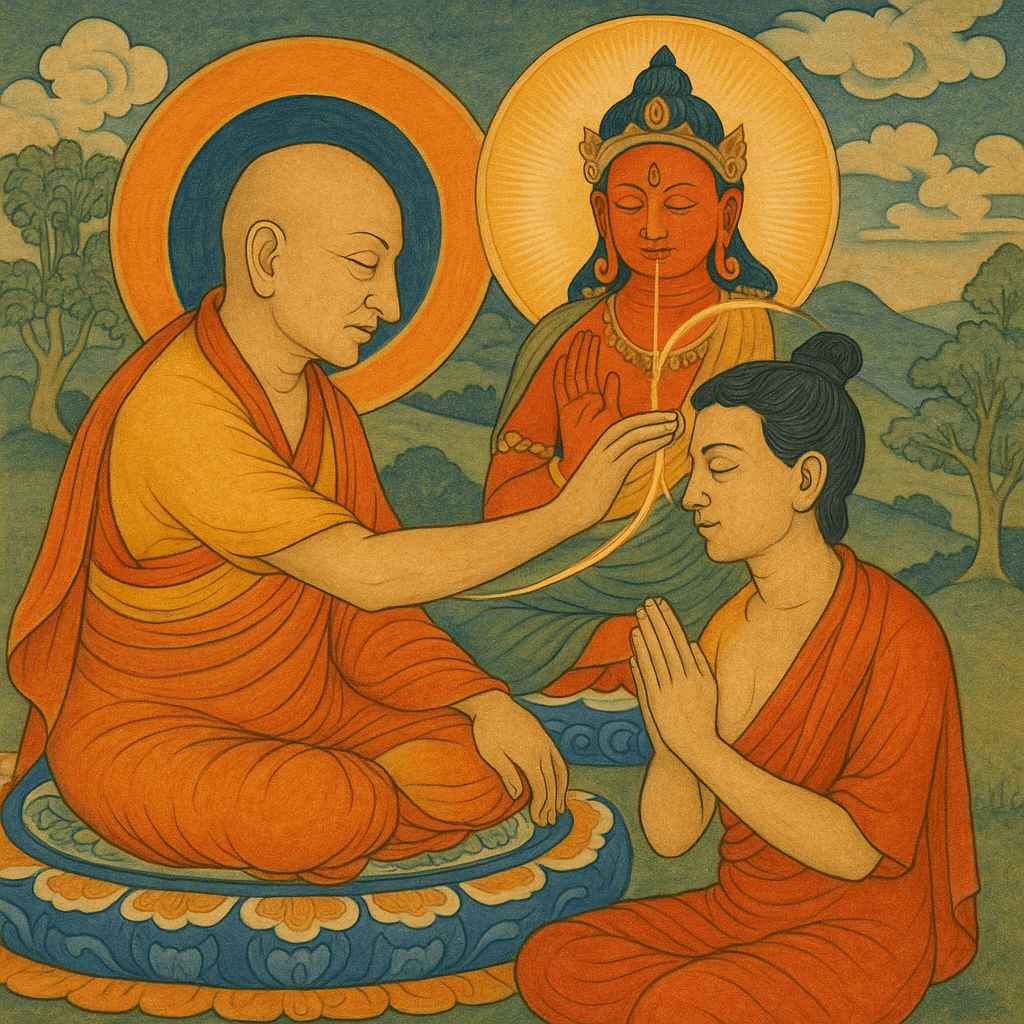
Instructions for such ceremonies explain that the lama generates themselves as the deity and transmits that awakened essence into the disciple through vase water, mantras, and gestures. The disciple visualizes the deity dissolving into themselves, signifying that the deity’s mind is being placed within them. Lineage sources stress that the lama must already hold the deity’s realization in order to transmit it. As one commentary puts it: “You have to hold something in you before you can give it.”⁵
In short, classical sources affirm that empowerment involves the lama implanting the deity’s essence into the disciple. Without this, Vajrayana texts say, real accomplishment is impossible, “like trying to press oil from sand.”
Does the Lama Literally Install a Deity?
While ancient texts may not use the modern phrase “implant the deity,” their intent is clear. An authoritative Kagyu explanation says the lama “places a recipient in connection with a particular Tantric deity,” enabling a “merging of essences.” This “connection” implies not just a symbolic affiliation but a mystical joining.
The empowerment ritual is the cause that activates and personifies the disciple’s Buddha-nature as a specific deity. This is not something the student can do alone; it requires the guru’s intervention. In Highest Yoga Tantra, multiple initiations (vase, secret, wisdom, word) facilitate this process in stages. During empowerment, the disciple imagines themselves as the deity (samaya being) and invites the wisdom deity to enter. When the two merge, the disciple becomes “in union” with the deity.
Some texts describe this as light or energy entering the disciple symbolizing the deity’s mind entering their heart. The Indian master Vilāsavajra described the climax of empowerment as a point when “wisdom and samaya come together.”⁶ The disciple leaves not just authorized but changed, carrying the seed of the deity from that point forward.
Jamgön Kongtrul writes that empowerment “introduces the disciple into the deity’s mandala” and allows the deity’s form and wisdom to “take root.”⁷ A Nyingma commentary states the guru, visualized as the deity, dissolves into the disciple, granting the blessing of the deity’s mind. Even the phrase “blessings enter the disciple’s stream” implies the transfer of a conscious presence.
In effect, tantric empowerment functions like a spiritual implantation, or even possession, in which the enlightened mind of the deity is placed into the disciple. The initiate now carries the deity within them, not merely as a concept but a living presence.
Modern Teachings: Omission or Adaptation?
If this is the traditional view, why don’t modern teachers say so? Contemporary teachings, especially those aimed at Western or general audiences, consistently describe empowerment in vague terms: permission, inspiration, activation of inner potential. The mystical detail of the lama implanting the deity is nearly always omitted.
In a transcribed teaching from a famous lama, now deceased (see below), empowerment is described as a prerequisite for deity meditation: the disciple receives empowerment, then instructions, and cultivates their body as the deity’s form. No mention is made of the lama placing anything into the disciple. It reads more like ceremonial enrollment than spiritual fusion.
This pattern is widespread: contemporary teachers often emphasize psychological language such as inner transformation, personal growth, and discovering potential, while minimizing the traditional notion of external metaphysical transmission. For instance, the Rubin Museum describes empowerment as a “ritual to introduce us to our own innermost Buddha qualities,”⁸ rather than as the reception of a deity from the lama. Such a framing casts the guru as a guide rather than a spiritual agent. However, this reinterpretation flattens the ritual’s ontological depth and misrepresents the original esoteric function of empowerment.
Even phrases like “placing the disciple in connection with the deity” or “ripening the mindstream” are left undefined. Many Vajrayana students, unless they study technical commentaries, may never realize that the tradition sees empowerment as a supernatural event. The omission is so consistent that one might suspect it’s intentional, perhaps to avoid alarming newcomers with the idea of having a foreign spirit installed in their mind.
Secrecy and Obfuscation in Vajrayana
To understand this omission, we must examine the role of secrecy. Vajrayana has always been esoteric. Revealing inner teachings to the uninitiated is a root downfall. As such, teachers often avoid revealing too much, especially in public settings.
Defenders of this approach argue that it’s compassionate: premature disclosure can cause misunderstanding or fear. Teachings are “graduated” and deeper layers revealed as the student progresses. In this view, the omission is considered skillful, not deceptive.
Yet critics argue that this secrecy amounts to intentional obfuscation in the modern information age. Newcomers are told that Vajrayana is about archetypes and psychological growth; this is appealing, secular-friendly language. Only later do they learn that the practice involves guru-bestowed metaphysical empowerment and deity implantation.
Few Vajrayana centers provide an upfront disclosure like: “In this empowerment, you will vow lifelong devotion and we believe that the deity’s mind will enter into yours.” Without this, informed consent becomes impossible. What if the student has been raised Christian and bound by the First Commandment: “You shall not have strange gods before Me”⁹? Would they agree to deity possession if fully informed?
The disconnect between outer presentation and inner doctrine has led some former practitioners to label the tradition dishonest. Years may pass before students learn that guru-deity fusion/possession are standard parts of the system. At that point, it may be too late as they’ve taken vows, invested emotionally, and become spiritually entangled.
Some defenders argue that Vajrayana’s opacity is necessary, that it was never meant for everyone. But in modern multi-cultural societies, this clandestine approach resembles a bait-and-switch. Students sign up for meditation, not spiritual merging with an imported god. They deserve to know what they’re consenting to.
Restoring Honesty in Transmission
Is omitting the “deity implantation” deceptive? From an academic standpoint, the answer is yes: there is a clear disconnect between traditional texts and public presentation. The idea that the guru installs a deity in the disciple’s mindstream is a core teaching, not a fringe view.
Yet most public talks and introductory texts never say this plainly. The true nature of the ritual, guru/deity fusion with the recipient, is hidden behind euphemism. This may prevent questions, but it is morally dishonest.
Vajrayana dharma centers must move toward transparency. Honesty about what is really occurring would both honor the teaching and protect the student. That this is seldom done nowadays is deeply disturbing.
In a predominantly Christian culture, where devotion to other gods violates divine commandments, the omission is not just deceptive, it’s a spiritual breach of consent. Prospective practitioners deserve to know what is happening before the ritual occurs, not after.
The tradition holds that through the guru’s blessing, one’s mind becomes inseparable from the deity. Then let us insist that teachers explain that clearly, before it is too late for the recipient to turn back.
Sources:
Traditional Vajrayana saying; cited in various commentarial teachings on abhisheka.
His Holiness the 14th Dalai Lama, Kalachakra Initiation Teachings.
Sam van Schaik, “The Limits of Transgression: The Samaya Vows of Mahāyoga” (2010).
Ngawang Phuntsok, On Receiving Wang (Empowerment).
Vilāsavajra, commentary on tantric vows; source referenced in academic discussion on Mahāyoga.
Jamgön Kongtrul, The Treasury of Knowledge, Book Eight, Part Three: The Elements of Tantric Practice.
Scott Globus, “Empowerments: Awakening the Buddha Within,” Rubin Museum, 2021.
Exodus 20:3, The Holy Bible.
Kalu Rinpoche – Teachings on Karmamudra and Mahamudra–California, Los Angeles, December 21, 1988
Transcript:
The gentleman is asking whether there is any connection between the traditional Buddhist approach to tantric practice and various sexual yogas—whether these practices have any bearing on the traditional path or whether that’s a misconception.
Yes, there is a connection. Previously, I spoke of the four major classes of tantra: Kriya Tantra, Charya Tantra, Yoga Tantra, and the fourth, Anuttara Yoga Tantra, or the Tantra of Unsurpassable Union. This fourth category is divided into Father Tantra, Mother Tantra, and Non-dual Tantra.
Principally in the classes of Mother and Non-dual Tantra, there are techniques involving sexual union as a basis for spiritual practice, technically termed karma mudra. These practices form part of a broader cycle known as the teachings on the Four Mudras. These teachings, as taught by the Buddha, are authentic and part of the tradition—the challenge lies in practicing them purely.
Traditionally, an individual would first undergo a long period of purification—purifying body, speech, and mind from harmful actions and obscurations, while cultivating positive qualities like merit and awareness. This is done through preliminary practices known as ngöndro.
Next, the individual would receive an authentic empowerment into one of the major tantric cycles from a qualified teacher. They would then receive extensive instruction in deity meditation and cultivate the experience of their own body as the deity’s form—experiencing the union of form and emptiness not as an idea, but as direct realization. Their speech would become the union of sound and emptiness, often practiced through extensive mantra recitation. They would also cultivate the awareness of mind as the union of intelligent clarity and emptiness, stabilizing it through meditative absorption.
Following this, the person would practice tummo or inner heat. This practice is done in stages and begins with the generation of inner warmth at the navel. As the warmth spreads, energy from the crown of the head flows downward. Through mastery of this flow, the practitioner experiences a profound bliss that pervades the mind-body complex.
Advanced stages involve focusing energy through the chakras. When energy is drawn to the throat, joy arises. At the heart, sublime joy. At the navel, special joy. And when energy is drawn down and contained within the genital chakra, co-emergent joy. Karma mudra practice requires the ability to hold this energy without losing it through orgasm. This leads to a nondual, non-conceptual state of awareness.
Eventually, the practitioner reverses the flow of energy upward through the chakras. Mastery over lowering and raising energy is required before karma mudra practice can be properly undertaken. With that mastery, energy is consciously directed through the 72,000 subtle channels (nadis) in the body. The ultimate aim is not sexual pleasure, but realization of Mahamudra.
Examples of individuals who attained enlightenment through such practices include the Indian king Indrabhuti, who is said to have relied on 1,000 consorts over six years. Tibetan lay practitioners like Marpa the Translator—who had eight consorts—are also examples. These paths exist, but must be practiced with purity and commitment.
Misunderstanding these practices—believing tantra is simply about sex—is a serious mistake. One of the 14 root downfalls in Vajrayana practice involves this misunderstanding, particularly the indulgence in orgasm, which is seen as a loss of energy that could otherwise be harnessed for enlightenment.
Another audience question asked about how long to leave a corpse undisturbed after death. In Tibetan tradition, the consciousness remains associated with the body for about 3.5 days. During this time, the body should ideally not be touched. A practitioner of phowa (transference of consciousness) is then called to assist the consciousness in departing skillfully.
After that, the body may be disposed of through burial, water burial, or cremation—accompanied by ritual and chanting to aid the consciousness. These practices can still be valuable even in cultures where such methods are not common, and ideally a phowa practitioner should be contacted if possible.
Another question asked whether one can attain liberation in a single lifetime through tantra. The answer is yes—realization of Buddhahood is possible. However, the physical manifestations may differ from those of a SambhogakayaBuddha, who displays specific physical marks of perfection. Still, the inner realization can be the same.
To discern an authentic teacher, look for someone with an unbroken lineage, proper transmission, sincere motivation, and correct understanding. Avoid teachers who have been disowned by their own lineage, or who act out of selfish motives. Examine their character, conduct, and consistency with traditional teachings.
In closing, the speaker encourages all listeners to study, practice, and seek qualified teachers. The merit of the teaching session is dedicated to the awakening of all sentient beings from ignorance, and the spreading of primordial awareness so that all beings may eventually attain Buddhahood.
When I began my journey into Tibetan Buddhism, I was swiftly enveloped in its rituals and traditions. Without much explanation, I was handed monastic robes, instructed to shave my head, and urged to take lifelong vows. This rapid immersion into a structured and demanding system left me questioning the true nature of the practice. Was this a genuine spiritual path, or was I being drawn into a cult masquerading as a path to enlightenment?
The Allure of Tibetan Buddhism
Tibetan Buddhism often presents itself as a path of loving-kindness, compassion, and profound meditative insight. Its teachings emphasize peace, mindfulness, and the cultivation of wisdom. On the surface, these ideals are appealing and resonate with many.
However, lurking beneath this serene exterior is a complex structure of vows, rituals, and hierarchical relationships that can be overwhelming and oppressive.
The Samaya Vows: Protective or Deadly?
Central to Vajrayana Buddhism are the samaya vows, which are commitments taken by practitioners during tantric initiations. They establish a sacred bond between the guru and the disciple, outlining the conduct required to uphold that bond.
These vows can create a sense of obligation and fear. Breaking samaya is believed to lead to severe karmic consequences, placing immense pressure on individuals to adhere strictly to obedience no matter what the guru does.
Hidden Subjugation and Control
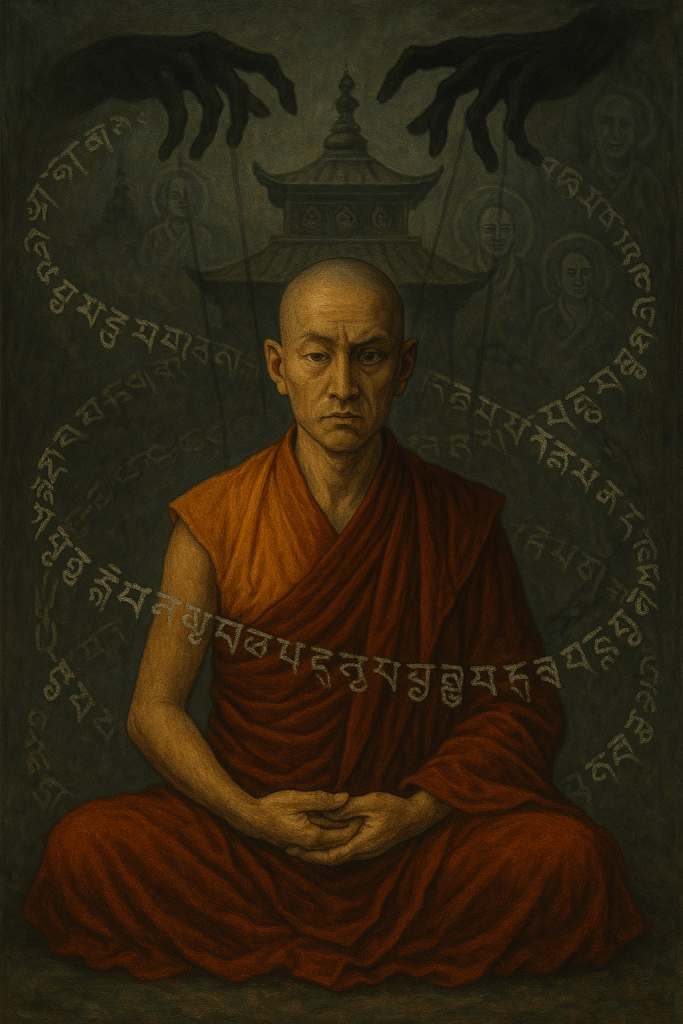
The hierarchical nature of Tibetan Buddhist communities can lead to overt forms of mind control and manipulation. The reverence for the guru borders on unquestioning subservience, with the guru’s authority rarely being challenged. This dynamic can foster an environment where questioning is discouraged, and followers are compelled to conform to the guru’s demands and the group’s expectations.
Moreover, the concept of “crazy wisdom” is sometimes used to justify behavior that would otherwise be deemed inappropriate or abusive. This philosophy, associated with figures like Chögyam Trungpa, suggests that unconventional or even disruptive actions by a guru are acceptable if they lead to spiritual awakening. Such justifications can blur ethical boundaries to the extent that students are ripe for abuse.
The Dark Side of Tibetan Buddhism
Instances of widespread misconduct within Tibetan Buddhist communities have been reported, raising concerns about the integrity of these institutions. The case of Sogyal Rinpoche, the founder of the Rigpa organization, is one example where allegations of sexual abuse and severe authoritarian control surfaced, leading to significant controversy and criticism. After eight students leaked a letter on the internet exposing his crimes, a highly-regarded Khenpo associated with the group gave a talk denouncing those eight students, angrily declaring that they would all go to vajra hell. Even though many Westerner disciples of Tibetan Buddhism don’t believe in vajra hell, I can assure you from first hand experience that it’s very real. You can read more about it here.
These incidents highlight the potential for exploitation within systems that place immense power in the hands of a single individual or a small group of leaders. The lack of accountability and transparency in many Tibetan Buddhist organizations can create an environment ripe for cultish abuse.
Conclusion: A Call for Critical Reflection
While Tibetan Buddhism appears to offer profound teachings and practices, it is essential to approach these traditions with a critical eye. The allure of compassion and peace should not overshadow the lack of ethical conduct, transparency, and respect for individual autonomy that often hides beneath the surface.
When I was fifteen, I walked away from the Catholic Church.
There was no drama, no spiritual backlash, no eerie sense of guilt or dread. I simply left. I had questions, and I didn’t know the answers. Like so many teenagers raised in religion, I drifted toward freedom, or what I thought was freedom. But I never stopped believing in Jesus Christ. I always knew He was real.
Still, for eight years, I lived outside the Church. No demons haunted me. No spiritual “agents” came after me. No dark force tried to pull me back or punish me. I was free to explore.
Then, at twenty-three, I was introduced to Tibetan Buddhism by a friend. Spiritual curiosity quickly became commitment. The teachings were deep, the rituals profound, and the promises huge. My belief in Jesus wasn’t challenged outright; instead, the gurus cleverly and swiftly recast Him as a “bodhisattva,” one of many enlightened beings in a cosmic buffet of spiritual options. I was told He was admirable, but not unique. Just another wise, and probably enlightened teacher.
I didn’t realize then how that subtle shift had planted the seeds of spiritual confusion. Over time, the practices became more demanding and more secretive. Eventually questions weren’t welcomed. When I began to notice darker occult elements woven into the heart of the practice, I had troubling doubts. The tantric path spoke of vajra hell, an eternal punishment for those who questioned or broke samaya (spiritual vows to the guru). And not just for betrayal or disobedience, but even for internal doubts.
And when I had them, everything changed.
I was tossed out. Not just socially or emotionally, but spiritually. I was attacked, not just by my former gurus, but by unseen forces. It was violent and supernatural. The very same tradition that had claimed to offer peace and enlightenment unleashed something very dark the moment I started to turn away from the guru.
This wasn’t like walking away from the Catholic Church. It was completely different. I experienced a spiritual assault of such magnitude that no one could believe me. And it begged the question: What kind of spiritual path tortures you for eternity for having doubts?
A demonic path does.The historical Buddha taught to question everything, but tantra did not allow it.
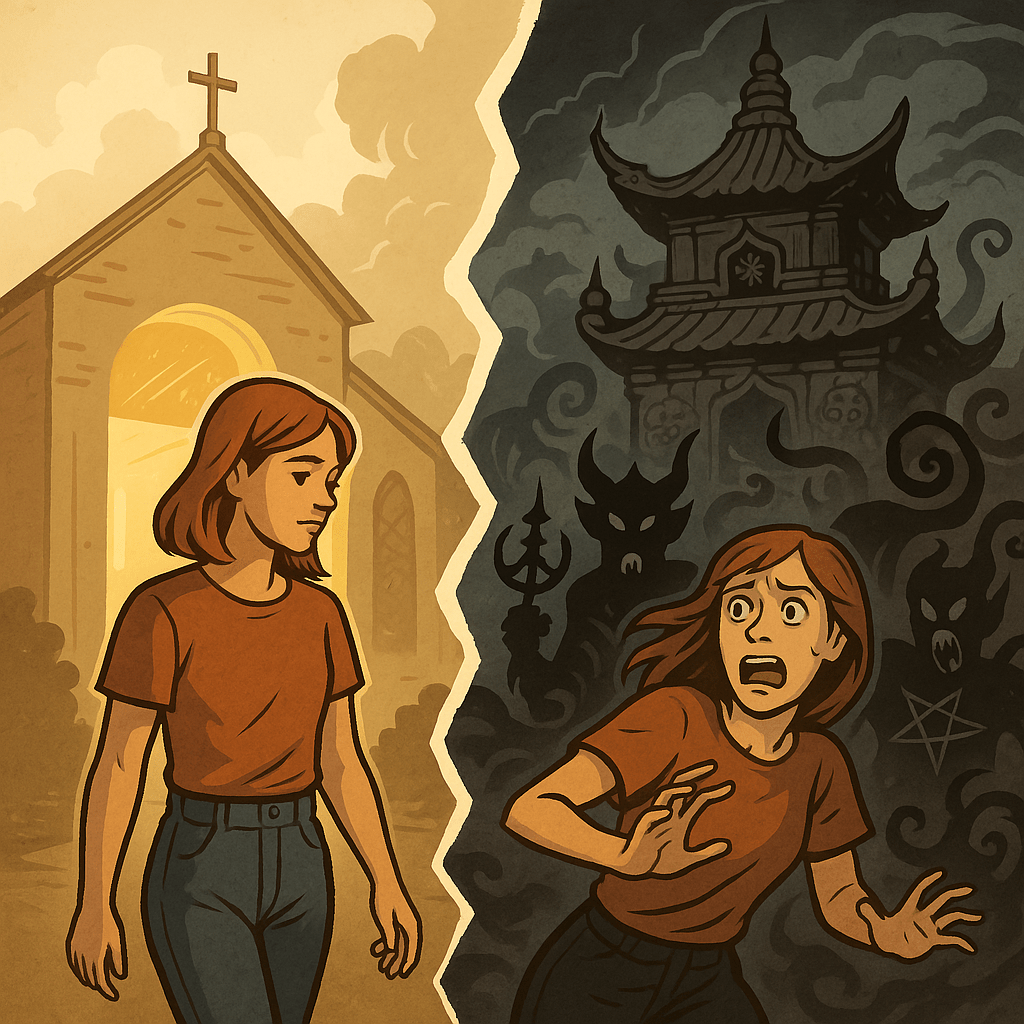
Tibetan Buddhism may parade as a tradition of compassion and peace, but my experience showed otherwise. If it were truly of the Light, it wouldn’t need to threaten vajra hell or unleash invisible tormentors on those who simply ask blunt and honest questions. It wouldn’t need to cloak the guru in infallibility while turning a blind eye to his abuse. And it certainly wouldn’t need to demonically retaliate against a soul simply for having doubts and trauma. The difference between the two paths couldn’t be clearer. When I left the Church, there was silence. When I left Tibetan Buddhism, there was war.
Lately, I’ve been praying for God to continue revealing the truth about what I was involved in during my years of deep immersion in Tibetan Tantra. I’ve asked Him to uncover every layer of deception and to expose every way in which these practices are demonic. And He is answering.
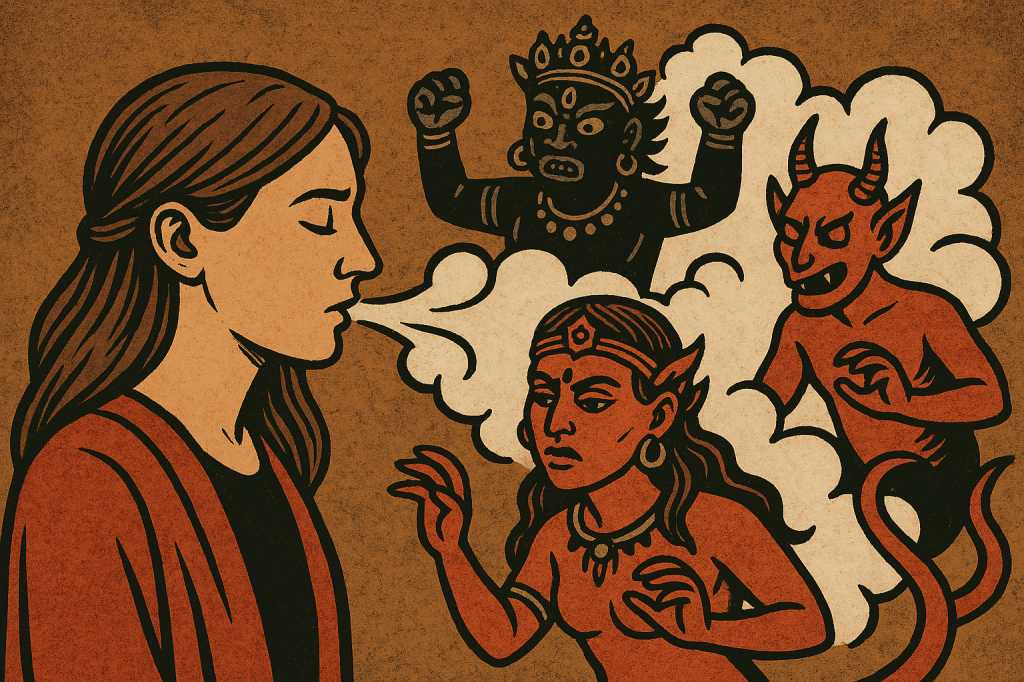
This past week, something profound happened: I experienced mass deliverance through my breath. As I exhaled, demons left me. Over and over again. It was undeniable. And then it hit me: of course they left on the breath. They came in on the breath.
This is not metaphorical. This is how tantra works. The breath is a key mechanism through which demonic entities enter one’s being. Yogic and tantric practices revolve around breath control: deep manipulation and intentional retention of the breath to open oneself to possession by what are euphemistically called “deities” but are, according to Christianity, demons.
In my three-year retreat, the main entities I invoked and merged with were Vajrayogini, the Red Dakini, and her consort. These were not simple meditations or visualizations. These were acts of surrender and identity dissolution. In essence, the goal was full-blown possession, even though it wasn’t couched in those terms and I didn’t realize that is what was happening.
Vajrayogini doesn’t come alone. Her retinue includes approximately 120 assistants, each with its own functions and qualities. That number is staggering, and that’s just one system of practice. In addition to her, I practiced the sadhana of a wrathful black deity with a massive host of demonic attendants. I should stress that these are not benign energies. They are demanding, and potentially violent and spiritually lethal.
But even beyond retreat, I continued to receive more initiations, or so-called empowerments. One that stands out is the Kalachakra initiation in 2011 from the Dalai Lama in Washington, D.C. It was a 10-day, all-day affair. I was zealous, determined to catch every detail of the ritual. I arrived early each morning to watch the Dalai Lama prepare himself by “self-generating” as the deity Kalachakra. It was amazing to watch; he was ritually becoming the deity.
Kalachakra, which means “Wheel of Time,” is a tantric deity surrounded by a staggering retinue of 722 deities. But these aren’t heavenly hosts. According to Christianity, they are demons. Every one of them. The entire system is a carefully constructed spiritual snare designed to bind souls to counterfeit light.
Thousands, maybe millions, have received these same initiations. The Dalai Lama has made it his mission to offer the Kalachakra globally. People believe they are receiving a blessing. But in reality, they are being spiritually colonized. Demonic systems are being seeded into the nations. These rituals are not neutral cultural events. They are portals for dark power.
If you want a glimpse into what may really happening during these ceremonies, I encourage you to read this article that lays it out plainly: Dalai Lama and the Kalachakra
As for me, I’m continuing to pray and seek God’s help in cleansing every layer of my being. What I’m realizing is horrifying but I am confident that God is showing me the truth and setting me free.
Vajrayana Buddhism presents itself as a path of radical transformation: a sacred alchemy where ordinary perception is transmuted into enlightened wisdom. Its ritual technologies are often described as “skillful means,” and its magical practices framed as expressions of “Buddha activity.” But the colorful mandalas and enchanting deity meditations may obscure something far more dangerous than most practitioners realize.
According to vajranatha.com, Vajrayana operates through four principal kinds of magical activity, each aligned with a cardinal direction, a color, and a particular type of power:
White (east): for pacifying and healing
Yellow (south): for increasing wealth and wisdom
Red (west): for attraction and control
Dark blue or green (north): for wrathful subjugation and protection
These are personified in the deity forms of White Tara, Dzambhala, Kurukulla, and Vajrakilaya, respectively. Collectively, these “Four Activities” are described as enlightened, but their function mirrors the mechanisms of many other occult systems: healing, sorcery, love spells, exorcism, and domination.
So who, or what, is powering these rituals?
Chögyam Trungpa, one of the most influential Tibetan lamas to bring Vajrayana to the West, once gave a startlingly candid warning:
“Committing oneself to the Vajrayana teaching is like inviting a poisonous snake into bed with you and making love to it. Once you have the possibility of making love to this poisonous snake, it is fantastically pleasurable: you are churning out antideath potion on the spot. The whole snake turns into antideath potion and eternal joy. But if you make the wrong move, that snake will destroy you on the spot.” —Chögyam Trungpa
This is not a metaphor for the all-encompassing wisdom and compassion of the Buddhas and Bodhisattvas. It is a warning of immense spiritual danger.
Vajrayana demands the total surrender of body, speech, and mind, not only to the teachings, but to the guru and the spiritual forces behind those teachings. This surrender is cloaked in bliss, ecstasy, and the promise of transformation. But as Trungpa makes clear, one wrong move and the very force you trusted can turn lethal. It can turn on a dime.
I experienced this firsthand. It began as a profound visualization and mantra practice during a three-year retreat and gradually turned into energetic torment and psychological destabilization. The deities I once practiced became increasingly foreign, invasive, and predatory. The guru, once seen as a vessel of wisdom, became a wrathful executioner.
These practices are not what they seem: they tap into powerful magic. And one must ask, who is really powering these rituals? Who benefits when a practitioner opens themselves to these entities and their so-called “energies”? Why should we assume these forces are benevolent, simply because they have Buddhist names and appear in ornate, colorful iconography?
The structure described here isn’t just about religious symbolism or spiritual beauty, it reflects a deep psychological system designed to influence the mind through ritual. Vajrayana practices use visualization, chanting, offerings, and mantra repetition to create altered states of consciousness and emotional bonding with supernatural entities. This is what scholars call ritual psychology: the way ritual shapes belief, identity, and experience.
But Vajrayana doesn’t just manipulate the mind. It aligns closely with classic occult systems, ones that use similar rituals to summon, contact, and make pacts with spirits. Healing and increase, attraction and domination are bit neutral tools. They are technologies for channeling unseen forces toward specific outcomes. And these forces are personified, and bonded with through ritual acts that, the deeper you go, begin to resemble spiritual possession with demonic pacts.
In my own experience, the entities I contacted through these practices eventually revealed themselves to be something other than the enlightened mind of the Buddhas, whatever that might be. They had their own will, their own agendas, and their own personalities. Especially in the darker rites of semi-wrathful and wrathful deities, there was a sharp edge of coercion, and spiritual threat.
If we take these rituals seriously, not as colorful mysticism, but as real technologies of spiritual manipulation, then we must also take seriously the possibility that their source may not be benevolent.
Just because it’s branded as “Buddha activity” doesn’t mean it is holy. Survivors of spiritual abuse in Tibetan Buddhism must be brave enough to ask the hard questions. Who, or what, are we inviting into our minds and bodies when we chant these mantras, visualize these beings, and make offerings in exchange for spiritual results? Are these forces truly enlightened or are we just calling them that because we’ve been taught to?
When your healing comes at the cost of spiritual bondage…When your wisdom is bought by making pacts with demons…Something is deeply wrong.
Magic in Vajrayana is not peripheral but central to the practice. And it must be examined not with awe, but with clear-eyed discernment.




 Tantric Deception