
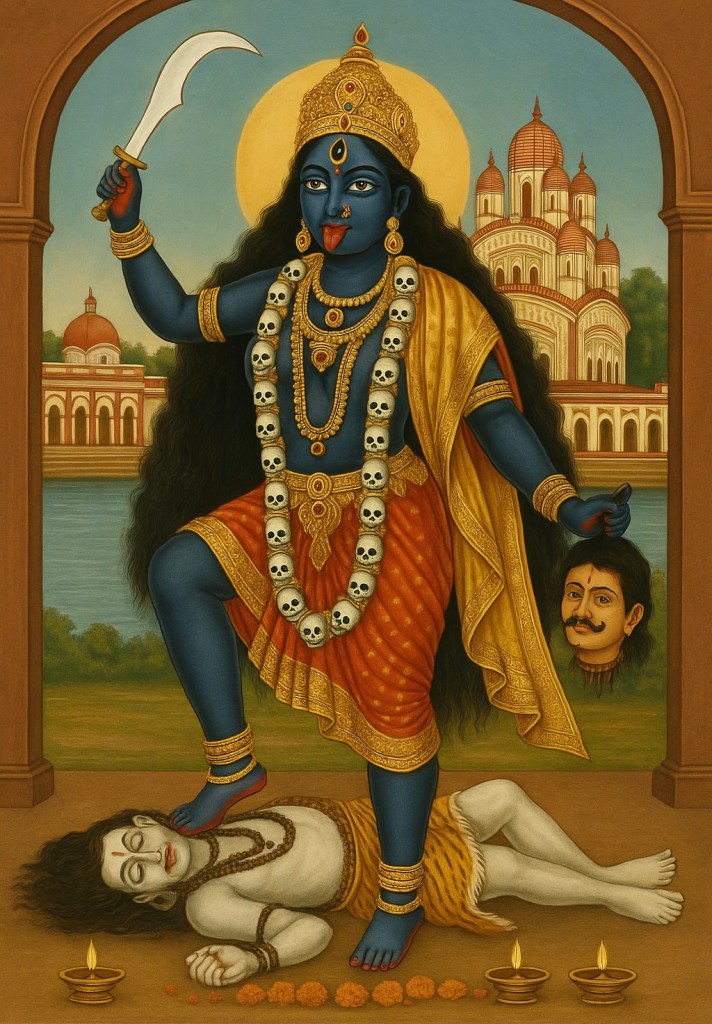
An Encounter with Kali


The descent into Bengal began with a vision. As our plane banked low over the hazy sprawl of Calcutta, I sat in meditation, quietly preparing for a long journey north to Sikkim for a series of tantric empowerments. Then, quite suddenly, a naked dakini appeared before me, dancing and beckoning. She seemed to be greeting me to Calcutta. I knew, or thought I knew, that it was Kali.

We stayed in a modest Baptist guesthouse chosen for its safety and low price, a short walk from Mother Teresa’s compound. It was late October, and the air was warm and humid. Calcutta felt down at heel, yet intellectual and dignified. My companions, all Tibetan Buddhist practitioners, decided to visit Mother Teresa’s place to pay homage. I hung back. They were sincere in their devotion to that famous nun, but something in me pulled in another direction. Although I had been raised Catholic, I felt a faint aversion to anything connected with the Catholic Church. I regarded the religion as problematic at that time. Still, seeing how genuinely excited my friends were, I encouraged them to go.

The next day I hired a taxi and arranged for us to cross the city to the Dakshineswar Kali Temple, the same temple where Ramakrishna had worshipped and experienced his visions of the Divine Mother and became enlightened. “We really must make the effort to see it,” I told the others, although I wasn’t sure why. The journey took nearly an hour through dusty streets and chaotic traffic. I had read that Kali was the patron goddess of Bengal, and that Dakshineswar was one of her most important shrines. The closer we came, the stronger the pull felt.

At the temple, a long line of Indian devotees wound through the courtyard, each waiting to glimpse the goddess and receive her blessing. We appeared to be the only Westerners there. I knew very little about the history of the temple at that point. All I knew was that I had always been intrigued by Ramakrishna among all the Hindu mystics and had always wanted to visit his temple and pay my respects.

The Temple and Its History

The Dakshineswar Kali Temple was founded in the mid-nineteenth century by Rani Rashmoni, a wealthy zamindar who, according to legend, dreamt that the goddess Kali commanded her to build a temple on the banks of the Hooghly River rather than journey by boat to Varanasi¹. Rashmoni had been preparing for the pilgrimage for months and had spent a small fortune, but on the night before her departure, Kali appeared in a dream and told her she need not travel at all. Instead, the goddess instructed her to raise a temple and enshrine an image that Kali herself would inhabit, blessing all who came to worship. The temple was completed in 1855 and the complex stands on land said to resemble a tortoise, a form considered especially auspicious in Shakta-Tantra cosmology².

Architecturally, the main temple is built in the navaratna (nine-spired) style typical of Bengal, raised on a high platform overlooking the river³. Surrounding the sanctum are twelve identical Shiva shrines aligned along the Hooghly’s edge, a small Radha-Krishna temple, and bathing ghats for pilgrims⁴.

Inside the sanctum resides Bhavatarini, a fierce aspect of Kali known as “Saviour of the Universe,” depicted with one foot on Shiva’s chest⁵. The mystic Ramakrishna served as the temple’s priest and carried out years of intense spiritual practice within its grounds, transforming the site into one of India’s holiest centers of Shakti worship⁶. The atmosphere is thick with incense, bells, flowers, and the hum of a thousand mantras. Once inside the gate you feel the city’s chaos fall away.

As we stood in line, something unexpected happened. An Indian guard suddenly appeared, motioned to me and a Buddhist friend, and beckoned us forward. Without explanation, we were led past the waiting crowd directly to the inner sanctum. The goddess stood before us, draped in red and gold, eyes alive in the flicker of ghee lamps. When I received prasad, it tasted sweet and delicious, and I felt a surge of a deep, penetrating love. It was so overwhelming that I began to cry.

As a Tibetan Buddhist, I had always regarded Hindu deities as somehow inferior and secondary to the Tibetan ones who were the representations of the ultimate truth. My practice had centered on Vajrayogini and Chakrasamvara, not on Kali. Yet there, when the experience of divine love engulfed me in the Dakshineswar temple, I felt an unmistakable recognition.

Years later, after surviving the catastrophic unraveling of my own tantric path due to the betrayal by male Buddhist teachers, the exposure of their sexual abuses, and the psychic annihilation that followed, I began to study the origins of tantra in earnest. Through the research of Alexis Sanderson and others, I learned what my experience at Dakshineswar had already shown me: that the yoginī tantras of Tibetan Buddhism arose from the same crucible of medieval Hindu Śaiva and Śākta practice⁷. Vajrayoginī, the red goddess of my own initiations, was in essence a Buddhized form of Kali. The goddess in both traditions can give blessings and boons, but she can become, in an instant, a terrifying and destructive demon with her own set of intentions and cosmic laws.

That insight came at great cost. The deeper I studied, the more clearly I saw that tantra, in both Hindu and Buddhist forms, was inseparable from forces of domination, secrecy, and power. The same ecstatic current that once inspired devotion also lurked behind manipulation and abuse. In the West, these darker currents were long dismissed or hidden, until the many scandals of 2017 tore the veil away.

My visit to Kali’s temple remains a paradox. In that moment I felt only grace: the raw, overwhelming presence of the divine feminine. But in hindsight, I experienced Kali as both mother and destroyer, blessing and devourer. She welcomed me to Calcutta with open arms, but in time, in her Buddhist form as Vajrayogini, she stripped me of everything I held dear in order to completely destroy my body, mind, and soul. By the grace of the highest divinity, the eternal Christian God, I survived and am still alive to tell the tale.


Notes

  1. Dakshineswar Kali Temple, Wikipedia, last modified 2025.
  2. Ibid.
  3. Ibid.
  4. Ibid.; see also Dakshineswar Kali Temple official site, Places in Dakshineshwar (dakshineswarkalitemple.org).
  5. Dakshineswar Kali Temple, Britannica.
  6. Ibid.; Ramakrishna’s association documented in Swami Nikhilananda, The Gospel of Sri Ramakrishna (New York: Ramakrishna-Vivekananda Center, 1942).
  7. Alexis Sanderson, “The Śaiva Age: The Rise and Dominance of Śaivism during the Early Medieval Period,” in Genesis and Development of Tantrism, ed. Shingo Einoo (Tokyo: Institute of Oriental Culture, University of Tokyo, 2009), 41–350.

Tantric Āveśa and Demonic Possession: A Comparative Exploration


Āveśa (Sanskrit) refers to a state of spiritual possession or divine inhabitation in which a deity or sacred power “enters” and dwells within a person. The word literally means “an entering” or “fusion,” describing the incorporation of divine power into the human body. Such forms of sacred possession have long been central to Indian Tantric practice, invoked for both worldly benefits (bhoga) and spiritual liberation (mokṣa). This is often contrasted with demonic possession in Christian theology, typically characterized as an involuntary affliction by an evil spirit.

Cross-cultural studies note that spirit possession can be either voluntary or involuntary, and it is interpreted differently depending on the tradition. Western occult traditions, such as Luciferianism, may view possession by a demon as desirable, even leading to a so-called “perfect possession.” In Christianity, however, even voluntary possession by a demonic force is considered evil. The question then arises: who or what possesses the practitioner in Eastern contexts?

Towards the end of my 35 years in Tantric Buddhism, I came to believe that the force presenting itself as a deity was, in fact, demonic. In what follows, I will examine the phenomenon of āveśa in two major esoteric traditions, Hindu Tantra (especially Shaiva lineages such as Kashmir Shaivism), and Tibetan Vajrayāna Buddhism. I will contrast these forms of divinely sanctioned possession with demonic possession in Christian and occult frameworks, drawing from historical sources, academic analysis, and personal experience.


Āveśa in Hindu Tantric Traditions

Scriptural Origins and Tantric Development

The Sanskrit root ā-viś (to enter) appears in early Indian texts, foreshadowing the later Tantric elaboration of āveśa.1 From the 5th to 11th centuries, Tantric scriptures across Śāiva, Śākta, and Buddhist milieus incorporated āveśa into ritual practice. Scholar Vikas Malhotra describes āveśa as the “entrance or fusion of oneself with the deity,” central to both magical and liberatory goals.2

These practices utilized mantras, mudrās, and nyāsa (installing mantras on the body) to induce the deity’s presence. Often this process was linked to śaktipāta, or the descent of divine energy. Over time, āveśa came to refer not just to deity possession, but a range of spiritual states culminating in union with Śiva.3 In contrast to exorcism (removing evil spirits), this adorcistic form of possession aimed to invite a divine presence.

Kashmir Shaivism and Samāveśa

In the Trika system of Kashmir Shaivism, the term samāveśa refers to full ontological immersion in Śiva-consciousness. Abhinavagupta, a 10th-century Hindu philosopher and Tantric adept, defined it as a merger of individual and divine being, sometimes accompanied by shaking, trance, or devotional ecstasy.4 Rituals such as nyāsa or advanced mudrā usage were seen as ways to divinize the body. Kṣemarāja, a key Trika commentator, emphasized that the body itself becomes a vessel for cosmic forces, eroding the sense of ego.5

This idea extended to daily ritual. The practitioner installs divine presences into various body parts—e.g., “May Brahmā be in my genitals, ViṣŇu in my feet, Śiva in my heart”—until the self is transformed.6 Āveśa was also connected to śaktipāta dīkṣā (initiation by grace), which Abhinavagupta saw as the guru’s transmission of divine force into the student.

Historical sources and hagiographies portray this not as pathology but sacred awakening. In the Bhakti tradition, saints like Caitanya and Rāmakṛṣṇa exhibited signs interpreted as divine possession, a loss of ordinary consciousness during worship or dancing in states of trance. In goddess worship, the ecstatic state of bhāva can evolve into full possession by a fierce Devī or goddess.

Induced Trance in Ritual Practice

Possession is not accidental; it is often deliberately induced. Contemporary folk-Tantric rites like Theyyam in Kerala reenact this vividly. The performer undergoes intense ritual preparation, dons a sacred headdress, and becomes a vessel for the deity. His demeanor, voice, and movements change dramatically, and devotees approach him as a god.7 These techniques including fasting, music, sacred garb, and mantra, parallel ancient Tantric rituals meant to induce āveśa.

Importantly, this experience is consensual. A priest may invite a deity for oracular guidance or blessing. The Tantric yogi similarly invites identification with Śiva. As Frederick Smith notes, such possession is the most valued spiritual experience in many Indian settings.8 Advanced yogis even practiced para-kāya praveśa, the entry of one’s consciousness into another’s body, a form of high-level āveśa.9


Āveśa (Possession) in Tibetan Vajrayāna Buddhism

Deity Yoga and Guru Inhabitation

Though the term “possession” is less used, Vajrayāna emphasizes divine inhabitation. In Deity Yoga, one visualizes oneself as a yidam (meditational deity) and invites the deity’s wisdom aspect (jñānasattva) to merge with the visualization (samayasattva). Through mantra and meditation, the practitioner dissolves ego and identifies as the deity.

While framed as an enlightened act, in practice there is no safeguard against malevolent forces. Many Tibetan rituals derive from the Yoginītantras, esoteric texts filled with wrathful, dangerous dākinīs. These entities are unpredictable and must be carefully propitiated. Practitioners hope to merge with them for wisdom and power, but failure often results in spiritual collapse or madness. One either becomes “enlightened” or is destroyed.

My personal experience, including participating in two three-year retreats, led me to conclude these deities are not divine but demonic. After prolonged practice, I experienced terrifying possession states, torturous sensations, and an uncontrollable kundalini awakening. While there were moments of bliss and magical phenomena, the final result was spiritual devastation.

Guru Yoga and Transmission

Guru Yoga, especially in the Nyingma and Kagyu lineages, mirrors āveśa. The practitioner visualizes the guru dissolving into them, merging body, speech, and mind. This is intended to produce an inseparable union. Some historical accounts even describe instant enlightenment via physical gestures or verbal commands from a master, a form of mind-to-mind transmission akin to possession.

Some Vajrayāna practices involve obvious demon possession. The Nechung Oracle, for example, enters trance during elaborate rituals, allowing the deity Pehar to possess his body. Frightening physical changes, voice alteration, and strength are observed. The practice is structured around phowa, a method of ejecting consciousness to allow divine entry.10


Possession as Initiation and Transformation

Both traditions treat āveśa as transformative. In Hindu Tantra, samāveśa may mark initiation or realization. In Vajrayāna, empowerment rituals symbolically install the lineage mindstream into the disciple. When successful, the practitioner believes they have merged with divine consciousness.

The experiences are often euphoric and expansive. Yet, as I learned, they can also become nightmarish. The forces one invokes may not be what they seem. While traditions insist the entities are enlightened or benevolent, there is no proof. Many undergo trauma, dissociation, and spiritual breakdown.


Christian Views of Possession: A Stark Contrast

In Christian theology, possession is demonic by nature. The demon enters uninvited or through occult involvement, and exorcism is the remedy. Symptoms include revulsion to the sacred, altered voices, and loss of control. Unlike tantric āveśa, the demon is not a divine aspect but an evil other. (I should note that the kundalini energy always felt “other” to me, but I was encouraged to see it as a positive experience.)

Catholic doctrine states that even voluntary occult involvement is condemned, seen as opening a door to bondage; the soul remains untouched, but the body and mind may be dominated. Consent may be partial or misguided, but once entered, the demon seeks destruction.

Only the Holy Spirit is seen as a positive presence, and even then, Christian traditions speak of inspiration rather than possession. Some Pentecostal expressions resemble Eastern possession states, but many Christians believe these, too, are counterfeit Holy Spirit experiences linked to kundalini phenomena.

Scripture offers stern warnings:

All the gods of the nations are demons.” — Psalm 96:5 (Septuagint) “They sacrificed to demons, not to God.” — Deuteronomy 32:17

In conclusion: āveśa is framed as a sacred merging in Tantra, but my experience revealed it as demonic deception. Beneath the ritual beauty lies spiritual subjugation. As an exorcist once warned me: Be careful who or what you invite to abide within.


Footnotes

  1. “A Brief Study of Possession in Hinduism Part II: The Spiritual Context,” Indic Today
  2. Vikas Malhotra, ĀveŚan and Deity Possession in the Tantric Traditions of South Asia
  3. Ibid. 
  4. “The Fulcrum of Experience in Indian Yoga and Possession Trance.” 
  5. Ibid. 
  6. Indic Today, op. cit. 
  7. “Theyyam,” Wikipedia
  8. Frederick M. Smith, The Self-Possessed: Deity and Spirit Possession in South Asian Literature and Civilization
  9. Yogasūtra III.38. 
  10. “Nechung Oracle,” Wikipedia