A recent Vatican meeting between Pope Leo XIV and the International Association of Exorcists underscores growing concern within the Church about the spread of occult practices and their spiritual consequences.
According to the exorcists, there has been a “noticeable rise” in involvement with “occultism, esotericism, and Satanism,” developments they associate with increasing cases of spiritual distress.¹ These trends are not viewed as abstract cultural shifts, but as realities encountered in pastoral work.
The delegation stressed that many individuals who engage in such practices experience serious harm, describing “grave spiritual suffering” among those affected.¹ In their view, these are not isolated incidents but part of a broader pattern requiring a structured response from the Church.
“Ignoring these realities leaves many people without an adequate response to grave spiritual suffering.”¹
For this reason, the exorcists emphasized the importance of ensuring that every diocese has properly trained clergy capable of addressing these situations. They called for stronger formation, clearer discernment, and greater institutional readiness.
At the same time, they acknowledged the complexity of these cases. The meeting highlighted the need for collaboration with medical and psychological professionals to distinguish between spiritual affliction and mental health conditions.¹ This cooperation is seen as essential for responsible pastoral care.
The Vatican framed the issue as one of accompaniment and guidance. Many who turn to occult or esoteric practices are described as searching for meaning or relief from personal struggles.¹ From the exorcists’ standpoint, this search can expose individuals to demonic influences that require careful spiritual intervention.
Overall, the meeting reflects a coordinated effort within the Church to respond to what exorcists describe as a growing pastoral challenge: one that involves both spiritual discernment and practical support for those affected.
St. Michael the Archangel, defender of the faithful, stands as heaven’s warrior casting down the forces of darkness and waging relentless battle against demonic powers.
Footnote
Marty Vergel Baes, “Pope Leo XIV Hosts Exorcists at Vatican — Surge in Satanism Cases Raises Concern for Vulnerable Believers,” International Business Times UK, March 23, 2026.
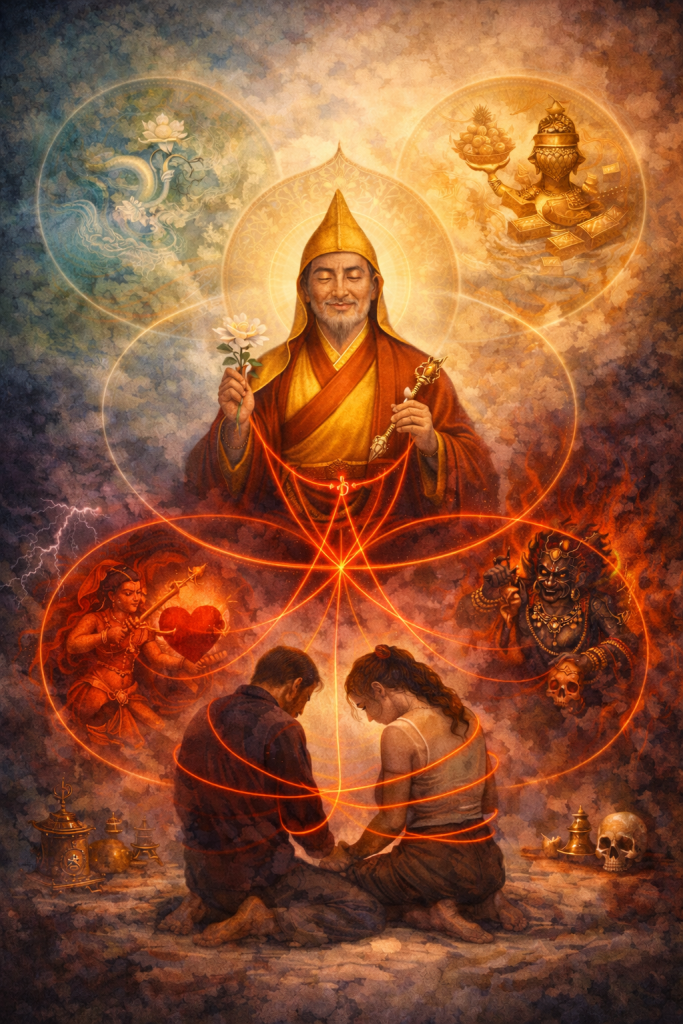
In Vajrayana Buddhism and related tantric systems, practitioners are taught that enlightened activity manifests in four fundamental modes, often called the Four Activities. These are commonly translated as Pacifying, Enriching, Magnetizing, and Subjugating. In Sanskrit they correspond to śāntika, pauṣṭika, vaśīkaraṇa, and abhicāra. In Tibetan sources they are known as zhi, rgyas, dbang, and drag po.
Doctrinally, the Four Activities are described as spontaneous expressions of awakened compassion. An enlightened being pacifies obstacles, enriches virtue and resources, magnetizes beings toward the Dharma, and subjugates harmful forces. This presentation emphasizes intent and realization, assuring the student that such actions, when performed from enlightenment, are free of karmic stain.
Yet this sanitized description obscures a more uncomfortable reality. Historically and textually, the Four Activities function as classificatory frameworks for large compendiums of ritual technologies. These include magical spells, rites, visualizations, mantras, and talismanic operations designed to bring about very specific effects in the world. Such effects include healing and calming, increasing wealth or longevity, attracting and binding others, and coercing, harming, or destroying enemies.
This dual framing creates a tension that is rarely examined openly within modern Buddhist discourse.
The Four Activities as Magical Technologies
Tantric manuals from India and Tibet make explicit that the Four Activities are not metaphors. They are actionable ritual categories. Tantras such as the Guhyasamāja Tantra and the Hevajra Tantra, along with later ritual compendiums such as the Sādhanamālā and abhicāravidyā genre texts, provide detailed instructions for rites aimed at controlling weather, influencing rulers, compelling lovers, paralyzing rivals, or causing illness and death.[1]
These materials make clear that tantric ritual was never confined to inner transformation alone. The Four Activities structured a full spectrum of practical interventions into social, political, and psychological life.
The Sādhanamālā
The Sādhanamālā is a large Sanskrit compendium of tantric ritual manuals compiled in India roughly between the 8th and 12th centuries CE.
It is Buddhist, specifically Vajrayana or Mantrayāna, and not Śaiva, even though it shares techniques and ritual logic with non-Buddhist tantric traditions. The text consists of several hundred sādhana instructions for meditation and ritual practice focused on Buddhas, bodhisattvas, and tantric deities such as Tārā, Avalokiteśvara, Mañjuśrī, Vajrayoginī, and Hevajra.
Many of these sādhanas are explicitly or implicitly classified according to the Four Activities. They include ritual prescriptions for pacifying illness, enriching wealth or lifespan, magnetizing kings, patrons, or disciples, and subjugating enemies. The intended effects are practical and worldly as well as soteriological.
The Sādhanamālā was translated into Tibetan in parts and circulated widely in Tibet. Tibetan ritual literature draws heavily on this material, even when the Indian source material is not foregrounded explicitly.
Standard scholarly references include: Benoytosh Bhattacharyya, Sādhanamālā, Baroda, 1925–1928, and David Snellgrove, Indo-Tibetan Buddhism, Shambhala, 1987.
Abhicāravidyā Texts
Abhicāravidyā is not a single book but a category of ritual literature.
The Sanskrit term abhicāra refers to rites of coercion, harm, or destructive magic. Vidyā means a spell or magical formula. Abhicāravidyā texts are therefore manuals of destructive or coercive rites.
In Buddhist tantra, such texts describe subjugation practices including immobilization, madness, illness, death, expulsion of consciousness, and rites intended to cause death, sometimes described as ritual killing by proxy. These rites are usually justified as actions taken against enemies of the Dharma, oath breakers, or beings deemed karmically irredeemable.
These texts circulated in India among tantric specialists and were selectively translated into Tibetan, often under euphemistic titles or embedded within larger ritual cycles. In Tibet, their contents were reorganized under the heading of drag po, or wrathful activity.
Important examples of Buddhist abhicāra material appear in:
The Guhyasamāja Tantra and its explanatory tantras The Hevajra Tantra The Sarvatathāgatatattvasaṃgraha Later ritual manuals attributed to figures such as Nāgārjuna and Padmasambhava
Because of their ethical volatility, abhicāra rites were rarely taught openly. Access was restricted, which is one reason modern practitioners often underestimate how central such practices were historically.
Key scholarly discussions include: Ronald Davidson, Indian Esoteric Buddhism, Columbia University Press, 2002, and Alexis Sanderson, “The Śaiva Age,” in Genesis and Development of Tantrism, Tokyo, 2009.
Relationship to Tibetan Buddhism
Tibetan Buddhism inherited these Indian materials largely intact. The Four Activities framework in Tibet is not an innovation but a systematization of Indian tantric categories.
What changed in Tibet was less the ritual content than the doctrinal rhetoric surrounding it. Destructive and coercive rites were reframed as compassionate acts performed by realized beings. This rhetorical move allowed the practices to survive while softening their public presentation.
When Tibetan teachers speak of the Four Activities today, they are standing on a ritual foundation built by Indian Buddhist tantra, including the Sādhanamālā and abhicāravidyā traditions, whether this inheritance is acknowledged or not.
In Tibetan contexts, this ritual material was further systematized. The Four Activities became a classificatory framework under which thousands of rites were organized. Fire pujas, effigy magic, thread-cross rituals, and sexual yogas all find their place within this scheme.[2]
The ethical difficulty is obvious. While pacifying and enriching activities can be interpreted charitably, subjugation practices explicitly involve violence, coercion, and psychological domination. Tibetan ritual manuals state that subjugation rites can cause madness, death, or rebirth in hell realms for the target, often justified by vague claims that the victim is an enemy of the Dharma.[3]
Subjugation and Buddhist Ethical Dissonance
From the standpoint of Buddhist ethics, subjugation is the most troubling of the Four Activities. Buddhism is grounded in non-harming and the cultivation of compassion. Yet subjugation rituals rely on wrathful intent and instrumental harm. Traditional defenses argue that enlightened beings act beyond dualistic morality because they have transcended good and evil.
For modern Western practitioners, these explanations often remain abstract. Teachers rarely teach subjugation practices explicitly, and students are encouraged to interpret wrathful deities symbolically. This produces a form of cognitive dissonance. The practices exist, are preserved, and are sometimes performed within group pujas, but disciples can maintain psychological distance by not understanding the wrathful practices or details. Ignorance becomes a form of insulation.
Magnetizing Activity and the Binding of Disciples
Magnetizing activity is often portrayed as benign. It is described as the compassionate attraction of beings to the path. Yet tantric texts are explicit that magnetizing rites are used to influence minds, bind loyalty, and generate devotion.[4]
In ritual manuals, magnetizing practices are used to attract lovers, patrons, followers, and students. They involve visualizations of cords, hooks, nooses, and substances entering the bodies of targets to incline their thoughts and emotions. These are not metaphors for persuasion. They are magical technologies of attachment.
Within guru-disciple relationships, magnetizing activity takes on a particularly disturbing dimension. Once a student takes tantric initiation, they are bound by samaya vows. These vows often include lifelong loyalty to the guru and lineage until enlightenment is achieved.[5]
The power imbalance is severe. The teacher is positioned as the embodiment of awakening. The student is warned that doubt, criticism, or separation leads to spiritual ruin.
What If Enlightenment Is Not Reached?
Traditional literature assumes enlightenment will be reached. But what if it is not. What if the practitioner becomes disillusioned, traumatized, or psychologically destabilized.
In such cases, the Four Activities do not disappear. The same ritual logic that binds can also be used to punish. Tibetan sources describe the use of subjugation rites against oath breakers, samaya violators, and enemies of the lineage.[6]
Modern scholars and psychologists studying tantric communities have documented patterns of dependency, identity collapse, and long-term trauma following abusive guru relationships.[7] Magnetizing activity, in this light, resembles a spider’s web. Attraction is not neutral. It is structured, adhesive, and difficult to escape.
Conclusion
The Four Activities are not merely poetic descriptions of enlightened compassion. They are historical and functional systems of magical action. To ignore this is to misunderstand tantra at its core.
Subjugation challenges Buddhist ethics directly. Magnetizing challenges them more subtly. It operates through devotion, love, and surrender, making it easier to accept and harder to question. For Western practitioners kept deliberately ignorant of these dynamics, the result is not safety but vulnerability and the possibility of ruin.
An honest engagement with tantra requires confronting these practices without romanticism, without denial, and without pretending that malevolent harm disappears simply because it is cloaked in sacred language.
Footnotes and Sources
Alexis Sanderson, “The Śaiva Age,” in Genesis and Development of Tantrism, Tokyo, 2009.
Samten Karmay, The Arrow and the Spindle, Mandala Book Point, 1998.
Ronald Davidson, Indian Esoteric Buddhism, Columbia University Press, 2002.
David Gordon White, Kiss of the Yogini, University of Chicago Press, 2003.
Jamgön Kongtrul, The Torch of Certainty, Shambhala, 1977.
Stephen Beyer, The Cult of Tārā, University of California Press, 1978.
Mariana Caplan, Halfway Up the Mountain, Hohm Press, 2011.
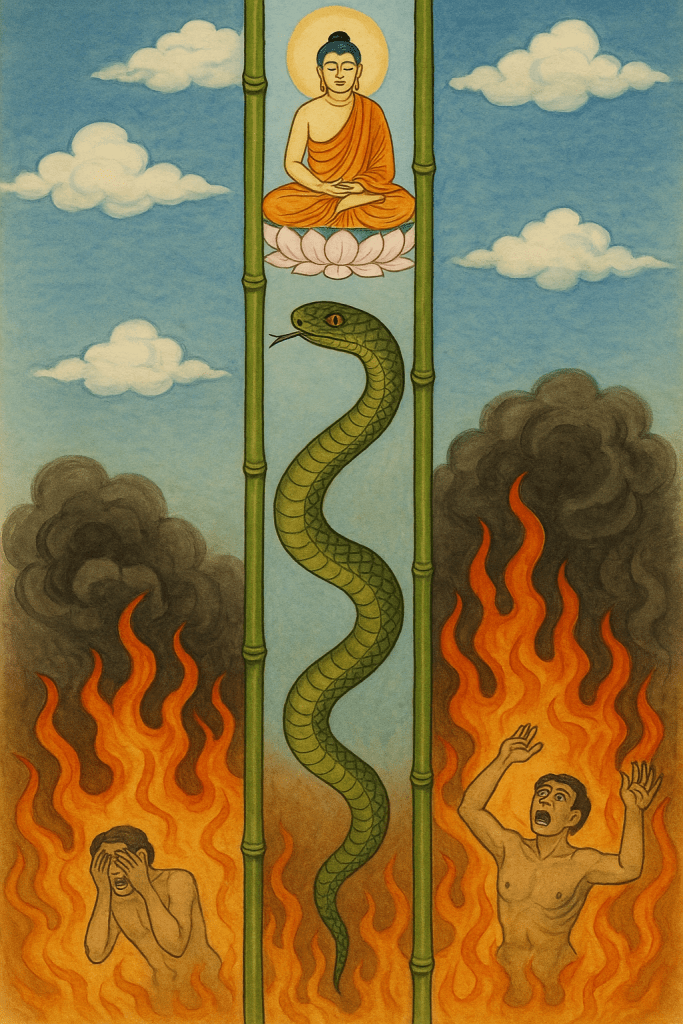
In Tibetan tantric Buddhism, the image of the snake trapped in a bamboo tube is more than a vivid proverb. It functions as a doctrinal warning: once a student enters the tantric path, there is no lateral escape. One either goes upward toward awakening or downward toward failure and “vajra hell.” Teachers have used this image to describe the uncompromising nature of samaya, the vows that bind a student to the guru, the deity, and the tantric methods themselves.¹
What is striking is how explicitly the tradition frames tantra as irreversible and high-stakes, and how rarely that stark truth is communicated to Western beginners before they agree to the vows that supposedly make the tube snap shut behind them. This mismatch between traditional warning and Western presentation is not a minor detail; it shapes the entire experience of Vajrayāna in modern contexts.
When the Warning Arrives Too Late
Many longtime practitioners have reported that the “snake in the tube” metaphor is introduced only after they have taken empowerments, established loyalty to the teacher, and accepted vows they did not fully understand. In one account, students were told after receiving advanced teachings that they were now like snakes [in a tube] with no side exit, and that questioning or leaving the guru’s authority carried dire karmic consequences.² Once framed in these terms, the student is no longer encountering tantra freely. The imagery becomes a retrospective justification for total commitment and an interpretive trap that discourages reevaluation, dissent or disengagement.
This sequencing matters. Warnings given after the student is already inside the tube are not warnings at all; they function as a mechanism of control. Sadly, it’s not just empty scaremongering to get the student to do whatever the teacher wants. The teacher can play a part in destroying the student if he wishes.
Western students, however, often enter tantra without the cultural framework that understands concepts like vajra–hell, and as a result frequently interpret them metaphorically or ignore them altogether during empowerments or teachings. As a result, the gravity of samaya is often hidden in plain sight. Students may assume that vows are symbolic or aspirational when, within the tradition, they are treated as binding conditions that determine spiritual destiny.
The asymmetry of information here is profound. Tibetan teachers know the stakes, but Western students usually do not.
Fear as a Reinforcing Mechanism
Inside the tantric system, samaya is often discussed as a bond of trust and devotion. But its shadow side is rarely addressed openly: the way threats of karmic ruin can be used to enforce silence and obedience. If leaving the guru, criticizing harmful behavior, or even doubting the teacher’s purity is framed as a breach of samaya, then fear becomes central to the student’s experience. Some Tibetan masters teach that both teacher and student can fall into vajra-hell for damaging the guru-disciple bond.³ In practice, however, this warning is most often directed at students, who are told that speaking publicly about misconduct or abuse may destroy their spiritual future.
Why the Snake Matters
The “snake in the bamboo tube” metaphor distills these concerns with unusual clarity. It shows that tantra is not designed to allow experimentation or partial commitment. It requires total participation in a closed system with its own rules, hierarchies, and cosmology. In cultures where this system has historically been embedded, those entering it do so in fuller awareness of the stakes. In the West, students often do not and they may hear such warnings in a highly suggestible state, without really grasping the implications.
One famous guru in the 1980s bluntly told students that they could be both Christian and Buddhist with no conflict whatsoever. This blatantly goes against Christian teaching. In those days Westerners were often thrust into the three-year-retreat program shortly after they signed up for teachings at Dharma centers with no knowledge of what they were really getting into. Many had little preparation to truly understand the arcane nature of samaya and its risks. Furthermore, many Tibetan teachers took advantage of their roles as authority figures to manipulate vulnerable students into sexual relationships and other sorts of commitments. Engaging in secretive sexual relationships with students while pressuring them to take highest yoga tantra vows and practices that would bind them forever often led to deep confusion and psychological unmooring.
The result is a form of spiritual engagement that looks consensual on the surface but lacks true informed consent. Students may be drawn in by promises of transformation but only later discover the rigidity of the commitments they have made. This is especially jarring given that Vajrayāna wraps together the renunciation of the Hinayāna, the boundless compassion of the Mahāyāna, and the esoteric demands of tantra. In this unwieldy fusion, the same tradition that teaches gentle observation of thoughts can also insist that a single critical thought toward one’s guru carries the weight of karmic catastrophe. The threat of vajra-hell sits uneasily beside Buddhism’s wider emphasis on compassion and non-judgment. An ethical issue looms large: a path that describes itself as having no side exit should not be offered as if it does.
To treat tantra’s danger as a secret or secondary detail is to undermine the integrity of the path itself. If practitioners are indeed snakes in a tube, they deserve to be told before they go inside.
Footnotes
¹ “Once you take samaya you become like a snake in a vertical bamboo tube: you’re either going up, or you’re going down. You can’t sneak out the side.” (Kun zang.org) (kunzang.org) ² Note: practitioner-reports and forum posts indicate the metaphor is often applied post-initiation. For example: “A Vajrayana practitioner is like a snake in a tube; … he can either go up or down, not left or right.” (dharmawheel.net) ³ “The metaphor for samaya is a snake in a bamboo tube. It has only 2 directions – up to enlightenment or down to the hells.” (TibetDharma.com) (Tibetan Buddhism)
It has taken me decades to admit something that began as a faint suspicion, then settled into unease, and now has crystallized into a sober conclusion: Tibetan tantric Buddhism is not what I thought it was. Nor is it what I believed when I first encountered it many years ago, a bit before the time His Holiness the Dalai Lama received the Nobel Peace Prize in 1989.
Back then, the first wave of Tibetan lamas and rinpoches were arriving in the West. To many of us, they seemed like emissaries from a lost Shangrila. Coming out of the disillusionment of the Vietnam War years, with trust in government and organized religion badly shaken, we were primed to seek something transcendent and pure. And here were these men, holy men trained in the monasteries of old Tibet, carrying with them an aura of mystery and profound wisdom. Meeting them felt like an unimaginable stroke of good fortune.
The historical Buddha’s teachings struck us as luminous and deeply humane. The philosophical treatises were subtle, the meditation techniques precise and effective. And then there was tantra. We were told, almost in passing, that tantra too came directly from the Buddha. No mention was made of its roots in Shaivism, or its overlaps with the worship of Shiva, Kali, and the other tantric currents in Indian religion. Yes, there were references to the 84 Siddhas, some of whom practiced in Hindu traditions, but it was presented as a kind of colorful backdrop rather than something that demanded careful inquiry. The task, we were told, was to study the dharma, not to ask too many uncomfortable questions.
And yet, the Buddha himself had urged his students to test his words as one tests gold: cutting, burning, hammering to see if it is true. I carried that instruction into Tibetan Buddhism. But the environment I found myself in didn’t encourage such testing. Quite the opposite.
Very quickly, I was drawn into the highest yoga tantras. After a series of initiations that were performed in Tibetan, a language I didn’t understand, I was informed by a lama I scarcely knew that from now on, I had to do whatever he told me. Cognitive dissonance set in immediately. Around me, others spoke of him as a fully enlightened buddha. Terms like samaya and vajra hell were introduced without context, wrapped in a swirl of historical Buddha teachings and cryptic tantric concepts. Critical thought was not just discouraged; it was quietly undermined. The lama was king, and the student’s role was obedience.
For Westerners raised with democratic ideals and an education that stressed inquiry, this was a bewildering fit. Many of us unconsciously overlaid our early religious conditioning onto what was, in fact, a foreign and feudal religious structure with a pantheon of strange and colorful deities. The result of treating the lama as an omniscient god created confusion, sometimes tragedy. I have heard of suicides, psychotic breaks, and lives unmoored. At the same time, I know people who genuinely believe they have benefited from Tibetan Buddhism. For years, I counted myself among them, until my own turn came.
I was privately attacked by my gurus during a tantric ritual for what I considered minor offenses related to situations outside of my control. What followed was worse: a series of what can only be described as black magical assaults. I now look back at those suicides I had once heard about and wonder: had they endured similar attacks, subtle or overt, after questioning or disappointing their teachers? Perhaps. I cannot know for sure. But I do know this: the mask of compassion many lamas wear often drops when they feel challenged or exposed. Not all, certainly. But enough to form a pattern.
That slow dawning that Tibetan tantric Buddhism was not what it was presented to be has been deeply painful. The disillusionment runs far beyond personal disappointment; it speaks to a betrayal of trust, the suppression of critical thought, and the dangers that arise when power is handed to unaccountable gurus who claim authority over hidden magical practices and wield them at will. Brought into a Western culture of sincere but searching seekers, this has created a toxic mix that leaves people vulnerable at the very moment they are most open.
In his article Orientalism and Aspects of Violence in the Tibetan Tradition, Elliot Sperling uses the term Orientalism in the sense made famous by Edward Said. It describes how Western scholars, writers, and media have often portrayed Asian and Middle Eastern societies in ways that are exotic, stereotypical, and distorted (Sperling 2001, p. 317). [1]
In this context, Elliot Sperling is pointing out that Tibet, especially Tibetan Buddhism, has been framed in the West not as a complex, politically active society but as a mystical and pacifist Shangri-la (Sperling 2001, p. 318). That romanticized portrayal fits the Orientalist mold because it projects Western fantasies and agendas onto a culture instead of showing it in its full, often messy, historical reality.
Here, Orientalism is not just about misunderstanding or stereotyping. It is about how those misconceptions feed into selective histories, in this case downplaying or erasing the tradition’s capacity for political maneuvering, power struggles, and violence.
It is important to cut through the sugar-coated narratives about Tibetan Buddhism as an always peaceful, otherworldly faith. Historian Elliot Sperling, a top authority on Tibet and China history, attempts to do this in his essay. He shreds the romanticized “compassionate lama” image and reintroduces the messy, political, and yes, violent realities of Tibetan history (Sperling 2001, p. 320).
Tibetan Buddhism was not pacifism incarnate. Sperling points out that the Fifth Dalai Lama did not shy away from military force when Gelugpa interests were on the line in the 17th century. In the early 20th century, the Thirteenth Dalai Lama actively sanctioned armed resistance against Qing forces in Lhasa (Sperling 2001, pp. 323–324).
Modern Western portrayals have softened the truth. The prevailing global image of Tibetan Buddhism, as inherently gentle, infallibly peaceful, and untouched by politics, is largely a product of Western assimilation and the Tibetan exile community’s framing of their own image (Sperling 2001, pp. 317–318).
Why It Matters
If you are buying into the “peace only” ideal, Sperling’s essay demands reconsideration. He forces you to recognize Tibetan Buddhism as a tradition entwined in power and violence when necessary (Sperling 2001, p. 317). The strident idealism selling Tibet as a spiritual Shangri-la does not hold up under scrutiny. In 1660, the Fifth Dalai Lama faced a rebellion in Tsang. Declaring he acted for the good of the people in the region, he issued uncompromising orders for the complete destruction of his enemies, men, women, children, servants, and property, leaving no trace of them. This directive, written in his own hand, reveals a leader willing to use extreme military force to secure his government’s power, a stark contrast to the modern image of the Dalai Lama as an unshakable symbol of peace.
[Of those in] the band of enemies who have despoiled the duties entrusted to them: Make the male lines like trees that have had their roots cut; Make the female lines like brooks that have dried up in winter; Make the children and grandchildren like eggs smashed against rocks; Make the servants and followers like heaps of grass consumed by fire; Make their dominion like a lamp whose oil has been exhausted; In short, annihilate any traces of them, even their names (Sperling 2001, p. 325).
This brutal passage, is a powerful and chilling indictment. It underscores the darker potential within any ideology. When power, anger, or fear take hold, even so-called peaceful spiritual traditions can sanction annihilation. Sperling’s work reminds us to stop buying into the marketing of Tibetan Buddhism as a compassionate, peaceful idyll. His historical analysis and the many examples of tantric annihilation rituals used against human targets says otherwise. It is time to drop the myth and acknowledge the tradition for what it truly is: a living, political, and sometimes violent force (Sperling 2001, p. 329).
Elliot Sperling, “Orientalism and Aspects of Violence in the Tibetan Tradition” (2001), info-buddhism.com, originally published in Imagining Tibet: Perceptions, Projections, & Fantasies, ed. Thierry Dodin and Heinz Räther, Wisdom Publications. Available at: https://info-buddhism.com/Orientalism_Violence_Tibetan_Buddhism_Elliot_Sperling.html





 Tantric Deception