
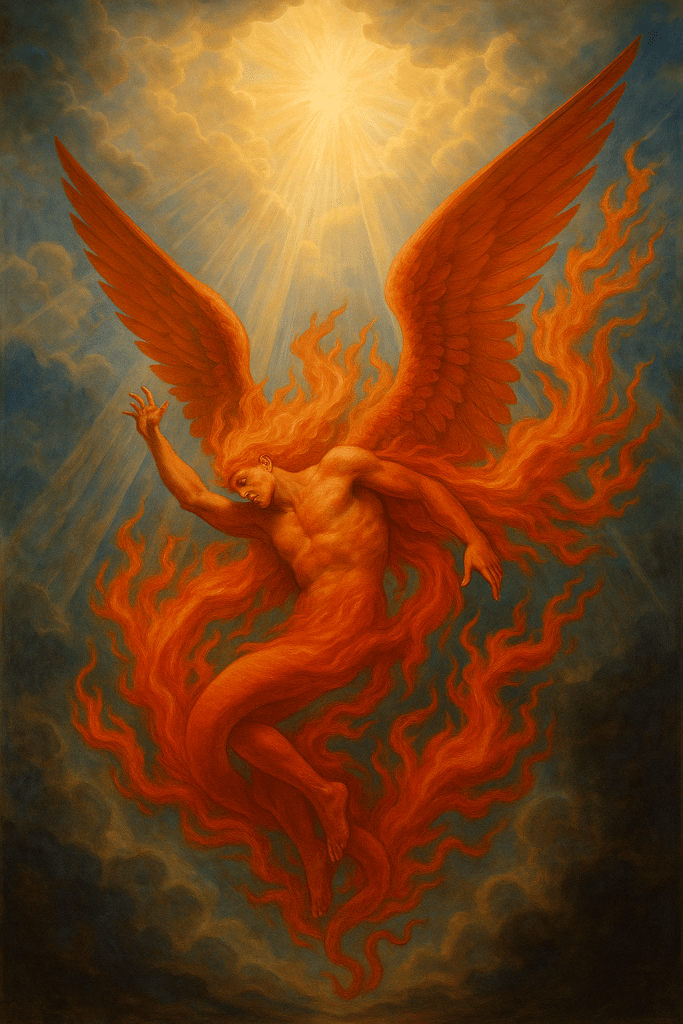
What If the Kundalini Serpent Fire Was Once Angelic?


What if some of the radiant beings that ancient texts call Seraphim, the fiery, serpentine angels who once circled the throne of God, fell from that high order? The Hebrew word saraph itself means both burning one and serpent. In that ambiguity lies a bridge between the flaming spirits of heaven and the serpent powers found in other traditions.

Across the world, in the Sanskrit Purāṇas and yogic literature, there are also serpentine intelligences: the Nāgas, the Kundalinī energy, and the goddess figures who appear surrounded by flames. The sage Patañjali, author of the Yoga Sūtras, is deeply linked with serpent symbolism. In Indian mythology, he is sometimes described as an incarnation (avatāra) of the serpent deity Ādiśeṣa, or Ananta, the cosmic serpent who supports Viṣṇu. Ādiśeṣa is said to have descended to earth to bring knowledge that would relieve human suffering. This connection is why Patañjali is often portrayed with a serpent hood behind his head or a serpent body below the waist. Whether or not serpent spirits literally whispered the Yoga Sūtras to him, serpent imagery pervades yogic and tantric cosmology. The Nāgas are keepers of divine wisdom, and Kundalinī is envisioned as a coiled fiery energy at the base of the spine that awakens through disciplined practice. Over time, these motifs merged into a vision of serpentine power as both the source and the path of revelation. Suppose these mythic beings were echoes of the same order of spirits, glimpsed through another cultural lens. If the Seraphim of the Old Testament were “burning ones,” what would a fallen Seraph look like to those who encountered its power? Perhaps like the Kundalinī Śakti, a current of fire roaring through the body, consuming and transformative, perilous and hideous.

In Tibetan tantric art, figures such as Vajrayoginī blaze with this same imagery. She stands wreathed in flame, hair flying, a garland of human heads around her neck: a being of immense energy and occult knowledge. To her accomplished devotees she is enlightenment embodied, but to others overwhelmed by her force, the experience could resemble an encounter with a terrifying, cosmic intelligence that feels at once divine and frightfully destructive.

In Christian cosmology, the Seraphim stood closest to the divine light, their essence described as pure burning love. If the story of the angelic rebellion is true, the fall of Lucifer and his host might be understood as the perversion of that love for God turned inward toward self-worship. The Seraphs, if any joined that rebellion, would have fallen from the highest heaven to earth yet carried the memory of their incandescent proximity to the Most High. After such a fall, their nature would remain fiery but unmoored, no longer worshipping the divine but seeking vessels in which to become divine objects themselves, demanding reverence rather than giving it. Their rebellion took the form of imitation, of becoming godlike and leading humans away from God through elaborate systems of spiritual artifice. Seen through that lens, the serpent fire that rises in the body could be a vestige of this celestial descent, a remnant of the same luminous essence striving to return upward yet incapable of abiding in heaven because of their grave sin. In mythic terms, these fallen Seraphs might not have become the grotesque demons described by some exorcists but radiant, fallen intelligences deprived of their proper axis.

Catholic exorcists often describe demons as denizens of hell, creatures of stench, mockery, and degradation that feed on blood and fear. Yet if a third of the angels fell, the fallen host was not of one kind alone. Tradition holds that beings from all nine choirs joined the rebellion, from the lowly messengers to the highest Seraphs who once blazed before the throne. After the fall, these spirits lost their divine orientation but not their essential nature: fiery where they had been fiery, clever where they had been wise. In rebellion they became hierarchies of distortion, a dark mirror of heaven. Some manifest as the grotesque forms exorcists encounter; others as subtler intelligences still bearing the trace of their former luminosity. And what of the Nephilim, the offspring of the “sons of God” and human women? When they died, it is said, they became wandering spirits of great malice. “Demon,” then, is not a single species but a spectrum of fallen orders, each expressing what it once was in a corrupted form. As one exorcist observed, each fallen angel is a species unto itself. A fallen Seraph would perhaps appear differently from a fallen Power, Dominion, or Nephilim spirit.

If the Kundalinī or tantric fire represents contact with that residual Seraphic current, it may explain why it bears both a luminous and a destructive face. The energy feels ancient and intelligent. The ecstatic experiences described in yogic ascent mirror, in certain sense, a fallen entity yearning to return to its source. The agony that often accompanies a kundalini awakening—the painful burning, the psychic rupture, and the sense of another will within—could be the friction between that powerful celestial energy and the humble human vessel struggling to contain it. Whether one interprets this as possession or not, the pattern remains: what was once angelic becomes dangerous when severed from its orientation toward God and seeking to inhabit a human host.

Whether understood theologically, psychologically, or experientially, the speculation remains: serpent fire is something that seeks to burn within human beings, hoping to be redeemed and adored rather than condemned.

Spiritual paths that promise transcendence through serpent fire often walk a razor’s edge where illumination meets peril. Tantric Deception seeks to explore that tension, showing how practices that seem to lead toward light may instead open gateways into spiritual posession and darkness. What begins as ascent toward divinity can turn into descent into hell, both in this life and beyond. To approach the serpent fire is to confront both heaven and the echo of its fall, a perilous imitation of grace. One might call it a race to the bottom. The fallen angels made their choice long ago, and according to Christian theology there is no return for them. Those who follow, worship, or seek to become like them will share their fate in the same fire reserved for their fallen gods, a place described in Scripture as the final dwelling of the devil, his angels, and all who reject the true light. There they are said to be cast into a lake of fire that burns without end, cut off forever from the presence of the Most High God, where the torment born of rebellion becomes eternal.
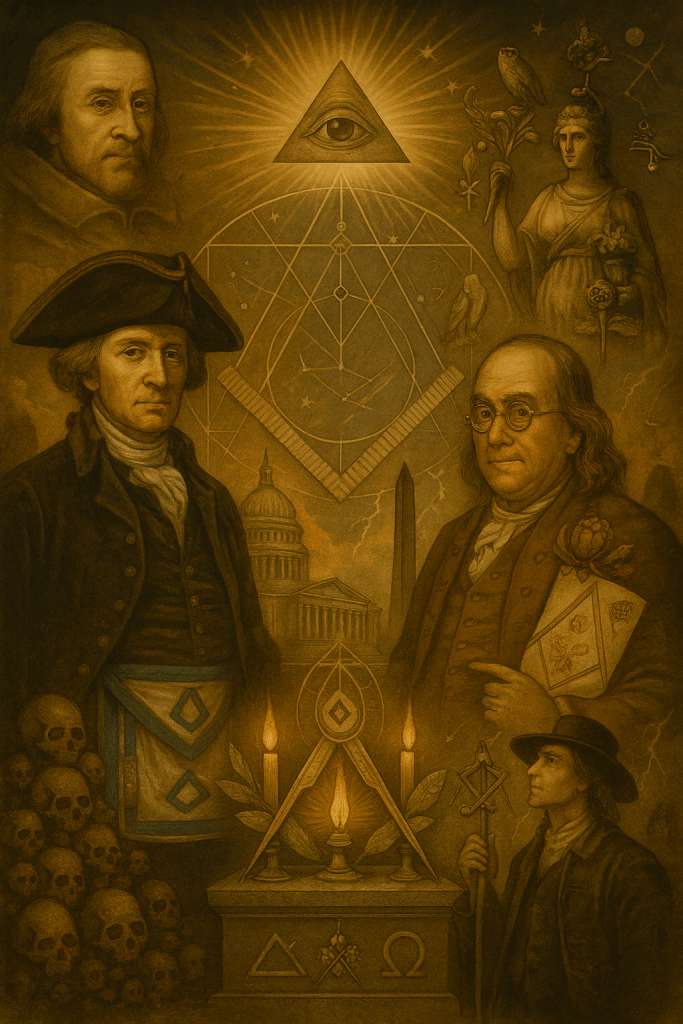
The Secret Religion of America’s Founding Fathers


When we are taught the story of America’s birth, it is usually a tale of idealism. Enlightened men gathered in Philadelphia to declare independence, draft a Constitution, and form a free republic unlike any other. They were men of reason, we are told, men who broke the chains of monarchy and dogma. That is the official version.

There is another version though, one that rarely finds its way into the nation’s history textbooks. It is a story of secret societies, hidden rituals, and a shadow religion that shaped the foundations of the republic. Many of the founders were not only statesmen but initiates of the Masonic lodges. They swore oaths in candlelit chambers surrounded by symbols older than Christianity, and they believed in occult truths that they encoded into architecture, city plans, and perhaps even the clauses of the Constitution itself.

It is sometimes claimed that these men were “33rd degree Freemasons,” but that phrase is an anachronism. The Scottish Rite’s 33rd degree did not exist until the early 1800s, after the Revolution. In the America of Washington and Franklin, the system of Masonry offered three primary degrees, with Master Mason as the highest level attainable. Yet to dismiss these three degrees as merely entry level would be a mistake.

George Washington, for example, was a documented Master Mason and conducted the laying of the Capitol’s cornerstone in 1793 with a full Masonic ritual, apron and all. Benjamin Franklin advanced even further, becoming Grand Master of the Lodge of Nine Sisters in Paris, where Masonry blurred into Rosicrucianism and the hidden philosophies of Europe. Paul Revere and John Hancock also became Grand Masters in Massachusetts, placing them at the pinnacle of the craft in the colonies. Thomas Jefferson, though never conclusively proven to be a Mason, was deeply immersed in esoteric literature and deistic philosophy, moving in the same intellectual currents. Meriwether Lewis and William Clark were both confirmed Masons, carrying the symbols of the lodge as they mapped the continent at Jefferson’s command.

So while the founders were not 33rd degree in the technical sense, many were far more than casual lodge members. They were Masters and Grand Masters, men who presided over rituals, commanded respect, and carried with them the authority and secrecy that would later be associated with the highest degrees of Masonry. In their time, these roles carried the same aura of power and hidden knowledge. To understand their position is to see the founding not just as a political act, but as an occult project guided by initiates of a secret order.

Liberty As A Shield

The First Amendment’s guarantee of religious freedom can be seen as more than just a shield against sectarian conflict. For men who belonged to lodges that drew on symbols and allegories older than Christianity, it also functioned as legal protection for their own rites. The Constitution made it impossible for the government to persecute secret gatherings, whether they were Masonic initiations or other esoteric practices. What looked to the public like a safeguard for Protestant dissenters doubled as a safeguard for the private rites of the elite.

This was no small matter, because in Europe such societies had been hunted and suppressed for centuries. The Knights Templar, once one of the most powerful military orders of Christendom, were destroyed in 1307 when King Philip IV of France moved to seize their wealth and eliminate their independence. On October 13 of that year, hundreds of Templars were arrested, tortured, and forced to confess to strange crimes: spitting on the cross, engaging in forbidden rites, and worshipping an idol called “Baphomet.” The name may or may not have been drawn from an actual deity worshipped at that time in Europe. Most scholars believe it was a corruption of “Mahomet,” a medieval way of referring to Muhammad, used to smear the Templars as crypto-Muslims and heretics. Some trial records describe a head or strange effigy, but no evidence of such an idol was found, and the confessions were extracted under brutal torture.

Much later, in the nineteenth century, occult writers revived the legend. The French magician Eliphas Lévi reimagined Baphomet as the goat-headed figure known as the Sabbatic Goat, a symbol of esoteric balance and hidden knowledge. That image, now iconic in the modern occult imagination, had little to do with the medieval Templars, but it grew out of the accusations against them. The effect of the original charges, true or not, was devastating. Many Templar leaders were burned at the stake, and the order was annihilated. More importantly, the spectacle set a pattern: when the Church encountered a secret society it could not control, it branded it as diabolical and destroyed it.

That suspicion carried forward into the Enlightenment. Freemasonry faced the same hostility. In 1738, Pope Clement XII issued the first papal bull banning Catholics from joining the lodges, condemning them as heretical and politically dangerous. Pope Benedict XIV reinforced the prohibition in 1751, ensuring that Masons remained under suspicion across Catholic Europe. Lodges were forced underground, their rituals hidden from the public eye, even as whispers linked them to the same dark charges once leveled against the Templars. By the time of America’s founding, the memory of suppression was fresh, and the lodges in the colonies offered a freedom their European counterparts could only dream of. Writing religious liberty into the Constitution was therefore not just an Enlightenment ideal, but also a coded guarantee that the persecutions of the past would not be repeated on American soil.

Esoteric Echoes In The Constitution

There is another layer to the founding philosophy. In occult traditions there is a split between the exoteric, the outer teachings for the public, and the esoteric, the inner teachings for initiates. By separating church and state, the founders created a dual structure: an outer civic faith in liberty and equality that everyone could see, and an inner realm of private belief where initiates could pursue forbidden truths. Even the structure of government can be read symbolically in this light. The Constitution divided power into executive, legislative, and judicial branches, a design openly inspired by Montesquieu’s philosophy. Yet the pattern also echoes older currents of Hermetic and alchemical thought, where balance is achieved by setting opposing forces against one another and resolving them into harmony. Whether by design or coincidence, the republic’s framework resonates with the esoteric idea that true order emerges only when tensions are held in careful balance.

The Name Of A Hidden God

The Masonry Washington practiced was limited to three degrees, and the records of his lodge never mention anything beyond them. Yet as the Craft expanded into higher rites during and after the Revolution, a curious word surfaced: Jahbulon. Introduced in the Royal Arch degree and whispered as a “sacred name,” it fused Jehovah, Baal, and an Egyptian sun god into a single blasphemous trinity. To Masons it was defended as a symbol of universality, a way of joining together divine names from different traditions. To outsiders, it looked like sorcery and proof that the Craft concealed a god of its own. The charge of demonism attached itself to Jahbulon, and for generations pastors and ex-Masons would point to it as the true hidden lord of the lodge.

Franklin’s Bones In London

In 1998, during renovations at Benjamin Franklin’s former London home, workers discovered a pit filled with skeletal remains. More than a dozen bodies, many of them children, were buried beneath the house where Franklin lived for nearly two decades. The accepted explanation is that an acquaintance of Franklin’s was performing medical experiments. Yet the image of one of America’s most celebrated founders living above a hidden grave is hard to shake. Franklin was a Freemason and a member of elite clubs in both London and Philadelphia. Did he share in these experiments, or was something else taking place in the basement of his home?

Jefferson, Lewis, And Clark: The Quest For Giants

Thomas Jefferson publicly presented himself as a rationalist, skeptical of superstition. In private he was fascinated with bones, especially those of giant stature. Reports circulated among Native nations of colossal beings who had once walked the continent. Mounds in the Ohio Valley yielded bones that seemed to support the legends. Jefferson tasked Meriwether Lewis and William Clark, both Freemasons, to gather evidence as they explored the new territories. The expedition is remembered for mapping, diplomacy, and science, but it was also a search for remnants of a forgotten race. Set beside Europe’s long history of suppressing heterodox knowledge, that search reads like a counter-move: recovering what the Old World had buried.

Francis Bacon And The Vision Of A New Atlantis

A century before the Revolution, the philosopher Francis Bacon had sketched the outlines of a world that looked suspiciously like what America would become. In his unfinished work New Atlantis, published in 1627, he imagined a secretive island nation ruled by an invisible order of wise men. Knowledge was their power. They collected information from across the globe, preserved hidden sciences, and governed not through kings or priests but through an unseen hierarchy of initiates. For Bacon, this was not just a utopian dream. It was a blueprint.

Bacon was tied to the Rosicrucian movement, an esoteric current that preached secrecy, symbolic architecture, and the union of science and spirituality. These ideas filtered into Freemasonry, which in turn shaped the worldview of many of America’s founders. The New World, far from the reach of papal bulls and European monarchs, offered the perfect stage on which to bring Bacon’s vision to life.

When Washington, D.C. was laid out in the 1790s, it bore the fingerprints of an esoteric tradition. The Capitol’s cornerstone was set with full Masonic ritual by George Washington in 1793. The city’s street plan, designed by Pierre Charles L’Enfant and later adjusted by Masonic surveyors, is filled with geometric alignments. Triangles, squares, and compass shapes radiate through the avenues. The Washington Monument, an obelisk borrowed from ancient Egypt, rises as a stone needle between the Capitol and the White House. And on the nation’s Great Seal, later emblazoned on the one-dollar bill, an unfinished pyramid crowned with the all-seeing eye declares in Latin: Novus Ordo Seclorum, a New Order of the Ages.

For those steeped in Bacon’s writings, this was more than civic planning. It was sacred geometry, an attempt to encode cosmic truths into the stones and avenues of the capital. The city itself became a temple, a visible New Atlantis built on the banks of the Potomac. America was not only a republic in the political sense, but also an experiment in hidden architecture and esoteric governance. In the vision of Bacon and the Masons who followed him, the United States was to be both a nation and a ritual machine, replete with symbols that would shape its destiny.

The Hidden Pantheon

The secret religion of the founders was not a single system. It was a mixture of Enlightenment deism, Masonic ritual, Templar legends, Rosicrucian utopianism, and an obsession with the lost giants of the New World. They spoke in public of reason and progress. In private they gathered in lodges, invoked symbols, and swore oaths that bound them to a different order altogether. The nation they built was more than a republic. It was an occult machine written into stone, ritual, and law.


America was born with the promise of liberty and justice for all. Yet as the centuries unfolded, that mandate became overshadowed by a darker reality. Eisenhower’s warning of a “military-industrial complex” has long since hardened into fact. From Vietnam to Iraq, from the deserts of the Middle East to the hidden prisons of the modern empire, America has become feared as much as it was formerly admired.

Was this corruption a hostile takeover by dark forces, or were the seeds of it sown from the very beginning, in the secret oaths and hidden gods that shaped its founding? Perhaps the two Americas were always there: the outer republic of freedom, and the inner machine of ritual power. One speaks of liberty and equality, while the other feeds on secrecy, empire, and control.

Which America do you live in? And which America will prevail?