An Encounter with Kali


The descent into Bengal began with a vision. As our plane banked low over the hazy sprawl of Calcutta, I sat in meditation, quietly preparing for a long journey north to Sikkim for a series of tantric empowerments. Then, quite suddenly, a naked dakini appeared before me, dancing and beckoning. She seemed to be greeting me to Calcutta. I knew, or thought I knew, that it was Kali.

We stayed in a modest Baptist guesthouse chosen for its safety and low price, a short walk from Mother Teresa’s compound. It was late October, and the air was warm and humid. Calcutta felt down at heel, yet intellectual and dignified. My companions, all Tibetan Buddhist practitioners, decided to visit Mother Teresa’s place to pay homage. I hung back. They were sincere in their devotion to that famous nun, but something in me pulled in another direction. Although I had been raised Catholic, I felt a faint aversion to anything connected with the Catholic Church. I regarded the religion as problematic at that time. Still, seeing how genuinely excited my friends were, I encouraged them to go.

The next day I hired a taxi and arranged for us to cross the city to the Dakshineswar Kali Temple, the same temple where Ramakrishna had worshipped and experienced his visions of the Divine Mother and became enlightened. “We really must make the effort to see it,” I told the others, although I wasn’t sure why. The journey took nearly an hour through dusty streets and chaotic traffic. I had read that Kali was the patron goddess of Bengal, and that Dakshineswar was one of her most important shrines. The closer we came, the stronger the pull felt.

At the temple, a long line of Indian devotees wound through the courtyard, each waiting to glimpse the goddess and receive her blessing. We appeared to be the only Westerners there. I knew very little about the history of the temple at that point. All I knew was that I had always been intrigued by Ramakrishna among all the Hindu mystics and had always wanted to visit his temple and pay my respects.

The Temple and Its History

The Dakshineswar Kali Temple was founded in the mid-nineteenth century by Rani Rashmoni, a wealthy zamindar who, according to legend, dreamt that the goddess Kali commanded her to build a temple on the banks of the Hooghly River rather than journey by boat to Varanasi¹. Rashmoni had been preparing for the pilgrimage for months and had spent a small fortune, but on the night before her departure, Kali appeared in a dream and told her she need not travel at all. Instead, the goddess instructed her to raise a temple and enshrine an image that Kali herself would inhabit, blessing all who came to worship. The temple was completed in 1855 and the complex stands on land said to resemble a tortoise, a form considered especially auspicious in Shakta-Tantra cosmology².

Architecturally, the main temple is built in the navaratna (nine-spired) style typical of Bengal, raised on a high platform overlooking the river³. Surrounding the sanctum are twelve identical Shiva shrines aligned along the Hooghly’s edge, a small Radha-Krishna temple, and bathing ghats for pilgrims⁴.

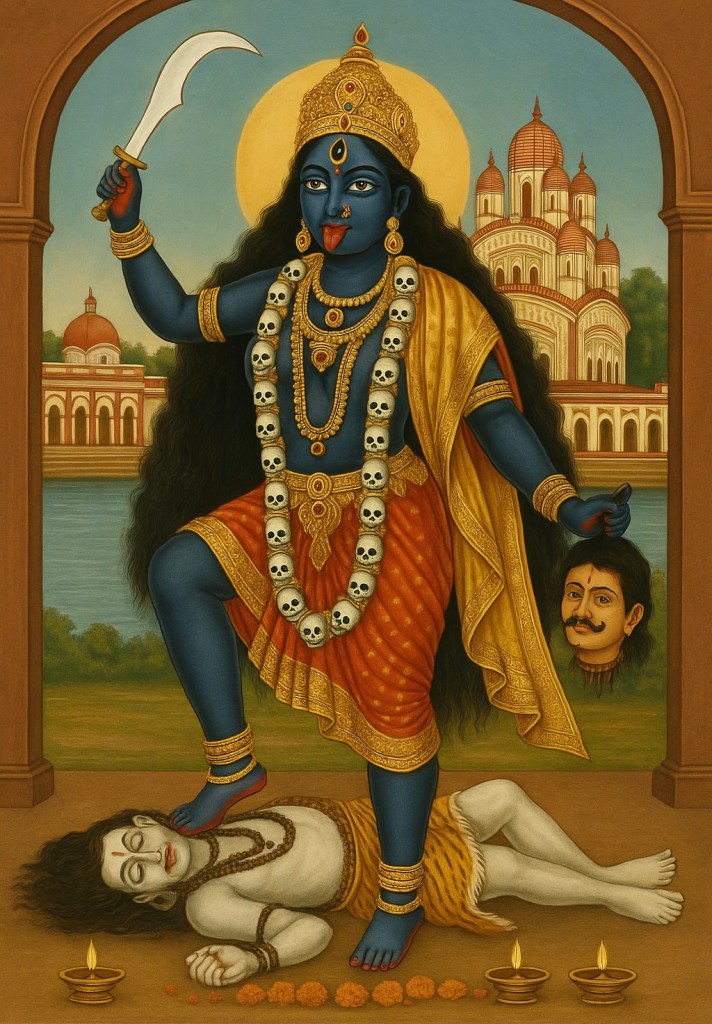
Inside the sanctum resides Bhavatarini, a fierce aspect of Kali known as “Saviour of the Universe,” depicted with one foot on Shiva’s chest⁵. The mystic Ramakrishna served as the temple’s priest and carried out years of intense spiritual practice within its grounds, transforming the site into one of India’s holiest centers of Shakti worship⁶. The atmosphere is thick with incense, bells, flowers, and the hum of a thousand mantras. Once inside the gate you feel the city’s chaos fall away.

As we stood in line, something unexpected happened. An Indian guard suddenly appeared, motioned to me and a Buddhist friend, and beckoned us forward. Without explanation, we were led past the waiting crowd directly to the inner sanctum. The goddess stood before us, draped in red and gold, eyes alive in the flicker of ghee lamps. When I received prasad, it tasted sweet and delicious, and I felt a surge of a deep, penetrating love. It was so overwhelming that I began to cry.

As a Tibetan Buddhist, I had always regarded Hindu deities as somehow inferior and secondary to the Tibetan ones who were the representations of the ultimate truth. My practice had centered on Vajrayogini and Chakrasamvara, not on Kali. Yet there, when the experience of divine love engulfed me in the Dakshineswar temple, I felt an unmistakable recognition.

Years later, after surviving the catastrophic unraveling of my own tantric path due to the betrayal by male Buddhist teachers, the exposure of their sexual abuses, and the psychic annihilation that followed, I began to study the origins of tantra in earnest. Through the research of Alexis Sanderson and others, I learned what my experience at Dakshineswar had already shown me: that the yoginī tantras of Tibetan Buddhism arose from the same crucible of medieval Hindu Śaiva and Śākta practice⁷. Vajrayoginī, the red goddess of my own initiations, was in essence a Buddhized form of Kali. The goddess in both traditions can give blessings and boons, but she can become, in an instant, a terrifying and destructive demon with her own set of intentions and cosmic laws.

That insight came at great cost. The deeper I studied, the more clearly I saw that tantra, in both Hindu and Buddhist forms, was inseparable from forces of domination, secrecy, and power. The same ecstatic current that once inspired devotion also lurked behind manipulation and abuse. In the West, these darker currents were long dismissed or hidden, until the many scandals of 2017 tore the veil away.

My visit to Kali’s temple remains a paradox. In that moment I felt only grace: the raw, overwhelming presence of the divine feminine. But in hindsight, I experienced Kali as both mother and destroyer, blessing and devourer. She welcomed me to Calcutta with open arms, but in time, in her Buddhist form as Vajrayogini, she stripped me of everything I held dear in order to completely destroy my body, mind, and soul. By the grace of the highest divinity, the eternal Christian God, I survived and am still alive to tell the tale.


Notes

  1. Dakshineswar Kali Temple, Wikipedia, last modified 2025.
  2. Ibid.
  3. Ibid.
  4. Ibid.; see also Dakshineswar Kali Temple official site, Places in Dakshineshwar (dakshineswarkalitemple.org).
  5. Dakshineswar Kali Temple, Britannica.
  6. Ibid.; Ramakrishna’s association documented in Swami Nikhilananda, The Gospel of Sri Ramakrishna (New York: Ramakrishna-Vivekananda Center, 1942).
  7. Alexis Sanderson, “The Śaiva Age: The Rise and Dominance of Śaivism during the Early Medieval Period,” in Genesis and Development of Tantrism, ed. Shingo Einoo (Tokyo: Institute of Oriental Culture, University of Tokyo, 2009), 41–350.
What If the Kundalini Serpent Fire Was Once Angelic?


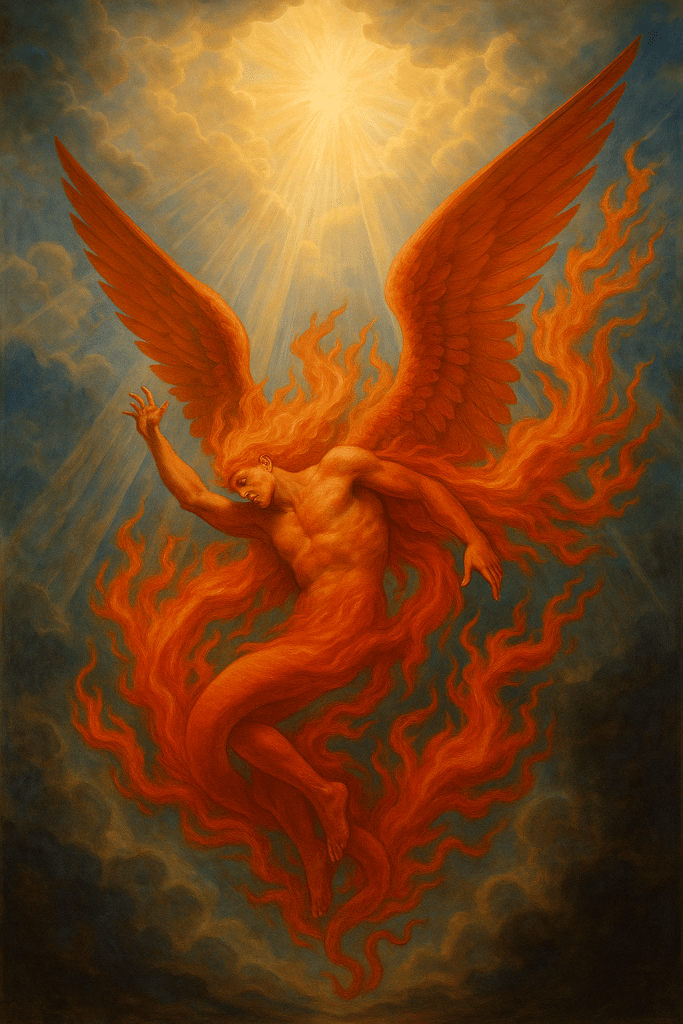
What if some of the radiant beings that ancient texts call Seraphim, the fiery, serpentine angels who once circled the throne of God, fell from that high order? The Hebrew word saraph itself means both burning one and serpent. In that ambiguity lies a bridge between the flaming spirits of heaven and the serpent powers found in other traditions.

Across the world, in the Sanskrit Purāṇas and yogic literature, there are also serpentine intelligences: the Nāgas, the Kundalinī energy, and the goddess figures who appear surrounded by flames. The sage Patañjali, author of the Yoga Sūtras, is deeply linked with serpent symbolism. In Indian mythology, he is sometimes described as an incarnation (avatāra) of the serpent deity Ādiśeṣa, or Ananta, the cosmic serpent who supports Viṣṇu. Ādiśeṣa is said to have descended to earth to bring knowledge that would relieve human suffering. This connection is why Patañjali is often portrayed with a serpent hood behind his head or a serpent body below the waist. Whether or not serpent spirits literally whispered the Yoga Sūtras to him, serpent imagery pervades yogic and tantric cosmology. The Nāgas are keepers of divine wisdom, and Kundalinī is envisioned as a coiled fiery energy at the base of the spine that awakens through disciplined practice. Over time, these motifs merged into a vision of serpentine power as both the source and the path of revelation. Suppose these mythic beings were echoes of the same order of spirits, glimpsed through another cultural lens. If the Seraphim of the Old Testament were “burning ones,” what would a fallen Seraph look like to those who encountered its power? Perhaps like the Kundalinī Śakti, a current of fire roaring through the body, consuming and transformative, perilous and hideous.

In Tibetan tantric art, figures such as Vajrayoginī blaze with this same imagery. She stands wreathed in flame, hair flying, a garland of human heads around her neck: a being of immense energy and occult knowledge. To her accomplished devotees she is enlightenment embodied, but to others overwhelmed by her force, the experience could resemble an encounter with a terrifying, cosmic intelligence that feels at once divine and frightfully destructive.

In Christian cosmology, the Seraphim stood closest to the divine light, their essence described as pure burning love. If the story of the angelic rebellion is true, the fall of Lucifer and his host might be understood as the perversion of that love for God turned inward toward self-worship. The Seraphs, if any joined that rebellion, would have fallen from the highest heaven to earth yet carried the memory of their incandescent proximity to the Most High. After such a fall, their nature would remain fiery but unmoored, no longer worshipping the divine but seeking vessels in which to become divine objects themselves, demanding reverence rather than giving it. Their rebellion took the form of imitation, of becoming godlike and leading humans away from God through elaborate systems of spiritual artifice. Seen through that lens, the serpent fire that rises in the body could be a vestige of this celestial descent, a remnant of the same luminous essence striving to return upward yet incapable of abiding in heaven because of their grave sin. In mythic terms, these fallen Seraphs might not have become the grotesque demons described by some exorcists but radiant, fallen intelligences deprived of their proper axis.

Catholic exorcists often describe demons as denizens of hell, creatures of stench, mockery, and degradation that feed on blood and fear. Yet if a third of the angels fell, the fallen host was not of one kind alone. Tradition holds that beings from all nine choirs joined the rebellion, from the lowly messengers to the highest Seraphs who once blazed before the throne. After the fall, these spirits lost their divine orientation but not their essential nature: fiery where they had been fiery, clever where they had been wise. In rebellion they became hierarchies of distortion, a dark mirror of heaven. Some manifest as the grotesque forms exorcists encounter; others as subtler intelligences still bearing the trace of their former luminosity. And what of the Nephilim, the offspring of the “sons of God” and human women? When they died, it is said, they became wandering spirits of great malice. “Demon,” then, is not a single species but a spectrum of fallen orders, each expressing what it once was in a corrupted form. As one exorcist observed, each fallen angel is a species unto itself. A fallen Seraph would perhaps appear differently from a fallen Power, Dominion, or Nephilim spirit.

If the Kundalinī or tantric fire represents contact with that residual Seraphic current, it may explain why it bears both a luminous and a destructive face. The energy feels ancient and intelligent. The ecstatic experiences described in yogic ascent mirror, in certain sense, a fallen entity yearning to return to its source. The agony that often accompanies a kundalini awakening—the painful burning, the psychic rupture, and the sense of another will within—could be the friction between that powerful celestial energy and the humble human vessel struggling to contain it. Whether one interprets this as possession or not, the pattern remains: what was once angelic becomes dangerous when severed from its orientation toward God and seeking to inhabit a human host.

Whether understood theologically, psychologically, or experientially, the speculation remains: serpent fire is something that seeks to burn within human beings, hoping to be redeemed and adored rather than condemned.

Spiritual paths that promise transcendence through serpent fire often walk a razor’s edge where illumination meets peril. Tantric Deception seeks to explore that tension, showing how practices that seem to lead toward light may instead open gateways into spiritual posession and darkness. What begins as ascent toward divinity can turn into descent into hell, both in this life and beyond. To approach the serpent fire is to confront both heaven and the echo of its fall, a perilous imitation of grace. One might call it a race to the bottom. The fallen angels made their choice long ago, and according to Christian theology there is no return for them. Those who follow, worship, or seek to become like them will share their fate in the same fire reserved for their fallen gods, a place described in Scripture as the final dwelling of the devil, his angels, and all who reject the true light. There they are said to be cast into a lake of fire that burns without end, cut off forever from the presence of the Most High God, where the torment born of rebellion becomes eternal.

Between Mount Athos and the Ashram: An Exploration of Deception and Deliverance


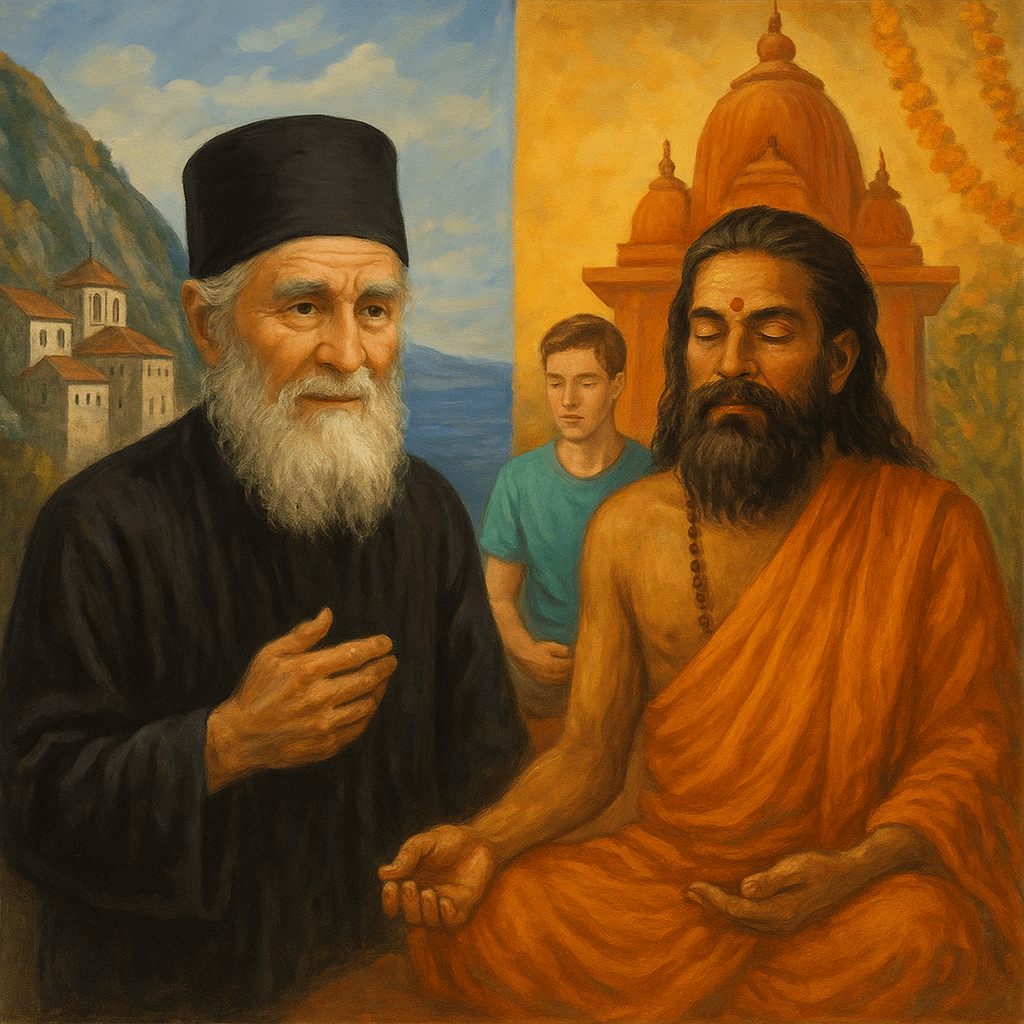
In 2008, the Holy Monastery of Saint Arsenios on Mount Athos published The Gurus, the Young Man, and Elder Paisios.¹ It tells the true story of a young Greek man whose hunger for spiritual depth led him from the monasteries of Athos to the ashrams of India, where he fell under the sway of a Hindu guru. This book resonated with me because it mirrors the restlessness of many modern seekers. It traces the arc from yearning for authentic experience, through dangerous detours into counterfeit light, and finally to deliverance through Christ. That theme, the need for discernment in a world of spiritual seductions, is central to my own story and to the explorations I share.

The First Encounter with Elder Paisios

The young man first encountered Elder Paisios on Mount Athos, the spiritual heart of Greek Orthodoxy. Athos is not simply a monastic peninsula but a living continuation of the desert fathers, a land saturated with centuries of prayer. Elder Paisios was already known as a man with the profound gifts of clairvoyance, discernment, and love. At the heart of Orthodoxy, he explained, lies the invocation of the name of Christ: “Lord Jesus Christ, have mercy on me.”² This is not a spiritual technique but a cry from the heart. As Paisios emphasized, “With the name of Christ we experience divine Grace, divine illumination, and union with God.”³

Life on Mount Athos

Mount Athos rises from the Aegean like a fortress of prayer. Approaching by boat, pilgrims see monasteries clinging to cliffs, their domes catching the morning sun. Bells toll at dawn, summoning monks from their cells to the katholikón, the central church. Inside, the air is heavy with incense; oil lamps flicker before icons blackened with centuries of smoke. The chanting is slow and unhurried, carrying the words of the Psalms like waves rolling in from the sea.

The rhythm of Athonite life is simple but relentless. To walk its paths is to feel the weight of prayer, as if the very stones are steeped in the remembrance of God. When the young man would meet Elder Paisios in his cell at Panagouda, he encountered not pomp or grandeur but humility. The elder sat on a rough stool, his clothes patched, his face lined with suffering yet radiant with joy. Paisios was accessible, direct, and utterly unpretentious. His authority did not come from outward spectacle but from the depth of grace shining through him.

Despite these encounters, the young man was restless. His desire for spiritual experience drew him beyond Orthodoxy and into Hinduism in India.

Life in the Ashram

India overwhelmed his senses. It was a riot of bright colors and potent scents. Bells clanged rhythmically at dawn, mingling with the chant of myriad voices repeating mantras. Bare feet shuffled across dusty courtyards as disciples hurried to gather at the feet of the guru, who sat elevated on a dais draped in silk and garlands of marigolds. The air around him was charged with expectancy.

Daily life in the ashram followed ritual precision. Before sunrise, disciples bathed in cold water, then filed into meditation halls where they repeated mantras by the thousands. Each syllable, they believed, vibrated with cosmic energy. The guru’s followers bowed low, sometimes lying full-length on the ground, convinced that to touch even the dust beneath his feet was a blessing.⁴ His faintest smile was received as a gift, his disapproval a knife wound.

The guru’s teachings promised transcendence. He insisted that the repetition of mantras would dissolve the ego and merge the self into the divine. He was not merely a teacher but the embodiment of truth itself. Service was considered worship: cooking his meals, arranging his seat, or waving fans before him was thought to create conditions conducive to liberation. At first, the young man was drawn in by the atmosphere of devotion and the apparent serenity of the disciples. The charged rituals, intense and mystical, seemed to hum with power.

Yet Elder Paisios had already warned him: “The invocation of the name of any other god apart from Christ is communion with demons. The person who invokes that name calls upon the demon corresponding to it and is possessed by it.”⁵ What seemed like nectar would prove to be poison.

Paisios explained that deceptive energies imitate grace: “They give a sweetness, a supposed peace, but afterwards they bring turmoil.”⁶ This was the young man’s experience. The chants that once filled him with calm soon unsettled him. His thoughts scattered, his dreams grew dark, and the guru’s gaze, once a source of comfort, became suffocating. The ashram that had promised freedom now felt like a dangerous place.

The Return to Mount Athos

When the young man finally returned to Athos and told Paisios everything, the elder spoke with clarity. “In Orthodoxy we have the invocation of the name of Christ. With it we experience illumination and union with God. All other invocations, all other names, apart from Christ, lead to deception.”⁷

Paisios prayed for him, invoking Christ. In that moment, the torment that had hounded the young man since the ashram lifted. He felt the peace of God return, and the tormenting voices were silenced. What the guru’s gaze and mantras had invoked, the simple name of Jesus restored.

Why It Resonates

This story mirrors my own path. Like the young man, I wandered away from Christ into Eastern occult traditions that promised transformation through techniques such as deity yoga, mantra repetition, and breath manipulation. The initial sweetness was very real followed by years of difficulties alternating with mystical heights, but all of that led to demonic possession by entities I once thought were buddhas.

In a world where esoteric practices are commonplace, Paisios’s warnings are urgent. Many today seek mystical experiences, but as Elder Paisios said, “Grace brings deep humility, contrition, tears, and love for Christ.”⁸ The counterfeit, by contrast, produces disturbance and bondage. The young man’s deliverance is not his story alone; it is a caution to the world that spiritual deceptions come at a terrible price.


Notes

  1. Dionysios Farasiotis, The Gurus, the Young Man, and Elder Paisios, trans. and adapted by Hieromonk Alexis (Trader), ed. Philip Navarro (Platina, CA: St. Herman of Alaska Brotherhood, 2011).
  2. Farasiotis, The Gurus, the Young Man, and Elder Paisios, chap. 3.
  3. Farasiotis, The Gurus, the Young Man, and Elder Paisios, chap. 4.
  4. Farasiotis, The Gurus, the Young Man, and Elder Paisios, chap. 5.
  5. Farasiotis, The Gurus, the Young Man, and Elder Paisios, chap. 4.
  6. Farasiotis, The Gurus, the Young Man, and Elder Paisios, chap. 4.
  7. Farasiotis, The Gurus, the Young Man, and Elder Paisios, chap. 4.
  8. Farasiotis, The Gurus, the Young Man, and Elder Paisios, chap. 4.

Kali and Vajrayoginī: A Biblical Perspective


In both Hindu and Buddhist tantric traditions, Kali and Vajrayoginī stand as iconic figures of immense power. Wrathful, seductive, and liberating, they are revered as goddesses who destroy ignorance and ego, leading practitioners to freedom through terrifying grace. They drink blood, wear garlands of skulls, and dance on corpses. These are not symbols for the faint of heart.

Kali, in Hinduism, is the goddess of time and death. She is the dark mother who slays demons, severs illusion, and devours ego. Vajrayoginī, in Vajrayāna Buddhism, is a female buddha who leads devotees to enlightenment through the annihilation of dualistic perception, often through erotic and wrathful means.

Today, many feminists embrace these goddesses as symbols of female empowerment, strength, and liberation from patriarchal religion. But this overlooks the possibility that these figures, far from celebrating womanhood, may actually represent a deep spiritual hostility toward it. The ego-annihilation they demand may not be empowering at all, but destructive, both spiritually and psychologically. When viewed through a biblical lens, one must consider whether these so-called icons of empowerment are in fact hostile agents cloaked in feminine form. From a biblical worldview, who are they really?


Fallen Beings or Demonic Entities

If we take the Bible as the sole and literal authority:

  • There is one true God (YHWH), and worship is due to Him alone.
  • Any supernatural beings outside of YHWH and His angels fall under:
    • Idols (Psalm 96:5 – “For all the gods of the nations are idols”)
    • Deceiving spirits or demons (1 Corinthians 10:20 – “The sacrifices of pagans are offered to demons, not to God.”)

From this view:

DeityBiblical Interpretation
KaliA manifestation of a demonic spirit that seduces worshippers through fear and false power
VajrayoginīA spirit of deception using mystical allure to imitate divine enlightenment

Why They’re Considered Dangerous

1. They Accept Worship Not Meant for Them

  • Worship of any being other than the God of Israel is strictly forbidden. (Exodus 20:3 – “You shall have no other gods before Me.”)
  • Revering supernatural powers outside of God constitutes rebellion and idolatry.

2. They Promote False Teachings

3. They Offer Counterfeit Spiritual Power

  • These goddesses can induce real mystical experiences through the occult third eye, but from a biblical view, such power is not from God.
  • They mimic light and transcendence, offering access to preternatural realms that ensnare souls in spiritual bondage.

Biblical Warnings Relevant to These Figures

  • 2 Corinthians 11:14 – “Even Satan disguises himself as an angel of light.”
  • Deuteronomy 13:1–3 – Even if a sign or wonder comes to pass, if it leads you to follow other gods, it is a test from the Lord.
  • Revelation 9:20 – Condemns worship of “idols of gold and silver… which cannot see or hear or walk.”

Summary (from a Biblical Lens)

Kali and Vajrayoginī are not misunderstood archetypes or symbolic feminine faces of divine truth. From a biblical standpoint, they are false gods or fallen spirits who lure seekers through mysticism, ecstasy, and power into worship that ultimately defies the true and living God.

Their powers are spiritual deceptions, designed to mimic enlightenment while leading souls away from salvation and the truth of Jesus Christ.

To those recovering from tantric abuse or deception: the biblical path does not deny spiritual reality, it affirms that spiritual warfare is real, and that freedom is found in Christ alone, not through altered states, or the worship of seductive wrathful or peaceful goddesses, or any other small “g” god for that matter.

You shall have no other gods before Me.” — Exodus 20:3