Enlightenment as a Smokescreen: How Luciferianism and Tibetan Buddhism Mirror Each Other

When I was a devoted Tibetan Buddhist, the word enlightenment held sacred weight. It meant the complete awakening of compassion and wisdom, the state of a Buddha who sees through illusion and dedicates themselves to freeing all sentient beings from the sufferings of samsara. I trusted in that vision, because I believed I was following a noble tradition.

But even then, something always felt a little off. I had a quiet discomfort I kept pushing aside.

The problem was this: the term enlightenment wasn’t exclusive to Buddhism. I saw the same word used in the occult, in Theosophy, Freemasonry, and even Luciferianism, often in ways that glorified rebellion and the pursuit of hidden knowledge. Why were systems as wildly different as Tibetan Buddhism and Luciferian occultism both invoking “enlightenment” and “awakening” as their ultimate goal? Why did the same term span both the sacred and the profane?

Tibetan Buddhism: Enlightenment as Compassionate Wisdom

In Tibetan Buddhism, enlightenment is the realization of emptiness, the transcendence of ego, and the birth of boundless compassion. The ideal of the bodhisattva is someone who delays their own final nirvana in order to help all other beings reach liberation. This enlightenment isn’t just something a guru gifts you; it’s a hard-won transformation of your own mind.

Vajrayana Buddhism, the tantric branch of Tibetan Buddhism, adds layers of secrecy and initiation. There are empowerments, mantras, visualizations, and guru devotion practices. It uses powerful symbols such as vajras, weapons, fire, and wrathful deities that on the surface could resemble occult ritual. This made me uneasy. Was this actually an Eastern form of the same hidden path to power that Western esoteric groups followed?

I reassured myself that Vajrayana was different. It used “occult” methods, maybe, but only to realize true compassion and emptiness. Still, the similarity in tone and terminology between tantric rituals and occult rites always bothered me.

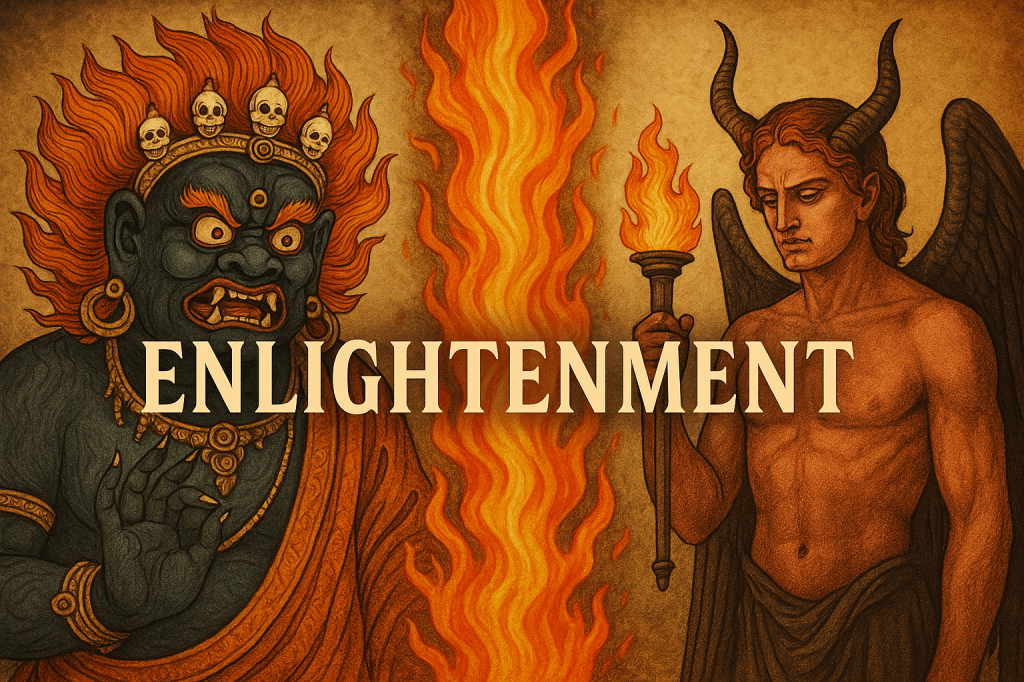
Now, after 35 years of hard work, study, devotion, and ultimately betrayal at the hands of tantric Buddhist gurus and deities, I’ve come to a grim realization: the enlightenment I was seeking wasn’t what I thought it was. It is merely an occult system dressed in Buddhist robes. The deeper I went, the clearer it became that Tibetan Buddhism and Luciferianism are two sides of the same coin. They may use different language, imagery, and rituals, but they are architecturally and spiritually similar and they both serve darkness, not light.

The word that they share, enlightenment, is the bait they use to ensnare seekers.

Luciferianism and Tibetan Buddhism: Two Faces of the Same Enlightenment Agenda

In Luciferianism, enlightenment is about becoming your own god. Lucifer is framed not as evil, but as the “light-bringer,” the one who defies divine authority to bestow forbidden knowledge. Enlightenment here is rebellion, self-deification, and esoteric power.

Helena Blavatsky, the founder of Theosophy, which heavily influenced modern occultism, named her journal Lucifer and described the figure as a misunderstood bringer of divine wisdom¹. In The Secret Doctrine, she refers to Lucifer as the “spirit of intellectual enlightenment”² and equates him with the higher mind of humanity. Freemasonry, Theosophy, and modern occultism all share the core motif: moving from darkness to light, and from ignorance to gnosis, through secret initiation.³

This kind of “light” is occult and exclusive. The “enlightened ones” in these systems are initiates who’ve been brought into deeper mysteries. The light is not for everyone; it’s reserved for those chosen by the system who are able to serve its agenda.

What shocked me, and what I ignored for years, is that tantric Buddhism functions much the same way. It promises special teachings, revealed only to the initiated. It trains students to see their guru as a living Buddha, above criticism or doubt, and presents his questionable actions as “skillful means,” while bypassing basic moral accountability. There is a similar secretive, hierarchical structure although this one is surrounded by colorful thangkas and Sanskrit mantras.

The deeper I went, the more I saw that my devotion was being weaponized against me. Tantric gurus used “crazy wisdom” to justify harm, and “samaya vows” to silence dissent. It wasn’t really compassion, but a spiritual aristocracy, no different from the occult orders I once thought Buddhism stood apart from. The beatific vision of enlightenment for the benefit of all sentient beings was merely the bait. The hook was the hidden power of dark forces.

Now I see clearly that the word enlightenment, both in Tibetan Buddhism and Luciferianism, functions as a kind of smokescreen. It sounds noble, luminous, and superior. But in both systems, it serves those in power and creates a class of “enlightened ones” who are above reproach, who serve gods and buddhas from unseen realms that are not what they appear to be.

“Enlightened Ones” as Agents of the Lie

It’s not just that the term enlightenment is misused. It’s that those who claim it, whether in Tibetan Buddhism or Luciferianism, are agents of a system that serves a being or beings pretending to be of the light.

These “enlightened ones” often behave the same way, regardless of tradition: they demand loyalty, obedience, and silence. They wield charisma and secrecy as tools. And when challenged, they invoke mystical authority and retaliation.

In both systems, the “light” is a mask and those who follow it are bound to something posing as divine. Whether it’s called Buddha, a Bodhisattva, an Ascended Master, or Lucifer, the same current runs underneath: it is a demonic force clothed in the language of transcendence.

Christianity and the True Nature of Light

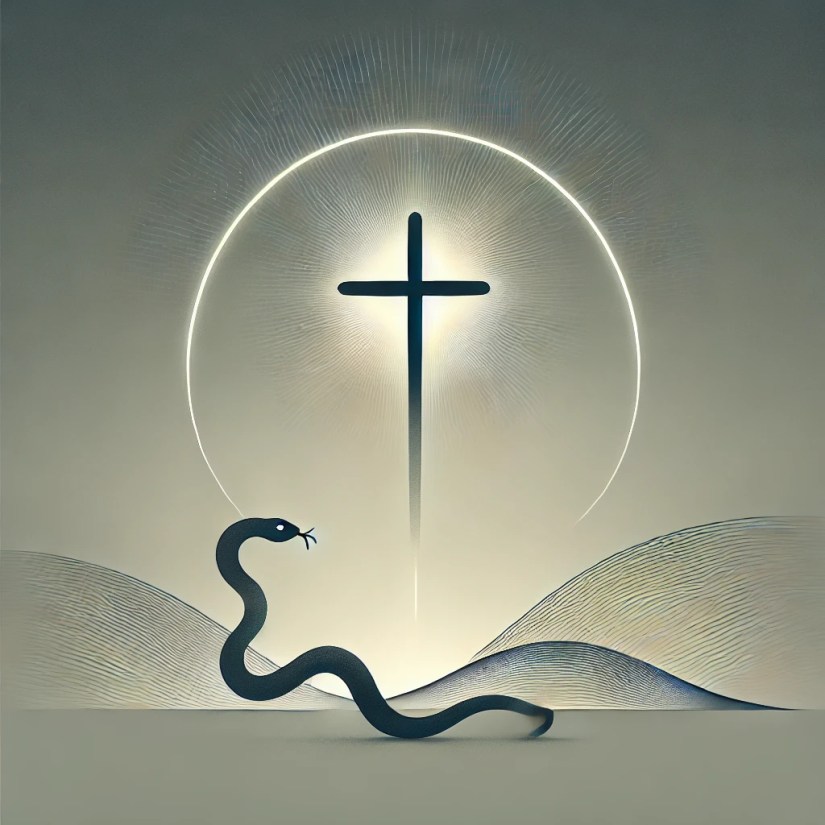
Unlike Tibetan Buddhism and occultism, Christianity doesn’t use enlightenment as a central goal. It speaks instead of salvationgrace, and being born again through the Holy Spirit. The light of Christ is not esoteric knowledge reserved for an initiated elite but is open, relational, and grounded in love and repentance. Christ’s light is not something attained through ritual or secrecy; it is something revealed publicly and offered to all.

As Jesus says in the Gospel of John: *“I have spoken openly to the world. I have always taught in synagogues and in the temple, where all Jews come together. I have said nothing in secret.”⁵ This sharply contrasts with occult traditions, including tantric Buddhism, where knowledge is concealed, layered in initiations, and distributed only to those deemed “ready.” In my own experience, this secrecy became a mask for control. I was told not to question or doubt. I had to sacrifice my own inner wisdom and clarity.

But the light of Christ does not require silence or blind devotion. The Holy Spirit is not a power to be manipulated, but a divine presence who convicts, comforts, and guides with truth. In my experience, that is the only light that does not deceive.

Every other version I followed, no matter how radiant it appeared, eventually demanded that I suppress my discernment, abandon my conscience, and serve a system of secrecy cloaked in mystical language.

A Word to the Seekers

To anyone still in these systems, or brushing up against them through yoga, New Age teachings, or tantric practices: be careful with “light” that demands you stop using discernment. Be cautious of teachers who ask for your silence or your soul. Be wary of the spiritual forces behind the promised enlightenment.

I say this not as an outsider, but as someone who gave my life to this path. I practiced the rituals, prostrated to the gurus, and offered my heart in devotion. And when the mask came off, I saw what was truly being served, and it wasn’t holy. It was something else entirely.


Footnotes and Sources

  1. Blavatsky, H. P., Lucifer, Vol. 1. Theosophical Society, 1887.
  2. Blavatsky, H. P., The Secret Doctrine, Vol. 2. Theosophical Publishing House, 1888.
  3. Pike, Albert. Morals and Dogma of the Ancient and Accepted Scottish Rite of Freemasonry. Southern Jurisdiction, 1871.
  4. Mackey, Albert G. The Symbolism of Freemasonry. Masonic Publishing, 1882.
  5. The Holy Bible, English Standard Version, John 18:20.
  6. Crowley, Aleister. The Book of the Law. 1904.
  7. Bailey, Alice A. Initiation, Human and Solar. Lucis Publishing Company, 1922.
  8. Dapsance, Marion. “Behind the Smiling Façade: Abuse in Tibetan Buddhism.” Le Nouvel Observateur, 2018. Translated and discussed in Tricycle: The Buddhist Review.
  9. Sawerthal, Anna. “Sogyal Rinpoche’s Abuse and the Breakdown of Secrecy in Buddhism.” Tricycle, 2018.
  10. Peljor, Tenzin. “Tibetan Buddhism and Abuse: Why Critical Thinking is Essential.” Interview in Spiegel Online, 2019.

When Spirits Enter: Comparing Vajrayana Empowerment with Western Occult Initiation

Both Vajrayana and Luciferian rites use geometric portals to invoke spiritual forces and what comes through may not leave easily.


Follow-up to: “The ‘Hidden’ Truth of Vajrayana Empowerment: Does the Lama Implant a Deity into the Disciple’s Mind?”

Following the previous article “The ‘Hidden’ Truth of Vajrayana Empowerment,” which exposed how Tibetan tantric initiation involves the lama implanting a deity into the disciple’s mind-stream, this follow-up explores how that same core process, spiritual implantation, appears in Western occult and Satanic initiation rites. Though culturally and theologically distinct, both systems describe a mystical transformation in which the aspirant is indwelt, overshadowed, or spiritually fused with a nonhuman being. The parallels are striking, and the implications for unsuspecting spiritual seekers are sobering.

Union Through Inhabitation

In Vajrayana Buddhism, the empowerment ritual is designed to activate the disciple’s Buddha-nature by personifying it as a specific deity. This process is not symbolic; it requires the intervention of the guru, who performs a series of initiations (vase, secret, wisdom, and word) that culminate in the wisdom deity entering the disciple’s visualized form. Sam van Schaik and other scholars describe this as a fusion of two minds: the practitioner becomes “in union” with the deity.¹ Light or energy entering the heart symbolizes this transmission, and classical sources like Vilāsavajra² and Jamgön Kongtrul³ confirm that the deity’s presence is meant to take root within the initiate.

This process mirrors what takes place in various forms of Western occult initiation. Whether in ceremonial magic, Luciferian practice, or Thelemic rites, the aspirant invites a spiritual entity, sometimes framed as a “higher self” and other times as a demon or god-form, to inhabit or fuse with their consciousness.⁴ In certain traditions, this is done under the guise of awakening one’s divine essence or ascending the Tree of Life, but the mechanics remain: the person is inviting another spiritual will to merge with their own.

The Role of the Officiant

In Vajrayana, only a qualified guru can perform the empowerment. The lama must have realization of the deity in order to transmit it, effectively serving as a channel through which the deity is implanted into the disciple. The disciple cannot access the highest yoga tantra deity alone; it must come through the guru.⁵

In Western occultism, the structure is more flexible. In ceremonial lodges like the Golden Dawn, initiation is conferred by a hierarchy of initiates. In solitary or Luciferian paths, the practitioner may self-initiate, performing a ritual to invoke and receive a spiritual entity directly.⁶ This difference, hierarchical transmission versus self-directed invocation, changes the form but not the essence of what is happening: a spiritual being is invited in.

Seed and Possession

Both traditions speak of what can be described as a spiritual seed taking root in the initiate. In Vajrayana Buddhism this is the seed of the deity that is implanted through ritual and nurtured by mantra and visualization, growing into full enlightenment.⁷ In occult traditions, similar metaphors abound: the Black Flame (Luciferianism), divine spark (Gnosticism), or magical current (Thelema) all describe a presence awakened or implanted within the practitioner.⁸

Possession or identity fusion is not merely metaphorical in either tradition. In Vajrayana, the practitioner becomes the deity in practice and visualization. In Western occultism, invocation or evocation may result in the spirit speaking through the practitioner, taking partial or full control.⁹ The aspirant may not merely visualize the entity; they may be inhabited by it.

Theological Framing

Here is where the surface similarities give way to deeper concerns. Vajrayana presents this union as sacred and salvific. The deities are said to be manifestations of enlightened mind, and the process is aimed at liberation from suffering.

In contrast, many Western occult traditions embrace the transgressive nature of the ritual. In Luciferian and Satanic paths, the union with a spiritual being is framed as an act of rebellion, empowerment, or divinization.¹⁰ Even in systems that use angelic or archetypal language, the goal is often gnosis independent of God, power over nature, or rejection of traditional morality.

From a Christian theological perspective, both processes, however cloaked in cultural or religious language, involve the opening of the soul to spiritual beings not of God.¹¹ Whether the entity is labeled as a deity, guardian angel, or inner Buddha, the core act is the same: inviting possession or fusion with a nonhuman intelligence. Exorcists describe demons as “persons without bodies.”

Deliberate Secrecy vs. Ritual Transparency

Another key difference lies in disclosure. Vajrayana does not typically explain to new initiates that the lama will implant the deity into their mindstream. This is concealed under layers of euphemisms, talk of “blessings,” “inspiration,” or “awakening Buddha-nature”.¹² Western occultism, by contrast, often acknowledges its aims more directly. A Luciferian magician knows they are invoking Lucifer. A Thelemite understands the goal is Knowledge and Conversation with a higher being.¹³

But the result is no less dangerous. Both systems involve entering into a spiritual relationship that can dominate or override the practitioner’s will. From a Christian point of view, these are not symbolic practices but acts of spiritual surrender and potentially, spiritual bondage.

Conclusion: Two Paths, One Mechanism

While Vajrayana tantra and Western occultism differ in terminology, mythos, and cultural packaging, they share a core mechanism: a ritual invitation for a spiritual being to enter the initiate’s consciousness. Whether masked as deity yoga or celebrated as demonic possession, the outcome is the same: identity fusion with a nonhuman spirit.

The true danger lies not only in the act itself but in the lack of informed consent. Many Vajrayana practitioners never fully understand what they’ve opened themselves to until it’s too late. And many occultists, lured by the promise of empowerment, mistake possession for enlightenment.

As explored on this blog, the deeper deception is the true nature of “possession” rituals versus how they are presented. Spiritual seekers deserve the truth: that these practices, whether called empowerment or initiation, are not harmless techniques for personal growth and transcendence. They are open doors: both Vajrayana and Luciferian rites use geometric portals to invoke spiritual forces and what walks through may not be your friend or leave easily.


Sources

  1. Sam van Schaik, “The Limits of Transgression: The Samaya Vows of Mahāyoga” (2010).
  2. Vilāsavajra, Hevajra Tantra Commentary, excerpts found in Mahāyoga textual studies.
  3. Jamgön Kongtrul, The Treasury of Knowledge, Book Eight, Part Three.
  4. Aleister Crowley, Magick in Theory and Practice; Michael Ford, Luciferian Witchcraft.
  5. Ngawang Phuntsok, On Receiving Wang (Empowerment).
  6. Israel Regardie, The Golden Dawn: A Complete System of Magic.
  7. Dalai Lama, Kalachakra Initiation Teachings; traditional commentaries on empowerment.
  8. Michael W. Ford, Apotheosis: The Ultimate Beginner’s Guide to Luciferianism.
  9. Kenneth Grant, The Magical Revival; practices in chaos and ceremonial magic.
  10. Anton LaVey, The Satanic Bible; Ford, Dragon of the Two Flames.
  11. Catechism of the Catholic Church, paragraphs 2116–2117.
  12. Scott Globus, “Empowerments: Awakening the Buddha Within,” Rubin Museum, 2021.
  13. Aleister Crowley, The Vision and the VoiceLiber Samekh.

A Testimony of Deliverance from Demonic Deception on Reddit


I came to the realization they were actually evil (you have to understand they can pretend to be good, even despite their demonic names, and twist your mind into believing in them—and it feels very real)—but I couldn’t resist their power.”

They’d love bomb me and then in the next breath become really nasty. Eventually it got to the point I’d see Lucifer walking around my apartment, as a real man, and then take control of my body…and end up raping me.”

These words, pulled from a harrowing testimony posted on Reddit, felt like echoes of my own past, so chillingly familiar that I found myself nodding.

The author of the post, anonymous but heartbreakingly real, shares a decade-long descent into Luciferianism, New Age spirituality, kundalini experiences, possession, and finally, miraculous deliverance by Jesus Christ. Her story is raw, detailed, and unapologetically honest. And for those of us who have lived through the spiritual counterfeit, it rings true on every level.

Like her, I once believed the false light was real. In my case, it came in Tibetan robes, wrapped in Buddhist philosophy and tantric mysticism, cloaked in teachings about “enlightenment” and “emptiness.” Before my first three-year retreat in my twenties, my retreat lama (guru) love-bombed me. He saw my spiritual hunger and poured affection, flattery, and attention into me until the day I resisted his sexual advances. Then his interest in me turned to cruelty. The same happened again, years later, with my second three-year retreat root guru. It’s a familiar pattern to survivors of spiritual abuse: seduction, betrayal, and punishment.

The Reddit testimony describes a similar spiritual seduction, initially sweet and ecstatic, culminating in a brutal loss of bodily autonomy. Demonic spirits love-bombed her, appeared to her as beautiful, powerful entities and then turned violent and abusive, eventually raping her both spiritually and physically. She writes of Lucifer “walking around her apartment… and taking control of her body.” I, too, experienced possession after tantric rituals designed to merge with deities. The difference is, in Tibetan Buddhism, such possession is framed as “blessing.”

And like her, I couldn’t break free until I cried out to Jesus, not under pressure, but because I had nowhere else to turn. When I finally surrendered, I, too, felt deliverance (still ongoing) that was cleansing, and unmistakably holy. It felt like the definite breaking of chains.

This woman’s account is long, but worth reading. You can find the full testimony here. It’s a sobering reminder of how widespread and insidious these spiritual deceptions are and how they shape-shift across traditions, religions, and cultures, but always carry the same fingerprints: seduction, confusion, torment, and ultimate destruction of the soul.

Her courage in speaking out is an act of spiritual warfare, and I share this not to sensationalize her story but to affirm: you are not alone. And yes, there is a way out.