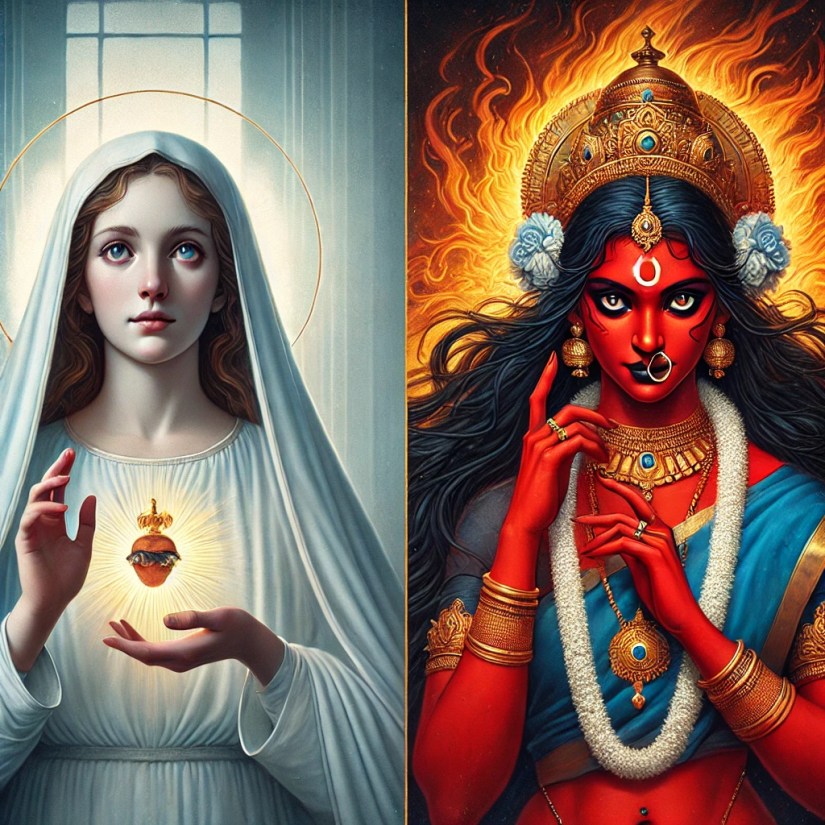
An Encounter with Kali


The descent into Bengal began with a vision. As our plane banked low over the hazy sprawl of Calcutta, I sat in meditation, quietly preparing for a long journey north to Sikkim for a series of tantric empowerments. Then, quite suddenly, a naked dakini appeared before me, dancing and beckoning. She seemed to be greeting me to Calcutta. I knew, or thought I knew, that it was Kali.

We stayed in a modest Baptist guesthouse chosen for its safety and low price, a short walk from Mother Teresa’s compound. It was late October, and the air was warm and humid. Calcutta felt down at heel, yet intellectual and dignified. My companions, all Tibetan Buddhist practitioners, decided to visit Mother Teresa’s place to pay homage. I hung back. They were sincere in their devotion to that famous nun, but something in me pulled in another direction. Although I had been raised Catholic, I felt a faint aversion to anything connected with the Catholic Church. I regarded the religion as problematic at that time. Still, seeing how genuinely excited my friends were, I encouraged them to go.

The next day I hired a taxi and arranged for us to cross the city to the Dakshineswar Kali Temple, the same temple where Ramakrishna had worshipped and experienced his visions of the Divine Mother and became enlightened. “We really must make the effort to see it,” I told the others, although I wasn’t sure why. The journey took nearly an hour through dusty streets and chaotic traffic. I had read that Kali was the patron goddess of Bengal, and that Dakshineswar was one of her most important shrines. The closer we came, the stronger the pull felt.

At the temple, a long line of Indian devotees wound through the courtyard, each waiting to glimpse the goddess and receive her blessing. We appeared to be the only Westerners there. I knew very little about the history of the temple at that point. All I knew was that I had always been intrigued by Ramakrishna among all the Hindu mystics and had always wanted to visit his temple and pay my respects.

The Temple and Its History

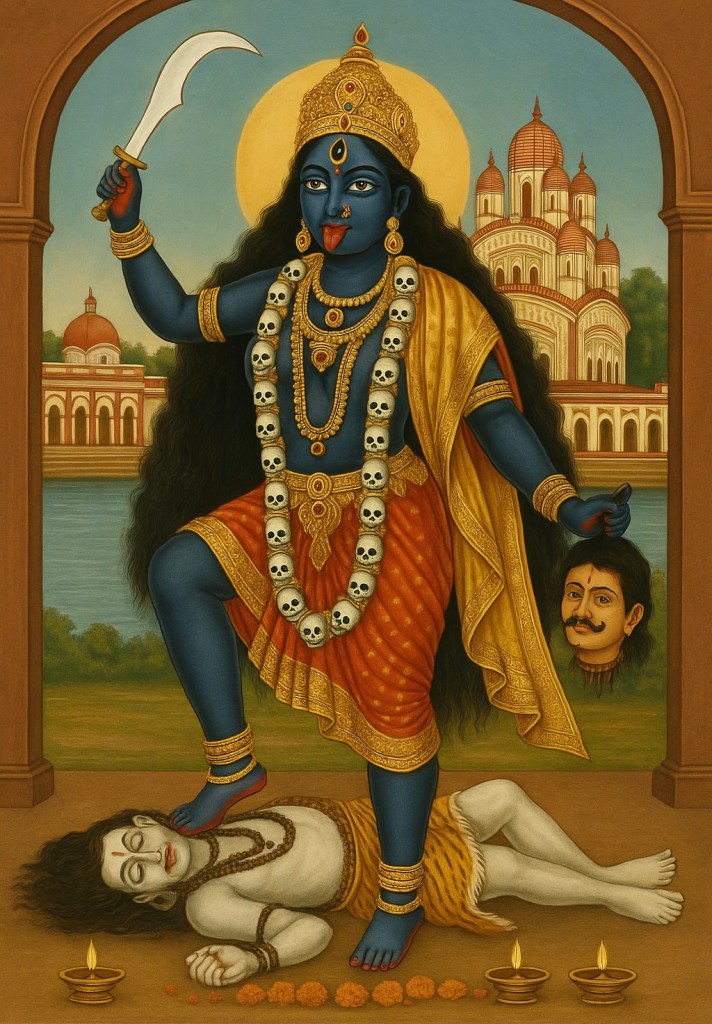
The Dakshineswar Kali Temple was founded in the mid-nineteenth century by Rani Rashmoni, a wealthy zamindar who, according to legend, dreamt that the goddess Kali commanded her to build a temple on the banks of the Hooghly River rather than journey by boat to Varanasi¹. Rashmoni had been preparing for the pilgrimage for months and had spent a small fortune, but on the night before her departure, Kali appeared in a dream and told her she need not travel at all. Instead, the goddess instructed her to raise a temple and enshrine an image that Kali herself would inhabit, blessing all who came to worship. The temple was completed in 1855 and the complex stands on land said to resemble a tortoise, a form considered especially auspicious in Shakta-Tantra cosmology².

Architecturally, the main temple is built in the navaratna (nine-spired) style typical of Bengal, raised on a high platform overlooking the river³. Surrounding the sanctum are twelve identical Shiva shrines aligned along the Hooghly’s edge, a small Radha-Krishna temple, and bathing ghats for pilgrims⁴.

Inside the sanctum resides Bhavatarini, a fierce aspect of Kali known as “Saviour of the Universe,” depicted with one foot on Shiva’s chest⁵. The mystic Ramakrishna served as the temple’s priest and carried out years of intense spiritual practice within its grounds, transforming the site into one of India’s holiest centers of Shakti worship⁶. The atmosphere is thick with incense, bells, flowers, and the hum of a thousand mantras. Once inside the gate you feel the city’s chaos fall away.

As we stood in line, something unexpected happened. An Indian guard suddenly appeared, motioned to me and a Buddhist friend, and beckoned us forward. Without explanation, we were led past the waiting crowd directly to the inner sanctum. The goddess stood before us, draped in red and gold, eyes alive in the flicker of ghee lamps. When I received prasad, it tasted sweet and delicious, and I felt a surge of a deep, penetrating love. It was so overwhelming that I began to cry.

As a Tibetan Buddhist, I had always regarded Hindu deities as somehow inferior and secondary to the Tibetan ones who were the representations of the ultimate truth. My practice had centered on Vajrayogini and Chakrasamvara, not on Kali. Yet there, when the experience of divine love engulfed me in the Dakshineswar temple, I felt an unmistakable recognition.

Years later, after surviving the catastrophic unraveling of my own tantric path due to the betrayal by male Buddhist teachers, the exposure of their sexual abuses, and the psychic annihilation that followed, I began to study the origins of tantra in earnest. Through the research of Alexis Sanderson and others, I learned what my experience at Dakshineswar had already shown me: that the yoginī tantras of Tibetan Buddhism arose from the same crucible of medieval Hindu Śaiva and Śākta practice⁷. Vajrayoginī, the red goddess of my own initiations, was in essence a Buddhized form of Kali. The goddess in both traditions can give blessings and boons, but she can become, in an instant, a terrifying and destructive demon with her own set of intentions and cosmic laws.

That insight came at great cost. The deeper I studied, the more clearly I saw that tantra, in both Hindu and Buddhist forms, was inseparable from forces of domination, secrecy, and power. The same ecstatic current that once inspired devotion also lurked behind manipulation and abuse. In the West, these darker currents were long dismissed or hidden, until the many scandals of 2017 tore the veil away.

My visit to Kali’s temple remains a paradox. In that moment I felt only grace: the raw, overwhelming presence of the divine feminine. But in hindsight, I experienced Kali as both mother and destroyer, blessing and devourer. She welcomed me to Calcutta with open arms, but in time, in her Buddhist form as Vajrayogini, she stripped me of everything I held dear in order to completely destroy my body, mind, and soul. By the grace of the highest divinity, the eternal Christian God, I survived and am still alive to tell the tale.


Notes

  1. Dakshineswar Kali Temple, Wikipedia, last modified 2025.
  2. Ibid.
  3. Ibid.
  4. Ibid.; see also Dakshineswar Kali Temple official site, Places in Dakshineshwar (dakshineswarkalitemple.org).
  5. Dakshineswar Kali Temple, Britannica.
  6. Ibid.; Ramakrishna’s association documented in Swami Nikhilananda, The Gospel of Sri Ramakrishna (New York: Ramakrishna-Vivekananda Center, 1942).
  7. Alexis Sanderson, “The Śaiva Age: The Rise and Dominance of Śaivism during the Early Medieval Period,” in Genesis and Development of Tantrism, ed. Shingo Einoo (Tokyo: Institute of Oriental Culture, University of Tokyo, 2009), 41–350.
Between Mount Athos and the Ashram: An Exploration of Deception and Deliverance


In 2008, the Holy Monastery of Saint Arsenios on Mount Athos published The Gurus, the Young Man, and Elder Paisios.¹ It tells the true story of a young Greek man whose hunger for spiritual depth led him from the monasteries of Athos to the ashrams of India, where he fell under the sway of a Hindu guru. This book resonated with me because it mirrors the restlessness of many modern seekers. It traces the arc from yearning for authentic experience, through dangerous detours into counterfeit light, and finally to deliverance through Christ. That theme, the need for discernment in a world of spiritual seductions, is central to my own story and to the explorations I share.

The First Encounter with Elder Paisios

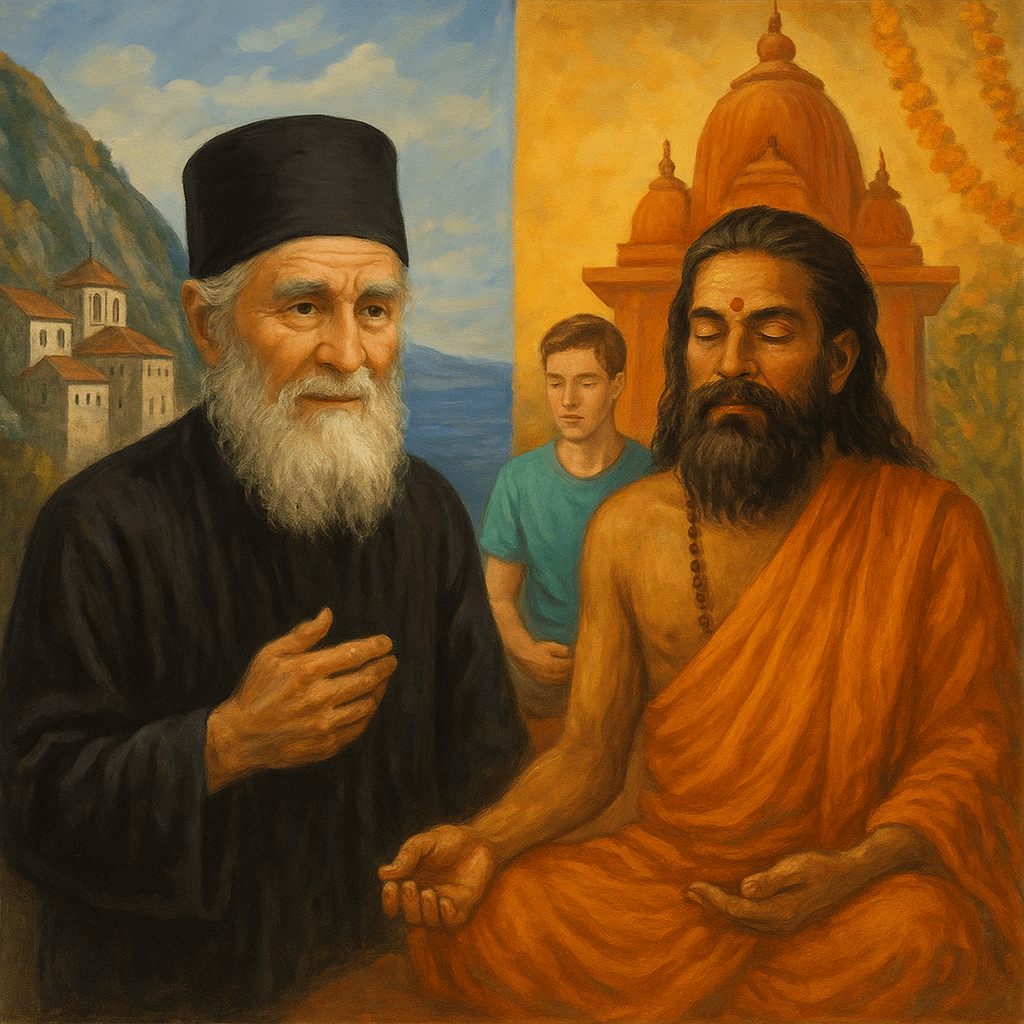
The young man first encountered Elder Paisios on Mount Athos, the spiritual heart of Greek Orthodoxy. Athos is not simply a monastic peninsula but a living continuation of the desert fathers, a land saturated with centuries of prayer. Elder Paisios was already known as a man with the profound gifts of clairvoyance, discernment, and love. At the heart of Orthodoxy, he explained, lies the invocation of the name of Christ: “Lord Jesus Christ, have mercy on me.”² This is not a spiritual technique but a cry from the heart. As Paisios emphasized, “With the name of Christ we experience divine Grace, divine illumination, and union with God.”³

Life on Mount Athos

Mount Athos rises from the Aegean like a fortress of prayer. Approaching by boat, pilgrims see monasteries clinging to cliffs, their domes catching the morning sun. Bells toll at dawn, summoning monks from their cells to the katholikón, the central church. Inside, the air is heavy with incense; oil lamps flicker before icons blackened with centuries of smoke. The chanting is slow and unhurried, carrying the words of the Psalms like waves rolling in from the sea.

The rhythm of Athonite life is simple but relentless. To walk its paths is to feel the weight of prayer, as if the very stones are steeped in the remembrance of God. When the young man would meet Elder Paisios in his cell at Panagouda, he encountered not pomp or grandeur but humility. The elder sat on a rough stool, his clothes patched, his face lined with suffering yet radiant with joy. Paisios was accessible, direct, and utterly unpretentious. His authority did not come from outward spectacle but from the depth of grace shining through him.

Despite these encounters, the young man was restless. His desire for spiritual experience drew him beyond Orthodoxy and into Hinduism in India.

Life in the Ashram

India overwhelmed his senses. It was a riot of bright colors and potent scents. Bells clanged rhythmically at dawn, mingling with the chant of myriad voices repeating mantras. Bare feet shuffled across dusty courtyards as disciples hurried to gather at the feet of the guru, who sat elevated on a dais draped in silk and garlands of marigolds. The air around him was charged with expectancy.

Daily life in the ashram followed ritual precision. Before sunrise, disciples bathed in cold water, then filed into meditation halls where they repeated mantras by the thousands. Each syllable, they believed, vibrated with cosmic energy. The guru’s followers bowed low, sometimes lying full-length on the ground, convinced that to touch even the dust beneath his feet was a blessing.⁴ His faintest smile was received as a gift, his disapproval a knife wound.

The guru’s teachings promised transcendence. He insisted that the repetition of mantras would dissolve the ego and merge the self into the divine. He was not merely a teacher but the embodiment of truth itself. Service was considered worship: cooking his meals, arranging his seat, or waving fans before him was thought to create conditions conducive to liberation. At first, the young man was drawn in by the atmosphere of devotion and the apparent serenity of the disciples. The charged rituals, intense and mystical, seemed to hum with power.

Yet Elder Paisios had already warned him: “The invocation of the name of any other god apart from Christ is communion with demons. The person who invokes that name calls upon the demon corresponding to it and is possessed by it.”⁵ What seemed like nectar would prove to be poison.

Paisios explained that deceptive energies imitate grace: “They give a sweetness, a supposed peace, but afterwards they bring turmoil.”⁶ This was the young man’s experience. The chants that once filled him with calm soon unsettled him. His thoughts scattered, his dreams grew dark, and the guru’s gaze, once a source of comfort, became suffocating. The ashram that had promised freedom now felt like a dangerous place.

The Return to Mount Athos

When the young man finally returned to Athos and told Paisios everything, the elder spoke with clarity. “In Orthodoxy we have the invocation of the name of Christ. With it we experience illumination and union with God. All other invocations, all other names, apart from Christ, lead to deception.”⁷

Paisios prayed for him, invoking Christ. In that moment, the torment that had hounded the young man since the ashram lifted. He felt the peace of God return, and the tormenting voices were silenced. What the guru’s gaze and mantras had invoked, the simple name of Jesus restored.

Why It Resonates

This story mirrors my own path. Like the young man, I wandered away from Christ into Eastern occult traditions that promised transformation through techniques such as deity yoga, mantra repetition, and breath manipulation. The initial sweetness was very real followed by years of difficulties alternating with mystical heights, but all of that led to demonic possession by entities I once thought were buddhas.

In a world where esoteric practices are commonplace, Paisios’s warnings are urgent. Many today seek mystical experiences, but as Elder Paisios said, “Grace brings deep humility, contrition, tears, and love for Christ.”⁸ The counterfeit, by contrast, produces disturbance and bondage. The young man’s deliverance is not his story alone; it is a caution to the world that spiritual deceptions come at a terrible price.


Notes

  1. Dionysios Farasiotis, The Gurus, the Young Man, and Elder Paisios, trans. and adapted by Hieromonk Alexis (Trader), ed. Philip Navarro (Platina, CA: St. Herman of Alaska Brotherhood, 2011).
  2. Farasiotis, The Gurus, the Young Man, and Elder Paisios, chap. 3.
  3. Farasiotis, The Gurus, the Young Man, and Elder Paisios, chap. 4.
  4. Farasiotis, The Gurus, the Young Man, and Elder Paisios, chap. 5.
  5. Farasiotis, The Gurus, the Young Man, and Elder Paisios, chap. 4.
  6. Farasiotis, The Gurus, the Young Man, and Elder Paisios, chap. 4.
  7. Farasiotis, The Gurus, the Young Man, and Elder Paisios, chap. 4.
  8. Farasiotis, The Gurus, the Young Man, and Elder Paisios, chap. 4.

The Question of the Soul: Christianity, Hinduism, and Buddhism


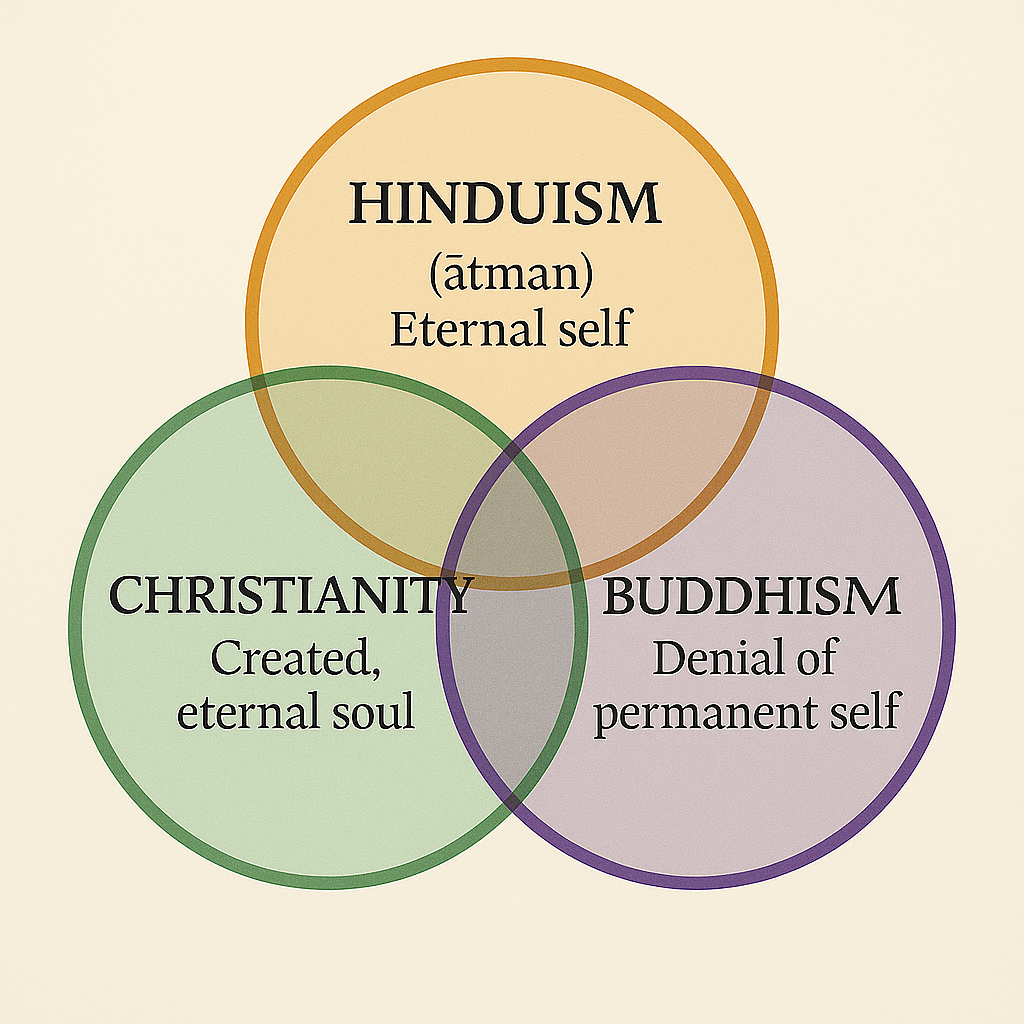
The question of what the soul is, whether it exists, and what happens to it after death lies at the center of the world’s major religious traditions. Christianity, especially in its Catholic tradition, affirms the soul as eternal and God-given. Hinduism has multiple schools, often affirming an eternal self or ātman. Buddhism, including Tibetan Buddhism, rejects the idea of a permanent self or soul and instead speaks of mind and consciousness as a conditioned stream of awareness without enduring essence.


The Christian and Catholic Understanding of the Soul

Christianity teaches that every human being has a unique, immortal soul created by God. According to Catholic doctrine, the soul is the spiritual principle of the human person. It is eternal in destiny, surviving bodily death, and directed either toward communion with God or separation from Him.

Scriptural sources include Genesis 2:7, where God breathes life into Adam and he becomes a living soul [1]; Matthew 10:28, where Jesus warns of the danger of losing the soul [2]; and the Catechism of the Catholic Church, which affirms that the soul is created by God and immortal [3]. In this view, the soul is not an impersonal principle but a personal identity, judged and redeemed by God.


Hindu Views on the Self (Ātman)

Hinduism is diverse, but most of its classical schools affirm the existence of ātman, the true self. The Chandogya Upanishad teaches “tat tvam asi” (you are that), affirming the identity of the self with Brahman [4]. The Brihadaranyaka Upanishad declares, “This self (ātman) is indeed Brahman” [5]. The Bhagavad Gita teaches that the self is eternal and indestructible [6].

Distinguishing Hindu and Christian Concepts

Both Hindu and Christian traditions speak of something enduring at the core of human existence, but they do so in different ways.

Christianity teaches that the soul is created by God, personal, and accountable before Him. It does not preexist from eternity but comes into being by His will and remains dependent on Him for existence, judgment, and salvation.

In Hindu thought, Advaita Vedānta emphasizes the identity of the self (ātman) with Brahman, dissolving individuality into the absolute. Dvaita and many Bhakti traditions instead teach that the self remains distinct yet eternal, existing in relationship with the divine. In all of these cases, the ātman is uncreated and co-eternal with ultimate reality, not brought into being by God.

Thus, while both traditions sometimes use personal and sometimes abstract language, the Christian soul and the Hindu ātman play very different roles. The soul in Christian theology is a created person before God; the ātman in Hindu philosophy is an eternal essence, whether one with Brahman or distinct in devotion.


The Creator God in Christianity and Hinduism

Christianity affirms one personal Creator God who brings the universe into being from nothing and sustains it in existence.

Hinduism presents a wide range of views. In Bhakti traditions, deities such as Vishnu, Shiva, or Devi are worshiped as supreme creators. Vedānta schools affirm Brahman as the ultimate source, though in Advaita this is not a personal act of creation but the manifestation of māyā. Other schools such as Sāṃkhya and Mīmāṃsā reject a creator altogether, viewing the universe as self-arising.

Thus, while Christianity grounds the soul in a personal God who creates and judges, Hindu thought ranges from devotion to a personal creator to cosmologies where no creator is necessary.


Buddhist Rejection of the Soul

Buddhism arose in part as a rejection of the Hindu doctrine of ātman. In the Anattalakkhana Sutta, the Buddha declared that none of the five aggregates of existence constitute a self [7]. The doctrine of anātman (no-soul) became central.

Mind and Consciousness

In Tibetan Buddhism, mind and consciousness are viewed as a stream of awareness, conditioned by karma. The Abhidharma-kośa describes consciousness as momentary and dependent [8]. Unlike Christianity and Hinduism, which affirm an eternal principle (soul or self), Buddhism denies it, calling belief in permanence a delusion.

Yet questions arise. If there is no soul, then what suffers in the hell realms described in Tibetan texts? The Bardo Thödol warns of the horrors of the Vajra Hell, a realm said to be utterly without escape [9]. The Hevajra Tantra declares that those who violate tantric commitments “will not be liberated for as many eons as there are atoms in the universe” [10]. The Cakrasaṃvara Tantra and later commentaries also teach that breaking tantric vows leads to vajra hells without release [11].

This presents a paradox: if there is no enduring self, who is suffering eternally?


Tibetan Buddhist Schools Under Examination

Madhyamaka – Nāgārjuna’s Mūlamadhyamakakārikā argues that all phenomena, including the self, are empty of inherent existence [13]. But if the self is an illusion, how does karma persist? If Vajra Hell is eternal, how can something that does not exist suffer forever?

Yogācāra (Mind-Only) – The Yogācārabhūmi Śāstra introduces ālayavijñāna, the “storehouse consciousness,” which preserves karmic seeds [14]. Though intended to avoid affirming a self, it functions much like one: carrying memory, identity, and karma. Hinduism here provides a comparison: the Bhagavad Gita teaches that the self carries karma through many births [6]. Yogācāra denies the term “soul,” yet reintroduces something strikingly similar. Christianity differs again: not a karmic storehouse, but a personal soul created by God.

Dzogchen (Great Perfection) – Dzogchen teachings, such as the Kunjed Gyalpo (All-Creating King), speak of rigpa, primordial pure awareness that is timeless and luminous [15]. Though Dzogchen denies that rigpa is a soul, the resemblance is striking. If rigpa is eternal, pure, and the ground of all experience, how is this different from what Christians call the soul or Hindus call ātman? The denial seems rhetorical rather than substantive.

Vajrayāna and Deity Possession – Tantric scriptures describe deity yoga, in which practitioners invite deities to merge with them [16]. If there is no self or soul, what exactly is being merged with or possessed?


Conclusion

Across Christianity, Hinduism, and Buddhism, the question of what endures, what we might call the soul, self, or consciousness, reveals fundamentally different views of human identity. Christianity anchors personhood in a created, immortal soul made by God and accountable to Him. Hinduism envisions an eternal ātman, uncreated and either one with or distinct from the divine. Buddhism, in contrast, denies any enduring essence, seeing the sense of self as a conditioned process. Yet in its Tibetan forms, teachings on karmic continuity, primordial awareness, and tantric transformation often edge back toward affirming something that functions like a self.

From long immersion in both Catholic and Tibetan Buddhist traditions, I have come to believe that the Christian vision alone sustains coherence between moral responsibility, continuity of consciousness, and the promise of redemption. It affirms not only that we exist, but that we are known and loved by the One who created us. Against the shifting alternatives of an impersonal absolute or an empty stream of awareness, in my opinion, the Christian understanding of the soul remains the clearest expression of what it means to be human before God.


References

[1] Genesis 2:7, The Holy Bible (ESV).
[2] Matthew 10:28, The Holy Bible (ESV).
[3] Catechism of the Catholic Church, Part I, Section Two, Chapter One, Article 1, §366.
[4] Chandogya Upanishad 6.8.7, in Radhakrishnan, S. (trans.), The Principal Upanishads.
[5] Brihadaranyaka Upanishad 4.4.5, in Olivelle, P. (trans.), The Early Upanishads.
[6] Bhagavad Gita 2.20, in Zaehner, R. (trans.), The Bhagavad-Gita.
[7] Anattalakkhana Sutta (Samyutta Nikaya 22.59), in Bhikkhu Bodhi (trans.), The Connected Discourses of the Buddha.
[8] Vasubandhu, Abhidharma-kośa.
[9] Bardo Thödol (Tibetan Book of the Dead), in Evans-Wentz, W.Y. (ed.).
[10] Hevajra Tantra, Snellgrove, D.L. (trans.), The Hevajra Tantra: A Critical Study.
[11] Cakrasaṃvara Tantra, in Tsuda, S. (trans.), The Samvarodaya Tantra.
[12] Hevajra Tantra, ibid.
[13] Nāgārjuna, Mūlamadhyamakakārikā, Kalupahana, D.J. (trans.).
[14] Yogācārabhūmi Śāstra, Xuanzang (trans.).
[15] Kunjed Gyalpo (All-Creating King), in Namkhai Norbu (trans.), The Supreme Source.
[16] Cakrasaṃvara Tantra and Hevajra Tantra, ibid.


Southern India: The Virgin Who Heals vs. Goddesses Who Possess


In a dusty corner of southern India, something strange is happening. Among the Catholic untouchables of Tamil Nadu the Virgin Mary reigns. These are the Dalit communities who converted to Christianity to escape caste oppression. Here the Virgin Mary is not just the mother of Christ or the Queen of Heaven. She’s the protector from demons, the healer of the possessed, and the exorcist of lustful spirits who prey on young women. [1]

Her name here is Arockyai Mary, “Our Lady of Good Health,” and unlike the goddesses of India’s native pantheon, she never harms. She doesn’t demand blood, or rage, or possess.

This makes her an anomaly in a world where possession is an everyday threat and where menstruation, pregnancy, and the liminal chaos of female sexuality are believed to attract wandering spirits, often the ghosts of those who died violently or before their time. These spirits, it is said, latch onto the vulnerable, especially women, and drive them into trances and convulsions.

And then there are the Hindu goddesses like Mariyamman [2] and Kaliamman [3], powerful but volatile. They heal, but they can also possess, punish, and destroy. Unlike the Virgin Mary, who is seen as unconditionally loving and healing, Mariyamman and Kaliamman’s protection must be earned through ritual and sacrifice. Their presence is often feared as much as it is venerated, revealing a form of feminine divinity that is transactional, fierce, and unpredictable.

The deeper thread that ties this to my own journey through Eastern mysticism and into Catholic truth is that the female deities of India are not so much saviors as they are owners. They ride their devotees like horses often through an overpowering kundalini experience. They enter bodies without informed consent. They demand submission, sacrifice, and pain. This is what possession looks like when the divine manifests as fierce femininity unmoored from moral restraint.

But the Virgin Mary is different in kind, not just degree. She doesn’t exploit vulnerability; she protects it. Her power is rooted in love, not domination. She doesn’t punish women for their sexuality; she guards them from the predators that do.

Many of us who were drawn into the tantric and yogic traditions found ourselves worshiping goddesses we didn’t truly understand such as Kali, Vajrayogini, and Durga. These powerful beings granted “blessings” that often came in the form of disorientation, illness, and spiritual invasion. What we called “awakening” was perhaps possession, wrapped in ritual and mystique.

In the story of the Paraiyar women, we see this clearly. Demonic possession is a warning as well. The culture teaches women that if they stray outside ritual boundaries, if they become too sexually visible, if they travel alone at dusk or cross the wrong river, they open the door to attack. And it’s the Virgin Mary, not Kali, who shows up to cast the darkness out.

Humanity does not need more divine rage, but the one Woman who is pure benevolence: the Mother of Jesus who through her perfection is feared by and can cast out spirits and demonic goddesses.

[1] Source article: Deliège, Robert. “La Possession démoniaque chez les Intouchables catholiques de l’Inde du sud / Demoniac Possession Among the Catholic Untouchables in Southern India.” Archives de sciences sociales des religions, no. 79, 1992, pp. 115–134. Available online.

[2] Mariyamman is a powerful village goddess widely worshipped in South India, especially in Tamil Nadu. Her name combines “mari,” meaning rain or disease, and “amman,” meaning mother—making her the Mother of Rain and Disease. She is especially associated with illnesses like smallpox, fevers, and skin diseases, but also with fertility, childbirth, and protection from evil spirits. Visually, she often appears fierce—sometimes with fiery red skin, holding a trident, and crowned with flames—bearing a resemblance to goddesses like Kali or Durga. Her shrines are typically modest, and her worship is deeply rooted in folk rituals. Devotees may offer animal sacrifices, participate in firewalking, or fall into trances believed to be divine possessions. In many cases, women are the ones possessed by Mariyamman, and these episodes are interpreted as both blessings and warnings—depending on whether the goddess has been properly appeased.

[3] Kaliammam is a fierce village manifestation of the goddess Kali, worshipped primarily in Tamil Nadu and other parts of South India. The name “Kaliamman” translates to “Mother Kali,” reflecting her role as a local protective mother goddess rooted in folk traditions. Like Kali, she is associated with destruction, power, and the eradication of evil, but in the village context, she is also invoked for healing, fertility, and protection from malevolent spirits. Kaliamman is often depicted with dark skin, a lolling tongue, wild hair, and multiple arms holding weapons—symbolizing her unrestrained spiritual power. Her worship includes rituals that are intense and sometimes violent: offerings of blood, possession trances, firewalking, and dramatic acts of devotion are common. She is believed to possess her devotees—often women—either to bless them, deliver a warning, or punish neglect. She must be honored and feared. Her presence reinforces moral and ritual boundaries in the community, demanding reverence through sacrifice and submission rather than drawing near in mercy or compassion.

Anatomy of a Murder: Consciousness Destruction Ritual in Tibetan Tantra

Hidden in the depths of Tibetan esoteric traditions, certain wrathful rituals exist that are rarely spoken of outside the inner sanctums of designated tantric practitioners. These rituals, designed for the destruction of a consciousness, are meant to dissolve its influence, perceived obstructive intent, or spiritual presence. While these practices claim to protect against malevolent spirits, they have, at times, been weaponized against living humans, including those who threaten to expose misconduct within Buddhist institutions.


The Ritual of Consciousness Annihilation

A specific type of tantric ritual involves an esoteric diagram, similar to the one depicted in the image above, where a human form is inscribed with powerful mantras, seed syllables, and esoteric symbols. There is a six-pointed blade weapon surrounding the victim. The six points of the blade correspond to the double triangle (hexagram-shaped) mandala of the chief deity in this lineage. If the deity and guru/s decide that the practitioner has broken the samayas (tantric laws), according to their system, the deity’s mandala turns into a horrific weapon that destroys the mind/consciousness of the victim. But this ritual doesn’t just affect the mind/consciousness, it also has a profound effect on the physical body. The victim’s body will be tortured extensively through a type of voodoo and the very shape of the person’s body will morph to resemble the figure in the diagram. This ritual serves to bind, neutralize, and dissolve a targeted consciousness, whether it be an external spirit, a human, or a “perceived” karmic obstruction. The ritual process follows a structured framework

  1. Creation of the Diagram
    • The targeted consciousness is symbolically bound within a mandala-like formation.
    • Protective and wrathful mantras seal off escape routes.
    • Crosses and sigils mark the finality of the destruction process.
  2. Invocation of Wrathful Deities
    • Mantras and visualizations call forth powerful, wrathful deities.
    • The deities are instructed to subdue, bind, and annihilate the “perceived” enemy.
    • The practitioner performing the ritual sees themselves as a manifestation of the deity, wielding its power.
  3. Execution of the Consciousness
    • The bound entity is pierced, burned, or dissolved into emptiness.
    • Ritual implements, such as a phurba (ritual dagger), are used to cut through the energy ties of the target.
    • The ritual often ends with the destruction of the paper or material that carried the sigils.

The Four Wrathful Deities that Could be Used in Consciousness Destruction Rituals

1. Mahākāla (The Black-Cloaked Guardian)

Mahākāla is the supreme protector of the Dharma, known for his fierce nature. In the context of destructive rituals, Mahākāla is invoked to crush obstacles and eliminate spiritual threats. His iconography often features a black body, fiery aura, and skull garland, symbolizing the destruction of ignorance and negative forces.

  • Origins: Derived from Hinduism’s Shiva, Mahākāla was integrated into Buddhism as a Dharma protector.
  • Role in Rituals: Practitioners visualize Mahākāla’s fire consuming the obstructive consciousness, reducing it to emptiness.

2. Vajrakīlaya (Dorje Phurba, The Slayer of Demonic Forces)

Vajrakīlaya is one of the most feared wrathful deities in Vajrayana Buddhism. He is depicted holding a three-bladed phurba dagger, which symbolizes his power to penetrate and destroy negative karmic influences and malicious forces.

  • Origins: Introduced into Tibetan Buddhism through the great master Padmasambhava.
  • Role in Rituals: Vajrakīlaya’s phurba is symbolically plunged into the obstructive consciousness, shattering its energy and dispersing it into the void.

3. Dorje Legpa (The Enforcer of Vows)

Dorje Legpa is a lesser-known but highly effective Dharma protector, often depicted riding a snow lion. His primary role is to punish those who violate spiritual oaths and disrupt the Dharma.

  • Origins: A native Tibetan deity later assimilated into Buddhist protector pantheon.
  • Role in Rituals: He is invoked to hunt down malevolent forces, bind them in the diagram, and neutralize their influence.

4. Ekajati (The One-Eyed Protector)

Ekajati is a wrathful female deity, feared for her ability to cut off the life force of negative beings and obstructive forces. She is depicted with one eye, one tooth, and one breast, symbolizing her singular focus on eradicating spiritual threats.

  • Origins: A key protector in the Nyingma and Kagyu traditions, linked to Padmasambhava.
  • Role in Rituals: Practitioners visualize Ekajati severing the energy threads of the targeted consciousness, ensuring complete destruction.

Historically, these rituals were supposed to be used to eliminate spiritual and karmic obstacles, not to harm innocent people. However, in some cases, they have been repurposed as tools of suppression within Buddhist institutions. When fear, secrecy, and power dynamics come into play, these ancient magical practices can be wielded as weapons.

There are instances where individuals who were never a true threat to the Dharma were nonetheless targeted. Some have been subjected to these rituals simply because they possessed knowledge that could expose wrongdoing, particularly cases of sexual misconduct and abuse within monastic settings. Instead of facing accountability, certain powerful tantric figures within these circles have used their esoteric knowledge to attack those they feared might reveal the truth.

Karmic Consequences of Weaponized Tantra

From a Buddhist perspective, the intentional use of spiritual power to harm others, especially for self-serving reasons, carries immense karmic consequences. Perhaps this can explain why certain prominent lineages in Tibetan Buddhism face overwhelming obstacles, such as vicious infighting and shocking treachery.

  • If such a ritual is performed with malicious intent, the negative karma generated will eventually return to the practitioner.
  • Those who use these practices risk invoking their own downfall.

Consciousness destruction rituals are horrific tools of suppression and spiritual manipulation. The existence of these rituals, the fact that they abide within the sacred confines of the so-called Buddha Dharma, raises an important ethical question: Who decides what constitutes an “enemy of the Dharma” and how does this practice line up with the teachings of the historical Buddha that emphasize ahimsa or non-violence? And why aren’t spiritual seekers told the truth about these destructive practices before they sign their names on the proverbial dotted line. Even the most beatific seeming Rinpoche must know this sort of thing goes on behind the scenes. Withholding the truth about the dark side of Tibetan Buddhism is very wrong as it puts innocent people in harm’s way.

Moreover, for those who have been targeted, these rituals represent not just an abuse of spiritual power but a deep betrayal of the very teachings they were meant to uphold. Ultimately, any attempt to silence or destroy others through dark esoteric means will eventually meet its own hellish reckoning.