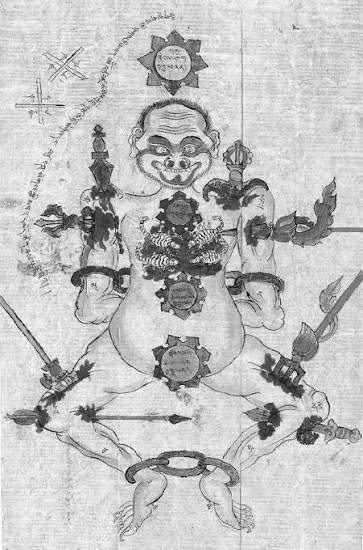

The Tantric Image That Is Never Explained

Among the many images that circulate quietly within Tibetan tantric lineages, there are several that are never explained to most practitioners and never shown outside advanced ritual contexts. One such image, often embedded within long Mahākāla rites and other high-level tantric liturgies, depicts a bound, pierced, weapon-studded human figure marked with mantras, seals, and symbolic restraints. To the uninitiated, it resembles a wrathful medical diagram or an esoteric curse talisman. To insiders, it represents something much more disturbing.

These images are not symbolic reminders of compassion, nor are they abstract metaphors for ego-death. They are ritual instruments. Specifically, they are used in rites intended to punish, bind, obstruct, or destroy the lives of those who are deemed to have broken samaya—the sacred vows binding a tantric practitioner to their guru, lineage, and yidam deity.

This fact is rarely discussed openly. When it is mentioned at all, it is framed euphemistically as “removing obstacles,” “protecting the Dharma,” or “subjugating harmful forces.” What is almost never acknowledged is that, within some tantric systems, the “harmful force” being targeted is a former disciple.

Why Beginners Are Never Told

Students entering Tibetan Buddhism are typically introduced through ethics, meditation, philosophy, and aspirational ideals: loving-kindness, compassion, non-violence, and wisdom. Tantric Buddhism is presented as a fast but benevolent path, dangerous only insofar as it requires devotion and discipline.

What they are not told is that questioning, criticizing, or emotionally reacting to a guru can itself be framed as a samaya violation. Nor are they told that certain rituals explicitly teach that lineage holders have the right, and sometimes the obligation, to retaliate metaphysically against perceived betrayal.

Beginners are warned vaguely that breaking samaya leads to “terrible consequences,” often described as karmic rather than intentional. The implication is that the universe itself will respond. What is left unsaid is that these consequences may be deliberately invoked, ritualized, and sustained by human agents acting within a tantric framework.

The unspoken lesson is simple: dissent is dangerous.

The Yidam Is Watching

At the core of highest yoga tantra is the yidam deity, the meditational deity with whom the practitioner forms an exclusive, intimate bond. The yidam is not merely visualized as an external symbol but is gradually internalized, embodied, and ultimately identified with as one’s own enlightened nature.

This process is often described in modern terms as psychological transformation. In traditional terms, however, it is far closer to classical possession.

The practitioner receives initiation from a master understood to be fully realized–meaning fully inhabited by the yidam. Through empowerment, mantra recitation, repeated visualization, and ritual invitation, the practitioner repeatedly invites the deity to enter their body and mind. Over time, the boundary between practitioner and deity is intentionally dissolved.

This is how the yidam “monitors” the practitioner: not metaphorically, but through total psychic access. Thoughts, emotions, doubts, and impulses are no longer private. They are offerings or offenses.

Within this framework, enlightenment, siddhis, and protection are granted conditionally. The deity gives, and the deity can withhold. More disturbingly, the deity can retaliate.

“Sons” of the Deity and Absolute Obedience

Advanced tantric systems often refer to lineage masters as the “sons” of the yidam. These are the men who have fully merged with the deity through practice. Disrespecting such a figure is not treated as a social conflict or ethical disagreement; it is framed as an attack on the deity itself.

This becomes especially dangerous in cases involving sexual relationships between guru and disciple. While not every such relationship is abusive, many are. In some cases, a guru expects sexual access as a demonstration of devotion and service. When the disciple becomes distressed, confused, or resistant, or when she later speaks out, the guru’s response is not accountability but punishment.

From within the tantric logic, the guru is not merely a man abusing power. He is a god-being whose will cannot be questioned. The disciple’s suffering is reframed as karmic purification or divine retribution.

Ritual Retaliation Is Real

There is a tendency among modern defenders of Tibetan Buddhism to dismiss accounts of retaliation as superstition or paranoia. Yet whistleblowers, both Western and Asian, have repeatedly documented actions taken against former disciples over months or years. In the most extreme cases, these are not momentary curses but sustained practices intended to ruin health, relationships, livelihood, and sanity.

I personally have known three gurus who engaged in such retaliatory behavior. These were not fringe figures. They were respected, accomplished masters with devoted followings. The rituals were not symbolic. They were methodical, intentional, and experienced by the practitioners themselves to be effective.

This is witchcraft in the plain sense of the word. It is no different in structure or intent from Haitian vodou curses or European malefic magic. The only difference is the religious branding.

The Ethical Contradiction at the Heart of Tantra

This raises an unavoidable question: how can a system that claims descent from the historical Buddha whose teachings emphasize non-harming, restraint, and compassion contain practices that deliberately destroy human lives?

The answer lies in tantric exceptionalism. Within these systems, ordinary Buddhist ethics are considered provisional. Once one enters the tantric domain, morality becomes subordinate to obedience, secrecy, and power. A guru possessed by a wrathful deity is no longer bound by conventional ethics because the deity is not.

Publicly, tantric masters speak constantly of compassion and loving-kindness. They smile, bless, and perform virtue with great skill. Privately, nothing is free. Every empowerment creates obligations. Every vow tightens the noose. And the deeper one goes, the more rigid and unforgiving the system becomes.

The Real Danger

Not all Tibetan Buddhist teachers engage in these practices. Many do not. But the fact that some of the most accomplished masters have done so for centuries means the danger is structural, not incidental.

The real threat of tantric Buddhism is that it weaponizes devotion, sanctifies possession, and normalizes ritual violence while hiding behind the language of Buddhist compassion and enlightenment.

Until this is openly acknowledged, aspirants will continue to walk blindly into systems that can, and sometimes do, destroy them, all in the name of awakening.

Tantric Āveśa and Demonic Possession: A Comparative Exploration


Āveśa (Sanskrit) refers to a state of spiritual possession or divine inhabitation in which a deity or sacred power “enters” and dwells within a person. The word literally means “an entering” or “fusion,” describing the incorporation of divine power into the human body. Such forms of sacred possession have long been central to Indian Tantric practice, invoked for both worldly benefits (bhoga) and spiritual liberation (mokṣa). This is often contrasted with demonic possession in Christian theology, typically characterized as an involuntary affliction by an evil spirit.

Cross-cultural studies note that spirit possession can be either voluntary or involuntary, and it is interpreted differently depending on the tradition. Western occult traditions, such as Luciferianism, may view possession by a demon as desirable, even leading to a so-called “perfect possession.” In Christianity, however, even voluntary possession by a demonic force is considered evil. The question then arises: who or what possesses the practitioner in Eastern contexts?

Towards the end of my 35 years in Tantric Buddhism, I came to believe that the force presenting itself as a deity was, in fact, demonic. In what follows, I will examine the phenomenon of āveśa in two major esoteric traditions, Hindu Tantra (especially Shaiva lineages such as Kashmir Shaivism), and Tibetan Vajrayāna Buddhism. I will contrast these forms of divinely sanctioned possession with demonic possession in Christian and occult frameworks, drawing from historical sources, academic analysis, and personal experience.


Āveśa in Hindu Tantric Traditions

Scriptural Origins and Tantric Development

The Sanskrit root ā-viś (to enter) appears in early Indian texts, foreshadowing the later Tantric elaboration of āveśa.1 From the 5th to 11th centuries, Tantric scriptures across Śāiva, Śākta, and Buddhist milieus incorporated āveśa into ritual practice. Scholar Vikas Malhotra describes āveśa as the “entrance or fusion of oneself with the deity,” central to both magical and liberatory goals.2

These practices utilized mantras, mudrās, and nyāsa (installing mantras on the body) to induce the deity’s presence. Often this process was linked to śaktipāta, or the descent of divine energy. Over time, āveśa came to refer not just to deity possession, but a range of spiritual states culminating in union with Śiva.3 In contrast to exorcism (removing evil spirits), this adorcistic form of possession aimed to invite a divine presence.

Kashmir Shaivism and Samāveśa

In the Trika system of Kashmir Shaivism, the term samāveśa refers to full ontological immersion in Śiva-consciousness. Abhinavagupta, a 10th-century Hindu philosopher and Tantric adept, defined it as a merger of individual and divine being, sometimes accompanied by shaking, trance, or devotional ecstasy.4 Rituals such as nyāsa or advanced mudrā usage were seen as ways to divinize the body. Kṣemarāja, a key Trika commentator, emphasized that the body itself becomes a vessel for cosmic forces, eroding the sense of ego.5

This idea extended to daily ritual. The practitioner installs divine presences into various body parts—e.g., “May Brahmā be in my genitals, ViṣŇu in my feet, Śiva in my heart”—until the self is transformed.6 Āveśa was also connected to śaktipāta dīkṣā (initiation by grace), which Abhinavagupta saw as the guru’s transmission of divine force into the student.

Historical sources and hagiographies portray this not as pathology but sacred awakening. In the Bhakti tradition, saints like Caitanya and Rāmakṛṣṇa exhibited signs interpreted as divine possession, a loss of ordinary consciousness during worship or dancing in states of trance. In goddess worship, the ecstatic state of bhāva can evolve into full possession by a fierce Devī or goddess.

Induced Trance in Ritual Practice

Possession is not accidental; it is often deliberately induced. Contemporary folk-Tantric rites like Theyyam in Kerala reenact this vividly. The performer undergoes intense ritual preparation, dons a sacred headdress, and becomes a vessel for the deity. His demeanor, voice, and movements change dramatically, and devotees approach him as a god.7 These techniques including fasting, music, sacred garb, and mantra, parallel ancient Tantric rituals meant to induce āveśa.

Importantly, this experience is consensual. A priest may invite a deity for oracular guidance or blessing. The Tantric yogi similarly invites identification with Śiva. As Frederick Smith notes, such possession is the most valued spiritual experience in many Indian settings.8 Advanced yogis even practiced para-kāya praveśa, the entry of one’s consciousness into another’s body, a form of high-level āveśa.9


Āveśa (Possession) in Tibetan Vajrayāna Buddhism

Deity Yoga and Guru Inhabitation

Though the term “possession” is less used, Vajrayāna emphasizes divine inhabitation. In Deity Yoga, one visualizes oneself as a yidam (meditational deity) and invites the deity’s wisdom aspect (jñānasattva) to merge with the visualization (samayasattva). Through mantra and meditation, the practitioner dissolves ego and identifies as the deity.

While framed as an enlightened act, in practice there is no safeguard against malevolent forces. Many Tibetan rituals derive from the Yoginītantras, esoteric texts filled with wrathful, dangerous dākinīs. These entities are unpredictable and must be carefully propitiated. Practitioners hope to merge with them for wisdom and power, but failure often results in spiritual collapse or madness. One either becomes “enlightened” or is destroyed.

My personal experience, including participating in two three-year retreats, led me to conclude these deities are not divine but demonic. After prolonged practice, I experienced terrifying possession states, torturous sensations, and an uncontrollable kundalini awakening. While there were moments of bliss and magical phenomena, the final result was spiritual devastation.

Guru Yoga and Transmission

Guru Yoga, especially in the Nyingma and Kagyu lineages, mirrors āveśa. The practitioner visualizes the guru dissolving into them, merging body, speech, and mind. This is intended to produce an inseparable union. Some historical accounts even describe instant enlightenment via physical gestures or verbal commands from a master, a form of mind-to-mind transmission akin to possession.

Some Vajrayāna practices involve obvious demon possession. The Nechung Oracle, for example, enters trance during elaborate rituals, allowing the deity Pehar to possess his body. Frightening physical changes, voice alteration, and strength are observed. The practice is structured around phowa, a method of ejecting consciousness to allow divine entry.10


Possession as Initiation and Transformation

Both traditions treat āveśa as transformative. In Hindu Tantra, samāveśa may mark initiation or realization. In Vajrayāna, empowerment rituals symbolically install the lineage mindstream into the disciple. When successful, the practitioner believes they have merged with divine consciousness.

The experiences are often euphoric and expansive. Yet, as I learned, they can also become nightmarish. The forces one invokes may not be what they seem. While traditions insist the entities are enlightened or benevolent, there is no proof. Many undergo trauma, dissociation, and spiritual breakdown.


Christian Views of Possession: A Stark Contrast

In Christian theology, possession is demonic by nature. The demon enters uninvited or through occult involvement, and exorcism is the remedy. Symptoms include revulsion to the sacred, altered voices, and loss of control. Unlike tantric āveśa, the demon is not a divine aspect but an evil other. (I should note that the kundalini energy always felt “other” to me, but I was encouraged to see it as a positive experience.)

Catholic doctrine states that even voluntary occult involvement is condemned, seen as opening a door to bondage; the soul remains untouched, but the body and mind may be dominated. Consent may be partial or misguided, but once entered, the demon seeks destruction.

Only the Holy Spirit is seen as a positive presence, and even then, Christian traditions speak of inspiration rather than possession. Some Pentecostal expressions resemble Eastern possession states, but many Christians believe these, too, are counterfeit Holy Spirit experiences linked to kundalini phenomena.

Scripture offers stern warnings:

All the gods of the nations are demons.” — Psalm 96:5 (Septuagint) “They sacrificed to demons, not to God.” — Deuteronomy 32:17

In conclusion: āveśa is framed as a sacred merging in Tantra, but my experience revealed it as demonic deception. Beneath the ritual beauty lies spiritual subjugation. As an exorcist once warned me: Be careful who or what you invite to abide within.


Footnotes

  1. “A Brief Study of Possession in Hinduism Part II: The Spiritual Context,” Indic Today
  2. Vikas Malhotra, ĀveŚan and Deity Possession in the Tantric Traditions of South Asia
  3. Ibid. 
  4. “The Fulcrum of Experience in Indian Yoga and Possession Trance.” 
  5. Ibid. 
  6. Indic Today, op. cit. 
  7. “Theyyam,” Wikipedia
  8. Frederick M. Smith, The Self-Possessed: Deity and Spirit Possession in South Asian Literature and Civilization
  9. Yogasūtra III.38. 
  10. “Nechung Oracle,” Wikipedia