
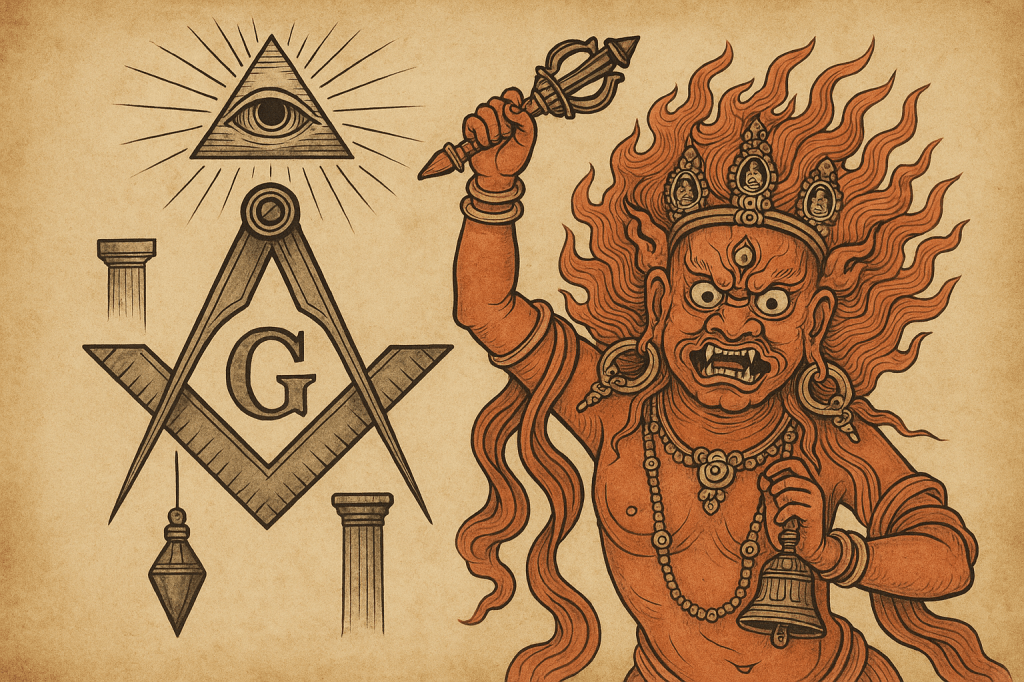
Occult Parallels Between Freemasonry and Tibetan Tantric Buddhism


When most people hear the term Freemasonry, they think of an old-world fraternity, moral instruction through symbolism, and discreet handshakes. When they hear Tibetan tantric Buddhism, they imagine serene monks, compassion, and meditation. The public image of both is carefully cultivated, and in both cases, that image obscures a deeper, more esoteric reality.

Layers of Secrecy

Freemasonry is famously structured in degrees. Early initiates learn benign moral allegories; the deeper teachings are said to be revealed only at the highest levels, with rumors persisting about a Luciferian current unveiled around the 33rd degree. Likewise, Tibetan tantric Buddhism presents an accessible outer face, with philosophical teachings and an emphasis on compassionate practices, while reserving its most potent techniques for advanced initiates. These require formal empowerment ceremonies (wangkur) and vows (samaya) that bind the disciple not only to the guru but also to the unseen entities invoked in the practice.

Initiations and Oaths

In both systems, entry into the deeper mysteries requires swearing oaths. In Masonry, the vows historically invoked dire consequences for betrayal, couched in symbolic language. In tantric Buddhism, the initiatory vows carry the threat of karmic ruin, disease, or worse for breaking them. From a critical perspective, these oaths are more than quaint tradition. They function as binding contracts with what practitioners believe are spiritual forces. Those who view the occult with suspicion might identify these forces not as enlightened beings or symbols, but as demonic entities.

Hidden Entities and Magical Practice

Strip away the Buddhist philosophical overlay and Tibetan tantra reveals a highly ritualized form of magic. Complex visualizations, mantras, and mudras serve not merely as meditation aids, but as precise methods of summoning and merging with non-human intelligences. This is not unlike the ceremonial magic that underpins parts of Masonic symbolism, particularly in its higher degrees, where the initiate engages with archetypes, symbols, and names drawn from older mystery traditions. Both traditions cloak these operations in the language of self-improvement and enlightenment, but the mechanics of calling upon unseen forces, entering altered states, and channeling power remain strikingly similar to ancient magical rites.

Shared Roots in Ancient Occultism

Freemasonry draws openly from the Hermetic and Kabbalistic streams of Western esotericism, both of which trace their roots back to the mystery schools of the ancient world. Tibetan tantric Buddhism, though filtered through the Buddhist canon, absorbed elements from pre-Buddhist Bön shamanism, Indian Tantra, and Himalayan spirit-worship. From this angle, both may be considered descendants of the same primordial magical worldview: that reality can be manipulated through ritual, symbol, and alliance with non-physical beings.

The Public Face vs. the Hidden Core

The genius of both systems is their dual-layered structure. The public face draws in seekers with ideals of morality, compassion, and personal growth. The hidden core, accessible only through successive initiations, operates in a world of occult allegory, ritual precision, and spirit interaction. Whether one calls those spirits Buddhas, angels, demons, or archetypes depends largely on one’s interpretive lens. From a Christian lens, it is clear that both systems engage with fallen angels.

Freemasonry and Tibetan tantric Buddhism, at first glance, seem to occupy opposite ends of the cultural spectrum, one a Western fraternal order, the other an Eastern spiritual tradition. Yet both can be read as initiatory magical systems that mask their deeper workings behind an accessible moral or philosophical front. For the uninitiated, this outer layer is all they will ever see. For those who pass through the degrees or empowerments, the real initiation may lie in forging a relationship with the very forces their public image denies. And that is where the parallels become most disturbing.

These similarities are not vague or coincidental. They are structural, symbolic, and functional. Strip away the public image and both systems follow the same blueprint: they lure the seeker with ideals, bind them with oaths, then initiate them into rituals that channel demonic forces. Below is a side-by-side look at how the two traditions mirror each other in startling detail.

Freemasonry vs. Tibetan Tantric Buddhism: Structural & Occult Parallels

AspectFreemasonryTibetan Tantric Buddhism
Outer PresentationFraternal order promoting moral improvement, philanthropy, brotherhoodCompassion-based philosophy, meditation, cultural preservation
Initiatory Structure3 public degrees (Entered Apprentice → Master Mason) followed by higher Scottish Rite or York Rite degrees culminating in the 33rd degreeThree turnings of the wheel of Dharma leading to tantric initiation (Vajrayana), then advanced empowerments and yogas
Vows/OathsOaths of secrecy and loyalty; historical versions included symbolic penaltiesSamaya vows taken during empowerments, with karmic penalties for violation (illness, misfortune, spiritual ruin)
Hidden CurriculumEsoteric symbolism, Kabbalistic and Hermetic philosophy, rituals involving archetypal forcesAdvanced deity yoga, mantra recitation, visualization, and energy-body work aimed at merging with yidams (tutelary deities)
Entities InvokedAllegorical architect figure, angels, and names from older magical traditions; higher degrees hint at Lucifer as light-bearerDeities, protectors, and Buddhas invoked in ritual, often fierce or wrathful forms with clear pre-Buddhist shamanic traits
Magical ToolsCompass, square, tracing boards, symbolic implements; ritual words and gesturesVajra (dorje), bell, mandalas, mudras, mantras, tormas (substitutes for sacrificial offerings), visualized palaces
Source TraditionsHermeticism, Kabbalah, Rosicrucianism, medieval guild ritualBön shamanism, Indian Tantra, Himalayan spirit practices overlaid with Buddhist philosophy
Outer vs. Inner TeachingsPublicly moral, privately esoteric; higher levels teach occult philosophyPublicly compassionate, privately tantric; higher levels teach deity invocation and magical union
Binding MechanismOaths tie member to lodge and brotherhood, reinforced through ritual dramaSamaya ties disciple to guru and the deities invoked, reinforced through ritual visualization and mantra
Potential Root ParallelsMystery schools of antiquity, ritual magic, symbolic initiationsMystery schools of antiquity, ritual magic, symbolic initiations (via Eastern streams)

When we see these parallels laid bare, the comforting illusion of ancient wisdom starts to crumble. The robes and rituals, whether in a Masonic lodge or a Himalayan temple, are not neutral cultural artifacts. They are technology for binding humans to hidden powers, likely demons. Those who hold the keys to these systems know exactly what they are doing. The question is not whether the forces behind them exist, but whether the seeker truly understands who or what is answering when the call is made.
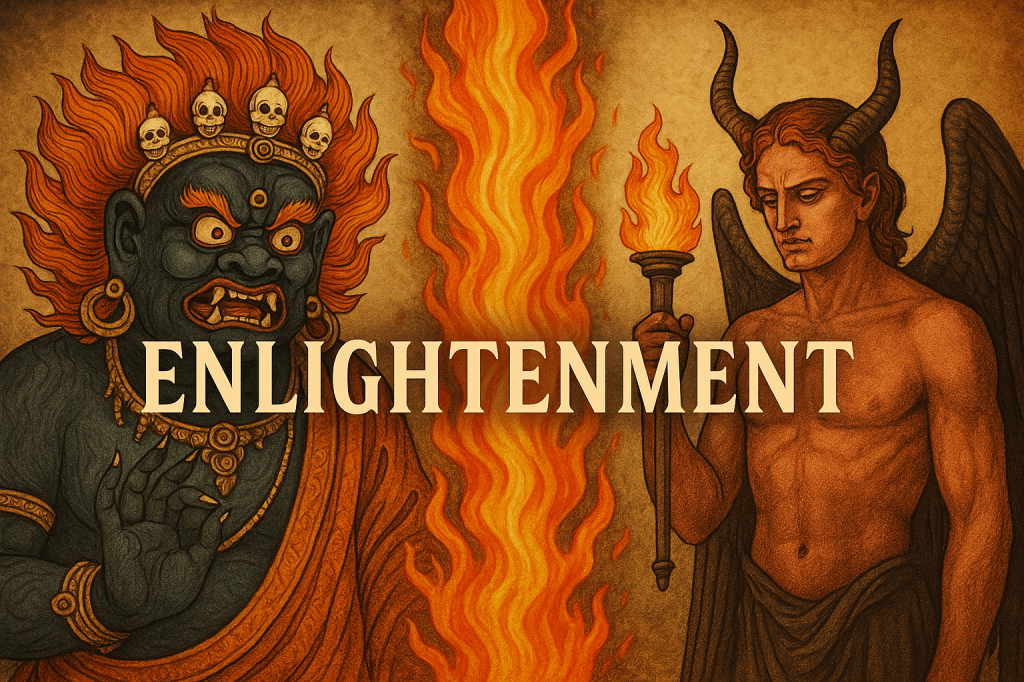
Enlightenment as a Smokescreen: How Luciferianism and Tibetan Buddhism Mirror Each Other

When I was a devoted Tibetan Buddhist, the word enlightenment held sacred weight. It meant the complete awakening of compassion and wisdom, the state of a Buddha who sees through illusion and dedicates themselves to freeing all sentient beings from the sufferings of samsara. I trusted in that vision, because I believed I was following a noble tradition.

But even then, something always felt a little off. I had a quiet discomfort I kept pushing aside.

The problem was this: the term enlightenment wasn’t exclusive to Buddhism. I saw the same word used in the occult, in Theosophy, Freemasonry, and even Luciferianism, often in ways that glorified rebellion and the pursuit of hidden knowledge. Why were systems as wildly different as Tibetan Buddhism and Luciferian occultism both invoking “enlightenment” and “awakening” as their ultimate goal? Why did the same term span both the sacred and the profane?

Tibetan Buddhism: Enlightenment as Compassionate Wisdom

In Tibetan Buddhism, enlightenment is the realization of emptiness, the transcendence of ego, and the birth of boundless compassion. The ideal of the bodhisattva is someone who delays their own final nirvana in order to help all other beings reach liberation. This enlightenment isn’t just something a guru gifts you; it’s a hard-won transformation of your own mind.

Vajrayana Buddhism, the tantric branch of Tibetan Buddhism, adds layers of secrecy and initiation. There are empowerments, mantras, visualizations, and guru devotion practices. It uses powerful symbols such as vajras, weapons, fire, and wrathful deities that on the surface could resemble occult ritual. This made me uneasy. Was this actually an Eastern form of the same hidden path to power that Western esoteric groups followed?

I reassured myself that Vajrayana was different. It used “occult” methods, maybe, but only to realize true compassion and emptiness. Still, the similarity in tone and terminology between tantric rituals and occult rites always bothered me.

Now, after 35 years of hard work, study, devotion, and ultimately betrayal at the hands of tantric Buddhist gurus and deities, I’ve come to a grim realization: the enlightenment I was seeking wasn’t what I thought it was. It is merely an occult system dressed in Buddhist robes. The deeper I went, the clearer it became that Tibetan Buddhism and Luciferianism are two sides of the same coin. They may use different language, imagery, and rituals, but they are architecturally and spiritually similar and they both serve darkness, not light.

The word that they share, enlightenment, is the bait they use to ensnare seekers.

Luciferianism and Tibetan Buddhism: Two Faces of the Same Enlightenment Agenda

In Luciferianism, enlightenment is about becoming your own god. Lucifer is framed not as evil, but as the “light-bringer,” the one who defies divine authority to bestow forbidden knowledge. Enlightenment here is rebellion, self-deification, and esoteric power.

Helena Blavatsky, the founder of Theosophy, which heavily influenced modern occultism, named her journal Lucifer and described the figure as a misunderstood bringer of divine wisdom¹. In The Secret Doctrine, she refers to Lucifer as the “spirit of intellectual enlightenment”² and equates him with the higher mind of humanity. Freemasonry, Theosophy, and modern occultism all share the core motif: moving from darkness to light, and from ignorance to gnosis, through secret initiation.³

This kind of “light” is occult and exclusive. The “enlightened ones” in these systems are initiates who’ve been brought into deeper mysteries. The light is not for everyone; it’s reserved for those chosen by the system who are able to serve its agenda.

What shocked me, and what I ignored for years, is that tantric Buddhism functions much the same way. It promises special teachings, revealed only to the initiated. It trains students to see their guru as a living Buddha, above criticism or doubt, and presents his questionable actions as “skillful means,” while bypassing basic moral accountability. There is a similar secretive, hierarchical structure although this one is surrounded by colorful thangkas and Sanskrit mantras.

The deeper I went, the more I saw that my devotion was being weaponized against me. Tantric gurus used “crazy wisdom” to justify harm, and “samaya vows” to silence dissent. It wasn’t really compassion, but a spiritual aristocracy, no different from the occult orders I once thought Buddhism stood apart from. The beatific vision of enlightenment for the benefit of all sentient beings was merely the bait. The hook was the hidden power of dark forces.

Now I see clearly that the word enlightenment, both in Tibetan Buddhism and Luciferianism, functions as a kind of smokescreen. It sounds noble, luminous, and superior. But in both systems, it serves those in power and creates a class of “enlightened ones” who are above reproach, who serve gods and buddhas from unseen realms that are not what they appear to be.

“Enlightened Ones” as Agents of the Lie

It’s not just that the term enlightenment is misused. It’s that those who claim it, whether in Tibetan Buddhism or Luciferianism, are agents of a system that serves a being or beings pretending to be of the light.

These “enlightened ones” often behave the same way, regardless of tradition: they demand loyalty, obedience, and silence. They wield charisma and secrecy as tools. And when challenged, they invoke mystical authority and retaliation.

In both systems, the “light” is a mask and those who follow it are bound to something posing as divine. Whether it’s called Buddha, a Bodhisattva, an Ascended Master, or Lucifer, the same current runs underneath: it is a demonic force clothed in the language of transcendence.

Christianity and the True Nature of Light

Unlike Tibetan Buddhism and occultism, Christianity doesn’t use enlightenment as a central goal. It speaks instead of salvationgrace, and being born again through the Holy Spirit. The light of Christ is not esoteric knowledge reserved for an initiated elite but is open, relational, and grounded in love and repentance. Christ’s light is not something attained through ritual or secrecy; it is something revealed publicly and offered to all.

As Jesus says in the Gospel of John: *“I have spoken openly to the world. I have always taught in synagogues and in the temple, where all Jews come together. I have said nothing in secret.”⁵ This sharply contrasts with occult traditions, including tantric Buddhism, where knowledge is concealed, layered in initiations, and distributed only to those deemed “ready.” In my own experience, this secrecy became a mask for control. I was told not to question or doubt. I had to sacrifice my own inner wisdom and clarity.

But the light of Christ does not require silence or blind devotion. The Holy Spirit is not a power to be manipulated, but a divine presence who convicts, comforts, and guides with truth. In my experience, that is the only light that does not deceive.

Every other version I followed, no matter how radiant it appeared, eventually demanded that I suppress my discernment, abandon my conscience, and serve a system of secrecy cloaked in mystical language.

A Word to the Seekers

To anyone still in these systems, or brushing up against them through yoga, New Age teachings, or tantric practices: be careful with “light” that demands you stop using discernment. Be cautious of teachers who ask for your silence or your soul. Be wary of the spiritual forces behind the promised enlightenment.

I say this not as an outsider, but as someone who gave my life to this path. I practiced the rituals, prostrated to the gurus, and offered my heart in devotion. And when the mask came off, I saw what was truly being served, and it wasn’t holy. It was something else entirely.


Footnotes and Sources

  1. Blavatsky, H. P., Lucifer, Vol. 1. Theosophical Society, 1887.
  2. Blavatsky, H. P., The Secret Doctrine, Vol. 2. Theosophical Publishing House, 1888.
  3. Pike, Albert. Morals and Dogma of the Ancient and Accepted Scottish Rite of Freemasonry. Southern Jurisdiction, 1871.
  4. Mackey, Albert G. The Symbolism of Freemasonry. Masonic Publishing, 1882.
  5. The Holy Bible, English Standard Version, John 18:20.
  6. Crowley, Aleister. The Book of the Law. 1904.
  7. Bailey, Alice A. Initiation, Human and Solar. Lucis Publishing Company, 1922.
  8. Dapsance, Marion. “Behind the Smiling Façade: Abuse in Tibetan Buddhism.” Le Nouvel Observateur, 2018. Translated and discussed in Tricycle: The Buddhist Review.
  9. Sawerthal, Anna. “Sogyal Rinpoche’s Abuse and the Breakdown of Secrecy in Buddhism.” Tricycle, 2018.
  10. Peljor, Tenzin. “Tibetan Buddhism and Abuse: Why Critical Thinking is Essential.” Interview in Spiegel Online, 2019.

Tantric Āveśa and Demonic Possession: A Comparative Exploration


Āveśa (Sanskrit) refers to a state of spiritual possession or divine inhabitation in which a deity or sacred power “enters” and dwells within a person. The word literally means “an entering” or “fusion,” describing the incorporation of divine power into the human body. Such forms of sacred possession have long been central to Indian Tantric practice, invoked for both worldly benefits (bhoga) and spiritual liberation (mokṣa). This is often contrasted with demonic possession in Christian theology, typically characterized as an involuntary affliction by an evil spirit.

Cross-cultural studies note that spirit possession can be either voluntary or involuntary, and it is interpreted differently depending on the tradition. Western occult traditions, such as Luciferianism, may view possession by a demon as desirable, even leading to a so-called “perfect possession.” In Christianity, however, even voluntary possession by a demonic force is considered evil. The question then arises: who or what possesses the practitioner in Eastern contexts?

Towards the end of my 35 years in Tantric Buddhism, I came to believe that the force presenting itself as a deity was, in fact, demonic. In what follows, I will examine the phenomenon of āveśa in two major esoteric traditions, Hindu Tantra (especially Shaiva lineages such as Kashmir Shaivism), and Tibetan Vajrayāna Buddhism. I will contrast these forms of divinely sanctioned possession with demonic possession in Christian and occult frameworks, drawing from historical sources, academic analysis, and personal experience.


Āveśa in Hindu Tantric Traditions

Scriptural Origins and Tantric Development

The Sanskrit root ā-viś (to enter) appears in early Indian texts, foreshadowing the later Tantric elaboration of āveśa.1 From the 5th to 11th centuries, Tantric scriptures across Śāiva, Śākta, and Buddhist milieus incorporated āveśa into ritual practice. Scholar Vikas Malhotra describes āveśa as the “entrance or fusion of oneself with the deity,” central to both magical and liberatory goals.2

These practices utilized mantras, mudrās, and nyāsa (installing mantras on the body) to induce the deity’s presence. Often this process was linked to śaktipāta, or the descent of divine energy. Over time, āveśa came to refer not just to deity possession, but a range of spiritual states culminating in union with Śiva.3 In contrast to exorcism (removing evil spirits), this adorcistic form of possession aimed to invite a divine presence.

Kashmir Shaivism and Samāveśa

In the Trika system of Kashmir Shaivism, the term samāveśa refers to full ontological immersion in Śiva-consciousness. Abhinavagupta, a 10th-century Hindu philosopher and Tantric adept, defined it as a merger of individual and divine being, sometimes accompanied by shaking, trance, or devotional ecstasy.4 Rituals such as nyāsa or advanced mudrā usage were seen as ways to divinize the body. Kṣemarāja, a key Trika commentator, emphasized that the body itself becomes a vessel for cosmic forces, eroding the sense of ego.5

This idea extended to daily ritual. The practitioner installs divine presences into various body parts—e.g., “May Brahmā be in my genitals, ViṣŇu in my feet, Śiva in my heart”—until the self is transformed.6 Āveśa was also connected to śaktipāta dīkṣā (initiation by grace), which Abhinavagupta saw as the guru’s transmission of divine force into the student.

Historical sources and hagiographies portray this not as pathology but sacred awakening. In the Bhakti tradition, saints like Caitanya and Rāmakṛṣṇa exhibited signs interpreted as divine possession, a loss of ordinary consciousness during worship or dancing in states of trance. In goddess worship, the ecstatic state of bhāva can evolve into full possession by a fierce Devī or goddess.

Induced Trance in Ritual Practice

Possession is not accidental; it is often deliberately induced. Contemporary folk-Tantric rites like Theyyam in Kerala reenact this vividly. The performer undergoes intense ritual preparation, dons a sacred headdress, and becomes a vessel for the deity. His demeanor, voice, and movements change dramatically, and devotees approach him as a god.7 These techniques including fasting, music, sacred garb, and mantra, parallel ancient Tantric rituals meant to induce āveśa.

Importantly, this experience is consensual. A priest may invite a deity for oracular guidance or blessing. The Tantric yogi similarly invites identification with Śiva. As Frederick Smith notes, such possession is the most valued spiritual experience in many Indian settings.8 Advanced yogis even practiced para-kāya praveśa, the entry of one’s consciousness into another’s body, a form of high-level āveśa.9


Āveśa (Possession) in Tibetan Vajrayāna Buddhism

Deity Yoga and Guru Inhabitation

Though the term “possession” is less used, Vajrayāna emphasizes divine inhabitation. In Deity Yoga, one visualizes oneself as a yidam (meditational deity) and invites the deity’s wisdom aspect (jñānasattva) to merge with the visualization (samayasattva). Through mantra and meditation, the practitioner dissolves ego and identifies as the deity.

While framed as an enlightened act, in practice there is no safeguard against malevolent forces. Many Tibetan rituals derive from the Yoginītantras, esoteric texts filled with wrathful, dangerous dākinīs. These entities are unpredictable and must be carefully propitiated. Practitioners hope to merge with them for wisdom and power, but failure often results in spiritual collapse or madness. One either becomes “enlightened” or is destroyed.

My personal experience, including participating in two three-year retreats, led me to conclude these deities are not divine but demonic. After prolonged practice, I experienced terrifying possession states, torturous sensations, and an uncontrollable kundalini awakening. While there were moments of bliss and magical phenomena, the final result was spiritual devastation.

Guru Yoga and Transmission

Guru Yoga, especially in the Nyingma and Kagyu lineages, mirrors āveśa. The practitioner visualizes the guru dissolving into them, merging body, speech, and mind. This is intended to produce an inseparable union. Some historical accounts even describe instant enlightenment via physical gestures or verbal commands from a master, a form of mind-to-mind transmission akin to possession.

Some Vajrayāna practices involve obvious demon possession. The Nechung Oracle, for example, enters trance during elaborate rituals, allowing the deity Pehar to possess his body. Frightening physical changes, voice alteration, and strength are observed. The practice is structured around phowa, a method of ejecting consciousness to allow divine entry.10


Possession as Initiation and Transformation

Both traditions treat āveśa as transformative. In Hindu Tantra, samāveśa may mark initiation or realization. In Vajrayāna, empowerment rituals symbolically install the lineage mindstream into the disciple. When successful, the practitioner believes they have merged with divine consciousness.

The experiences are often euphoric and expansive. Yet, as I learned, they can also become nightmarish. The forces one invokes may not be what they seem. While traditions insist the entities are enlightened or benevolent, there is no proof. Many undergo trauma, dissociation, and spiritual breakdown.


Christian Views of Possession: A Stark Contrast

In Christian theology, possession is demonic by nature. The demon enters uninvited or through occult involvement, and exorcism is the remedy. Symptoms include revulsion to the sacred, altered voices, and loss of control. Unlike tantric āveśa, the demon is not a divine aspect but an evil other. (I should note that the kundalini energy always felt “other” to me, but I was encouraged to see it as a positive experience.)

Catholic doctrine states that even voluntary occult involvement is condemned, seen as opening a door to bondage; the soul remains untouched, but the body and mind may be dominated. Consent may be partial or misguided, but once entered, the demon seeks destruction.

Only the Holy Spirit is seen as a positive presence, and even then, Christian traditions speak of inspiration rather than possession. Some Pentecostal expressions resemble Eastern possession states, but many Christians believe these, too, are counterfeit Holy Spirit experiences linked to kundalini phenomena.

Scripture offers stern warnings:

All the gods of the nations are demons.” — Psalm 96:5 (Septuagint) “They sacrificed to demons, not to God.” — Deuteronomy 32:17

In conclusion: āveśa is framed as a sacred merging in Tantra, but my experience revealed it as demonic deception. Beneath the ritual beauty lies spiritual subjugation. As an exorcist once warned me: Be careful who or what you invite to abide within.


Footnotes

  1. “A Brief Study of Possession in Hinduism Part II: The Spiritual Context,” Indic Today
  2. Vikas Malhotra, ĀveŚan and Deity Possession in the Tantric Traditions of South Asia
  3. Ibid. 
  4. “The Fulcrum of Experience in Indian Yoga and Possession Trance.” 
  5. Ibid. 
  6. Indic Today, op. cit. 
  7. “Theyyam,” Wikipedia
  8. Frederick M. Smith, The Self-Possessed: Deity and Spirit Possession in South Asian Literature and Civilization
  9. Yogasūtra III.38. 
  10. “Nechung Oracle,” Wikipedia