Tibetan Buddhism is marketed in the West as a path of the highest integrity. It is described as a philosophical system with techniques for developing mindfulness, compassion, and ultimately for attaining enlightenment. What is rarely stated plainly is that Vajrayāna tantric systems are structured around ritualized spirit possession and identity takeover.
A 2022 doctoral dissertation, Āveśa and Deity Possession in the Tantric Traditions of South Asia by Vikas Malhotra, documents that possession became central to medieval Tantric practice, including Buddhist Tantra that later developed into Tibetan Vajrayāna.[1] The Sanskrit term āveśa literally means “entering into.” In Tantric contexts, it refers to the fusion of practitioner and deity. This was not marginal but foundational.[2]
Deity Yoga Involves Possession
In Tibetan Deity Yoga, practitioners visualize themselves as a deity, recite its mantra, adopt its gestures and identity, and are instructed to experience no separation between themselves and that being. Modern teachers frame this as symbolic or psychological and as a method to realize emptiness. But examined historically, it follows the structure of possession technology:
Invocation
Descent of power
Identity fusion
Altered agency
Bodily and psychological signs
Medieval Tantric texts describe possession markers such as trembling, ecstasy, altered consciousness, and loss of ordinary identity. These same phenomena and mechanisms are reported in Vajrayāna contexts.
Guru Yoga and Human Possession
There are also uncomfortable truths concerning Guru Yoga. In this practice, the visualized guru dissolves into light and enters the disciple. The disciple experiences the guru’s mind as inseparable from their own. Empowerment is described as a descent of blessing into the subtle body. The dissertation notes that in Tantric systems, even advanced humans could possess others in positive ways. [3]
The guru embodies enlightened power.
Through initiation, that power descends.
The disciple becomes a vessel.
Identity shifts from individual to lineage-bearer.
This is ritualized human-to-human possession. It is framed as a positive transmission, but is it really? What are the implications of inviting another human being in to possess you? If you examine the numerous exposés of abuse in Vajrayāna communities over the past few decades, you might wonder why anyone would let a fallible human being enter and possess them. As someone who lived through egregious abuse by a supposedly enlightened Vajrayāna master, I can speak from personal experience. Guru yoga creates a framework in which another human being is granted intimate internal authority over your mind and identity. Why would anyone knowingly consent to that dynamic? They probably wouldn’t if they knew that spiritual possession is what actually happens during guru and deity yoga.
Why This Is Glossed Over
The fact that this is glossed over in Tibetan Buddhist teachings should give one pause. Why isn’t this discussed up front? It is because possession sounds primitive and carries negative psychiatric and colonial baggage. For these reasons, traditions seeking Western legitimacy avoid the term and conceal the reality beneath layers of theological and philosophical euphemism. The issue is not vocabulary, but whether practitioners are told clearly what is structurally taking place. If Vajrayāna depends on ritualized possession through deity and guru incorporation, that should be stated plainly.
In Western religious history, especially within Christianity, possession has long been regarded as negative, spiritually dangerous, and psychologically destabilizing. It is associated with loss of agency, vulnerability to manipulation by demonic entities, and the need for protection or exorcism. It is not treated as spiritually glamorous. It is treated as a serious risk.
Yet when similar identity-dissolving dynamics appear within an imported spiritual system, they are often elevated, aestheticized, and shielded from scrutiny. The language changes but the underlying structure does not.
Why does ritual possession provoke alarm in one context but reverence in another? Why does a shift in metaphysical framing automatically neutralize the concern? If this would raise red flags in a Western church, why should it be exempt from examination in a Tibetan temple?
The historical record is clear. Possession is not peripheral to Tibetan Tantra. It is embedded in its ritual core. If that is so, then practitioners deserve to confront that reality consciously rather than encounter it disguised as harmless symbolism or elevated mysticism.
Footnotes
[1] Vikas Malhotra, Āveśa and Deity Possession in the Tantric Traditions of South Asia: History, Evolution, & Etiology, PhD diss., University of California, Santa Barbara, 2022 .
[2] Ibid., discussion of possession becoming central to Tantric praxis .
[3] Ibid., discussion of positive forms of human possession .
[4] Ibid., integrated model of possession as embodied transformation .
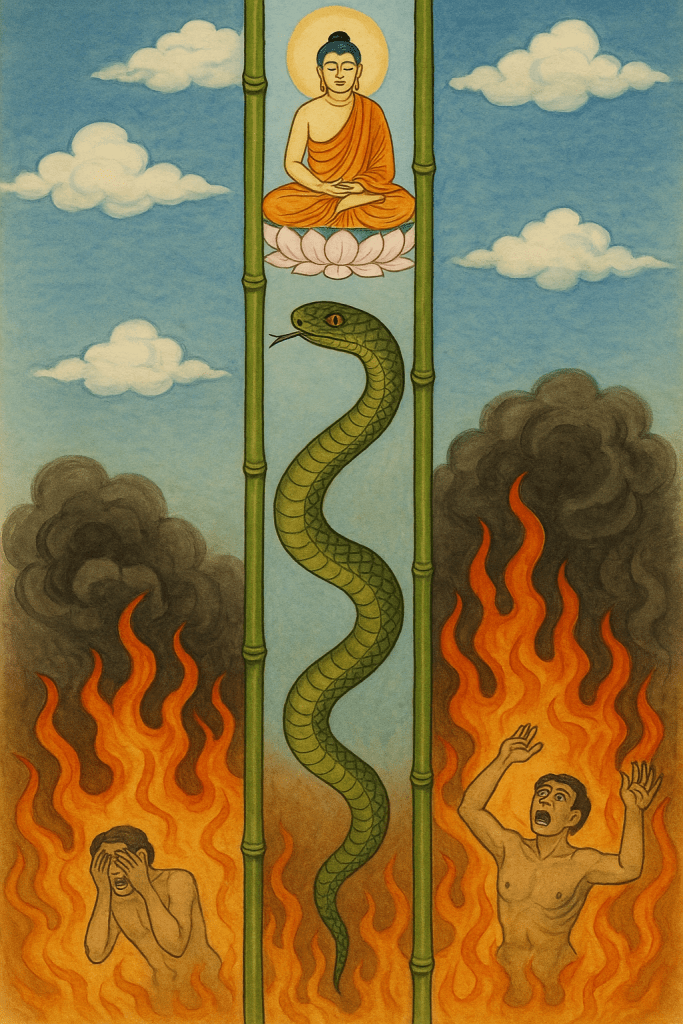
In Tibetan tantric Buddhism, the image of the snake trapped in a bamboo tube is more than a vivid proverb. It functions as a doctrinal warning: once a student enters the tantric path, there is no lateral escape. One either goes upward toward awakening or downward toward failure and “vajra hell.” Teachers have used this image to describe the uncompromising nature of samaya, the vows that bind a student to the guru, the deity, and the tantric methods themselves.¹
What is striking is how explicitly the tradition frames tantra as irreversible and high-stakes, and how rarely that stark truth is communicated to Western beginners before they agree to the vows that supposedly make the tube snap shut behind them. This mismatch between traditional warning and Western presentation is not a minor detail; it shapes the entire experience of Vajrayāna in modern contexts.
When the Warning Arrives Too Late
Many longtime practitioners have reported that the “snake in the tube” metaphor is introduced only after they have taken empowerments, established loyalty to the teacher, and accepted vows they did not fully understand. In one account, students were told after receiving advanced teachings that they were now like snakes [in a tube] with no side exit, and that questioning or leaving the guru’s authority carried dire karmic consequences.² Once framed in these terms, the student is no longer encountering tantra freely. The imagery becomes a retrospective justification for total commitment and an interpretive trap that discourages reevaluation, dissent or disengagement.
This sequencing matters. Warnings given after the student is already inside the tube are not warnings at all; they function as a mechanism of control. Sadly, it’s not just empty scaremongering to get the student to do whatever the teacher wants. The teacher can play a part in destroying the student if he wishes.
Western students, however, often enter tantra without the cultural framework that understands concepts like vajra–hell, and as a result frequently interpret them metaphorically or ignore them altogether during empowerments or teachings. As a result, the gravity of samaya is often hidden in plain sight. Students may assume that vows are symbolic or aspirational when, within the tradition, they are treated as binding conditions that determine spiritual destiny.
The asymmetry of information here is profound. Tibetan teachers know the stakes, but Western students usually do not.
Fear as a Reinforcing Mechanism
Inside the tantric system, samaya is often discussed as a bond of trust and devotion. But its shadow side is rarely addressed openly: the way threats of karmic ruin can be used to enforce silence and obedience. If leaving the guru, criticizing harmful behavior, or even doubting the teacher’s purity is framed as a breach of samaya, then fear becomes central to the student’s experience. Some Tibetan masters teach that both teacher and student can fall into vajra-hell for damaging the guru-disciple bond.³ In practice, however, this warning is most often directed at students, who are told that speaking publicly about misconduct or abuse may destroy their spiritual future.
Why the Snake Matters
The “snake in the bamboo tube” metaphor distills these concerns with unusual clarity. It shows that tantra is not designed to allow experimentation or partial commitment. It requires total participation in a closed system with its own rules, hierarchies, and cosmology. In cultures where this system has historically been embedded, those entering it do so in fuller awareness of the stakes. In the West, students often do not and they may hear such warnings in a highly suggestible state, without really grasping the implications.
One famous guru in the 1980s bluntly told students that they could be both Christian and Buddhist with no conflict whatsoever. This blatantly goes against Christian teaching. In those days Westerners were often thrust into the three-year-retreat program shortly after they signed up for teachings at Dharma centers with no knowledge of what they were really getting into. Many had little preparation to truly understand the arcane nature of samaya and its risks. Furthermore, many Tibetan teachers took advantage of their roles as authority figures to manipulate vulnerable students into sexual relationships and other sorts of commitments. Engaging in secretive sexual relationships with students while pressuring them to take highest yoga tantra vows and practices that would bind them forever often led to deep confusion and psychological unmooring.
The result is a form of spiritual engagement that looks consensual on the surface but lacks true informed consent. Students may be drawn in by promises of transformation but only later discover the rigidity of the commitments they have made. This is especially jarring given that Vajrayāna wraps together the renunciation of the Hinayāna, the boundless compassion of the Mahāyāna, and the esoteric demands of tantra. In this unwieldy fusion, the same tradition that teaches gentle observation of thoughts can also insist that a single critical thought toward one’s guru carries the weight of karmic catastrophe. The threat of vajra-hell sits uneasily beside Buddhism’s wider emphasis on compassion and non-judgment. An ethical issue looms large: a path that describes itself as having no side exit should not be offered as if it does.
To treat tantra’s danger as a secret or secondary detail is to undermine the integrity of the path itself. If practitioners are indeed snakes in a tube, they deserve to be told before they go inside.
Footnotes
¹ “Once you take samaya you become like a snake in a vertical bamboo tube: you’re either going up, or you’re going down. You can’t sneak out the side.” (Kun zang.org) (kunzang.org) ² Note: practitioner-reports and forum posts indicate the metaphor is often applied post-initiation. For example: “A Vajrayana practitioner is like a snake in a tube; … he can either go up or down, not left or right.” (dharmawheel.net) ³ “The metaphor for samaya is a snake in a bamboo tube. It has only 2 directions – up to enlightenment or down to the hells.” (TibetDharma.com) (Tibetan Buddhism)
A ritual battle scene: Kschetrapala rising from a burning sacrificial torma outside Lhasa, facing the monstrous nine-headed Chinese demon in a clash of spirit armies.
This article contains excerpts from The Shadow of the Dalai Lama: Sexuality, Magic and Politics in Tibetan Buddhism by Victor and Victoria Trimondi
Who were the Trimondis?
Victor and Victoria Trimondi are the pen names of German cultural historians Herbert and Mariana Röttgen. In the 1980s and early 1990s, they were active supporters of the Dalai Lama, translating and publishing his works into German and helping to organize international events in support of Tibet. Initially, they saw Tibetan Buddhism as a beacon of compassion and ethical renewal.
But their perspective changed. Over years of study, they became disillusioned by what they regarded as the darker, concealed aspects of Tibetan tantric Buddhism: ritual magic, sexual practices, secrecy, and the fusion of religion with political power. Their critical work The Shadow of the Dalai Lama: Sexuality, Magic and Politics in Tibetan Buddhism (2003) full text here seeks to expose these elements, drawing heavily on Tibetan source texts and the earlier ethnographic research of figures like René de Nebesky-Wojkowitz (Oracles and Demons of Tibet, 1956) and Matthias Hermanns.
Because of this trajectory, from enthusiastic supporters of Tibetan Buddhism to outspoken critics, the Trimondis occupy a controversial position. Admirers of Tibetan Buddhism accuse them of exaggeration and hostility, but their book nonetheless catalogs texts, rituals, and historical examples that complicate the popular image of Tibetan Buddhism as peaceful and compassionate.
The following excerpts illustrate how the Trimondis argue that ritual magic was systematically integrated into Tibetan politics and warfare:
Invocation of demons Since time immemorial ritual magic and politics have been one in Tibet. A large proportion of these magic practices are devoted to the annihilation of enemies, and especially to the neutralizing of political opponents. The help of demons was necessary for such ends. And they could be found everywhere — the Land of Snows all but overflowed with terror gods, fateful spirits, vampires, ghouls, vengeful goddesses, devils, messengers of death and similar entities, who, in the words of Matthias Hermanns, “completely overgrow the mild and goodly elements [of Buddhism] and hardly let them reveal their advantages” (Hermanns, 1965, p. 401).
For this reason, invocations of demons were not at all rare occurrences nor were they restricted to the spheres of personal and family life. They were in general among the most preferred functions of the lamas. Hence, “demonology” was a high science taught at the monastic universities, and ritual dealings with malevolent spirits were — as we shall see in a moment — an important function of the lamaist state.
The war demon Kschetrapala Once the gods had accepted the sacrifice they stood at the ritual master’s disposal. The four-armed protective deity, Mahakala, was considered a particularly active assistant when it came to the destruction of enemies. In national matters his bloodthirsty emanation, the six-handed Kschetrapala, was called upon. The magician in charge wrote the war god’s mantra on a piece of paper in gold ink or blood from the blade of a sword together with the wishes he hoped to have granted, and began the invocation.
Towards the end of the forties the Gelugpa lamas sent Kschetrapala into battle against the Chinese. He was cast into a roughly three-yard high sacrificial cake (or torma). This was then set alight outside Lhasa, and whilst the priests lowered their victory banner the demon freed himself and flew in the direction of the threatened border with his army. A real battle of the spirits took place here, as a “nine-headed Chinese demon”, who was assumed to have assisted the Communists in all matters concerning Tibet, appeared on the battlefield. Both spirit princes (the Tibetan and the Chinese) have been mortal enemies for centuries. Obviously the nine-headed emerged from this final battle of the demons as the victor.
“Voodoo magic” in Tibetan Buddhism The practice widely known from the Haitian voodoo religion of making a likeness of an enemy or a doll and torturing or destroying this in their place is also widespread in Tibetan Buddhism. Usually, some substance belonging to the opponent, be it a hair or a swatch from their clothing, has to be incorporated into the substitute. It is, however, sufficient to note their name on a piece of paper…
Such “voodoo practices” were no rare and unhealthy products of the Nyingmapa sect or the despised pre-Buddhist Bonpos. Under the Fifth Dalai Lama they became part of the elevated politics of state. The “Great Fifth” had a terrible “recipe book” (the Golden Manuscript) recorded on black thangkas which was exclusively concerned with magical techniques for destroying an enemy.
Why all this matters
These passages highlight a side of Tibetan Buddhism that is largely hidden from public view: the integration of destructive magic and spirit warfare into the machinery of the lamaist state. Nebesky-Wojkowitz’s research on ritual manuals, Hermanns’ cultural observations, and the Trimondis’ synthesis all converge on the same conclusion: alongside compassion and wisdom, Tibetan Buddhism preserved and continues to use technologies of coercion and violence.
For modern practitioners and students in the West, this raises unavoidable questions:
Are newcomers told that tantric ritual includes not only deities of compassion but also demon invocations and rites of subjugation? What risks do these violent magical technologies pose for the unsuspecting student?
What does “consent” mean if disciples are invited to take refuge in Tibetan Buddhism and receive empowerments without knowledge of these dimensions?
How much of this is framed as symbolic or metaphorical today, and is that distinction clearly explained? Evidence suggests that such practices continue much as they did in the past, which makes a thorough and honest examination all the more urgent.
Conclusion
The Trimondis’ work is controversial, but it is also important because it insists on remembering what is usually forgotten or denied. If the compassionate face of Tibetan Buddhism is to be embraced honestly, then its shadow side, the reality of political magic, demon invocations, and coercive ritual, must also be acknowledged. Only then can students and practitioners engage with full awareness, rather than be fooled by the illusion of partial truths.
Kurukullā, the red goddess of magnetizing, depicted in a traditional Tibetan thangka style, embodying the tantric power to attract and bind.
Western seekers approaching Tibetan Buddhism are usually drawn to its most humane face. Chenrezig practice promises the cultivation of boundless compassion through visualizing Avalokiteśvara and reciting his mantra Om Mani Peme Hung. Tonglen “taking and sending” practice trains the mind to breathe in the suffering of others and breathe out relief. These sincere aspirations are the public face of Tibetan Buddhism. Yet this religion also preserves a hidden curriculum. Alongside compassionate practices sit the four activities that structure tantric ritual: pacifying, enriching, magnetizing, and subjugating. This fuller picture is rarely presented to beginners, and yet it has consequences for any claim to informed consent.[1]
The four activities: not just compassion
The four activities, known in Sanskrit as caturkarman, classify tantric rites by their intended effect:
Pacifying (śāntika) calms illness and obstacles.
Enriching (puṣṭika) augments longevity, merit, charisma, retinues, and wealth.
Magnetizing (vaśīkaraṇa) draws people and circumstances into a chosen orbit.
Subjugating (abhicāra) forces or destroys enemies.
These are not modern inventions but standard categories across tantric manuals and commentaries.[2]
While Western students are typically introduced to the activities of pacifying and enriching, the other two, magnetizing and subjugating, remain obscure, despite being prominent in tantric ritual literature. Historian Jacob Dalton has shown that violent tantric rites were not marginal but integral, even harnessed by Tibetan states to consolidate power in the medieval period.[3]
Kurukullā: the red goddess of attraction
Kurukullā, a red goddess associated with Amitābha and Tara, epitomizes magnetizing. In traditional texts she is praised as the deity of attraction, and in Tibetan sources she is sometimes known as the “Magnetizing Tara.” She is depicted holding a arrow, bow, flower and hook, all instruments of enchantment. [4]
Contemporary dharma centers sometimes describe her as a deity of love and influence, a kind of esoteric Cupid. But Tibetan ritual manuals, as catalogued by Stephan Beyer and translated in part by modern scholars, show that Kurukullā rites include binding the loyalty or desire of others.[5]
The omission of this material in introductory teachings is significant. Students often hear of compassion, not of enchantment and coercion.
Subjugation and tantric violence
Subjugating rituals, by contrast, can be overtly violent. Dunhuang manuscripts detail effigy rites and “liberation” practices, in which enemies are ritually slain to protect practitioners and their patrons. Dalton notes that these methods scaled from local shamanic forms into state-sanctioned tantric technologies by the 13th century.[6]
Even today, wrathful practices remain part of Tibetan public culture. Cham dances of Mahākāla, staged annually in monasteries, dramatically enact the destruction of obstacles. While these are often seen as symbolic, their presence keeps alive a framework where wrathful force is ritually mobilized against perceived threats.[7]
Samaya: the binding vow
In Highest Yoga Tantra empowerments, disciples take vows of refuge, bodhisattva vows, and tantric samaya commitments. Samaya is described as a “sacred bond” with the guru and the deity. Root downfalls include disrespecting the master or revealing tantric secrets. Breach is said to bring spiritual ruin.[8]
This means that students who take empowerments without understanding the full scope of tantric practices, including magnetizing, subjugating, and punishment rites, are effectively giving consent under partial information. Despite not understanding fully what they are entering into, the bond of samaya can become a blanket mechanism of control.
As the 17th Karmapa indicated in teachings earlier this year, samaya breakers are spoken of in language that implies wrathful retribution, both spiritual and physical. The retribution he described is not symbolic but actual. See my essay, “Read Between the Lines,” for more on this.[9]
Survivors’ voices
Accounts from survivors and critical practitioners suggest that magnetizing and wrathful practices are not just metaphors. Women have described experiences of sexual energy being manipulated at a distance, sometimes calling it a form of “astral rape.” Whether one interprets this as energetic manipulation or psychological intrusion, the perception of violation is real.
Lion’s Roar published testimonies arguing that samaya has been used as a principal mechanism of coercion in abuse cases. Independent investigations of groups like Shambhala document patterns where devotion and secrecy prevented victims from speaking out.[10]
Buddhist communities are now grappling with these realities. Some organizations are introducing explicit consent policies, recognizing that the charisma of a guru, altered states of consciousness induced during a ritual, and the binding reality of vows can impair a student’s capacity to freely choose.[11]
Historical context does not erase ethical duty
Scholars such as Ronald Davidson have contextualized tantric violence as a product of medieval frontier politics and kingship.[12] This explains how such rites developed. But historical context does not remove the ethical obligation to disclose them to modern students.
Without disclosure, the vows taken in empowerments are not truly informed. The student consents to Buddhist compassion, but is bound to a system that also contains sexual enchantment, psychological manipulation, and deadly punishments.
Conclusion
The compassionate practices of Chenrezig and Tonglen have a genuine power to transform, yet Tibetan Buddhism’s esoteric side contains hidden technologies that are not peaceful but harmful: the rites of magnetizing, subjugation, and punishment. These are attested in texts, preserved in ritual, and acknowledged by scholars and survivors alike. Until these dimensions are more fully disclosed, the vows taken in tantric empowerments remain shadowy. Consent given without knowledge of the whole spectrum of practice is not true consent. It is, as this essay argues, an illusion.
Source Notes
1. Rigpa Wiki, “Four activities,” accessed 2025. Rigpa Wiki is a practitioner-maintained encyclopedia that summarizes key Vajrayana concepts. Its entry on the “four activities” clearly lays out pacifying, enriching, magnetizing, and subjugating as the classical categories of tantric ritual. It is not a critical academic source, but it reflects how contemporary Tibetan Buddhist institutions themselves present the material.
2. Study Buddhism, “What is Samaya?” and “Empowerment.” Study Buddhism is a project led by Alexander Berzin and colleagues, offering accessible introductions to Buddhist theory and practice. These entries explain samaya as a binding relationship with a guru and empowerment as the ritual granting of authority to practice tantra. They are useful for showing how Tibetan teachers explain vows and empowerments to Western audiences.
3. Jacob P. Dalton, The Taming of the Demons: Violence and Liberation in Tibetan Buddhism (Yale University Press, 2011). Dalton’s book is a landmark study of ritual violence in Tibetan Buddhism. Drawing on Dunhuang manuscripts, he shows that wrathful rites, including violent subjugation and “liberation” rituals, were integral to tantric practice. Dalton’s work challenges romantic views of Buddhism as purely peaceful.
4. Wikipedia, “Kurukullā” The Wikipedia entry gives a concise overview of Kurukullā as a magnetizing deity across Buddhist cultures.
5. Stephan Beyer, The Cult of Tārā: Magic and Ritual in Tibet (University of California Press, 1973). Beyer’s study remains a foundational ethnography of tantric ritual in Tibet. His translations of ritual manuals include examples of both compassionate and wrathful practices, including rites of attraction and subjugation. It is particularly valuable for showing how deity practices were embedded in everyday Tibetan religious life.
6. Dalton, Taming of the Demons; see also Jacob P. Dalton, “A Crisis of Doxography,” in Journal of the International Association of Buddhist Studies 28, no. 1 (2005). In addition to his book, Dalton’s article “A Crisis of Doxography” analyzes how violent rites were classified in Tibetan scholastic traditions. He shows that even systematizing scholars struggled to reconcile wrathful tantric methods with Buddhist ideals, which underscores their presence and their tension.
7. Associated Press, “Wrathful deities in Tibetan Cham dance,” 2024. This news report covers annual cham dances in Tibet and in exile communities, where wrathful deities like Mahākāla are invoked to repel obstacles. It illustrates that wrathful practices are still a living part of Tibetan Buddhist culture, even if framed from the public as symbolic or theatrical.
8. Study Buddhism, “Samaya”; Rigpa Wiki, “Empowerment.” Both entries describe the vows and commitments made during empowerment rituals. They confirm that samaya includes strict obligations to the guru and to secrecy. Their language highlights how the bonding process is explained to new students, and how much is left unspoken.
9 “Read Between the Lines: A Glimpse Into the Dark Heart of Guru Devotion,” Tantric Deception, April 4, 2025. This essay analyzes a teaching by the 17th Karmapa, where he discussed samaya and hinted at punitive consequences for breaking devotion. It shows how even contemporary high lamas continue to invoke the discourse of samaya enforcement, reinforcing the concerns about consent.
10. Lion’s Roar, “When Samaya is Used as a Weapon,” 2018; Buddhist Project Sunshine Reports, 2018–2019. Lion’s Roar published reflections by teachers and survivors on how samaya language has been used to silence or coerce students in abuse cases. Buddhist Project Sunshine was a grassroots effort to document sexual misconduct in Shambhala and other Tibetan Buddhist organizations. These sources provide survivor-centered evidence of how samaya functions in practice.
11. Buddhist Ethics Working Group, “Consent in Vajrayana,” 2021. This collective statement from Buddhist practitioners and ethicists proposes new standards for sexual and spiritual consent in Vajrayana contexts. It emphasizes enthusiastic, ongoing consent and rejects the misuse of tantric language to excuse coercion. It is an attempt at reform efforts from within the tradition.
12. Ronald M. Davidson, Indian Esoteric Buddhism: A Social History of the Tantric Movement (Columbia University Press, 2002). Davidson’s historical study situates tantric Buddhism in the political and social context of medieval India. He shows how esoteric practices were bound up with kingship, warfare, and elite patronage. His work helps explain how violent and manipulative rites could become integral to the tradition, even if they clash with Buddhist ethics.
Both Vajrayana and Luciferian rites use geometric portals to invoke spiritual forces and what comes through may not leave easily.
Follow-up to: “The ‘Hidden’ Truth of Vajrayana Empowerment: Does the Lama Implant a Deity into the Disciple’s Mind?”
Following the previous article “The ‘Hidden’ Truth of Vajrayana Empowerment,” which exposed how Tibetan tantric initiation involves the lama implanting a deity into the disciple’s mind-stream, this follow-up explores how that same core process, spiritual implantation, appears in Western occult and Satanic initiation rites. Though culturally and theologically distinct, both systems describe a mystical transformation in which the aspirant is indwelt, overshadowed, or spiritually fused with a nonhuman being. The parallels are striking, and the implications for unsuspecting spiritual seekers are sobering.
Union Through Inhabitation
In Vajrayana Buddhism, the empowerment ritual is designed to activate the disciple’s Buddha-nature by personifying it as a specific deity. This process is not symbolic; it requires the intervention of the guru, who performs a series of initiations (vase, secret, wisdom, and word) that culminate in the wisdom deity entering the disciple’s visualized form. Sam van Schaik and other scholars describe this as a fusion of two minds: the practitioner becomes “in union” with the deity.¹ Light or energy entering the heart symbolizes this transmission, and classical sources like Vilāsavajra² and Jamgön Kongtrul³ confirm that the deity’s presence is meant to take root within the initiate.
This process mirrors what takes place in various forms of Western occult initiation. Whether in ceremonial magic, Luciferian practice, or Thelemic rites, the aspirant invites a spiritual entity, sometimes framed as a “higher self” and other times as a demon or god-form, to inhabit or fuse with their consciousness.⁴ In certain traditions, this is done under the guise of awakening one’s divine essence or ascending the Tree of Life, but the mechanics remain: the person is inviting another spiritual will to merge with their own.
The Role of the Officiant
In Vajrayana, only a qualified guru can perform the empowerment. The lama must have realization of the deity in order to transmit it, effectively serving as a channel through which the deity is implanted into the disciple. The disciple cannot access the highest yoga tantra deity alone; it must come through the guru.⁵
In Western occultism, the structure is more flexible. In ceremonial lodges like the Golden Dawn, initiation is conferred by a hierarchy of initiates. In solitary or Luciferian paths, the practitioner may self-initiate, performing a ritual to invoke and receive a spiritual entity directly.⁶ This difference, hierarchical transmission versus self-directed invocation, changes the form but not the essence of what is happening: a spiritual being is invited in.
Seed and Possession
Both traditions speak of what can be described as a spiritual seed taking root in the initiate. In Vajrayana Buddhism this is the seed of the deity that is implanted through ritual and nurtured by mantra and visualization, growing into full enlightenment.⁷ In occult traditions, similar metaphors abound: the Black Flame (Luciferianism), divine spark (Gnosticism), or magical current (Thelema) all describe a presence awakened or implanted within the practitioner.⁸
Possession or identity fusion is not merely metaphorical in either tradition. In Vajrayana, the practitioner becomes the deity in practice and visualization. In Western occultism, invocation or evocation may result in the spirit speaking through the practitioner, taking partial or full control.⁹ The aspirant may not merely visualize the entity; they may be inhabited by it.
Theological Framing
Here is where the surface similarities give way to deeper concerns. Vajrayana presents this union as sacred and salvific. The deities are said to be manifestations of enlightened mind, and the process is aimed at liberation from suffering.
In contrast, many Western occult traditions embrace the transgressive nature of the ritual. In Luciferian and Satanic paths, the union with a spiritual being is framed as an act of rebellion, empowerment, or divinization.¹⁰ Even in systems that use angelic or archetypal language, the goal is often gnosis independent of God, power over nature, or rejection of traditional morality.
From a Christian theological perspective, both processes, however cloaked in cultural or religious language, involve the opening of the soul to spiritual beings not of God.¹¹ Whether the entity is labeled as a deity, guardian angel, or inner Buddha, the core act is the same: inviting possession or fusion with a nonhuman intelligence. Exorcists describe demons as “persons without bodies.”
Deliberate Secrecy vs. Ritual Transparency
Another key difference lies in disclosure. Vajrayana does not typically explain to new initiates that the lama will implant the deity into their mindstream. This is concealed under layers of euphemisms, talk of “blessings,” “inspiration,” or “awakening Buddha-nature”.¹² Western occultism, by contrast, often acknowledges its aims more directly. A Luciferian magician knows they are invoking Lucifer. A Thelemite understands the goal is Knowledge and Conversation with a higher being.¹³
But the result is no less dangerous. Both systems involve entering into a spiritual relationship that can dominate or override the practitioner’s will. From a Christian point of view, these are not symbolic practices but acts of spiritual surrender and potentially, spiritual bondage.
Conclusion: Two Paths, One Mechanism
While Vajrayana tantra and Western occultism differ in terminology, mythos, and cultural packaging, they share a core mechanism: a ritual invitation for a spiritual being to enter the initiate’s consciousness. Whether masked as deity yoga or celebrated as demonic possession, the outcome is the same: identity fusion with a nonhuman spirit.
The true danger lies not only in the act itself but in the lack of informed consent. Many Vajrayana practitioners never fully understand what they’ve opened themselves to until it’s too late. And many occultists, lured by the promise of empowerment, mistake possession for enlightenment.
As explored on this blog, the deeper deception is the true nature of “possession” rituals versus how they are presented. Spiritual seekers deserve the truth: that these practices, whether called empowerment or initiation, are not harmless techniques for personal growth and transcendence. They are open doors: both Vajrayana and Luciferian rites use geometric portals to invoke spiritual forces and what walks through may not be your friend or leave easily.
Sources
Sam van Schaik, “The Limits of Transgression: The Samaya Vows of Mahāyoga” (2010).
Vilāsavajra, Hevajra Tantra Commentary, excerpts found in Mahāyoga textual studies.
Jamgön Kongtrul, The Treasury of Knowledge, Book Eight, Part Three.
Aleister Crowley, Magick in Theory and Practice; Michael Ford, Luciferian Witchcraft.
Ngawang Phuntsok, On Receiving Wang (Empowerment).
Israel Regardie, The Golden Dawn: A Complete System of Magic.
Dalai Lama, Kalachakra Initiation Teachings; traditional commentaries on empowerment.
Michael W. Ford, Apotheosis: The Ultimate Beginner’s Guide to Luciferianism.
Kenneth Grant, The Magical Revival; practices in chaos and ceremonial magic.
Anton LaVey, The Satanic Bible; Ford, Dragon of the Two Flames.
Catechism of the Catholic Church, paragraphs 2116–2117.
Scott Globus, “Empowerments: Awakening the Buddha Within,” Rubin Museum, 2021.
Aleister Crowley, The Vision and the Voice; Liber Samekh.





 Tantric Deception