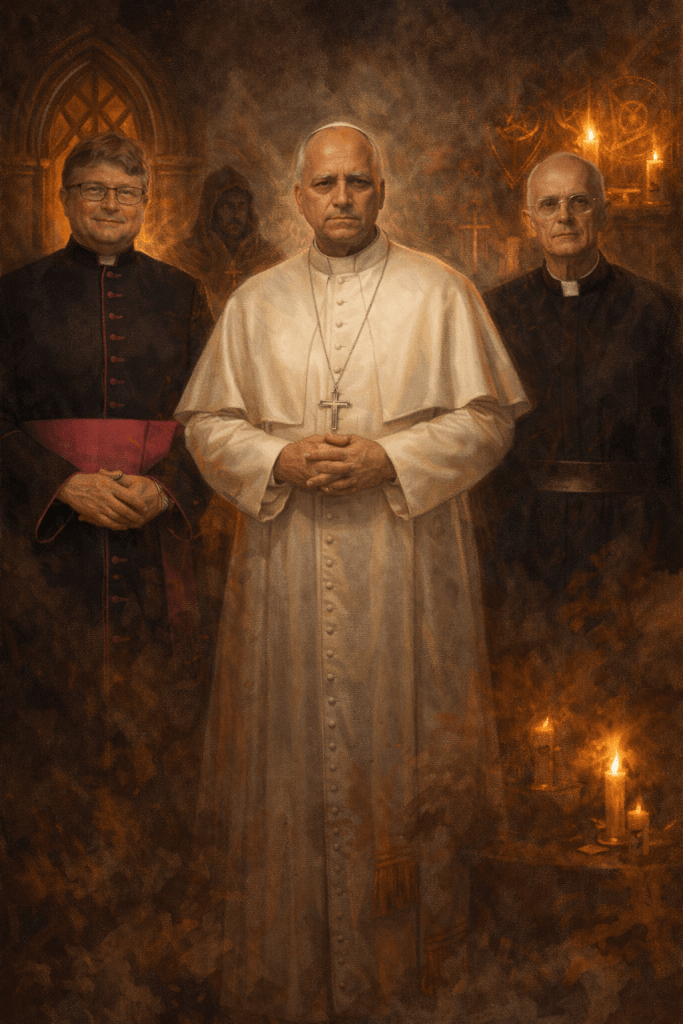
A recent Vatican meeting between Pope Leo XIV and the International Association of Exorcists underscores growing concern within the Church about the spread of occult practices and their spiritual consequences.
According to the exorcists, there has been a “noticeable rise” in involvement with “occultism, esotericism, and Satanism,” developments they associate with increasing cases of spiritual distress.¹ These trends are not viewed as abstract cultural shifts, but as realities encountered in pastoral work.
The delegation stressed that many individuals who engage in such practices experience serious harm, describing “grave spiritual suffering” among those affected.¹ In their view, these are not isolated incidents but part of a broader pattern requiring a structured response from the Church.
“Ignoring these realities leaves many people without an adequate response to grave spiritual suffering.”¹
For this reason, the exorcists emphasized the importance of ensuring that every diocese has properly trained clergy capable of addressing these situations. They called for stronger formation, clearer discernment, and greater institutional readiness.
At the same time, they acknowledged the complexity of these cases. The meeting highlighted the need for collaboration with medical and psychological professionals to distinguish between spiritual affliction and mental health conditions.¹ This cooperation is seen as essential for responsible pastoral care.
The Vatican framed the issue as one of accompaniment and guidance. Many who turn to occult or esoteric practices are described as searching for meaning or relief from personal struggles.¹ From the exorcists’ standpoint, this search can expose individuals to demonic influences that require careful spiritual intervention.
Overall, the meeting reflects a coordinated effort within the Church to respond to what exorcists describe as a growing pastoral challenge: one that involves both spiritual discernment and practical support for those affected.
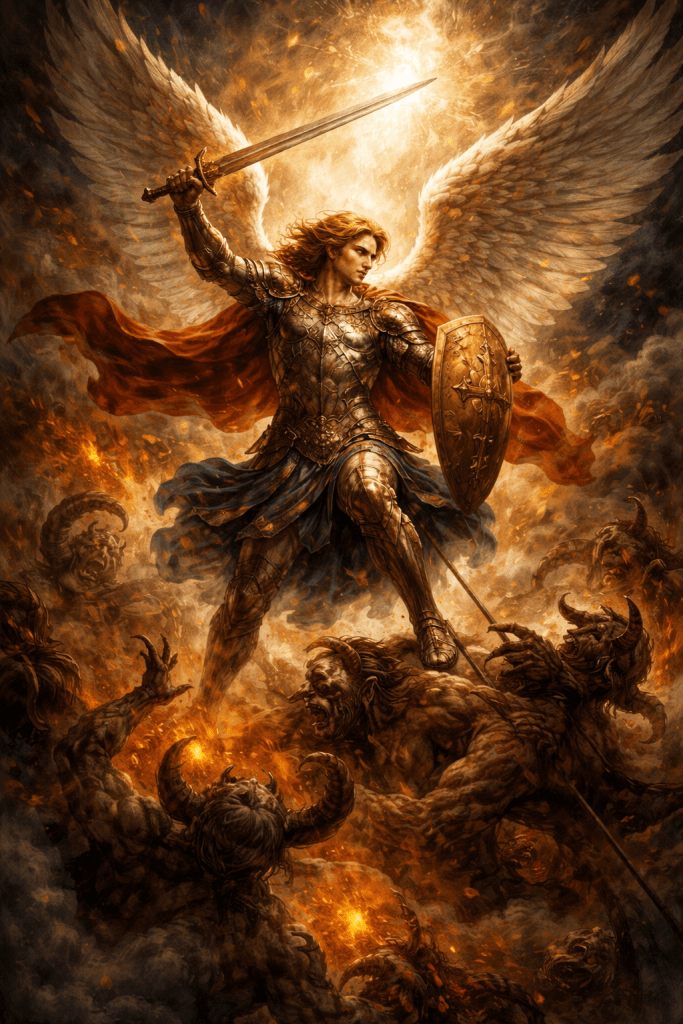
St. Michael the Archangel, defender of the faithful, stands as heaven’s warrior casting down the forces of darkness and waging relentless battle against demonic powers.
Footnote
Marty Vergel Baes, “Pope Leo XIV Hosts Exorcists at Vatican — Surge in Satanism Cases Raises Concern for Vulnerable Believers,” International Business Times UK, March 23, 2026.
A ritual battle scene: Kschetrapala rising from a burning sacrificial torma outside Lhasa, facing the monstrous nine-headed Chinese demon in a clash of spirit armies.
This article contains excerpts from The Shadow of the Dalai Lama: Sexuality, Magic and Politics in Tibetan Buddhism by Victor and Victoria Trimondi
Who were the Trimondis?
Victor and Victoria Trimondi are the pen names of German cultural historians Herbert and Mariana Röttgen. In the 1980s and early 1990s, they were active supporters of the Dalai Lama, translating and publishing his works into German and helping to organize international events in support of Tibet. Initially, they saw Tibetan Buddhism as a beacon of compassion and ethical renewal.
But their perspective changed. Over years of study, they became disillusioned by what they regarded as the darker, concealed aspects of Tibetan tantric Buddhism: ritual magic, sexual practices, secrecy, and the fusion of religion with political power. Their critical work The Shadow of the Dalai Lama: Sexuality, Magic and Politics in Tibetan Buddhism (2003) full text here seeks to expose these elements, drawing heavily on Tibetan source texts and the earlier ethnographic research of figures like René de Nebesky-Wojkowitz (Oracles and Demons of Tibet, 1956) and Matthias Hermanns.
Because of this trajectory, from enthusiastic supporters of Tibetan Buddhism to outspoken critics, the Trimondis occupy a controversial position. Admirers of Tibetan Buddhism accuse them of exaggeration and hostility, but their book nonetheless catalogs texts, rituals, and historical examples that complicate the popular image of Tibetan Buddhism as peaceful and compassionate.
The following excerpts illustrate how the Trimondis argue that ritual magic was systematically integrated into Tibetan politics and warfare:
Invocation of demons Since time immemorial ritual magic and politics have been one in Tibet. A large proportion of these magic practices are devoted to the annihilation of enemies, and especially to the neutralizing of political opponents. The help of demons was necessary for such ends. And they could be found everywhere — the Land of Snows all but overflowed with terror gods, fateful spirits, vampires, ghouls, vengeful goddesses, devils, messengers of death and similar entities, who, in the words of Matthias Hermanns, “completely overgrow the mild and goodly elements [of Buddhism] and hardly let them reveal their advantages” (Hermanns, 1965, p. 401).
For this reason, invocations of demons were not at all rare occurrences nor were they restricted to the spheres of personal and family life. They were in general among the most preferred functions of the lamas. Hence, “demonology” was a high science taught at the monastic universities, and ritual dealings with malevolent spirits were — as we shall see in a moment — an important function of the lamaist state.
The war demon Kschetrapala Once the gods had accepted the sacrifice they stood at the ritual master’s disposal. The four-armed protective deity, Mahakala, was considered a particularly active assistant when it came to the destruction of enemies. In national matters his bloodthirsty emanation, the six-handed Kschetrapala, was called upon. The magician in charge wrote the war god’s mantra on a piece of paper in gold ink or blood from the blade of a sword together with the wishes he hoped to have granted, and began the invocation.
Towards the end of the forties the Gelugpa lamas sent Kschetrapala into battle against the Chinese. He was cast into a roughly three-yard high sacrificial cake (or torma). This was then set alight outside Lhasa, and whilst the priests lowered their victory banner the demon freed himself and flew in the direction of the threatened border with his army. A real battle of the spirits took place here, as a “nine-headed Chinese demon”, who was assumed to have assisted the Communists in all matters concerning Tibet, appeared on the battlefield. Both spirit princes (the Tibetan and the Chinese) have been mortal enemies for centuries. Obviously the nine-headed emerged from this final battle of the demons as the victor.
“Voodoo magic” in Tibetan Buddhism The practice widely known from the Haitian voodoo religion of making a likeness of an enemy or a doll and torturing or destroying this in their place is also widespread in Tibetan Buddhism. Usually, some substance belonging to the opponent, be it a hair or a swatch from their clothing, has to be incorporated into the substitute. It is, however, sufficient to note their name on a piece of paper…
Such “voodoo practices” were no rare and unhealthy products of the Nyingmapa sect or the despised pre-Buddhist Bonpos. Under the Fifth Dalai Lama they became part of the elevated politics of state. The “Great Fifth” had a terrible “recipe book” (the Golden Manuscript) recorded on black thangkas which was exclusively concerned with magical techniques for destroying an enemy.
Why all this matters
These passages highlight a side of Tibetan Buddhism that is largely hidden from public view: the integration of destructive magic and spirit warfare into the machinery of the lamaist state. Nebesky-Wojkowitz’s research on ritual manuals, Hermanns’ cultural observations, and the Trimondis’ synthesis all converge on the same conclusion: alongside compassion and wisdom, Tibetan Buddhism preserved and continues to use technologies of coercion and violence.
For modern practitioners and students in the West, this raises unavoidable questions:
Are newcomers told that tantric ritual includes not only deities of compassion but also demon invocations and rites of subjugation? What risks do these violent magical technologies pose for the unsuspecting student?
What does “consent” mean if disciples are invited to take refuge in Tibetan Buddhism and receive empowerments without knowledge of these dimensions?
How much of this is framed as symbolic or metaphorical today, and is that distinction clearly explained? Evidence suggests that such practices continue much as they did in the past, which makes a thorough and honest examination all the more urgent.
Conclusion
The Trimondis’ work is controversial, but it is also important because it insists on remembering what is usually forgotten or denied. If the compassionate face of Tibetan Buddhism is to be embraced honestly, then its shadow side, the reality of political magic, demon invocations, and coercive ritual, must also be acknowledged. Only then can students and practitioners engage with full awareness, rather than be fooled by the illusion of partial truths.
Before the modern age romanticized pagan religions into New Age panaceas, ancient worship was known to be raw and brutally pragmatic. In our modern spiritual-industrial complex, it is often sugarcoated into some kind of warm, earth-loving ceremony filled with personal empowerment and divine intimacy. But if you’re reading this, you’re probably already suspicious of that narrative.
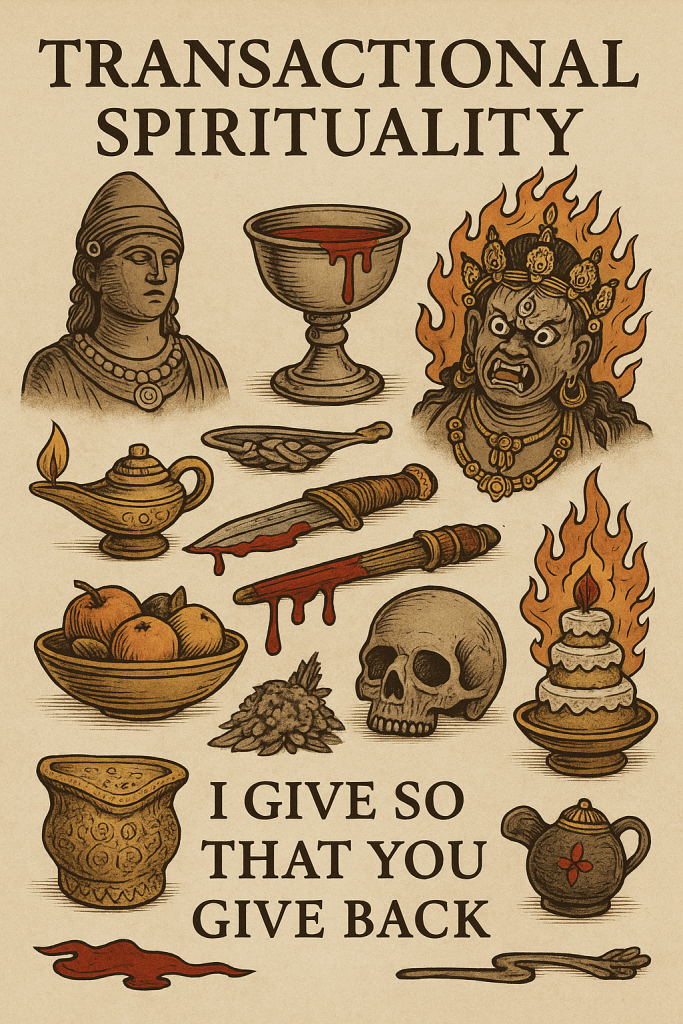
In fact ancient religion, pagan religion, was highly transactional. The gods didn’t love you. They didn’t weep over your suffering or aspire to protect you.
A passage from Behold the Christ: Proclaiming the Gospel of Matthew by Leroy A. Huizenga makes this brutally clear. Pagan worship, he writes, operated on the ancient principle of do ut des: “I give so that you give back.”(1) In other words, the gods and humans used each other. You offered sacrifices, incense, food, or praise not out of adoration, but because you wanted something in return: good crops, protection in war, fertility, rain, wealth, healing, vengeance, and victory. And the gods? They wanted to be fed, praised, and kept relevant. It was mutual exploitation dressed up in sacred costume.
“That is, the worshipper provides a sacrifice to a god that pleases and empowers the god, who then turns around and does the worshipper favors. Because the gods are often indifferent to humans, worshippers engage in repeated ritual to reach out and get a god’s attention.”
This paragraph says more about ancient spirituality than most modern New Age books on “manifesting” or “connecting with the divine.” The ancients weren’t confused. They understood that the gods were powerful, unpredictable, and not especially interested in human wellbeing unless there was something in it for them.
And this wasn’t limited to Rome or Greece. Versions of do ut des appear in Vedic sacrifice, Mesopotamian temple economies, and also Tantric Buddhist practice where offerings are made to wrathful deities to invoke, control, or appease.
Nowhere is this transactional logic more systematized and ritualized to the point of industrial precision than in Tibetan Buddhism. While cloaked in the language of enlightenment and compassion, the tradition is saturated with mechanisms that mirror the ancient do ut des economy: elaborate offerings, incense, butter lamps, mandalas, and tormas (sacrificial cakes that replaced blood offerings when the Buddhist principle of ahimsa “non-harming” took root). These were given not out of unconditional reverence, but to elicit specific outcomes from specific deities. Monastic liturgies are not just meditative recitations, but are negotiations with a pantheon of wrathful and peaceful beings, each with their own preferences, powers, and temperaments. Moreover, the non-harming sentiment in Tibetan Buddhism only extends so far. While Buddhist tantra forbids blood sacrifice, its subjugation rituals, aimed at both spiritual and human enemies, can involve some of the most brutal punishments found in any ritual religion.
Drupchöd ceremonies, held in large monasteries, exemplify this beautifully. These are days- or weeks-long ritual marathons involving collective chanting, visualization, music, mudras, and vast offerings, all designed to propitiate deities into bestowing protection, wisdom, and worldly benefits like health and prosperity. Whether invoking Mahakala to remove obstacles or Tara for swift blessings, the assumption is clear: the deity acts when properly fed, praised, and invoked. The gods (or enlightened beings, depending on your doctrinal parsing) are not passively watching; they’re participants in a cosmic economy, and Tibetan Buddhism, more than almost any other tradition, has mastered the bureaucratic apparatus needed to transact with them. It’s not just about personal devotion. It’s about correct performance, correct offerings, and the correct “exchange rate” of ritual. The love of the gods is not assumed. Their attention must be earned over and over again.
Modern Takeaways and a Warning
This transactional pattern isn’t limited to ancient paganism or esoteric Tibetan ritualism. You’ll find the same spiritual economy alive and well in the darker corners of contemporary occultism. Take it from someone like Riaan Swiegelaar who’s lived on the other side: former Satanists and occult practitioners routinely speak of offering sacrifices, especially blood, to demons in order to negotiate outcomes.(2)
He described it well: “A lot of people ask me, ‘Why are there so many sacrifices in Satanism? Why is there blood?’ The answer is simple: blood has currency in the spirit world. If I want to negotiate with demons, I need to bring an [animal] sacrifice because that blood holds value. It functions as spiritual capital.
“But here’s the contrast: the blood of Jesus is the highest currency in the spirit world. It covers everything. That’s the authority we stand on. And every ex-Satanist or ex-occultist who’s encountered Christ will tell you the same thing. I might be the only one talking about it openly, but this is real: we engaged in negotiations with demons, offered animal sacrifices, and got results. That’s how the system worked. Then we experienced the blood and love of Christ and there’s no comparison. It’s not even close. His blood is infinitely more powerful. In spiritual warfare, people need to grasp that reality. The blood of Christ is free, but it is not cheap, is it? It came at the highest cost. And what happened on the cross? That wasn’t a one-time transaction in history: it remains as valid, active, and potent today as it was then, and always will be.”
This is so important that it bears repeating: no spiritual currency, no ritual offering, no demonic pact compares to the raw, unmatched power of the blood of Christ. This is the rupture at the heart of Christianity: the economy of sacrifice is over, not because gods stopped demanding payment, but because one sacrifice bankrupted the system.
From blood-soaked altars in Babylon to ritual offering tormas in Himalayan monasteries, humanity has always traded devotion for power and offerings for favor. But the cross flipped the script. There is no more need for bartering, manipulation, and performance to win divine attention. What Christ offered wasn’t another payment into the cosmic vending machine but a final act that rendered the machine obsolete. And if that’s true, then every attempt to re-enter the old system, whether through pagan ritual, tantric bureaucracy, or occult negotiation, isn’t just a return to tradition. It’s a rejection of victory.
(1) Leroy A. Huizenga, Behold the Christ: Proclaiming the Gospel of Matthew (Emmaus Road Publishing, Steubenville, Ohio).
(2) Riaan Swiegelaar, former co-founder of the South African Satanic Church, in various public testimonies including interviews and livestreams (e.g., “Riaan Swiegelaar Testimony,” YouTube, 2022), has spoken openly about blood sacrifice as spiritual currency and his eventual conversion after experiencing the love of Christ.
Yesterday, Dan Rivera, a U.S. Army veteran and lead investigator for the New England Society for Psychic Research (NESPR), died suddenly during a tour in Gettysburg, Pennsylvania. Rivera, 54, was headlining the sold-out “Devils on the Run Tour,” a paranormal event centered around the infamous Annabelle doll, which inspired the Conjuring film series. Emergency responders performed CPR at his hotel, but Rivera was pronounced dead at the scene. Exact cause of death is unclear. The irony? Rivera died while promoting one of the most notorious cases of alleged demonic possession in American folklore.
Annabelle is no carnival sideshow. The Raggedy Ann doll was housed in the now-defunct Occult Museum founded by Ed and Lorraine Warren, the couple who brought demonic cases into the public eye long before Hollywood did. According to the Warrens, Annabelle had a history of real violence. Not metaphorical, but physical harm that left actual wounds. She caused slashes that drew blood. In one case, a priest who defied the doll reportedly crashed his car into a tree shortly after leaving. In another, a detective who came into contact with the doll was allegedly stabbed and forced into early retirement.
The Warrens took no chances. They sealed Annabelle in a locked glass and wood cabinet, built specifically to contain her. A large sign at the top read, “WARNING: POSITIVELY DO NOT OPEN,” and a crucifix was affixed nearby for protection. The case was blessed regularly by a Catholic priest, and the Warrens made it clear: no one was to touch the case, mock the doll, or treat her as a curiosity. The museum, as they described it, was not a showcase of artifacts; it was a containment zone for objects they believed were spiritually dangerous. And Annabelle was its most volatile resident. Ed Warren died in 2006, Lorraine in 2019, and after their deaths, Annabelle remained in the care of their son-in-law, Tony Spera. According to the New York Post article published on July 15, 2025, “In 2019, the museum closed to the public over zoning issues, and in recent years, they have toured around the US instead.” However, perhaps touring the country with a possessed doll wasn’t the greatest idea.
Annabelle’s case isn’t just a bizarre footnote in paranormal lore but a stark example of what happens when human curiosity crosses into forbidden territory. The line between fascination and spiritual danger is thinner than most people think
Flirting with Evil Is Not Harmless Curiosity
The Catholic Church has been blunt on this issue for centuries: do not engage with evil or attempt to communicate with it. The Church doesn’t take demons lightly because it understands their nature and knows they don’t play fair. Their goal is the destruction of body, mind, and soul.
Rivera’s death is not the first time a paranormal investigator has died while engaging in their work. In 2016, prominent demonologist Lorraine Warren warned publicly that even decades-old “cleansed” objects and locations still carried spiritual residue. In her words, the influence of evil does not simply go dormant, it waits.
Zak Bagans, host of Ghost Adventures, once had to close off a room in his Las Vegas museum containing what’s become known as a dybbuk box. Visitors reported nausea, blackouts, and even strokes after encountering it. One man died of a heart attack just hours after taunting the box on camera. The term “dybbuk box” refers to a modern, supposedly haunted object, often described as a wine cabinet that houses a malicious spirit rooted in Jewish folklore. Traditionally, a dybbuk is a dislocated soul believed to possess the living. However, the concept of trapping one in a box is a recent invention with no basis in authentic Jewish theology. The box was first popularized through a viral eBay listing and later sensationalized by paranormal media.
The Conjuring: A Fictional Mirror of a Spiritual Reality
Hollywood loves the Conjuring universe. Ghosts, demons, and haunted dolls are box office gold. But what people forget is that the source material isn’t fiction. These were real cases documented by the Warrens. And the “entertainment” factor trivializes the spiritual warfare at the heart of these phenomena.
This is where the deception lies. Evil often presents itself as fascinating and seductive—something to be conquered or controlled. But actual demonic entities are predatory. The more one invites them in, the greater the chance of a devastating outcome.
Dan Rivera’s Legacy: A Cautionary Tale
No one questions Rivera’s bravery or passion. But we must question the wisdom of his choices. Spiritual warfare is real. Whether Rivera’s death was directly supernatural or not is ultimately beside the point. The fact is, he died while immersed in the darkest corners of the supernatural, and he is far from the first.
The Church’s warnings aren’t outdated superstition: do not make a spectacle of evil. Do not exploit evil for entertainment. Some doors should stay shut.
Catholic exorcists consistently emphasize that full demonic possession is rare. Far more common are lesser forms of demonic influence, what the Church calls degrees of demonic attack. According to experts like Fr. Gabriele Amorth and Fr. Chad Ripperger, these stages are typically identified as:
Temptation (ordinary spiritual warfare)
Infestation (demonic presence in a place or object)
Oppression (external hardships caused by a demon)
Obsession (mental or emotional torment)
Possession (a demon controls the body, but not the soul)
Perfect Possession (the soul itself has given full consent to the demonic)
What Is Perfect Possession?
Fr. Malachi Martin, Jesuit priest, Vatican insider, and exorcist, famously warned of the phenomenon he called perfect possession. This occurs not when a demon forces its way into a person, but when a human being voluntarily invites and cooperates with a demonic entity over time until the human will is no longer in conflict with the demon’s presence. In such cases, the individual may appear calm, successful, and even spiritual, but has wholly aligned his or her soul with darkness.
Martin described this as the most terrifying form of possession because there is no resistance and often, no exorcism possible. The person has handed over consent of the will, and the demon resides not only in the body but in the soul.
This is not the ugly, contorted possession made famous by Hollywood. This is a quieter form of coexistence.
Possession Among the Occult Elite
Catholic exorcists often connect perfect possession to satanic priests, high-level occultists, or individuals who have undergone ritual consecration to Lucifer. It is the end point of a spiritual trajectory, not a single moment of sin. It involves years of voluntary cooperation with evil using ritual invocation, blood pacts, and blasphemous imitation of the sacraments.
But there is more discrete path that leads to the same end. It is cloaked in lotus flower imagery, Sanskrit mantras, and spiritual “blessings,” and is propagated by tantric adepts, yogis, and mahasiddhas who have spent years practicing yoga and ritual invocation of beings they consider to be deities.
Is Perfect Possession the Hidden Goal of Tantra?
In the Tibetan Vajrayana tradition, called “the quick path to enlightenment,” tantric practitioners visualize themselves as the deity. They merge consciousness with the god, goddess, or guru, often through esoteric or sexual ritual, in pursuit of realization.
But what if these “deities” are not who they claim to be?
What if they are counterfeit spirits or demonic intelligences disguised as beneficent beings of light?
In that case, the tantric adept is inviting an entity to live within him, again and again, through ritual, offerings, and mental surrender. Over time, the boundary between the self and the invoked being dissolves.
This is a form of spiritual possession.
And if the person no longer resists, if they call this possession “enlightenment,” then it seems to meet the classical definition of perfect possession or possession of the soul.
Signs of Perfect Possession in the Tantric World
Unlike Hollywood portrayals, the perfectly possessed do not foam at the mouth or speak in guttural Latin. Instead, they:
Radiate serenity, even as they worship gods of wrath and destruction
Exhibit supernatural knowledge or powers (siddhis), which are praised, not feared
Express total identification with the spirit/s they invoke
Are untouchable by traditional exorcism, because they do not want to be freed
In Catholic understanding, this is the most dangerous state of all because it involves no inner conflict, and therefore no pathway to repentance. The soul lives in union with a demon, often under the delusion that it is serving the good.
Satan Appears as an Angel of Light
Scripture warns us: “And no wonder, for even Satan disguises himself as an angel of light.” – 2 Corinthians 11:14
What better disguise than that of a esoteric deity offering long life, healing, spiritual bliss, and enlightenment?
Exorcists like Fr. Amorth and Fr. Martin remind us that total possession doesn’t happen by accident. Satan must be invited in. And perfect possession is the result of spiritual consent, repeated and ritualized over time.
Tantric practitioners may never use the language of possession. They may call it “liberation,” “non-duality,” or “union with the deity.”
But from the standpoint of Christian spiritual warfare, it is not liberation but captivity, sanctified and made beautiful. It is a demonic entity, ethereally robed and seated on lotus thrones, perfectly at home in the human soul. And it leaves the adept deeply indebted to demons.
Both Vajrayana and Luciferian rites use geometric portals to invoke spiritual forces and what comes through may not leave easily.
Follow-up to: “The ‘Hidden’ Truth of Vajrayana Empowerment: Does the Lama Implant a Deity into the Disciple’s Mind?”
Following the previous article “The ‘Hidden’ Truth of Vajrayana Empowerment,” which exposed how Tibetan tantric initiation involves the lama implanting a deity into the disciple’s mind-stream, this follow-up explores how that same core process, spiritual implantation, appears in Western occult and Satanic initiation rites. Though culturally and theologically distinct, both systems describe a mystical transformation in which the aspirant is indwelt, overshadowed, or spiritually fused with a nonhuman being. The parallels are striking, and the implications for unsuspecting spiritual seekers are sobering.
Union Through Inhabitation
In Vajrayana Buddhism, the empowerment ritual is designed to activate the disciple’s Buddha-nature by personifying it as a specific deity. This process is not symbolic; it requires the intervention of the guru, who performs a series of initiations (vase, secret, wisdom, and word) that culminate in the wisdom deity entering the disciple’s visualized form. Sam van Schaik and other scholars describe this as a fusion of two minds: the practitioner becomes “in union” with the deity.¹ Light or energy entering the heart symbolizes this transmission, and classical sources like Vilāsavajra² and Jamgön Kongtrul³ confirm that the deity’s presence is meant to take root within the initiate.
This process mirrors what takes place in various forms of Western occult initiation. Whether in ceremonial magic, Luciferian practice, or Thelemic rites, the aspirant invites a spiritual entity, sometimes framed as a “higher self” and other times as a demon or god-form, to inhabit or fuse with their consciousness.⁴ In certain traditions, this is done under the guise of awakening one’s divine essence or ascending the Tree of Life, but the mechanics remain: the person is inviting another spiritual will to merge with their own.
The Role of the Officiant
In Vajrayana, only a qualified guru can perform the empowerment. The lama must have realization of the deity in order to transmit it, effectively serving as a channel through which the deity is implanted into the disciple. The disciple cannot access the highest yoga tantra deity alone; it must come through the guru.⁵
In Western occultism, the structure is more flexible. In ceremonial lodges like the Golden Dawn, initiation is conferred by a hierarchy of initiates. In solitary or Luciferian paths, the practitioner may self-initiate, performing a ritual to invoke and receive a spiritual entity directly.⁶ This difference, hierarchical transmission versus self-directed invocation, changes the form but not the essence of what is happening: a spiritual being is invited in.
Seed and Possession
Both traditions speak of what can be described as a spiritual seed taking root in the initiate. In Vajrayana Buddhism this is the seed of the deity that is implanted through ritual and nurtured by mantra and visualization, growing into full enlightenment.⁷ In occult traditions, similar metaphors abound: the Black Flame (Luciferianism), divine spark (Gnosticism), or magical current (Thelema) all describe a presence awakened or implanted within the practitioner.⁸
Possession or identity fusion is not merely metaphorical in either tradition. In Vajrayana, the practitioner becomes the deity in practice and visualization. In Western occultism, invocation or evocation may result in the spirit speaking through the practitioner, taking partial or full control.⁹ The aspirant may not merely visualize the entity; they may be inhabited by it.
Theological Framing
Here is where the surface similarities give way to deeper concerns. Vajrayana presents this union as sacred and salvific. The deities are said to be manifestations of enlightened mind, and the process is aimed at liberation from suffering.
In contrast, many Western occult traditions embrace the transgressive nature of the ritual. In Luciferian and Satanic paths, the union with a spiritual being is framed as an act of rebellion, empowerment, or divinization.¹⁰ Even in systems that use angelic or archetypal language, the goal is often gnosis independent of God, power over nature, or rejection of traditional morality.
From a Christian theological perspective, both processes, however cloaked in cultural or religious language, involve the opening of the soul to spiritual beings not of God.¹¹ Whether the entity is labeled as a deity, guardian angel, or inner Buddha, the core act is the same: inviting possession or fusion with a nonhuman intelligence. Exorcists describe demons as “persons without bodies.”
Deliberate Secrecy vs. Ritual Transparency
Another key difference lies in disclosure. Vajrayana does not typically explain to new initiates that the lama will implant the deity into their mindstream. This is concealed under layers of euphemisms, talk of “blessings,” “inspiration,” or “awakening Buddha-nature”.¹² Western occultism, by contrast, often acknowledges its aims more directly. A Luciferian magician knows they are invoking Lucifer. A Thelemite understands the goal is Knowledge and Conversation with a higher being.¹³
But the result is no less dangerous. Both systems involve entering into a spiritual relationship that can dominate or override the practitioner’s will. From a Christian point of view, these are not symbolic practices but acts of spiritual surrender and potentially, spiritual bondage.
Conclusion: Two Paths, One Mechanism
While Vajrayana tantra and Western occultism differ in terminology, mythos, and cultural packaging, they share a core mechanism: a ritual invitation for a spiritual being to enter the initiate’s consciousness. Whether masked as deity yoga or celebrated as demonic possession, the outcome is the same: identity fusion with a nonhuman spirit.
The true danger lies not only in the act itself but in the lack of informed consent. Many Vajrayana practitioners never fully understand what they’ve opened themselves to until it’s too late. And many occultists, lured by the promise of empowerment, mistake possession for enlightenment.
As explored on this blog, the deeper deception is the true nature of “possession” rituals versus how they are presented. Spiritual seekers deserve the truth: that these practices, whether called empowerment or initiation, are not harmless techniques for personal growth and transcendence. They are open doors: both Vajrayana and Luciferian rites use geometric portals to invoke spiritual forces and what walks through may not be your friend or leave easily.
Sources
Sam van Schaik, “The Limits of Transgression: The Samaya Vows of Mahāyoga” (2010).
Vilāsavajra, Hevajra Tantra Commentary, excerpts found in Mahāyoga textual studies.
Jamgön Kongtrul, The Treasury of Knowledge, Book Eight, Part Three.
Aleister Crowley, Magick in Theory and Practice; Michael Ford, Luciferian Witchcraft.
Ngawang Phuntsok, On Receiving Wang (Empowerment).
Israel Regardie, The Golden Dawn: A Complete System of Magic.
Dalai Lama, Kalachakra Initiation Teachings; traditional commentaries on empowerment.
Michael W. Ford, Apotheosis: The Ultimate Beginner’s Guide to Luciferianism.
Kenneth Grant, The Magical Revival; practices in chaos and ceremonial magic.
Anton LaVey, The Satanic Bible; Ford, Dragon of the Two Flames.
Catechism of the Catholic Church, paragraphs 2116–2117.
Scott Globus, “Empowerments: Awakening the Buddha Within,” Rubin Museum, 2021.
Aleister Crowley, The Vision and the Voice; Liber Samekh.





 Tantric Deception