Kundalini Possession vs. Classic Demonic Possession: A Comparative Study


Kundalini is often described in modern yoga and New Age spirituality as a universal spiritual energy coiled at the base of the spine, waiting to rise and bring enlightenment. This portrayal is misleading. In reality, what is called a “kundalini awakening” is better understood as a form of possession. Rather than a benign inner energy, kundalini is a demonic force that enters the human mind-body continuum, hijacks the nervous system, and rewires perception, behavior, and physiology. This explains why the symptoms of kundalini often overlap with those of classic demonic possession.

Symptoms: Kundalini Possession vs. Demonic Possession

Kundalini possession symptoms

  • Involuntary bodily spasms or kriyas, often violent or exhausting.
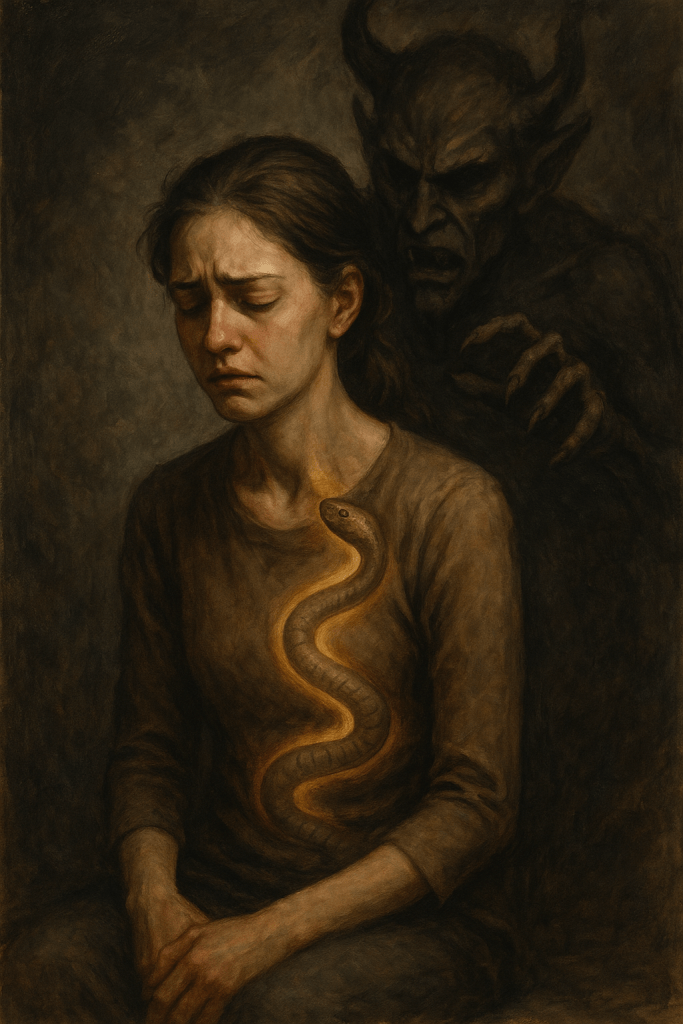
  • A sensation of a serpent or current moving through the spine, causing heat, pressure, or pain.
  • Rapid swings between bliss and terror, often accompanied by visions or auditory phenomena.
  • Disassociation and feelings of being controlled by something non-human.
  • Progressive neurological deterioration: insomnia, paranoia, and psychosis.
  • Identification with Hindu deities or serpentine archetypes, which parallels demonic manifestations described in other cultures.

Demonic possession symptoms (more broadly recognized)

  • Aversion to the sacred, where holy names, prayers, or symbols provoke rage.
  • Manifestations of supernatural strength or the sudden ability to speak foreign languages.
  • Violent outbursts, self-harm, or aggression against others.
  • Distorted voice, grotesque facial expressions, or animal-like behavior.
  • Physical disturbances such as objects moving, foul odors, or sudden temperature drops.
  • A clear sense of hostile external control.

Both states are marked by loss of sovereignty and the intrusion of an alien intelligence. What makes kundalini more deceptive is that it cloaks itself in the language of spiritual progress.

The Entities Behind the Possessions

Kundalini-related beings

  • Kundalini is personified as Shakti, the serpent goddess. While Hindu texts portray her as divine, serpent symbolism universally points to deception and danger, as the serpent has long been associated with Satan in Christianity.
  • Many afflicted report contact with or identification as Kali, Durga, or other fierce Hindu and tantric Buddhist deities whose attributes of blood, violence, and intoxication align closely with demonic qualities.

Entities in wider demonic possession

  • Christianity: fallen angels under Satan’s authority.
  • Islam: malicious jinn, created from smokeless fire.
  • Judaism: dybbuks, wandering spirits of the dead seeking to inhabit bodies.
  • Indigenous traditions: hungry ghosts, nature demons, or restless ancestral spirits.

The same destructive force that is worshiped in India as divine feminine energy is interpreted in other traditions as demonic intrusion.

Why Kundalini Possession Often Appears Different

There are many anecdotal accounts of people afflicted by kundalini who do not display the same dramatic symptoms seen in major exorcisms performed by the Catholic Church. They may not display superhuman strength, speak unknown languages, or react violently to holy objects. Instead, their suffering appears as neurological collapse or uncontrollable kriyas.

Why does this happen? One possibility is what some exorcists call “perfect possession.” By willingly engaging in yoga, Eastern meditation, or tantric practices, the person effectively invites the spirit in. Once invited, the demon does not always need to manifest with violence or open hostility. It is already enthroned, so to speak, in the person’s consciousness and nervous system. It burrows in and embeds itself. The possession is often quieter but no less real.

Another possibility is that kundalini spirits simply manifest differently than other categories of demons. The absence of classic symptoms described by the Catholic Church may not mean the person is not possessed. It may mean they are afflicted by a different type of spirit, or by a demon whose preferred mode of influence is more insidious and long-term. Rather than breaking furniture or speaking in foreign tongues, it works by corrupting the nervous system, trapping the victim in cycles of ecstatic highs and devastating lows, and slowly eroding the mind and spirit.

Implications for the Catholic Church

Because many of these cases do not fit the criteria traditionally used to diagnose possession, individuals suffering from kundalini affliction are sometimes turned away by exorcists. Yet the sheer number of Westerners who have turned to yoga, meditation, and tantric practices since the 1960s suggests that the Church may need to reevaluate how possession presents in modern contexts. Kundalini demons may not manifest with the same overt signs as other kinds of possession, but their effects are no less destructive.

To dismiss these cases as mere psychological breakdowns risks ignoring an entire category of demonic assault that has proliferated under the guise of spirituality. The deceptive packaging of kundalini as “spiritual energy” makes it one of the most dangerous forms of possession today.

Playing with Fire: The Death of a Paranormal Investigator and the Perils of Inviting Evil


Yesterday, Dan Rivera, a U.S. Army veteran and lead investigator for the New England Society for Psychic Research (NESPR), died suddenly during a tour in Gettysburg, Pennsylvania. Rivera, 54, was headlining the sold-out “Devils on the Run Tour,” a paranormal event centered around the infamous Annabelle doll, which inspired the Conjuring film series. Emergency responders performed CPR at his hotel, but Rivera was pronounced dead at the scene. Exact cause of death is unclear. The irony? Rivera died while promoting one of the most notorious cases of alleged demonic possession in American folklore.

Annabelle is no carnival sideshow. The Raggedy Ann doll was housed in the now-defunct Occult Museum founded by Ed and Lorraine Warren, the couple who brought demonic cases into the public eye long before Hollywood did. According to the Warrens, Annabelle had a history of real violence. Not metaphorical, but physical harm that left actual wounds. She caused slashes that drew blood. In one case, a priest who defied the doll reportedly crashed his car into a tree shortly after leaving. In another, a detective who came into contact with the doll was allegedly stabbed and forced into early retirement.

The Warrens took no chances. They sealed Annabelle in a locked glass and wood cabinet, built specifically to contain her. A large sign at the top read, “WARNING: POSITIVELY DO NOT OPEN,” and a crucifix was affixed nearby for protection. The case was blessed regularly by a Catholic priest, and the Warrens made it clear: no one was to touch the case, mock the doll, or treat her as a curiosity. The museum, as they described it, was not a showcase of artifacts; it was a containment zone for objects they believed were spiritually dangerous. And Annabelle was its most volatile resident. Ed Warren died in 2006, Lorraine in 2019, and after their deaths, Annabelle remained in the care of their son-in-law, Tony Spera. According to the New York Post article published on July 15, 2025, “In 2019, the museum closed to the public over zoning issues, and in recent years, they have toured around the US instead.” However, perhaps touring the country with a possessed doll wasn’t the greatest idea.

Annabelle’s case isn’t just a bizarre footnote in paranormal lore but a stark example of what happens when human curiosity crosses into forbidden territory. The line between fascination and spiritual danger is thinner than most people think


Flirting with Evil Is Not Harmless Curiosity

The Catholic Church has been blunt on this issue for centuries: do not engage with evil or attempt to communicate with it. The Church doesn’t take demons lightly because it understands their nature and knows they don’t play fair. Their goal is the destruction of body, mind, and soul.

Rivera’s death is not the first time a paranormal investigator has died while engaging in their work. In 2016, prominent demonologist Lorraine Warren warned publicly that even decades-old “cleansed” objects and locations still carried spiritual residue. In her words, the influence of evil does not simply go dormant, it waits.

Zak Bagans, host of Ghost Adventures, once had to close off a room in his Las Vegas museum containing what’s become known as a dybbuk box. Visitors reported nausea, blackouts, and even strokes after encountering it. One man died of a heart attack just hours after taunting the box on camera. The term “dybbuk box” refers to a modern, supposedly haunted object, often described as a wine cabinet that houses a malicious spirit rooted in Jewish folklore. Traditionally, a dybbuk is a dislocated soul believed to possess the living. However, the concept of trapping one in a box is a recent invention with no basis in authentic Jewish theology. The box was first popularized through a viral eBay listing and later sensationalized by paranormal media.


The Conjuring: A Fictional Mirror of a Spiritual Reality

Hollywood loves the Conjuring universe. Ghosts, demons, and haunted dolls are box office gold. But what people forget is that the source material isn’t fiction. These were real cases documented by the Warrens. And the “entertainment” factor trivializes the spiritual warfare at the heart of these phenomena.

This is where the deception lies. Evil often presents itself as fascinating and seductive—something to be conquered or controlled. But actual demonic entities are predatory. The more one invites them in, the greater the chance of a devastating outcome.


Dan Rivera’s Legacy: A Cautionary Tale

No one questions Rivera’s bravery or passion. But we must question the wisdom of his choices. Spiritual warfare is real. Whether Rivera’s death was directly supernatural or not is ultimately beside the point. The fact is, he died while immersed in the darkest corners of the supernatural, and he is far from the first.

The Church’s warnings aren’t outdated superstition: do not make a spectacle of evil. Do not exploit evil for entertainment. Some doors should stay shut.


The Subconscious as Battleground: Demonic Infiltration Through the Wounds of the Psyche


In our modern world, the subconscious is often reduced to a psychological artifact, a repository of repressed memories, habits, and impulses. But from a biblical and Catholic standpoint, this internal space is more than just a vault of emotion and instinct. It is a spiritual battleground and a vulnerable domain where real entities, such as demons seek entry and control.

I speak not in theory but from personal experience. As someone who has lived through the horror of possession, I know firsthand what it means to have my subconscious colonized by non-physical forces, in particular, Tantric deities and the so-called yidams (meditational deities) I once invoked in long term retreats. They now exert control over my dreams at night, not as fragments of memory, but with an intention, force, and intelligence all their own.

Trauma, Sin, and the Open Doors

The Catholic tradition is clear: sin creates openings. These are spiritual vulnerabilities through which demonic powers can assert influence. But it’s not always sin, but often wounds and traumas that become entry points. This aligns, ironically, with what Jung called the shadow: the parts of ourselves we deny or fail to integrate.

In occult and tantric frameworks, these shadows are often “worked with” i.e. ritualistically invited, named, and visualized. In my case, the visualizations of the yidam were never just symbolic. They were summonings that invited intelligent spiritual entities through geometric portals into the liminal space of my subconscious mind.

Obviously, tantric rituals are powerful, but the power is not “of God.” The light of Christ later revealed to me that what I had opened myself up to were demonic counterfeits or parasitic forces clothed in deceptive splendor.

The Subconscious

While the Jungian model treats these internal figures such as archetypes, gods, and dreams, as symbolic representations of the psyche, Biblical scripture offers a different view. Ephesians 6:12 tells us that our struggle is “not against flesh and blood, but against principalities, against powers, against the rulers of the darkness of this world.”

What modern psychology calls “unconscious drives” may, in reality, be demonic actors exploiting our blind spots. They can manifest through thoughts, compulsions, visions, or dreams. They don’t just influence behavior, they shape the architecture of perception, infiltrating belief itself. This is why confession and deliverance are not just spiritual maintenance but are spiritual war strategies.

Dreams: The Nightly Invasion

The yidam I practiced during my retreats appears nightly, manipulating my dreams and injecting disturbing images, physical sensations, and false feelings of failure and yearning. It tries to arouse old loyalties alternating between affects of pseudo kindness and visions of cruel and bitter punishments. These dream invasions foster confusion and despair; and sometimes cause sensations of physical torment.

From a biblical perspective, dreams are a legitimate domain of spiritual communication, but that doesn’t mean all dream figures are from God. In Jeremiah 23, the Lord condemns false prophets who “make my people forget my name by their dreams.” Satan can disguise himself as an angel of light and in my experience, tantric deities do precisely that.

We must recognize the subconscious not as a private fortress, but as a permeable space, one that requires guarding, cleansing, and illumination by Christ alone. Anything else, especially tantric visualization and archetypal meditation, opens up doors we cannot close on our own.

There is no neutral spirituality. Every spiritual practice either opens the soul to grace or to deception. As one who has been inside the snare, I say this without hesitation: tantric deities are demons in disguise, and their preferred hiding place is the very part of us we least understand: the subconscious.

But Jesus Christ, in His mercy, descends even into those hidden caverns, casting out darkness and healing the wounds that made us vulnerable in the first place.

“For this purpose the Son of God was manifested, that He might destroy the works of the devil.”
— 1 John 3:8

Perfect Possession: The Hidden Endgame of the Tantric Path?


Catholic exorcists consistently emphasize that full demonic possession is rare. Far more common are lesser forms of demonic influence, what the Church calls degrees of demonic attack. According to experts like Fr. Gabriele Amorth and Fr. Chad Ripperger, these stages are typically identified as:

  • Temptation (ordinary spiritual warfare)
  • Infestation (demonic presence in a place or object)
  • Oppression (external hardships caused by a demon)
  • Obsession (mental or emotional torment)
  • Possession (a demon controls the body, but not the soul)
  • Perfect Possession (the soul itself has given full consent to the demonic)

What Is Perfect Possession?

Fr. Malachi Martin, Jesuit priest, Vatican insider, and exorcist, famously warned of the phenomenon he called perfect possession. This occurs not when a demon forces its way into a person, but when a human being voluntarily invites and cooperates with a demonic entity over time until the human will is no longer in conflict with the demon’s presence. In such cases, the individual may appear calm, successful, and even spiritual, but has wholly aligned his or her soul with darkness.

Martin described this as the most terrifying form of possession because there is no resistance and often, no exorcism possible. The person has handed over consent of the will, and the demon resides not only in the body but in the soul.

This is not the ugly, contorted possession made famous by Hollywood. This is a quieter form of coexistence.

Possession Among the Occult Elite

Catholic exorcists often connect perfect possession to satanic priests, high-level occultists, or individuals who have undergone ritual consecration to Lucifer. It is the end point of a spiritual trajectory, not a single moment of sin. It involves years of voluntary cooperation with evil using ritual invocation, blood pacts, and blasphemous imitation of the sacraments.

But there is more discrete path that leads to the same end. It is cloaked in lotus flower imagery, Sanskrit mantras, and spiritual “blessings,” and is propagated by tantric adepts, yogis, and mahasiddhas who have spent years practicing yoga and ritual invocation of beings they consider to be deities.

Is Perfect Possession the Hidden Goal of Tantra?

In the Tibetan Vajrayana tradition, called “the quick path to enlightenment,” tantric practitioners visualize themselves as the deity. They merge consciousness with the god, goddess, or guru, often through esoteric or sexual ritual, in pursuit of realization.

But what if these “deities” are not who they claim to be?

What if they are counterfeit spirits or demonic intelligences disguised as beneficent beings of light?

In that case, the tantric adept is inviting an entity to live within him, again and again, through ritual, offerings, and mental surrender. Over time, the boundary between the self and the invoked being dissolves.

This is a form of spiritual possession.

And if the person no longer resists, if they call this possession “enlightenment,” then it seems to meet the classical definition of perfect possession or possession of the soul.

Signs of Perfect Possession in the Tantric World

Unlike Hollywood portrayals, the perfectly possessed do not foam at the mouth or speak in guttural Latin. Instead, they:

  • Radiate serenity, even as they worship gods of wrath and destruction
  • Exhibit supernatural knowledge or powers (siddhis), which are praised, not feared
  • Express total identification with the spirit/s they invoke
  • Are untouchable by traditional exorcism, because they do not want to be freed

In Catholic understanding, this is the most dangerous state of all because it involves no inner conflict, and therefore no pathway to repentance. The soul lives in union with a demon, often under the delusion that it is serving the good.

Satan Appears as an Angel of Light

Scripture warns us:
“And no wonder, for even Satan disguises himself as an angel of light.” – 2 Corinthians 11:14

What better disguise than that of a esoteric deity offering long life, healing, spiritual bliss, and enlightenment?

Exorcists like Fr. Amorth and Fr. Martin remind us that total possession doesn’t happen by accident. Satan must be invited in. And perfect possession is the result of spiritual consent, repeated and ritualized over time.

Tantric practitioners may never use the language of possession. They may call it “liberation,” “non-duality,” or “union with the deity.”

But from the standpoint of Christian spiritual warfare, it is not liberation but captivity, sanctified and made beautiful. It is a demonic entity, ethereally robed and seated on lotus thrones, perfectly at home in the human soul. And it leaves the adept deeply indebted to demons.

Tantric Āveśa and Demonic Possession: A Comparative Exploration


Āveśa (Sanskrit) refers to a state of spiritual possession or divine inhabitation in which a deity or sacred power “enters” and dwells within a person. The word literally means “an entering” or “fusion,” describing the incorporation of divine power into the human body. Such forms of sacred possession have long been central to Indian Tantric practice, invoked for both worldly benefits (bhoga) and spiritual liberation (mokṣa). This is often contrasted with demonic possession in Christian theology, typically characterized as an involuntary affliction by an evil spirit.

Cross-cultural studies note that spirit possession can be either voluntary or involuntary, and it is interpreted differently depending on the tradition. Western occult traditions, such as Luciferianism, may view possession by a demon as desirable, even leading to a so-called “perfect possession.” In Christianity, however, even voluntary possession by a demonic force is considered evil. The question then arises: who or what possesses the practitioner in Eastern contexts?

Towards the end of my 35 years in Tantric Buddhism, I came to believe that the force presenting itself as a deity was, in fact, demonic. In what follows, I will examine the phenomenon of āveśa in two major esoteric traditions, Hindu Tantra (especially Shaiva lineages such as Kashmir Shaivism), and Tibetan Vajrayāna Buddhism. I will contrast these forms of divinely sanctioned possession with demonic possession in Christian and occult frameworks, drawing from historical sources, academic analysis, and personal experience.


Āveśa in Hindu Tantric Traditions

Scriptural Origins and Tantric Development

The Sanskrit root ā-viś (to enter) appears in early Indian texts, foreshadowing the later Tantric elaboration of āveśa.1 From the 5th to 11th centuries, Tantric scriptures across Śāiva, Śākta, and Buddhist milieus incorporated āveśa into ritual practice. Scholar Vikas Malhotra describes āveśa as the “entrance or fusion of oneself with the deity,” central to both magical and liberatory goals.2

These practices utilized mantras, mudrās, and nyāsa (installing mantras on the body) to induce the deity’s presence. Often this process was linked to śaktipāta, or the descent of divine energy. Over time, āveśa came to refer not just to deity possession, but a range of spiritual states culminating in union with Śiva.3 In contrast to exorcism (removing evil spirits), this adorcistic form of possession aimed to invite a divine presence.

Kashmir Shaivism and Samāveśa

In the Trika system of Kashmir Shaivism, the term samāveśa refers to full ontological immersion in Śiva-consciousness. Abhinavagupta, a 10th-century Hindu philosopher and Tantric adept, defined it as a merger of individual and divine being, sometimes accompanied by shaking, trance, or devotional ecstasy.4 Rituals such as nyāsa or advanced mudrā usage were seen as ways to divinize the body. Kṣemarāja, a key Trika commentator, emphasized that the body itself becomes a vessel for cosmic forces, eroding the sense of ego.5

This idea extended to daily ritual. The practitioner installs divine presences into various body parts—e.g., “May Brahmā be in my genitals, ViṣŇu in my feet, Śiva in my heart”—until the self is transformed.6 Āveśa was also connected to śaktipāta dīkṣā (initiation by grace), which Abhinavagupta saw as the guru’s transmission of divine force into the student.

Historical sources and hagiographies portray this not as pathology but sacred awakening. In the Bhakti tradition, saints like Caitanya and Rāmakṛṣṇa exhibited signs interpreted as divine possession, a loss of ordinary consciousness during worship or dancing in states of trance. In goddess worship, the ecstatic state of bhāva can evolve into full possession by a fierce Devī or goddess.

Induced Trance in Ritual Practice

Possession is not accidental; it is often deliberately induced. Contemporary folk-Tantric rites like Theyyam in Kerala reenact this vividly. The performer undergoes intense ritual preparation, dons a sacred headdress, and becomes a vessel for the deity. His demeanor, voice, and movements change dramatically, and devotees approach him as a god.7 These techniques including fasting, music, sacred garb, and mantra, parallel ancient Tantric rituals meant to induce āveśa.

Importantly, this experience is consensual. A priest may invite a deity for oracular guidance or blessing. The Tantric yogi similarly invites identification with Śiva. As Frederick Smith notes, such possession is the most valued spiritual experience in many Indian settings.8 Advanced yogis even practiced para-kāya praveśa, the entry of one’s consciousness into another’s body, a form of high-level āveśa.9


Āveśa (Possession) in Tibetan Vajrayāna Buddhism

Deity Yoga and Guru Inhabitation

Though the term “possession” is less used, Vajrayāna emphasizes divine inhabitation. In Deity Yoga, one visualizes oneself as a yidam (meditational deity) and invites the deity’s wisdom aspect (jñānasattva) to merge with the visualization (samayasattva). Through mantra and meditation, the practitioner dissolves ego and identifies as the deity.

While framed as an enlightened act, in practice there is no safeguard against malevolent forces. Many Tibetan rituals derive from the Yoginītantras, esoteric texts filled with wrathful, dangerous dākinīs. These entities are unpredictable and must be carefully propitiated. Practitioners hope to merge with them for wisdom and power, but failure often results in spiritual collapse or madness. One either becomes “enlightened” or is destroyed.

My personal experience, including participating in two three-year retreats, led me to conclude these deities are not divine but demonic. After prolonged practice, I experienced terrifying possession states, torturous sensations, and an uncontrollable kundalini awakening. While there were moments of bliss and magical phenomena, the final result was spiritual devastation.

Guru Yoga and Transmission

Guru Yoga, especially in the Nyingma and Kagyu lineages, mirrors āveśa. The practitioner visualizes the guru dissolving into them, merging body, speech, and mind. This is intended to produce an inseparable union. Some historical accounts even describe instant enlightenment via physical gestures or verbal commands from a master, a form of mind-to-mind transmission akin to possession.

Some Vajrayāna practices involve obvious demon possession. The Nechung Oracle, for example, enters trance during elaborate rituals, allowing the deity Pehar to possess his body. Frightening physical changes, voice alteration, and strength are observed. The practice is structured around phowa, a method of ejecting consciousness to allow divine entry.10


Possession as Initiation and Transformation

Both traditions treat āveśa as transformative. In Hindu Tantra, samāveśa may mark initiation or realization. In Vajrayāna, empowerment rituals symbolically install the lineage mindstream into the disciple. When successful, the practitioner believes they have merged with divine consciousness.

The experiences are often euphoric and expansive. Yet, as I learned, they can also become nightmarish. The forces one invokes may not be what they seem. While traditions insist the entities are enlightened or benevolent, there is no proof. Many undergo trauma, dissociation, and spiritual breakdown.


Christian Views of Possession: A Stark Contrast

In Christian theology, possession is demonic by nature. The demon enters uninvited or through occult involvement, and exorcism is the remedy. Symptoms include revulsion to the sacred, altered voices, and loss of control. Unlike tantric āveśa, the demon is not a divine aspect but an evil other. (I should note that the kundalini energy always felt “other” to me, but I was encouraged to see it as a positive experience.)

Catholic doctrine states that even voluntary occult involvement is condemned, seen as opening a door to bondage; the soul remains untouched, but the body and mind may be dominated. Consent may be partial or misguided, but once entered, the demon seeks destruction.

Only the Holy Spirit is seen as a positive presence, and even then, Christian traditions speak of inspiration rather than possession. Some Pentecostal expressions resemble Eastern possession states, but many Christians believe these, too, are counterfeit Holy Spirit experiences linked to kundalini phenomena.

Scripture offers stern warnings:

All the gods of the nations are demons.” — Psalm 96:5 (Septuagint) “They sacrificed to demons, not to God.” — Deuteronomy 32:17

In conclusion: āveśa is framed as a sacred merging in Tantra, but my experience revealed it as demonic deception. Beneath the ritual beauty lies spiritual subjugation. As an exorcist once warned me: Be careful who or what you invite to abide within.


Footnotes

  1. “A Brief Study of Possession in Hinduism Part II: The Spiritual Context,” Indic Today
  2. Vikas Malhotra, ĀveŚan and Deity Possession in the Tantric Traditions of South Asia
  3. Ibid. 
  4. “The Fulcrum of Experience in Indian Yoga and Possession Trance.” 
  5. Ibid. 
  6. Indic Today, op. cit. 
  7. “Theyyam,” Wikipedia
  8. Frederick M. Smith, The Self-Possessed: Deity and Spirit Possession in South Asian Literature and Civilization
  9. Yogasūtra III.38. 
  10. “Nechung Oracle,” Wikipedia

When Demons Leave the Way They Came: Breath, Tantra, and the Kalachakra Deception


Lately, I’ve been praying for God to continue revealing the truth about what I was involved in during my years of deep immersion in Tibetan Tantra. I’ve asked Him to uncover every layer of deception and to expose every way in which these practices are demonic. And He is answering.

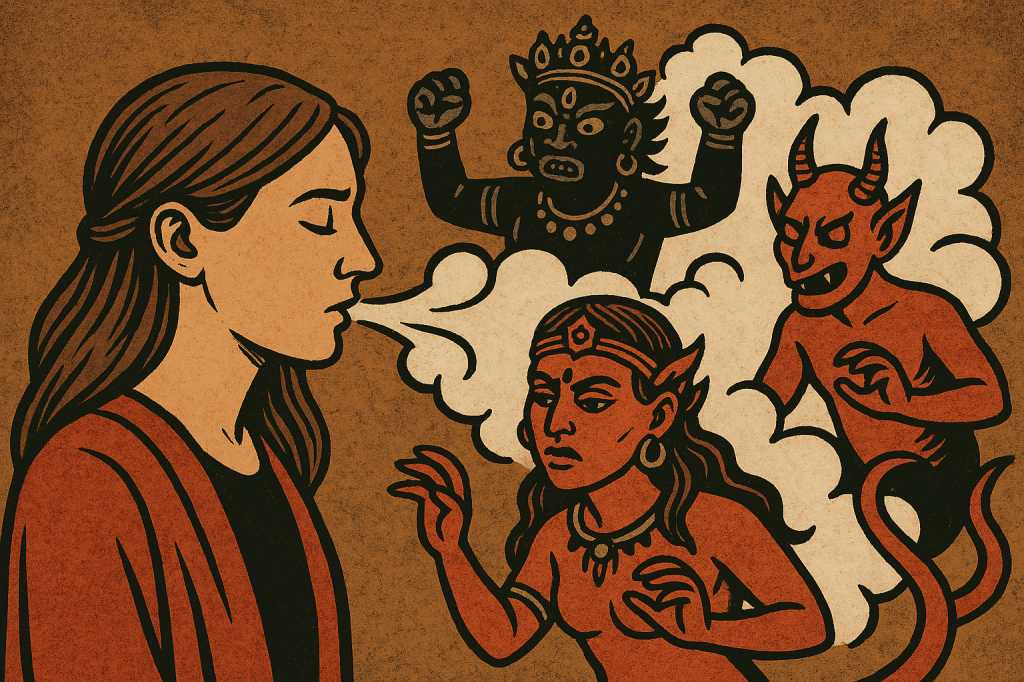
This past week, something profound happened: I experienced mass deliverance through my breath. As I exhaled, demons left me. Over and over again. It was undeniable. And then it hit me: of course they left on the breath. They came in on the breath.

This is not metaphorical. This is how tantra works. The breath is a key mechanism through which demonic entities enter one’s being. Yogic and tantric practices revolve around breath control: deep manipulation and intentional retention of the breath to open oneself to possession by what are euphemistically called “deities” but are, according to Christianity, demons.

In my three-year retreat, the main entities I invoked and merged with were Vajrayogini, the Red Dakini, and her consort. These were not simple meditations or visualizations. These were acts of surrender and identity dissolution. In essence, the goal was full-blown possession, even though it wasn’t couched in those terms and I didn’t realize that is what was happening.

Vajrayogini doesn’t come alone. Her retinue includes approximately 120 assistants, each with its own functions and qualities. That number is staggering, and that’s just one system of practice. In addition to her, I practiced the sadhana of a wrathful black deity with a massive host of demonic attendants. I should stress that these are not benign energies. They are demanding, and potentially violent and spiritually lethal.

But even beyond retreat, I continued to receive more initiations, or so-called empowerments. One that stands out is the Kalachakra initiation in 2011 from the Dalai Lama in Washington, D.C. It was a 10-day, all-day affair. I was zealous, determined to catch every detail of the ritual. I arrived early each morning to watch the Dalai Lama prepare himself by “self-generating” as the deity Kalachakra. It was amazing to watch; he was ritually becoming the deity.

Kalachakra, which means “Wheel of Time,” is a tantric deity surrounded by a staggering retinue of 722 deities. But these aren’t heavenly hosts. According to Christianity, they are demons. Every one of them. The entire system is a carefully constructed spiritual snare designed to bind souls to counterfeit light.

Thousands, maybe millions, have received these same initiations. The Dalai Lama has made it his mission to offer the Kalachakra globally. People believe they are receiving a blessing. But in reality, they are being spiritually colonized. Demonic systems are being seeded into the nations. These rituals are not neutral cultural events. They are portals for dark power.

If you want a glimpse into what may really happening during these ceremonies, I encourage you to read this article that lays it out plainly:
Dalai Lama and the Kalachakra

As for me, I’m continuing to pray and seek God’s help in cleansing every layer of my being. What I’m realizing is horrifying but I am confident that God is showing me the truth and setting me free.

Southern India: The Virgin Who Heals vs. Goddesses Who Possess


In a dusty corner of southern India, something strange is happening. Among the Catholic untouchables of Tamil Nadu the Virgin Mary reigns. These are the Dalit communities who converted to Christianity to escape caste oppression. Here the Virgin Mary is not just the mother of Christ or the Queen of Heaven. She’s the protector from demons, the healer of the possessed, and the exorcist of lustful spirits who prey on young women. [1]

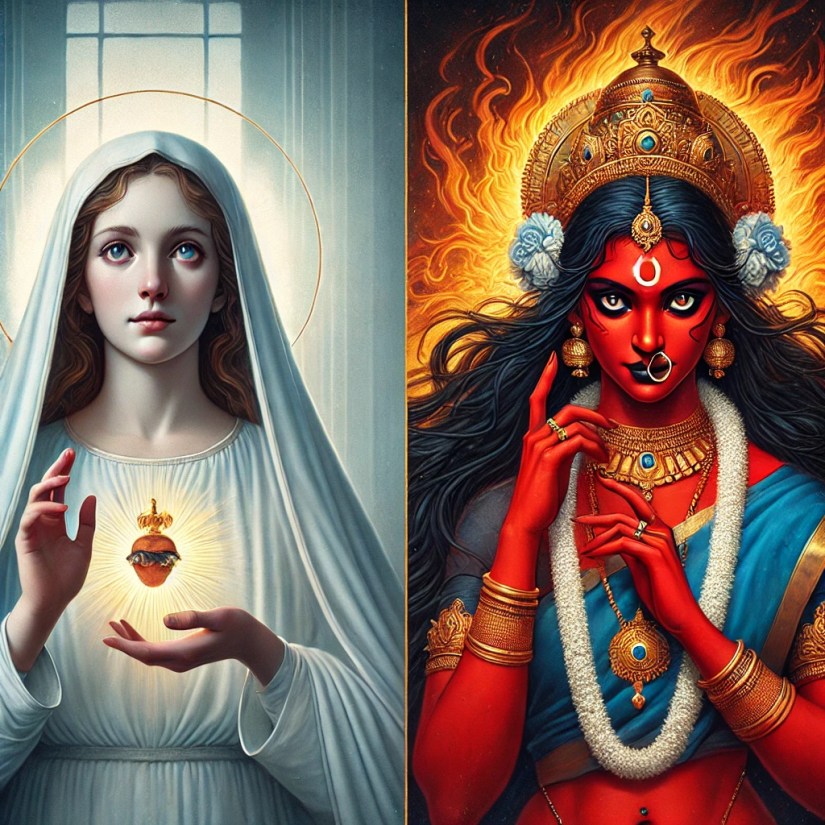
Her name here is Arockyai Mary, “Our Lady of Good Health,” and unlike the goddesses of India’s native pantheon, she never harms. She doesn’t demand blood, or rage, or possess.

This makes her an anomaly in a world where possession is an everyday threat and where menstruation, pregnancy, and the liminal chaos of female sexuality are believed to attract wandering spirits, often the ghosts of those who died violently or before their time. These spirits, it is said, latch onto the vulnerable, especially women, and drive them into trances and convulsions.

And then there are the Hindu goddesses like Mariyamman [2] and Kaliamman [3], powerful but volatile. They heal, but they can also possess, punish, and destroy. Unlike the Virgin Mary, who is seen as unconditionally loving and healing, Mariyamman and Kaliamman’s protection must be earned through ritual and sacrifice. Their presence is often feared as much as it is venerated, revealing a form of feminine divinity that is transactional, fierce, and unpredictable.

The deeper thread that ties this to my own journey through Eastern mysticism and into Catholic truth is that the female deities of India are not so much saviors as they are owners. They ride their devotees like horses often through an overpowering kundalini experience. They enter bodies without informed consent. They demand submission, sacrifice, and pain. This is what possession looks like when the divine manifests as fierce femininity unmoored from moral restraint.

But the Virgin Mary is different in kind, not just degree. She doesn’t exploit vulnerability; she protects it. Her power is rooted in love, not domination. She doesn’t punish women for their sexuality; she guards them from the predators that do.

Many of us who were drawn into the tantric and yogic traditions found ourselves worshiping goddesses we didn’t truly understand such as Kali, Vajrayogini, and Durga. These powerful beings granted “blessings” that often came in the form of disorientation, illness, and spiritual invasion. What we called “awakening” was perhaps possession, wrapped in ritual and mystique.

In the story of the Paraiyar women, we see this clearly. Demonic possession is a warning as well. The culture teaches women that if they stray outside ritual boundaries, if they become too sexually visible, if they travel alone at dusk or cross the wrong river, they open the door to attack. And it’s the Virgin Mary, not Kali, who shows up to cast the darkness out.

Humanity does not need more divine rage, but the one Woman who is pure benevolence: the Mother of Jesus who through her perfection is feared by and can cast out spirits and demonic goddesses.

[1] Source article: Deliège, Robert. “La Possession démoniaque chez les Intouchables catholiques de l’Inde du sud / Demoniac Possession Among the Catholic Untouchables in Southern India.” Archives de sciences sociales des religions, no. 79, 1992, pp. 115–134. Available online.

[2] Mariyamman is a powerful village goddess widely worshipped in South India, especially in Tamil Nadu. Her name combines “mari,” meaning rain or disease, and “amman,” meaning mother—making her the Mother of Rain and Disease. She is especially associated with illnesses like smallpox, fevers, and skin diseases, but also with fertility, childbirth, and protection from evil spirits. Visually, she often appears fierce—sometimes with fiery red skin, holding a trident, and crowned with flames—bearing a resemblance to goddesses like Kali or Durga. Her shrines are typically modest, and her worship is deeply rooted in folk rituals. Devotees may offer animal sacrifices, participate in firewalking, or fall into trances believed to be divine possessions. In many cases, women are the ones possessed by Mariyamman, and these episodes are interpreted as both blessings and warnings—depending on whether the goddess has been properly appeased.

[3] Kaliammam is a fierce village manifestation of the goddess Kali, worshipped primarily in Tamil Nadu and other parts of South India. The name “Kaliamman” translates to “Mother Kali,” reflecting her role as a local protective mother goddess rooted in folk traditions. Like Kali, she is associated with destruction, power, and the eradication of evil, but in the village context, she is also invoked for healing, fertility, and protection from malevolent spirits. Kaliamman is often depicted with dark skin, a lolling tongue, wild hair, and multiple arms holding weapons—symbolizing her unrestrained spiritual power. Her worship includes rituals that are intense and sometimes violent: offerings of blood, possession trances, firewalking, and dramatic acts of devotion are common. She is believed to possess her devotees—often women—either to bless them, deliver a warning, or punish neglect. She must be honored and feared. Her presence reinforces moral and ritual boundaries in the community, demanding reverence through sacrifice and submission rather than drawing near in mercy or compassion.

A Critical Look at Vajrayana Magic


Vajrayana Buddhism presents itself as a path of radical transformation: a sacred alchemy where ordinary perception is transmuted into enlightened wisdom. Its ritual technologies are often described as “skillful means,” and its magical practices framed as expressions of “Buddha activity.” But the colorful mandalas and enchanting deity meditations may obscure something far more dangerous than most practitioners realize.

According to vajranatha.com, Vajrayana operates through four principal kinds of magical activity, each aligned with a cardinal direction, a color, and a particular type of power:

  • White (east): for pacifying and healing
  • Yellow (south): for increasing wealth and wisdom
  • Red (west): for attraction and control
  • Dark blue or green (north): for wrathful subjugation and protection

These are personified in the deity forms of White Tara, Dzambhala, Kurukulla, and Vajrakilaya, respectively. Collectively, these “Four Activities” are described as enlightened, but their function mirrors the mechanisms of many other occult systems: healing, sorcery, love spells, exorcism, and domination.

So who, or what, is powering these rituals?

Chögyam Trungpa, one of the most influential Tibetan lamas to bring Vajrayana to the West, once gave a startlingly candid warning:

“Committing oneself to the Vajrayana teaching is like inviting a poisonous snake into bed with you and making love to it. Once you have the possibility of making love to this poisonous snake, it is fantastically pleasurable: you are churning out antideath potion on the spot. The whole snake turns into antideath potion and eternal joy. But if you make the wrong move, that snake will destroy you on the spot.”
—Chögyam Trungpa

This is not a metaphor for the all-encompassing wisdom and compassion of the Buddhas and Bodhisattvas. It is a warning of immense spiritual danger.

Vajrayana demands the total surrender of body, speech, and mind, not only to the teachings, but to the guru and the spiritual forces behind those teachings. This surrender is cloaked in bliss, ecstasy, and the promise of transformation. But as Trungpa makes clear, one wrong move and the very force you trusted can turn lethal. It can turn on a dime.

I experienced this firsthand. It began as a profound visualization and mantra practice during a three-year retreat and gradually turned into energetic torment and psychological destabilization. The deities I once practiced became increasingly foreign, invasive, and predatory. The guru, once seen as a vessel of wisdom, became a wrathful executioner.

These practices are not what they seem: they tap into powerful magic. And one must ask, who is really powering these rituals? Who benefits when a practitioner opens themselves to these entities and their so-called “energies”? Why should we assume these forces are benevolent, simply because they have Buddhist names and appear in ornate, colorful iconography?

The structure described here isn’t just about religious symbolism or spiritual beauty, it reflects a deep psychological system designed to influence the mind through ritual. Vajrayana practices use visualization, chanting, offerings, and mantra repetition to create altered states of consciousness and emotional bonding with supernatural entities. This is what scholars call ritual psychology: the way ritual shapes belief, identity, and experience.

But Vajrayana doesn’t just manipulate the mind. It aligns closely with classic occult systems, ones that use similar rituals to summon, contact, and make pacts with spirits. Healing and increase, attraction and domination are bit neutral tools. They are technologies for channeling unseen forces toward specific outcomes. And these forces are personified, and bonded with through ritual acts that, the deeper you go, begin to resemble spiritual possession with demonic pacts.

In my own experience, the entities I contacted through these practices eventually revealed themselves to be something other than the enlightened mind of the Buddhas, whatever that might be. They had their own will, their own agendas, and their own personalities. Especially in the darker rites of semi-wrathful and wrathful deities, there was a sharp edge of coercion, and spiritual threat.

If we take these rituals seriously, not as colorful mysticism, but as real technologies of spiritual manipulation, then we must also take seriously the possibility that their source may not be benevolent.

Just because it’s branded as “Buddha activity” doesn’t mean it is holy. Survivors of spiritual abuse in Tibetan Buddhism must be brave enough to ask the hard questions. Who, or what, are we inviting into our minds and bodies when we chant these mantras, visualize these beings, and make offerings in exchange for spiritual results? Are these forces truly enlightened or are we just calling them that because we’ve been taught to?

When your healing comes at the cost of spiritual bondage…When your wisdom is bought by making pacts with demons…Something is deeply wrong.

Magic in Vajrayana is not peripheral but central to the practice. And it must be examined not with awe, but with clear-eyed discernment.