

The Tragic Consequences of Romantic Relationships Between Tibetan Gurus and Their Female Disciples


In the world of Tibetan Tantra, the guru is not merely a teacher. He is regarded as a living embodiment of enlightenment, someone who, once accepted, must be obeyed as if he were the Buddha himself. Into this framework walk countless Western women, often earnest seekers of truth, healing, or transcendence. But when romance, sexuality, and devotion become intertwined, the results are rarely transformative. More often, they are tragic.

This article explores the inherent power imbalance, cultural dissonance, and psychological manipulation that underpin many intimate relationships between Tibetan tantric gurus and their female disciples.


A Different Cultural Code

In Tibetan culture, it is not uncommon for powerful men, including lamas, to have secret relationships, multiple consorts, or children outside of marriage. In many traditional communities, this behavior is normalized, even expected. Male infidelity is culturally tolerated, and truth-telling in romantic relationships is not seen as a moral imperative.

For many Western women, however, raised in societies where emotional honesty and monogamy are core values in intimate relationships, these behaviors come as a rude awakening. When a Tibetan lama engages in a romantic or sexual relationship with a Western disciple, he often does so under entirely different assumptions than she brings to the table.

The result is a tragic mismatch, not only of expectations, but of entire worldviews.

Samaya: A Weaponized Vow

At the heart of tantric Buddhism is the concept of samaya, a sacred vow of loyalty and obedience to the guru. These vows are complex, often opaque, and understood differently in Tibetan contexts than in the West. A Western woman may believe she is entering a relationship based on mutual affection or spiritual partnership, while the guru sees her as a consort, a dakini, a means to an end, whose role is to support his realization through sexual union, secrecy, and ritual submission. A less realized guru might just use women for his own sexual satisfaction without having the ability to properly engage in tantric sex for spiritual ends. This is often true nowadays.

In any case, breaking samaya is said to have dire consequences, not only spiritually, but psychologically, and physically. The risk is greatly compounded if the woman undertakes a traditional three-year-retreat and engages in the highest yoga tantra practices, including the physical yoga. The looming threat of tantric destruction can trap women in relationships that are exploitative, confusing, and coercive. Once the guru becomes the channel for the deity, any questioning of his authority can be framed as demonic and a cause for imminent karmic downfall.

Possession Disguised as Enlightenment

Tantric union is not merely symbolic. It often involves rituals where the guru is said to be “inhabited” by the deity and his voice, gaze, and touch become divinely charged. During such practices, the female disciple is encouraged to dissolve her ego, to merge into the guru-deity, and to practice dak nang or “pure view.” This process can mimic, and in some cases become, a form of spiritual possession.

What’s often missed is the psychological and energetic takeover that occurs. The guru, now deified in the disciple’s mind and practice, can dominate her thoughts, dreams, emotions, and even her bodily functions. This fusion can make it nearly impossible for her to discern spiritual guidance from emotional manipulation or sexual coercion.

Real-World Tragedies

Numerous cases, both widely reported and quietly suppressed, illustrate the dangers of intimate relationships between tantric gurus and their students. These accounts reveal recurring patterns of deception, coercion, and spiritual abuse, all cloaked in esoteric language and asymmetrical power dynamics. They are not isolated incidents but part of a systemic pattern deeply embedded in a tradition that grants unchecked spiritual authority to men who are rarely held accountable.

For those who wish to explore further, consider just a few of the many investigations and testimonies:

Buddhist Project Sunshine – Phase 3 Final Report (2018)
This comprehensive report documents allegations of abuse within the Rigpa community, providing detailed accounts and analyses.
📄 Read the PDF Report

Beyond the Temple – What Now? Blog
Formerly known as “What Now?”, this blog offers reflections and information from ex-Rigpa members about their experiences and the broader implications of abuse in spiritual communities.
Beyond the Temple – Survivors of Abuse in Tibetan Buddhism

Tricycle – “Rigpa Abuse: Former Students of Sogyal Rinpoche Share Their Stories”
An article featuring firsthand accounts from former students detailing their experiences with Sogyal Rinpoche and the Rigpa organization.
📰 Read the Article

Lion’s Roar – “Letter to Sogyal Rinpoche from Current and Ex-Rigpa Members Details Abuse Allegations”
This piece publishes a letter from Rigpa members outlining specific abuse allegations against Sogyal Rinpoche.
📄 Read the Letter

The Aftermath: Disillusionment and Healing

For many women, the breaking point comes when the promised enlightenment fails to materialize, and the emotional wounds become undeniable. Depression, anxiety, spiritual confusion, sexual trauma, and a profound crisis of faith often follow. Some leave Tibetan Buddhism altogether. Others struggle for years in silence, fearing karmic retribution or spiritual failure.

But there is also healing. More and more survivors are finding their voices, connecting with others, and re-evaluating what true spirituality looks like outside the grip of occult religions.

Conclusion: A Cautionary Tale

The guru-disciple relationship in tantric Buddhism is not a romantic ideal. It is a spiritual contract saturated with asymmetrical power, cultural blindness, and theological complexity. When this dynamic becomes sexual, the risks multiply exponentially. For Western women seeking union with the divine, the guru-lover becomes not a liberator but a captor. The elaborate practice of guru yoga further seals the deal.

This truth must be told, not to demonize individuals or traditions, but to expose the structural and spiritual dangers that thrive in secrecy. Love, in its purest form, cannot flourish where truth is sacrificed to deception and devotion is manipulated into coercion.

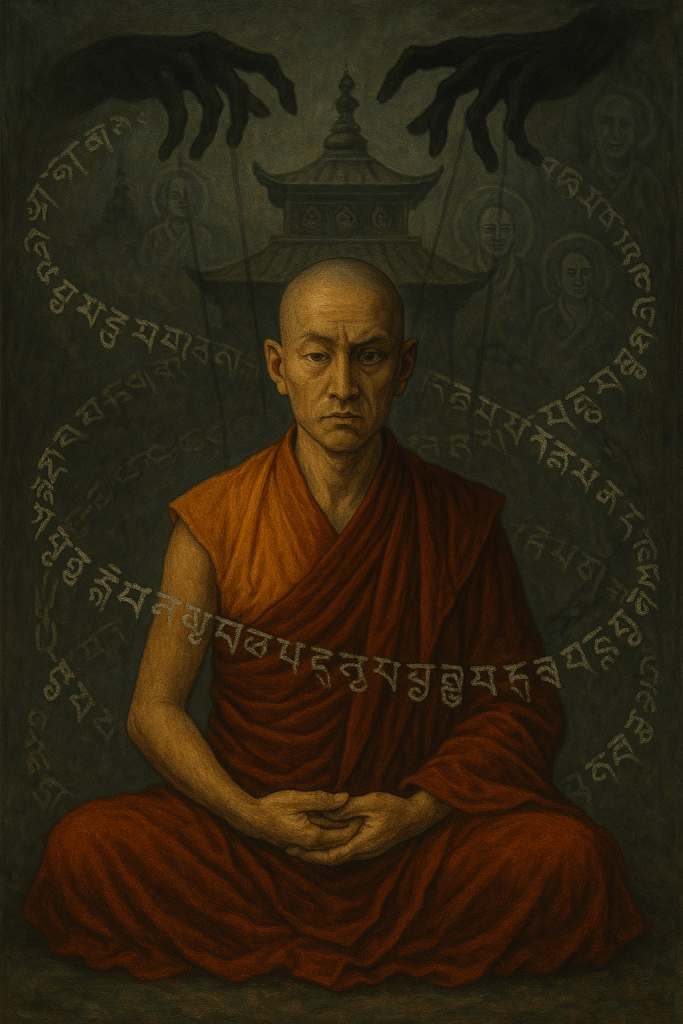
The Mirror and the Light: Spiritual Execution in Tibetan Feudalism


In Hilary Mantel’s The Mirror and the Light, Thomas Cromwell rises from blacksmith’s son to the right hand of King Henry VIII. He becomes the monarch’s “mirror and light,” reflecting and executing his will. But the same proximity that elevates him also destroys him. When Cromwell fails to deliver a pleasing queen, he is arrested, disgraced, and executed, his closeness to power proving fatal.

Tibetan tantric Buddhism operates on a hauntingly similar logic. In this tradition, the guru is king, and the disciple, like a courtier, is raised or destroyed at the guru’s whim. Far from being egalitarian or purely spiritual, Tibetan Buddhism, especially in its institutional forms, retains a deeply feudal structure, complete with titles, inheritance, land ownership, and enforced hierarchy.¹

Tibetan Buddhism as a Feudal System

For centuries, Tibetan Buddhism was not just a religion but the ruling system of the nation. The Dalai Lama was both spiritual sovereign and temporal king. Monasteries controlled vast tracts of land, collected taxes, and held legal authority over villages.² Senior lamas, often reincarnated tulkus, inherited wealth and power from their predecessors, a system akin to aristocracy by divine right. Large institutions like Drepung, Sera, and Tashi Lhunpo amassed political influence and wealth, with monasteries owning up to two-thirds of arable land in pre-1950s Tibet.³

The tulku system (identifying reincarnated masters) consolidated this feudalism. Wealth and authority passed to a chosen child, often from a high-status family, and the child was installed into a network of patronage, where senior monks managed the estate until the tulku matured. Ordinary monks and villagers remained economically dependent on these institutions, often working the land in exchange for spiritual services and blessings.⁴ According to historian Melvyn Goldstein, Tibetan society was “essentially a form of monastic feudalism.”⁵

The Guru as King: Absolute Power

In the Vajrayāna path, the guru is not merely a teacher: he is treated as the Buddha himself. Vajrayāna texts warn against questioning the guru, no matter how erratic or abusive his behavior.⁶ Students are bound by samaya (tantric vows), which demand total obedience, silence, and loyalty. In this relationship, the disciple becomes like Cromwell: a mirror for the guru’s will, performing rituals, making offerings, and receiving favor or punishment.

This closeness creates the illusion of intimacy, even love. Many disciples report feeling spiritually chosen or singled out by the guru. But this intimacy masks a darker truth: it is conditional and instrumental. When the disciple fails to satisfy the guru, by asking questions, expressing trauma, or failing to uphold impossible vows, they are cast out. Not just socially, but cosmically.⁷

Falling Out of Favor: Spiritual Annihilation

When a disciple displeases a guru in these feudal tantric systems, the consequences are severe. Historically, punishments ranged from beatings and public shaming to exile from the monastic estate.⁸ In modern times, exile takes subtler forms: ostracism, reputation assassination, spiritual gaslighting, and the threat of karmic damnation. Survivors of abuse report being told they were “possessed by demons,” “breaking their samaya,” or “falling into the lower realms” simply for speaking out.⁹

Just like Henry VIII’s wives or ministers, the disciple who falls out of favor is ritually erased. Their years of devotion are forgotten; their insights mocked. The same master who called them “special” now identifies them as a threat to the dharma. The disciple’s proximity to power becomes their undoing.

When the Light Burns

The title The Mirror and the Light is tragically fitting for both Thomas Cromwell and the countless disciples who believed that closeness to the guru meant safety. In Tibetan tantric Buddhism’s feudal framework, it often means the opposite. Disciples serve as tools of the guru’s charisma, devotion, and control. When they no longer reflect his will, they are discarded and spiritually “executed” without ceremony.

Just as Cromwell’s brilliance could not save him, neither can sincerity or devotion save a disciple in a rigged, feudal system.


Footnotes

  1. Geoffrey Samuel, Civilized Shamans: Buddhism in Tibetan Societies (Smithsonian Institution Press, 1993), pp. 22–29.
  2. Melvyn C. Goldstein, A History of Modern Tibet, Volume 1: The Demise of the Lamaist State (University of California Press, 1989), pp. 80–95.
  3. Matthew T. Kapstein, The Tibetans (Wiley-Blackwell, 2006), pp. 142–148.
  4. Toni Huber and Stuart Blackburn, Origins of the Tulku System in The Social History of Tibetan Institutions (Brill, 2002).
  5. Goldstein, History of Modern Tibet, p. 90.
  6. Alex Wayman, The Role of the Guru in Vajrayana, in Tibetan Buddhism: Reason and Revelation, ed. S. Lopez (SUNY Press, 1997).
  7. Miranda Adams, Samaya and Silence: Enforcing Obedience in Vajrayana Communities, unpublished thesis, 2020.
  8. Janet Gyatso, Being Human in a Buddhist World (Columbia University Press, 2015), ch. 3.
  9. Annabella Pitkin, “Broken Samaya and the Threat of Hell: Devotion, Dissent, and Control in Contemporary Tibetan Buddhism,” Journal of Global Buddhism, Vol. 22 (2021).

The Cultish Nature of Tibetan Buddhism


When I began my journey into Tibetan Buddhism, I was swiftly enveloped in its rituals and traditions. Without much explanation, I was handed monastic robes, instructed to shave my head, and urged to take lifelong vows. This rapid immersion into a structured and demanding system left me questioning the true nature of the practice. Was this a genuine spiritual path, or was I being drawn into a cult masquerading as a path to enlightenment?

The Allure of Tibetan Buddhism

Tibetan Buddhism often presents itself as a path of loving-kindness, compassion, and profound meditative insight. Its teachings emphasize peace, mindfulness, and the cultivation of wisdom. On the surface, these ideals are appealing and resonate with many.

However, lurking beneath this serene exterior is a complex structure of vows, rituals, and hierarchical relationships that can be overwhelming and oppressive.

The Samaya Vows: Protective or Deadly?

Central to Vajrayana Buddhism are the samaya vows, which are commitments taken by practitioners during tantric initiations. They establish a sacred bond between the guru and the disciple, outlining the conduct required to uphold that bond.

These vows can create a sense of obligation and fear. Breaking samaya is believed to lead to severe karmic consequences, placing immense pressure on individuals to adhere strictly to obedience no matter what the guru does.

Hidden Subjugation and Control

The hierarchical nature of Tibetan Buddhist communities can lead to overt forms of mind control and manipulation. The reverence for the guru borders on unquestioning subservience, with the guru’s authority rarely being challenged. This dynamic can foster an environment where questioning is discouraged, and followers are compelled to conform to the guru’s demands and the group’s expectations.

Moreover, the concept of “crazy wisdom” is sometimes used to justify behavior that would otherwise be deemed inappropriate or abusive. This philosophy, associated with figures like Chögyam Trungpa, suggests that unconventional or even disruptive actions by a guru are acceptable if they lead to spiritual awakening. Such justifications can blur ethical boundaries to the extent that students are ripe for abuse.

The Dark Side of Tibetan Buddhism

Instances of widespread misconduct within Tibetan Buddhist communities have been reported, raising concerns about the integrity of these institutions. The case of Sogyal Rinpoche, the founder of the Rigpa organization, is one example where allegations of sexual abuse and severe authoritarian control surfaced, leading to significant controversy and criticism. After eight students leaked a letter on the internet exposing his crimes, a highly-regarded Khenpo associated with the group gave a talk denouncing those eight students, angrily declaring that they would all go to vajra hell. Even though many Westerner disciples of Tibetan Buddhism don’t believe in vajra hell, I can assure you from first hand experience that it’s very real. You can read more about it here.

These incidents highlight the potential for exploitation within systems that place immense power in the hands of a single individual or a small group of leaders. The lack of accountability and transparency in many Tibetan Buddhist organizations can create an environment ripe for cultish abuse.

Conclusion: A Call for Critical Reflection

While Tibetan Buddhism appears to offer profound teachings and practices, it is essential to approach these traditions with a critical eye. The allure of compassion and peace should not overshadow the lack of ethical conduct, transparency, and respect for individual autonomy that often hides beneath the surface.