An Encounter with Kali


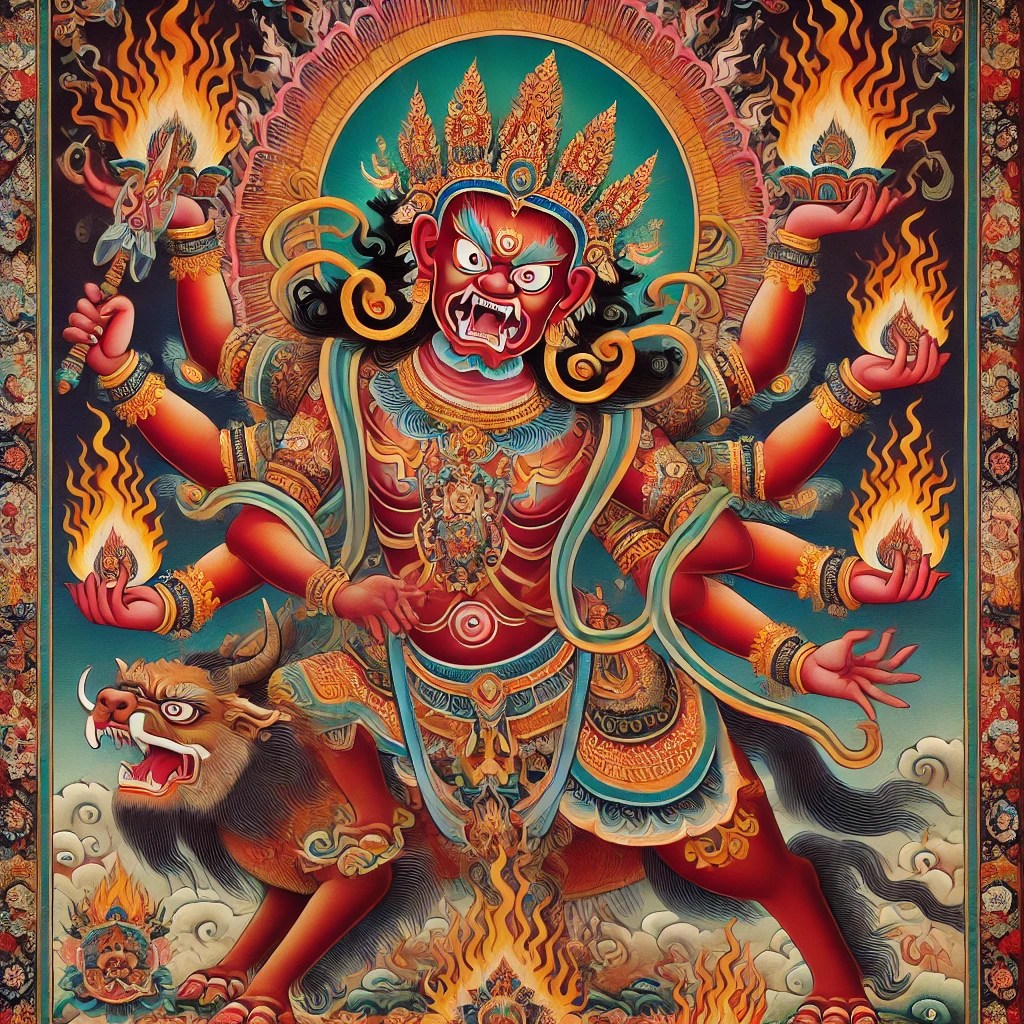
The descent into Bengal began with a vision. As our plane banked low over the hazy sprawl of Calcutta, I sat in meditation, quietly preparing for a long journey north to Sikkim for a series of tantric empowerments. Then, quite suddenly, a naked dakini appeared before me, dancing and beckoning. She seemed to be greeting me to Calcutta. I knew, or thought I knew, that it was Kali.

We stayed in a modest Baptist guesthouse chosen for its safety and low price, a short walk from Mother Teresa’s compound. It was late October, and the air was warm and humid. Calcutta felt down at heel, yet intellectual and dignified. My companions, all Tibetan Buddhist practitioners, decided to visit Mother Teresa’s place to pay homage. I hung back. They were sincere in their devotion to that famous nun, but something in me pulled in another direction. Although I had been raised Catholic, I felt a faint aversion to anything connected with the Catholic Church. I regarded the religion as problematic at that time. Still, seeing how genuinely excited my friends were, I encouraged them to go.

The next day I hired a taxi and arranged for us to cross the city to the Dakshineswar Kali Temple, the same temple where Ramakrishna had worshipped and experienced his visions of the Divine Mother and became enlightened. “We really must make the effort to see it,” I told the others, although I wasn’t sure why. The journey took nearly an hour through dusty streets and chaotic traffic. I had read that Kali was the patron goddess of Bengal, and that Dakshineswar was one of her most important shrines. The closer we came, the stronger the pull felt.

At the temple, a long line of Indian devotees wound through the courtyard, each waiting to glimpse the goddess and receive her blessing. We appeared to be the only Westerners there. I knew very little about the history of the temple at that point. All I knew was that I had always been intrigued by Ramakrishna among all the Hindu mystics and had always wanted to visit his temple and pay my respects.

The Temple and Its History

The Dakshineswar Kali Temple was founded in the mid-nineteenth century by Rani Rashmoni, a wealthy zamindar who, according to legend, dreamt that the goddess Kali commanded her to build a temple on the banks of the Hooghly River rather than journey by boat to Varanasi¹. Rashmoni had been preparing for the pilgrimage for months and had spent a small fortune, but on the night before her departure, Kali appeared in a dream and told her she need not travel at all. Instead, the goddess instructed her to raise a temple and enshrine an image that Kali herself would inhabit, blessing all who came to worship. The temple was completed in 1855 and the complex stands on land said to resemble a tortoise, a form considered especially auspicious in Shakta-Tantra cosmology².

Architecturally, the main temple is built in the navaratna (nine-spired) style typical of Bengal, raised on a high platform overlooking the river³. Surrounding the sanctum are twelve identical Shiva shrines aligned along the Hooghly’s edge, a small Radha-Krishna temple, and bathing ghats for pilgrims⁴.

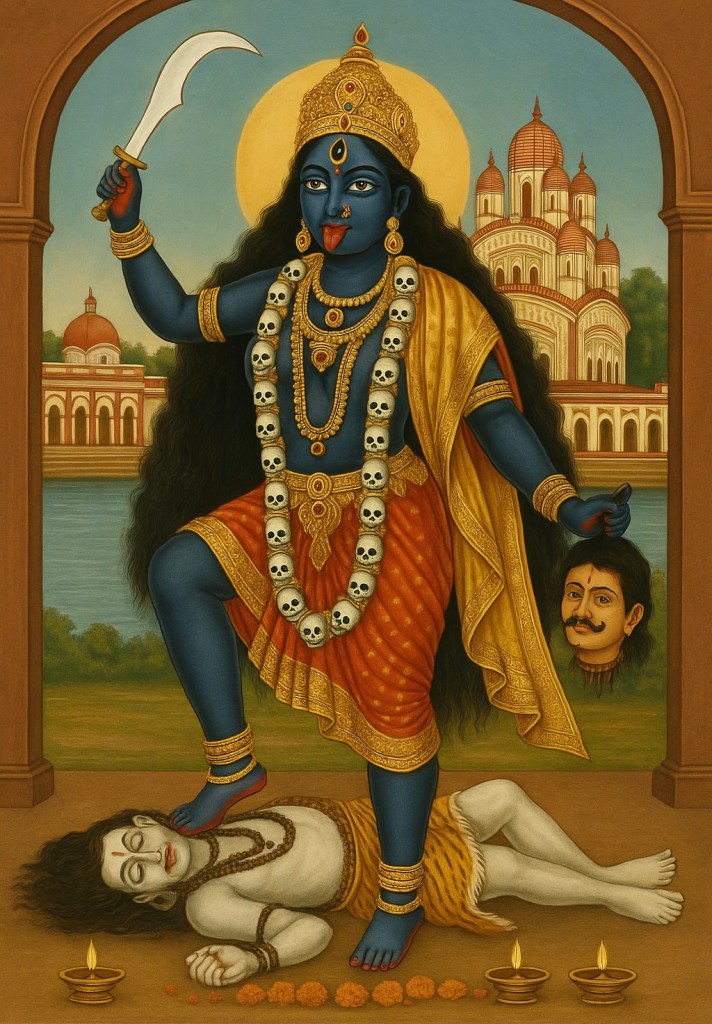
Inside the sanctum resides Bhavatarini, a fierce aspect of Kali known as “Saviour of the Universe,” depicted with one foot on Shiva’s chest⁵. The mystic Ramakrishna served as the temple’s priest and carried out years of intense spiritual practice within its grounds, transforming the site into one of India’s holiest centers of Shakti worship⁶. The atmosphere is thick with incense, bells, flowers, and the hum of a thousand mantras. Once inside the gate you feel the city’s chaos fall away.

As we stood in line, something unexpected happened. An Indian guard suddenly appeared, motioned to me and a Buddhist friend, and beckoned us forward. Without explanation, we were led past the waiting crowd directly to the inner sanctum. The goddess stood before us, draped in red and gold, eyes alive in the flicker of ghee lamps. When I received prasad, it tasted sweet and delicious, and I felt a surge of a deep, penetrating love. It was so overwhelming that I began to cry.

As a Tibetan Buddhist, I had always regarded Hindu deities as somehow inferior and secondary to the Tibetan ones who were the representations of the ultimate truth. My practice had centered on Vajrayogini and Chakrasamvara, not on Kali. Yet there, when the experience of divine love engulfed me in the Dakshineswar temple, I felt an unmistakable recognition.

Years later, after surviving the catastrophic unraveling of my own tantric path due to the betrayal by male Buddhist teachers, the exposure of their sexual abuses, and the psychic annihilation that followed, I began to study the origins of tantra in earnest. Through the research of Alexis Sanderson and others, I learned what my experience at Dakshineswar had already shown me: that the yoginī tantras of Tibetan Buddhism arose from the same crucible of medieval Hindu Śaiva and Śākta practice⁷. Vajrayoginī, the red goddess of my own initiations, was in essence a Buddhized form of Kali. The goddess in both traditions can give blessings and boons, but she can become, in an instant, a terrifying and destructive demon with her own set of intentions and cosmic laws.

That insight came at great cost. The deeper I studied, the more clearly I saw that tantra, in both Hindu and Buddhist forms, was inseparable from forces of domination, secrecy, and power. The same ecstatic current that once inspired devotion also lurked behind manipulation and abuse. In the West, these darker currents were long dismissed or hidden, until the many scandals of 2017 tore the veil away.

My visit to Kali’s temple remains a paradox. In that moment I felt only grace: the raw, overwhelming presence of the divine feminine. But in hindsight, I experienced Kali as both mother and destroyer, blessing and devourer. She welcomed me to Calcutta with open arms, but in time, in her Buddhist form as Vajrayogini, she stripped me of everything I held dear in order to completely destroy my body, mind, and soul. By the grace of the highest divinity, the eternal Christian God, I survived and am still alive to tell the tale.


Notes

  1. Dakshineswar Kali Temple, Wikipedia, last modified 2025.
  2. Ibid.
  3. Ibid.
  4. Ibid.; see also Dakshineswar Kali Temple official site, Places in Dakshineshwar (dakshineswarkalitemple.org).
  5. Dakshineswar Kali Temple, Britannica.
  6. Ibid.; Ramakrishna’s association documented in Swami Nikhilananda, The Gospel of Sri Ramakrishna (New York: Ramakrishna-Vivekananda Center, 1942).
  7. Alexis Sanderson, “The Śaiva Age: The Rise and Dominance of Śaivism during the Early Medieval Period,” in Genesis and Development of Tantrism, ed. Shingo Einoo (Tokyo: Institute of Oriental Culture, University of Tokyo, 2009), 41–350.
A Brief History of Christianity in Tibet


Early Traces: The Nestorians and the Eighth Century

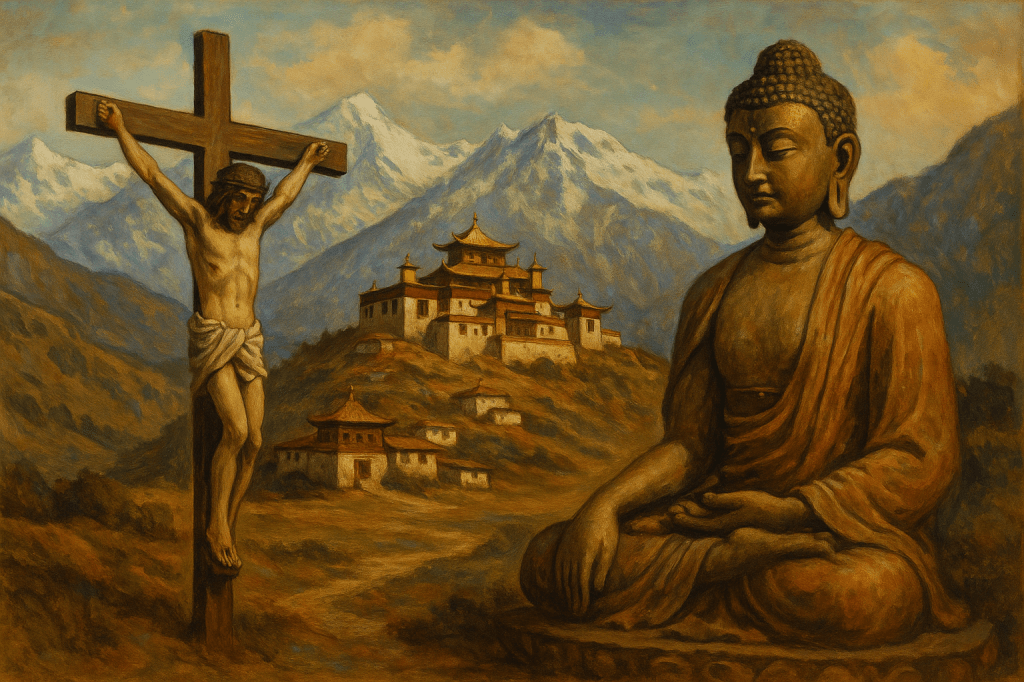
The history of Christianity in Tibet stretches back far earlier than most assume. The earliest Christian presence likely came from the Nestorian Church of the East, which had spread along Silk Road routes from Mesopotamia into China by the 7th century. Evidence from the Xi’an Stele of 781 CE shows that Nestorian missionaries were active under the Tang Dynasty, and given Tibet’s close relations with Tang China, it is plausible that Christian communities emerged within the Tibetan cultural sphere during the 8th century.1 However, these early Christian enclaves left no sustained legacy; Tibet’s conversion to Buddhism under Trisong Detsen soon dominated its spiritual landscape.

Jesuits in Guge: Antonio de Andrade and the Lost Kingdom

The next major encounter between Christianity and Tibet came through the Jesuit missions of the 17th century. In 1624, the Portuguese Jesuit Antonio de Andrade became the first known European to enter Tibet. He reached Tsaparang, the capital of the Guge Kingdom in western Tibet, where he was warmly received by King Tri Tashi Dakpa (also called Chadakpo). The king even laid the cornerstone for Tibet’s first church, completed in 1626.2

De Andrade’s arrival, however, sparked tensions. His success in converting local nobles alienated the powerful Buddhist clergy. A political conflict between the king and his brother, who was aligned with Buddhist monastics, led to the downfall of the Guge mission. Around 1630, the king was overthrown with assistance from the Ladakhi ruler Sengge Namgyal, who viewed Guge’s alliance with Catholic missionaries as a provocation.3 The Jesuits were expelled or killed, and Guge itself disappeared from the political map soon thereafter.

The Jesuits in Lhasa: Ippolito Desideri and the Capuchin Controversy

After Guge’s fall, the next great missionary endeavor came with Ippolito Desideri, an Italian Jesuit who reached Lhasa in 1716. Desideri immersed himself in Tibetan culture, mastered the language, and composed treatises comparing Christian and Buddhist metaphysics. His conciliatory approach, attempting dialogue rather than confrontation, won him both local sympathy and later admiration among scholars.4

Desideri’s work, however, was undone not by Tibetans but by Church politics in Rome. The Vatican’s Congregation for the Propagation of the Faith (Propaganda Fide) restructured Asian missions and in 1703 assigned Tibet to the Capuchins, a Franciscan order. The Jesuits were ordered to withdraw, leading to Desideri’s forced departure in 1721. The decision reflected not only internal rivalry but also a Vatican preference for an order more controllable and less inclined toward syncretic engagement.5

Suppression and Exile: The 18th and 19th Centuries

After the Jesuits’ departure, Capuchin missionaries continued their work until the 1740s. A crisis erupted in 1742, when a Tibetan convert refused to bow before the Dalai Lama, an act perceived as defiance against both religion and state. The government expelled the missionaries and banned Christianity in Central Tibet, a policy enforced by 1760.6

Despite this, individual attempts persisted. In the 19th century, the British missionary Annie Royle Taylor undertook a daring journey toward Lhasa in 1892, becoming the first Western woman to reach central Tibet, though she was ultimately turned back by Tibetan guards.7 Her journey epitomized the enduring fascination and futility of Christian outreach in a land long closed to foreigners.

Elsewhere, especially in eastern Tibet (Kham), anti-Christian sentiment often flared into violence. During the 1905 Batang Uprising, missionaries and Tibetan converts were targeted and killed. Among those martyred were André Soulié (1858–1905) and Jean-Théodore Monbeig-Andrieu (1875–1914), who are commemorated in Catholic hagiographies as victims of faith-driven hostility.8

The Vatican’s Strategic Shift: Why the Jesuits Were Replaced

The Vatican’s decision to replace the Jesuits with Capuchins was rooted in both theological and geopolitical concerns. The Chinese Rites Controversy (late 17th–early 18th centuries), in which Jesuits were accused of tolerating Confucian and local religious practices, had eroded papal trust. The Propaganda Fide viewed Jesuit accommodationism, especially Desideri’s open dialogue with Buddhist philosophy, as dangerous relativism. Capuchins, by contrast, were stricter and less likely to blur doctrinal lines. As historian Donald Lach notes, “the Capuchins represented the centralizing impulse of the Counter-Reformation, where obedience outweighed intellectual innovation.”9

Christianity and Modern Tibet: A Restricted Faith

Under Chinese administration since the 1950s, Tibet’s relationship with Christianity has remained tightly controlled. The People’s Republic of China recognizes only state-sanctioned religious institutions, and Catholic practice in the Tibet Autonomous Region exists only under the auspices of the Chinese Catholic Patriotic Association, which does not recognize Vatican authority. The Holy See’s cautious diplomacy, especially during Pope Francis’s efforts to reestablish relations with Beijing, has led to a de facto acceptance of limited Catholic presence, primarily among Han Chinese residents in Lhasa rather than ethnic Tibetans.10

The Vatican continues to regard Tibet as part of its mission territory, but evangelization remains almost nonexistent. Tibetan Buddhism remains dominant, and Christian symbols such as crosses, churches, even icons are scarce across the plateau.

Legacy

From the Nestorian wanderers to Jesuit polymaths and Franciscan ascetics, Christianity’s story in Tibet is one of ambition, misunderstanding, and endurance. While never a major presence, its traces linger in forgotten ruins in Tsaparang, in Desideri’s Tibetan manuscripts preserved in Rome, and in the historical memory of dialogue between two of the world’s most mystical spiritual traditions.

Footnotes

  1. Samuel H. Moffett, A History of Christianity in Asia, Vol. I: Beginnings to 1500 (Maryknoll: Orbis Books, 1992), 291–295.
  2. Antonio de Andrade, Novo Descobrimento do Gram Cathayo ou dos Reinos de Tibet (Lisbon, 1626); Timo Schmitz, An Overview of Tibetan History (2025), 91–92.
  3. Le Calloc’h, J. (1991). “Antonio de Andrade and the Mission in Western Tibet.” Archivum Historicum Societatis Iesu, 60: 57–60.
  4. Ippolito Desideri, Notizie Istoriche del Tibet (Rome, 1727); Hattaway, Paul. Tibet: The Roof of the World (2021), 41.
  5. Peter Clarke, The Jesuits in Asia (Cambridge University Press, 1993), 204–207.
  6. Schmitz, Timo An Overview of Tibetan History, 91–92; Hattaway, 2021: 41–44.
  7. Hattaway, 2021: 68–71.
  8. Servin, Michael. “Christian Martyrs of Tibet.” Journal of Asian Church History 11 (2010): 23–39.
  9. Donald F. Lach, Asia in the Making of Europe, Vol. III (University of Chicago Press, 1977), 225–228.
  10. Holy See Press Office, “Relations between the Vatican and China,” L’Osservatore Romano, 2020.

The Question of the Soul: Christianity, Hinduism, and Buddhism


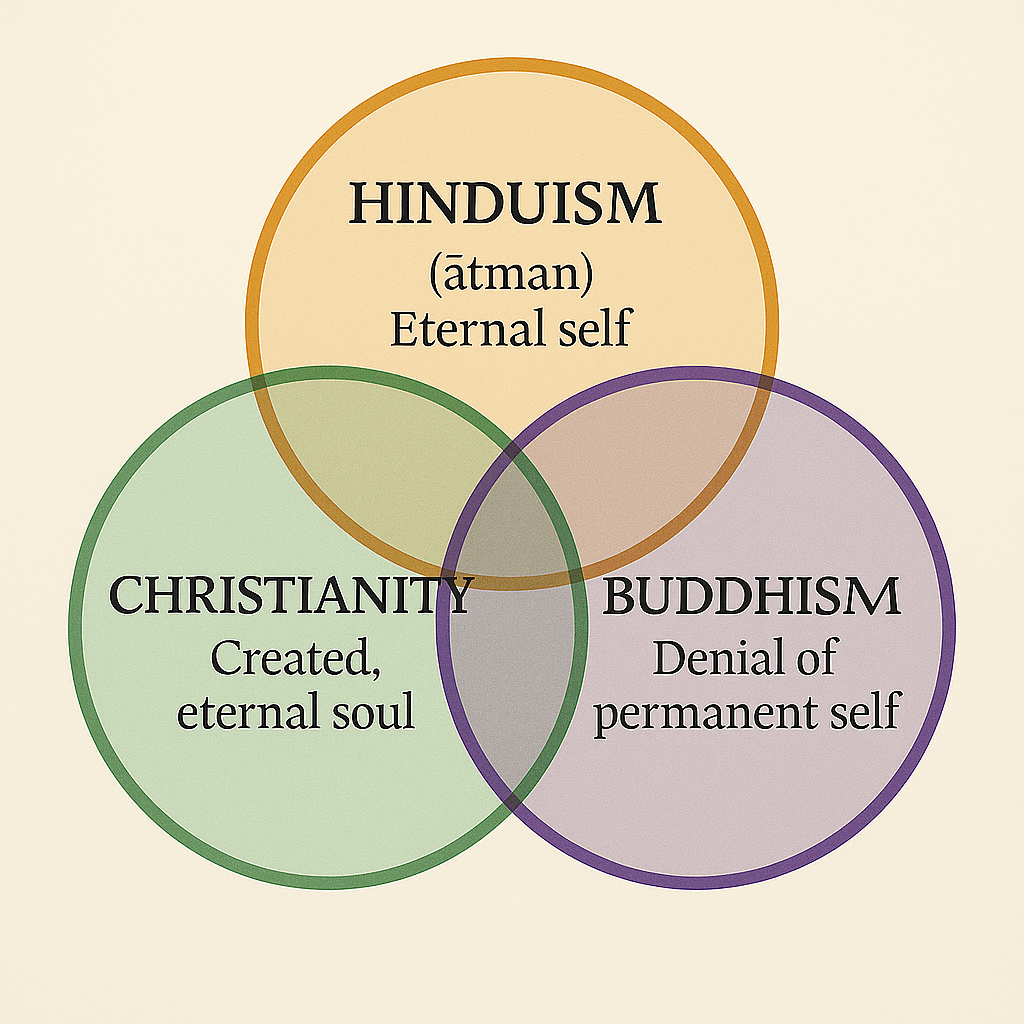
The question of what the soul is, whether it exists, and what happens to it after death lies at the center of the world’s major religious traditions. Christianity, especially in its Catholic tradition, affirms the soul as eternal and God-given. Hinduism has multiple schools, often affirming an eternal self or ātman. Buddhism, including Tibetan Buddhism, rejects the idea of a permanent self or soul and instead speaks of mind and consciousness as a conditioned stream of awareness without enduring essence.


The Christian and Catholic Understanding of the Soul

Christianity teaches that every human being has a unique, immortal soul created by God. According to Catholic doctrine, the soul is the spiritual principle of the human person. It is eternal in destiny, surviving bodily death, and directed either toward communion with God or separation from Him.

Scriptural sources include Genesis 2:7, where God breathes life into Adam and he becomes a living soul [1]; Matthew 10:28, where Jesus warns of the danger of losing the soul [2]; and the Catechism of the Catholic Church, which affirms that the soul is created by God and immortal [3]. In this view, the soul is not an impersonal principle but a personal identity, judged and redeemed by God.


Hindu Views on the Self (Ātman)

Hinduism is diverse, but most of its classical schools affirm the existence of ātman, the true self. The Chandogya Upanishad teaches “tat tvam asi” (you are that), affirming the identity of the self with Brahman [4]. The Brihadaranyaka Upanishad declares, “This self (ātman) is indeed Brahman” [5]. The Bhagavad Gita teaches that the self is eternal and indestructible [6].

Distinguishing Hindu and Christian Concepts

Both Hindu and Christian traditions speak of something enduring at the core of human existence, but they do so in different ways.

Christianity teaches that the soul is created by God, personal, and accountable before Him. It does not preexist from eternity but comes into being by His will and remains dependent on Him for existence, judgment, and salvation.

In Hindu thought, Advaita Vedānta emphasizes the identity of the self (ātman) with Brahman, dissolving individuality into the absolute. Dvaita and many Bhakti traditions instead teach that the self remains distinct yet eternal, existing in relationship with the divine. In all of these cases, the ātman is uncreated and co-eternal with ultimate reality, not brought into being by God.

Thus, while both traditions sometimes use personal and sometimes abstract language, the Christian soul and the Hindu ātman play very different roles. The soul in Christian theology is a created person before God; the ātman in Hindu philosophy is an eternal essence, whether one with Brahman or distinct in devotion.


The Creator God in Christianity and Hinduism

Christianity affirms one personal Creator God who brings the universe into being from nothing and sustains it in existence.

Hinduism presents a wide range of views. In Bhakti traditions, deities such as Vishnu, Shiva, or Devi are worshiped as supreme creators. Vedānta schools affirm Brahman as the ultimate source, though in Advaita this is not a personal act of creation but the manifestation of māyā. Other schools such as Sāṃkhya and Mīmāṃsā reject a creator altogether, viewing the universe as self-arising.

Thus, while Christianity grounds the soul in a personal God who creates and judges, Hindu thought ranges from devotion to a personal creator to cosmologies where no creator is necessary.


Buddhist Rejection of the Soul

Buddhism arose in part as a rejection of the Hindu doctrine of ātman. In the Anattalakkhana Sutta, the Buddha declared that none of the five aggregates of existence constitute a self [7]. The doctrine of anātman (no-soul) became central.

Mind and Consciousness

In Tibetan Buddhism, mind and consciousness are viewed as a stream of awareness, conditioned by karma. The Abhidharma-kośa describes consciousness as momentary and dependent [8]. Unlike Christianity and Hinduism, which affirm an eternal principle (soul or self), Buddhism denies it, calling belief in permanence a delusion.

Yet questions arise. If there is no soul, then what suffers in the hell realms described in Tibetan texts? The Bardo Thödol warns of the horrors of the Vajra Hell, a realm said to be utterly without escape [9]. The Hevajra Tantra declares that those who violate tantric commitments “will not be liberated for as many eons as there are atoms in the universe” [10]. The Cakrasaṃvara Tantra and later commentaries also teach that breaking tantric vows leads to vajra hells without release [11].

This presents a paradox: if there is no enduring self, who is suffering eternally?


Tibetan Buddhist Schools Under Examination

Madhyamaka – Nāgārjuna’s Mūlamadhyamakakārikā argues that all phenomena, including the self, are empty of inherent existence [13]. But if the self is an illusion, how does karma persist? If Vajra Hell is eternal, how can something that does not exist suffer forever?

Yogācāra (Mind-Only) – The Yogācārabhūmi Śāstra introduces ālayavijñāna, the “storehouse consciousness,” which preserves karmic seeds [14]. Though intended to avoid affirming a self, it functions much like one: carrying memory, identity, and karma. Hinduism here provides a comparison: the Bhagavad Gita teaches that the self carries karma through many births [6]. Yogācāra denies the term “soul,” yet reintroduces something strikingly similar. Christianity differs again: not a karmic storehouse, but a personal soul created by God.

Dzogchen (Great Perfection) – Dzogchen teachings, such as the Kunjed Gyalpo (All-Creating King), speak of rigpa, primordial pure awareness that is timeless and luminous [15]. Though Dzogchen denies that rigpa is a soul, the resemblance is striking. If rigpa is eternal, pure, and the ground of all experience, how is this different from what Christians call the soul or Hindus call ātman? The denial seems rhetorical rather than substantive.

Vajrayāna and Deity Possession – Tantric scriptures describe deity yoga, in which practitioners invite deities to merge with them [16]. If there is no self or soul, what exactly is being merged with or possessed?


Conclusion

Across Christianity, Hinduism, and Buddhism, the question of what endures, what we might call the soul, self, or consciousness, reveals fundamentally different views of human identity. Christianity anchors personhood in a created, immortal soul made by God and accountable to Him. Hinduism envisions an eternal ātman, uncreated and either one with or distinct from the divine. Buddhism, in contrast, denies any enduring essence, seeing the sense of self as a conditioned process. Yet in its Tibetan forms, teachings on karmic continuity, primordial awareness, and tantric transformation often edge back toward affirming something that functions like a self.

From long immersion in both Catholic and Tibetan Buddhist traditions, I have come to believe that the Christian vision alone sustains coherence between moral responsibility, continuity of consciousness, and the promise of redemption. It affirms not only that we exist, but that we are known and loved by the One who created us. Against the shifting alternatives of an impersonal absolute or an empty stream of awareness, in my opinion, the Christian understanding of the soul remains the clearest expression of what it means to be human before God.


References

[1] Genesis 2:7, The Holy Bible (ESV).
[2] Matthew 10:28, The Holy Bible (ESV).
[3] Catechism of the Catholic Church, Part I, Section Two, Chapter One, Article 1, §366.
[4] Chandogya Upanishad 6.8.7, in Radhakrishnan, S. (trans.), The Principal Upanishads.
[5] Brihadaranyaka Upanishad 4.4.5, in Olivelle, P. (trans.), The Early Upanishads.
[6] Bhagavad Gita 2.20, in Zaehner, R. (trans.), The Bhagavad-Gita.
[7] Anattalakkhana Sutta (Samyutta Nikaya 22.59), in Bhikkhu Bodhi (trans.), The Connected Discourses of the Buddha.
[8] Vasubandhu, Abhidharma-kośa.
[9] Bardo Thödol (Tibetan Book of the Dead), in Evans-Wentz, W.Y. (ed.).
[10] Hevajra Tantra, Snellgrove, D.L. (trans.), The Hevajra Tantra: A Critical Study.
[11] Cakrasaṃvara Tantra, in Tsuda, S. (trans.), The Samvarodaya Tantra.
[12] Hevajra Tantra, ibid.
[13] Nāgārjuna, Mūlamadhyamakakārikā, Kalupahana, D.J. (trans.).
[14] Yogācārabhūmi Śāstra, Xuanzang (trans.).
[15] Kunjed Gyalpo (All-Creating King), in Namkhai Norbu (trans.), The Supreme Source.
[16] Cakrasaṃvara Tantra and Hevajra Tantra, ibid.


A Critical Look at Vajrayana Magic


Vajrayana Buddhism presents itself as a path of radical transformation: a sacred alchemy where ordinary perception is transmuted into enlightened wisdom. Its ritual technologies are often described as “skillful means,” and its magical practices framed as expressions of “Buddha activity.” But the colorful mandalas and enchanting deity meditations may obscure something far more dangerous than most practitioners realize.

According to vajranatha.com, Vajrayana operates through four principal kinds of magical activity, each aligned with a cardinal direction, a color, and a particular type of power:

  • White (east): for pacifying and healing
  • Yellow (south): for increasing wealth and wisdom
  • Red (west): for attraction and control
  • Dark blue or green (north): for wrathful subjugation and protection

These are personified in the deity forms of White Tara, Dzambhala, Kurukulla, and Vajrakilaya, respectively. Collectively, these “Four Activities” are described as enlightened, but their function mirrors the mechanisms of many other occult systems: healing, sorcery, love spells, exorcism, and domination.

So who, or what, is powering these rituals?

Chögyam Trungpa, one of the most influential Tibetan lamas to bring Vajrayana to the West, once gave a startlingly candid warning:

“Committing oneself to the Vajrayana teaching is like inviting a poisonous snake into bed with you and making love to it. Once you have the possibility of making love to this poisonous snake, it is fantastically pleasurable: you are churning out antideath potion on the spot. The whole snake turns into antideath potion and eternal joy. But if you make the wrong move, that snake will destroy you on the spot.”
—Chögyam Trungpa

This is not a metaphor for the all-encompassing wisdom and compassion of the Buddhas and Bodhisattvas. It is a warning of immense spiritual danger.

Vajrayana demands the total surrender of body, speech, and mind, not only to the teachings, but to the guru and the spiritual forces behind those teachings. This surrender is cloaked in bliss, ecstasy, and the promise of transformation. But as Trungpa makes clear, one wrong move and the very force you trusted can turn lethal. It can turn on a dime.

I experienced this firsthand. It began as a profound visualization and mantra practice during a three-year retreat and gradually turned into energetic torment and psychological destabilization. The deities I once practiced became increasingly foreign, invasive, and predatory. The guru, once seen as a vessel of wisdom, became a wrathful executioner.

These practices are not what they seem: they tap into powerful magic. And one must ask, who is really powering these rituals? Who benefits when a practitioner opens themselves to these entities and their so-called “energies”? Why should we assume these forces are benevolent, simply because they have Buddhist names and appear in ornate, colorful iconography?

The structure described here isn’t just about religious symbolism or spiritual beauty, it reflects a deep psychological system designed to influence the mind through ritual. Vajrayana practices use visualization, chanting, offerings, and mantra repetition to create altered states of consciousness and emotional bonding with supernatural entities. This is what scholars call ritual psychology: the way ritual shapes belief, identity, and experience.

But Vajrayana doesn’t just manipulate the mind. It aligns closely with classic occult systems, ones that use similar rituals to summon, contact, and make pacts with spirits. Healing and increase, attraction and domination are bit neutral tools. They are technologies for channeling unseen forces toward specific outcomes. And these forces are personified, and bonded with through ritual acts that, the deeper you go, begin to resemble spiritual possession with demonic pacts.

In my own experience, the entities I contacted through these practices eventually revealed themselves to be something other than the enlightened mind of the Buddhas, whatever that might be. They had their own will, their own agendas, and their own personalities. Especially in the darker rites of semi-wrathful and wrathful deities, there was a sharp edge of coercion, and spiritual threat.

If we take these rituals seriously, not as colorful mysticism, but as real technologies of spiritual manipulation, then we must also take seriously the possibility that their source may not be benevolent.

Just because it’s branded as “Buddha activity” doesn’t mean it is holy. Survivors of spiritual abuse in Tibetan Buddhism must be brave enough to ask the hard questions. Who, or what, are we inviting into our minds and bodies when we chant these mantras, visualize these beings, and make offerings in exchange for spiritual results? Are these forces truly enlightened or are we just calling them that because we’ve been taught to?

When your healing comes at the cost of spiritual bondage…When your wisdom is bought by making pacts with demons…Something is deeply wrong.

Magic in Vajrayana is not peripheral but central to the practice. And it must be examined not with awe, but with clear-eyed discernment.


Tantric Buddhism: A Hijacking of the Buddha’s Teachings?


The Buddhist Tantras present themselves as the so-called ‘fast track’ to enlightenment, yet their historical origins, practices, and content diverge so significantly from the Buddha’s original teachings that one must ask: has something hijacked Buddhism under the guise of esoteric wisdom? Given that the Buddha never endorsed magical practices, sexual rituals, or deity worship, why would these suddenly emerge in the later tantric texts? Did an alien or even malevolent force infiltrate and co-opt Buddhism?

The Evolution of Tantra: A Radical Departure

David B. Gray’s study of the Cakrasamvara Tantra and Francesco Sferra’s analysis of the Hindu-Buddhist tantric relationship both expose an inconvenient truth: Tantric Buddhism did not originate organically from the Buddha’s teachings. Instead, it emerged centuries later, largely influenced by non-Buddhist elements, specifically, Hindu Śaiva traditions and indigenous occult practices.

The Buddha’s original teachings in the Pali Canon and early Mahayana texts emphasized ethical living, meditation, and wisdom as the path to liberation. Nowhere in the sutras do we find instructions for transgressive sexual rites, violence, or summoning spirits, yet these are prominent features in Tantric Buddhism.

Gray’s study of Cakrasamvara Tantra makes it clear that these texts were not composed within monastic Buddhist institutions but rather in liminal, non-traditional spaces. The practitioners of these tantras, the siddhas, were often depicted as wandering ascetics engaging in bizarre and shocking rituals. This movement incorporated elements of Hindu Kapalika practices, which involved cremation ground rituals, consumption of taboo substances, and the worship of wrathful deities. Such imagery is wholly alien to the serene and ethical path laid out by the Buddha.

Magical Powers and Occult Influences

One of the most glaring discrepancies between Tantra and early Buddhism is the obsession with supernatural powers (siddhis). In the Cakrasamvara Tantra, entire chapters are dedicated to spell-casting, invisibility techniques, and the control of spirits. Gray describes a ritual where an adept pulverizes the skin of a corpse’s foot, mixes it with blood, and recites mantras to gain the power of invisibility. This is not the noble Eightfold Path.

Similarly, Sferra highlights the deep infiltration of Hindu esoteric ideas into Buddhist Tantra. The very concept of mantra as a mechanism for altering reality aligns more closely with Vedic sacrificial traditions than with the Buddha’s core doctrine of impermanence and dependent origination. If enlightenment is beyond form, why is so much emphasis placed on elaborate rituals, deity worship, and secret initiations?

The “Demonic” Question: An Ancient Deception?

Given the radical departure from Buddhist teachings, one must ask: what is really behind the Tantras? If Tantra promises enlightenment but is steeped in dark rituals and transgressive practices, could it be a deception? The Bible describes Satan as a deceiver who masquerades as an angel of light (2 Corinthians 11:14). Could Tantra be a system where malevolent entities disguise themselves as enlightened deities?

Tantric deities such as Heruka and Vajravārāhī are described as trampling on Hindu gods, signifying the subjugation of earlier traditions. However, they themselves bear striking similarities to wrathful Hindu deities like Bhairava and Kali. Gray notes that these deities were often worshipped in charnel grounds, places of death and decay: locations that, across cultures, have been associated with spirits and demonic activity.

Furthermore, the Yoginītantras introduce figures such as dakinis, who were once seen as flesh-eating spirits but were later reinterpreted as enlightened beings. Why would the Buddha, who taught the renunciation of desire, suddenly endorse interactions with terrifying, sexualized female spirits? Could it be that these entities were never enlightened at all, but rather opportunistic spirits hijacking Buddhism for their own ends?

Why Would the Buddha Suddenly Promote Magic?

Sferra’s work highlights that even within Buddhist circles, there was resistance to the Tantras. The Yoginītantras, which emphasize sexuality and violent rituals, were seen as particularly controversial. The historical Buddha spent his life teaching śīla (morality), samadhi (concentration), and prajñā (wisdom). The introduction of abhiseka (initiation rites), visualization of deities, and sexual yoga represents an alien system grafted onto Buddhism rather than an authentic development of his teachings.

Even within later Buddhist traditions, there were attempts to downplay the more disturbing aspects of Tantra. Gray notes that later Tibetan commentators, such as Tsongkhapa, reinterpreted or omitted elements that were too transgressive. If Tantra were truly the highest Buddhist path, why would it require such extensive revision?

Conclusion: A Counterfeit Path?

Tantric Buddhism presents itself as a shortcut to enlightenment, but historical scrutiny reveals it to be a hybrid system, borrowing heavily from non-Buddhist traditions while contradicting the very essence of the Buddha’s teachings. The emphasis on occult powers, erotic mysticism, and deity worship starkly contrasts with the original Buddhist path.

If the Buddha himself never taught Tantra, why should we accept it as a legitimate form of Buddhism? More disturbingly, given its fixation on spirit invocation, possession, and ritual magic, is it possible that Tantra is not just an aberration but an infiltration? Is it a deception designed to mislead practitioners?

The questions remain open, but one thing is clear: Tantra is not Buddhism as the Buddha taught it. Those seeking truth must discern whether they are walking the Buddha’s path or following an elaborate illusion that masquerades as enlightenment.

REFERENCES:

  1. Gray, David B. The Cakrasamvara Tantra: Its History, Interpretation, and Practice in India and Tibet. Religion Compass 1, no. 6 (2007): 695–710. https://doi.org/10.1111/j.1749-8171.2007.00046.x.
  2. Sferra, Francesco. “Some Considerations on the Relationship Between Hindu and Buddhist Tantras.” Journal of the International Association of Buddhist Studies 27, no. 1 (2004): 263–307.

Shape-Shifting in Tantra and Shamanism


Shape-shifting has long been a recurring theme in mystical traditions across the world, appearing in shamanic practices, tantric rituals, and folklore. In Tibetan Buddhism, the Chakrasamvara Tantra contains instructions for shape-shifting, particularly into animals such as hawks and eagles. The presence of these spells in a sacred text raises an intriguing question: where do these siddhis (spiritual powers) truly originate from? Are they manifestations of enlightenment, or do they come at a cost, placing the practitioner in debt to unseen forces?

Shape-Shifting in the Cakrasamvara Tantra

The Cakrasamvara Tantra is one of the most esoteric and influential texts within the Anuttarayoga (highest yoga) class of Tantric Buddhism. Among its many rituals, it contains precise instructions for practitioners to take on non-human forms, including that of a bird. David Gray, in his translation and commentary on the text, notes that these shape-shifting spells are not mere metaphors but were understood as actual yogic attainments.

The text outlines multiple methods for transformation. One passage describes a ritual in which a practitioner can enchant a cord made from the sinew or hair of an animal and bind it around their neck to assume that animal’s form. This includes birds such as hawks, owls, and vultures, as well as larger quadrupeds (Cakrasamvara Tantra, Chapter XLVII, p. 363). Another section states that by consuming or even touching an enchanted substance, the yogin may take on a divine or animal form (Cakrasamvara Tantra, Chapter XLIX, p. 369). These instructions suggest that shape-shifting was considered a real and attainable siddhi for advanced practitioners.

In Vajrayana, these extraordinary abilities, known as siddhis, are divided into two categories:

  • Mundane siddhis (laukika siddhis), which include powers such as flight, invisibility, and shape-shifting.
  • Supreme siddhis (lokottara siddhis), which refer to enlightenment itself.

While the latter is the ultimate goal of practice, the existence of spells for mundane abilities suggests that some practitioners were actively seeking, and attaining, more earthly, supernatural powers.

But why would a Buddhist tantra contain shape-shifting spells? The standard response is that these abilities help advanced practitioners aid sentient beings and overcome obstacles. However, if the goal were purely benevolent, why does the very same tantra contain spells for harming, controlling, and even destroying sentient beings? The presence of violent and coercive rituals alongside shape-shifting practices suggests that acquiring such siddhis was not solely about compassion or enlightenment. Instead, these abilities may have served more ambiguous or self-serving purposes, whether for power, domination, and even destruction. Moreover, history is filled with accounts of people acquiring mystical abilities at a hidden cost, often through pacts with forces beyond their ultimate control or comprehension. If a yogin can assume the form of an animal, what else might they be gaining or losing in the process?

Debt to the Unseen: Shape-Shifting and Supernatural Pacts

The idea that magical transformations require spiritual debt is not unique to Tantra. Across cultures, shape-shifting often comes with hidden agreements between the practitioner and demonic entities.

  • Shamanism and Possession: In many indigenous traditions, a shaman does not shape-shift alone but must first enter a trance state, often facilitated by spirits or tutelary deities. This raises the question, when a shaman transforms into an animal, are they truly in control, or is something else working through them?
  • Vampirism and the Undead Pact: The myth of the vampire is closely related to shape-shifting, with folklore describing their ability to turn into bats, wolves, or mist. Yet, vampires are universally depicted as cursed beings who exist by taking the life force of others. Their transformations are not self-generated but come as a consequence of an external force, a dark exchange that binds them to an unnatural state.
  • Faustian Bargains in Occult Traditions: From medieval grimoires to modern occultism, the idea persists that those who seek supernatural abilities must often enter into a contract with demonic non-human entities. The magician gains knowledge or power but loses something in return, whether it be autonomy or a portion of their soul.

Could the siddhis described in tantric texts function similarly? If shape-shifting is possible, does it occur through the practitioner’s own spiritual mastery, or is it facilitated by a demonic force to which they become indebted?

The Cost of Siddhis: Are They Truly Benevolent?

Tantric Buddhism teaches that mundane siddhis should never be sought for their own sake. In the Hevajra Tantra, a text closely related to Chakrasamvara, the practitioner is warned that seeking supernatural abilities out of attachment can lead to ruin. Some Buddhist teachers even caution that siddhis can become obstacles on the path to liberation, enticing practitioners away from true spiritual realization.

If shape-shifting and similar siddhis are real, should they be seen as gifts of an awakened mind or as evidence of hidden transactions with demonic forces? If the latter, what do these forces ultimately seek in return?

For those who have witnessed such transformations firsthand, the question remains: What is really behind them?

[1] Gray, David B. (2007). The Cakrasamvara Tantra (The Discourse of Śrī Heruka): A Study and Annotated Translation. New York: American Institute of Buddhist Studies at Columbia University. ISBN: 978-0975373460. See Chapter XLVII, p. 363, and Chapter XLIX, p. 369 for descriptions of shape-shifting methods.

Worldly Protectors and Demons in Tibetan Tantric Buddhism: Symbolic Forms or Tools for Harm?


Tibetan Buddhism is often portrayed as a peaceful, meditative tradition centered on compassion and enlightenment. However, this masks a complex esoteric system that includes the worship and manipulation of worldly protectors (Chökyong) and wrathful spirits. While some of these entities are invoked for protection and blessings, they can also be weaponized against perceived enemies. In this article, we explore the darker side of tantric practices involving these beings and how they can be used to harm others.

Worldly Protectors: Not Always Benevolent

Worldly protectors (Tib. Chökyong) are not enlightened beings but rather powerful spirits, often local deities or ancient demons that were subdued and bound by tantric masters into serving the Buddhist dharma. Unlike fully enlightened protectors, who “alledgedly” operate beyond mundane entanglements, worldly protectors still possess emotions, grudges, and the capacity for harm. Their allegiance to particular sects or lineages makes them especially useful for those seeking to gain favor or exert power.

Beyond protectors, Tibetan tantric Buddhism includes rituals explicitly designed to summon harmful spirits to attack enemies. These practices often involve wrathful deities and demons, coercing them into carrying out curses, sickness, or even death.

Gyalpo spirits are mischievous and vengeful entities, often former monks or rulers who became wandering ghosts. These spirits can be bound through ritual to inflict misfortune, financial ruin, or insanity on an intended victim. Their influence is particularly feared in tantric monasteries.

Mamo spirits are wild, untamed female entities that exist in liminal spaces between worlds. These spirits are associated with plagues, natural disasters, and personal calamities. Invoking them requires blood offerings and precise tantric rituals to direct their chaotic energy toward an enemy. (These days the blood offerings have probably been replaced by symbolic blood offerings like red tormas–offering cakes made of barley flour and butter and painted red). The risk, however, is that Mamos are unpredictable and can turn against the summoner if not properly controlled.

Wrathful Drupchods in Tibetan Monasteries

In Tibetan monasteries in India and Nepal, large-scale tantric rituals known as drupchods are performed to invoke wrathful deities such as Vajrakilaya and Mahakala. These elaborate ceremonies involve extensive mantra recitations, fire offerings (homa), and ritual dances aimed at subjugating negative forces. While officially framed as purification rituals, they also contain elements of esoteric warfare.

The practice of using effigies (linga) in Tibetan Buddhist rituals, particularly during drupchods invoking wrathful deities like Vajrakilaya and Mahakala, is well-documented in esoteric Buddhist literature. These effigies are crafted to represent specific enemies, both spiritual and human, and are often imbued with personal or symbolic elements to establish a metaphysical link to the intended target. The ritual destruction, burning, or expulsion of these effigies is believed to direct the wrathful energy of the deity towards those perceived as threats.​

Scholarly research highlights the significance of these practices. For instance, Haoran Hou’s study on The Ritual Use of Human Effigies in the Esoteric Buddhist Literature from Karakhoto, discusses how liṅga effigies were utilized for purposes such as inflicting harm, healing, and exorcism. These rituals, originating in India, traversed through Tibet and extended into regions like the Tangut Empire and the Yuan Dynasty. The study provides translations and annotations of ritual texts, illustrating the methods of making and using liṅga effigies for harming humans and other purposes, while exploring their transmission across Eastern Central Asia between the 11th and 14th centuries.

Additionally, contemporary practices continue to reflect these ancient traditions. At the Palpung Sherabling monastery in Baijnath, India, monks perform the cham dance on the eve of the Tibetan New Year, invoking the wrathful deity Mahakala. This ritual involves monks dressed in vibrant robes and menacing masks enacting sacred dances, accompanied by drums, cymbals, and horns. A significant aspect of this ceremony is the creation and subsequent burning of a large mask-like representation of Mahakala, made from barley flour and butter. This act symbolizes purification and the elimination of negative forces, aligning with the traditional use of effigies to target and dispel obstacles or perceived threats. ​

These sources underscore the ritualistic use of effigies in Tibetan Buddhist ceremonies, highlighting their role in both historical and contemporary contexts to symbolically address and neutralize adversarial forces.​

How These Forces Are Used in Power Struggles

While many Tibetan Buddhists are unaware of these esoteric practices, high-ranking lamas and tantric practitioners have long used them to settle disputes, intimidate rivals, punish samaya breakers, and maintain control. Whether through secret rituals, oracles, or direct curses, these entities serve as supernatural enforcers in an unseen war for power within the tradition.

Historically, factions within Tibetan Buddhism have accused each other of using protectors and demons for political advantage. Even the exile of the Dalai Lama from Tibet involved a struggle over a protector propitiation. In modern times, stories persist of lamas employing such methods against those who leave or criticize the lama or the tradition.

Breaking Free from the Grip of These Forces

For those who have problems in Tibetan Buddhism and experience its darker aspects, the lingering influence of these protectors and spirits can be overwhelming. The key to breaking free lies in renouncing, breaking ties, forgiving those who harmed you, and refusing to participate in any aspect of Tibetan Buddhism. If one needs protection it is necessary to embrace a spiritual path that does not require servitude to wrathful entities. I find solace in Christian prayer and deliverance, a system that offers freedom from demons, witchcraft, and pagan practices.

Conclusion

While Tibetan Buddhism outwardly promotes compassion and enlightenment, its esoteric layers reveal a different story, one where worldly protectors and demons can be weaponized against others. These beings, bound by oaths and rituals, operate in a liminal realm and can be used for both defense and destruction. Understanding their dual nature is crucial for anyone seeking to navigate or escape the hidden dangers of tantric practice.

References:

Hou, Haoran. The Ritual Use of Human Effigies in Esoteric Buddhist Literature from Karakhoto. BuddhistRoad Paper Series 2.3. Ruhr-Universität Bochum, 2023.

Cuevas, Bryan J. Illustrations of Human Effigies in Tibetan Ritual Texts: With Remarks on Specific Anatomical Figures and Their Possible Iconographic Source. Journal of the Royal Asiatic Society 21, no. 1 (2011): 73–97.

Dreyfus, Georges. The Shugden Affair: Origins of a Controversy. Journal of the International Association of Buddhist Studies, 1998.

Nebesky-Wojkowitz, René de. Oracles and Demons of Tibet: The Cult and Iconography of the Tibetan Protective Deities. The Hague: Mouton, 1956.

Lopez, Donald S. Prisoners of Shangri-La: Tibetan Buddhism and the West. Chicago: University of Chicago Press, 1998.

Samuel, Geoffrey. Civilized Shamans: Buddhism in Tibetan Societies. Washington, D.C.: Smithsonian Institution Press, 1993.

Kapstein, Matthew. The Tibetans. Malden, MA: Blackwell Publishing, 2006.

Goldstein, Melvyn C. A History of Modern Tibet: The Demise of the Lamaist State. Berkeley: University of California Press, 1989.

Why My Experience in Vajrayāna Buddhism Is Plausible


When I share my experience with Vajrayāna Buddhism, I encounter two distinct reactions.

Some people, those who don’t practice Tibetan Buddhism but have helped individuals suffering spiritual harassment from the occult, immediately recognize the patterns I describe.

Others, particularly Western Vajrayāna practitioners and scholars, dismiss my testimony outright.

They assume that my experience must be:

  • A misunderstanding of Vajrayāna teachings.
  • A psychological disturbance.
  • The result of improper practice.
  • A projection of my fears of retribution.

But my experience is not only real but also completely plausible when examined through the lens of history, psychology, and Vajrayāna’s own teachings.


The Problem with Dismissal: A Lack of Critical Engagement

Many Western Vajrayāna practitioners approach the tradition with a romanticized view. They believe they have found an unbroken lineage of wisdom, distinct from Western religion and free from the power dynamics that have corrupted other faiths. They assume they can pick and choose what they accept while ignoring the rest.

But if we apply some intellectual honesty it is clear that:

  • If someone left a charismatic cult claiming they had been spiritually manipulated and attacked, we wouldn’t immediately dismiss them.
  • If someone escaped from a Satanic cult and said demons pursued them, we wouldn’t automatically assume they were delusional.
  • If someone left a New Age movement after a kundalini awakening that triggered possession-like symptoms, we wouldn’t rush to call them crazy. Many Western Buddhists acknowledge that kundalini can cause spiritual emergencies.
  • If an anthropologist studied indigenous shamanic traditions and found initiates reporting spirit attacks, scholars wouldn’t dismiss their experiences. They’d document how these encounters function in that culture.

Yet when someone shares a disturbing experience from Vajrayāna Buddhism, the immediate response is:

  • “You misunderstood the teachings.”
  • “The deities or gurus would never harm anyone.”
  • “The deities aren’t real; they’re just projections of your own mind.”
  • “You must have mental health issues.”

This double standard serves as a defense mechanism, not an intellectually rigorous position.


Vajrayāna’s Own Teachings Make My Experience Plausible

Vajrayāna, more than any other Buddhist tradition, teaches that initiation and meditation create real, external effects in the spirit world. If you don’t believe that, then you’re not truly practicing Vajrayāna; you’re engaging with a secularized, sanitized Western reinterpretation.

Consider the following:

  • Empowerments (abhisheka) explicitly link practitioners to tantric deities, dakinis, and protectors. If you believe these forces are real, why assume they are always benevolent?
  • Vajrayāna warns against breaking samaya (tantric vows), claiming it angers deities and protectors. Why would angering supernatural beings have consequences if they were just psychological symbols?
  • Many initiates, particularly in traditional Tibetan settings, report strange and distressing experiences such as dream visitations, intrusive thoughts, even physical ailments. Teachers will say, “This is your karma ripening from breaking samaya,” but isn’t this just another way of saying that ambiguous spiritual forces attached to me through the empowerments and practices?

Vajrayāna itself affirms the reality of what I describe, it just frames it differently, often in ways that maintain control over practitioners while allowing plausible deniability.


The Historical Context of Tantra and Its Parallels to Occultism

Vajrayāna did not develop in a vacuum.

Tantric Buddhism emerged in India in the late first millennium, heavily influenced by esoteric Hindu traditions, Shaiva Tantra, and the Kapalikas, wandering renunciants who engaged in spirit summoning, sex rituals, and corpse meditation.

Chinese Buddhist monks like Hsuan Chao were deeply critical of Vajrayāna because they saw parallels between tantric rituals and the black magic they had encountered in India. Despite these warnings, Tibetan Buddhist traditions absorbed these practices wholesale.

Western scholars readily acknowledge that tantric Hinduism and Shaivism engage with external spiritual forces. Why, then, would Buddhist Tantra, which emerged in the same time and place, not also be interacting with something real?


Psychological Manipulation and Cognitive Entrapment

Even if you reject the idea of spirit harm from gurus and tantric deities, consider the psychological and emotional conditioning at play in Vajrayāna.

  • Mantra repetition rewires the brain. Studies show that repetitive prayer, chanting, and visualization alter consciousness, reduce critical thinking, and induce dissociation.
  • Guru devotion fosters dependency. Many ex-practitioners struggle with guilt, fear, and paranoia, symptoms identical to those of cult survivors.
  • The fear of breaking samaya becomes a mental prison. Some Vajrayāna students dismiss samaya punishments as psychological control, while others live in terror of divine retribution. Either way, the belief system exerts total influence over the mind.

If Vajrayāna were just an innocuous Buddhist tradition, why does the thought of leaving it leave so many people in existential terror?


The “Magical” Elements in Buddhist Sutras: Later Additions?

One common argument is that Vajrayāna is just a natural extension of Mahāyāna Buddhism, thus the spells, deities, and rituals have always been part of Buddhist practice.

That’s only partially true.

While some Mahāyāna sutras contain dhāraṇīs (magical incantations), serious scholars debate whether these were later interpolations, added to appeal to popular religious sensibilities.

The Pali Canon, the earliest Buddhist texts, explicitly warns against summoning spirits and using supernatural powers for personal gain. The Buddha rejected such practices. Vajrayāna, by contrast, embraces them.

If you’re a Western scholar, you might want to ask: How did this shift happen?
If you’re a Vajrayāna practitioner, you might ask: Why does this look more like occultism than Buddhism?


Conclusion

If you are a Vajrayāna practitioner or scholar, you might still be skeptical. That’s fine. I only ask that you apply the same intellectual standard to my experience that you would to any other spiritual testimony.

  • If you believe Vajrayāna empowerments connect practitioners to supernatural forces, consider the possibility that these forces may not always be benevolent.
  • If you acknowledge the historical connection between Vajrayāna and Hindu Tantra, ask whether something deeper is at play.
  • If you recognize the psychological power of guru devotion and mantra repetition, be open to the idea that Vajrayāna entraps people in ways they don’t initially see.

I’m not here to tell anyone what to believe. But I am here to challenge you to question what you think you know about Vajrayāna, power, and the unseen realms.

If you think what happened to me could never happen to you, think again.

Monk Hsuan Chao’s View of Tantric Buddhism in 10th Century India


The emergence of Tantric Buddhism, also known as Vajrayana, represents a radical departure from the original teachings of the Buddha. While early Buddhism focused on ethical conduct, meditation, and wisdom as the path to enlightenment, Tantra introduced esoteric rituals, mantras, and controversial practices that blurred the lines between Buddhism and Hindu Shaivite traditions. The origins of Tantric Buddhism can be traced back to the mid-first millennium CE, gaining prominence between the seventh and tenth centuries. This period saw its infiltration into the great Buddhist monastic institutions of India, including the renowned Nalanda University.

The Rise of Tantric Buddhism

By the seventh century, Buddhist monks and scholars at Nalanda, Vikramashila, and other centers of learning began incorporating Tantric elements into their teachings. The introduction of deities, elaborate rituals, and magical practices marked a significant transformation from the rational and ethical framework established by the Buddha. The Guhyasamāja Tantra (c. 8th century) and other tantras became part of monastic curricula, suggesting that at least some scholars at these institutions were receptive to these esoteric traditions.

However, not all Buddhist monks welcomed these innovations. The Chinese monk Hsuan Chao (Xuanzhao), who traveled to India in the 10th century, was particularly critical of the Tantric Buddhists he encountered. He likened their practices to those of the Kapalikas, a Shaivite sect notorious for engaging in transgressive rituals involving human remains, sexual rites, and magical invocations.

Hsuan Chao’s Observations

Hsuan Chao’s journey to India was part of a larger Chinese monastic tradition of seeking authentic Buddhist teachings from their source. Although there is no definitive evidence that he studied at Nalanda, he likely visited Buddhist centers where Tantra was taught and observed its practitioners firsthand. He was disturbed by their practices, which he viewed as a stark deviation from the ethical and meditative traditions that defined early Buddhism.

His critiques were not merely personal reflections; they were grounded in the belief that Buddhism had been corrupted by external influences. The Buddha’s original teachings, as preserved in the Pali Canon and early Mahayana texts, emphasized renunciation, discipline, and insight. By contrast, Tantric Buddhism introduced complex rituals, deity worship, and doctrines that mirrored Hindu traditions, leading figures like Hsuan Chao to question whether these practices were truly Buddhist at all.

The Heretical Shift

Tantric Buddhism’s divergence from the core principles of Buddhism raises important questions about its legitimacy. The Buddha’s teaching on suffering (dukkha), impermanence (anicca), and non-self (anatta) left no room for the mystical aspirations of Tantra. Yet, by the late first millennium, Tantric texts were becoming influential within Buddhist traditions, particularly through the incorporation of dhāranīs (magical incantations) and mantras into Mahayana and Vajrayana texts. Some Mahayana sutras, such as the Lotus Sutra and Golden Light Sutra, contain elements of magical prayer, leading to scholarly debate over whether these were original to the texts or later interpolations. The presence of spells and protective charms in Buddhist literature suggests that such additions may have been efforts to appeal to popular religious sensibilities rather than direct reflections of the Buddha’s earliest teachings.

It is likely that some of these magical elements were added later, as Buddhism adapted to local traditions and sought to compete with Hindu and indigenous religious movements. In doing so, it absorbed ritualistic elements that were foreign to its original doctrine. The Buddha himself warned against blind faith in supernatural powers, emphasizing instead the development of wisdom and ethical conduct. This makes the inclusion of tantric rituals, many of which involved breaking moral precepts, highly suspect.

Conclusion

The rise of Tantric Buddhism represents a significant and, arguably, heretical transformation of the Buddha’s teachings. While early Buddhism sought liberation through ethical discipline and meditation, Tantra embraced occult rituals and esoteric knowledge as shortcuts to enlightenment. Monks like Hsuan Chao saw this as a dangerous deviation, likening Tantric Buddhists to the Kapalikas, whose extreme practices had long been considered outside the bounds of both Buddhist and Hindu orthodoxy.

The question remains: Was Tantric Buddhism a legitimate evolution of Buddhist thought, or was it a corruption of its foundational principles? Given its reliance on practices that directly contradicted the Buddha’s teachings, the latter seems more likely. As such, the study of Tantric Buddhism should be approached with a critical eye, recognizing its fundamental departure from the wisdom and ethics that once defined the Buddhist path.

The Harsh Reality of Samaya: The Unbreakable Laws of Vajrayāna


In the Western embrace of Tibetan Buddhism, samaya (sacred bond) is often treated as a vague concept, a flexible spiritual guideline open to interpretation. Many practitioners, influenced by modern individualism, believe they can define samaya for themselves, shaping it to fit their personal path. But it’s not so easy. Samaya is not a subjective ideal or a broad ethical principle. It is an uncompromising system of laws dictated by the deities of Tibetan Buddhist tantra, and the consequences of breaking it are catastrophic.

The Origin of Samaya: A System of Absolute Control

As Sam van Schaik explains, with the emergence of Vajrayāna in the seventh century, samaya became the defining framework of tantric practice. It was not merely a commitment to enlightenment or bodhichitta; it was a rigid contract that bound the practitioner to the deities, the guru, and the teachings in a way that left no room for negotiation. The very term “samaya” signifies a binding agreement, a point of convergence where wisdom manifests through ritual, visualization, and esoteric substances. These vows were not meant to be symbolic gestures but inviolable pacts with cosmic forces.

The West tends to frame Buddhism as a path of peace and compassion, yet within Vajrayāna, samaya is not about universal kindness or personal growth. It is about absolute allegiance to the tantric system. Any deviation from this allegiance is not simply a spiritual misstep, it is a crime against the sacred laws of tantra.

The Consequences of Breaking Samaya: Illness, Insanity, and Demonic Affliction

One of the most terrifying aspects of samaya is its enforcement mechanism. Unlike moral guidelines in mainstream Buddhism, which rely on karmic repercussions across lifetimes, samaya violations often carry immediate and devastating consequences in this very life. Tibetan texts are explicit: breaking samaya leads to physical illness, mental instability, and possession by malevolent forces.

Illness as a Sign of Broken Samaya

Tantric texts frequently warn that violating samaya will manifest as sickness. This is not metaphorical. Traditional Tibetan medical texts list broken samaya as a cause of chronic diseases, unexplained fevers, and deteriorating health that no ordinary treatment can cure. The idea is that the tantric deities and protectors, angered by the transgression, withdraw their blessings, leaving the practitioner vulnerable to suffering, often caused by the deities themselves.

It is not uncommon to hear stories in Vajrayāna circles of Westerners who fought with or abandoned their guru, only to fall into inexplicable physical decline. Some develop persistent health issues that defy medical diagnosis. Others find themselves facing severe misfortunes, financial ruin, or a string of accidents. Traditional Tibetan lamas do not hesitate to attribute such misfortunes to broken samaya.

Demonic Afflictions: The Price of Transgression

Beyond physical illness, breaking samaya is believed to invite spiritual and psychological torment. The tantric pantheon is not just composed of peaceful deities; it is teeming with wrathful beings, dharma protectors, and guardian spirits who enforce the rules of the tradition with merciless precision. When samaya is broken, these entities are said to turn against the practitioner, causing possession, insanity, or relentless bad luck.

In the Tibetan worldview, demonic affliction is not an abstract concept but a literal reality. Those who have transgressed samaya might experience intense nightmares, hallucinations, or an overwhelming sense of mental disintegration. Some report hearing voices, seeing terrifying visions, or feeling the presence of unseen entities oppressing them. In extreme cases, individuals descend into madness, their minds fractured under the weight of their spiritual transgressions.

Samaya and the Persecution of Women Who Resist Sexual Exploitation

While samaya is traditionally presented as a means of maintaining the purity of Vajrayāna teachings, there have been numerous instances where it has been weaponized against women. Throughout Tibetan Buddhist history, samaya has been invoked to silence and punish women who resisted sexual advances from their gurus or exposed instances of abuse.

The guru-disciple relationship in Vajrayāna is absolute, with the guru often regarded as the embodiment of the Buddha’s wisdom. Women who took empowerments from a lama were thus considered bound to him through samaya. If they later rejected his sexual advances or spoke out against his predatory behavior, they were accused of breaking their samaya vows, making them spiritually compromised and subject to supernatural retribution.

A striking example of this dynamic is found in the research of scholar Holly Gayley, who examines how Vajrayāna secrecy and power dynamics have historically been used against women. In her article, Revisiting the ‘Secret Consort’ (gsang yum) in Tibetan Buddhism, Gayley recounts a case in which a Tibetan woman refused the sexual advances of a lama and warned other women about him. As a result, it was said that she was condemned to Vajra Hell, an especially severe form of punishment for breaking samaya. This narrative reflects the broader pattern of how women who resist sexual coercion by spiritual authorities are framed as transgressors rather than victims.¹

Let me begin with a cautionary tale from Tibet regarding the judgment pronounced by Yama, the Lord of Death, to a woman who refused to serve as the consort for a Buddhist teacher or lama (Skt: guru, Tib: bla ma).1 The young lady from a well-to-do family, named Chödrön, had sought out Buddhist teachings from numerous esteemed lamas. One of them, the itinerant Zhönu Gyaltsen, asked her to be his “secret consort,” but she refused. The request caused her to lose faith in the lama and leave the gathering before receiving the complete instructions. Later, she told girlfriends about the incident. In Yama’s assessment, since Zhönu Gyaltsen was a master of esoteric teachings, Chödrön had breached her tantric commitments (Skt: samaya, Tib: dam tshig) on several counts: not complying with the lama’s request, not completing the training in his teachings and (worst of all, it seems) speaking about the incident with other women. When Chödrön protests that if the lama was realized, it was inappropriate for him to take a sexual interest in her, Yama counters that when Zhönu Gyaltsen died, numerous relics and miraculous signs occurred, attesting to his high degree of realization. Positioning her as a gossip, he avers that she caused numerous others to lose faith, thereby harming the lama and his disciples. He concludes, “it is a greater sin to denigrate and slander lamas and teachers than it is to murder a thousand living beings,” and condemns her to suffer the torments of the hell realms. [1]”

Some Tibetan Buddhist practitioners might argue that when a lama engages in unethical behavior, such as lying, manipulation, or sexual misconduct, he is the one who has broken samaya. They may claim that by violating his own Vinaya or Mahāyāna vows, the lama has nullified his spiritual authority, thereby freeing disciples from any obligation of fealty.

In her article for Lion’s Roar magazine, “Samaya as Symbiotic Relationship,” Damchö Diana Finnegan recounts questioning several erudite Vajrayāna teachers on this issue. According to her, these teachers asserted that “the samaya between guru and student would be broken when the guru asks the students to provide them with sexual services. Therefore, according to this doctrinal interpretation, students who are being pressed for sex are no longer bound by any samaya commitments to comply. The guru has already broken that sacred bond with the disciple.”

However, it is telling that none of these teachers were willing to go on the record with their statements. Why were they reluctant to share their names? Their silence suggests that this perspective, while politically palatable, may not reflect the deeper realities of samaya within Vajrayāna doctrine. While I may be mistaken, I believe this view misinterprets the mechanics of samaya. Within the Vajrayāna framework, if a lama has attained realization through tantric practice, disciples who receive tantric empowerments and teachings from him/her must remain bound to him/her regardless of his ethical conduct.

The logic of Vajrayāna dictates that the guru is beyond conventional morality, and his actions, even those that appear harmful, should be seen as expressions of skillful means. This rigid framework leaves little room for individual discernment; once samaya is taken, loyalty to the guru is absolute. Lesser concepts such as conventional morality, compassion, or ethical considerations do not override the tantric principle of unwavering devotion. Fealty to the guru is absolute.

The West’s Dangerous Misunderstanding of Samaya

Western practitioners often brush aside the concept of samaya, treating it as a personal promise rather than a sacred contract with supernatural consequences. Many believe they can pick and choose which vows to follow, rationalizing that samaya should align with their own moral compass. But in the rigid framework of Vajrayana Buddhism, this is not how it works. Samaya is otherwordly, enforced by divine forces beyond human comprehension.

Modern spiritual seekers dabbling in Tibetan Buddhism often think they can leave if it no longer serves them. But the system was never designed for that kind of flexibility. The moment one takes empowerment, they are bound to the guru and the deities of the tradition. There is no “undoing” samaya without consequence. The idea that one can walk away from tantric vows unscathed is a Western delusion.

The Reality Check: Understanding the Gravity of Vajrayāna Commitments

For those considering the tantric path, a harsh reality check is necessary. Vajrayāna is not a casual spiritual endeavor. It is a binding commitment that demands unwavering loyalty. Once samaya is taken, there is no turning back without risk. The system is not built on forgiveness but on law, and those who transgress it may find themselves in a living nightmare.

If Western practitioners truly wish to engage with Tibetan Buddhism, they must abandon the idea that samaya is subjective. It is not about compassion or bodhichitta in the general sense; it is a legalistic, doctrinal framework with severe consequences. Breaking samaya is not just a spiritual failing but a transgression against forces that do not easily forgive.

To those who have already taken empowerment, the only recourse is strict adherence to samaya or intense purification practices to mitigate the damage of broken samaya. For those who have not yet committed, this article serves as a warning: enter at your own risk, and understand that once you do, there is no way out without a price.

Some of the sources for this article are as follows:

[¹] Holly Gayley, Revisiting the ‘Secret Consort’ (gsang yum) in Tibetan Buddhism, MDPI. https://www.mdpi.com/2077-1444/9/6/179

Sam van Schaik’s Early Tibet BlogSam van Schaik on Mahāyoga Samaya Vows:

Wikipedia on Samaya:

Samaya as Symbiotic Relationship: