For years, I was ensnared in the world of Tantric Buddhism, believing its practices held the key to enlightenment. But instead of finding peace and liberation, I encountered spiritual torment on and off for years, first with sexual abuse by a lama and then when the kundalini energy went completely awry. My guru, whom I had trusted, placed a curse on me, and the so-called enlightened deities of Tibetan Buddhism revealed themselves as tormenting demons. The suffering I endured was beyond anything I could have imagined.
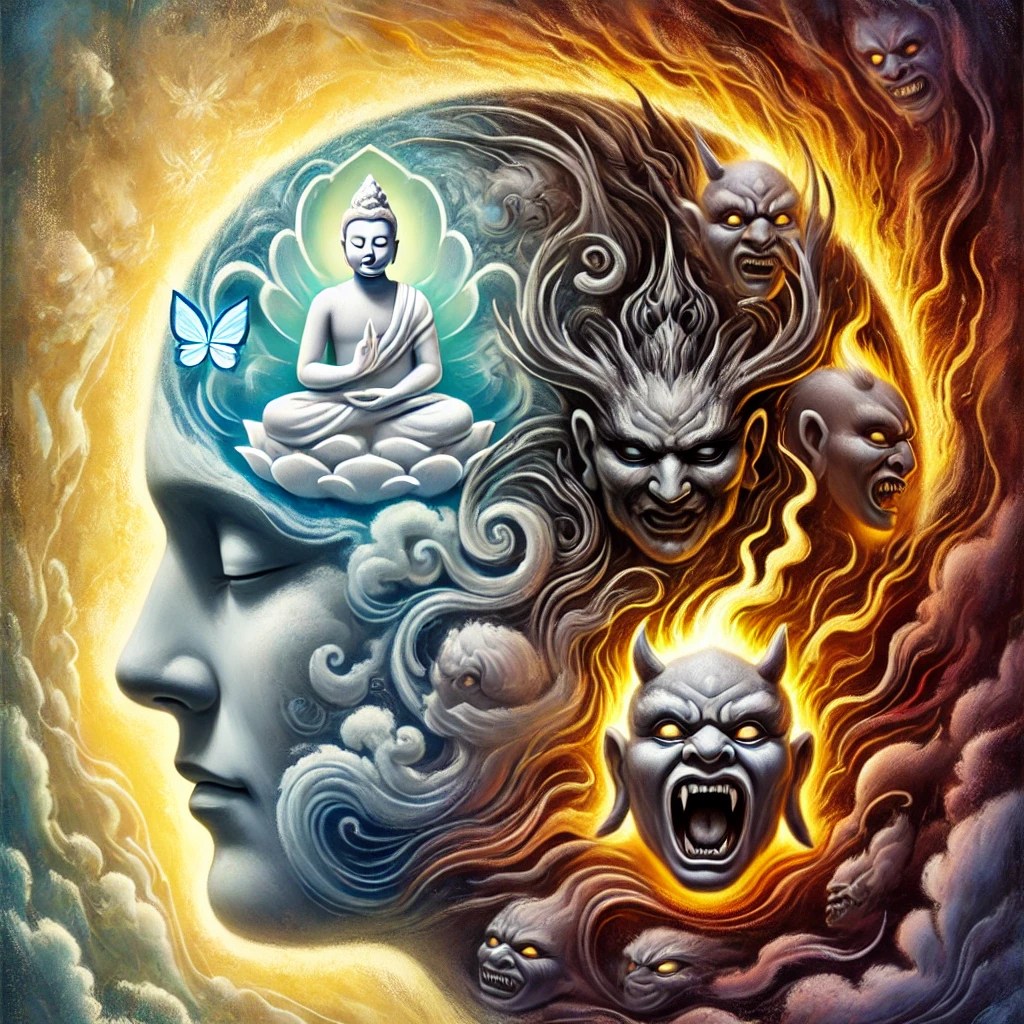
After the linga annihilation ritual, I thought there was no hope. I had been completely immersed in their tantric system for most of my adult life. Thanks to a suggestion from a young man I met who was going through a devastating kundalini awakening, I had the idea to contact a Catholic exorcist. I read his book called Diary of an American Exorcist that came out in 2021 , and for the first time in my life, I started to think I might actually be possessed by the tantric deities I had practiced for years. I had been taught they were perfectly enlightened buddhas, so why had they turned against me, manifesting as demonic forces bent on my total destruction? How could I overcome these forces that seemed so powerful, so intransigent? The answer was something higher, greater, and infinitely more powerful than the tantric magical system. In order for it to work, it had to be completely outside of their deceptive system. That answer was the Biblical God and his son Jesus Christ.
The Power of Christ Over Dark Forces
Tibetan Buddhism presents itself as a perfect path to enlightenment, but what I experienced was a system built on deception and control. The practices I had been taught that used rituals, empowerments, and deity visualizations, brought many experiences, both blissful and horrible. When I started to have grave doubts and investigated the origins of tantra, to question and examine, it became obvious that was not allowed. Then came punishment and the bloody realization that these forces would never let me go.
But ever since I turned to Jesus Christ, slowly, gradually, things have changed. His power is greater than any so-called tantric magic or divine blessing from a guru. The name of Jesus brings healing and casts out demons. He has authority over all the small “g” gods.
Tibetan Buddhism teaches that its deities are compassionate buddhas and bodhisattvas, but in the end, I found them to be nothing but oppressive spirits masquerading as wisdom beings. They were powerless against Christ. The moment I surrendered to Jesus, they started to lose their grip on me. This was not psychological; it was spiritual warfare. I am not unique; many others have experienced the same freedom from demons and darkness.
Evidence in My Own Life: Healing, Hope, and Peace
If Tibetan Buddhism had been the true path, I would have found healing through it. Instead, it nearly destroyed me. The fact that I am now very much recovered, that I am healing and have hope, happiness, and peace, is proof that Christ is real and that He reigns above all. No Buddhist deity, no tantric ritual, no guru’s power is more powerful.
As Psalm 91:13 declares, “You will tread on the lion and the cobra; you will trample the great lion and the serpent.” This scripture became real in my life as Jesus granted me victory over the kundalini spirit and the guru. Although I am not completely free, they still have some control over my dreams and my body, I am so much more healed. I finally see the light at the end of the tunnel.
Why Christianity is the True Religion
Christ’s Power Over Darkness: No tantric deity or Buddhist practice could free me. Only Jesus could break the chains that bound me spiritually.
A Relationship, Not Rituals: Christianity is about knowing a living God, not engaging in endless rituals to appease deities that ultimately bring suffering.
True Healing and Transformation: The peace, hope, and healing I have now are real and lasting. No Buddhist practice ever gave me that.
The Dominion of Christ: The fact that Jesus Christ is triumphing over all the forces that tormented me proves His supremacy over all spiritual powers.
I spent a lifetime in Tibetan Buddhism, immersing myself in it. My spiritual journey took me to places I never imagined in the search for ultimate truth. I experienced expansive states of consciousness, and feeling a deep and blissful connection to the divine. But which “divinity?” What I didn’t know then, and what I have come to realize, is that there is a darkness woven into the fabric of tantric practices. What appears to be ascension, enlightenment, and higher understanding is, in reality, an ingenious, demonic hack of consciousness.
The Tibetan Buddhist teachings I followed, deeply rooted in ancient tantric rituals, promised transcendence through their intense and elaborate practices. I absolutely believed that I would be completely enlightened in this life, in the bardo (the period between lives) or in the next life. But sadly this was not to be because I angered my first lama, and later on my second guru, by taking issue with the sexual abuse by lamas of their students. It had happened to me many years ago by my first lama and had been deeply traumatic; I never completely recovered from it. Then a few years ago, I was the victim of a “linga annihilation ritual,” a highly secretive and disturbing process, led by two gurus who used their power to sever my connection with the divine. These gurus were attempting to bring about spiritual “death” through the destruction of my mind and body, but what they did was far worse than anything I could have imagined. The ritual shattered my consciousness, left me stripped of my spirit, and plunged me into a terrifying, hellish reality.
Before this happened to me, I believed that the tantric rituals, no matter how painful or intense, were a part of the path to enlightenment. I knew that the sexual abuse by the lamas of their students was very wrong and destructive, but I thought that the teachings themselves were pure. The sexual abuse, however common, must just be an aberration, I thought. But the linga annihilation ritual that occurred after my first lama was publicly exposed for predatory sexual abuse after many years left me spiritually completely hollow and cut off from any sense of peace or hope. I was literally attacked day and night by the gurus and their demons. This went on for years, and continues in a lesser form even up to the present day. It is obvious to me now that for all those years, I had been deeply deceived. In the guise of spiritual awakening, I had been led into the deepest form of spiritual manipulation. The guru, with his promise of divine power and liberation, became little more than an agent of destruction, using a deep knowledge of tantra to exploit, control, and then destroy my very being.
This devastating crisis led me to search for an answer beyond the confines of Tibetan Buddhism, something that could provide true healing, hope, and redemption. After a lot of suffering, I eventually found my way back to Catholicism, the faith of my childhood that I had left so many years ago in search of something more powerful and profound. I came to realize that Christianity, and Catholicism in particular, offers a truth that tantric practices could never deliver. The love of God, the grace of Christ, and the power of the Holy Spirit were waiting for me all along, not in the dark corners of esoteric rituals, but in the simplicity and purity of Christ’s message of salvation.
Returning to Catholicism has not been easy. The process of re-entering the Church after years of living in a completely different spiritual system has been humbling, and at times, disorienting. The Church has had many upheavals of Her own. But as I embrace the sacraments, pray with sincerity, and allow God’s healing grace to wash over me, I am starting to feel a deep sense of peace that I have not known in years. The darkness that has clouded my mind is slowly lifting.
I know now that tantra, with its promises of spiritual power and transcendence, is not a path to liberation but a detour that leads one further away from God. Its manipulations of consciousness, through rituals and doctrines, are not about divine union but about yielding to spiritual forces that are in reality dark entities seeking to enslave and destroy. I can see it now for what it is, an elaborate trick of the enemy, gussied up as enlightenment. It took my mind, spirit, and soul sinking to a place of the deepest despair before I could finally see the truth.
To anyone reading this who may feel lost or deceived in their spiritual journey, I urge you to seek truth, not in hidden, mystical practices, but in the clear, unwavering love of Christ. He is the only way, the truth, and the life. After all these years, I finally understand the symbolism of the crucifix: Jesus Christ sacrificed himself to pay the deep debt of all of humanity. As I continue to make progress on my journey and engage in spiritual warfare against the enemy to become completely free, I hope to document this process as I engage in the biggest battle of my life.
Tantric effigies, often referred to as linga, play a significant role in Vajrayana Buddhism, especially when used as instruments of spiritual protection or tools for overcoming various obstacles and enemies. These symbolic figures, primarily drawn or carved, are part of an extensive arsenal designed to affect not just the environment, but also entities and humans.
What is a Linga?
The term linga (or lingam) refers to a symbolic representation of divine power, often associated with Shiva in Hinduism, but in the context of Vajrayana Buddhism, it has taken on broader meanings. In Buddhist Tantra, linga effigies are intricately designed symbols or blockprints that serve as consecrated figures infused with spiritual potency. These are often drawn with profound intention and purpose, and they may be used in ritual contexts aimed at safeguarding the practitioner, overcoming internal or external obstacles, or exerting influence over other individuals.
The Role of Yantra and Linga
The creation of these effigies falls under the broader category of yantra, a Sanskrit term that means a mystical diagram, generally consisting of geometric patterns, sacred geometry, and other spiritual symbols. Yantras are central to Tantric practices across various traditions, including those found in Vajrayana Buddhism.
While the primary purpose of these yantras is to facilitate communication with higher spiritual realms, their scope extends further. They are also utilized to overcome real-world challenges and enemies. The designs, which often incorporate powerful symbols and mantras, carry potent energies capable of affecting the lives of living beings. Their geometric formations have a unique power to influence reality in profound ways.
The Darker Use of Yantra: Targeting Living Humans
While many tantric practices appear to be centered on positive transformation, some yantras, especially the one depicted in the image above, are created with a more malicious intent. These may be used as a means to control, manipulate, or incapacitate a living person. Often, these designs are invoked when a practitioner feels threatened, when they believe someone is working against them, or when they wish to remove or neutralize an opponent.
In the darker aspects of Tantric Buddhism, these images become tools of spiritual warfare. The effigies, with their precise, intricate diagrams, are said to unleash energies capable of affecting the target at a very deep level, interfering with their mental state, their health, or their circumstances. In this sense, the use of such yantras can be likened to a form of spiritual attack, though it is often viewed through the lens of the practitioner’s need for protection or redress.
The image above is an example of such designs. Similar images may be viewed here. They range from those that depict complex, concentric patterns to those that show figures bound by chains, limbs twisted into unnatural positions, and surrounded by ominous symbols. The repetitive nature of the patterns, often arranged in a triangular, circular, or star-shaped structure, is indicative of their purpose to concentrate and focus spiritual energy. Whether drawn on paper or inscribed on talismans, these figures are sometimes used in rituals specifically designed to target a human being.
Why Use Linga and Yantra Against Living Humans?
The reasons for using these powerful symbols against another human are varied. In Tantric Buddhism, as in other forms of esoteric spiritual practice, the belief exists that the power of the mind can utilize demonic forces to directly affect the material world. When someone faces extreme opposition or malefic influence, or for other reasons, they may turn to these symbols for relief or to change their reality.
These rituals, however, are not without ethical consequences. While some view the use of yantras as a form of spiritual justice, others consider it malicious, especially when the symbols are used to manipulate or harm people for personal reasons. It is important to note that such practices fall outside the bounds of mainstream Buddhist teachings but are definitely used in Tibetan Buddhist tantra. This poses the question: how “Buddhist” are the practices in tantric Tibetan Buddhism, really?
The Power and Potential of Yantras
Whether used in defense or as an act of aggression, the power of linga and yantra comes from their ability to channel spiritual energy and demonic entities. They are meticulously created and charged with specific intentions. The geometric precision and intricate design are not merely aesthetic but are believed to carry profound spiritual repercussions.
Conclusion
It is important to understand that the effigies and yantras used in Vajrayana Buddhism represent more than just spiritual protection. These powerful drawings, blockprints, and talismans are active spiritual forces that, when used effectively, can bring about profound harm. As these ancient Tantric practices continue to spread throughout the world, it is essential to understand their darker uses. Only through knowledge and wisdom can these traditions be fully comprehended. Aspirants should take care and not stumble blindly into spiritual esotericism, even if it is cloaked in an appearance of compassion and light.
Many individuals in the Western world grow up in homes steeped in Judaeo-Christian traditions, often baptized as children and raised with an understanding of Jesus Christ as the central figure of faith. Yet, as they mature, many are drawn into Eastern religious practices that promise inner peace and spiritual enlightenment. This pull toward Eastern religions, particularly Tibetan Buddhism and its practices, is sometimes presented as harmless, even compatible with Christian teachings. In my own experience, some Tibetan Buddhist teachers have claimed that there is no conflict between the teachings of Christ and those of Tibetan Buddhism. While this may sound like a comforting and inclusive message, it is, at best, misleading, and at worst, a dangerous lie that leads many Christians astray.
For individuals baptized into the Christian faith as infants or children, an indelible spiritual imprint occurs on the soul, one that marks them as belonging to the God of the Bible. This sacred act establishes a direct relationship with the Creator, which stands in stark contrast to the beliefs and practices found in Eastern religions. Despite this foundational truth, many are lured into a syncretic blend of Christian teachings with the mystical, spiritual practices of Buddhism, Hinduism, or other occult traditions. The danger lies in the fact that this mixture ultimately dilutes or distorts one’s Christian identity and opens individuals to the influence of deceptive spiritual forces.
The Danger of Syncretism: Mixing Christian Faith with Pagan Practices
The claim that Jesus’ teachings and Tibetan Buddhism can coexist is rooted in a concept known as syncretism, the blending of two or more belief systems. While this may seem like a path to spiritual open-mindedness and personal growth, the Bible clearly warns against such practices. The Old Testament is filled with injunctions against idolatry and the worship of foreign gods, whether in the form of pagan deities or mystical spiritual practices.
In Deuteronomy 18:9-14, God commands His people to avoid any form of divination, sorcery, or magic, practices that are prevalent in many Eastern traditions. These acts are considered detestable to God and directly oppose the purity of worshiping the one true Creator God. These prohibitions apply just as much today as they did thousands of years ago, even if modern expressions of occultism have evolved and adapted into seemingly more “acceptable” forms, like meditation or chakra healing.
When individuals who have been baptized in the Christian faith engage in practices like Buddhist meditation, energy work, or divination, they risk opening themselves up to dark spiritual forces. The Bible warns against such practices not only because they involve the worship of false gods but because they undermine the central role of Christ as the sole mediator between God and humanity. Jesus himself makes this clear in John 14:6 when He says, “I am the way, the truth, and the life. No one comes to the Father except through me.” To engage in Eastern religious practices is to step away from that singular path to salvation.
The Spiritual Imprint of Baptism: A Mark of Belonging to the Christian God
Moreover, for those baptized as children, the Bible teaches that baptism is not merely a symbolic act but a profound spiritual marking of the soul. In baptism, one is initiated into the life of Christ and made part of His Church. This sacred act is intended to be the foundation of a lifelong relationship with God, one that is in direct opposition to pagan practices.
Romans 6:3-4 tells us that in baptism, we are “buried with him through baptism into death in order that, just as Christ was raised from the dead through the glory of the Father, we too may live a new life.” This new life is one marked by obedience to God and rejection of all that seeks to draw us away from Him. Pagan religious systems, including Eastern occult practices, offer a counterfeit spirituality that leads away from Christ, not toward Him. The baptismal mark on a Christian soul is a direct line of connection to the one true God and should not be confused with the spiritual practices that often accompany other belief systems.
While Eastern religions may offer an alluring promise of inner peace or spiritual awakening, they can never replace the saving grace found in Christ. The temptation to seek answers outside of the Christian faith leads individuals into dangerous spiritual territory, where demonic influence can gain a foothold. The apostle Paul warns in 2 Corinthians 11:14-15 that “Satan himself masquerades as an angel of light,” and many false teachers will appear to offer what seems like truth but ultimately lead people astray.
The Spirit of Divination: The Third Eye and Demonic Portals
The Bible also highlights the dangers of divination, which are common practices in many Eastern traditions, including Tibetan Buddhism. One vivid example is found in Acts 16:16-18, where the apostle Paul encounters a slave girl who possesses a spirit of divination. This spirit enables her to predict the future. The girl follows Paul and his companions, shouting that they are servants of the Most High God, which seems to align with truth, but in reality, the spirit she possesses is a demonic force.
Paul, recognizing the deception, casts out the demon of divination, saying, “In the name of Jesus Christ, I command you to come out of her!” (Acts 16:18). This moment is significant because it reveals the true nature of divination: it is not a benign spiritual gift or insight, but rather a demonic influence. The spirit of divination that Paul confronts is the very same one that oversees the opening of the occult “third eye,” a concept in Eastern occultism often linked to psychic abilities and spiritual awakening.
The “third eye” or so-called “wisdom eye” is considered by many as a metaphysical organ that allows one to access hidden spiritual realms and tap into supernatural knowledge. However, the Bible warns against such practices because they open a door to the preternatural world, a world where demonic spirits can influence and deceive those who seek power outside of God. This “third eye” is not a gateway to divine enlightenment but a portal that leads into the realm of darkness, where demons dwell and influence human lives. Jesus is the only true source of spiritual insight and enlightenment. Any attempt to open one’s spiritual eyes outside of Christ is a dangerous invitation to demonic oppression.
The Spiritual Dangers of Divination, Meditation, and Yoga
Eastern religious practices often involve forms of meditation or yoga that encourage individuals to connect with unseen spiritual forces. Tibetan Buddhist meditation, for example, often involves visualizing deities or engaging in rituals that invite spiritual forces into one’s body and mind. Energy work and chakra healing, popular in New Age practices, propose that spiritual power can be manipulated through physical means or harnessed from the universe. However, the Bible teaches that all spiritual power comes from God alone and that seeking power outside of Him is an act of rebellion. In Ephesians 6:12, Paul reminds us that our battle is not against flesh and blood but against “the rulers, the authorities, the powers of this dark world and against the spiritual forces of evil in the heavenly realms.” Engaging in occult practices, however begin they may seem, opens individuals to these forces of darkness.
Conclusion: Remain Faithful to Your Christian Roots
It is crucial for those of the Christian faith to understand the deep spiritual dangers that arise from dabbling in occult practices, particularly those from Eastern religions. The temptation to blend the Biblical teachings with those of pagan systems is not new, but it remains just as dangerous today as it was in ancient times. God calls His people to remain pure in their worship, to avoid the seductive allure of false spiritual practices, and to stand firm in the faith that was once for all entrusted to the saints (Jude 1:3).
Christ is the only way to salvation, and any attempt to mix Him with other gods or spiritual practices ultimately leads to deception and destruction. Baptism marks a Christian as belonging to God, and that identity must not be compromised by the pursuit of false teachings. Therefore, stand firm in the faith, and guard hearts and minds against the dangerous allure of Eastern occult practices.
Tibetan tantric Buddhism has long fascinated and mystified both scholars and practitioners alike. While much of its practice revolves around meditation, visualization, and philosophical discourse, historical accounts suggest that certain sects engaged in secretive and controversial rites, including subjugation rituals and, in some cases, physical executions. While some tantric lineages justify these as purely symbolic acts of internal transformation, others indicate that ritualized killings are at times part of esoteric practices. These remain one of the most sensitive and least discussed aspects of Vajrayāna Buddhism.
The Justification: Internal Alchemy and Subjugation Rites
Many Tibetan Buddhist schools frame tantric rituals as a means to subdue inner enemies such as destructive emotions, ignorance, and attachments, rather than external foes. Texts such as the Cakrasaṃvara Tantra and the Hevajra Tantra describe wrathful deities engaged in acts of destruction, yet these are often interpreted by Tibetan lamas and Western scholars as symbols of the practitioner’s battle against their own mental afflictions.
Rituals involving visualized violence, such as slaying demons in the form of effigies, throwing tormas (ritual offerings) representing bombs, or drinking substances from a kapala (skull cup), are intended to dismantle the ego and lead to enlightenment. This view holds that the tantric practitioner does not actually kill, but instead undergoes a psychological transformation through these rites.
The Evidence: Historical Accounts of Ritual Killings
Despite this justification, historical records and oral traditions suggest that certain tantric practitioners, particularly within the darker recesses of Tibetan esotericism, may engage in actual acts of ritualized violence. The practice of srog sgrol (life liberation or live killing) has been referenced in some sources, where a ritualized execution was believed to transfer the victim’s consciousness to other realms, i.e. to the lower realms or hell.
Reports from Tibetan and Western observers, including early European travelers and Buddhist historians, recount instances where enemies of the dharma, or those deemed spiritually unfit, were objects of ritual subjugation. In these cases, physical acts were justified as a form of karmic retribution.
The Role of Tantric Adepts (Mahasiddhas) in Extreme Practices
Certain Tibetan and Indian Mahasiddhas (tantric masters) were known for their transgressive practices, challenging conventional morality to break through illusions of duality. Some of these figures, such as Padmasambhava and Virupa, were associated with wrathful magical feats and subjugation rituals, though their actions are often interpreted metaphorically. However, other figures, particularly in later Tibetan history, were accused of employing lethal tantric techniques to eliminate obstacles and enemies, both spiritual and political.
Controversy and Silence: Why Modern Authorities Avoid This Topic
In contemporary Tibetan Buddhism, discussions of these practices are largely absent or carefully avoided. The emphasis in modern Vajrayāna teachings is placed on compassion, wisdom, and ethical conduct, aligning with broader Buddhist principles. However, the existence of such rituals in historical contexts poses challenging questions:
Were these practices ever widely accepted, or were they fringe activities of rogue tantric practitioners?
To what extent were physical acts considered necessary versus metaphorical transformations?
How do modern Tibetan lineages reconcile these historical accounts with their present-day teachings that successfully whitewash the truth?
The intersection of symbolic transformation and real-world ritual violence remains one of the least understood aspects of Tibetan Buddhist history. While most tantric traditions today publicly emphasize nonviolence and ethical discipline, the shadows of past practices linger in historical accounts and most likely continue to this day. What we do know is that actual magical executions took place in Tibet and later in the Tibetan diaspora outside of Tibet. There is little reason to believe that this has changed. This illustrates that tantric Buddhism has always walked a fine line between virtue and evil. This begs the question: Is the apparent virtue just window dressing for darker practices? Just look at the photos on Facebook of some of the big drupchos (series of rituals, prayers, and meditation practices) done at the large Tibetan monasteries in India. What do you see? Are the so-called wrathful deities invoked in Tibetan Buddhist rituals really enlightened buddhas and bodhisattvas? This issue deserves sincere examination and honest discussion among Tibetan lamas and Rinpoches who instead go to great lengths to whitewash and obfuscate these matters.
Tantric Buddhism has long been one of the most misunderstood and debated traditions in religious history. At the heart of this controversy lies a fundamental question: Should its texts and practices be interpreted literally or symbolically? One of the most influential figures in this debate was Jñānākara, an 11th-century scholar who championed a symbolic interpretation of tantric scriptures, countering those who advocated for a literal approach to tantric rituals.[1]
The Tantric Dilemma: Symbolism or Literalism?
Tantric texts often contain vivid imagery of sexual union, wrathful rituals, and the consumption of taboo substances. Some Buddhist practitioners and scholars understood these descriptions as directives for actual practices, while others saw them as metaphors for deeper spiritual principles.[2]
Literal Interpretation: Some tantric teachers and traditions argued that rituals involving sexual union, the consumption of alcohol and other taboo substances, and even violent imagery were meant to be physically enacted as part of the spiritual path. These practitioners believed that by transcending conventional morality, they could directly attain enlightenment by confronting and transforming base emotions like desire and aversion.[3]
Symbolic Interpretation: Jñānākara strongly opposed this approach, insisting that such texts were meant to be understood allegorically, not literally. In his Mantrāvatāra, he systematically argued that sexual union symbolized the merging of wisdom and compassion, and that tantric rituals were meant to take place on a mental and meditative level rather than in the physical world.[4]
Jñānākara’s Critique of Literal Tantra
For Jñānākara, the rise of literal interpretations was a dangerous trend that risked undermining Buddhist ethics, particularly monastic discipline. Many monks had taken vows of celibacy, and engaging in literal sexual rites contradicted their commitments. He believed that those who promoted physical tantric rituals were misunderstanding or distorting the true intent of tantric texts.[5]
To support his argument, Jñānākara drew upon hermeneutical techniques established by earlier scholars like Candrakīrti. He emphasized that tantric texts contained twilight language (sandhābhāṣā), meaning they were meant to be decoded through metaphor rather than taken at face value.[6]
For example:
Sexual imagery in tantric texts represents the union of wisdom (prajñā) and skillful means (upāya), rather than physical intercourse.
Killing and wrathful acts do not endorse violence but symbolize destroying ignorance and negative mental states.
Consuming taboo substances represents transcending dualistic notions of purity and impurity.[7]
The Opposition: Advocates of Literal Tantra
While Jñānākara and like-minded scholars, including Atīśa, promoted a restrained, symbolic approach, other tantric masters argued that direct experience through literal practice was essential for transformation. These practitioners contended that symbolic interpretations diluted the raw power of tantra, which aimed to cut through illusion in an immediate, experiential way.[8]
Figures such as Abhayākaragupta and Darpanācārya argued that all Buddhists, monks and laypeople alike, should be allowed to engage in tantric consecrations, including sexual initiation rites. They maintained that direct engagement with desire, fear, and social taboos could accelerate spiritual awakening.[9]
Subjection Rites and Ritual Violence in Tantra
Despite Jñānākara’s emphasis on symbolic interpretation, some tantric traditions in Tibet, including those that largely followed his approach, continued to engage in subjection rites, sometimes involving ritualized acts of violence. The Cakrasaṁvara Tantra, for instance, describes rituals meant to subjugate, bind, and even kill enemies, with wrathful deities acting as enforcers of divine justice.[10]
There is evidence that in Tibet, “live kills” (srog sgrol) were practiced into the 20th century, and possibly still occur today in some secretive circles. These rites were believed to be means of neutralizing obstacles, whether internal (psychological enemies) or external (political or spiritual threats). Even among those adhering to Jñānākara’s symbolic reading, subjection rites continued in a ritualized form, where the target of destruction was seen as a demonic force rather than an actual person.[11]
While some Tibetan tantric lineages attempted to justify these practices as symbolic acts of internal transformation, historical accounts suggest that physical executions and ritualized killings did, at times, occur as part of certain tantric sects’ secretive rites. These practices remain highly controversial and are rarely discussed openly by modern Buddhist authorities.[12]
Conclusion
Even today, different schools of Vajrayāna Buddhism hold varying interpretations of tantra. Some Tibetan Buddhist traditions, such as the Gelugpa school, maintain a strongly symbolic approach, while others, particularly some Nyingma and Kagyu traditions, acknowledge the historical presence of more literal practices in certain contexts.[14]
The controversy surrounding tantra highlights a larger question in religious traditions: Who gets to decide how sacred texts should be read? Jñānākara’s conservative stance on symbolic interpretation shaped Tibetan Buddhism in profound ways, steering it toward a more ethical, monastically compatible form of tantra. [15]
Ultimately, Jñānākara’s legacy reminds us that how we interpret texts matters as much as what they say. His approach demonstrates the lasting power of hermeneutics, how the meaning of a text is shaped by the needs, ethics, and priorities of those who read it.
Footnotes:
Lopez, D. (1998). Prisoners of Shangri-La. University of Chicago Press.
Davidson, R. (2004). Indian Esoteric Buddhism: A Social History of the Tantric Movement. Columbia University Press.
Wenta, A. (2018). The Making of Tantric Orthodoxy in the Eleventh-Century Indo-Tibetan World: Jñānākara’s Mantrāvatāra. Springer.
Gray, D. (2007). The Cakrasamvara Tantra: A Study and Annotated Translation. Columbia University Press.
Wedemeyer, C. (2013). Making Sense of Tantric Buddhism: History, Semiology, and Transgression in the Indian Traditions. Columbia University Press.
Sanderson, A. (2009). The Śiva Age: The Rise and Dominance of Śivism During the Early Medieval Period. Brill.
Snellgrove, D. (1987). Indo-Tibetan Buddhism: Indian Buddhists and Their Tibetan Successors. Shambhala Publications.
Newman, J. (1987). The Outer, Inner, and Secret Biography of Padmasambhava. Oxford University Press.
Gray, D. (2016). Subjugation and Ritual Violence in Buddhist Tantra. Oxford University Press.
Karmay, S. (1998). Secret Visions of the Fifth Dalai Lama. Serindia Publications.
The following article explores perceived similarities between Tibetan Buddhism and Satanic Ritual Abuse (SRA) in terms of control mechanisms, ritual practices, and psychological manipulation. The comparisons drawn are based on specific interpretations and are not intended to generalize or misrepresent either tradition as a whole.
Both Tibetan Buddhism and Satanic Ritual Abuse (SRA) represent complex systems that involve ritual, hierarchical structures, and psychological influences. While they originate from different cultural and spiritual frameworks, certain similarities in their use of control tactics, dualistic personas, and ritualistic practices warrant closer examination. This article explores these parallels, particularly in the context of mind control, fear-based manipulation, and the use of dual identities in both systems.
1. Mind Control and Psychological Manipulation
In accounts of SRA, mind control plays a pivotal role, often involving the deliberate fragmentation of an individual’s psyche to create multiple alter personalities. These alters are frequently compartmentalized into ‘front’ and ‘back’ personalities, serving different purposes based on the handler’s intent. Demonic entities are often assigned to control these alters, reinforcing obedience and perpetuating fear.
Tibetan Buddhism, while traditionally viewed as a spiritual path toward enlightenment, contains elements that can be interpreted as psychological manipulation. The use of fear tactics, such as warnings of karmic retribution or spiritual downfall, serves to maintain authority within the monastic hierarchy. Additionally, initiations into various deities, some peaceful, others wrathful, can create psychological dichotomies within practitioners. These deities, which could be perceived as symbolic representations of different mental states, play roles that parallel the concept of alters in SRA.
2. The Use of Dualistic Personas: Peaceful and Wrathful Entities
A significant parallel between SRA and Tibetan Buddhism lies in the use of dualistic personas. In SRA, handlers create front alters that appear functional and benign, while back alters may be programmed for destructive or hidden purposes. This duality fosters confusion and reinforces the handler’s control.
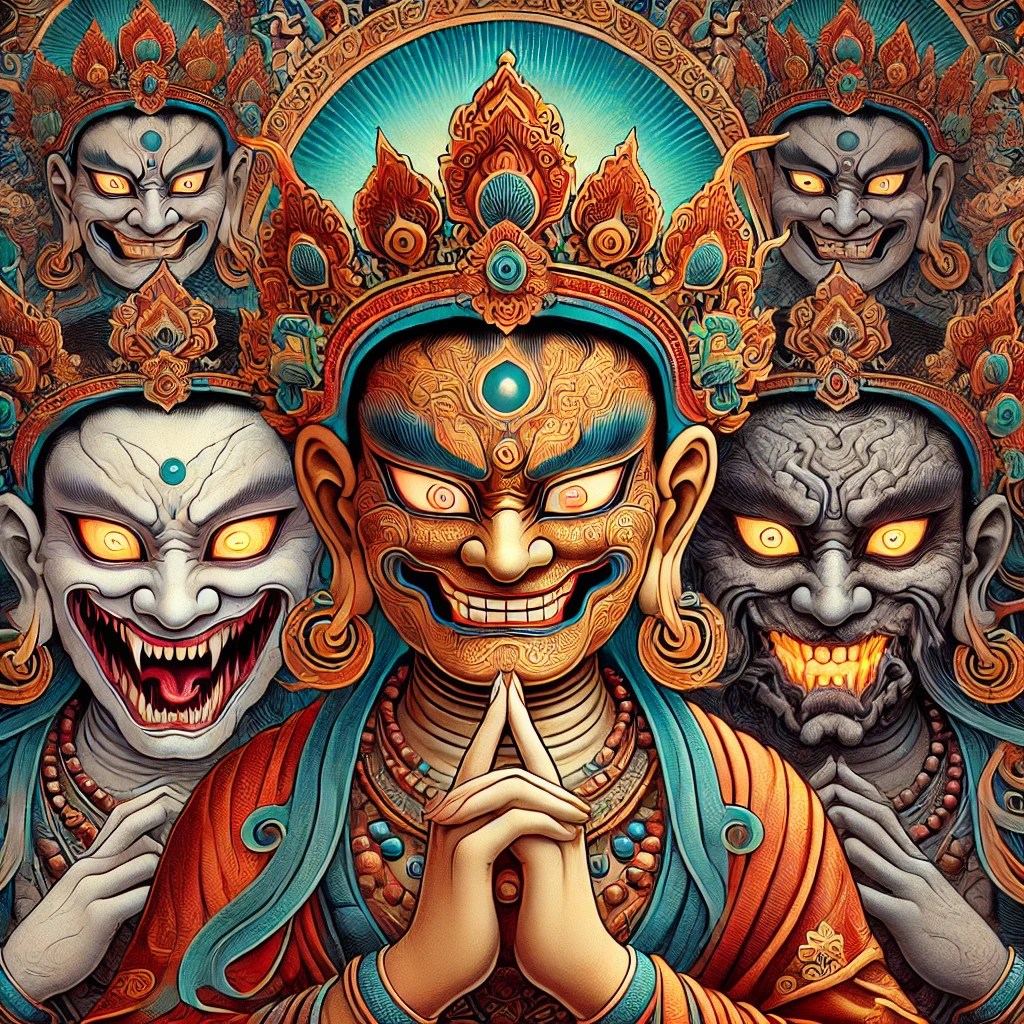
Similarly, Tibetan Buddhism employs the concept of peaceful and wrathful deities. Figures like Chenrezig (Avalokiteshvara), the deity of compassion, embody the peaceful aspect, while wrathful manifestations like Mahakala represent fierce, protective energies. The Mahasiddha, an enlightened being considered beyond good and evil, can manifest these dual personas depending on the circumstances. In some cases, a spiritual teacher (or Root Guru) may embody a compassionate demeanor publicly, but exhibit wrathful behavior when “necessary” for spiritual subjugation or destruction. This duality can create cognitive dissonance in disciples.
3. Ritual Practices and the Role of Fear
Both systems incorporate ritualistic practices designed to reinforce psychological control. In SRA, rituals often involve symbolic or literal acts of violence, aimed at instilling fear and breaking down individual resistance. The presence of demonic entities within these rituals further amplifies the psychological trauma and sense of helplessness in victims.
Tibetan Buddhism’s rituals, while usually viewed as spiritually transformative, can also be interpreted through this lens. The rituals of subjugation, for instance, are designed to exert control over both human and spiritual entities. Wrathful deities are invoked to overcome obstacles, enemies, or internal psychological barriers, often through complex ceremonies that may include visualizations of violence or destruction. For disciples who are vulnerable or questioning, these practices can evoke fear and reinforce the guru’s power over their spiritual and personal lives.
4. The Guru as a Central Authority Figure
In both Tibetan Buddhism and SRA, the central authority figure, whether a Root Guru or a handler, wields significant control over individuals. The guru, much like the SRA handler, is often viewed as infallible, possessing superior knowledge or spiritual insight that justifies their behavior, whether compassionate or wrathful. The disciple’s trust in the guru’s wisdom can lead to unquestioning obedience, even in the face of apparent contradictions or abuse.
The Mahasiddha’s role, being beyond conventional morality, mirrors the handler’s manipulation in SRA, where actions are justified as necessary for the victim’s transformation or initiation. This dynamic can trap individuals in dangerous situations and tortured mental states.
While Tibetan Buddhism and Satanic Ritual Abuse arise from distinct cultural and spiritual backgrounds, their methods of control, use of dual personas, and ritualistic practices reveal striking similarities in how they can manipulate individuals psychologically and spiritually. Recognizing these parallels is crucial for understanding the broader mechanisms of power that aim to trap and curtail individual freedom and agency.
In the world of Tibetan Buddhism, we often hear about enlightenment and compassion, but there is a darker side that rarely gets discussed, one where charismatic gurus exploit their positions of power to manipulate and control their followers. This is my story of how a Tibetan Buddhist guru used mind control and supernatural abilities to take my power, overwrite his priorities onto my mind, and ultimately subject me to sexual abuse and spiritual control.
When I first met him, he seemed wise, compassionate, and spiritually advanced. His charisma was undeniable, and the Tibetan Buddhist teachings resonated deeply with me. I was drawn in, believing I had found someone who could guide me on my spiritual path. But over time, subtle shifts began to occur. Through a mix of psychological manipulation and what felt like supernatural influence, something often referred to as “magic,” he began to infiltrate my thoughts, convincing me that his desires and priorities were my own.
It didn’t happen overnight. The process was gradual, almost imperceptible. He would use flattery to build me up, only to tear me down when I didn’t conform to his expectations. He planted seeds of doubt in my mind, making me question my worth and my intuition. This mental and emotional manipulation created a dependency, making it difficult to see the abuse for what it was.
The guru used his perceived supernatural abilities to deepen this control. He made me believe that he had insights and powers beyond the ordinary, which made me doubt my own perceptions even more. For one thing he could read my mind and he demonstrated this again and again. He had other supernatural abilities as well. This led me to believe he was all-knowing and enlightened and it made me ripe for abuse. His manipulation extended to my sense of self-worth. Later on, when I tried to stand up for myself, he would convince me that I was unworthy and defective, that my resistance was a sign of spiritual failure.
But no one has the right to overwrite your mind or take your power. No one should ever convince you that you are unworthy or defective for standing up against their abuse. It took me a long time to realize that the problem was not with me, but with him and his need to feel superior and in control.
If you find yourself in a similar situation, know that you are not alone. Abuse, whether sexual, spiritual, or psychological, is never your fault. The first step to reclaiming your power is recognizing the manipulation for what it is: brainwashing designed to keep you compliant. Do not agree to be defeated just because someone else deeds it so. Your self-worth is a God given, inherent right, and no guru, no matter how “enlightened” or seemingly powerful, can take that away from you.
This is a call to action: Trust your instincts. Stand up for yourself. Break free from the illusion and reclaim your power. No one has the right to control you to fulfill their own narcissistic desires or for any other reason. In Tibetan Buddhism the Root Guru is treated as a god, but I now know they are fallible and often deeply troubled human beings who have tapped into a dubious spiritual realm through magical practices. Their powers may seem limitless, but Jesus is much more powerful and they are in for a rude awakening.
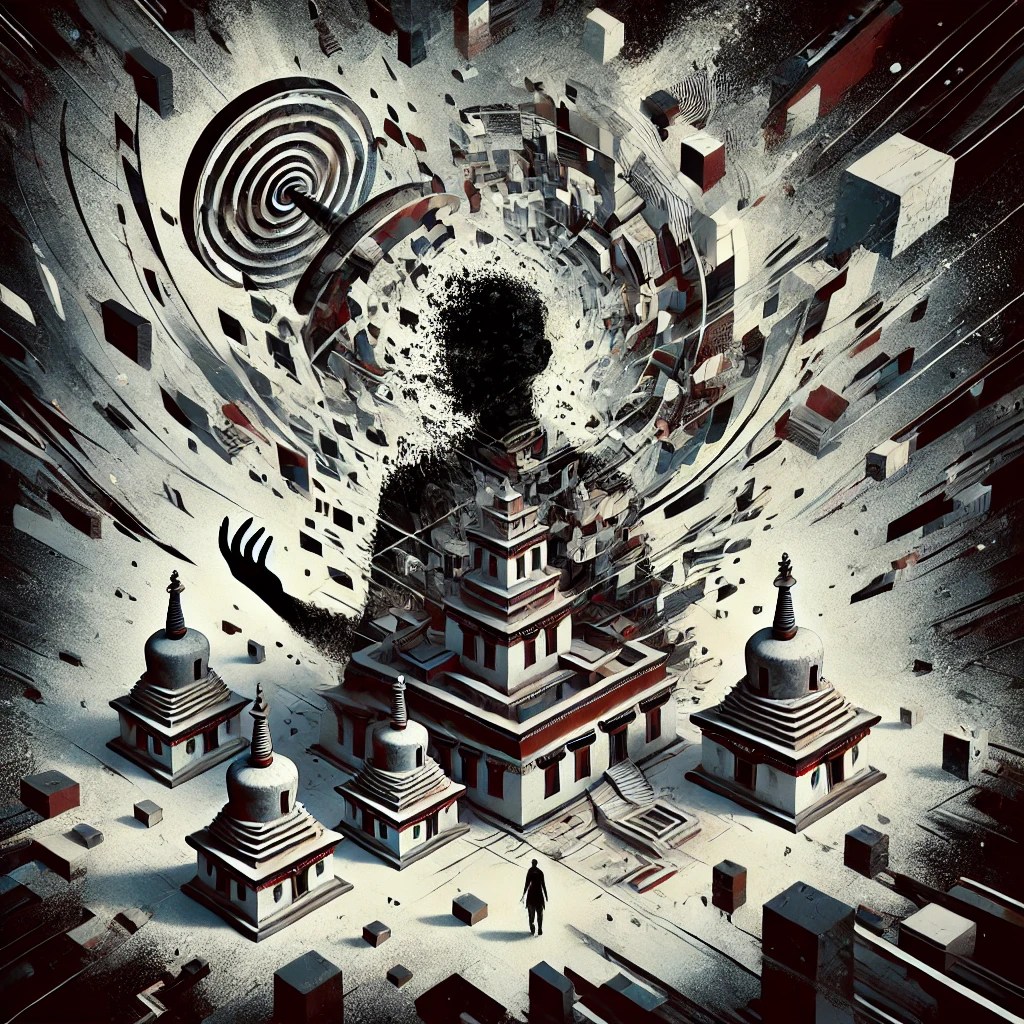
This illustration depicts the state of “vajra hell,” the total dissolution of the mind.
When many Westerners approach Tibetan Buddhism, they do so with an open heart and a desire to deepen their spiritual practice. The exotic rituals, profound teachings, and seemingly compassionate community can be deeply appealing. However, beneath this shiny surface lies a complex web of commitments and consequences that few are prepared for, most notably, the concept of samaya (sacred bond) and its implications.
What is Samaya?
Samaya refers to the vows and commitments a student makes to their tantric guru and yidam deities. These vows are considered sacred, and maintaining them is central to the practitioner’s spiritual progress. However, the specifics of these vows and the consequences of breaking them are often vaguely communicated, especially to Western practitioners who may not be familiar with the cultural and historical contexts in which these practices developed.
The Culture of Silence and Fear
One of the most concerning aspects of samaya is the culture of silence it fosters. Criticizing or even feeling anger towards one’s guru, regardless of whether that anger is justified, is seen as a severe violation. In some teachings, it’s said that such emotions can lead to dire spiritual consequences, including rebirth in vajra hell, a particularly terrifying concept designed to enforce obedience and submission.
This culture makes it exceedingly difficult for practitioners to voice concerns or challenge questionable behavior. The fear of spiritual retribution can be paralyzing, leaving individuals trapped in harmful situations without support.
The Danger of Vague Punishments
In many Tibetan Buddhist communities, the specific repercussions for breaking samaya are deliberately left vague. This ambiguity serves to keep practitioners in a state of uncertainty and fear, unsure of what might trigger severe consequences. For those involved in intensive practices like three-year retreats, this can create an environment ripe for manipulation and abuse.
A Warning to Western Practitioners
If you’re considering entering into a tantric relationship with a Tibetan Buddhist guru, it’s crucial to fully understand the commitments you’re making. Ask questions, seek out diverse perspectives, and be wary of any teacher who discourages inquiry or transparency.
Remember, spiritual growth should not come at the cost of your autonomy, well-being, or mental health. Trust your instincts, and don’t hesitate to step away from harmful situations.
Final Thoughts
Tibetan Buddhism offers many seemingly profound teachings, but it’s essential to approach these practices with both a very discerning mind, especially if you come from a Judeo-Christian background. Understanding the hidden dangers of Tibetan Buddhism can help protect you from falling into harmful dynamics that have ensnared many unsuspecting practitioners before you.
The word “Tantra” evokes sex and mysticism in the modern world. However, it is a spiritual practice fraught with controversy and potential harm. Though its origins are deeply embedded in South Asian spiritual traditions, Tantra has long been a subject of debate for its questionable methods and the risks it poses to practitioners.
Questioning Tantra’s Validity in Indian Buddhism
One of the most contentious aspects of Tantra in Indian Buddhism is its origins. Did these esoteric practices truly originate with the Buddha, or do they stem from darker, occult sources? Many argue that Tantra’s reliance on rituals, mantras, and deity possession deviates sharply from the Buddha’s original teachings. Instead, Tantra seems to delve into a realm of magic, where practitioners invoke powerful spirits or deities that are difficult to control. The secretive and arcane nature of Tantra has even drawn comparisons to Western Satanism, with parallels in symbolic inversion, forbidden knowledge, and the harnessing of dark energies. These troubling similarities raise serious questions about the true intent and origins of Tantra.
Tantra is believed to have emerged in India around the 5th to 7th centuries CE as a response to the rigid practices of Vedic Hinduism and early Buddhism. Its origins are steeped in secrecy and myth. The term “Tantra,” means “to weave” or “to expand,” and hints at its darker origins: the weaving of esoteric forces into the human psyche.
The Core Principles of Tantra: A Double-Edged Sword
Tantra appears to challenge dualistic thinking, presenting the material and spiritual worlds as interconnected:
Shakti and Shiva: While the union of Shakti (divine feminine) and Shiva (divine masculine) is portrayed as a balance, the rituals associated with this concept often involve the invocation of chaotic energies that can destabilize practitioners.
Sacredness of the Body: Tantra’s reverence for the body as a vehicle for enlightenment can lead to practices that blur ethical boundaries, and expose aspirants to physical and psychological risks. These practices often involve an extreme form of yoga that includes breath manipulation and physical postures designed to awaken kundalini energy. This wild and often uncontrollable force is said to be a dormant energy that resides at the base of the spine, but in reality, it involves possession by a spirit.
Ritual and Symbolism: The intricate rituals, mandalas (geometric designs), and mantras (sacred sounds) used in Tantra can act as portals and invocations to preternatural forces.
Tantra in Hinduism and Buddhism
While Tantra is often associated with Hinduism and Buddhism, its practices diverge significantly from the ethical foundations of these traditions. In Hinduism, Tantra became linked with Shaivism and Shaktism, incorporating rituals that many consider to be unorthodox and even dangerous. For instance, human sacrifice, though outlawed, is still secretly practiced in India. In Buddhism, Tantra’s form, Vajrayana, emerged as an esoteric path that relies heavily on guru worship, deity yoga, and visualization. These methods often blur the line between spiritual growth and occult manipulation. Critics argue that such practices betray the Buddha’s emphasis on ethical conduct and mindfulness.
The Spread and Evolution of Tantra: A Troubling Legacy
As Tantra spread beyond India, it adapted to local cultures but retained its core. In Tibet, for instance, Tantric rituals merged with indigenous Bon practices, creating a potent fusion. During the colonial era, Western scholars sensationalized Tantra, focusing on its sexual practices and scary looking deities while ignoring its broader implications. This misrepresentation led to a rehabilitation of Tantra in the West in the second half of the 20th century that idealized Tibetan Buddhist Tantra as purely benevolent, reframing and obscuring its darker aspects.
In the modern world, Tantra has been rebranded as a tool for personal empowerment, often stripped of its spiritual and cultural context. However, this simplification overlooks the risks associated with its practices. Authentic Tantra, with its emphasis on invoking and channeling preternatural energies, is a perilous path that can lead to psychological torment and spiritual dissolution. The allure of Tantra’s supposed transformative power can blind practitioners to its potential for harm.
A Warning
The history of Tantra is not merely a tale of spiritual innovation but also a cautionary story of occult manipulation and risk. Its practices, which often involve possession by spirits or deities, can have dire consequences even if approached with extreme caution. These entities, if angered or improperly controlled, can turn on the practitioner, leading to profound suffering. While Tantra may promise enlightenment, its methods carry a heavy price. Those who seek spiritual growth would do well to heed these warnings and consider safer, more ethical paths.










 Tantric Deception