
The Question of the Soul: Christianity, Hinduism, and Buddhism


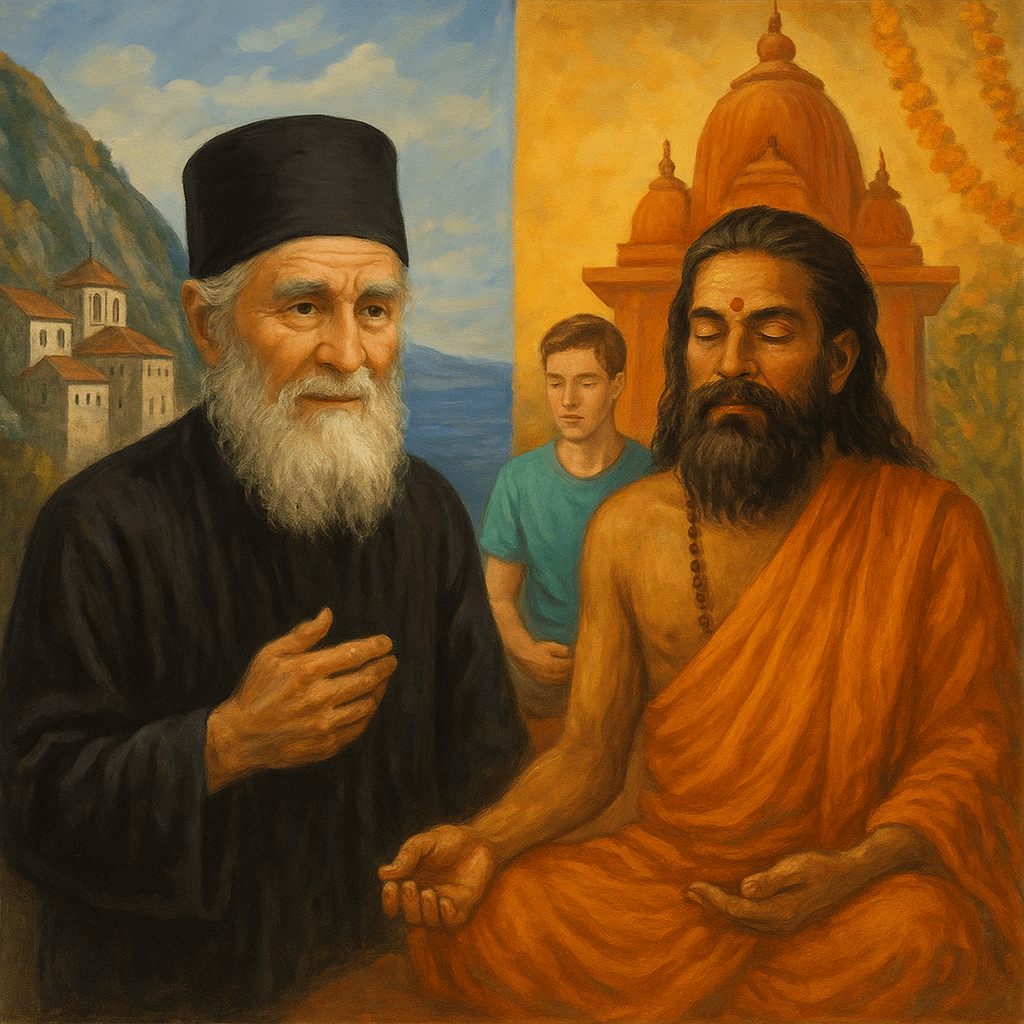
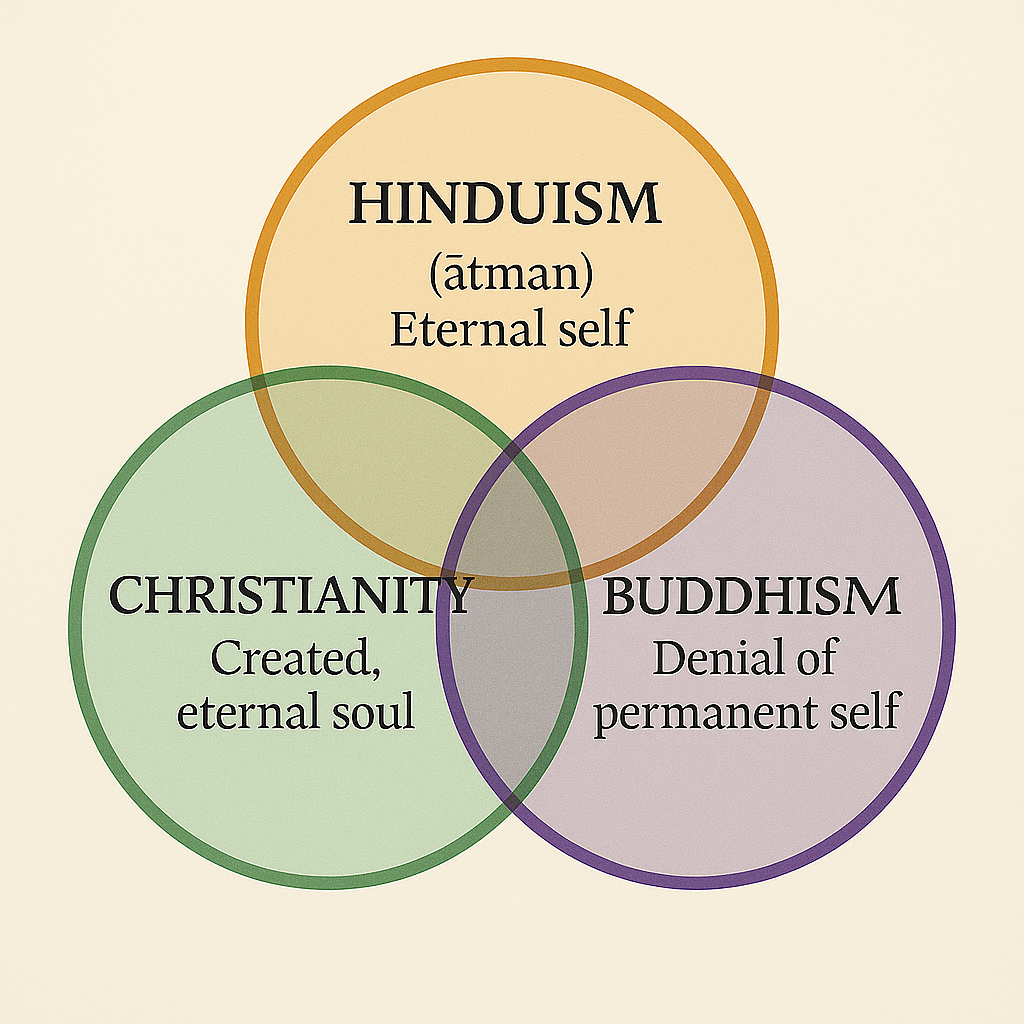
The question of what the soul is, whether it exists, and what happens to it after death lies at the center of the world’s major religious traditions. Christianity, especially in its Catholic tradition, affirms the soul as eternal and God-given. Hinduism has multiple schools, often affirming an eternal self or ātman. Buddhism, including Tibetan Buddhism, rejects the idea of a permanent self or soul and instead speaks of mind and consciousness as a conditioned stream of awareness without enduring essence.


The Christian and Catholic Understanding of the Soul

Christianity teaches that every human being has a unique, immortal soul created by God. According to Catholic doctrine, the soul is the spiritual principle of the human person. It is eternal in destiny, surviving bodily death, and directed either toward communion with God or separation from Him.

Scriptural sources include Genesis 2:7, where God breathes life into Adam and he becomes a living soul [1]; Matthew 10:28, where Jesus warns of the danger of losing the soul [2]; and the Catechism of the Catholic Church, which affirms that the soul is created by God and immortal [3]. In this view, the soul is not an impersonal principle but a personal identity, judged and redeemed by God.


Hindu Views on the Self (Ātman)

Hinduism is diverse, but most of its classical schools affirm the existence of ātman, the true self. The Chandogya Upanishad teaches “tat tvam asi” (you are that), affirming the identity of the self with Brahman [4]. The Brihadaranyaka Upanishad declares, “This self (ātman) is indeed Brahman” [5]. The Bhagavad Gita teaches that the self is eternal and indestructible [6].

Distinguishing Hindu and Christian Concepts

Both Hindu and Christian traditions speak of something enduring at the core of human existence, but they do so in different ways.

Christianity teaches that the soul is created by God, personal, and accountable before Him. It does not preexist from eternity but comes into being by His will and remains dependent on Him for existence, judgment, and salvation.

In Hindu thought, Advaita Vedānta emphasizes the identity of the self (ātman) with Brahman, dissolving individuality into the absolute. Dvaita and many Bhakti traditions instead teach that the self remains distinct yet eternal, existing in relationship with the divine. In all of these cases, the ātman is uncreated and co-eternal with ultimate reality, not brought into being by God.

Thus, while both traditions sometimes use personal and sometimes abstract language, the Christian soul and the Hindu ātman play very different roles. The soul in Christian theology is a created person before God; the ātman in Hindu philosophy is an eternal essence, whether one with Brahman or distinct in devotion.


The Creator God in Christianity and Hinduism

Christianity affirms one personal Creator God who brings the universe into being from nothing and sustains it in existence.

Hinduism presents a wide range of views. In Bhakti traditions, deities such as Vishnu, Shiva, or Devi are worshiped as supreme creators. Vedānta schools affirm Brahman as the ultimate source, though in Advaita this is not a personal act of creation but the manifestation of māyā. Other schools such as Sāṃkhya and Mīmāṃsā reject a creator altogether, viewing the universe as self-arising.

Thus, while Christianity grounds the soul in a personal God who creates and judges, Hindu thought ranges from devotion to a personal creator to cosmologies where no creator is necessary.


Buddhist Rejection of the Soul

Buddhism arose in part as a rejection of the Hindu doctrine of ātman. In the Anattalakkhana Sutta, the Buddha declared that none of the five aggregates of existence constitute a self [7]. The doctrine of anātman (no-soul) became central.

Mind and Consciousness

In Tibetan Buddhism, mind and consciousness are viewed as a stream of awareness, conditioned by karma. The Abhidharma-kośa describes consciousness as momentary and dependent [8]. Unlike Christianity and Hinduism, which affirm an eternal principle (soul or self), Buddhism denies it, calling belief in permanence a delusion.

Yet questions arise. If there is no soul, then what suffers in the hell realms described in Tibetan texts? The Bardo Thödol warns of the horrors of the Vajra Hell, a realm said to be utterly without escape [9]. The Hevajra Tantra declares that those who violate tantric commitments “will not be liberated for as many eons as there are atoms in the universe” [10]. The Cakrasaṃvara Tantra and later commentaries also teach that breaking tantric vows leads to vajra hells without release [11].

This presents a paradox: if there is no enduring self, who is suffering eternally?


Tibetan Buddhist Schools Under Examination

Madhyamaka – Nāgārjuna’s Mūlamadhyamakakārikā argues that all phenomena, including the self, are empty of inherent existence [13]. But if the self is an illusion, how does karma persist? If Vajra Hell is eternal, how can something that does not exist suffer forever?

Yogācāra (Mind-Only) – The Yogācārabhūmi Śāstra introduces ālayavijñāna, the “storehouse consciousness,” which preserves karmic seeds [14]. Though intended to avoid affirming a self, it functions much like one: carrying memory, identity, and karma. Hinduism here provides a comparison: the Bhagavad Gita teaches that the self carries karma through many births [6]. Yogācāra denies the term “soul,” yet reintroduces something strikingly similar. Christianity differs again: not a karmic storehouse, but a personal soul created by God.

Dzogchen (Great Perfection) – Dzogchen teachings, such as the Kunjed Gyalpo (All-Creating King), speak of rigpa, primordial pure awareness that is timeless and luminous [15]. Though Dzogchen denies that rigpa is a soul, the resemblance is striking. If rigpa is eternal, pure, and the ground of all experience, how is this different from what Christians call the soul or Hindus call ātman? The denial seems rhetorical rather than substantive.

Vajrayāna and Deity Possession – Tantric scriptures describe deity yoga, in which practitioners invite deities to merge with them [16]. If there is no self or soul, what exactly is being merged with or possessed?


Conclusion

Across Christianity, Hinduism, and Buddhism, the question of what endures, what we might call the soul, self, or consciousness, reveals fundamentally different views of human identity. Christianity anchors personhood in a created, immortal soul made by God and accountable to Him. Hinduism envisions an eternal ātman, uncreated and either one with or distinct from the divine. Buddhism, in contrast, denies any enduring essence, seeing the sense of self as a conditioned process. Yet in its Tibetan forms, teachings on karmic continuity, primordial awareness, and tantric transformation often edge back toward affirming something that functions like a self.

From long immersion in both Catholic and Tibetan Buddhist traditions, I have come to believe that the Christian vision alone sustains coherence between moral responsibility, continuity of consciousness, and the promise of redemption. It affirms not only that we exist, but that we are known and loved by the One who created us. Against the shifting alternatives of an impersonal absolute or an empty stream of awareness, in my opinion, the Christian understanding of the soul remains the clearest expression of what it means to be human before God.


References

[1] Genesis 2:7, The Holy Bible (ESV).
[2] Matthew 10:28, The Holy Bible (ESV).
[3] Catechism of the Catholic Church, Part I, Section Two, Chapter One, Article 1, §366.
[4] Chandogya Upanishad 6.8.7, in Radhakrishnan, S. (trans.), The Principal Upanishads.
[5] Brihadaranyaka Upanishad 4.4.5, in Olivelle, P. (trans.), The Early Upanishads.
[6] Bhagavad Gita 2.20, in Zaehner, R. (trans.), The Bhagavad-Gita.
[7] Anattalakkhana Sutta (Samyutta Nikaya 22.59), in Bhikkhu Bodhi (trans.), The Connected Discourses of the Buddha.
[8] Vasubandhu, Abhidharma-kośa.
[9] Bardo Thödol (Tibetan Book of the Dead), in Evans-Wentz, W.Y. (ed.).
[10] Hevajra Tantra, Snellgrove, D.L. (trans.), The Hevajra Tantra: A Critical Study.
[11] Cakrasaṃvara Tantra, in Tsuda, S. (trans.), The Samvarodaya Tantra.
[12] Hevajra Tantra, ibid.
[13] Nāgārjuna, Mūlamadhyamakakārikā, Kalupahana, D.J. (trans.).
[14] Yogācārabhūmi Śāstra, Xuanzang (trans.).
[15] Kunjed Gyalpo (All-Creating King), in Namkhai Norbu (trans.), The Supreme Source.
[16] Cakrasaṃvara Tantra and Hevajra Tantra, ibid.


Lin Kai’s: “Meanings of Violence in Tibetan Buddhism”


In his essay Meanings of Violence in Tibetan Buddhism, Lin Kai develops themes first raised by Elliot Sperling: Tibetan Buddhism has never been simply the peaceful, pacifist tradition imagined in Western romantic projections. Both history and ritual demonstrate how violence was woven into Tibetan religious and political life¹, continuing into the present. As Kai underscores, and as Sperling noted before him, both Western interpreters and Tibetan voices have often gone to great lengths to overlook or obscure this troubling facet of Tibetan Buddhism.

Kai highlights how rulers, including the Fifth Dalai Lama, relied on military force to consolidate power and punish rebellion. As Sperling documented, the Dalai Lama issued explicit orders in the seventeenth century to annihilate enemies, words that expose a stark contrast to the modern image of Tibet².

The Fifth Dalai Lama’s commands were phrased in brutal, almost ritualistic terms:

Make the children and grandchildren like eggs smashed against rocks;
Make the servants and followers like heaps of grass consumed by fire;
In short, annihilate any traces of them, even their names.²

This edict was aimed at other Tibetan Buddhists, mind you. Amidst such warfare, Kai notes, not all monks accepted this with ease. Some were unsettled by the amount of time and resources demanded for war rituals, though few dared openly resist their lamas. A particularly striking passage from the Fifth Dalai Lama’s autobiography shows him wrestling with his own position as a Buddhist leader at war. He recounts the following dream:

“Looking through an open window on the eastern side of the protector-chapel, stood the treasurer [Sonam Rabten] and a crowd of well-dressed monks with disapproving looks. Shoving the ritual dagger into my belt, I went outside. Thinking that if any of those monks said anything, I would strike him with the dagger, I walked resolutely straight through them. They all lowered their eyes and just stood there. When I awoke, my illness and impurities had been completely removed; not even the slightest bit remained. I was absolutely overflowing with amazement and faithful devotion.” — Fifth Dalai Lama¹

This moment captures the tension at the heart of Tibetan statecraft: the bodhisattva ideal of compassion colliding with the felt necessity of violence. Kai also emphasizes ritual violence, where wrathful deities and fierce imagery symbolize the annihilation of obstacles to enlightenment. These practices were not simply symbolic. They paralleled real political campaigns, where violent suppression against human beings was justified as protecting the Dharma¹.

Western audiences, however, have often distorted this history. Kai argues that Orientalist fantasies, especially those that cast Tibet as a timeless land of peace, obscure the record of blood and retribution¹. Sperling made the same point, noting how the Dalai Lama’s reputation as a Nobel Peace laureate stands in sharp tension with the historical evidence².

“Violence in Tibetan Buddhism cannot be neatly categorized as either barbaric or compassionate. It exists within a worldview where wrathful action and compassion may coincide, depending on context and intent.” —Lin Kai¹

In this worldview, compassion and violence were not opposites. Wrathful action could be seen as alright when it was thought to protect the Dharma or eliminate obstacles, even human ones. What emerges, then, is a very complicated and unsettling picture: violence was not an exception but an integral part of Tibetan Buddhist practice.

Kai’s work reinforces Sperling’s warning: if we want to understand Tibetan Buddhism as it is, rather than as we wish it to be, we must confront the ways in which violence was and still is sacralized within the tradition.

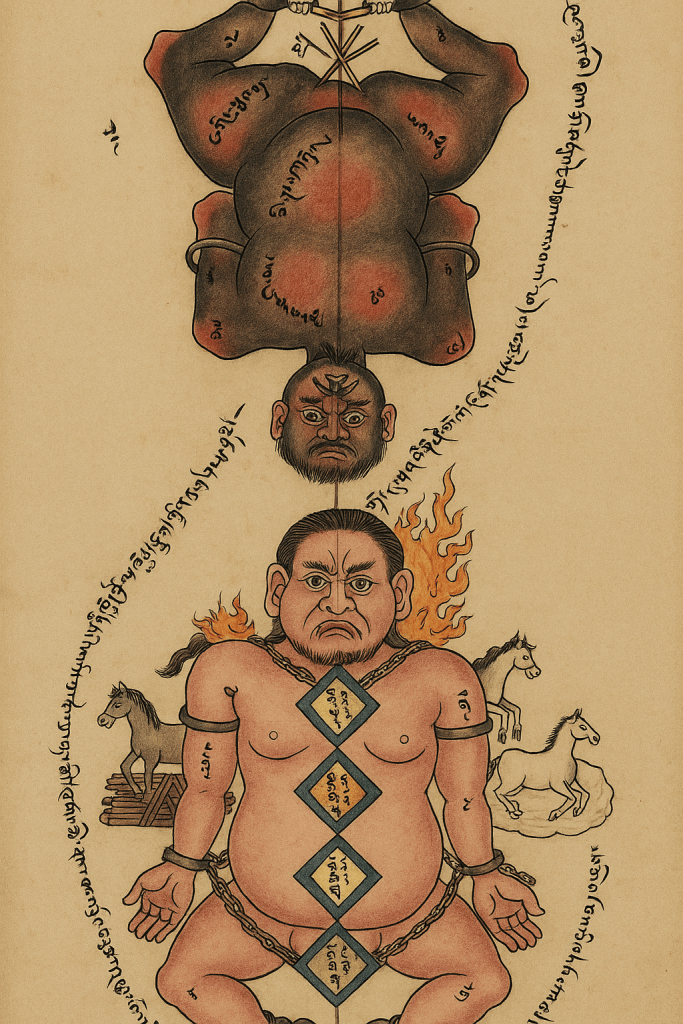
This type of linga resembles one depicted in the Secret Visions of the Fifth Dalai Lama, a visionary autobiography. It shows two figures to be ritually ‘liberated’ or killed, typical of effigies used in Tibetan Buddhist rites against so-called ‘enemies of the dharma.’ Such effigy sacrifices remain part of Tibetan Buddhist ritual practice today.


Footnotes

¹ Lin Kai, Meanings of Violence in Tibetan Buddhism, Substack, 2025.
² Elliot Sperling, Orientalism and Aspects of Violence in the Tibetan Tradition, Info-Buddhism, 2004.

Truth Behind the Myth: Violence in Tibetan Buddhism


In his article Orientalism and Aspects of Violence in the Tibetan Tradition, Elliot Sperling uses the term Orientalism in the sense made famous by Edward Said. It describes how Western scholars, writers, and media have often portrayed Asian and Middle Eastern societies in ways that are exotic, stereotypical, and distorted (Sperling 2001, p. 317). [1]

In this context, Elliot Sperling is pointing out that Tibet, especially Tibetan Buddhism, has been framed in the West not as a complex, politically active society but as a mystical and pacifist Shangri-la (Sperling 2001, p. 318). That romanticized portrayal fits the Orientalist mold because it projects Western fantasies and agendas onto a culture instead of showing it in its full, often messy, historical reality.

Here, Orientalism is not just about misunderstanding or stereotyping. It is about how those misconceptions feed into selective histories, in this case downplaying or erasing the tradition’s capacity for political maneuvering, power struggles, and violence.

It is important to cut through the sugar-coated narratives about Tibetan Buddhism as an always peaceful, otherworldly faith. Historian Elliot Sperling, a top authority on Tibet and China history, attempts to do this in his essay. He shreds the romanticized “compassionate lama” image and reintroduces the messy, political, and yes, violent realities of Tibetan history (Sperling 2001, p. 320).

  • Tibetan Buddhism was not pacifism incarnate. Sperling points out that the Fifth Dalai Lama did not shy away from military force when Gelugpa interests were on the line in the 17th century. In the early 20th century, the Thirteenth Dalai Lama actively sanctioned armed resistance against Qing forces in Lhasa (Sperling 2001, pp. 323–324).
  • Modern Western portrayals have softened the truth. The prevailing global image of Tibetan Buddhism, as inherently gentle, infallibly peaceful, and untouched by politics, is largely a product of Western assimilation and the Tibetan exile community’s framing of their own image (Sperling 2001, pp. 317–318).

Why It Matters

If you are buying into the “peace only” ideal, Sperling’s essay demands reconsideration. He forces you to recognize Tibetan Buddhism as a tradition entwined in power and violence when necessary (Sperling 2001, p. 317). The strident idealism selling Tibet as a spiritual Shangri-la does not hold up under scrutiny. In 1660, the Fifth Dalai Lama faced a rebellion in Tsang. Declaring he acted for the good of the people in the region, he issued uncompromising orders for the complete destruction of his enemies, men, women, children, servants, and property, leaving no trace of them. This directive, written in his own hand, reveals a leader willing to use extreme military force to secure his government’s power, a stark contrast to the modern image of the Dalai Lama as an unshakable symbol of peace.

[Of those in] the band of enemies who have despoiled the duties entrusted to them:
Make the male lines like trees that have had their roots cut;
Make the female lines like brooks that have dried up in winter;
Make the children and grandchildren like eggs smashed against rocks;
Make the servants and followers like heaps of grass consumed by fire;
Make their dominion like a lamp whose oil has been exhausted;
In short, annihilate any traces of them, even their names (Sperling 2001, p. 325).

This brutal passage, is a powerful and chilling indictment. It underscores the darker potential within any ideology. When power, anger, or fear take hold, even so-called peaceful spiritual traditions can sanction annihilation. Sperling’s work reminds us to stop buying into the marketing of Tibetan Buddhism as a compassionate, peaceful idyll. His historical analysis and the many examples of tantric annihilation rituals used against human targets says otherwise. It is time to drop the myth and acknowledge the tradition for what it truly is: a living, political, and sometimes violent force (Sperling 2001, p. 329).

  1. Elliot Sperling, “Orientalism and Aspects of Violence in the Tibetan Tradition” (2001), info-buddhism.com, originally published in Imagining Tibet: Perceptions, Projections, & Fantasies, ed. Thierry Dodin and Heinz Räther, Wisdom Publications. Available at: https://info-buddhism.com/Orientalism_Violence_Tibetan_Buddhism_Elliot_Sperling.html

When Devotion Becomes a Cage: Abuse in the Guru–Disciple Relationship


Based on Mary Garden’s article “The Potential for Abuse in the Guru-Disciple Relationship,” Cult Recovery 101

“No amount of evidence, nor the quality of it, will serve to un-convince the true believer. Their belief is something they not only want, they need it.” –James Randi

For decades, the Western imagination has romanticized the guru-disciple relationship: the wise, enlightened master guiding the humble seeker toward liberation. Yet beneath the rosy image lies a power dynamic that can turn toxic, even violent. Mary Garden’s searing account strips away the mystique, showing how devotion can be exploited to serve the ego, desires, and domination of the so-called spiritual elite.

A Pattern Hidden in Plain Sight

The dynamics Garden describes are not confined to Hindu ashrams or Indian gurus. They echo almost perfectly the same mechanisms of control found in certain strains of tantric practices within Tibetan Buddhism. These are systems where teachers are often elevated to godlike status and obedience is framed as the fast track to enlightenment. In both cases, devotion becomes a weapon that protects the guru from scrutiny, while binding the disciple to them even in the face of blatant harm.

Surrender Without Safeguards

Garden recalls her own journey in the 1970s, moving between ashrams in search of enlightenment. She describes the intoxicating joy of initiation, the chants, the sense of belonging, and the ecstatic highs that felt like spiritual transformation. But once she became a guru’s favored consort, the darkness emerged. The same man who preached divine wisdom alternated between seduction and brutal rage, even physically assaulting others in her presence. At one point she became pregnant by him and he blamed her for it and forced her to have an abortion.

The culture of total surrender made resistance almost unthinkable. Cruelty was reframed as a test of faith, abuse as a blessing, and every whim of the guru as cosmic law. The environment rewarded silence and punished doubt. Those who questioned were shamed, isolated, or cast out.

How Control Works

Her experience, echoed in countless other testimonies, reveals the common mechanics of spiritual exploitation:

  • Deification of the teacher silences doubt and criticism
  • Induced dependency through mystical highs and identity fusion
  • Rationalized harm presented as discipline or “divine play”
  • Social entrapment that makes leaving a spiritual, financial, and emotional crisis

The Cost of Leaving

Breaking free meant dismantling not only her faith in the guru, but also her connection to the community, the esoteric practices, and the sense of higher purpose she had built her life around. Even after witnessing violence firsthand, many of her peers remained loyal, their belief immune to any evidence of harm.

Lessons for the Seeker

Garden’s testimony is not a blanket condemnation of spiritual practice. It is a warning: any system that demands unquestioning obedience to a single human being, no matter how radiant their smile or lofty their words, contains the seed of abuse. Without discernment and the freedom to question, devotion can slide into bondage.

In her closing words, Garden writes, “The guru-disciple relationship is probably the most authoritarian of all in its demands for surrender and obedience. Hence it can be the most destructive. Far from achieving the enlightenment and freedom that many of us ‘wannabe’ spiritual pioneers of the 1970s sought and were promised, we experienced mental imprisonment and confusion. We were seduced by yogis and swamis telling us what we wanted to hear: that we were special and that they were God incarnate. Our need was our downfall. And if we escaped, we often carried lingering doubts: Was it just me? Did I fail? Did I give up too soon?”

Source: Mary Garden, The Potential for Abuse in the Guru-Disciple Relationship, Cult Recovery 101. Read the original article here.

Yamantaka and the Truth About Violent Rituals in Tibetan Buddhism


The following is based on Aleksandra Wenta’s article “Tantric Ritual and Conflict in Tibetan Buddhist Society: The Cult of Yamāntaka” (2022).

Public perception paints Buddhism as the ultimate religion of compassion. The Dalai Lama’s cheerful smile and monks chanting in maroon robes conjure images of peace in the Western imagination. But the historical record tells quite another story, one most Buddhist institutions would prefer to bury. Violent ritual has always had a place in Tibetan Buddhist practice, and the cult of the wrathful deity Yamantaka is one of the clearest examples.

The Deity of Destruction

Yamantaka, whose name means “Ender of Death,” is no serene Buddha. In tantric lore he is a ferocious, multi-headed, weapon-wielding deity invoked to annihilate enemies. These enemies might be inner demons in metaphor, but in many cases they were very real human targets. As Wenta’s research shows, Tibetan Buddhist ritual specialists used Yamantaka rites as deliberate acts of destruction, both spiritual and physical.

Politics and Ritual Warfare

The historical examples are difficult to dismiss. In the ninth century, the Buddhist master Gnubs chen Sangs rgyas yeshes allegedly used Yamantaka magic against King Lang Darma, a ruler seen as hostile to the Dharma. Centuries later, during the political struggles of the seventeenth century, the Fifth Dalai Lama employed Yamantaka rituals to consolidate power over rival factions. These were not fringe experiments, but state-linked religious acts intended to remove opponents.

The reach of these rites went beyond Tibet. The Manchu Qianlong emperor adopted Yamantaka worship to project legitimacy over his subjects, while Mongolian and Japanese traditions incorporated similar ritual violence into their own religious-political frameworks.

Violent Compassion as Justification

Practitioners did not see these rites as morally corrupt. They justified them through the doctrine of “violent compassion,” the belief that killing or harming could liberate an enemy from a worse rebirth. Wenta notes that tantric philosophy, particularly the doctrine of emptiness, was used to argue that concepts like killer or victim do not ultimately exist. In this logic, an enlightened being could commit an act of violence without accruing negative karma.

Ritualized Destruction

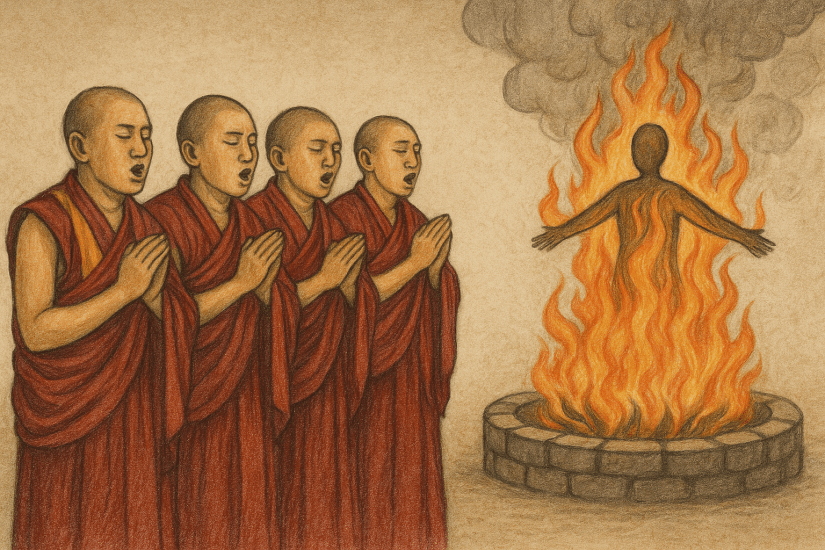
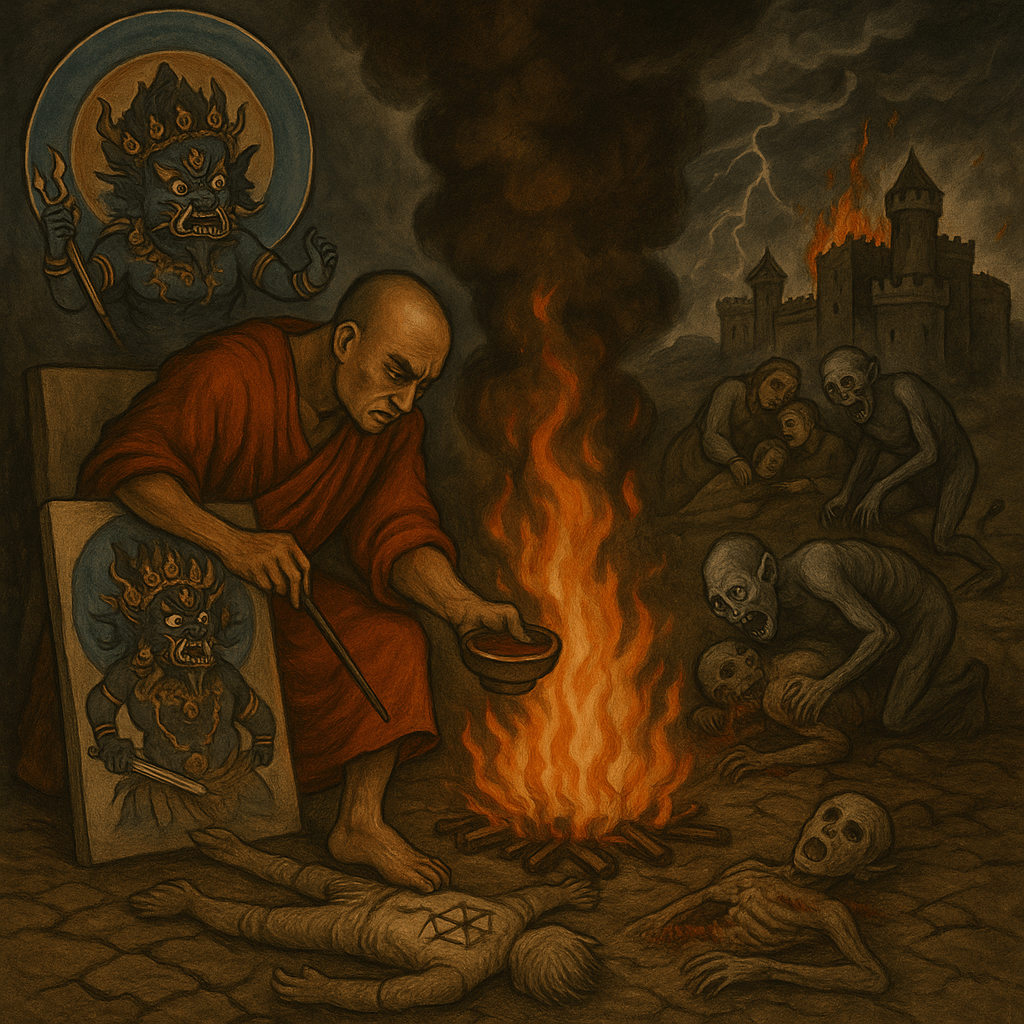
From the Mañjuśriyamūlakalpa’s “Ritual Against the Wicked Kings” comes one of the most explicit and brutal examples. The text instructs the practitioner to paint Yamantaka in terrifying form, then perform fire offerings of human blood, flesh, and powdered bone mixed with poisons and toxic plants to unleash plague, famine, storms, and demonic infestations upon the target. The king’s family is to die in sequence: son on the first day, wife and ministers on the second, the king himself on the third, while his court is overrun by flesh-eating spirits and his land struck by drought, fire from the sky, rockfall, and invasion. A human effigy bearing the victim’s birth star in cremation-ground charcoal is trampled during mantric recitation so the enemy dies, goes mad, or is devoured by demons. This is ritualized destruction in its most literal, calculated form.

One section of the same text reads like a manual for calculated devastation. The practitioner is instructed to heap human blood, flesh, powdered bone, poisons, and the roots of deadly plants onto a ritual fire in front of the painted deity. After 1008 offerings, not only is the enemy destroyed, but their family, ministers, and allies are swept away as well. The text promises droughts, plagues, famine, and storms, even fire and rocks falling from the sky, while demonic forces overrun the victim’s court. In some variations, a single datura root is enough to drive the target insane, or a few spoonfuls of spiced offerings can induce fatal fevers within days.

The text also states, “If he wants to kill someone, then having made a puppet (kṛtiṃ) he should write a name: the deity name or a nakṣatra (‘asterism under which the target was born’) using a charcoal of the cremation ground, which should be placed on the ground in front of the paṭa. Standing on [the puppet’s] head with his foot, he should be in a wrathful state, and do the recitation. He (the king) will become overpowered by a major disease, or he will die on the spot. That lord of men will be seized by piercing pains for no apparent reason, or he will be killed by an animal, or he will become crippled. He will be eaten by fierce rākṣasas, and various impure beings that have arisen from non-human birth (kravyādin), pūtanas, piśācas, pretas and the mothers, or he will be killed immediately by his own attendants.” 1

Conflict Inside the Tradition

Even within Tibetan Buddhism, the legitimacy of destructive rituals such as these was contested. Some figures, such as Rwa lo tsā ba, became famous for their wrathful practices but were denounced by peers as frauds or heretics. Reformers like Yeshes ’od tried to curtail the most extreme acts, replacing “live liberation” killings with symbolic substitutes like effigy destruction. But these reforms did not erase the underlying acceptance of ritual violence; they only tamed it for public consumption.

Another Piece of the Puzzle

Wenta’s work adds yet another piece of hard evidence to the growing pile that Tibetan Buddhism has long included practices designed to harm or destroy. These rituals were not simply metaphorical, and they were not limited to obscure sects. They were woven into the political and religious fabric of Tibet and beyond.

For those willing to look past Tibetan Buddhism’s carefully crafted PR image, the cult of Yamantaka exposes a reality in which the language of compassion hid a persistent undercurrent of deliberate harm.

Footnotes

1) Aleksandra Wenta, Tantric Ritual and Conflict in Tibetan Buddhist Society: The Cult of Yamāntaka, in Esimoncini, 19 Wenta CHIUSO, available at https://tibetanbuddhistencyclopedia.com/en/images/0/0b/Esimoncini%2C%2B19_Wenta_CHIUSO.pdf.

Occult Parallels Between Freemasonry and Tibetan Tantric Buddhism


When most people hear the term Freemasonry, they think of an old-world fraternity, moral instruction through symbolism, and discreet handshakes. When they hear Tibetan tantric Buddhism, they imagine serene monks, compassion, and meditation. The public image of both is carefully cultivated, and in both cases, that image obscures a deeper, more esoteric reality.

Layers of Secrecy

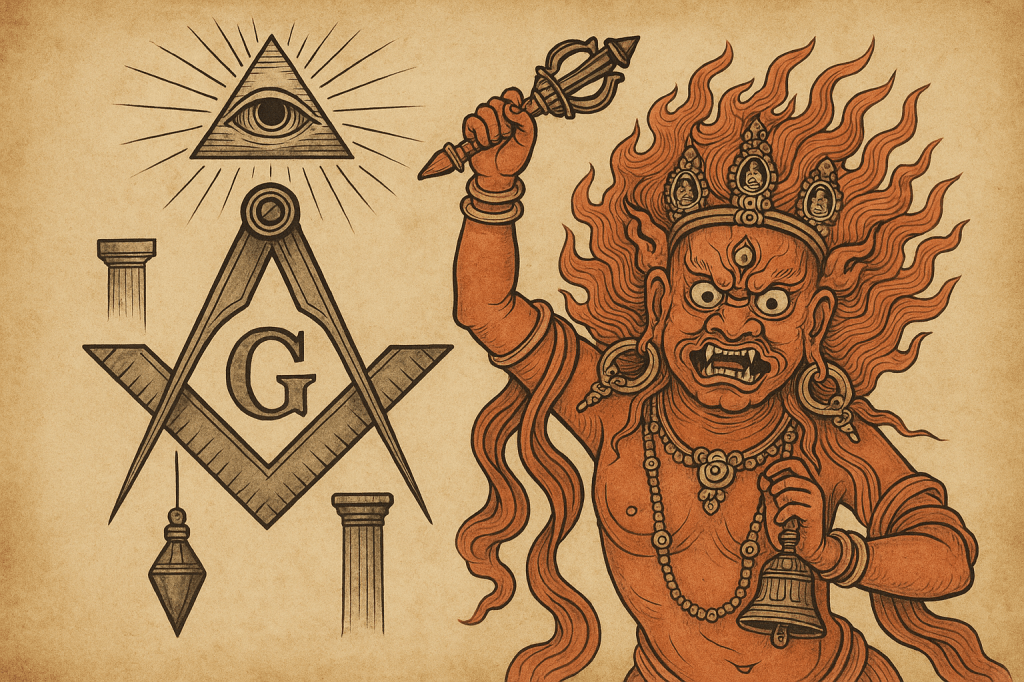
Freemasonry is famously structured in degrees. Early initiates learn benign moral allegories; the deeper teachings are said to be revealed only at the highest levels, with rumors persisting about a Luciferian current unveiled around the 33rd degree. Likewise, Tibetan tantric Buddhism presents an accessible outer face, with philosophical teachings and an emphasis on compassionate practices, while reserving its most potent techniques for advanced initiates. These require formal empowerment ceremonies (wangkur) and vows (samaya) that bind the disciple not only to the guru but also to the unseen entities invoked in the practice.

Initiations and Oaths

In both systems, entry into the deeper mysteries requires swearing oaths. In Masonry, the vows historically invoked dire consequences for betrayal, couched in symbolic language. In tantric Buddhism, the initiatory vows carry the threat of karmic ruin, disease, or worse for breaking them. From a critical perspective, these oaths are more than quaint tradition. They function as binding contracts with what practitioners believe are spiritual forces. Those who view the occult with suspicion might identify these forces not as enlightened beings or symbols, but as demonic entities.

Hidden Entities and Magical Practice

Strip away the Buddhist philosophical overlay and Tibetan tantra reveals a highly ritualized form of magic. Complex visualizations, mantras, and mudras serve not merely as meditation aids, but as precise methods of summoning and merging with non-human intelligences. This is not unlike the ceremonial magic that underpins parts of Masonic symbolism, particularly in its higher degrees, where the initiate engages with archetypes, symbols, and names drawn from older mystery traditions. Both traditions cloak these operations in the language of self-improvement and enlightenment, but the mechanics of calling upon unseen forces, entering altered states, and channeling power remain strikingly similar to ancient magical rites.

Shared Roots in Ancient Occultism

Freemasonry draws openly from the Hermetic and Kabbalistic streams of Western esotericism, both of which trace their roots back to the mystery schools of the ancient world. Tibetan tantric Buddhism, though filtered through the Buddhist canon, absorbed elements from pre-Buddhist Bön shamanism, Indian Tantra, and Himalayan spirit-worship. From this angle, both may be considered descendants of the same primordial magical worldview: that reality can be manipulated through ritual, symbol, and alliance with non-physical beings.

The Public Face vs. the Hidden Core

The genius of both systems is their dual-layered structure. The public face draws in seekers with ideals of morality, compassion, and personal growth. The hidden core, accessible only through successive initiations, operates in a world of occult allegory, ritual precision, and spirit interaction. Whether one calls those spirits Buddhas, angels, demons, or archetypes depends largely on one’s interpretive lens. From a Christian lens, it is clear that both systems engage with fallen angels.

Freemasonry and Tibetan tantric Buddhism, at first glance, seem to occupy opposite ends of the cultural spectrum, one a Western fraternal order, the other an Eastern spiritual tradition. Yet both can be read as initiatory magical systems that mask their deeper workings behind an accessible moral or philosophical front. For the uninitiated, this outer layer is all they will ever see. For those who pass through the degrees or empowerments, the real initiation may lie in forging a relationship with the very forces their public image denies. And that is where the parallels become most disturbing.

These similarities are not vague or coincidental. They are structural, symbolic, and functional. Strip away the public image and both systems follow the same blueprint: they lure the seeker with ideals, bind them with oaths, then initiate them into rituals that channel demonic forces. Below is a side-by-side look at how the two traditions mirror each other in startling detail.

Freemasonry vs. Tibetan Tantric Buddhism: Structural & Occult Parallels

AspectFreemasonryTibetan Tantric Buddhism
Outer PresentationFraternal order promoting moral improvement, philanthropy, brotherhoodCompassion-based philosophy, meditation, cultural preservation
Initiatory Structure3 public degrees (Entered Apprentice → Master Mason) followed by higher Scottish Rite or York Rite degrees culminating in the 33rd degreeThree turnings of the wheel of Dharma leading to tantric initiation (Vajrayana), then advanced empowerments and yogas
Vows/OathsOaths of secrecy and loyalty; historical versions included symbolic penaltiesSamaya vows taken during empowerments, with karmic penalties for violation (illness, misfortune, spiritual ruin)
Hidden CurriculumEsoteric symbolism, Kabbalistic and Hermetic philosophy, rituals involving archetypal forcesAdvanced deity yoga, mantra recitation, visualization, and energy-body work aimed at merging with yidams (tutelary deities)
Entities InvokedAllegorical architect figure, angels, and names from older magical traditions; higher degrees hint at Lucifer as light-bearerDeities, protectors, and Buddhas invoked in ritual, often fierce or wrathful forms with clear pre-Buddhist shamanic traits
Magical ToolsCompass, square, tracing boards, symbolic implements; ritual words and gesturesVajra (dorje), bell, mandalas, mudras, mantras, tormas (substitutes for sacrificial offerings), visualized palaces
Source TraditionsHermeticism, Kabbalah, Rosicrucianism, medieval guild ritualBön shamanism, Indian Tantra, Himalayan spirit practices overlaid with Buddhist philosophy
Outer vs. Inner TeachingsPublicly moral, privately esoteric; higher levels teach occult philosophyPublicly compassionate, privately tantric; higher levels teach deity invocation and magical union
Binding MechanismOaths tie member to lodge and brotherhood, reinforced through ritual dramaSamaya ties disciple to guru and the deities invoked, reinforced through ritual visualization and mantra
Potential Root ParallelsMystery schools of antiquity, ritual magic, symbolic initiationsMystery schools of antiquity, ritual magic, symbolic initiations (via Eastern streams)

When we see these parallels laid bare, the comforting illusion of ancient wisdom starts to crumble. The robes and rituals, whether in a Masonic lodge or a Himalayan temple, are not neutral cultural artifacts. They are technology for binding humans to hidden powers, likely demons. Those who hold the keys to these systems know exactly what they are doing. The question is not whether the forces behind them exist, but whether the seeker truly understands who or what is answering when the call is made.

Sacrifice, Favor, Repeat


Before the modern age romanticized pagan religions into New Age panaceas, ancient worship was known to be raw and brutally pragmatic. In our modern spiritual-industrial complex, it is often sugarcoated into some kind of warm, earth-loving ceremony filled with personal empowerment and divine intimacy. But if you’re reading this, you’re probably already suspicious of that narrative.

In fact ancient religion, pagan religion, was highly transactional. The gods didn’t love you. They didn’t weep over your suffering or aspire to protect you.

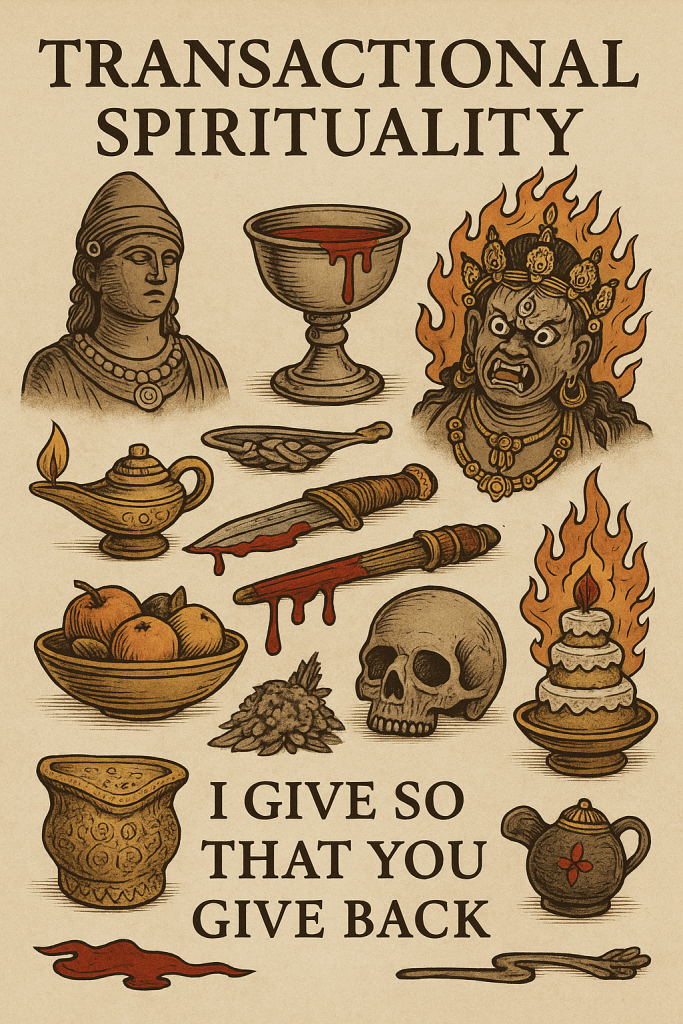
A passage from Behold the Christ: Proclaiming the Gospel of Matthew by Leroy A. Huizenga makes this brutally clear. Pagan worship, he writes, operated on the ancient principle of do ut des: “I give so that you give back.”(1) In other words, the gods and humans used each other. You offered sacrifices, incense, food, or praise not out of adoration, but because you wanted something in return: good crops, protection in war, fertility, rain, wealth, healing, vengeance, and victory. And the gods? They wanted to be fed, praised, and kept relevant. It was mutual exploitation dressed up in sacred costume.

“That is, the worshipper provides a sacrifice to a god that pleases and empowers the god, who then turns around and does the worshipper favors. Because the gods are often indifferent to humans, worshippers engage in repeated ritual to reach out and get a god’s attention.”

This paragraph says more about ancient spirituality than most modern New Age books on “manifesting” or “connecting with the divine.” The ancients weren’t confused. They understood that the gods were powerful, unpredictable, and not especially interested in human wellbeing unless there was something in it for them.

And this wasn’t limited to Rome or Greece. Versions of do ut des appear in Vedic sacrifice, Mesopotamian temple economies, and also Tantric Buddhist practice where offerings are made to wrathful deities to invoke, control, or appease.

Nowhere is this transactional logic more systematized and ritualized to the point of industrial precision than in Tibetan Buddhism. While cloaked in the language of enlightenment and compassion, the tradition is saturated with mechanisms that mirror the ancient do ut des economy: elaborate offerings, incense, butter lamps, mandalas, and tormas (sacrificial cakes that replaced blood offerings when the Buddhist principle of ahimsa “non-harming” took root). These were given not out of unconditional reverence, but to elicit specific outcomes from specific deities. Monastic liturgies are not just meditative recitations, but are negotiations with a pantheon of wrathful and peaceful beings, each with their own preferences, powers, and temperaments. Moreover, the non-harming sentiment in Tibetan Buddhism only extends so far. While Buddhist tantra forbids blood sacrifice, its subjugation rituals, aimed at both spiritual and human enemies, can involve some of the most brutal punishments found in any ritual religion.

Drupchöd ceremonies, held in large monasteries, exemplify this beautifully. These are days- or weeks-long ritual marathons involving collective chanting, visualization, music, mudras, and vast offerings, all designed to propitiate deities into bestowing protection, wisdom, and worldly benefits like health and prosperity. Whether invoking Mahakala to remove obstacles or Tara for swift blessings, the assumption is clear: the deity acts when properly fed, praised, and invoked. The gods (or enlightened beings, depending on your doctrinal parsing) are not passively watching; they’re participants in a cosmic economy, and Tibetan Buddhism, more than almost any other tradition, has mastered the bureaucratic apparatus needed to transact with them. It’s not just about personal devotion. It’s about correct performance, correct offerings, and the correct “exchange rate” of ritual. The love of the gods is not assumed. Their attention must be earned over and over again.

Modern Takeaways and a Warning

This transactional pattern isn’t limited to ancient paganism or esoteric Tibetan ritualism. You’ll find the same spiritual economy alive and well in the darker corners of contemporary occultism. Take it from someone like Riaan Swiegelaar who’s lived on the other side: former Satanists and occult practitioners routinely speak of offering sacrifices, especially blood, to demons in order to negotiate outcomes.(2)

He described it well: “A lot of people ask me, ‘Why are there so many sacrifices in Satanism? Why is there blood?’ The answer is simple: blood has currency in the spirit world. If I want to negotiate with demons, I need to bring an [animal] sacrifice because that blood holds value. It functions as spiritual capital.

“But here’s the contrast: the blood of Jesus is the highest currency in the spirit world. It covers everything. That’s the authority we stand on. And every ex-Satanist or ex-occultist who’s encountered Christ will tell you the same thing. I might be the only one talking about it openly, but this is real: we engaged in negotiations with demons, offered animal sacrifices, and got results. That’s how the system worked. Then we experienced the blood and love of Christ and there’s no comparison. It’s not even close. His blood is infinitely more powerful. In spiritual warfare, people need to grasp that reality. The blood of Christ is free, but it is not cheap, is it? It came at the highest cost. And what happened on the cross? That wasn’t a one-time transaction in history: it remains as valid, active, and potent today as it was then, and always will be.”

This is so important that it bears repeating: no spiritual currency, no ritual offering, no demonic pact compares to the raw, unmatched power of the blood of Christ. This is the rupture at the heart of Christianity: the economy of sacrifice is over, not because gods stopped demanding payment, but because one sacrifice bankrupted the system.

From blood-soaked altars in Babylon to ritual offering tormas in Himalayan monasteries, humanity has always traded devotion for power and offerings for favor. But the cross flipped the script. There is no more need for bartering, manipulation, and performance to win divine attention. What Christ offered wasn’t another payment into the cosmic vending machine but a final act that rendered the machine obsolete. And if that’s true, then every attempt to re-enter the old system, whether through pagan ritual, tantric bureaucracy, or occult negotiation, isn’t just a return to tradition. It’s a rejection of victory.

(1) Leroy A. Huizenga, Behold the Christ: Proclaiming the Gospel of Matthew (Emmaus Road Publishing, Steubenville, Ohio).

(2) Riaan Swiegelaar, former co-founder of the South African Satanic Church, in various public testimonies including interviews and livestreams (e.g., “Riaan Swiegelaar Testimony,” YouTube, 2022), has spoken openly about blood sacrifice as spiritual currency and his eventual conversion after experiencing the love of Christ.


Playing with Fire: The Death of a Paranormal Investigator and the Perils of Inviting Evil


Yesterday, Dan Rivera, a U.S. Army veteran and lead investigator for the New England Society for Psychic Research (NESPR), died suddenly during a tour in Gettysburg, Pennsylvania. Rivera, 54, was headlining the sold-out “Devils on the Run Tour,” a paranormal event centered around the infamous Annabelle doll, which inspired the Conjuring film series. Emergency responders performed CPR at his hotel, but Rivera was pronounced dead at the scene. Exact cause of death is unclear. The irony? Rivera died while promoting one of the most notorious cases of alleged demonic possession in American folklore.

Annabelle is no carnival sideshow. The Raggedy Ann doll was housed in the now-defunct Occult Museum founded by Ed and Lorraine Warren, the couple who brought demonic cases into the public eye long before Hollywood did. According to the Warrens, Annabelle had a history of real violence. Not metaphorical, but physical harm that left actual wounds. She caused slashes that drew blood. In one case, a priest who defied the doll reportedly crashed his car into a tree shortly after leaving. In another, a detective who came into contact with the doll was allegedly stabbed and forced into early retirement.

The Warrens took no chances. They sealed Annabelle in a locked glass and wood cabinet, built specifically to contain her. A large sign at the top read, “WARNING: POSITIVELY DO NOT OPEN,” and a crucifix was affixed nearby for protection. The case was blessed regularly by a Catholic priest, and the Warrens made it clear: no one was to touch the case, mock the doll, or treat her as a curiosity. The museum, as they described it, was not a showcase of artifacts; it was a containment zone for objects they believed were spiritually dangerous. And Annabelle was its most volatile resident. Ed Warren died in 2006, Lorraine in 2019, and after their deaths, Annabelle remained in the care of their son-in-law, Tony Spera. According to the New York Post article published on July 15, 2025, “In 2019, the museum closed to the public over zoning issues, and in recent years, they have toured around the US instead.” However, perhaps touring the country with a possessed doll wasn’t the greatest idea.

Annabelle’s case isn’t just a bizarre footnote in paranormal lore but a stark example of what happens when human curiosity crosses into forbidden territory. The line between fascination and spiritual danger is thinner than most people think


Flirting with Evil Is Not Harmless Curiosity

The Catholic Church has been blunt on this issue for centuries: do not engage with evil or attempt to communicate with it. The Church doesn’t take demons lightly because it understands their nature and knows they don’t play fair. Their goal is the destruction of body, mind, and soul.

Rivera’s death is not the first time a paranormal investigator has died while engaging in their work. In 2016, prominent demonologist Lorraine Warren warned publicly that even decades-old “cleansed” objects and locations still carried spiritual residue. In her words, the influence of evil does not simply go dormant, it waits.

Zak Bagans, host of Ghost Adventures, once had to close off a room in his Las Vegas museum containing what’s become known as a dybbuk box. Visitors reported nausea, blackouts, and even strokes after encountering it. One man died of a heart attack just hours after taunting the box on camera. The term “dybbuk box” refers to a modern, supposedly haunted object, often described as a wine cabinet that houses a malicious spirit rooted in Jewish folklore. Traditionally, a dybbuk is a dislocated soul believed to possess the living. However, the concept of trapping one in a box is a recent invention with no basis in authentic Jewish theology. The box was first popularized through a viral eBay listing and later sensationalized by paranormal media.


The Conjuring: A Fictional Mirror of a Spiritual Reality

Hollywood loves the Conjuring universe. Ghosts, demons, and haunted dolls are box office gold. But what people forget is that the source material isn’t fiction. These were real cases documented by the Warrens. And the “entertainment” factor trivializes the spiritual warfare at the heart of these phenomena.

This is where the deception lies. Evil often presents itself as fascinating and seductive—something to be conquered or controlled. But actual demonic entities are predatory. The more one invites them in, the greater the chance of a devastating outcome.


Dan Rivera’s Legacy: A Cautionary Tale

No one questions Rivera’s bravery or passion. But we must question the wisdom of his choices. Spiritual warfare is real. Whether Rivera’s death was directly supernatural or not is ultimately beside the point. The fact is, he died while immersed in the darkest corners of the supernatural, and he is far from the first.

The Church’s warnings aren’t outdated superstition: do not make a spectacle of evil. Do not exploit evil for entertainment. Some doors should stay shut.


The Subconscious as Battleground: Demonic Infiltration Through the Wounds of the Psyche


In our modern world, the subconscious is often reduced to a psychological artifact, a repository of repressed memories, habits, and impulses. But from a biblical and Catholic standpoint, this internal space is more than just a vault of emotion and instinct. It is a spiritual battleground and a vulnerable domain where real entities, such as demons seek entry and control.

I speak not in theory but from personal experience. As someone who has lived through the horror of possession, I know firsthand what it means to have my subconscious colonized by non-physical forces, in particular, Tantric deities and the so-called yidams (meditational deities) I once invoked in long term retreats. They now exert control over my dreams at night, not as fragments of memory, but with an intention, force, and intelligence all their own.

Trauma, Sin, and the Open Doors

The Catholic tradition is clear: sin creates openings. These are spiritual vulnerabilities through which demonic powers can assert influence. But it’s not always sin, but often wounds and traumas that become entry points. This aligns, ironically, with what Jung called the shadow: the parts of ourselves we deny or fail to integrate.

In occult and tantric frameworks, these shadows are often “worked with” i.e. ritualistically invited, named, and visualized. In my case, the visualizations of the yidam were never just symbolic. They were summonings that invited intelligent spiritual entities through geometric portals into the liminal space of my subconscious mind.

Obviously, tantric rituals are powerful, but the power is not “of God.” The light of Christ later revealed to me that what I had opened myself up to were demonic counterfeits or parasitic forces clothed in deceptive splendor.

The Subconscious

While the Jungian model treats these internal figures such as archetypes, gods, and dreams, as symbolic representations of the psyche, Biblical scripture offers a different view. Ephesians 6:12 tells us that our struggle is “not against flesh and blood, but against principalities, against powers, against the rulers of the darkness of this world.”

What modern psychology calls “unconscious drives” may, in reality, be demonic actors exploiting our blind spots. They can manifest through thoughts, compulsions, visions, or dreams. They don’t just influence behavior, they shape the architecture of perception, infiltrating belief itself. This is why confession and deliverance are not just spiritual maintenance but are spiritual war strategies.

Dreams: The Nightly Invasion

The yidam I practiced during my retreats appears nightly, manipulating my dreams and injecting disturbing images, physical sensations, and false feelings of failure and yearning. It tries to arouse old loyalties alternating between affects of pseudo kindness and visions of cruel and bitter punishments. These dream invasions foster confusion and despair; and sometimes cause sensations of physical torment.

From a biblical perspective, dreams are a legitimate domain of spiritual communication, but that doesn’t mean all dream figures are from God. In Jeremiah 23, the Lord condemns false prophets who “make my people forget my name by their dreams.” Satan can disguise himself as an angel of light and in my experience, tantric deities do precisely that.

We must recognize the subconscious not as a private fortress, but as a permeable space, one that requires guarding, cleansing, and illumination by Christ alone. Anything else, especially tantric visualization and archetypal meditation, opens up doors we cannot close on our own.

There is no neutral spirituality. Every spiritual practice either opens the soul to grace or to deception. As one who has been inside the snare, I say this without hesitation: tantric deities are demons in disguise, and their preferred hiding place is the very part of us we least understand: the subconscious.

But Jesus Christ, in His mercy, descends even into those hidden caverns, casting out darkness and healing the wounds that made us vulnerable in the first place.

“For this purpose the Son of God was manifested, that He might destroy the works of the devil.”
— 1 John 3:8

Perfect Possession: The Hidden Endgame of the Tantric Path?


Catholic exorcists consistently emphasize that full demonic possession is rare. Far more common are lesser forms of demonic influence, what the Church calls degrees of demonic attack. According to experts like Fr. Gabriele Amorth and Fr. Chad Ripperger, these stages are typically identified as:

  • Temptation (ordinary spiritual warfare)
  • Infestation (demonic presence in a place or object)
  • Oppression (external hardships caused by a demon)
  • Obsession (mental or emotional torment)
  • Possession (a demon controls the body, but not the soul)
  • Perfect Possession (the soul itself has given full consent to the demonic)

What Is Perfect Possession?

Fr. Malachi Martin, Jesuit priest, Vatican insider, and exorcist, famously warned of the phenomenon he called perfect possession. This occurs not when a demon forces its way into a person, but when a human being voluntarily invites and cooperates with a demonic entity over time until the human will is no longer in conflict with the demon’s presence. In such cases, the individual may appear calm, successful, and even spiritual, but has wholly aligned his or her soul with darkness.

Martin described this as the most terrifying form of possession because there is no resistance and often, no exorcism possible. The person has handed over consent of the will, and the demon resides not only in the body but in the soul.

This is not the ugly, contorted possession made famous by Hollywood. This is a quieter form of coexistence.

Possession Among the Occult Elite

Catholic exorcists often connect perfect possession to satanic priests, high-level occultists, or individuals who have undergone ritual consecration to Lucifer. It is the end point of a spiritual trajectory, not a single moment of sin. It involves years of voluntary cooperation with evil using ritual invocation, blood pacts, and blasphemous imitation of the sacraments.

But there is more discrete path that leads to the same end. It is cloaked in lotus flower imagery, Sanskrit mantras, and spiritual “blessings,” and is propagated by tantric adepts, yogis, and mahasiddhas who have spent years practicing yoga and ritual invocation of beings they consider to be deities.

Is Perfect Possession the Hidden Goal of Tantra?

In the Tibetan Vajrayana tradition, called “the quick path to enlightenment,” tantric practitioners visualize themselves as the deity. They merge consciousness with the god, goddess, or guru, often through esoteric or sexual ritual, in pursuit of realization.

But what if these “deities” are not who they claim to be?

What if they are counterfeit spirits or demonic intelligences disguised as beneficent beings of light?

In that case, the tantric adept is inviting an entity to live within him, again and again, through ritual, offerings, and mental surrender. Over time, the boundary between the self and the invoked being dissolves.

This is a form of spiritual possession.

And if the person no longer resists, if they call this possession “enlightenment,” then it seems to meet the classical definition of perfect possession or possession of the soul.

Signs of Perfect Possession in the Tantric World

Unlike Hollywood portrayals, the perfectly possessed do not foam at the mouth or speak in guttural Latin. Instead, they:

  • Radiate serenity, even as they worship gods of wrath and destruction
  • Exhibit supernatural knowledge or powers (siddhis), which are praised, not feared
  • Express total identification with the spirit/s they invoke
  • Are untouchable by traditional exorcism, because they do not want to be freed

In Catholic understanding, this is the most dangerous state of all because it involves no inner conflict, and therefore no pathway to repentance. The soul lives in union with a demon, often under the delusion that it is serving the good.

Satan Appears as an Angel of Light

Scripture warns us:
“And no wonder, for even Satan disguises himself as an angel of light.” – 2 Corinthians 11:14

What better disguise than that of a esoteric deity offering long life, healing, spiritual bliss, and enlightenment?

Exorcists like Fr. Amorth and Fr. Martin remind us that total possession doesn’t happen by accident. Satan must be invited in. And perfect possession is the result of spiritual consent, repeated and ritualized over time.

Tantric practitioners may never use the language of possession. They may call it “liberation,” “non-duality,” or “union with the deity.”

But from the standpoint of Christian spiritual warfare, it is not liberation but captivity, sanctified and made beautiful. It is a demonic entity, ethereally robed and seated on lotus thrones, perfectly at home in the human soul. And it leaves the adept deeply indebted to demons.