

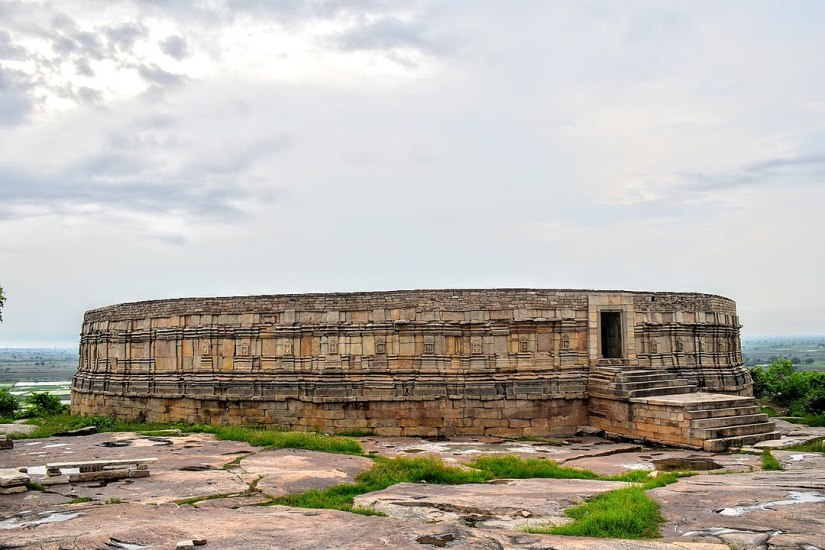
By Dharmendra106 – Own work, CC BY-SA 4.0, https://commons.wikimedia.org/w/index.php?curid=94123575
Vidya Dehejia is a retired American academic and the Barbara Stoler Miller Professor Emerita of Indian and South Asian Art at Columbia University. She has published 24 books and numerous academic papers on the art of South Asia, and has curated many exhibitions on the same theme.
She has been awarded the Padma Bhushan by the Indian government and a Freer Medal from the Smithsonian’s National Museum of Asian Art. The following manuscript is from a lecture she gave two years ago for the British Museum. The video is still on Youtube but you must go there to view the lecture. I have provided the link to the entire lecture here: https://www.youtube.com/live/LvRso-8oMnU?feature=share. Below I have slightly edited the first 30 minutes of Vidya Dehejia’s lecture up until the moderator takes over for the Q & A part.
1:01
Welcome everyone. Thank you for joining us for what promises to be a fascinating and rich exploration of the yoginis goddesses of tantra led by one of the world’s leading figures in the public understanding of South Asian art: Professor Vidya. My name is Ima Ramos and I’m the curator of the British Museum’s current exhibition: Tantra Enlightenment Revolution. The show explores how power is central to tantra. A power described and visualized as feminine and known as Shakthi introduced many new goddesses into the Hindu and Buddhist pantheons. Often ferocious and sexually charged, the yoginis challenged traditional models of femininity as passive and docile in their intertwining of destructive power and maternal strength. Seductive,yet dangerous, these goddesses could shape-shift into women, birds, snakes, and jackals as the mood took them. At the heart of the exhibition is the museum’s temple statue of a yogini from Tamil Nadu alongside an imaginative and immersive recreation of one of the most famous yogini temples in India located in Hirapo in Odisha, and built around the 10th century. Professor Vidya Dehejia is the Barbara Stoller Miller professor of Indian and South Asian Arts at Colombia University. She was awarded the Padma Bhushan award by the Indian government and has also been appointed to the Mario Miranda Visiting Research professorship at Goa University. Her acclaimed publications include Yogini Cults and Temples: The Body Adorned and Devi the Great Goddess: Female Divinity in South Asian Arts.
In this talk Professor Dehejia will explore the role of yoginis in Medieval India and the visually stunning temple complexes that were built in their honor across India. Following a 30-minute illustrated presentation she will be joined by playwright critic and former British Museum trustee Bonnie Greer for an exploration of the importance of yoginis within South Asian philosophy and belief.
3:39
[Professor Dehejia’s presentation begins].
Hello to all of you in whichever part of the world you might be in. I hear there are a number of you, and I’m delighted at this interest in the subject of tantra and my thanks to the British Museum for this opportunity to share with you my exploration of yogini temples. You all know about temples and when one speaks of an Indian temple one conjures up a picture of a tall temple tower, maybe an impressive gateway, all covered with masses of decorative sculpture for which, of course, India is famous. One imagines halls, perhaps more than one hall, each darker than the one before, leading finally to the sanctum where the image of the deities enshrined in a sort of darkened mystery lit only by the flickering light of oil lamps, but the yogini temples of India present a complete contrast to such a picture. There’s no temple tower; in fact, there’s no roof at all. Yogini temples are circular enclosures completely open to the sky. They allow the bright sunlight or for that matter, moonlight as well as wind and rain, to enter freely. There’s no decorative carving at all on the temple walls. As you can see, rather these plain blocks of stone could have been put together by a competent stone mason without any aid from a sculptor. There’s no impressive gateway. The entrance into the temple is more on the nature of an interruption in the circular wall and when you enter you find a series of niches in the circular wall, generally 64 niches, and within each is placed the figure of a female form, a deity known as a yogini.
Is there anything at the center? Well at the center there is usually a small pavilion sometimes open, sometimes closed, that houses an image of god Shiva. So a yogini temple consists of a circle of yoginis surrounding a central Shiva with this entire group subject to the vagaries of sun, wind, and rainstorms. Yogini temples can be small ones like this one at Hirapor, which you just saw in that wonderful visual at the taken at the British Museum, or they can be very much larger–128 feet in diameter as you will soon see. The yoginis themselves are beautiful female figures with nubile bodies, rounded breasts, narrow waist, and broad hips–the idealized form of the Indian sculpture. Generally, they have exquisite faces to accompany their curvaceous forms. Look at the glory of this figure exquisitely adorned and with a wonderful hairdo pulled to one side of her face. But not always! Here you see a yogini with a horse head. On the right you see a yogini in which the face has been replaced completely by a snakehead, so you have the cobra hood in place of a head at all.
You have fearsome faces, but you also have ones like this rabbit. Absolutely, you wonder how there could be fearsome figures; you wonder how it is that you’re scared of some of these figures. I think the one on the left is a lion head. It’s badly damaged and on the right, you have this emaciated form with sunken stomach and hanging breasts. You can see the rib cage in between. The face is badly damaged but I’m sure it was scary. It probably had sunken eyes with an open mouth and maybe fangs in the mouth. And what is she holding in her left hand? She’s holding a severed human head in her right hand. It’s damaged but it’s a curved cutlery knife and two more heads. She’s holding aloft above her head the carcass of a tiger, a very strange heraldic sort of tiger.
Yoginis and their temples are feared I found out as I started researching them. They evoke a sense of awe born of fear—the fear of invoking the curse of the yoginis. The people feel that almost anything is sufficient to invoke the curse of the yoginis. For instance, even approaching too close to their temples, and in fact some of the ancient texts like the Yanaranova Tantra speak of people becoming food for the yoginis if they divulge the secrets of their cult and this fear existed when I started my research. It existed before–that is evident in the fact that this particular yogini temple, the Hirapor temple–that is sort of what you are seeing in that visual in the British Museum. That temple first became known in the year 1953. Isn’t that extraordinary? It’s quite close to the capital of the state of Odisha, the temple town of Bhubaneshwar, and yet it only became known in 1953. Local villagers must have known about them, but they didn’t care to make their knowledge public. Who wanted to risk the curse of the yoginis? This made it, of course, very difficult to research the temples. Nobody wanted to lead me to any of them.
I found too, that the mysteries of the cult had been completely lost over time; no one seemed to know anything about their original significance and the extent to which the cult had been forgotten is seen in an amusing story I was told at one yogini temple site. Not this wonderful little one Hirapor, but a site that was located upon a low hill. The story I was told was that the British soldiers who were ruling India at that time chased a group of village women who ran up to the top of this hill. They formed a circle and prayed to the goddess and the goddess in her mercy rather than allow them to fall into the hands of the British soldiers, turn them into stone.
So, you can see how much any information about the cult had been completely lost. Where was I going to get my information? One thing was clear, that this was a tantric cult and I’m using that word lightly here to mean things esoteric and things secret as well, because the yogini texts I finally discovered all have this insistence upon secrecy–that it is the most secret of secret things and it isn’t to be divulged casually. So where was I going to find information about this cult?
Well, there were tantric practitioners all in many parts of India, particularly in the town of what we used to call Benaras, which is now Varanasi. I spent some time looking into this possibility. I had so many questions about these yoginis but the problem with looking into tantra as a practice was, first of all, I needed to become an initiate and I had misgivings on that score. I wasn’t sure that my research was going to take that sort of first place in my life, but secondly the problem was that assuming I decided to get initiated, I wasn’t allowed after that to divulge the secrets of the cult. I remembered that ancient text–I would become food for the yoginis. Actually, it wasn’t the yoginis I feared so much as modern tantric practitioners who are a really powerful group of people. But I did have these numerous questions about who these yoginis were and where did they fit into this already expansive Hindu pantheon of deities? Why did so many have faces of birds or animals? Why were the temples built as chakras, as circles, as wheels? What manner of people worshipped in these circles? What sort of rites were performed for these yoginis?
So where was I to go to find manuscripts? Manuscript libraries in India in the days when I was doing my research, which was prior to the internet, prior to cell phones–things that we totally take for granted today–um digitization of manuscripts hadn’t happened yet. There was no such thing as a printed catalog or a catalog online because online didn’t exist, but there were handwritten catalogs, and these were big, huge documents. They contained entries. You know you had to turn pages like that. They contained entries as manuscripts. They came into a library, and they were entered not by any title because there wasn’t such a thing, but by the first line of a manuscript. So, what was I to rely on? Knowledgeable manuscript librarians. I spent hours and hours talking to manuscript librarians. I drank numerous cups of very sugary tea talking to manuscript librarians who felt they needed to extend hospitality to me, and only the manuscript librarian, the good manuscript librarian, knows the contents of his collection. What was I looking for in a manuscript?
First a tantric manuscript and then a tantric manuscript that dealt with these yoginis—talk about looking for a needle in a haystack! It’s almost easier to look for the needle. At least you know exactly what that needle looks like but with my hypothetical manuscript, and by the way I came across several texts of this type which didn’t lead me anywhere, they are name valleys–that is, they are a list of names of the yoginis, 64 of them and they tell you nothing else. This particular text starts over here. With the first one, you get the name and then the number, which is one divia yogini siddha yogini yanishwari. You know it goes on…. What’s the use of knowing 64 names but nothing more about it? So, at the end of two years I was just about to give up on this project of mine. More crucially, I should say my grant was running out. I knew I could write an interesting article on the yogini temples. When I started out, we knew of three yogini temples; by the time I had wandered the length and breadth of India I had found a total of 13 temples, so my article could deal with the evolution of sculptural style starting with the earliest and ending with the latest. [That was] fine but that’s not what I had set out to explore and then I found my first tantric manuscript dealing with yoginis. I didn’t find it in India proper; I found it in Nepal, in Kathmandu in the royal archives, which since then has actually been digitized but at that time it was not digitized.
It was sort of a question-and-answer tantra and once I had found that, it had a sort of a snowball effect. I returned to Benares; I found a copy there. I found the manuscript library and [the librarian] said to me, “Oh you want the matari tantra. This has been published by the chakumba Sanskrit series right here in this town.” And then I found that there were similar manuscripts in the west coast in Baroda; that they were in madras in the south; that they were everywhere, and they gave me some of the answers I sought so that I could round out what was going to be just a stylistic study of temples with giving meaning to the actual practices.
What did I find out? My first question was: why did people worship the yoginis? What I found was that the words for salvation and liberation–those were not the sorts of words that occurred in texts on yoginis. What the yogini texts focused on was the word siddhi. A siddhi is a magical power, a magical ability, and there are eight great magical abilities that are well known in tantric circles. [In certain circles] they are so well known that the text sometimes didn’t even bother to explain them. They might list them, but they might not even list them, they would just tell you if you appropriately worship the yoginis the eight great siddhis will be yours. What are these? They’re immensely powerful, assuming that you’re going to take them seriously. There’s iman, an ability to become minute in size so that you can penetrate an atom or a molecule. There’s mahima which is the opposite–to become gigantic in size, maybe to move out of our solar system; there’s laghiman which is weightlessness. This could include things like levitation. There’s its opposite gariman, which is very great weight, so that you cannot be moved. There’s prakamia which is an irresistible will and then there are two very interesting ones: control over body and mind, your own but also that of others–think of that power! Rasheed has to do with control over the natural elements, i.e., the ability to cause a flash flood, etc. Finally, there is one to achieve the fulfillment of all your desires. So, these are the eight great magical abilities that give one immense power–that was the reason for worshiping the dakinis.
After that, sometimes the text would go on to enumerate the black magical abilities, including the ability to cause somebody to abandon their home, the ability to cause paralysis in them, the ability even to call for their death–a variety of other things.
So, these were immensely powerful goddesses and you had to appropriately worship them in temples. What was the appropriate worship? That was my next question, and it was also answered in the matari tantra text. There is something you all know of which is chanting of mantras, which are sound syllables of one sort or another, such as om hrim, syllables of that sort but in potent combinations. There were then offerings of wine and offerings of flesh and blood and finally there were offerings of rundas and mundus. What on earth are these? The runda is a headless human body and the munda is the severed human head. No wonder yogini temples were in isolated spots like this on top of a hill and in the midst of forest, generally far away from any habitation. The habitation that you’re seeing in this view at the bottom is very modern and is part of a whole smuggling ring, but the less said about that the better. Let’s consider these yoginis: both of these yoginis are holding a bowl that could contain wine, but it could also contain blood. The yoginis are described as being particularly fond of wine. The texts describe them as delighting in the pleasure of wine. The phrase is madirananda nandita. Their eyes are rolling through the effect of wine. I found a recipe for the favorite drink of the yoginis, believe it or not. It is one part dried ginger, two parts lemon bark, three parts black peppercorns, four parts dhataki, five parts of blossom, six parts honey, eight parts jaggery or brown sugar mixed together with water twice the quantity of the honey. Brew it for 12 days and wow, potent stuff! The names the yoginis–one of them is called Surapriya that means “lover of wine.” Another is called Lolupa, “she who’s greedy for pressed wine.” Yoginis have names that describe their drinking blood and eating meat. So, the figure on the right here is holding something, eating something that could be a piece of meat.
What about the rundas and the mundus, the severed human head? The munda that you see is in the view of the same yogini on the right. You’re seeing her at a slightly different angle so that you can see these severed human heads. Now, let’s be quite clear about this; this is not human sacrifice this is corpse ritual, and the text is very clear telling you how to select a corpse that is recently diseased and that is perfect in every way. It tells how you bathe it and then anoint it with sandalwood paste, then you cut off its head and you use it overnight in a ritual. Then as I found out when I went to sites where such things did happen, they replaced the head on the body, and put lots of garlands around it and then gave it back to the family so it could be cremated. So let’s take stock of all of this. Here’s one more image for you to look at where you can see the severed human being held by the figure–the sadhaka, the worshiper. It’s a male sadhaka that’s being addressed, who’s told to take all his courage in his hand and cut off that head for its place in this ritual.
So, when did the yogini cult emerge? It probably emerged by the 6th century. The temples, the earliest, is probably that beautiful little one at Hirapur, built around 800 or 850 AD. That is probably the earliest temple. Now you can see that these are clearly outside mainstream Hinduism, that they are tantric, and yet by the year 900 AD the yoginis had been brought into the fold of mainstream Hinduism. Their names are listed in texts called puranas which are part of mainstream Hinduism. So, you have the agni purana and the skanda purana and how did they include the yoginis into this fold? On maybe the outermost fringes of the fold, but how did they do that? Well, one simple answer is that there’s in India there is always this all-encompassing desire to include rather than to exclude. You can look at something like the avatars of Vishnu and say that the Buddha became the ninth avatar. If you turn today to Kerala, Jesus is one of the avatars of Vishnu. So, apart from that, how do they do this with the yoginis? They seem to have attempted two methods to include them in mainstream Hinduism and both of them seem to have been successful. One strategy was to describe the yoginis as attendants of the goddess so when you look at the god Shiva, whom you see dancing in the center here, and you see to the lower right his horde of attendants, they are called ??? and often they have the heads of birds and other animals. For instance, in this stone image, a ??? of Shiva so if Shiva has his host of attendants, it was only right that the goddess, whom you see here, Parvati Uma Shakti should also have her own set of attendants, and many of these seem to have the heads of birds and animals.
There was another method of bringing the yoginis into the central fold. Instead of thinking of them in a more lowly stature as attendants of the goddess, they also suggested that they were aspects of the goddess–that the goddess had 64 different aspects to it.
What you’re seeing here is a circle that’s sort of superimposed upon her and there are 64 female figures: they are yoginis superimposed, and they’re wearing slightly different colored garments so you can see the 64 images. They’ve got the name and the number so they’re from 1 to 64 and the name that goes with it. You will see aspects of the goddess that are obviously going to be a very much higher status than being just attendants and that is reflected in some of the yogini temples where you see these yoginis. The names are inscribed on the pedestal down below. So, here is a yogini who’s obviously an aspect of the goddess because she’s called sarvato moki, “she who looks in all directions,” and as you can see, she’s got heads in various directions, or this yogini who is called antagari, “she who brings all things to an end.” So, this gives the yoginis a much higher stature within this attempt to bring them into mainstream Hinduism.
I want to show you this temple because it’s the largest of the temples. The yoginis, who are aspects of the goddess, are over life size: it’s 128 feet in diameter and you’ve got this whole circle and here are the yoginis. They’re very badly damaged. They belong to a part of India that suffered a great deal of warfare and damage, but you can see the yoginis themselves. Every one of them is inscribed. So, you have a name and I want particularly to point you to the yogini on the left here. She’s called karma, “the giver of love,” and in this case, as you focus on the image itself; it’s the giver of sexual love; the giver of female love.
Talking about what happened to this cult, I just want to show you two images from South India since I’ve been talking about Odisha and Central India and Northern India generally, up to now. You might think that [the cult] was not in the south but we do have yoginis in South India as well, in the Chola region. What happens to this cult is that it starts with a first temple maybe around the year 850. The cult itself may have emerged around 650. The texts tell us that you can worship the yoginis by drawing a circle in the mud; you can worship them by painting them on cloth; you can inscribe them on a sheet of metal, or you can build a temple. A temple costs a lot of money so less temples would have been built [for this reason]. What happens to the cult is that it seems to thrive into the 12th century, even into the 13th century. This yogini temple is at a site called Mithauli, which is near the town of Gwalior in India. Unfortunately, believe it or not, there’s not one single yogini image left intact in this temple, but we have an inscription of the year 1305, which tells us that worshippers gave lamps to this temple. So, it’s just for lamps but the cult must have believed in yoginis. The worship of yoginis seems to have gone on until almost 1300.
What was happening in 1300? We have the Delhi sultanate ruling much of Northern India. Very soon thereafter the moguls came in and what happened to the yoginis and worship of the yoginis? Does it disappear? Well, it seems to. Remember it started by saying you could draw a circle on the ground or on cloth or on any other form and it seems that the cult and belief in yogini’s practice seems to recede. We find a great number of paper chakras–these circles that you’re seeing on the top–and there’s a lot going on. There’s astrological stuff going on there, but I’m ignoring all that and only pointing you to this circle, which is the detail that you’re seeing here. What you have is (the number three is the same in the Indian script as in the English script), so here you have the yogini number 33, then there’s 34, 35, 36, 37, 38, 39, 40, 41…it goes on and the same thing over here is the chakra of yoginis.
So, instead of worshiping in the temples themselves you could, in fact, worship privately, in your own home. Without having the money to build a temple, without drawing attention to all of that you could continue to worship the yoginis in private. We have these paper diagrams that mostly come from Rajasthan, from the region of Jaipur and Udaipur and Jodhpur, which many of you will know about. Here is a yogini instead of a chakra–it’s a square this time but superimposed upon the goddess now so that you have the goddess standing there with a variety of weapons in her hands. Superimposed upon her is the square formation with one, two starting here–it’s a magic square, so the numbering is different. Also, the idea that the yoginis are in fact perhaps aspects of the goddess herself and the yoginis, in a way, change from being the goddesses who are going to give you those types of siddhis.
There are 19th-century texts in the region of Mumbai (Bombay), which says that the yoginis are protectresses of children, and that means immediately that every single woman is going to worship the yoginis. In these sorts of diagrams, here’s a close-up in black and white in which you can actually see the figures of the yoginis a little bit better—so aspects of the goddess–attendants of the goddess Shakthi. This is where I am happy to end and open it up to Bonnie who is our wonderful moderator who is going to take over from me now.
 Tantric Deception