

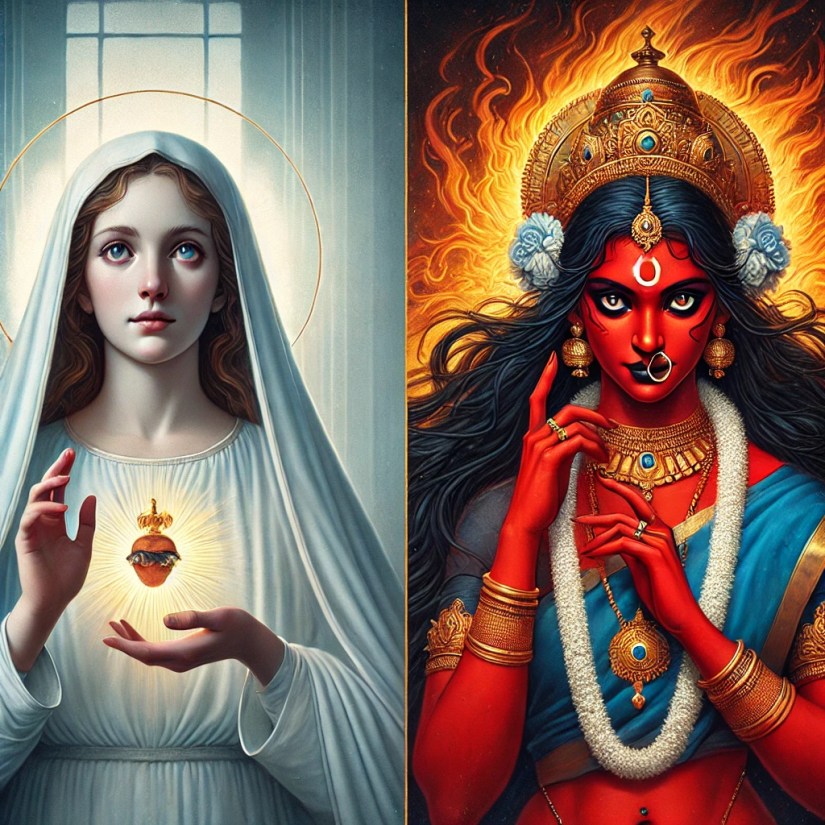
In a dusty corner of southern India, something strange is happening. Among the Catholic untouchables of Tamil Nadu the Virgin Mary reigns. These are the Dalit communities who converted to Christianity to escape caste oppression. Here the Virgin Mary is not just the mother of Christ or the Queen of Heaven. She’s the protector from demons, the healer of the possessed, and the exorcist of lustful spirits who prey on young women. [1]
Her name here is Arockyai Mary, “Our Lady of Good Health,” and unlike the goddesses of India’s native pantheon, she never harms. She doesn’t demand blood, or rage, or possess.
This makes her an anomaly in a world where possession is an everyday threat and where menstruation, pregnancy, and the liminal chaos of female sexuality are believed to attract wandering spirits, often the ghosts of those who died violently or before their time. These spirits, it is said, latch onto the vulnerable, especially women, and drive them into trances and convulsions.
And then there are the Hindu goddesses like Mariyamman [2] and Kaliamman [3], powerful but volatile. They heal, but they can also possess, punish, and destroy. Unlike the Virgin Mary, who is seen as unconditionally loving and healing, Mariyamman and Kaliamman’s protection must be earned through ritual and sacrifice. Their presence is often feared as much as it is venerated, revealing a form of feminine divinity that is transactional, fierce, and unpredictable.
The deeper thread that ties this to my own journey through Eastern mysticism and into Catholic truth is that the female deities of India are not so much saviors as they are owners. They ride their devotees like horses often through an overpowering kundalini experience. They enter bodies without informed consent. They demand submission, sacrifice, and pain. This is what possession looks like when the divine manifests as fierce femininity unmoored from moral restraint.
But the Virgin Mary is different in kind, not just degree. She doesn’t exploit vulnerability; she protects it. Her power is rooted in love, not domination. She doesn’t punish women for their sexuality; she guards them from the predators that do.
Many of us who were drawn into the tantric and yogic traditions found ourselves worshiping goddesses we didn’t truly understand such as Kali, Vajrayogini, and Durga. These powerful beings granted “blessings” that often came in the form of disorientation, illness, and spiritual invasion. What we called “awakening” was perhaps possession, wrapped in ritual and mystique.
In the story of the Paraiyar women, we see this clearly. Demonic possession is a warning as well. The culture teaches women that if they stray outside ritual boundaries, if they become too sexually visible, if they travel alone at dusk or cross the wrong river, they open the door to attack. And it’s the Virgin Mary, not Kali, who shows up to cast the darkness out.
Humanity does not need more divine rage, but the one Woman who is pure benevolence: the Mother of Jesus who through her perfection is feared by and can cast out spirits and demonic goddesses.
[1] Source article: Deliège, Robert. “La Possession démoniaque chez les Intouchables catholiques de l’Inde du sud / Demoniac Possession Among the Catholic Untouchables in Southern India.” Archives de sciences sociales des religions, no. 79, 1992, pp. 115–134. Available online.
[2] Mariyamman is a powerful village goddess widely worshipped in South India, especially in Tamil Nadu. Her name combines “mari,” meaning rain or disease, and “amman,” meaning mother—making her the Mother of Rain and Disease. She is especially associated with illnesses like smallpox, fevers, and skin diseases, but also with fertility, childbirth, and protection from evil spirits. Visually, she often appears fierce—sometimes with fiery red skin, holding a trident, and crowned with flames—bearing a resemblance to goddesses like Kali or Durga. Her shrines are typically modest, and her worship is deeply rooted in folk rituals. Devotees may offer animal sacrifices, participate in firewalking, or fall into trances believed to be divine possessions. In many cases, women are the ones possessed by Mariyamman, and these episodes are interpreted as both blessings and warnings—depending on whether the goddess has been properly appeased.
[3] Kaliammam is a fierce village manifestation of the goddess Kali, worshipped primarily in Tamil Nadu and other parts of South India. The name “Kaliamman” translates to “Mother Kali,” reflecting her role as a local protective mother goddess rooted in folk traditions. Like Kali, she is associated with destruction, power, and the eradication of evil, but in the village context, she is also invoked for healing, fertility, and protection from malevolent spirits. Kaliamman is often depicted with dark skin, a lolling tongue, wild hair, and multiple arms holding weapons—symbolizing her unrestrained spiritual power. Her worship includes rituals that are intense and sometimes violent: offerings of blood, possession trances, firewalking, and dramatic acts of devotion are common. She is believed to possess her devotees—often women—either to bless them, deliver a warning, or punish neglect. She must be honored and feared. Her presence reinforces moral and ritual boundaries in the community, demanding reverence through sacrifice and submission rather than drawing near in mercy or compassion.
 Tantric Deception